Early Grade Reading Mathematics Research in SA - Nic Spaull QER Conference 2022 31 Aug 2022 3 new edited volumes Published Open Access by OUP in December 2022 41 Chapters 77 Authors What do we know about learning outcomes in South
"Early Grade Reading & Mathematics Research in SA -" is the property of its rightful owner. Permission is granted to
download and print the materials on this website for personal, non-commercial use only, and to display it
on your personal computer provided you do not modify the materials and that you retain all copyright
notices contained in the materials. By downloading content from our website, you accept the terms of this
agreement.
Share
Embed code
Presentation Transcript
01
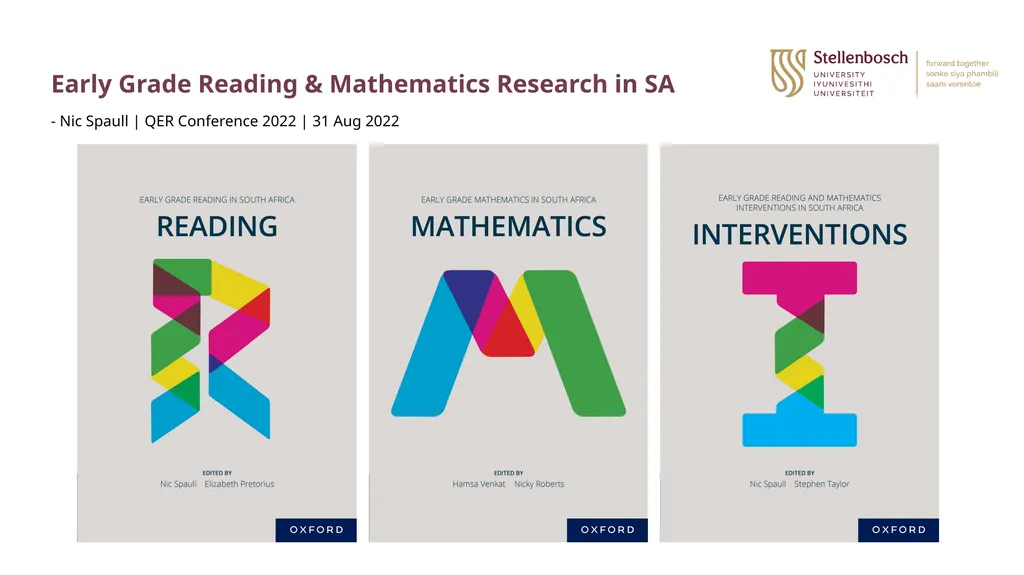
Early Grade Reading & Mathematics Research in SA
- Nic Spaull | QER Conference 2022 | 31 Aug 2022<br>
02
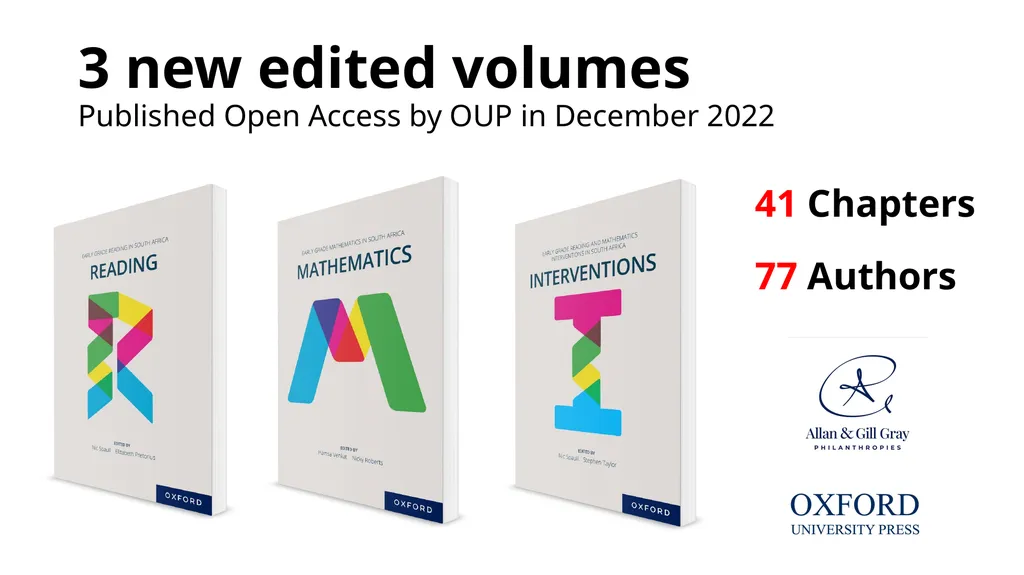
3 new edited volumes Published Open Access by OUP in December 2022 41 Chapters
77 Authors<br>
03
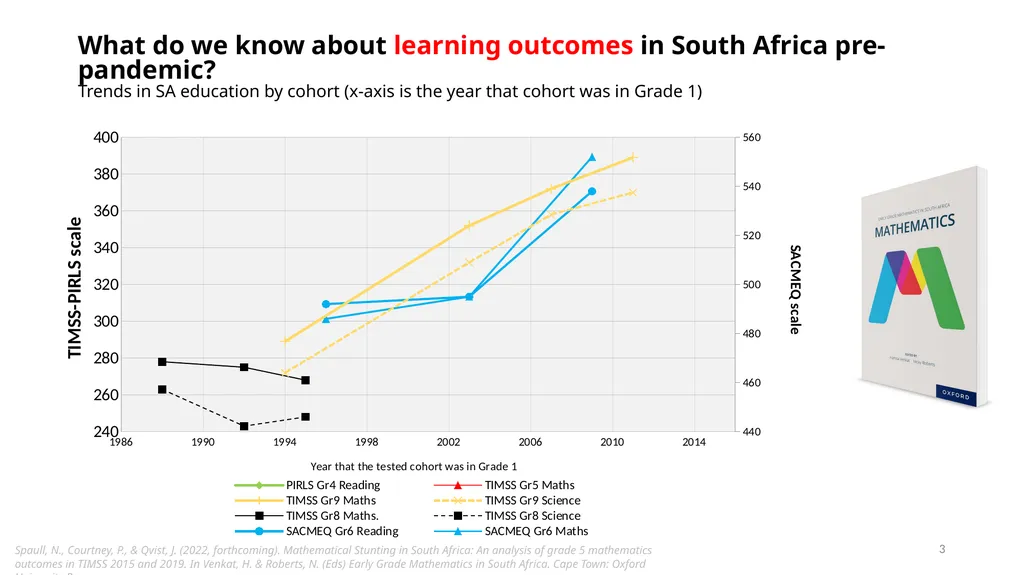
What do we know about learning outcomes in South Africa pre-pandemic? Trends in SA education by cohort (x-axis is the year that cohort was in Grade 1) 3 Spaull, N., Courtney, P., & Qvist, J. (2022, forthcoming). Mathematical Stunting in South Africa: An analysis of grade 5 mathematics outcomes in TIMSS 2015 and 2019. In Venkat, H. & Roberts, N. (Eds) Early Grade Mathematics in South Africa. Cape Town: Oxford University Press.<br>
04
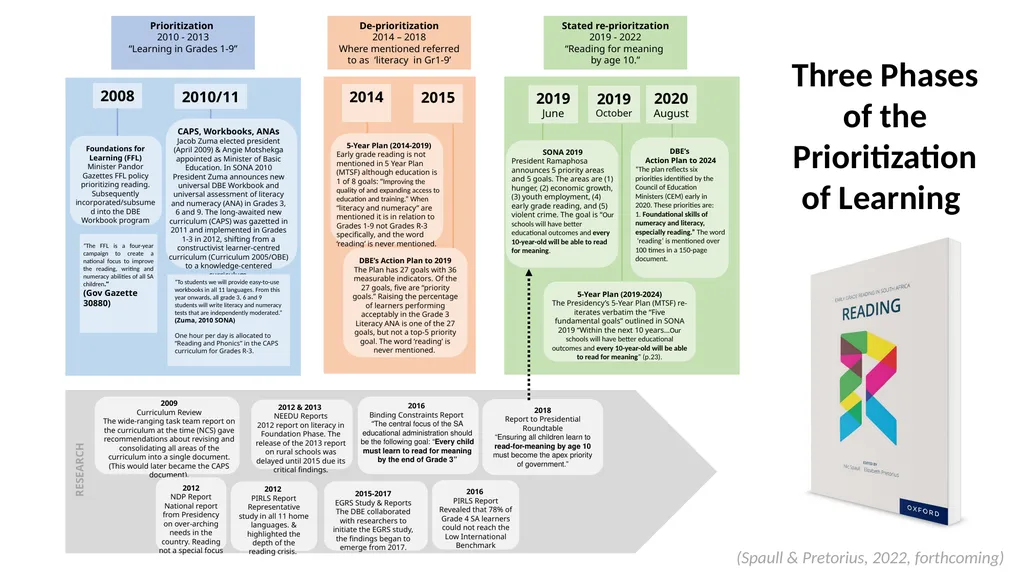
2008 2010/11 2014 2015 2019
June 2019
October 2020
August Prioritization
2010 - 2013
“Learning in Grades 1-9” De-prioritization
2014 – 2018
Where mentioned referred to as ‘literacy in Gr1-9’ Stated re-prioritzation
2019 - 2022
“Reading for meaning
by age 10.” RESEARCH 2009
Curriculum Review
The wide-ranging task team report on the curriculum at the time (NCS) gave recommendations about revising and consolidating all areas of the curriculum into a single document. (This would later became the CAPS document). Three Phases of the Prioritization of Learning (Spaull & Pretorius, 2022, forthcoming)<br>
05
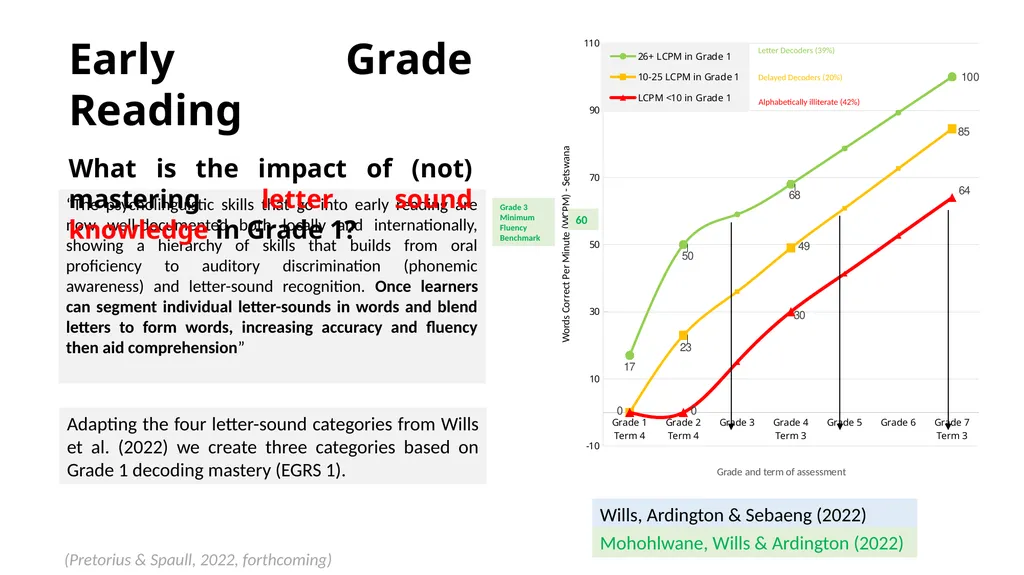
Alphabetically illiterate (42%) Delayed Decoders (20%) Letter Decoders (39%) Wills, Ardington & Sebaeng (2022) 60 Mohohlwane, Wills & Ardington (2022) “The psycholinguistic skills that go into early reading are now well-documented both locally and internationally, showing a hierarchy of skills that builds from oral proficiency to auditory discrimination (phonemic awareness) and letter-sound recognition. Once learners can segment individual letter-sounds in words and blend letters to form words, increasing accuracy and fluency then aid comprehension” Early Grade Reading
What is the impact of (not) mastering letter sound knowledge in Grade 1? Adapting the four letter-sound categories from Wills et al. (2022) we create three categories based on Grade 1 decoding mastery (EGRS 1). Grade 3 Minimum Fluency Benchmark (Pretorius & Spaull, 2022, forthcoming)<br>
06
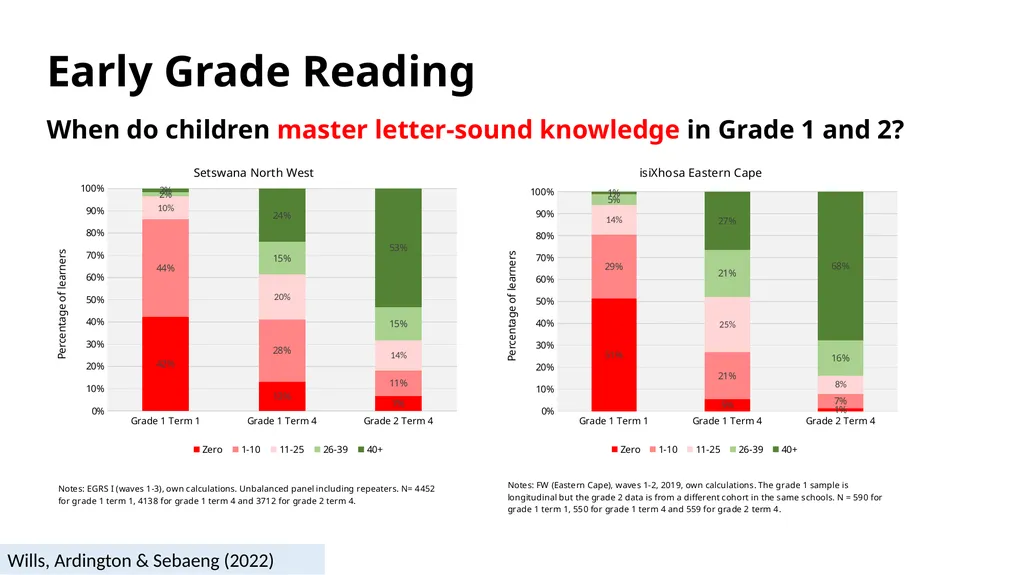
Early Grade Reading
When do children master letter-sound knowledge in Grade 1 and 2? Wills, Ardington & Sebaeng (2022)<br>
07
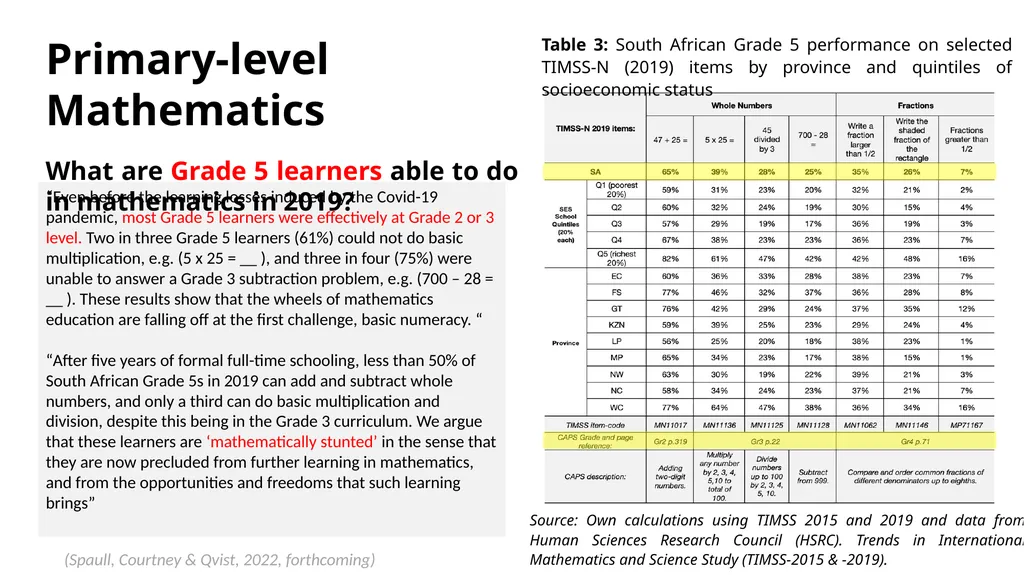
“Even before the learning losses induced by the Covid-19 pandemic, most Grade 5 learners were effectively at Grade 2 or 3 level. Two in three Grade 5 learners (61%) could not do basic multiplication, e.g. (5 x 25 = __ ), and three in four (75%) were unable to answer a Grade 3 subtraction problem, e.g. (700 – 28 = __ ). These results show that the wheels of mathematics education are falling off at the first challenge, basic numeracy. “
“After five years of formal full-time schooling, less than 50% of South African Grade 5s in 2019 can add and subtract whole numbers, and only a third can do basic multiplication and division, despite this being in the Grade 3 curriculum. We argue that these learners are ‘mathematically stunted’ in the sense that they are now precluded from further learning in mathematics, and from the opportunities and freedoms that such learning brings” Primary-level Mathematics
What are Grade 5 learners able to do in mathematics in 2019? Table 3: South African Grade 5 performance on selected TIMSS-N (2019) items by province and quintiles of socioeconomic status Source: Own calculations using TIMSS 2015 and 2019 and data from Human Sciences Research Council (HSRC). Trends in International Mathematics and Science Study (TIMSS-2015 & -2019). (Spaull, Courtney & Qvist, 2022, forthcoming)<br>
08
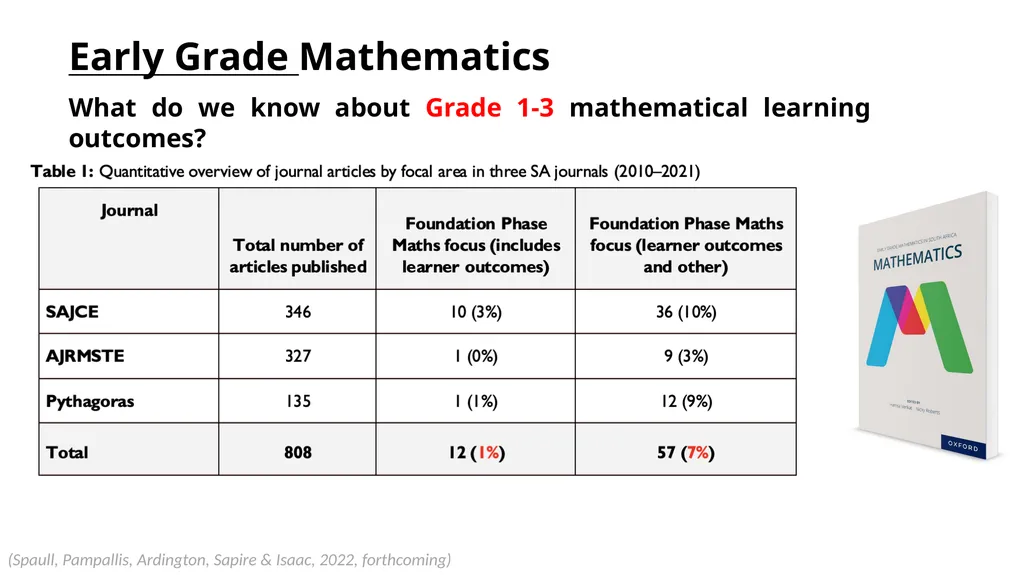
Early Grade Mathematics
What do we know about Grade 1-3 mathematical learning outcomes? (Spaull, Pampallis, Ardington, Sapire & Isaac, 2022, forthcoming)<br>
09
Early Grade Mathematics
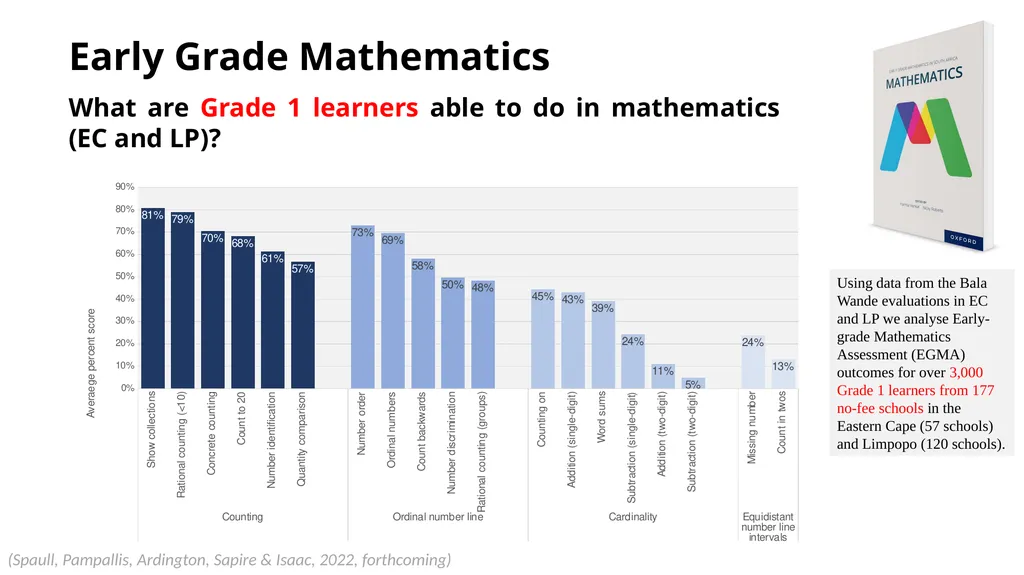
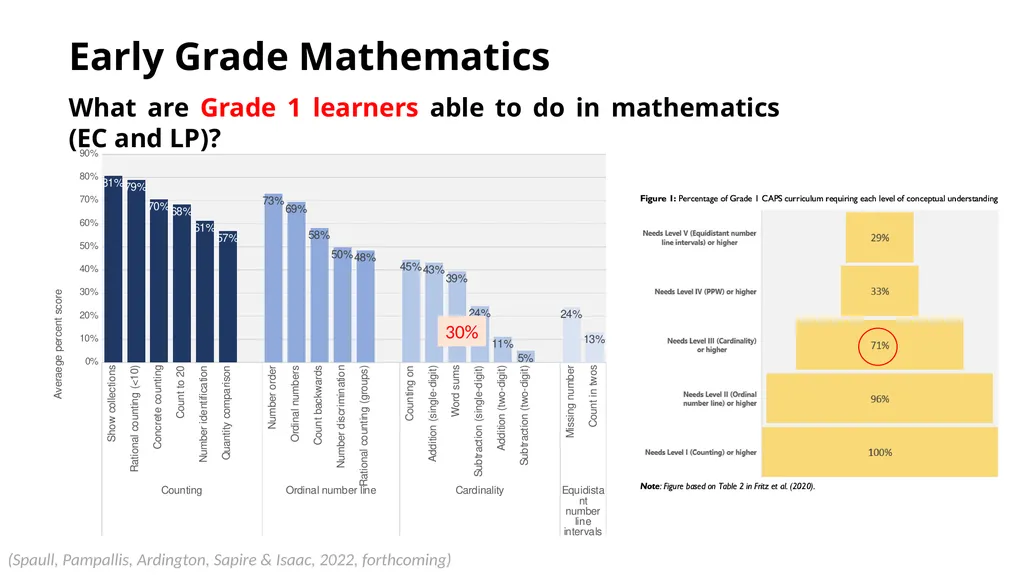
What are Grade 1 learners able to do in mathematics (EC and LP)? (Spaull, Pampallis, Ardington, Sapire & Isaac, 2022, forthcoming) Using data from the Bala Wande evaluations in EC and LP we analyse Early-grade Mathematics Assessment (EGMA) outcomes for over 3,000 Grade 1 learners from 177 no-fee schools in the Eastern Cape (57 schools) and Limpopo (120 schools).<br>
10
Early Grade Mathematics
What are Grade 1 learners able to do in mathematics (EC and LP)? (Spaull, Pampallis, Ardington, Sapire & Isaac, 2022, forthcoming) 30%<br>
11
Early Grade Mathematics
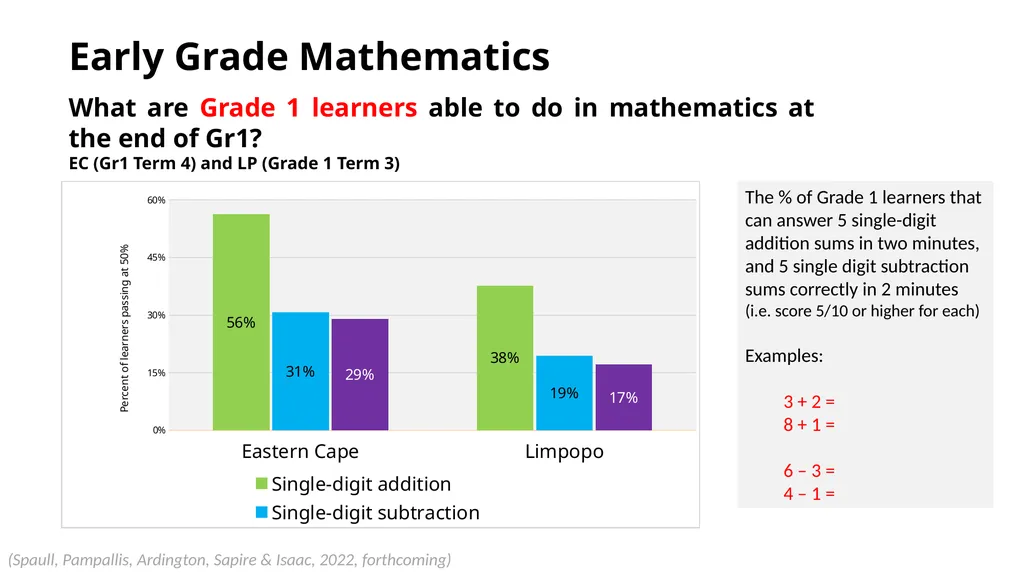
What are Grade 1 learners able to do in mathematics at the end of Gr1?
EC (Gr1 Term 4) and LP (Grade 1 Term 3) (Spaull, Pampallis, Ardington, Sapire & Isaac, 2022, forthcoming) The % of Grade 1 learners that can answer 5 single-digit addition sums in two minutes, and 5 single digit subtraction sums correctly in 2 minutes
(i.e. score 5/10 or higher for each)
Examples:
3 + 2 =
8 + 1 =
6 – 3 =
4 – 1 =<br>
12
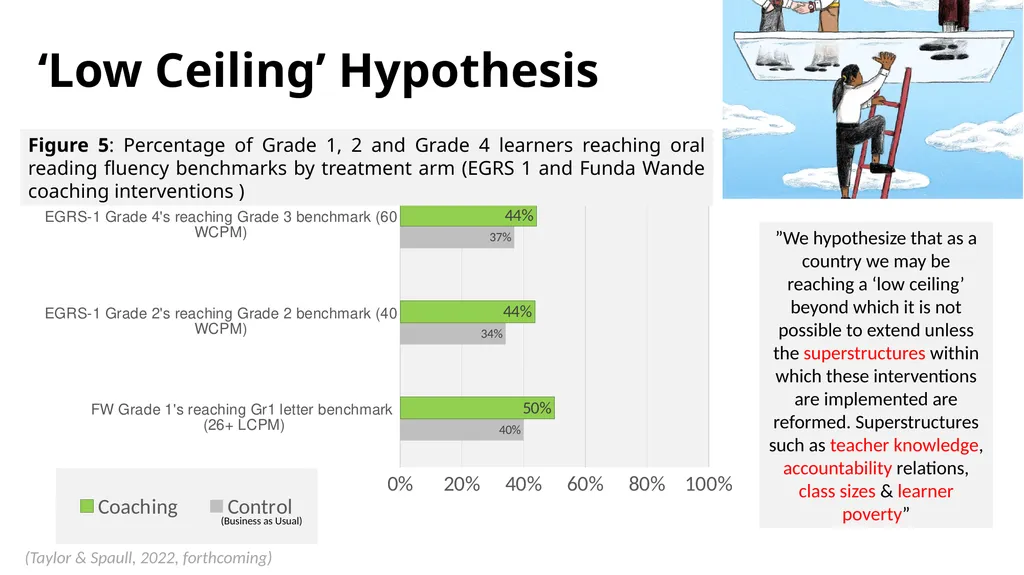
‘Low Ceiling’ Hypothesis (Business as Usual) Figure 5: Percentage of Grade 1, 2 and Grade 4 learners reaching oral reading fluency benchmarks by treatment arm (EGRS 1 and Funda Wande coaching interventions ) (Taylor & Spaull, 2022, forthcoming) ”We hypothesize that as a country we may be reaching a ‘low ceiling’ beyond which it is not possible to extend unless the superstructures within which these interventions are implemented are reformed. Superstructures such as teacher knowledge, accountability relations, class sizes & learner poverty”<br>
13
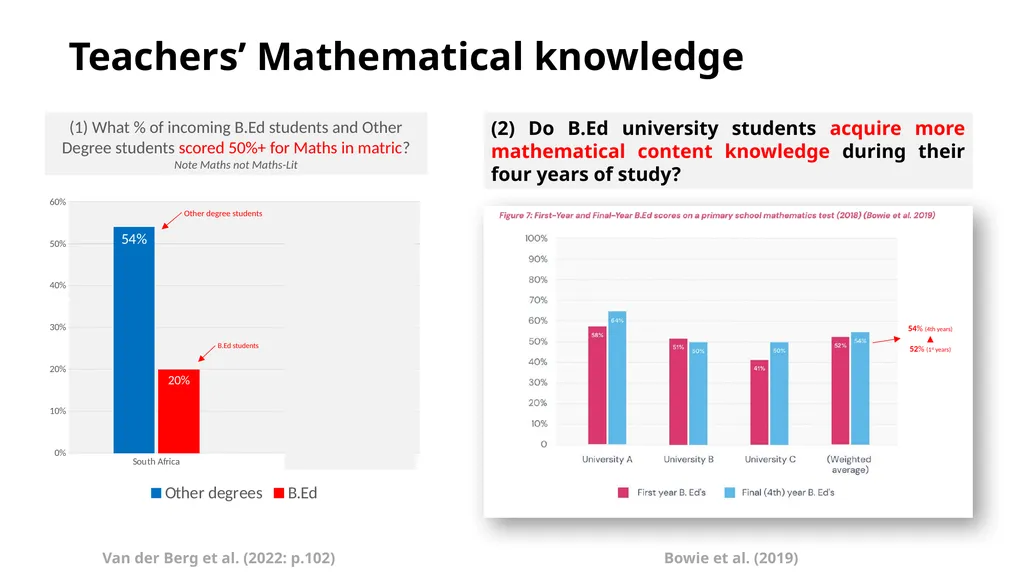
Teachers’ Mathematical knowledge (1) What % of incoming B.Ed students and Other Degree students scored 50%+ for Maths in matric?
Note Maths not Maths-Lit (2) Do B.Ed university students acquire more mathematical content knowledge during their four years of study? Van der Berg et al. (2022: p.102) Other degree students B.Ed students Bowie et al. (2019) 54% (4th years)
▲
52% (1st years)<br>
14
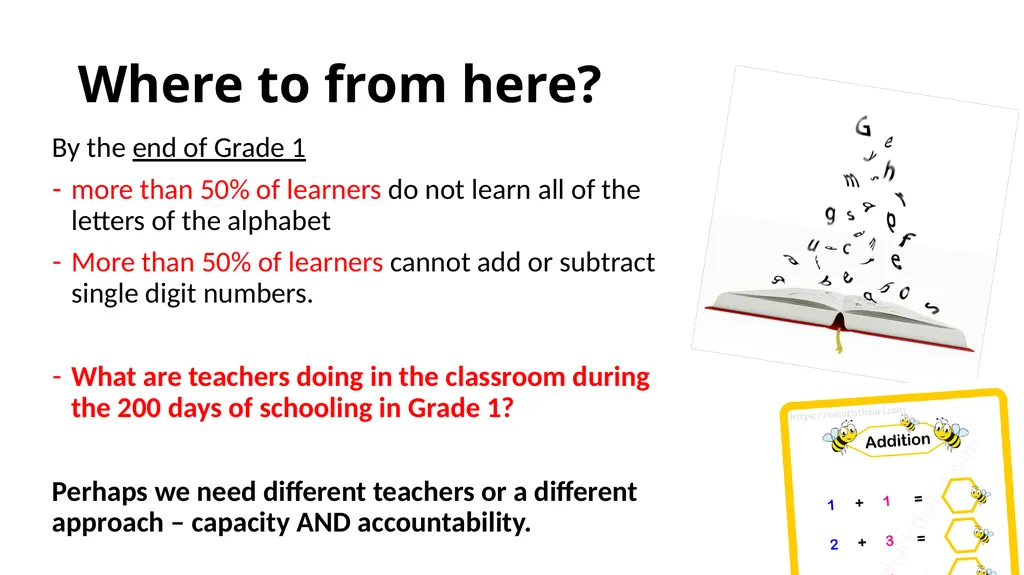
Where to from here? By the end of Grade 1
more than 50% of learners do not learn all of the letters of the alphabet
More than 50% of learners cannot add or subtract single digit numbers.
What are teachers doing in the classroom during the 200 days of schooling in Grade 1?
Perhaps we need different teachers or a different approach – capacity AND accountability.<br>
15
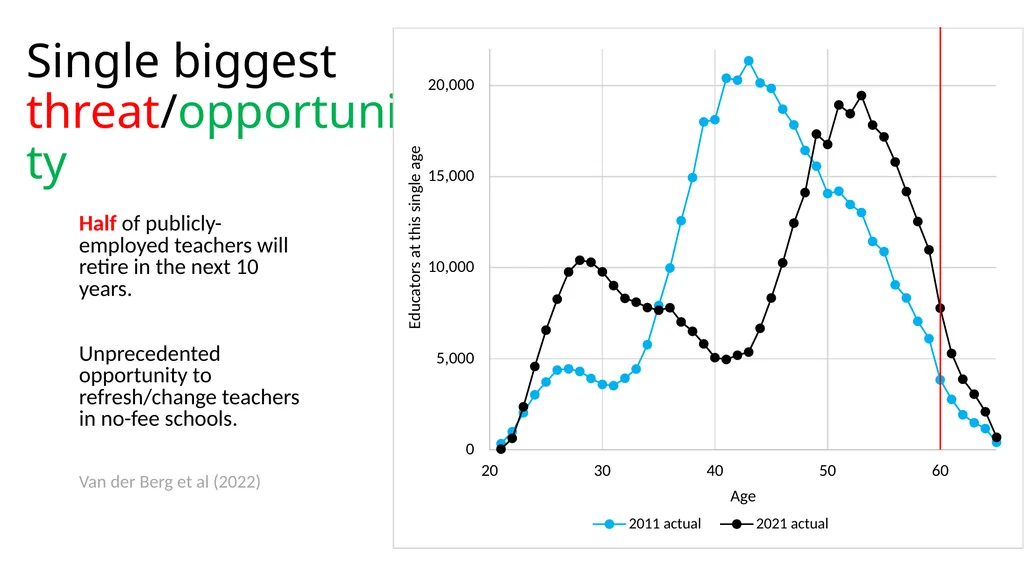
Single biggest threat/opportunity Half of publicly-employed teachers will retire in the next 10 years.
Unprecedented opportunity to refresh/change teachers in no-fee schools.
Van der Berg et al (2022)<br>
16
Thank you.<br>
17
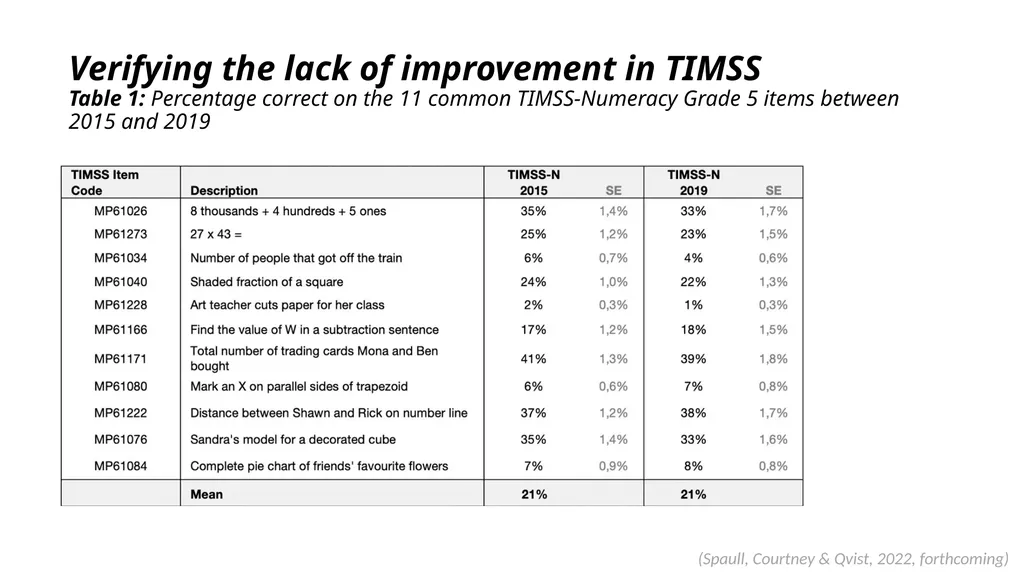
Verifying the lack of improvement in TIMSS Table 1: Percentage correct on the 11 common TIMSS-Numeracy Grade 5 items between 2015 and 2019 (Spaull, Courtney & Qvist, 2022, forthcoming)<br>
18
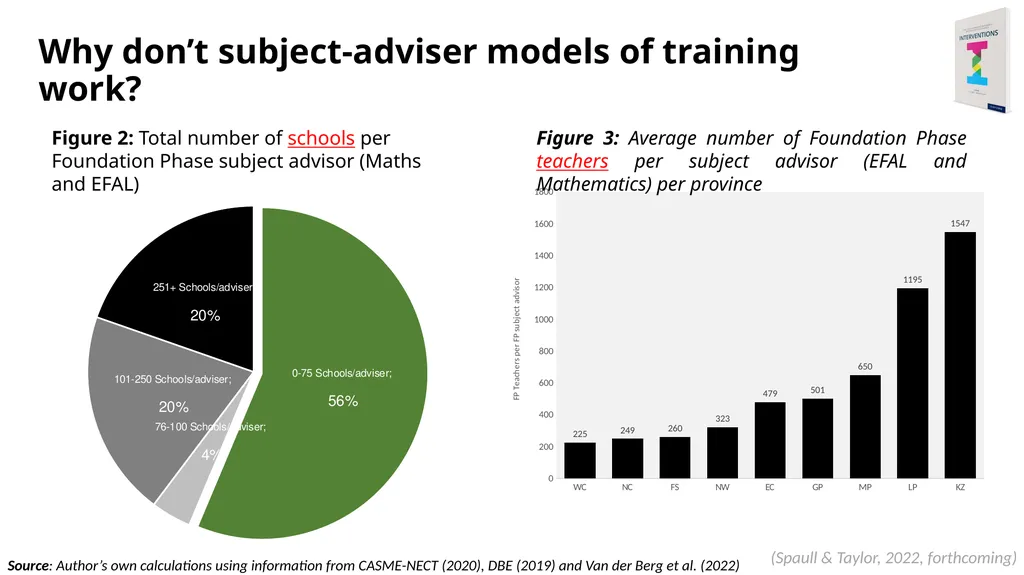
Why don’t subject-adviser models of training work? Source: Author’s own calculations using information from CASME-NECT (2020), DBE (2019) and Van der Berg et al. (2022) Figure 3: Average number of Foundation Phase teachers per subject advisor (EFAL and Mathematics) per province Figure 2: Total number of schools per Foundation Phase subject advisor (Maths and EFAL) (Spaull & Taylor, 2022, forthcoming)<br>