
Early Learning Model Overview August 2016 The





Description: Early Learning Model Overview August 2016 The Early Learning Model Tennessee Succeeds The state of pre-K in Tennessee Pre-KK student growth portfolio model Kindergarten Entry Inventory Early Learning Model in 2016-17 Agenda By the end of
Related Topics
Download Presentation
"Early Learning Model Overview August 2016 The" is the property of its rightful owner. Permission is granted to download and print the materials on this website for personal, non-commercial use only, and to display it on your personal computer provided you do not modify the materials and that you retain all copyright notices contained in the materials. By downloading content from our website, you accept the terms of this agreement.
Presentation Transcript
slide1. Early Learning Model Overview August 2016<br>
slide2. The Early Learning Model
Tennessee Succeeds
The state of pre-K in Tennessee
Pre-K/K student growth portfolio model
Kindergarten Entry Inventory
Early Learning Model in 2016-17 Agenda<br>
slide3. By the end of today’s meeting participants will be equipped to:
describe the connections between other state initiatives and the Early Learning Model
share talking points in home districts about the critical parts of the Early Learning Model
name what Early Learning Model success looks like for district leaders, school leaders, teachers, and students Outcome<br>
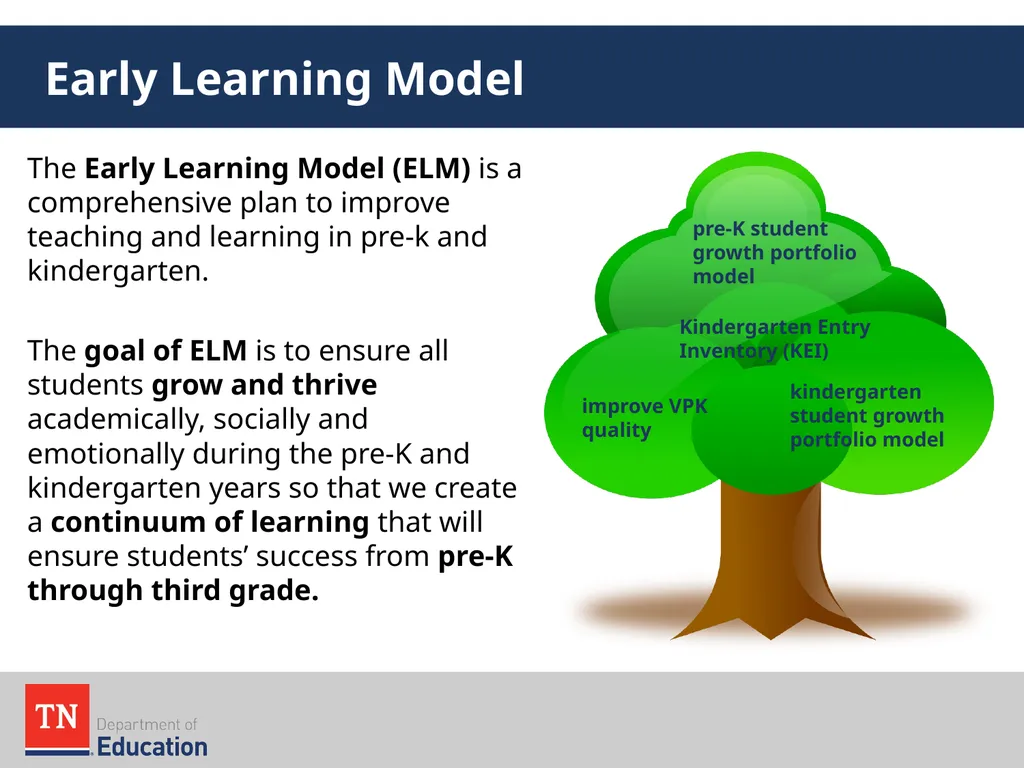
slide4. The Early Learning Model (ELM) is a comprehensive plan to improve teaching and learning in pre-k and kindergarten.
The goal of ELM is to ensure all students grow and thrive academically, socially and emotionally during the pre-K and kindergarten years so that we create a continuum of learning that will ensure students’ success from pre-K through third grade. Early Learning Model pre-K student growth portfolio model improve VPK quality kindergarten student growth portfolio model Kindergarten Entry Inventory (KEI)<br>
slide5. [Video 1] Early Learning Model<br>
slide6. Tennessee Succeeds<br>
slide7. Districts and schools in Tennessee will exemplify excellence and equity such that all students are equipped with the knowledge and skills to successfully embark upon their chosen path in life. Vision<br>
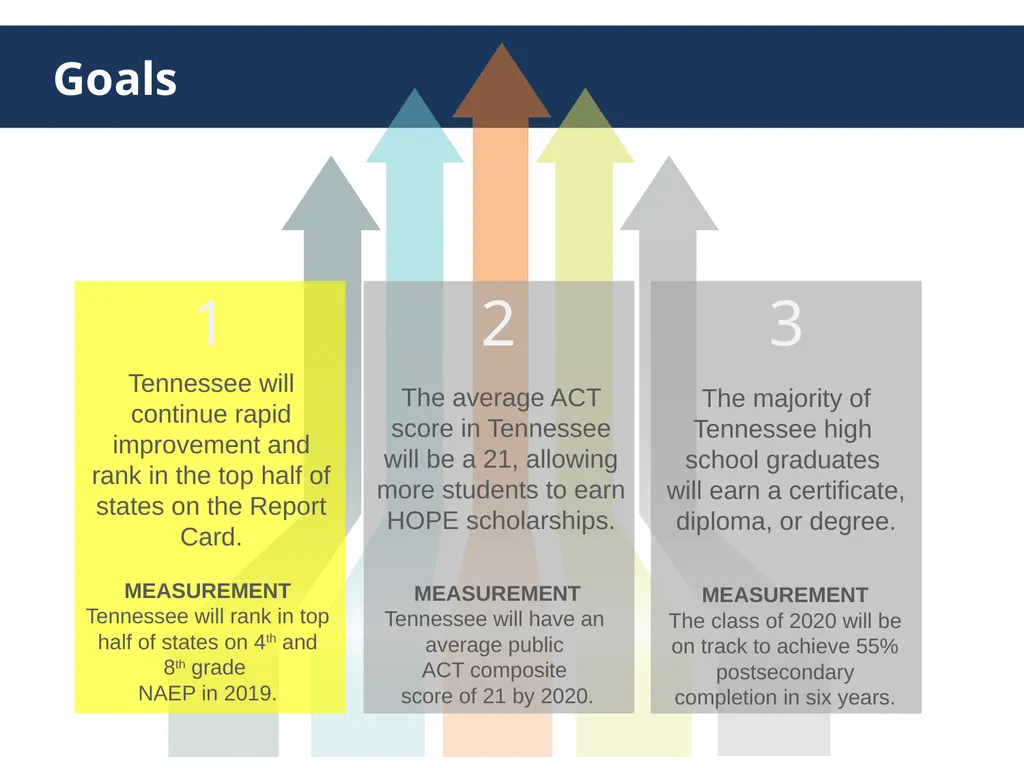
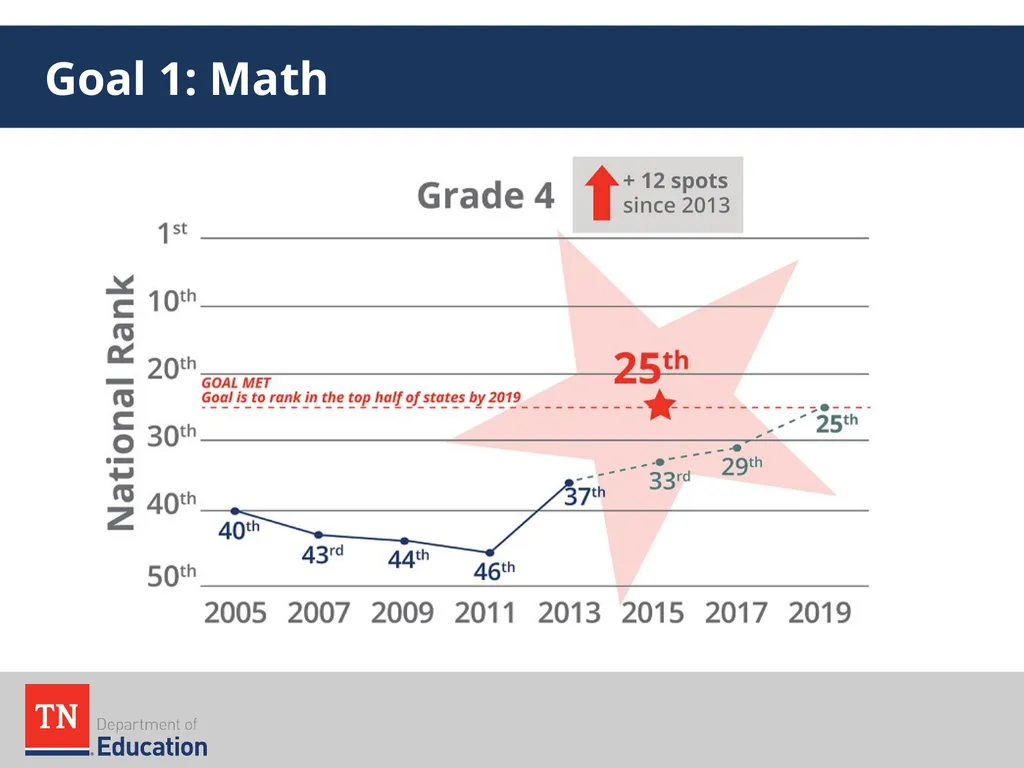
slide8. Tennessee will continue rapid improvement and rank in the top half of states on the Report Card. MEASUREMENT
Tennessee will rank in top half of states on 4th and 8th grade
NAEP in 2019. 1 2 3 The average ACT score in Tennessee will be a 21, allowing more students to earn HOPE scholarships. MEASUREMENT
The class of 2020 will be on track to achieve 55% postsecondary completion in six years. The majority of Tennessee high
school graduates will earn a certificate, diploma, or degree. MEASUREMENT
Tennessee will have an
average public ACT composite
score of 21 by 2020. Goals<br>
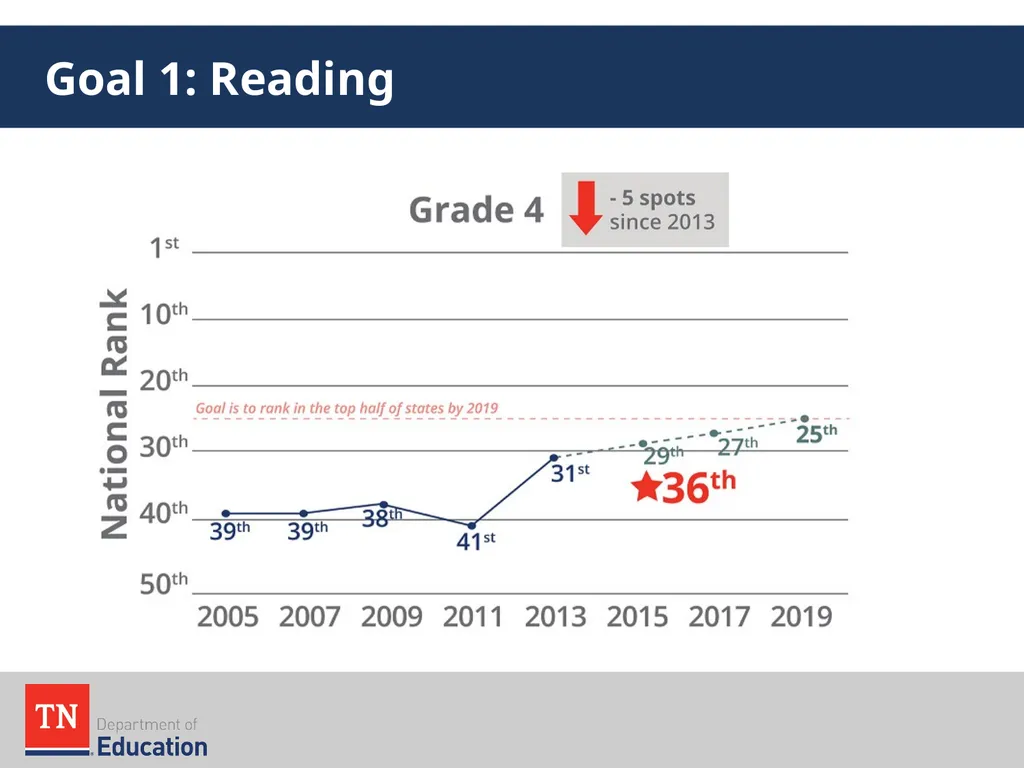
slide9. Goal 1: Reading<br>
slide10. Goal 1: Math<br>
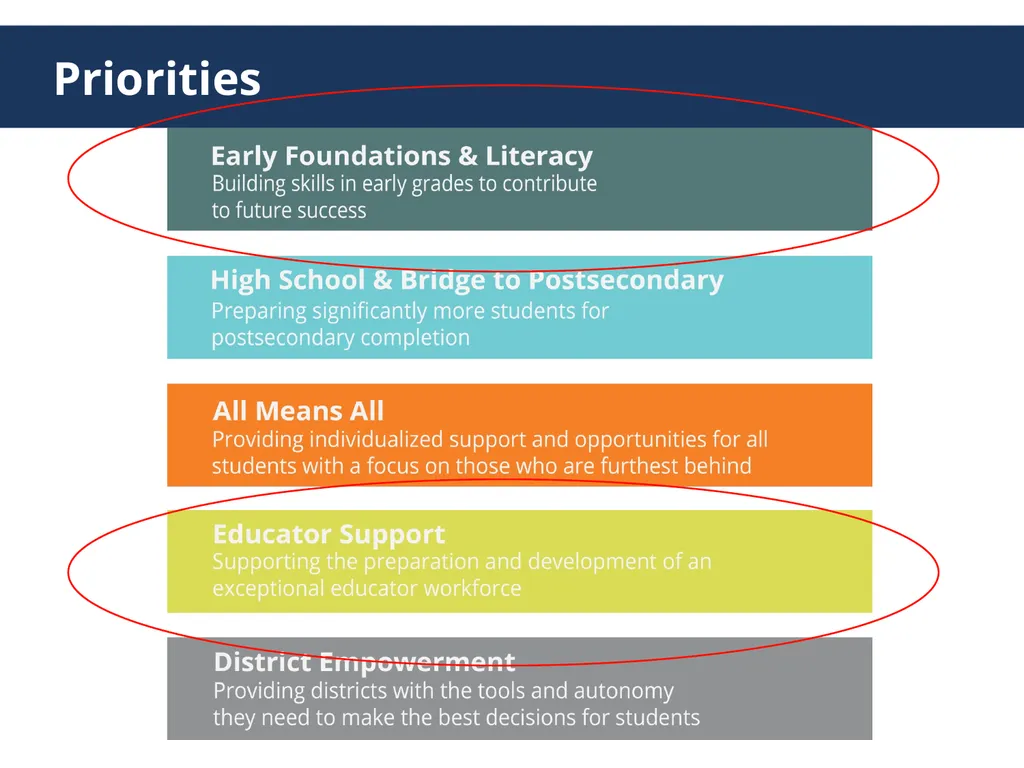
slide11. Priorities<br>
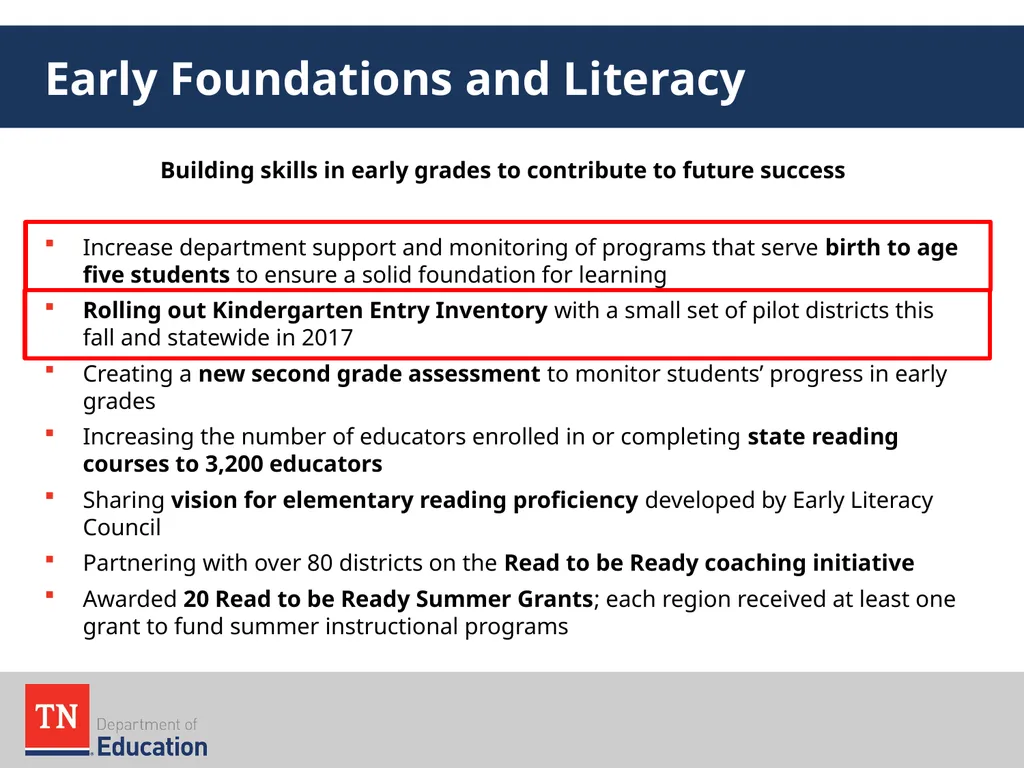
slide12. Building skills in early grades to contribute to future success
Increase department support and monitoring of programs that serve birth to age five students to ensure a solid foundation for learning
Rolling out Kindergarten Entry Inventory with a small set of pilot districts this fall and statewide in 2017
Creating a new second grade assessment to monitor students’ progress in early grades
Increasing the number of educators enrolled in or completing state reading courses to 3,200 educators
Sharing vision for elementary reading proficiency developed by Early Literacy Council
Partnering with over 80 districts on the Read to be Ready coaching initiative
Awarded 20 Read to be Ready Summer Grants; each region received at least one grant to fund summer instructional programs Early Foundations and Literacy<br>
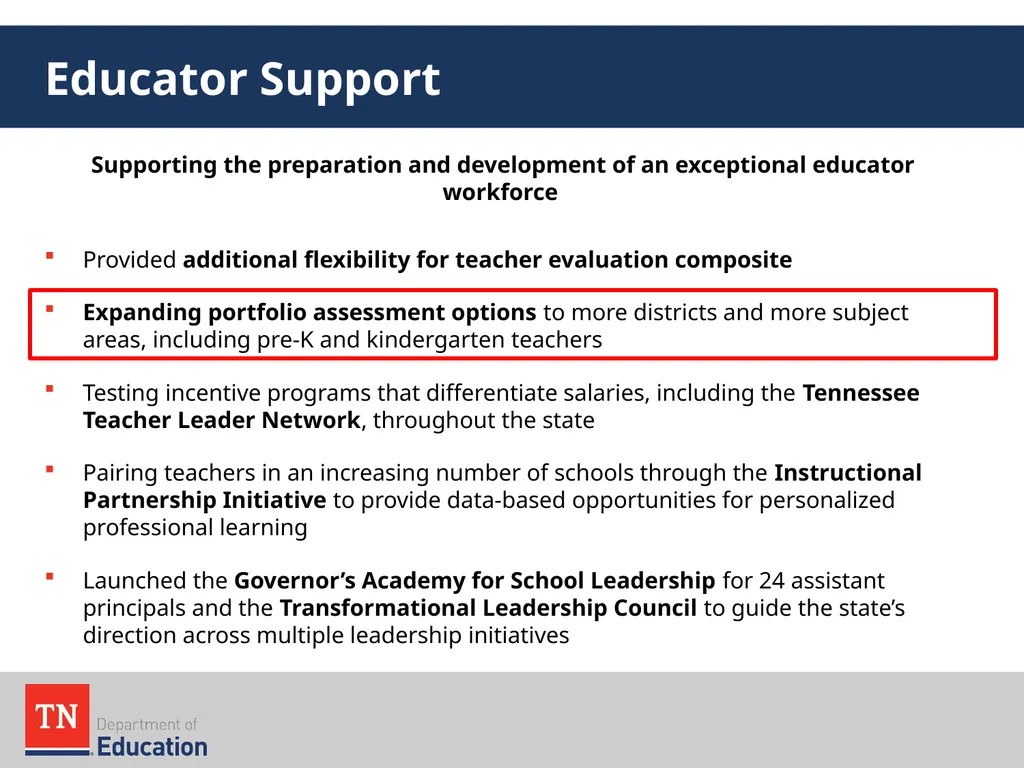
slide13. Supporting the preparation and development of an exceptional educator workforce
Provided additional flexibility for teacher evaluation composite
Expanding portfolio assessment options to more districts and more subject areas, including pre-K and kindergarten teachers
Testing incentive programs that differentiate salaries, including the Tennessee Teacher Leader Network, throughout the state
Pairing teachers in an increasing number of schools through the Instructional Partnership Initiative to provide data-based opportunities for personalized professional learning
Launched the Governor’s Academy for School Leadership for 24 assistant principals and the Transformational Leadership Council to guide the state’s direction across multiple leadership initiatives Educator Support<br>
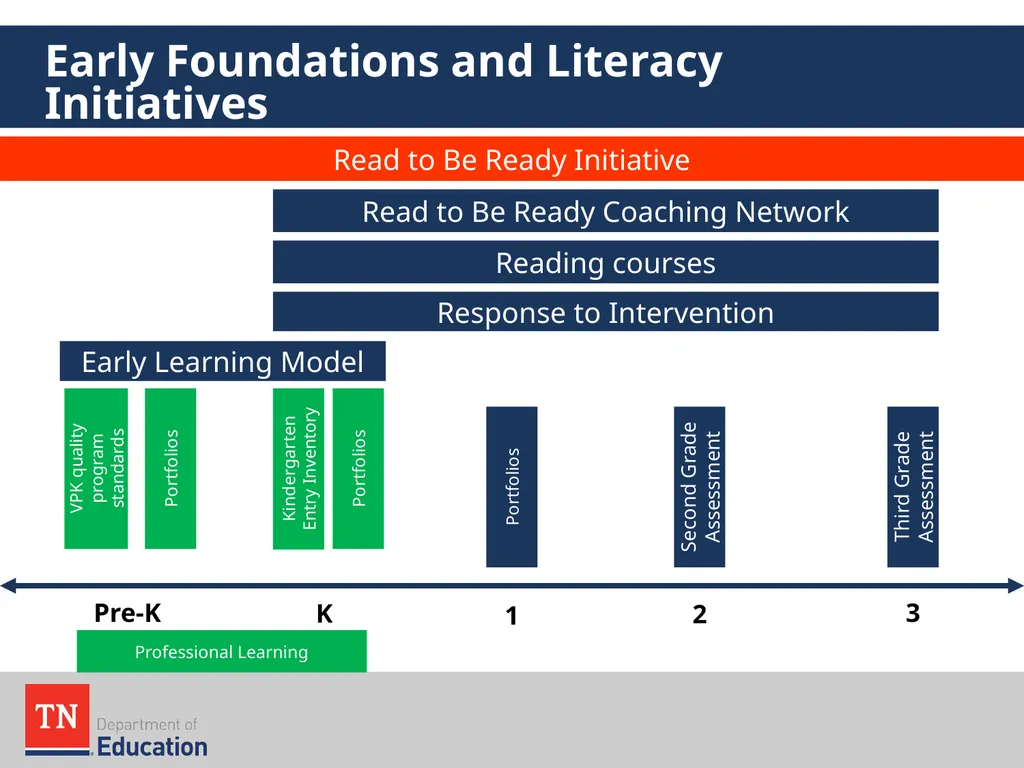
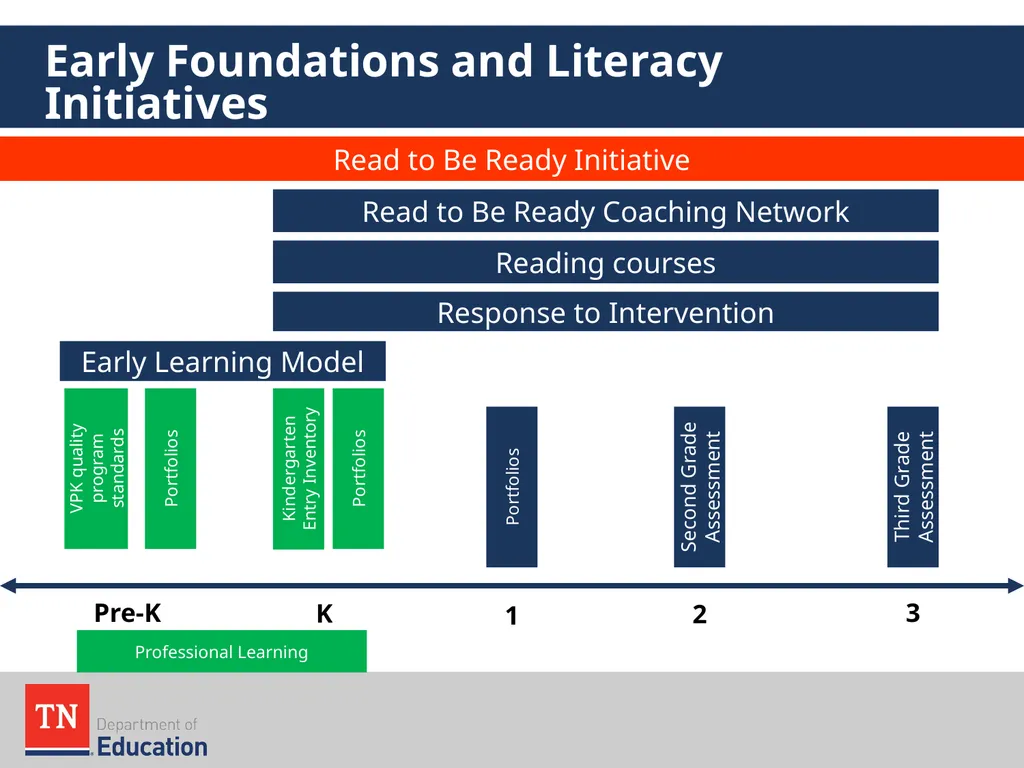
slide14. Early Foundations and Literacy Initiatives K 1 2 3 Response to Intervention Read to Be Ready Initiative Kindergarten Entry Inventory Portfolios Read to Be Ready Coaching Network Second Grade Assessment Third Grade Assessment Pre-K Portfolios VPK quality program standards Portfolios Reading courses Professional Learning Early Learning Model<br>
slide15. The State of Pre-K in Tennessee<br>
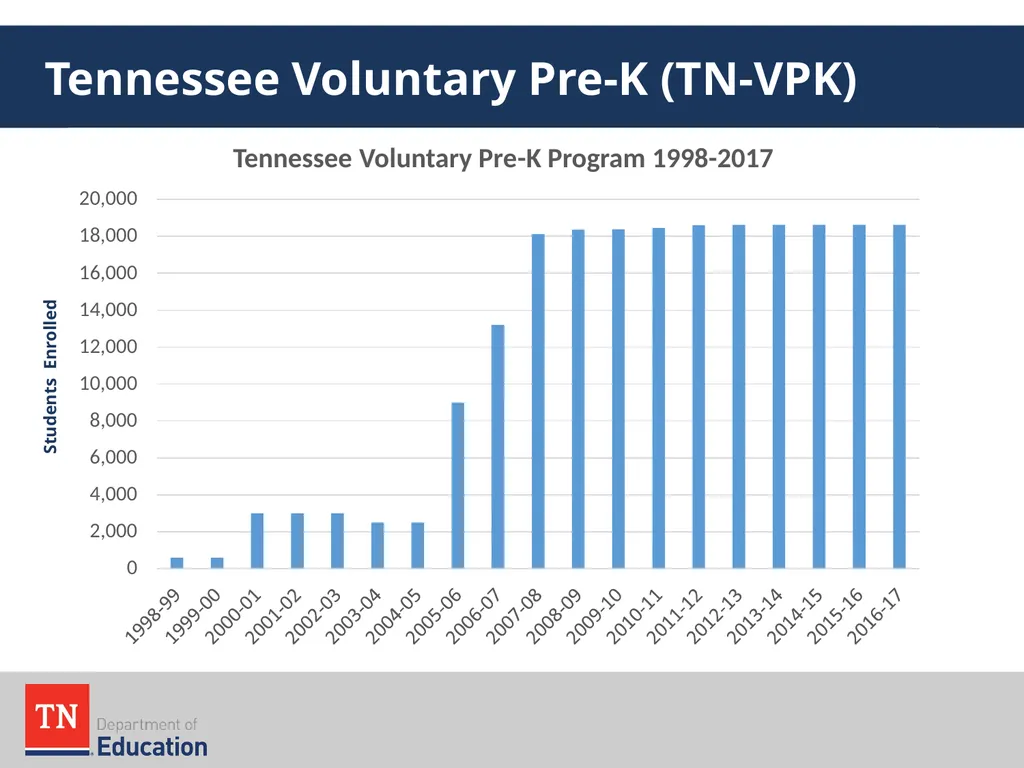
slide16. Tennessee Voluntary Pre-K (TN-VPK) Students Enrolled<br>
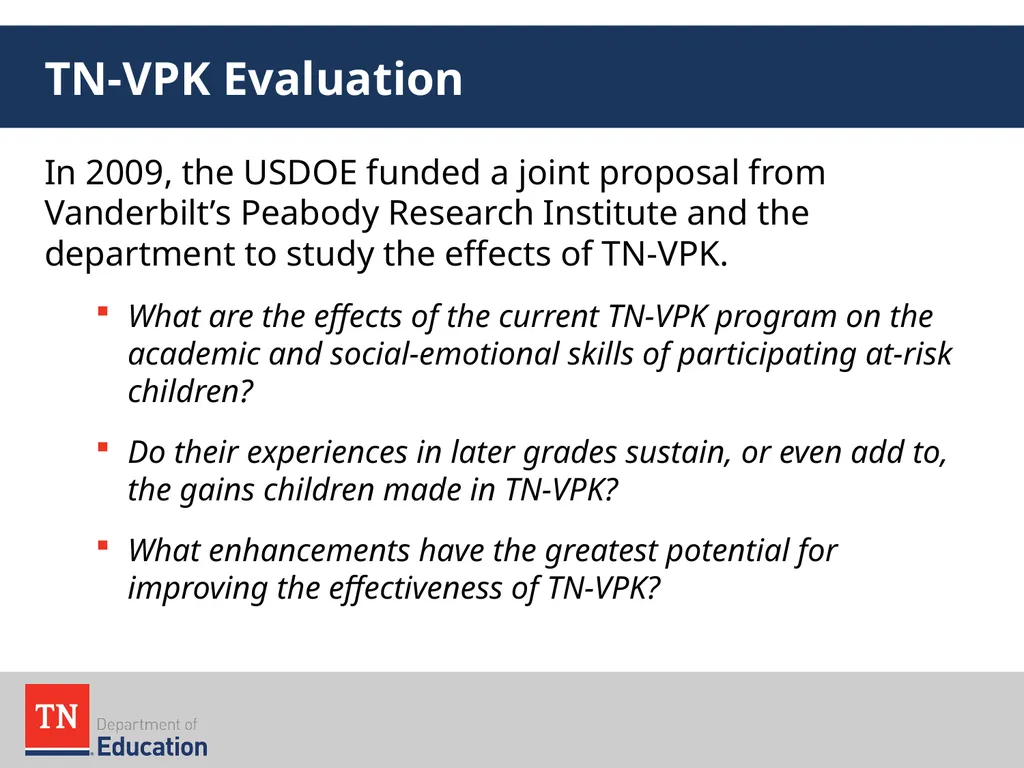
slide17. In 2009, the USDOE funded a joint proposal from Vanderbilt’s Peabody Research Institute and the department to study the effects of TN-VPK.
What are the effects of the current TN-VPK program on the academic and social-emotional skills of participating at-risk children?
Do their experiences in later grades sustain, or even add to, the gains children made in TN-VPK?
What enhancements have the greatest potential for improving the effectiveness of TN-VPK? TN-VPK Evaluation<br>
slide18. TN-VPK Evaluation Results<br>
slide19. TN-VPK Evaluation Results<br>
slide20. TN-VPK Evaluation Results<br>
slide21. TN-VPK Evaluation Results<br>
slide22. TN-VPK Evaluation Results<br>
slide23. TN-VPK Evaluation Results<br>
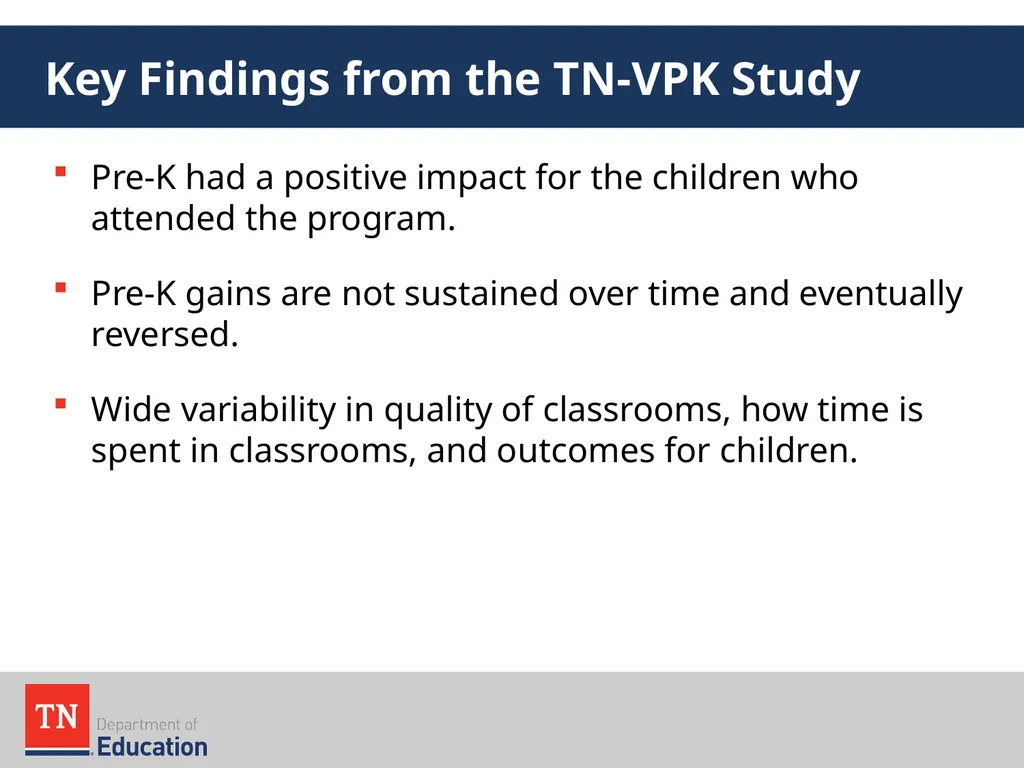
slide24. Pre-K had a positive impact for the children who attended the program.
Pre-K gains are not sustained over time and eventually reversed.
Wide variability in quality of classrooms, how time is spent in classrooms, and outcomes for children. Key Findings from the TN-VPK Study<br>
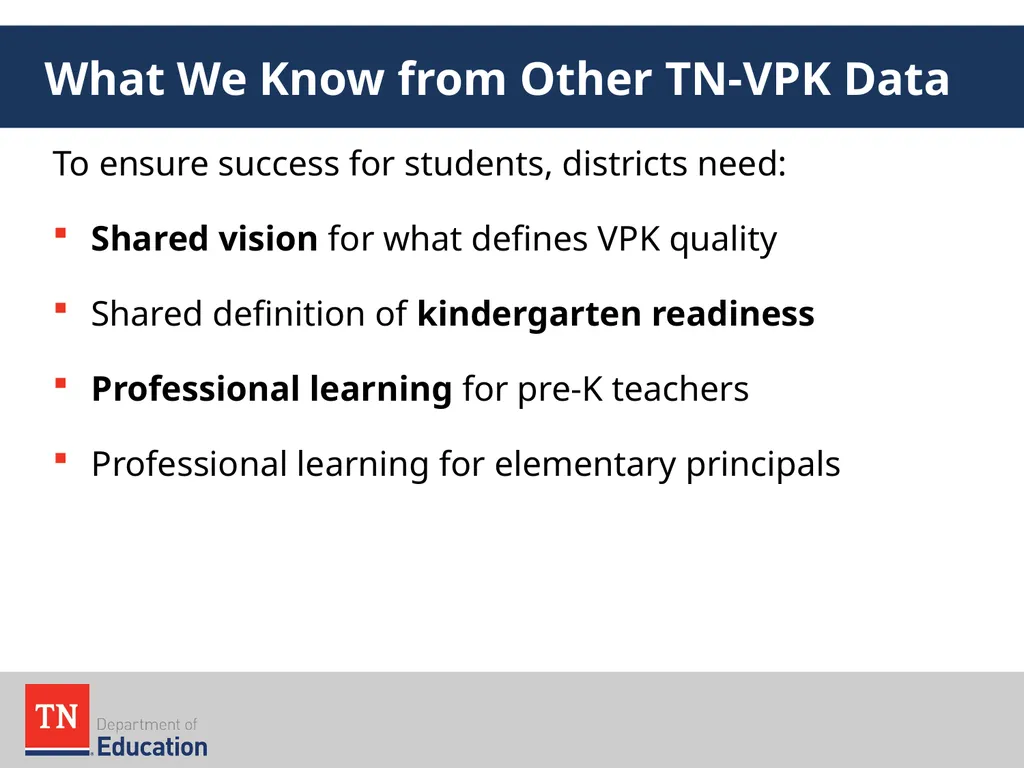
slide25. To ensure success for students, districts need:
Shared vision for what defines VPK quality
Shared definition of kindergarten readiness
Professional learning for pre-K teachers
Professional learning for elementary principals What We Know from Other TN-VPK Data<br>
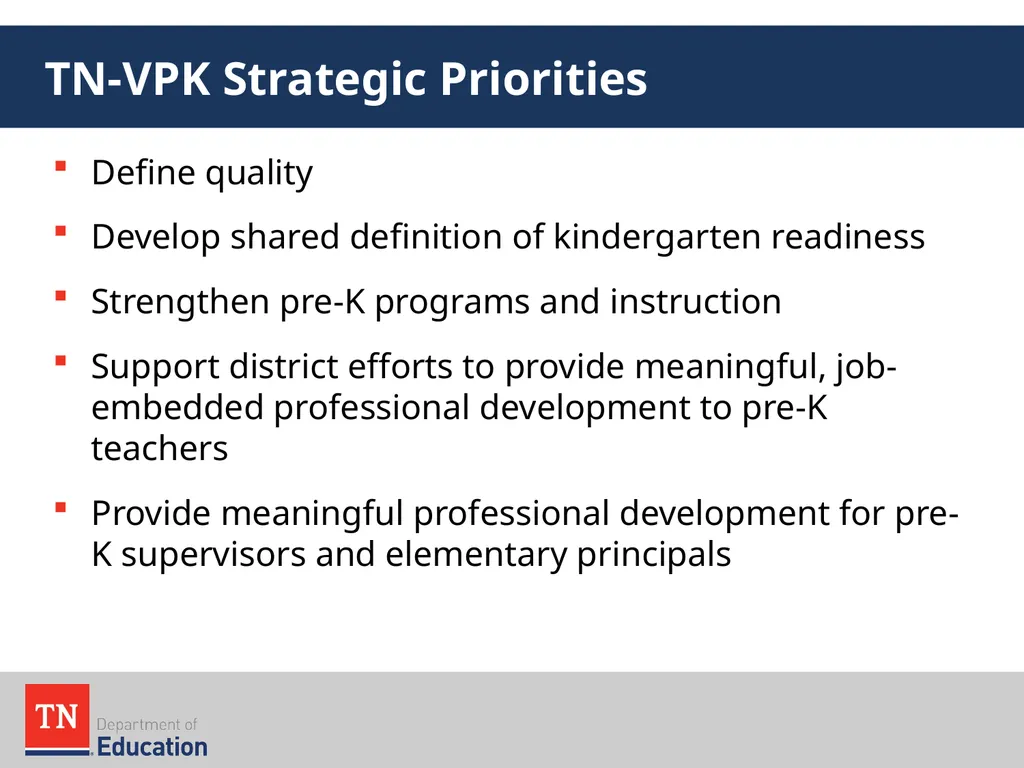
slide26. Define quality
Develop shared definition of kindergarten readiness
Strengthen pre-K programs and instruction
Support district efforts to provide meaningful, job-embedded professional development to pre-K teachers
Provide meaningful professional development for pre-K supervisors and elementary principals TN-VPK Strategic Priorities<br>
slide27. With your shoulder partner, discuss what the Early Learning Model is and why it is important.
If questions develop, jot them on the post-it notes found on your tables and we will revisit the questions later. Reflection<br>
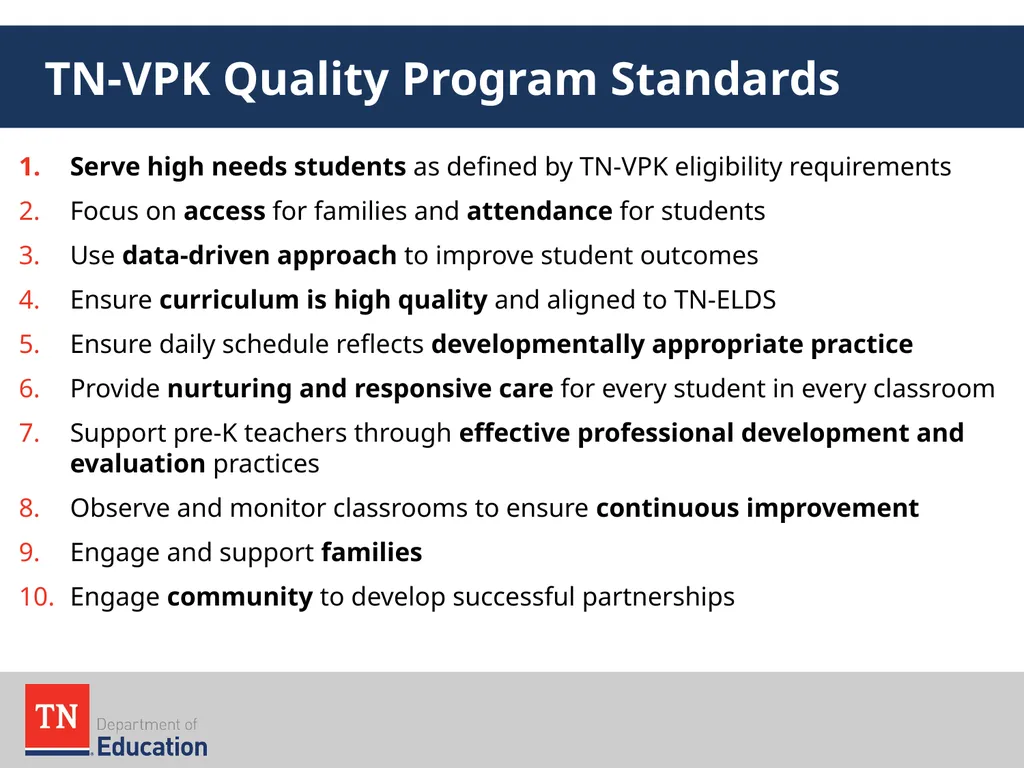
slide28. TN-VPK Quality Program Standards<br>
slide29. Serve high needs students as defined by TN-VPK eligibility requirements
Focus on access for families and attendance for students
Use data-driven approach to improve student outcomes
Ensure curriculum is high quality and aligned to TN-ELDS
Ensure daily schedule reflects developmentally appropriate practice
Provide nurturing and responsive care for every student in every classroom
Support pre-K teachers through effective professional development and evaluation practices
Observe and monitor classrooms to ensure continuous improvement
Engage and support families
Engage community to develop successful partnerships TN-VPK Quality Program Standards<br>
slide30. PreK/K Student Growth Portfolio Model<br>
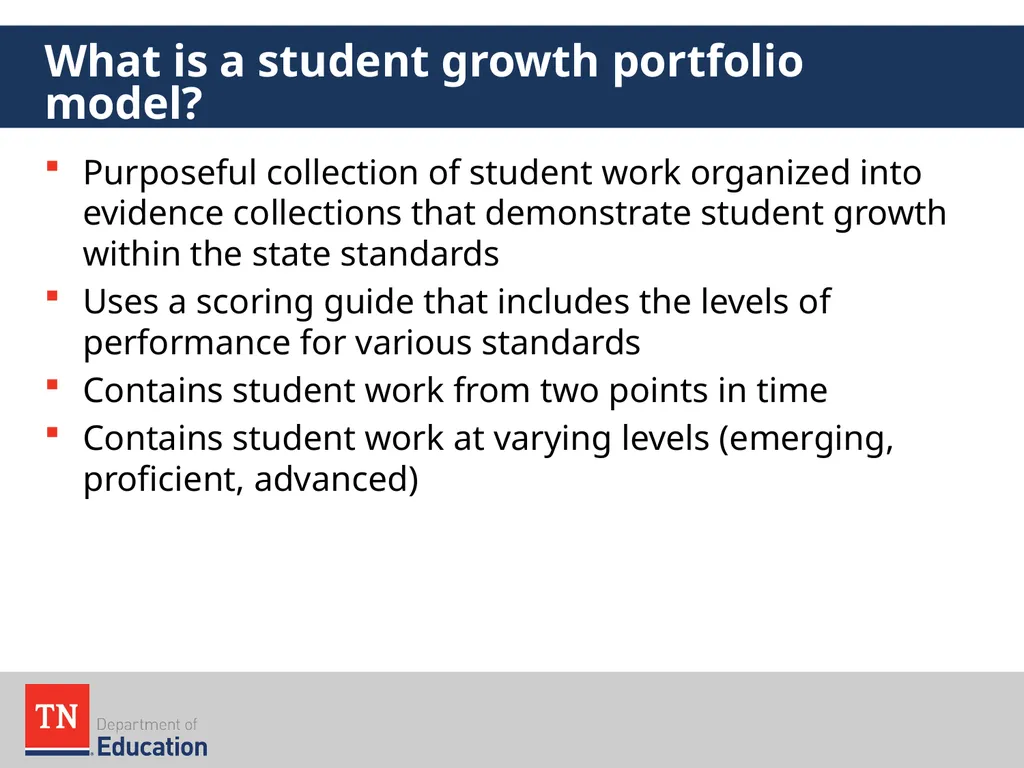
slide31. Purposeful collection of student work organized into evidence collections that demonstrate student growth within the state standards
Uses a scoring guide that includes the levels of performance for various standards
Contains student work from two points in time
Contains student work at varying levels (emerging, proficient, advanced) What is a student growth portfolio model?<br>
slide32. Through the use of portfolios, students can
develop and understand criteria for good work,
apply these criteria to their own work efforts and that of other students,
increase critical thinking and self-reflection,
examine how they succeeded or failed or improved on a task, and
set goals for future work.
No longer is the learning just about the final product, evaluation or grade but becomes more focused on students developing metacognitive skills that will enable them to reflect upon and make adjustments in their learning in school and beyond.
https://dese.mo.gov/sites The Power of Portfolios<br>
slide33. [Video 2] The Power of Student Work<br>
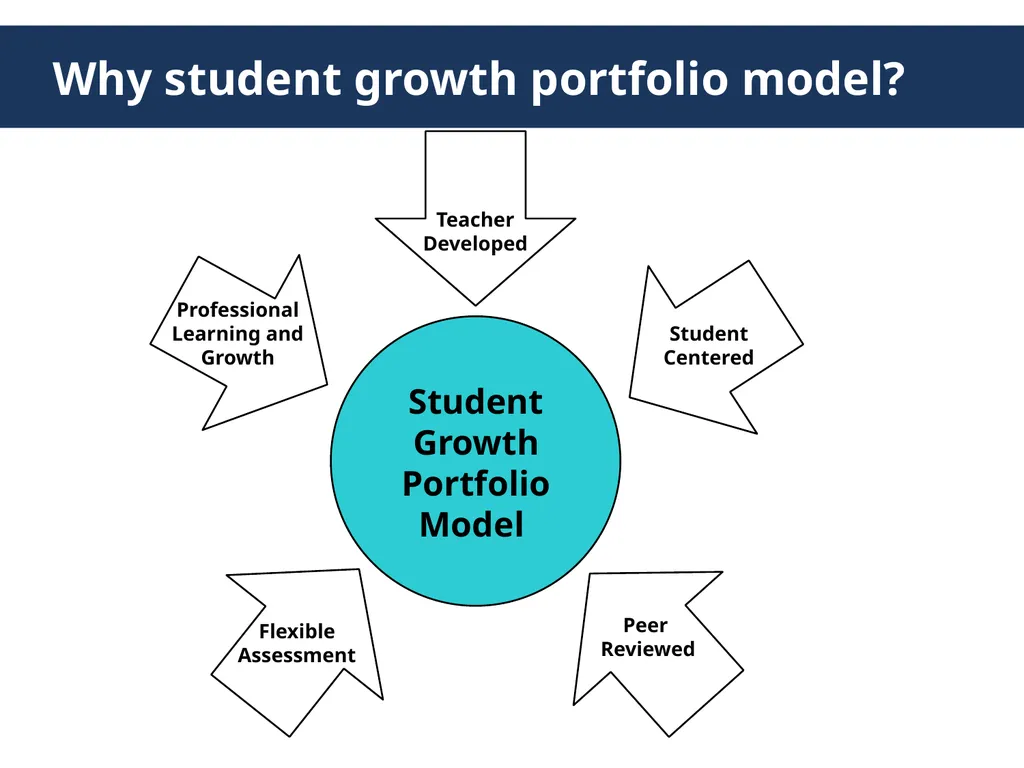
slide34. P P P P P Why student growth portfolio model? Professional Learning and Growth Flexible Assessment Peer
Reviewed Student Centered Teacher Developed Student Growth Portfolio Model<br>
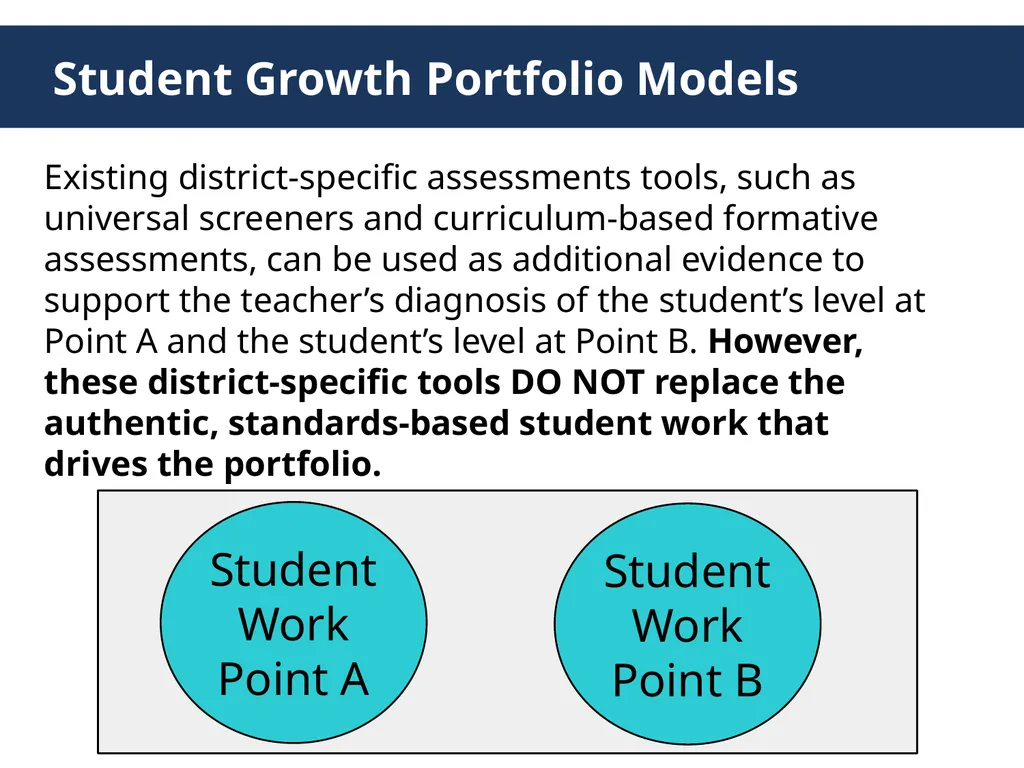
slide35. Student Growth Portfolio Models Student Work
Point A Existing district-specific assessments tools, such as universal screeners and curriculum-based formative assessments, can be used as additional evidence to support the teacher’s diagnosis of the student’s level at Point A and the student’s level at Point B. However, these district-specific tools DO NOT replace the authentic, standards-based student work that drives the portfolio. Student Work
Point B<br>
slide36. Focus on Student Work<br>
slide37. [Video 3] How does looking at student work improve teacher practice?<br>
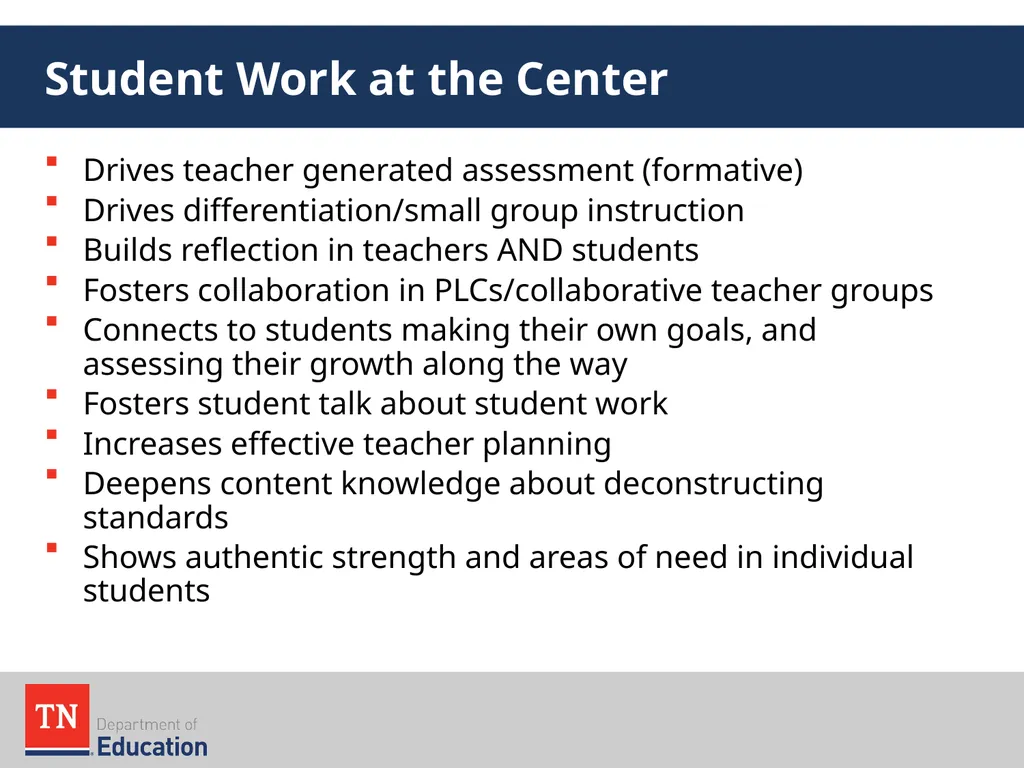
slide38. Drives teacher generated assessment (formative)
Drives differentiation/small group instruction
Builds reflection in teachers AND students
Fosters collaboration in PLCs/collaborative teacher groups
Connects to students making their own goals, and assessing their growth along the way
Fosters student talk about student work
Increases effective teacher planning
Deepens content knowledge about deconstructing standards
Shows authentic strength and areas of need in individual students Student Work at the Center<br>
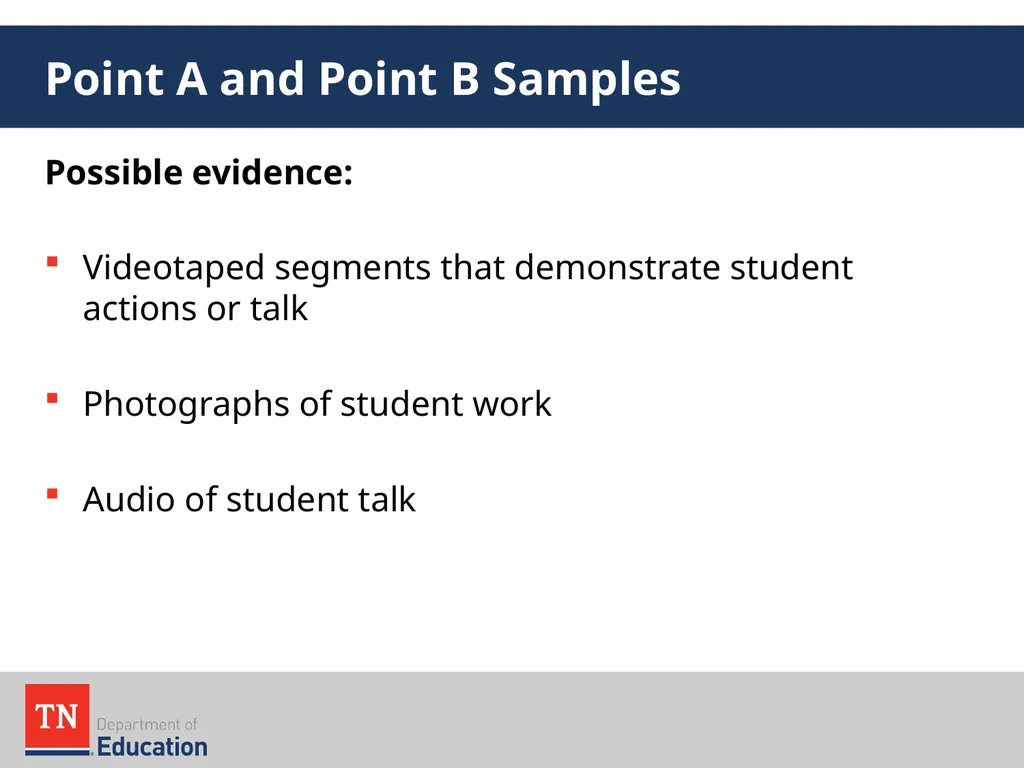
slide39. Possible evidence:
Videotaped segments that demonstrate student actions or talk
Photographs of student work
Audio of student talk Point A and Point B Samples<br>
slide40. Portfolios and Evaluation<br>
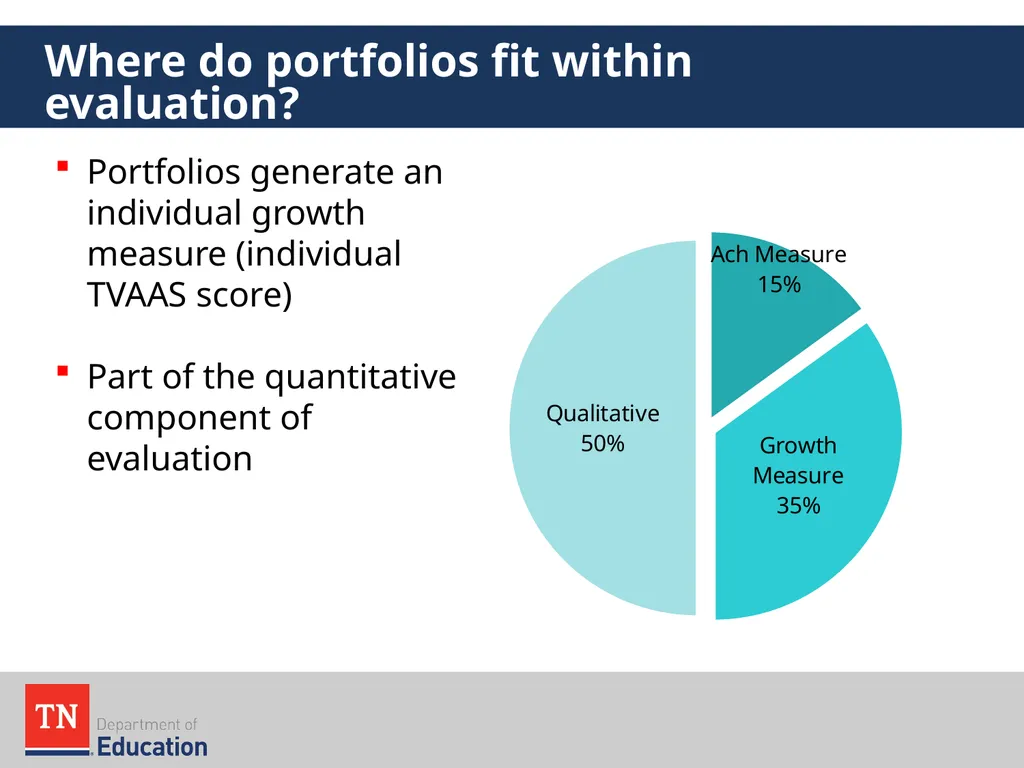
slide41. Where do portfolios fit within evaluation? Portfolios generate an individual growth measure (individual TVAAS score)
Part of the quantitative component of evaluation<br>
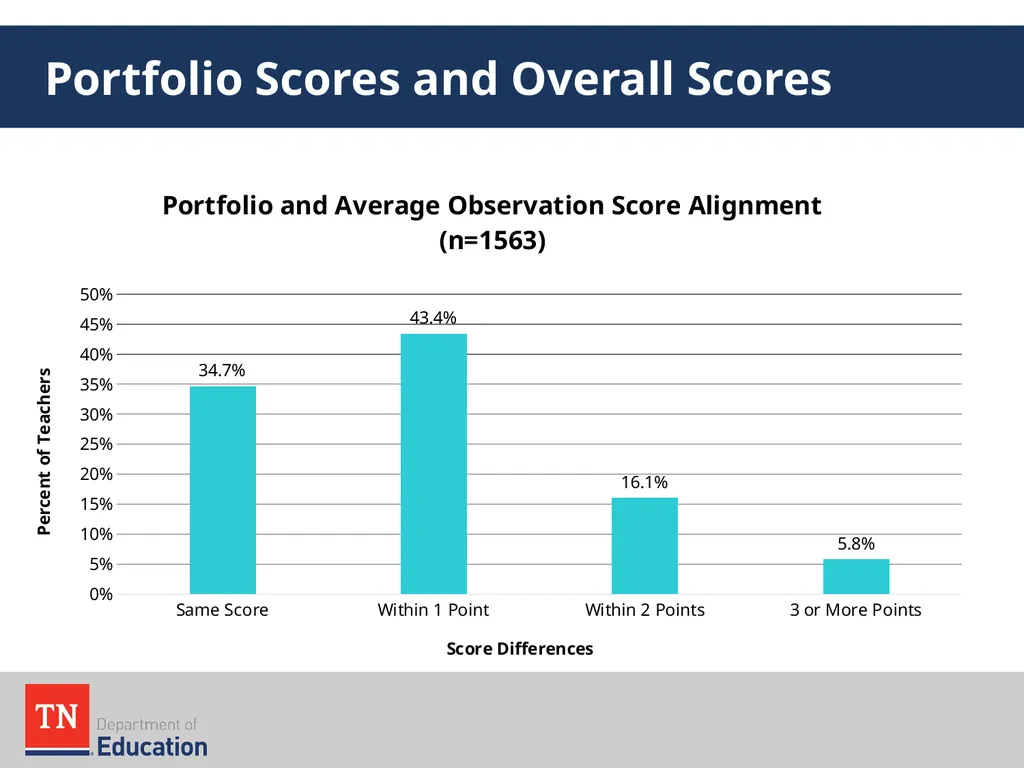
slide42. Portfolio Scores and Overall Scores<br>
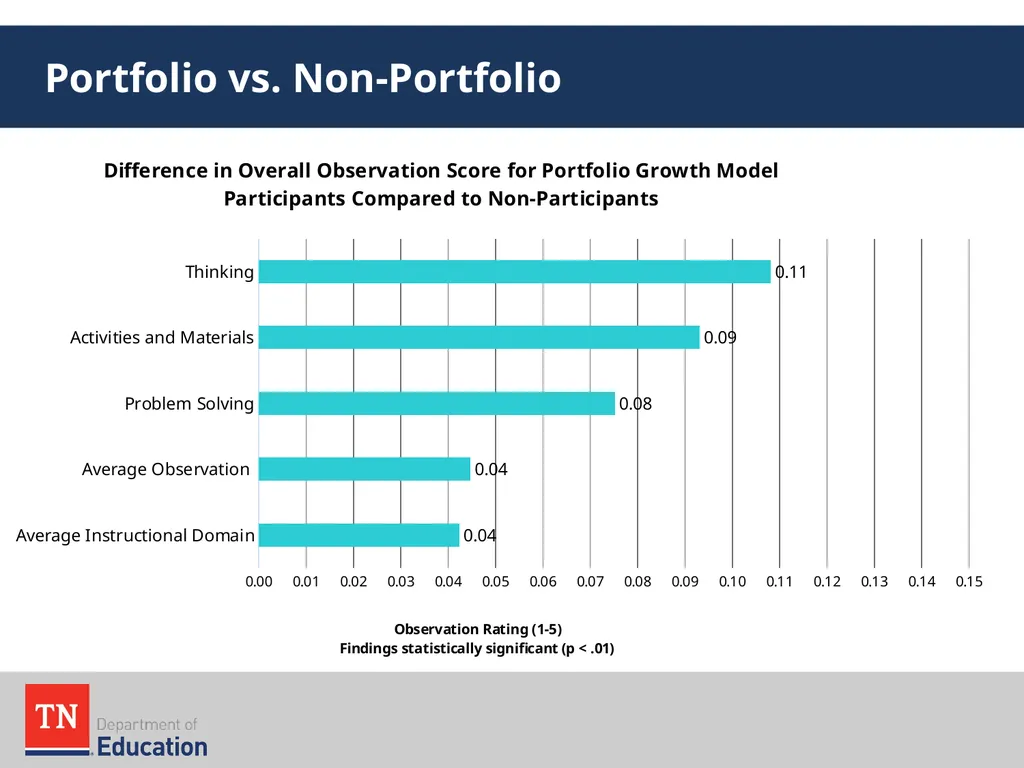
slide43. Portfolio vs. Non-Portfolio<br>
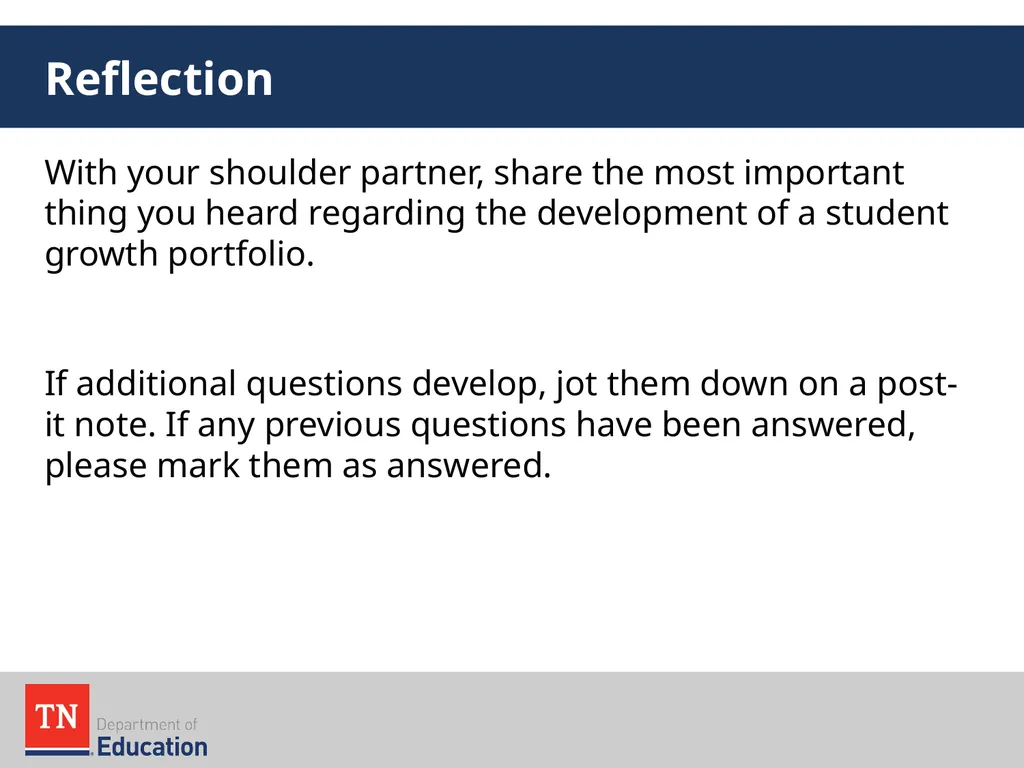
slide44. With your shoulder partner, share the most important thing you heard regarding the development of a student growth portfolio.
If additional questions develop, jot them down on a post-it note. If any previous questions have been answered, please mark them as answered. Reflection<br>
slide45. Kindergarten Entry Inventory<br>
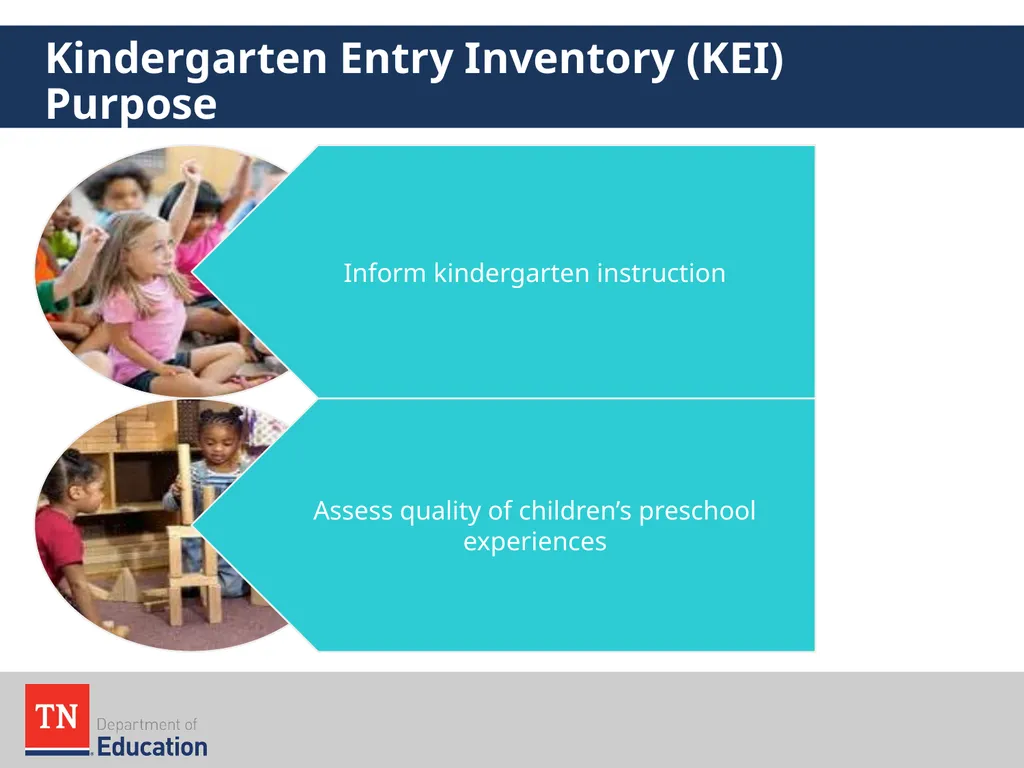
slide46. Kindergarten Entry Inventory (KEI) Purpose<br>
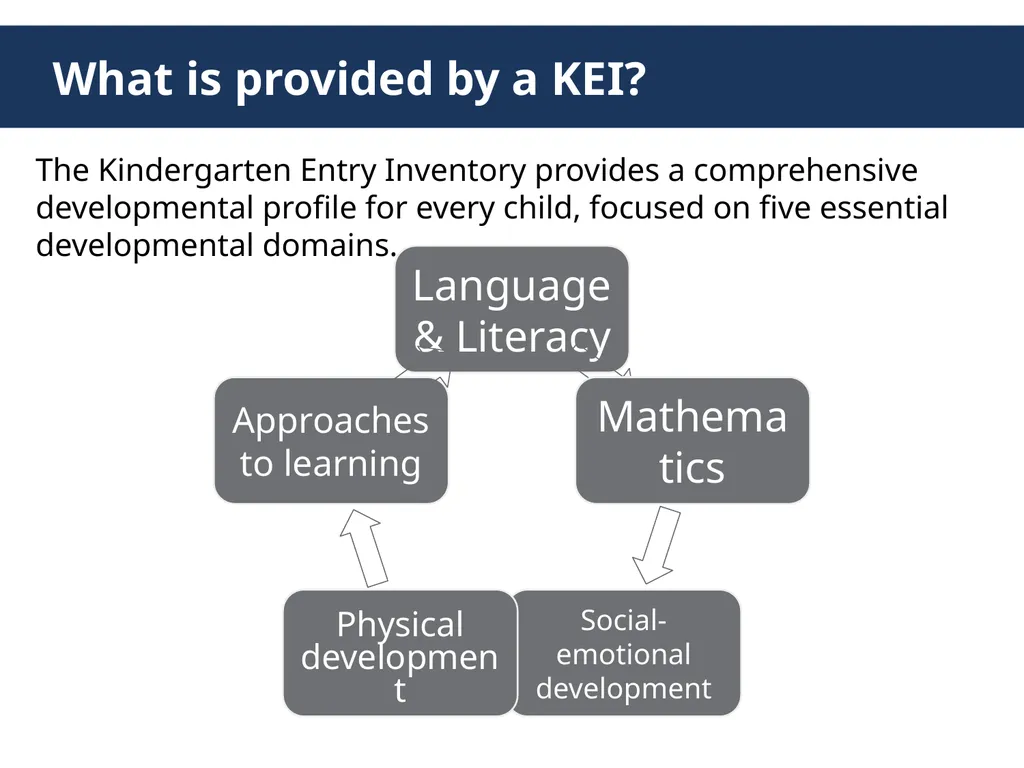
slide47. What is provided by a KEI? The Kindergarten Entry Inventory provides a comprehensive developmental profile for every child, focused on five essential developmental domains.<br>
slide48. How does the KEI work? The KEI is administered by kindergarten teachers during the first eight weeks of school. The assessment is conducted during the course of regular schools days and schedules. The KEI is designed to ensure the kindergarten teacher has control over when the KEI is administered, based on her/his schedule and planning. The KEI is comprised of items in three different formats:
Selected response items – student selects the correct response from three choices provided
Performance tasks – student engages in an activity with the teacher, often using manipulatives
Observations – teachers observe students working and interacting in the normal course of a day<br>
slide49. [Video 4] How does the KEI look in practice?<br>
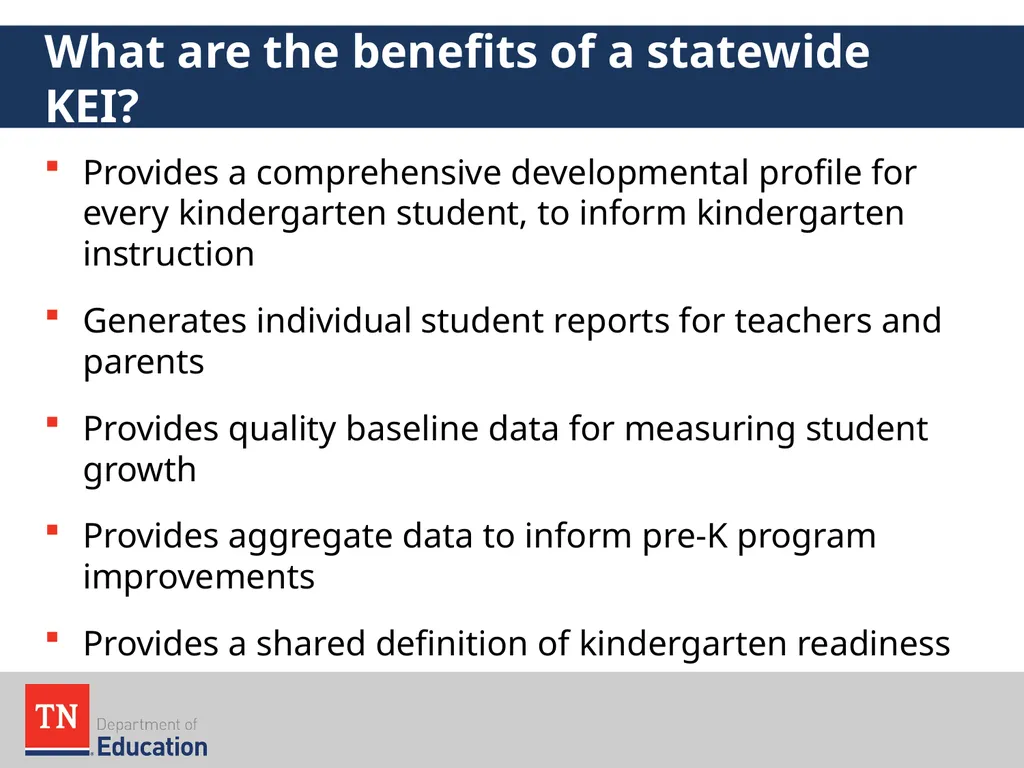
slide50. Provides a comprehensive developmental profile for every kindergarten student, to inform kindergarten instruction
Generates individual student reports for teachers and parents
Provides quality baseline data for measuring student growth
Provides aggregate data to inform pre-K program improvements
Provides a shared definition of kindergarten readiness What are the benefits of a statewide KEI?<br>
slide51. With your shoulder partner, discuss how the Kindergarten Entry Inventory can benefit teaching and learning in pre-K and kindergarten.
If questions develop, jot them on the post-it notes found on your tables and we will revisit the questions later. Reflection<br>
slide52. Early Learning Model in 2016-17<br>
slide53. Early Foundations and Literacy Initiatives K 1 2 3 Response to Intervention Read to Be Ready Initiative Kindergarten Entry Inventory Portfolios Read to Be Ready Coaching Network Second Grade Assessment Third Grade Assessment Pre-K Portfolios VPK quality program standards Portfolios Reading courses Professional Learning Early Learning Model<br>
slide54. ELM Training Timeline<br>
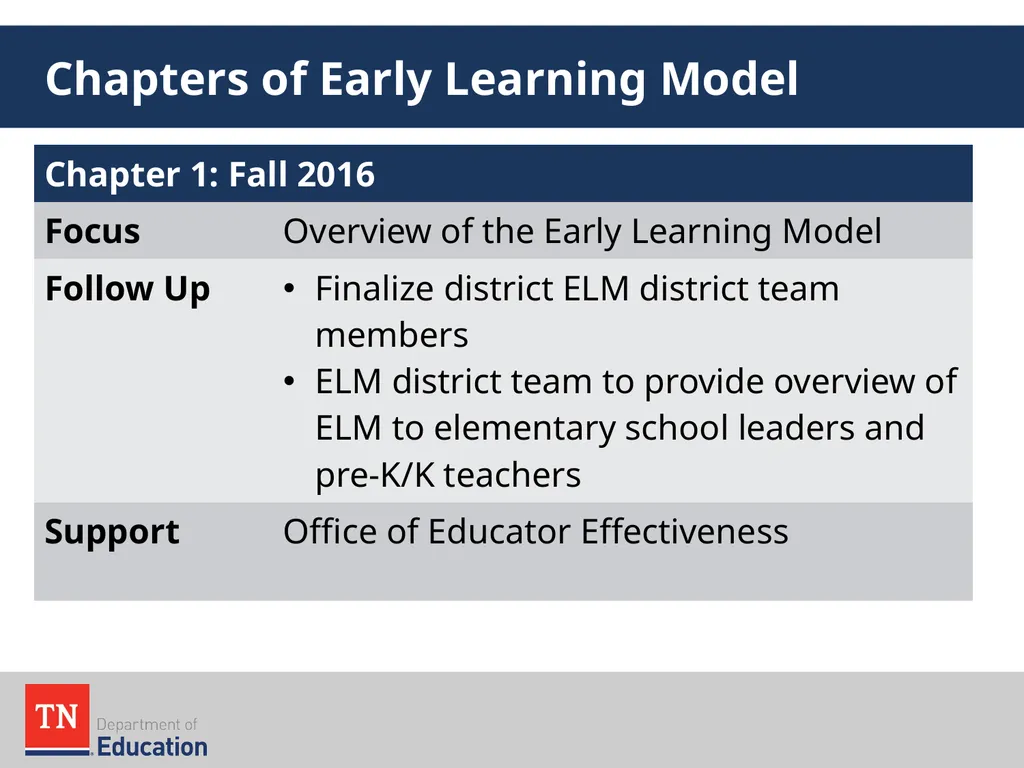
slide55. Chapters of Early Learning Model<br>
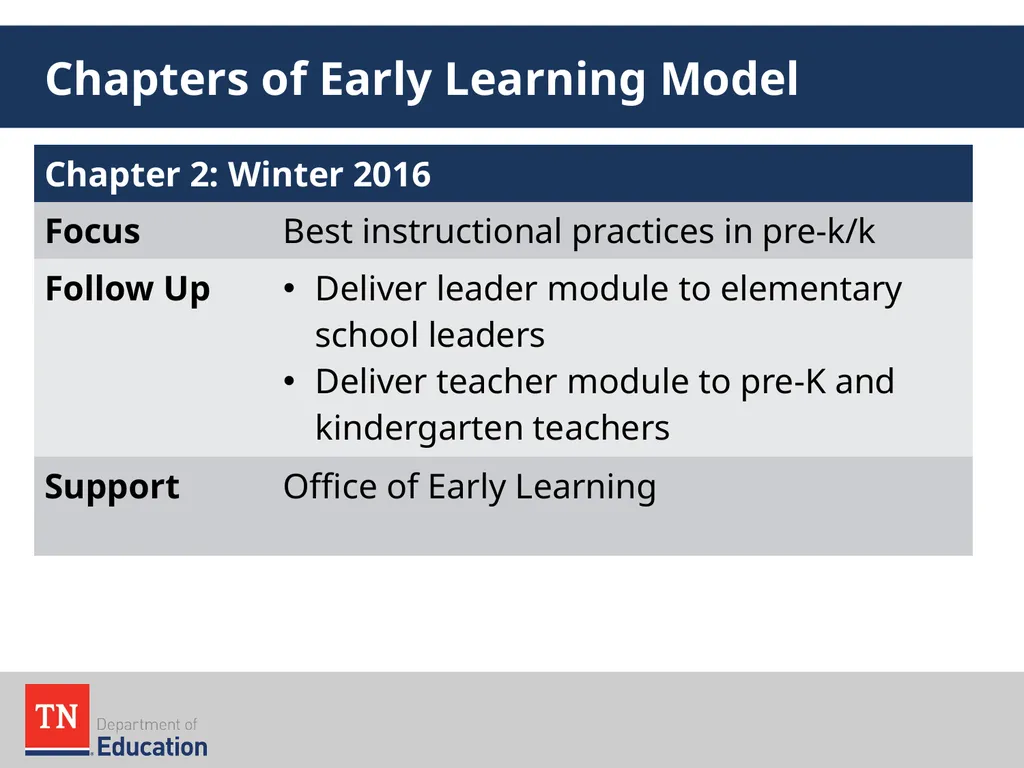
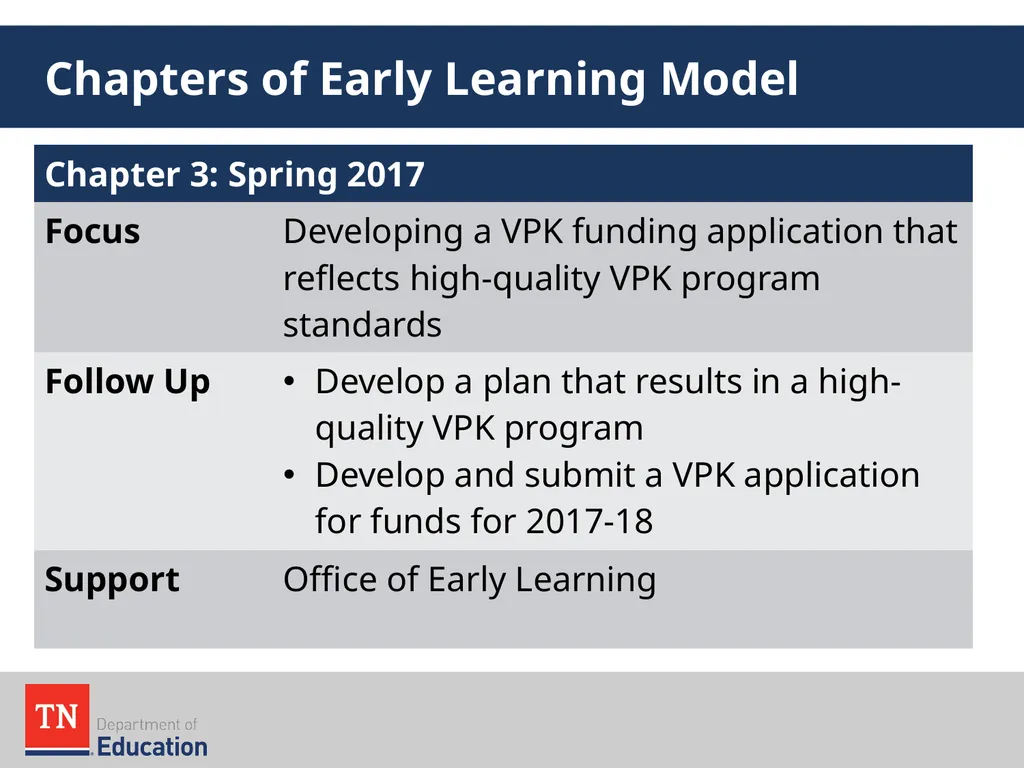
slide56. Chapters of Early Learning Model<br>
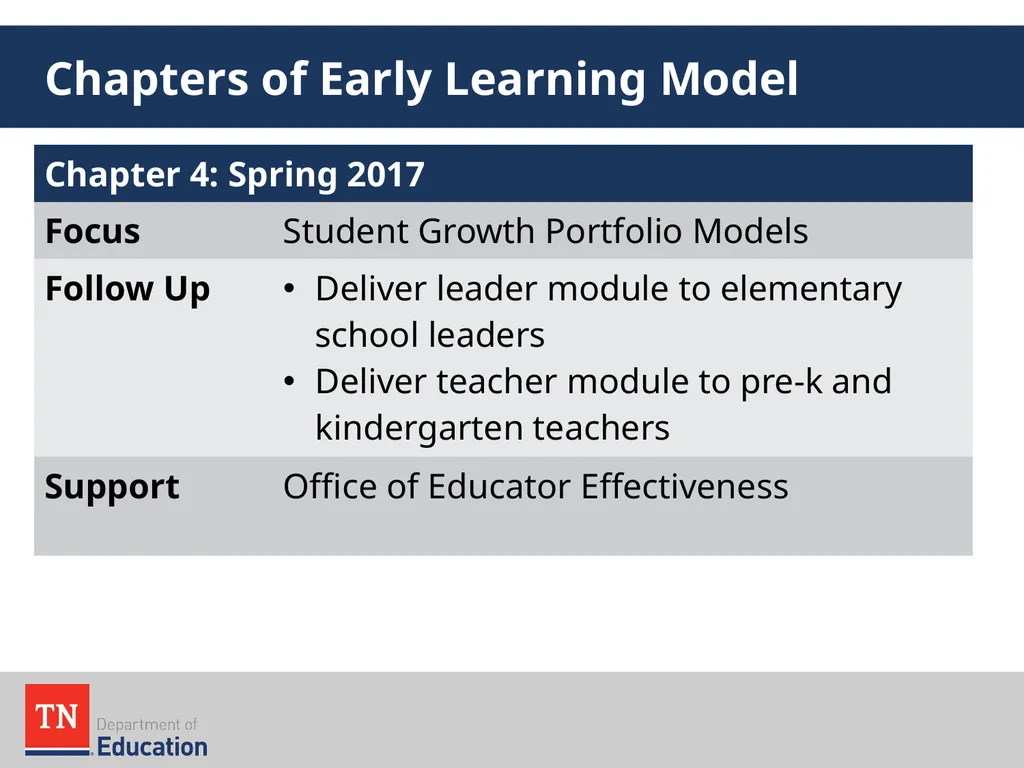
slide57. Chapters of Early Learning Model<br>
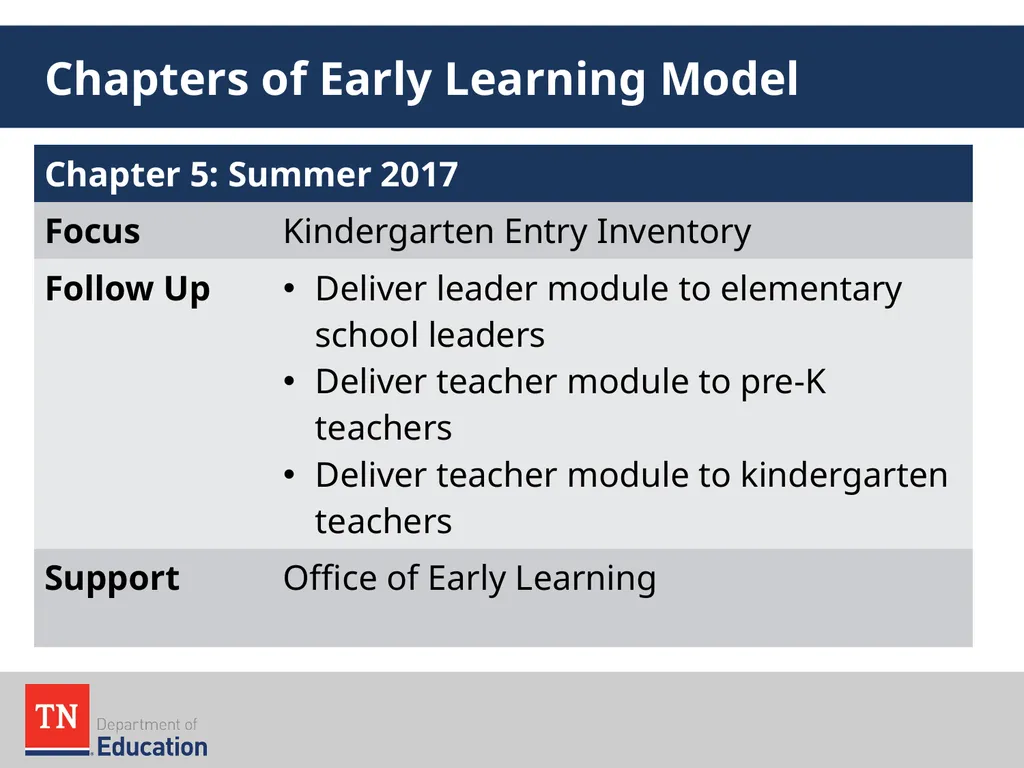
slide58. Chapters of Early Learning Model<br>
slide59. Chapters of Early Learning Model<br>
slide60. Develop a Vision of Success<br>
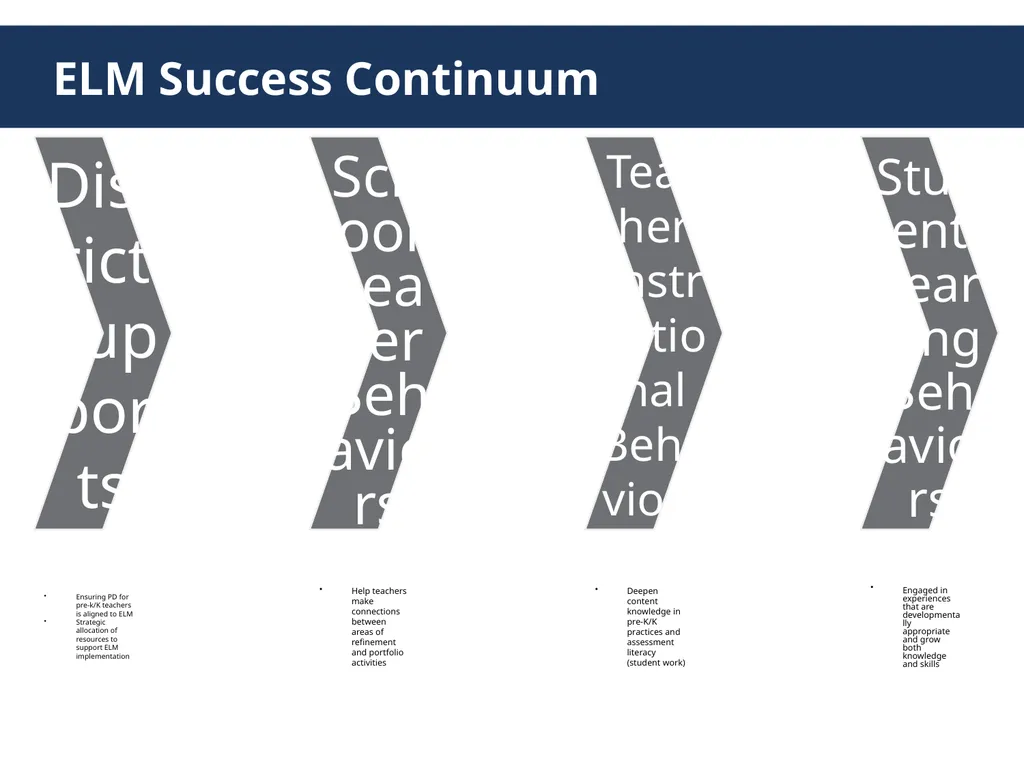
slide61. ELM Success Continuum<br>
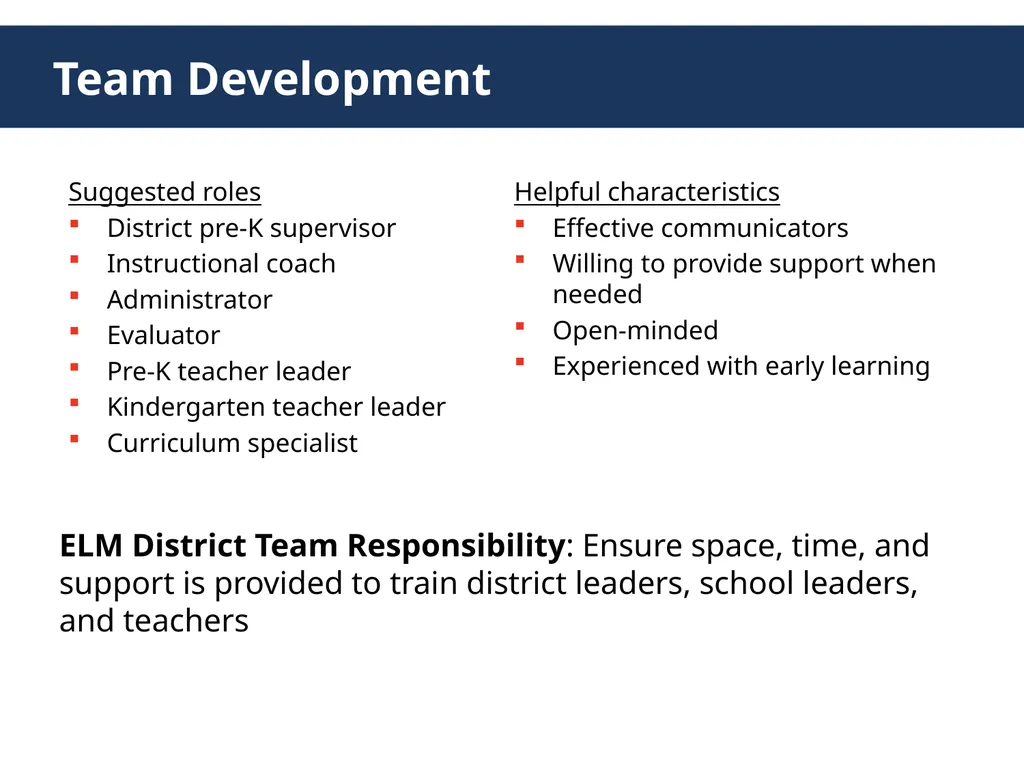
slide62. Team Development Suggested roles
District pre-K supervisor
Instructional coach
Administrator
Evaluator
Pre-K teacher leader
Kindergarten teacher leader
Curriculum specialist Helpful characteristics
Effective communicators
Willing to provide support when needed
Open-minded
Experienced with early learning ELM District Team Responsibility: Ensure space, time, and support is provided to train district leaders, school leaders, and teachers<br>
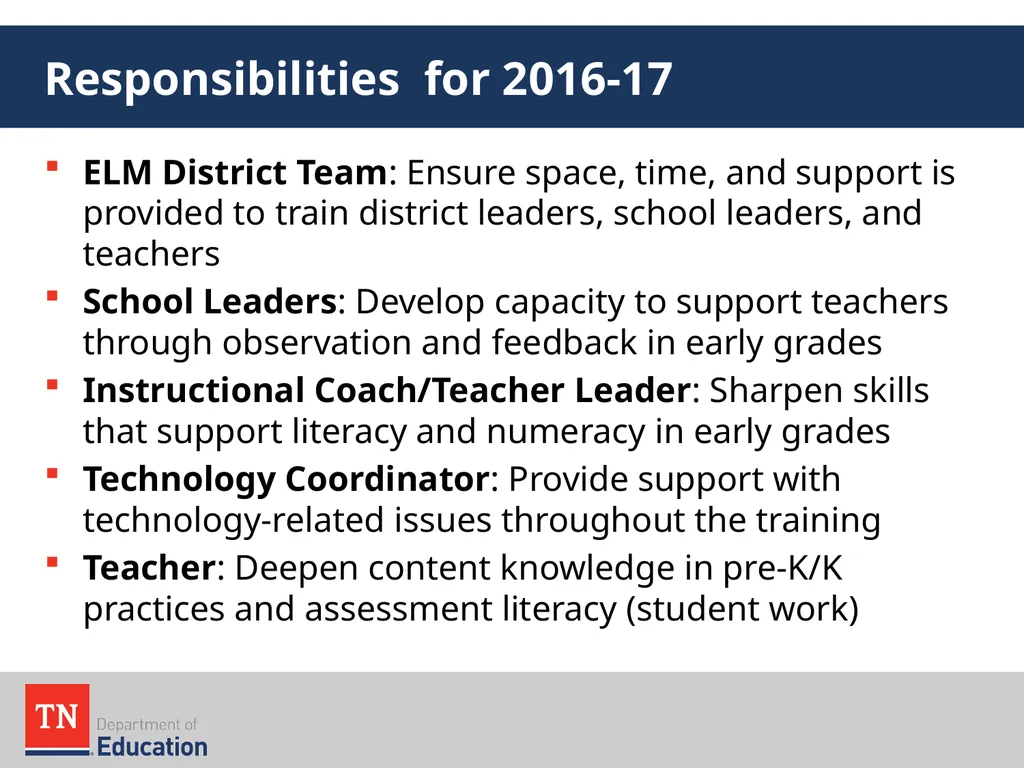
slide63. ELM District Team: Ensure space, time, and support is provided to train district leaders, school leaders, and teachers
School Leaders: Develop capacity to support teachers through observation and feedback in early grades
Instructional Coach/Teacher Leader: Sharpen skills that support literacy and numeracy in early grades
Technology Coordinator: Provide support with technology-related issues throughout the training
Teacher: Deepen content knowledge in pre-K/K practices and assessment literacy (student work) Responsibilities for 2016-17<br>
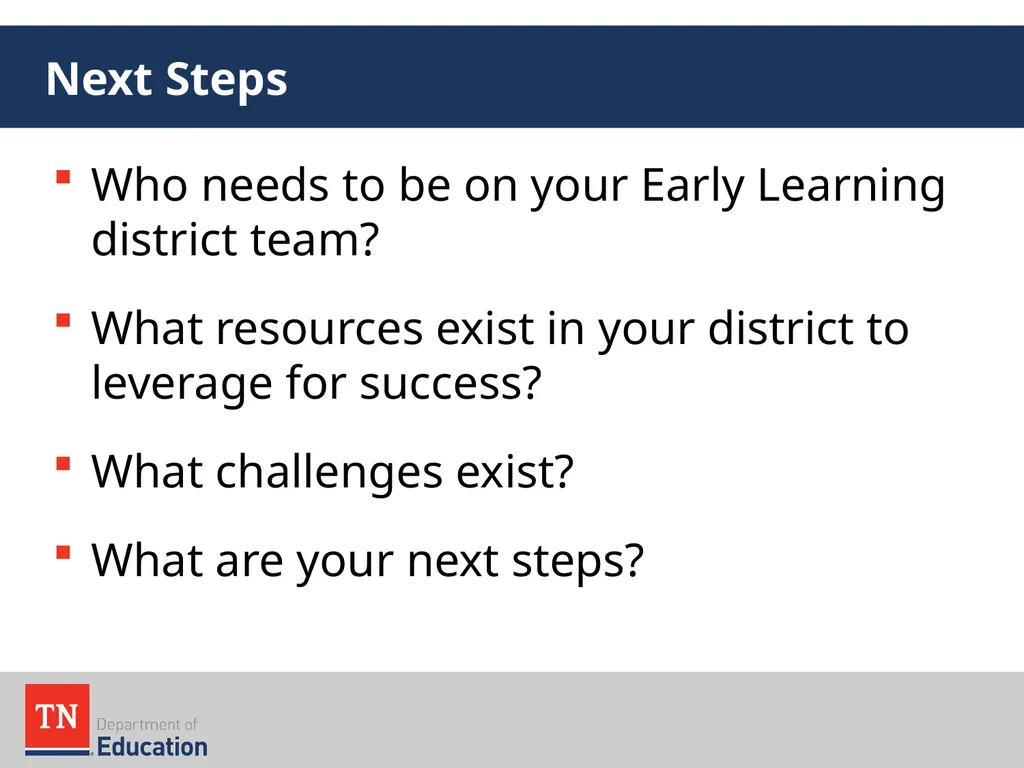
slide64. Who needs to be on your Early Learning district team?
What resources exist in your district to leverage for success?
What challenges exist?
What are your next steps? Next Steps<br>
slide65. Lisa Wiltshire, Executive Director of Early Learning Lisa.Wiltshire@tn.gov
Rene’ Diamond, Executive Director of Educator Effectiveness
Rene.Diamond@tn.gov
Keely Potter, Director of Educator Effectiveness
Keely.Potter@tn.gov Department Contact Information<br>
slide2. The Early Learning Model
Tennessee Succeeds
The state of pre-K in Tennessee
Pre-K/K student growth portfolio model
Kindergarten Entry Inventory
Early Learning Model in 2016-17 Agenda<br>
slide3. By the end of today’s meeting participants will be equipped to:
describe the connections between other state initiatives and the Early Learning Model
share talking points in home districts about the critical parts of the Early Learning Model
name what Early Learning Model success looks like for district leaders, school leaders, teachers, and students Outcome<br>
slide4. The Early Learning Model (ELM) is a comprehensive plan to improve teaching and learning in pre-k and kindergarten.
The goal of ELM is to ensure all students grow and thrive academically, socially and emotionally during the pre-K and kindergarten years so that we create a continuum of learning that will ensure students’ success from pre-K through third grade. Early Learning Model pre-K student growth portfolio model improve VPK quality kindergarten student growth portfolio model Kindergarten Entry Inventory (KEI)<br>
slide5. [Video 1] Early Learning Model<br>
slide6. Tennessee Succeeds<br>
slide7. Districts and schools in Tennessee will exemplify excellence and equity such that all students are equipped with the knowledge and skills to successfully embark upon their chosen path in life. Vision<br>
slide8. Tennessee will continue rapid improvement and rank in the top half of states on the Report Card. MEASUREMENT
Tennessee will rank in top half of states on 4th and 8th grade
NAEP in 2019. 1 2 3 The average ACT score in Tennessee will be a 21, allowing more students to earn HOPE scholarships. MEASUREMENT
The class of 2020 will be on track to achieve 55% postsecondary completion in six years. The majority of Tennessee high
school graduates will earn a certificate, diploma, or degree. MEASUREMENT
Tennessee will have an
average public ACT composite
score of 21 by 2020. Goals<br>
slide9. Goal 1: Reading<br>
slide10. Goal 1: Math<br>
slide11. Priorities<br>
slide12. Building skills in early grades to contribute to future success
Increase department support and monitoring of programs that serve birth to age five students to ensure a solid foundation for learning
Rolling out Kindergarten Entry Inventory with a small set of pilot districts this fall and statewide in 2017
Creating a new second grade assessment to monitor students’ progress in early grades
Increasing the number of educators enrolled in or completing state reading courses to 3,200 educators
Sharing vision for elementary reading proficiency developed by Early Literacy Council
Partnering with over 80 districts on the Read to be Ready coaching initiative
Awarded 20 Read to be Ready Summer Grants; each region received at least one grant to fund summer instructional programs Early Foundations and Literacy<br>
slide13. Supporting the preparation and development of an exceptional educator workforce
Provided additional flexibility for teacher evaluation composite
Expanding portfolio assessment options to more districts and more subject areas, including pre-K and kindergarten teachers
Testing incentive programs that differentiate salaries, including the Tennessee Teacher Leader Network, throughout the state
Pairing teachers in an increasing number of schools through the Instructional Partnership Initiative to provide data-based opportunities for personalized professional learning
Launched the Governor’s Academy for School Leadership for 24 assistant principals and the Transformational Leadership Council to guide the state’s direction across multiple leadership initiatives Educator Support<br>
slide14. Early Foundations and Literacy Initiatives K 1 2 3 Response to Intervention Read to Be Ready Initiative Kindergarten Entry Inventory Portfolios Read to Be Ready Coaching Network Second Grade Assessment Third Grade Assessment Pre-K Portfolios VPK quality program standards Portfolios Reading courses Professional Learning Early Learning Model<br>
slide15. The State of Pre-K in Tennessee<br>
slide16. Tennessee Voluntary Pre-K (TN-VPK) Students Enrolled<br>
slide17. In 2009, the USDOE funded a joint proposal from Vanderbilt’s Peabody Research Institute and the department to study the effects of TN-VPK.
What are the effects of the current TN-VPK program on the academic and social-emotional skills of participating at-risk children?
Do their experiences in later grades sustain, or even add to, the gains children made in TN-VPK?
What enhancements have the greatest potential for improving the effectiveness of TN-VPK? TN-VPK Evaluation<br>
slide18. TN-VPK Evaluation Results<br>
slide19. TN-VPK Evaluation Results<br>
slide20. TN-VPK Evaluation Results<br>
slide21. TN-VPK Evaluation Results<br>
slide22. TN-VPK Evaluation Results<br>
slide23. TN-VPK Evaluation Results<br>
slide24. Pre-K had a positive impact for the children who attended the program.
Pre-K gains are not sustained over time and eventually reversed.
Wide variability in quality of classrooms, how time is spent in classrooms, and outcomes for children. Key Findings from the TN-VPK Study<br>
slide25. To ensure success for students, districts need:
Shared vision for what defines VPK quality
Shared definition of kindergarten readiness
Professional learning for pre-K teachers
Professional learning for elementary principals What We Know from Other TN-VPK Data<br>
slide26. Define quality
Develop shared definition of kindergarten readiness
Strengthen pre-K programs and instruction
Support district efforts to provide meaningful, job-embedded professional development to pre-K teachers
Provide meaningful professional development for pre-K supervisors and elementary principals TN-VPK Strategic Priorities<br>
slide27. With your shoulder partner, discuss what the Early Learning Model is and why it is important.
If questions develop, jot them on the post-it notes found on your tables and we will revisit the questions later. Reflection<br>
slide28. TN-VPK Quality Program Standards<br>
slide29. Serve high needs students as defined by TN-VPK eligibility requirements
Focus on access for families and attendance for students
Use data-driven approach to improve student outcomes
Ensure curriculum is high quality and aligned to TN-ELDS
Ensure daily schedule reflects developmentally appropriate practice
Provide nurturing and responsive care for every student in every classroom
Support pre-K teachers through effective professional development and evaluation practices
Observe and monitor classrooms to ensure continuous improvement
Engage and support families
Engage community to develop successful partnerships TN-VPK Quality Program Standards<br>
slide30. PreK/K Student Growth Portfolio Model<br>
slide31. Purposeful collection of student work organized into evidence collections that demonstrate student growth within the state standards
Uses a scoring guide that includes the levels of performance for various standards
Contains student work from two points in time
Contains student work at varying levels (emerging, proficient, advanced) What is a student growth portfolio model?<br>
slide32. Through the use of portfolios, students can
develop and understand criteria for good work,
apply these criteria to their own work efforts and that of other students,
increase critical thinking and self-reflection,
examine how they succeeded or failed or improved on a task, and
set goals for future work.
No longer is the learning just about the final product, evaluation or grade but becomes more focused on students developing metacognitive skills that will enable them to reflect upon and make adjustments in their learning in school and beyond.
https://dese.mo.gov/sites The Power of Portfolios<br>
slide33. [Video 2] The Power of Student Work<br>
slide34. P P P P P Why student growth portfolio model? Professional Learning and Growth Flexible Assessment Peer
Reviewed Student Centered Teacher Developed Student Growth Portfolio Model<br>
slide35. Student Growth Portfolio Models Student Work
Point A Existing district-specific assessments tools, such as universal screeners and curriculum-based formative assessments, can be used as additional evidence to support the teacher’s diagnosis of the student’s level at Point A and the student’s level at Point B. However, these district-specific tools DO NOT replace the authentic, standards-based student work that drives the portfolio. Student Work
Point B<br>
slide36. Focus on Student Work<br>
slide37. [Video 3] How does looking at student work improve teacher practice?<br>
slide38. Drives teacher generated assessment (formative)
Drives differentiation/small group instruction
Builds reflection in teachers AND students
Fosters collaboration in PLCs/collaborative teacher groups
Connects to students making their own goals, and assessing their growth along the way
Fosters student talk about student work
Increases effective teacher planning
Deepens content knowledge about deconstructing standards
Shows authentic strength and areas of need in individual students Student Work at the Center<br>
slide39. Possible evidence:
Videotaped segments that demonstrate student actions or talk
Photographs of student work
Audio of student talk Point A and Point B Samples<br>
slide40. Portfolios and Evaluation<br>
slide41. Where do portfolios fit within evaluation? Portfolios generate an individual growth measure (individual TVAAS score)
Part of the quantitative component of evaluation<br>
slide42. Portfolio Scores and Overall Scores<br>
slide43. Portfolio vs. Non-Portfolio<br>
slide44. With your shoulder partner, share the most important thing you heard regarding the development of a student growth portfolio.
If additional questions develop, jot them down on a post-it note. If any previous questions have been answered, please mark them as answered. Reflection<br>
slide45. Kindergarten Entry Inventory<br>
slide46. Kindergarten Entry Inventory (KEI) Purpose<br>
slide47. What is provided by a KEI? The Kindergarten Entry Inventory provides a comprehensive developmental profile for every child, focused on five essential developmental domains.<br>
slide48. How does the KEI work? The KEI is administered by kindergarten teachers during the first eight weeks of school. The assessment is conducted during the course of regular schools days and schedules. The KEI is designed to ensure the kindergarten teacher has control over when the KEI is administered, based on her/his schedule and planning. The KEI is comprised of items in three different formats:
Selected response items – student selects the correct response from three choices provided
Performance tasks – student engages in an activity with the teacher, often using manipulatives
Observations – teachers observe students working and interacting in the normal course of a day<br>
slide49. [Video 4] How does the KEI look in practice?<br>
slide50. Provides a comprehensive developmental profile for every kindergarten student, to inform kindergarten instruction
Generates individual student reports for teachers and parents
Provides quality baseline data for measuring student growth
Provides aggregate data to inform pre-K program improvements
Provides a shared definition of kindergarten readiness What are the benefits of a statewide KEI?<br>
slide51. With your shoulder partner, discuss how the Kindergarten Entry Inventory can benefit teaching and learning in pre-K and kindergarten.
If questions develop, jot them on the post-it notes found on your tables and we will revisit the questions later. Reflection<br>
slide52. Early Learning Model in 2016-17<br>
slide53. Early Foundations and Literacy Initiatives K 1 2 3 Response to Intervention Read to Be Ready Initiative Kindergarten Entry Inventory Portfolios Read to Be Ready Coaching Network Second Grade Assessment Third Grade Assessment Pre-K Portfolios VPK quality program standards Portfolios Reading courses Professional Learning Early Learning Model<br>
slide54. ELM Training Timeline<br>
slide55. Chapters of Early Learning Model<br>
slide56. Chapters of Early Learning Model<br>
slide57. Chapters of Early Learning Model<br>
slide58. Chapters of Early Learning Model<br>
slide59. Chapters of Early Learning Model<br>
slide60. Develop a Vision of Success<br>
slide61. ELM Success Continuum<br>
slide62. Team Development Suggested roles
District pre-K supervisor
Instructional coach
Administrator
Evaluator
Pre-K teacher leader
Kindergarten teacher leader
Curriculum specialist Helpful characteristics
Effective communicators
Willing to provide support when needed
Open-minded
Experienced with early learning ELM District Team Responsibility: Ensure space, time, and support is provided to train district leaders, school leaders, and teachers<br>
slide63. ELM District Team: Ensure space, time, and support is provided to train district leaders, school leaders, and teachers
School Leaders: Develop capacity to support teachers through observation and feedback in early grades
Instructional Coach/Teacher Leader: Sharpen skills that support literacy and numeracy in early grades
Technology Coordinator: Provide support with technology-related issues throughout the training
Teacher: Deepen content knowledge in pre-K/K practices and assessment literacy (student work) Responsibilities for 2016-17<br>
slide64. Who needs to be on your Early Learning district team?
What resources exist in your district to leverage for success?
What challenges exist?
What are your next steps? Next Steps<br>
slide65. Lisa Wiltshire, Executive Director of Early Learning Lisa.Wiltshire@tn.gov
Rene’ Diamond, Executive Director of Educator Effectiveness
Rene.Diamond@tn.gov
Keely Potter, Director of Educator Effectiveness
Keely.Potter@tn.gov Department Contact Information<br>