
Early Warning Score & Vital Sign Chart(s) Proposed
LV
Published · 48 slides · 0 views

1 / 1



Description
Early Warning Score Vital Sign Chart(s) Proposed content for E-Learning CCDHB Early Warning Score (EWS) Welcome to the EWS and vital sign chart e-learning site. This resource provides an opportunity to learn about the use of the new adult
Related Topics
Share
Embed code
Download this presentation From Below
"Early Warning Score & Vital Sign Chart(s) Proposed" is the property of its rightful owner. Permission is granted to download and print the materials on this website for personal, non-commercial use only, and to display it on your personal computer provided you do not modify the materials and that you retain all copyright notices contained in the materials. By downloading content from our website, you accept the terms of this agreement.
Presentation Transcript
01
Early Warning Score & Vital Sign Chart(s) Proposed content for E-Learning<br>
02
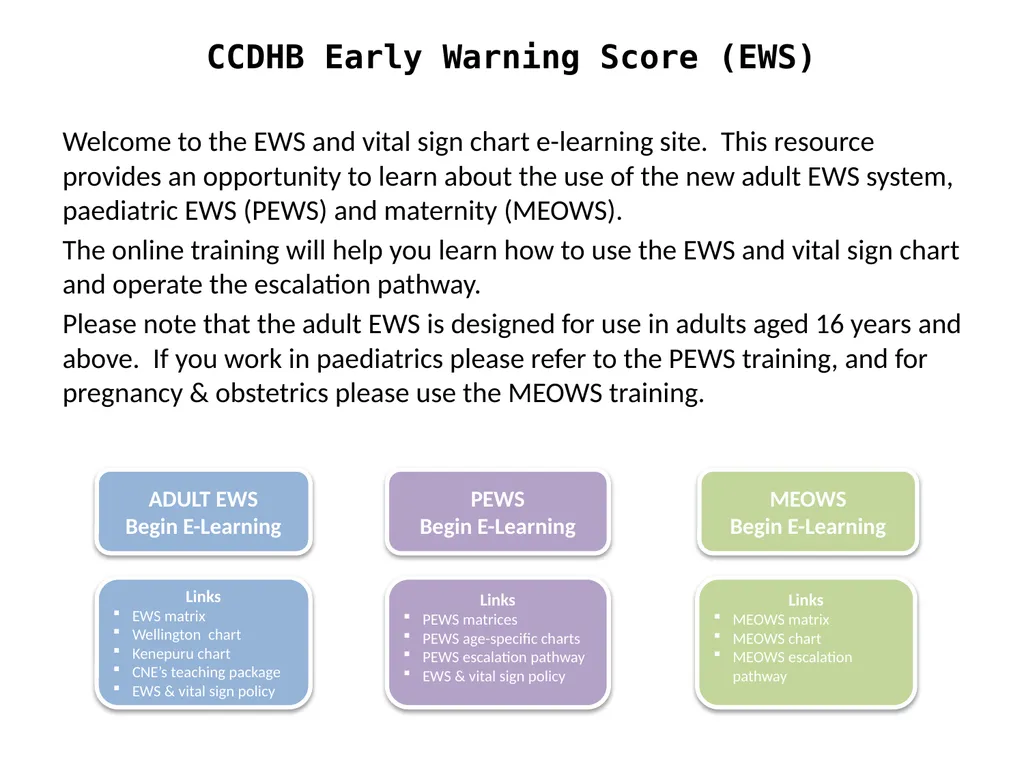
CCDHB Early Warning Score (EWS) Welcome to the EWS and vital sign chart e-learning site. This resource provides an opportunity to learn about the use of the new adult EWS system, paediatric EWS (PEWS) and maternity (MEOWS).
The online training will help you learn how to use the EWS and vital sign chart and operate the escalation pathway.
Please note that the adult EWS is designed for use in adults aged 16 years and above. If you work in paediatrics please refer to the PEWS training, and for pregnancy & obstetrics please use the MEOWS training. ADULT EWS
Begin E-Learning Links
EWS matrix
Wellington chart
Kenepuru chart
CNE’s teaching package
EWS & vital sign policy PEWS
Begin E-Learning MEOWS
Begin E-Learning Links
PEWS matrices
PEWS age-specific charts
PEWS escalation pathway
EWS & vital sign policy Links
MEOWS matrix
MEOWS chart
MEOWS escalation pathway<br>
03
Training Session: PAEDIATRIC Learning objectives
PEWS parameters
Calculating a PEWS & recording vital signs
Triggering a PEWS response & escalation
PEWS Quiz<br>
PEWS parameters
Calculating a PEWS & recording vital signs
Triggering a PEWS response & escalation
PEWS Quiz<br>
04
Learning Objectives After completion of this e-learning session you will be able to:
Understand the benefits of the PEWS
Describe the seven PEWS parameters
Calculate an PEWS correctly
Use the mandatory PEWS triggers to initiate a mandated response
Understand how the PEWS escalation pathway works
Know how the PEWS Modification Box is used<br>
Understand the benefits of the PEWS
Describe the seven PEWS parameters
Calculate an PEWS correctly
Use the mandatory PEWS triggers to initiate a mandated response
Understand how the PEWS escalation pathway works
Know how the PEWS Modification Box is used<br>
05
1. Benefits of EWS Early Warning Scores (EWS) have been developed internationally, to help identify acutely ill and deteriorating patients in acute care hospitals
EWS focus on EARLY recognition of clinical signs of deterioration. EWS trigger a fast and efficient clinical response, which helps prevent deterioration to cardiac arrest. This EARLY approach to acute deterioration optimises patient outcomes.<br>
EWS focus on EARLY recognition of clinical signs of deterioration. EWS trigger a fast and efficient clinical response, which helps prevent deterioration to cardiac arrest. This EARLY approach to acute deterioration optimises patient outcomes.<br>
06
Paediatric EWS (PEWS) In recent years Paediatric EWS have been developed internationally, with Toronto and Queensland publishing validated PEWS systems these have been implemented in a number of centres around NZ ( Starship, Kidz First and CHCH DHB1-4)
The PEWS system (January 2014) is based on the Queensland CEWT system Adopted by CHCH DHB and used with kind permission. There is a move towards a standardised EWS across the sub-regional 3 DHBs (Hutt Valley, Wairarapa & CCDHB)<br>
The PEWS system (January 2014) is based on the Queensland CEWT system Adopted by CHCH DHB and used with kind permission. There is a move towards a standardised EWS across the sub-regional 3 DHBs (Hutt Valley, Wairarapa & CCDHB)<br>
07
References Tibballs J, Kinney S, Duke T, Oakley E, Hennessy M. Reduction of paediatric in-patient cardiac arrest and death with a medical emergency team: preliminary results. Archives of disease in childhood 2005;90(11):1148-52.
Duncan H, Hutchison J, Parshuram CS. The Pediatric Early Warning System score: a severity of illness score to predict urgent medical need in hospitalized children. Journal of critical care 2006;21(3):271-8.
Haines C, Perrott M, Weir P. Promoting care for acutely ill children-development and evaluation of a paediatric early warning tool. Intensive Crit Care Nurs 2006;22(2):73-81.
Monaghan A. Detecting and managing deterioration in children. Paediatric nursing 2005;17(1):32-5.<br>
08
2. PEWS Parameters There are 7 parameters that form the basis for the EWS:
Respiratory rate
Oxygen saturation
Supplemental oxygen
Respiratory distress
Systolic blood pressure
Heart rate
Level of consciousness<br>
Respiratory rate
Oxygen saturation
Supplemental oxygen
Respiratory distress
Systolic blood pressure
Heart rate
Level of consciousness<br>
09
PEWS charts There are 5 age-specific PEWS vital sign charts:
0-3 months
4-11months
1-4 years
5-11 years
12 + years
For the purposes of this training, the 4-11month chart is used for all clinical examples Link to chart Link to chart Link to chart Link to chart Link to chart<br>
0-3 months
4-11months
1-4 years
5-11 years
12 + years
For the purposes of this training, the 4-11month chart is used for all clinical examples Link to chart Link to chart Link to chart Link to chart Link to chart<br>
10
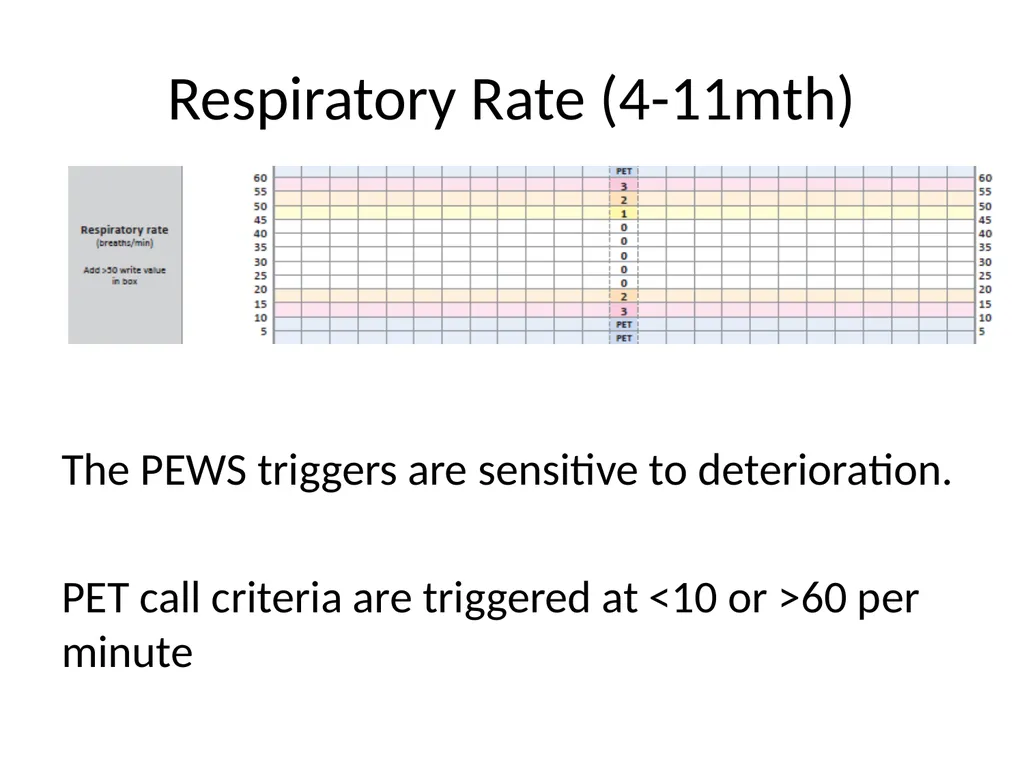
Respiratory Rate (4-11mth) The PEWS triggers are sensitive to deterioration.
PET call criteria are triggered at <10 or >60 per minute<br>
PET call criteria are triggered at <10 or >60 per minute<br>
11
Measuring Respiratory Rate An elevated respiratory rate is one of the most sensitive indicators of acute illness in paediatric patients.
To calculate an accurate respiratory rate, the patient’s breathing must be assessed for a full minute.<br>
To calculate an accurate respiratory rate, the patient’s breathing must be assessed for a full minute.<br>
12
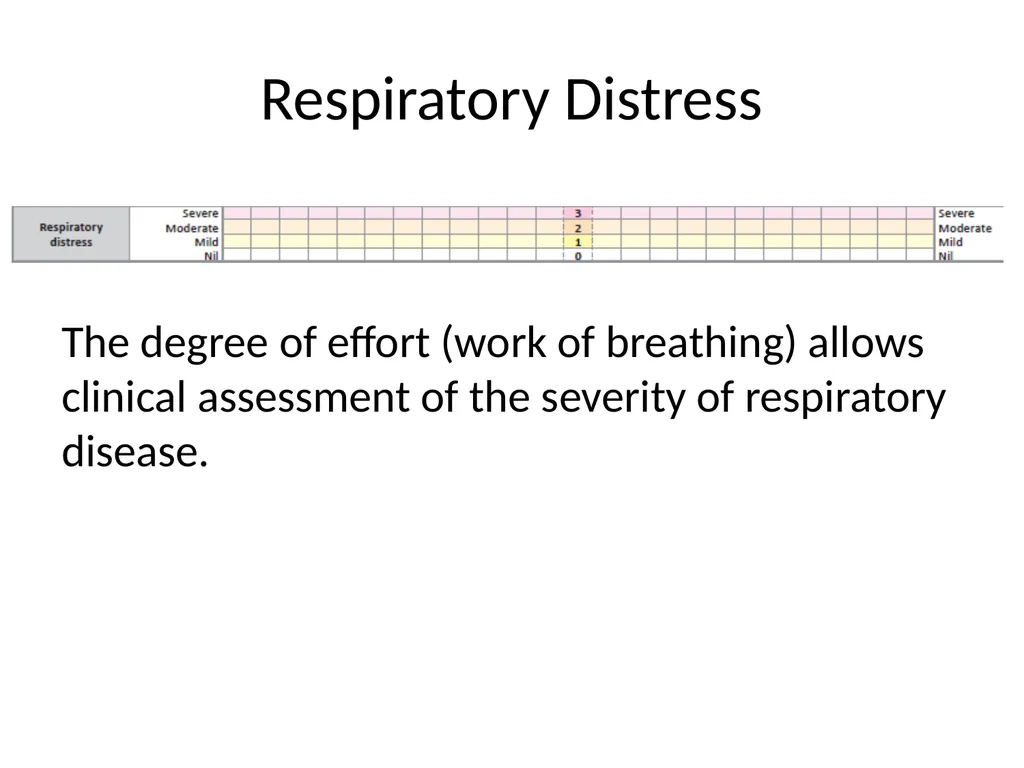
Respiratory Distress The degree of effort (work of breathing) allows clinical assessment of the severity of respiratory disease.<br>
13
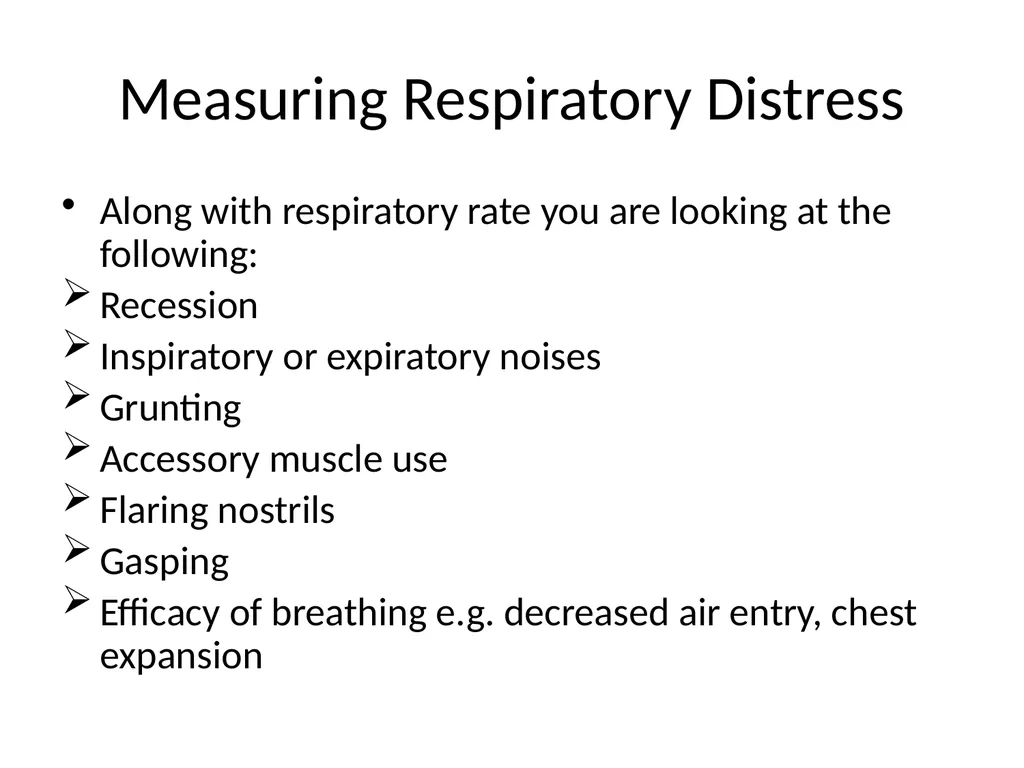
Measuring Respiratory Distress Along with respiratory rate you are looking at the following:
Recession
Inspiratory or expiratory noises
Grunting
Accessory muscle use
Flaring nostrils
Gasping
Efficacy of breathing e.g. decreased air entry, chest expansion<br>
Recession
Inspiratory or expiratory noises
Grunting
Accessory muscle use
Flaring nostrils
Gasping
Efficacy of breathing e.g. decreased air entry, chest expansion<br>
14
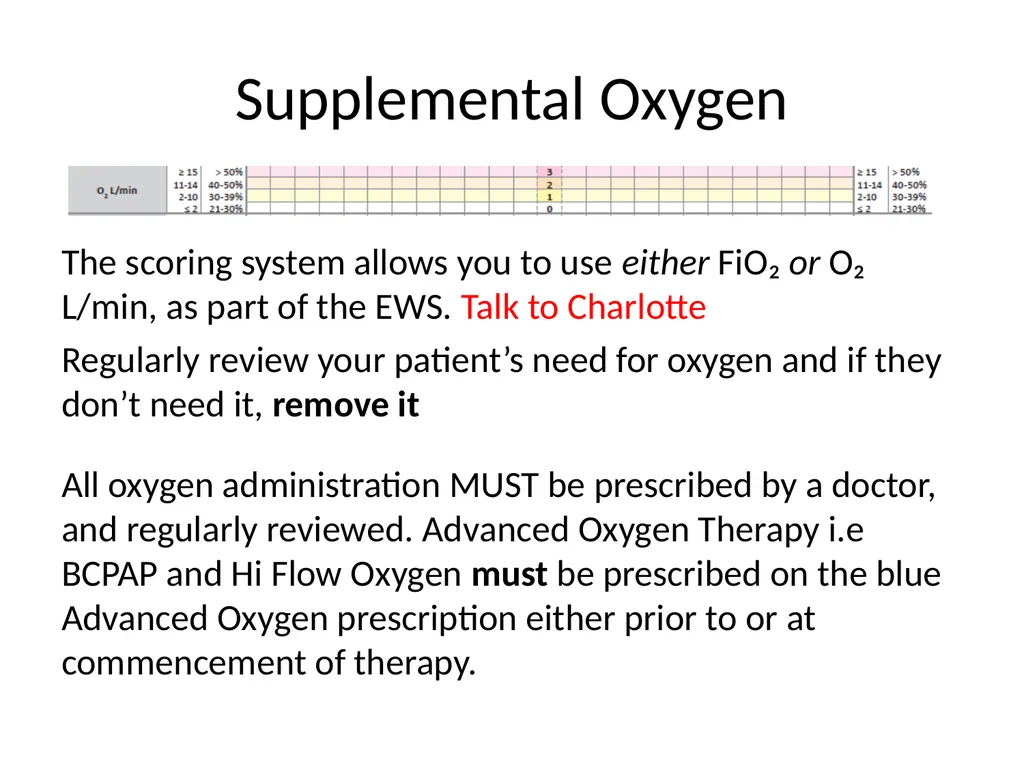
Supplemental Oxygen The scoring system allows you to use either FiO₂ or O₂ L/min, as part of the EWS. Talk to Charlotte
Regularly review your patient’s need for oxygen and if they don’t need it, remove it
All oxygen administration MUST be prescribed by a doctor, and regularly reviewed. Advanced Oxygen Therapy i.e BCPAP and Hi Flow Oxygen must be prescribed on the blue Advanced Oxygen prescription either prior to or at commencement of therapy.<br>
15
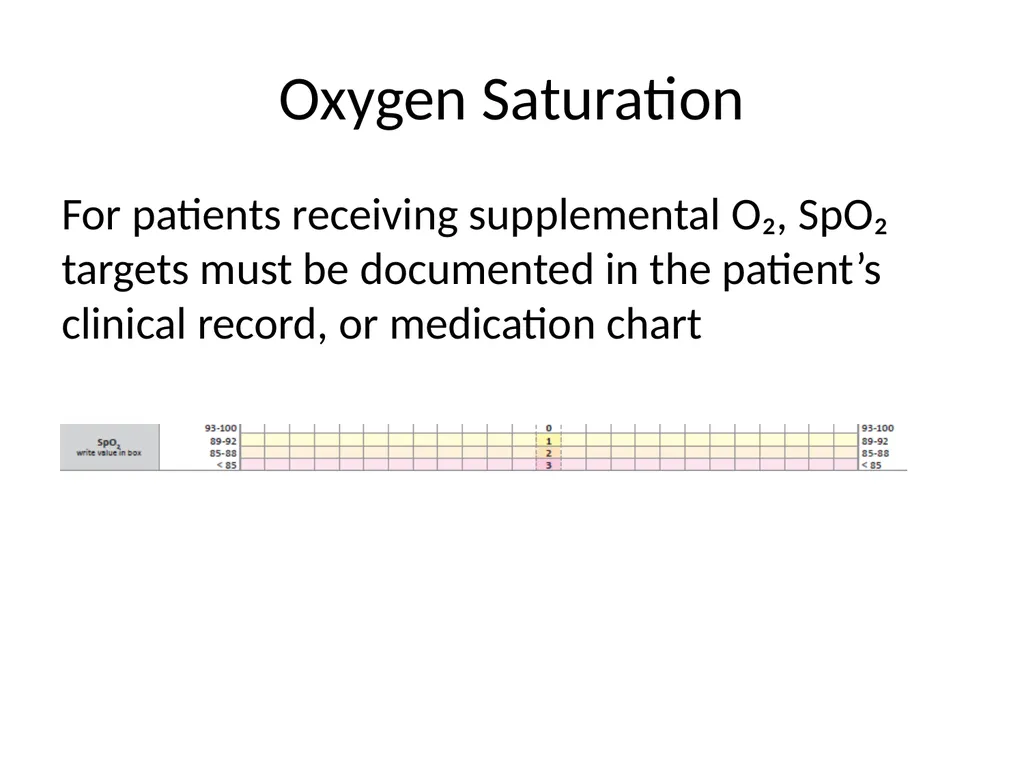
Oxygen Saturation For patients receiving supplemental O₂, SpO₂ targets must be documented in the patient’s clinical record, or medication chart<br>
16
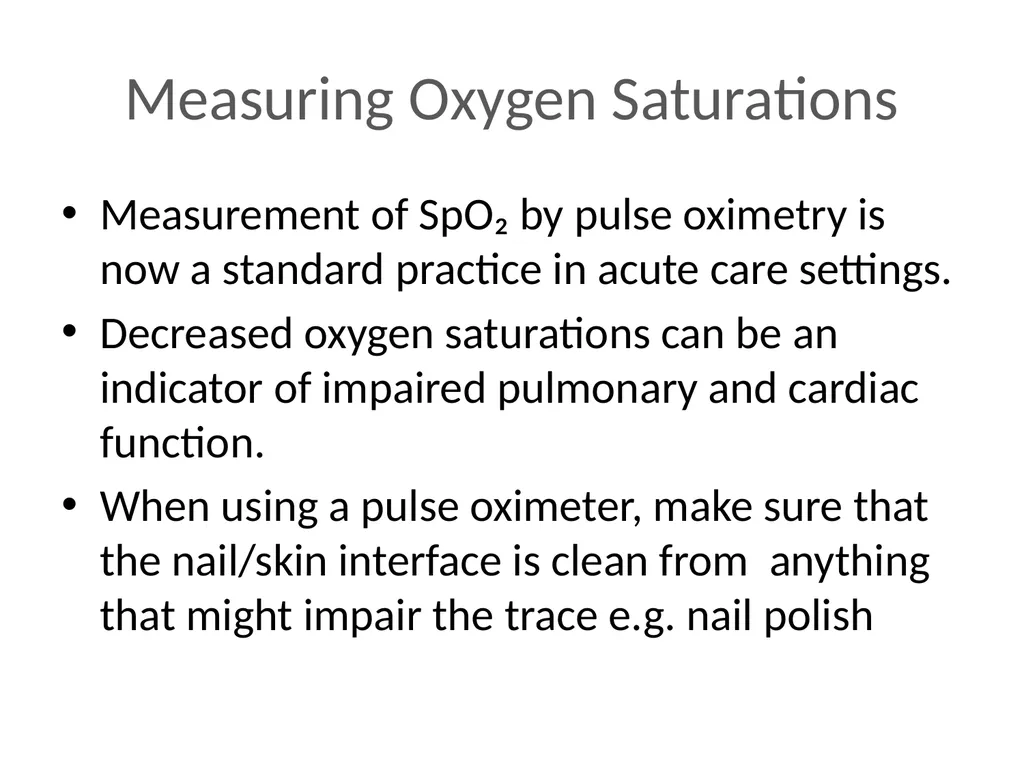
Measuring Oxygen Saturations Measurement of SpO₂ by pulse oximetry is now a standard practice in acute care settings.
Decreased oxygen saturations can be an indicator of impaired pulmonary and cardiac function.
When using a pulse oximeter, make sure that the nail/skin interface is clean from anything that might impair the trace e.g. nail polish<br>
Decreased oxygen saturations can be an indicator of impaired pulmonary and cardiac function.
When using a pulse oximeter, make sure that the nail/skin interface is clean from anything that might impair the trace e.g. nail polish<br>
17
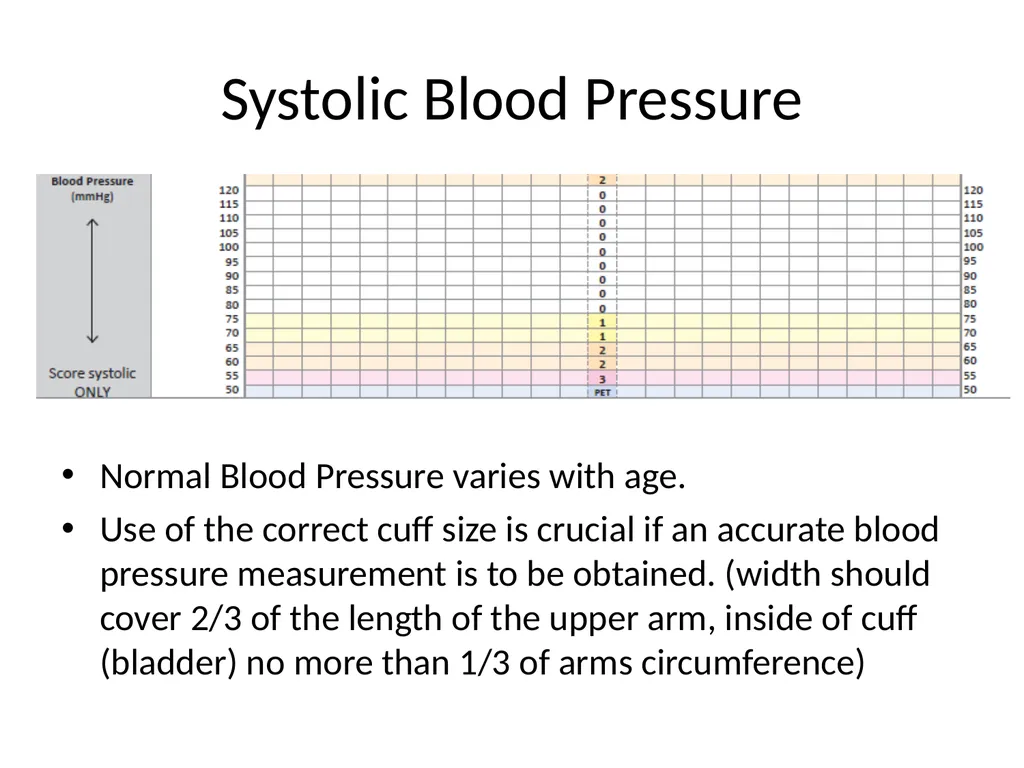
Systolic Blood Pressure Normal Blood Pressure varies with age.
Use of the correct cuff size is crucial if an accurate blood pressure measurement is to be obtained. (width should cover 2/3 of the length of the upper arm, inside of cuff (bladder) no more than 1/3 of arms circumference)<br>
Use of the correct cuff size is crucial if an accurate blood pressure measurement is to be obtained. (width should cover 2/3 of the length of the upper arm, inside of cuff (bladder) no more than 1/3 of arms circumference)<br>
18
Measuring Blood Pressure Blood pressure is to be recorded as per existing standards; on admission, preoperatively and on return to ward postoperatively.
In neonates and infants, blood pressure should be recorded if renal disease or co-arctation of aorta are suspected or if there are signs of hypotension.
Any child or adolescent should also have their blood pressure measured with symptoms of hypotension, hypertension, renal or cardiac disease, diabetes or adrenal disorder, head injury or trauma.
Blood pressure should be recorded 4-8 hourly or more frequently if indicated. Use correct cuff size.
Blood pressure must be recorded if the PEWS score is 3 or greater based on other parameters.<br>
19
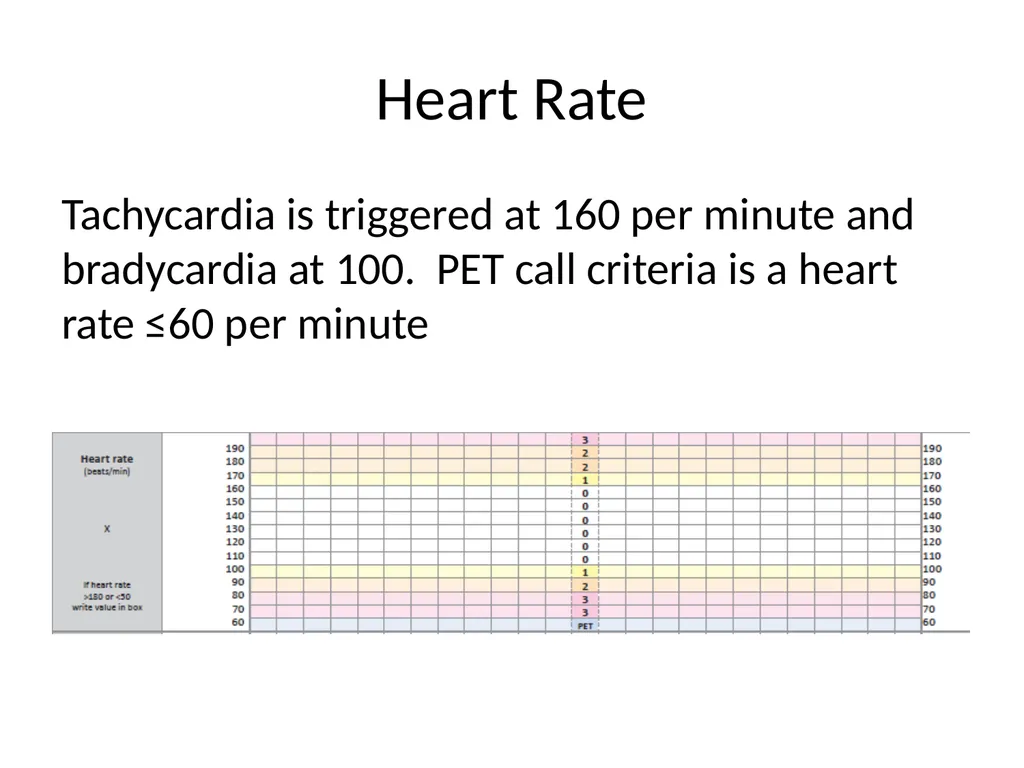
Heart Rate Tachycardia is triggered at 160 per minute and bradycardia at 100. PET call criteria is a heart rate ≤60 per minute<br>
20
Measuring Heart Rate Heart rate is an important indicator of any acute condition
The normal heart rate varies with age and activity
Tachycardia may be due to a number of causes:
Fever
Anaemia
Shock
Dysrhythmia
Sepsis
Metabolic disturbances especially due to dehydration
Pain/nausea/distress
Medications
Bradycardia is often a sign of an impending cardiorespirtaory arrest. Other causes of bradycardiac may be an indicator of hypothermia, CNS depression, heart block or hypothyroidism.
When assessing the heart rate it is best practice to manually feel for the pulse, rather than rely on pulse oximetry. Palpation will provide important clinical information e.g. skin temperature, regularity and strength of pulse<br>
21
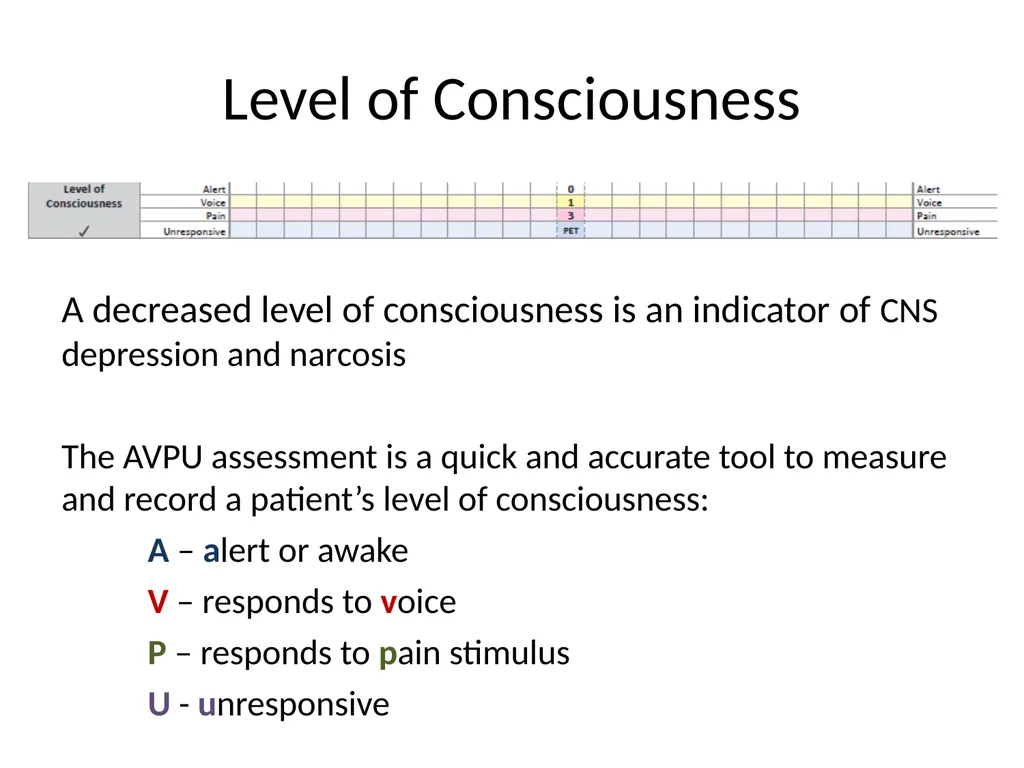
Level of Consciousness A decreased level of consciousness is an indicator of CNS depression and narcosis
The AVPU assessment is a quick and accurate tool to measure and record a patient’s level of consciousness:
A – alert or awake
V – responds to voice
P – responds to pain stimulus
U - unresponsive<br>
The AVPU assessment is a quick and accurate tool to measure and record a patient’s level of consciousness:
A – alert or awake
V – responds to voice
P – responds to pain stimulus
U - unresponsive<br>
22
3. Using PEWS The minimum frequency for taking a full set of vital signs & calculating the Early Warning Score is every 4 hours (Adult & paediatric vital sign measurement, EWS and escalation policy. Document ID 1.101901.
The frequency for taking vital signs may be increased or decreased, according to the clinical need of each patient.
Each EWS parameter is weighted, so that the greater the deviation from normal, the higher the EWS score. The weighted scores range from 0 (normal) to 3 (grossly abnormal).
The individual parameter scores are then added together to derive an aggregated EWS. If significant, a clinical response is triggered<br>
23
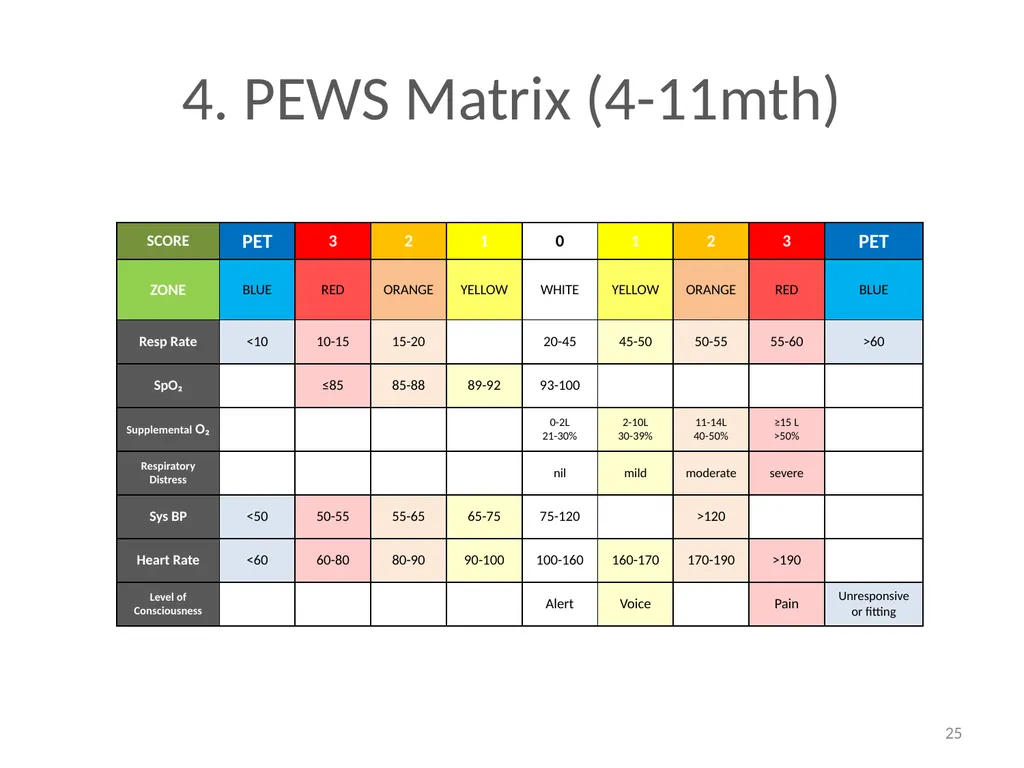
The vital sign charts have colour-coding to help identify each EWS zone:
White = normal
Yellow = potential to deteriorate
Orange = indicates acute illness or unstable chronic disease
Red = likely to deteriorate rapidly
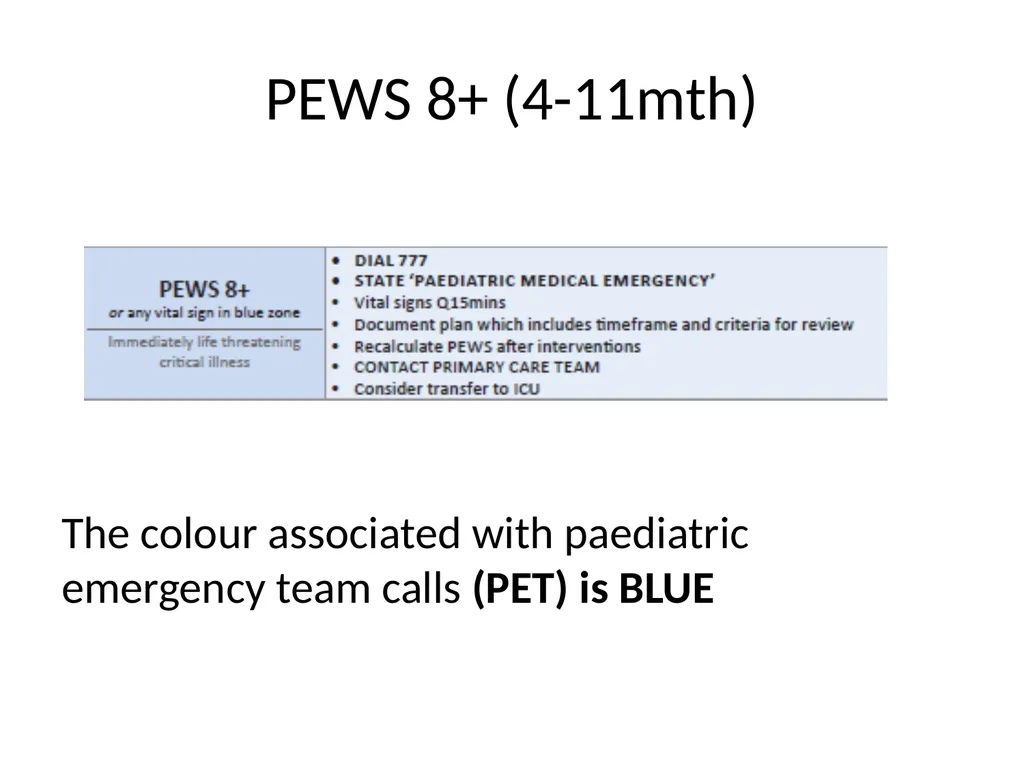
Blue = immediately life threatening critical illness
The PEWS system also allows for single parameter scoring e.g. if any vital sign falls in a coloured zone, the associated action is triggered.<br>
24
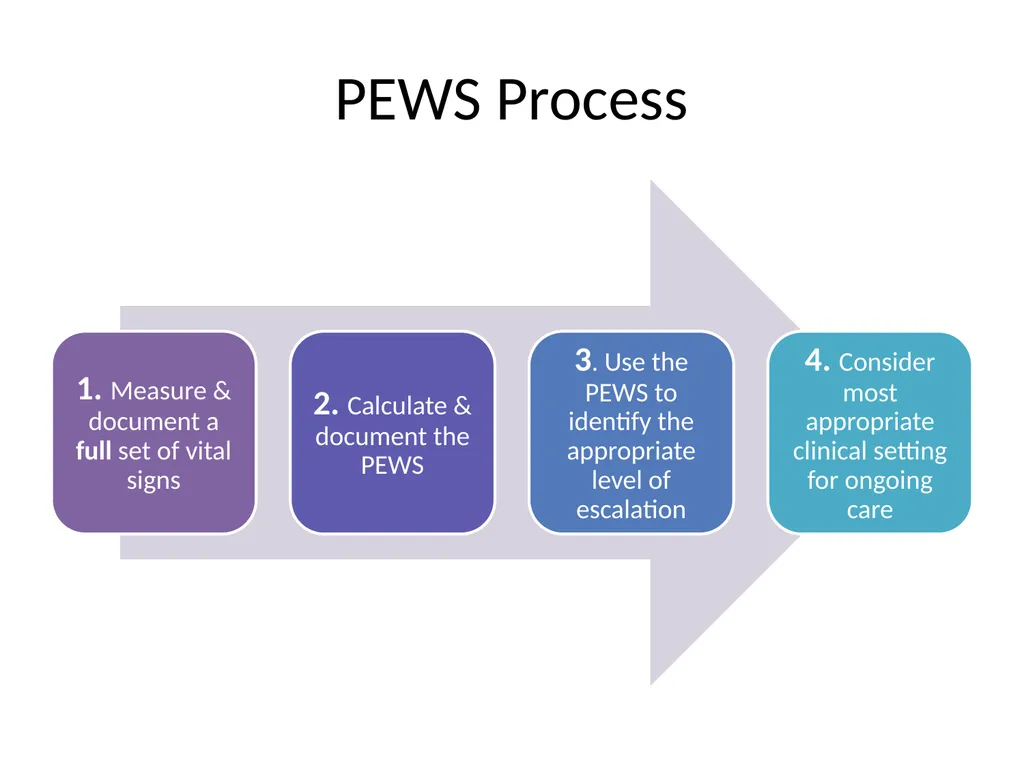
PEWS Process<br>
25
4. PEWS Matrix (4-11mth) 25<br>
26
Wellington Hospital’s vital sign chart<br>
27
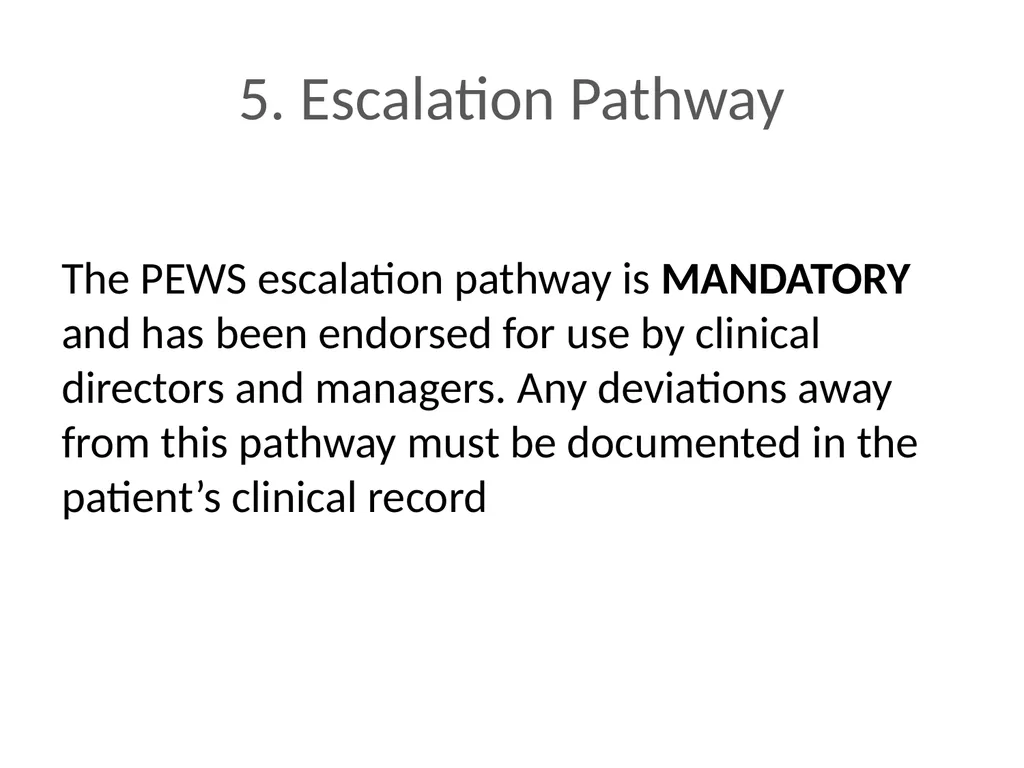
5. Escalation Pathway The PEWS escalation pathway is MANDATORY and has been endorsed for use by clinical directors and managers. Any deviations away from this pathway must be documented in the patient’s clinical record<br>
28
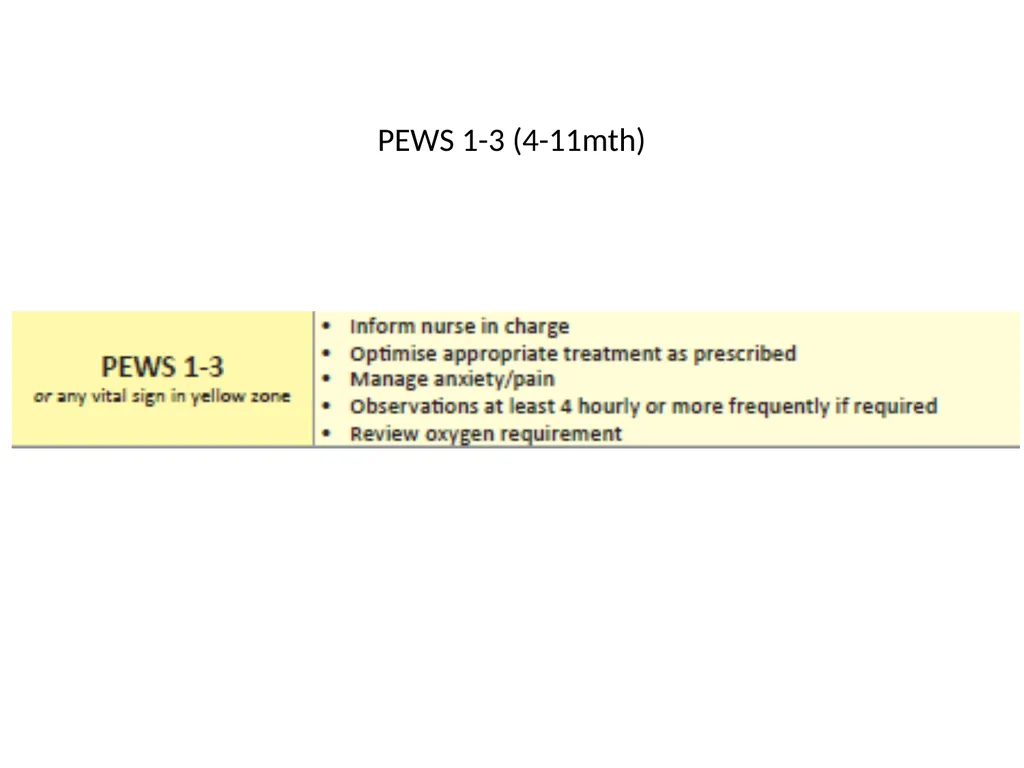
PEWS 1-3 (4-11mth)<br>
29
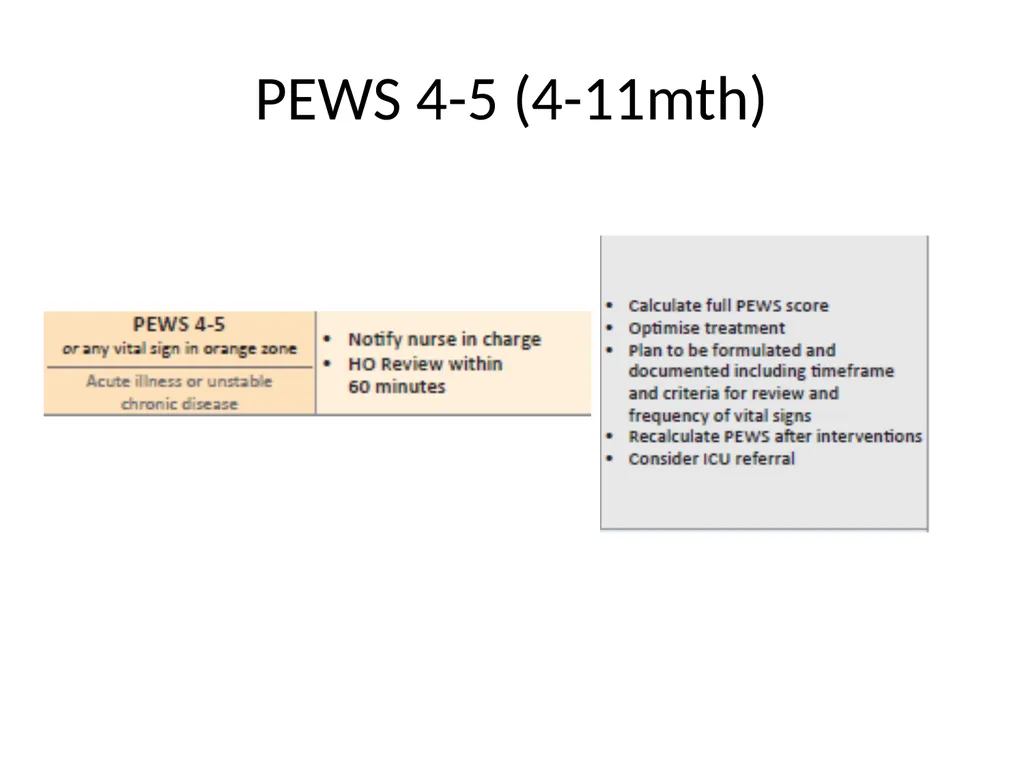
PEWS 4-5 (4-11mth)<br>
30
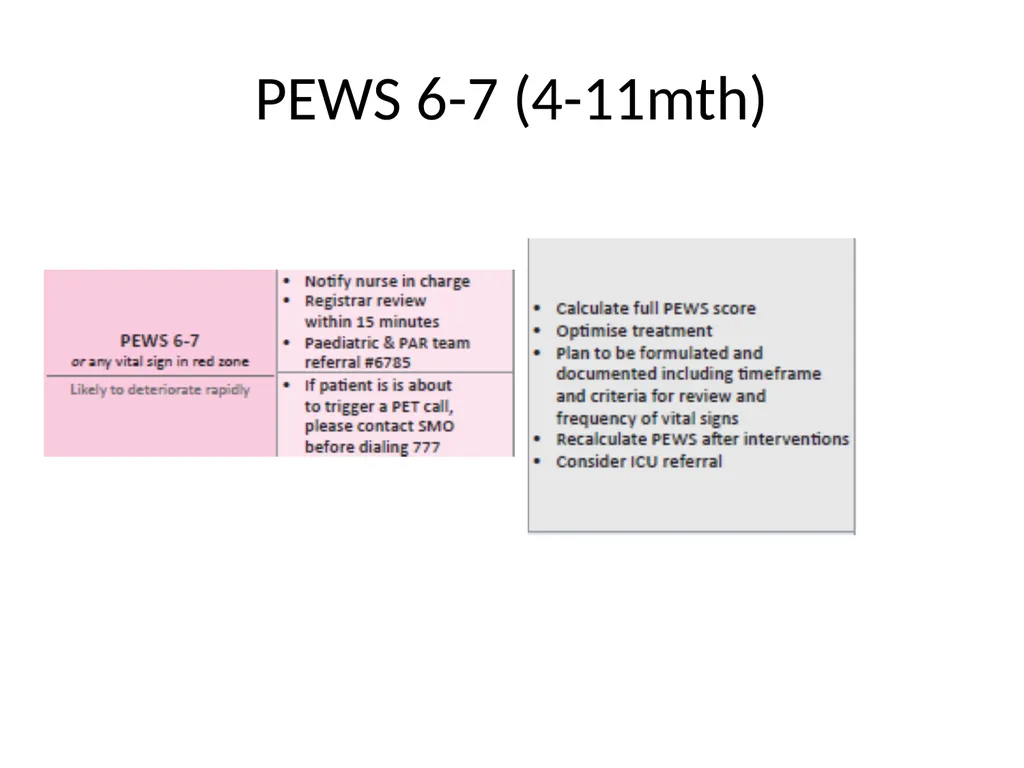
PEWS 6-7 (4-11mth)<br>
31
PEWS 8+ (4-11mth) The colour associated with paediatric emergency team calls (PET) is BLUE<br>
32
The PEWS system does not replace sound clinical judgment
If you are seriously concerned about any patient, regardless of vital signs/PEWS, call ‘777 PET’
Alternatively, if there is no timely response to your request for review, escalate to the next coloured zone.<br>
If you are seriously concerned about any patient, regardless of vital signs/PEWS, call ‘777 PET’
Alternatively, if there is no timely response to your request for review, escalate to the next coloured zone.<br>
33
6. Modification to PEWS Triggers There are cases when clinically stable patients may have abnormal vital signs. In order to accommodate this and prevent alarm-fatigue from over-triggering patient reviews, the PEWS can be modified
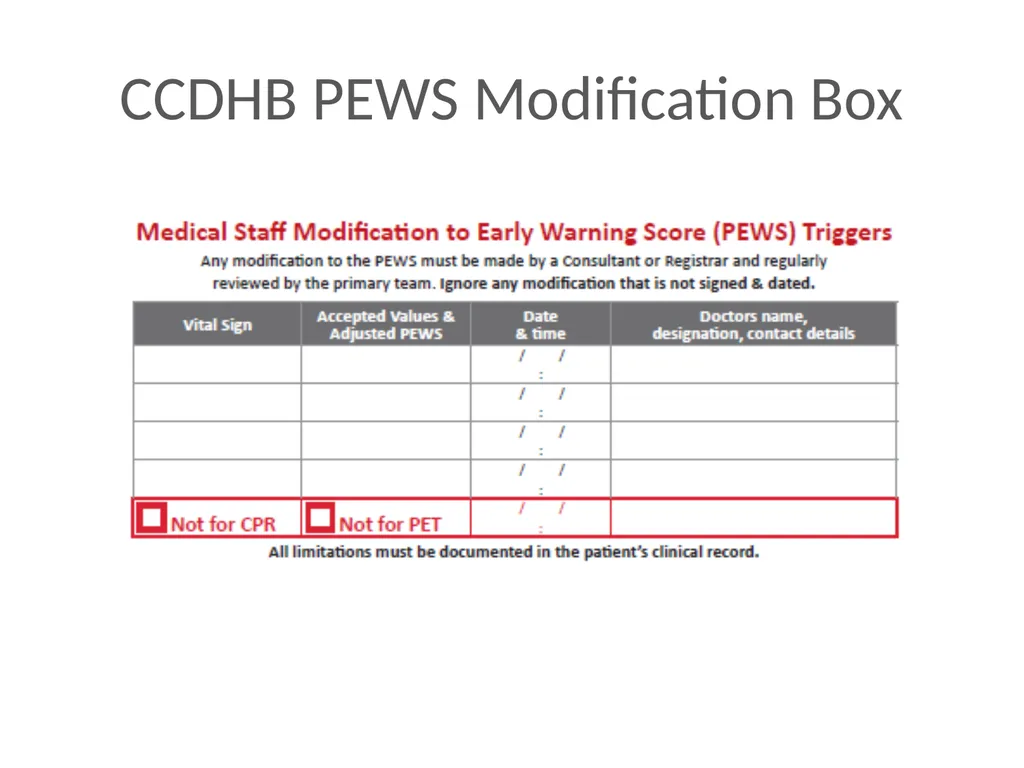
Any modification to the PEWS must be made by a Consultant or Registrar and be regularly reviewed by the primary team
Modification to PEWS must never be used to normalise abnormal vital signs in clinically unstable patients, or deter ward staff from accessing the help they need e.g. preventing 777 calls from being made<br>
34
CCDHB PEWS Modification Box<br>
35
Paediatric EWS Quiz<br>
36
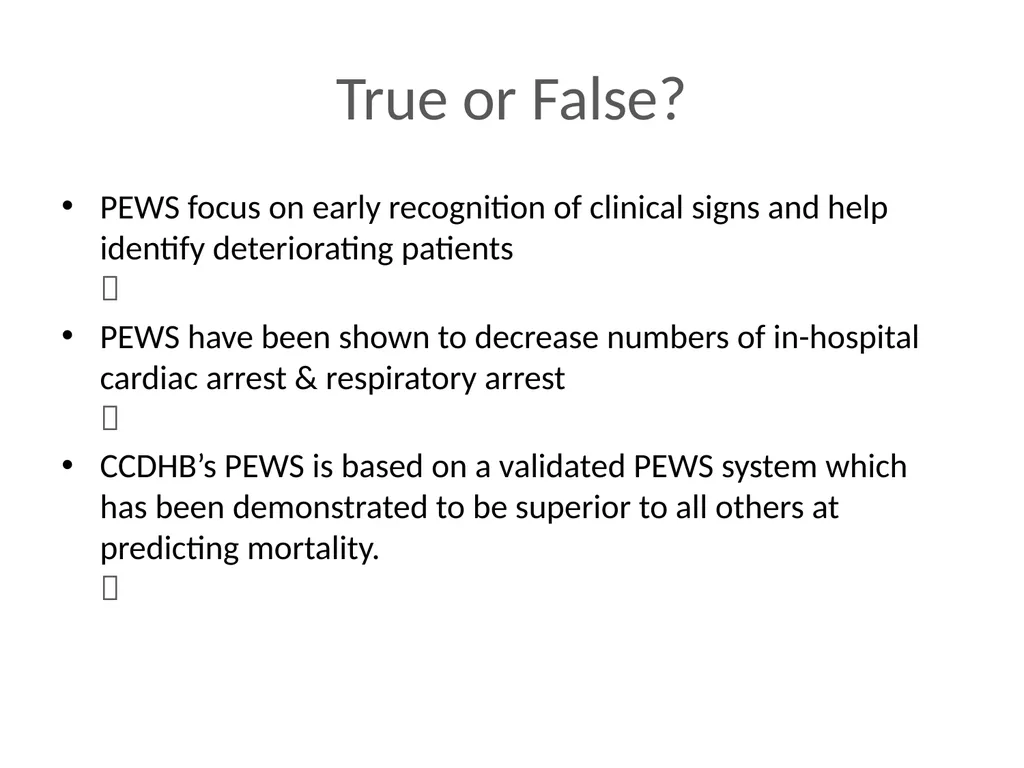
True or False? PEWS focus on early recognition of clinical signs and help identify deteriorating patients
PEWS have been shown to decrease numbers of in-hospital cardiac arrest & respiratory arrest
CCDHB’s PEWS is based on a validated PEWS system which has been demonstrated to be superior to all others at predicting mortality. <br>
PEWS have been shown to decrease numbers of in-hospital cardiac arrest & respiratory arrest
CCDHB’s PEWS is based on a validated PEWS system which has been demonstrated to be superior to all others at predicting mortality. <br>
37
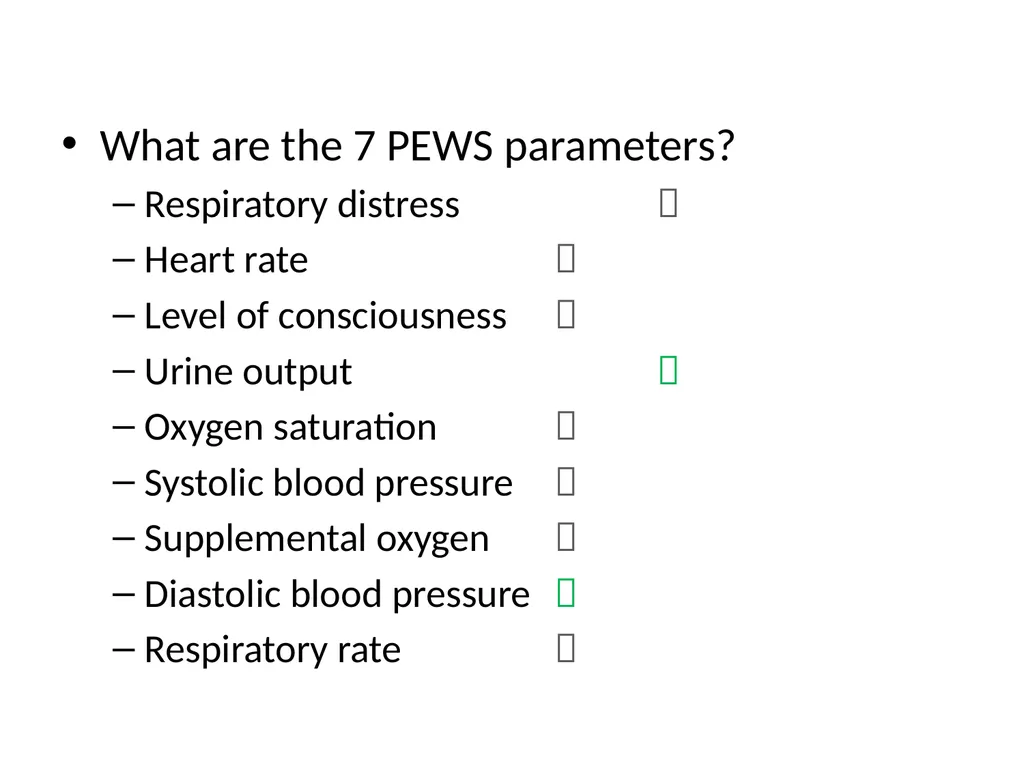
What are the 7 PEWS parameters?
Respiratory distress
Heart rate
Level of consciousness
Urine output
Oxygen saturation
Systolic blood pressure
Supplemental oxygen
Diastolic blood pressure
Respiratory rate <br>
Respiratory distress
Heart rate
Level of consciousness
Urine output
Oxygen saturation
Systolic blood pressure
Supplemental oxygen
Diastolic blood pressure
Respiratory rate <br>
38
Which of the vital signs is considered the most sensitive indicator of acute illness?
Temperature
Heart rate
Respiratory rate <br>
Temperature
Heart rate
Respiratory rate <br>
39
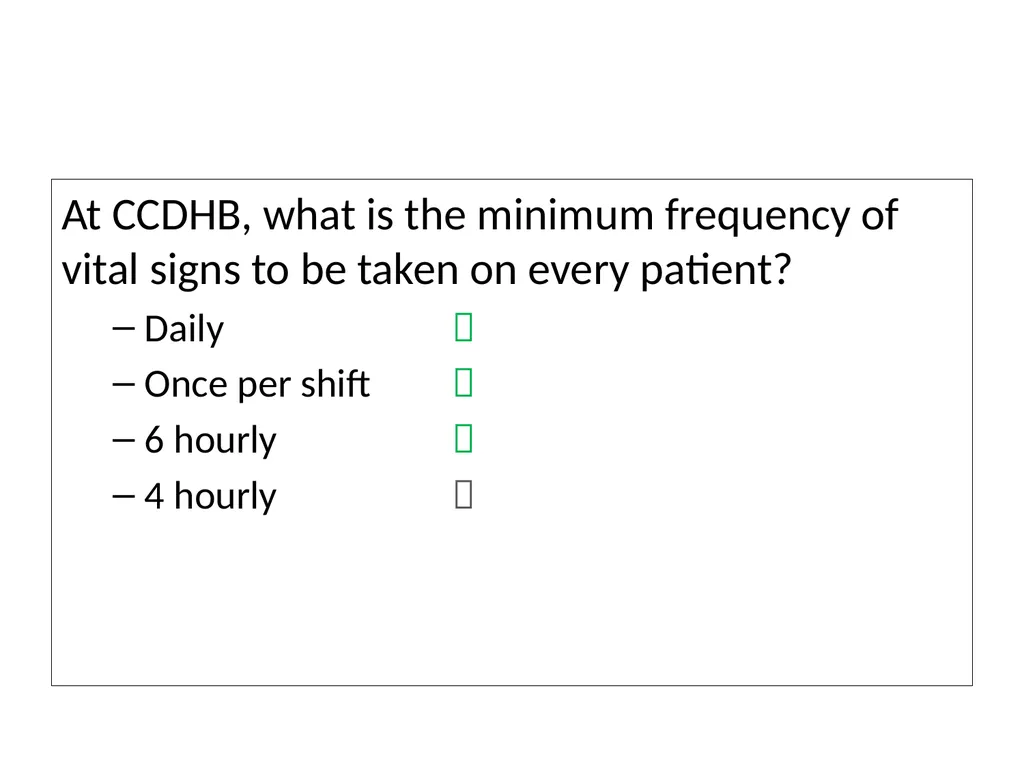
At CCDHB, what is the minimum frequency of vital signs to be taken on every patient?
Daily
Once per shift
6 hourly
4 hourly <br>
Daily
Once per shift
6 hourly
4 hourly <br>
40
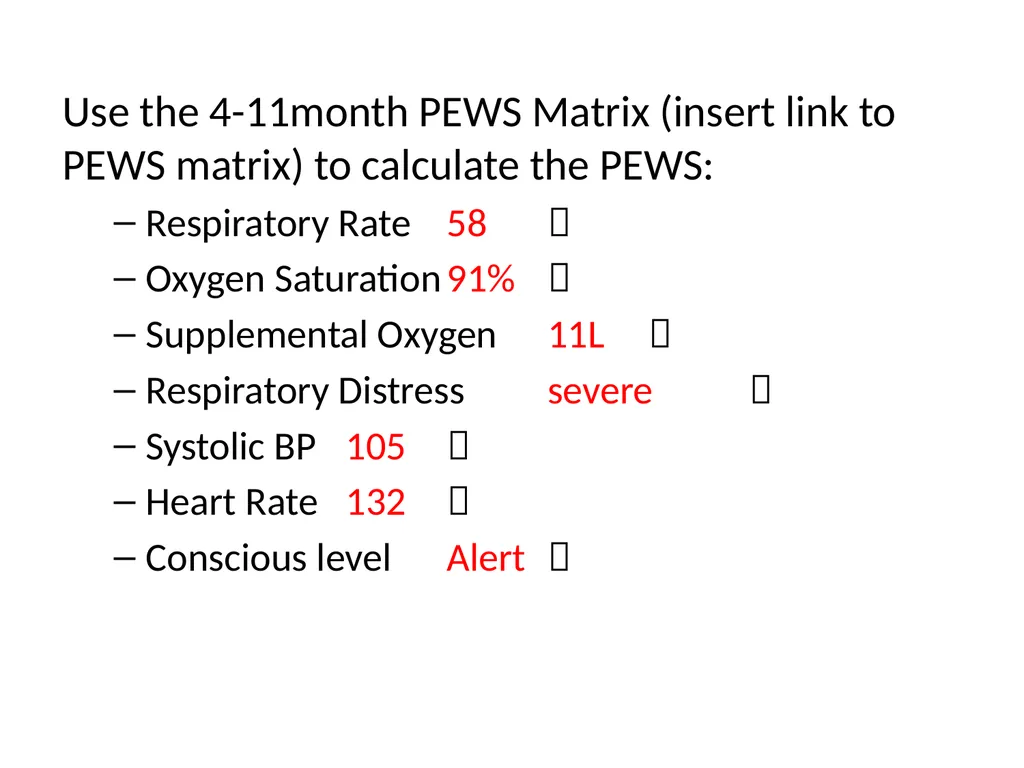
Use the 4-11month PEWS Matrix (insert link to PEWS matrix) to calculate the PEWS:
Respiratory Rate 58
Oxygen Saturation 91%
Supplemental Oxygen 11L
Respiratory Distress severe
Systolic BP 105
Heart Rate 132
Conscious level Alert <br>
Respiratory Rate 58
Oxygen Saturation 91%
Supplemental Oxygen 11L
Respiratory Distress severe
Systolic BP 105
Heart Rate 132
Conscious level Alert <br>
41
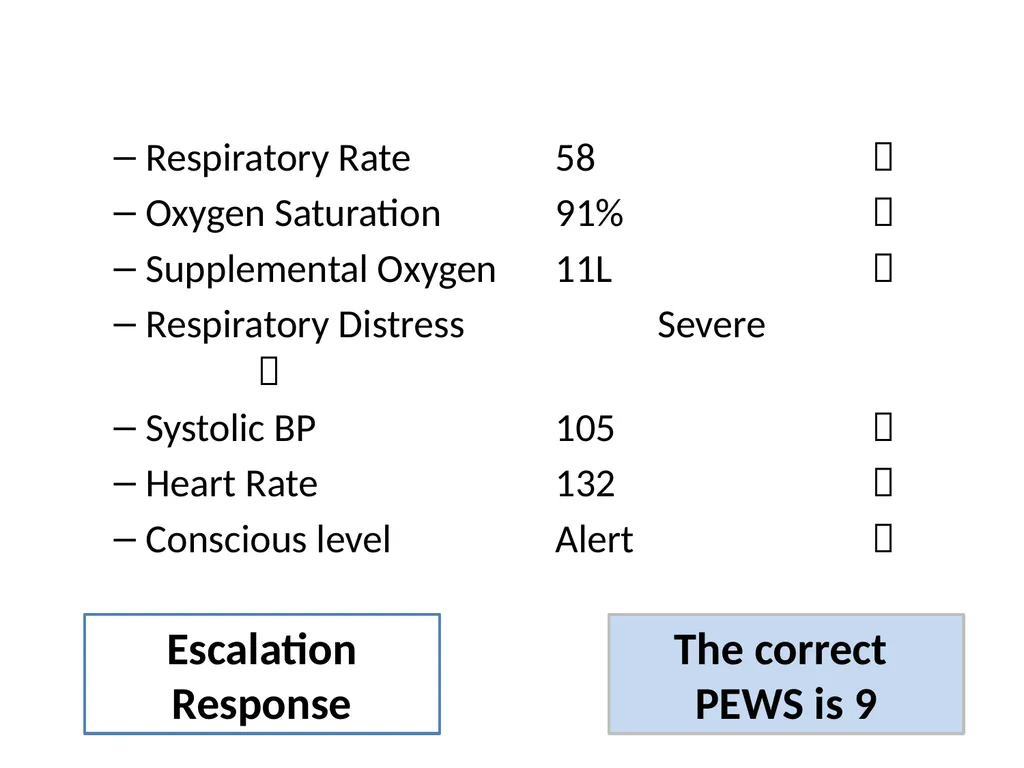
Respiratory Rate 58
Oxygen Saturation 91%
Supplemental Oxygen 11L
Respiratory Distress Severe
Systolic BP 105
Heart Rate 132
Conscious level Alert The correct
PEWS is 9 Escalation
Response<br>
Oxygen Saturation 91%
Supplemental Oxygen 11L
Respiratory Distress Severe
Systolic BP 105
Heart Rate 132
Conscious level Alert The correct
PEWS is 9 Escalation
Response<br>
42
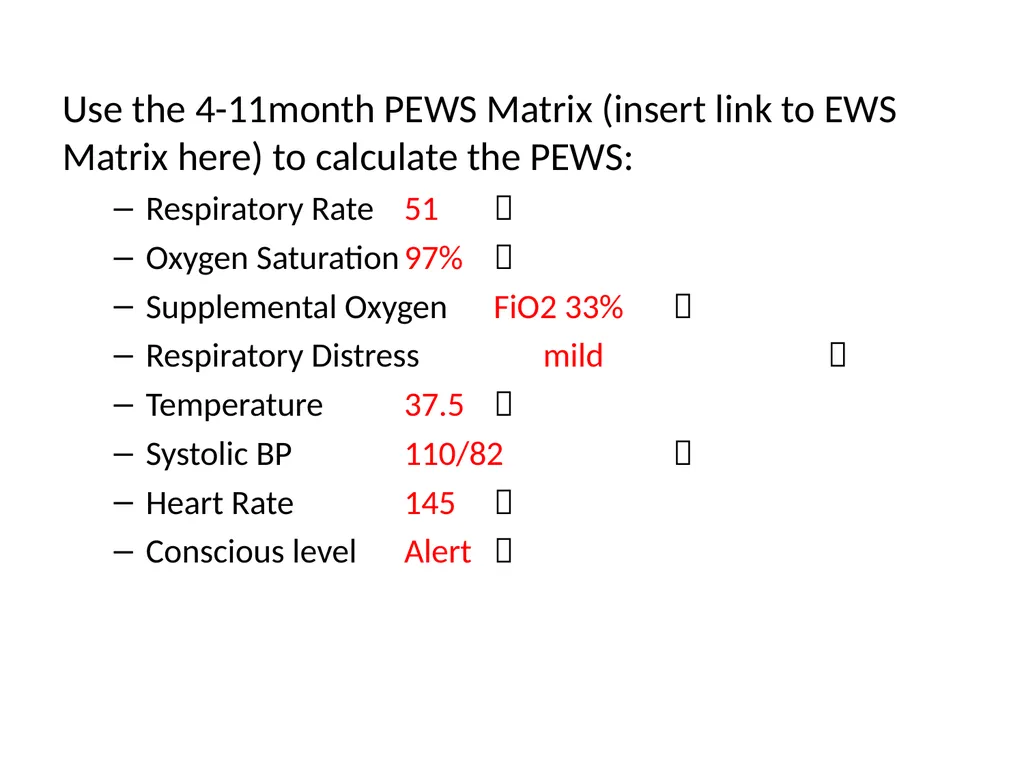
Use the 4-11month PEWS Matrix (insert link to EWS Matrix here) to calculate the PEWS:
Respiratory Rate 51
Oxygen Saturation 97%
Supplemental Oxygen FiO2 33%
Respiratory Distress mild
Temperature 37.5
Systolic BP 110/82
Heart Rate 145
Conscious level Alert <br>
Respiratory Rate 51
Oxygen Saturation 97%
Supplemental Oxygen FiO2 33%
Respiratory Distress mild
Temperature 37.5
Systolic BP 110/82
Heart Rate 145
Conscious level Alert <br>
43
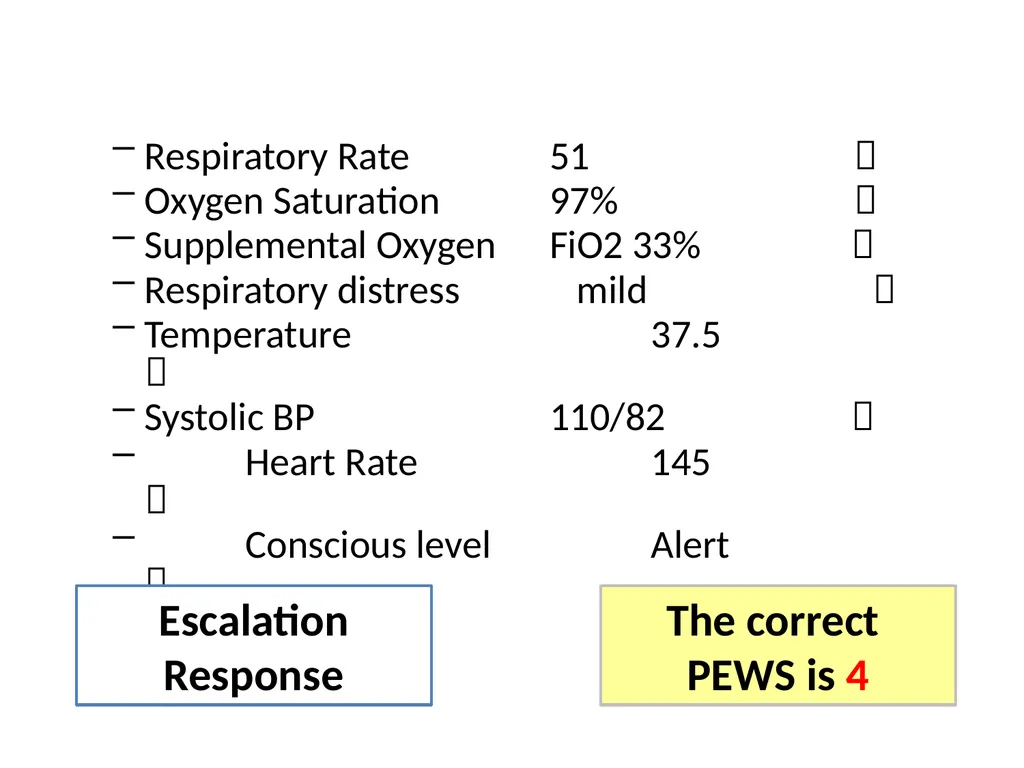
Respiratory Rate 51
Oxygen Saturation 97%
Supplemental Oxygen FiO2 33%
Respiratory distress mild
Temperature 37.5
Systolic BP 110/82
Heart Rate 145
Conscious level Alert The correct
PEWS is 4 Escalation
Response<br>
Oxygen Saturation 97%
Supplemental Oxygen FiO2 33%
Respiratory distress mild
Temperature 37.5
Systolic BP 110/82
Heart Rate 145
Conscious level Alert The correct
PEWS is 4 Escalation
Response<br>
44
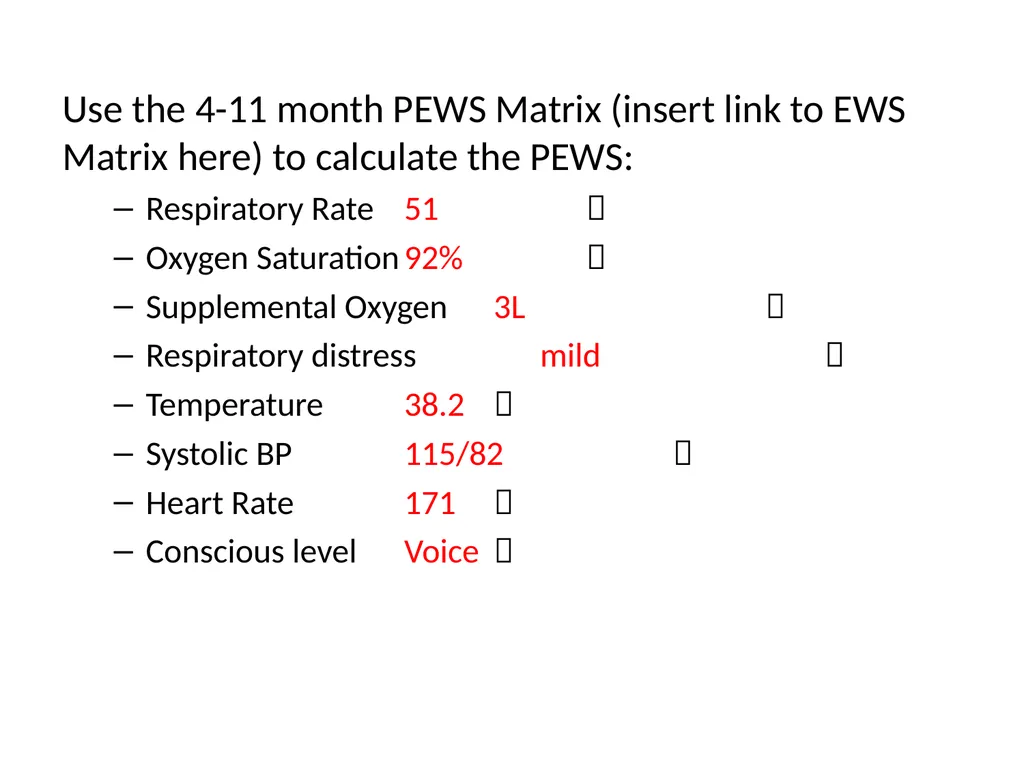
Use the 4-11 month PEWS Matrix (insert link to EWS Matrix here) to calculate the PEWS:
Respiratory Rate 51
Oxygen Saturation 92%
Supplemental Oxygen 3L
Respiratory distress mild
Temperature 38.2
Systolic BP 115/82
Heart Rate 171
Conscious level Voice <br>
Respiratory Rate 51
Oxygen Saturation 92%
Supplemental Oxygen 3L
Respiratory distress mild
Temperature 38.2
Systolic BP 115/82
Heart Rate 171
Conscious level Voice <br>
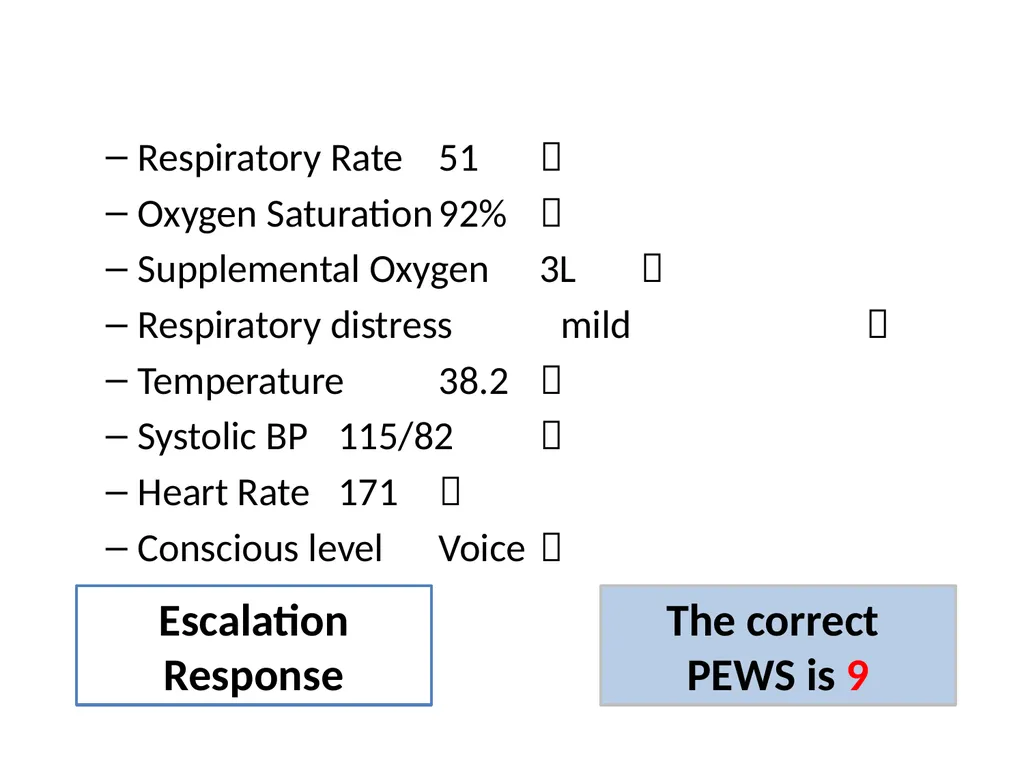
45
Respiratory Rate 51
Oxygen Saturation 92%
Supplemental Oxygen 3L
Respiratory distress mild
Temperature 38.2
Systolic BP 115/82
Heart Rate 171
Conscious level Voice The correct
PEWS is 9 Escalation
Response<br>
Oxygen Saturation 92%
Supplemental Oxygen 3L
Respiratory distress mild
Temperature 38.2
Systolic BP 115/82
Heart Rate 171
Conscious level Voice The correct
PEWS is 9 Escalation
Response<br>
46
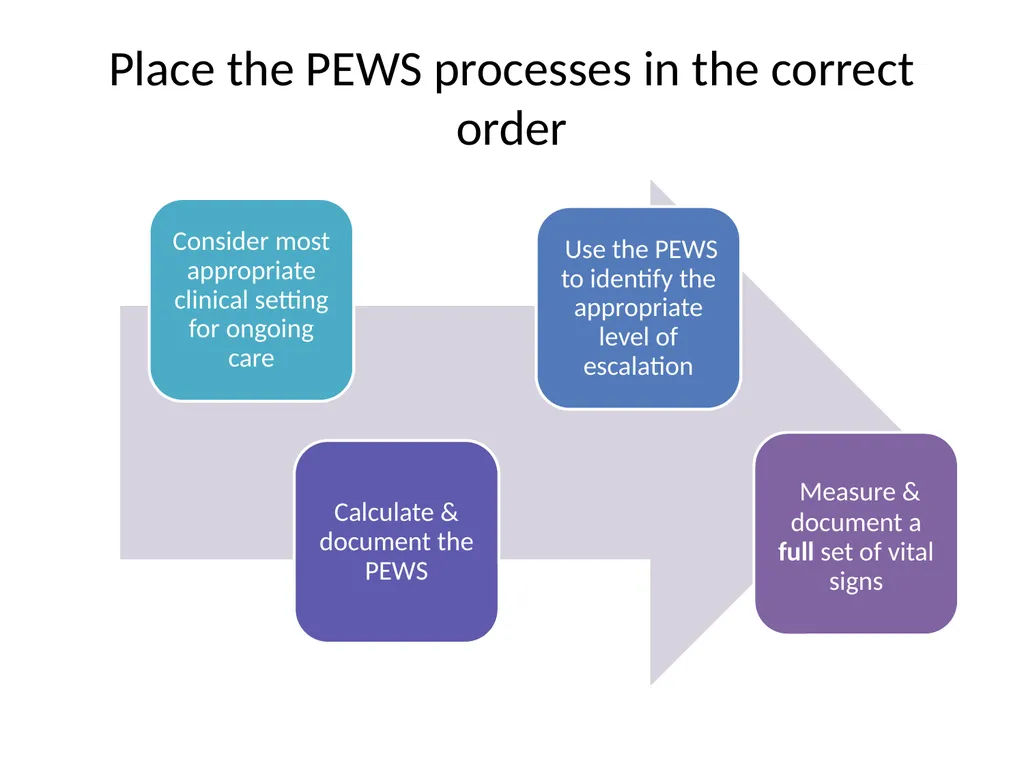
Place the PEWS processes in the correct order<br>
47
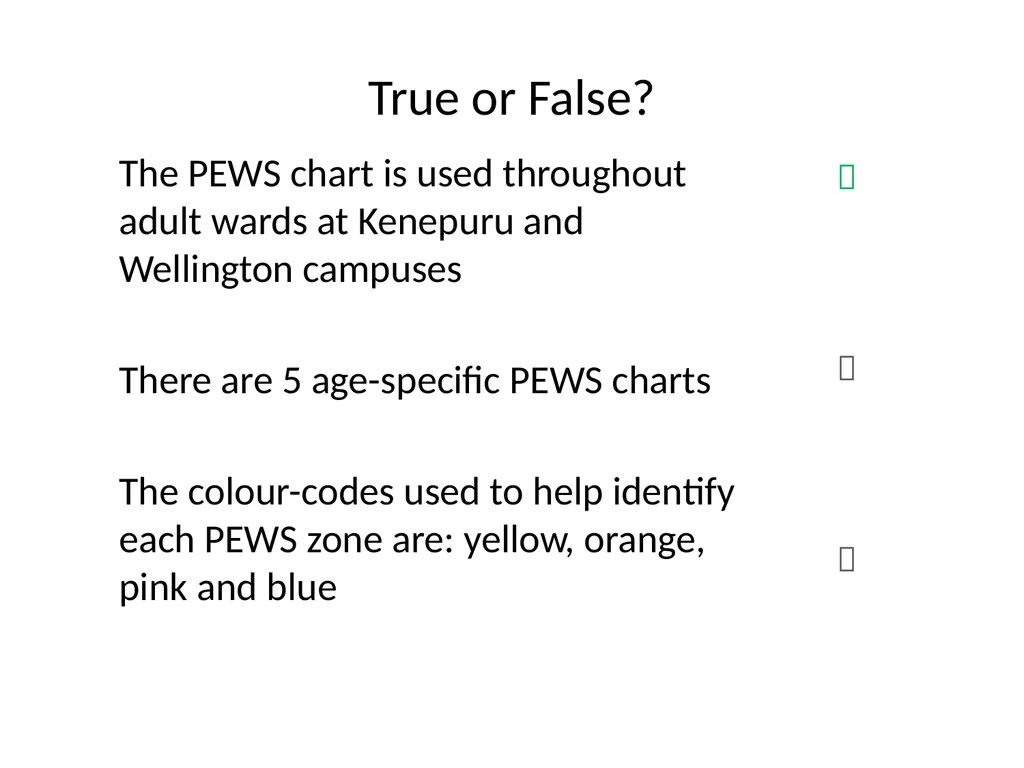
True or False?
The PEWS chart is used throughout adult wards at Kenepuru and Wellington campuses
There are 5 age-specific PEWS charts
The colour-codes used to help identify each PEWS zone are: yellow, orange, pink and blue<br>
The PEWS chart is used throughout adult wards at Kenepuru and Wellington campuses
There are 5 age-specific PEWS charts
The colour-codes used to help identify each PEWS zone are: yellow, orange, pink and blue<br>
48
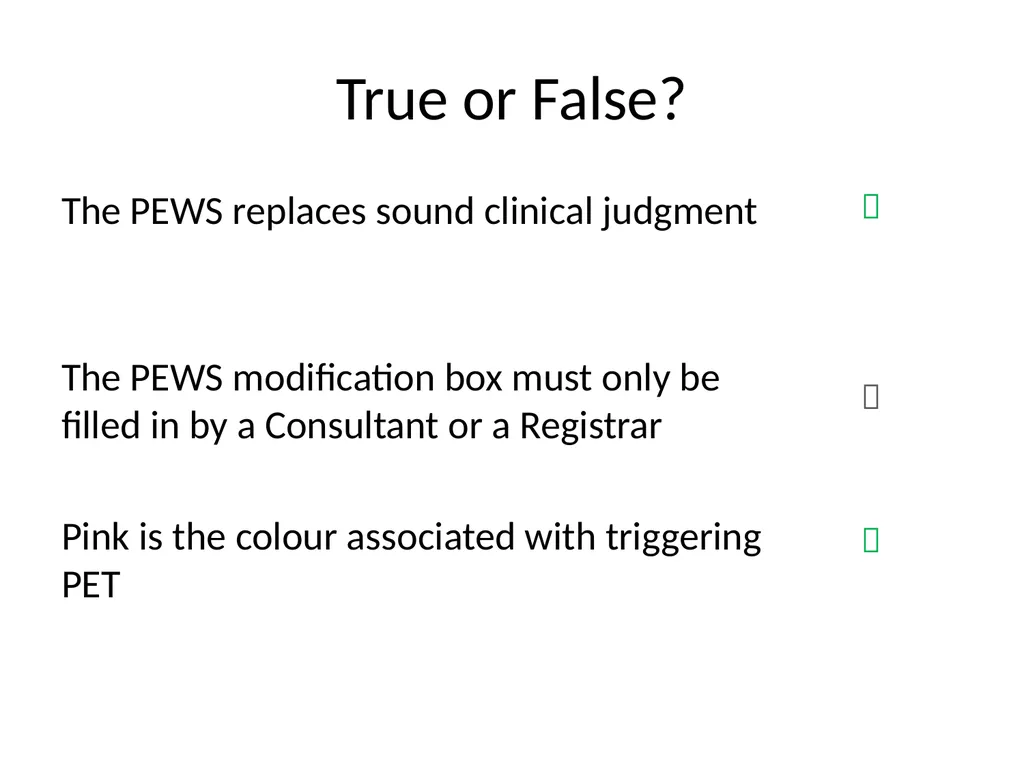
True or False? The PEWS replaces sound clinical judgment
The PEWS modification box must only be filled in by a Consultant or a Registrar
Pink is the colour associated with triggering PET
<br>
The PEWS modification box must only be filled in by a Consultant or a Registrar
Pink is the colour associated with triggering PET
<br>