
East Midlands GP Practice Flu Vaccination Toolkit
AS
Published · 21 slides · 0 views
1 / 1


Description
East Midlands GP Practice Flu Vaccination Toolkit East Midlands Vaccinations Public Health Commissioning Team - NHS England (Midlands) August 2024 Aim of this toolkit The purpose of this toolkit is to support GP Practices improve flu
Related Topics
Share
Embed code
Download this presentation From Below
"East Midlands GP Practice Flu Vaccination Toolkit" is the property of its rightful owner. Permission is granted to download and print the materials on this website for personal, non-commercial use only, and to display it on your personal computer provided you do not modify the materials and that you retain all copyright notices contained in the materials. By downloading content from our website, you accept the terms of this agreement.
Presentation Transcript
01
East Midlands
GP Practice
Flu Vaccination
Toolkit East Midlands Vaccinations Public Health Commissioning Team - NHS England (Midlands) August 2024<br>
02
Aim of this toolkit The purpose of this toolkit is to support GP Practices improve
flu vaccine uptake in 2024/25 flu season
https://www.gov.uk/government/publications/national-flu-immunisation-programme-plan-2024-to-2025<br>
flu vaccine uptake in 2024/25 flu season
https://www.gov.uk/government/publications/national-flu-immunisation-programme-plan-2024-to-2025<br>
03
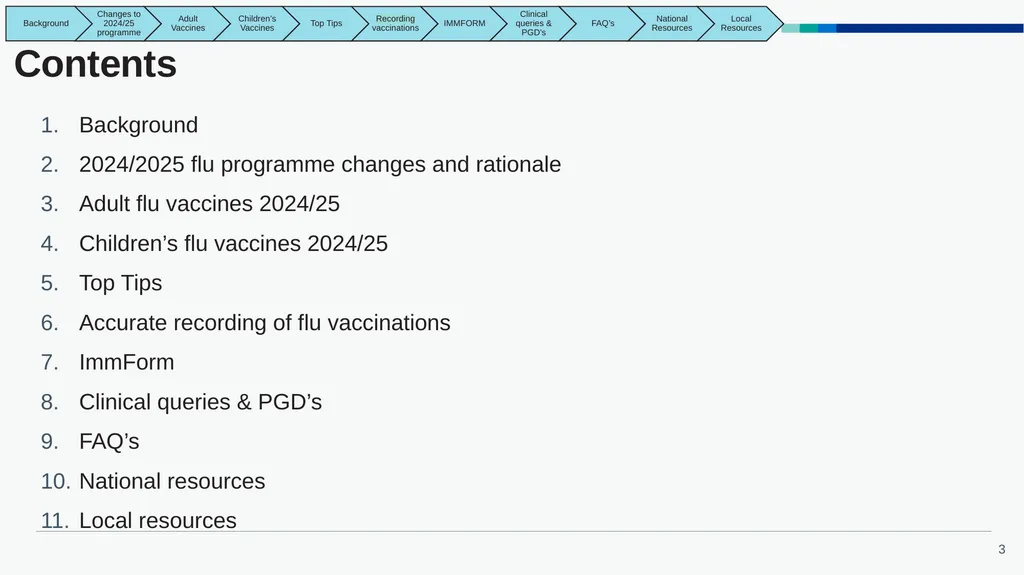
Contents Background
2024/2025 flu programme changes and rationale
Adult flu vaccines 2024/25
Children’s flu vaccines 2024/25
Top Tips
Accurate recording of flu vaccinations
ImmForm
Clinical queries & PGD’s
FAQ’s
National resources
Local resources<br>
2024/2025 flu programme changes and rationale
Adult flu vaccines 2024/25
Children’s flu vaccines 2024/25
Top Tips
Accurate recording of flu vaccinations
ImmForm
Clinical queries & PGD’s
FAQ’s
National resources
Local resources<br>
04
The purpose of the seasonal flu vaccination programme is to protect those most at risk of developing influenza associated morbidity and mortality.
Influenza is a highly infectious, acute viral respiratory tract infection which has a usual incubation period of 1 to 3 days. Patients can experience sudden onset of symptoms such as dry cough, headache, fever and extreme fatigue. For otherwise healthy individuals, it is an unpleasant but usually self-limiting disease with recovery occurring within 2 to 7 days.
More serious illness may occur in children under 5 years, pregnant women, those aged over 65 years and those with underlying health conditions. These groups are at higher risk of developing severe complications such as bronchitis, secondary bacterial pneumonia, or otitis media in children.
Seasonal flu vaccination is a critically important public health intervention that reduces morbidity, mortality, hospitalisation and pressure on primary care associated with flu at a time when the NHS and social care will be managing winter pressures. Background - Influenza<br>
Influenza is a highly infectious, acute viral respiratory tract infection which has a usual incubation period of 1 to 3 days. Patients can experience sudden onset of symptoms such as dry cough, headache, fever and extreme fatigue. For otherwise healthy individuals, it is an unpleasant but usually self-limiting disease with recovery occurring within 2 to 7 days.
More serious illness may occur in children under 5 years, pregnant women, those aged over 65 years and those with underlying health conditions. These groups are at higher risk of developing severe complications such as bronchitis, secondary bacterial pneumonia, or otitis media in children.
Seasonal flu vaccination is a critically important public health intervention that reduces morbidity, mortality, hospitalisation and pressure on primary care associated with flu at a time when the NHS and social care will be managing winter pressures. Background - Influenza<br>
05
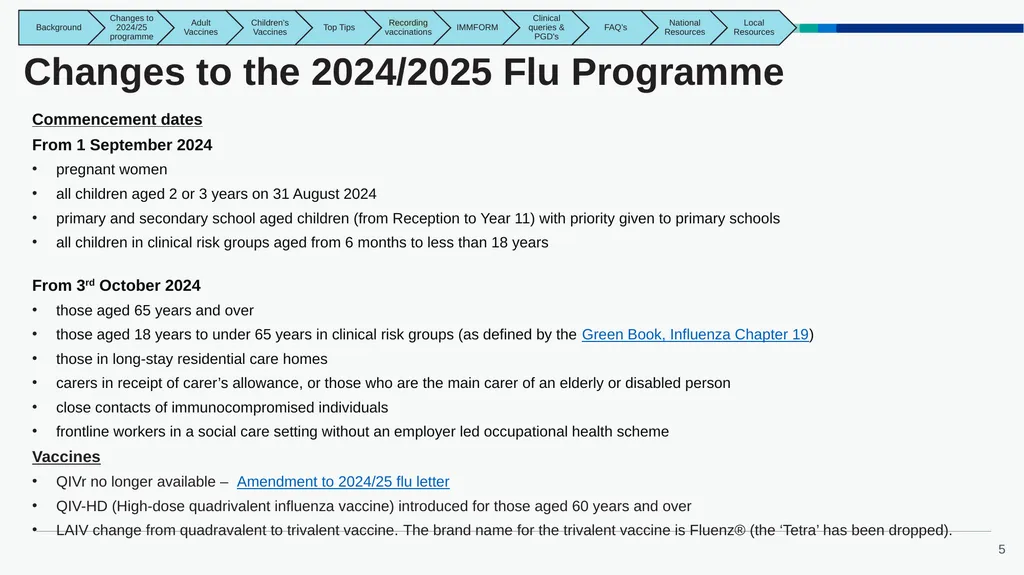
Commencement dates
From 1 September 2024
pregnant women
all children aged 2 or 3 years on 31 August 2024
primary and secondary school aged children (from Reception to Year 11) with priority given to primary schools
all children in clinical risk groups aged from 6 months to less than 18 years
From 3rd October 2024
those aged 65 years and over
those aged 18 years to under 65 years in clinical risk groups (as defined by the Green Book, Influenza Chapter 19)
those in long-stay residential care homes
carers in receipt of carer’s allowance, or those who are the main carer of an elderly or disabled person
close contacts of immunocompromised individuals
frontline workers in a social care setting without an employer led occupational health scheme
Vaccines
QIVr no longer available – Amendment to 2024/25 flu letter
QIV-HD (High-dose quadrivalent influenza vaccine) introduced for those aged 60 years and over
LAIV change from quadravalent to trivalent vaccine. The brand name for the trivalent vaccine is Fluenz® (the ‘Tetra’ has been dropped). Changes to the 2024/2025 Flu Programme<br>
From 1 September 2024
pregnant women
all children aged 2 or 3 years on 31 August 2024
primary and secondary school aged children (from Reception to Year 11) with priority given to primary schools
all children in clinical risk groups aged from 6 months to less than 18 years
From 3rd October 2024
those aged 65 years and over
those aged 18 years to under 65 years in clinical risk groups (as defined by the Green Book, Influenza Chapter 19)
those in long-stay residential care homes
carers in receipt of carer’s allowance, or those who are the main carer of an elderly or disabled person
close contacts of immunocompromised individuals
frontline workers in a social care setting without an employer led occupational health scheme
Vaccines
QIVr no longer available – Amendment to 2024/25 flu letter
QIV-HD (High-dose quadrivalent influenza vaccine) introduced for those aged 60 years and over
LAIV change from quadravalent to trivalent vaccine. The brand name for the trivalent vaccine is Fluenz® (the ‘Tetra’ has been dropped). Changes to the 2024/2025 Flu Programme<br>
06
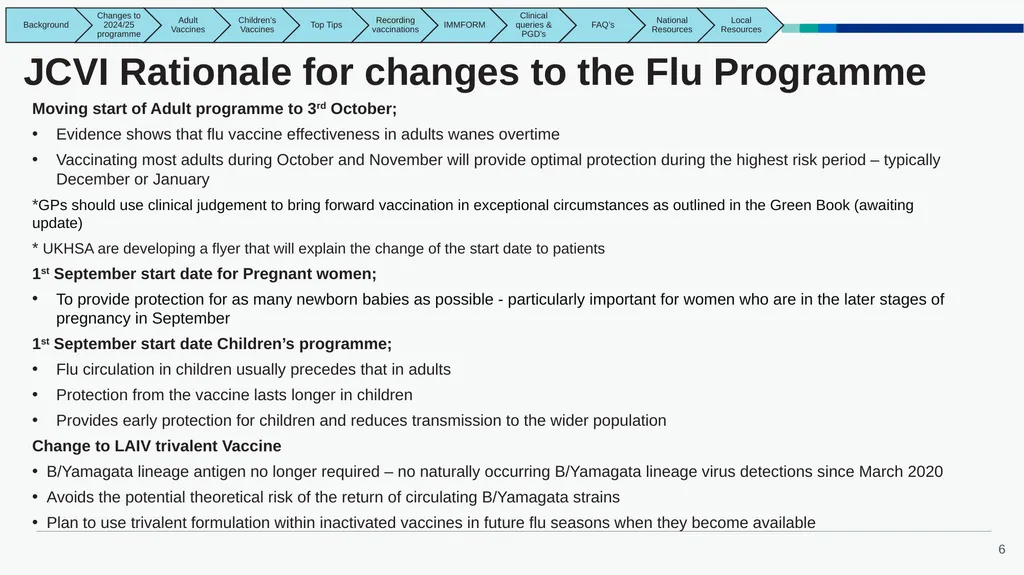
Moving start of Adult programme to 3rd October;
Evidence shows that flu vaccine effectiveness in adults wanes overtime
Vaccinating most adults during October and November will provide optimal protection during the highest risk period – typically December or January
*GPs should use clinical judgement to bring forward vaccination in exceptional circumstances as outlined in the Green Book (awaiting update)
* UKHSA are developing a flyer that will explain the change of the start date to patients
1st September start date for Pregnant women;
To provide protection for as many newborn babies as possible - particularly important for women who are in the later stages of pregnancy in September
1st September start date Children’s programme;
Flu circulation in children usually precedes that in adults
Protection from the vaccine lasts longer in children
Provides early protection for children and reduces transmission to the wider population
Change to LAIV trivalent Vaccine
B/Yamagata lineage antigen no longer required – no naturally occurring B/Yamagata lineage virus detections since March 2020
Avoids the potential theoretical risk of the return of circulating B/Yamagata strains
Plan to use trivalent formulation within inactivated vaccines in future flu seasons when they become available JCVI Rationale for changes to the Flu Programme<br>
Evidence shows that flu vaccine effectiveness in adults wanes overtime
Vaccinating most adults during October and November will provide optimal protection during the highest risk period – typically December or January
*GPs should use clinical judgement to bring forward vaccination in exceptional circumstances as outlined in the Green Book (awaiting update)
* UKHSA are developing a flyer that will explain the change of the start date to patients
1st September start date for Pregnant women;
To provide protection for as many newborn babies as possible - particularly important for women who are in the later stages of pregnancy in September
1st September start date Children’s programme;
Flu circulation in children usually precedes that in adults
Protection from the vaccine lasts longer in children
Provides early protection for children and reduces transmission to the wider population
Change to LAIV trivalent Vaccine
B/Yamagata lineage antigen no longer required – no naturally occurring B/Yamagata lineage virus detections since March 2020
Avoids the potential theoretical risk of the return of circulating B/Yamagata strains
Plan to use trivalent formulation within inactivated vaccines in future flu seasons when they become available JCVI Rationale for changes to the Flu Programme<br>
07
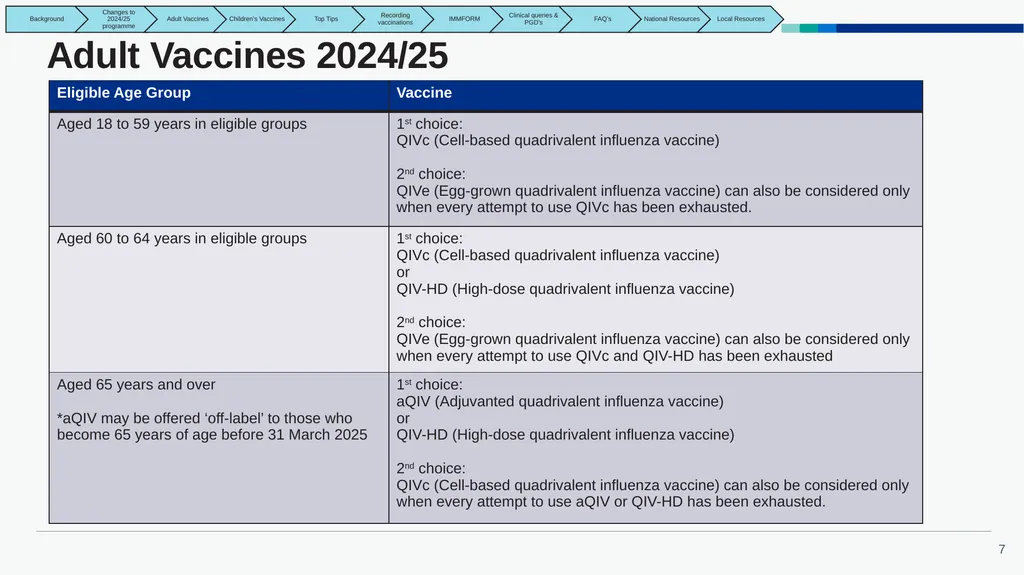
Adult Vaccines 2024/25<br>
08
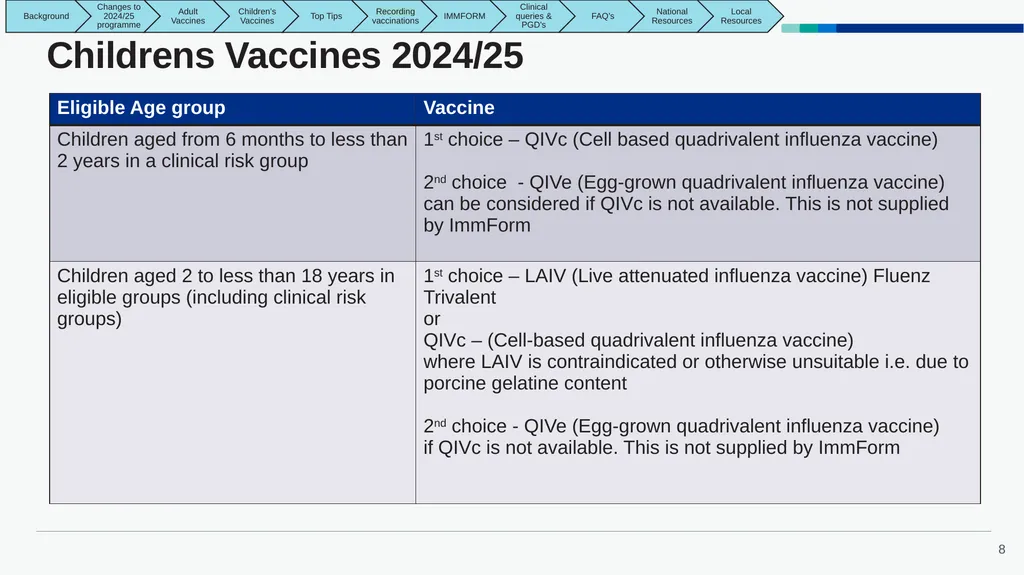
Childrens Vaccines 2024/25<br>
09
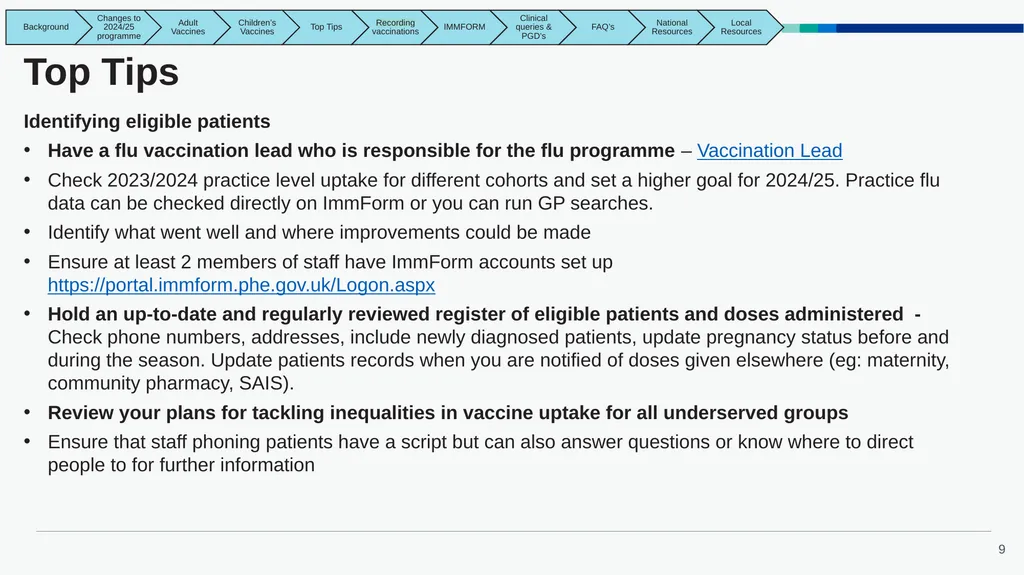
Identifying eligible patients
Have a flu vaccination lead who is responsible for the flu programme – Vaccination Lead
Check 2023/2024 practice level uptake for different cohorts and set a higher goal for 2024/25. Practice flu data can be checked directly on ImmForm or you can run GP searches.
Identify what went well and where improvements could be made
Ensure at least 2 members of staff have ImmForm accounts set up https://portal.immform.phe.gov.uk/Logon.aspx
Hold an up-to-date and regularly reviewed register of eligible patients and doses administered - Check phone numbers, addresses, include newly diagnosed patients, update pregnancy status before and during the season. Update patients records when you are notified of doses given elsewhere (eg: maternity, community pharmacy, SAIS).
Review your plans for tackling inequalities in vaccine uptake for all underserved groups
Ensure that staff phoning patients have a script but can also answer questions or know where to direct people to for further information Top Tips<br>
Have a flu vaccination lead who is responsible for the flu programme – Vaccination Lead
Check 2023/2024 practice level uptake for different cohorts and set a higher goal for 2024/25. Practice flu data can be checked directly on ImmForm or you can run GP searches.
Identify what went well and where improvements could be made
Ensure at least 2 members of staff have ImmForm accounts set up https://portal.immform.phe.gov.uk/Logon.aspx
Hold an up-to-date and regularly reviewed register of eligible patients and doses administered - Check phone numbers, addresses, include newly diagnosed patients, update pregnancy status before and during the season. Update patients records when you are notified of doses given elsewhere (eg: maternity, community pharmacy, SAIS).
Review your plans for tackling inequalities in vaccine uptake for all underserved groups
Ensure that staff phoning patients have a script but can also answer questions or know where to direct people to for further information Top Tips<br>
10
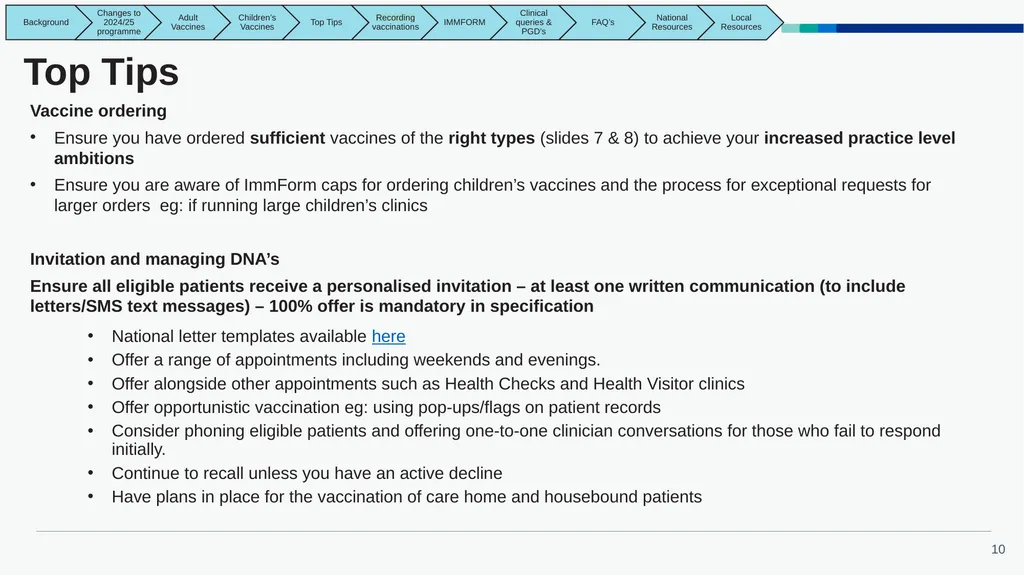
Vaccine ordering
Ensure you have ordered sufficient vaccines of the right types (slides 7 & 8) to achieve your increased practice level ambitions
Ensure you are aware of ImmForm caps for ordering children’s vaccines and the process for exceptional requests for larger orders eg: if running large children’s clinics
Invitation and managing DNA’s
Ensure all eligible patients receive a personalised invitation – at least one written communication (to include letters/SMS text messages) – 100% offer is mandatory in specification
National letter templates available here
Offer a range of appointments including weekends and evenings.
Offer alongside other appointments such as Health Checks and Health Visitor clinics
Offer opportunistic vaccination eg: using pop-ups/flags on patient records
Consider phoning eligible patients and offering one-to-one clinician conversations for those who fail to respond initially.
Continue to recall unless you have an active decline
Have plans in place for the vaccination of care home and housebound patients Top Tips<br>
Ensure you have ordered sufficient vaccines of the right types (slides 7 & 8) to achieve your increased practice level ambitions
Ensure you are aware of ImmForm caps for ordering children’s vaccines and the process for exceptional requests for larger orders eg: if running large children’s clinics
Invitation and managing DNA’s
Ensure all eligible patients receive a personalised invitation – at least one written communication (to include letters/SMS text messages) – 100% offer is mandatory in specification
National letter templates available here
Offer a range of appointments including weekends and evenings.
Offer alongside other appointments such as Health Checks and Health Visitor clinics
Offer opportunistic vaccination eg: using pop-ups/flags on patient records
Consider phoning eligible patients and offering one-to-one clinician conversations for those who fail to respond initially.
Continue to recall unless you have an active decline
Have plans in place for the vaccination of care home and housebound patients Top Tips<br>
11
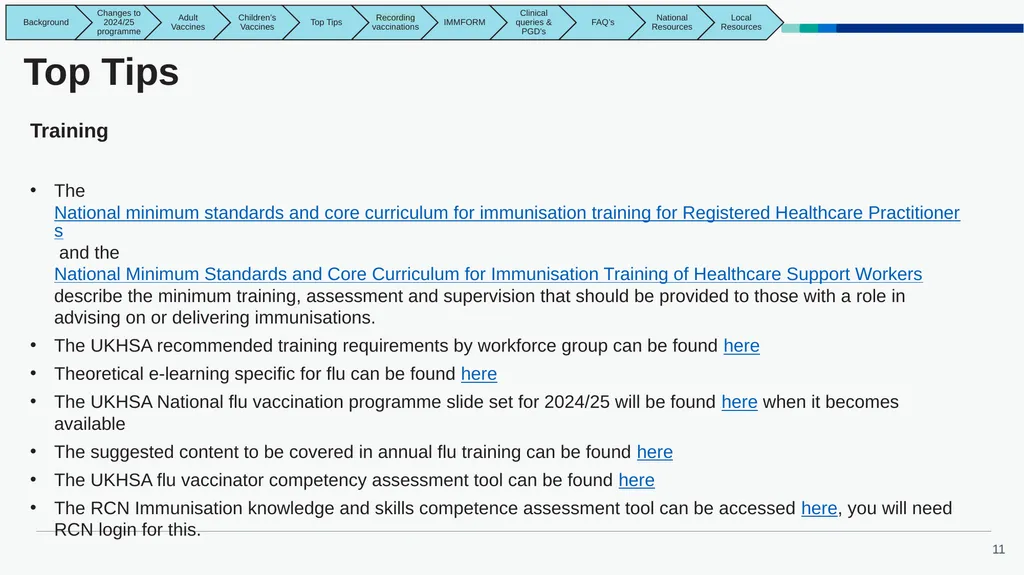
Training
The National minimum standards and core curriculum for immunisation training for Registered Healthcare Practitioners and the National Minimum Standards and Core Curriculum for Immunisation Training of Healthcare Support Workers describe the minimum training, assessment and supervision that should be provided to those with a role in advising on or delivering immunisations.
The UKHSA recommended training requirements by workforce group can be found here
Theoretical e-learning specific for flu can be found here
The UKHSA National flu vaccination programme slide set for 2024/25 will be found here when it becomes available
The suggested content to be covered in annual flu training can be found here
The UKHSA flu vaccinator competency assessment tool can be found here
The RCN Immunisation knowledge and skills competence assessment tool can be accessed here, you will need RCN login for this. Top Tips<br>
The National minimum standards and core curriculum for immunisation training for Registered Healthcare Practitioners and the National Minimum Standards and Core Curriculum for Immunisation Training of Healthcare Support Workers describe the minimum training, assessment and supervision that should be provided to those with a role in advising on or delivering immunisations.
The UKHSA recommended training requirements by workforce group can be found here
Theoretical e-learning specific for flu can be found here
The UKHSA National flu vaccination programme slide set for 2024/25 will be found here when it becomes available
The suggested content to be covered in annual flu training can be found here
The UKHSA flu vaccinator competency assessment tool can be found here
The RCN Immunisation knowledge and skills competence assessment tool can be accessed here, you will need RCN login for this. Top Tips<br>
12
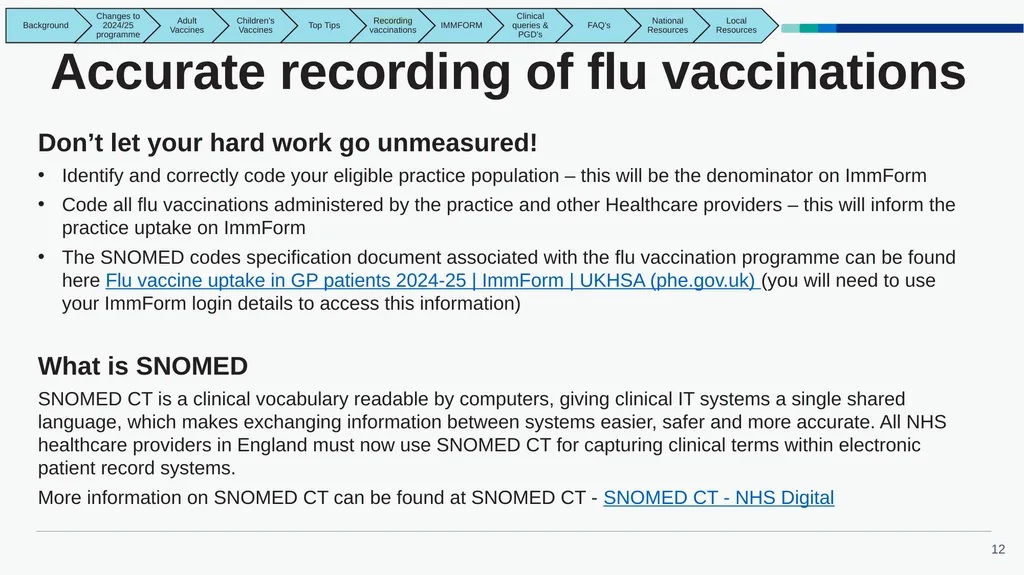
Accurate recording of flu vaccinations Don’t let your hard work go unmeasured!
Identify and correctly code your eligible practice population – this will be the denominator on ImmForm
Code all flu vaccinations administered by the practice and other Healthcare providers – this will inform the practice uptake on ImmForm
The SNOMED codes specification document associated with the flu vaccination programme can be found here Flu vaccine uptake in GP patients 2024-25 | ImmForm | UKHSA (phe.gov.uk) (you will need to use your ImmForm login details to access this information)
What is SNOMED
SNOMED CT is a clinical vocabulary readable by computers, giving clinical IT systems a single shared language, which makes exchanging information between systems easier, safer and more accurate. All NHS healthcare providers in England must now use SNOMED CT for capturing clinical terms within electronic patient record systems.
More information on SNOMED CT can be found at SNOMED CT - SNOMED CT - NHS Digital<br>
Identify and correctly code your eligible practice population – this will be the denominator on ImmForm
Code all flu vaccinations administered by the practice and other Healthcare providers – this will inform the practice uptake on ImmForm
The SNOMED codes specification document associated with the flu vaccination programme can be found here Flu vaccine uptake in GP patients 2024-25 | ImmForm | UKHSA (phe.gov.uk) (you will need to use your ImmForm login details to access this information)
What is SNOMED
SNOMED CT is a clinical vocabulary readable by computers, giving clinical IT systems a single shared language, which makes exchanging information between systems easier, safer and more accurate. All NHS healthcare providers in England must now use SNOMED CT for capturing clinical terms within electronic patient record systems.
More information on SNOMED CT can be found at SNOMED CT - SNOMED CT - NHS Digital<br>
13
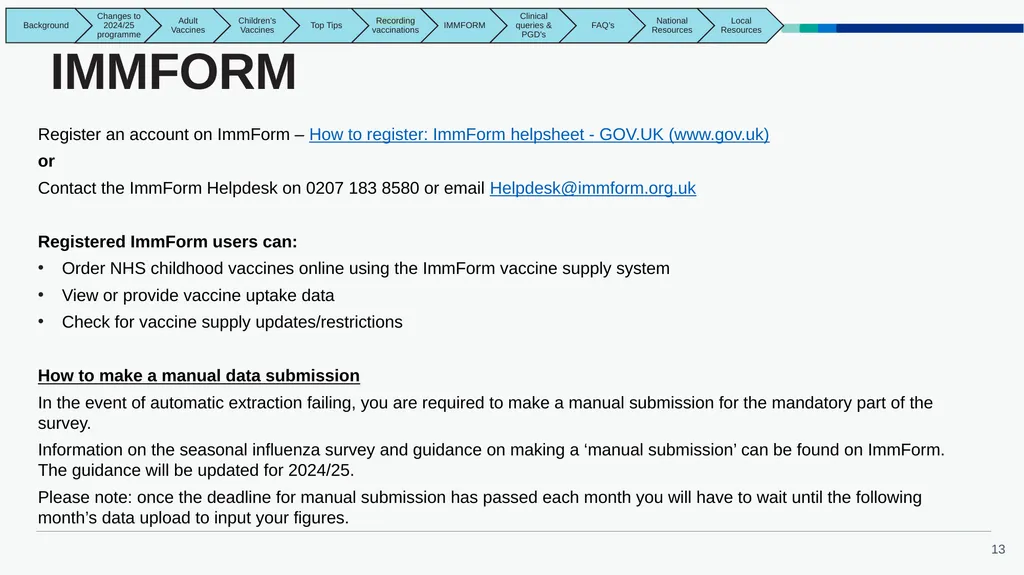
IMMFORM Register an account on ImmForm – How to register: ImmForm helpsheet - GOV.UK (www.gov.uk)
or
Contact the ImmForm Helpdesk on 0207 183 8580 or email Helpdesk@immform.org.uk
Registered ImmForm users can:
Order NHS childhood vaccines online using the ImmForm vaccine supply system
View or provide vaccine uptake data
Check for vaccine supply updates/restrictions
How to make a manual data submission
In the event of automatic extraction failing, you are required to make a manual submission for the mandatory part of the survey.
Information on the seasonal influenza survey and guidance on making a ‘manual submission’ can be found on ImmForm. The guidance will be updated for 2024/25.
Please note: once the deadline for manual submission has passed each month you will have to wait until the following month’s data upload to input your figures.<br>
or
Contact the ImmForm Helpdesk on 0207 183 8580 or email Helpdesk@immform.org.uk
Registered ImmForm users can:
Order NHS childhood vaccines online using the ImmForm vaccine supply system
View or provide vaccine uptake data
Check for vaccine supply updates/restrictions
How to make a manual data submission
In the event of automatic extraction failing, you are required to make a manual submission for the mandatory part of the survey.
Information on the seasonal influenza survey and guidance on making a ‘manual submission’ can be found on ImmForm. The guidance will be updated for 2024/25.
Please note: once the deadline for manual submission has passed each month you will have to wait until the following month’s data upload to input your figures.<br>
14
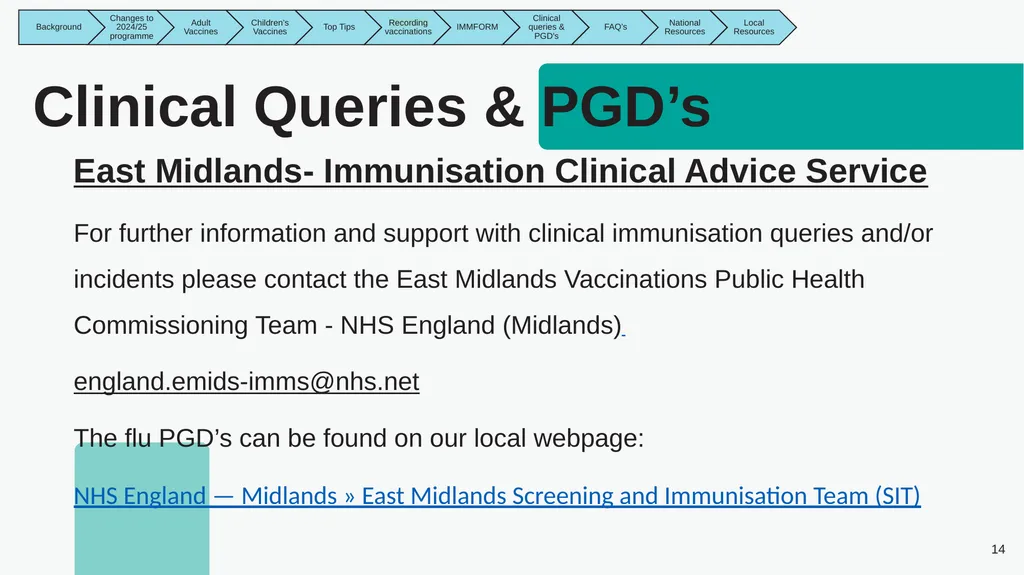
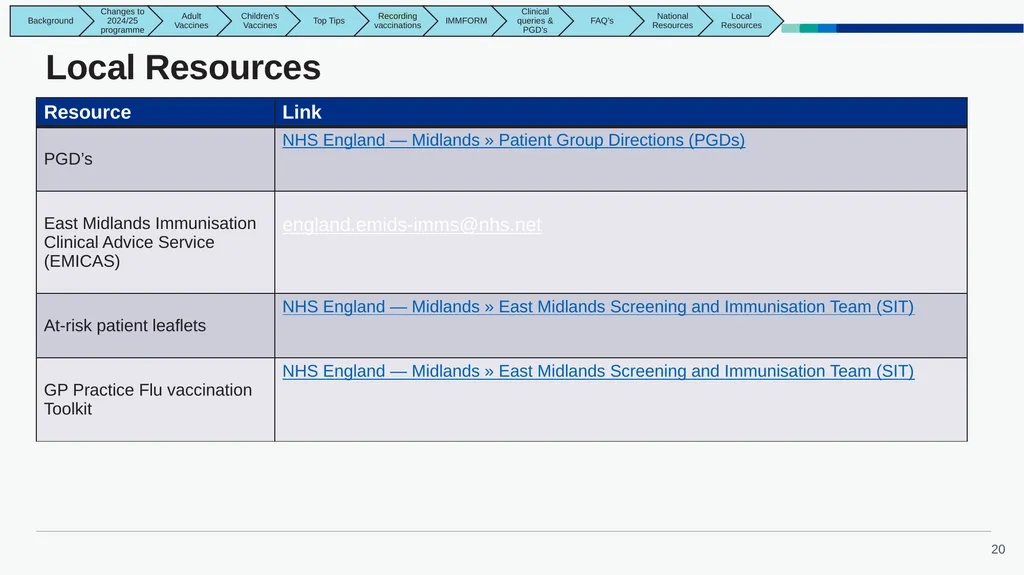
Clinical Queries & PGD’s East Midlands- Immunisation Clinical Advice Service
For further information and support with clinical immunisation queries and/or incidents please contact the East Midlands Vaccinations Public Health Commissioning Team - NHS England (Midlands)
england.emids-imms@nhs.net
The flu PGD’s can be found on our local webpage:
NHS England — Midlands » East Midlands Screening and Immunisation Team (SIT)<br>
For further information and support with clinical immunisation queries and/or incidents please contact the East Midlands Vaccinations Public Health Commissioning Team - NHS England (Midlands)
england.emids-imms@nhs.net
The flu PGD’s can be found on our local webpage:
NHS England — Midlands » East Midlands Screening and Immunisation Team (SIT)<br>
15
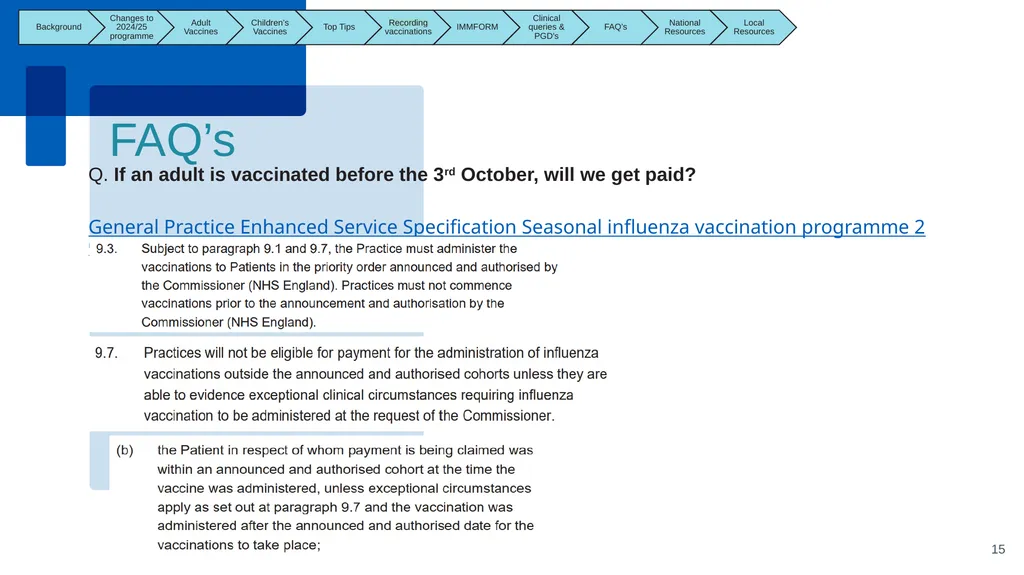
FAQ’s Q. If an adult is vaccinated before the 3rd October, will we get paid?
General Practice Enhanced Service Specification Seasonal influenza vaccination programme 2024/25 (england.nhs.uk)
11.2.1.<br>
General Practice Enhanced Service Specification Seasonal influenza vaccination programme 2024/25 (england.nhs.uk)
11.2.1.<br>
16
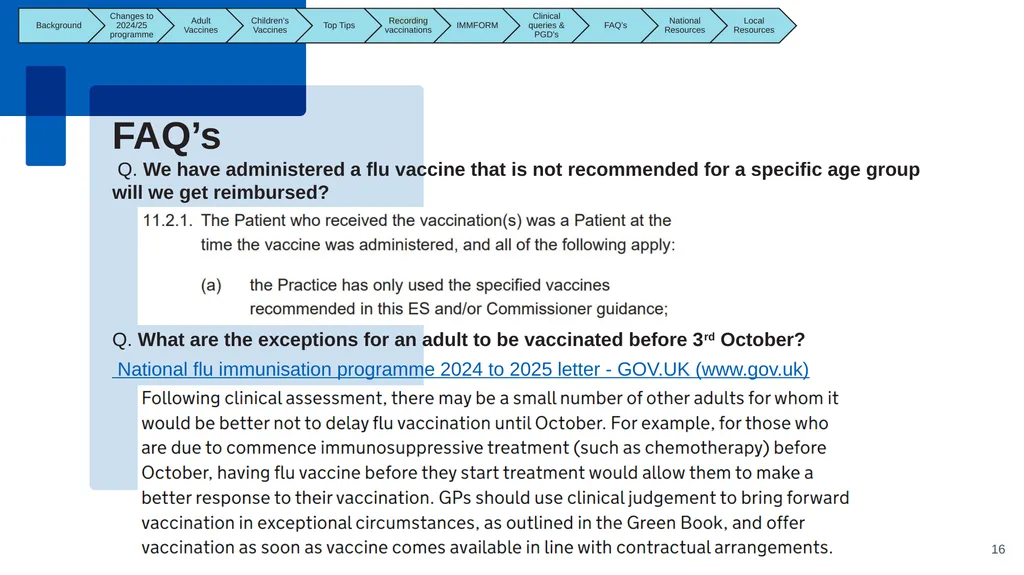
FAQ’s Q. We have administered a flu vaccine that is not recommended for a specific age group will we get reimbursed?
Q. What are the exceptions for an adult to be vaccinated before 3rd October?
National flu immunisation programme 2024 to 2025 letter - GOV.UK (www.gov.uk)<br>
Q. What are the exceptions for an adult to be vaccinated before 3rd October?
National flu immunisation programme 2024 to 2025 letter - GOV.UK (www.gov.uk)<br>
17
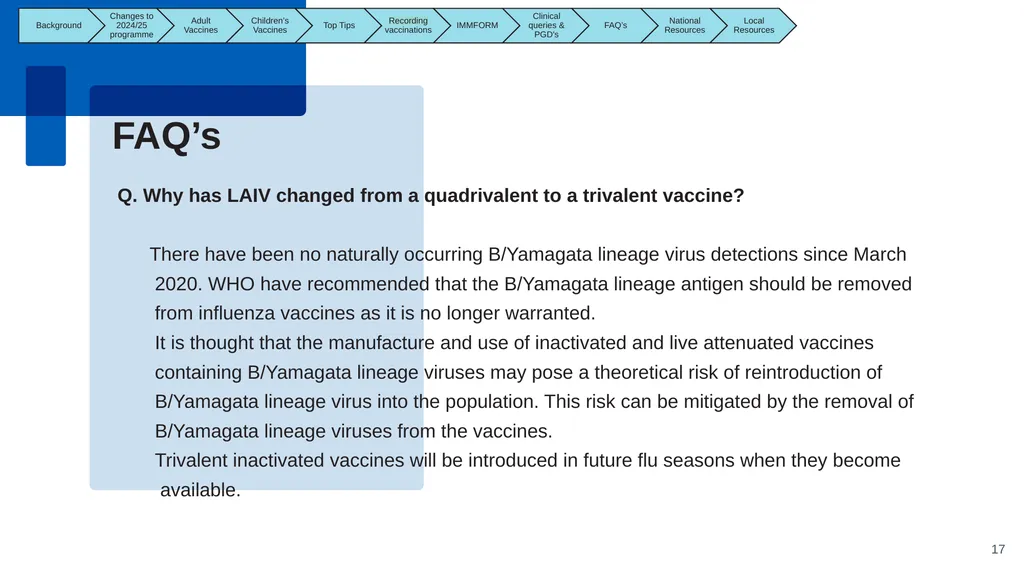
FAQ’s Q. Why has LAIV changed from a quadrivalent to a trivalent vaccine?
There have been no naturally occurring B/Yamagata lineage virus detections since March
2020. WHO have recommended that the B/Yamagata lineage antigen should be removed
from influenza vaccines as it is no longer warranted.
It is thought that the manufacture and use of inactivated and live attenuated vaccines
containing B/Yamagata lineage viruses may pose a theoretical risk of reintroduction of
B/Yamagata lineage virus into the population. This risk can be mitigated by the removal of
B/Yamagata lineage viruses from the vaccines.
Trivalent inactivated vaccines will be introduced in future flu seasons when they become
available.<br>
There have been no naturally occurring B/Yamagata lineage virus detections since March
2020. WHO have recommended that the B/Yamagata lineage antigen should be removed
from influenza vaccines as it is no longer warranted.
It is thought that the manufacture and use of inactivated and live attenuated vaccines
containing B/Yamagata lineage viruses may pose a theoretical risk of reintroduction of
B/Yamagata lineage virus into the population. This risk can be mitigated by the removal of
B/Yamagata lineage viruses from the vaccines.
Trivalent inactivated vaccines will be introduced in future flu seasons when they become
available.<br>
18
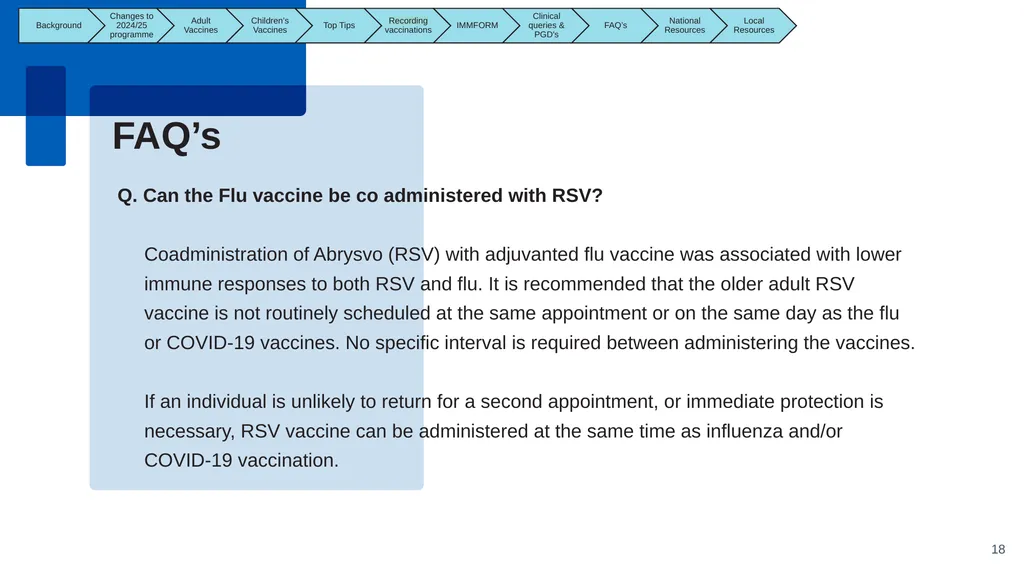
FAQ’s Q. Can the Flu vaccine be co administered with RSV?
Coadministration of Abrysvo (RSV) with adjuvanted flu vaccine was associated with lower
immune responses to both RSV and flu. It is recommended that the older adult RSV
vaccine is not routinely scheduled at the same appointment or on the same day as the flu
or COVID-19 vaccines. No specific interval is required between administering the vaccines.
If an individual is unlikely to return for a second appointment, or immediate protection is
necessary, RSV vaccine can be administered at the same time as influenza and/or
COVID-19 vaccination.<br>
Coadministration of Abrysvo (RSV) with adjuvanted flu vaccine was associated with lower
immune responses to both RSV and flu. It is recommended that the older adult RSV
vaccine is not routinely scheduled at the same appointment or on the same day as the flu
or COVID-19 vaccines. No specific interval is required between administering the vaccines.
If an individual is unlikely to return for a second appointment, or immediate protection is
necessary, RSV vaccine can be administered at the same time as influenza and/or
COVID-19 vaccination.<br>
19
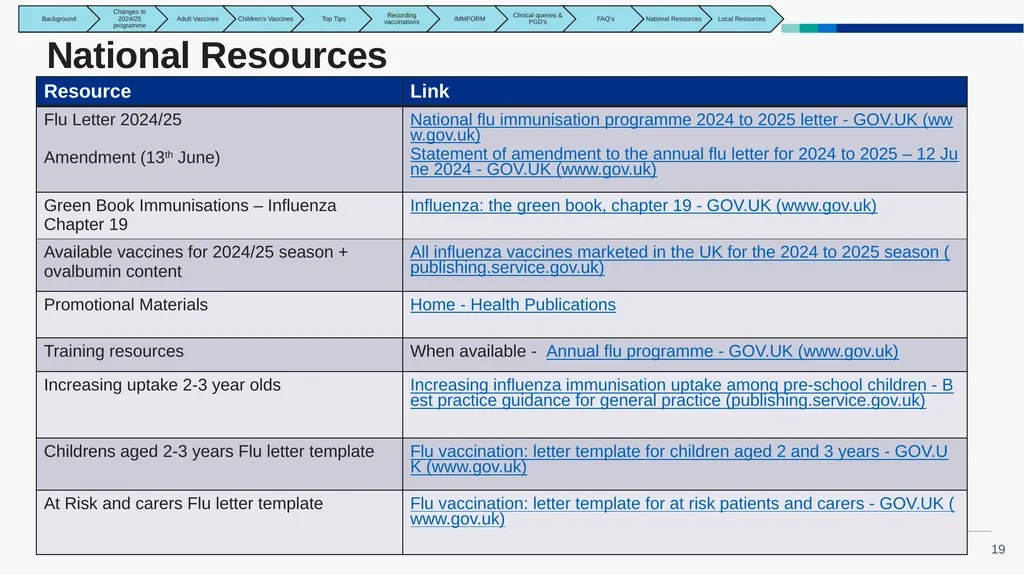
National Resources<br>
20
Local Resources<br>
21
Please refer any healthy school aged children to the appropriate SAIS Team if they have missed vaccination in school, including children that are home schooled Local Resources
School Aged Immunisation Team Contact Details<br>