Economic Development and Innovation Operational Programme (2014-20) Tamás Karsai Head of Managing Authority Budapest, 18 May 2017 Content of the presentation General overview about the Operational Programme Evaluation of the institutional
Related Topics
Share
Embed code
Download this presentation From Below
"Economic Development and Innovation Operational" is the property of its rightful owner. Permission is granted to
download and print the materials on this website for personal, non-commercial use only, and to display it
on your personal computer provided you do not modify the materials and that you retain all copyright
notices contained in the materials. By downloading content from our website, you accept the terms of this
agreement.
Presentation Transcript
01
Economic Development and Innovation Operational Programme
(2014-20) Tamás Karsai
Head of Managing Authority
Budapest, 18 May 2017<br>
02
Content of the presentation General overview about the Operational Programme
Evaluation of the institutional background - organisation of MA;
State of play;
Introduction of priorities - measures
Financial instruments;
Major Project – ELI ALPS
Lessons learned – Challenges, benefits, success stories<br>
03
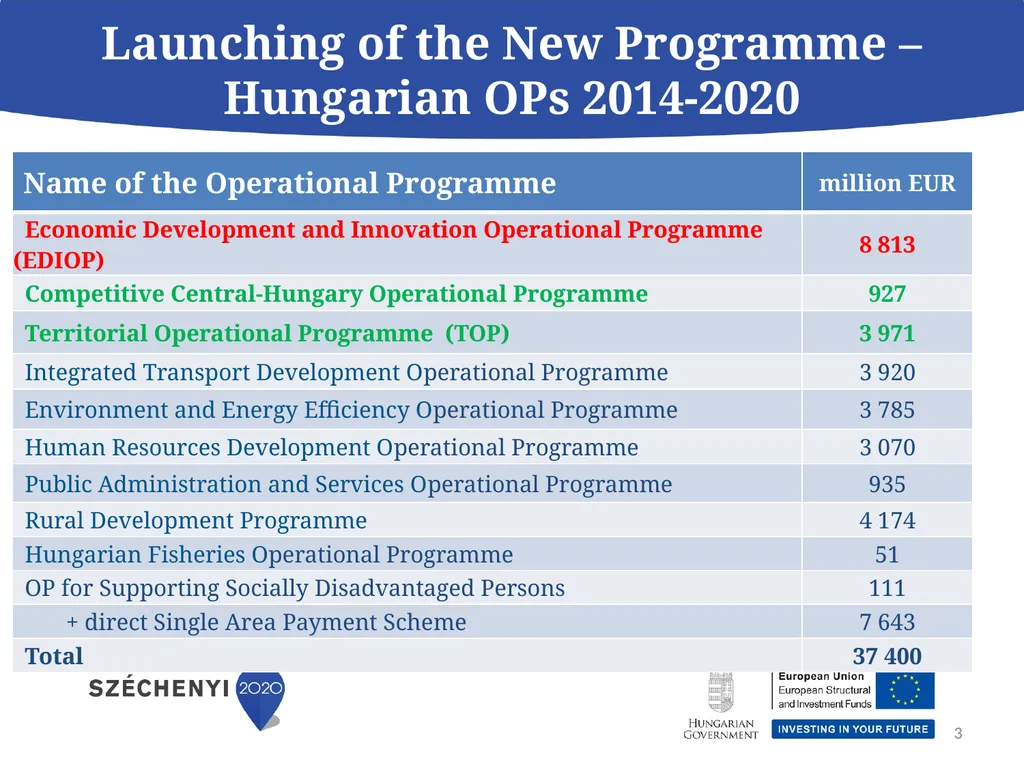
Launching of the New Programme – Hungarian OPs 2014-2020 3<br>
04
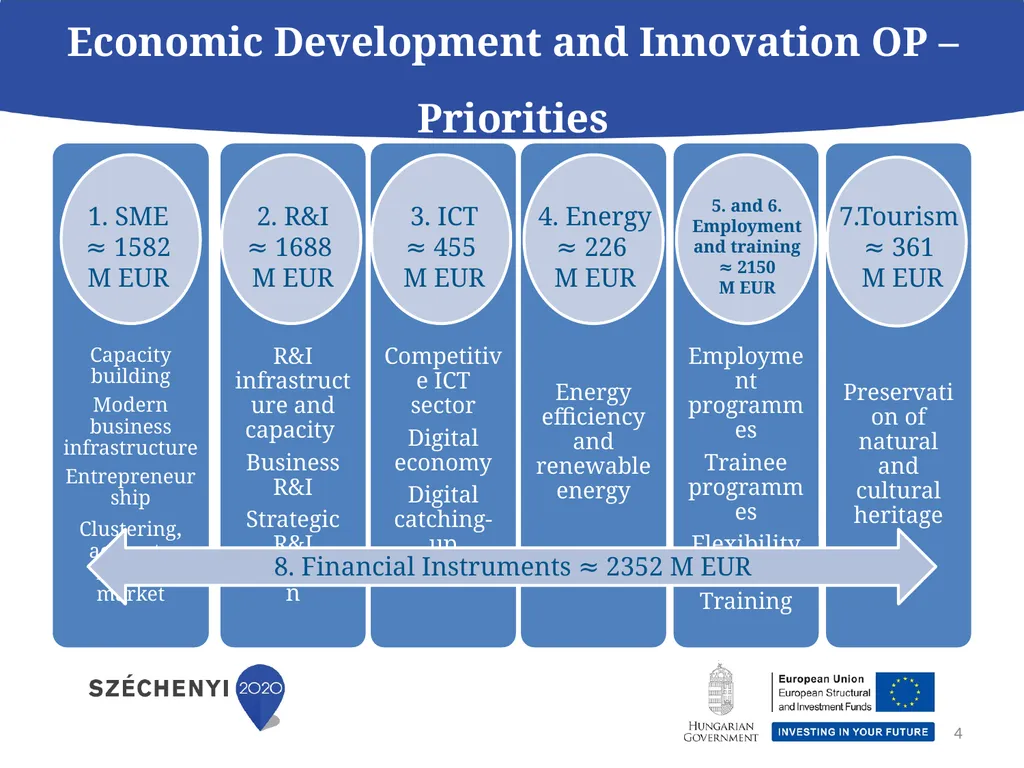
Economic Development and Innovation OP – Priorities 1. SME
≈ 1582
M EUR 2. R&I
≈ 1688
M EUR 3. ICT
≈ 455
M EUR 4. Energy
≈ 226
M EUR 5. and 6. Employment and training
≈ 2150
M EUR 7.Tourism
≈ 361
M EUR 8. Financial Instruments ≈ 2352 M EUR 4<br>
05
„Evolution” of the institutional background managing EU Funds in Hungary 5 Institutional Structure<br>
06
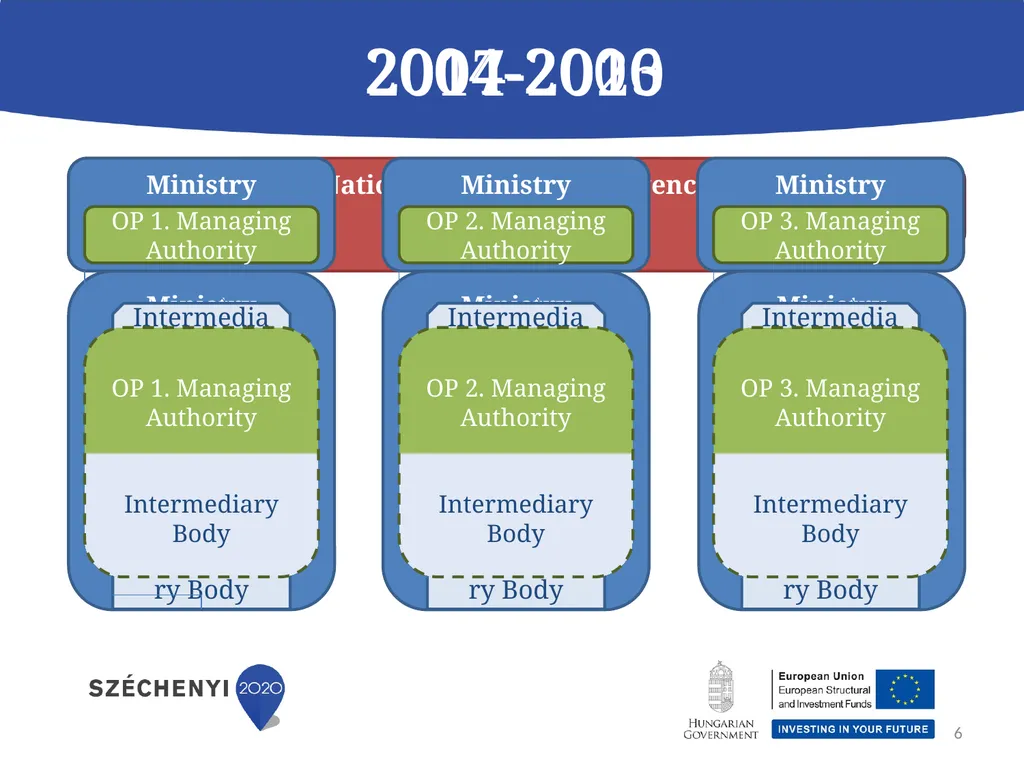
Ministry Ministry Ministry Prime Minister’s Office
(Central coordinating body) National Development Agency 2007-2013 Ministry Ministry Ministry Intermediary Body Intermediary Body Intermediary Body Intermediary Body Intermediary Body Intermediary Body Intermediary Body Intermediary Body Intermediary Body Intermediary Body Intermediary Body Intermediary Body 2004-2006 Intermediary Body Intermediary Body Intermediary Body 2014-2020 OP 1. Managing Authority OP 2. Managing Authority OP 3. Managing Authority OP 1. Managing Authority
Intermediary Body OP 2. Managing Authority
Intermediary Body OP 3. Managing Authority
Intermediary Body 6<br>
07
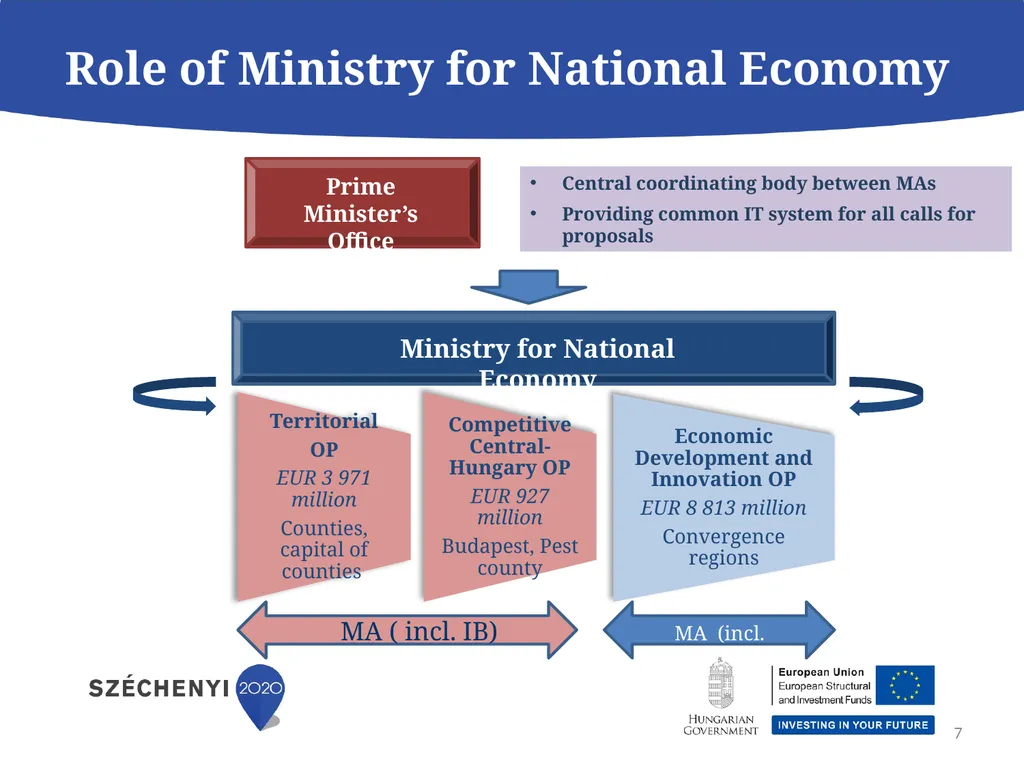
Role of Ministry for National Economy MA ( incl. IB) MA (incl. IB) Central coordinating body between MAs
Providing common IT system for all calls for proposals 7<br>
08
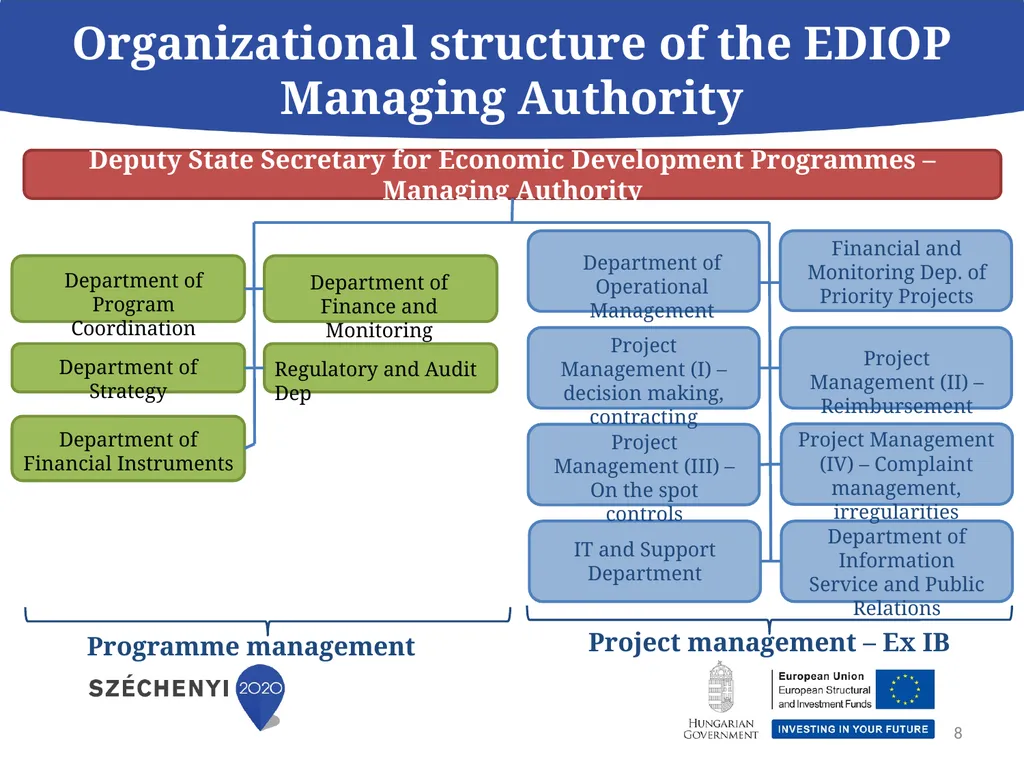
Organizational structure of the EDIOP Managing Authority Deputy State Secretary for Economic Development Programmes –Managing Authority Programme management Project management – Ex IB 8 Department of Program Coordination Department of Strategy Department of Finance and Monitoring Regulatory and Audit Dep Department of Financial Instruments Department of Information Service and Public Relations Project Management (IV) – Complaint management, irregularities Project Management (II) – Reimbursement Financial and Monitoring Dep. of Priority Projects Department of Operational Management Project Management (I) – decision making, contracting Project Management (III) – On the spot controls IT and Support Department<br>
09
State of Play Committed and disbursed funds 9<br>
10
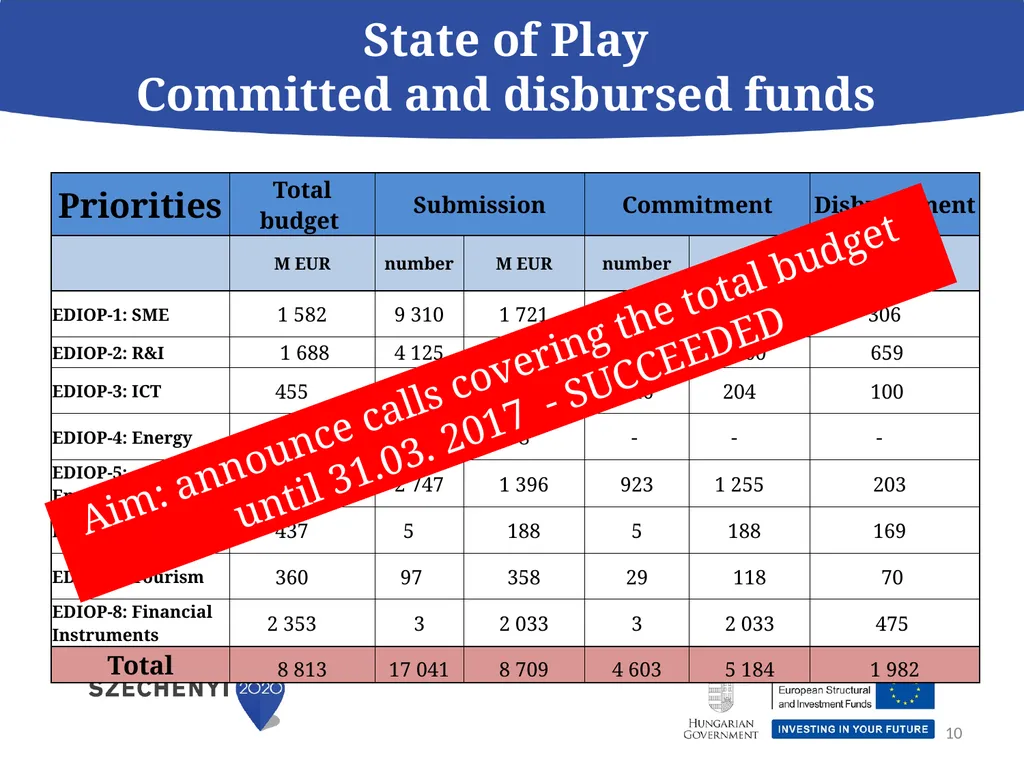
State of Play Committed and disbursed funds 10 Aim: announce calls covering the total budget
until 31.03. 2017 - SUCCEEDED<br>
11
Introduction of the priorities 1-7. (non-refundable grants) 11<br>
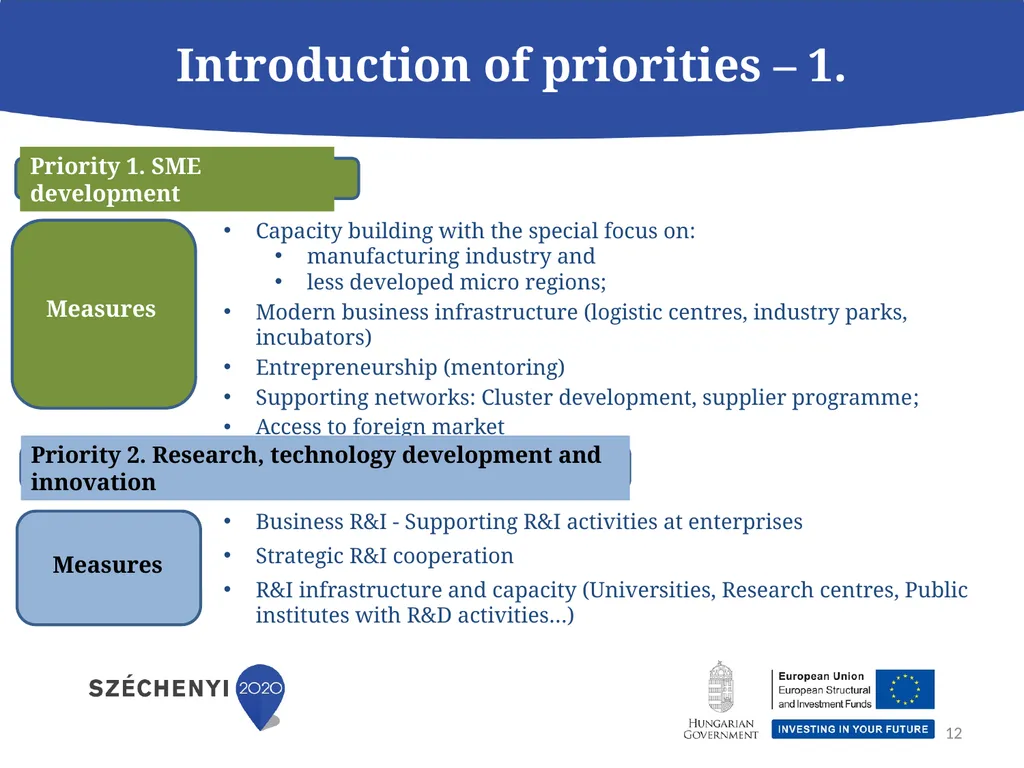
12
Introduction of priorities – 1. 12 Capacity building with the special focus on:
manufacturing industry and
less developed micro regions;
Modern business infrastructure (logistic centres, industry parks, incubators)
Entrepreneurship (mentoring)
Supporting networks: Cluster development, supplier programme;
Access to foreign market Business R&I - Supporting R&I activities at enterprises
Strategic R&I cooperation
R&I infrastructure and capacity (Universities, Research centres, Public institutes with R&D activities…)<br>
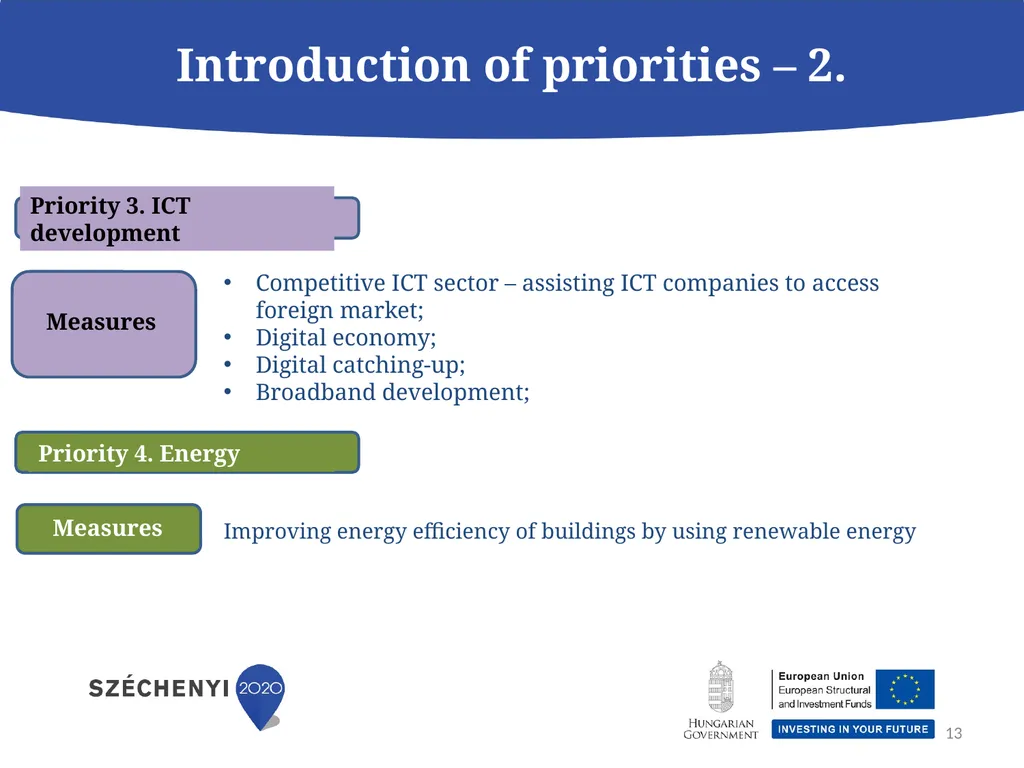
13
Introduction of priorities – 2. 13 Competitive ICT sector – assisting ICT companies to access foreign market;
Digital economy;
Digital catching-up;
Broadband development; Improving energy efficiency of buildings by using renewable energy<br>
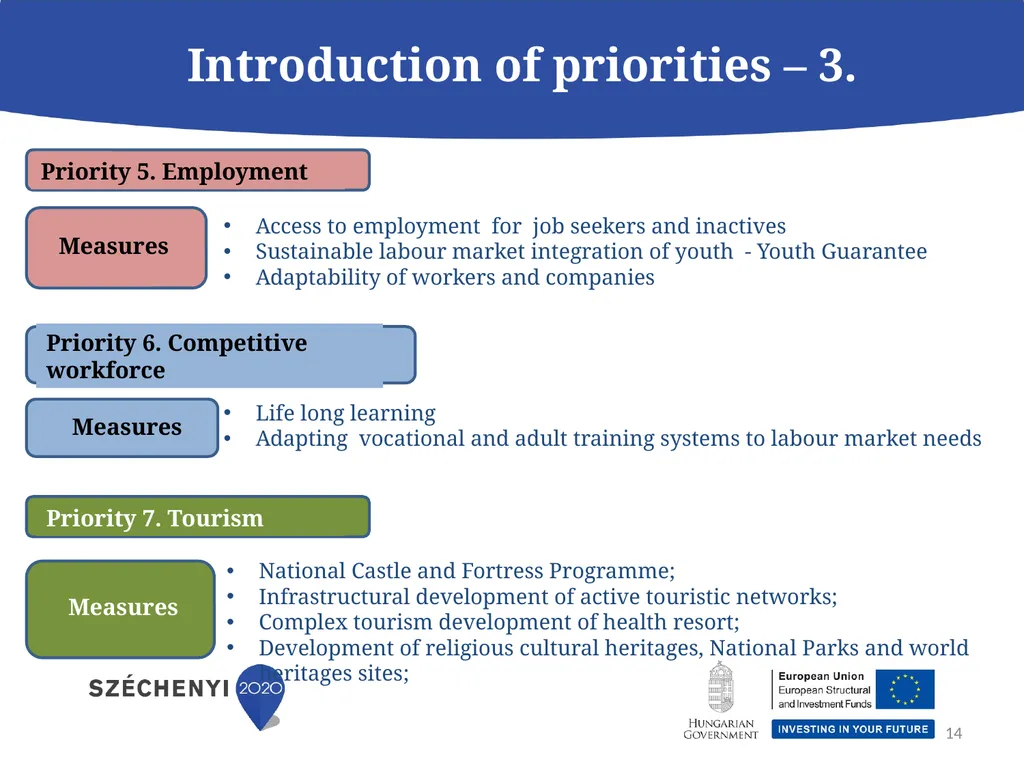
14
Introduction of priorities – 3. 14 Access to employment for job seekers and inactives
Sustainable labour market integration of youth - Youth Guarantee
Adaptability of workers and companies Life long learning
Adapting vocational and adult training systems to labour market needs National Castle and Fortress Programme;
Infrastructural development of active touristic networks;
Complex tourism development of health resort;
Development of religious cultural heritages, National Parks and world heritages sites;<br>
15
Financial Instruments 15<br>
16
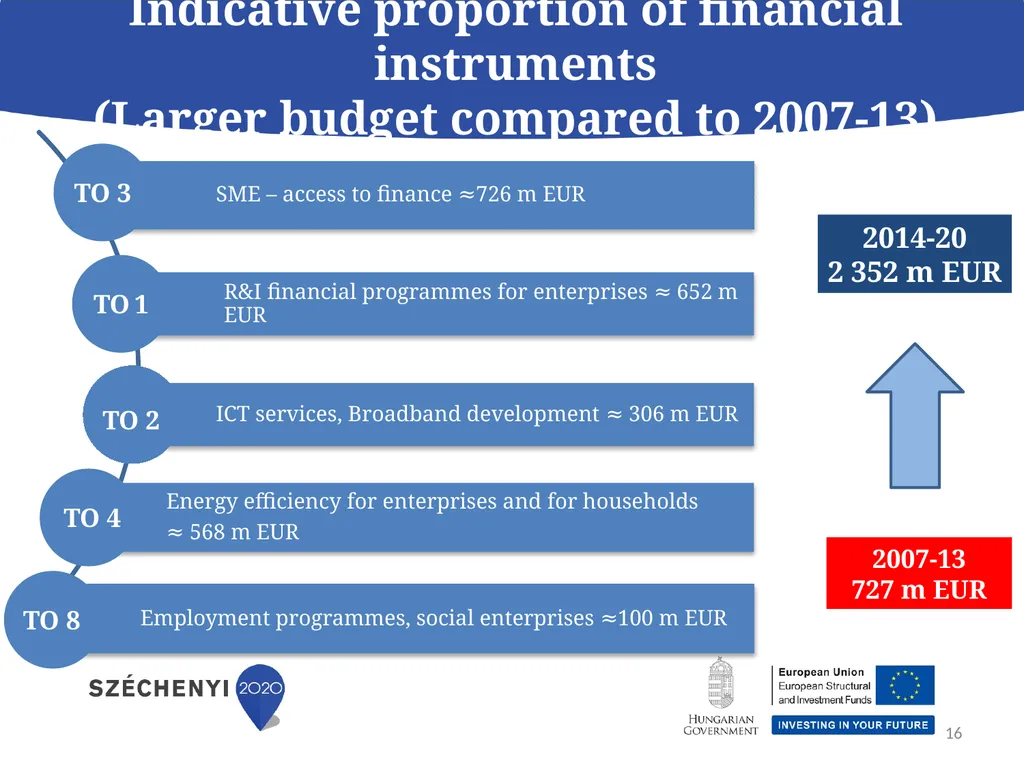
Indicative proportion of financial instruments (Larger budget compared to 2007-13) Employment programmes, social enterprises ≈100 m EUR 2014-20
2 352 m EUR 2007-13
727 m EUR TO 1 TO 4 TO 8 TO 2 TO 3 16<br>
17
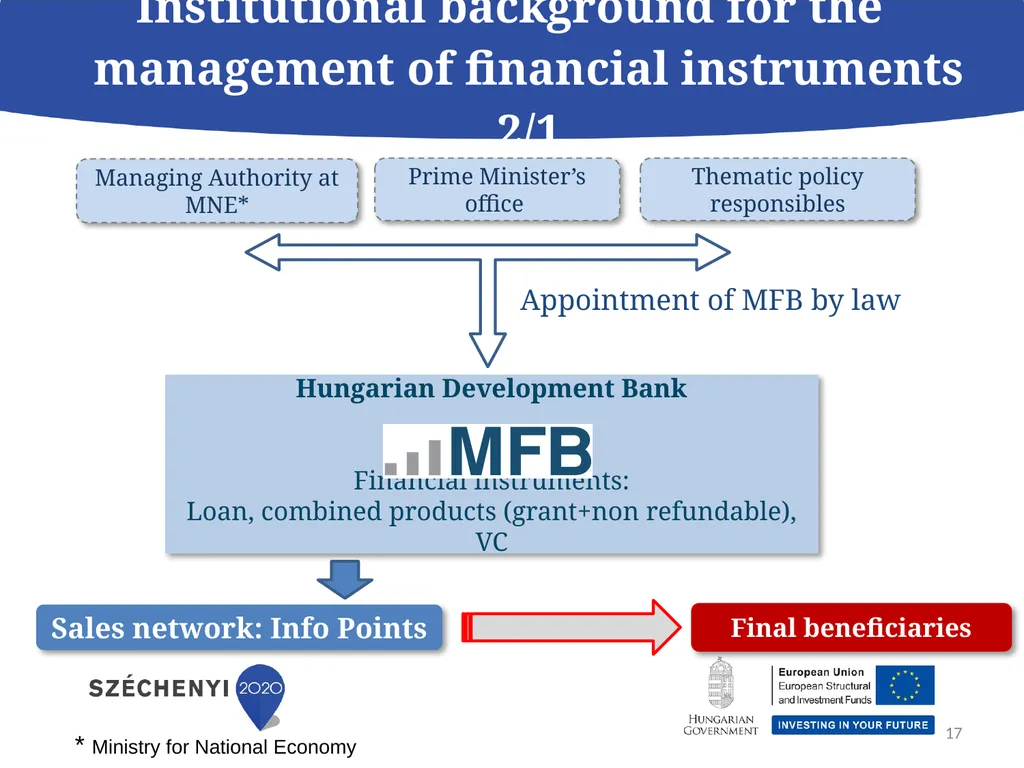
Institutional background for the management of financial instruments 2/1 Managing Authority at MNE* Final beneficiaries Prime Minister’s office Thematic policy responsibles Sales network: Info Points Hungarian Development Bank
Financial instruments:
Loan, combined products (grant+non refundable), VC * Ministry for National Economy Appointment of MFB by law 17<br>
18
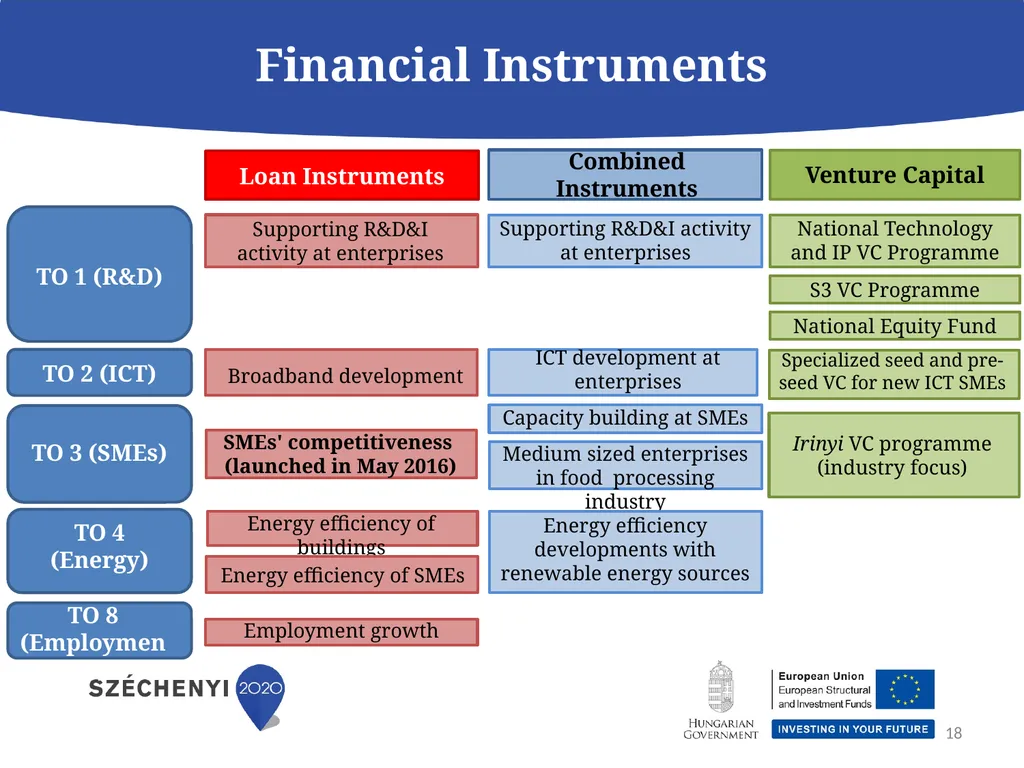
Financial Instruments 18<br>
19
Major project – ELI ALPS 19<br>
20
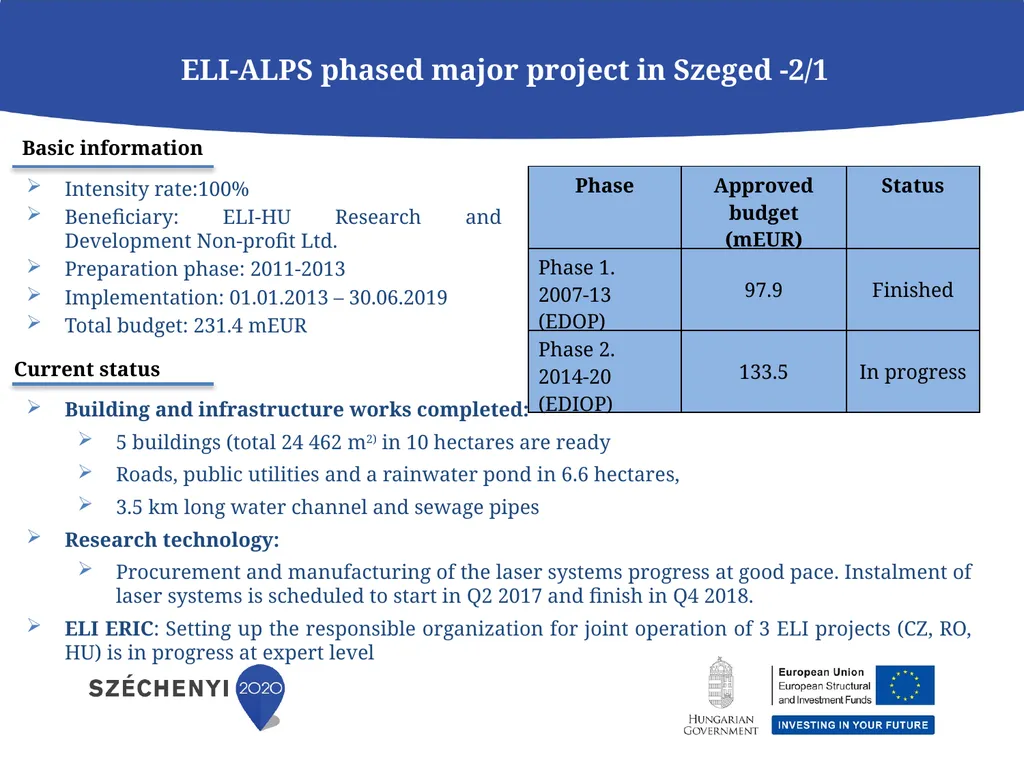
ELI-ALPS phased major project in Szeged -2/1 Current status Basic information Intensity rate:100%
Beneficiary: ELI-HU Research and Development Non-profit Ltd.
Preparation phase: 2011-2013
Implementation: 01.01.2013 – 30.06.2019
Total budget: 231.4 mEUR Building and infrastructure works completed:
5 buildings (total 24 462 m2) in 10 hectares are ready
Roads, public utilities and a rainwater pond in 6.6 hectares,
3.5 km long water channel and sewage pipes
Research technology:
Procurement and manufacturing of the laser systems progress at good pace. Instalment of laser systems is scheduled to start in Q2 2017 and finish in Q4 2018.
ELI ERIC: Setting up the responsible organization for joint operation of 3 ELI projects (CZ, RO, HU) is in progress at expert level<br>
21
ELI-ALPS phased major project in Szeged -2/2 http://www.eli-alps.hu/?q=en<br>
22
Lessons learned – Challenges, benefits, success stories from the past 10 years 22<br>
23
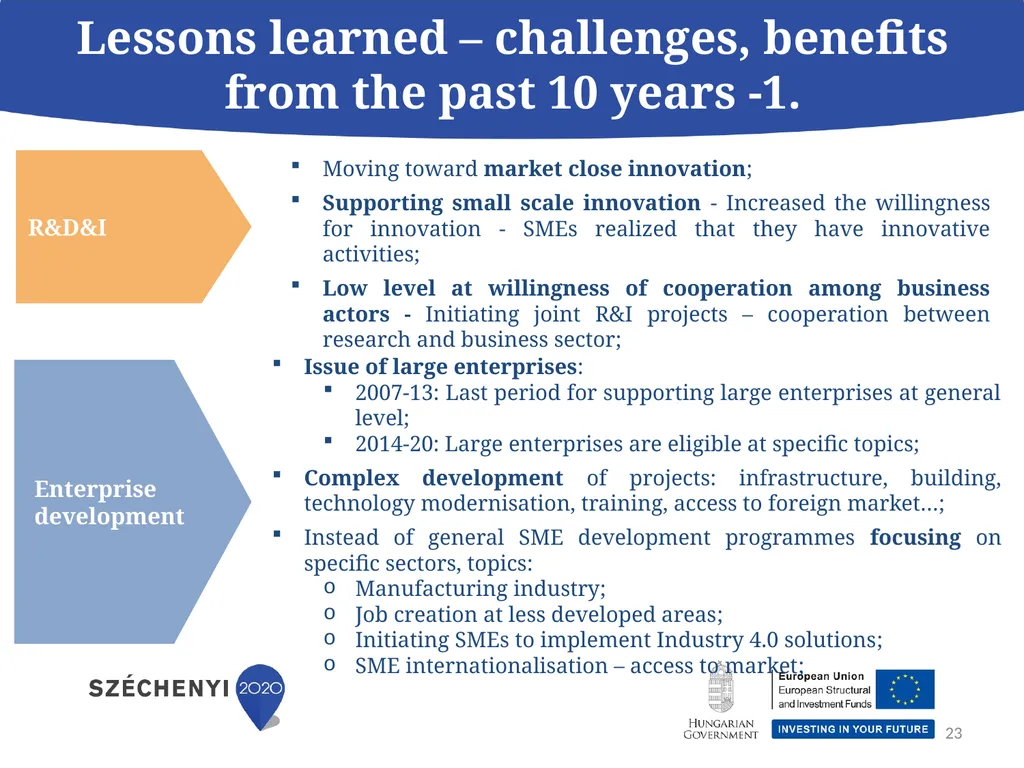
Lessons learned – challenges, benefits from the past 10 years -1. 23 Moving toward market close innovation;
Supporting small scale innovation - Increased the willingness for innovation - SMEs realized that they have innovative activities;
Low level at willingness of cooperation among business actors - Initiating joint R&I projects – cooperation between research and business sector; Issue of large enterprises:
2007-13: Last period for supporting large enterprises at general level;
2014-20: Large enterprises are eligible at specific topics;
Complex development of projects: infrastructure, building, technology modernisation, training, access to foreign market…;
Instead of general SME development programmes focusing on specific sectors, topics:
Manufacturing industry;
Job creation at less developed areas;
Initiating SMEs to implement Industry 4.0 solutions;
SME internationalisation – access to market; R&D&I Enterprise
development<br>
24
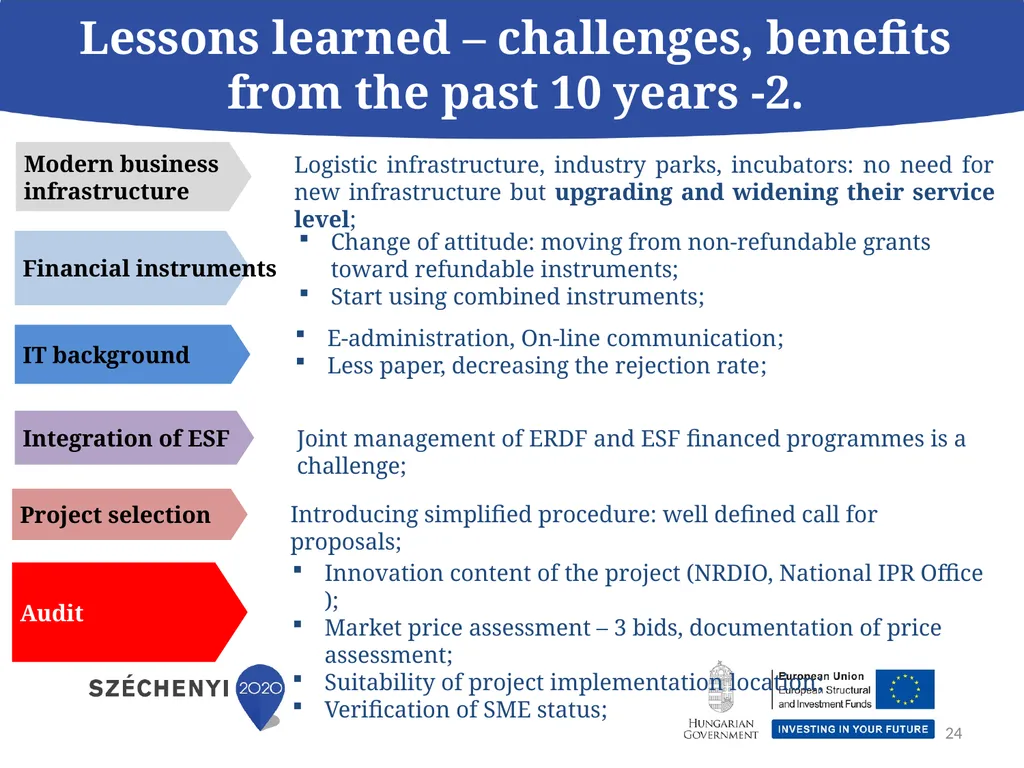
Lessons learned – challenges, benefits from the past 10 years -2. 24 E-administration, On-line communication;
Less paper, decreasing the rejection rate; IT background Project selection Introducing simplified procedure: well defined call for proposals; Change of attitude: moving from non-refundable grants toward refundable instruments;
Start using combined instruments; Financial instruments Logistic infrastructure, industry parks, incubators: no need for new infrastructure but upgrading and widening their service level; Modern business
infrastructure Innovation content of the project (NRDIO, National IPR Office );
Market price assessment – 3 bids, documentation of price assessment;
Suitability of project implementation location;
Verification of SME status; Audit Joint management of ERDF and ESF financed programmes is a challenge; Integration of ESF<br>
25
Thank you for your kind attention! Ministry for National Economy Managing Authority for Economic Development Programmes<br>