EEL 3004 Linear Circuits I Lecture 7B Practical Relefence The Bipolar Junction Transistor Amplifier Lecture Objectives The lecture today will focus on: Learn about the voltage amplifier and why it is important in todays electronic
"EEL 3004 Linear Circuits I Lecture #7B Practical" is the property of its rightful owner. Permission is granted to
download and print the materials on this website for personal, non-commercial use only, and to display it
on your personal computer provided you do not modify the materials and that you retain all copyright
notices contained in the materials. By downloading content from our website, you accept the terms of this
agreement.
Presentation Transcript
01
EEL 3004 Linear Circuits I Lecture #7B Practical Relefence The Bipolar Junction Transistor Amplifier<br>
02
Lecture Objectives The lecture today will focus on:
Learn about the voltage amplifier and why it is important in today’s electronic products
Understand the function of the transistor as an amplifier
Understand the model of the transistor
Learn the how to analyze simple voltage amplifier model<br>
03
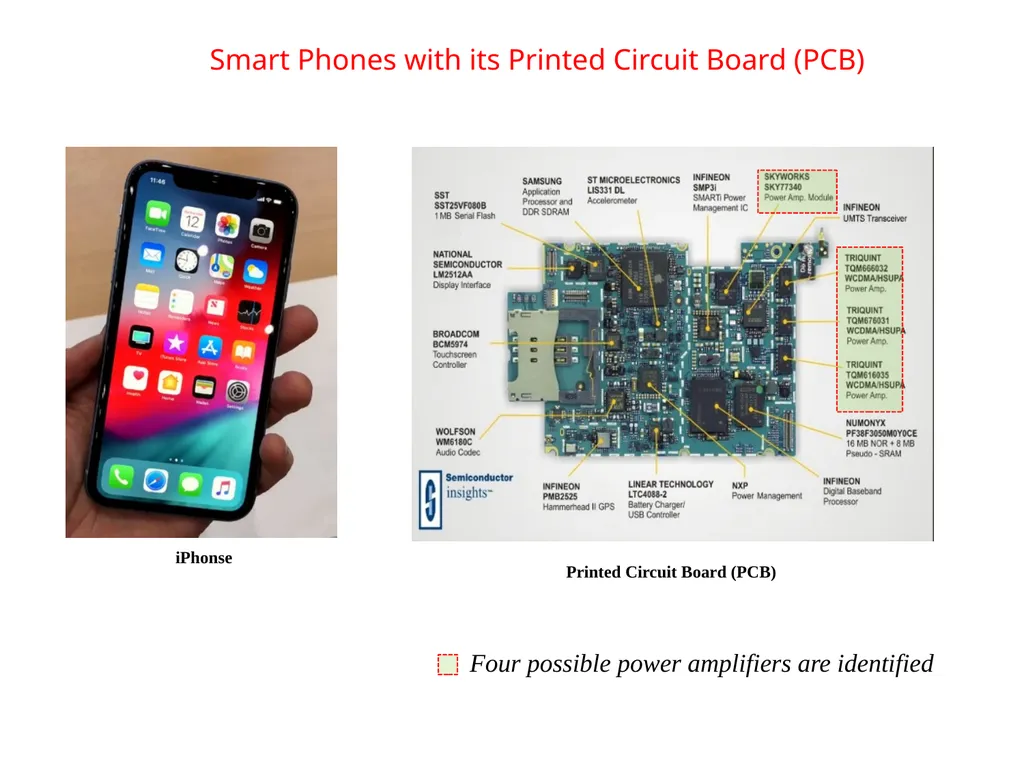
Smart Phones with its Printed Circuit Board (PCB) Printed Circuit Board (PCB) iPhonse Four possible power amplifiers are identified<br>
04
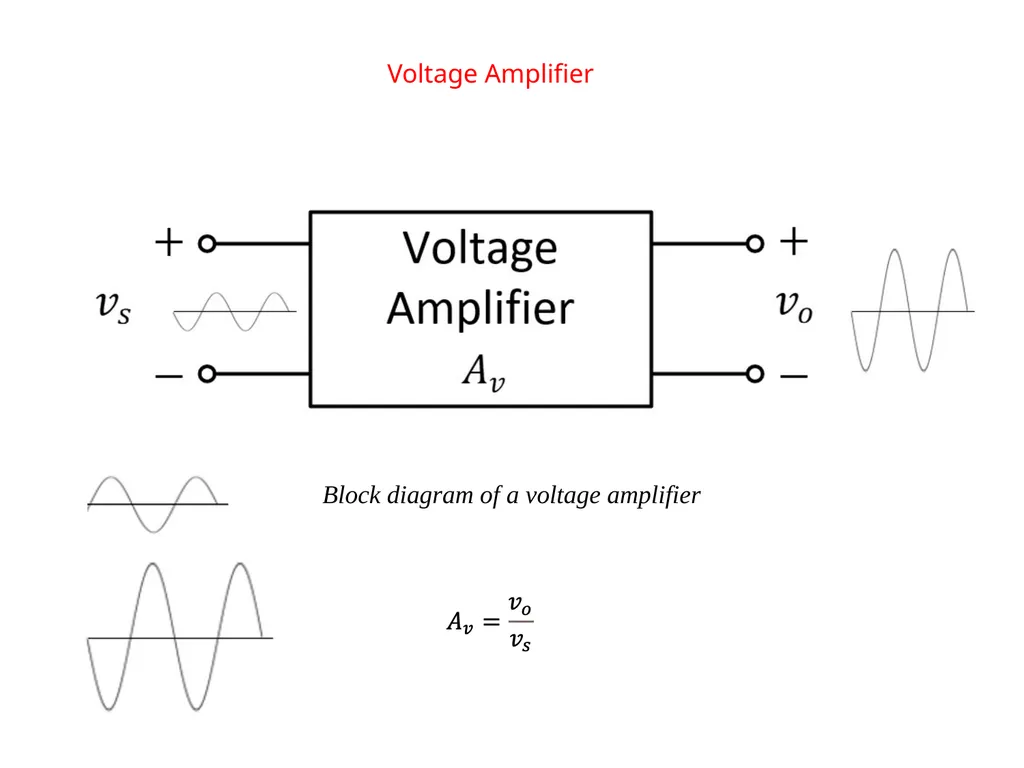
Voltage Amplifier Block diagram of a voltage amplifier<br>
05
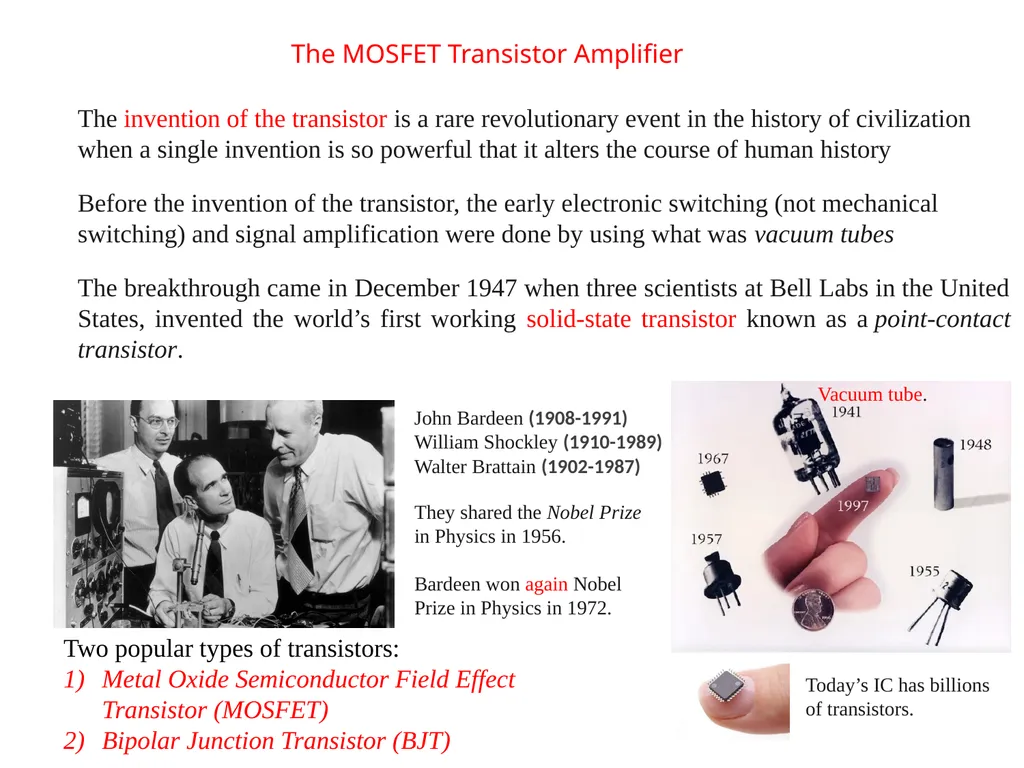
The MOSFET Transistor Amplifier Two popular types of transistors:
Metal Oxide Semiconductor Field Effect Transistor (MOSFET)
Bipolar Junction Transistor (BJT) The invention of the transistor is a rare revolutionary event in the history of civilization when a single invention is so powerful that it alters the course of human history Before the invention of the transistor, the early electronic switching (not mechanical switching) and signal amplification were done by using what was vacuum tubes The breakthrough came in December 1947 when three scientists at Bell Labs in the United States, invented the world’s first working solid-state transistor known as a point-contact transistor. They shared the Nobel Prize in Physics in 1956.
Bardeen won again Nobel Prize in Physics in 1972. John Bardeen (1908-1991)
William Shockley (1910-1989)
Walter Brattain (1902-1987) Bardeen won 2nd Nobel Prize in Physics in 1972 on developing the theory of superconductivity. Today’s IC has billions of transistors. Vacuum tube.<br>
06
Transistor Technology - BJT<br>
07
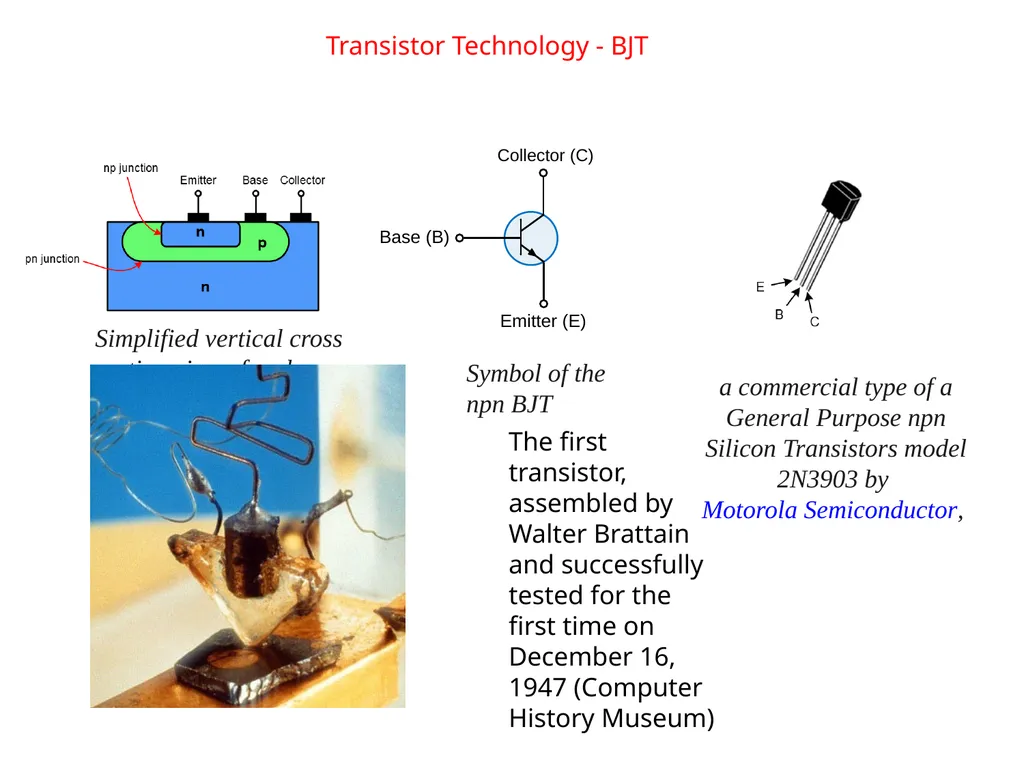
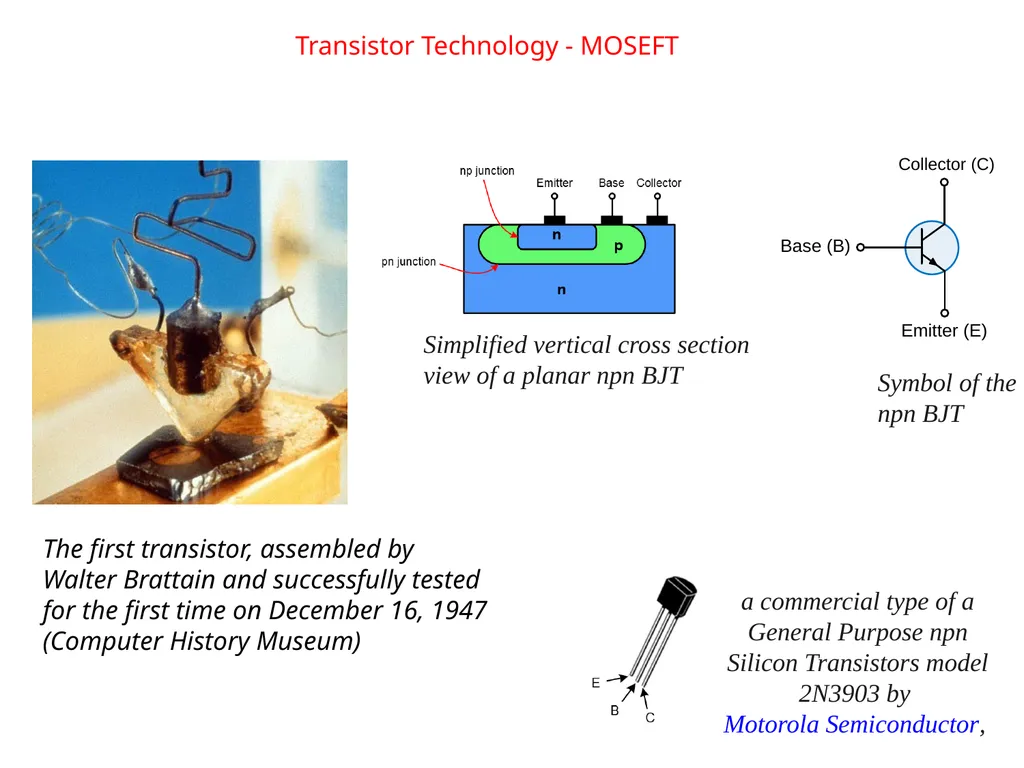
Transistor Technology - BJT a commercial type of a General Purpose npn Silicon Transistors model 2N3903 by Motorola Semiconductor, Simplified vertical cross section view of a planar npn BJT Symbol of the npn BJT The first transistor, assembled by Walter Brattain and successfully tested for the first time on December 16, 1947 (Computer History Museum)<br>
08
Transistor Technology - MOSEFT a commercial type of a General Purpose npn Silicon Transistors model 2N3903 by Motorola Semiconductor, Simplified vertical cross section view of a planar npn BJT Symbol of the npn BJT The first transistor, assembled by Walter Brattain and successfully tested for the first time on December 16, 1947 (Computer History Museum)<br>
09
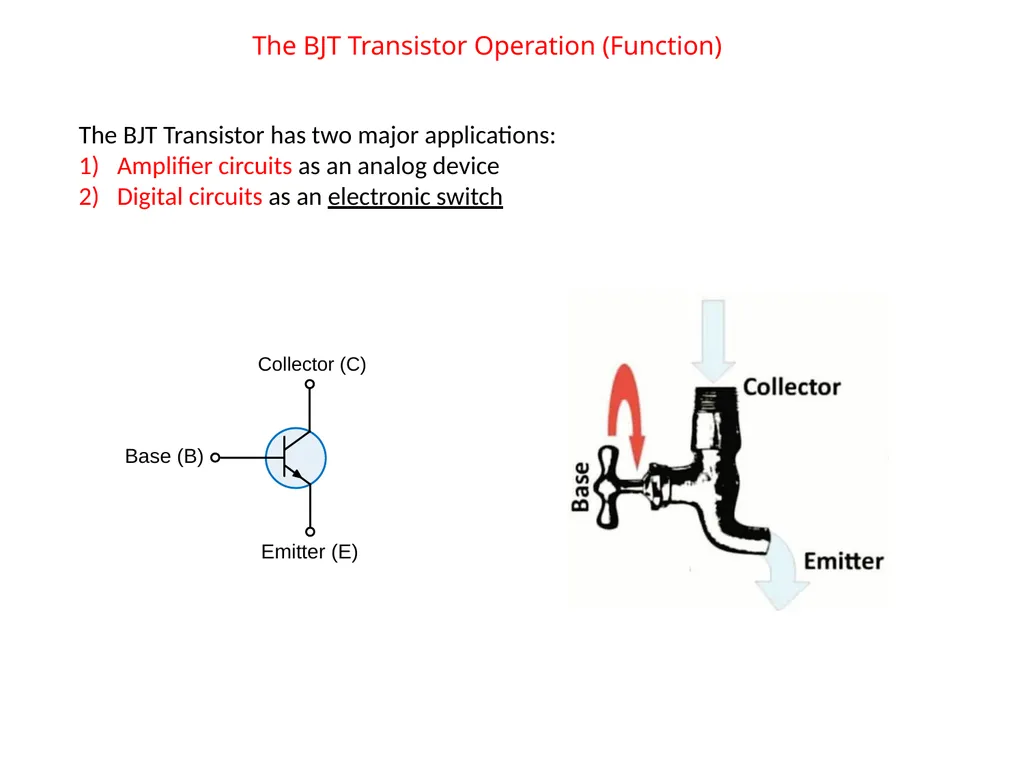
The BJT Transistor Operation (Function) The BJT Transistor has two major applications:
Amplifier circuits as an analog device
Digital circuits as an electronic switch<br>
10
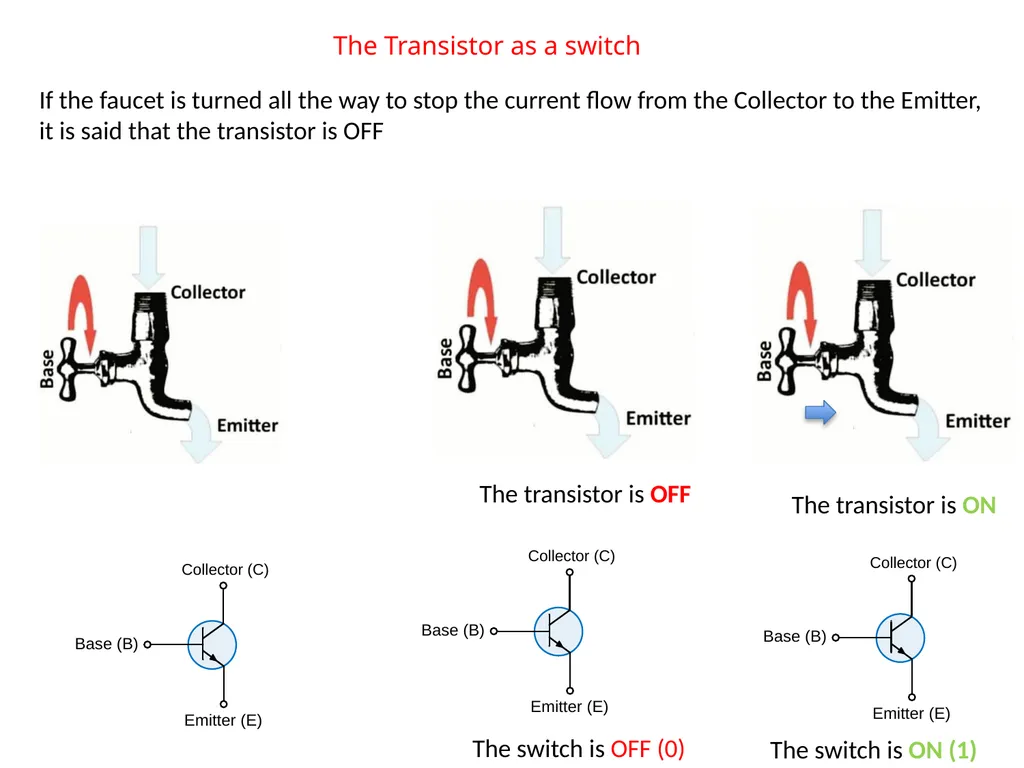
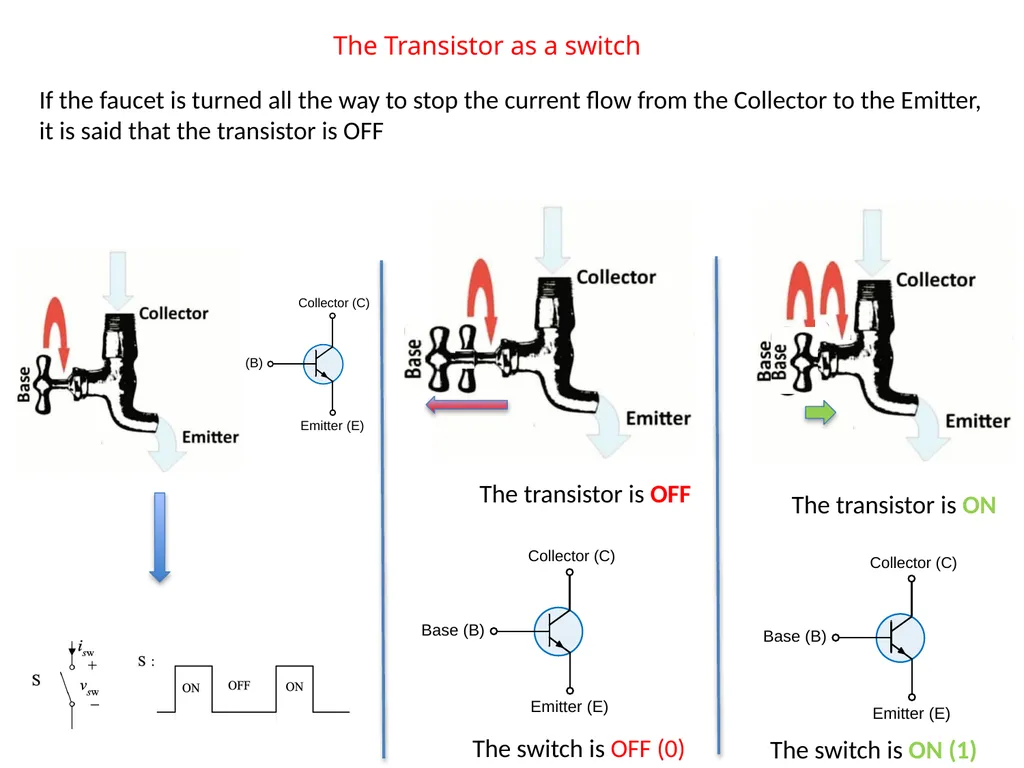
The Transistor as a switch If the faucet is turned all the way to stop the current flow from the Collector to the Emitter, it is said that the transistor is OFF The switch is OFF (0) The transistor is ON The switch is ON (1) The transistor is OFF<br>
11
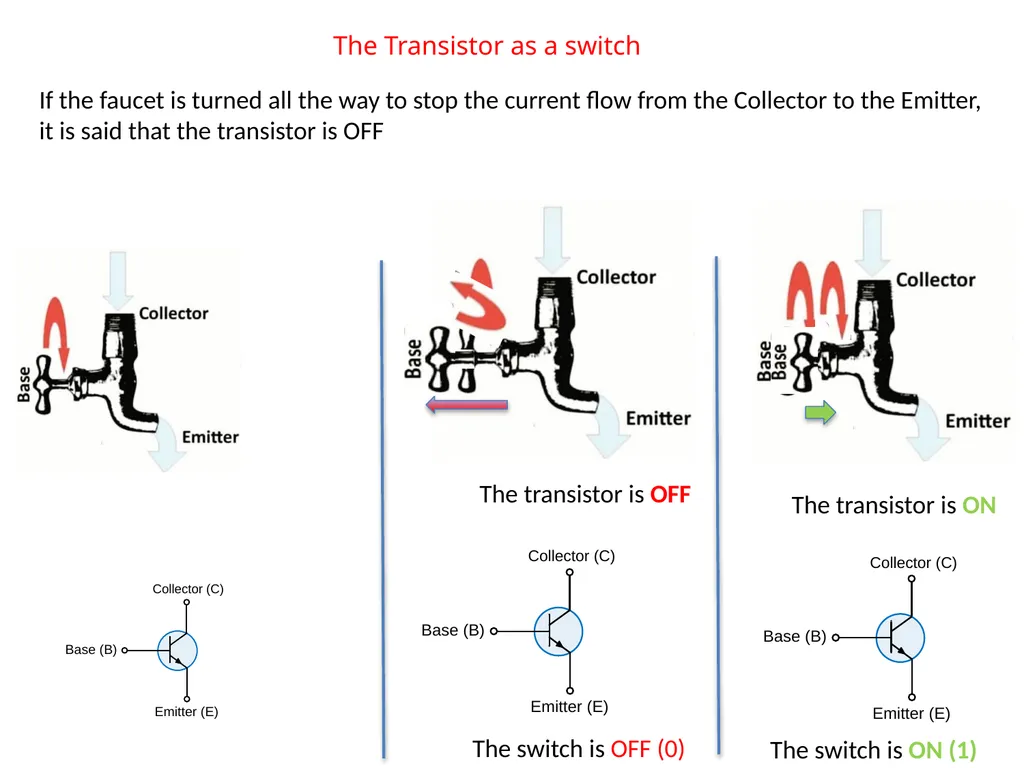
The Transistor as a switch If the faucet is turned all the way to stop the current flow from the Collector to the Emitter, it is said that the transistor is OFF The switch is OFF (0) The transistor is ON The switch is ON (1) The transistor is OFF<br>
12
The Transistor as a switch If the faucet is turned all the way to stop the current flow from the Collector to the Emitter, it is said that the transistor is OFF The switch is OFF (0) The transistor is ON The switch is ON (1) The transistor is OFF<br>
13
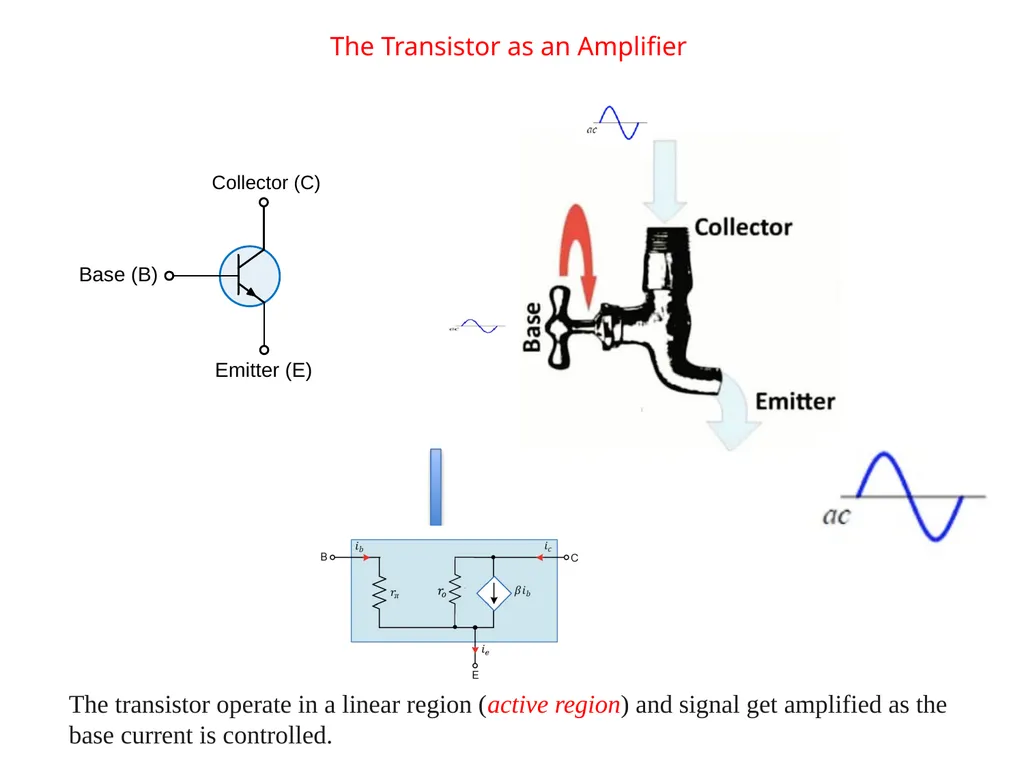
The Transistor as an Amplifier The transistor operate in a linear region (active region) and signal get amplified as the base current is controlled.<br>
14
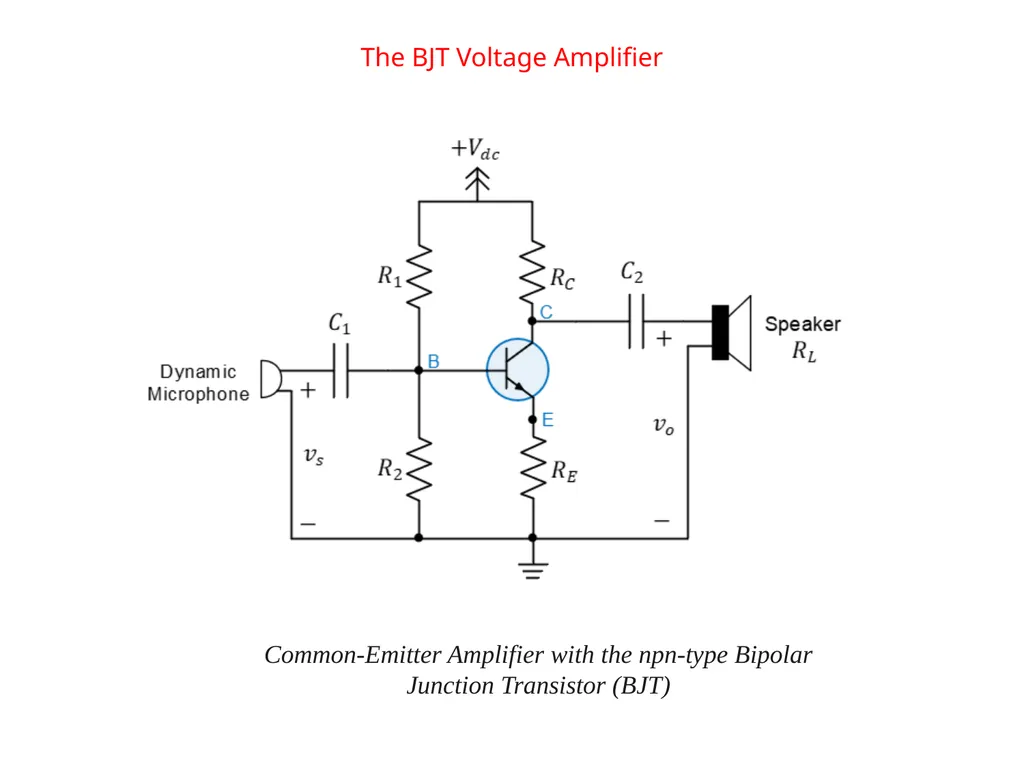
The BJT Voltage Amplifier Common-Emitter Amplifier with the npn-type Bipolar Junction Transistor (BJT)<br>
15
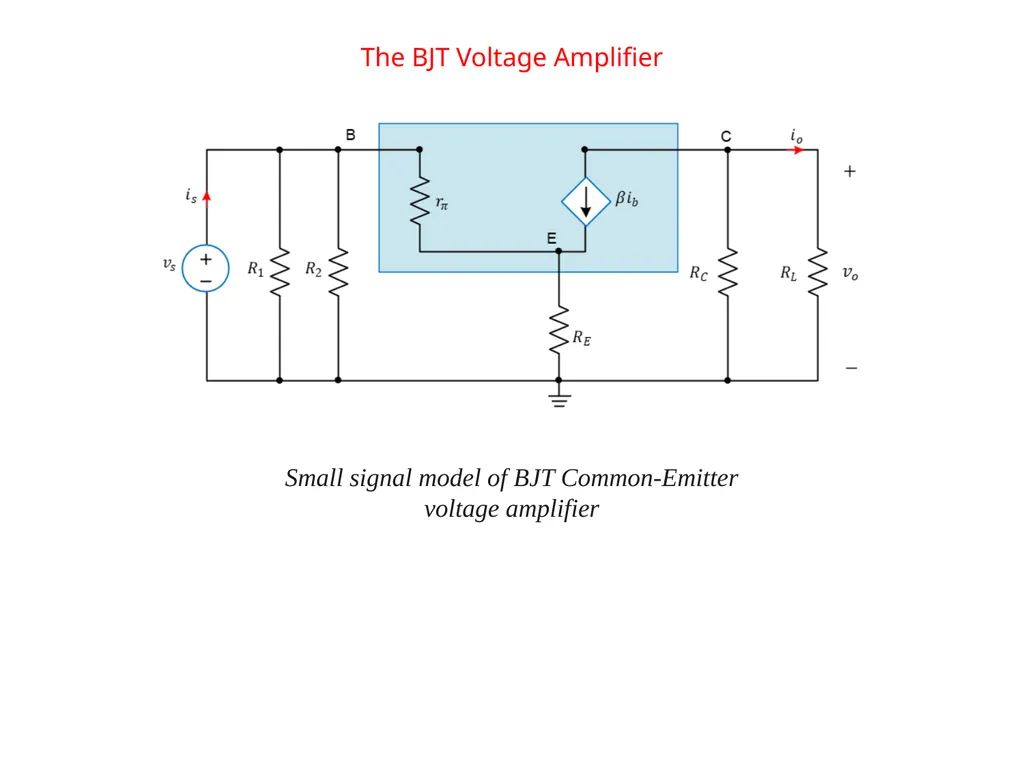
The BJT Voltage Amplifier Small signal model of BJT Common-Emitter voltage amplifier<br>
16
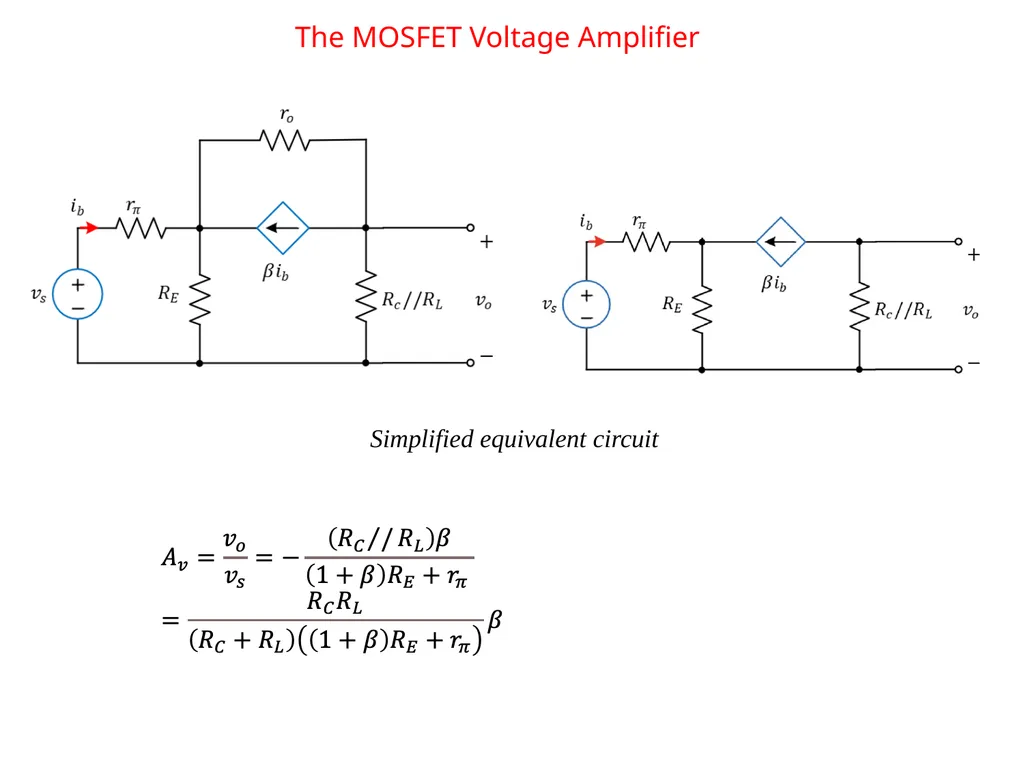
The MOSFET Voltage Amplifier Simplified equivalent circuit<br>
17
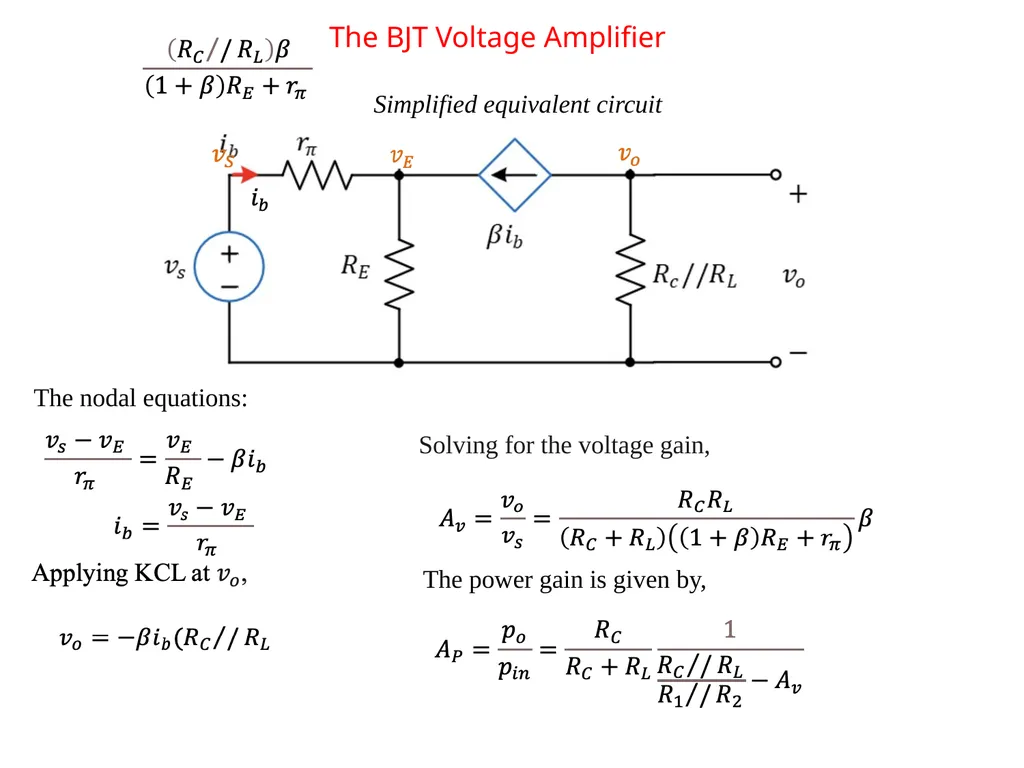
The BJT Voltage Amplifier Simplified equivalent circuit The nodal equations: Solving for the voltage gain, The power gain is given by,<br>
18
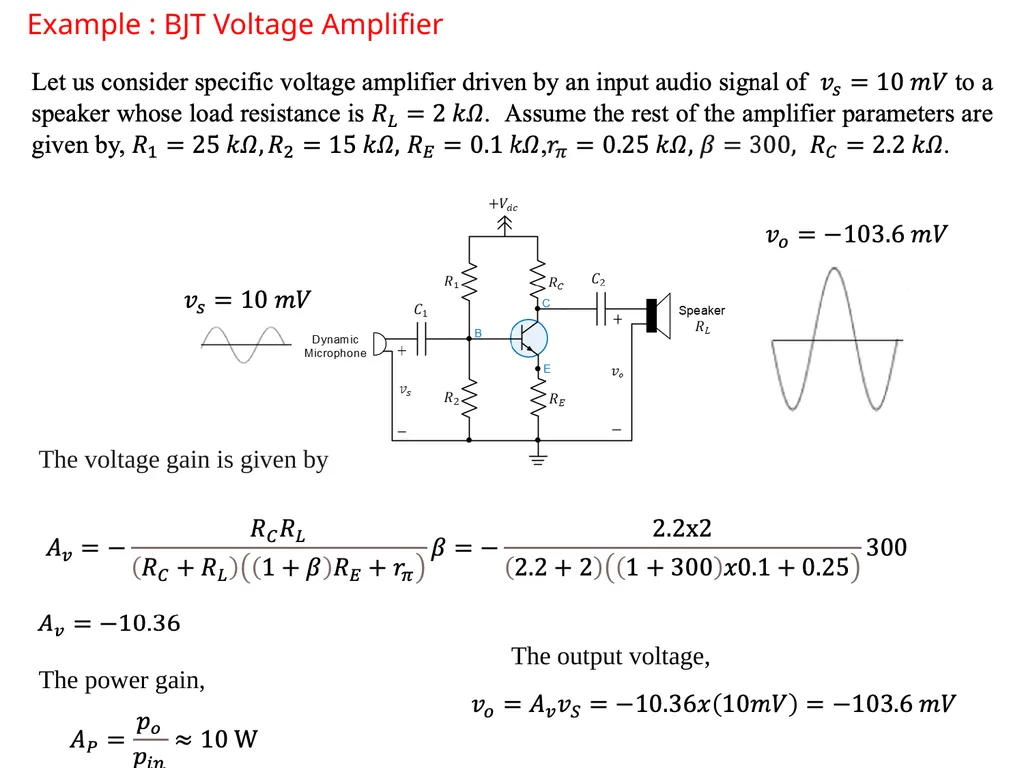
Example : BJT Voltage Amplifier The voltage gain is given by The power gain, The output voltage,<br>