
EER Modeling Sampath Jayarathna Cal Poly Pomona
MT
Published · 32 slides · 0 views

1 / 1

Description
EER Modeling Sampath Jayarathna Cal Poly Pomona Subclasses and Superclasses (1) An entity type may have additional meaningful subgroupings of its entities Example: EMPLOYEE may be further grouped into: SECRETARY, ENGINEER, TECHNICIAN,
Related Topics
Share
Embed code
Download this presentation From Below
"EER Modeling Sampath Jayarathna Cal Poly Pomona" is the property of its rightful owner. Permission is granted to download and print the materials on this website for personal, non-commercial use only, and to display it on your personal computer provided you do not modify the materials and that you retain all copyright notices contained in the materials. By downloading content from our website, you accept the terms of this agreement.
Presentation Transcript
01
EER Modeling Sampath Jayarathna
Cal Poly Pomona<br>
Cal Poly Pomona<br>
02
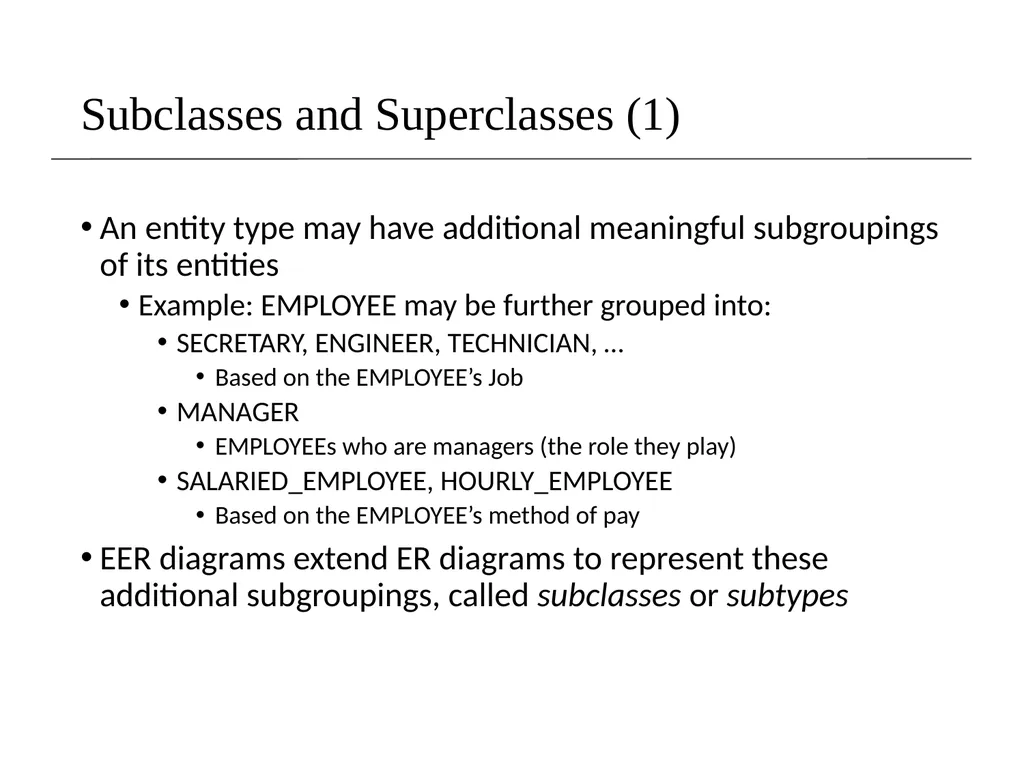
Subclasses and Superclasses (1) An entity type may have additional meaningful subgroupings of its entities
Example: EMPLOYEE may be further grouped into:
SECRETARY, ENGINEER, TECHNICIAN, …
Based on the EMPLOYEE’s Job
MANAGER
EMPLOYEEs who are managers (the role they play)
SALARIED_EMPLOYEE, HOURLY_EMPLOYEE
Based on the EMPLOYEE’s method of pay
EER diagrams extend ER diagrams to represent these additional subgroupings, called subclasses or subtypes<br>
Example: EMPLOYEE may be further grouped into:
SECRETARY, ENGINEER, TECHNICIAN, …
Based on the EMPLOYEE’s Job
MANAGER
EMPLOYEEs who are managers (the role they play)
SALARIED_EMPLOYEE, HOURLY_EMPLOYEE
Based on the EMPLOYEE’s method of pay
EER diagrams extend ER diagrams to represent these additional subgroupings, called subclasses or subtypes<br>
03
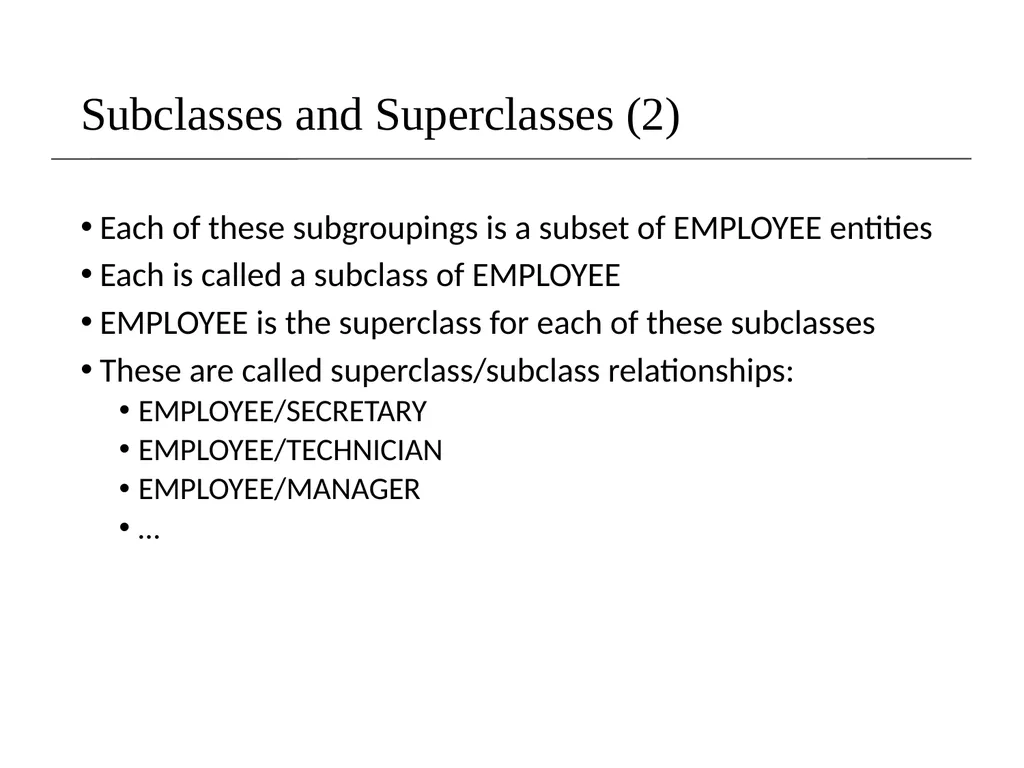
Subclasses and Superclasses (2) Each of these subgroupings is a subset of EMPLOYEE entities
Each is called a subclass of EMPLOYEE
EMPLOYEE is the superclass for each of these subclasses
These are called superclass/subclass relationships:
EMPLOYEE/SECRETARY
EMPLOYEE/TECHNICIAN
EMPLOYEE/MANAGER
…<br>
Each is called a subclass of EMPLOYEE
EMPLOYEE is the superclass for each of these subclasses
These are called superclass/subclass relationships:
EMPLOYEE/SECRETARY
EMPLOYEE/TECHNICIAN
EMPLOYEE/MANAGER
…<br>
04
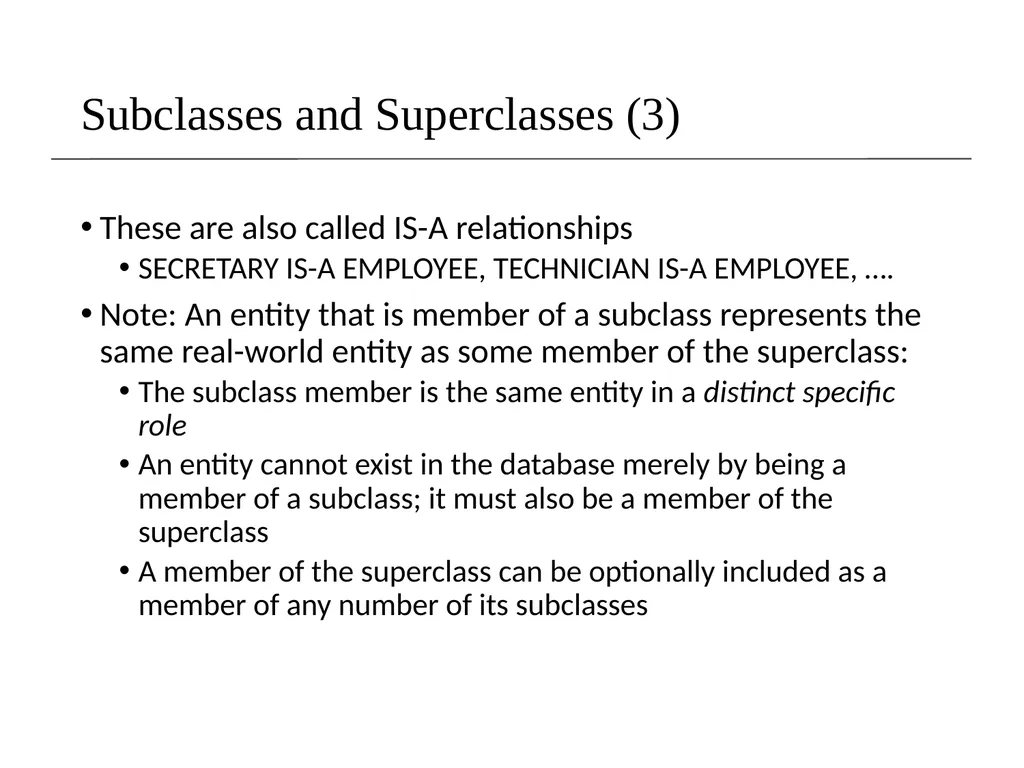
Subclasses and Superclasses (3) These are also called IS-A relationships
SECRETARY IS-A EMPLOYEE, TECHNICIAN IS-A EMPLOYEE, ….
Note: An entity that is member of a subclass represents the same real-world entity as some member of the superclass:
The subclass member is the same entity in a distinct specific role
An entity cannot exist in the database merely by being a member of a subclass; it must also be a member of the superclass
A member of the superclass can be optionally included as a member of any number of its subclasses<br>
SECRETARY IS-A EMPLOYEE, TECHNICIAN IS-A EMPLOYEE, ….
Note: An entity that is member of a subclass represents the same real-world entity as some member of the superclass:
The subclass member is the same entity in a distinct specific role
An entity cannot exist in the database merely by being a member of a subclass; it must also be a member of the superclass
A member of the superclass can be optionally included as a member of any number of its subclasses<br>
05
Subclasses and Superclasses (4) Examples:
A salaried employee who is also an engineer belongs to the two subclasses:
ENGINEER, and
SALARIED_EMPLOYEE
A salaried employee who is also an engineering manager belongs to the three subclasses:
MANAGER,
ENGINEER, and
SALARIED_EMPLOYEE<br>
A salaried employee who is also an engineer belongs to the two subclasses:
ENGINEER, and
SALARIED_EMPLOYEE
A salaried employee who is also an engineering manager belongs to the three subclasses:
MANAGER,
ENGINEER, and
SALARIED_EMPLOYEE<br>
06
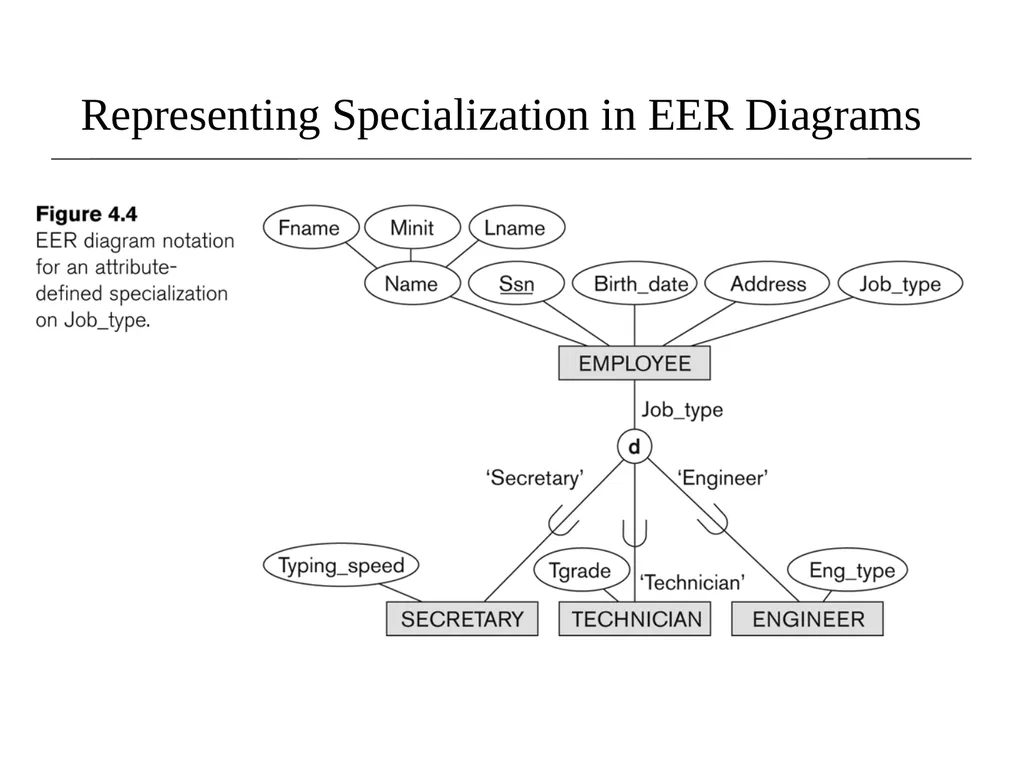
Representing Specialization in EER Diagrams<br>
07
Attribute Inheritance in Superclass / Subclass Relationships An entity that is member of a subclass inherits
All attributes of the entity as a member of the superclass
All relationships of the entity as a member of the superclass
Example:
In the previous slide, SECRETARY (as well as TECHNICIAN and ENGINEER) inherit the attributes Name, SSN, …, from EMPLOYEE
Every SECRETARY entity will have values for the inherited attributes<br>
All attributes of the entity as a member of the superclass
All relationships of the entity as a member of the superclass
Example:
In the previous slide, SECRETARY (as well as TECHNICIAN and ENGINEER) inherit the attributes Name, SSN, …, from EMPLOYEE
Every SECRETARY entity will have values for the inherited attributes<br>
08
Specialization (1) Specialization is the process of defining a set of subclasses of a superclass
The set of subclasses is based upon some distinguishing characteristics of the entities in the superclass
Example: {SECRETARY, ENGINEER, TECHNICIAN} is a specialization of EMPLOYEE based upon job type.
Example: MANAGER is a specialization of EMPLOYEE based on the role the employee plays
May have several specializations of the same superclass<br>
The set of subclasses is based upon some distinguishing characteristics of the entities in the superclass
Example: {SECRETARY, ENGINEER, TECHNICIAN} is a specialization of EMPLOYEE based upon job type.
Example: MANAGER is a specialization of EMPLOYEE based on the role the employee plays
May have several specializations of the same superclass<br>
09
Specialization (2) Example: Another specialization of EMPLOYEE based on method of pay is {SALARIED_EMPLOYEE, HOURLY_EMPLOYEE}.
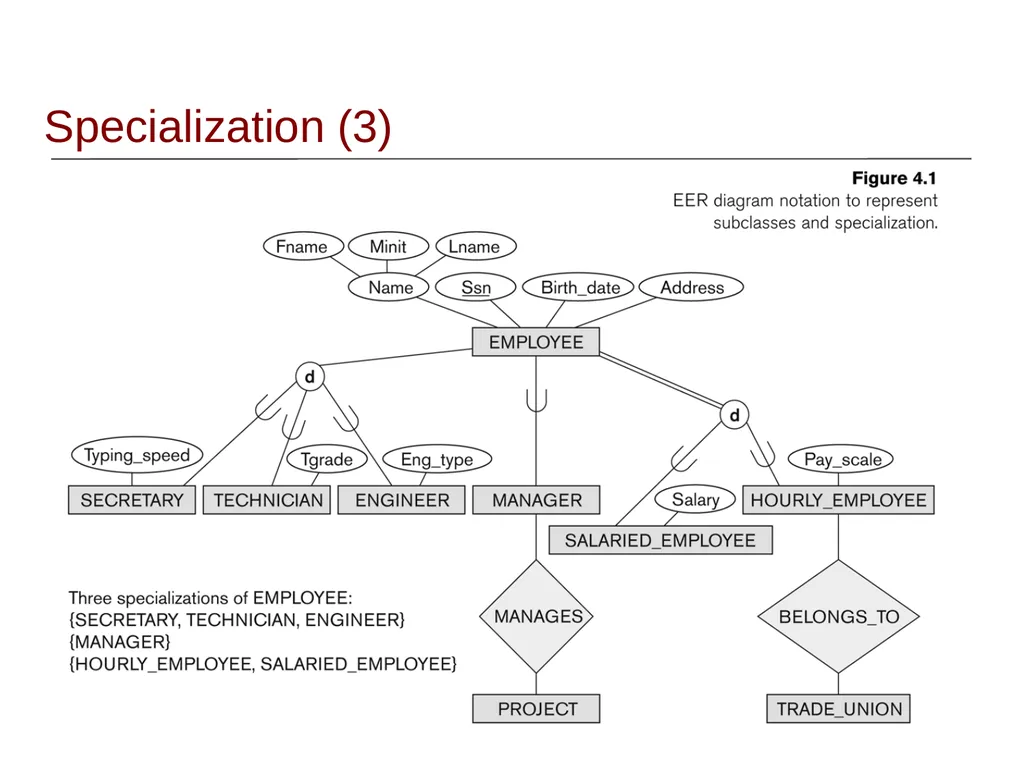
Superclass/subclass relationships and specialization can be diagrammatically represented in EER diagrams
Attributes of a subclass are called specific or local attributes.
For example, the attribute TypingSpeed of SECRETARY
The subclass can also participate in specific relationship types.
For example, a relationship BELONGS_TO of HOURLY_EMPLOYEE<br>
Superclass/subclass relationships and specialization can be diagrammatically represented in EER diagrams
Attributes of a subclass are called specific or local attributes.
For example, the attribute TypingSpeed of SECRETARY
The subclass can also participate in specific relationship types.
For example, a relationship BELONGS_TO of HOURLY_EMPLOYEE<br>
10
Specialization (3)<br>
11
Generalization Generalization is the reverse of the specialization process
Several classes with common features are generalized into a superclass;
original classes become its subclasses
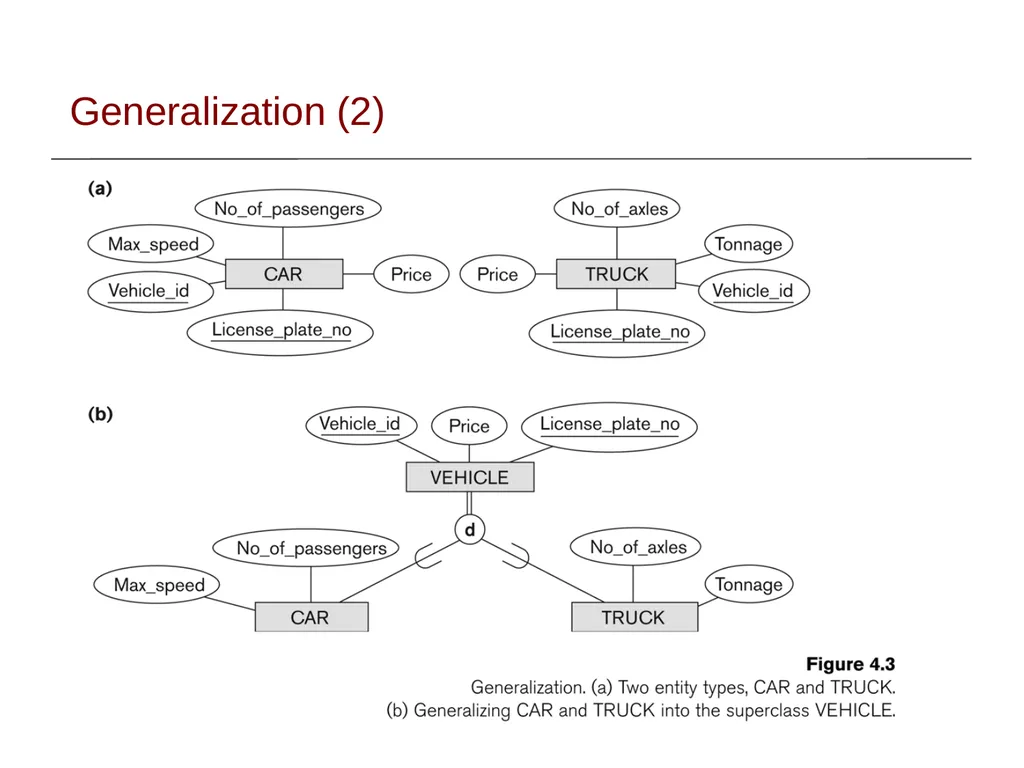
Example: CAR, TRUCK generalized into VEHICLE;
both CAR, TRUCK become subclasses of the superclass VEHICLE.
We can view {CAR, TRUCK} as a specialization of VEHICLE
Alternatively, we can view VEHICLE as a generalization of CAR and TRUCK<br>
Several classes with common features are generalized into a superclass;
original classes become its subclasses
Example: CAR, TRUCK generalized into VEHICLE;
both CAR, TRUCK become subclasses of the superclass VEHICLE.
We can view {CAR, TRUCK} as a specialization of VEHICLE
Alternatively, we can view VEHICLE as a generalization of CAR and TRUCK<br>
12
Generalization (2)<br>
13
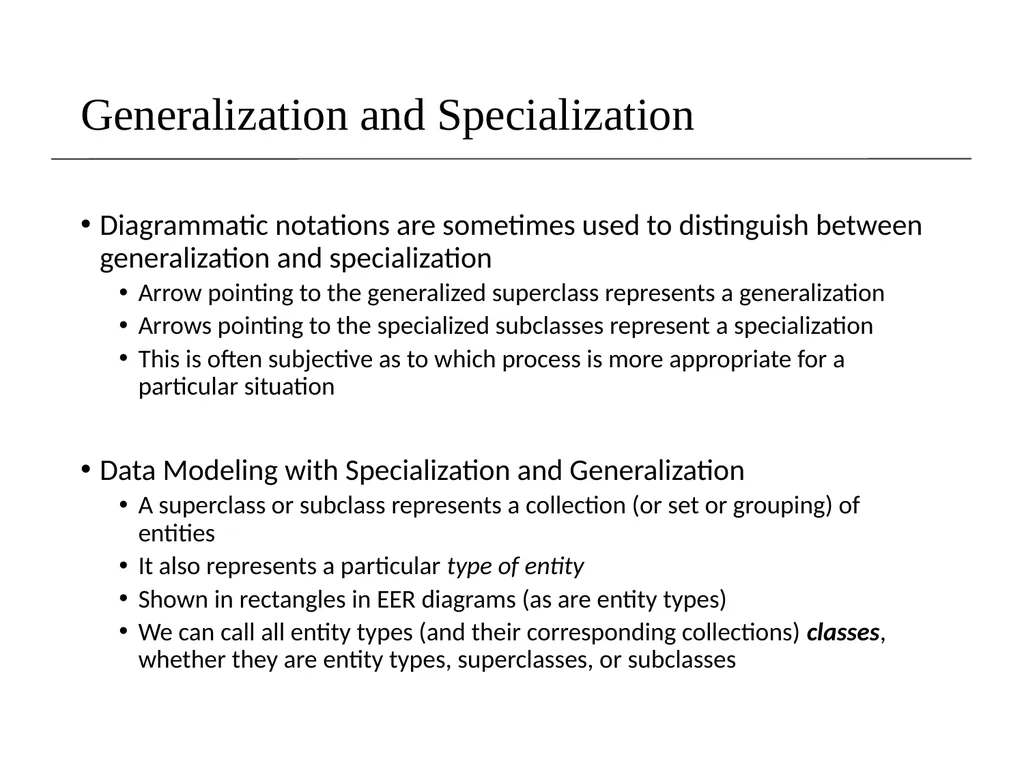
Generalization and Specialization Diagrammatic notations are sometimes used to distinguish between generalization and specialization
Arrow pointing to the generalized superclass represents a generalization
Arrows pointing to the specialized subclasses represent a specialization
This is often subjective as to which process is more appropriate for a particular situation
Data Modeling with Specialization and Generalization
A superclass or subclass represents a collection (or set or grouping) of entities
It also represents a particular type of entity
Shown in rectangles in EER diagrams (as are entity types)
We can call all entity types (and their corresponding collections) classes, whether they are entity types, superclasses, or subclasses<br>
Arrow pointing to the generalized superclass represents a generalization
Arrows pointing to the specialized subclasses represent a specialization
This is often subjective as to which process is more appropriate for a particular situation
Data Modeling with Specialization and Generalization
A superclass or subclass represents a collection (or set or grouping) of entities
It also represents a particular type of entity
Shown in rectangles in EER diagrams (as are entity types)
We can call all entity types (and their corresponding collections) classes, whether they are entity types, superclasses, or subclasses<br>
14
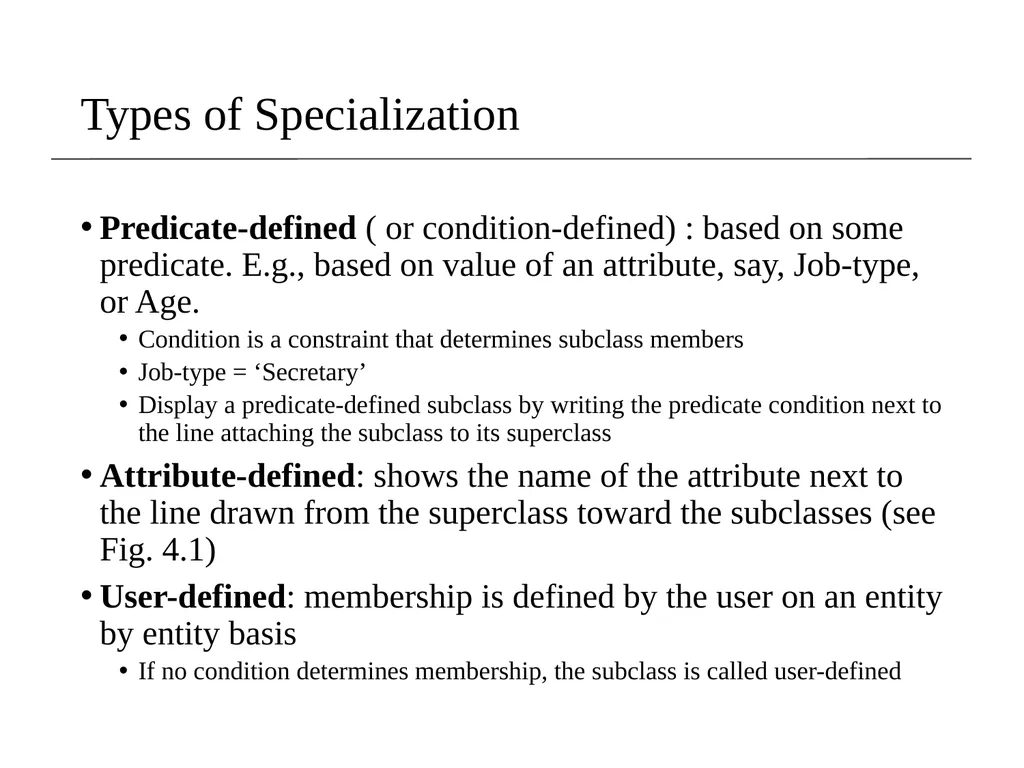
Types of Specialization Predicate-defined ( or condition-defined) : based on some predicate. E.g., based on value of an attribute, say, Job-type, or Age.
Condition is a constraint that determines subclass members
Job-type = ‘Secretary’
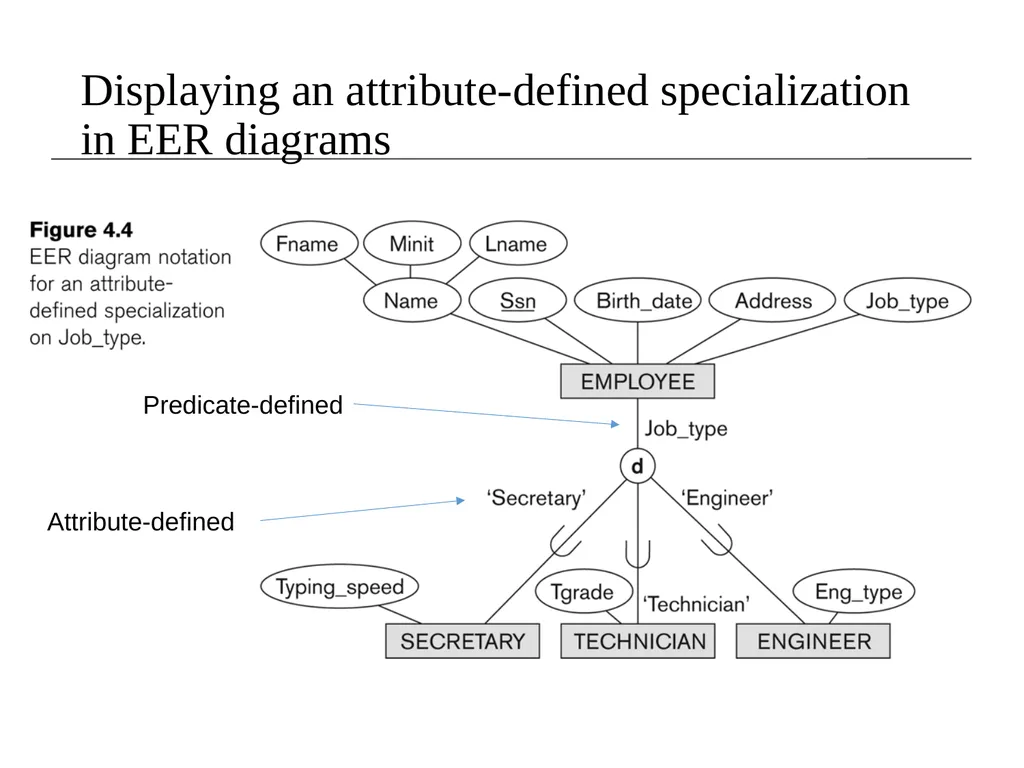
Display a predicate-defined subclass by writing the predicate condition next to the line attaching the subclass to its superclass
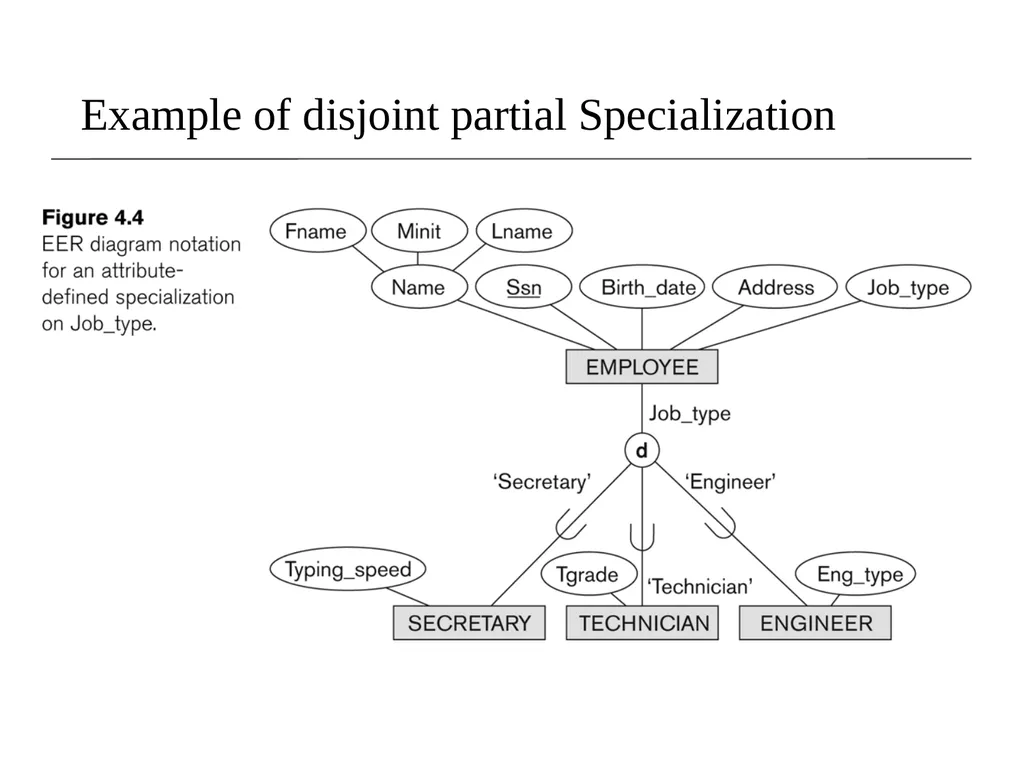
Attribute-defined: shows the name of the attribute next to the line drawn from the superclass toward the subclasses (see Fig. 4.1)
User-defined: membership is defined by the user on an entity by entity basis
If no condition determines membership, the subclass is called user-defined<br>
Condition is a constraint that determines subclass members
Job-type = ‘Secretary’
Display a predicate-defined subclass by writing the predicate condition next to the line attaching the subclass to its superclass
Attribute-defined: shows the name of the attribute next to the line drawn from the superclass toward the subclasses (see Fig. 4.1)
User-defined: membership is defined by the user on an entity by entity basis
If no condition determines membership, the subclass is called user-defined<br>
15
Displaying an attribute-defined specialization in EER diagrams Predicate-defined Attribute-defined<br>
16
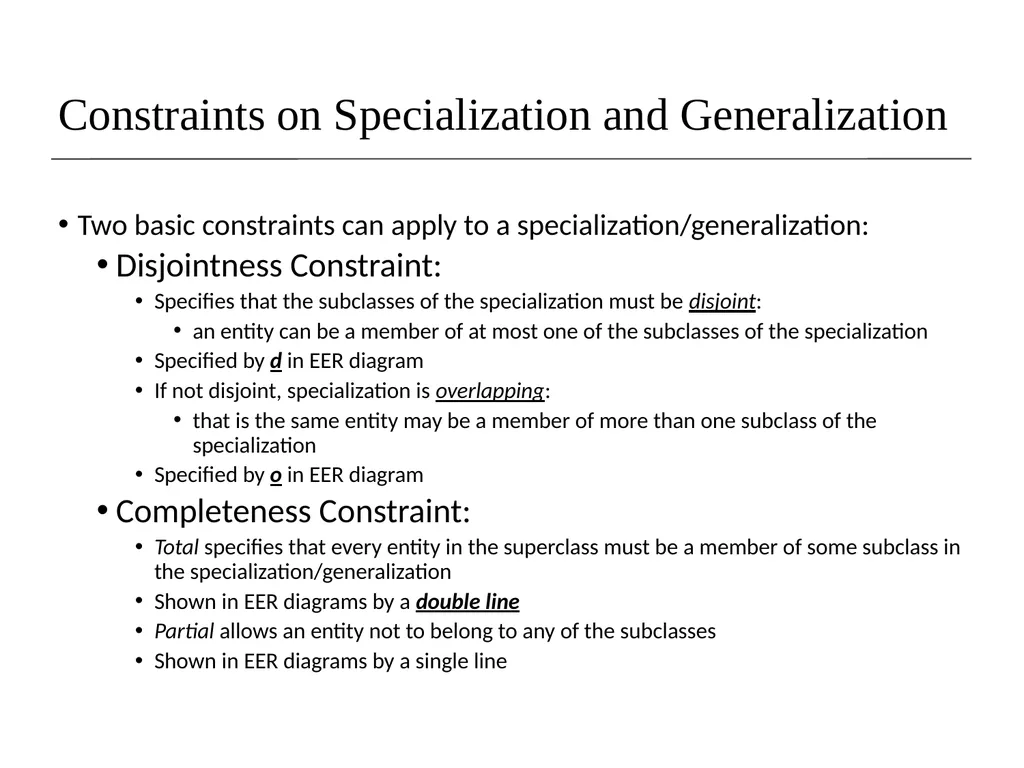
Constraints on Specialization and Generalization Two basic constraints can apply to a specialization/generalization:
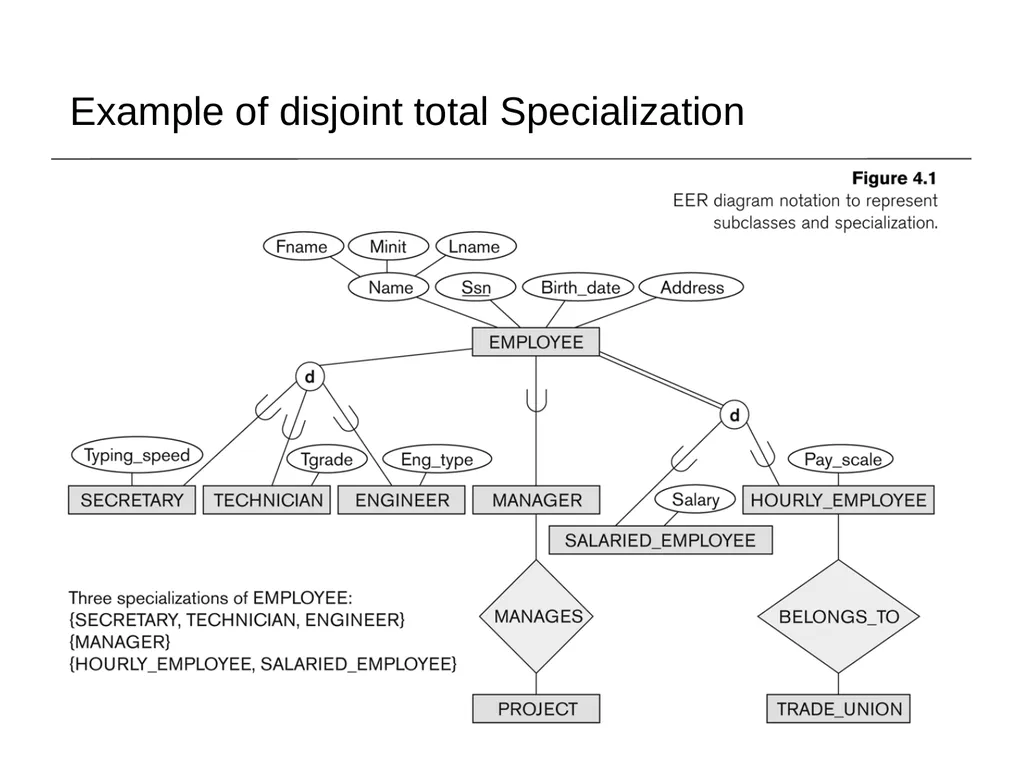
Disjointness Constraint:
Specifies that the subclasses of the specialization must be disjoint:
an entity can be a member of at most one of the subclasses of the specialization
Specified by d in EER diagram
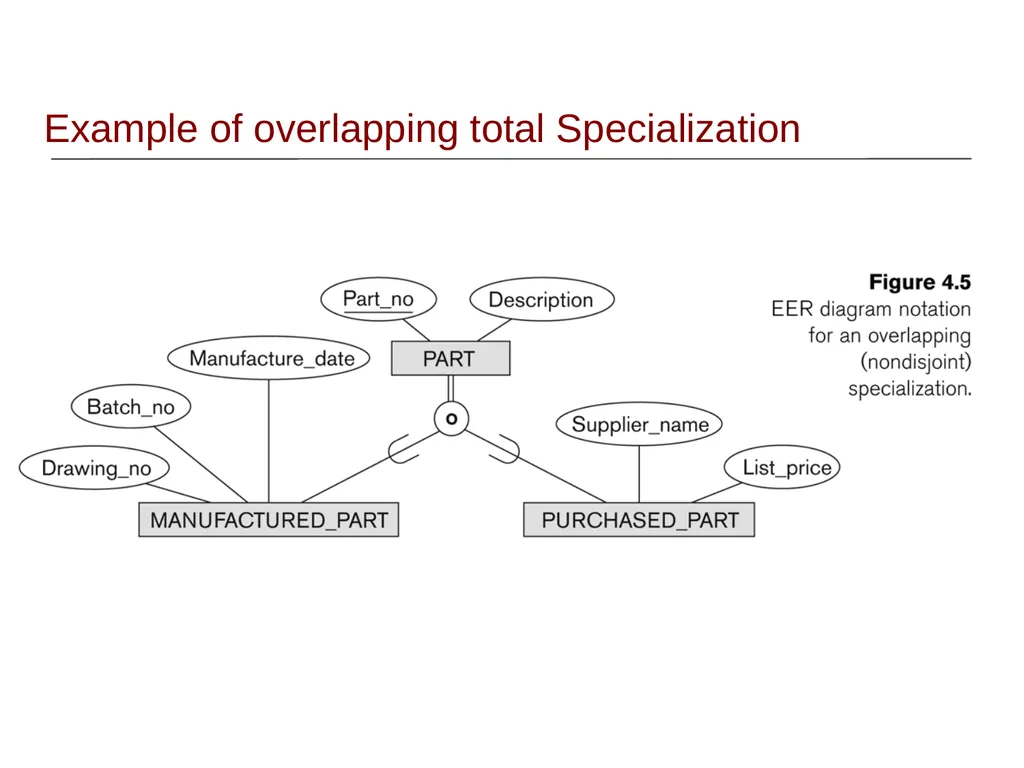
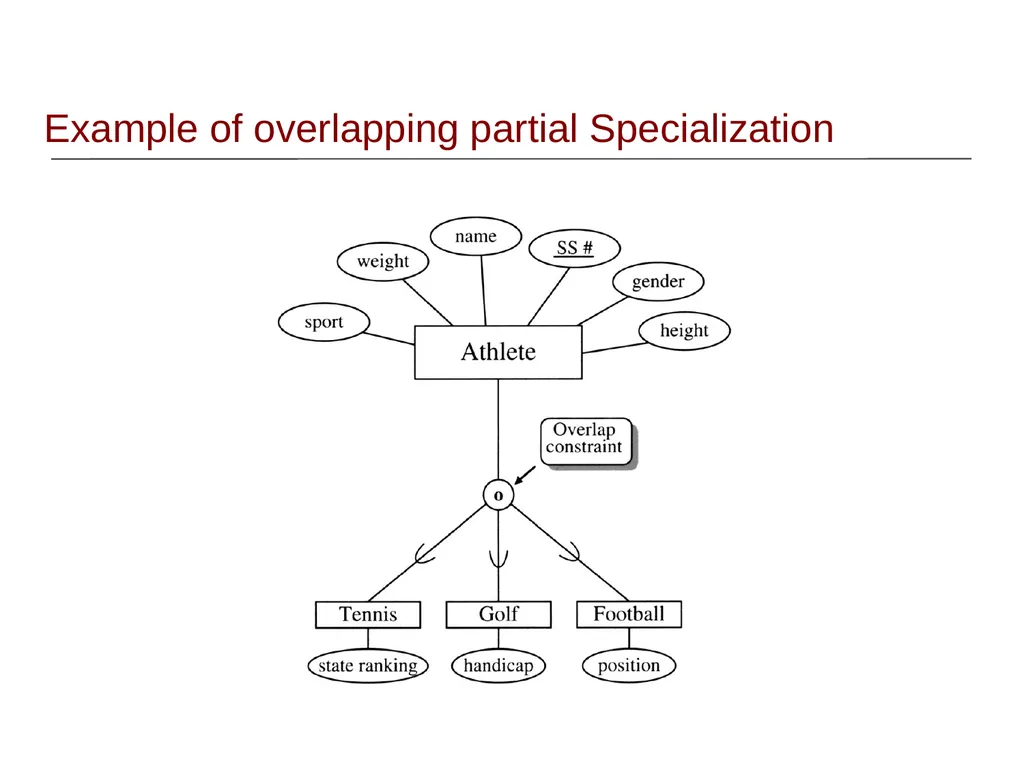
If not disjoint, specialization is overlapping:
that is the same entity may be a member of more than one subclass of the specialization
Specified by o in EER diagram
Completeness Constraint:
Total specifies that every entity in the superclass must be a member of some subclass in the specialization/generalization
Shown in EER diagrams by a double line
Partial allows an entity not to belong to any of the subclasses
Shown in EER diagrams by a single line<br>
Disjointness Constraint:
Specifies that the subclasses of the specialization must be disjoint:
an entity can be a member of at most one of the subclasses of the specialization
Specified by d in EER diagram
If not disjoint, specialization is overlapping:
that is the same entity may be a member of more than one subclass of the specialization
Specified by o in EER diagram
Completeness Constraint:
Total specifies that every entity in the superclass must be a member of some subclass in the specialization/generalization
Shown in EER diagrams by a double line
Partial allows an entity not to belong to any of the subclasses
Shown in EER diagrams by a single line<br>
17
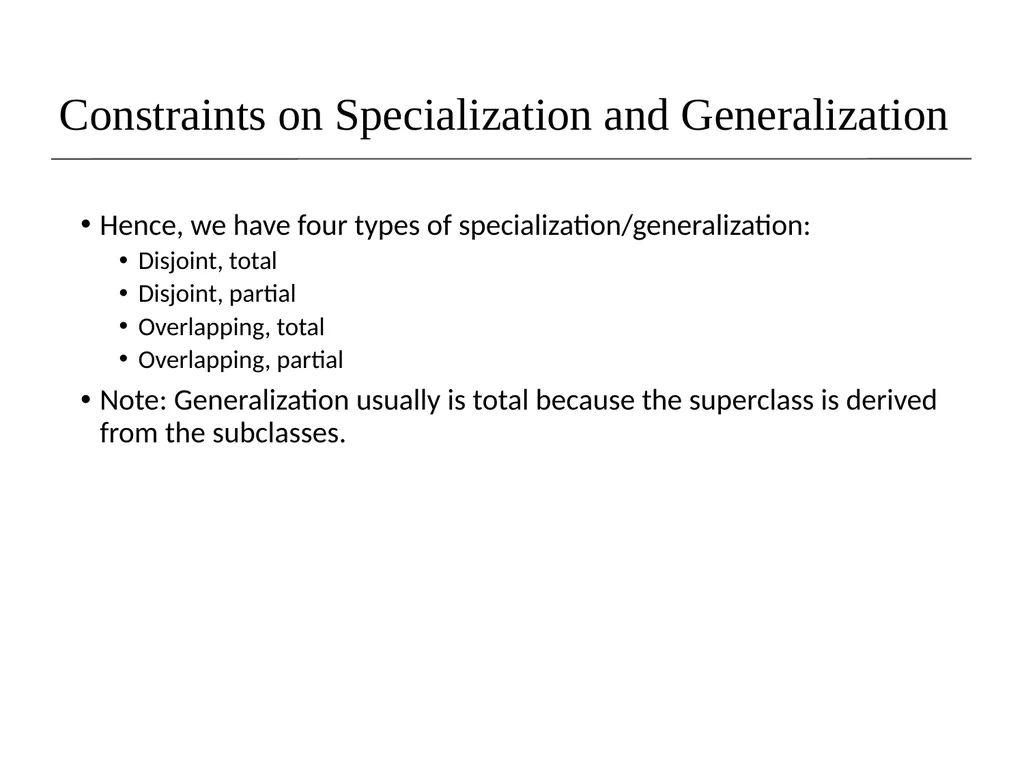
Constraints on Specialization and Generalization Hence, we have four types of specialization/generalization:
Disjoint, total
Disjoint, partial
Overlapping, total
Overlapping, partial
Note: Generalization usually is total because the superclass is derived from the subclasses.<br>
Disjoint, total
Disjoint, partial
Overlapping, total
Overlapping, partial
Note: Generalization usually is total because the superclass is derived from the subclasses.<br>
18
Example of disjoint partial Specialization<br>
19
Example of disjoint total Specialization<br>
20
Example of overlapping total Specialization<br>
21
Example of overlapping partial Specialization<br>
22
Specialization/Generalization Hierarchies, Lattices & Shared Subclasses (1) A subclass may itself have further subclasses specified on it
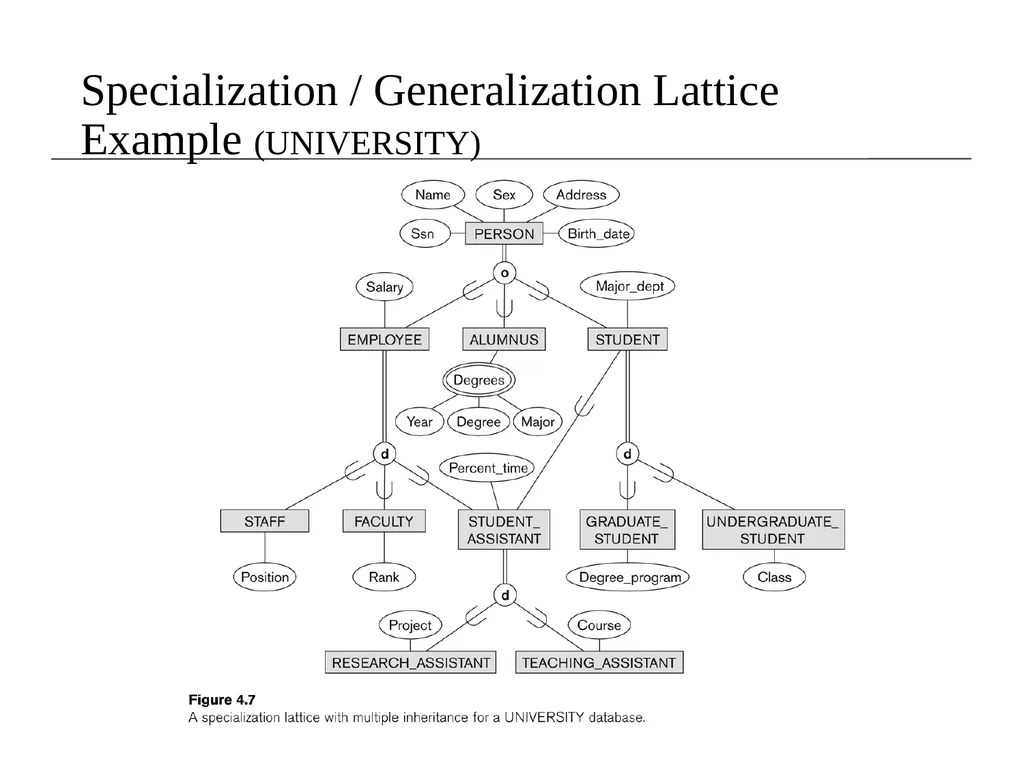
forms a hierarchy or a lattice
Hierarchy has a constraint that every subclass has only one superclass (called single inheritance); this is basically a tree structure
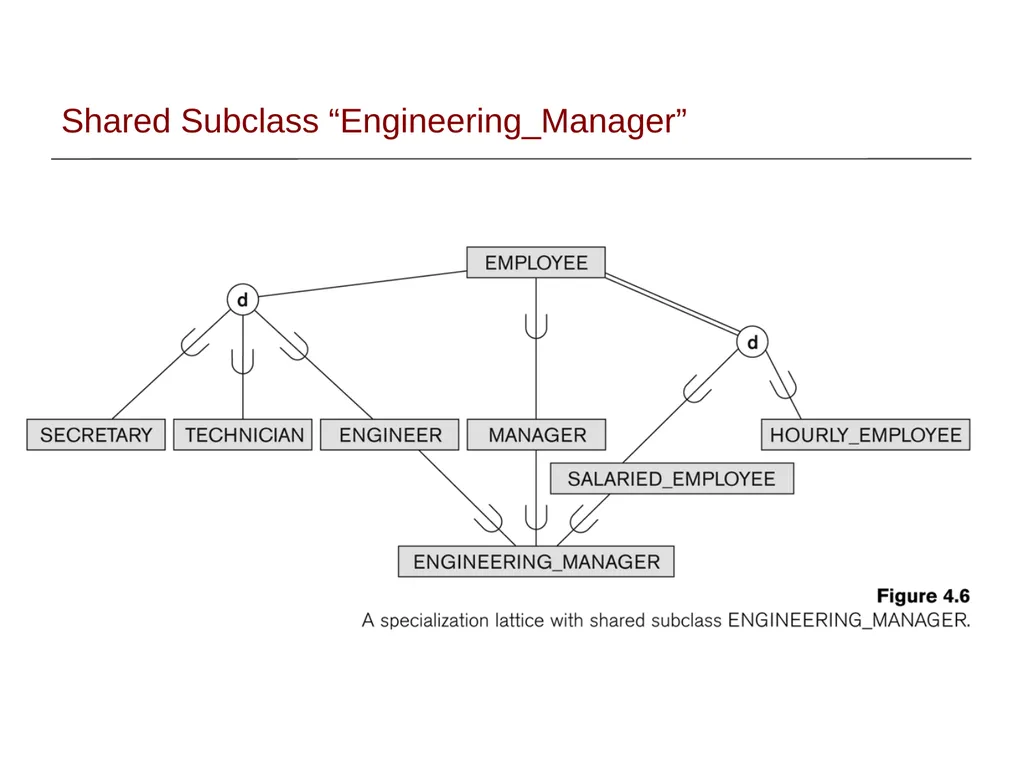
In a lattice, a subclass can be subclass of more than one superclass (called multiple inheritance)<br>
forms a hierarchy or a lattice
Hierarchy has a constraint that every subclass has only one superclass (called single inheritance); this is basically a tree structure
In a lattice, a subclass can be subclass of more than one superclass (called multiple inheritance)<br>
23
Shared Subclass “Engineering_Manager”<br>
24
Specialization/Generalization Hierarchies, Lattices & Shared Subclasses (2) In a lattice or hierarchy, a subclass inherits attributes not only of its direct superclass, but also of all its predecessor superclasses
A subclass with more than one superclass is called a shared subclass (multiple inheritance)<br>
A subclass with more than one superclass is called a shared subclass (multiple inheritance)<br>
25
Specialization/Generalization Hierarchies, Lattices & Shared Subclasses (3) In specialization, start with an entity type and then define subclasses of the entity type by successive specialization
called a top down conceptual refinement process
In generalization, start with many entity types and generalize those that have common properties
Called a bottom up conceptual synthesis process
In practice, a combination of both processes is usually employed<br>
called a top down conceptual refinement process
In generalization, start with many entity types and generalize those that have common properties
Called a bottom up conceptual synthesis process
In practice, a combination of both processes is usually employed<br>
26
Specialization / Generalization Lattice Example (UNIVERSITY)<br>
27
Categories (UNION TYPES) (1) All of the superclass/subclass relationships we have seen thus far have a single superclass
A shared subclass is a subclass in:
more than one distinct superclass/subclass relationships
each relationships has a single superclass
shared subclass leads to multiple inheritance
In some cases, we need to model a single superclass/subclass relationship with more than one superclass
Superclasses can represent different entity types
Such a subclass is called a category or UNION TYPE<br>
A shared subclass is a subclass in:
more than one distinct superclass/subclass relationships
each relationships has a single superclass
shared subclass leads to multiple inheritance
In some cases, we need to model a single superclass/subclass relationship with more than one superclass
Superclasses can represent different entity types
Such a subclass is called a category or UNION TYPE<br>
28
Categories (UNION TYPES) (2) Example: In a database for vehicle registration, a vehicle owner can be a PERSON, a BANK (holding a lien on a vehicle) or a COMPANY.
A category (UNION type) called OWNER is created to represent a subset of the union of the three superclasses COMPANY, BANK, and PERSON
A category member must exist in at least one (typically just one) of its superclasses
Difference from shared subclass, which is a:
subset of the intersection of its superclasses
shared subclass member must exist in all of its superclasses<br>
A category (UNION type) called OWNER is created to represent a subset of the union of the three superclasses COMPANY, BANK, and PERSON
A category member must exist in at least one (typically just one) of its superclasses
Difference from shared subclass, which is a:
subset of the intersection of its superclasses
shared subclass member must exist in all of its superclasses<br>
29
Two categories (UNION types): OWNER, REGISTERED_VEHICLE<br>
30
Alternative diagrammatic notations ER/EER diagrams are a specific notation for displaying the concepts of the model diagrammatically
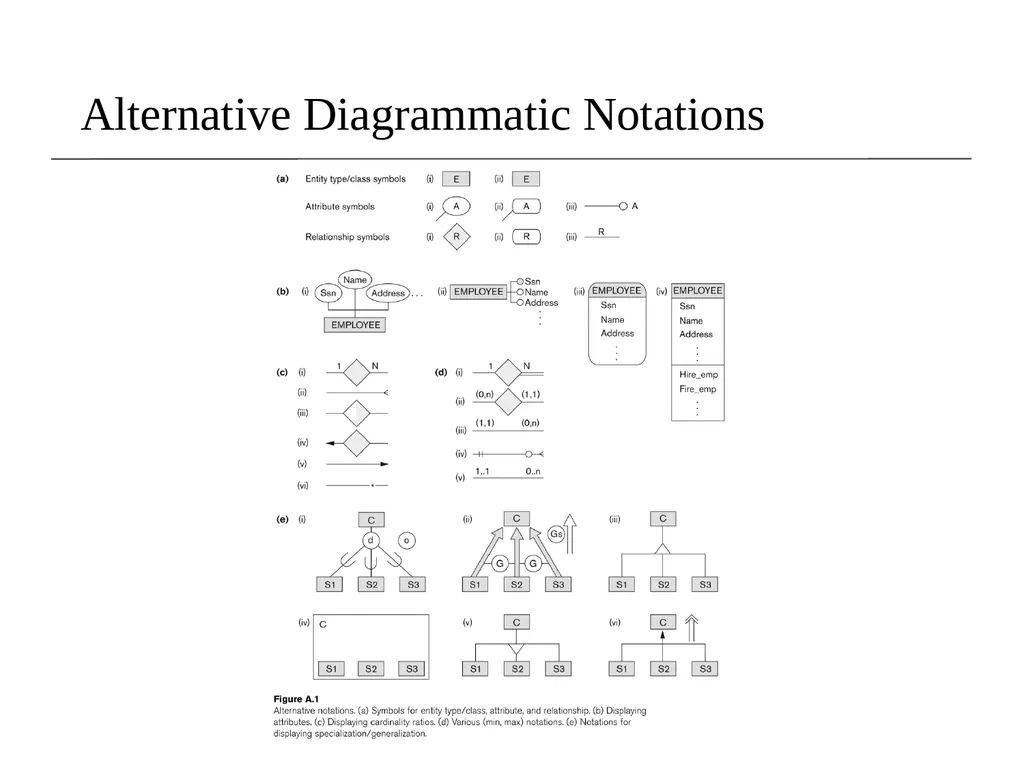
DB design tools use many alternative notations for the same or similar concepts
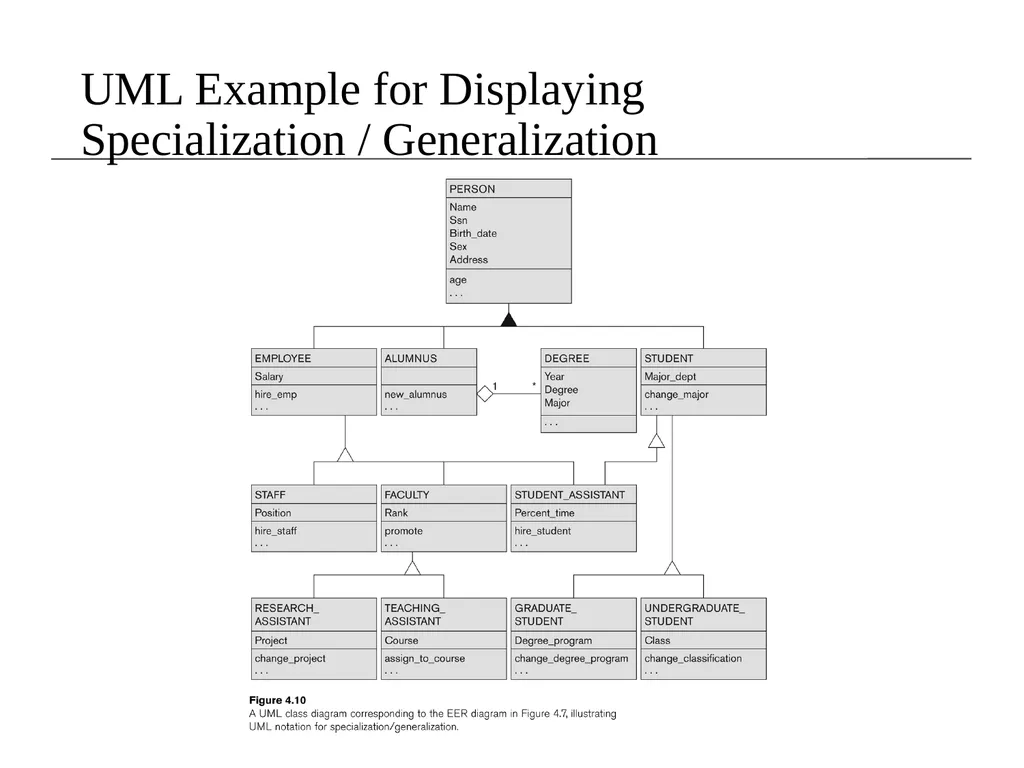
One popular alternative notation uses UML class diagrams
see next slides for UML class diagrams and other alternative notations<br>
DB design tools use many alternative notations for the same or similar concepts
One popular alternative notation uses UML class diagrams
see next slides for UML class diagrams and other alternative notations<br>
31
UML Example for Displaying Specialization / Generalization<br>
32
Alternative Diagrammatic Notations<br>