
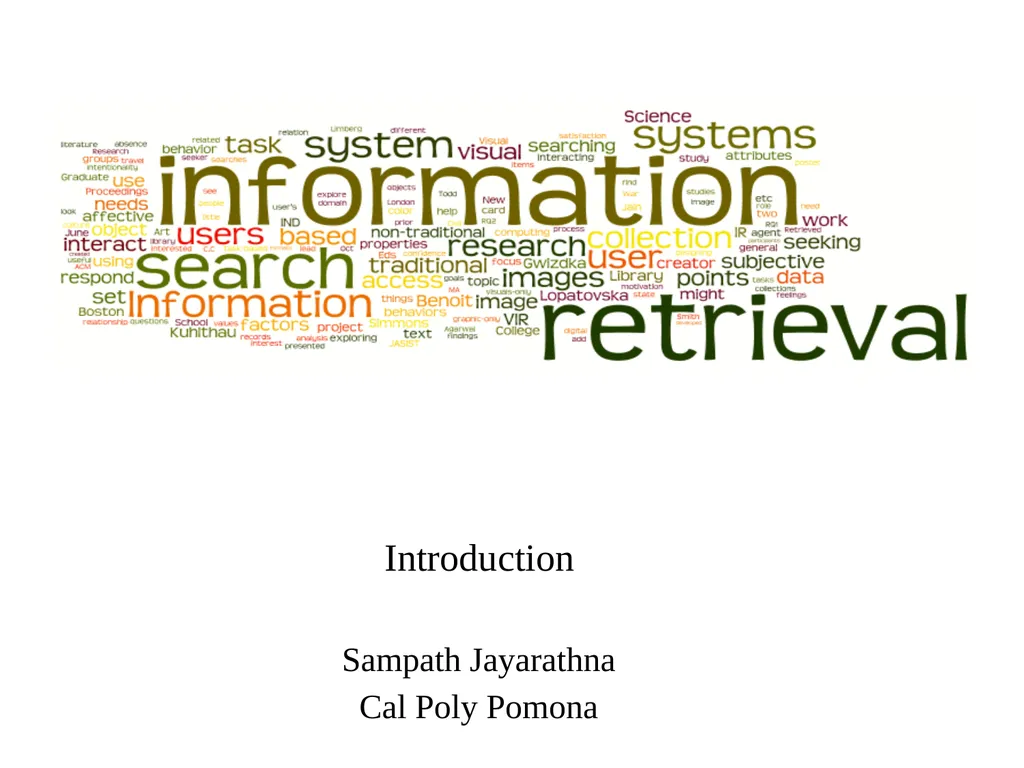
Introduction Sampath Jayarathna Cal Poly Pomona
DP
Published · 48 slides · 0 views

1 / 1

Description
Introduction Sampath Jayarathna Cal Poly Pomona Today Who I am CS 599 educational objectives (and why) Overview of the course, and logistics Quick overview of IR and why we study it 2 Who am I? Instructor : Sampath Jayarathna Joined Cal
Related Topics
Share
Embed code
Download this presentation From Below
"Introduction Sampath Jayarathna Cal Poly Pomona" is the property of its rightful owner. Permission is granted to download and print the materials on this website for personal, non-commercial use only, and to display it on your personal computer provided you do not modify the materials and that you retain all copyright notices contained in the materials. By downloading content from our website, you accept the terms of this agreement.
Presentation Transcript
01
Introduction Sampath Jayarathna
Cal Poly Pomona<br>
Cal Poly Pomona<br>
02
Today Who I am
CS 599 educational objectives (and why)
Overview of the course, and logistics
Quick overview of IR and why we study it 2<br>
CS 599 educational objectives (and why)
Overview of the course, and logistics
Quick overview of IR and why we study it 2<br>
03
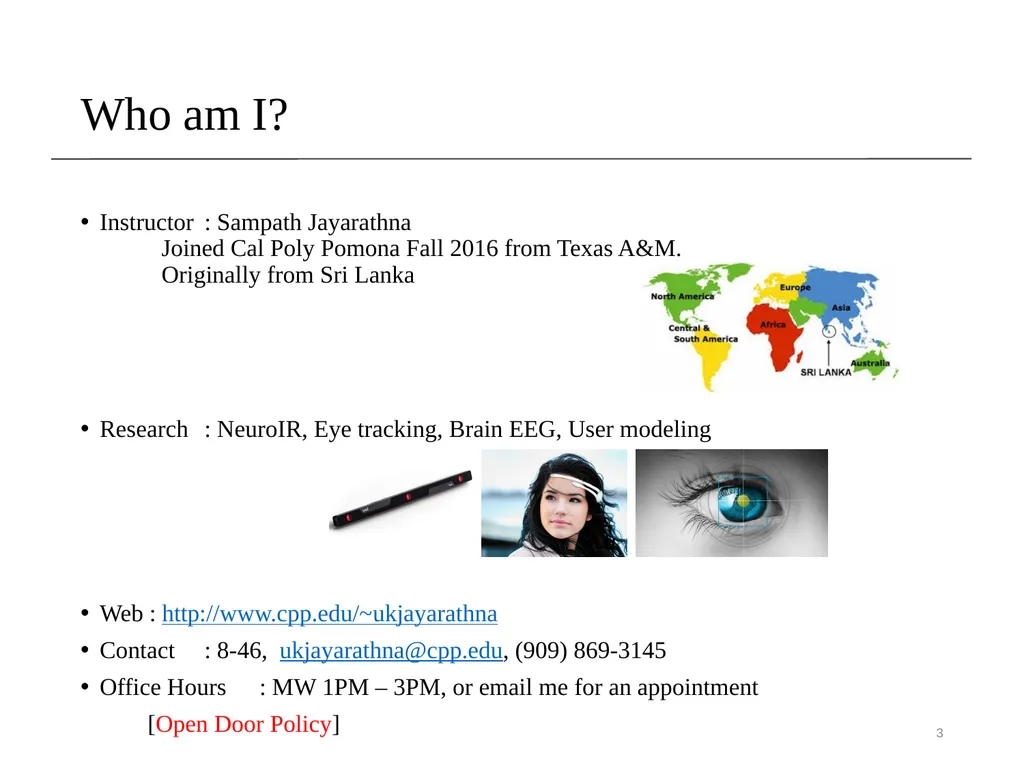
Who am I? Instructor : Sampath Jayarathna
Joined Cal Poly Pomona Fall 2016 from Texas A&M.
Originally from Sri Lanka
Research : NeuroIR, Eye tracking, Brain EEG, User modeling
Web : http://www.cpp.edu/~ukjayarathna
Contact : 8-46, ukjayarathna@cpp.edu, (909) 869-3145
Office Hours : MW 1PM – 3PM, or email me for an appointment
[Open Door Policy] 3<br>
Research : NeuroIR, Eye tracking, Brain EEG, User modeling
Web : http://www.cpp.edu/~ukjayarathna
Contact : 8-46, ukjayarathna@cpp.edu, (909) 869-3145
Office Hours : MW 1PM – 3PM, or email me for an appointment
[Open Door Policy] 3<br>
04
Course Information Schedule : MW, 8-348, 6.00 PM – 7.50 PM http://www.cpp.edu/~ukjayarathna/courses/w17/cs599
www.piazza.com/csupomona/winter2017/cs599/home
Blackboard
Prereqs
Official: CS331 or approval of instructor
Practical: Know object-oriented programming language
Format
Before lecture: do reading
In lecture: put reading in context
After lecture: assignments, for hands-on practice 4<br>
www.piazza.com/csupomona/winter2017/cs599/home
Blackboard
Prereqs
Official: CS331 or approval of instructor
Practical: Know object-oriented programming language
Format
Before lecture: do reading
In lecture: put reading in context
After lecture: assignments, for hands-on practice 4<br>
05
Required / Supplementary materials Required Book
Introduction to Information Retrieval C. Manning, P. Raghavan and H. Schutze Cambridge University Press, 2008. Free online version available at: http://nlp.stanford.edu/IR-book/
Supplementary
Search Engines – Information Retrieval in Practice W. B. Croft, D. Metzler, and T. Strohman Cambridge University Press, 2015. Free online version available at: http://ciir.cs.umass.edu/downloads/SEIRiP.pdf
Research Papers 5<br>
Introduction to Information Retrieval C. Manning, P. Raghavan and H. Schutze Cambridge University Press, 2008. Free online version available at: http://nlp.stanford.edu/IR-book/
Supplementary
Search Engines – Information Retrieval in Practice W. B. Croft, D. Metzler, and T. Strohman Cambridge University Press, 2015. Free online version available at: http://ciir.cs.umass.edu/downloads/SEIRiP.pdf
Research Papers 5<br>
06
Student Learning Outcomes After successfully completing this course, students should be able to:
Define and explain the key concepts and models relevant to information storage and retrieval, including efficient text indexing, boolean, vector space and probabilistic retrieval models, relevance feedback, document clustering and text categorization.
Analyze, identify and design core text based retrieval system algorithms and advanced algorithms like document clustering and text categorization/classification.
Learn measures and techniques to evaluate IR systems and fundamental techniques to implement IR systems
Demonstrate through involvement in a team project the central elements of team building and team management and salient features in recent research results in web search and information retrieval. 6<br>
Define and explain the key concepts and models relevant to information storage and retrieval, including efficient text indexing, boolean, vector space and probabilistic retrieval models, relevance feedback, document clustering and text categorization.
Analyze, identify and design core text based retrieval system algorithms and advanced algorithms like document clustering and text categorization/classification.
Learn measures and techniques to evaluate IR systems and fundamental techniques to implement IR systems
Demonstrate through involvement in a team project the central elements of team building and team management and salient features in recent research results in web search and information retrieval. 6<br>
07
Communication Piazza:
All questions will be fielded through Piazza.
Many questions everyone can see the answer
You can also post private messages that can only be seen by the instructor
Blackboard:
Blackboard will be used primarily for assignments/homework, extra credit submission and grade dissemination.
Email:
Again, email should only be used in rare instances, I will probably point you back to Piazza 7<br>
All questions will be fielded through Piazza.
Many questions everyone can see the answer
You can also post private messages that can only be seen by the instructor
Blackboard:
Blackboard will be used primarily for assignments/homework, extra credit submission and grade dissemination.
Email:
Again, email should only be used in rare instances, I will probably point you back to Piazza 7<br>
08
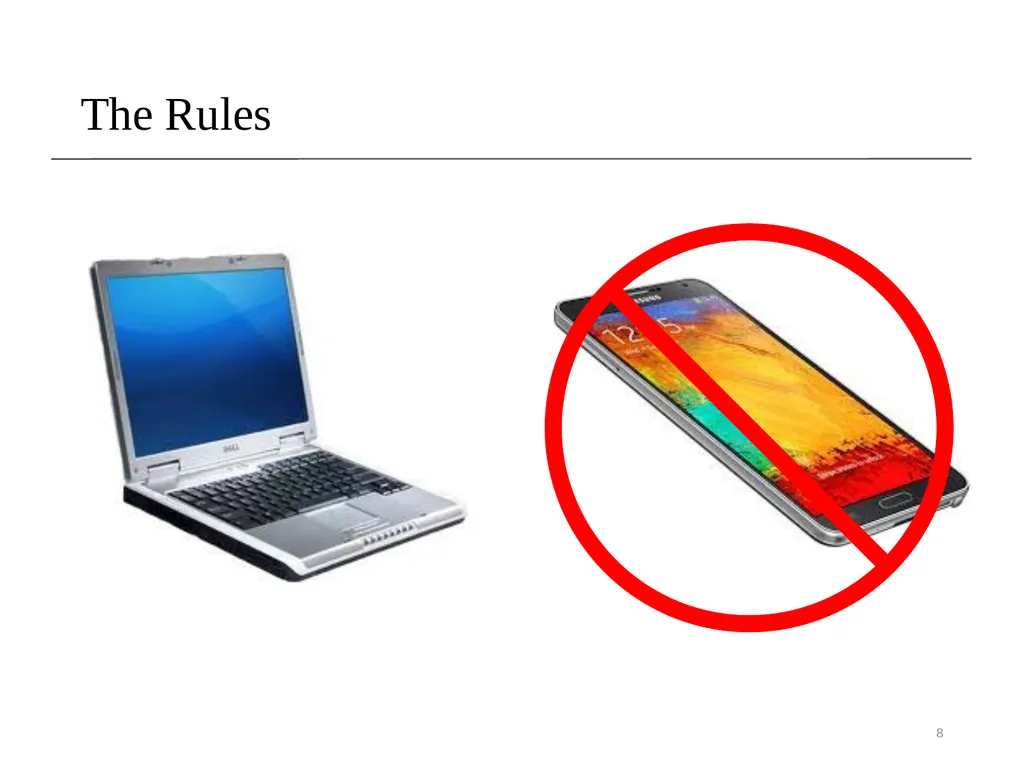
The Rules 8<br>
09
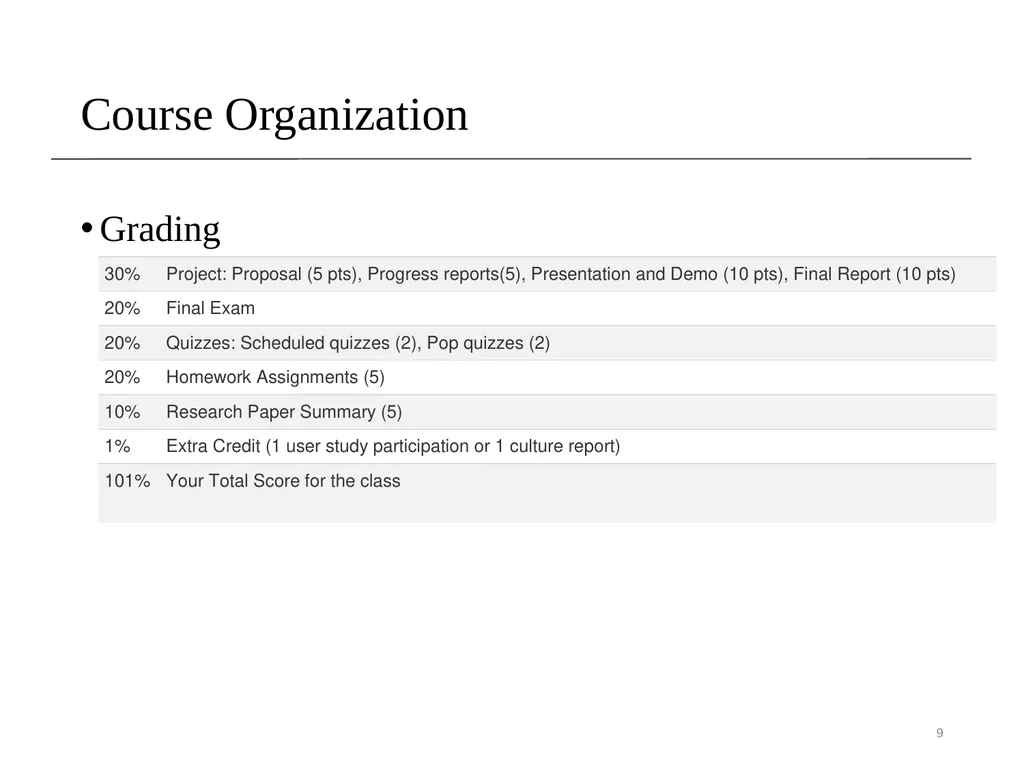
Course Organization Grading 9<br>
10
Course Organization Project: More in the next couple of slides…
Final Exam: The final exam is comprehensive, closed books and will be held on Monday, March 13, 6.00pm - 7.45pm.
Homework: We will have five homework assignments, each worth 4% of your overall grade. Homework 1 – 1 Page Resume, Due: 1/11, 6pm, Office 8-46
Research Paper Summary
7 Papers, Summary due on the day of the discussion
Quizzes
2 scheduled (1/25, 3/1), 2 pop quizzes
Extra Credit:
Culture reports or User Study evaluation participation 10<br>
Final Exam: The final exam is comprehensive, closed books and will be held on Monday, March 13, 6.00pm - 7.45pm.
Homework: We will have five homework assignments, each worth 4% of your overall grade. Homework 1 – 1 Page Resume, Due: 1/11, 6pm, Office 8-46
Research Paper Summary
7 Papers, Summary due on the day of the discussion
Quizzes
2 scheduled (1/25, 3/1), 2 pop quizzes
Extra Credit:
Culture reports or User Study evaluation participation 10<br>
11
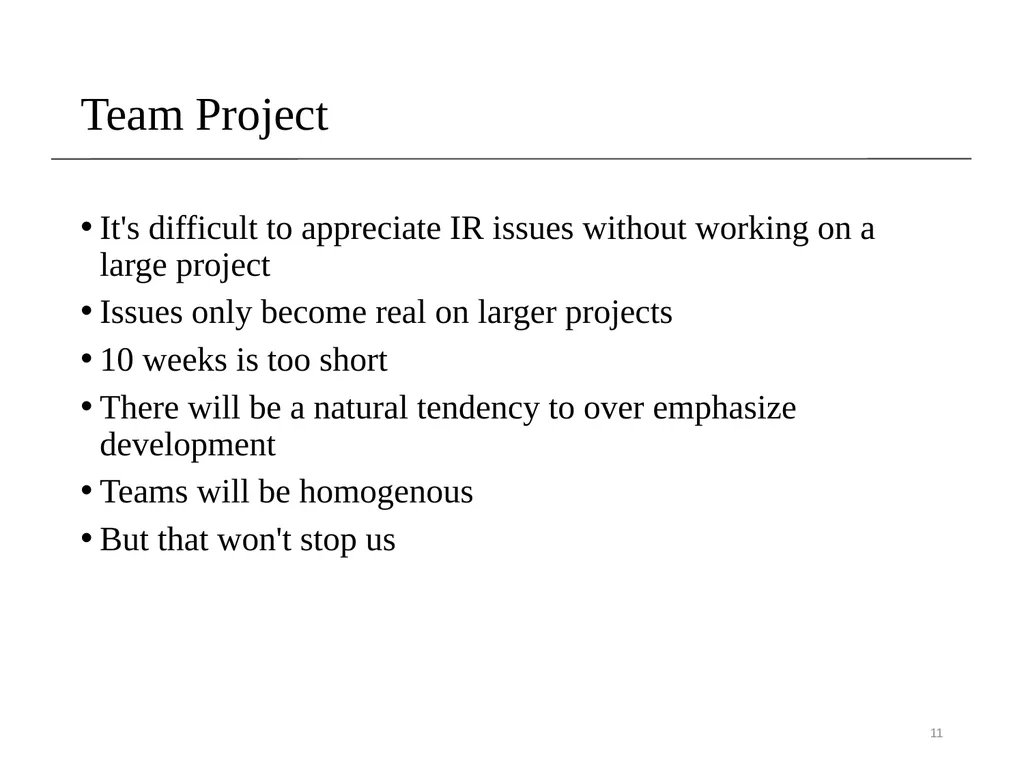
Team Project It's difficult to appreciate IR issues without working on a large project
Issues only become real on larger projects
10 weeks is too short
There will be a natural tendency to over emphasize development
Teams will be homogenous
But that won't stop us 11<br>
Issues only become real on larger projects
10 weeks is too short
There will be a natural tendency to over emphasize development
Teams will be homogenous
But that won't stop us 11<br>
12
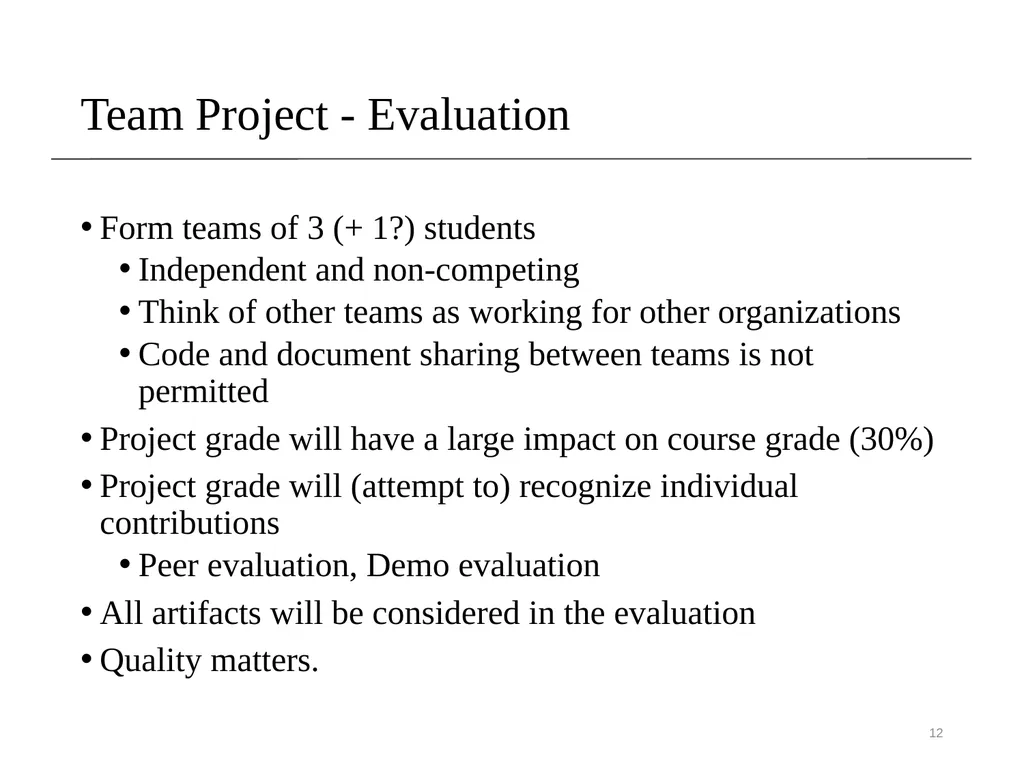
Team Project - Evaluation Form teams of 3 (+ 1?) students
Independent and non-competing
Think of other teams as working for other organizations
Code and document sharing between teams is not permitted
Project grade will have a large impact on course grade (30%)
Project grade will (attempt to) recognize individual contributions
Peer evaluation, Demo evaluation
All artifacts will be considered in the evaluation
Quality matters. 12<br>
Independent and non-competing
Think of other teams as working for other organizations
Code and document sharing between teams is not permitted
Project grade will have a large impact on course grade (30%)
Project grade will (attempt to) recognize individual contributions
Peer evaluation, Demo evaluation
All artifacts will be considered in the evaluation
Quality matters. 12<br>
13
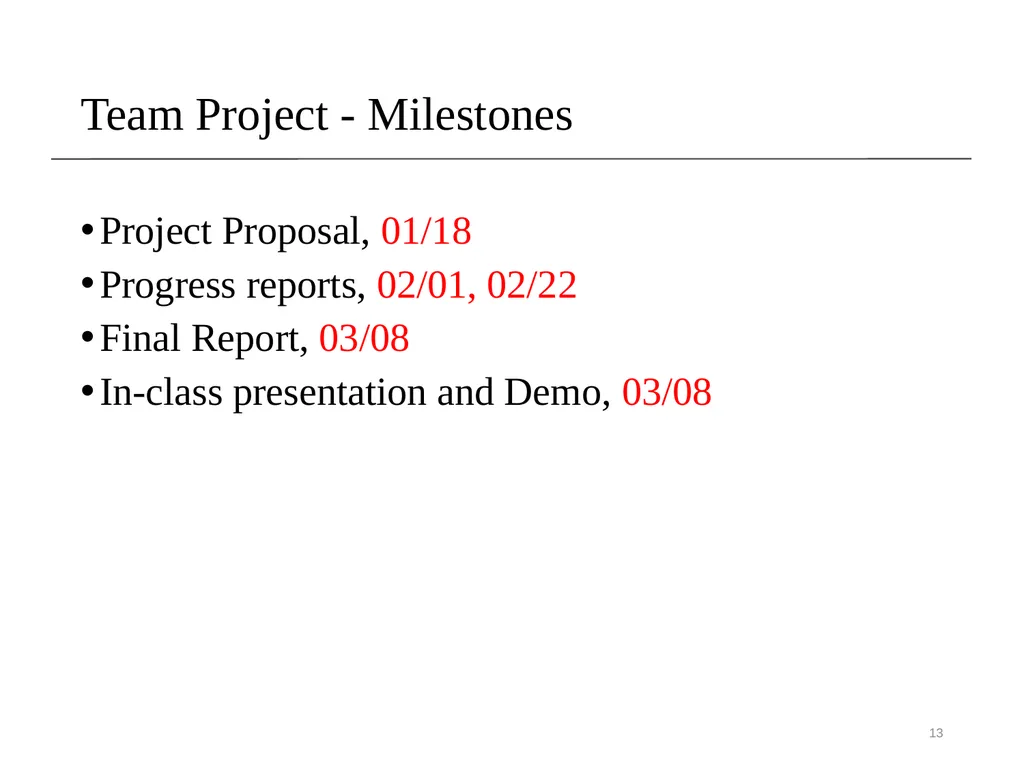
Team Project - Milestones Project Proposal, 01/18
Progress reports, 02/01, 02/22
Final Report, 03/08
In-class presentation and Demo, 03/08 13<br>
Progress reports, 02/01, 02/22
Final Report, 03/08
In-class presentation and Demo, 03/08 13<br>
14
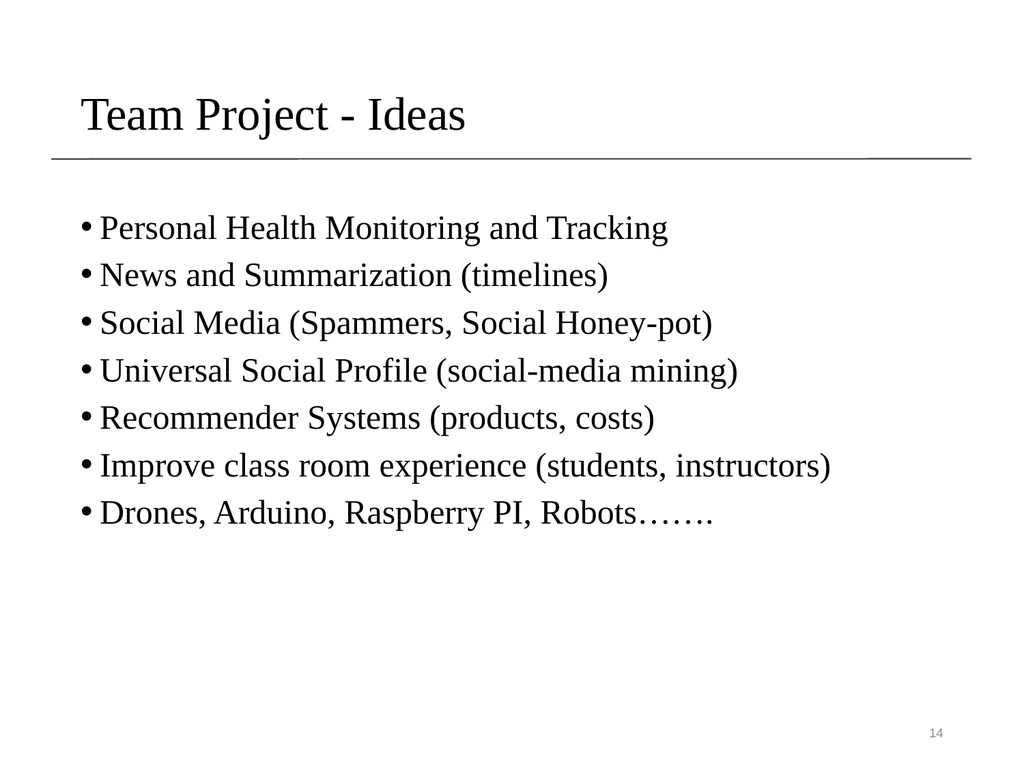
Team Project - Ideas Personal Health Monitoring and Tracking
News and Summarization (timelines)
Social Media (Spammers, Social Honey-pot)
Universal Social Profile (social-media mining)
Recommender Systems (products, costs)
Improve class room experience (students, instructors)
Drones, Arduino, Raspberry PI, Robots……. 14<br>
News and Summarization (timelines)
Social Media (Spammers, Social Honey-pot)
Universal Social Profile (social-media mining)
Recommender Systems (products, costs)
Improve class room experience (students, instructors)
Drones, Arduino, Raspberry PI, Robots……. 14<br>
15
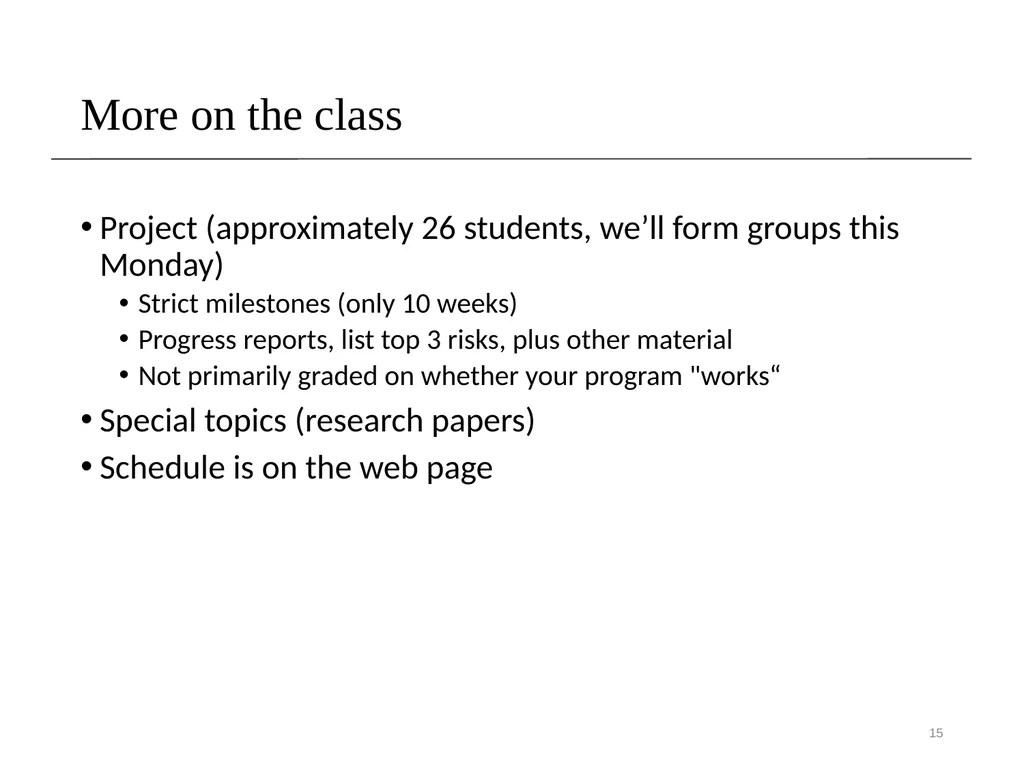
More on the class Project (approximately 26 students, we’ll form groups this Monday)
Strict milestones (only 10 weeks)
Progress reports, list top 3 risks, plus other material
Not primarily graded on whether your program "works“
Special topics (research papers)
Schedule is on the web page 15<br>
Strict milestones (only 10 weeks)
Progress reports, list top 3 risks, plus other material
Not primarily graded on whether your program "works“
Special topics (research papers)
Schedule is on the web page 15<br>
16
Lecture Overview Introduction to Information Retrieval
The Information Seeking Process
Information Retrieval History and Developments Credit for some of the slides in this lecture goes to Ray Larson at UC Berkeley and Ray Mooney at UT Austin 16<br>
The Information Seeking Process
Information Retrieval History and Developments Credit for some of the slides in this lecture goes to Ray Larson at UC Berkeley and Ray Mooney at UT Austin 16<br>
17
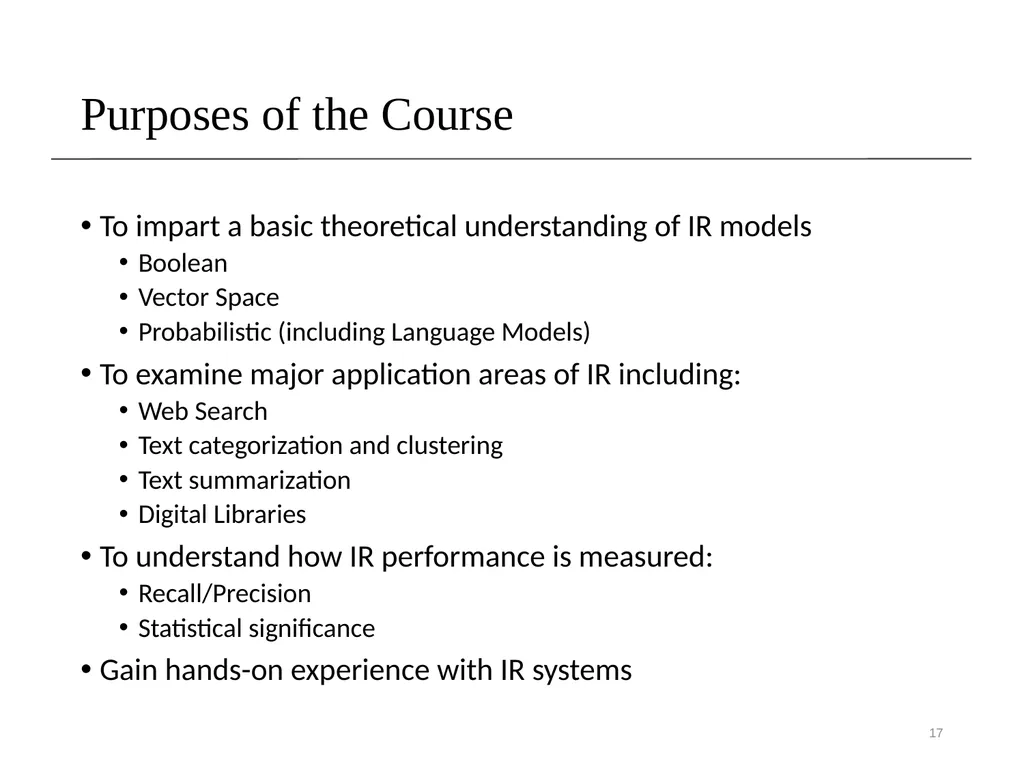
Purposes of the Course To impart a basic theoretical understanding of IR models
Boolean
Vector Space
Probabilistic (including Language Models)
To examine major application areas of IR including:
Web Search
Text categorization and clustering
Text summarization
Digital Libraries
To understand how IR performance is measured:
Recall/Precision
Statistical significance
Gain hands-on experience with IR systems 17<br>
Boolean
Vector Space
Probabilistic (including Language Models)
To examine major application areas of IR including:
Web Search
Text categorization and clustering
Text summarization
Digital Libraries
To understand how IR performance is measured:
Recall/Precision
Statistical significance
Gain hands-on experience with IR systems 17<br>
18
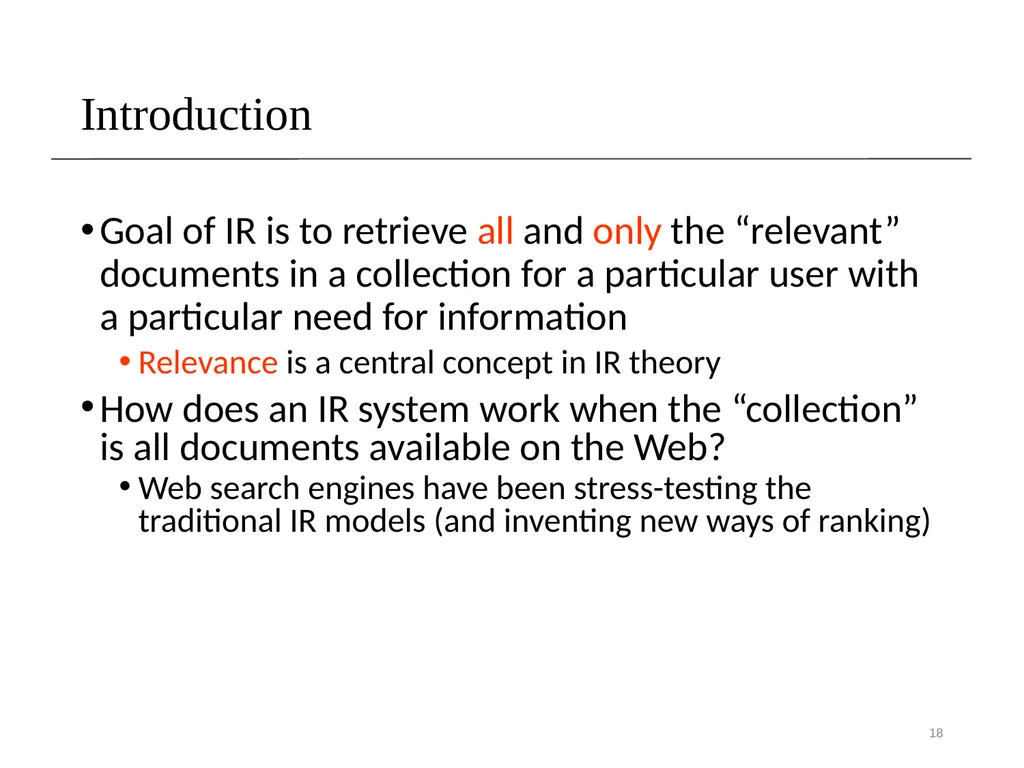
Introduction Goal of IR is to retrieve all and only the “relevant” documents in a collection for a particular user with a particular need for information
Relevance is a central concept in IR theory
How does an IR system work when the “collection” is all documents available on the Web?
Web search engines have been stress-testing the traditional IR models (and inventing new ways of ranking) 18<br>
Relevance is a central concept in IR theory
How does an IR system work when the “collection” is all documents available on the Web?
Web search engines have been stress-testing the traditional IR models (and inventing new ways of ranking) 18<br>
19
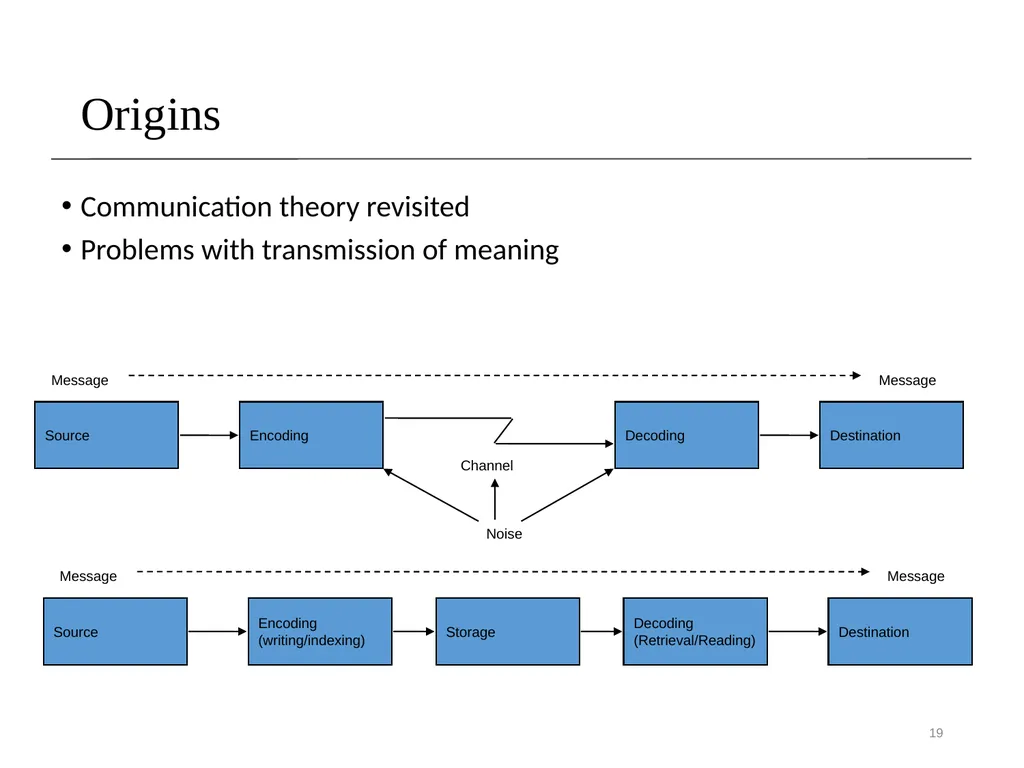
Origins Communication theory revisited
Problems with transmission of meaning Noise 19<br>
Problems with transmission of meaning Noise 19<br>
20
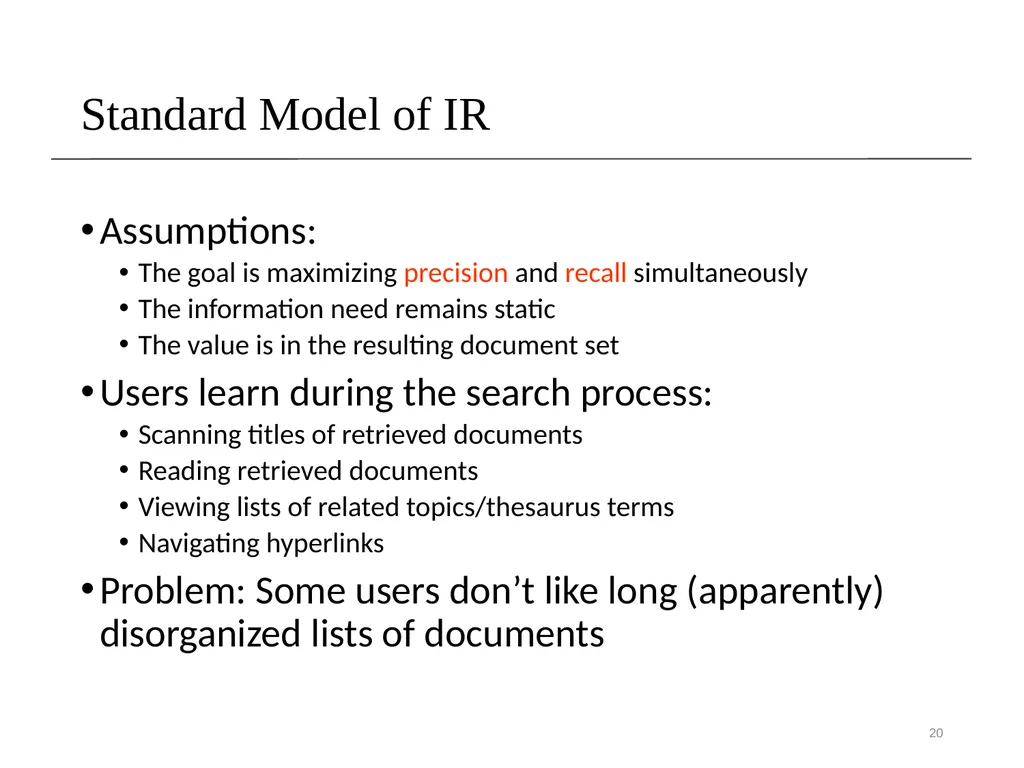
Standard Model of IR Assumptions:
The goal is maximizing precision and recall simultaneously
The information need remains static
The value is in the resulting document set
Users learn during the search process:
Scanning titles of retrieved documents
Reading retrieved documents
Viewing lists of related topics/thesaurus terms
Navigating hyperlinks
Problem: Some users don’t like long (apparently) disorganized lists of documents 20<br>
The goal is maximizing precision and recall simultaneously
The information need remains static
The value is in the resulting document set
Users learn during the search process:
Scanning titles of retrieved documents
Reading retrieved documents
Viewing lists of related topics/thesaurus terms
Navigating hyperlinks
Problem: Some users don’t like long (apparently) disorganized lists of documents 20<br>
21
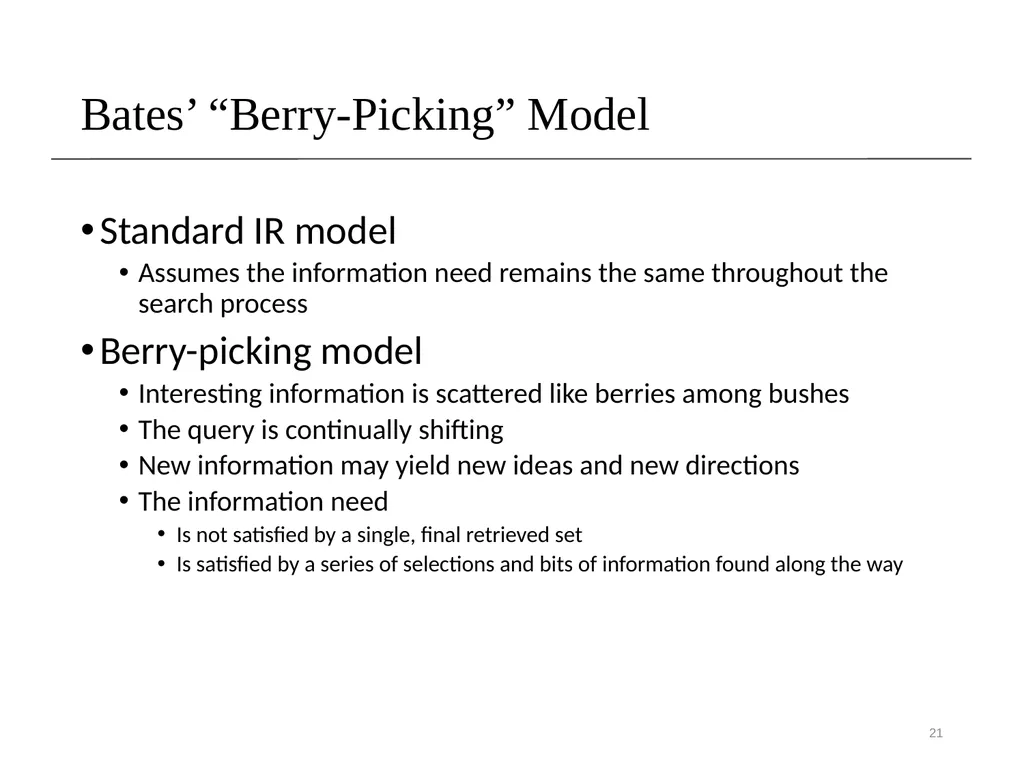
Bates’ “Berry-Picking” Model Standard IR model
Assumes the information need remains the same throughout the search process
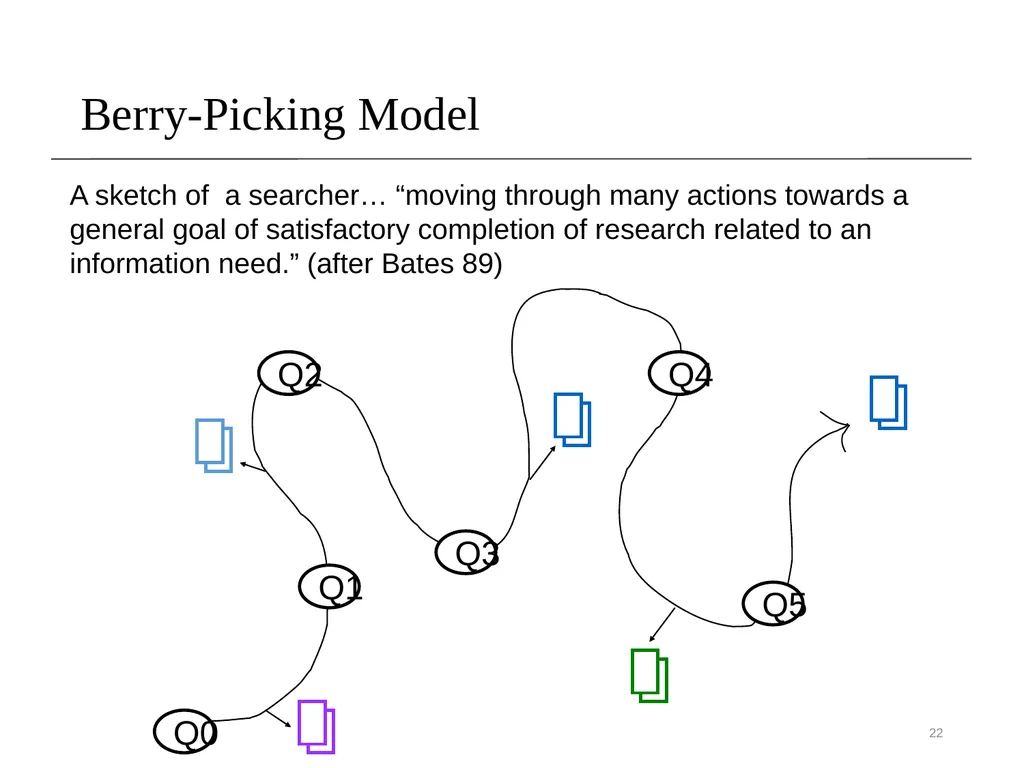
Berry-picking model
Interesting information is scattered like berries among bushes
The query is continually shifting
New information may yield new ideas and new directions
The information need
Is not satisfied by a single, final retrieved set
Is satisfied by a series of selections and bits of information found along the way 21<br>
Assumes the information need remains the same throughout the search process
Berry-picking model
Interesting information is scattered like berries among bushes
The query is continually shifting
New information may yield new ideas and new directions
The information need
Is not satisfied by a single, final retrieved set
Is satisfied by a series of selections and bits of information found along the way 21<br>
22
Berry-Picking Model Q0 Q1 Q2 Q3 Q4 Q5 A sketch of a searcher… “moving through many actions towards a general goal of satisfactory completion of research related to an information need.” (after Bates 89) 22<br>
23
Information Retrieval The indexing and retrieval of textual documents.
Searching for pages on the World Wide Web is the “killer app.”
Concerned firstly with retrieving relevant documents to a query.
Concerned secondly with retrieving from large sets of documents efficiently. 23<br>
Searching for pages on the World Wide Web is the “killer app.”
Concerned firstly with retrieving relevant documents to a query.
Concerned secondly with retrieving from large sets of documents efficiently. 23<br>
24
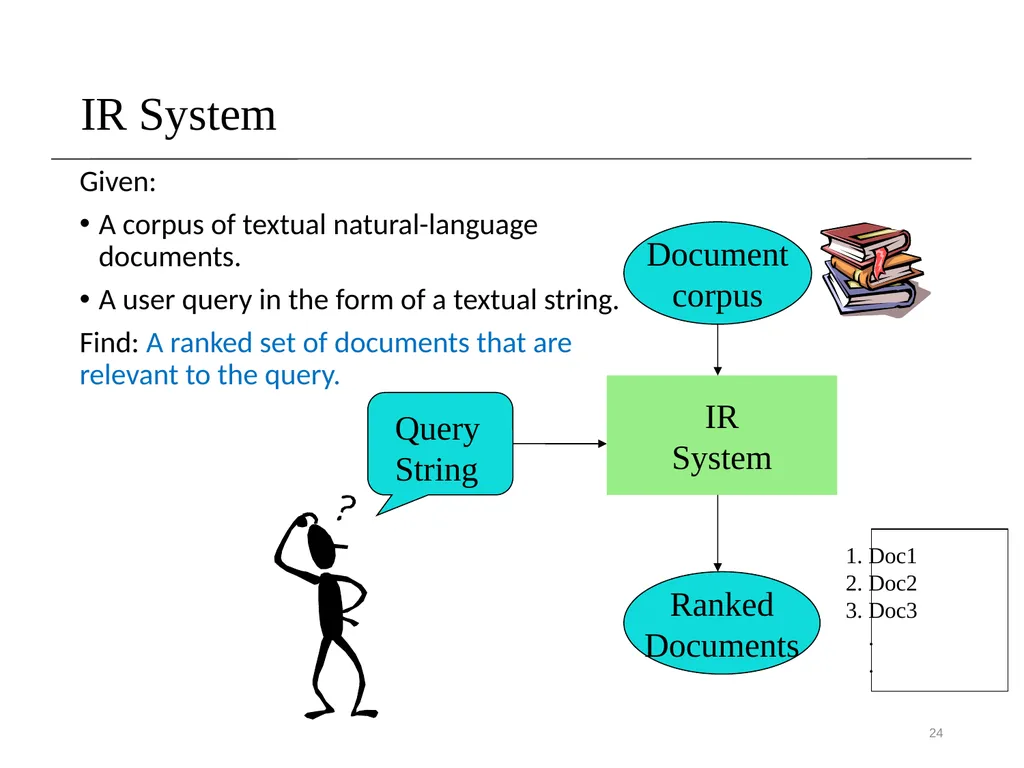
IR System IR
System 24 Given:
A corpus of textual natural-language documents.
A user query in the form of a textual string.
Find: A ranked set of documents that are relevant to the query.<br>
System 24 Given:
A corpus of textual natural-language documents.
A user query in the form of a textual string.
Find: A ranked set of documents that are relevant to the query.<br>
25
Relevance Relevance is a subjective judgment and may include:
Being on the proper subject.
Being timely (recent information).
Being authoritative (from a trusted source).
Satisfying the goals of the user and his/her intended use of the information (information need). 25<br>
Being on the proper subject.
Being timely (recent information).
Being authoritative (from a trusted source).
Satisfying the goals of the user and his/her intended use of the information (information need). 25<br>
26
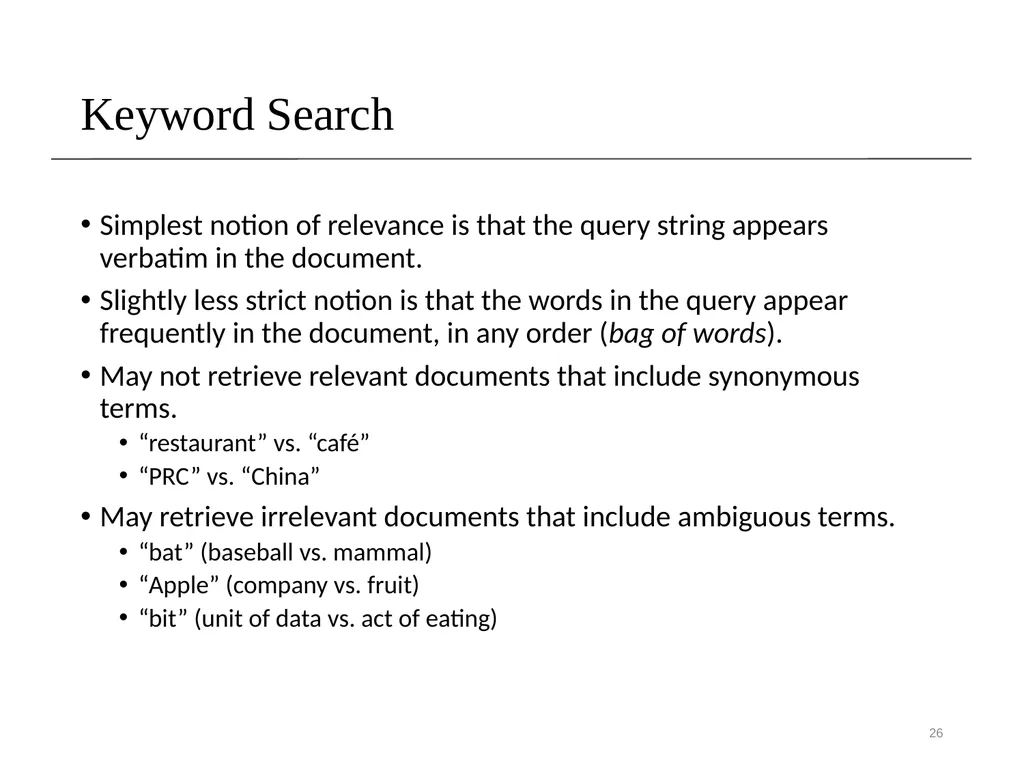
Keyword Search Simplest notion of relevance is that the query string appears verbatim in the document.
Slightly less strict notion is that the words in the query appear frequently in the document, in any order (bag of words).
May not retrieve relevant documents that include synonymous terms.
“restaurant” vs. “café”
“PRC” vs. “China”
May retrieve irrelevant documents that include ambiguous terms.
“bat” (baseball vs. mammal)
“Apple” (company vs. fruit)
“bit” (unit of data vs. act of eating) 26<br>
Slightly less strict notion is that the words in the query appear frequently in the document, in any order (bag of words).
May not retrieve relevant documents that include synonymous terms.
“restaurant” vs. “café”
“PRC” vs. “China”
May retrieve irrelevant documents that include ambiguous terms.
“bat” (baseball vs. mammal)
“Apple” (company vs. fruit)
“bit” (unit of data vs. act of eating) 26<br>
27
Beyond Keywords We will cover the basics of keyword-based IR, but…
We will focus on extensions and recent developments that go beyond keywords.
We will cover the basics of building an efficient IR system, but…
We will focus on basic capabilities and algorithms rather than systems issues that allow scaling to industrial size databases. 27<br>
We will focus on extensions and recent developments that go beyond keywords.
We will cover the basics of building an efficient IR system, but…
We will focus on basic capabilities and algorithms rather than systems issues that allow scaling to industrial size databases. 27<br>
28
Intelligent IR Taking into account the meaning of the words used.
Taking into account the order of words in the query.
Adapting to the user based on direct or indirect feedback.
Taking into account the authority of the source. 28<br>
Taking into account the order of words in the query.
Adapting to the user based on direct or indirect feedback.
Taking into account the authority of the source. 28<br>
29
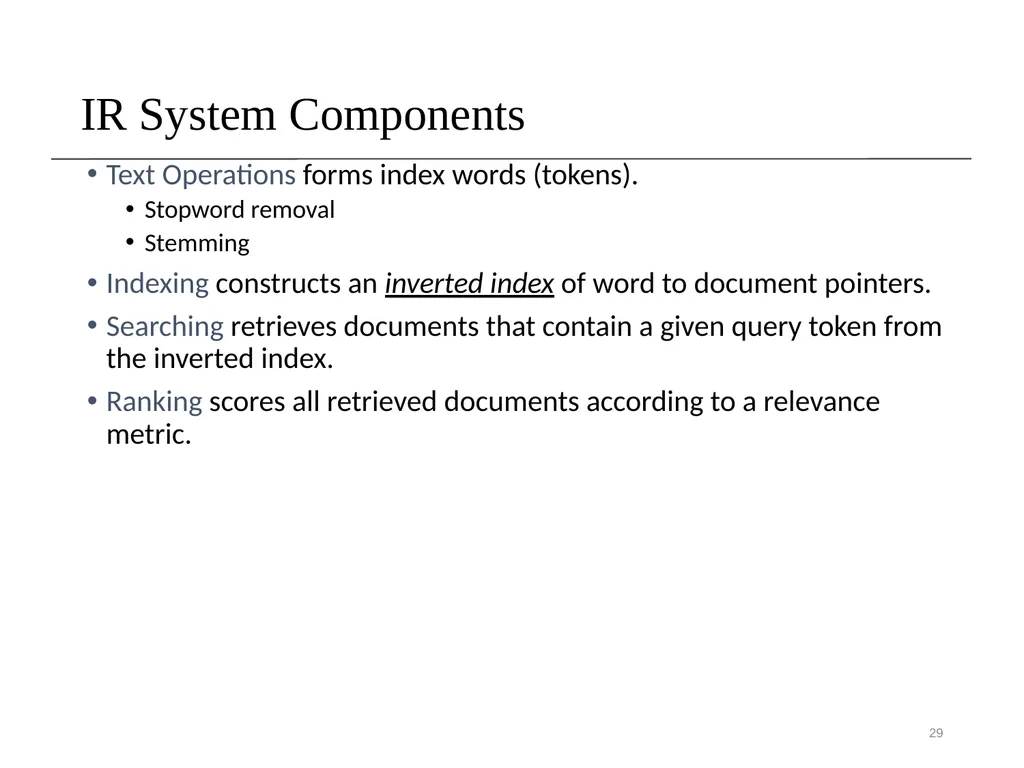
IR System Components Text Operations forms index words (tokens).
Stopword removal
Stemming
Indexing constructs an inverted index of word to document pointers.
Searching retrieves documents that contain a given query token from the inverted index.
Ranking scores all retrieved documents according to a relevance metric. 29<br>
Stopword removal
Stemming
Indexing constructs an inverted index of word to document pointers.
Searching retrieves documents that contain a given query token from the inverted index.
Ranking scores all retrieved documents according to a relevance metric. 29<br>
30
IR System Components (continued) User Interface manages interaction with the user:
Query input and document output.
Relevance feedback.
Visualization of results.
Query Operations transform the query to improve retrieval:
Query expansion using a thesaurus.
Query transformation using relevance feedback. 30<br>
Query input and document output.
Relevance feedback.
Visualization of results.
Query Operations transform the query to improve retrieval:
Query expansion using a thesaurus.
Query transformation using relevance feedback. 30<br>
31
Web Search Application of IR to HTML documents on the World Wide Web.
Differences:
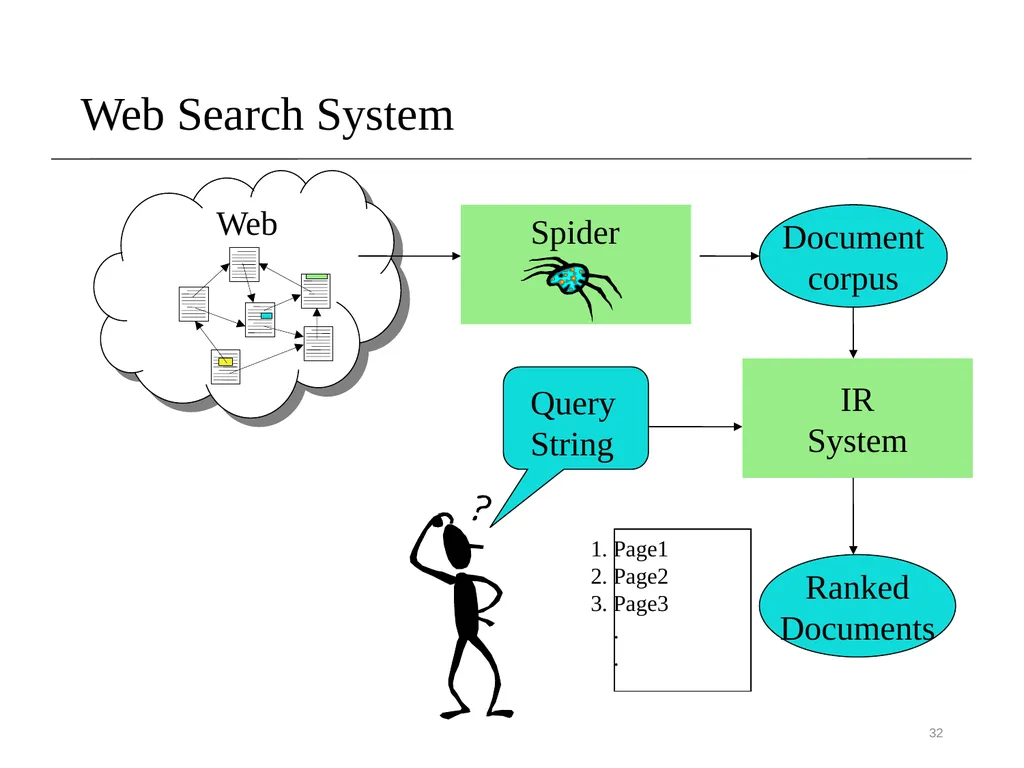
Must assemble document corpus by spidering the web.
Can exploit the structural layout information in HTML (XML).
Documents change uncontrollably.
Can exploit the link structure of the web. 31<br>
Differences:
Must assemble document corpus by spidering the web.
Can exploit the structural layout information in HTML (XML).
Documents change uncontrollably.
Can exploit the link structure of the web. 31<br>
32
Web Search System IR
System 32<br>
System 32<br>
33
IR History Overview Information Retrieval History
Origins and Early “IR”
Modern Roots in the scientific “Information Explosion” following WWII
Non-Computer IR (mid 1950’s)
Interest in computer-based IR from mid 1950’s
Modern IR – Large-scale evaluations, Web-based search and Search Engines -- 1990’s 33<br>
Origins and Early “IR”
Modern Roots in the scientific “Information Explosion” following WWII
Non-Computer IR (mid 1950’s)
Interest in computer-based IR from mid 1950’s
Modern IR – Large-scale evaluations, Web-based search and Search Engines -- 1990’s 33<br>
34
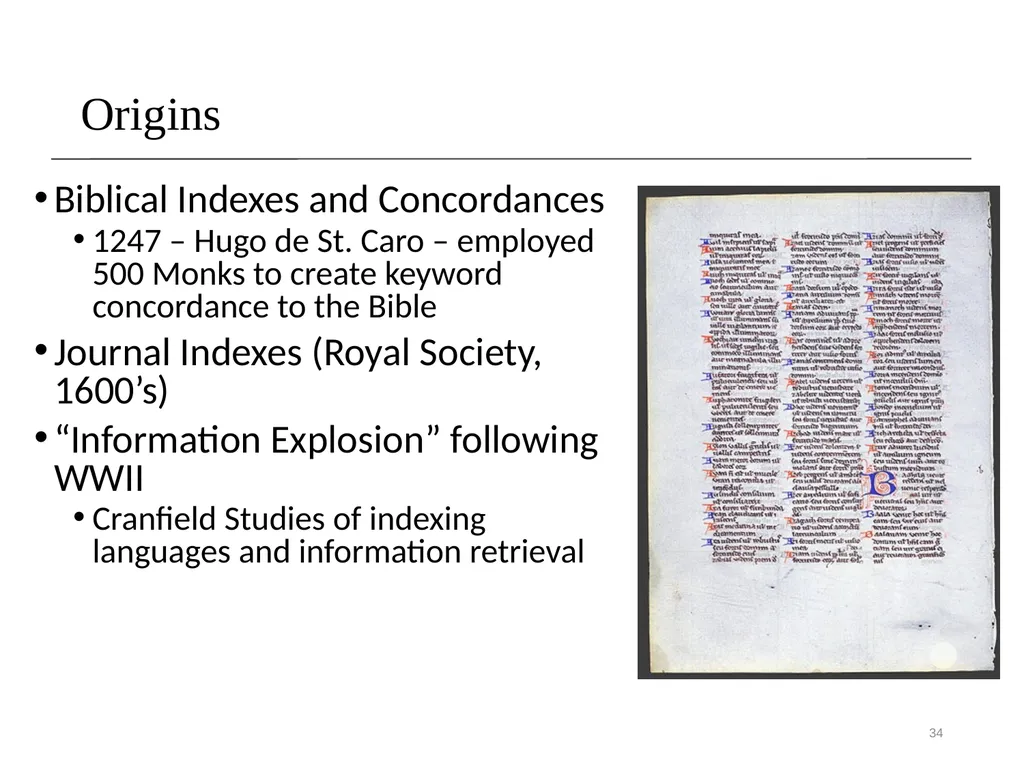
Origins Biblical Indexes and Concordances
1247 – Hugo de St. Caro – employed 500 Monks to create keyword concordance to the Bible
Journal Indexes (Royal Society, 1600’s)
“Information Explosion” following WWII
Cranfield Studies of indexing languages and information retrieval 34<br>
1247 – Hugo de St. Caro – employed 500 Monks to create keyword concordance to the Bible
Journal Indexes (Royal Society, 1600’s)
“Information Explosion” following WWII
Cranfield Studies of indexing languages and information retrieval 34<br>
35
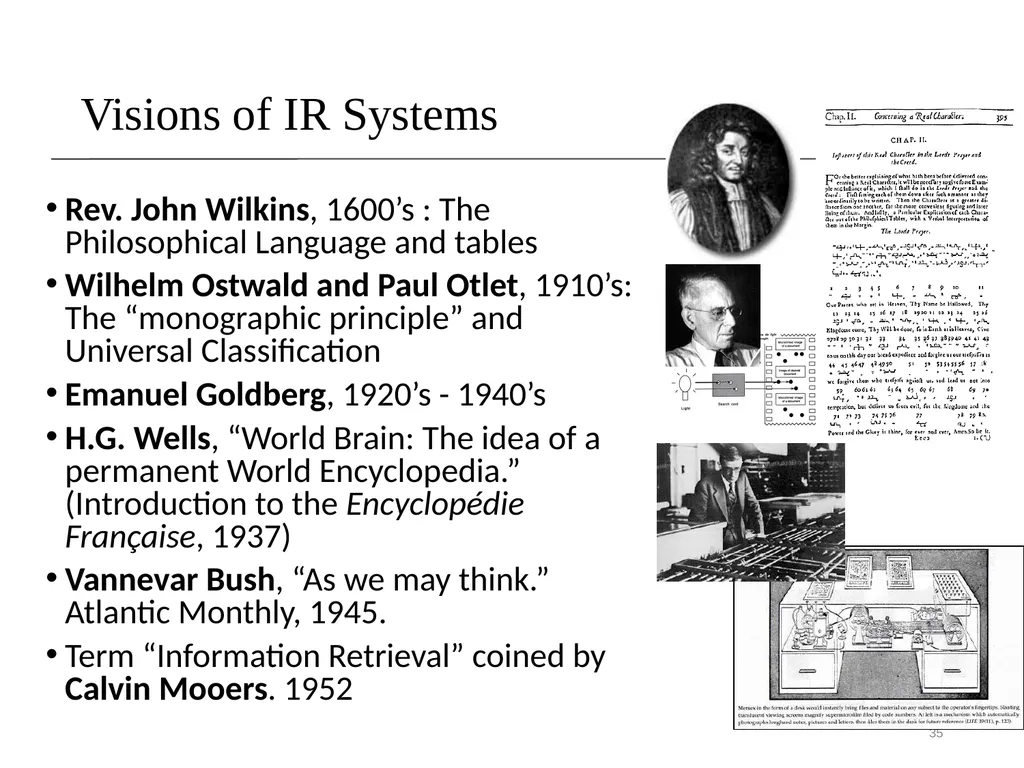
Visions of IR Systems Rev. John Wilkins, 1600’s : The Philosophical Language and tables
Wilhelm Ostwald and Paul Otlet, 1910’s: The “monographic principle” and Universal Classification
Emanuel Goldberg, 1920’s - 1940’s
H.G. Wells, “World Brain: The idea of a permanent World Encyclopedia.” (Introduction to the Encyclopédie Française, 1937)
Vannevar Bush, “As we may think.” Atlantic Monthly, 1945.
Term “Information Retrieval” coined by Calvin Mooers. 1952 35<br>
Wilhelm Ostwald and Paul Otlet, 1910’s: The “monographic principle” and Universal Classification
Emanuel Goldberg, 1920’s - 1940’s
H.G. Wells, “World Brain: The idea of a permanent World Encyclopedia.” (Introduction to the Encyclopédie Française, 1937)
Vannevar Bush, “As we may think.” Atlantic Monthly, 1945.
Term “Information Retrieval” coined by Calvin Mooers. 1952 35<br>
36
History of IR 1960-70’s:
Initial exploration of text retrieval systems for “small” corpora of scientific abstracts, and law and business documents.
Development of the basic Boolean and vector-space models of retrieval.
Prof. Salton and his students at Cornell University are the leading researchers in the area. 36<br>
Initial exploration of text retrieval systems for “small” corpora of scientific abstracts, and law and business documents.
Development of the basic Boolean and vector-space models of retrieval.
Prof. Salton and his students at Cornell University are the leading researchers in the area. 36<br>
37
IR History Continued 1980’s:
Large document database systems, many run by companies:
Lexis-Nexis
Dialog
MEDLINE
1990’s:
Searching FTPable documents on the Internet
Archie
WAIS
Searching the World Wide Web
Lycos
Yahoo
Altavista 37<br>
Large document database systems, many run by companies:
Lexis-Nexis
Dialog
MEDLINE
1990’s:
Searching FTPable documents on the Internet
Archie
WAIS
Searching the World Wide Web
Lycos
Yahoo
Altavista 37<br>
38
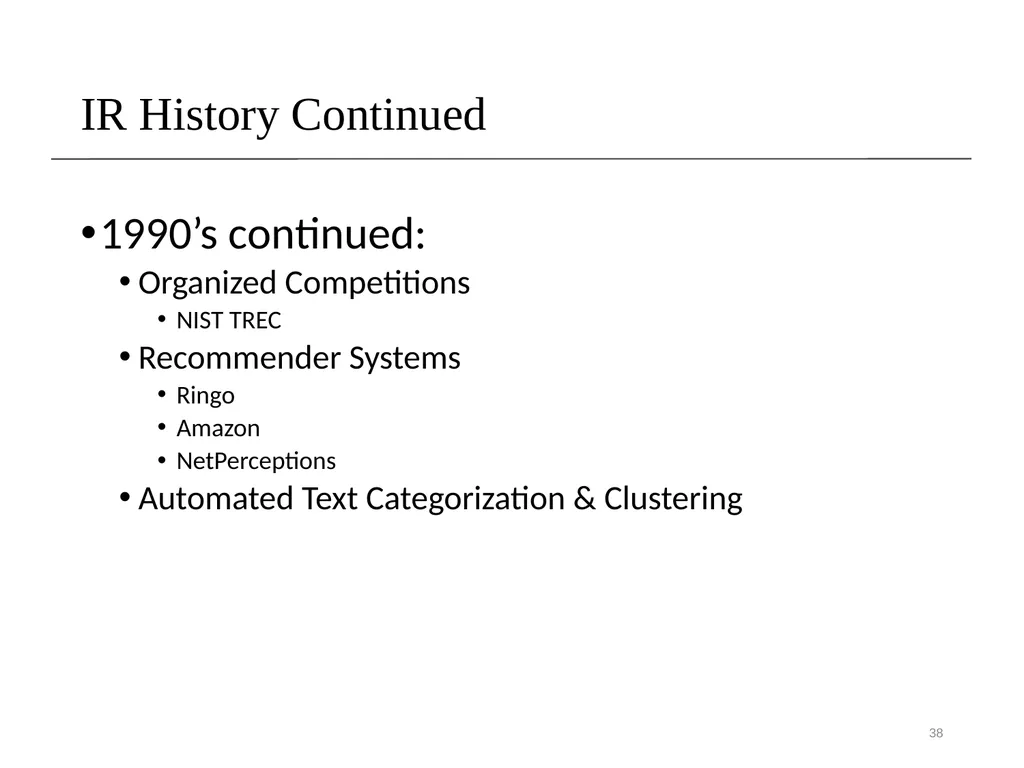
IR History Continued 1990’s continued:
Organized Competitions
NIST TREC
Recommender Systems
Ringo
Amazon
NetPerceptions
Automated Text Categorization & Clustering 38<br>
Organized Competitions
NIST TREC
Recommender Systems
Ringo
Amazon
NetPerceptions
Automated Text Categorization & Clustering 38<br>
39
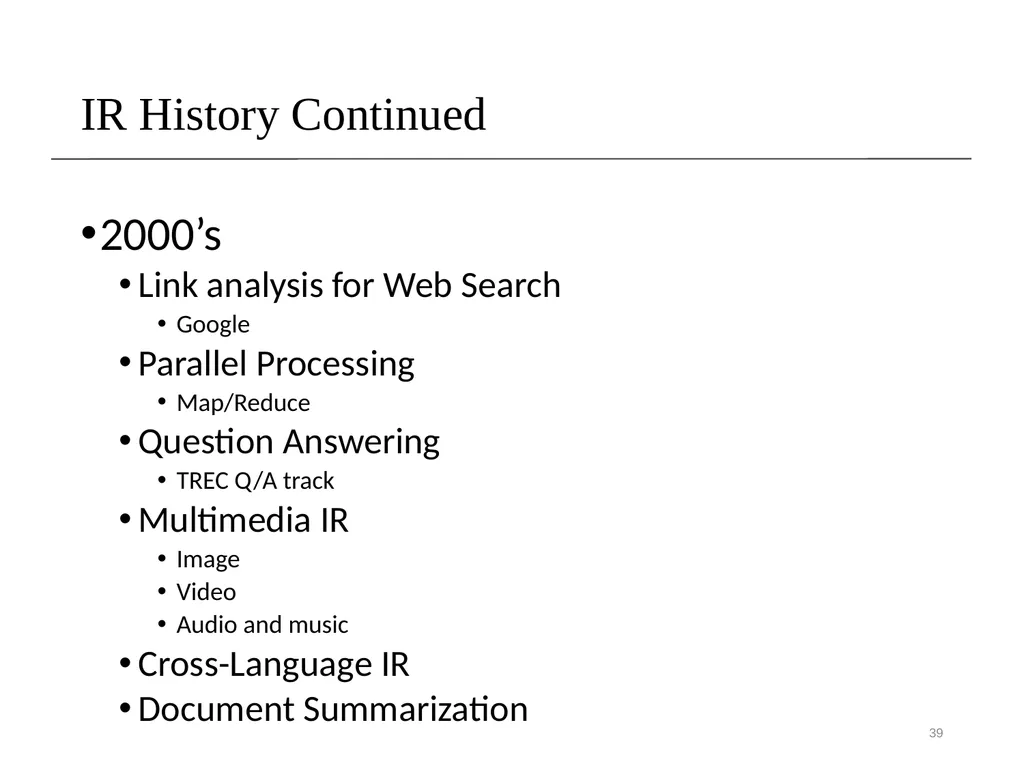
IR History Continued 2000’s
Link analysis for Web Search
Google
Parallel Processing
Map/Reduce
Question Answering
TREC Q/A track
Multimedia IR
Image
Video
Audio and music
Cross-Language IR
Document Summarization 39<br>
Link analysis for Web Search
Parallel Processing
Map/Reduce
Question Answering
TREC Q/A track
Multimedia IR
Image
Video
Audio and music
Cross-Language IR
Document Summarization 39<br>
40
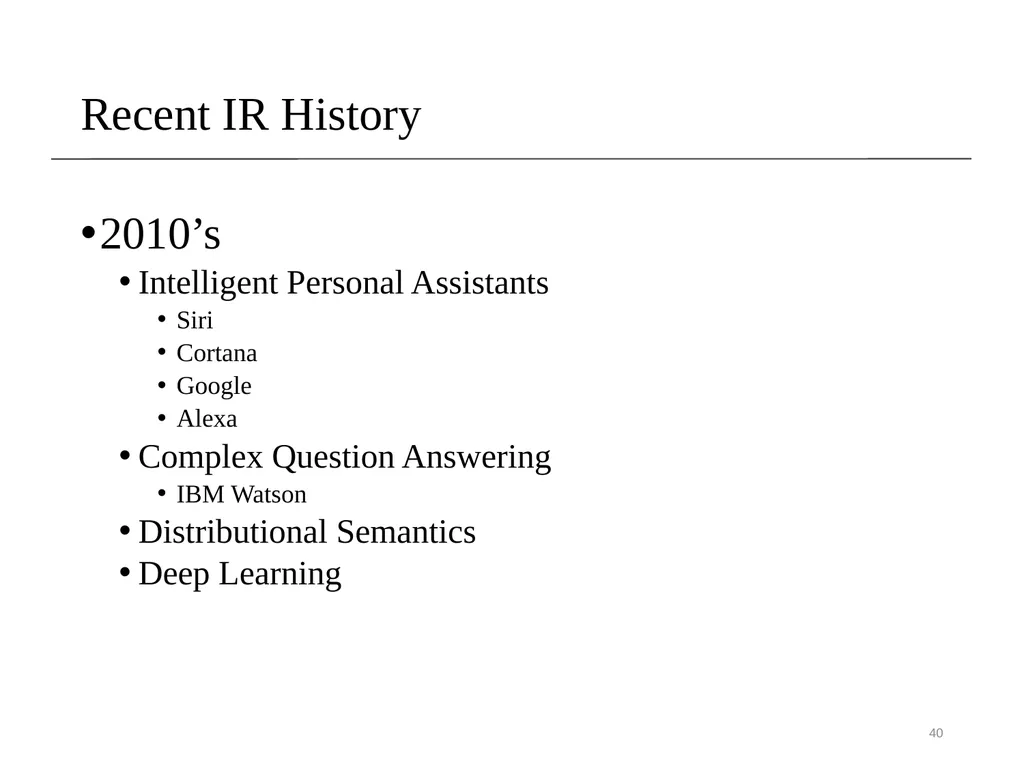
Recent IR History 2010’s
Intelligent Personal Assistants
Siri
Cortana
Google
Alexa
Complex Question Answering
IBM Watson
Distributional Semantics
Deep Learning 40<br>
Intelligent Personal Assistants
Siri
Cortana
Alexa
Complex Question Answering
IBM Watson
Distributional Semantics
Deep Learning 40<br>
41
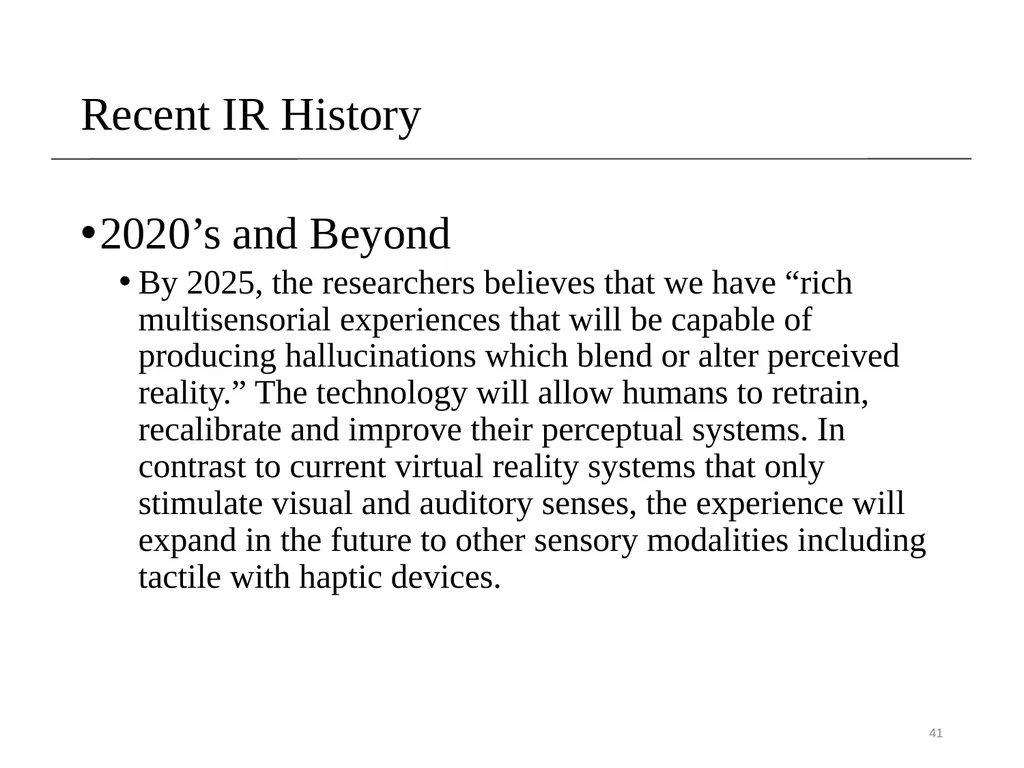
Recent IR History 2020’s and Beyond
By 2025, the researchers believes that we have “rich multisensorial experiences that will be capable of producing hallucinations which blend or alter perceived reality.” The technology will allow humans to retrain, recalibrate and improve their perceptual systems. In contrast to current virtual reality systems that only stimulate visual and auditory senses, the experience will expand in the future to other sensory modalities including tactile with haptic devices. 41<br>
By 2025, the researchers believes that we have “rich multisensorial experiences that will be capable of producing hallucinations which blend or alter perceived reality.” The technology will allow humans to retrain, recalibrate and improve their perceptual systems. In contrast to current virtual reality systems that only stimulate visual and auditory senses, the experience will expand in the future to other sensory modalities including tactile with haptic devices. 41<br>
42
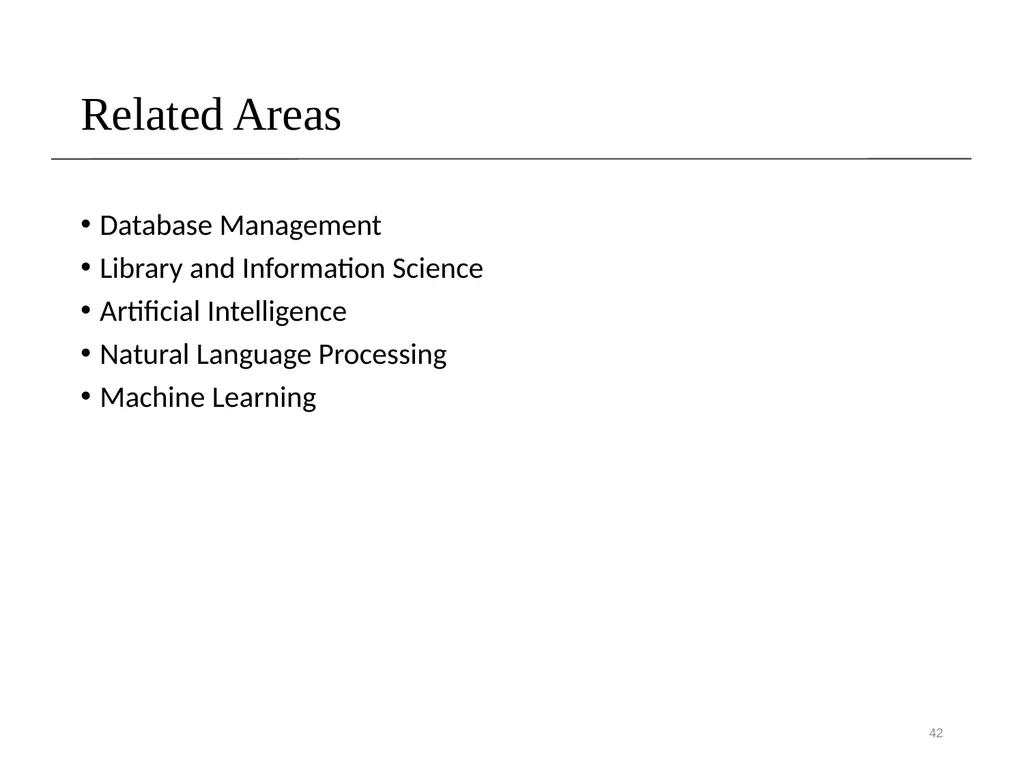
Related Areas Database Management
Library and Information Science
Artificial Intelligence
Natural Language Processing
Machine Learning 42<br>
Library and Information Science
Artificial Intelligence
Natural Language Processing
Machine Learning 42<br>
43
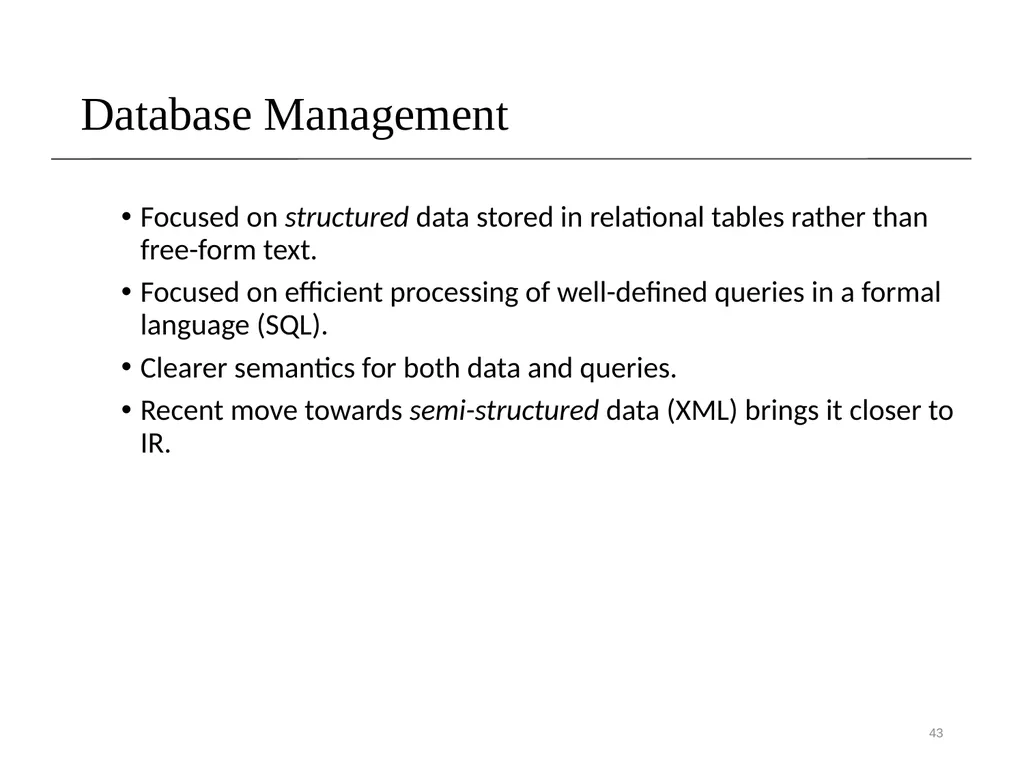
Database Management Focused on structured data stored in relational tables rather than free-form text.
Focused on efficient processing of well-defined queries in a formal language (SQL).
Clearer semantics for both data and queries.
Recent move towards semi-structured data (XML) brings it closer to IR. 43<br>
Focused on efficient processing of well-defined queries in a formal language (SQL).
Clearer semantics for both data and queries.
Recent move towards semi-structured data (XML) brings it closer to IR. 43<br>
44
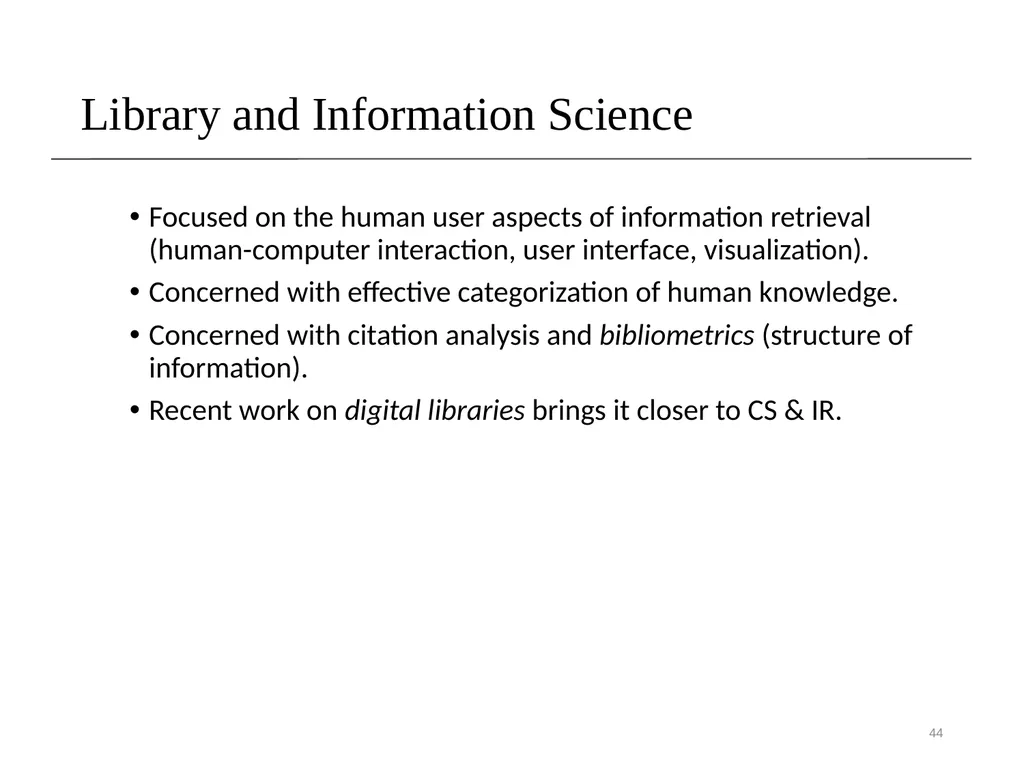
Library and Information Science Focused on the human user aspects of information retrieval (human-computer interaction, user interface, visualization).
Concerned with effective categorization of human knowledge.
Concerned with citation analysis and bibliometrics (structure of information).
Recent work on digital libraries brings it closer to CS & IR. 44<br>
Concerned with effective categorization of human knowledge.
Concerned with citation analysis and bibliometrics (structure of information).
Recent work on digital libraries brings it closer to CS & IR. 44<br>
45
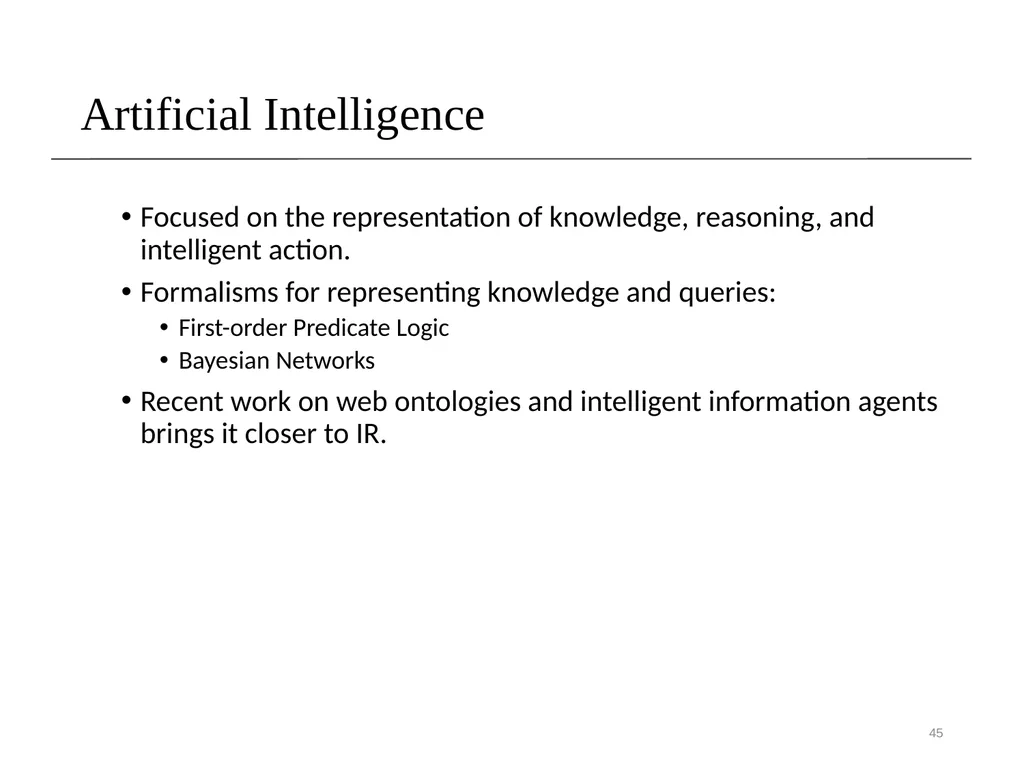
Artificial Intelligence Focused on the representation of knowledge, reasoning, and intelligent action.
Formalisms for representing knowledge and queries:
First-order Predicate Logic
Bayesian Networks
Recent work on web ontologies and intelligent information agents brings it closer to IR. 45<br>
Formalisms for representing knowledge and queries:
First-order Predicate Logic
Bayesian Networks
Recent work on web ontologies and intelligent information agents brings it closer to IR. 45<br>
46
Machine Learning Focused on the development of computational systems that improve their performance with experience.
Automated classification of examples based on learning concepts from labeled training examples (supervised learning).
Automated methods for clustering unlabeled examples into meaningful groups (unsupervised learning). 46<br>
Automated classification of examples based on learning concepts from labeled training examples (supervised learning).
Automated methods for clustering unlabeled examples into meaningful groups (unsupervised learning). 46<br>
47
Research Sources in Information Retrieval ACM Transactions on Information Systems
Am. Society for Information Science Journal
Document Analysis and IR Proceedings (Las Vegas)
Information Processing and Management (Pergammon)
Journal of Documentation
SIGIR Conference Proceedings
TREC Conference Proceedings
Much of this literature is now available online 47<br>
Am. Society for Information Science Journal
Document Analysis and IR Proceedings (Las Vegas)
Information Processing and Management (Pergammon)
Journal of Documentation
SIGIR Conference Proceedings
TREC Conference Proceedings
Much of this literature is now available online 47<br>
48
To-do and Next time Sign up for the Piazza
HW1 is out!
Due 1/11 (Wednesday)
Not for a grade (relax, people)
Next Monday
Vector Space Model (Read Chapters 1 and 6)
Team Project Groups (Use Piazza) 48<br>
HW1 is out!
Due 1/11 (Wednesday)
Not for a grade (relax, people)
Next Monday
Vector Space Model (Read Chapters 1 and 6)
Team Project Groups (Use Piazza) 48<br>