04
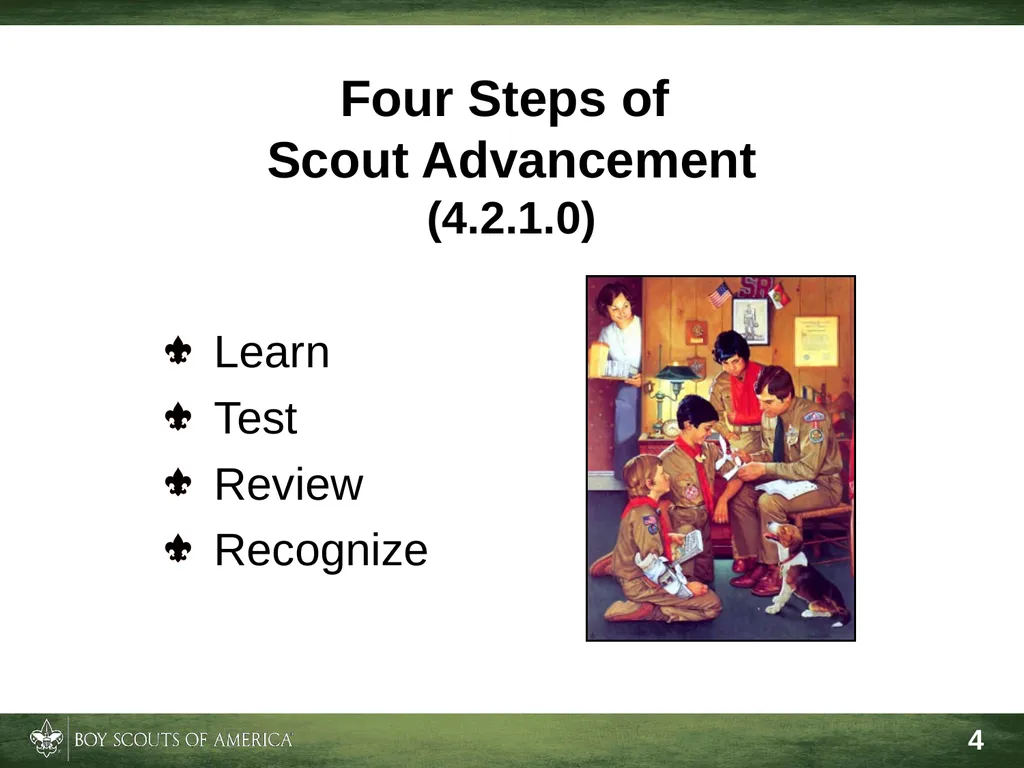
Four Steps of �Scout Advancement�(4.2.1.0) Learn
Test
Review
Recognize<br>
05
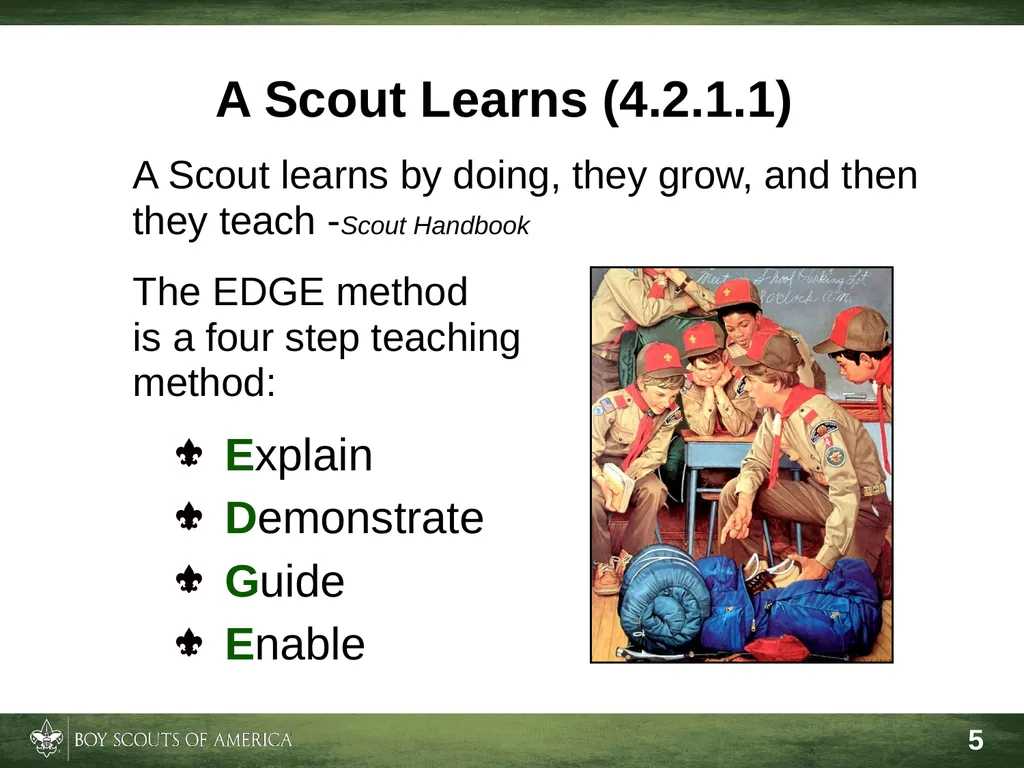
A Scout Learns (4.2.1.1) A Scout learns by doing, they grow, and then they teach -Scout Handbook
The EDGE method �is a four step teaching
method: Explain
Demonstrate
Guide
Enable<br>
06
A Scout is Tested (4.2.1.2) The unit leader authorizes those who may test and pass the Scout on rank requirements.
These might include patrol leaders, the senior patrol leader, an assistant unit leader, another Scout, or the unit leader.
Merit badge counselors teach and test the requirements for merit badges.
It is important that everyone understands that a Scout completes the requirements as written.<br>
07
A Scout is Reviewed (4.2.1.3) After completing all requirements for a rank, the Scout meets with a board of review.
For Scout rank, no board of review is held.
For Tenderfoot, Second Class, First Class, Star and Life ranks, the board of review is comprised of 3 to 6 members of the unit committee.
Local councils determine the level at which Eagle Scout boards of review are held.<br>
08
A Scout is Recognized (4.2.1.4) Recognition builds confidence and leads to additional advancement.
Rewards the Scouts for their hard work
Helps motivate them to continue
Provides a reminder for other Scouts to advance
Recognition should be immediate and repetitive.<br>
09
9 Troop Advancement �Responsibilities (3.0.0.3) The troop advancement coordinator’s responsibility is to support the unit’s advancement program, maximize rank achievement, and facilitate a smooth process.
Some troops may also organize an advancement committee chaired by an advancement coordinator.
All advancement administrators must know and understand advancement procedures.<br>
10
Unit Advancement �Coordinator (3.0.0.3) Supports unit leader’s vision for advancement.
Educates parents or guardians and unit leaders to stimulate advancement within the troop.
Helps plan, facilitate, and conduct regularly scheduled courts of honor.
Obtains necessary badges and certificates.<br>
11
Know and understand the advancement procedures for the program served, especially for Eagle, Summit, and Quartermaster.
Assists the unit leader in establishing practices that will allow each new Scout to achieve First Class within 12 to 18 months of joining, and Star rank soon thereafter.
Arranges for timely boards of review (monthly is suggested), and invites Scouts who are ready for them. Unit Advancement �Coordinator (3.0.0.3)<br>
12
Keeps advancement records and submits advancement reports to the troop committee.
Use the BSA’s internet portal to report advancement to the local council.
Keeps a current copy of the district or council provided merit badge counselor list.
With youth leadership, helps maintain a library of advancement literature. Unit Advancement �Coordinator (3.0.0.3)<br>
13
Learns about and promotes other Scouting awards and recognitions.
Troops must report all advancement to the local council via Scoutbook or other method.
Advancement should be reported at least monthly to ensure current and accurate records. Unit Advancement �Coordinator (3.0.0.3)<br>
14
Unit Advancement Responsibilities: Reporting (4.0.0.2) It is strongly recommended that units utilize the BSA’s current electronic advancement tools such as Scoutbook for reporting advancement. Units that do not have internet access must submit the Advancement Report #34403.
All badges of rank, merit badges, and Eagle Palms are restricted items, not to be sold without a completed advancement report.<br>
15
Scouting Ranks and Advancement Age Requirements�(4.2.0.1) Scout, Tenderfoot, Second Class, and First Class requirements can be worked on simultaneously after joining a troop. However, they must be earned in order, with Scout rank first.
Star, Life, and Eagle ranks must be earned in order. All of the requirements for these ranks, except those related to merit badges, must be fulfilled after the successful completion of a board of review for the previous rank.<br>
16
Unit Advancement Mechanics�(4.2.0.0) All rank requirements must be completed exactly as written – no more and no less.
All Scouts BSA rank advancements must be completed prior to age 18 unless special circumstances apply. (See section 10 of the GTA for further information.)
Time extensions for Eagle Scout rank may be requested under extenuating circumstances.<br>
17
Merit Badges�(7.0.1.0) Merit badge counselors must be BSA registered – this is in addition to unit leader registration.
Merit badge counselors must be approved by the local council.
The council or district furnishes the merit badge counselor lists to the units.<br>
18
Merit Badges Merit badge counselors must complete Youth Protection training every two years.
Merit badge counselors must be men or women of good character, age 18 or older, and must have recognized skills.
A youth member must not meet one-on-one with an adult. (7.0.3.1) All youth protection policies must be followed as outlined in the Guide to Safe Scouting.<br>
19
In Summary, Advancement… Encourages Scouts to learn new skills and explore new subject areas
Provides a tangible reward for hard work
Helps build confidence
Facilitates a Scout’s personal growth
Provides a method to further the objectives of Scouting<br>
20
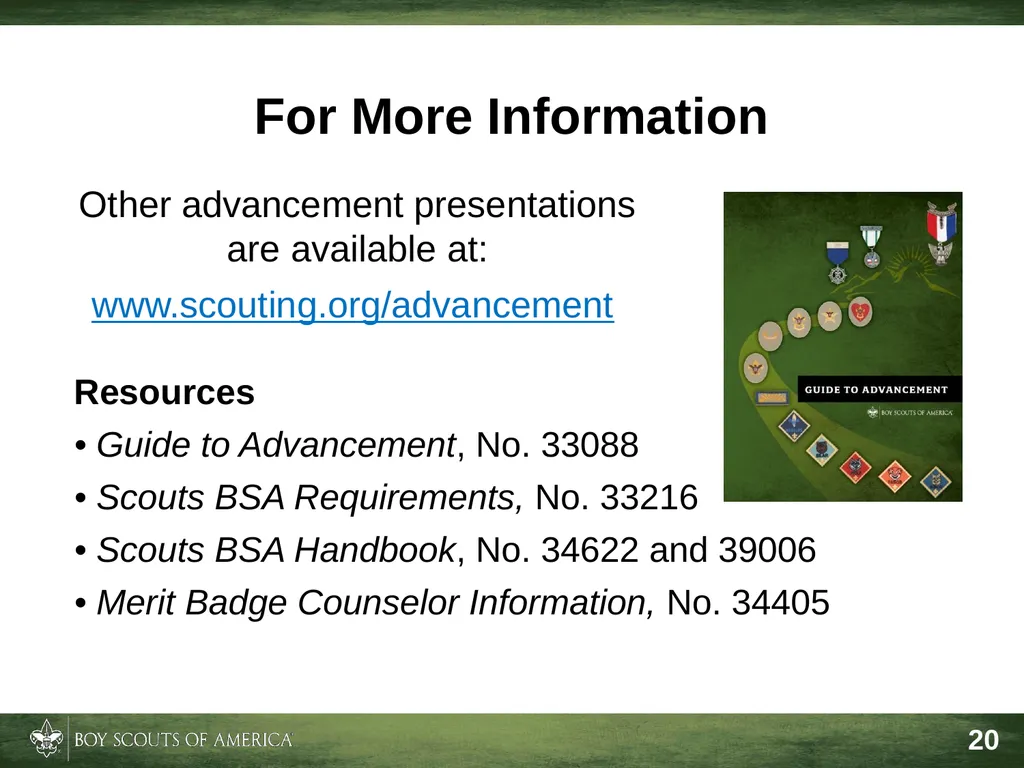
Resources
• Guide to Advancement, No. 33088
• Scouts BSA Requirements, No. 33216
• Scouts BSA Handbook, No. 34622 and 39006
• Merit Badge Counselor Information, No. 34405 For More Information Other advancement presentations are available at:
www.scouting.org/advancement<br>