Effort Level Search in Infinite Completion Trees with Application to Task and Motion Planning Marc Toussaint, Joaquim Ortiz de Haro, Valentin Noah Hartmann, Erez Karpas, and Wolfgang Hoenig ICRA 2024, Yokohama, May 13-17 Solving Task and
"Effort Level Search in Infinite Completion Trees" is the property of its rightful owner. Permission is granted to
download and print the materials on this website for personal, non-commercial use only, and to display it
on your personal computer provided you do not modify the materials and that you retain all copyright
notices contained in the materials. By downloading content from our website, you accept the terms of this
agreement.
Presentation Transcript
01
Effort Level Search in Infinite Completion Trees with Application to Task and Motion Planning Marc Toussaint, Joaquim Ortiz de Haro, Valentin Noah Hartmann, Erez Karpas, and Wolfgang Hoenig ICRA 2024, Yokohama, May 13-17<br>
02
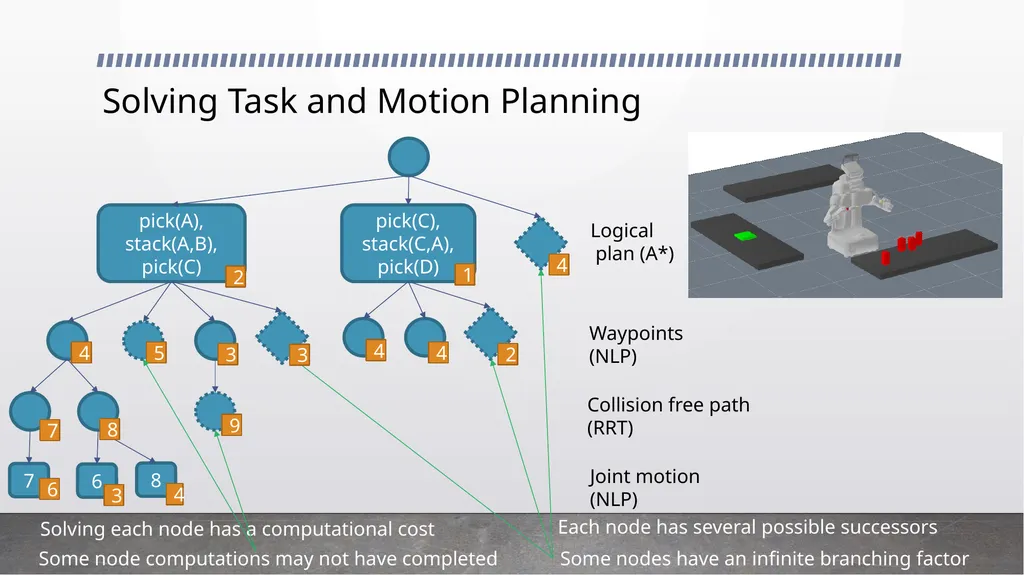
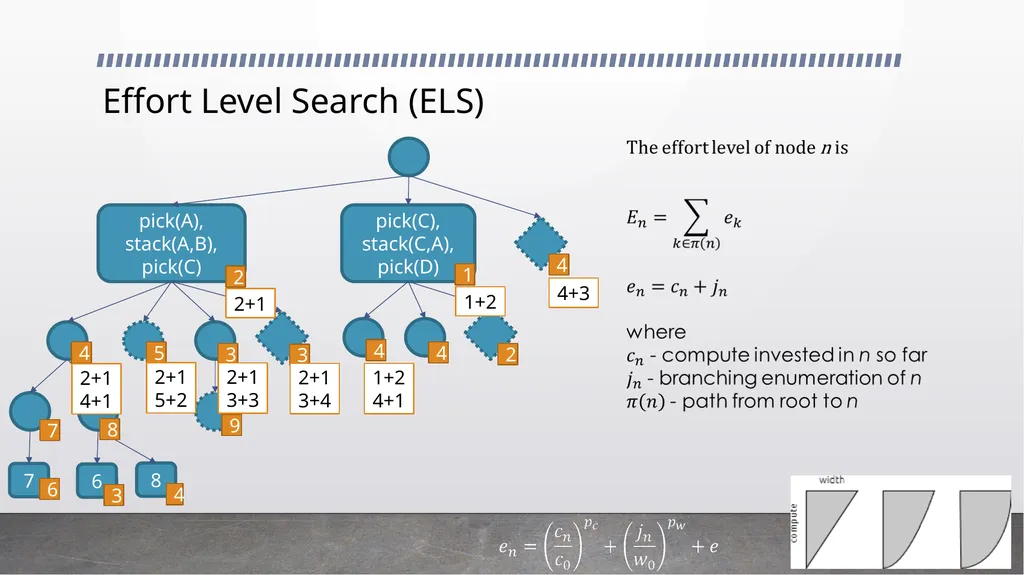
Solving Task and Motion Planning pick(A), stack(A,B), pick(C) pick(C), stack(C,A), pick(D) Logical
plan (A*) Waypoints
(NLP) Collision free path (RRT) Joint motion (NLP) 7 6 8 2 4 7 6 5 3 4 4 8 9 4 3 Solving each node has a computational cost 1 Some nodes have an infinite branching factor Some node computations may not have completed Each node has several possible successors 4 2 3<br>
03
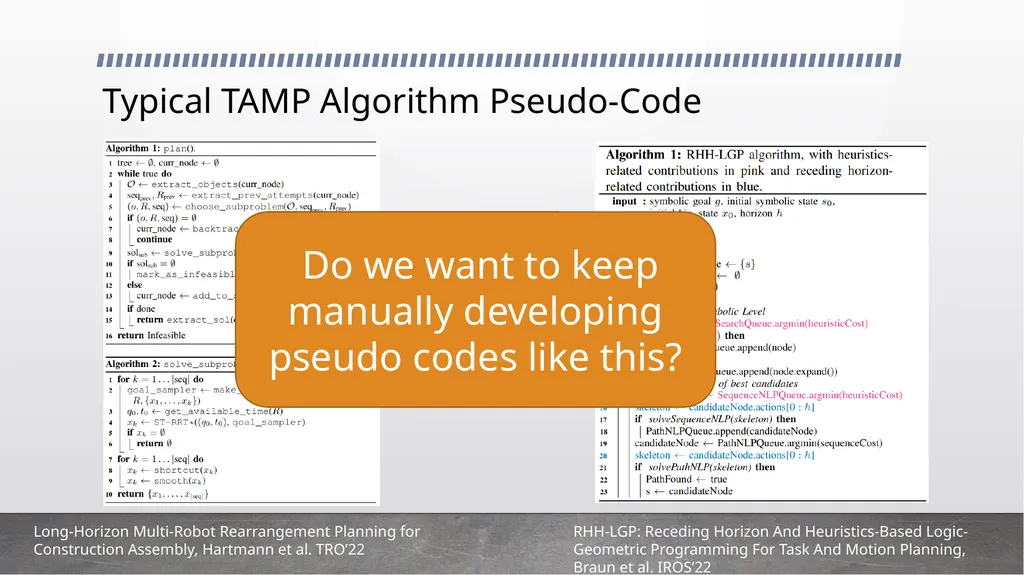
Typical TAMP Algorithm Pseudo-Code Long-Horizon Multi-Robot Rearrangement Planning for
Construction Assembly, Hartmann et al. TRO’22 RHH-LGP: Receding Horizon And Heuristics-Based Logic-Geometric Programming For Task And Motion Planning, Braun et al. IROS’22 Do we want to keep manually developing pseudo codes like this?<br>
04
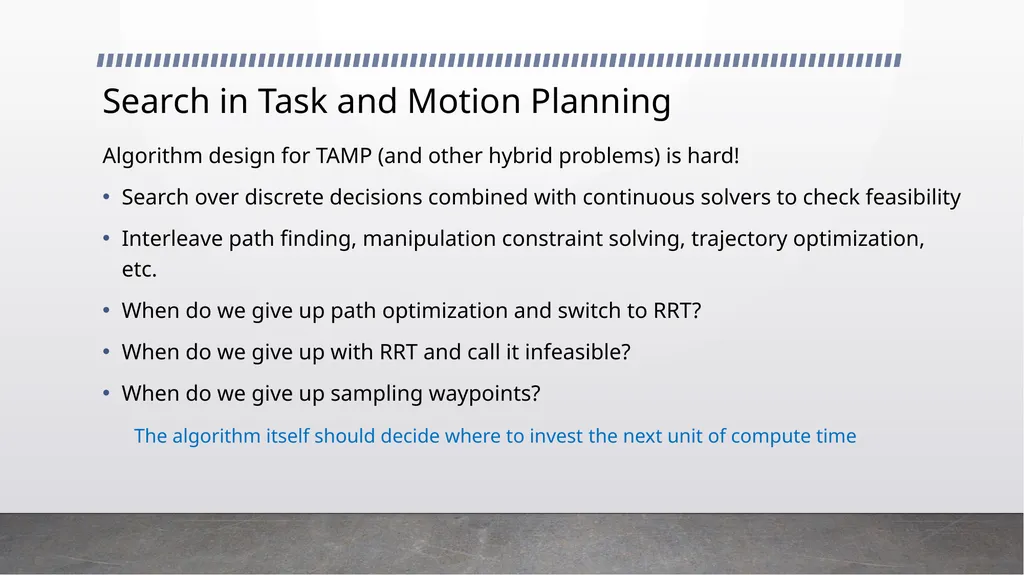
Search in Task and Motion Planning Algorithm design for TAMP (and other hybrid problems) is hard!
Search over discrete decisions combined with continuous solvers to check feasibility
Interleave path finding, manipulation constraint solving, trajectory optimization, etc.
When do we give up path optimization and switch to RRT?
When do we give up with RRT and call it infeasible?
When do we give up sampling waypoints? The algorithm itself should decide where to invest the next unit of compute time<br>
Effort Level Search (ELS) Essentially – breadth first search over infinite search trees
Instead of just expanding nodes, we have widen, deepen, and compute
Guarantees completeness – if an optimal solution exists, it will be found
Possibly, suboptimal solutions will be found before it
Generalizes round-robin, budgeted bandits, …<br>
07
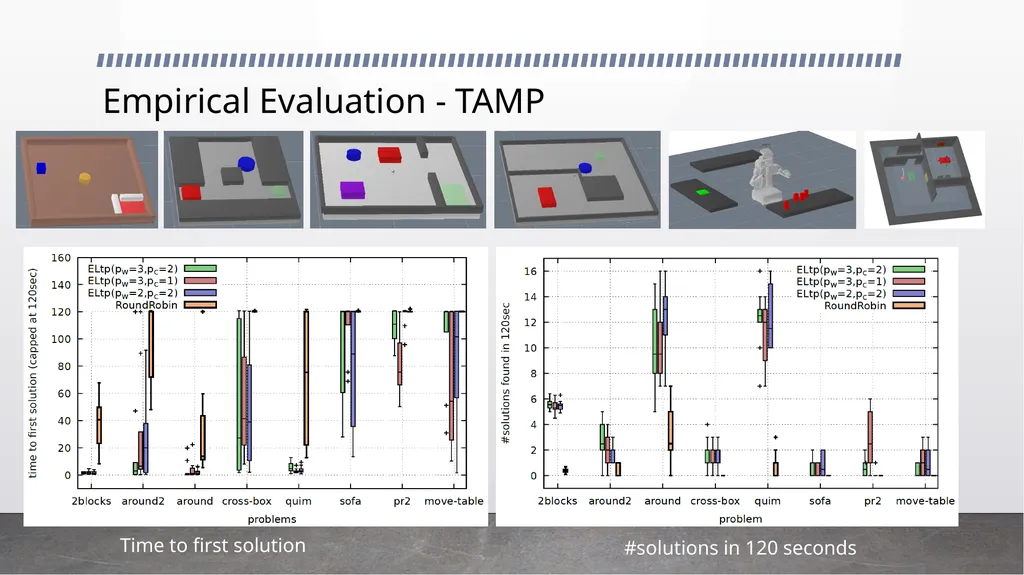
Empirical Evaluation - TAMP Time to first solution #solutions in 120 seconds<br>
08
Conclusion Effort Level Search is a new way to search through trees with an infinite branching factor
Challenge: better search guidance Thank you