
EIA PRESENTATION TO THE HONORABLE CHAIRMAN &



Description: EIA PRESENTATION TO THE HONORABLE CHAIRMAN MEMBERS OF KARNATAKA STATE EXPERT APPRAISAL COMMITTEE PROJECT: PROJECT: INDUSTRIALWAREHOUSINGSTORAGE LOGISTICS PARK AT BLOCK NOS-1-A-PART, 1-B AND 1-C OF DABASPET, 5TH PHASE INDUSTRIAL AREA,
Related Topics
Download Presentation
"EIA PRESENTATION TO THE HONORABLE CHAIRMAN &" is the property of its rightful owner. Permission is granted to download and print the materials on this website for personal, non-commercial use only, and to display it on your personal computer provided you do not modify the materials and that you retain all copyright notices contained in the materials. By downloading content from our website, you accept the terms of this agreement.
Presentation Transcript
slide1. EIA PRESENTATION
TO
THE HONORABLE CHAIRMAN & MEMBERS OF
KARNATAKA STATE EXPERT APPRAISAL COMMITTEE
PROJECT:
PROJECT:
INDUSTRIAL/WAREHOUSING/STORAGE/ LOGISTICS PARK
AT
BLOCK NOS-1-A-PART, 1-B AND 1-C OF
DABASPET, 5TH PHASE INDUSTRIAL AREA,
BANGALORE RURAL DISTRICT.
By
PROPONENT:
EMBASSY INDUSTRIAL PARKS PVT LTD ,
(NOW KNOWN AS HORIZON INDUSTRIAL PARKS PVT LTD)
1ST FLOOR, EMBASSY POINT,
150, INFANTRY ROAD,
BANGALORE-560001 1 APPLICATION NO: SEIAA 58 CON 2022<br>
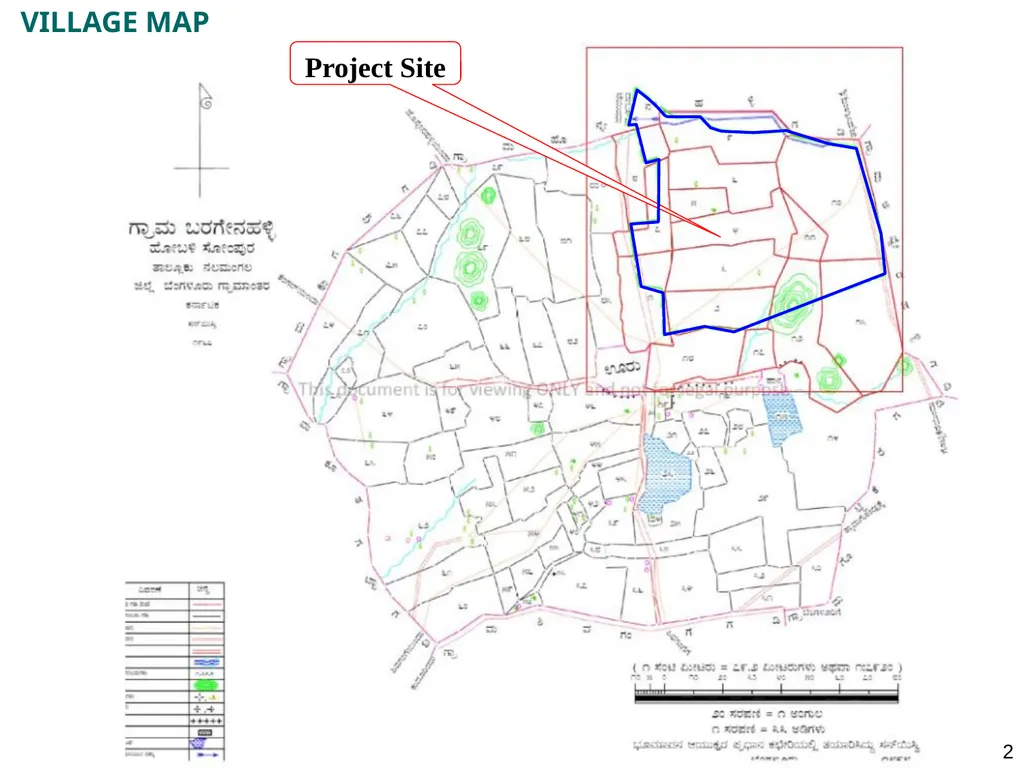
slide2. VILLAGE MAP Project Site 2<br>
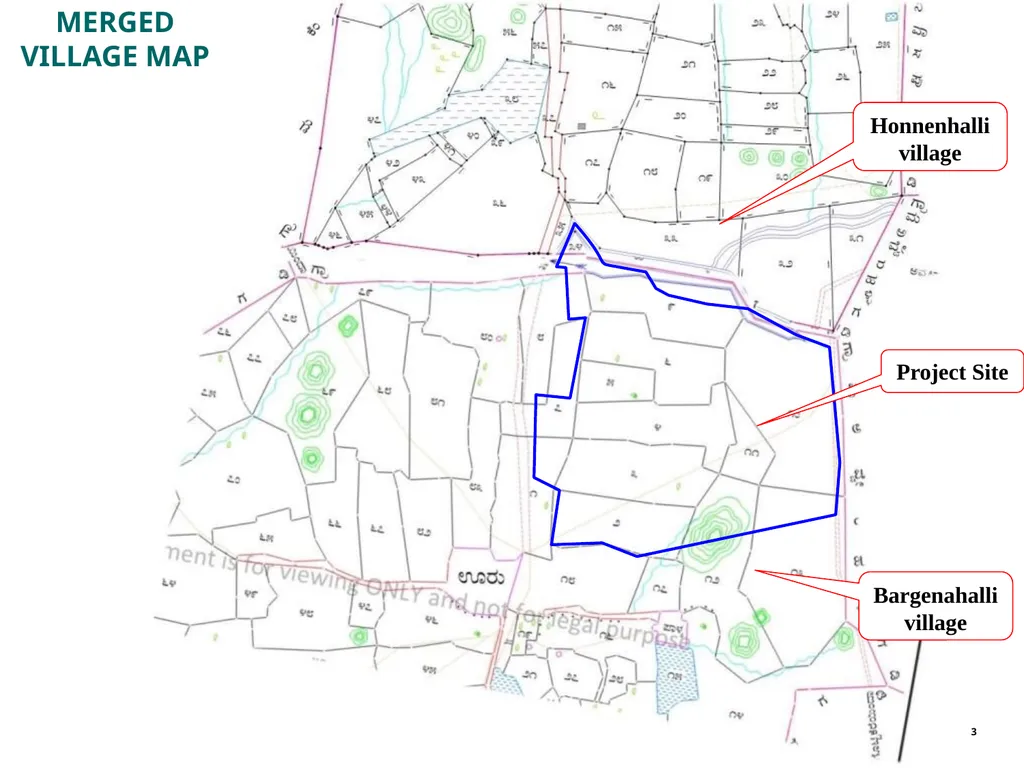
slide3. 3 Project Site MERGED
VILLAGE MAP Honnenhalli village Bargenahallivillage<br>
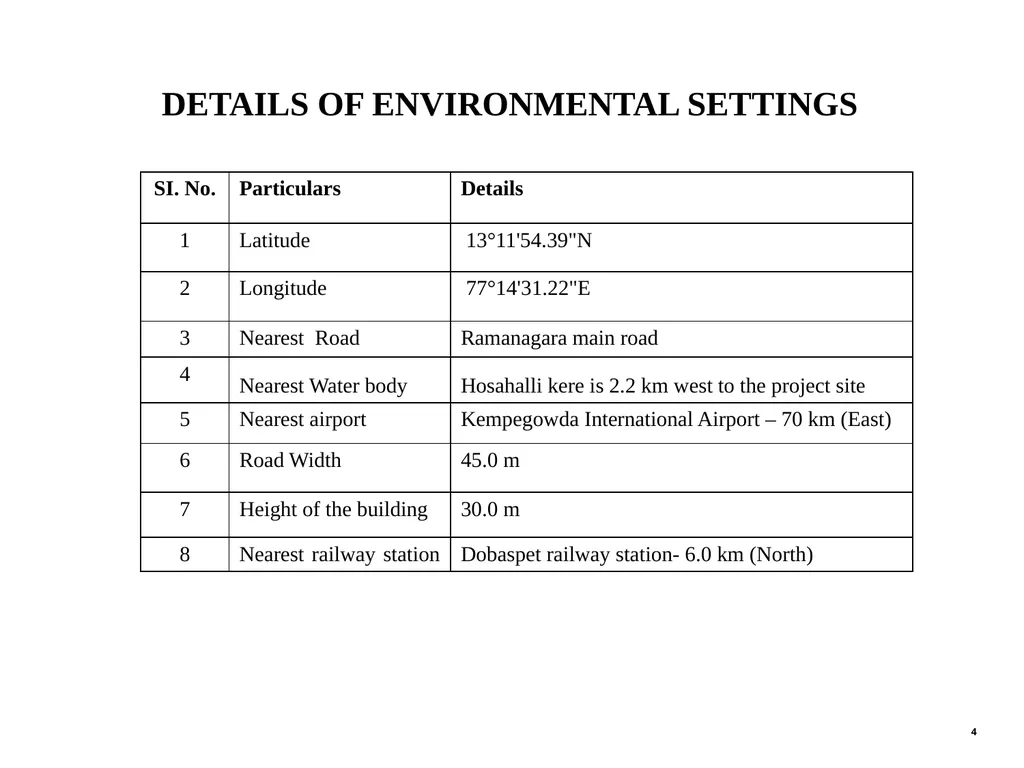
slide4. 4 DETAILS OF ENVIRONMENTAL SETTINGS<br>
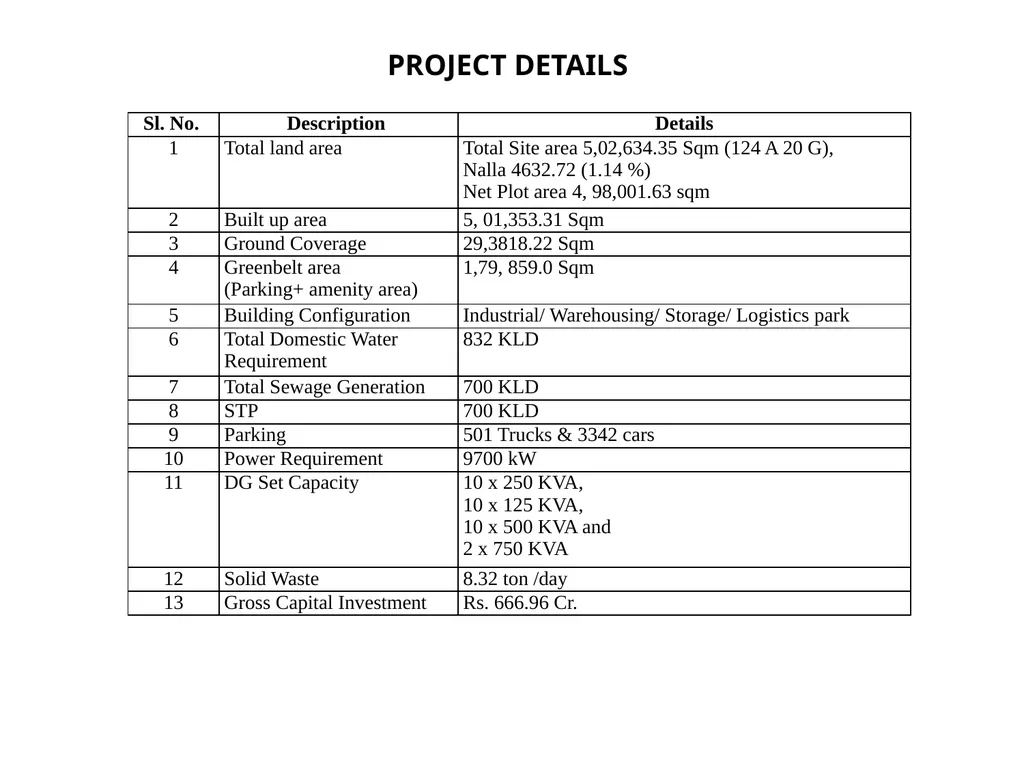
slide5. PROJECT DETAILS<br>
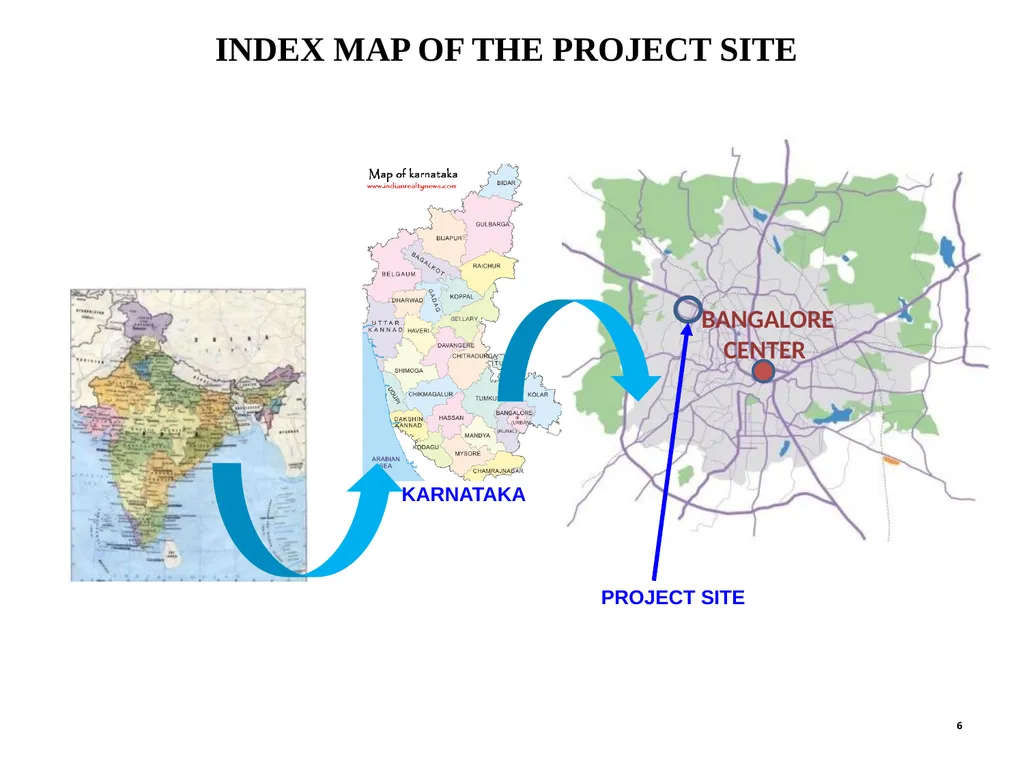
slide6. INDEX MAP OF THE PROJECT SITE 6 PROJECT SITE KARNATAKA BANGALORE
CENTER<br>
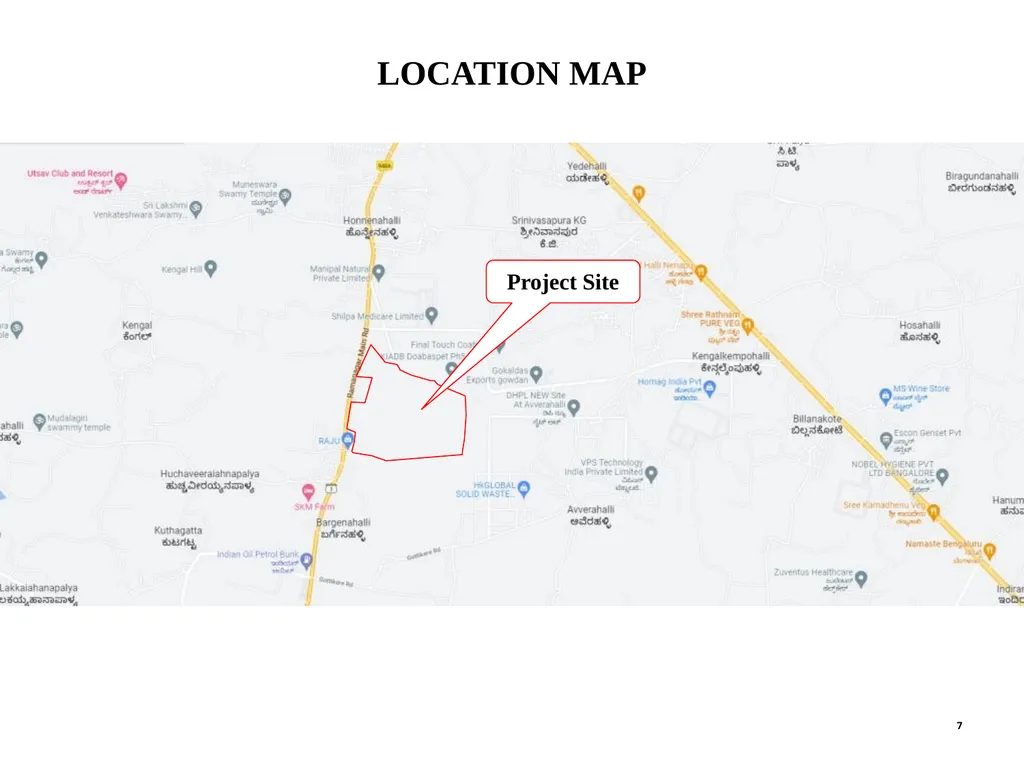
slide7. 7 LOCATION MAP Project Site<br>
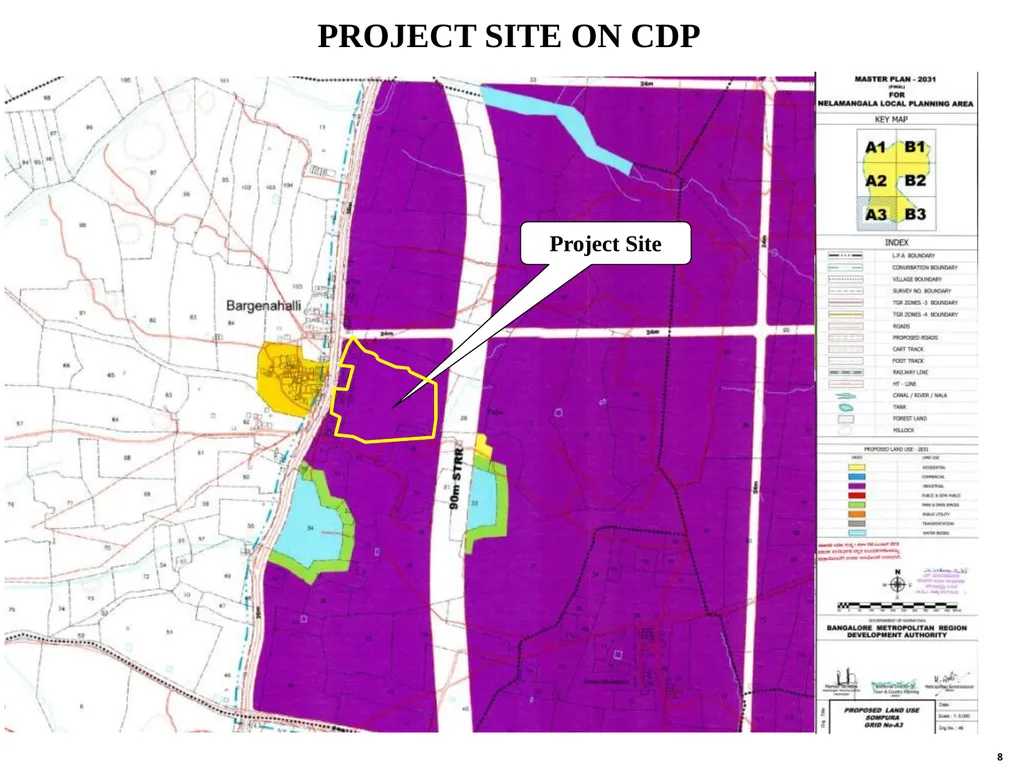
slide8. 8 PROJECT SITE ON CDP Project Site<br>
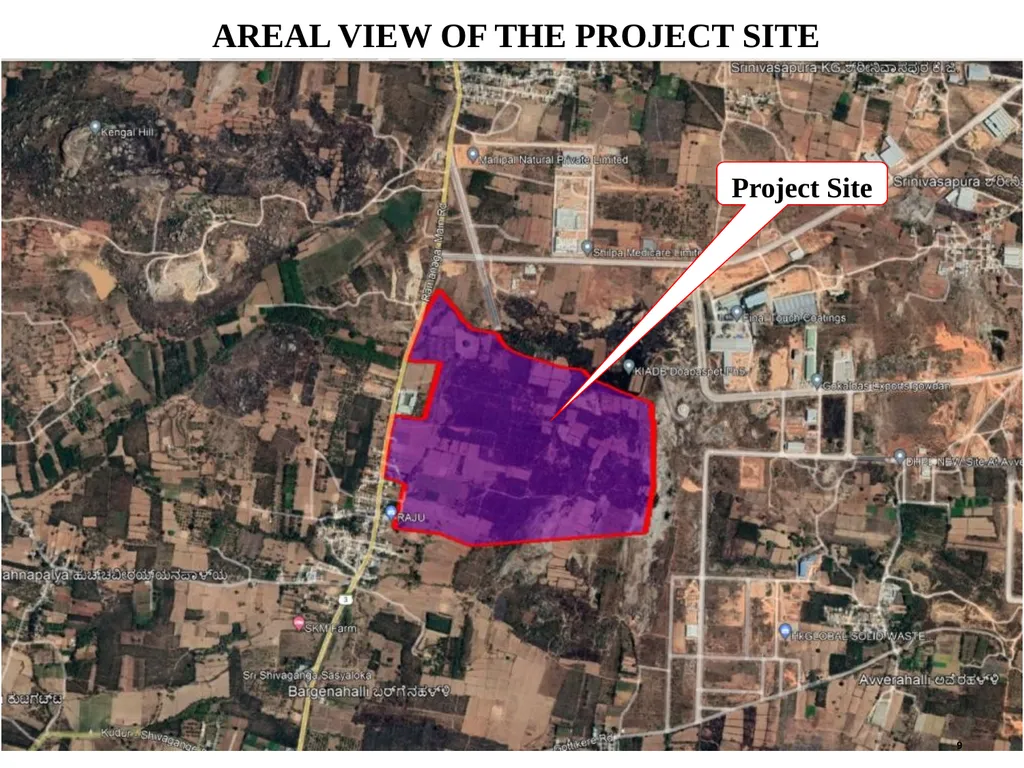
slide9. AREAL VIEW OF THE PROJECT SITE 9 Project Site<br>
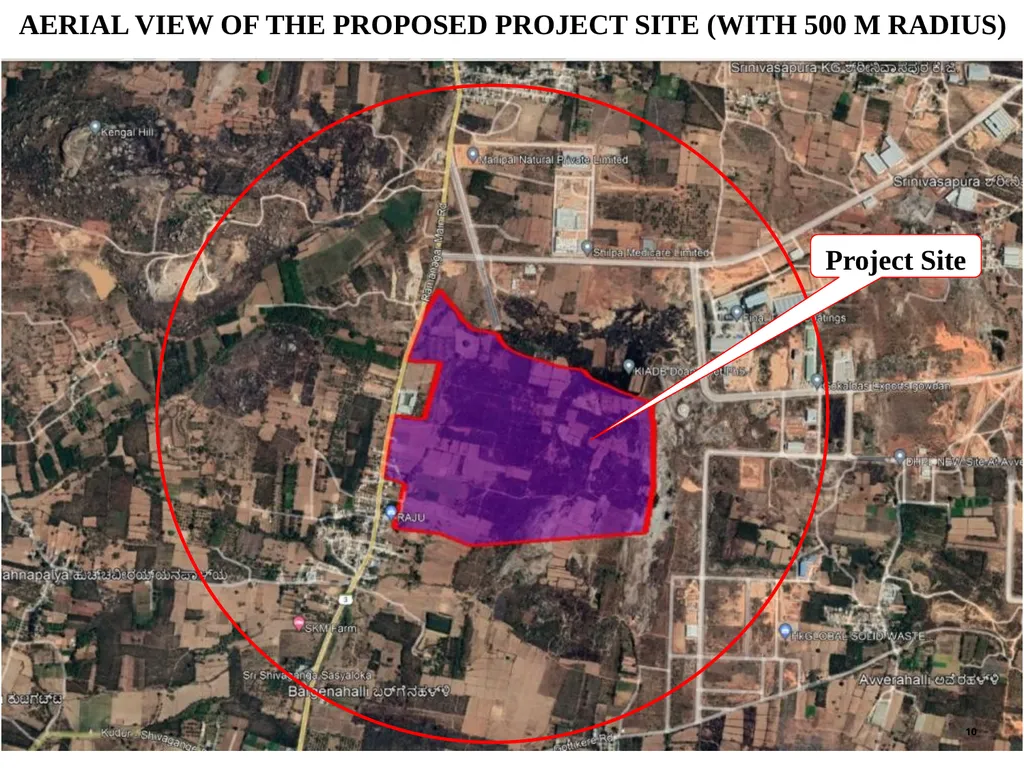
slide10. 10 AERIAL VIEW OF THE PROPOSED PROJECT SITE (WITH 500 M RADIUS) Project Site<br>
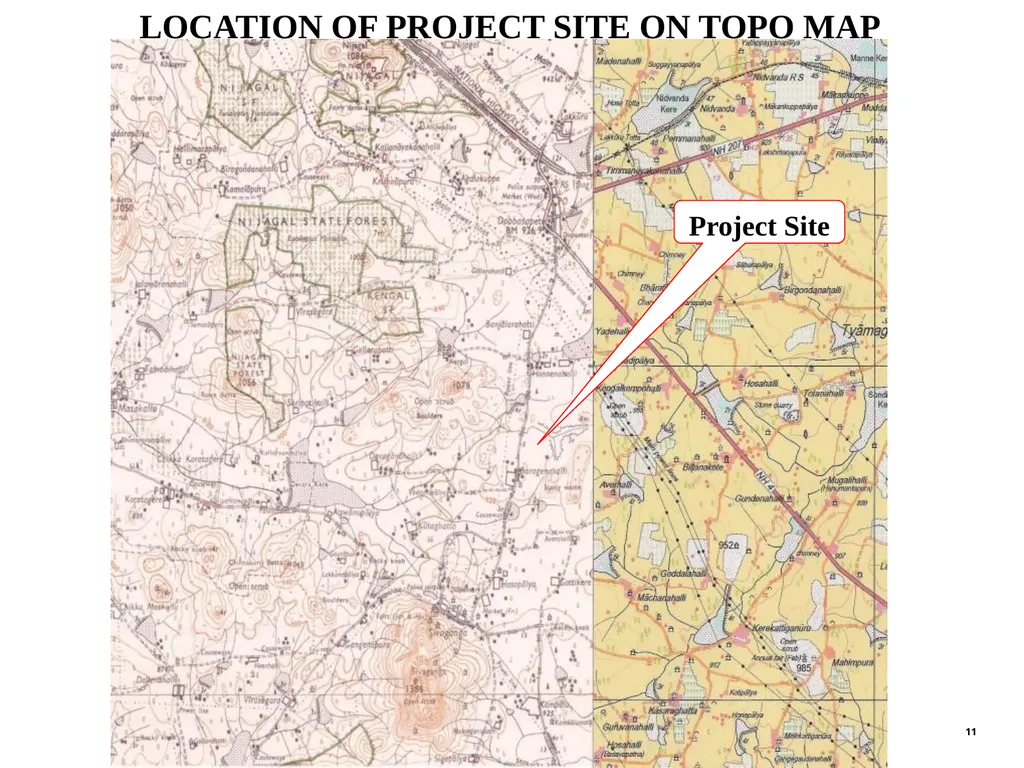
slide11. LOCATION OF PROJECT SITE ON TOPO MAP 11 Project Site<br>
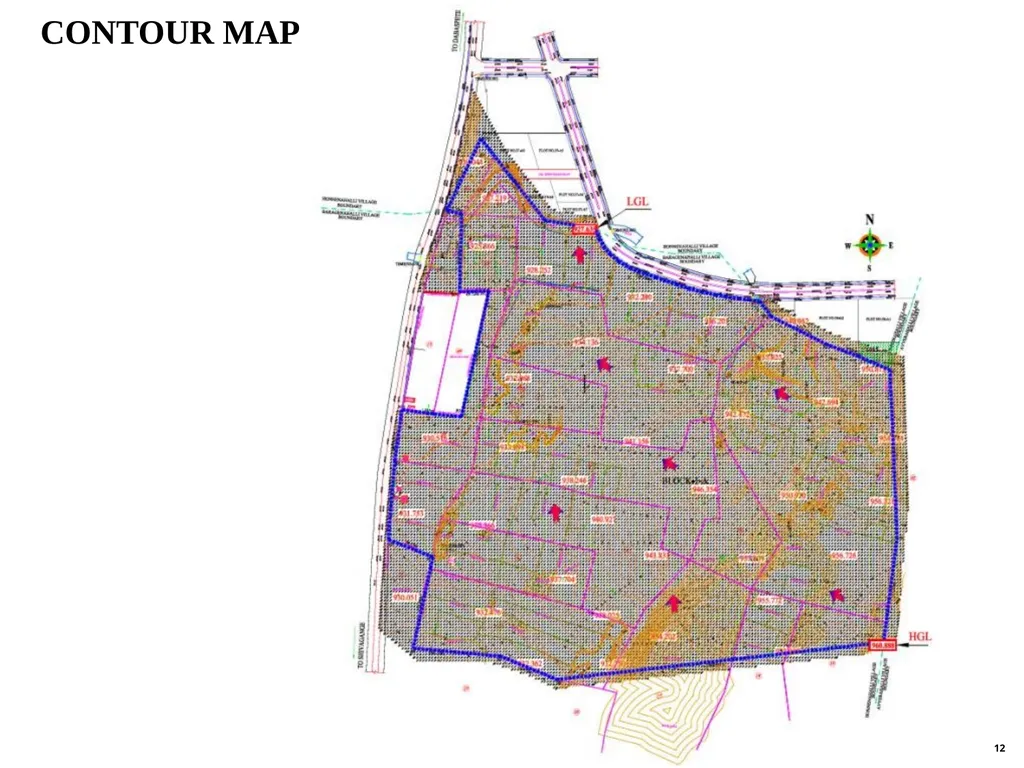
slide12. CONTOUR MAP 12<br>
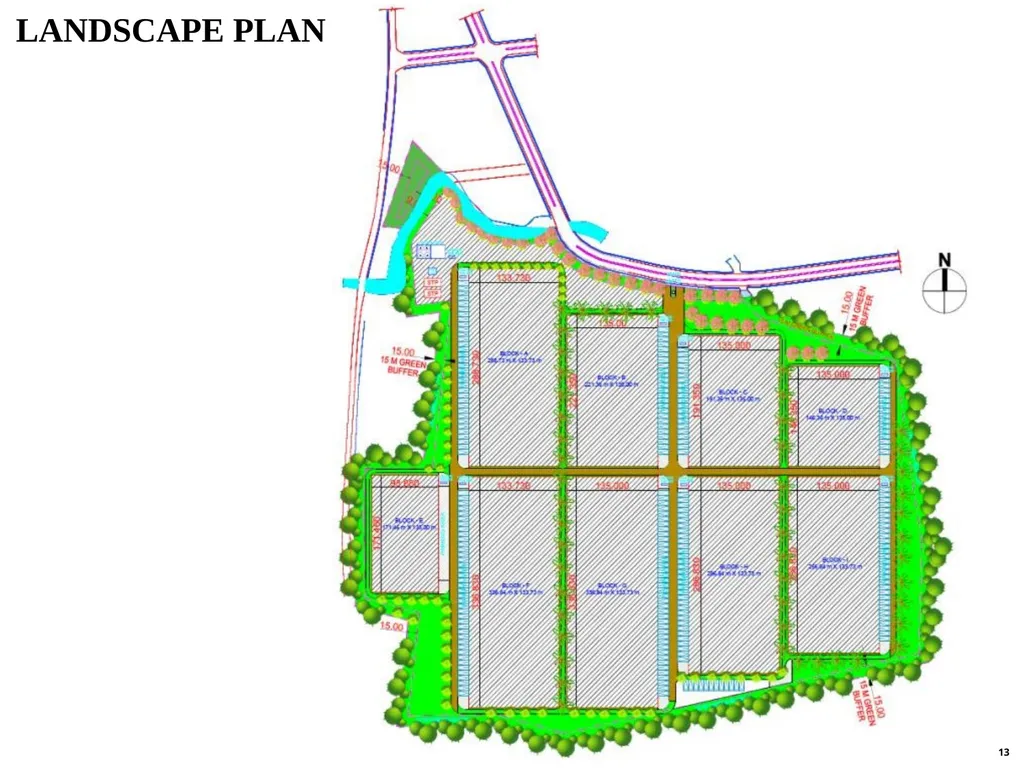
slide13. LANDSCAPE PLAN 13<br>
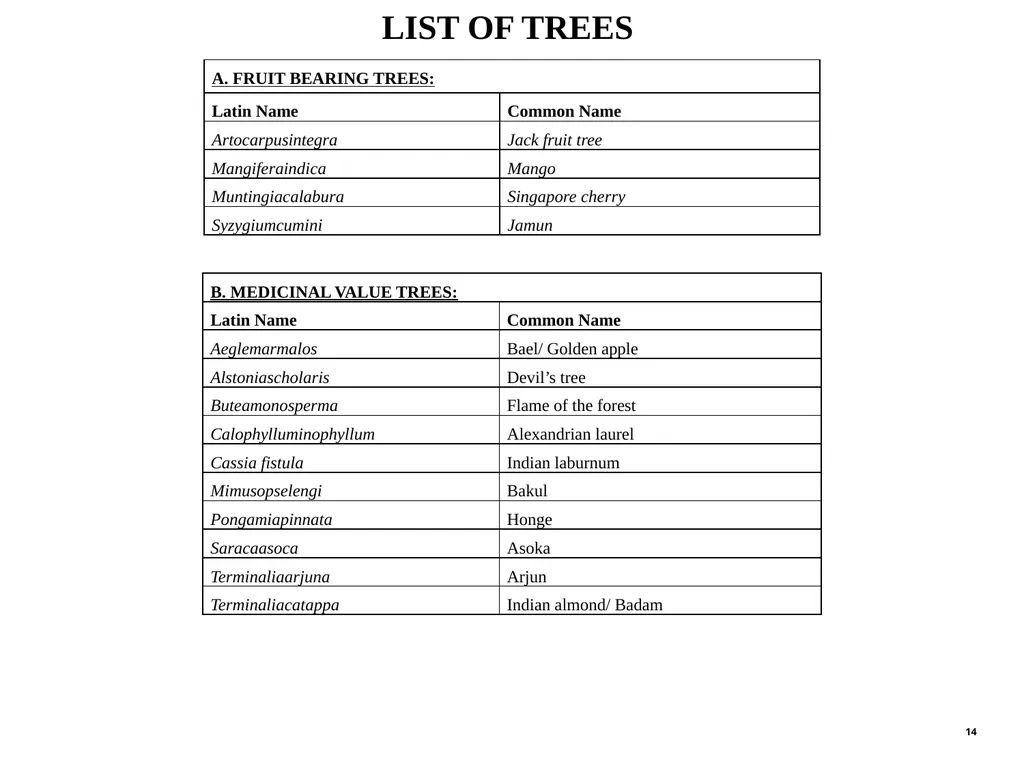
slide14. 14 LIST OF TREES<br>
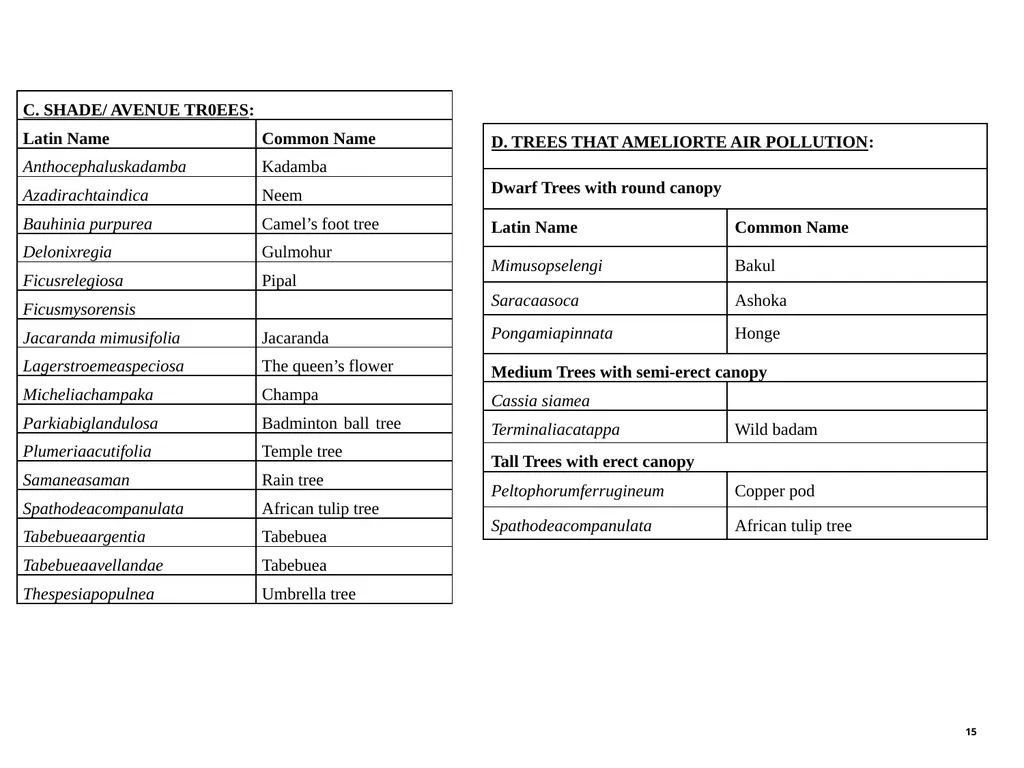
slide15. 15<br>
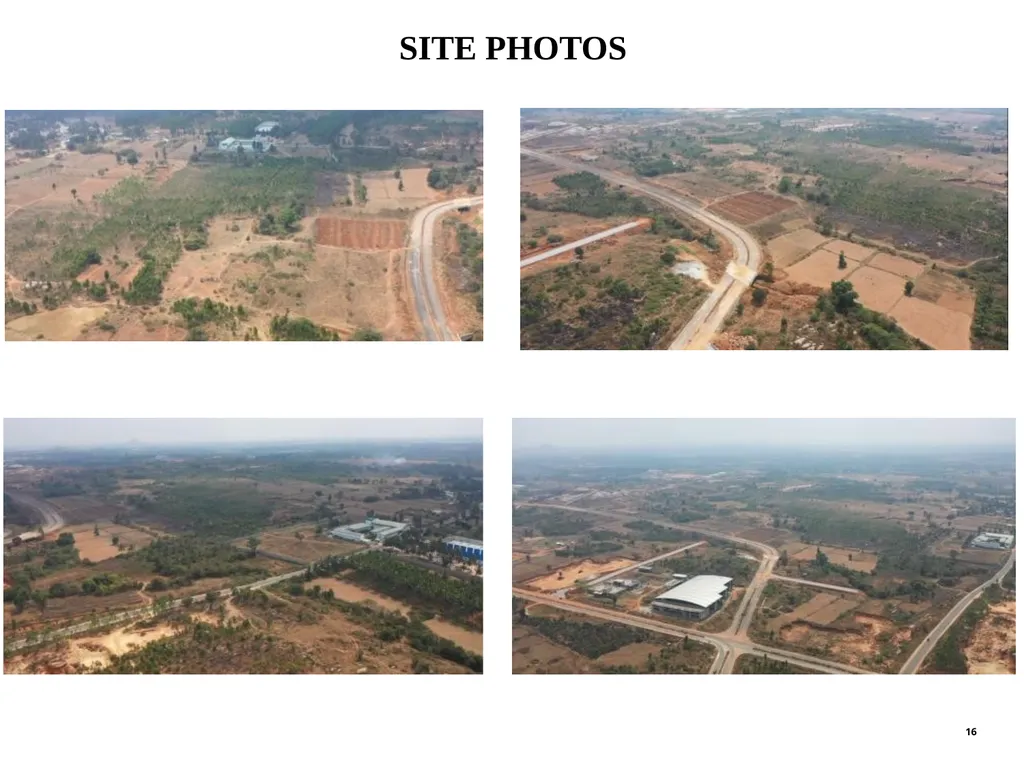
slide16. SITE PHOTOS 11.12.2012 16<br>
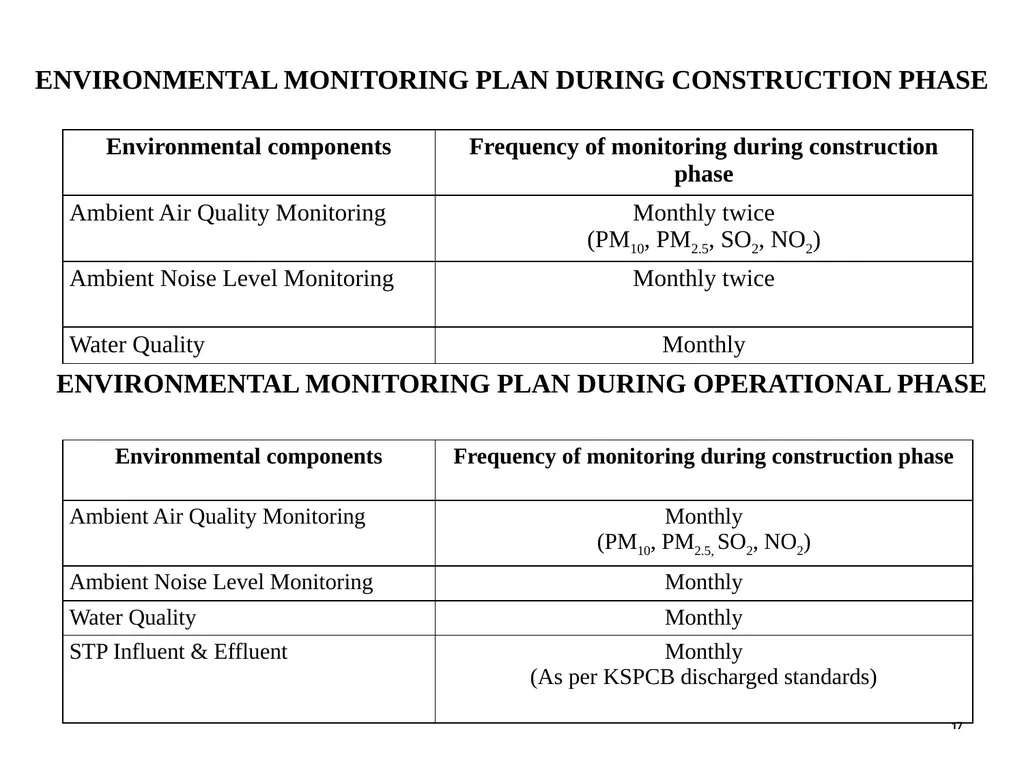
slide17. ENVIRONMENTAL MONITORING PLAN DURING CONSTRUCTION PHASE 17 ENVIRONMENTAL MONITORING PLAN DURING OPERATIONAL PHASE<br>
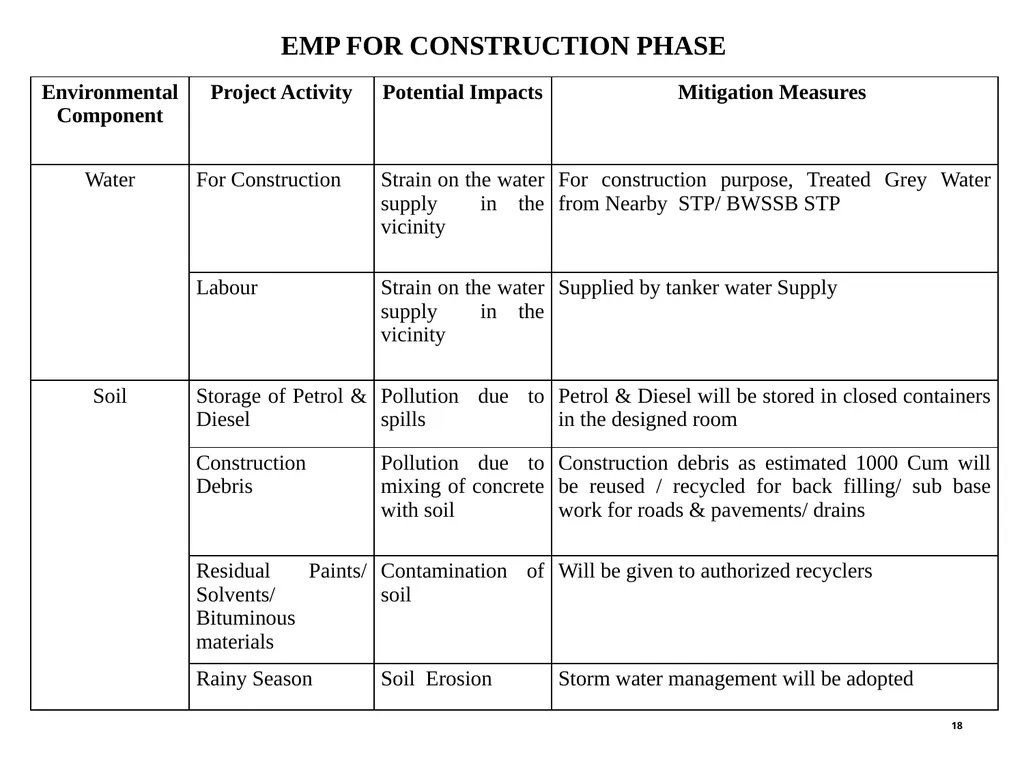
slide18. EMP FOR CONSTRUCTION PHASE 18<br>
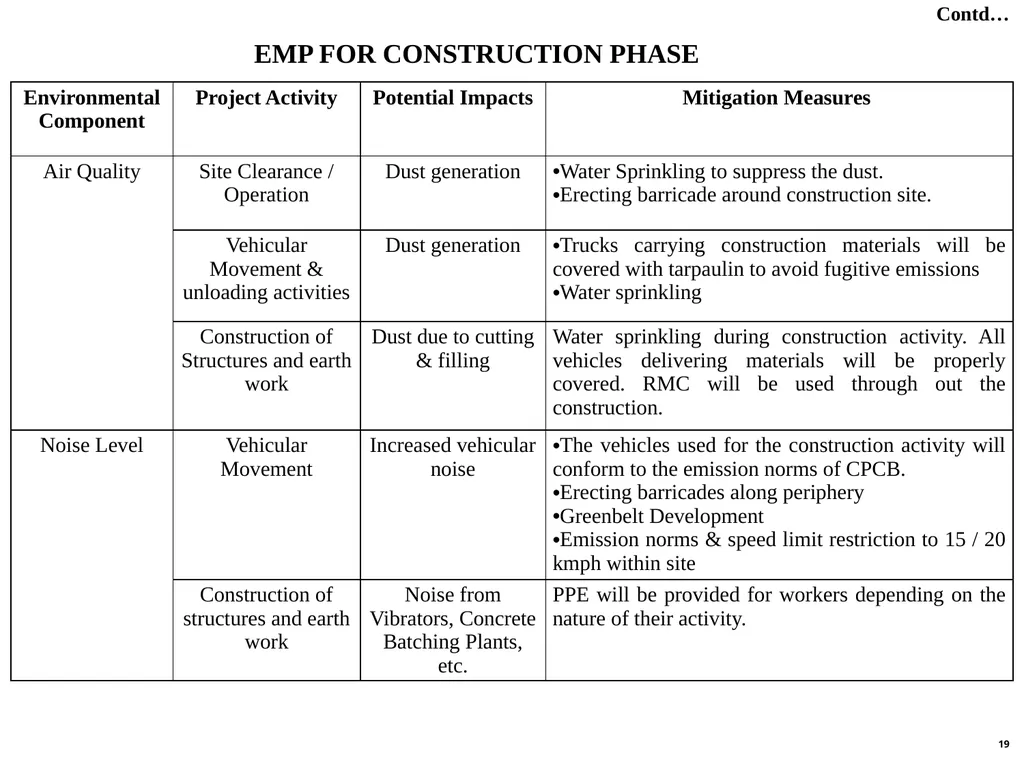
slide19. EMP FOR CONSTRUCTION PHASE 19 Contd…<br>
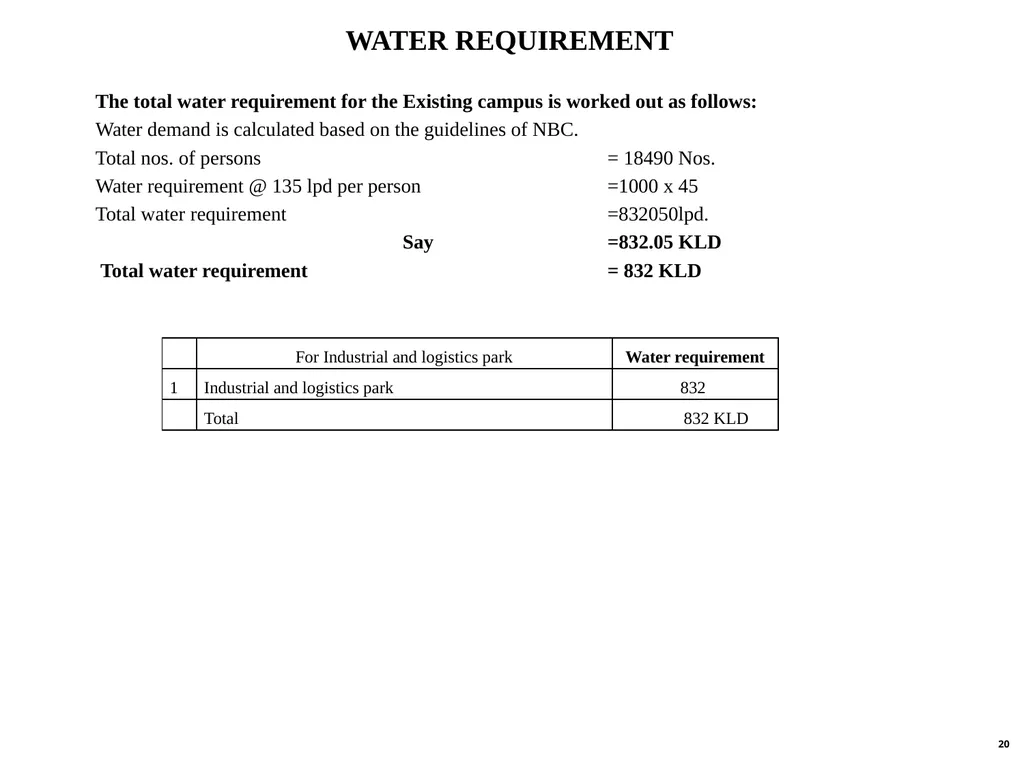
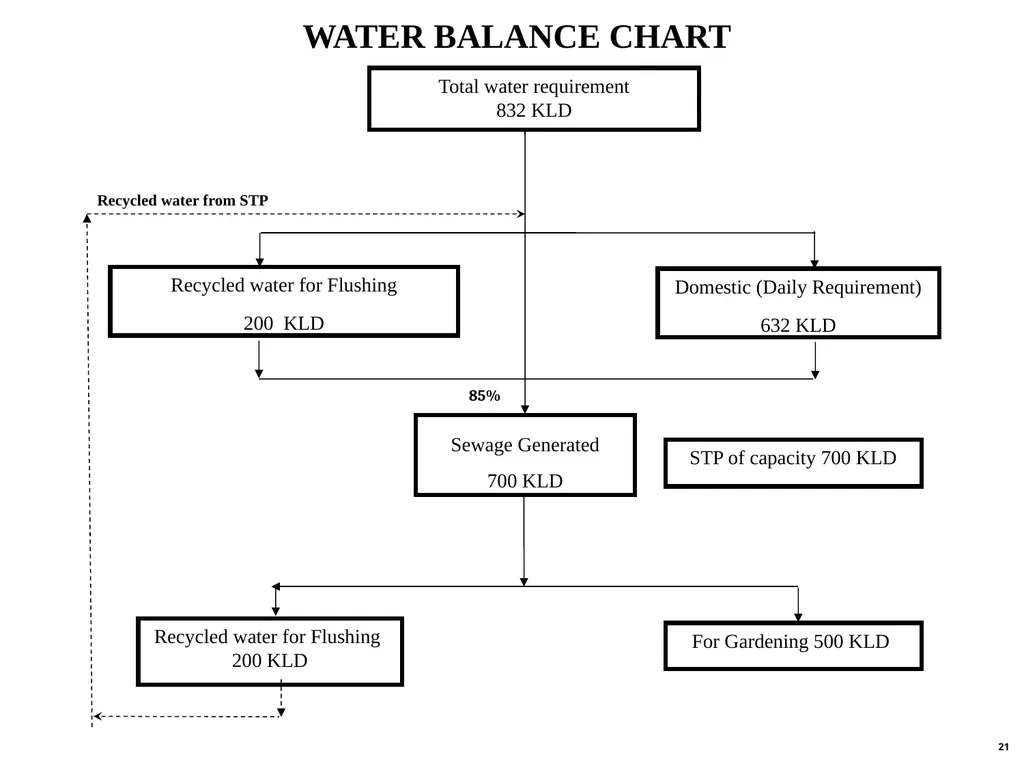
slide20. WATER REQUIREMENT 20 The total water requirement for the Existing campus is worked out as follows:
Water demand is calculated based on the guidelines of NBC.
Total nos. of persons = 18490 Nos.
Water requirement @ 135 lpd per person =1000 x 45
Total water requirement =832050lpd.
Say =832.05 KLD
Total water requirement = 832 KLD<br>
slide21. WATER BALANCE CHART 21<br>
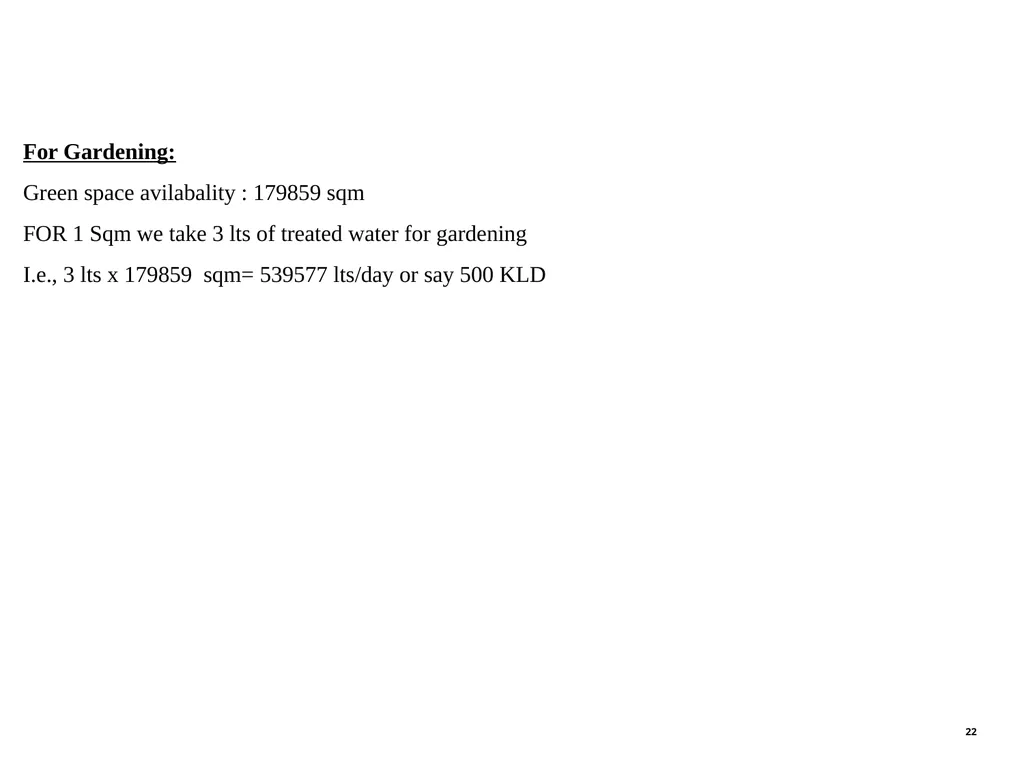
slide22. 22 For Gardening:
Green space avilabality : 179859 sqm
FOR 1 Sqm we take 3 lts of treated water for gardening
I.e., 3 lts x 179859 sqm= 539577 lts/day or say 500 KLD<br>
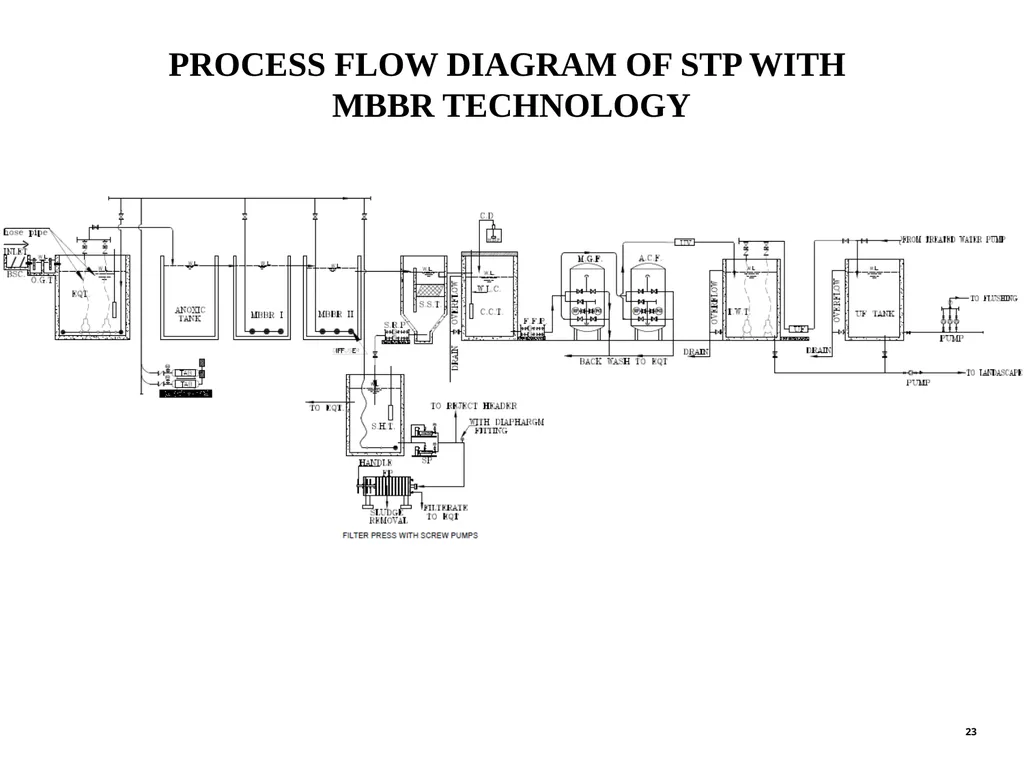
slide23. 23 PROCESS FLOW DIAGRAM OF STP WITH
MBBR TECHNOLOGY<br>
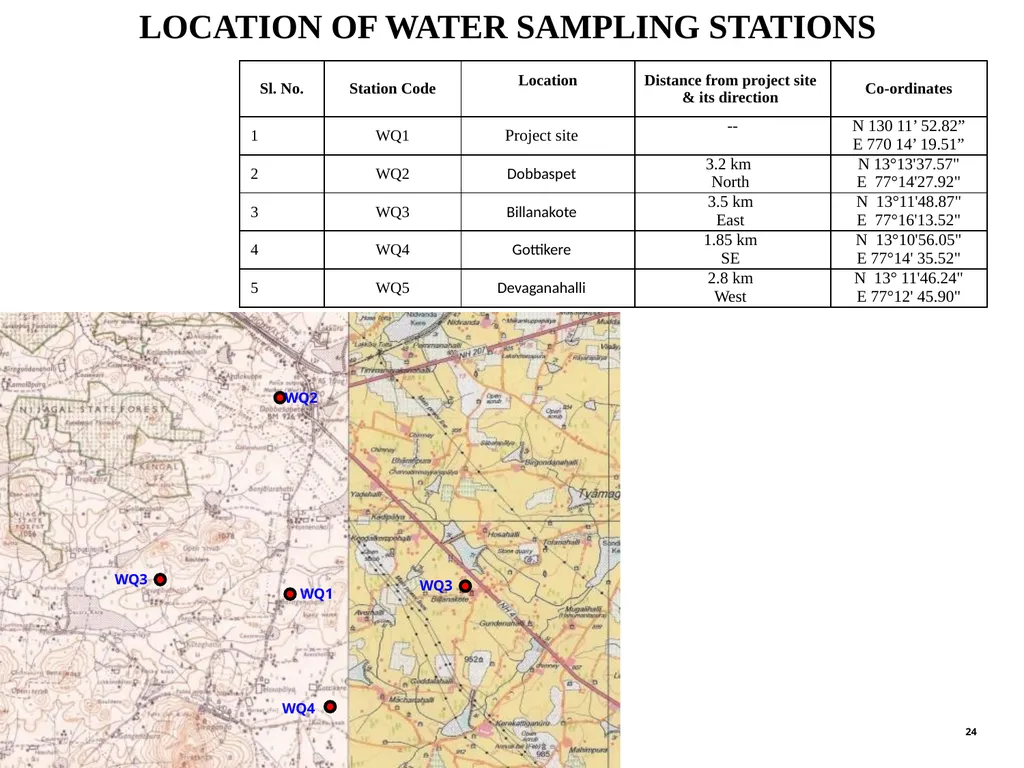
slide24. LOCATION OF WATER SAMPLING STATIONS 24 WQ3 WQ4 WQ1 WQ2 WQ3<br>
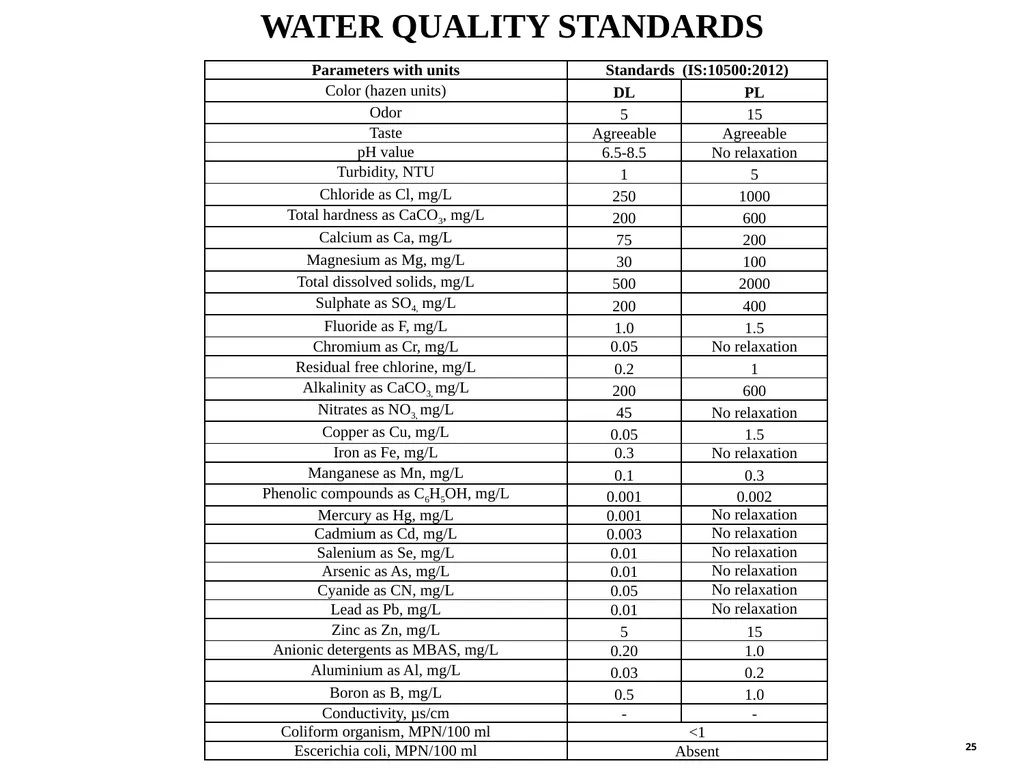
slide25. 25 WATER QUALITY STANDARDS<br>
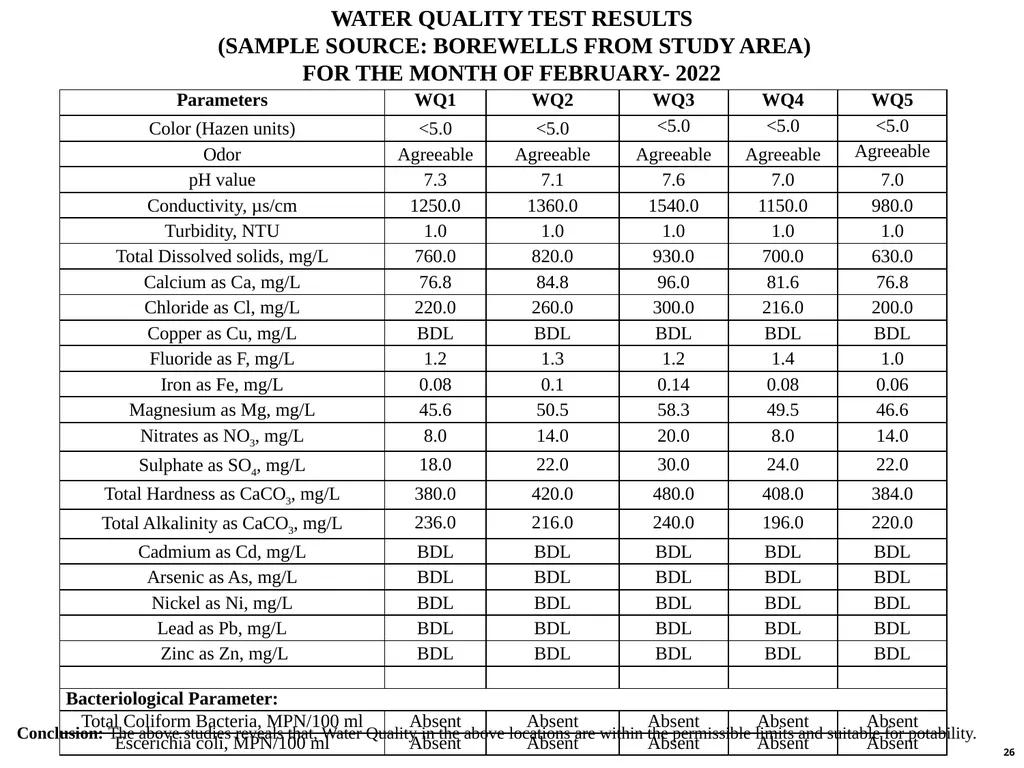
slide26. 26 WATER QUALITY TEST RESULTS
(SAMPLE SOURCE: BOREWELLS FROM STUDY AREA)
FOR THE MONTH OF FEBRUARY- 2022 Conclusion: The above studies reveals that, Water Quality in the above locations are within the permissible limits and suitable for potability.<br>
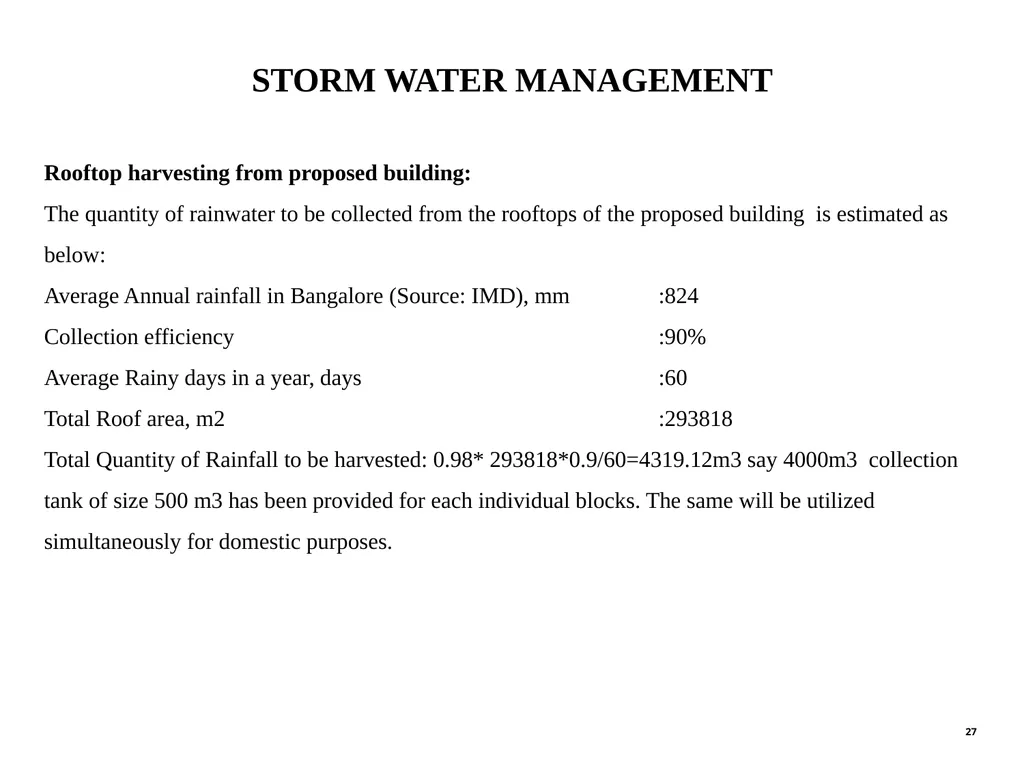
slide27. STORM WATER MANAGEMENT 27 Rooftop harvesting from proposed building:
The quantity of rainwater to be collected from the rooftops of the proposed building is estimated as below:
Average Annual rainfall in Bangalore (Source: IMD), mm :824
Collection efficiency :90%
Average Rainy days in a year, days :60
Total Roof area, m2 :293818
Total Quantity of Rainfall to be harvested: 0.98* 293818*0.9/60=4319.12m3 say 4000m3 collection tank of size 500 m3 has been provided for each individual blocks. The same will be utilized simultaneously for domestic purposes.<br>
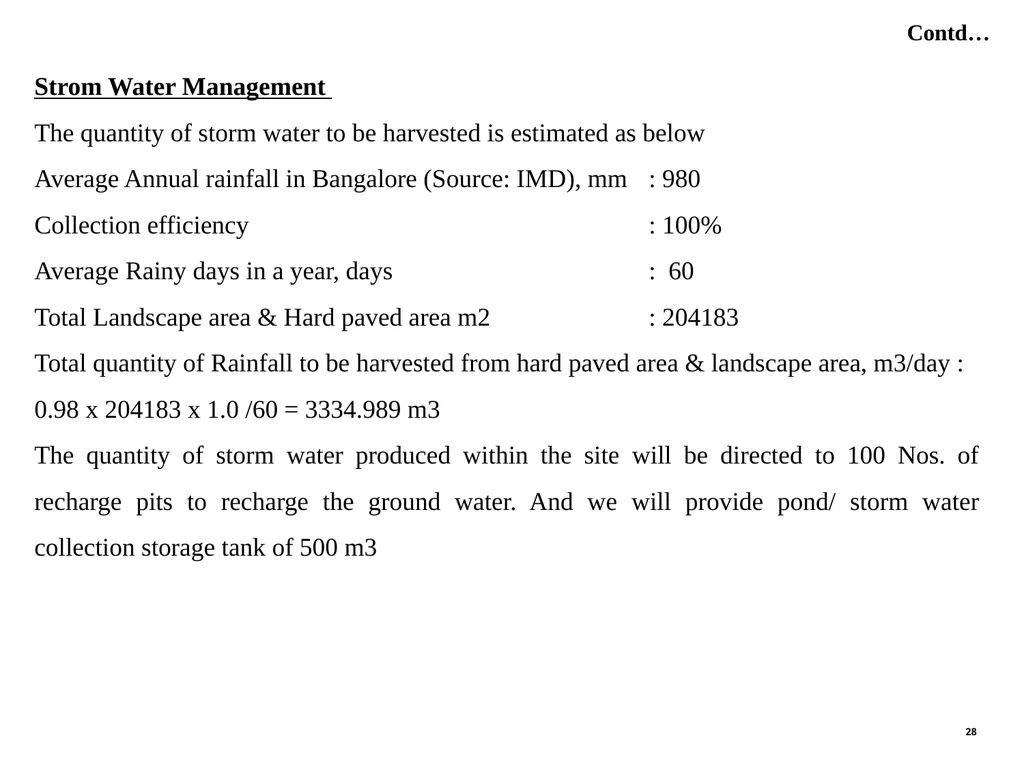
slide28. 28 Strom Water Management
The quantity of storm water to be harvested is estimated as below
Average Annual rainfall in Bangalore (Source: IMD), mm : 980
Collection efficiency : 100%
Average Rainy days in a year, days : 60
Total Landscape area & Hard paved area m2 : 204183
Total quantity of Rainfall to be harvested from hard paved area & landscape area, m3/day :
0.98 x 204183 x 1.0 /60 = 3334.989 m3
The quantity of storm water produced within the site will be directed to 100 Nos. of recharge pits to recharge the ground water. And we will provide pond/ storm water collection storage tank of 500 m3 Contd…<br>
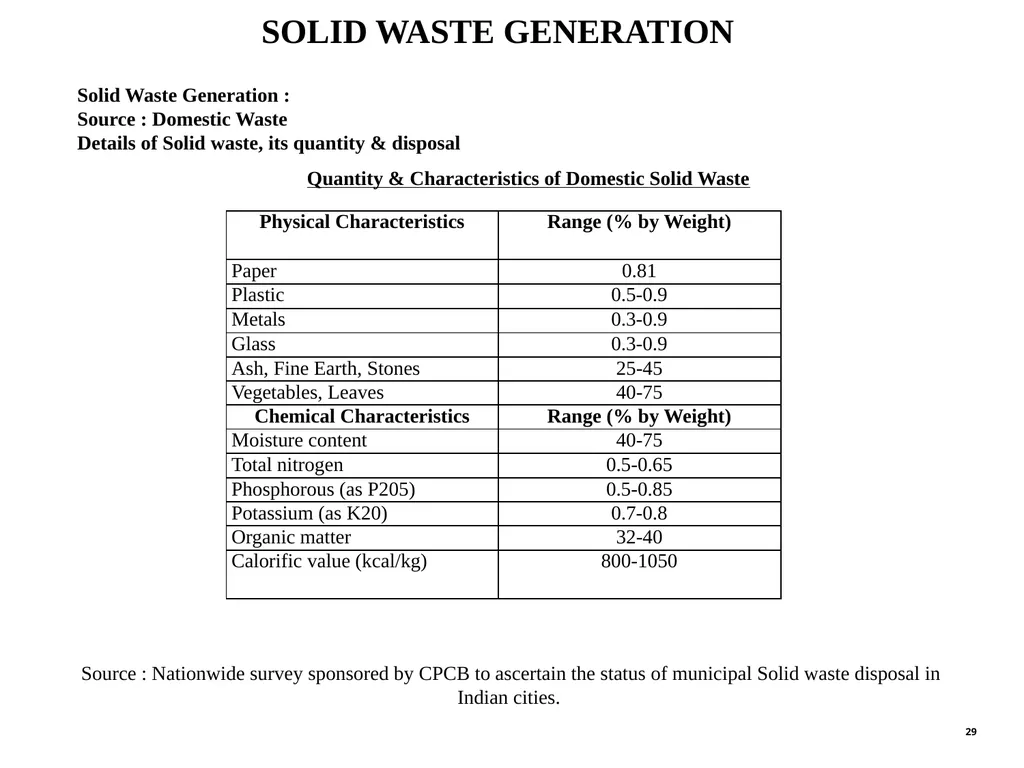
slide29. SOLID WASTE GENERATION 29 Solid Waste Generation :
Source : Domestic Waste
Details of Solid waste, its quantity & disposal Quantity & Characteristics of Domestic Solid Waste Source : Nationwide survey sponsored by CPCB to ascertain the status of municipal Solid waste disposal in Indian cities.<br>
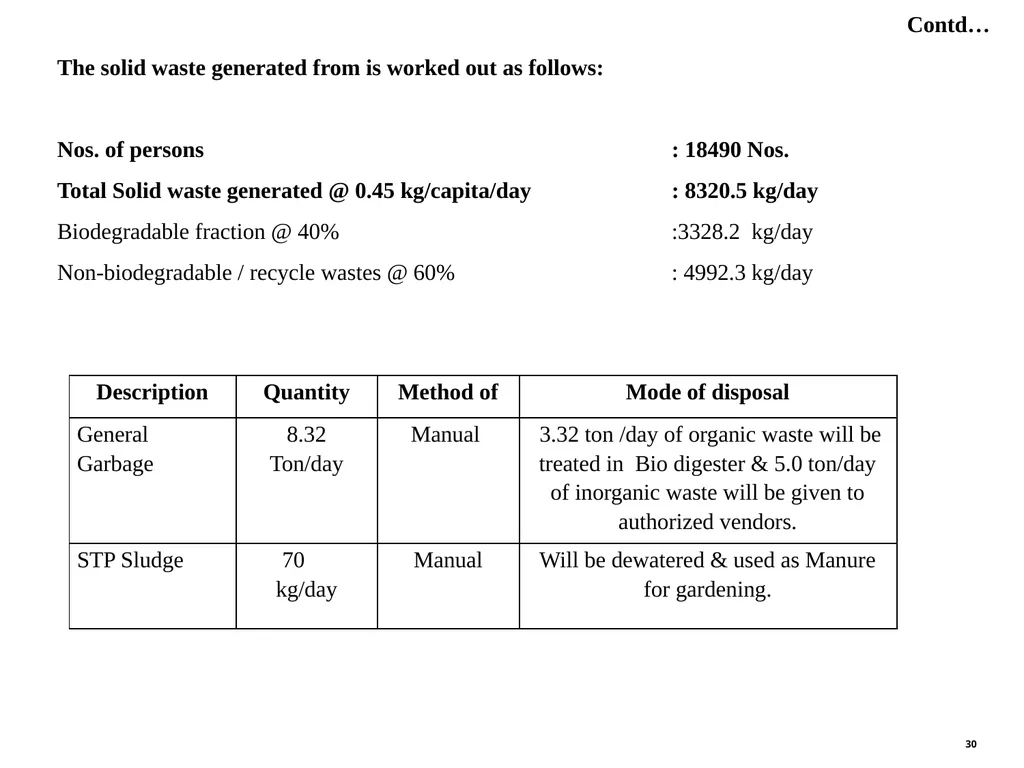
slide30. 30 Contd… The solid waste generated from is worked out as follows:
Nos. of persons : 18490 Nos.
Total Solid waste generated @ 0.45 kg/capita/day : 8320.5 kg/day
Biodegradable fraction @ 40% :3328.2 kg/day
Non-biodegradable / recycle wastes @ 60% : 4992.3 kg/day<br>
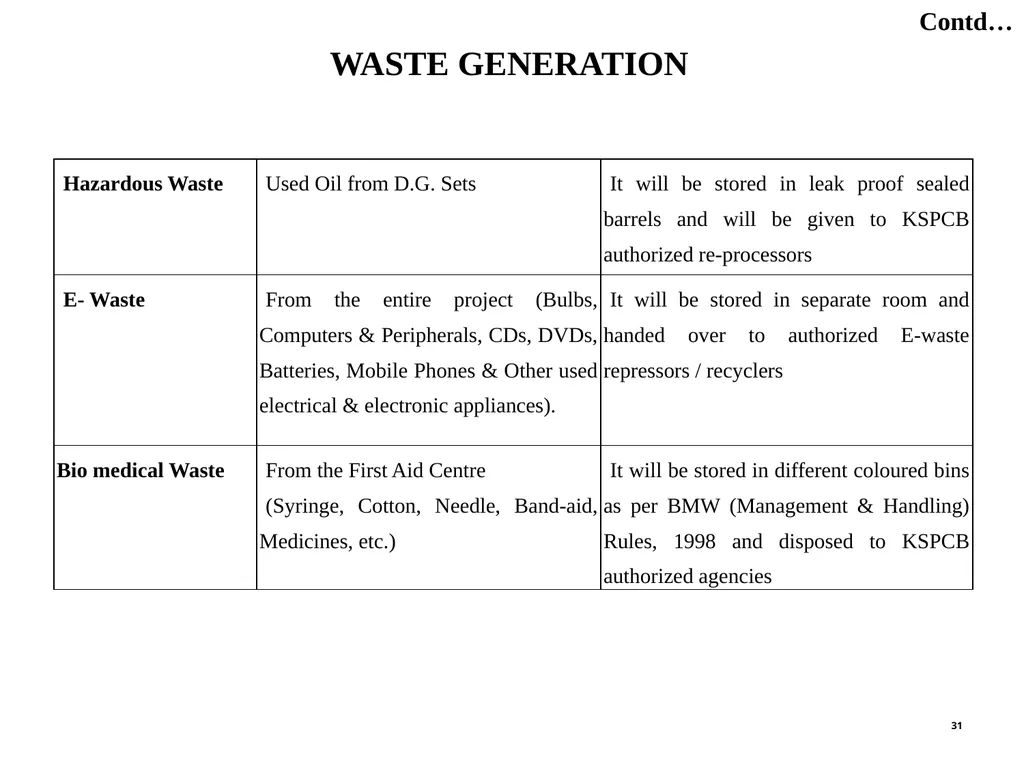
slide31. 31 WASTE GENERATION Contd…<br>
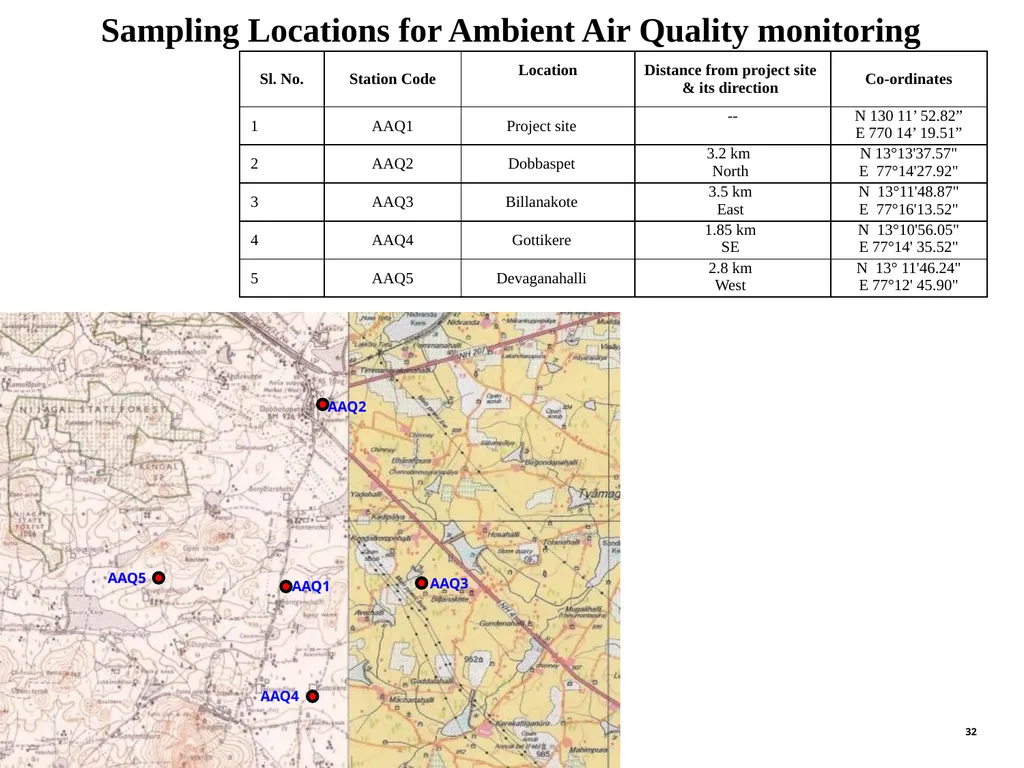
slide32. Sampling Locations for Ambient Air Quality monitoring 32 AAQ3 AAQ4 AAQ1 AAQ2 AAQ5<br>
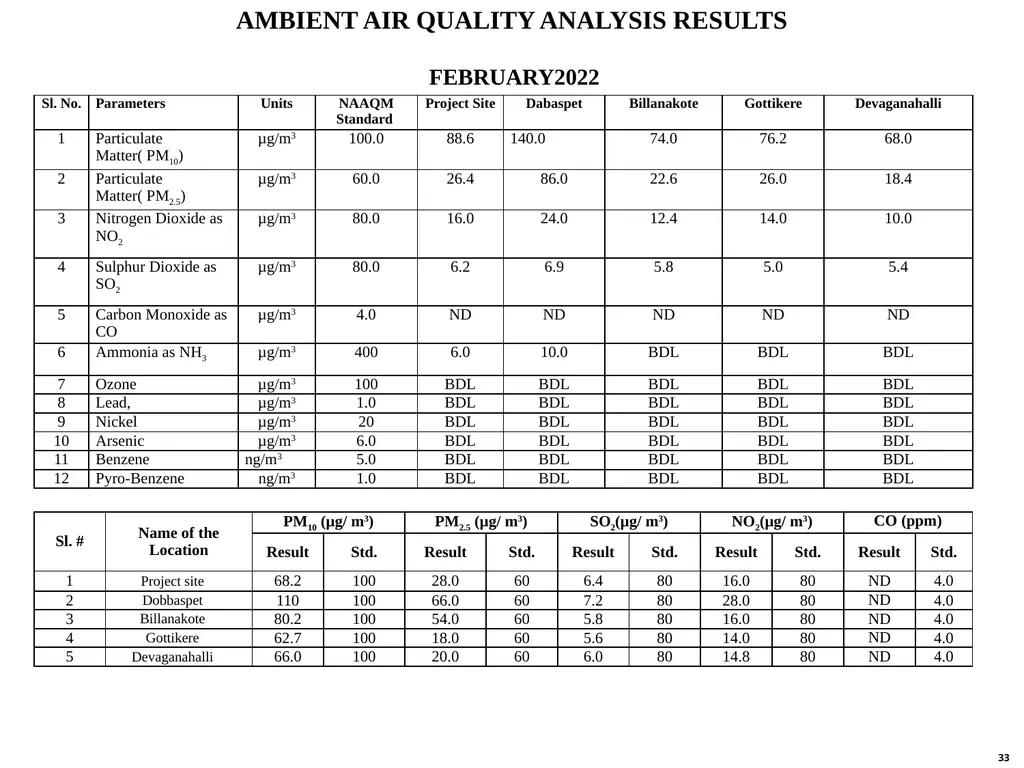
slide33. AMBIENT AIR QUALITY ANALYSIS RESULTS 33 FEBRUARY2022<br>
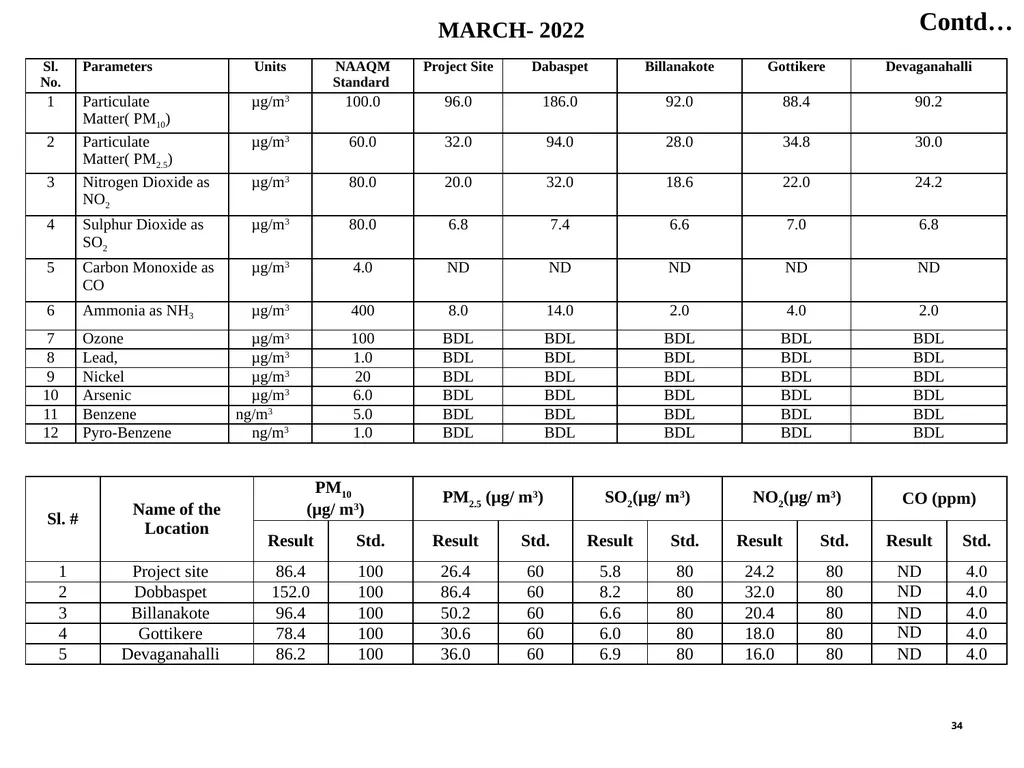
slide34. 34 MARCH- 2022 Contd…<br>
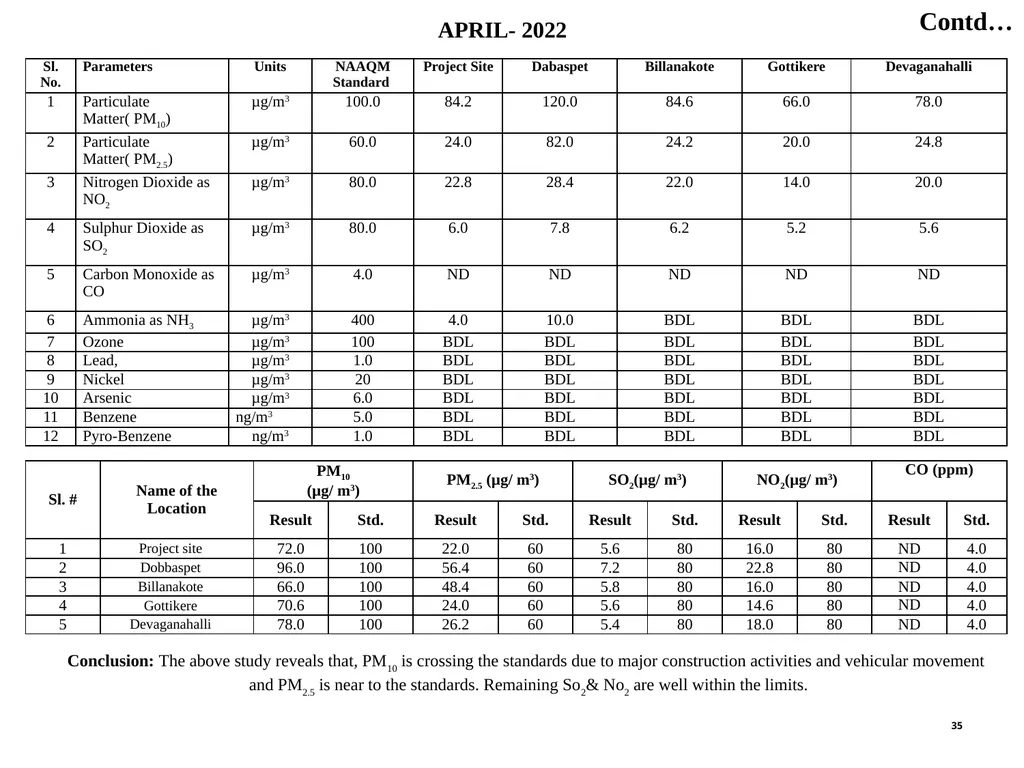
slide35. 35 Contd… APRIL- 2022 Conclusion: The above study reveals that, PM10 is crossing the standards due to major construction activities and vehicular movement
and PM2.5 is near to the standards. Remaining So2& No2 are well within the limits.<br>
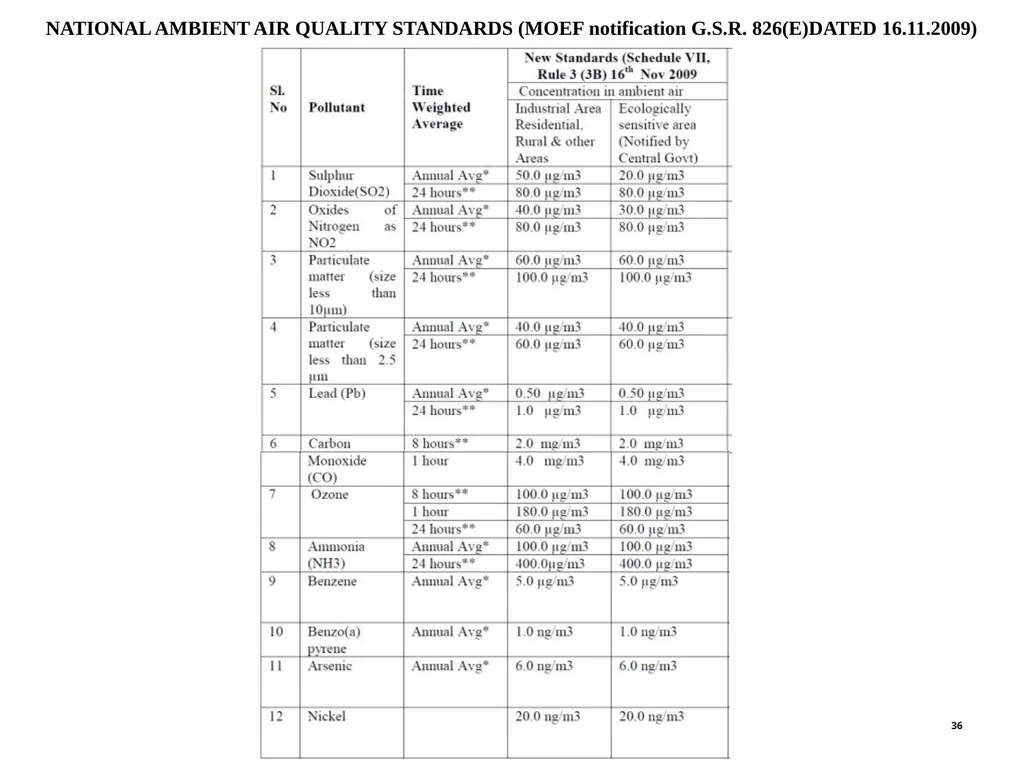
slide36. 36 NATIONAL AMBIENT AIR QUALITY STANDARDS (MOEF notification G.S.R. 826(E)DATED 16.11.2009)<br>
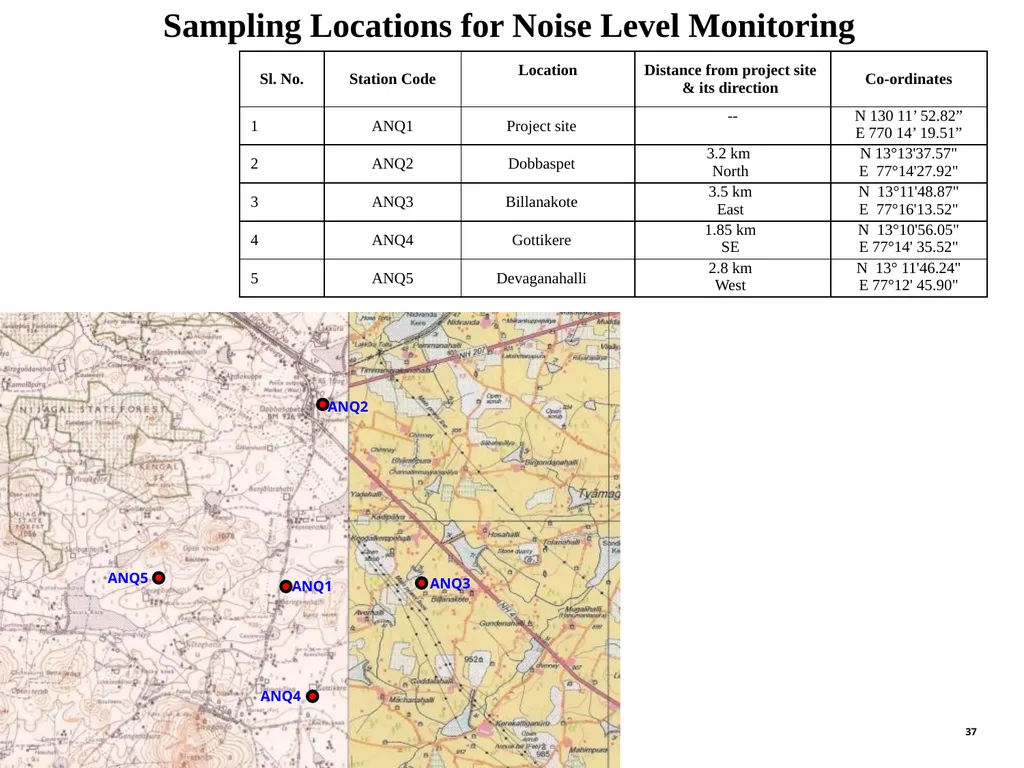
slide37. Sampling Locations for Noise Level Monitoring 37 ANQ3 ANQ4 ANQ1 ANQ2 ANQ5<br>
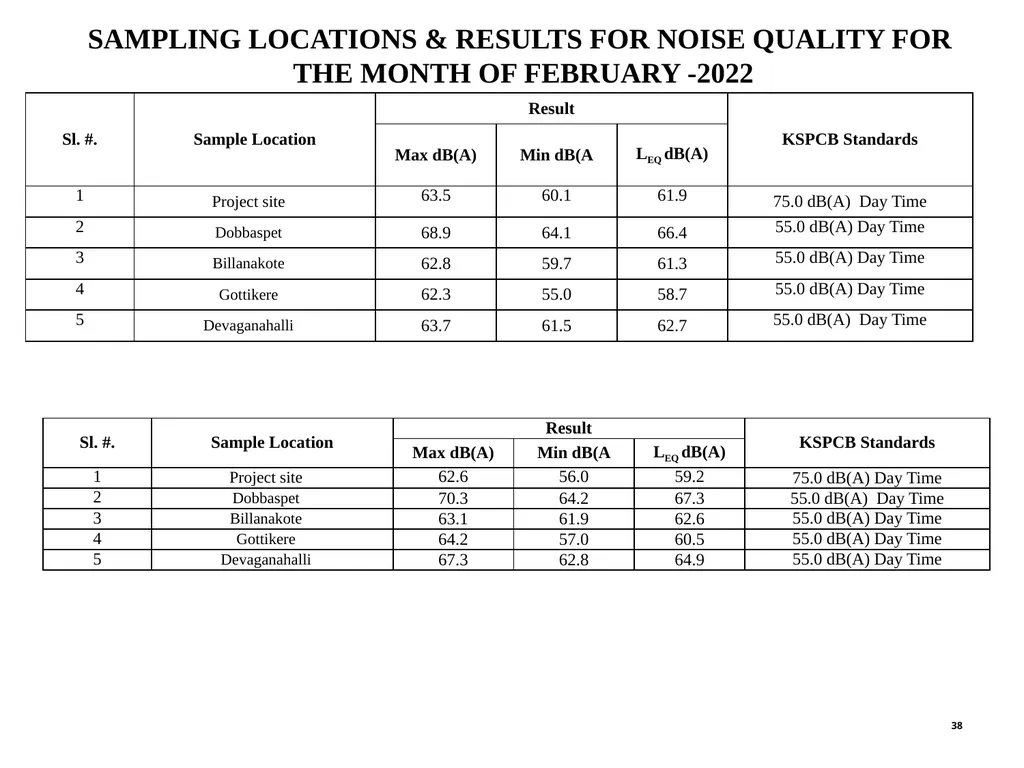
slide38. 38 SAMPLING LOCATIONS & RESULTS FOR NOISE QUALITY FOR
THE MONTH OF FEBRUARY -2022<br>
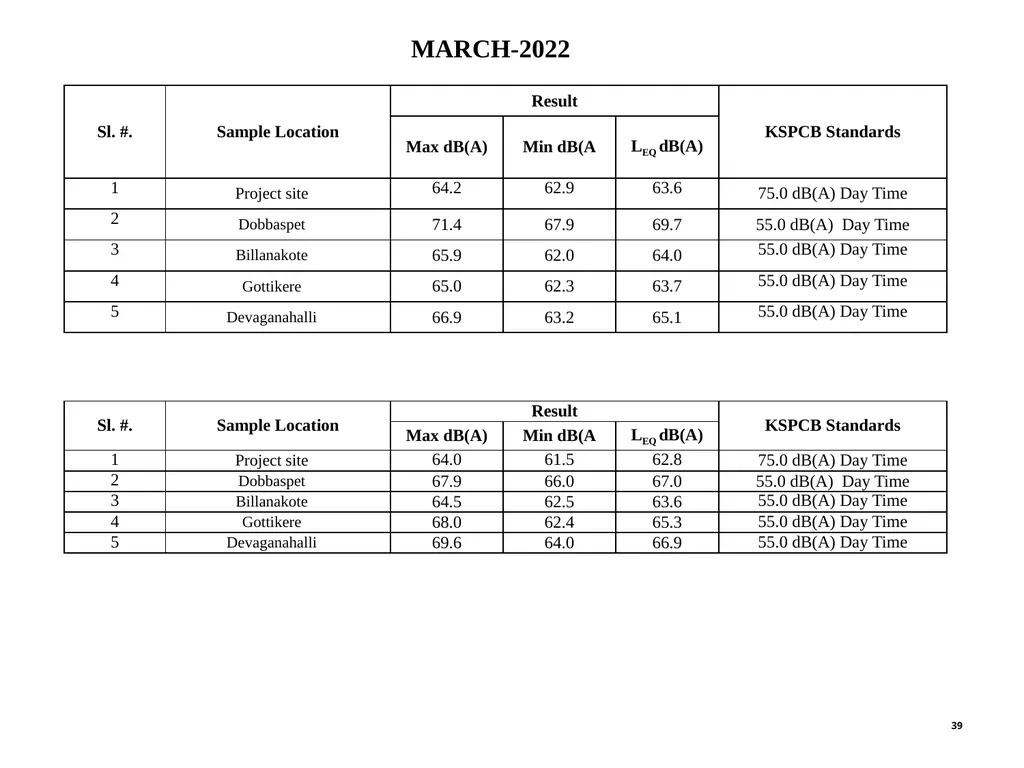
slide39. 39 MARCH-2022<br>
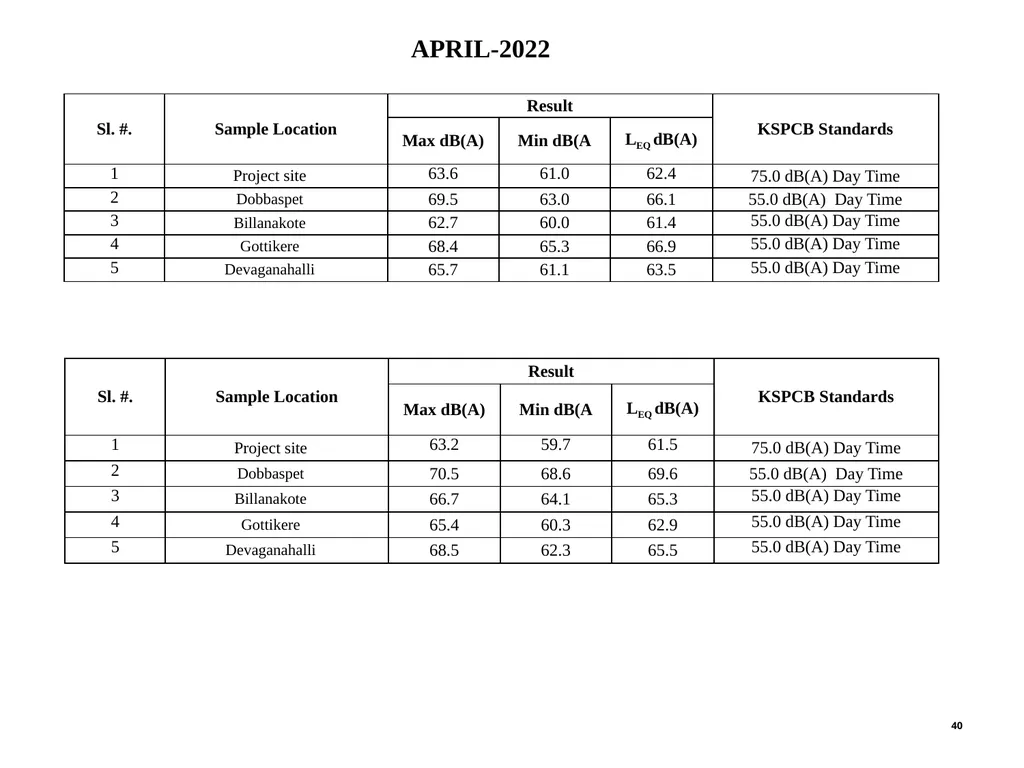
slide40. 40 APRIL-2022<br>
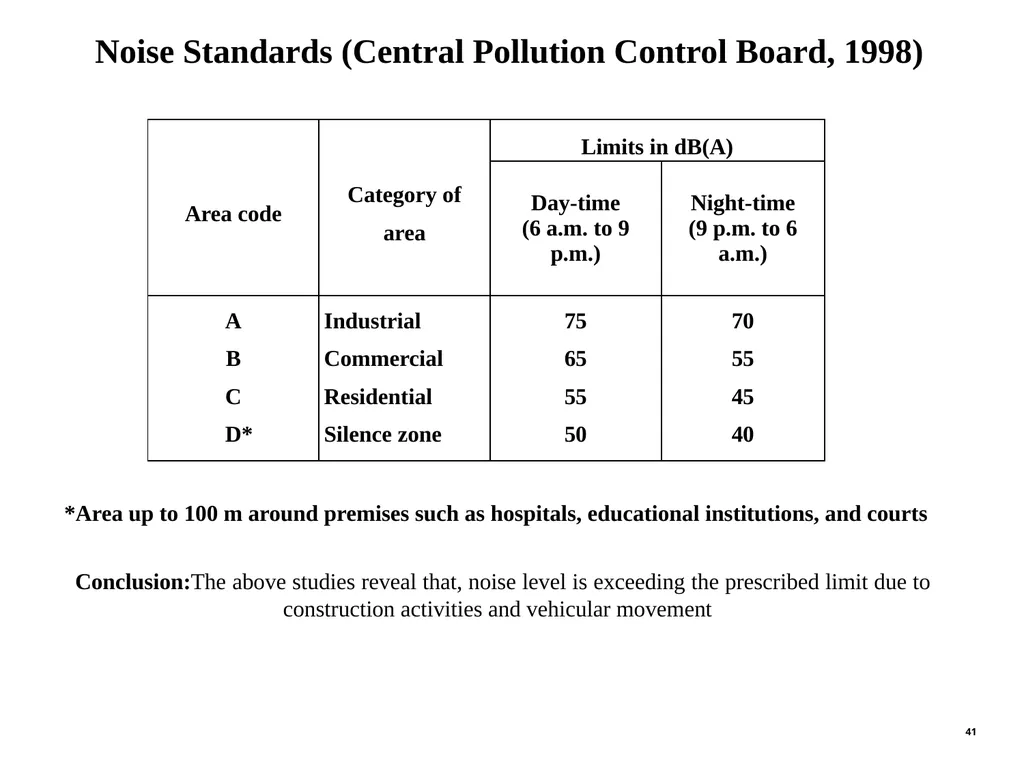
slide41. 41 Noise Standards (Central Pollution Control Board, 1998) *Area up to 100 m around premises such as hospitals, educational institutions, and courts Conclusion:The above studies reveal that, noise level is exceeding the prescribed limit due to construction activities and vehicular movement<br>
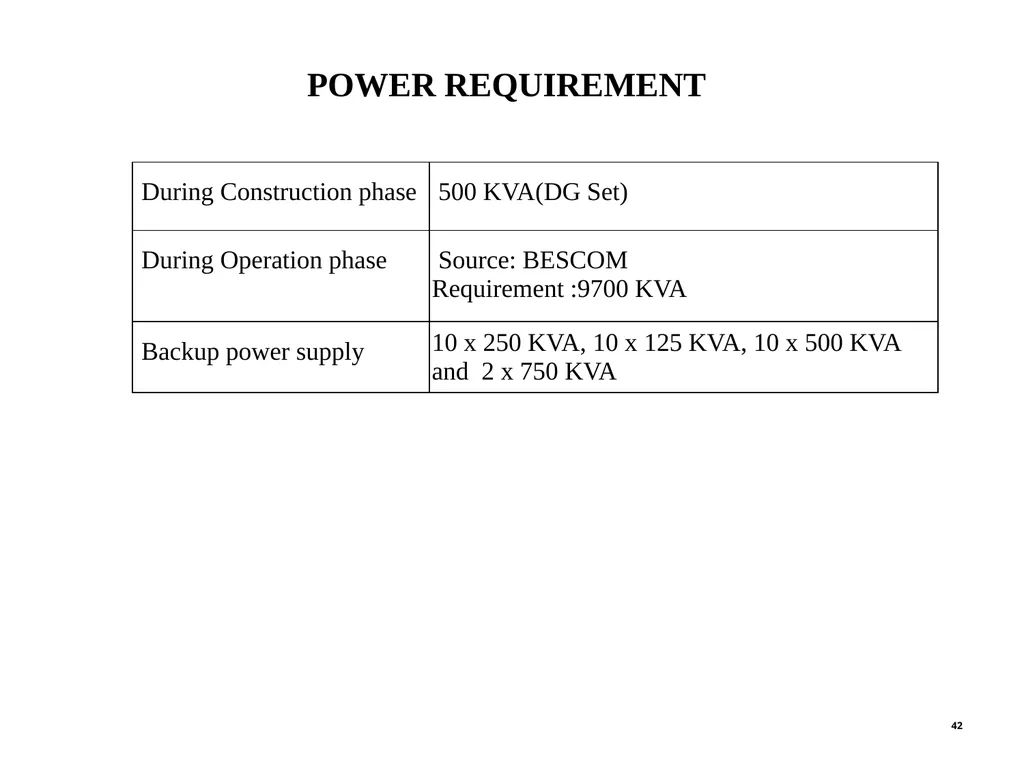
slide42. POWER REQUIREMENT 42<br>
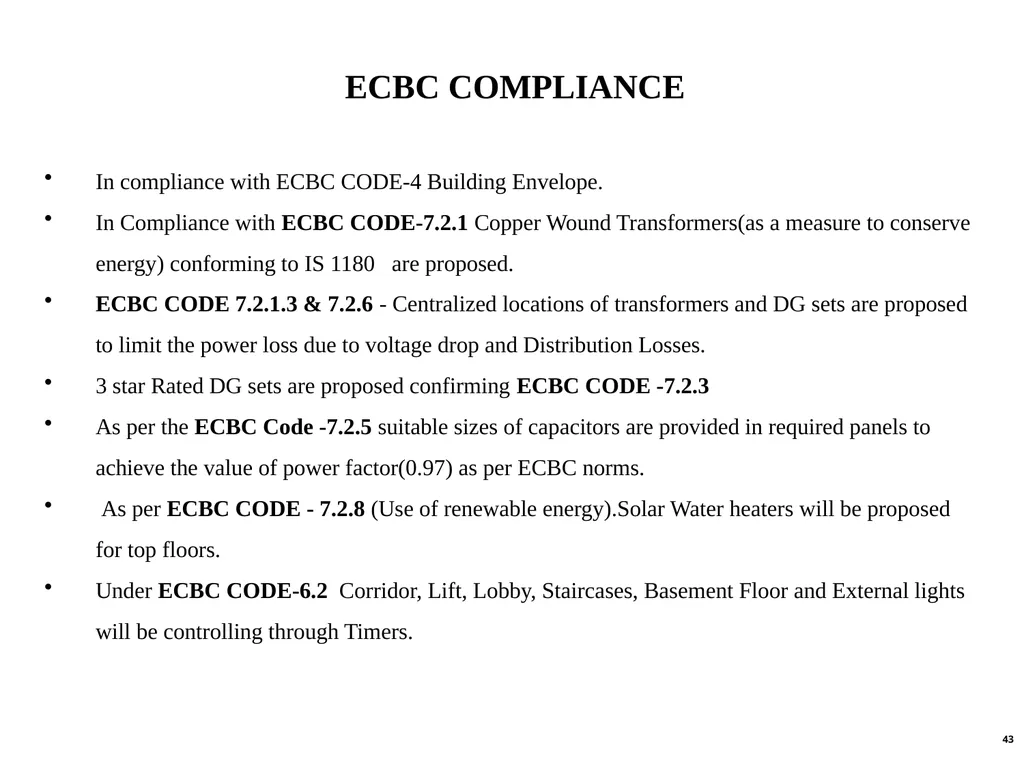
slide43. In compliance with ECBC CODE-4 Building Envelope.
In Compliance with ECBC CODE-7.2.1 Copper Wound Transformers(as a measure to conserve energy) conforming to IS 1180 are proposed.
ECBC CODE 7.2.1.3 & 7.2.6 - Centralized locations of transformers and DG sets are proposed to limit the power loss due to voltage drop and Distribution Losses.
3 star Rated DG sets are proposed confirming ECBC CODE -7.2.3
As per the ECBC Code -7.2.5 suitable sizes of capacitors are provided in required panels to achieve the value of power factor(0.97) as per ECBC norms.
As per ECBC CODE - 7.2.8 (Use of renewable energy).Solar Water heaters will be proposed for top floors.
Under ECBC CODE-6.2 Corridor, Lift, Lobby, Staircases, Basement Floor and External lights will be controlling through Timers. ECBC COMPLIANCE 43<br>
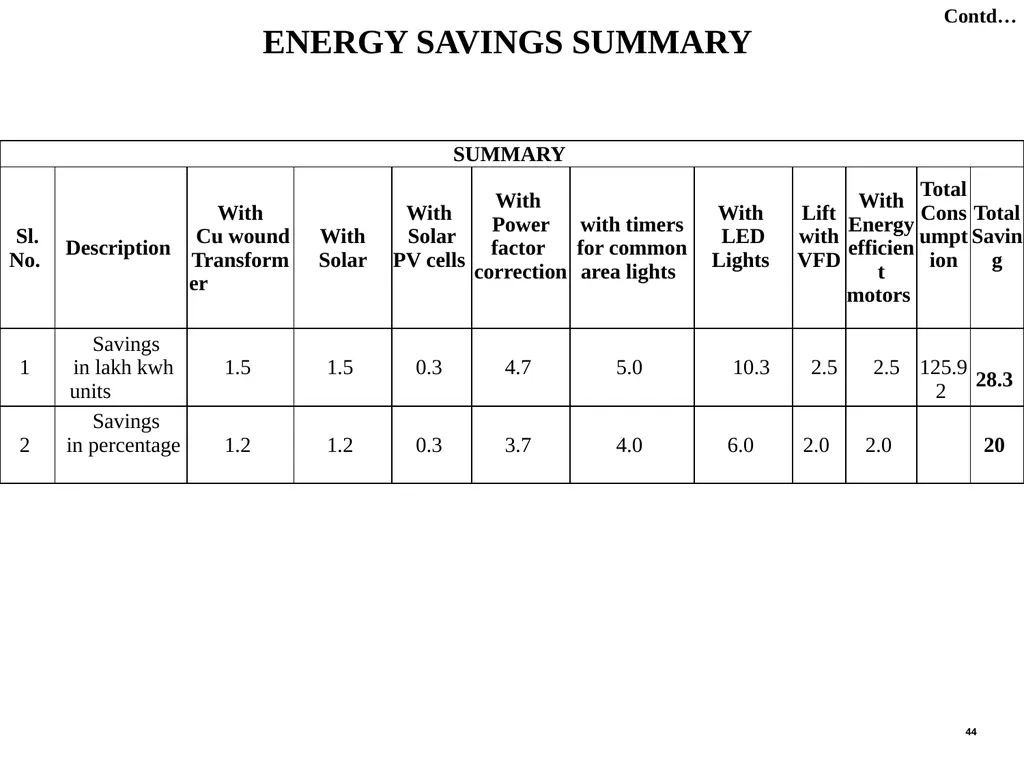
slide44. ENERGY SAVINGS SUMMARY 44 Contd…<br>
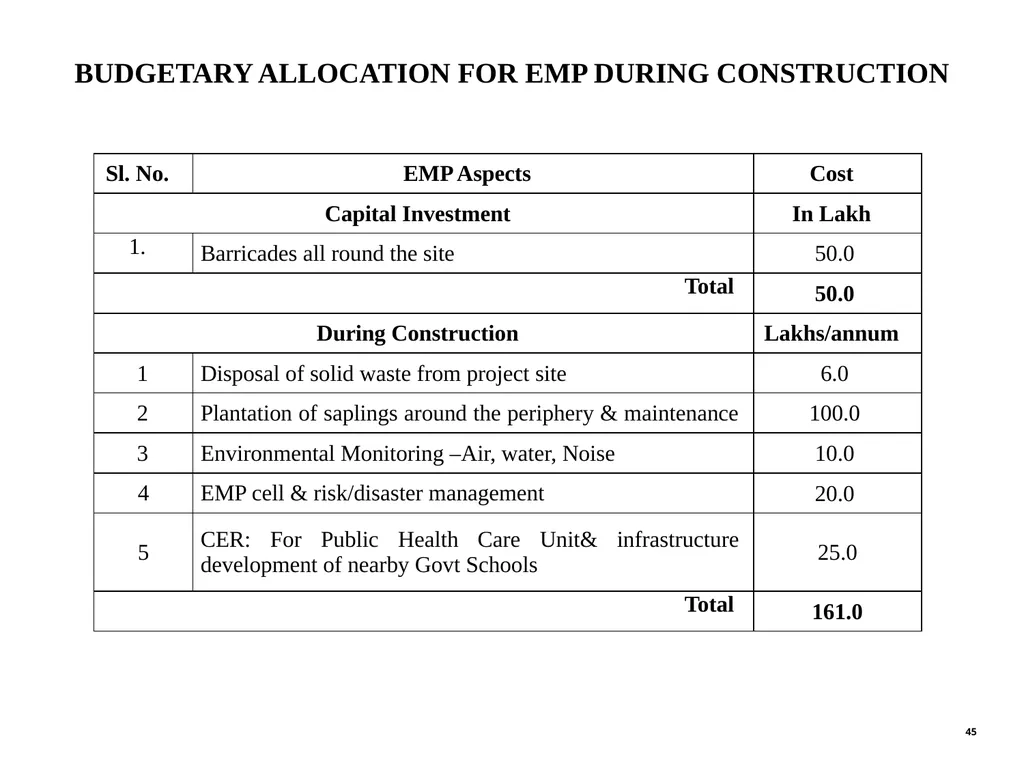
slide45. BUDGETARY ALLOCATION FOR EMP DURING CONSTRUCTION 45<br>
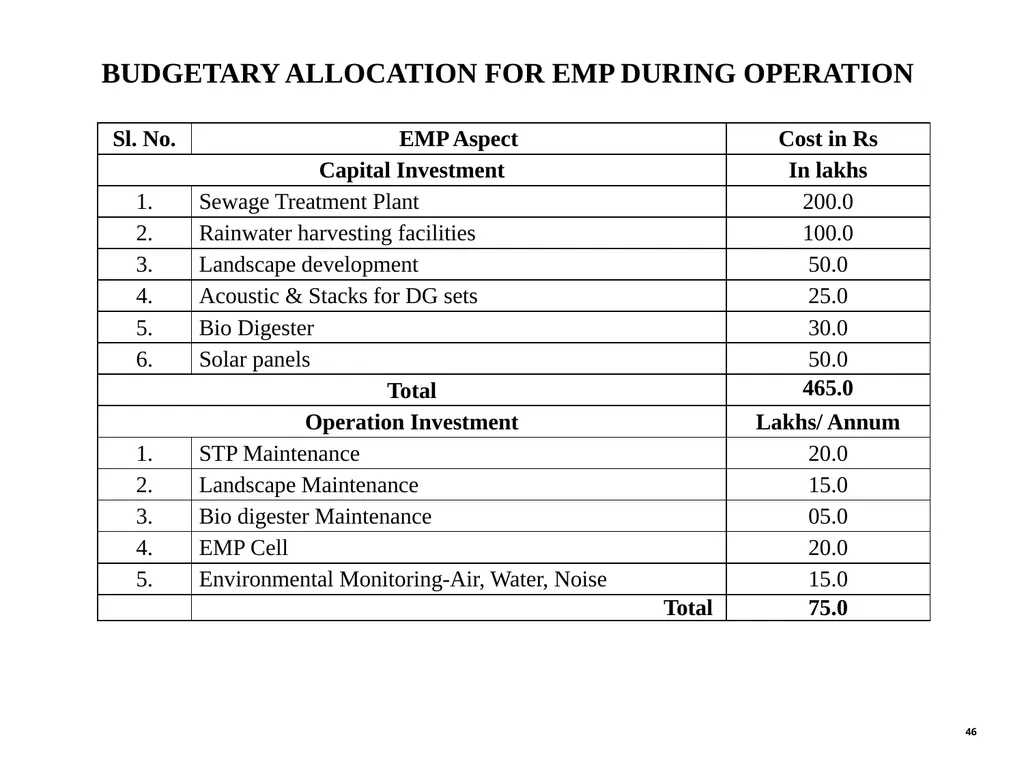
slide46. BUDGETARY ALLOCATION FOR EMP DURING OPERATION 46<br>
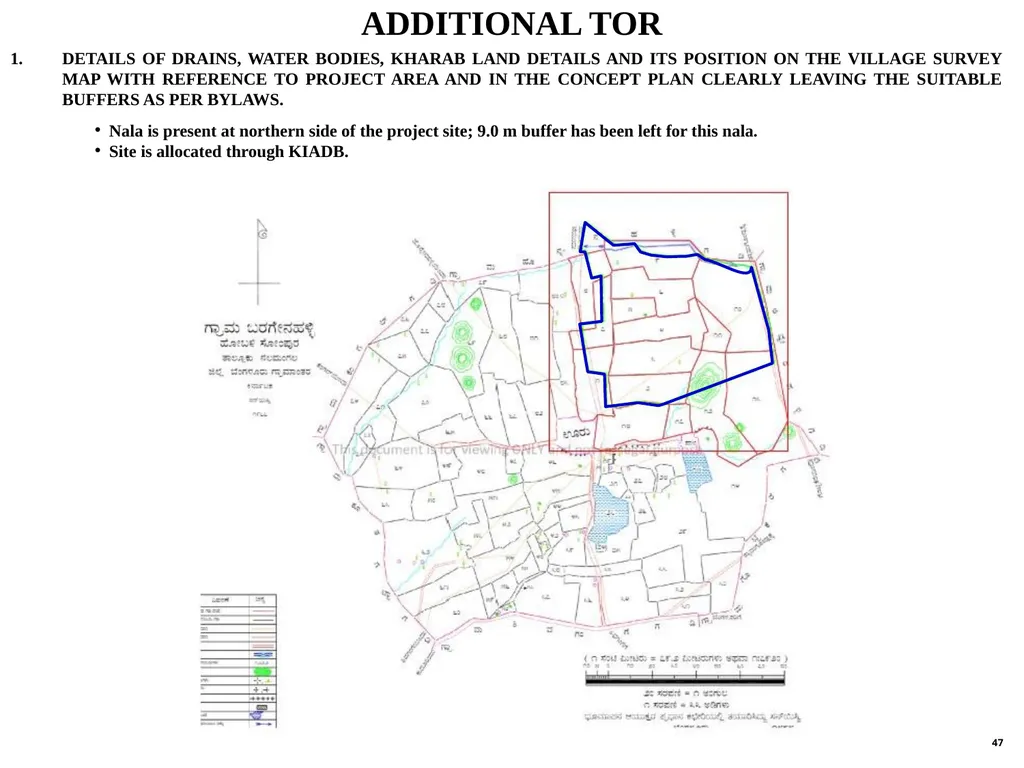
slide47. ADDITIONAL TOR 47 DETAILS OF DRAINS, WATER BODIES, KHARAB LAND DETAILS AND ITS POSITION ON THE VILLAGE SURVEY MAP WITH REFERENCE TO PROJECT AREA AND IN THE CONCEPT PLAN CLEARLY LEAVING THE SUITABLE BUFFERS AS PER BYLAWS. Nala is present at northern side of the project site; 9.0 m buffer has been left for this nala.
Site is allocated through KIADB.<br>
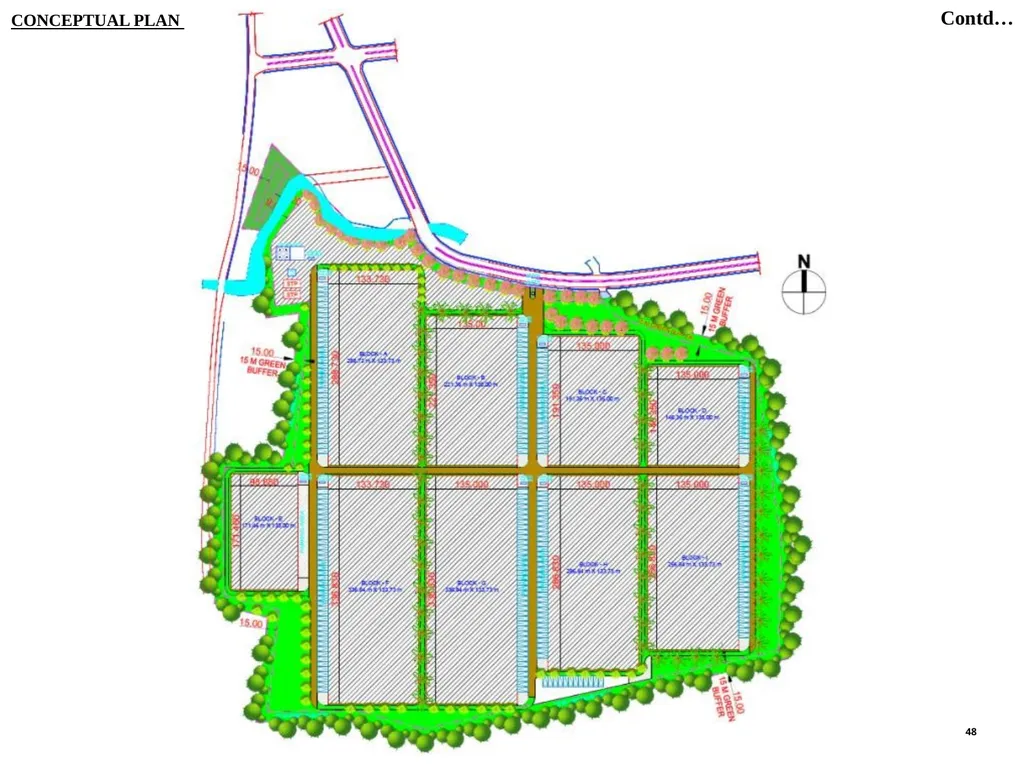
slide48. 48 Contd… CONCEPTUAL PLAN<br>
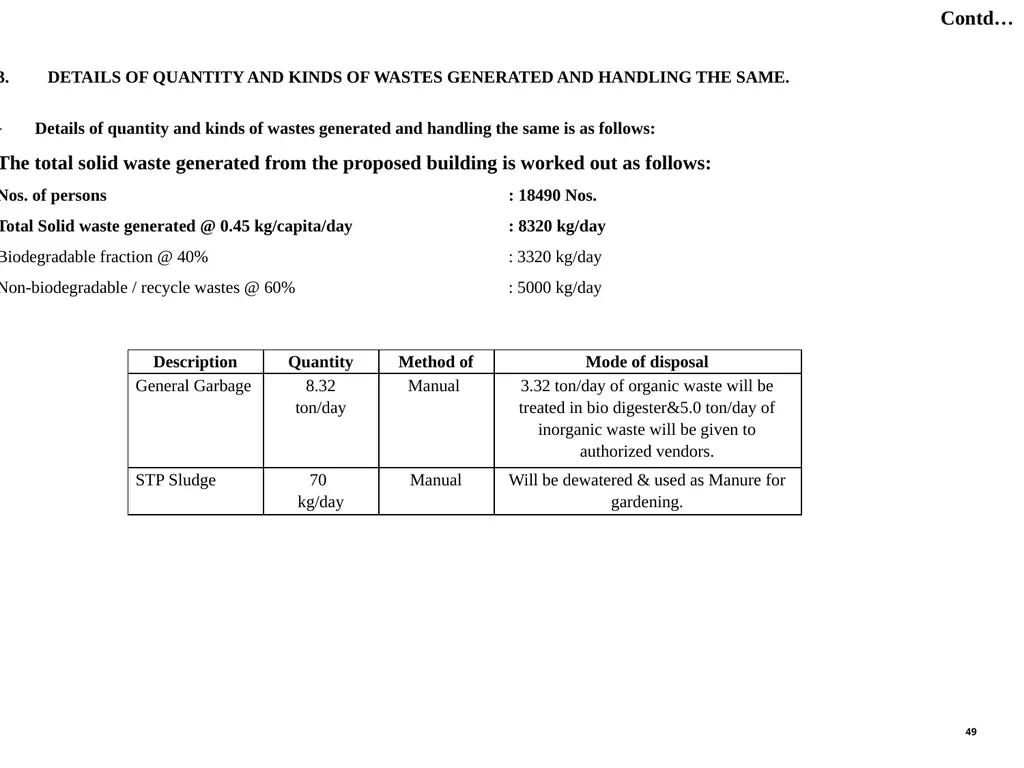
slide49. 49 3. DETAILS OF QUANTITY AND KINDS OF WASTES GENERATED AND HANDLING THE SAME.
Details of quantity and kinds of wastes generated and handling the same is as follows:
The total solid waste generated from the proposed building is worked out as follows:
Nos. of persons : 18490 Nos.
Total Solid waste generated @ 0.45 kg/capita/day : 8320 kg/day
Biodegradable fraction @ 40% : 3320 kg/day
Non-biodegradable / recycle wastes @ 60% : 5000 kg/day Contd…<br>
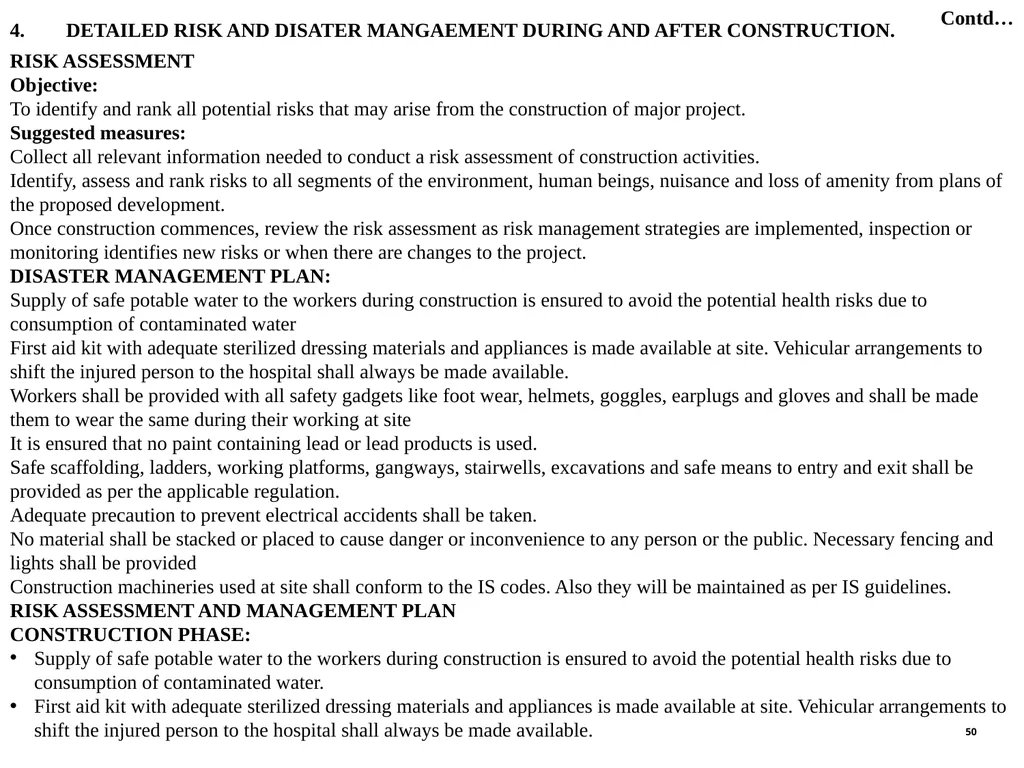
slide50. 50 4. DETAILED RISK AND DISATER MANGAEMENT DURING AND AFTER CONSTRUCTION. Contd… RISK ASSESSMENT
Objective:
To identify and rank all potential risks that may arise from the construction of major project.
Suggested measures:
Collect all relevant information needed to conduct a risk assessment of construction activities.
Identify, assess and rank risks to all segments of the environment, human beings, nuisance and loss of amenity from plans of the proposed development.
Once construction commences, review the risk assessment as risk management strategies are implemented, inspection or monitoring identifies new risks or when there are changes to the project.
DISASTER MANAGEMENT PLAN:
Supply of safe potable water to the workers during construction is ensured to avoid the potential health risks due to consumption of contaminated water
First aid kit with adequate sterilized dressing materials and appliances is made available at site. Vehicular arrangements to shift the injured person to the hospital shall always be made available.
Workers shall be provided with all safety gadgets like foot wear, helmets, goggles, earplugs and gloves and shall be made them to wear the same during their working at site
It is ensured that no paint containing lead or lead products is used.
Safe scaffolding, ladders, working platforms, gangways, stairwells, excavations and safe means to entry and exit shall be provided as per the applicable regulation.
Adequate precaution to prevent electrical accidents shall be taken.
No material shall be stacked or placed to cause danger or inconvenience to any person or the public. Necessary fencing and lights shall be provided
Construction machineries used at site shall conform to the IS codes. Also they will be maintained as per IS guidelines.
RISK ASSESSMENT AND MANAGEMENT PLAN
CONSTRUCTION PHASE:
Supply of safe potable water to the workers during construction is ensured to avoid the potential health risks due to consumption of contaminated water.
First aid kit with adequate sterilized dressing materials and appliances is made available at site. Vehicular arrangements to shift the injured person to the hospital shall always be made available.<br>
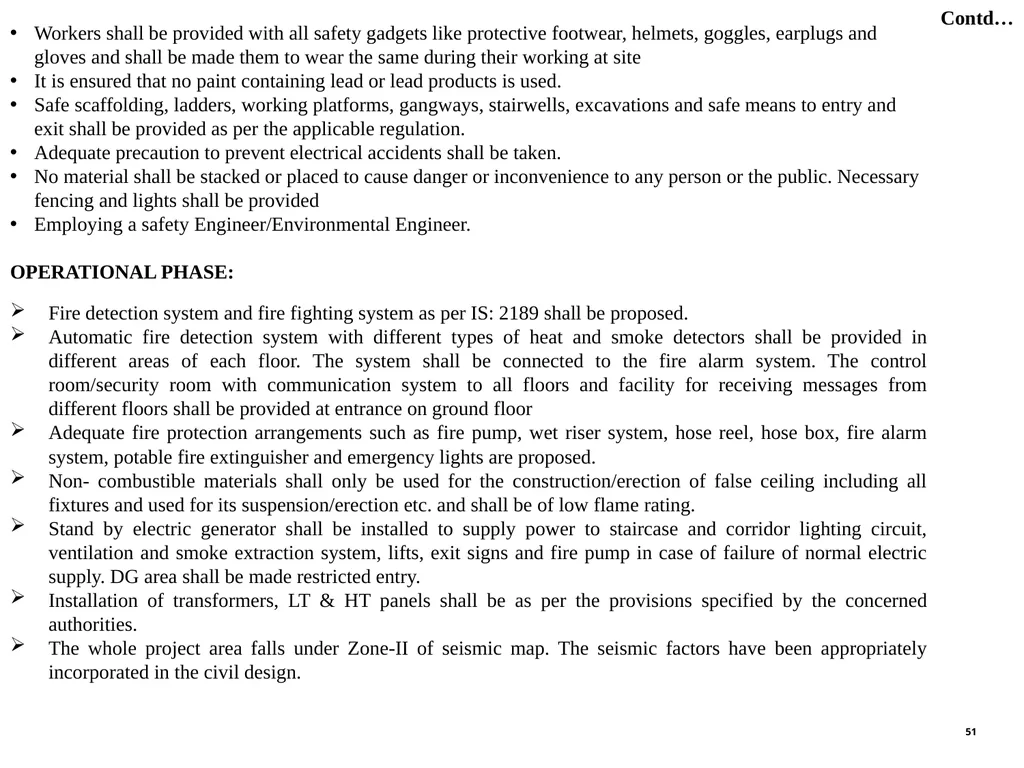
slide51. 51 Workers shall be provided with all safety gadgets like protective footwear, helmets, goggles, earplugs and gloves and shall be made them to wear the same during their working at site
It is ensured that no paint containing lead or lead products is used.
Safe scaffolding, ladders, working platforms, gangways, stairwells, excavations and safe means to entry and exit shall be provided as per the applicable regulation.
Adequate precaution to prevent electrical accidents shall be taken.
No material shall be stacked or placed to cause danger or inconvenience to any person or the public. Necessary fencing and lights shall be provided
Employing a safety Engineer/Environmental Engineer.
OPERATIONAL PHASE:
Fire detection system and fire fighting system as per IS: 2189 shall be proposed.
Automatic fire detection system with different types of heat and smoke detectors shall be provided in different areas of each floor. The system shall be connected to the fire alarm system. The control room/security room with communication system to all floors and facility for receiving messages from different floors shall be provided at entrance on ground floor
Adequate fire protection arrangements such as fire pump, wet riser system, hose reel, hose box, fire alarm system, potable fire extinguisher and emergency lights are proposed.
Non- combustible materials shall only be used for the construction/erection of false ceiling including all fixtures and used for its suspension/erection etc. and shall be of low flame rating.
Stand by electric generator shall be installed to supply power to staircase and corridor lighting circuit, ventilation and smoke extraction system, lifts, exit signs and fire pump in case of failure of normal electric supply. DG area shall be made restricted entry.
Installation of transformers, LT & HT panels shall be as per the provisions specified by the concerned authorities.
The whole project area falls under Zone-II of seismic map. The seismic factors have been appropriately incorporated in the civil design. Contd…<br>
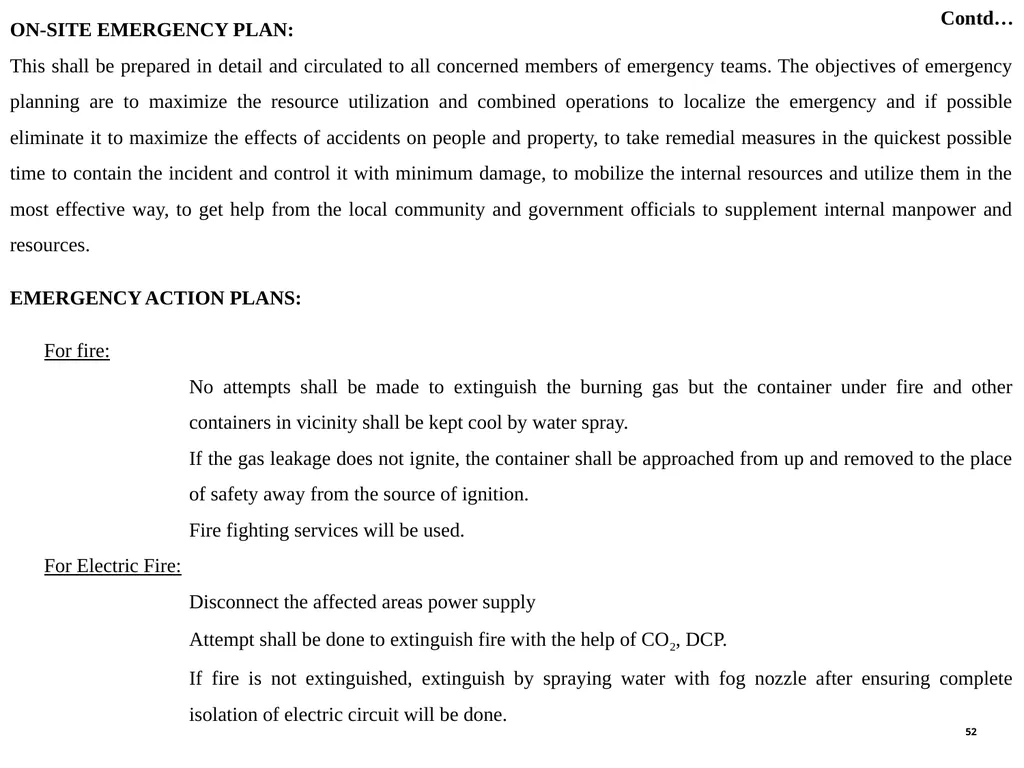
slide52. 52 ON-SITE EMERGENCY PLAN:
This shall be prepared in detail and circulated to all concerned members of emergency teams. The objectives of emergency planning are to maximize the resource utilization and combined operations to localize the emergency and if possible eliminate it to maximize the effects of accidents on people and property, to take remedial measures in the quickest possible time to contain the incident and control it with minimum damage, to mobilize the internal resources and utilize them in the most effective way, to get help from the local community and government officials to supplement internal manpower and resources.
EMERGENCY ACTION PLANS:
For fire:
No attempts shall be made to extinguish the burning gas but the container under fire and other containers in vicinity shall be kept cool by water spray.
If the gas leakage does not ignite, the container shall be approached from up and removed to the place of safety away from the source of ignition.
Fire fighting services will be used.
For Electric Fire:
Disconnect the affected areas power supply
Attempt shall be done to extinguish fire with the help of CO2, DCP.
If fire is not extinguished, extinguish by spraying water with fog nozzle after ensuring complete isolation of electric circuit will be done. Contd…<br>
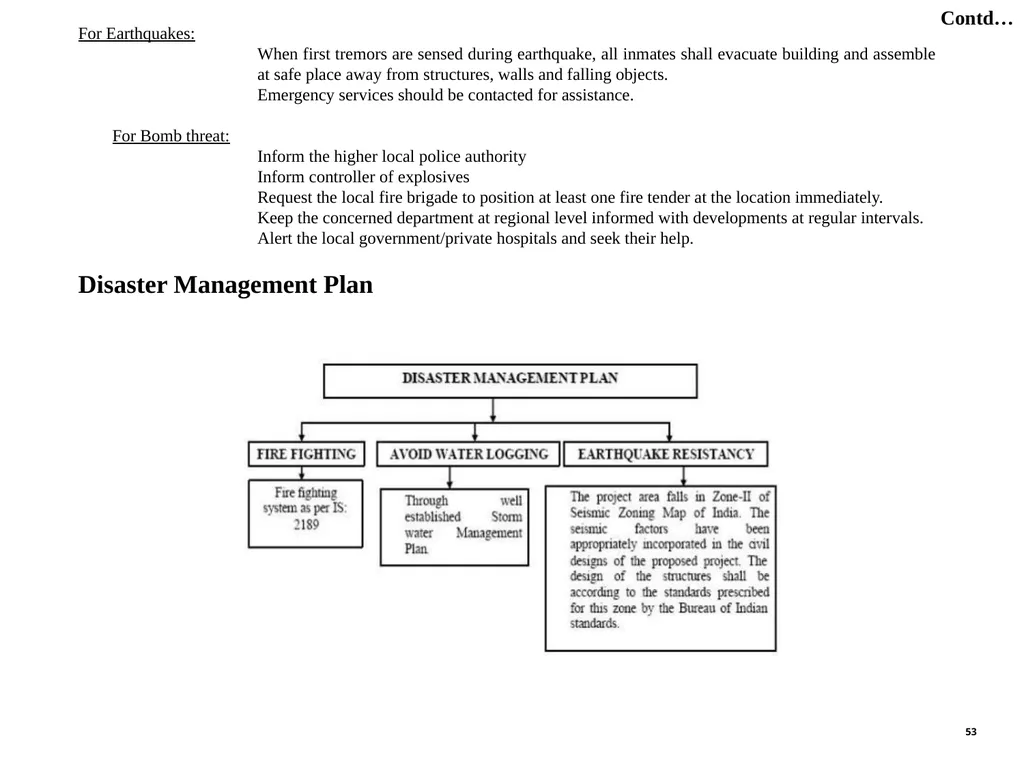
slide53. 53 For Earthquakes:
When first tremors are sensed during earthquake, all inmates shall evacuate building and assemble at safe place away from structures, walls and falling objects.
Emergency services should be contacted for assistance.
For Bomb threat:
Inform the higher local police authority
Inform controller of explosives
Request the local fire brigade to position at least one fire tender at the location immediately.
Keep the concerned department at regional level informed with developments at regular intervals.
Alert the local government/private hospitals and seek their help.
Disaster Management Plan Contd…<br>
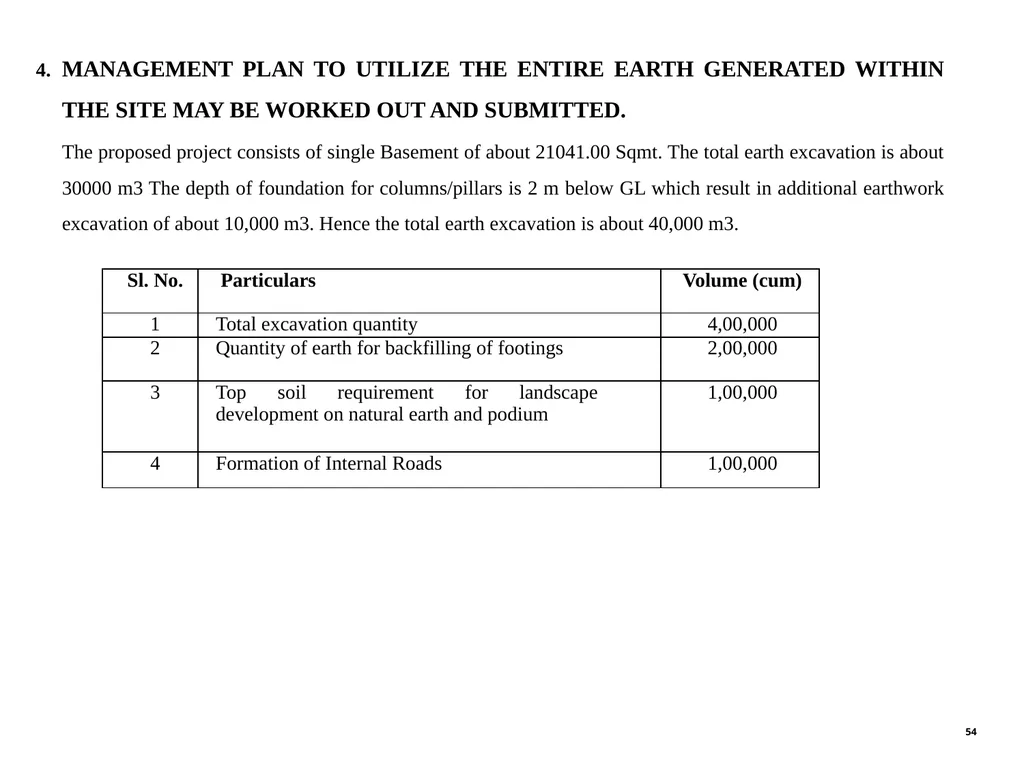
slide54. 54 4. MANAGEMENT PLAN TO UTILIZE THE ENTIRE EARTH GENERATED WITHIN THE SITE MAY BE WORKED OUT AND SUBMITTED.
The proposed project consists of single Basement of about 21041.00 Sqmt. The total earth excavation is about 30000 m3 The depth of foundation for columns/pillars is 2 m below GL which result in additional earthwork excavation of about 10,000 m3. Hence the total earth excavation is about 40,000 m3.<br>
slide55. 5. COMPLIANCE TO ECBC GUIDELINES AND INCORPORATION OF NBC FOR POROPSED PROJECT SHOULD BE DETAILED.
In compliance with ECBC CODE-4 Building Envelope.
In Compliance with ECBC CODE-7.2.1 Copper Wound Transformers(as a measure to conserve energy) conforming to IS 1180 are proposed.
ECBC CODE 7.2.1.3 & 7.2.6 - Centralized locations of transformers and DG sets are proposed to limit the power loss due to voltage drop and Distribution Losses.
3 star Rated DG sets are proposed confirming ECBC CODE -7.2.3
As per the ECBC Code -7.2.5 suitable sizes of capacitors are provided in required panels to achieve the value of power factor(0.97) as per ECBC norms.
As per ECBC CODE - 7.2.8 (Use of renewable energy).Solar Water heaters will be proposed for top floors.
Under ECBC CODE-6.2 Corridor, Lift, Lobby, Staircases, Basement Floor and External lights will be controlling through Timers. 55<br>
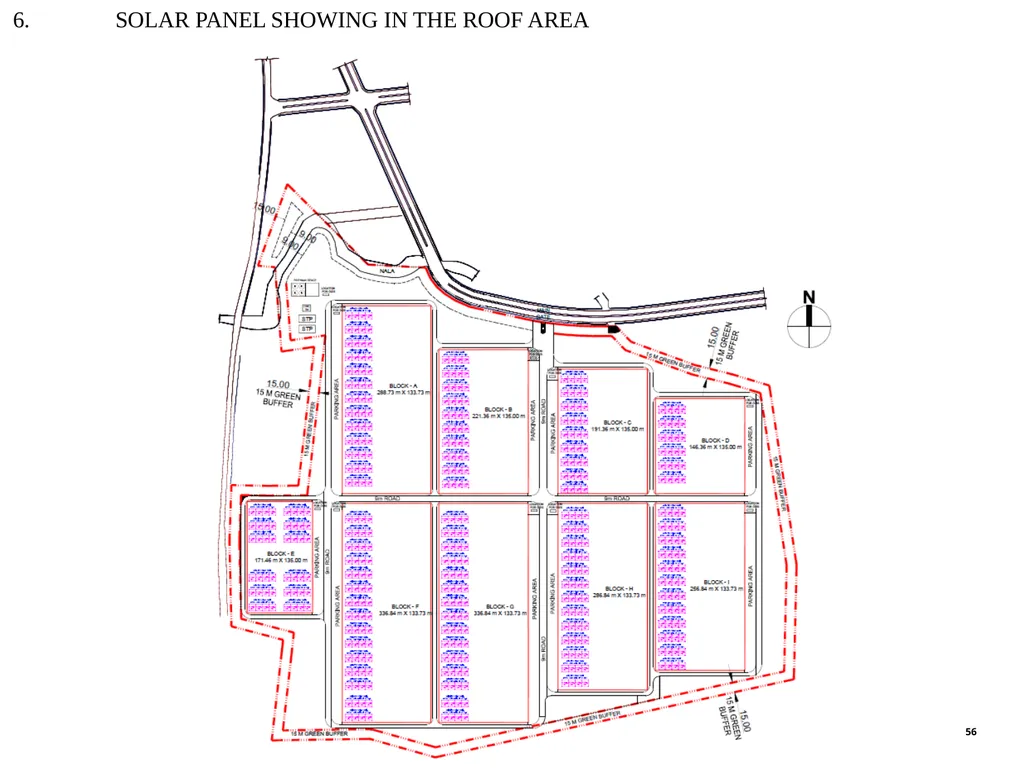
slide56. 56 6. SOLAR PANEL SHOWING IN THE ROOF AREA<br>
slide57. TRAFFIC IMPACT ASSESSMENT STUDIES 57<br>
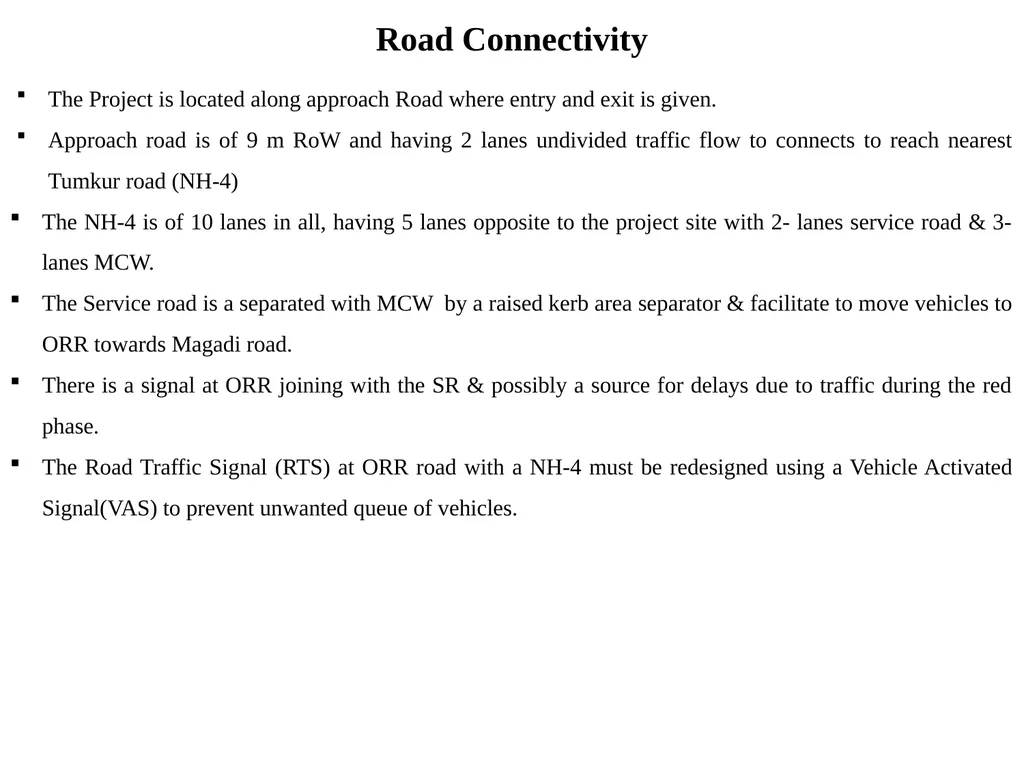
slide58. The Project is located along approach Road where entry and exit is given.
Approach road is of 9 m RoW and having 2 lanes undivided traffic flow to connects to reach nearest Tumkur road (NH-4)
The NH-4 is of 10 lanes in all, having 5 lanes opposite to the project site with 2- lanes service road & 3-lanes MCW.
The Service road is a separated with MCW by a raised kerb area separator & facilitate to move vehicles to ORR towards Magadi road.
There is a signal at ORR joining with the SR & possibly a source for delays due to traffic during the red phase.
The Road Traffic Signal (RTS) at ORR road with a NH-4 must be redesigned using a Vehicle Activated Signal(VAS) to prevent unwanted queue of vehicles. Road Connectivity<br>
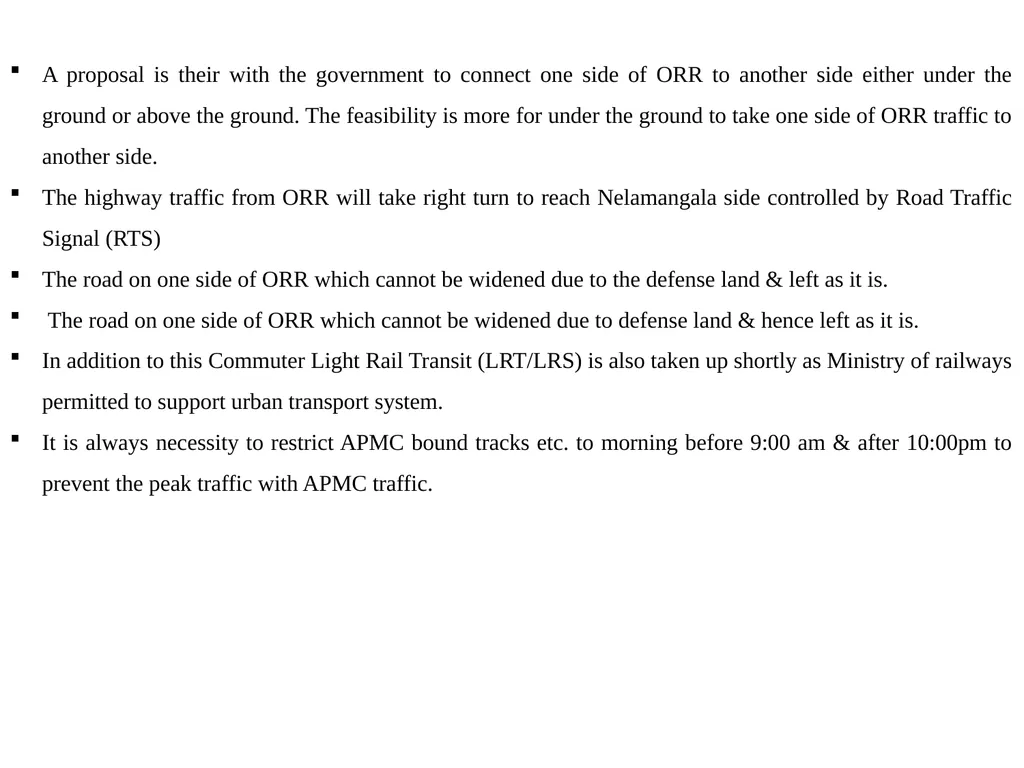
slide59. A proposal is their with the government to connect one side of ORR to another side either under the ground or above the ground. The feasibility is more for under the ground to take one side of ORR traffic to another side.
The highway traffic from ORR will take right turn to reach Nelamangala side controlled by Road Traffic Signal (RTS)
The road on one side of ORR which cannot be widened due to the defense land & left as it is.
The road on one side of ORR which cannot be widened due to defense land & hence left as it is.
In addition to this Commuter Light Rail Transit (LRT/LRS) is also taken up shortly as Ministry of railways permitted to support urban transport system.
It is always necessity to restrict APMC bound tracks etc. to morning before 9:00 am & after 10:00pm to prevent the peak traffic with APMC traffic.<br>
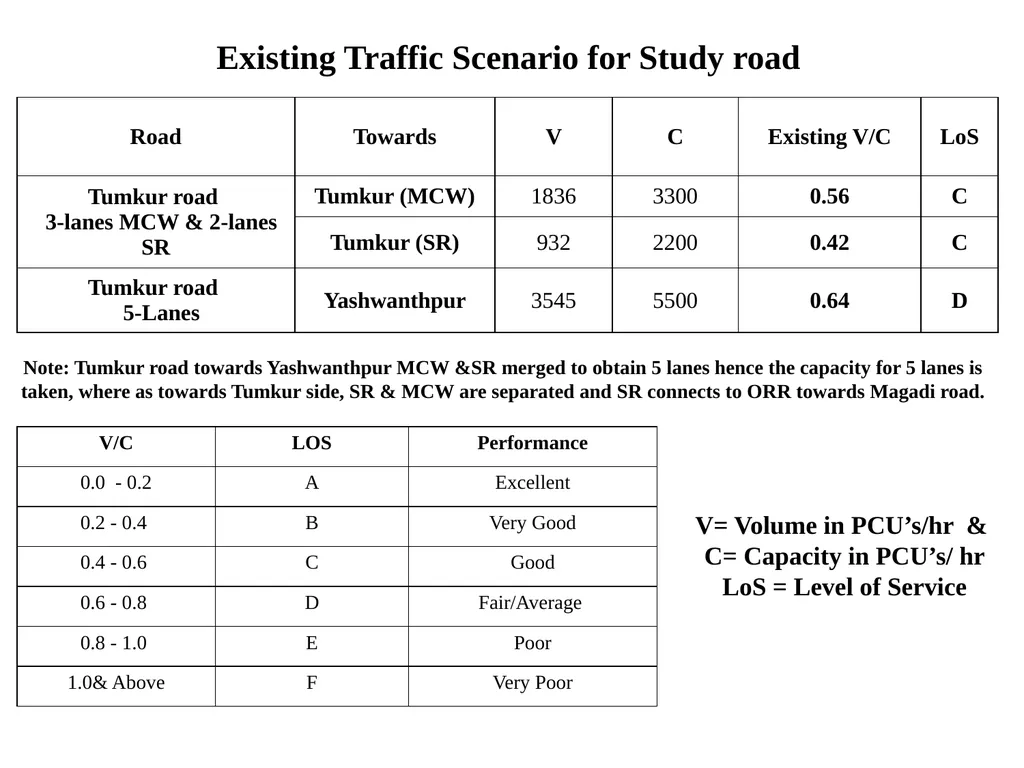
slide60. V= Volume in PCU’s/hr &
C= Capacity in PCU’s/ hr
LoS = Level of Service Existing Traffic Scenario for Study road Note: Tumkur road towards Yashwanthpur MCW &SR merged to obtain 5 lanes hence the capacity for 5 lanes is taken, where as towards Tumkur side, SR & MCW are separated and SR connects to ORR towards Magadi road.<br>
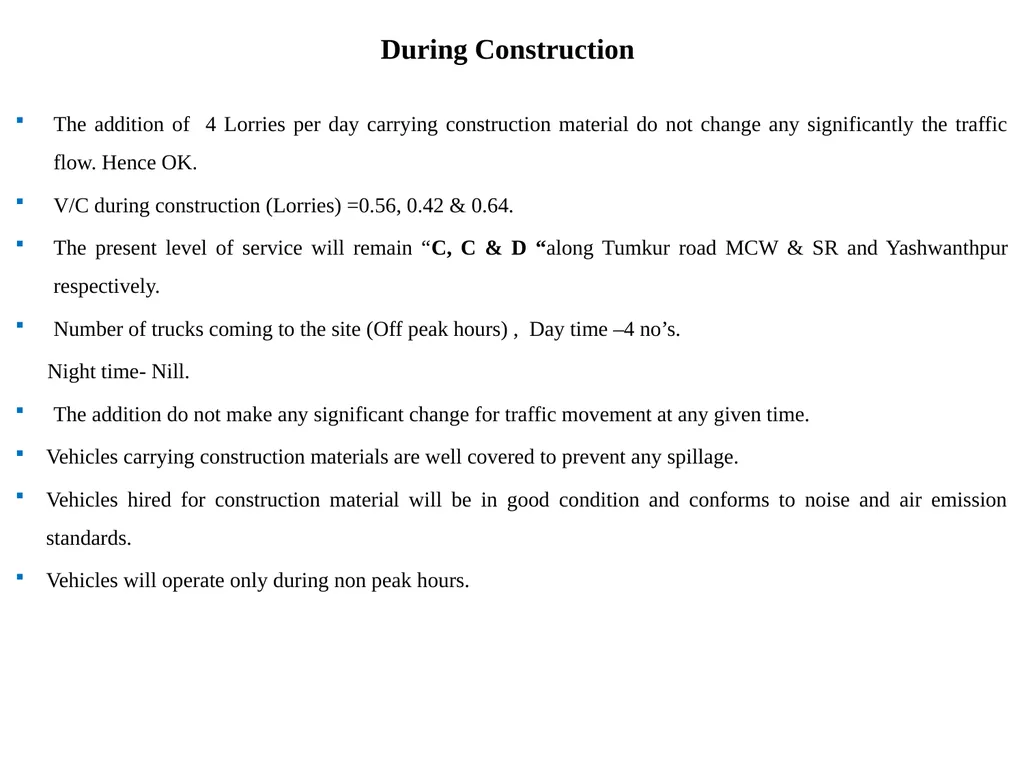
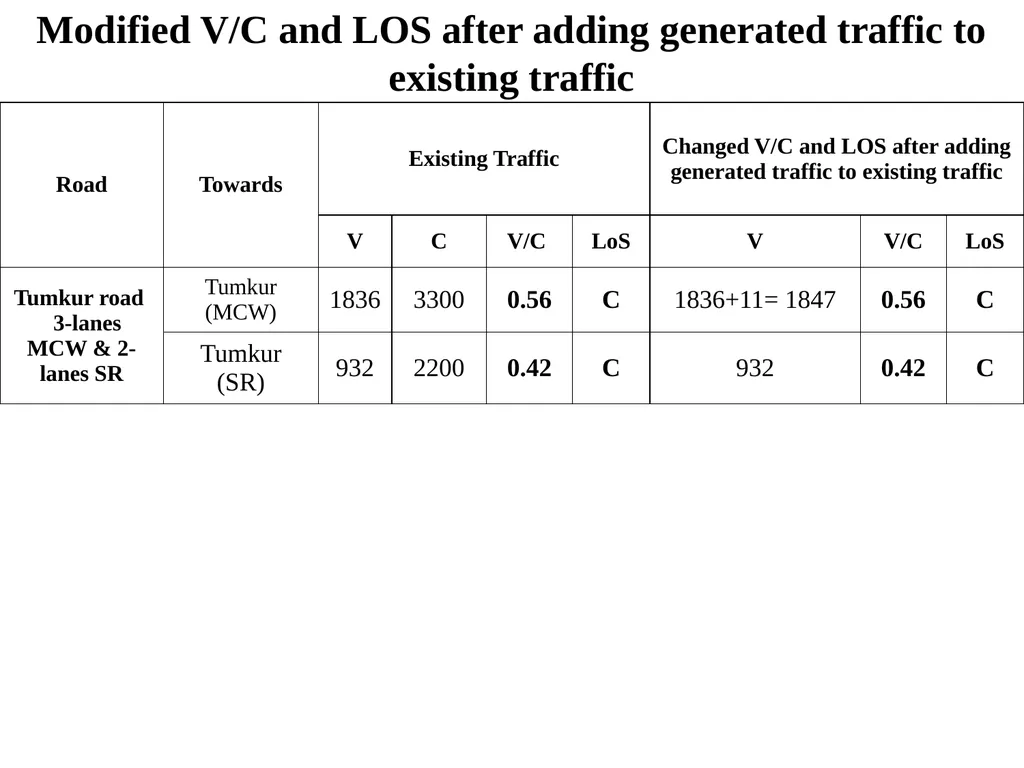
slide61. The addition of 4 Lorries per day carrying construction material do not change any significantly the traffic flow. Hence OK.
V/C during construction (Lorries) =0.56, 0.42 & 0.64.
The present level of service will remain “C, C & D “along Tumkur road MCW & SR and Yashwanthpur respectively.
Number of trucks coming to the site (Off peak hours) , Day time –4 no’s.
Night time- Nill.
The addition do not make any significant change for traffic movement at any given time.
Vehicles carrying construction materials are well covered to prevent any spillage.
Vehicles hired for construction material will be in good condition and conforms to noise and air emission standards.
Vehicles will operate only during non peak hours. During Construction<br>
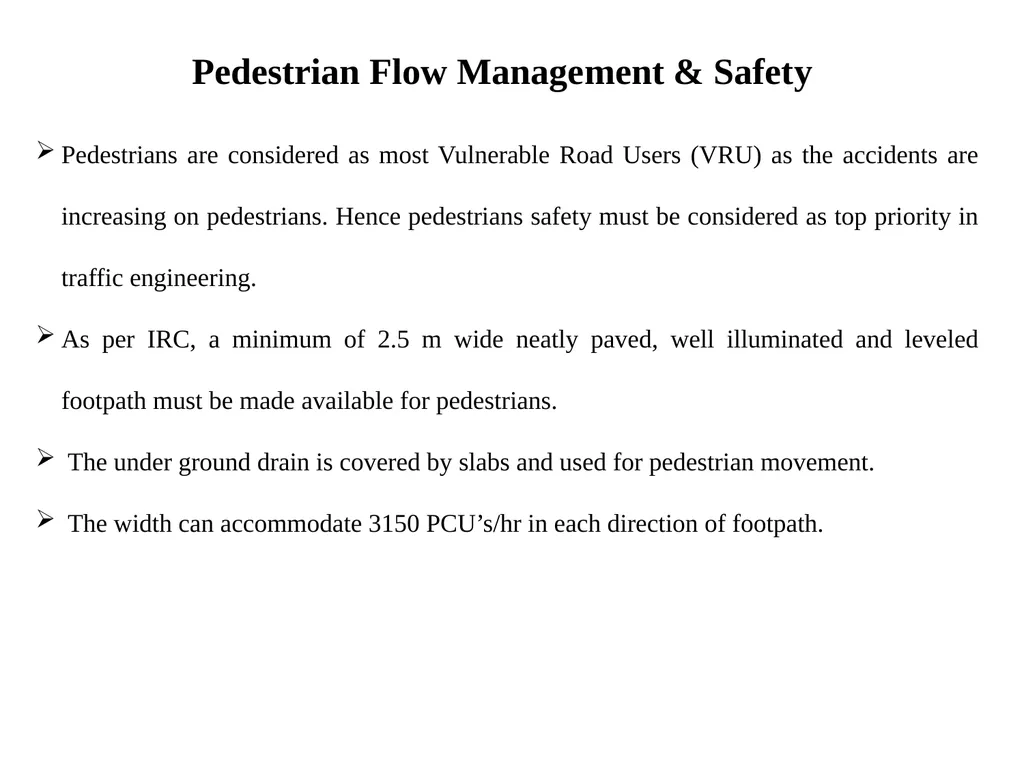
slide62. Pedestrian Flow Management & Safety Pedestrians are considered as most Vulnerable Road Users (VRU) as the accidents are increasing on pedestrians. Hence pedestrians safety must be considered as top priority in traffic engineering.
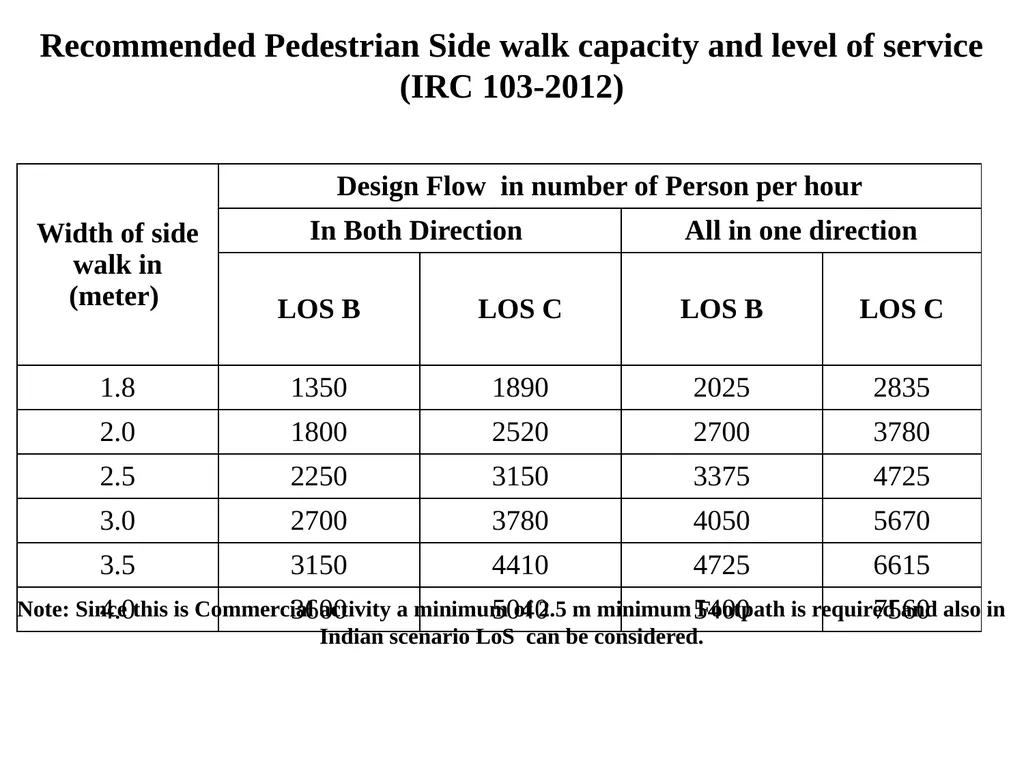
As per IRC, a minimum of 2.5 m wide neatly paved, well illuminated and leveled footpath must be made available for pedestrians.
The under ground drain is covered by slabs and used for pedestrian movement.
The width can accommodate 3150 PCU’s/hr in each direction of footpath.<br>
slide63. Recommended Pedestrian Side walk capacity and level of service (IRC 103-2012) Note: Since this is Commercial activity a minimum of 2.5 m minimum Footpath is required and also in Indian scenario LoS can be considered.<br>
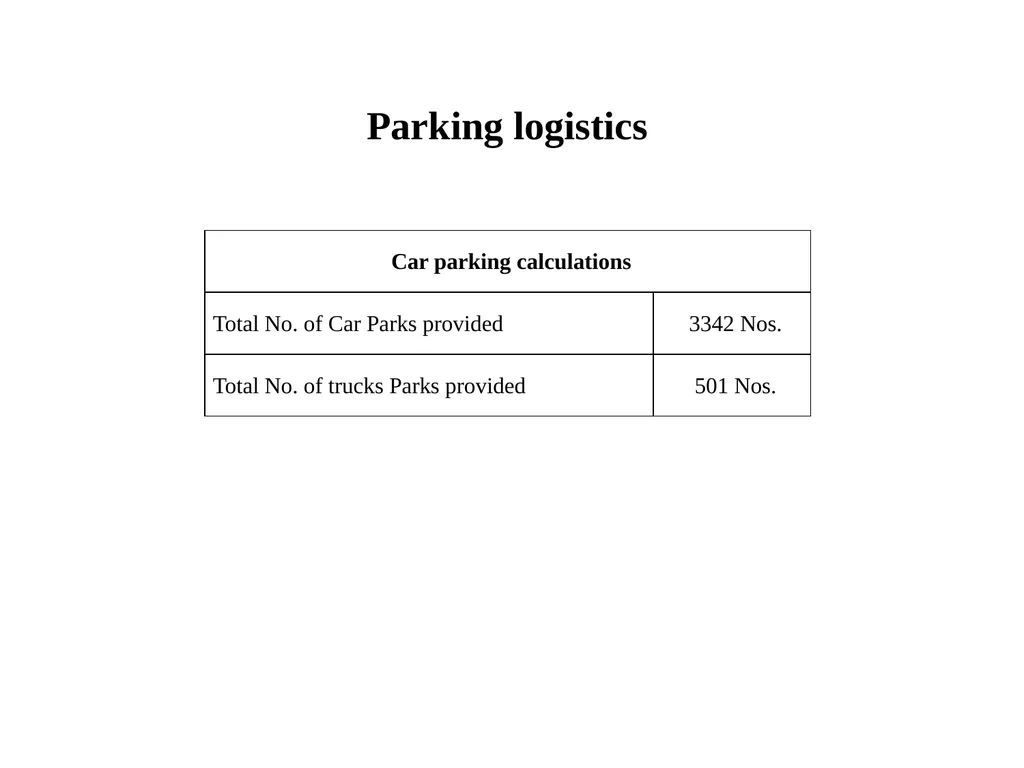
slide64. Parking logistics<br>
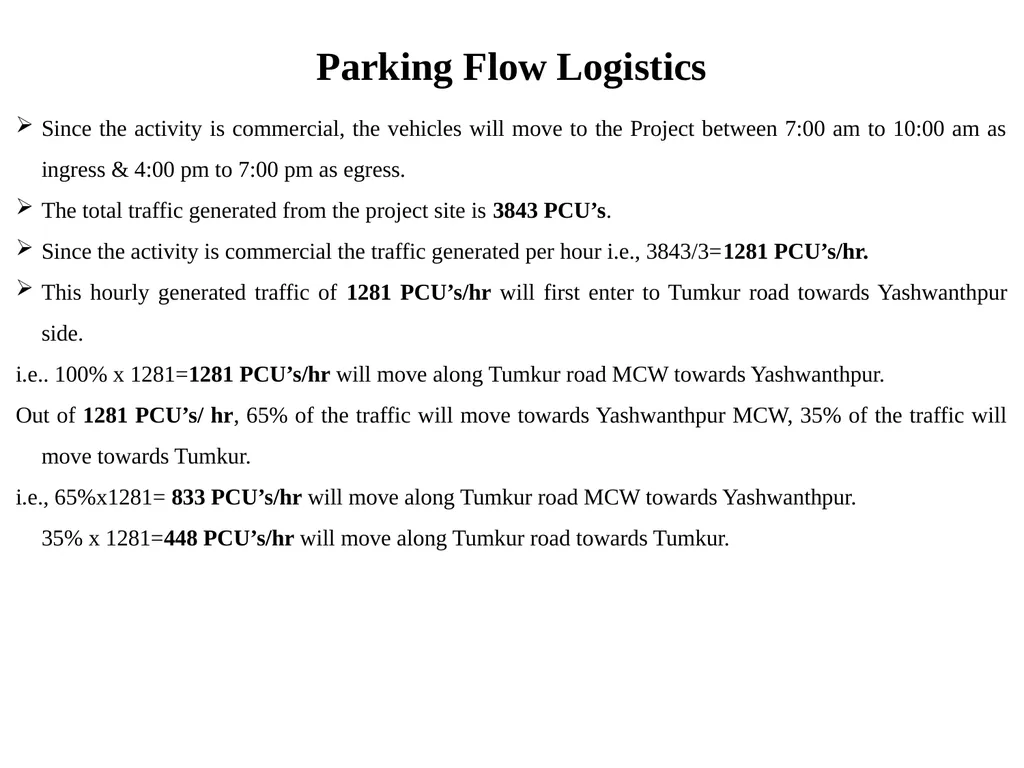
slide65. Since the activity is commercial, the vehicles will move to the Project between 7:00 am to 10:00 am as ingress & 4:00 pm to 7:00 pm as egress.
The total traffic generated from the project site is 3843 PCU’s.
Since the activity is commercial the traffic generated per hour i.e., 3843/3=1281 PCU’s/hr.
This hourly generated traffic of 1281 PCU’s/hr will first enter to Tumkur road towards Yashwanthpur side.
i.e.. 100% x 1281=1281 PCU’s/hr will move along Tumkur road MCW towards Yashwanthpur.
Out of 1281 PCU’s/ hr, 65% of the traffic will move towards Yashwanthpur MCW, 35% of the traffic will move towards Tumkur.
i.e., 65%x1281= 833 PCU’s/hr will move along Tumkur road MCW towards Yashwanthpur.
35% x 1281=448 PCU’s/hr will move along Tumkur road towards Tumkur. Parking Flow Logistics<br>
slide66. Modified V/C and LOS after adding generated traffic to existing traffic<br>
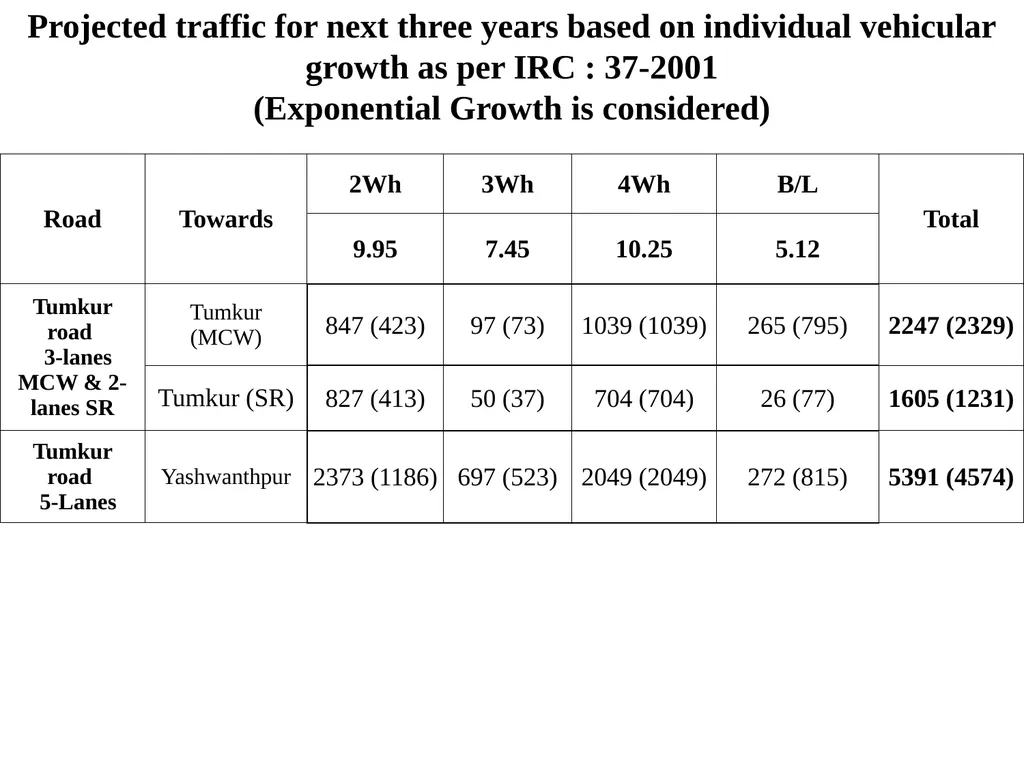
slide67. Projected traffic for next three years based on individual vehicular growth as per IRC : 37-2001 (Exponential Growth is considered)<br>
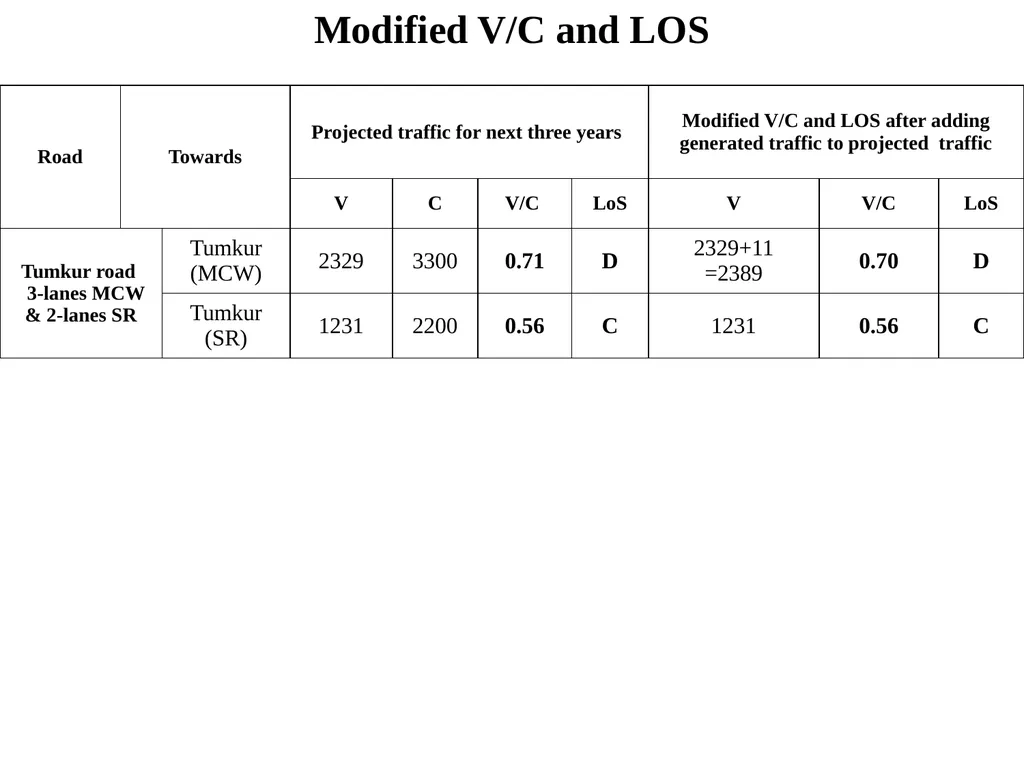
slide68. Modified V/C and LOS<br>
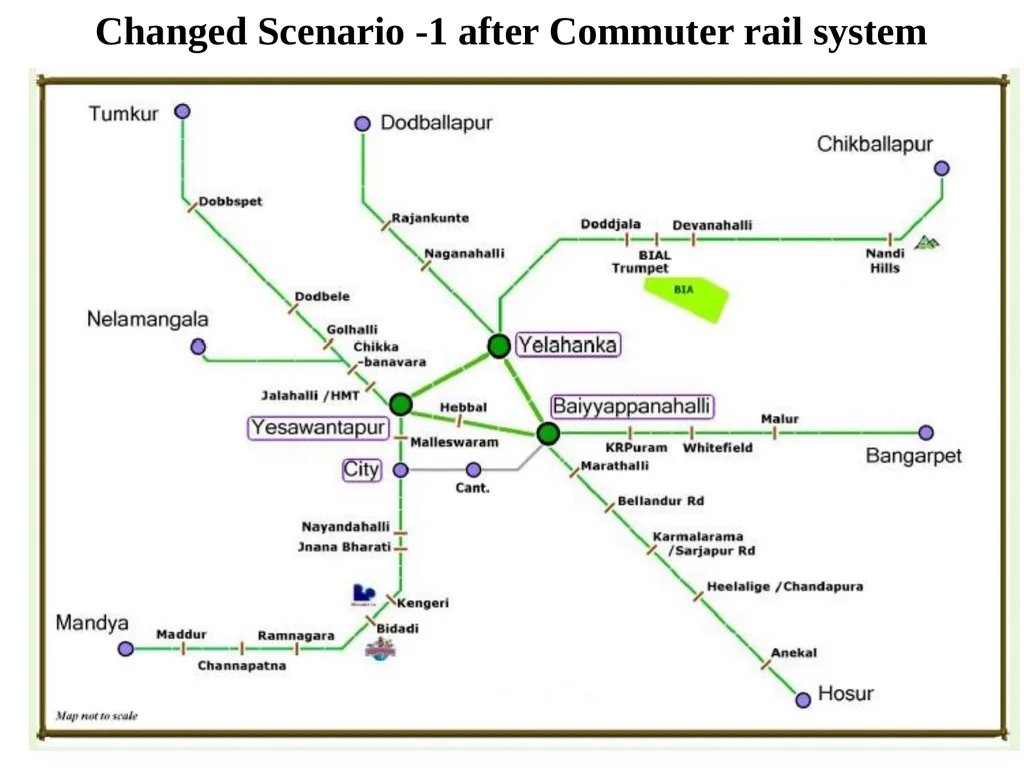
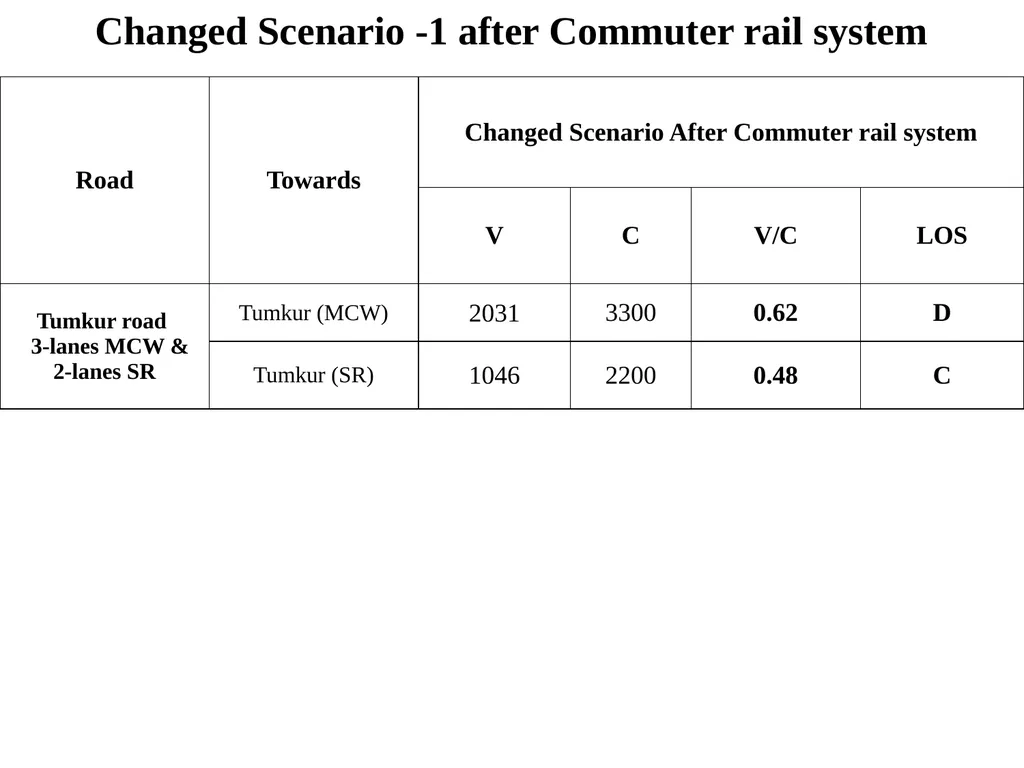
slide69. Changed Scenario -1 after Commuter rail system<br>
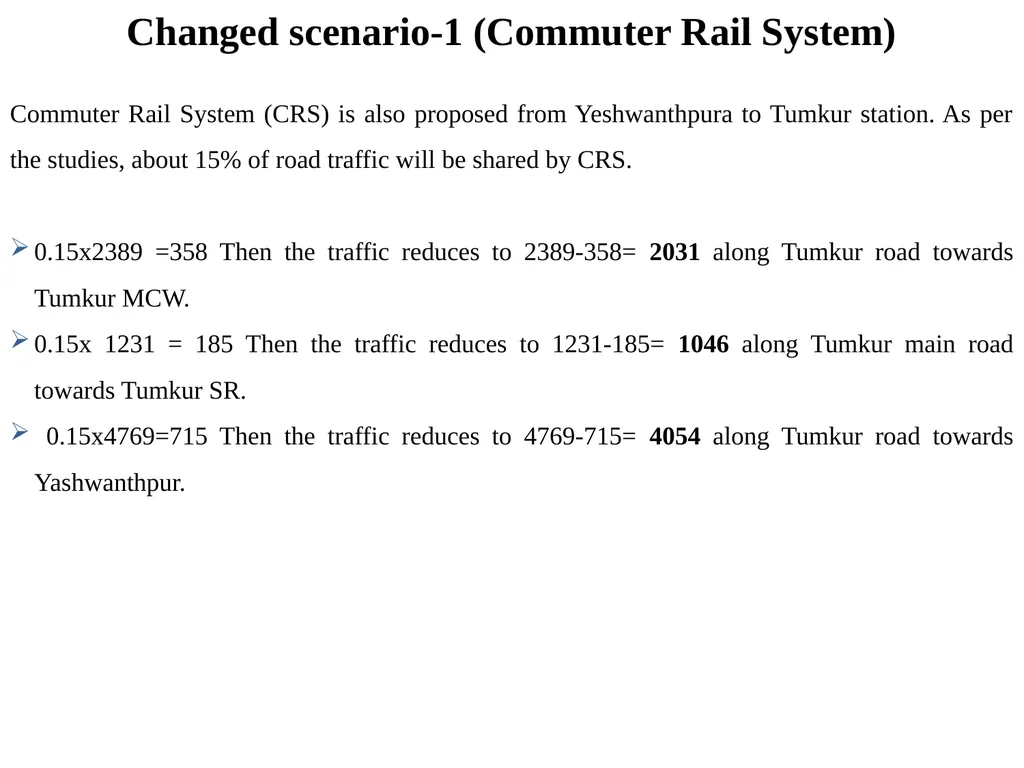
slide70. Commuter Rail System (CRS) is also proposed from Yeshwanthpura to Tumkur station. As per the studies, about 15% of road traffic will be shared by CRS.
0.15x2389 =358 Then the traffic reduces to 2389-358= 2031 along Tumkur road towards Tumkur MCW.
0.15x 1231 = 185 Then the traffic reduces to 1231-185= 1046 along Tumkur main road towards Tumkur SR.
0.15x4769=715 Then the traffic reduces to 4769-715= 4054 along Tumkur road towards Yashwanthpur. Changed scenario-1 (Commuter Rail System)<br>
slide71. Changed Scenario -1 after Commuter rail system<br>
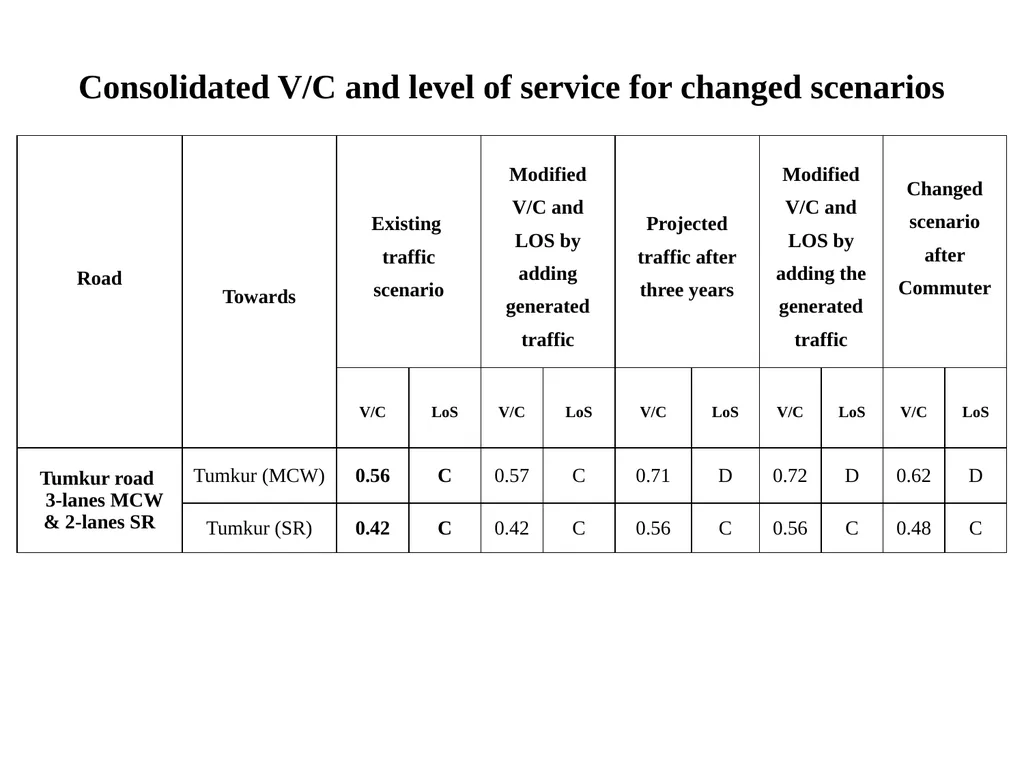
slide72. Consolidated V/C and level of service for changed scenarios<br>
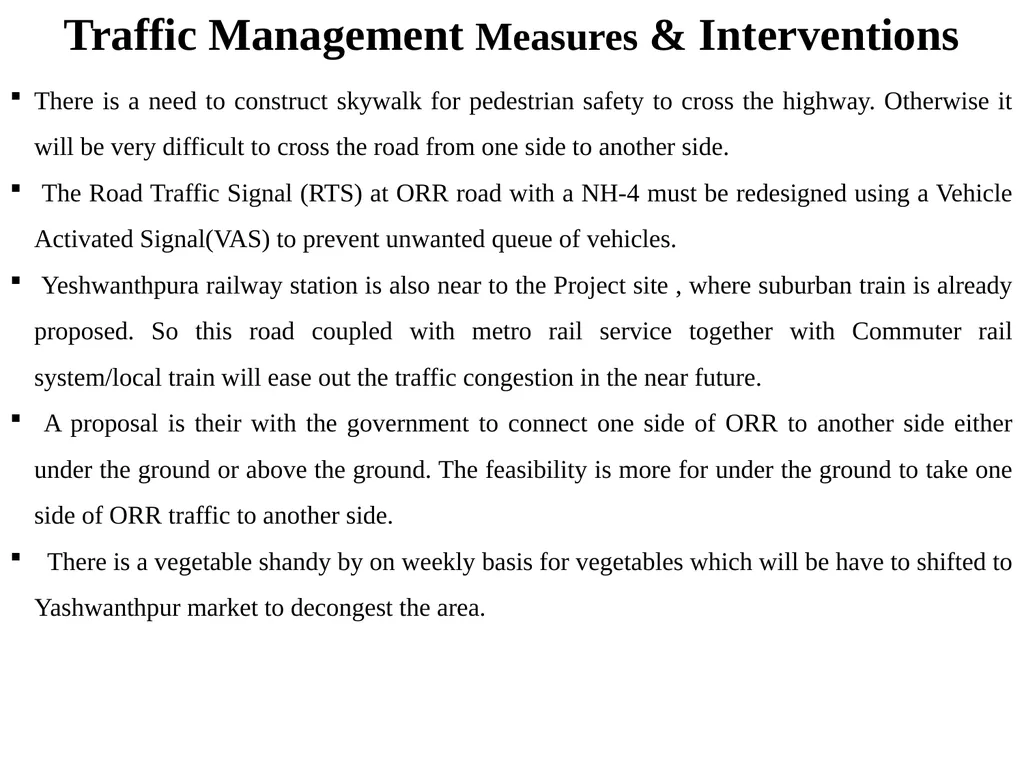
slide73. Traffic Management Measures & Interventions There is a need to construct skywalk for pedestrian safety to cross the highway. Otherwise it will be very difficult to cross the road from one side to another side.
The Road Traffic Signal (RTS) at ORR road with a NH-4 must be redesigned using a Vehicle Activated Signal(VAS) to prevent unwanted queue of vehicles.
Yeshwanthpura railway station is also near to the Project site , where suburban train is already proposed. So this road coupled with metro rail service together with Commuter rail system/local train will ease out the traffic congestion in the near future.
A proposal is their with the government to connect one side of ORR to another side either under the ground or above the ground. The feasibility is more for under the ground to take one side of ORR traffic to another side.
There is a vegetable shandy by on weekly basis for vegetables which will be have to shifted to Yashwanthpur market to decongest the area.<br>
slide74. The main Tumkur road is having the metro rail connectivity up to Nagavara getting extended to BIEC & have planes further up to Nelamangala. Hence the local traffic definitely can make use of the metro when it is completely made available with several track connectivity as planned.
This permits the passengers to use metro as a mass transport having the plans to take about 70% of the total traffic generated through mass transport as per MoUD projections for 2030.
In addition to this Commuter Light Rail Transit (LRT/LRS) is also taken up shortly as Ministry of railways permitted to support urban transport system.
All gates are manned with efficient security who can guide the entry and exit of vehicles.
All precautionary measures are ensured for the safety of construction laborers while working at the site.
The impact is manageable as the metro and commuter rail connectivity is available.<br>
slide75. THANK YOU…<br>
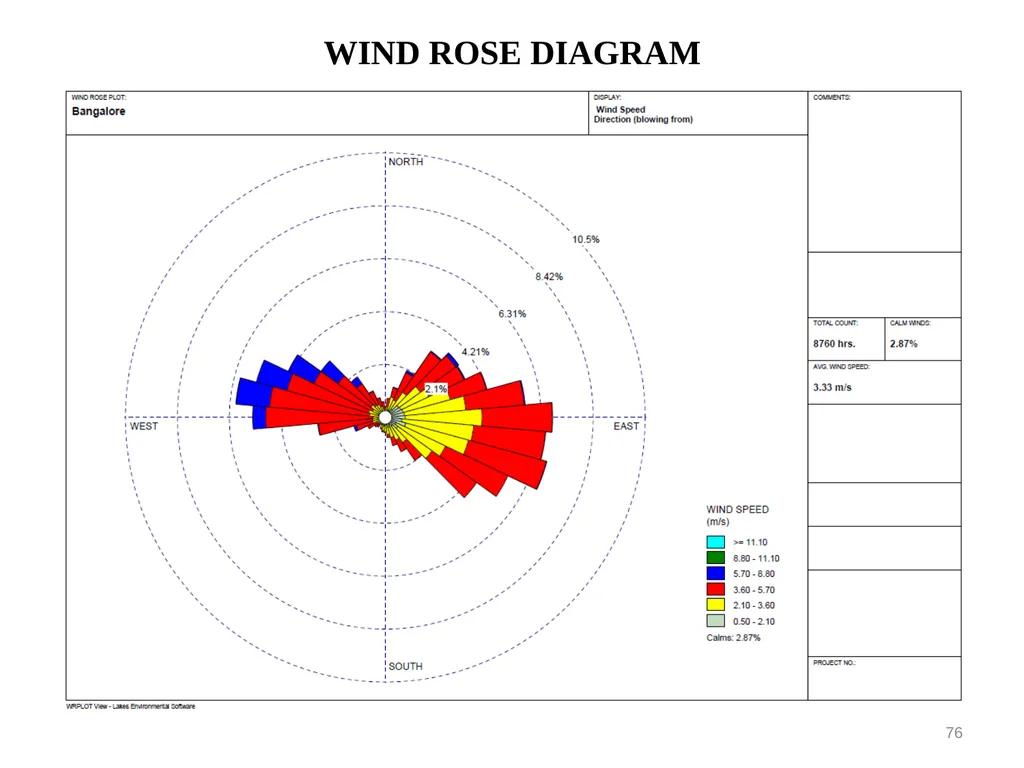
slide76. WIND ROSE DIAGRAM 76<br>
TO
THE HONORABLE CHAIRMAN & MEMBERS OF
KARNATAKA STATE EXPERT APPRAISAL COMMITTEE
PROJECT:
PROJECT:
INDUSTRIAL/WAREHOUSING/STORAGE/ LOGISTICS PARK
AT
BLOCK NOS-1-A-PART, 1-B AND 1-C OF
DABASPET, 5TH PHASE INDUSTRIAL AREA,
BANGALORE RURAL DISTRICT.
By
PROPONENT:
EMBASSY INDUSTRIAL PARKS PVT LTD ,
(NOW KNOWN AS HORIZON INDUSTRIAL PARKS PVT LTD)
1ST FLOOR, EMBASSY POINT,
150, INFANTRY ROAD,
BANGALORE-560001 1 APPLICATION NO: SEIAA 58 CON 2022<br>
slide2. VILLAGE MAP Project Site 2<br>
slide3. 3 Project Site MERGED
VILLAGE MAP Honnenhalli village Bargenahallivillage<br>
slide4. 4 DETAILS OF ENVIRONMENTAL SETTINGS<br>
slide5. PROJECT DETAILS<br>
slide6. INDEX MAP OF THE PROJECT SITE 6 PROJECT SITE KARNATAKA BANGALORE
CENTER<br>
slide7. 7 LOCATION MAP Project Site<br>
slide8. 8 PROJECT SITE ON CDP Project Site<br>
slide9. AREAL VIEW OF THE PROJECT SITE 9 Project Site<br>
slide10. 10 AERIAL VIEW OF THE PROPOSED PROJECT SITE (WITH 500 M RADIUS) Project Site<br>
slide11. LOCATION OF PROJECT SITE ON TOPO MAP 11 Project Site<br>
slide12. CONTOUR MAP 12<br>
slide13. LANDSCAPE PLAN 13<br>
slide14. 14 LIST OF TREES<br>
slide15. 15<br>
slide16. SITE PHOTOS 11.12.2012 16<br>
slide17. ENVIRONMENTAL MONITORING PLAN DURING CONSTRUCTION PHASE 17 ENVIRONMENTAL MONITORING PLAN DURING OPERATIONAL PHASE<br>
slide18. EMP FOR CONSTRUCTION PHASE 18<br>
slide19. EMP FOR CONSTRUCTION PHASE 19 Contd…<br>
slide20. WATER REQUIREMENT 20 The total water requirement for the Existing campus is worked out as follows:
Water demand is calculated based on the guidelines of NBC.
Total nos. of persons = 18490 Nos.
Water requirement @ 135 lpd per person =1000 x 45
Total water requirement =832050lpd.
Say =832.05 KLD
Total water requirement = 832 KLD<br>
slide21. WATER BALANCE CHART 21<br>
slide22. 22 For Gardening:
Green space avilabality : 179859 sqm
FOR 1 Sqm we take 3 lts of treated water for gardening
I.e., 3 lts x 179859 sqm= 539577 lts/day or say 500 KLD<br>
slide23. 23 PROCESS FLOW DIAGRAM OF STP WITH
MBBR TECHNOLOGY<br>
slide24. LOCATION OF WATER SAMPLING STATIONS 24 WQ3 WQ4 WQ1 WQ2 WQ3<br>
slide25. 25 WATER QUALITY STANDARDS<br>
slide26. 26 WATER QUALITY TEST RESULTS
(SAMPLE SOURCE: BOREWELLS FROM STUDY AREA)
FOR THE MONTH OF FEBRUARY- 2022 Conclusion: The above studies reveals that, Water Quality in the above locations are within the permissible limits and suitable for potability.<br>
slide27. STORM WATER MANAGEMENT 27 Rooftop harvesting from proposed building:
The quantity of rainwater to be collected from the rooftops of the proposed building is estimated as below:
Average Annual rainfall in Bangalore (Source: IMD), mm :824
Collection efficiency :90%
Average Rainy days in a year, days :60
Total Roof area, m2 :293818
Total Quantity of Rainfall to be harvested: 0.98* 293818*0.9/60=4319.12m3 say 4000m3 collection tank of size 500 m3 has been provided for each individual blocks. The same will be utilized simultaneously for domestic purposes.<br>
slide28. 28 Strom Water Management
The quantity of storm water to be harvested is estimated as below
Average Annual rainfall in Bangalore (Source: IMD), mm : 980
Collection efficiency : 100%
Average Rainy days in a year, days : 60
Total Landscape area & Hard paved area m2 : 204183
Total quantity of Rainfall to be harvested from hard paved area & landscape area, m3/day :
0.98 x 204183 x 1.0 /60 = 3334.989 m3
The quantity of storm water produced within the site will be directed to 100 Nos. of recharge pits to recharge the ground water. And we will provide pond/ storm water collection storage tank of 500 m3 Contd…<br>
slide29. SOLID WASTE GENERATION 29 Solid Waste Generation :
Source : Domestic Waste
Details of Solid waste, its quantity & disposal Quantity & Characteristics of Domestic Solid Waste Source : Nationwide survey sponsored by CPCB to ascertain the status of municipal Solid waste disposal in Indian cities.<br>
slide30. 30 Contd… The solid waste generated from is worked out as follows:
Nos. of persons : 18490 Nos.
Total Solid waste generated @ 0.45 kg/capita/day : 8320.5 kg/day
Biodegradable fraction @ 40% :3328.2 kg/day
Non-biodegradable / recycle wastes @ 60% : 4992.3 kg/day<br>
slide31. 31 WASTE GENERATION Contd…<br>
slide32. Sampling Locations for Ambient Air Quality monitoring 32 AAQ3 AAQ4 AAQ1 AAQ2 AAQ5<br>
slide33. AMBIENT AIR QUALITY ANALYSIS RESULTS 33 FEBRUARY2022<br>
slide34. 34 MARCH- 2022 Contd…<br>
slide35. 35 Contd… APRIL- 2022 Conclusion: The above study reveals that, PM10 is crossing the standards due to major construction activities and vehicular movement
and PM2.5 is near to the standards. Remaining So2& No2 are well within the limits.<br>
slide36. 36 NATIONAL AMBIENT AIR QUALITY STANDARDS (MOEF notification G.S.R. 826(E)DATED 16.11.2009)<br>
slide37. Sampling Locations for Noise Level Monitoring 37 ANQ3 ANQ4 ANQ1 ANQ2 ANQ5<br>
slide38. 38 SAMPLING LOCATIONS & RESULTS FOR NOISE QUALITY FOR
THE MONTH OF FEBRUARY -2022<br>
slide39. 39 MARCH-2022<br>
slide40. 40 APRIL-2022<br>
slide41. 41 Noise Standards (Central Pollution Control Board, 1998) *Area up to 100 m around premises such as hospitals, educational institutions, and courts Conclusion:The above studies reveal that, noise level is exceeding the prescribed limit due to construction activities and vehicular movement<br>
slide42. POWER REQUIREMENT 42<br>
slide43. In compliance with ECBC CODE-4 Building Envelope.
In Compliance with ECBC CODE-7.2.1 Copper Wound Transformers(as a measure to conserve energy) conforming to IS 1180 are proposed.
ECBC CODE 7.2.1.3 & 7.2.6 - Centralized locations of transformers and DG sets are proposed to limit the power loss due to voltage drop and Distribution Losses.
3 star Rated DG sets are proposed confirming ECBC CODE -7.2.3
As per the ECBC Code -7.2.5 suitable sizes of capacitors are provided in required panels to achieve the value of power factor(0.97) as per ECBC norms.
As per ECBC CODE - 7.2.8 (Use of renewable energy).Solar Water heaters will be proposed for top floors.
Under ECBC CODE-6.2 Corridor, Lift, Lobby, Staircases, Basement Floor and External lights will be controlling through Timers. ECBC COMPLIANCE 43<br>
slide44. ENERGY SAVINGS SUMMARY 44 Contd…<br>
slide45. BUDGETARY ALLOCATION FOR EMP DURING CONSTRUCTION 45<br>
slide46. BUDGETARY ALLOCATION FOR EMP DURING OPERATION 46<br>
slide47. ADDITIONAL TOR 47 DETAILS OF DRAINS, WATER BODIES, KHARAB LAND DETAILS AND ITS POSITION ON THE VILLAGE SURVEY MAP WITH REFERENCE TO PROJECT AREA AND IN THE CONCEPT PLAN CLEARLY LEAVING THE SUITABLE BUFFERS AS PER BYLAWS. Nala is present at northern side of the project site; 9.0 m buffer has been left for this nala.
Site is allocated through KIADB.<br>
slide48. 48 Contd… CONCEPTUAL PLAN<br>
slide49. 49 3. DETAILS OF QUANTITY AND KINDS OF WASTES GENERATED AND HANDLING THE SAME.
Details of quantity and kinds of wastes generated and handling the same is as follows:
The total solid waste generated from the proposed building is worked out as follows:
Nos. of persons : 18490 Nos.
Total Solid waste generated @ 0.45 kg/capita/day : 8320 kg/day
Biodegradable fraction @ 40% : 3320 kg/day
Non-biodegradable / recycle wastes @ 60% : 5000 kg/day Contd…<br>
slide50. 50 4. DETAILED RISK AND DISATER MANGAEMENT DURING AND AFTER CONSTRUCTION. Contd… RISK ASSESSMENT
Objective:
To identify and rank all potential risks that may arise from the construction of major project.
Suggested measures:
Collect all relevant information needed to conduct a risk assessment of construction activities.
Identify, assess and rank risks to all segments of the environment, human beings, nuisance and loss of amenity from plans of the proposed development.
Once construction commences, review the risk assessment as risk management strategies are implemented, inspection or monitoring identifies new risks or when there are changes to the project.
DISASTER MANAGEMENT PLAN:
Supply of safe potable water to the workers during construction is ensured to avoid the potential health risks due to consumption of contaminated water
First aid kit with adequate sterilized dressing materials and appliances is made available at site. Vehicular arrangements to shift the injured person to the hospital shall always be made available.
Workers shall be provided with all safety gadgets like foot wear, helmets, goggles, earplugs and gloves and shall be made them to wear the same during their working at site
It is ensured that no paint containing lead or lead products is used.
Safe scaffolding, ladders, working platforms, gangways, stairwells, excavations and safe means to entry and exit shall be provided as per the applicable regulation.
Adequate precaution to prevent electrical accidents shall be taken.
No material shall be stacked or placed to cause danger or inconvenience to any person or the public. Necessary fencing and lights shall be provided
Construction machineries used at site shall conform to the IS codes. Also they will be maintained as per IS guidelines.
RISK ASSESSMENT AND MANAGEMENT PLAN
CONSTRUCTION PHASE:
Supply of safe potable water to the workers during construction is ensured to avoid the potential health risks due to consumption of contaminated water.
First aid kit with adequate sterilized dressing materials and appliances is made available at site. Vehicular arrangements to shift the injured person to the hospital shall always be made available.<br>
slide51. 51 Workers shall be provided with all safety gadgets like protective footwear, helmets, goggles, earplugs and gloves and shall be made them to wear the same during their working at site
It is ensured that no paint containing lead or lead products is used.
Safe scaffolding, ladders, working platforms, gangways, stairwells, excavations and safe means to entry and exit shall be provided as per the applicable regulation.
Adequate precaution to prevent electrical accidents shall be taken.
No material shall be stacked or placed to cause danger or inconvenience to any person or the public. Necessary fencing and lights shall be provided
Employing a safety Engineer/Environmental Engineer.
OPERATIONAL PHASE:
Fire detection system and fire fighting system as per IS: 2189 shall be proposed.
Automatic fire detection system with different types of heat and smoke detectors shall be provided in different areas of each floor. The system shall be connected to the fire alarm system. The control room/security room with communication system to all floors and facility for receiving messages from different floors shall be provided at entrance on ground floor
Adequate fire protection arrangements such as fire pump, wet riser system, hose reel, hose box, fire alarm system, potable fire extinguisher and emergency lights are proposed.
Non- combustible materials shall only be used for the construction/erection of false ceiling including all fixtures and used for its suspension/erection etc. and shall be of low flame rating.
Stand by electric generator shall be installed to supply power to staircase and corridor lighting circuit, ventilation and smoke extraction system, lifts, exit signs and fire pump in case of failure of normal electric supply. DG area shall be made restricted entry.
Installation of transformers, LT & HT panels shall be as per the provisions specified by the concerned authorities.
The whole project area falls under Zone-II of seismic map. The seismic factors have been appropriately incorporated in the civil design. Contd…<br>
slide52. 52 ON-SITE EMERGENCY PLAN:
This shall be prepared in detail and circulated to all concerned members of emergency teams. The objectives of emergency planning are to maximize the resource utilization and combined operations to localize the emergency and if possible eliminate it to maximize the effects of accidents on people and property, to take remedial measures in the quickest possible time to contain the incident and control it with minimum damage, to mobilize the internal resources and utilize them in the most effective way, to get help from the local community and government officials to supplement internal manpower and resources.
EMERGENCY ACTION PLANS:
For fire:
No attempts shall be made to extinguish the burning gas but the container under fire and other containers in vicinity shall be kept cool by water spray.
If the gas leakage does not ignite, the container shall be approached from up and removed to the place of safety away from the source of ignition.
Fire fighting services will be used.
For Electric Fire:
Disconnect the affected areas power supply
Attempt shall be done to extinguish fire with the help of CO2, DCP.
If fire is not extinguished, extinguish by spraying water with fog nozzle after ensuring complete isolation of electric circuit will be done. Contd…<br>
slide53. 53 For Earthquakes:
When first tremors are sensed during earthquake, all inmates shall evacuate building and assemble at safe place away from structures, walls and falling objects.
Emergency services should be contacted for assistance.
For Bomb threat:
Inform the higher local police authority
Inform controller of explosives
Request the local fire brigade to position at least one fire tender at the location immediately.
Keep the concerned department at regional level informed with developments at regular intervals.
Alert the local government/private hospitals and seek their help.
Disaster Management Plan Contd…<br>
slide54. 54 4. MANAGEMENT PLAN TO UTILIZE THE ENTIRE EARTH GENERATED WITHIN THE SITE MAY BE WORKED OUT AND SUBMITTED.
The proposed project consists of single Basement of about 21041.00 Sqmt. The total earth excavation is about 30000 m3 The depth of foundation for columns/pillars is 2 m below GL which result in additional earthwork excavation of about 10,000 m3. Hence the total earth excavation is about 40,000 m3.<br>
slide55. 5. COMPLIANCE TO ECBC GUIDELINES AND INCORPORATION OF NBC FOR POROPSED PROJECT SHOULD BE DETAILED.
In compliance with ECBC CODE-4 Building Envelope.
In Compliance with ECBC CODE-7.2.1 Copper Wound Transformers(as a measure to conserve energy) conforming to IS 1180 are proposed.
ECBC CODE 7.2.1.3 & 7.2.6 - Centralized locations of transformers and DG sets are proposed to limit the power loss due to voltage drop and Distribution Losses.
3 star Rated DG sets are proposed confirming ECBC CODE -7.2.3
As per the ECBC Code -7.2.5 suitable sizes of capacitors are provided in required panels to achieve the value of power factor(0.97) as per ECBC norms.
As per ECBC CODE - 7.2.8 (Use of renewable energy).Solar Water heaters will be proposed for top floors.
Under ECBC CODE-6.2 Corridor, Lift, Lobby, Staircases, Basement Floor and External lights will be controlling through Timers. 55<br>
slide56. 56 6. SOLAR PANEL SHOWING IN THE ROOF AREA<br>
slide57. TRAFFIC IMPACT ASSESSMENT STUDIES 57<br>
slide58. The Project is located along approach Road where entry and exit is given.
Approach road is of 9 m RoW and having 2 lanes undivided traffic flow to connects to reach nearest Tumkur road (NH-4)
The NH-4 is of 10 lanes in all, having 5 lanes opposite to the project site with 2- lanes service road & 3-lanes MCW.
The Service road is a separated with MCW by a raised kerb area separator & facilitate to move vehicles to ORR towards Magadi road.
There is a signal at ORR joining with the SR & possibly a source for delays due to traffic during the red phase.
The Road Traffic Signal (RTS) at ORR road with a NH-4 must be redesigned using a Vehicle Activated Signal(VAS) to prevent unwanted queue of vehicles. Road Connectivity<br>
slide59. A proposal is their with the government to connect one side of ORR to another side either under the ground or above the ground. The feasibility is more for under the ground to take one side of ORR traffic to another side.
The highway traffic from ORR will take right turn to reach Nelamangala side controlled by Road Traffic Signal (RTS)
The road on one side of ORR which cannot be widened due to the defense land & left as it is.
The road on one side of ORR which cannot be widened due to defense land & hence left as it is.
In addition to this Commuter Light Rail Transit (LRT/LRS) is also taken up shortly as Ministry of railways permitted to support urban transport system.
It is always necessity to restrict APMC bound tracks etc. to morning before 9:00 am & after 10:00pm to prevent the peak traffic with APMC traffic.<br>
slide60. V= Volume in PCU’s/hr &
C= Capacity in PCU’s/ hr
LoS = Level of Service Existing Traffic Scenario for Study road Note: Tumkur road towards Yashwanthpur MCW &SR merged to obtain 5 lanes hence the capacity for 5 lanes is taken, where as towards Tumkur side, SR & MCW are separated and SR connects to ORR towards Magadi road.<br>
slide61. The addition of 4 Lorries per day carrying construction material do not change any significantly the traffic flow. Hence OK.
V/C during construction (Lorries) =0.56, 0.42 & 0.64.
The present level of service will remain “C, C & D “along Tumkur road MCW & SR and Yashwanthpur respectively.
Number of trucks coming to the site (Off peak hours) , Day time –4 no’s.
Night time- Nill.
The addition do not make any significant change for traffic movement at any given time.
Vehicles carrying construction materials are well covered to prevent any spillage.
Vehicles hired for construction material will be in good condition and conforms to noise and air emission standards.
Vehicles will operate only during non peak hours. During Construction<br>
slide62. Pedestrian Flow Management & Safety Pedestrians are considered as most Vulnerable Road Users (VRU) as the accidents are increasing on pedestrians. Hence pedestrians safety must be considered as top priority in traffic engineering.
As per IRC, a minimum of 2.5 m wide neatly paved, well illuminated and leveled footpath must be made available for pedestrians.
The under ground drain is covered by slabs and used for pedestrian movement.
The width can accommodate 3150 PCU’s/hr in each direction of footpath.<br>
slide63. Recommended Pedestrian Side walk capacity and level of service (IRC 103-2012) Note: Since this is Commercial activity a minimum of 2.5 m minimum Footpath is required and also in Indian scenario LoS can be considered.<br>
slide64. Parking logistics<br>
slide65. Since the activity is commercial, the vehicles will move to the Project between 7:00 am to 10:00 am as ingress & 4:00 pm to 7:00 pm as egress.
The total traffic generated from the project site is 3843 PCU’s.
Since the activity is commercial the traffic generated per hour i.e., 3843/3=1281 PCU’s/hr.
This hourly generated traffic of 1281 PCU’s/hr will first enter to Tumkur road towards Yashwanthpur side.
i.e.. 100% x 1281=1281 PCU’s/hr will move along Tumkur road MCW towards Yashwanthpur.
Out of 1281 PCU’s/ hr, 65% of the traffic will move towards Yashwanthpur MCW, 35% of the traffic will move towards Tumkur.
i.e., 65%x1281= 833 PCU’s/hr will move along Tumkur road MCW towards Yashwanthpur.
35% x 1281=448 PCU’s/hr will move along Tumkur road towards Tumkur. Parking Flow Logistics<br>
slide66. Modified V/C and LOS after adding generated traffic to existing traffic<br>
slide67. Projected traffic for next three years based on individual vehicular growth as per IRC : 37-2001 (Exponential Growth is considered)<br>
slide68. Modified V/C and LOS<br>
slide69. Changed Scenario -1 after Commuter rail system<br>
slide70. Commuter Rail System (CRS) is also proposed from Yeshwanthpura to Tumkur station. As per the studies, about 15% of road traffic will be shared by CRS.
0.15x2389 =358 Then the traffic reduces to 2389-358= 2031 along Tumkur road towards Tumkur MCW.
0.15x 1231 = 185 Then the traffic reduces to 1231-185= 1046 along Tumkur main road towards Tumkur SR.
0.15x4769=715 Then the traffic reduces to 4769-715= 4054 along Tumkur road towards Yashwanthpur. Changed scenario-1 (Commuter Rail System)<br>
slide71. Changed Scenario -1 after Commuter rail system<br>
slide72. Consolidated V/C and level of service for changed scenarios<br>
slide73. Traffic Management Measures & Interventions There is a need to construct skywalk for pedestrian safety to cross the highway. Otherwise it will be very difficult to cross the road from one side to another side.
The Road Traffic Signal (RTS) at ORR road with a NH-4 must be redesigned using a Vehicle Activated Signal(VAS) to prevent unwanted queue of vehicles.
Yeshwanthpura railway station is also near to the Project site , where suburban train is already proposed. So this road coupled with metro rail service together with Commuter rail system/local train will ease out the traffic congestion in the near future.
A proposal is their with the government to connect one side of ORR to another side either under the ground or above the ground. The feasibility is more for under the ground to take one side of ORR traffic to another side.
There is a vegetable shandy by on weekly basis for vegetables which will be have to shifted to Yashwanthpur market to decongest the area.<br>
slide74. The main Tumkur road is having the metro rail connectivity up to Nagavara getting extended to BIEC & have planes further up to Nelamangala. Hence the local traffic definitely can make use of the metro when it is completely made available with several track connectivity as planned.
This permits the passengers to use metro as a mass transport having the plans to take about 70% of the total traffic generated through mass transport as per MoUD projections for 2030.
In addition to this Commuter Light Rail Transit (LRT/LRS) is also taken up shortly as Ministry of railways permitted to support urban transport system.
All gates are manned with efficient security who can guide the entry and exit of vehicles.
All precautionary measures are ensured for the safety of construction laborers while working at the site.
The impact is manageable as the metro and commuter rail connectivity is available.<br>
slide75. THANK YOU…<br>
slide76. WIND ROSE DIAGRAM 76<br>