EIB Equity Risk Products Context EIB active in equityequity-type products for a long period of time (direct indirect) EFSI European Fund for Strategic Investors: December 2014 boosted the EIB equity-type activities: EUR 5bn (EFSI
"EIB Equity Risk Products Context EIB active in" is the property of its rightful owner. Permission is granted to
download and print the materials on this website for personal, non-commercial use only, and to display it
on your personal computer provided you do not modify the materials and that you retain all copyright
notices contained in the materials. By downloading content from our website, you accept the terms of this
agreement.
Presentation Transcript
01
EIB Equity Risk Products<br>
02
Context EIB active in equity/equity-type products for a long period of time (direct / indirect)
EFSI – European Fund for Strategic Investors: December 2014 boosted the EIB equity-type activities: EUR 5bn (EFSI objective) by mid-2018
EUR 3.4 bn participations in private funds through EIB (mainly infrastructure), cooperation with NPBs and EIF (VC/PE)
EUR 1.6 bn direct quasi-equity and co-investments:
EUR 1bn quasi-equity growth capital for innovative SME and Mid-Caps
(EIB venture debt)
EUR 0.6bn quasi-equity structures with Corporates & CVCs
Supporting European corporates for riskier R&D programmes and technological breakthroughs (key EU priorities)
Risk-sharing for the downside and the upside
Strong market interest from leading life science groups and large industrial players
Overall EFSI equity window on track to reach it’s target by mid-2018.
What’s for the next few years: Increased equity window of up to EUR 7bn by YE2020<br>
03
Quasi-Equity Product overview Growth Capital SME/MidCaps Corporate Risk Sharing Equity Co-Investments Debt product absorbing equity risk EUR 7.5- EUR 50m Improves IRR for sponsors and management MidCaps/Large Corporates Debt product absorbing equity risk EUR 7.5- EUR 90m Off-balance sheet risk sharing structures for corporate R&D SME/MidCaps Equity co-investments EUR 7.5- EUR25m Co-investments through CVCs, NPBs or other third parties<br>
04
Corporate Risk Sharing (1) Risk-sharing funding structure linked to one or more ring-fenced R&D programme(s) (e.g. pharma, biotech, technology)
Sharing of risk and return on the ring-fenced assets between EIB and the Corporate (limited or no recourse on the corporate B/S)
Milestone-based structure for disbursements tracking R&D programme progress
Repayments and remuneration contingent upon the success of the underlying assets or measurable milestones
Remuneration could be detached from principal repayment, e.g. cash interest, deferred/PIK interest, royalties over a pre-defined time window
Typical size EUR 7.5-90m but not exceeding 50% of total R&D programme cost EIB Corporate B/S R&D Programme Risk/Benefits Risk/Benefits<br>
Equity Co-investments – SPV structure EIB Fund/CVC Co-investment vehicle Co EU28 Co Manages Presents for approval Manages [Invests] Overview of the concept
Co-investments in minority stakes alongside captive funds / private investors
Pre-defined eligibility of co-investments
“Framework agreement” with desktop due diligence from EIB and delegation of investment management to the co-investment partners
Underlying investments between EUR 5-25m
Term of co-investment 7-9 years
Pre-defined exit strategy
Alignment of interest, certain level of control
Limited to EU 28 countries
Benefits
Additional capital for minority investments
Control on investment decisions (EIB is “passive” investor)
Quick response time
Stable, long-term partner
Risk sharing in the portfolio performance<br>
07
Equity Co-investments – contingent risk sharing EIB Corporate/CVC EU28 Co Presents
for approval Invests Commits Overview of the concept
EIB commits upfront a specific amount (> EUR 50m) in a form of a contingent and participating instrument
Underlying investments between EUR 5-25m+
Corporate & EIB agree on the scope (eligibility) of the investment programme
Corporate responsible for investments on behalf of both parties
Repayment of invested capital is contingent upon successful exit
The investment is participating pro-rata in the upside, excluding potential transaction costs
Benefits
Additional resources for minority investments
Delegated approach past the initial screening
No SPV needed
Stable, long-term partner Disburses Co<br>
08
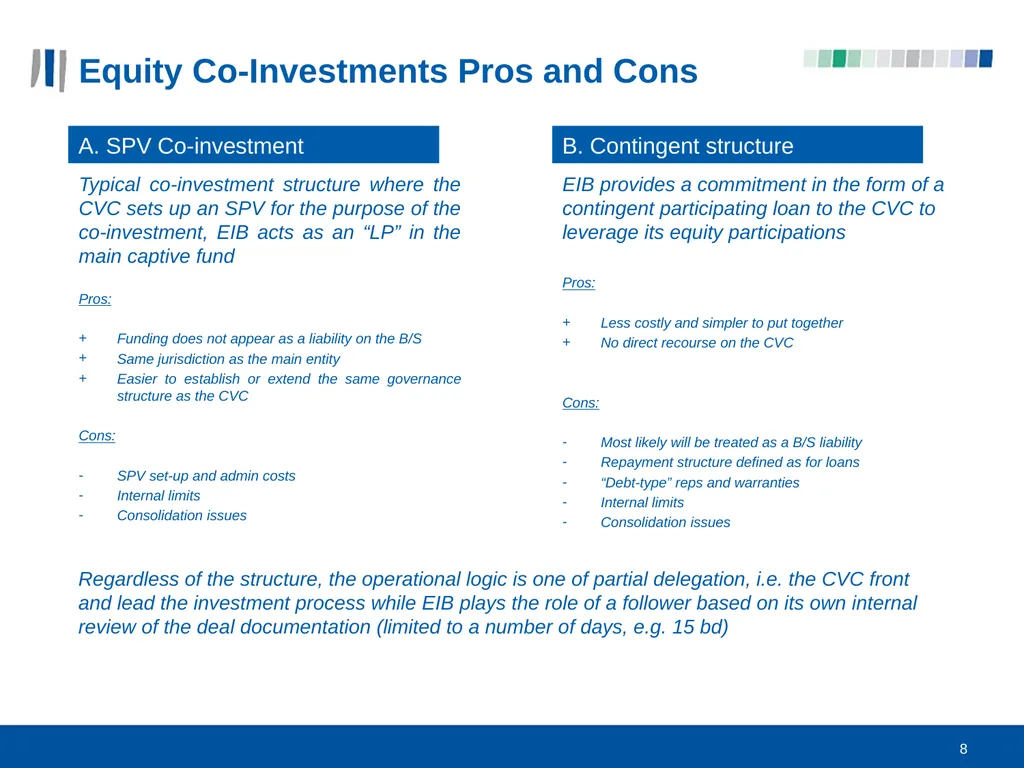
Equity Co-Investments Pros and Cons Typical co-investment structure where the CVC sets up an SPV for the purpose of the co-investment, EIB acts as an “LP” in the main captive fund
Pros:
Funding does not appear as a liability on the B/S
Same jurisdiction as the main entity
Easier to establish or extend the same governance structure as the CVC
Cons:
SPV set-up and admin costs
Internal limits
Consolidation issues EIB provides a commitment in the form of a contingent participating loan to the CVC to leverage its equity participations
Pros:
Less costly and simpler to put together
No direct recourse on the CVC
Cons:
Most likely will be treated as a B/S liability
Repayment structure defined as for loans
“Debt-type” reps and warranties
Internal limits
Consolidation issues A. SPV Co-investment B. Contingent structure Regardless of the structure, the operational logic is one of partial delegation, i.e. the CVC front and lead the investment process while EIB plays the role of a follower based on its own internal review of the deal documentation (limited to a number of days, e.g. 15 bd)<br>