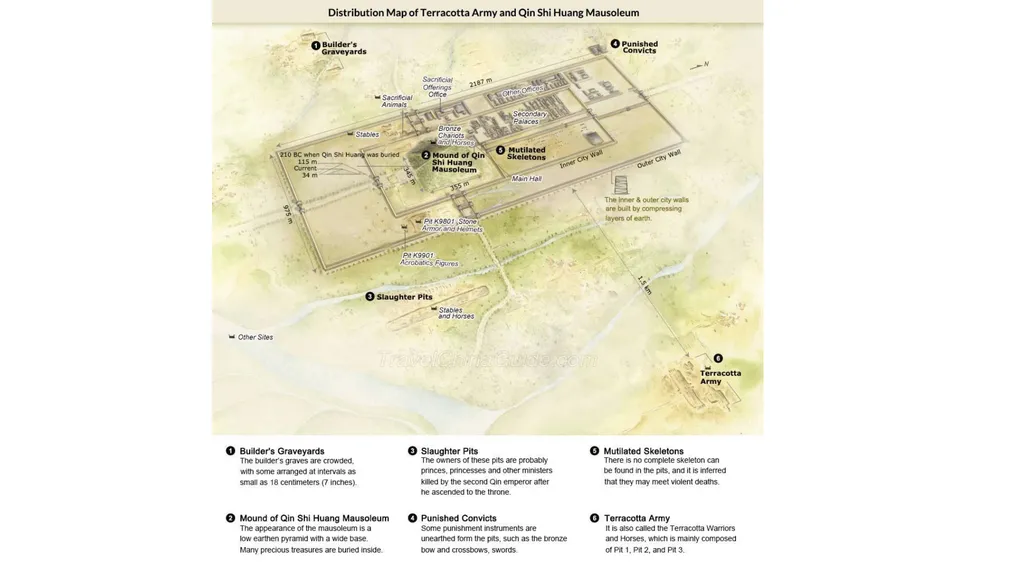
Eight thousand soldiers frozen underground Only forty years ago, this great secret was still hiding from the world. A group of Chinese farmers digging a well in 1974 were about to make one of the biggest discoveries of modern archaeology,
"Eight thousand soldiers frozen underground Only" is the property of its rightful owner. Permission is granted to
download and print the materials on this website for personal, non-commercial use only, and to display it
on your personal computer provided you do not modify the materials and that you retain all copyright
notices contained in the materials. By downloading content from our website, you accept the terms of this
agreement.
Share
Embed code
Presentation Transcript
01
Eight thousand soldiers frozen underground
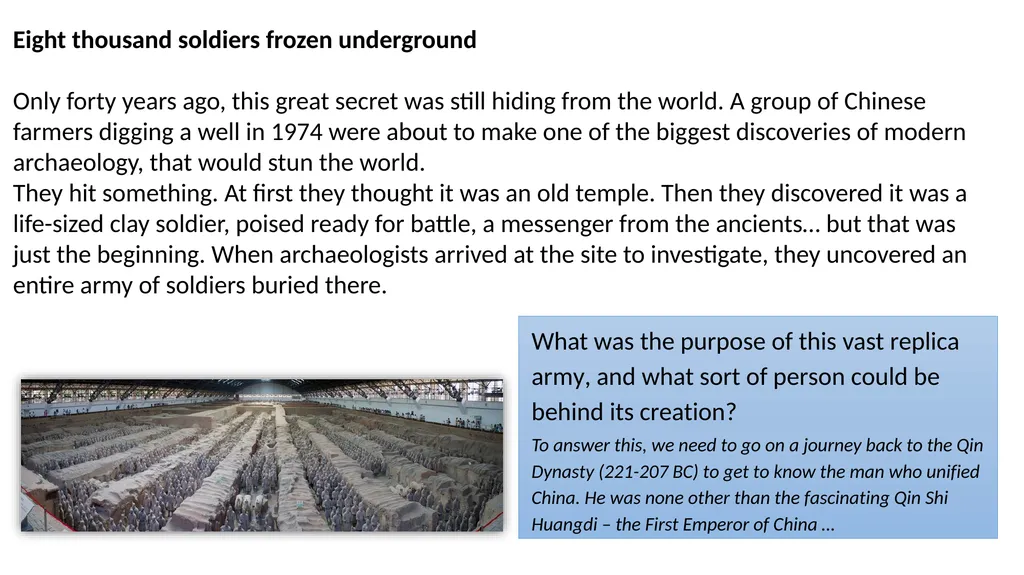
Only forty years ago, this great secret was still hiding from the world. A group of Chinese farmers digging a well in 1974 were about to make one of the biggest discoveries of modern archaeology, that would stun the world.
They hit something. At first they thought it was an old temple. Then they discovered it was a life-sized clay soldier, poised ready for battle, a messenger from the ancients… but that was just the beginning. When archaeologists arrived at the site to investigate, they uncovered an entire army of soldiers buried there. What was the purpose of this vast replica army, and what sort of person could be behind its creation?
To answer this, we need to go on a journey back to the Qin Dynasty (221-207 BC) to get to know the man who unified China. He was none other than the fascinating Qin Shi Huangdi – the First Emperor of China …<br>
02
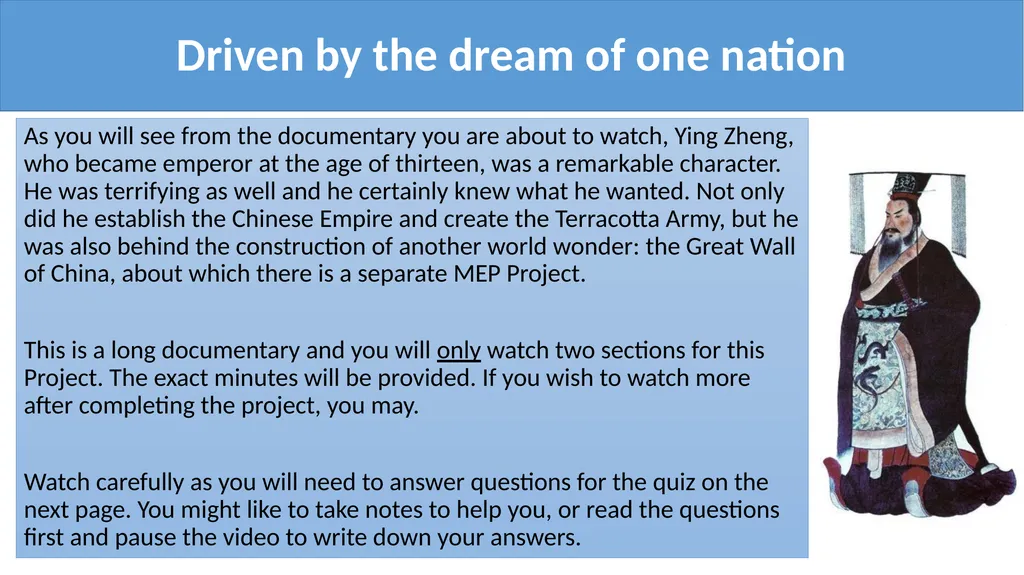
Driven by the dream of one nation As you will see from the documentary you are about to watch, Ying Zheng, who became emperor at the age of thirteen, was a remarkable character. He was terrifying as well and he certainly knew what he wanted. Not only did he establish the Chinese Empire and create the Terracotta Army, but he was also behind the construction of another world wonder: the Great Wall of China, about which there is a separate MEP Project.
This is a long documentary and you will only watch two sections for this Project. The exact minutes will be provided. If you wish to watch more after completing the project, you may.
Watch carefully as you will need to answer questions for the quiz on the next page. You might like to take notes to help you, or read the questions first and pause the video to write down your answers.<br>
03
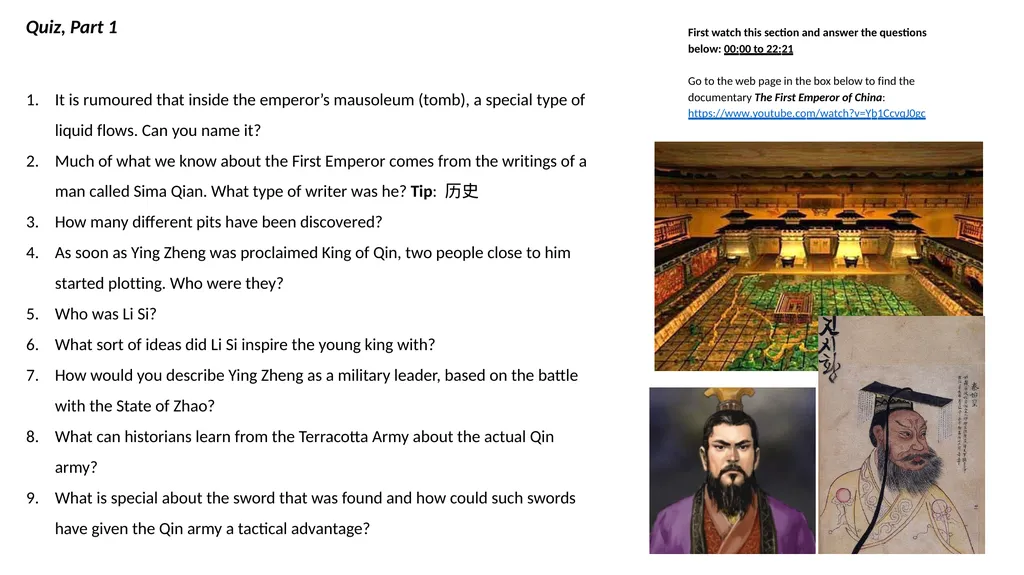
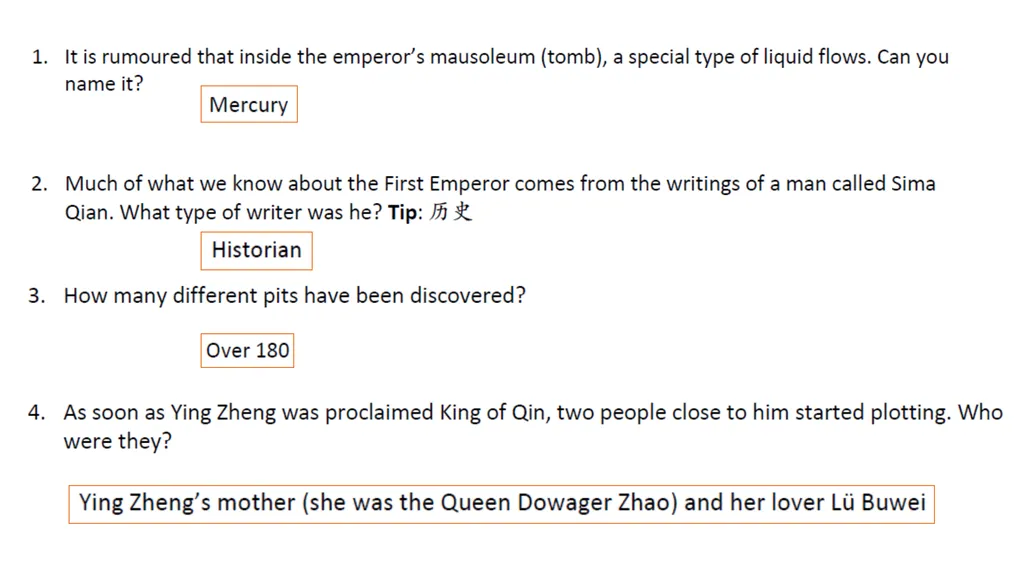
Quiz, Part 1 It is rumoured that inside the emperor’s mausoleum (tomb), a special type of liquid flows. Can you name it?
Much of what we know about the First Emperor comes from the writings of a man called Sima Qian. What type of writer was he? Tip: 历史
How many different pits have been discovered?
As soon as Ying Zheng was proclaimed King of Qin, two people close to him started plotting. Who were they?
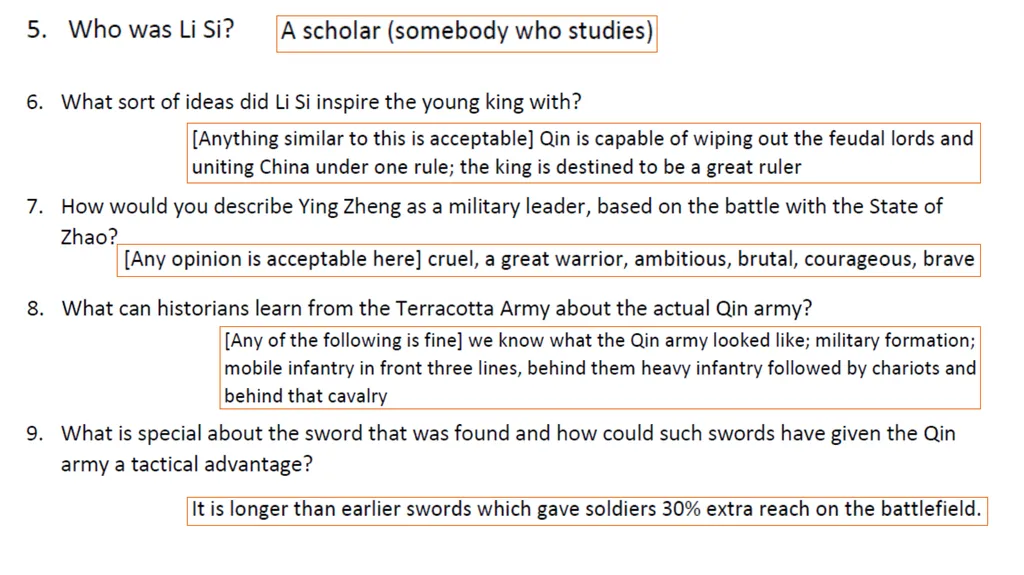
Who was Li Si?
What sort of ideas did Li Si inspire the young king with?
How would you describe Ying Zheng as a military leader, based on the battle with the State of Zhao?
What can historians learn from the Terracotta Army about the actual Qin army?
What is special about the sword that was found and how could such swords have given the Qin army a tactical advantage? First watch this section and answer the questions below: 00:00 to 22:21
Go to the web page in the box below to find the documentary The First Emperor of China:
https://www.youtube.com/watch?v=Yb1CcvqJ0gc<br>
04
When you have answered questions 1-9, jump to this section:
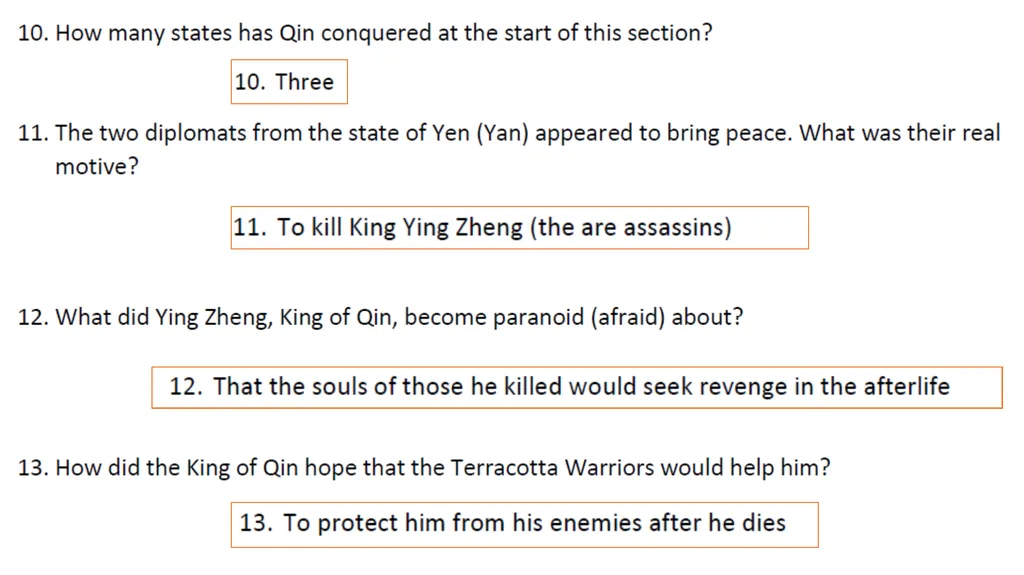
38:58 to 54:52 Quiz, Part 2 10. How many states has Qin conquered at the start of this section?
11. The two diplomats from the state of Yen (Yan) appeared to bring peace. What was their real motive?
12. What did Ying Zheng, King of Qin, become paranoid (afraid) about?
13. How did the King of Qin hope that the Terracotta Warriors would help him?
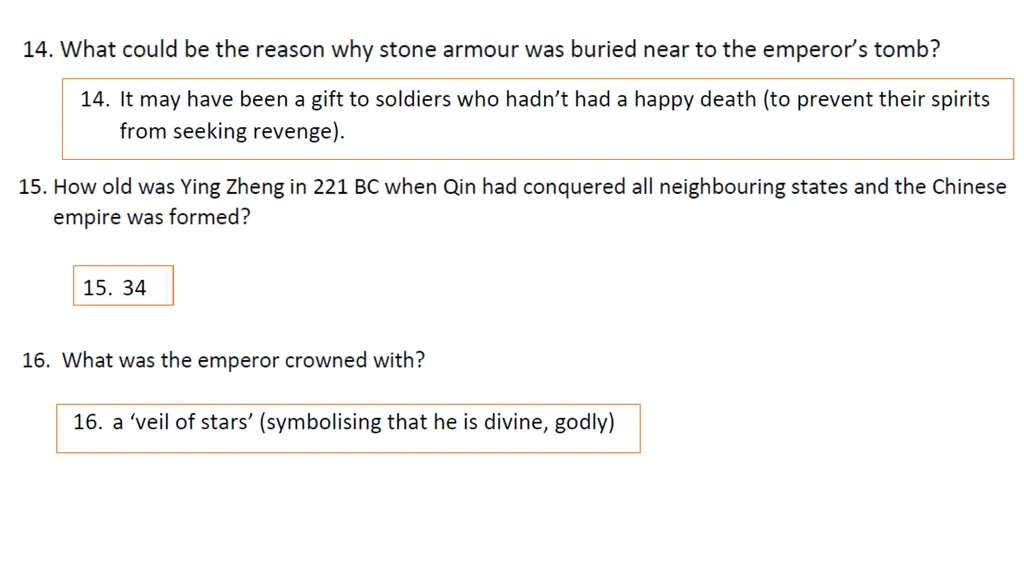
14. What could be the reason why stone armour was buried near to the emperor’s tomb?
15. How old was Ying Zheng in 221 BC when Qin had conquered all neighbouring states and the Chinese empire was formed?
16. What was the emperor crowned with?<br>
05
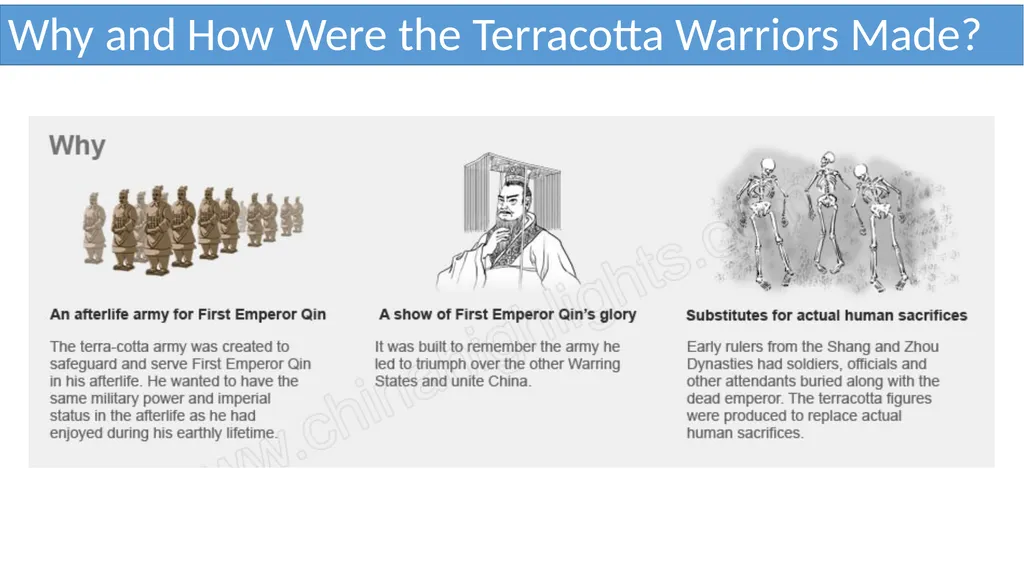
Why and How Were the Terracotta Warriors Made?<br>
06
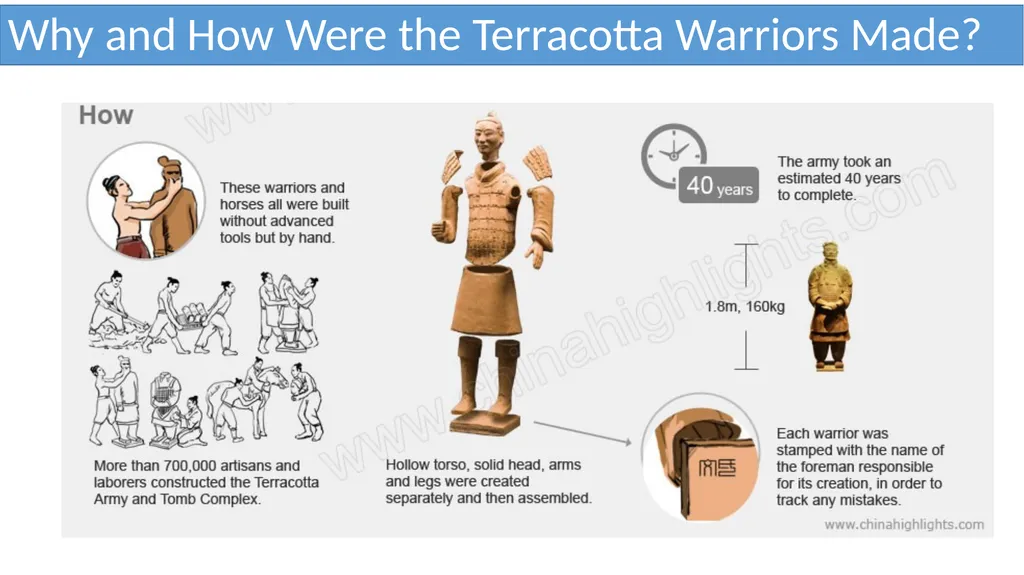
Why and How Were the Terracotta Warriors Made?<br>
07
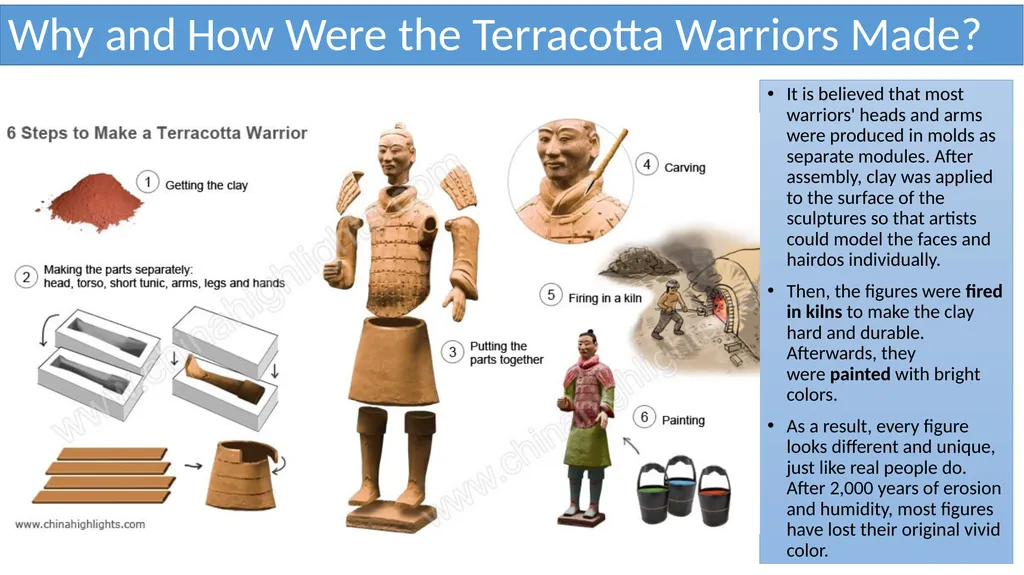
Why and How Were the Terracotta Warriors Made? It is believed that most warriors' heads and arms were produced in molds as separate modules. After assembly, clay was applied to the surface of the sculptures so that artists could model the faces and hairdos individually.
Then, the figures were fired in kilns to make the clay hard and durable. Afterwards, they were painted with bright colors.
As a result, every figure looks different and unique, just like real people do. After 2,000 years of erosion and humidity, most figures have lost their original vivid color.<br>
08
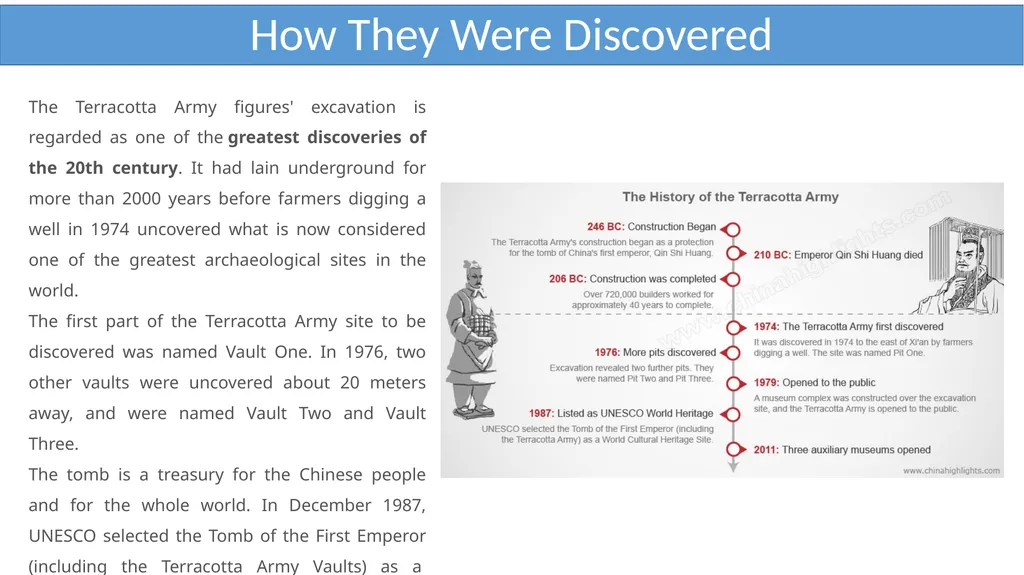
How They Were Discovered The Terracotta Army figures' excavation is regarded as one of the greatest discoveries of the 20th century. It had lain underground for more than 2000 years before farmers digging a well in 1974 uncovered what is now considered one of the greatest archaeological sites in the world.
The first part of the Terracotta Army site to be discovered was named Vault One. In 1976, two other vaults were uncovered about 20 meters away, and were named Vault Two and Vault Three.
The tomb is a treasury for the Chinese people and for the whole world. In December 1987, UNESCO selected the Tomb of the First Emperor (including the Terracotta Army Vaults) as a World Cultural Heritage Site.<br>
09
The excavated terracotta figures fall into three major categories: infantry, cavalry, and charioteers.
The infantry can be further divided into subcategories, including officers of high, middle, and low rank, light-armed and heavy-armed foot soldiers, and standing and kneeling archers.
The charioteers can be further divided into two subcategories: chariot drivers and chariot warriors.<br>
10
Your verdict on the man? For centuries, Chinese people have argued about whether Ying Zheng was a good or cruel ruler. Now it’s time for you to add your views to that discussion under the three categories below. Before you do, here are a few more details about the First Emperor’s rule:<br>
11
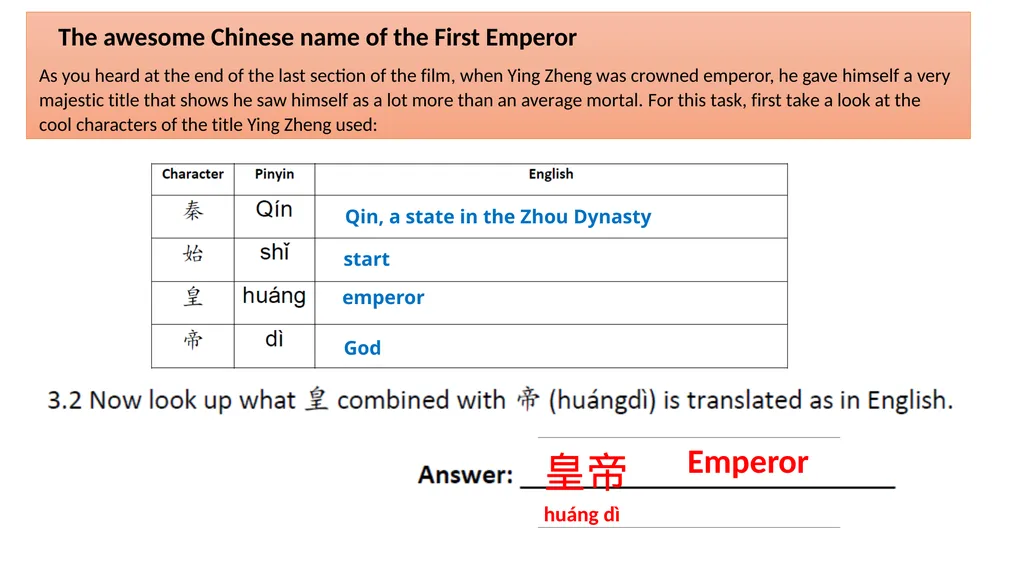
The awesome Chinese name of the First Emperor
As you heard at the end of the last section of the film, when Ying Zheng was crowned emperor, he gave himself a very majestic title that shows he saw himself as a lot more than an average mortal. For this task, first take a look at the cool characters of the title Ying Zheng used: Qin, a state in the Zhou Dynasty start emperor God<br>
12
I want to start eating The teacher wants to start the class There is a theory that the English name China comes from ancient Middle Eastern cultures (Cinah in Sanskrit and Chini in Persian), that refer to the Qin Dynasty.<br>
13
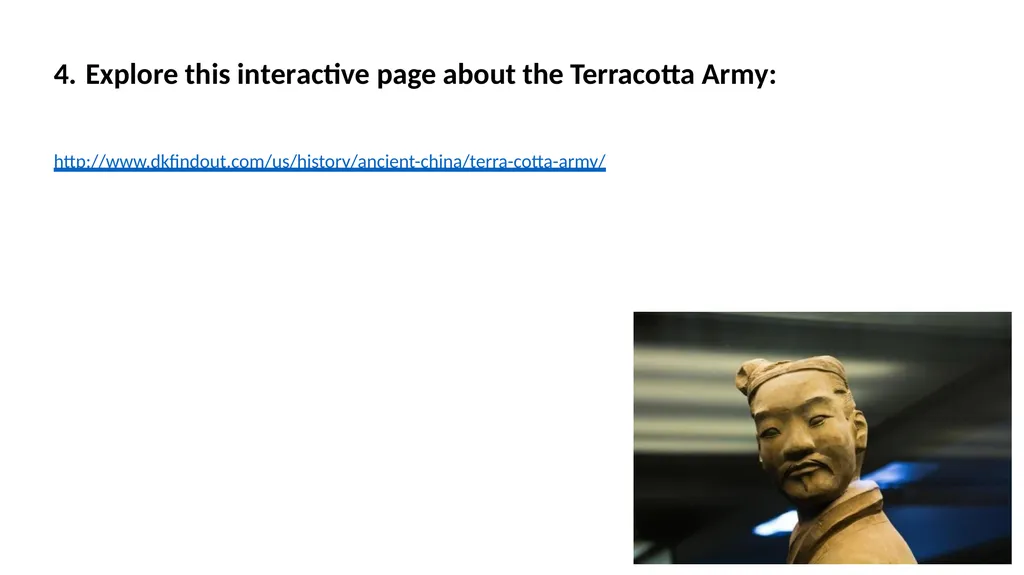
4. Explore this interactive page about the Terracotta Army:
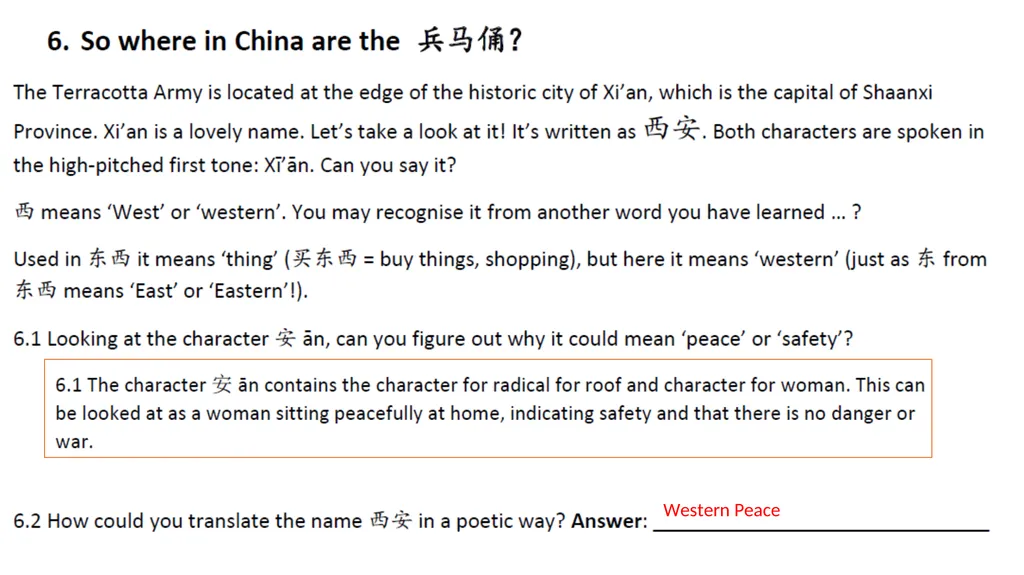
兵 looks similar to 乒乓 , 乒乓球(pīng pāng qiú) is ping pong/table tennis 马(mǎ) means horse and 俑 yǒng means figurine. They are used in the name 兵马俑 as there are figurines of soldiers and horses<br>
15
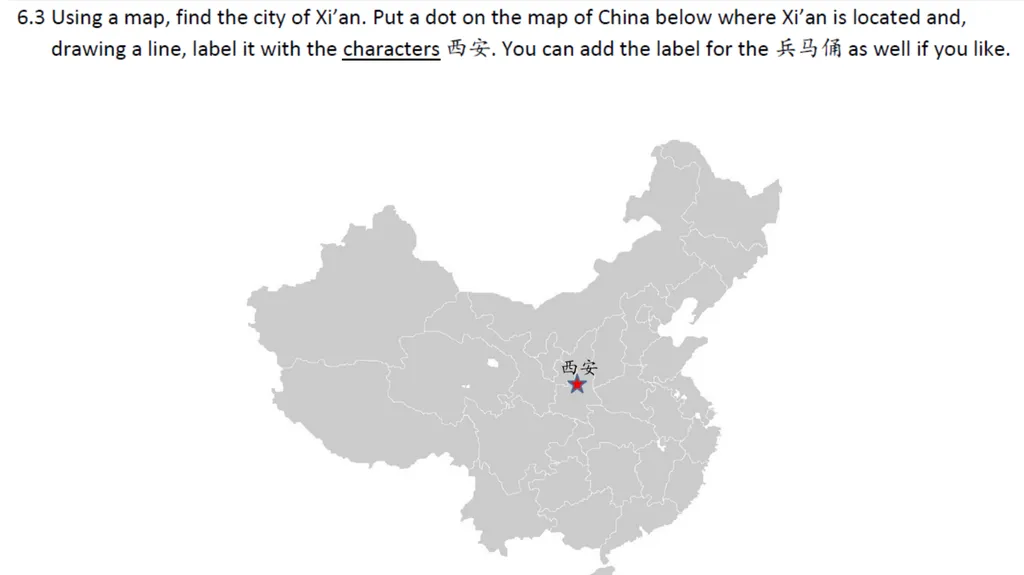
Western Peace<br>
16
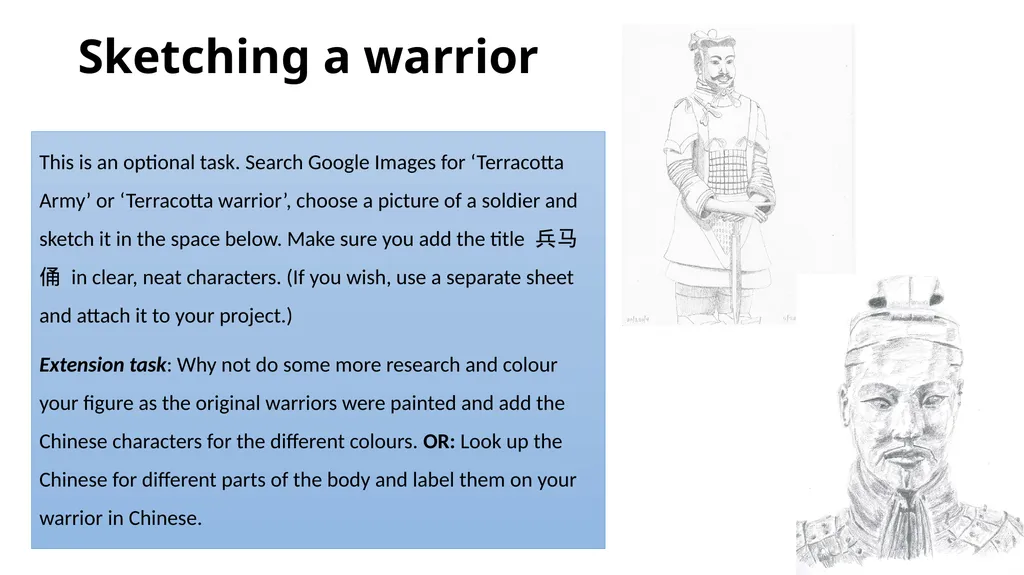
Sketching a warrior This is an optional task. Search Google Images for ‘Terracotta Army’ or ‘Terracotta warrior’, choose a picture of a soldier and sketch it in the space below. Make sure you add the title 兵马俑 in clear, neat characters. (If you wish, use a separate sheet and attach it to your project.)
Extension task: Why not do some more research and colour your figure as the original warriors were painted and add the Chinese characters for the different colours. OR: Look up the Chinese for different parts of the body and label them on your warrior in Chinese.<br>
17
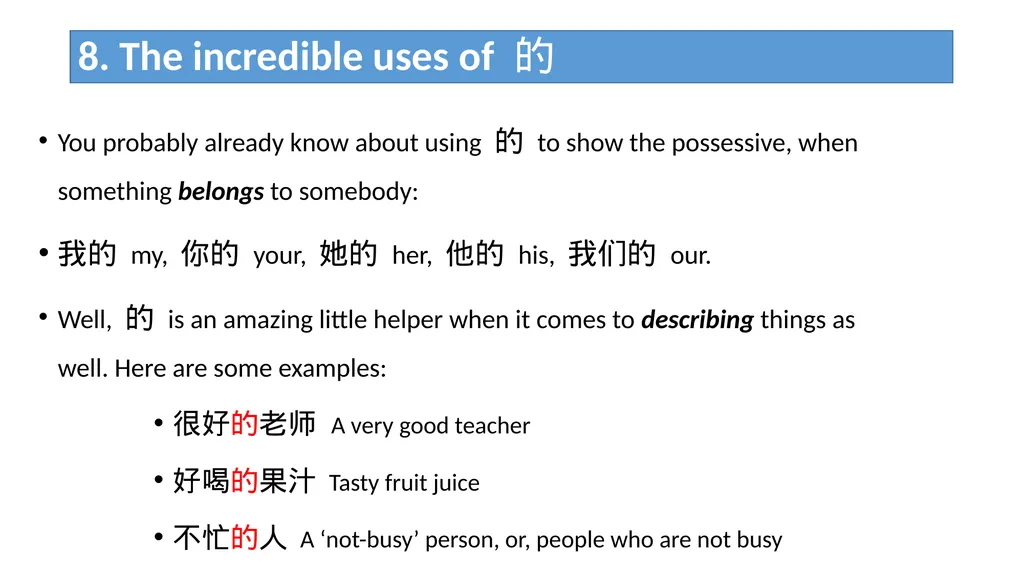
8. The incredible uses of 的 You probably already know about using 的 to show the possessive, when something belongs to somebody:
我的 my, 你的 your, 她的 her, 他的 his, 我们的 our.
Well, 的 is an amazing little helper when it comes to describing things as well. Here are some examples:
很好的老师 A very good teacher
好喝的果汁 Tasty fruit juice
不忙的人 A ‘not-busy’ person, or, people who are not busy<br>
18
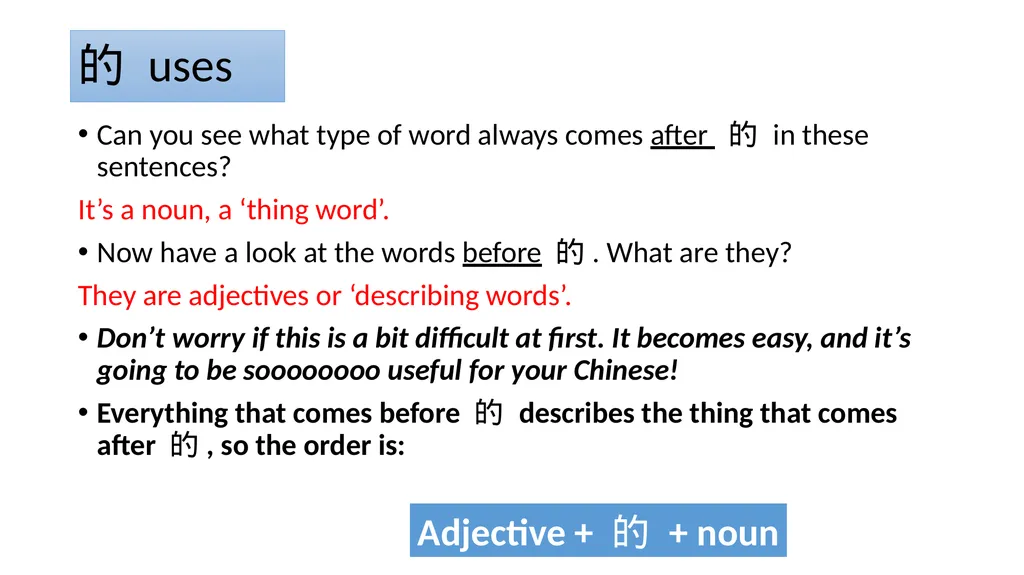
的 uses Can you see what type of word always comes after 的 in these sentences?
It’s a noun, a ‘thing word’.
Now have a look at the words before 的. What are they?
They are adjectives or ‘describing words’.
Don’t worry if this is a bit difficult at first. It becomes easy, and it’s going to be soooooooo useful for your Chinese!
Everything that comes before 的 describes the thing that comes after 的, so the order is: Adjective + 的 + noun<br>
19
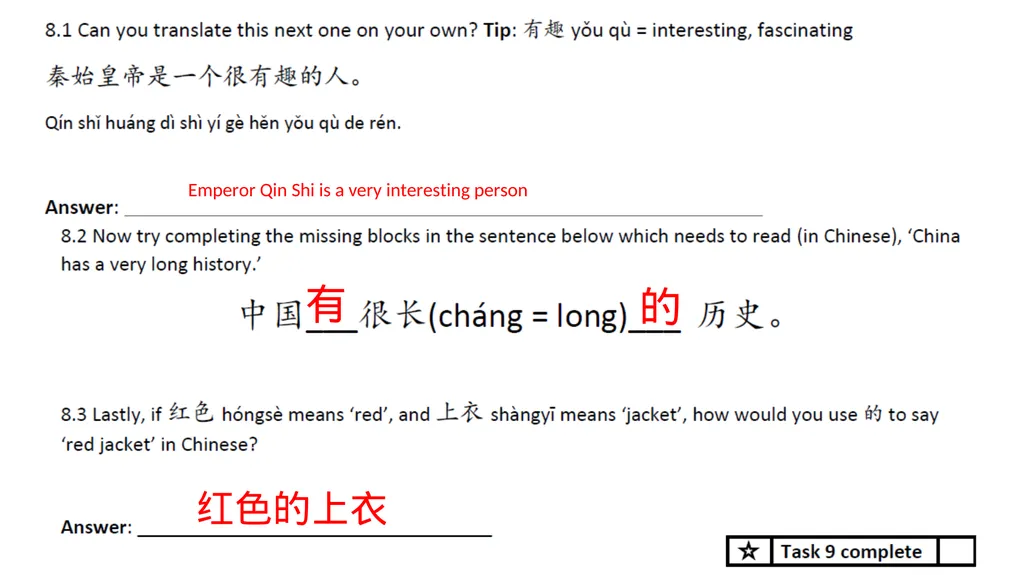
Emperor Qin Shi is a very interesting person 有 的 红色的上衣<br>
20
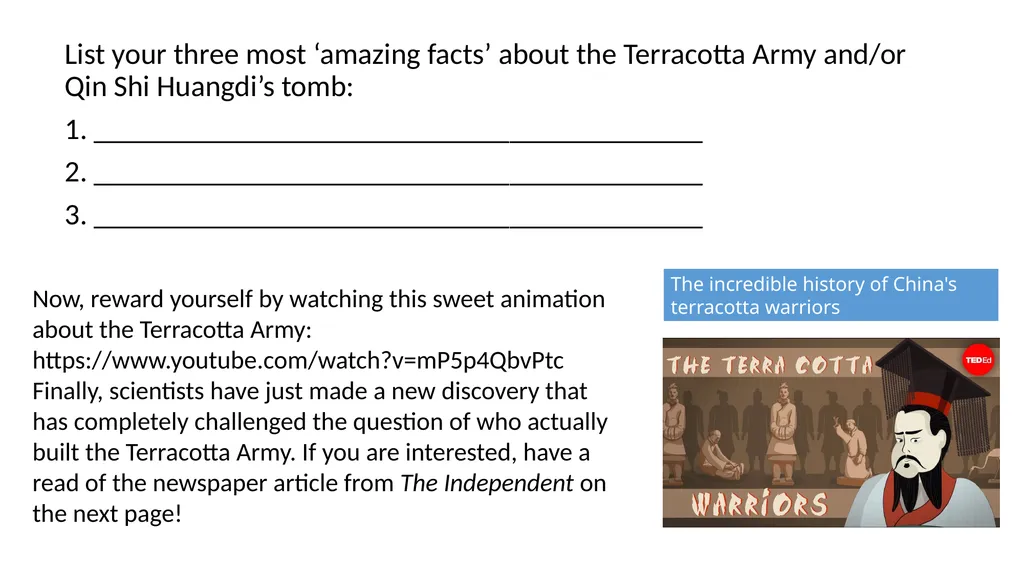
List your three most ‘amazing facts’ about the Terracotta Army and/or Qin Shi Huangdi’s tomb:
1. _________________________________________
2. _________________________________________
3. _________________________________________ Now, reward yourself by watching this sweet animation about the Terracotta Army:
https://www.youtube.com/watch?v=mP5p4QbvPtc
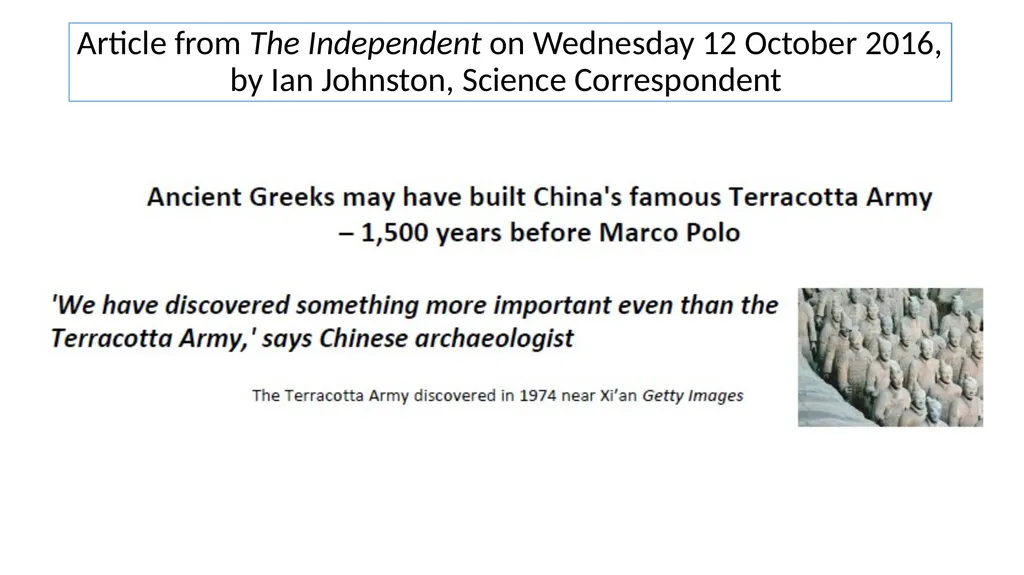
Finally, scientists have just made a new discovery that has completely challenged the question of who actually built the Terracotta Army. If you are interested, have a read of the newspaper article from The Independent on the next page! The incredible history of China's terracotta warriors<br>
21
Article from The Independent on Wednesday 12 October 2016, by Ian Johnston, Science Correspondent<br>