
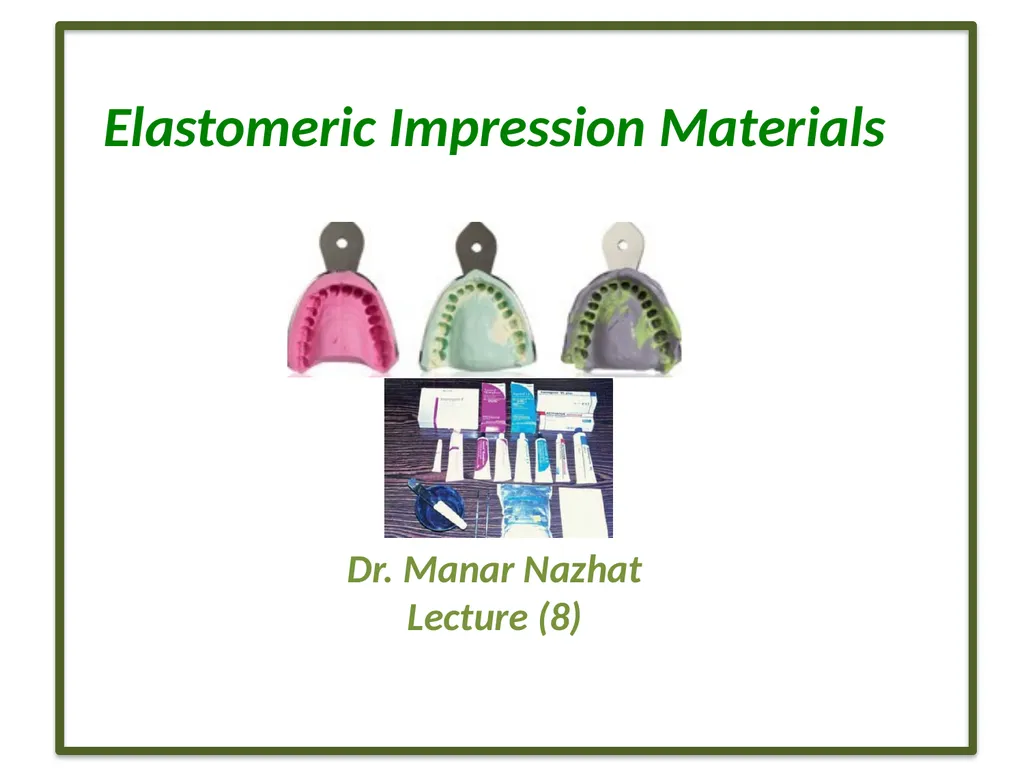
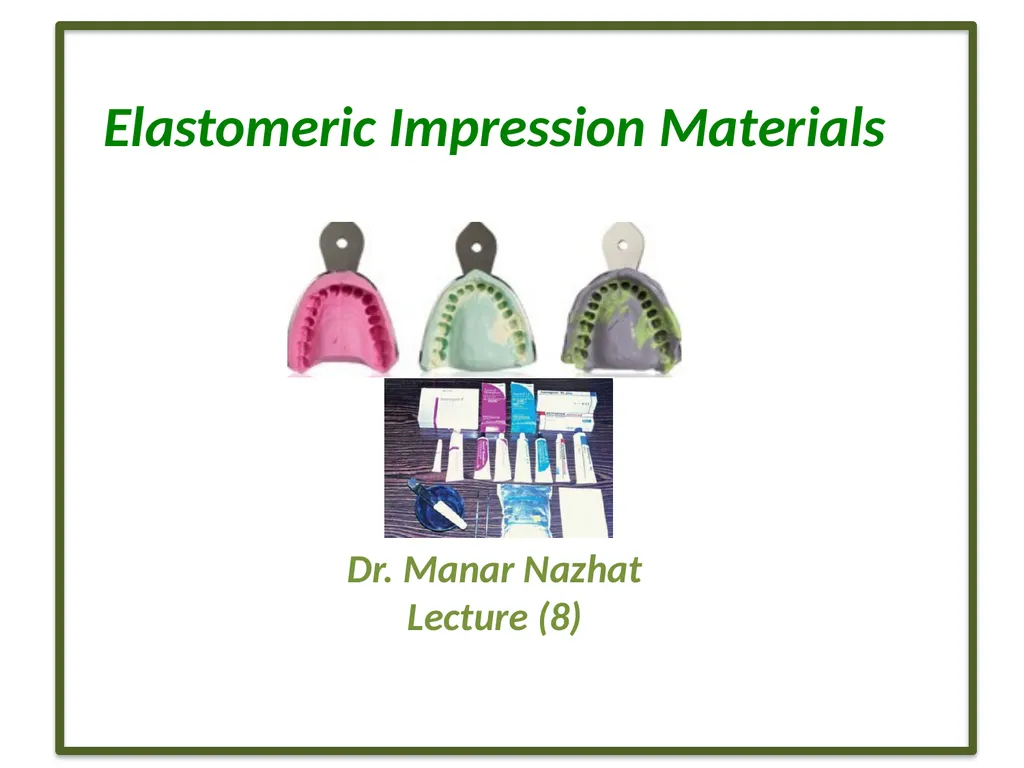
Elastomeric Impression Materials Dr. Manar Nazhat

Description: Elastomeric Impression Materials Dr. Manar Nazhat Lecture (8) 2. Elastic: Elastic impression materials are those that remain in an elastic or flexible state after they have set and have been removed from the mouth. Hydrocolloid: Reversible
Related Topics
Download Presentation
"Elastomeric Impression Materials Dr. Manar Nazhat" is the property of its rightful owner. Permission is granted to download and print the materials on this website for personal, non-commercial use only, and to display it on your personal computer provided you do not modify the materials and that you retain all copyright notices contained in the materials. By downloading content from our website, you accept the terms of this agreement.
Presentation Transcript
slide1. Elastomeric Impression Materials Dr. Manar Nazhat
Lecture (8)<br>
slide2. 2. Elastic:
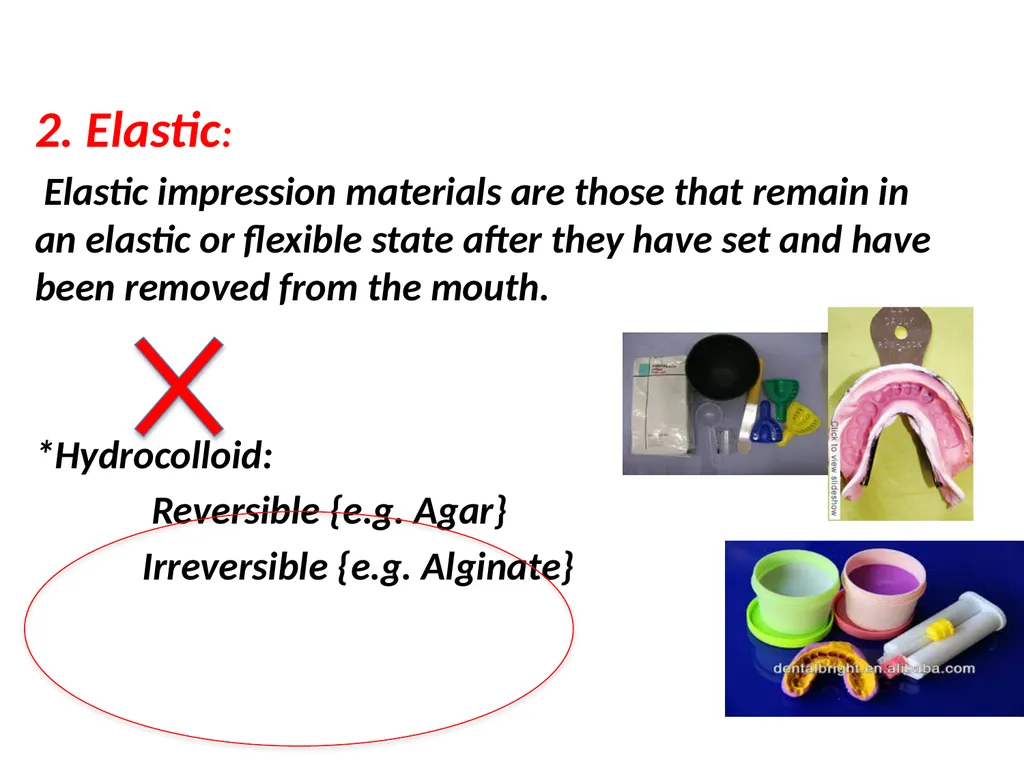
Elastic impression materials are those that remain in an elastic or flexible state after they have set and have been removed from the mouth.
*Hydrocolloid:
Reversible {e.g. Agar}
Irreversible {e.g. Alginate}
*Elastomeric impression materials
{E.g. Polysulfide, Polyether, Addition
silicones, Condensation silicones}<br>
slide3. ELASTOMERIC IMPRESSION MATERIALS
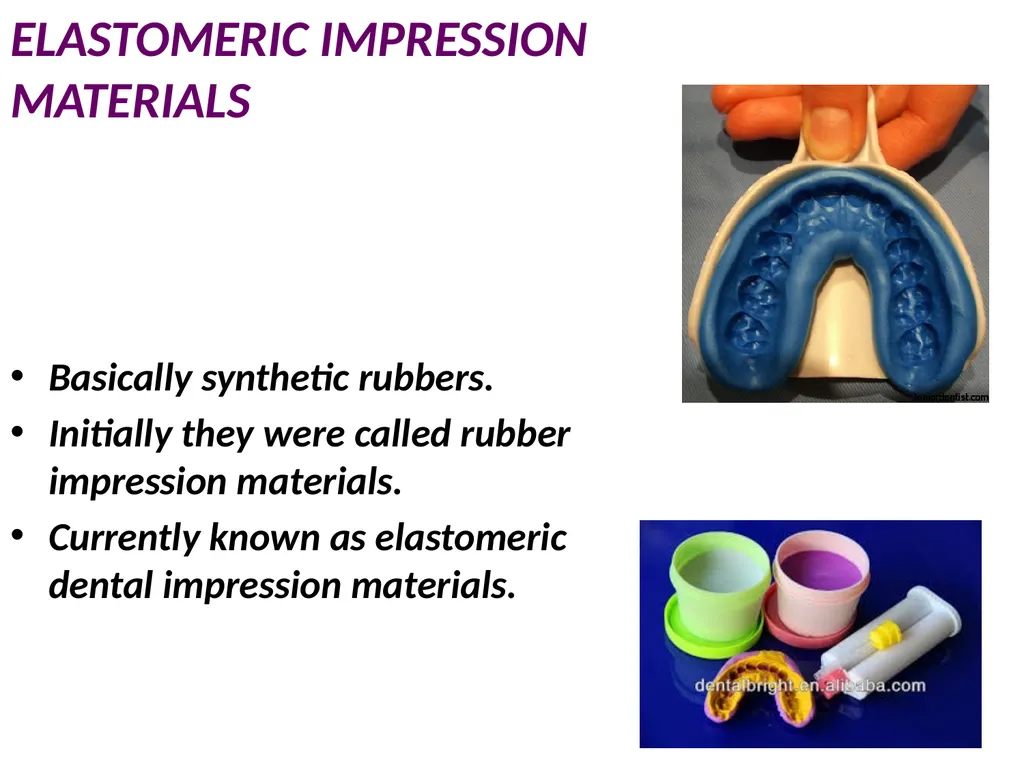
Basically synthetic rubbers.
Initially they were called rubber impression materials.
Currently known as elastomeric dental impression materials.<br>
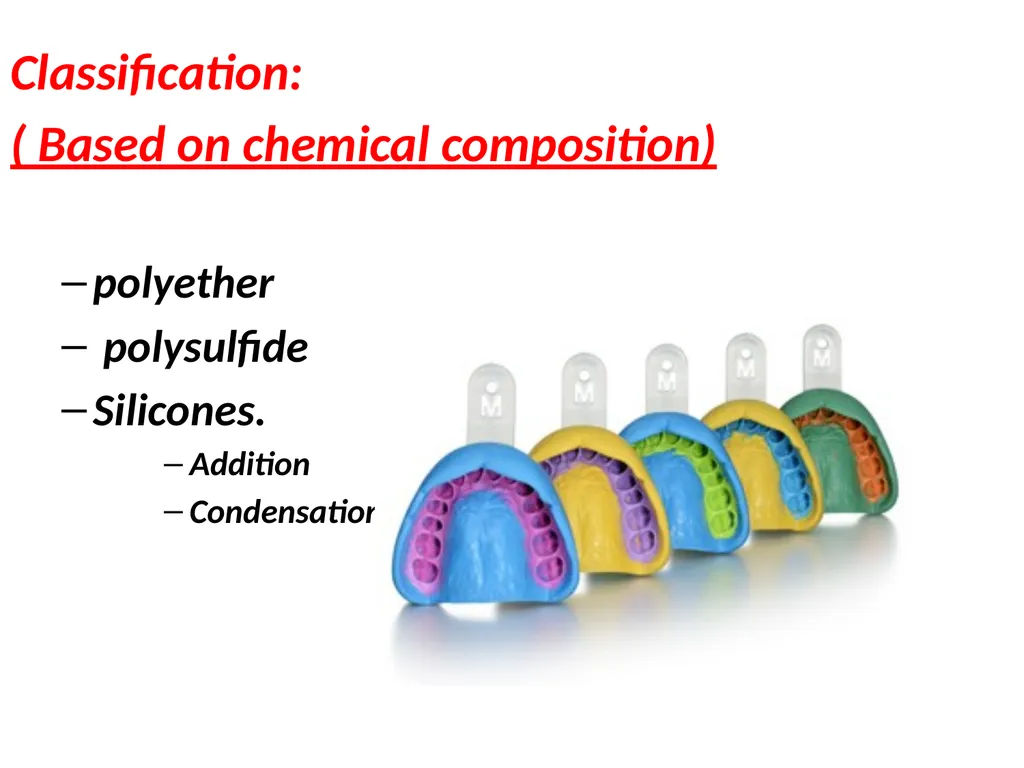
slide4. Classification:
( Based on chemical composition)
polyether
polysulfide
Silicones.
Addition
Condensation.<br>
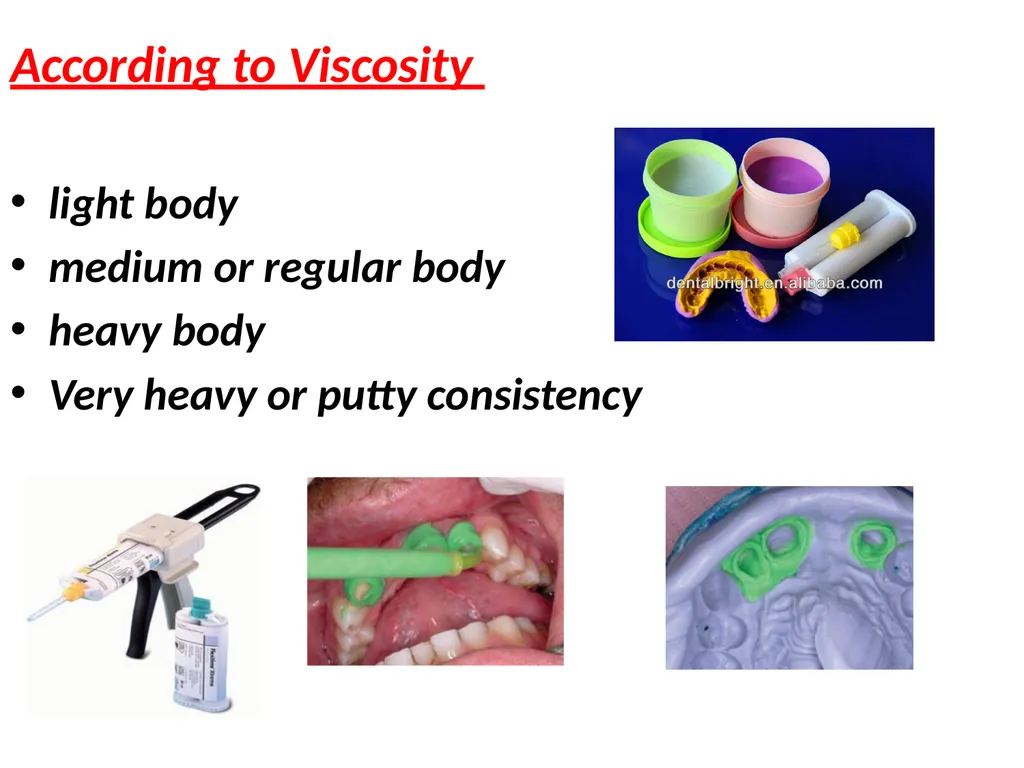
slide5. According to Viscosity
light body
medium or regular body
heavy body
Very heavy or putty consistency<br>
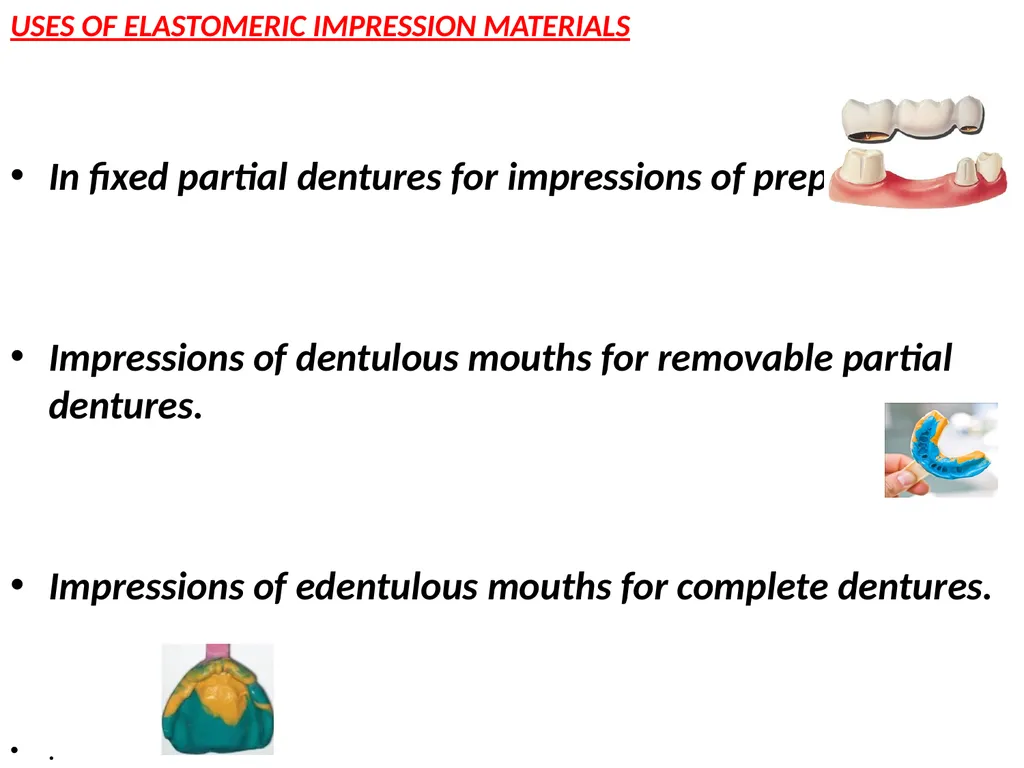
slide6. USES OF ELASTOMERIC IMPRESSION MATERIALS
In fixed partial dentures for impressions of prepared teeth.
Impressions of dentulous mouths for removable partial dentures.
Impressions of edentulous mouths for complete dentures.
.<br>
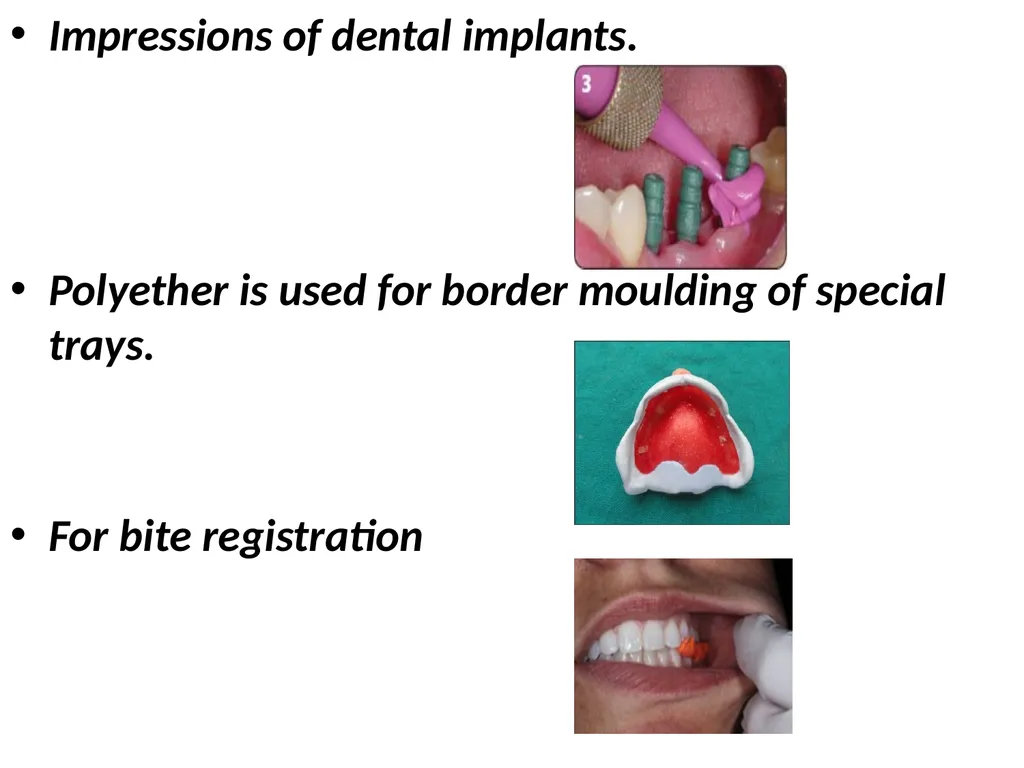
slide7. Impressions of dental implants.
Polyether is used for border moulding of special trays.
For bite registration Impressions of dental implants. Impressions of dental implants.
Polyether is used for border moulding of special trays.
For bite registration Impressions of dental implants.
Polyether is used for border moulding of special trays.
For bite registration
Polyether is used for border moulding of special trays.
For bite registration<br>
slide8. Supplied as
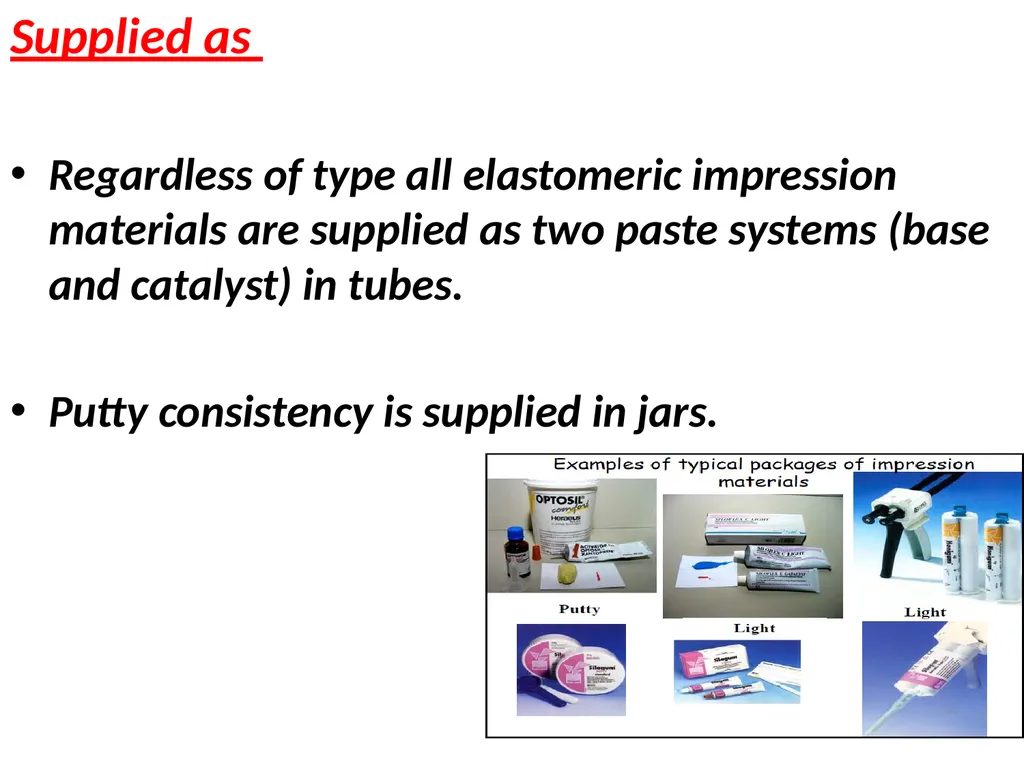
Regardless of type all elastomeric impression materials are supplied as two paste systems (base and catalyst) in tubes.
Putty consistency is supplied in jars.<br>
slide9. General properties of elastomeric materials
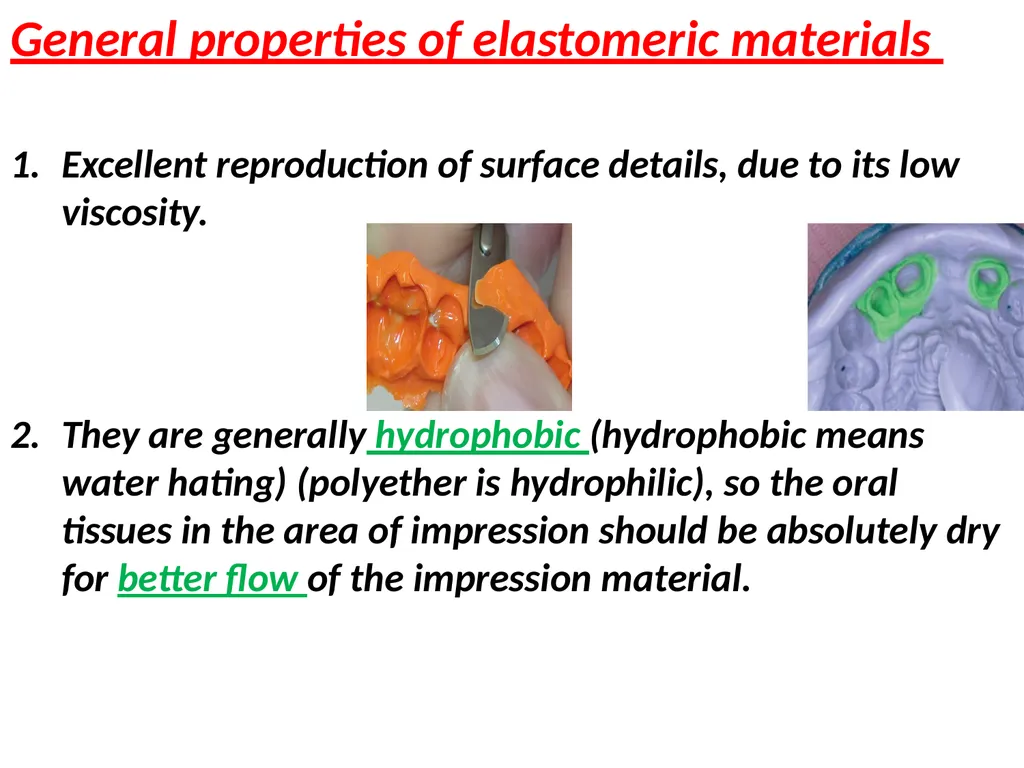
Excellent reproduction of surface details, due to its low viscosity.
They are generally hydrophobic (hydrophobic means water hating) (polyether is hydrophilic), so the oral tissues in the area of impression should be absolutely dry for better flow of the impression material.<br>
slide10. 3. Elastic properties of elastomers are good
(but elastic recovery is not complete). Repeated
pouring of impression is possible.
Coefficient of thermal expansion of elastomers is high.
Thermal contraction in set material occurs when impression is transferred from mouth to room temperature.<br>
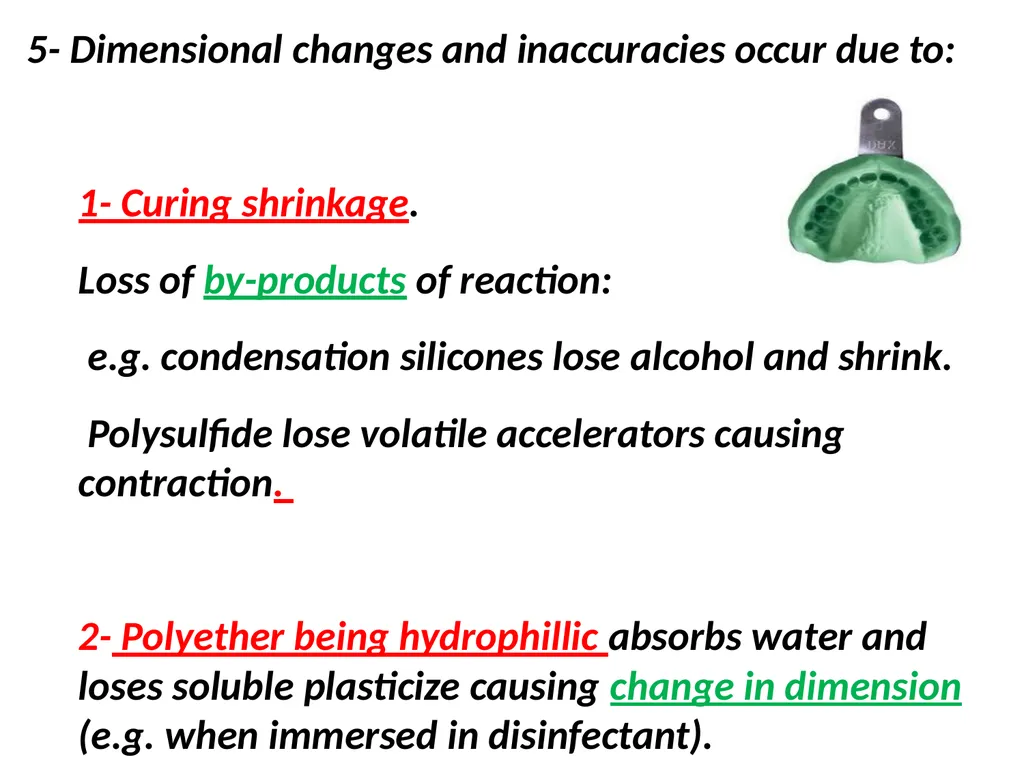
slide11. 5- Dimensional changes and inaccuracies occur due to:
1- Curing shrinkage.
Loss of by-products of reaction:
e.g. condensation silicones lose alcohol and shrink.
Polysulfide lose volatile accelerators causing contraction.
2- Polyether being hydrophillic absorbs water and loses soluble plasticize causing change in dimension (e.g. when immersed in disinfectant).<br>
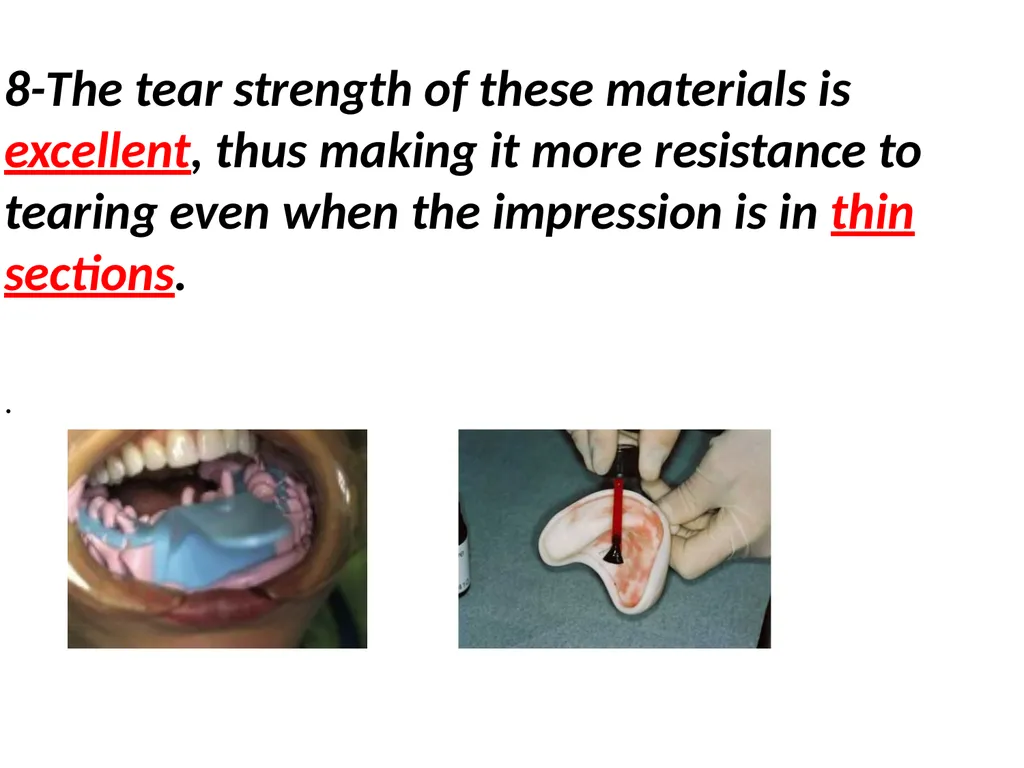
slide12. 6- Good adhesions of impression to the tray (with the help of adhesives) minimize dimensional changes as the shrinkage is directed towards the tray.
7--Time of pouring: impression should be poured after elastic recovery but before dimensional changes set in<br>
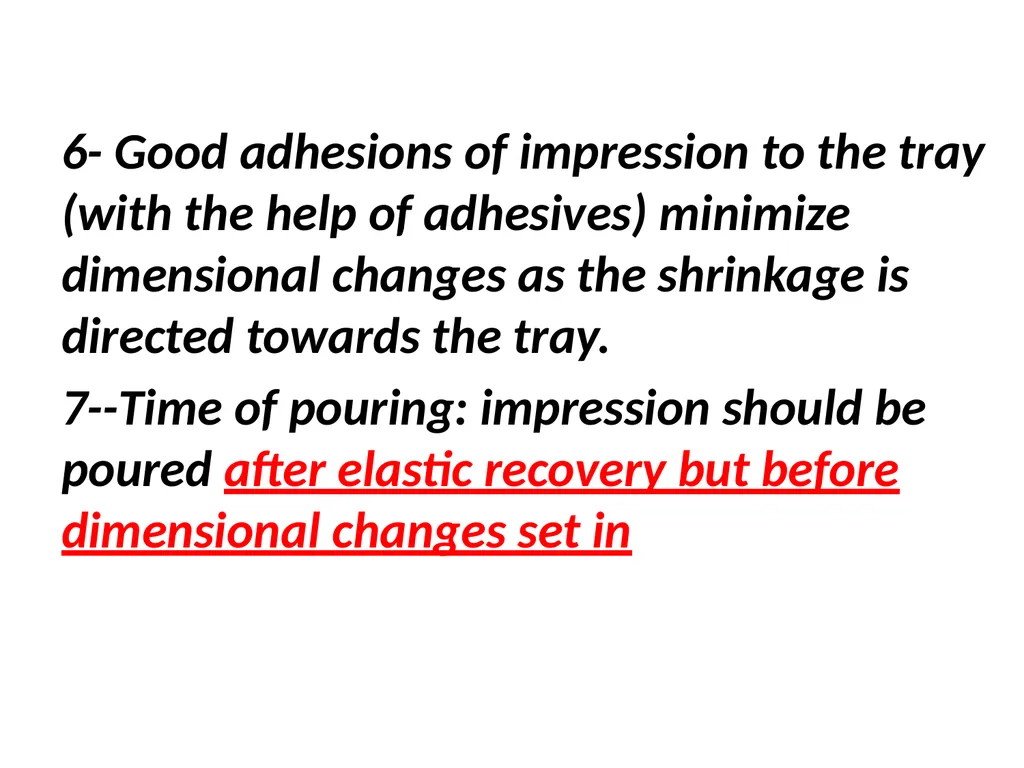
slide13. 8-The tear strength of these materials is excellent, thus making it more resistance to tearing even when the impression is in thin sections.
.<br>
slide14. Many of the properties of these products are
directly related to the amount of filler incorporated
in the pastes.
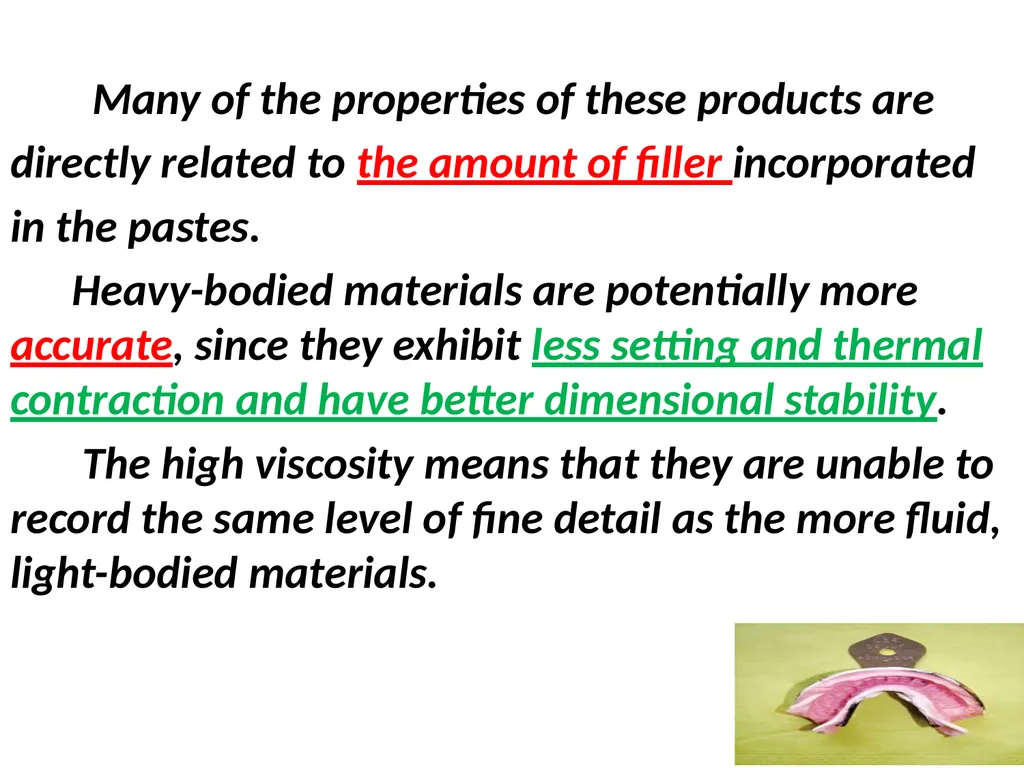
Heavy-bodied materials are potentially more accurate, since they exhibit less setting and thermal contraction and have better dimensional stability.
The high viscosity means that they are unable to record the same level of fine detail as the more fluid, light-bodied materials.<br>
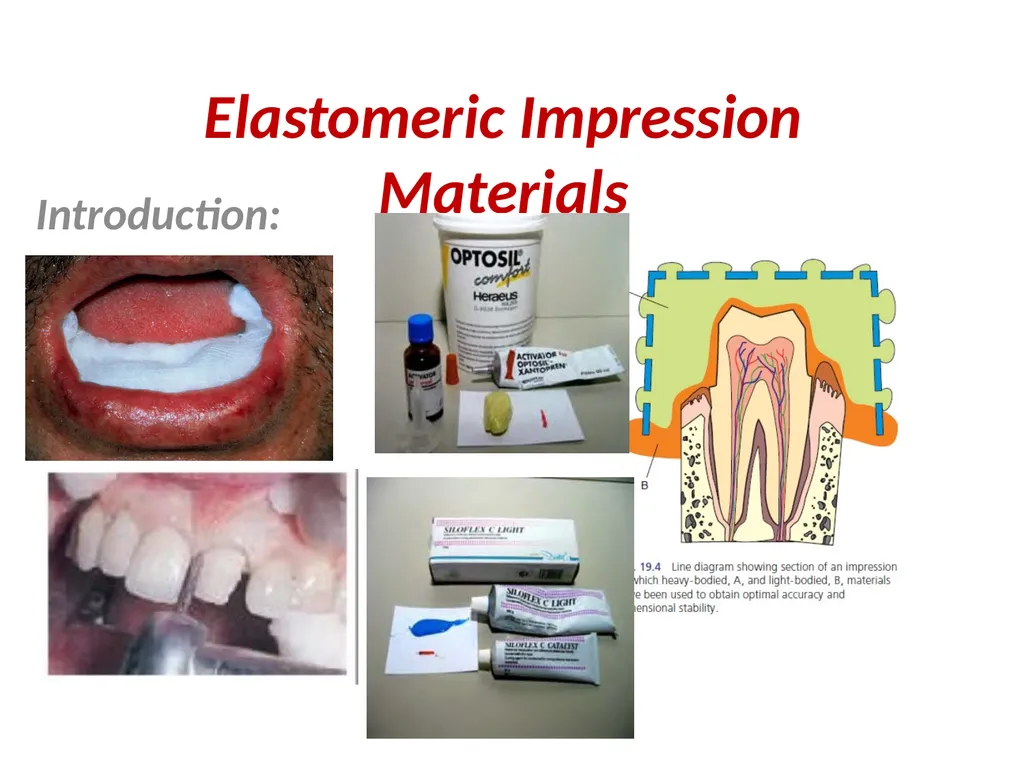
slide15. Elastomeric Impression Materials Introduction:<br>
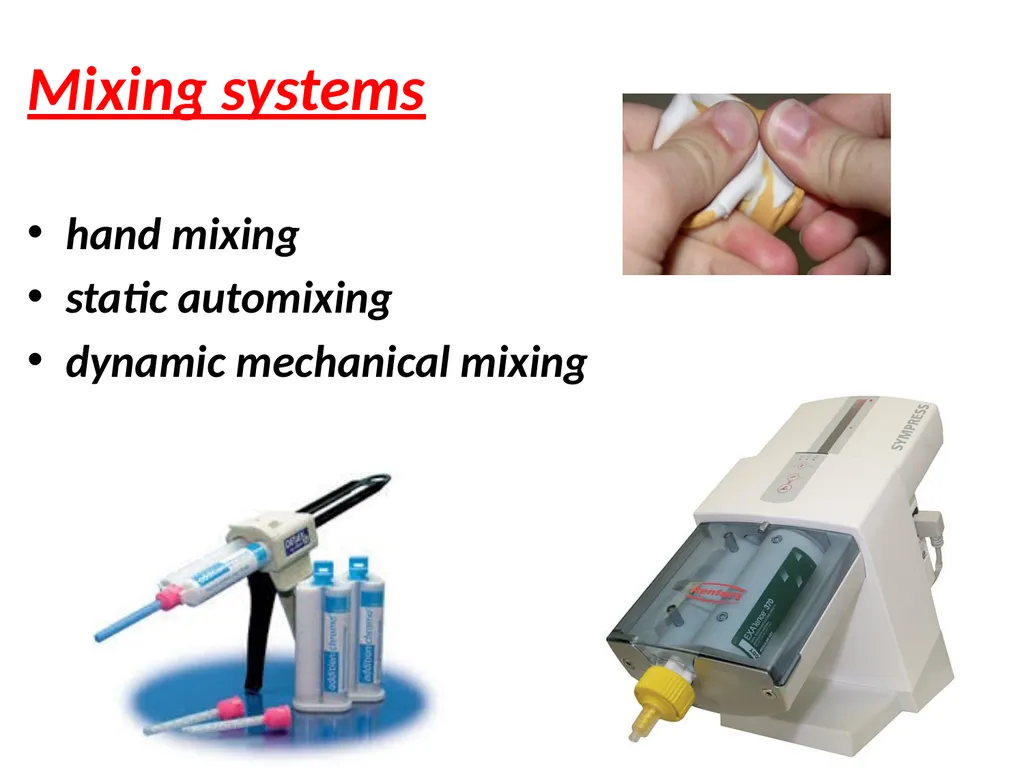
slide16. Mixing systems
hand mixing
static automixing
dynamic mechanical mixing<br>
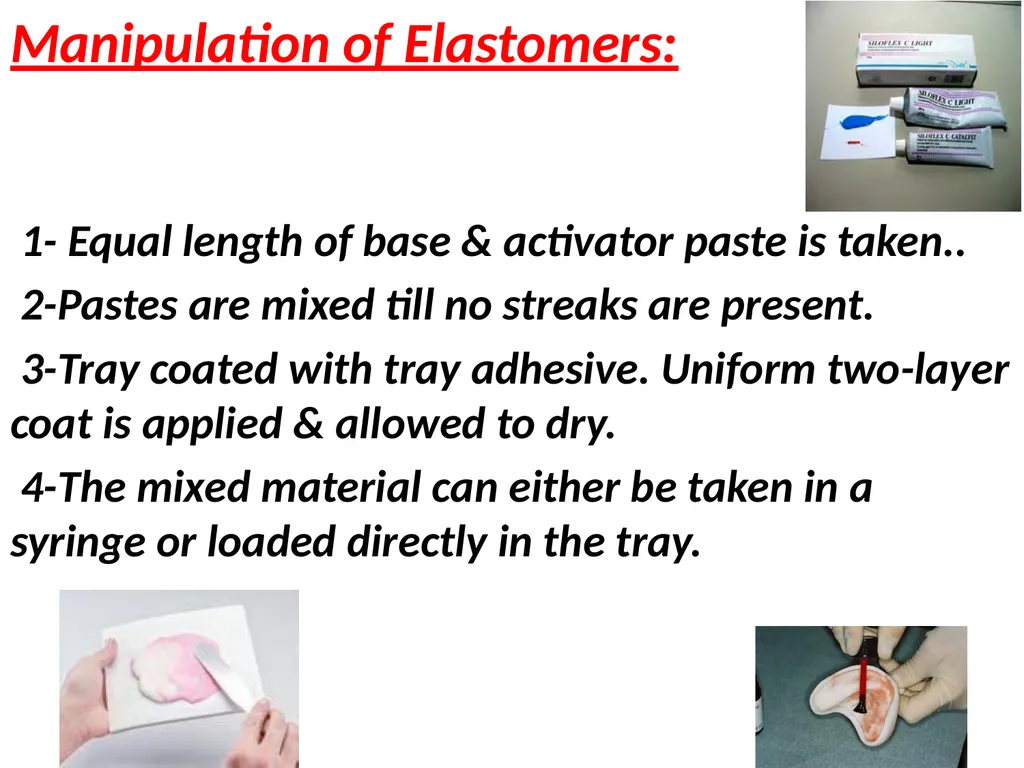
slide17. Manipulation of Elastomers:
1- Equal length of base & activator paste is taken..
2-Pastes are mixed till no streaks are present.
3-Tray coated with tray adhesive. Uniform two-layer coat is applied & allowed to dry.
4-The mixed material can either be taken in a syringe or loaded directly in the tray.<br>
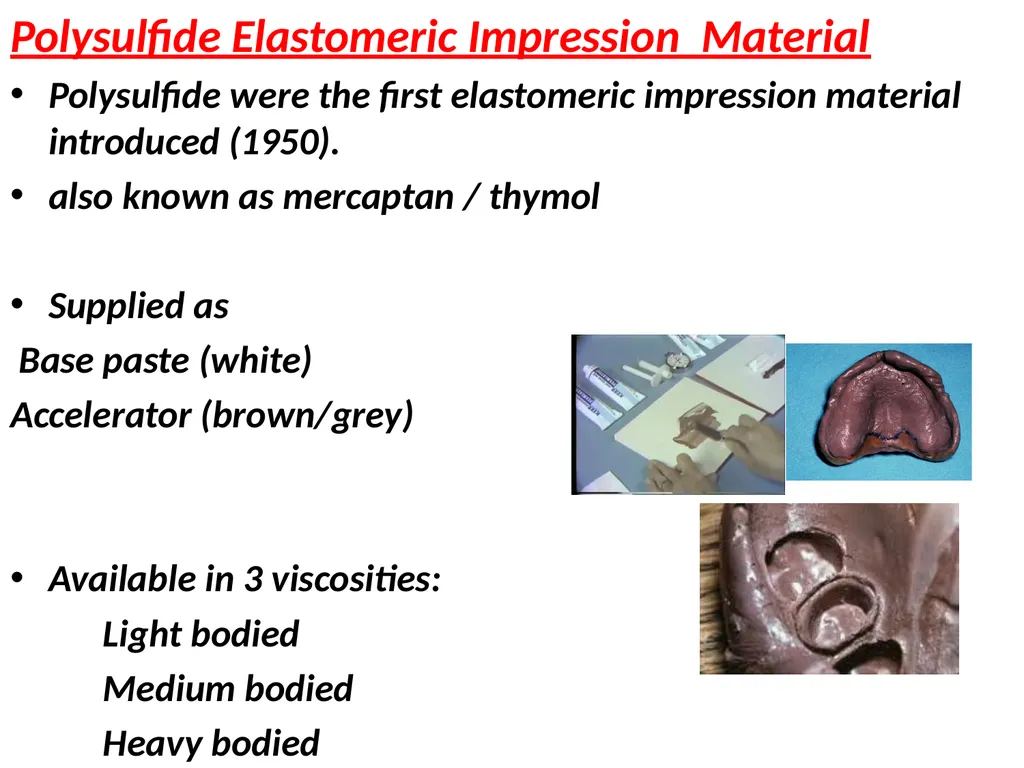
slide18. Polysulfide Elastomeric Impression Material
Polysulfide were the first elastomeric impression material introduced (1950).
also known as mercaptan / thymol
Supplied as
Base paste (white)
Accelerator (brown/grey)
Available in 3 viscosities:
Light bodied
Medium bodied
Heavy bodied<br>
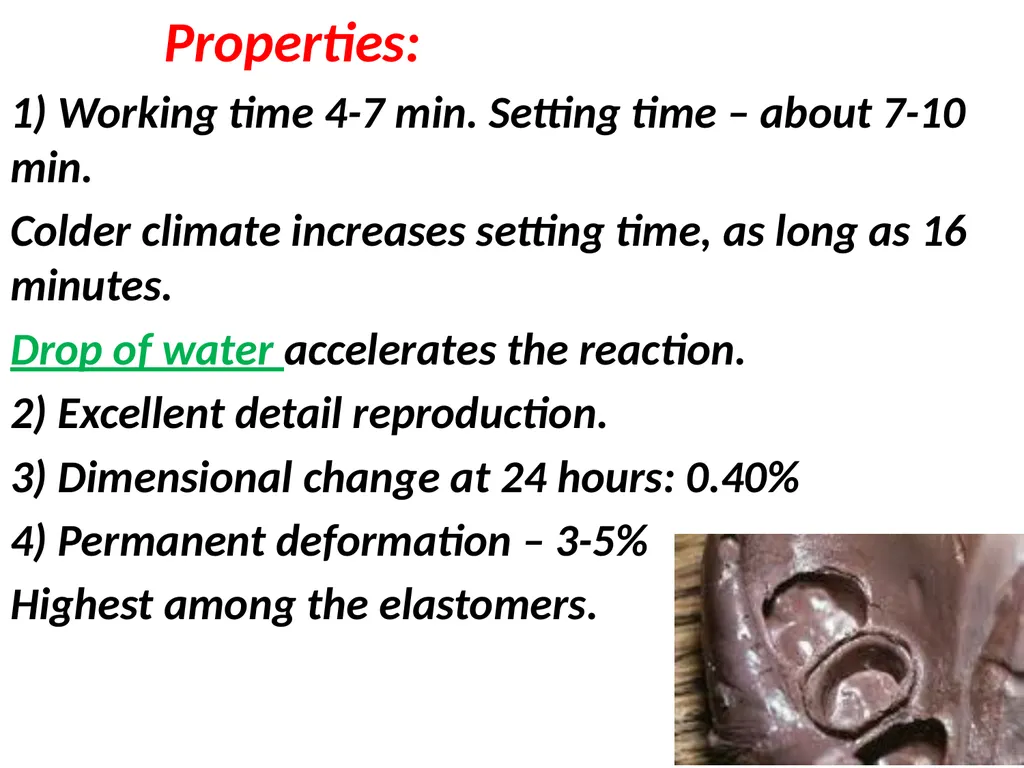
slide19. Properties:
1) Working time 4-7 min. Setting time – about 7-10 min.
Colder climate increases setting time, as long as 16 minutes.
Drop of water accelerates the reaction.
2) Excellent detail reproduction.
3) Dimensional change at 24 hours: 0.40%
4) Permanent deformation – 3-5%
Highest among the elastomers.<br>
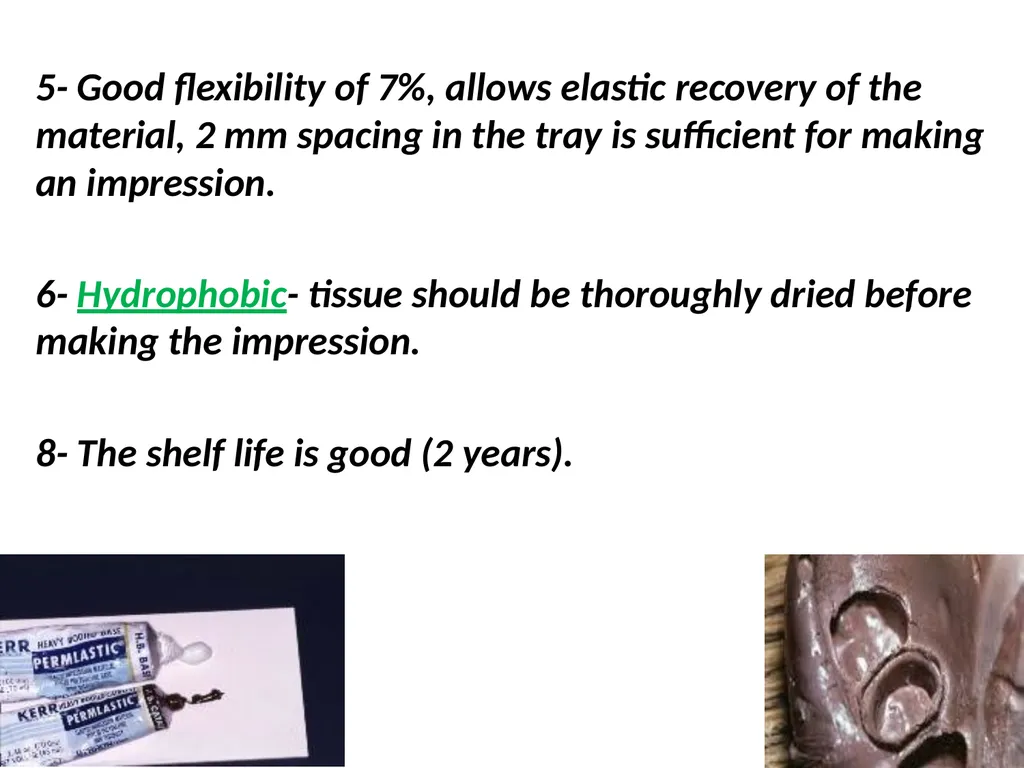
slide20. 5- Good flexibility of 7%, allows elastic recovery of the material, 2 mm spacing in the tray is sufficient for making an impression.
6- Hydrophobic- tissue should be thoroughly dried before making the impression.
8- The shelf life is good (2 years).<br>
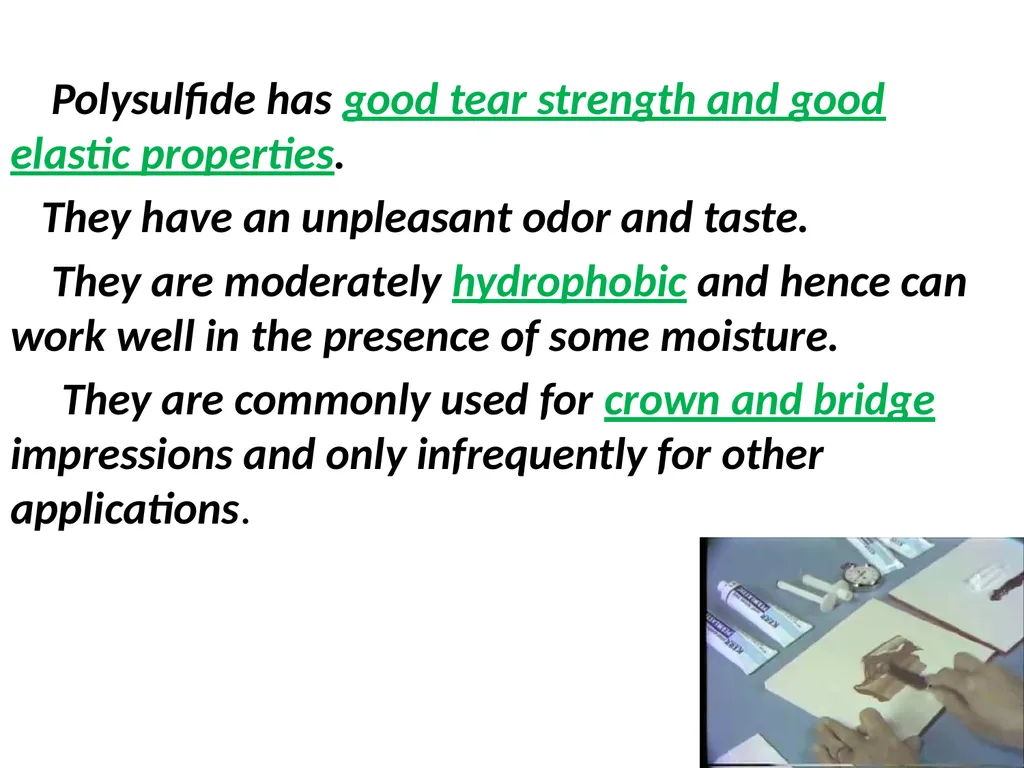
slide21. Polysulfide has good tear strength and good elastic properties.
They have an unpleasant odor and taste.
They are moderately hydrophobic and hence can work well in the presence of some moisture.
They are commonly used for crown and bridge impressions and only infrequently for other applications.<br>
slide22. Advantages
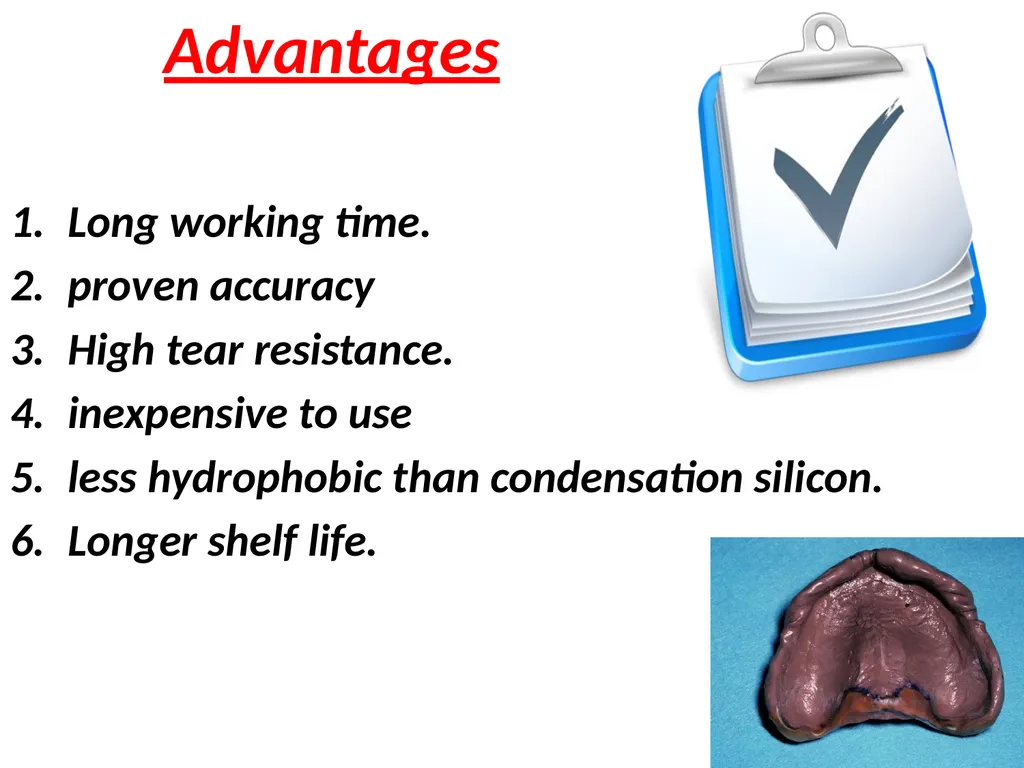
Long working time.
proven accuracy
High tear resistance.
inexpensive to use
less hydrophobic than condensation silicon.
Longer shelf life.<br>
slide23. Disadvantages:
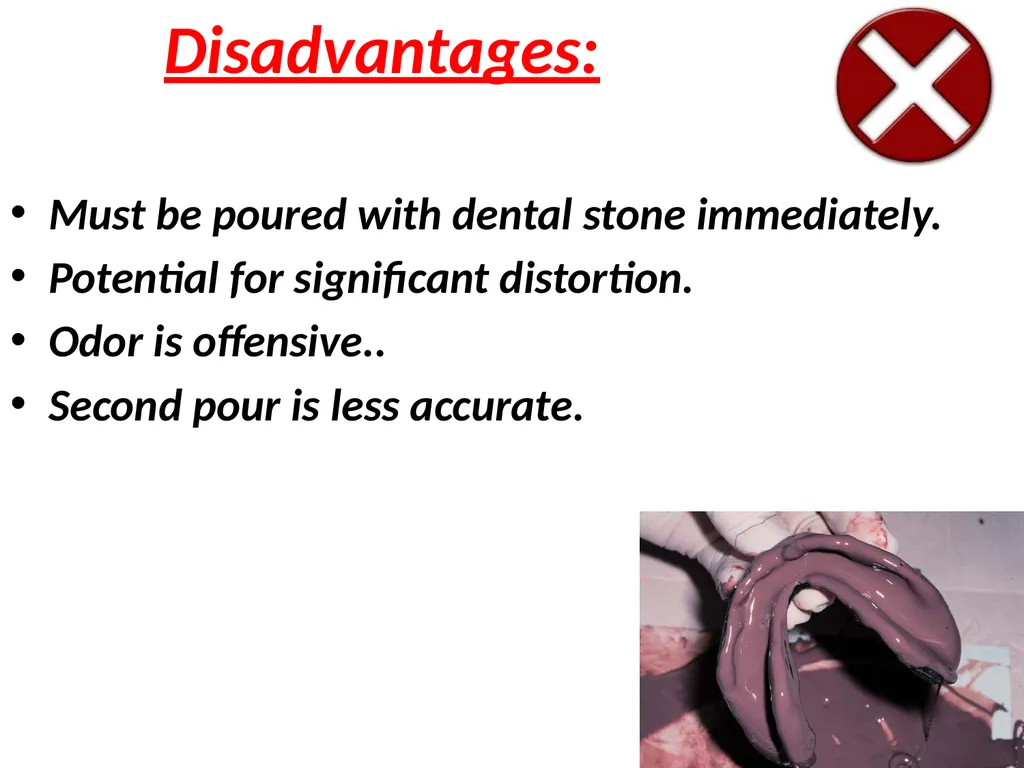
Must be poured with dental stone immediately.
Potential for significant distortion.
Odor is offensive..
Second pour is less accurate.<br>
slide24. Any questions?<br>
Lecture (8)<br>
slide2. 2. Elastic:
Elastic impression materials are those that remain in an elastic or flexible state after they have set and have been removed from the mouth.
*Hydrocolloid:
Reversible {e.g. Agar}
Irreversible {e.g. Alginate}
*Elastomeric impression materials
{E.g. Polysulfide, Polyether, Addition
silicones, Condensation silicones}<br>
slide3. ELASTOMERIC IMPRESSION MATERIALS
Basically synthetic rubbers.
Initially they were called rubber impression materials.
Currently known as elastomeric dental impression materials.<br>
slide4. Classification:
( Based on chemical composition)
polyether
polysulfide
Silicones.
Addition
Condensation.<br>
slide5. According to Viscosity
light body
medium or regular body
heavy body
Very heavy or putty consistency<br>
slide6. USES OF ELASTOMERIC IMPRESSION MATERIALS
In fixed partial dentures for impressions of prepared teeth.
Impressions of dentulous mouths for removable partial dentures.
Impressions of edentulous mouths for complete dentures.
.<br>
slide7. Impressions of dental implants.
Polyether is used for border moulding of special trays.
For bite registration Impressions of dental implants. Impressions of dental implants.
Polyether is used for border moulding of special trays.
For bite registration Impressions of dental implants.
Polyether is used for border moulding of special trays.
For bite registration
Polyether is used for border moulding of special trays.
For bite registration<br>
slide8. Supplied as
Regardless of type all elastomeric impression materials are supplied as two paste systems (base and catalyst) in tubes.
Putty consistency is supplied in jars.<br>
slide9. General properties of elastomeric materials
Excellent reproduction of surface details, due to its low viscosity.
They are generally hydrophobic (hydrophobic means water hating) (polyether is hydrophilic), so the oral tissues in the area of impression should be absolutely dry for better flow of the impression material.<br>
slide10. 3. Elastic properties of elastomers are good
(but elastic recovery is not complete). Repeated
pouring of impression is possible.
Coefficient of thermal expansion of elastomers is high.
Thermal contraction in set material occurs when impression is transferred from mouth to room temperature.<br>
slide11. 5- Dimensional changes and inaccuracies occur due to:
1- Curing shrinkage.
Loss of by-products of reaction:
e.g. condensation silicones lose alcohol and shrink.
Polysulfide lose volatile accelerators causing contraction.
2- Polyether being hydrophillic absorbs water and loses soluble plasticize causing change in dimension (e.g. when immersed in disinfectant).<br>
slide12. 6- Good adhesions of impression to the tray (with the help of adhesives) minimize dimensional changes as the shrinkage is directed towards the tray.
7--Time of pouring: impression should be poured after elastic recovery but before dimensional changes set in<br>
slide13. 8-The tear strength of these materials is excellent, thus making it more resistance to tearing even when the impression is in thin sections.
.<br>
slide14. Many of the properties of these products are
directly related to the amount of filler incorporated
in the pastes.
Heavy-bodied materials are potentially more accurate, since they exhibit less setting and thermal contraction and have better dimensional stability.
The high viscosity means that they are unable to record the same level of fine detail as the more fluid, light-bodied materials.<br>
slide15. Elastomeric Impression Materials Introduction:<br>
slide16. Mixing systems
hand mixing
static automixing
dynamic mechanical mixing<br>
slide17. Manipulation of Elastomers:
1- Equal length of base & activator paste is taken..
2-Pastes are mixed till no streaks are present.
3-Tray coated with tray adhesive. Uniform two-layer coat is applied & allowed to dry.
4-The mixed material can either be taken in a syringe or loaded directly in the tray.<br>
slide18. Polysulfide Elastomeric Impression Material
Polysulfide were the first elastomeric impression material introduced (1950).
also known as mercaptan / thymol
Supplied as
Base paste (white)
Accelerator (brown/grey)
Available in 3 viscosities:
Light bodied
Medium bodied
Heavy bodied<br>
slide19. Properties:
1) Working time 4-7 min. Setting time – about 7-10 min.
Colder climate increases setting time, as long as 16 minutes.
Drop of water accelerates the reaction.
2) Excellent detail reproduction.
3) Dimensional change at 24 hours: 0.40%
4) Permanent deformation – 3-5%
Highest among the elastomers.<br>
slide20. 5- Good flexibility of 7%, allows elastic recovery of the material, 2 mm spacing in the tray is sufficient for making an impression.
6- Hydrophobic- tissue should be thoroughly dried before making the impression.
8- The shelf life is good (2 years).<br>
slide21. Polysulfide has good tear strength and good elastic properties.
They have an unpleasant odor and taste.
They are moderately hydrophobic and hence can work well in the presence of some moisture.
They are commonly used for crown and bridge impressions and only infrequently for other applications.<br>
slide22. Advantages
Long working time.
proven accuracy
High tear resistance.
inexpensive to use
less hydrophobic than condensation silicon.
Longer shelf life.<br>
slide23. Disadvantages:
Must be poured with dental stone immediately.
Potential for significant distortion.
Odor is offensive..
Second pour is less accurate.<br>
slide24. Any questions?<br>