
ELC Meeting Program Theme Abstracts Speakers
Description: ELC Meeting Program Theme Abstracts Speakers MOCSIGsFellows May 27, 2014 Leadership and Innovation in Radically Changing Times There is an emerging and new collaborative ecosystem that is radically changing how people work and who they
Related Topics
Download Presentation
"ELC Meeting Program Theme Abstracts Speakers" is the property of its rightful owner. Permission is granted to download and print the materials on this website for personal, non-commercial use only, and to display it on your personal computer provided you do not modify the materials and that you retain all copyright notices contained in the materials. By downloading content from our website, you accept the terms of this agreement.
Presentation Transcript
slide1. ELC Meeting
Program Theme
Abstracts
Speakers
MOC/SIG’s/Fellows
May 27, 2014<br>
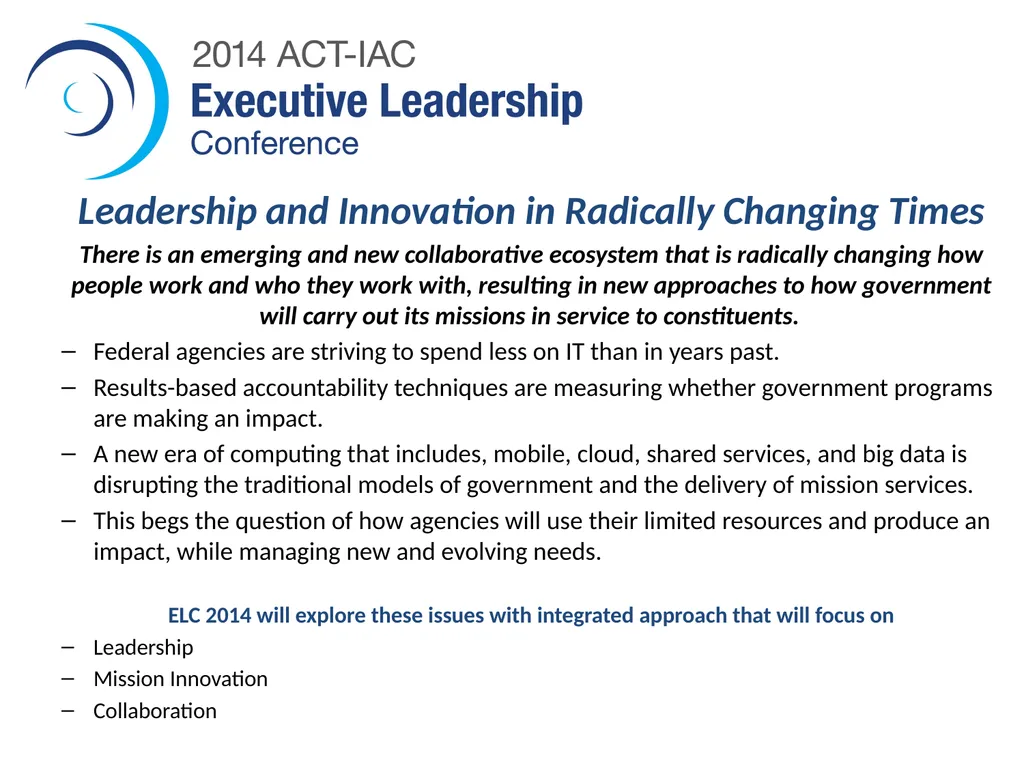
slide2. Leadership and Innovation in Radically Changing Times
There is an emerging and new collaborative ecosystem that is radically changing how people work and who they work with, resulting in new approaches to how government will carry out its missions in service to constituents.
Federal agencies are striving to spend less on IT than in years past.
Results-based accountability techniques are measuring whether government programs are making an impact.
A new era of computing that includes, mobile, cloud, shared services, and big data is disrupting the traditional models of government and the delivery of mission services.
This begs the question of how agencies will use their limited resources and produce an impact, while managing new and evolving needs.
ELC 2014 will explore these issues with integrated approach that will focus on
Leadership
Mission Innovation
Collaboration<br>
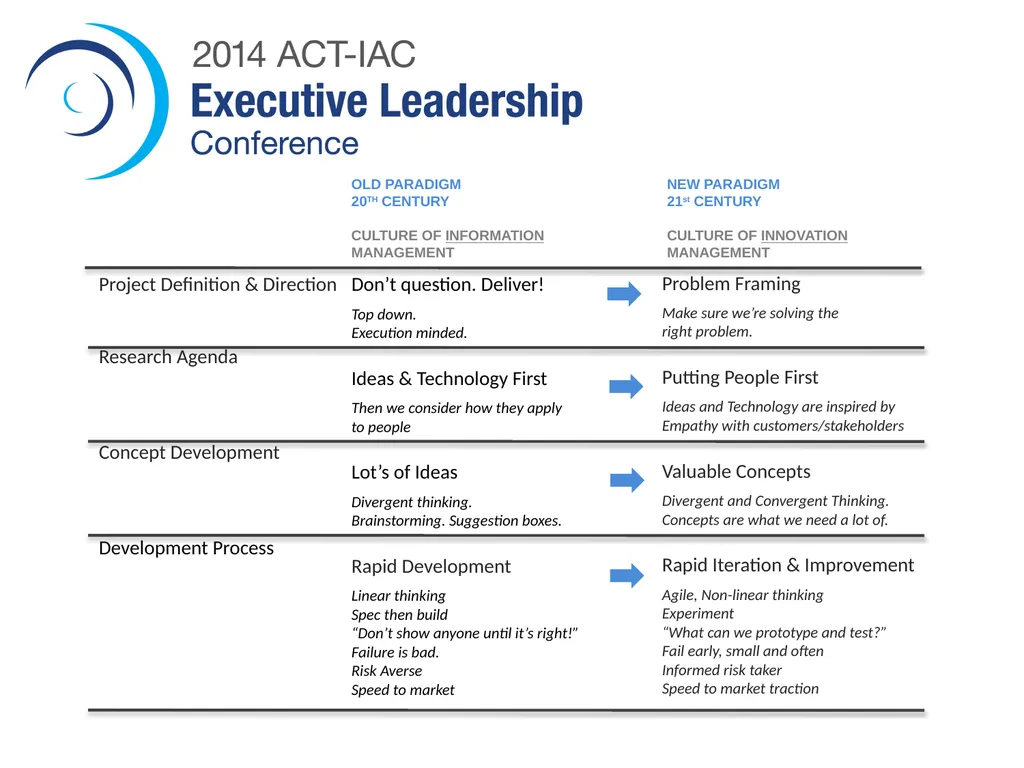
slide3. OLD PARADIGM
20TH CENTURY
CULTURE OF INFORMATION MANAGEMENT Project Definition & Direction
Research Agenda
Concept Development
Development Process Don’t question. Deliver!
Top down.
Execution minded.
Ideas & Technology First
Then we consider how they apply
to people
Lot’s of Ideas
Divergent thinking.
Brainstorming. Suggestion boxes.
Rapid Development
Linear thinking
Spec then build
“Don’t show anyone until it’s right!”
Failure is bad.
Risk Averse
Speed to market Problem Framing
Make sure we’re solving the
right problem.
Putting People First
Ideas and Technology are inspired by
Empathy with customers/stakeholders
Valuable Concepts
Divergent and Convergent Thinking.
Concepts are what we need a lot of.
Rapid Iteration & Improvement
Agile, Non-linear thinking
Experiment
“What can we prototype and test?”
Fail early, small and often
Informed risk taker
Speed to market traction NEW PARADIGM
21st CENTURY
CULTURE OF INNOVATION MANAGEMENT<br>
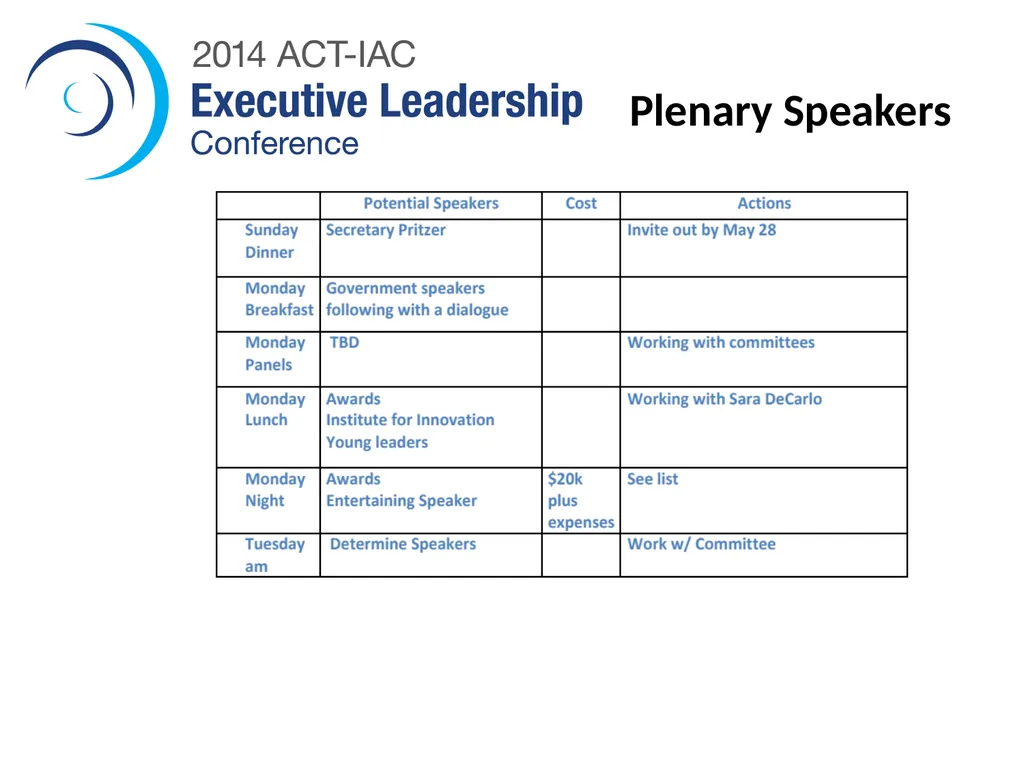
slide4. Plenary Speakers<br>
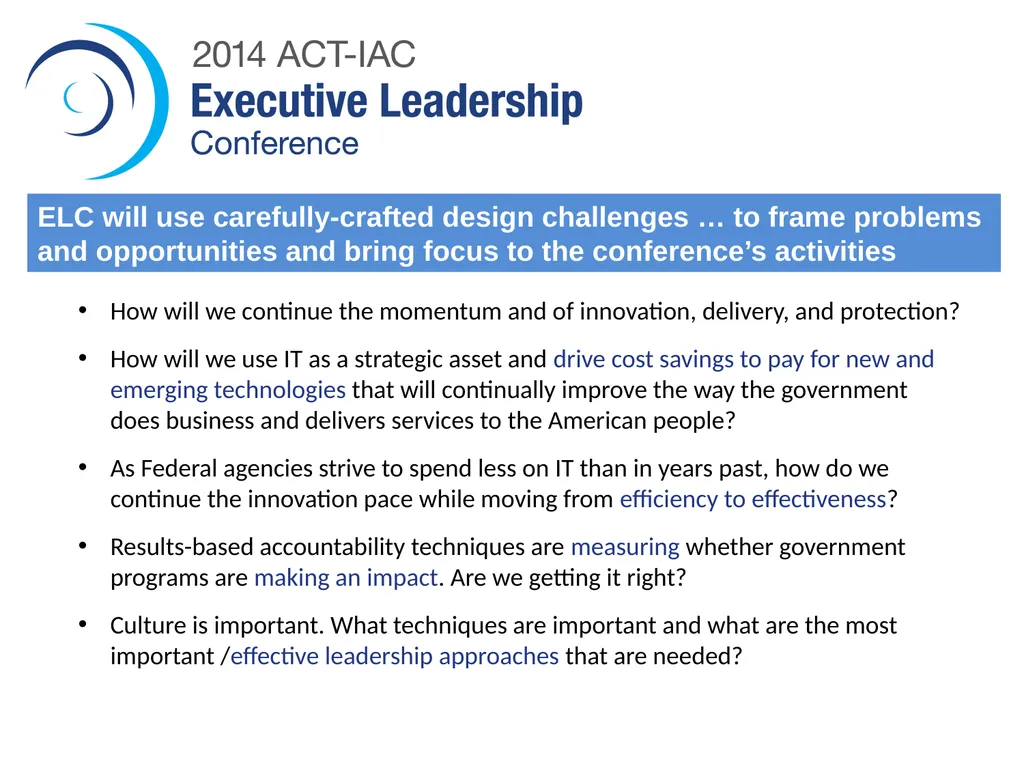
slide5. How will we continue the momentum and of innovation, delivery, and protection?
How will we use IT as a strategic asset and drive cost savings to pay for new and emerging technologies that will continually improve the way the government does business and delivers services to the American people?
As Federal agencies strive to spend less on IT than in years past, how do we continue the innovation pace while moving from efficiency to effectiveness?
Results-based accountability techniques are measuring whether government programs are making an impact. Are we getting it right?
Culture is important. What techniques are important and what are the most important /effective leadership approaches that are needed? ELC will use carefully-crafted design challenges … to frame problems and opportunities and bring focus to the conference’s activities<br>
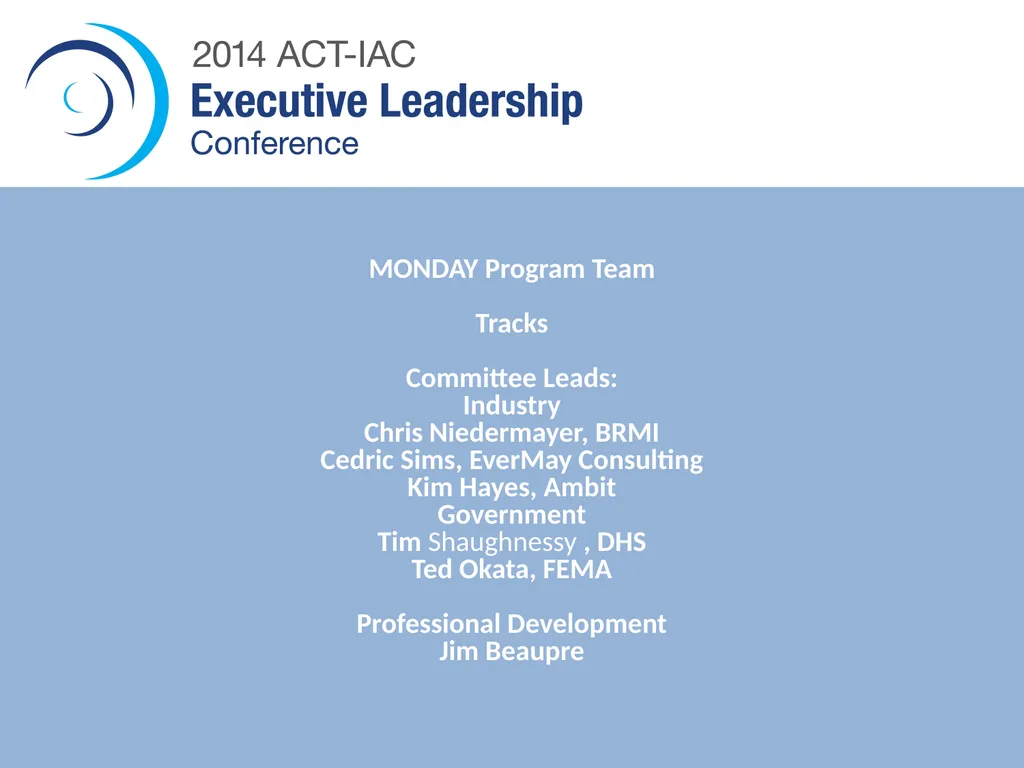
slide6. MONDAY Program Team
Tracks
Committee Leads:
Industry
Chris Niedermayer, BRMI
Cedric Sims, EverMay Consulting
Kim Hayes, Ambit
Government
Tim Shaughnessy , DHS
Ted Okata, FEMA
Professional Development
Jim Beaupre<br>
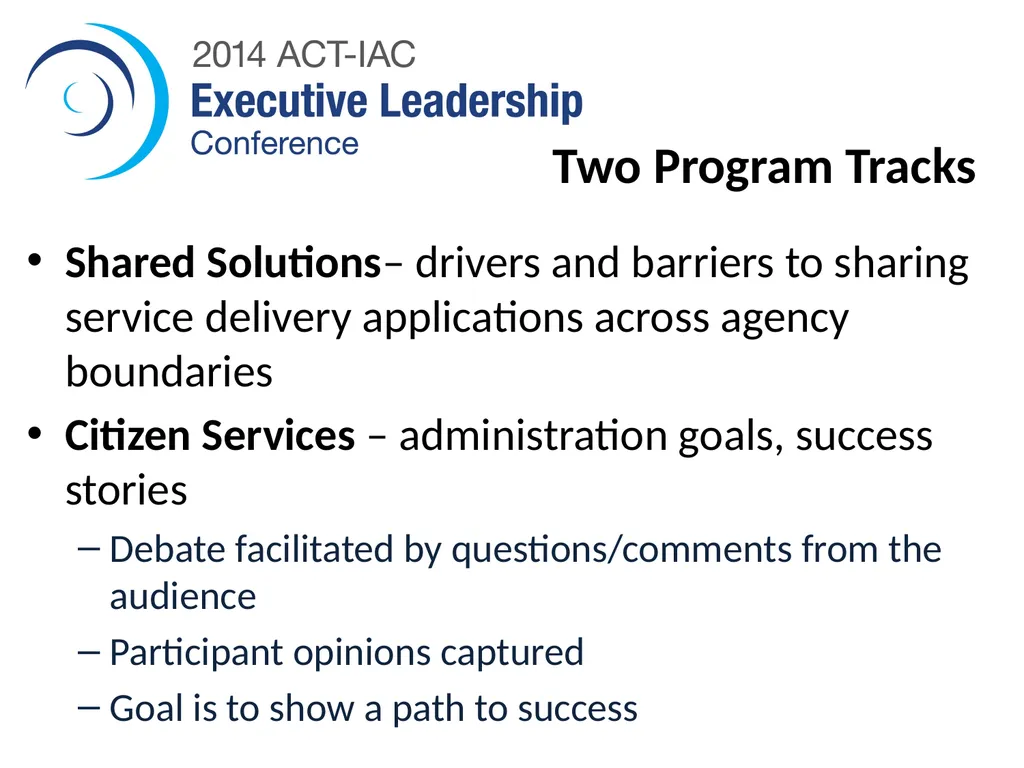
slide7. Two Program Tracks Shared Solutions– drivers and barriers to sharing service delivery applications across agency boundaries
Citizen Services – administration goals, success stories
Debate facilitated by questions/comments from the audience
Participant opinions captured
Goal is to show a path to success<br>
slide8. Shared Solutions Track Abstract An alarming majority of the federal government’s $80B IT budget is allocated to traditional O&M functions. O&M costs for maintaining agency administrative and service delivery applications are duplicated in countless agency budgets because many agencies perform similar functions and maintain separate applications to support them. These include banking and finance functions, disaster response, information exchange, identity and access management, and many others. Current costs to maintain individual agency solutions are not sustainable from a long-term budget standpoint and stifle investments in innovation, including improving the citizen experience. This track will highlight industry and agency leaders who will debate the benefits and barriers to cross-agency solution sharing within the dimensions of leadership and program management, acquisition, and technology. Attendees will share their views on ways to address application sharing challenges. Attendee views will be used to illustrate methods for successfully increasing solution sharing.<br>
slide9. Citizen Services Citizen expectations for government services are continually increasing, driven by improvements in technology and the high quality services provided by the private sector. And in times of emergency, both citizens and the agencies who serve them need to be able to understand the resources available to them in a safe and secure way anytime, anywhere, quickly and easily on any device.
Technology is one of the critical components to accomplish this goal. Under the President's Management Agenda (see Performance.gov) Customer Service is one of the Cross-Agency Priority (CAP) Goals, The stated goal is to: "Deliver world-class customer services to citizens by making it faster and easier for individuals and businesses to complete transactions and have a positive experience with government." This goal of improving customer service will be reached by 1) Streamlining transactions; 2) Developing standards for high impact services; and 3) Using technology to improve the customer experience. These are just a few of the ways that the government can improve service delivery. This track will contribute to building a customer service community for government by opening a dialog regarding best practices, standards, new technologies; what customer-centric services mean; and how to accomplish implementation of changes to improve customer service offerings.<br>
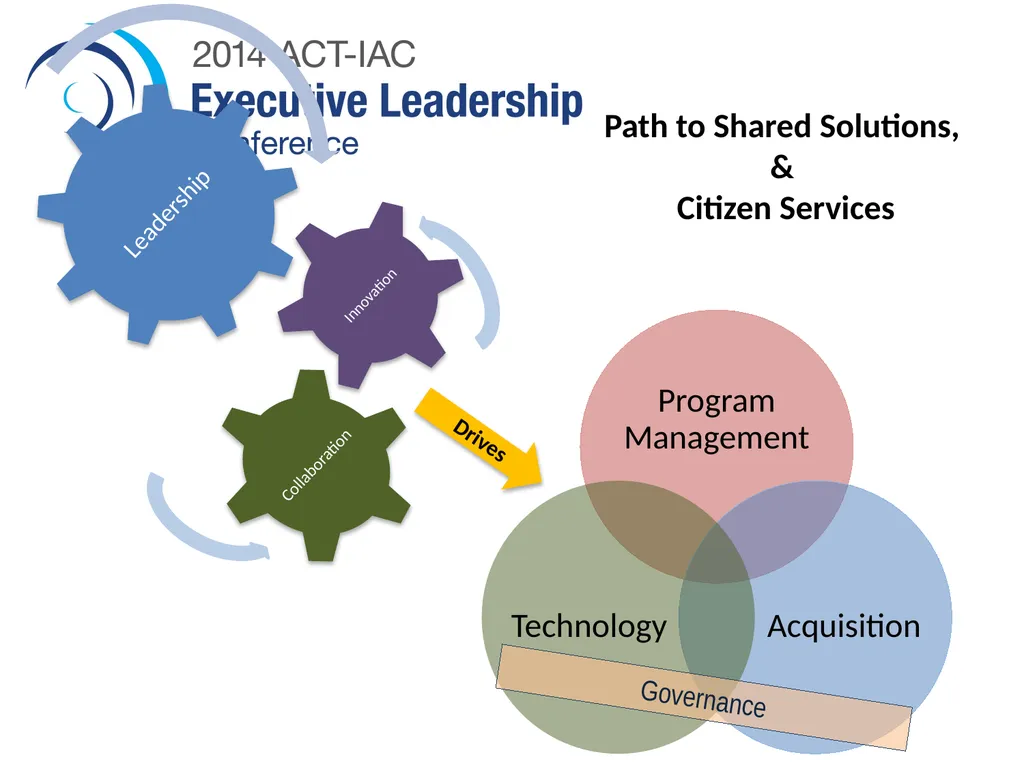
slide10. Path to Shared Solutions, & Citizen Services Governance<br>
slide11. Collaboration Committee
Committee Leads:
Susan Becker, VP Services Unisys
Corey Nickens, Group Manager, GSA FEDSIM
Joyce Hunter, Deputy CIO, Policy and Planning, U.S. Department of Agriculture
Andy Lieber, BD Hitachi Consulting<br>
slide12. Abstract
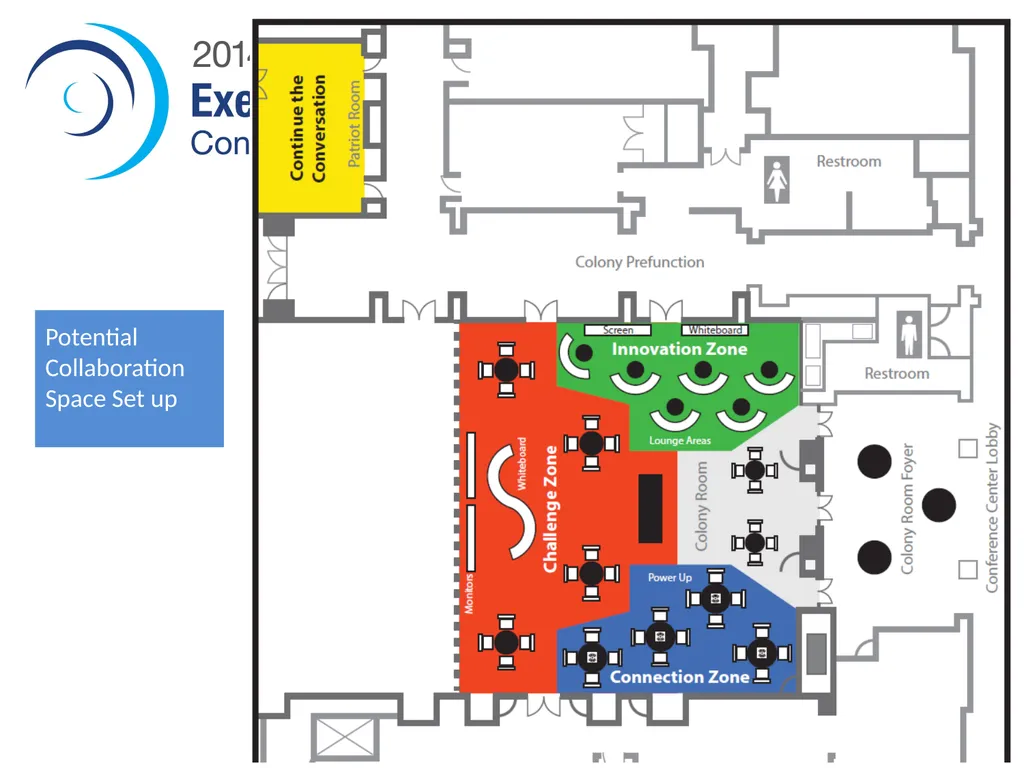
Come to the Collaboration Station, where you can share your ideas in the Challenge Zone, learn in the Innovation Zone, and Engage with your colleagues or recharge your batteries in the Connection Zone
Network and collaborate with other attendees, connect and “power up” (Connection Zone)
Contribute ideas for solving the “design challenges” that underpin the conference. Audience reaction collected, consolidated and reported in real-time (Challenge Zone)
Gather and learn about Government Innovation, and what others are sharing (Innovation Zone)
“Continue the Conversation” from Track Sessions, or Start a new one (Patriot Room) Collaboration Station<br>
slide13. Potential Collaboration Space Set up<br>
slide14. Tuesday Program
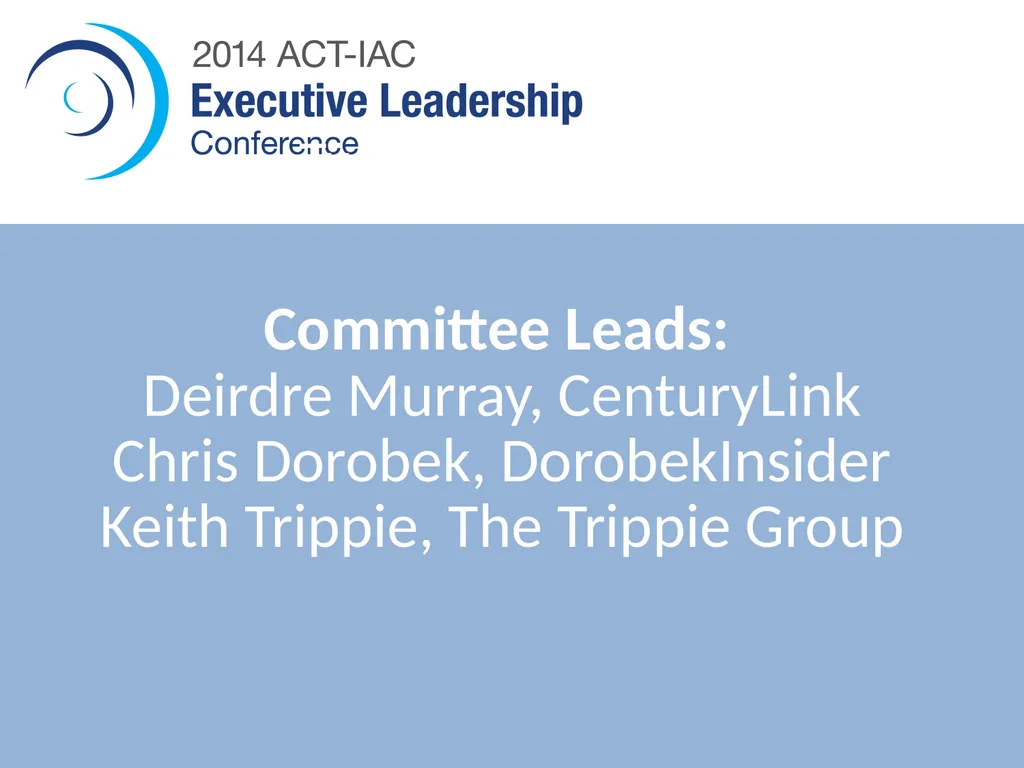
Committee Leads:
Deirdre Murray, CenturyLink
Chris Dorobek, DorobekInsider
Keith Trippie, The Trippie Group<br>
slide15. Tuesday Abstract ABSTRACT
ELC’s Tuesday “finale” will further the discussion on the new, emerging, and collaborative ecosystem that is changing how people work and who they work with – resulting in creative, new approaches to how government will carry out its mission and service to its constituents. Tuesday will continue to explore the issues of leadership, mission innovation and collaboration in an environment of fast-paced change and disruption of traditional models of government and delivery of mission services.
The Tuesday “finale” will combine the popular ELC format with new and innovative collaboration approaches. We’ll launch with a “Ted Talk” style, innovation thought leader and follow with the always-popular “CXO Town Hall” and government-industry roundtable discussions.
This creative format will provide a wealth of opportunities to engage in discussions and bring the energy and power of the crowd together in the ELC session “finale”.<br>
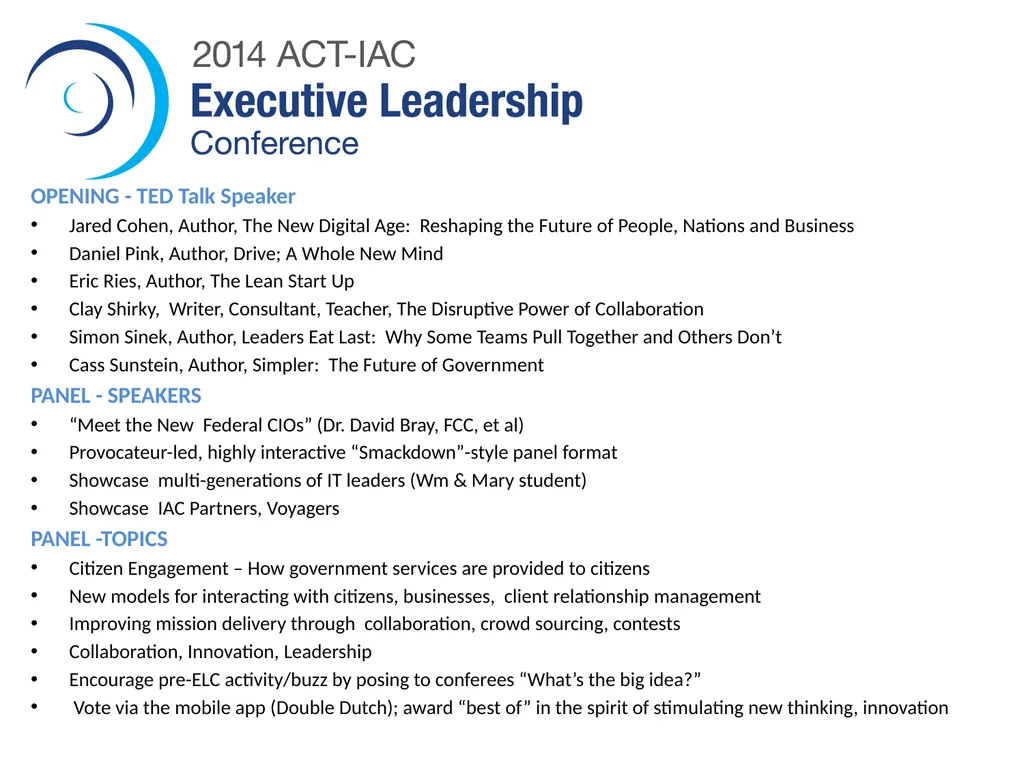
slide16. OPENING - TED Talk Speaker
Jared Cohen, Author, The New Digital Age: Reshaping the Future of People, Nations and Business
Daniel Pink, Author, Drive; A Whole New Mind
Eric Ries, Author, The Lean Start Up
Clay Shirky, Writer, Consultant, Teacher, The Disruptive Power of Collaboration
Simon Sinek, Author, Leaders Eat Last: Why Some Teams Pull Together and Others Don’t
Cass Sunstein, Author, Simpler: The Future of Government
PANEL - SPEAKERS
“Meet the New Federal CIOs” (Dr. David Bray, FCC, et al)
Provocateur-led, highly interactive “Smackdown”-style panel format
Showcase multi-generations of IT leaders (Wm & Mary student)
Showcase IAC Partners, Voyagers
PANEL -TOPICS
Citizen Engagement – How government services are provided to citizens
New models for interacting with citizens, businesses, client relationship management
Improving mission delivery through collaboration, crowd sourcing, contests
Collaboration, Innovation, Leadership
Encourage pre-ELC activity/buzz by posing to conferees “What’s the big idea?”
Vote via the mobile app (Double Dutch); award “best of” in the spirit of stimulating new thinking, innovation<br>
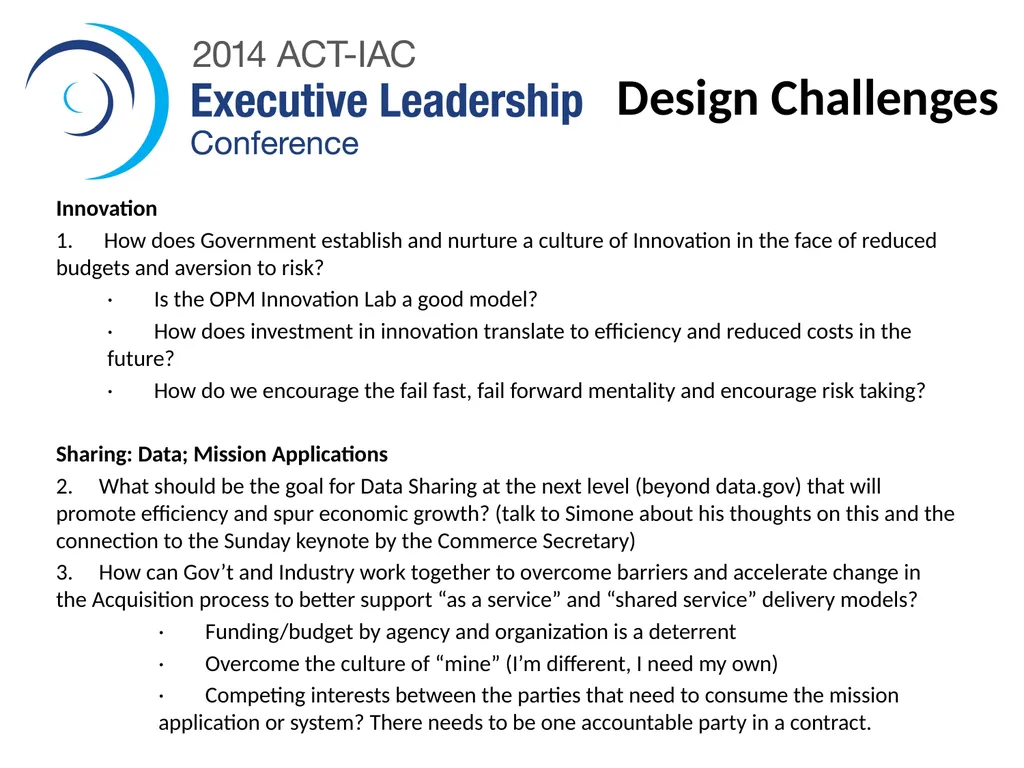
slide17. Design Challenges Innovation
1. How does Government establish and nurture a culture of Innovation in the face of reduced budgets and aversion to risk?
· Is the OPM Innovation Lab a good model?
· How does investment in innovation translate to efficiency and reduced costs in the future?
· How do we encourage the fail fast, fail forward mentality and encourage risk taking?
Sharing: Data; Mission Applications
2. What should be the goal for Data Sharing at the next level (beyond data.gov) that will promote efficiency and spur economic growth? (talk to Simone about his thoughts on this and the connection to the Sunday keynote by the Commerce Secretary)
3. How can Gov’t and Industry work together to overcome barriers and accelerate change in the Acquisition process to better support “as a service” and “shared service” delivery models?
· Funding/budget by agency and organization is a deterrent
· Overcome the culture of “mine” (I’m different, I need my own)
· Competing interests between the parties that need to consume the mission application or system? There needs to be one accountable party in a contract.<br>
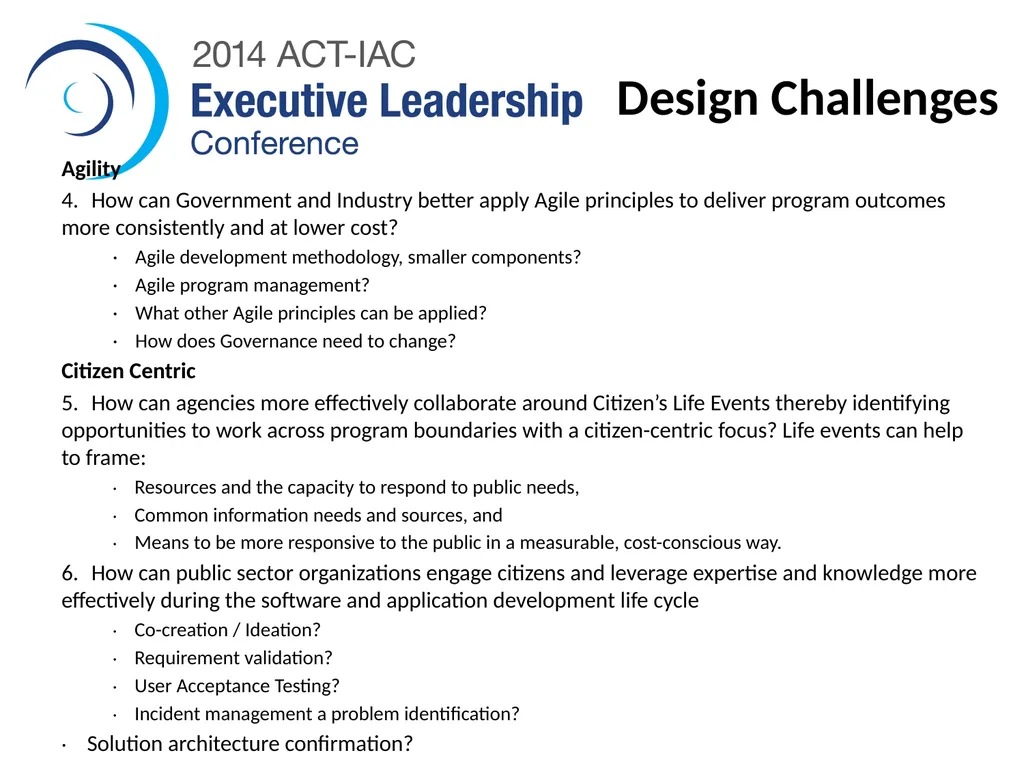
slide18. Agility
4. How can Government and Industry better apply Agile principles to deliver program outcomes more consistently and at lower cost?
· Agile development methodology, smaller components?
· Agile program management?
· What other Agile principles can be applied?
· How does Governance need to change?
Citizen Centric
5. How can agencies more effectively collaborate around Citizen’s Life Events thereby identifying opportunities to work across program boundaries with a citizen-centric focus? Life events can help to frame:
· Resources and the capacity to respond to public needs,
· Common information needs and sources, and
· Means to be more responsive to the public in a measurable, cost-conscious way.
6. How can public sector organizations engage citizens and leverage expertise and knowledge more effectively during the software and application development life cycle
· Co-creation / Ideation?
· Requirement validation?
· User Acceptance Testing?
· Incident management a problem identification?
· Solution architecture confirmation? Design Challenges<br>
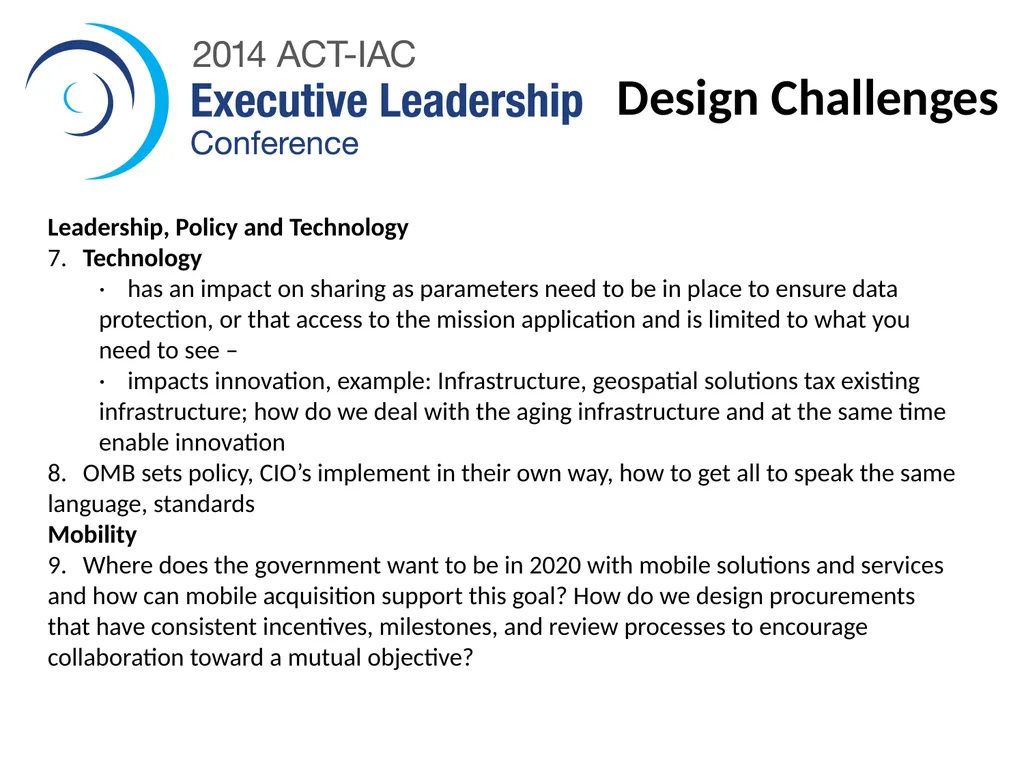
slide19. Leadership, Policy and Technology
7. Technology
· has an impact on sharing as parameters need to be in place to ensure data protection, or that access to the mission application and is limited to what you need to see –
· impacts innovation, example: Infrastructure, geospatial solutions tax existing infrastructure; how do we deal with the aging infrastructure and at the same time enable innovation
8. OMB sets policy, CIO’s implement in their own way, how to get all to speak the same language, standards
Mobility
9. Where does the government want to be in 2020 with mobile solutions and services and how can mobile acquisition support this goal? How do we design procurements that have consistent incentives, milestones, and review processes to encourage collaboration toward a mutual objective? Design Challenges<br>
slide20. MOC Outbrief Is Agile Real in Federal IT?
Open, Flexible Government
Open Data: What is in it for US?
Should Government Act as IT’s Own System Integrator
Implementing Continuous Diagnostics and Mitigation
Going out on a Limb —
Risk-taking, Innovation, and Failing Fast look at the specifics as they become available and work to roll them into our ELC agenda.<br>
slide21. MOC / SIG’s / Fellows MOC - working with the workshop chairs to determine outcomes Then passing to SIG‘s.
SIG‘s - We briefed ELC last week – they will determine how they wish to use their time slot (Mon 3:30 – 4:30 and get back to ELC team
Fellows Forum – we will follow outcomes as they become available
We will look at all these specifics as they become available and work to roll them into our ELC agenda.
Important that we make sure that we have some trail that shows the actionable outcomes. How did this make an impact.<br>
slide22. Priorities Speaker invitations
Track Development
Tues development
Abstracts into Marketing
Social Media discussions
Meeting w/ Media
SIG’s, MOC, Fellows, Partners
Design Challenges as a priority<br>
slide2. Leadership and Innovation in Radically Changing Times
There is an emerging and new collaborative ecosystem that is radically changing how people work and who they work with, resulting in new approaches to how government will carry out its missions in service to constituents.
Federal agencies are striving to spend less on IT than in years past.
Results-based accountability techniques are measuring whether government programs are making an impact.
A new era of computing that includes, mobile, cloud, shared services, and big data is disrupting the traditional models of government and the delivery of mission services.
This begs the question of how agencies will use their limited resources and produce an impact, while managing new and evolving needs.
ELC 2014 will explore these issues with integrated approach that will focus on
Leadership
Mission Innovation
Collaboration<br>
slide3. OLD PARADIGM
20TH CENTURY
CULTURE OF INFORMATION MANAGEMENT Project Definition & Direction
Research Agenda
Concept Development
Development Process Don’t question. Deliver!
Top down.
Execution minded.
Ideas & Technology First
Then we consider how they apply
to people
Lot’s of Ideas
Divergent thinking.
Brainstorming. Suggestion boxes.
Rapid Development
Linear thinking
Spec then build
“Don’t show anyone until it’s right!”
Failure is bad.
Risk Averse
Speed to market Problem Framing
Make sure we’re solving the
right problem.
Putting People First
Ideas and Technology are inspired by
Empathy with customers/stakeholders
Valuable Concepts
Divergent and Convergent Thinking.
Concepts are what we need a lot of.
Rapid Iteration & Improvement
Agile, Non-linear thinking
Experiment
“What can we prototype and test?”
Fail early, small and often
Informed risk taker
Speed to market traction NEW PARADIGM
21st CENTURY
CULTURE OF INNOVATION MANAGEMENT<br>
slide4. Plenary Speakers<br>
slide5. How will we continue the momentum and of innovation, delivery, and protection?
How will we use IT as a strategic asset and drive cost savings to pay for new and emerging technologies that will continually improve the way the government does business and delivers services to the American people?
As Federal agencies strive to spend less on IT than in years past, how do we continue the innovation pace while moving from efficiency to effectiveness?
Results-based accountability techniques are measuring whether government programs are making an impact. Are we getting it right?
Culture is important. What techniques are important and what are the most important /effective leadership approaches that are needed? ELC will use carefully-crafted design challenges … to frame problems and opportunities and bring focus to the conference’s activities<br>
slide6. MONDAY Program Team
Tracks
Committee Leads:
Industry
Chris Niedermayer, BRMI
Cedric Sims, EverMay Consulting
Kim Hayes, Ambit
Government
Tim Shaughnessy , DHS
Ted Okata, FEMA
Professional Development
Jim Beaupre<br>
slide7. Two Program Tracks Shared Solutions– drivers and barriers to sharing service delivery applications across agency boundaries
Citizen Services – administration goals, success stories
Debate facilitated by questions/comments from the audience
Participant opinions captured
Goal is to show a path to success<br>
slide8. Shared Solutions Track Abstract An alarming majority of the federal government’s $80B IT budget is allocated to traditional O&M functions. O&M costs for maintaining agency administrative and service delivery applications are duplicated in countless agency budgets because many agencies perform similar functions and maintain separate applications to support them. These include banking and finance functions, disaster response, information exchange, identity and access management, and many others. Current costs to maintain individual agency solutions are not sustainable from a long-term budget standpoint and stifle investments in innovation, including improving the citizen experience. This track will highlight industry and agency leaders who will debate the benefits and barriers to cross-agency solution sharing within the dimensions of leadership and program management, acquisition, and technology. Attendees will share their views on ways to address application sharing challenges. Attendee views will be used to illustrate methods for successfully increasing solution sharing.<br>
slide9. Citizen Services Citizen expectations for government services are continually increasing, driven by improvements in technology and the high quality services provided by the private sector. And in times of emergency, both citizens and the agencies who serve them need to be able to understand the resources available to them in a safe and secure way anytime, anywhere, quickly and easily on any device.
Technology is one of the critical components to accomplish this goal. Under the President's Management Agenda (see Performance.gov) Customer Service is one of the Cross-Agency Priority (CAP) Goals, The stated goal is to: "Deliver world-class customer services to citizens by making it faster and easier for individuals and businesses to complete transactions and have a positive experience with government." This goal of improving customer service will be reached by 1) Streamlining transactions; 2) Developing standards for high impact services; and 3) Using technology to improve the customer experience. These are just a few of the ways that the government can improve service delivery. This track will contribute to building a customer service community for government by opening a dialog regarding best practices, standards, new technologies; what customer-centric services mean; and how to accomplish implementation of changes to improve customer service offerings.<br>
slide10. Path to Shared Solutions, & Citizen Services Governance<br>
slide11. Collaboration Committee
Committee Leads:
Susan Becker, VP Services Unisys
Corey Nickens, Group Manager, GSA FEDSIM
Joyce Hunter, Deputy CIO, Policy and Planning, U.S. Department of Agriculture
Andy Lieber, BD Hitachi Consulting<br>
slide12. Abstract
Come to the Collaboration Station, where you can share your ideas in the Challenge Zone, learn in the Innovation Zone, and Engage with your colleagues or recharge your batteries in the Connection Zone
Network and collaborate with other attendees, connect and “power up” (Connection Zone)
Contribute ideas for solving the “design challenges” that underpin the conference. Audience reaction collected, consolidated and reported in real-time (Challenge Zone)
Gather and learn about Government Innovation, and what others are sharing (Innovation Zone)
“Continue the Conversation” from Track Sessions, or Start a new one (Patriot Room) Collaboration Station<br>
slide13. Potential Collaboration Space Set up<br>
slide14. Tuesday Program
Committee Leads:
Deirdre Murray, CenturyLink
Chris Dorobek, DorobekInsider
Keith Trippie, The Trippie Group<br>
slide15. Tuesday Abstract ABSTRACT
ELC’s Tuesday “finale” will further the discussion on the new, emerging, and collaborative ecosystem that is changing how people work and who they work with – resulting in creative, new approaches to how government will carry out its mission and service to its constituents. Tuesday will continue to explore the issues of leadership, mission innovation and collaboration in an environment of fast-paced change and disruption of traditional models of government and delivery of mission services.
The Tuesday “finale” will combine the popular ELC format with new and innovative collaboration approaches. We’ll launch with a “Ted Talk” style, innovation thought leader and follow with the always-popular “CXO Town Hall” and government-industry roundtable discussions.
This creative format will provide a wealth of opportunities to engage in discussions and bring the energy and power of the crowd together in the ELC session “finale”.<br>
slide16. OPENING - TED Talk Speaker
Jared Cohen, Author, The New Digital Age: Reshaping the Future of People, Nations and Business
Daniel Pink, Author, Drive; A Whole New Mind
Eric Ries, Author, The Lean Start Up
Clay Shirky, Writer, Consultant, Teacher, The Disruptive Power of Collaboration
Simon Sinek, Author, Leaders Eat Last: Why Some Teams Pull Together and Others Don’t
Cass Sunstein, Author, Simpler: The Future of Government
PANEL - SPEAKERS
“Meet the New Federal CIOs” (Dr. David Bray, FCC, et al)
Provocateur-led, highly interactive “Smackdown”-style panel format
Showcase multi-generations of IT leaders (Wm & Mary student)
Showcase IAC Partners, Voyagers
PANEL -TOPICS
Citizen Engagement – How government services are provided to citizens
New models for interacting with citizens, businesses, client relationship management
Improving mission delivery through collaboration, crowd sourcing, contests
Collaboration, Innovation, Leadership
Encourage pre-ELC activity/buzz by posing to conferees “What’s the big idea?”
Vote via the mobile app (Double Dutch); award “best of” in the spirit of stimulating new thinking, innovation<br>
slide17. Design Challenges Innovation
1. How does Government establish and nurture a culture of Innovation in the face of reduced budgets and aversion to risk?
· Is the OPM Innovation Lab a good model?
· How does investment in innovation translate to efficiency and reduced costs in the future?
· How do we encourage the fail fast, fail forward mentality and encourage risk taking?
Sharing: Data; Mission Applications
2. What should be the goal for Data Sharing at the next level (beyond data.gov) that will promote efficiency and spur economic growth? (talk to Simone about his thoughts on this and the connection to the Sunday keynote by the Commerce Secretary)
3. How can Gov’t and Industry work together to overcome barriers and accelerate change in the Acquisition process to better support “as a service” and “shared service” delivery models?
· Funding/budget by agency and organization is a deterrent
· Overcome the culture of “mine” (I’m different, I need my own)
· Competing interests between the parties that need to consume the mission application or system? There needs to be one accountable party in a contract.<br>
slide18. Agility
4. How can Government and Industry better apply Agile principles to deliver program outcomes more consistently and at lower cost?
· Agile development methodology, smaller components?
· Agile program management?
· What other Agile principles can be applied?
· How does Governance need to change?
Citizen Centric
5. How can agencies more effectively collaborate around Citizen’s Life Events thereby identifying opportunities to work across program boundaries with a citizen-centric focus? Life events can help to frame:
· Resources and the capacity to respond to public needs,
· Common information needs and sources, and
· Means to be more responsive to the public in a measurable, cost-conscious way.
6. How can public sector organizations engage citizens and leverage expertise and knowledge more effectively during the software and application development life cycle
· Co-creation / Ideation?
· Requirement validation?
· User Acceptance Testing?
· Incident management a problem identification?
· Solution architecture confirmation? Design Challenges<br>
slide19. Leadership, Policy and Technology
7. Technology
· has an impact on sharing as parameters need to be in place to ensure data protection, or that access to the mission application and is limited to what you need to see –
· impacts innovation, example: Infrastructure, geospatial solutions tax existing infrastructure; how do we deal with the aging infrastructure and at the same time enable innovation
8. OMB sets policy, CIO’s implement in their own way, how to get all to speak the same language, standards
Mobility
9. Where does the government want to be in 2020 with mobile solutions and services and how can mobile acquisition support this goal? How do we design procurements that have consistent incentives, milestones, and review processes to encourage collaboration toward a mutual objective? Design Challenges<br>
slide20. MOC Outbrief Is Agile Real in Federal IT?
Open, Flexible Government
Open Data: What is in it for US?
Should Government Act as IT’s Own System Integrator
Implementing Continuous Diagnostics and Mitigation
Going out on a Limb —
Risk-taking, Innovation, and Failing Fast look at the specifics as they become available and work to roll them into our ELC agenda.<br>
slide21. MOC / SIG’s / Fellows MOC - working with the workshop chairs to determine outcomes Then passing to SIG‘s.
SIG‘s - We briefed ELC last week – they will determine how they wish to use their time slot (Mon 3:30 – 4:30 and get back to ELC team
Fellows Forum – we will follow outcomes as they become available
We will look at all these specifics as they become available and work to roll them into our ELC agenda.
Important that we make sure that we have some trail that shows the actionable outcomes. How did this make an impact.<br>
slide22. Priorities Speaker invitations
Track Development
Tues development
Abstracts into Marketing
Social Media discussions
Meeting w/ Media
SIG’s, MOC, Fellows, Partners
Design Challenges as a priority<br>