
Elder Abuse Prevention and Response Your Vital
FD
Published · 50 slides · 0 views

1 / 1

Description
Elder Abuse Prevention and Response Your Vital Role in Safeguarding Older and Vulnerable Adults Presented by The ElderSAFE Center Presenters CHARLES E. SMITH LIFE COMMUNITIES 2 Tovah Kasdin, ElderSAFE Center Director Charles E. Smith Life
Related Topics
Share
Embed code
Download this presentation From Below
"Elder Abuse Prevention and Response Your Vital" is the property of its rightful owner. Permission is granted to download and print the materials on this website for personal, non-commercial use only, and to display it on your personal computer provided you do not modify the materials and that you retain all copyright notices contained in the materials. By downloading content from our website, you accept the terms of this agreement.
Presentation Transcript
01
Elder Abuse Prevention and Response Your Vital Role in Safeguarding Older and Vulnerable Adults Presented by
The ElderSAFE Center<br>
02
Presenters | CHARLES E. SMITH LIFE COMMUNITIES 2 Tovah Kasdin, ElderSAFE Center Director
Charles E. Smith Life Communities
KerryAnn Aleibar, ElderSAFE Center Program Manager
Charles E. Smith Life Communities
Sydney Palinkas, ElderSAFE Center Community Educator
Charles E. Smith Life Communities<br>
03
Objectives | CHARLES E. SMITH LIFE COMMUNITIES 3 Lay the foundation with a discussion of trauma
Gain an understanding of elder abuse and its types
Discuss warning signs of abuse
Discuss reporting and Adult Protective Services
Learn about ElderSAFE and how it can be a resource<br>
04
Trauma | CHARLES E. SMITH LIFE COMMUNITIES 4 Trauma is the unique individual experience of an event or enduring conditions, in which:
An individual’s ability to integrate his/her emotional experience is overwhelmed;
An individual experiences a threat to their life or a loved one’s;
There are long-lasting adverse effects to the individual’s functioning and their well-being
(SAMHSA, 2014)<br>
05
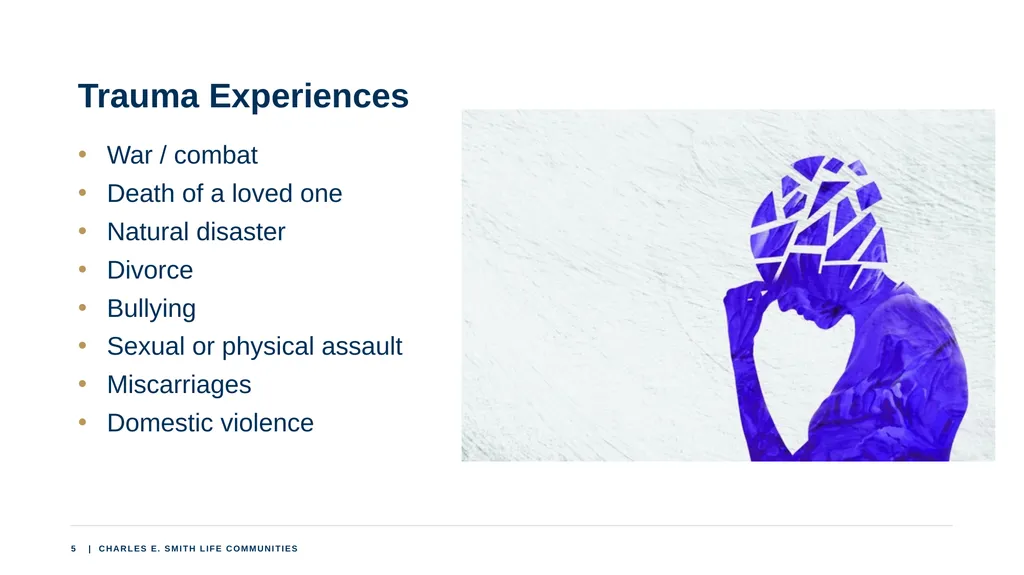
Trauma Experiences | CHARLES E. SMITH LIFE COMMUNITIES 5 War / combat
Death of a loved one
Natural disaster
Divorce
Bullying
Sexual or physical assault
Miscarriages
Domestic violence<br>
06
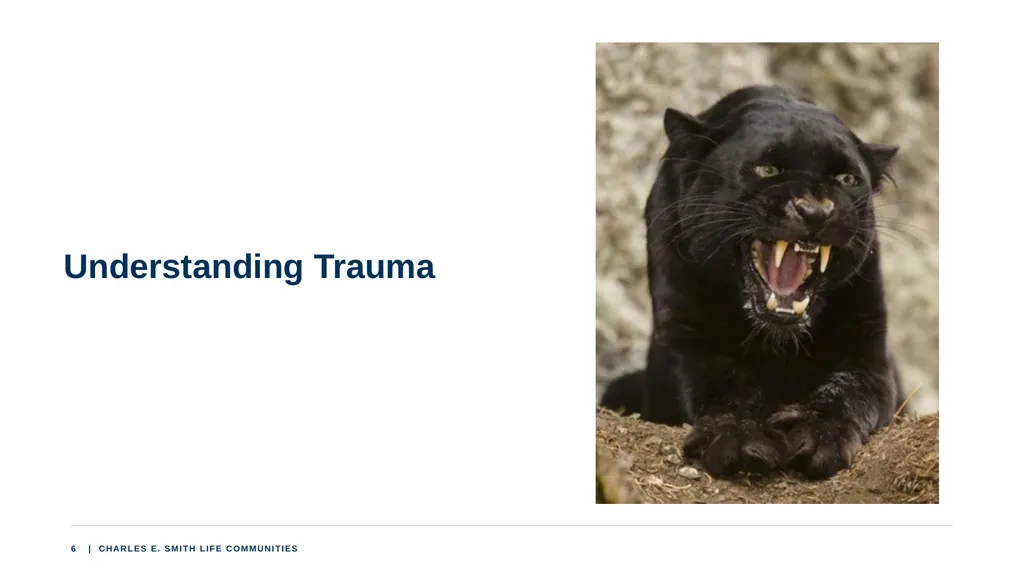
Understanding Trauma | CHARLES E. SMITH LIFE COMMUNITIES 6<br>
07
Re-emergence of Trauma Responses Later in Life | CHARLES E. SMITH LIFE COMMUNITIES 7 Loss of loved ones
Retirement
Loss of control
A time of reflection
Illness symptoms may mirror trauma
(Cook, 2017)<br>
08
Signs of Emotional Distress Due to Trauma | CHARLES E. SMITH LIFE COMMUNITIES 8 Intense emotional reactions that seem disproportionate to the situation
Hypervigilance
Dissociation
Panic attacks
Hypersensitivity to physical sensors
Somatic complaints
Triggers<br>
09
Things to Remember | CHARLES E. SMITH LIFE COMMUNITIES 9 There are no “normal” reactions to trauma
Traumatic memories often resurface later in life / at the end of life
You do not need to know the whole story
Try to give back a sense of control and self-determination<br>
10
Understanding Elder Abuse | CHARLES E. SMITH LIFE COMMUNITIES 10<br>
11
The Definition of Elder Abuse | CHARLES E. SMITH LIFE COMMUNITIES 11 Elder abuse “includes physical, sexual or psychological abuse, as well as neglect, abandonment, and financial exploitation of an older person by another person or entity that occurs in any setting (e.g., home, community, or facility) either in a relationship where there is an expectation of trust and/or when an older person is targeted based on age or disability.”
(Elder Justice Roadmap report, 2014)<br>
12
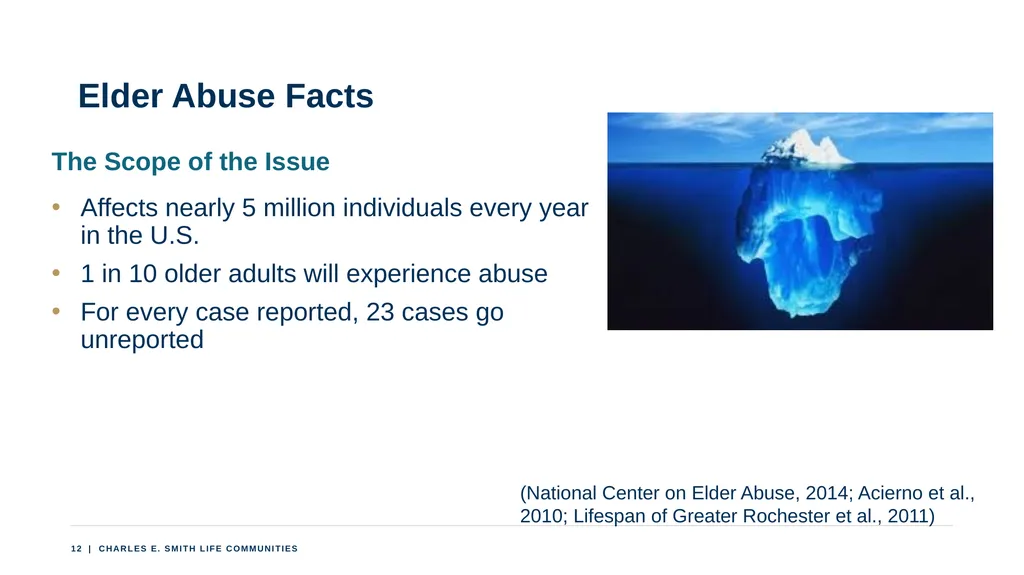
Elder Abuse Facts | CHARLES E. SMITH LIFE COMMUNITIES 12 Affects nearly 5 million individuals every year in the U.S.
1 in 10 older adults will experience abuse
For every case reported, 23 cases go unreported The Scope of the Issue (National Center on Elder Abuse, 2014; Acierno et al., 2010; Lifespan of Greater Rochester et al., 2011)<br>
13
Who Commits Elder Abuse? | CHARLES E. SMITH LIFE COMMUNITIES 13 A Spouse or dating partner
Family Member (adult child, grandchild, niece, nephew, sibling, in-laws, etc.)
Caregiver
Professionals
Neighbor or friend
Stranger<br>
14
Myths and Misconceptions | CHARLES E. SMITH LIFE COMMUNITIES 14 Elder mistreatment should be confirmed before its reported.
If an older adult is cognitively impaired, they can’t accurately report abuse.
If an older person denies abuse, that means it did not happen.
If an older adult asks you not to report abuse, you need to honor their wishes.
Older adults should be able to make their own decisions even if they are bad decisions.
Elder abuse mostly takes place in nursing homes. What are your thoughts?<br>
15
Does caregiver stress / burnout cause elder abuse? | CHARLES E. SMITH LIFE COMMUNITIES 15<br>
16
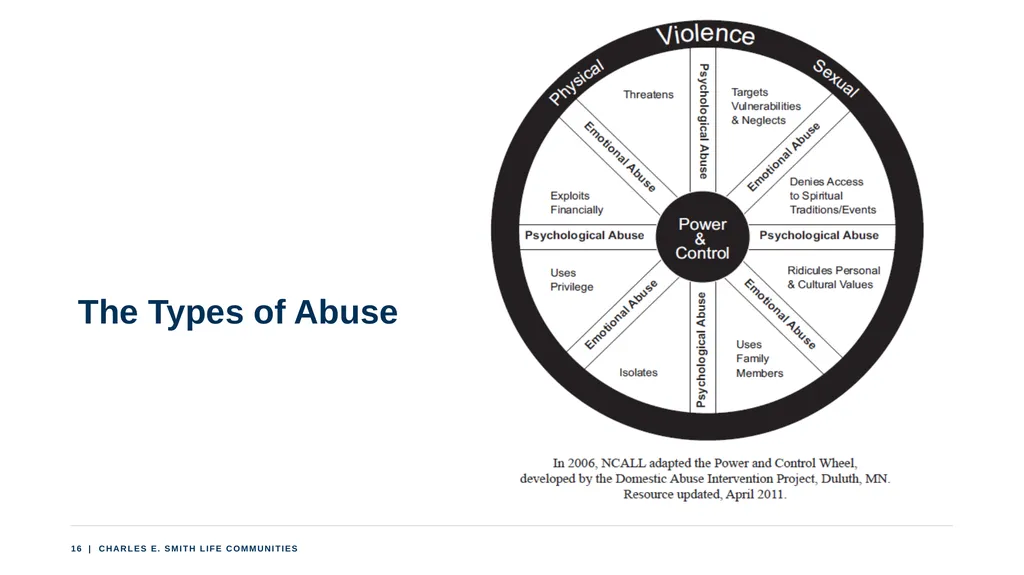
The Types of Abuse | CHARLES E. SMITH LIFE COMMUNITIES 16<br>
17
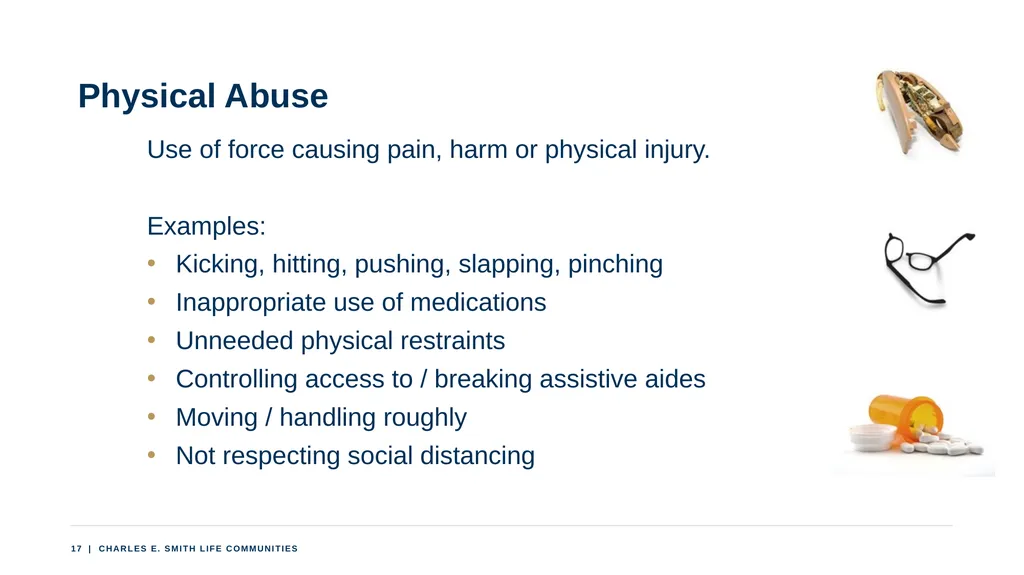
Physical Abuse | CHARLES E. SMITH LIFE COMMUNITIES 17 Use of force causing pain, harm or physical injury.
Examples:
Kicking, hitting, pushing, slapping, pinching
Inappropriate use of medications
Unneeded physical restraints
Controlling access to / breaking assistive aides
Moving / handling roughly
Not respecting social distancing<br>
18
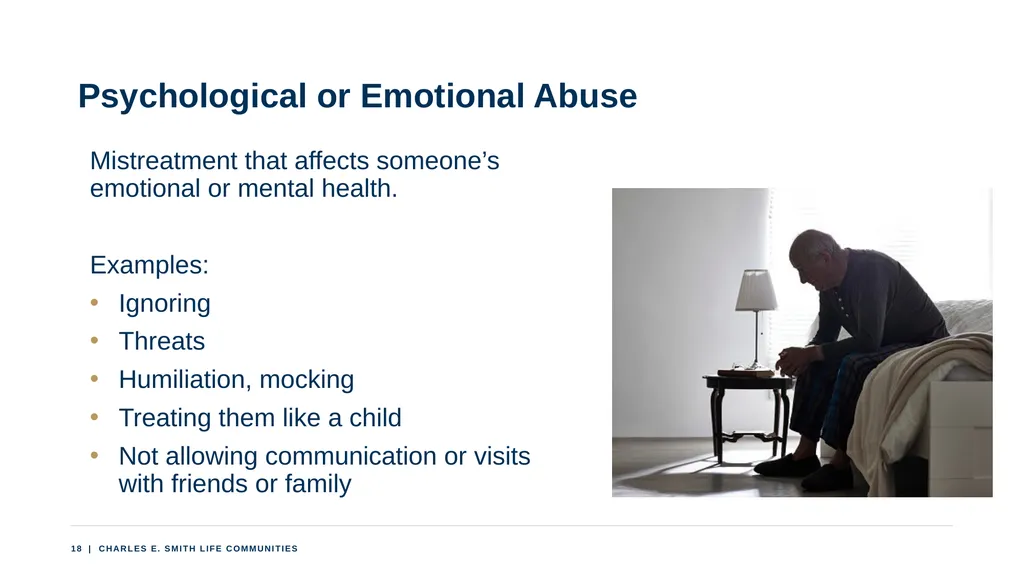
Psychological or Emotional Abuse | CHARLES E. SMITH LIFE COMMUNITIES 18 Mistreatment that affects someone’s emotional or mental health.
Examples:
Ignoring
Threats
Humiliation, mocking
Treating them like a child
Not allowing communication or visits with friends or family<br>
19
Financial Exploitation | CHARLES E. SMITH LIFE COMMUNITIES 19 The misuse of another’s person’s money, property or resources for self-gain.
Examples:
Taking benefits
Controlling bank accounts or credit cards
Forcing the older adult to change wills or property deeds
Taking possessions or money<br>
20
Sexual Abuse | CHARLES E. SMITH LIFE COMMUNITIES 20 Any type of non-consensual sexual act.
Examples:
Sexual assault
Inappropriate touching
Forced viewing of pornography
Taking photos without permission
Unwanted suggestive / sexual comments<br>
21
Neglect | CHARLES E. SMITH LIFE COMMUNITIES 21 Willful deprivation of one’s basic needs (food, clothing, shelter, medicine, or personal hygiene).
Examples:
Not addressing pain
Not changing clothing / bathing
Not renewing / administering prescriptions
Not addressing toileting needs
Locking older adult in their apartment / bedroom
Leaving older adult in same position for long periods of time<br>
22
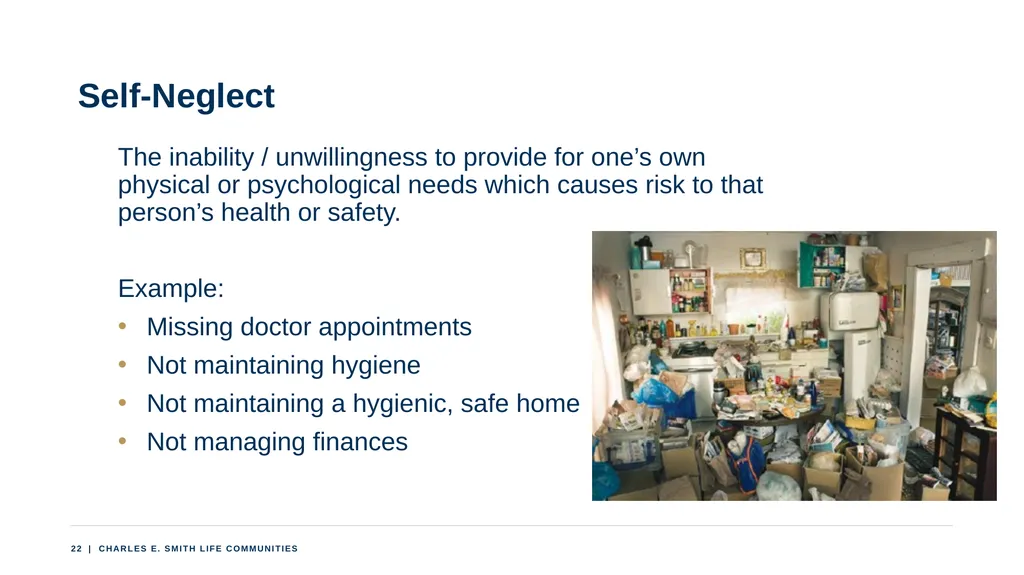
Self-Neglect | CHARLES E. SMITH LIFE COMMUNITIES 22 The inability / unwillingness to provide for one’s own physical or psychological needs which causes risk to that person’s health or safety.
Example:
Missing doctor appointments
Not maintaining hygiene
Not maintaining a hygienic, safe home
Not managing finances<br>
23
Physical Warning Signs | CHARLES E. SMITH LIFE COMMUNITIES 23 Unexplained bruising, cuts, welts, linear marks
Untreated injuries / bedsores
Bloody, torn clothing
Consistently broken assistive devices or medical equipment
Poor hygiene (dental, nails)
Consistently in pain – pain not being addressed<br>
24
Emotional / Behavioral Warning Signs | CHARLES E. SMITH LIFE COMMUNITIES 24 Fear
Changes in affect or personality
Depression, anxiety
Trouble sleeping / changes in appetite (not related to illness)
Low self-esteem
Concerned about finances
Secretiveness about finances<br>
25
Warning Signs from the Family / Caregiver | CHARLES E. SMITH LIFE COMMUNITIES 25 Ignoring older adult
Overly defensive
Using language like:
“Demented”, “Senile”, “Crazy”
“She forces me to be rough”
“Sometimes I get so stressed out….I regret things I’ve done.”<br>
26
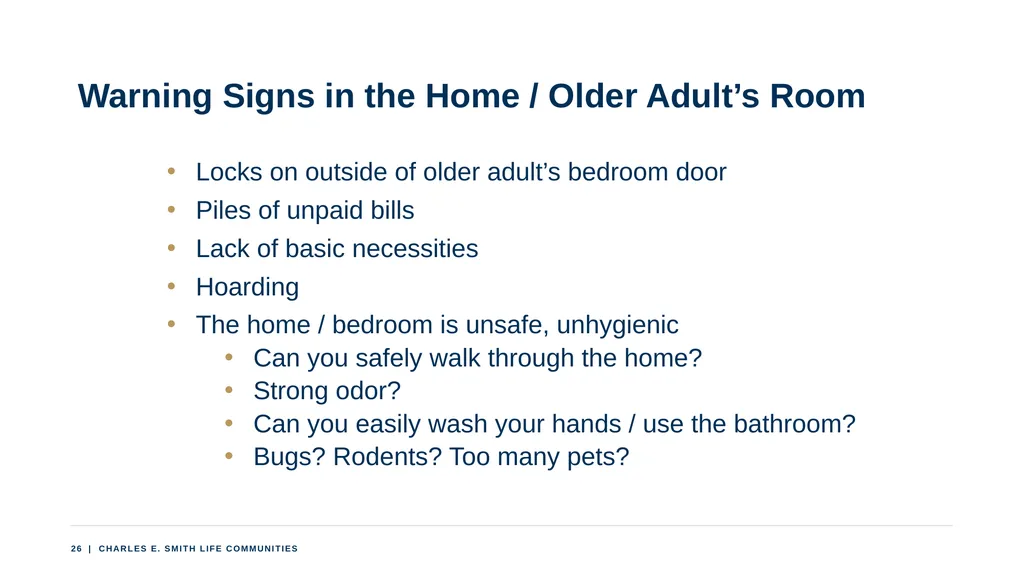
Warning Signs in the Home / Older Adult’s Room | CHARLES E. SMITH LIFE COMMUNITIES 26 Locks on outside of older adult’s bedroom door
Piles of unpaid bills
Lack of basic necessities
Hoarding
The home / bedroom is unsafe, unhygienic
Can you safely walk through the home?
Strong odor?
Can you easily wash your hands / use the bathroom?
Bugs? Rodents? Too many pets?<br>
27
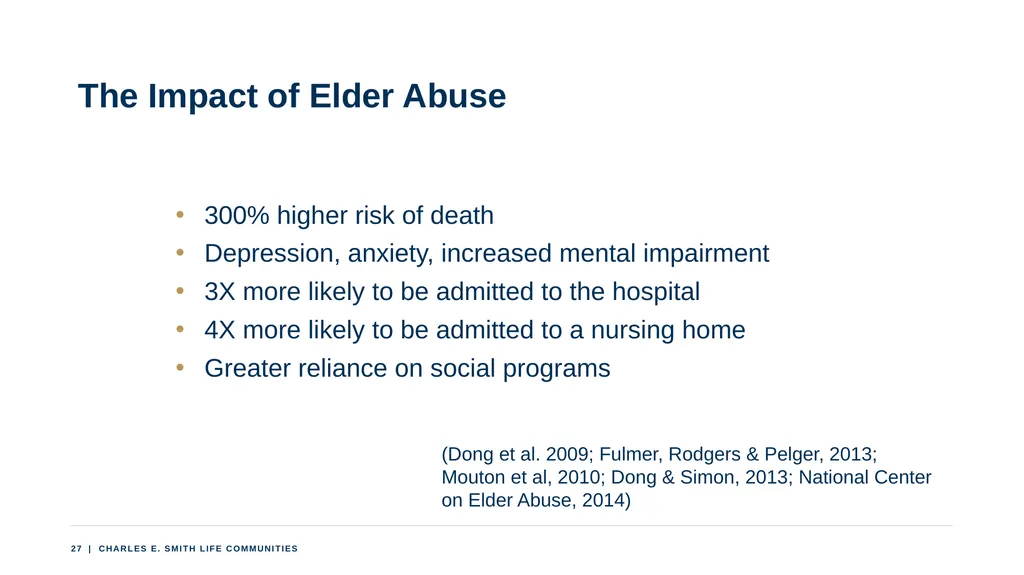
The Impact of Elder Abuse | CHARLES E. SMITH LIFE COMMUNITIES 27 300% higher risk of death
Depression, anxiety, increased mental impairment
3X more likely to be admitted to the hospital
4X more likely to be admitted to a nursing home
Greater reliance on social programs (Dong et al. 2009; Fulmer, Rodgers & Pelger, 2013; Mouton et al, 2010; Dong & Simon, 2013; National Center on Elder Abuse, 2014)<br>
28
Case Scenario #1 – Burt and his Grandson | CHARLES E. SMITH LIFE COMMUNITIES 28 You are the Care Manager for Burt, a 70 year old recently widowed male who lives alone. Since his wife’s passing, he has experienced a significant decline in his health. During your first intake assessment, you observed that Burt was unkempt, had difficulty walking and suffers from short term memory problems.
Your role as the Care Manager is to help Burt manage his medical appointments, coordinating home delivered meals, and home care services.
In one of your meetings, Burt mentions that his grandson has moved in with him. Burt is very happy to have his grandson’s company and support. He has been very lonely.<br>
29
Case Scenario #1 (Cont.) | CHARLES E. SMITH LIFE COMMUNITIES 29 A few week after his grandson moved in, Burt begins missing his medical appointments and his appointments with you. He says that his grandson had planned to take him but then got too busy. Burt says it’s okay, he appreciates the help that he does get.
Burt mentions that his grandson’s girlfriend has also moved in to the house. He says he doesn’t mind. “Sometimes things can be difficult. They do some things I don’t like,” says Burt.
You find out that Burt’s grandson has fired the home health aide. When you call several times to check in, Burt is always unavailable. His grandson assures you that he and his girlfriend can handle Burt’s care. They don’t need any extra help.<br>
30
Case Scenario #1: Discussion Questions | CHARLES E. SMITH LIFE COMMUNITIES 30 What factors make Burt vulnerable to elder abuse?
What would you do in this scenario?
Are there points you would / could have intervened earlier in this case?<br>
31
Why Would An Older Adult Not Disclose Abuse? | CHARLES E. SMITH LIFE COMMUNITIES 31 Older adult may not know this treatment is abusive
Fear
Shame
They depend on the person hurting them
Abuser dependent on older adult
Cognitively impaired
Does not want abuser to be punished or taken away
Lack of culturally / linguistically relevant programs
Distrust of authorities<br>
32
Reduce Barriers to Disclosure | CHARLES E. SMITH LIFE COMMUNITIES 32 Believe them
Take the time to listen
Be non-judgmental
Don’t give your opinion or feelings
Validate how brave they are to come forward
Talk in a safe place
Let them know about resources<br>
33
Starting the Conversation | CHARLES E. SMITH LIFE COMMUNITIES 33 Is someone making you feel bad? Sad? Upset?
I noticed your friends aren’t calling as often. Is anyone stopping them from visiting?
Does anyone ever make you do things that make you feel uncomfortable?
Tell me more about what happens when your son gets upset with you.<br>
34
Reporting Suspected Abuse | CHARLES E. SMITH LIFE COMMUNITIES 34<br>
35
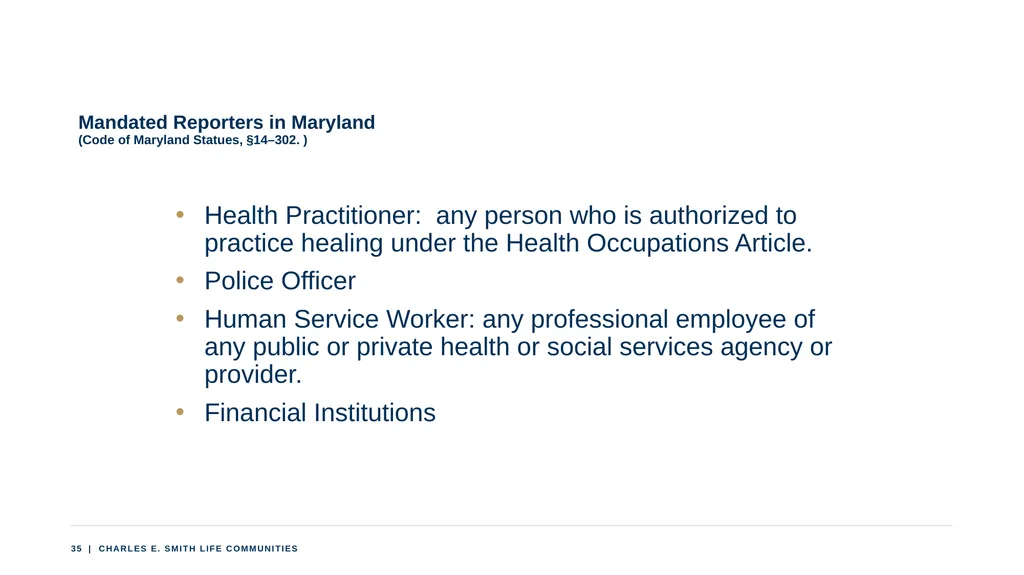
Mandated Reporters in Maryland
(Code of Maryland Statues, §14–302. ) | CHARLES E. SMITH LIFE COMMUNITIES 35 Health Practitioner: any person who is authorized to practice healing under the Health Occupations Article.
Police Officer
Human Service Worker: any professional employee of any public or private health or social services agency or provider.
Financial Institutions<br>
36
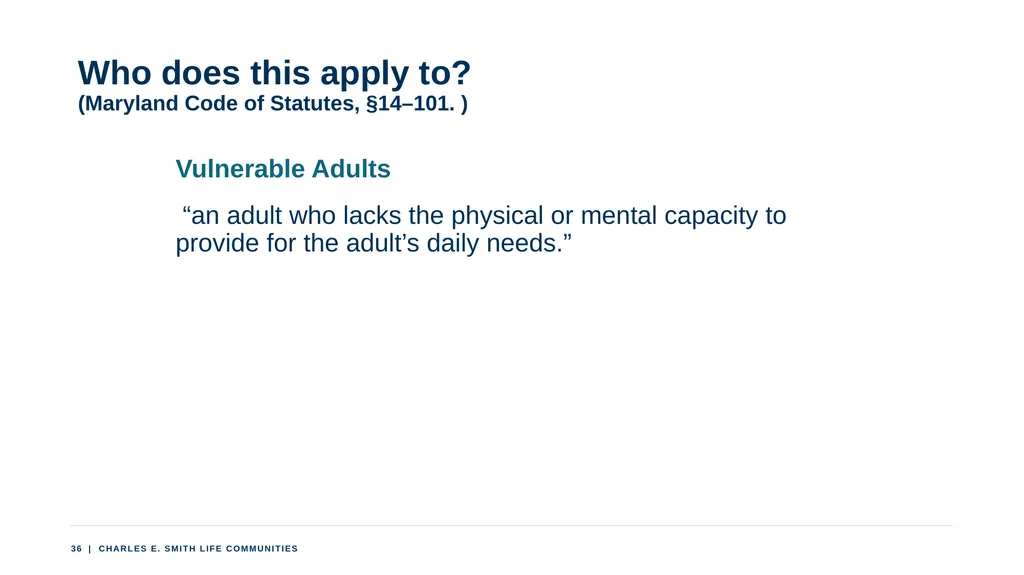
Who does this apply to?
(Maryland Code of Statutes, §14–101. ) | CHARLES E. SMITH LIFE COMMUNITIES 36 “an adult who lacks the physical or mental capacity to provide for the adult’s daily needs.” Vulnerable Adults<br>
37
Adult Protective Services | CHARLES E. SMITH LIFE COMMUNITIES 37 Montgomery County 240-777-3000
Maryland State Hotline: 1-800-332-6347
Washington, DC: 202-541-3950
Northern Virginia: 1-888-832-3858<br>
38
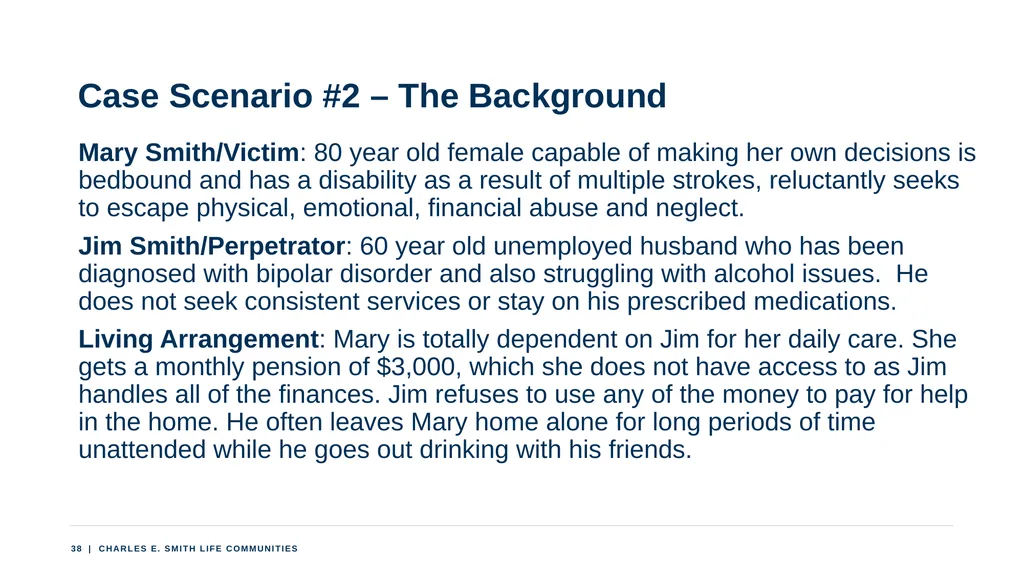
Case Scenario #2 – The Background | CHARLES E. SMITH LIFE COMMUNITIES 38 Mary Smith/Victim: 80 year old female capable of making her own decisions is bedbound and has a disability as a result of multiple strokes, reluctantly seeks to escape physical, emotional, financial abuse and neglect.
Jim Smith/Perpetrator: 60 year old unemployed husband who has been diagnosed with bipolar disorder and also struggling with alcohol issues. He does not seek consistent services or stay on his prescribed medications.
Living Arrangement: Mary is totally dependent on Jim for her daily care. She gets a monthly pension of $3,000, which she does not have access to as Jim handles all of the finances. Jim refuses to use any of the money to pay for help in the home. He often leaves Mary home alone for long periods of time unattended while he goes out drinking with his friends.<br>
39
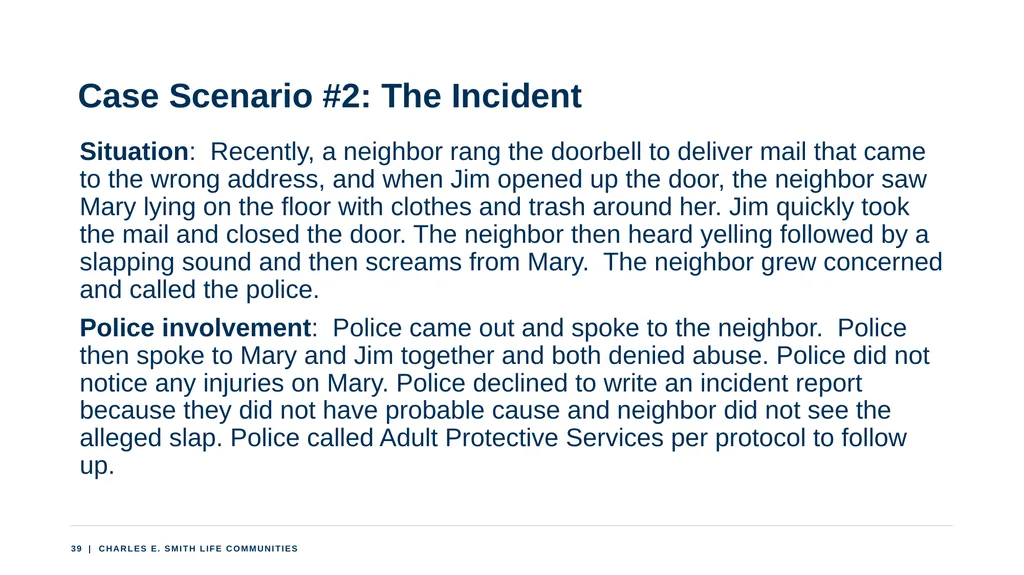
Case Scenario #2: The Incident | CHARLES E. SMITH LIFE COMMUNITIES 39 Situation: Recently, a neighbor rang the doorbell to deliver mail that came to the wrong address, and when Jim opened up the door, the neighbor saw Mary lying on the floor with clothes and trash around her. Jim quickly took the mail and closed the door. The neighbor then heard yelling followed by a slapping sound and then screams from Mary. The neighbor grew concerned and called the police.
Police involvement: Police came out and spoke to the neighbor. Police then spoke to Mary and Jim together and both denied abuse. Police did not notice any injuries on Mary. Police declined to write an incident report because they did not have probable cause and neighbor did not see the alleged slap. Police called Adult Protective Services per protocol to follow up.<br>
40
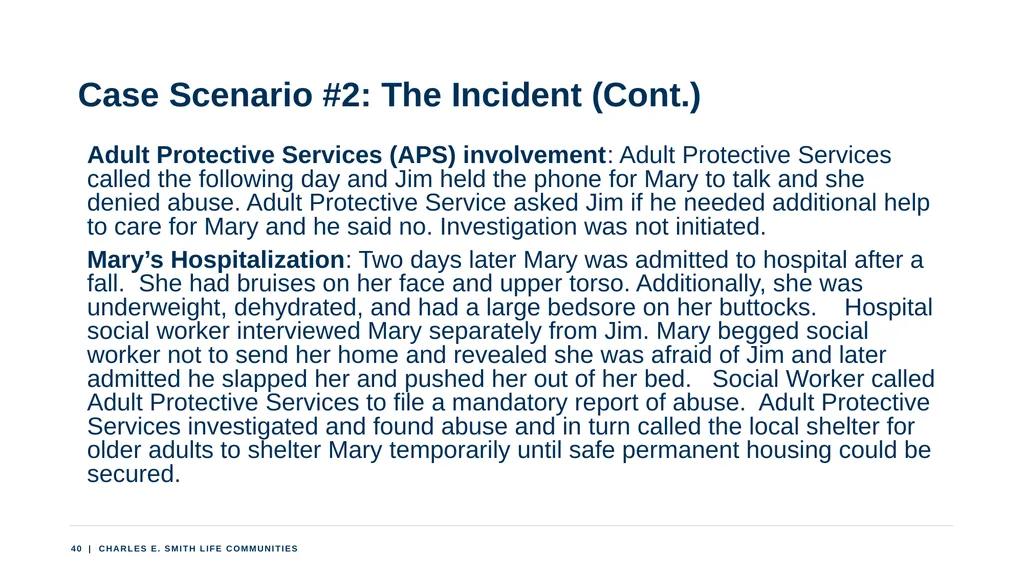
Case Scenario #2: The Incident (Cont.) | CHARLES E. SMITH LIFE COMMUNITIES 40 Adult Protective Services (APS) involvement: Adult Protective Services called the following day and Jim held the phone for Mary to talk and she denied abuse. Adult Protective Service asked Jim if he needed additional help to care for Mary and he said no. Investigation was not initiated.
Mary’s Hospitalization: Two days later Mary was admitted to hospital after a fall. She had bruises on her face and upper torso. Additionally, she was underweight, dehydrated, and had a large bedsore on her buttocks. Hospital social worker interviewed Mary separately from Jim. Mary begged social worker not to send her home and revealed she was afraid of Jim and later admitted he slapped her and pushed her out of her bed. Social Worker called Adult Protective Services to file a mandatory report of abuse. Adult Protective Services investigated and found abuse and in turn called the local shelter for older adults to shelter Mary temporarily until safe permanent housing could be secured.<br>
41
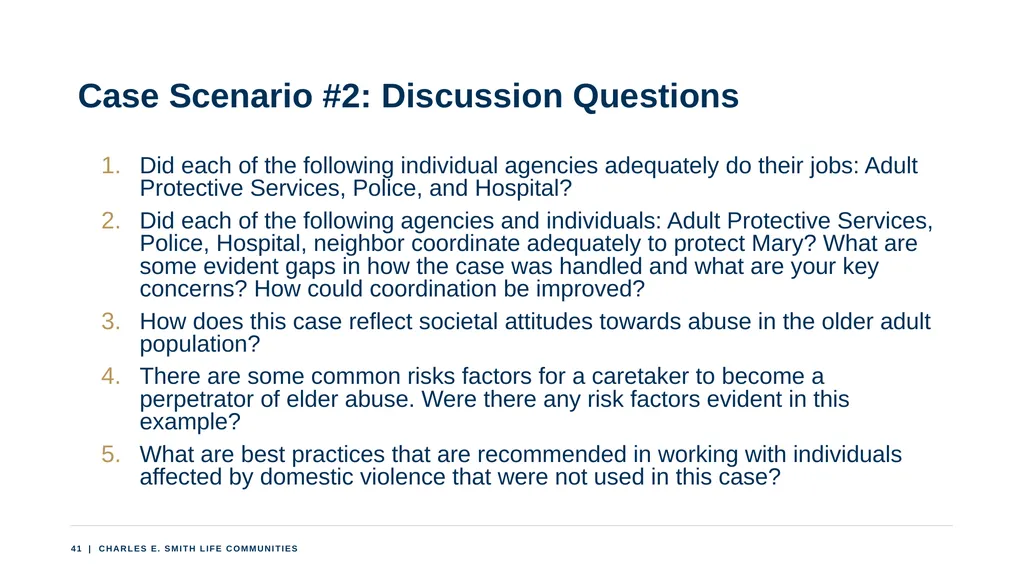
Case Scenario #2: Discussion Questions | CHARLES E. SMITH LIFE COMMUNITIES 41 Did each of the following individual agencies adequately do their jobs: Adult Protective Services, Police, and Hospital?
Did each of the following agencies and individuals: Adult Protective Services, Police, Hospital, neighbor coordinate adequately to protect Mary? What are some evident gaps in how the case was handled and what are your key concerns? How could coordination be improved?
How does this case reflect societal attitudes towards abuse in the older adult population?
There are some common risks factors for a caretaker to become a perpetrator of elder abuse. Were there any risk factors evident in this example?
What are best practices that are recommended in working with individuals affected by domestic violence that were not used in this case?<br>
42
42 | CHARLES E. SMITH LIFE COMMUNITIES<br>
43
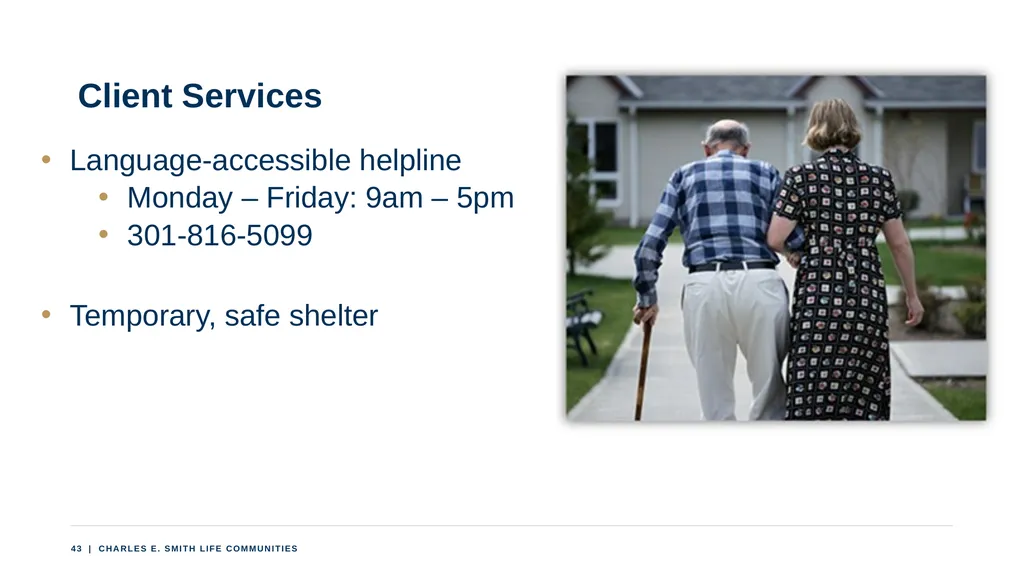
Client Services | CHARLES E. SMITH LIFE COMMUNITIES 43 Language-accessible helpline
Monday – Friday: 9am – 5pm
301-816-5099
Temporary, safe shelter<br>
44
Client Eligibility | CHARLES E. SMITH LIFE COMMUNITIES 44 60 years of age or older
A victim of one or more of the following types of abuse (physical, sexual, psychological, financial, neglect) or is at risk for experiencing abuse
Referred by an agency or program
Willing to be placed in temporary shelter
Agree to not contact abuser during shelter stay
Referrals accepted from Maryland, Washington DC and Northern Virginia
Please note:
**ElderSAFE will accept clients without insurance
**Self neglect and homeless cases are not accepted<br>
45
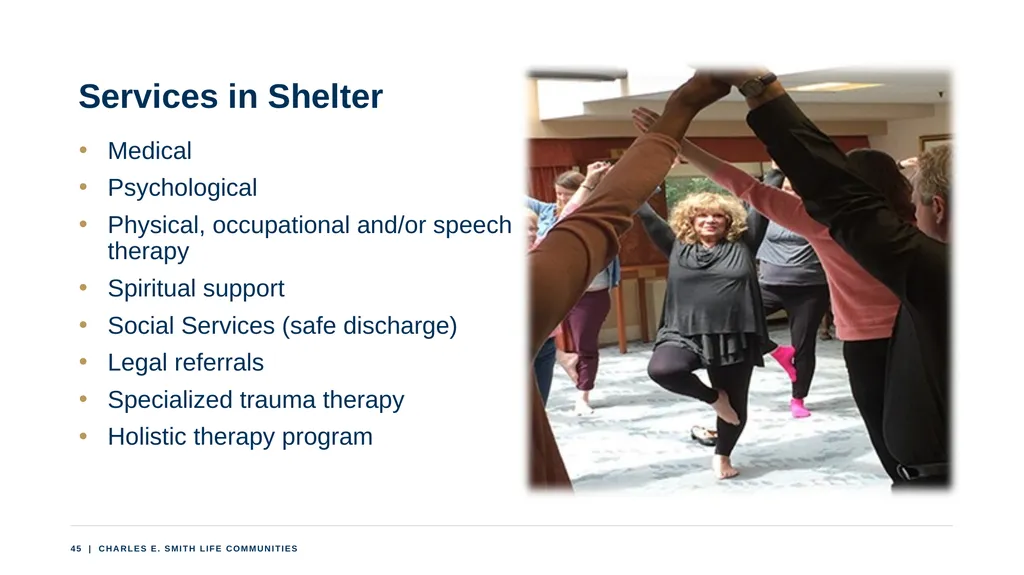
Services in Shelter 45 Medical
Psychological
Physical, occupational and/or speech therapy
Spiritual support
Social Services (safe discharge)
Legal referrals
Specialized trauma therapy
Holistic therapy program | CHARLES E. SMITH LIFE COMMUNITIES<br>
46
The ElderSAFE Center’s Community Resource Guide | CHARLES E. SMITH LIFE COMMUNITIES 46 Created to connect older adults—and the professionals, volunteers and caregivers who assist them—to community resources to promote safe and healthy living.
Available in English, Spanish, Russian, and Mandarin.
Available to download from our website or in hard copy.<br>
47
Questions?? | CHARLES E. SMITH LIFE COMMUNITIES 47<br>
48
ElderSAFE Contacts | CHARLES E. SMITH LIFE COMMUNITIES 48 Tovah Kasdin, J.D.
Director
301-770-8494
kasdin@ceslc.org
KerryAnn Aleibar, LCSW-C
Program Manager
301-816-5045
aleibar@ceslc.org
Sydney Palinkas, LGSW
Community Educator
301-770-8365
palinkas@ceslc.org
Language Accessible Helpline:
301-816-5099 (Mon-Fri 9am-5pm)
Website: www.smithlifecommunities.org<br>
49
References | CHARLES E. SMITH LIFE COMMUNITIES 49 Acierno, R. et al., (2009). National Elder Mistreatment Study. (U.S. Department of Justice grant report, NCJ 226456, March 2009), https://www.ncjrs.gov/pdffiles1/nij/grants/226456.pdf
Cook, J. (2017). Trauma and PTSD in Older Adults. Yale School of Medicine. National Center for PTSD. https://www.ptsd.va.gov/professional/consult/2017lecture_archive/02152017_lecture_slides.pdf
Dong, X, Simon, M., Mendes de Leon, C., Fulmer, T., Beck, T., Hebert, L. (2009). Elder self-neglect and abuse and mortality risk in a community-dwelling population. Journal of the American Medical Association, 302(5), 517–526. doi: 10.1001/jama.2009.1109
Dong, X. Q., & Simon, M. A. (2013). Elder abuse as a risk factor for hospitalization in older persons. JAMA Internal Medicine, 173 (10), 911–917. doi: 10.1001/jamainternmed.2013.238
Fulmer, T., Rodgers, R. F., & Pelger, A. (2013). Verbal mistreatment of the elderly. Journal of Elder Abuse & Neglect, 26(4), 351–364
Lifespan of Greater Rochester, Weill Cornell Medical Center of Cornell University, & New York City Department for the Aging. (2011). Under the radar: New York State elder abuse prevalence study. Self-reported prevalence and documented case surveys, Final report. New York, NY: William B. Hoyt Memorial New York State Children and Family Trust Fund, and the New York State Office of Children and Family Services
National Center on Elder Abuse. (2014). The Elder Justice Roadmap, (Washington, DC: Administration on Aging, U.S. Department of Health and Human Services), http://www.ncea.acl.gov/library/gov_report/docs/ejrp_roadmap.pdf<br>
50
Thank You<br>