
Electric potential is related to electrostatic
OM
Published · 24 slides · 0 views
1 / 1
Description
Electric potential is related to electrostatic potential energy in much the same way as electric field is related to electrostatic force. The change in electric potential is equal to the change in electrostatic potential energy per unit of
Related Topics
Share
Embed code
Download this presentation From Below
"Electric potential is related to electrostatic" is the property of its rightful owner. Permission is granted to download and print the materials on this website for personal, non-commercial use only, and to display it on your personal computer provided you do not modify the materials and that you retain all copyright notices contained in the materials. By downloading content from our website, you accept the terms of this agreement.
Presentation Transcript
01
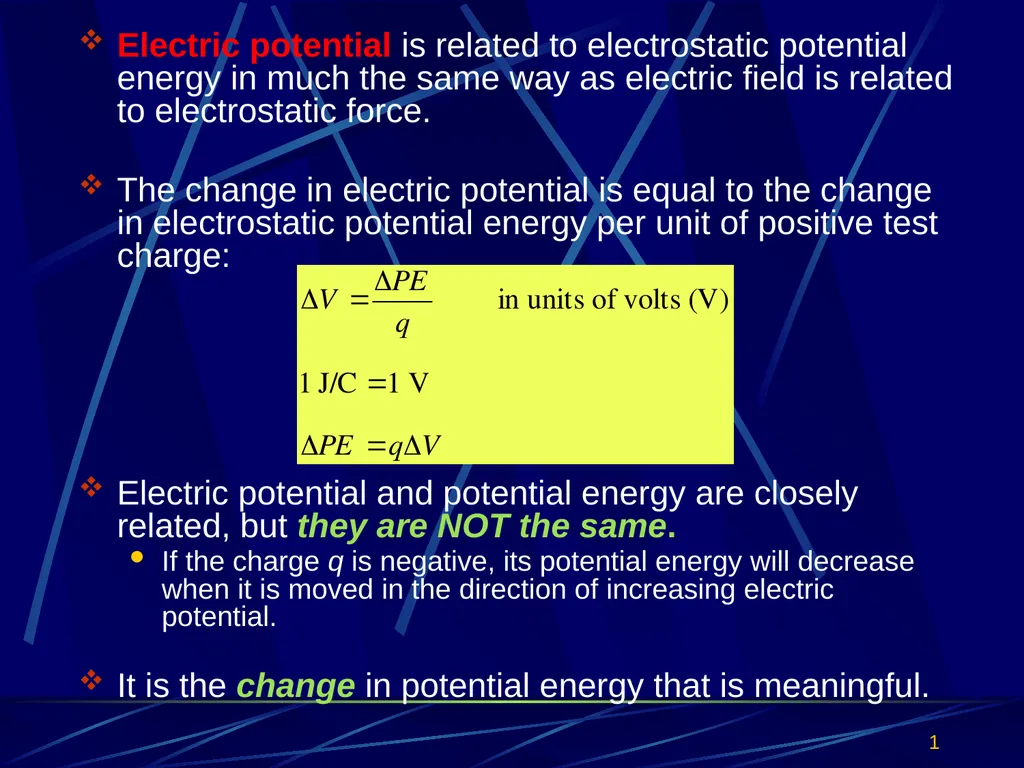
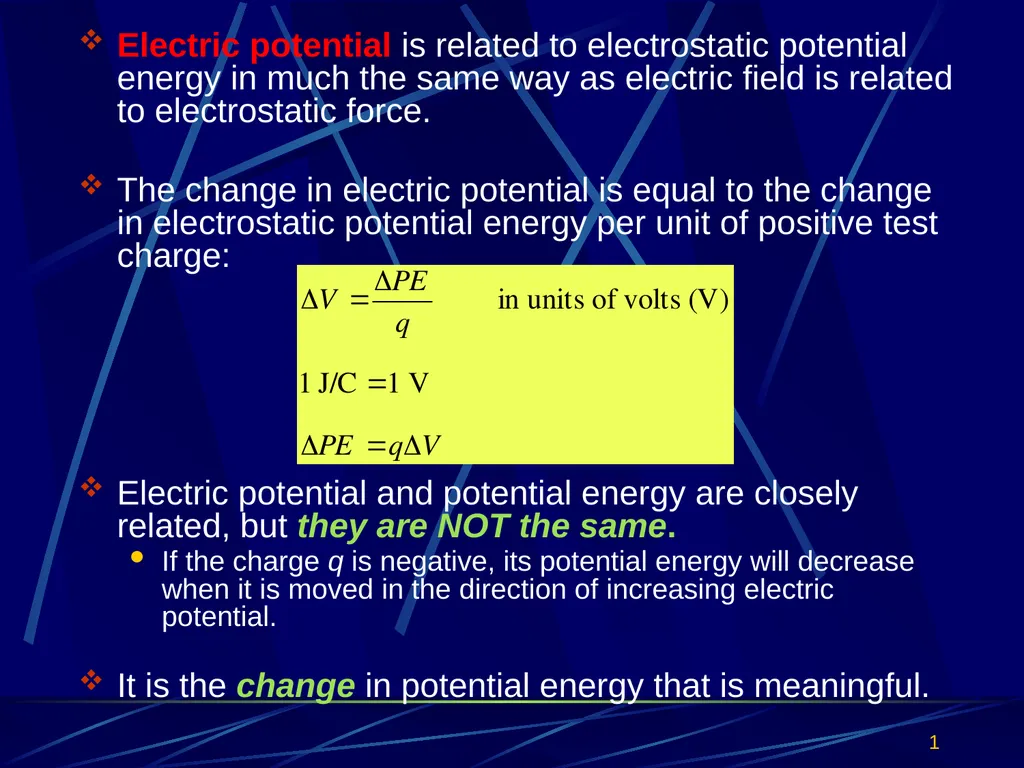
Electric potential is related to electrostatic potential energy in much the same way as electric field is related to electrostatic force.
The change in electric potential is equal to the change in electrostatic potential energy per unit of positive test charge:
Electric potential and potential energy are closely related, but they are NOT the same.
If the charge q is negative, its potential energy will decrease when it is moved in the direction of increasing electric potential.
It is the change in potential energy that is meaningful. 1<br>
The change in electric potential is equal to the change in electrostatic potential energy per unit of positive test charge:
Electric potential and potential energy are closely related, but they are NOT the same.
If the charge q is negative, its potential energy will decrease when it is moved in the direction of increasing electric potential.
It is the change in potential energy that is meaningful. 1<br>
02
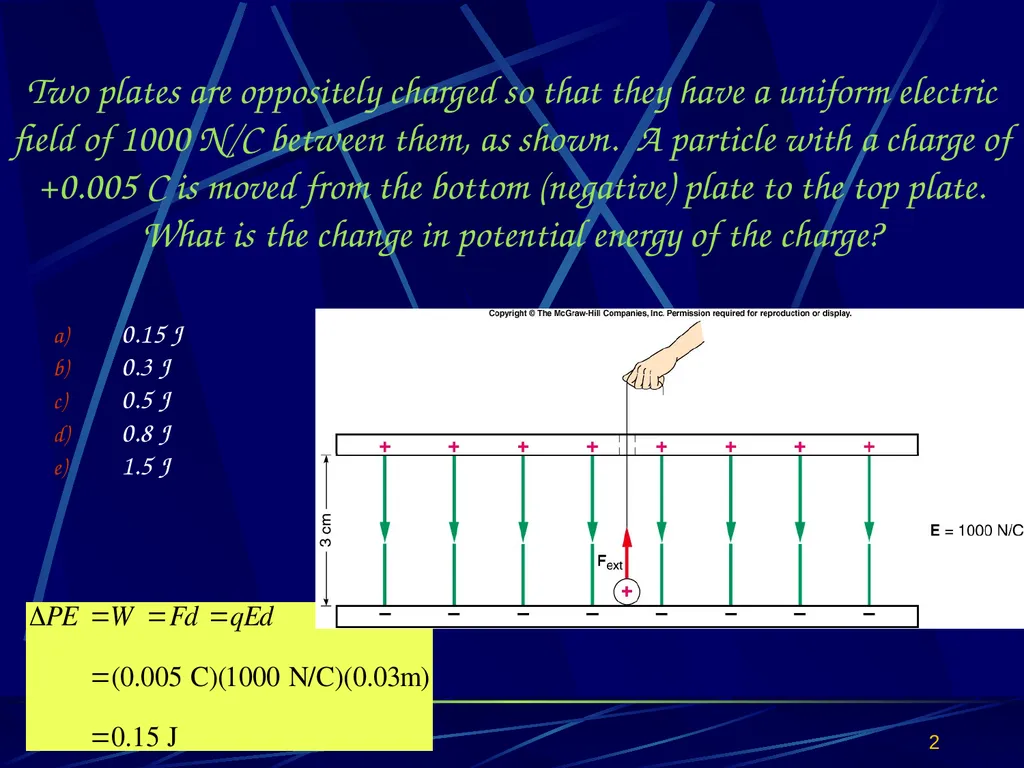
Two plates are oppositely charged so that they have a uniform electric field of 1000 N/C between them, as shown. A particle with a charge of +0.005 C is moved from the bottom (negative) plate to the top plate. What is the change in potential energy of the charge? 0.15 J
0.3 J
0.5 J
0.8 J
1.5 J 2<br>
0.3 J
0.5 J
0.8 J
1.5 J 2<br>
03
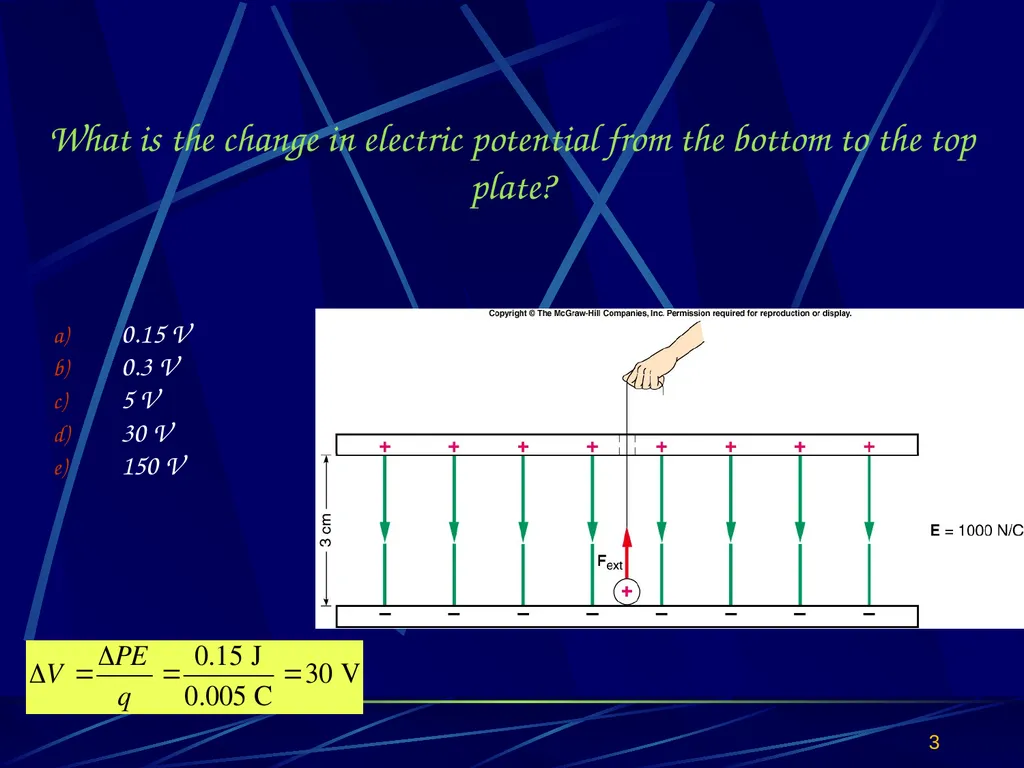
What is the change in electric potential from the bottom to the top plate? 0.15 V
0.3 V
5 V
30 V
150 V 3<br>
0.3 V
5 V
30 V
150 V 3<br>
04
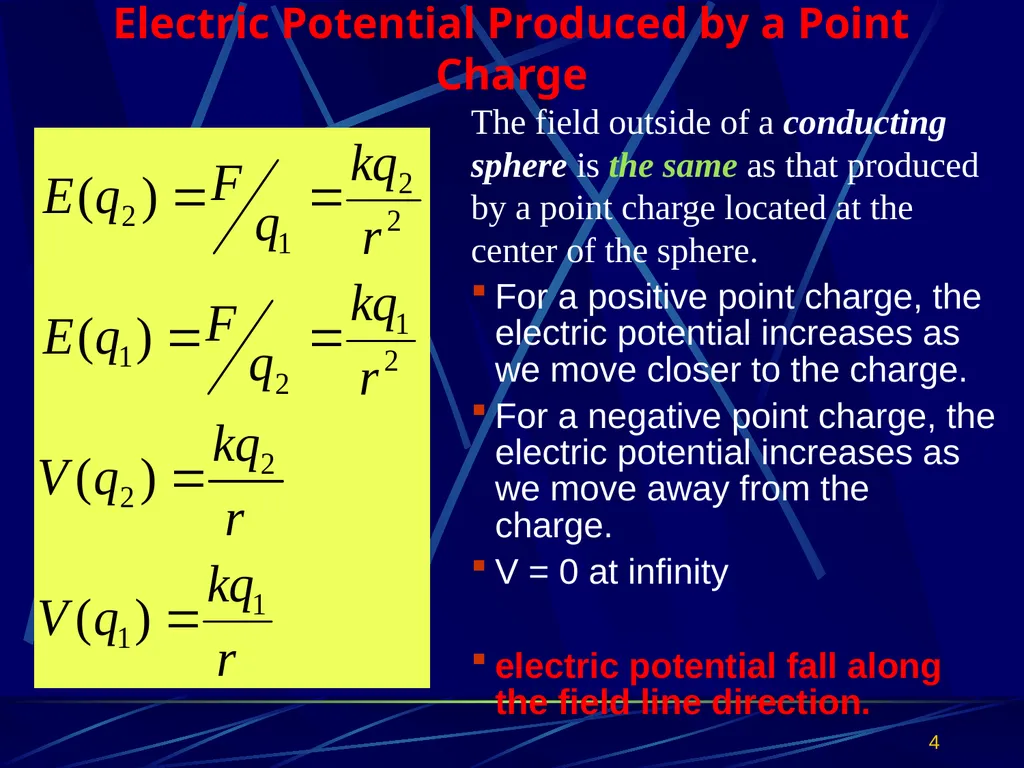
Electric Potential Produced by a Point Charge The field outside of a conducting sphere is the same as that produced by a point charge located at the center of the sphere.
For a positive point charge, the electric potential increases as we move closer to the charge.
For a negative point charge, the electric potential increases as we move away from the charge.
V = 0 at infinity
electric potential fall along the field line direction. 4<br>
For a positive point charge, the electric potential increases as we move closer to the charge.
For a negative point charge, the electric potential increases as we move away from the charge.
V = 0 at infinity
electric potential fall along the field line direction. 4<br>
05
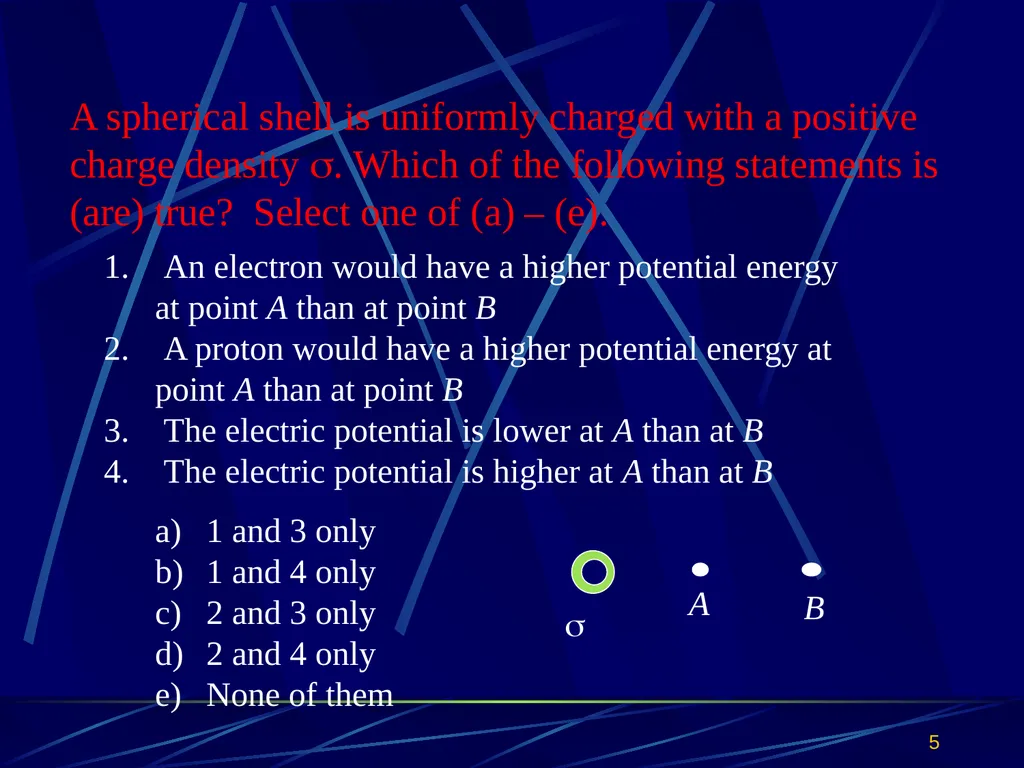
A spherical shell is uniformly charged with a positive charge density . Which of the following statements is (are) true? Select one of (a) – (e). An electron would have a higher potential energy at point A than at point B
A proton would have a higher potential energy at point A than at point B
The electric potential is lower at A than at B
The electric potential is higher at A than at B A B 1 and 3 only
1 and 4 only
2 and 3 only
2 and 4 only
None of them 5<br>
A proton would have a higher potential energy at point A than at point B
The electric potential is lower at A than at B
The electric potential is higher at A than at B A B 1 and 3 only
1 and 4 only
2 and 3 only
2 and 4 only
None of them 5<br>
06
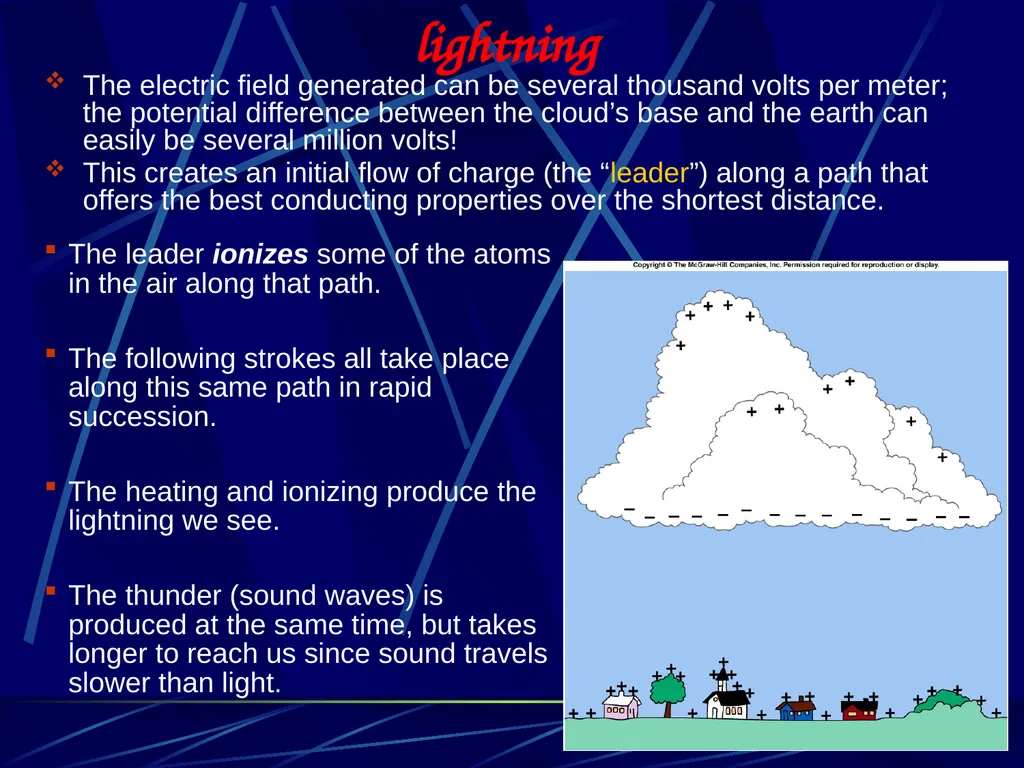
The electric field generated can be several thousand volts per meter; the potential difference between the cloud’s base and the earth can easily be several million volts!
This creates an initial flow of charge (the “leader”) along a path that offers the best conducting properties over the shortest distance. The leader ionizes some of the atoms in the air along that path.
The following strokes all take place along this same path in rapid succession.
The heating and ionizing produce the lightning we see.
The thunder (sound waves) is produced at the same time, but takes longer to reach us since sound travels slower than light. lightning 6<br>
This creates an initial flow of charge (the “leader”) along a path that offers the best conducting properties over the shortest distance. The leader ionizes some of the atoms in the air along that path.
The following strokes all take place along this same path in rapid succession.
The heating and ionizing produce the lightning we see.
The thunder (sound waves) is produced at the same time, but takes longer to reach us since sound travels slower than light. lightning 6<br>
07
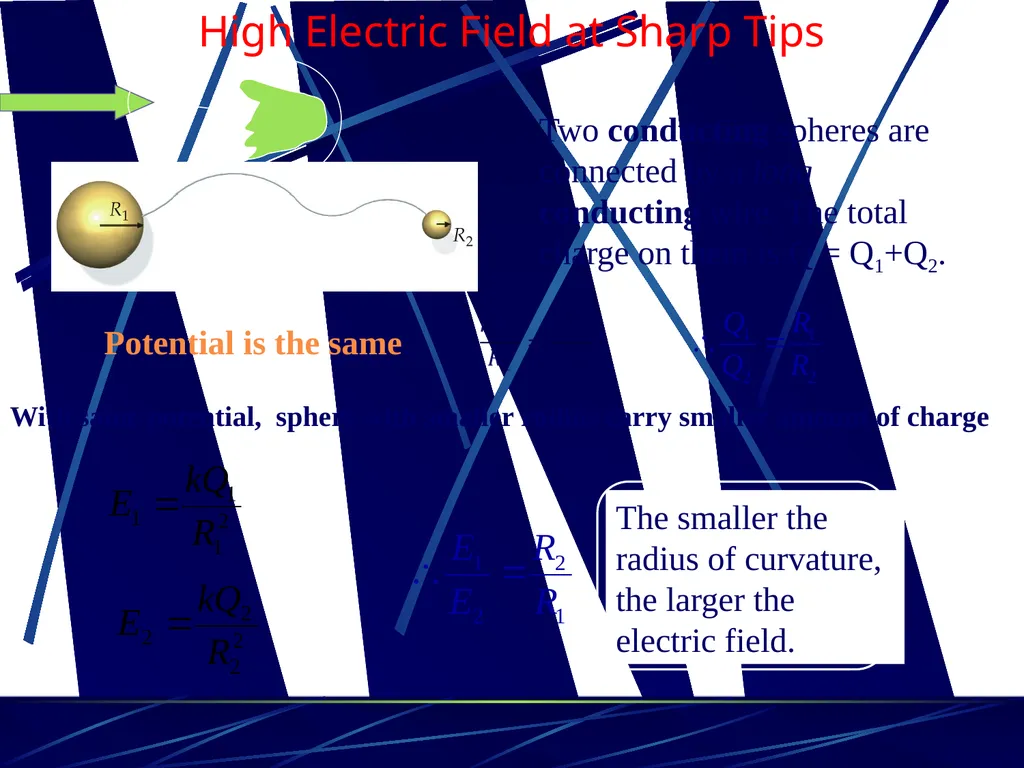
High Electric Field at Sharp Tips Two conducting spheres are connected by a long conducting wire. The total charge on them is Q = Q1+Q2. With same potential, sphere with smaller radius carry smaller amount of charge 7<br>
08
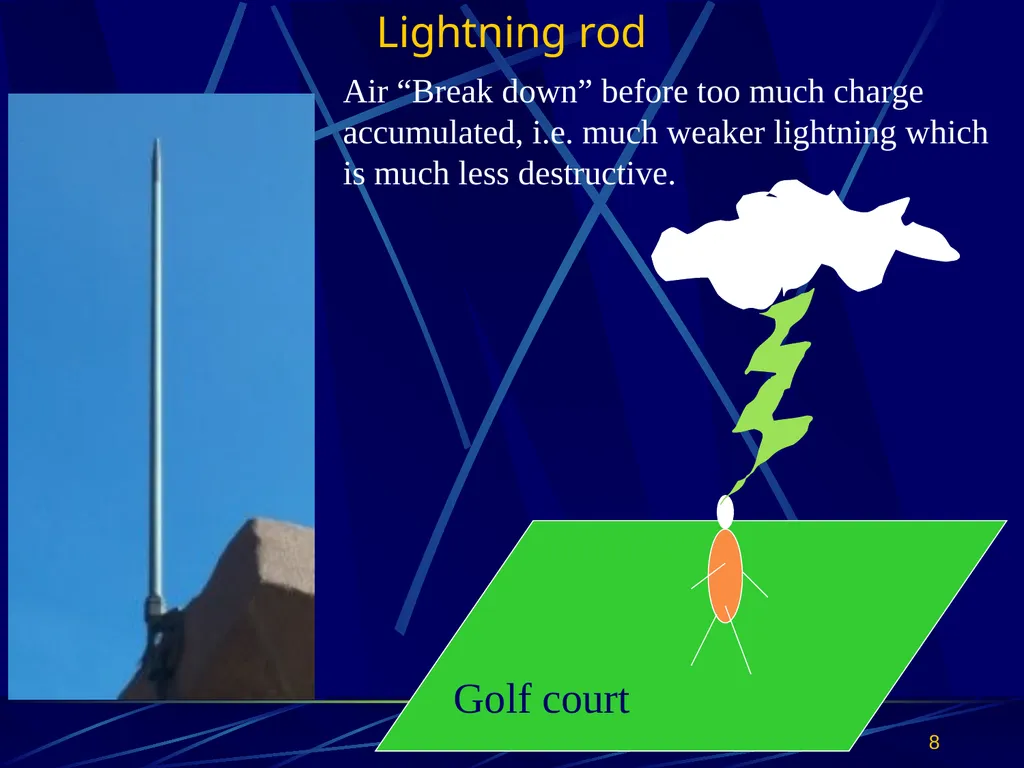
Lightning rod Air “Break down” before too much charge accumulated, i.e. much weaker lightning which is much less destructive. 8<br>
09
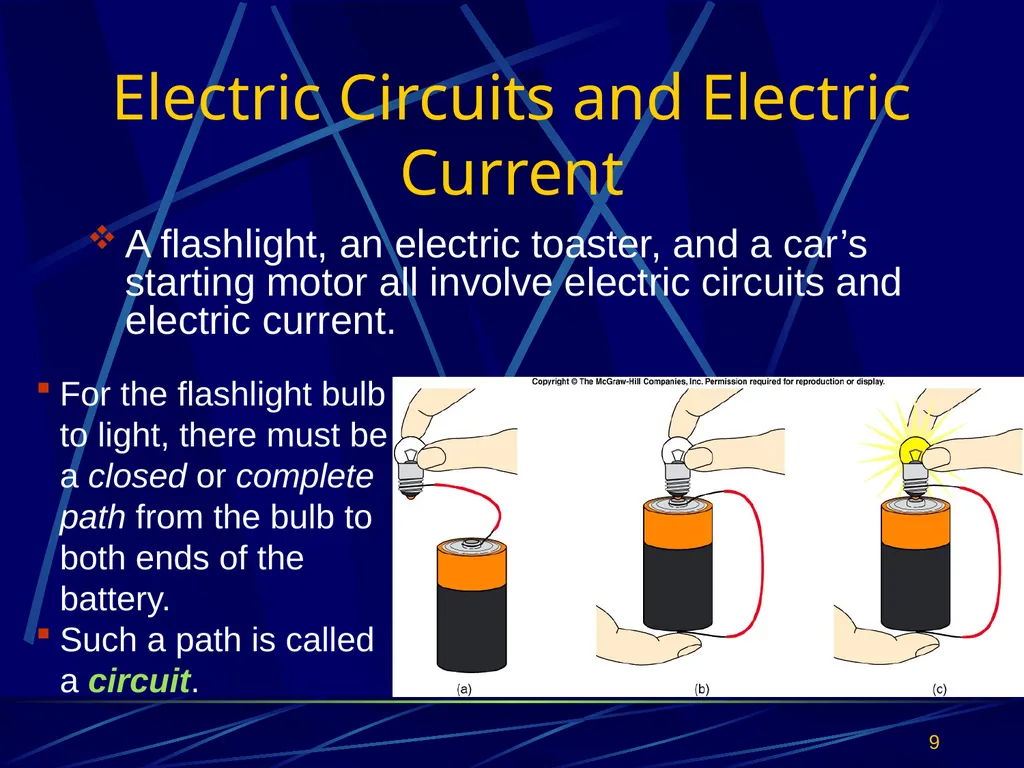
Electric Circuits and Electric Current A flashlight, an electric toaster, and a car’s starting motor all involve electric circuits and electric current. For the flashlight bulb to light, there must be a closed or complete path from the bulb to both ends of the battery.
Such a path is called a circuit. 9<br>
Such a path is called a circuit. 9<br>
10
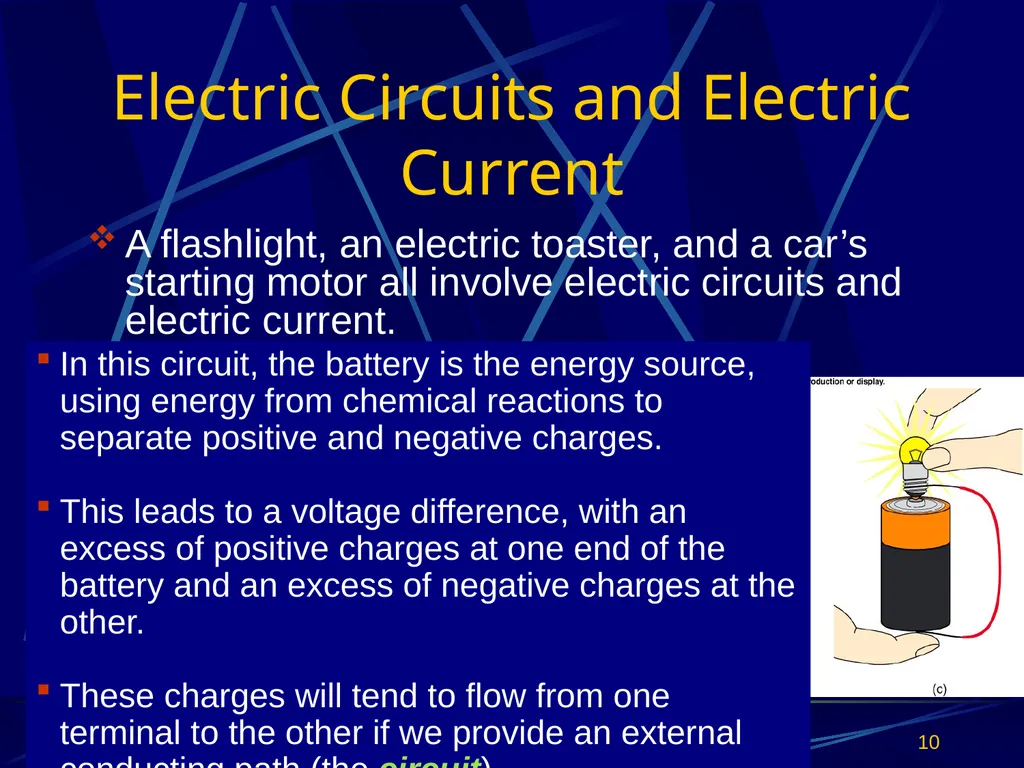
Electric Circuits and Electric Current A flashlight, an electric toaster, and a car’s starting motor all involve electric circuits and electric current. In this circuit, the battery is the energy source, using energy from chemical reactions to separate positive and negative charges.
This leads to a voltage difference, with an excess of positive charges at one end of the battery and an excess of negative charges at the other.
These charges will tend to flow from one terminal to the other if we provide an external conducting path (the circuit). 10<br>
This leads to a voltage difference, with an excess of positive charges at one end of the battery and an excess of negative charges at the other.
These charges will tend to flow from one terminal to the other if we provide an external conducting path (the circuit). 10<br>
11
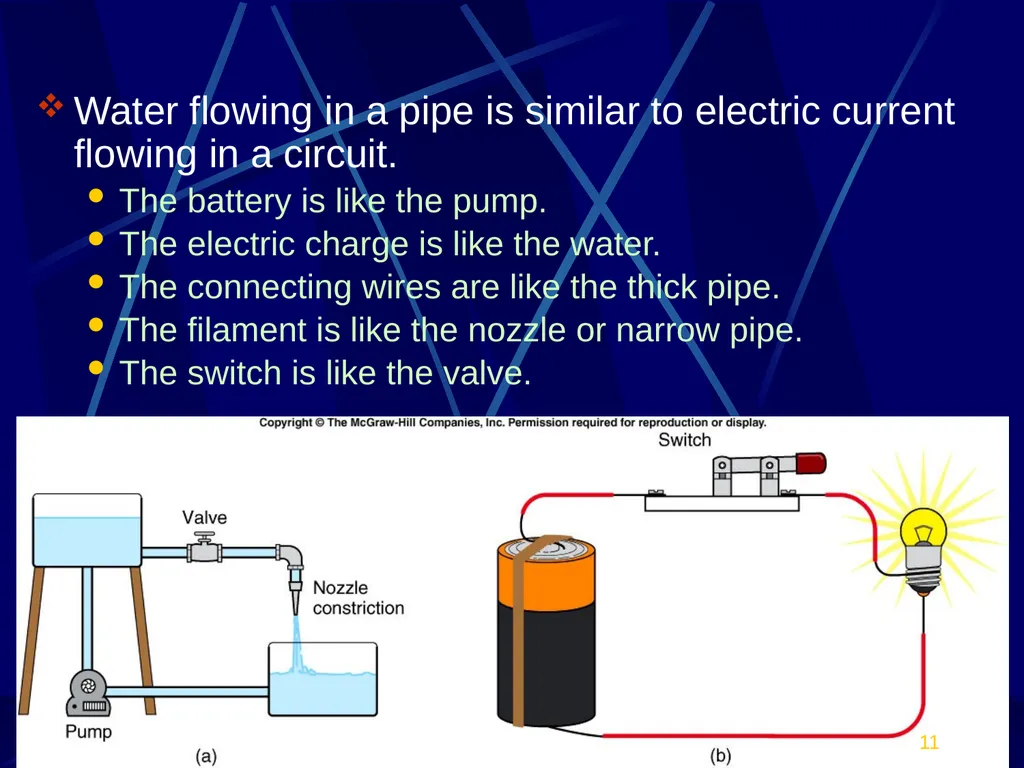
Water flowing in a pipe is similar to electric current flowing in a circuit.
The battery is like the pump.
The electric charge is like the water.
The connecting wires are like the thick pipe.
The filament is like the nozzle or narrow pipe.
The switch is like the valve. 11<br>
The battery is like the pump.
The electric charge is like the water.
The connecting wires are like the thick pipe.
The filament is like the nozzle or narrow pipe.
The switch is like the valve. 11<br>
12
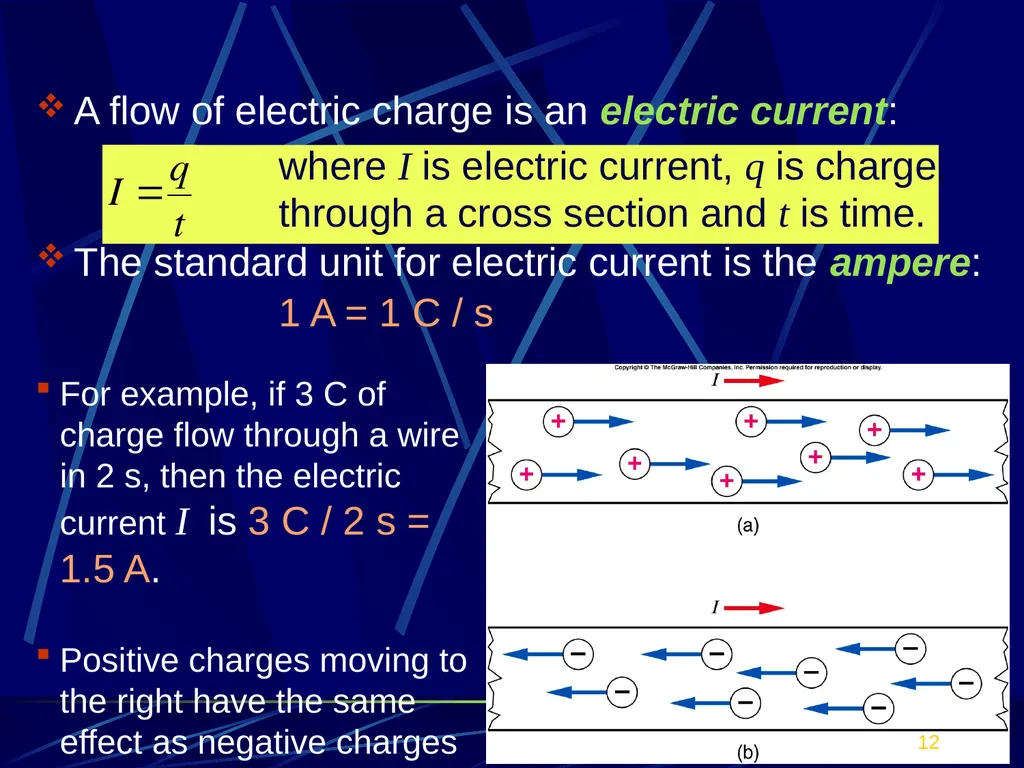
A flow of electric charge is an electric current:
where I is electric current, q is charge,
through a cross section and t is time.
The standard unit for electric current is the ampere:
1 A = 1 C / s For example, if 3 C of charge flow through a wire in 2 s, then the electric current I is 3 C / 2 s = 1.5 A.
Positive charges moving to the right have the same effect as negative charges moving to the left. 12<br>
where I is electric current, q is charge,
through a cross section and t is time.
The standard unit for electric current is the ampere:
1 A = 1 C / s For example, if 3 C of charge flow through a wire in 2 s, then the electric current I is 3 C / 2 s = 1.5 A.
Positive charges moving to the right have the same effect as negative charges moving to the left. 12<br>
13
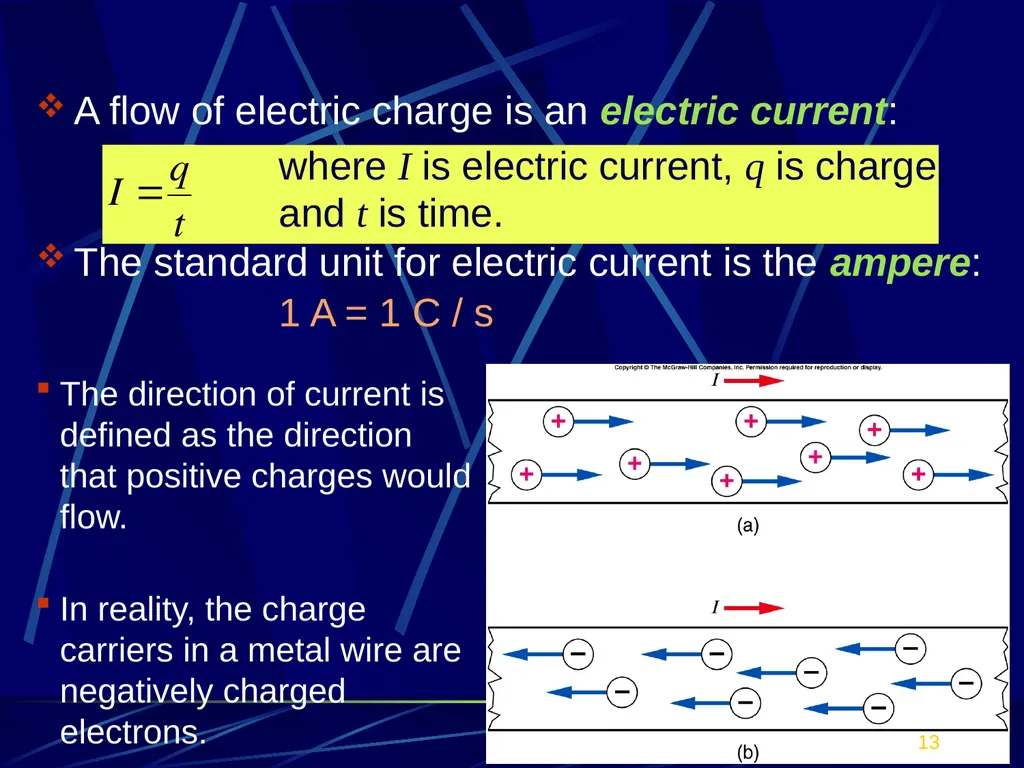
A flow of electric charge is an electric current:
where I is electric current, q is charge,
and t is time.
The standard unit for electric current is the ampere:
1 A = 1 C / s The direction of current is defined as the direction that positive charges would flow.
In reality, the charge carriers in a metal wire are negatively charged electrons. 13<br>
where I is electric current, q is charge,
and t is time.
The standard unit for electric current is the ampere:
1 A = 1 C / s The direction of current is defined as the direction that positive charges would flow.
In reality, the charge carriers in a metal wire are negatively charged electrons. 13<br>
14
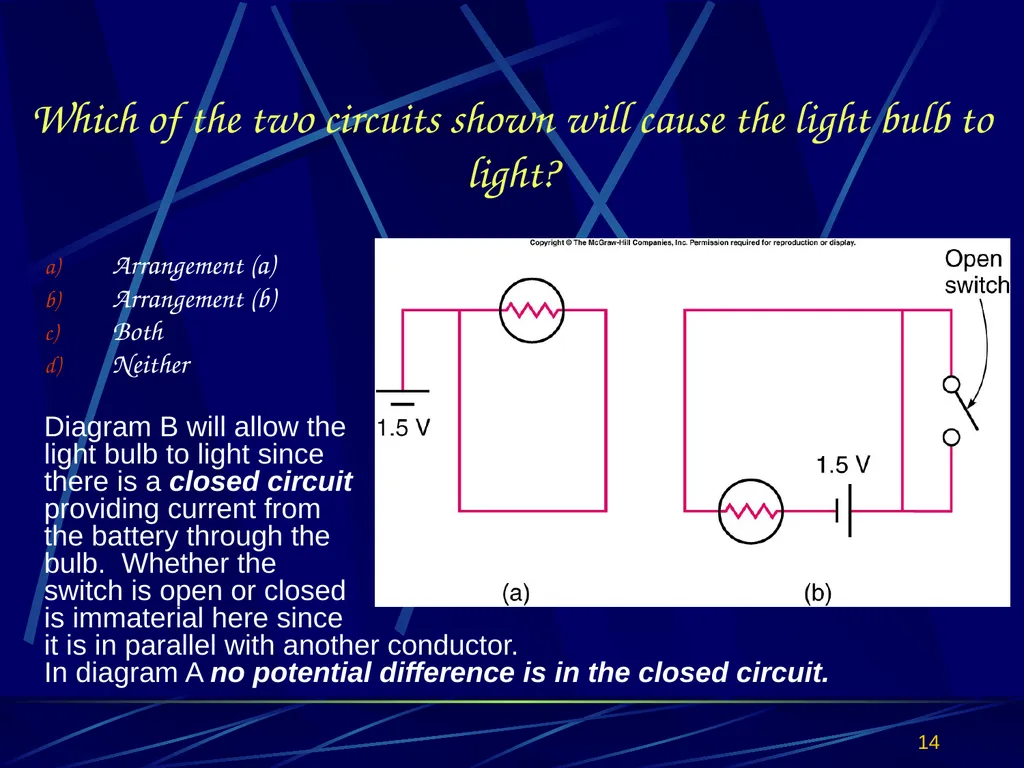
Which of the two circuits shown will cause the light bulb to light? Diagram B will allow the
light bulb to light since
there is a closed circuit
providing current from
the battery through the
bulb. Whether the
switch is open or closed
is immaterial here since
it is in parallel with another conductor.
In diagram A no potential difference is in the closed circuit. Arrangement (a)
Arrangement (b)
Both
Neither 14<br>
light bulb to light since
there is a closed circuit
providing current from
the battery through the
bulb. Whether the
switch is open or closed
is immaterial here since
it is in parallel with another conductor.
In diagram A no potential difference is in the closed circuit. Arrangement (a)
Arrangement (b)
Both
Neither 14<br>
15
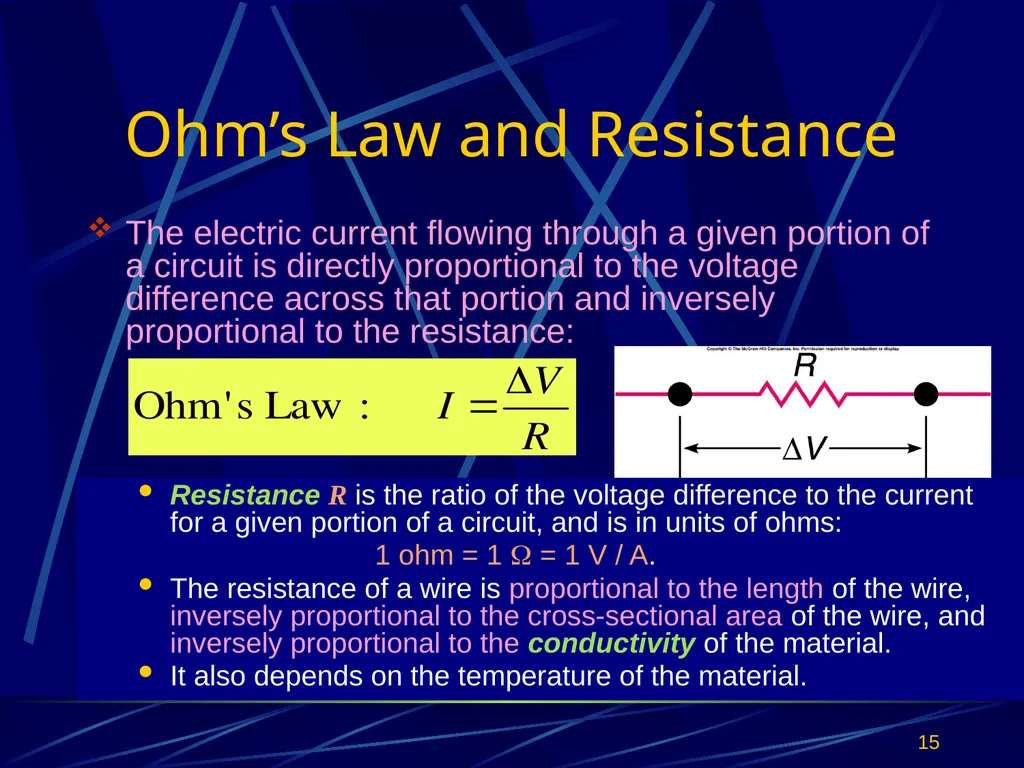
Ohm’s Law and Resistance The electric current flowing through a given portion of a circuit is directly proportional to the voltage difference across that portion and inversely proportional to the resistance: Resistance R is the ratio of the voltage difference to the current for a given portion of a circuit, and is in units of ohms:
1 ohm = 1 = 1 V / A.
The resistance of a wire is proportional to the length of the wire, inversely proportional to the cross-sectional area of the wire, and inversely proportional to the conductivity of the material.
It also depends on the temperature of the material. 15<br>
1 ohm = 1 = 1 V / A.
The resistance of a wire is proportional to the length of the wire, inversely proportional to the cross-sectional area of the wire, and inversely proportional to the conductivity of the material.
It also depends on the temperature of the material. 15<br>
16
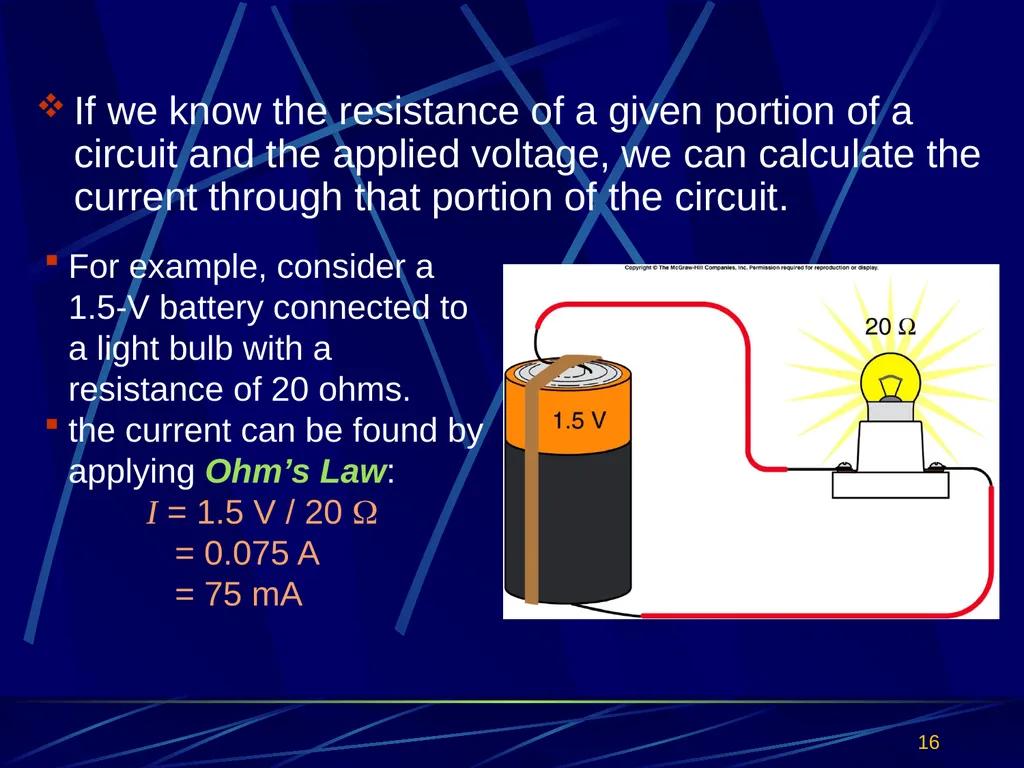
If we know the resistance of a given portion of a circuit and the applied voltage, we can calculate the current through that portion of the circuit. For example, consider a 1.5-V battery connected to a light bulb with a resistance of 20 ohms.
the current can be found by applying Ohm’s Law:
I = 1.5 V / 20
= 0.075 A
= 75 mA 16<br>
the current can be found by applying Ohm’s Law:
I = 1.5 V / 20
= 0.075 A
= 75 mA 16<br>
17
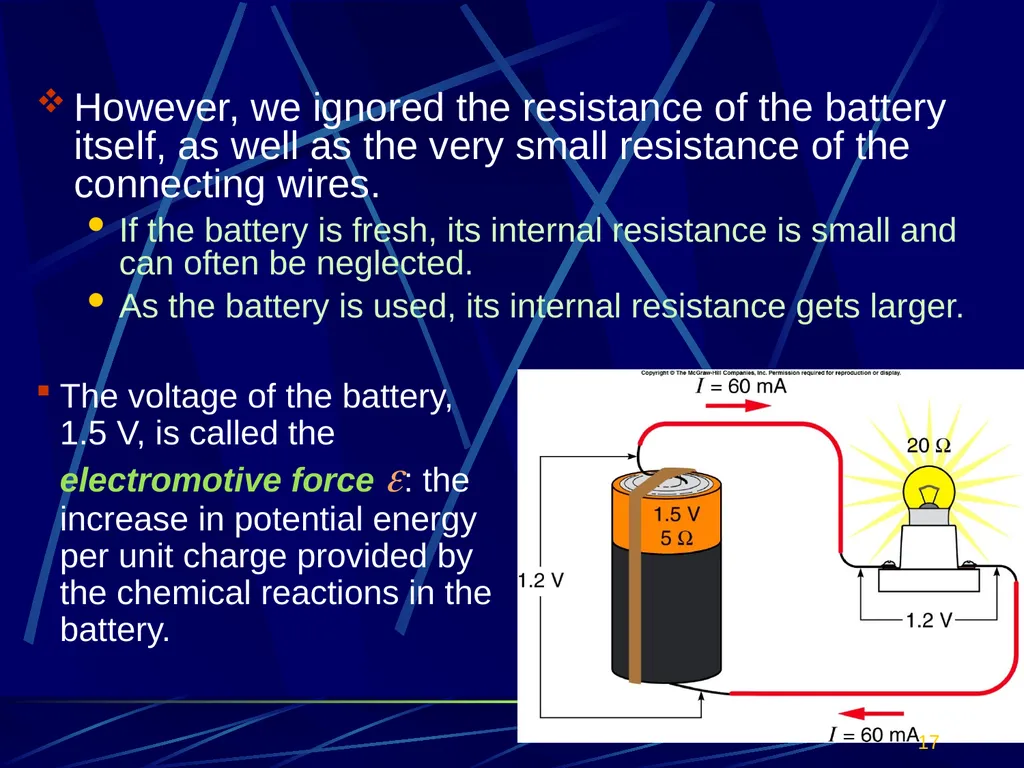
However, we ignored the resistance of the battery itself, as well as the very small resistance of the connecting wires.
If the battery is fresh, its internal resistance is small and can often be neglected.
As the battery is used, its internal resistance gets larger. The voltage of the battery, 1.5 V, is called the electromotive force : the increase in potential energy per unit charge provided by the chemical reactions in the battery. 17<br>
If the battery is fresh, its internal resistance is small and can often be neglected.
As the battery is used, its internal resistance gets larger. The voltage of the battery, 1.5 V, is called the electromotive force : the increase in potential energy per unit charge provided by the chemical reactions in the battery. 17<br>
18
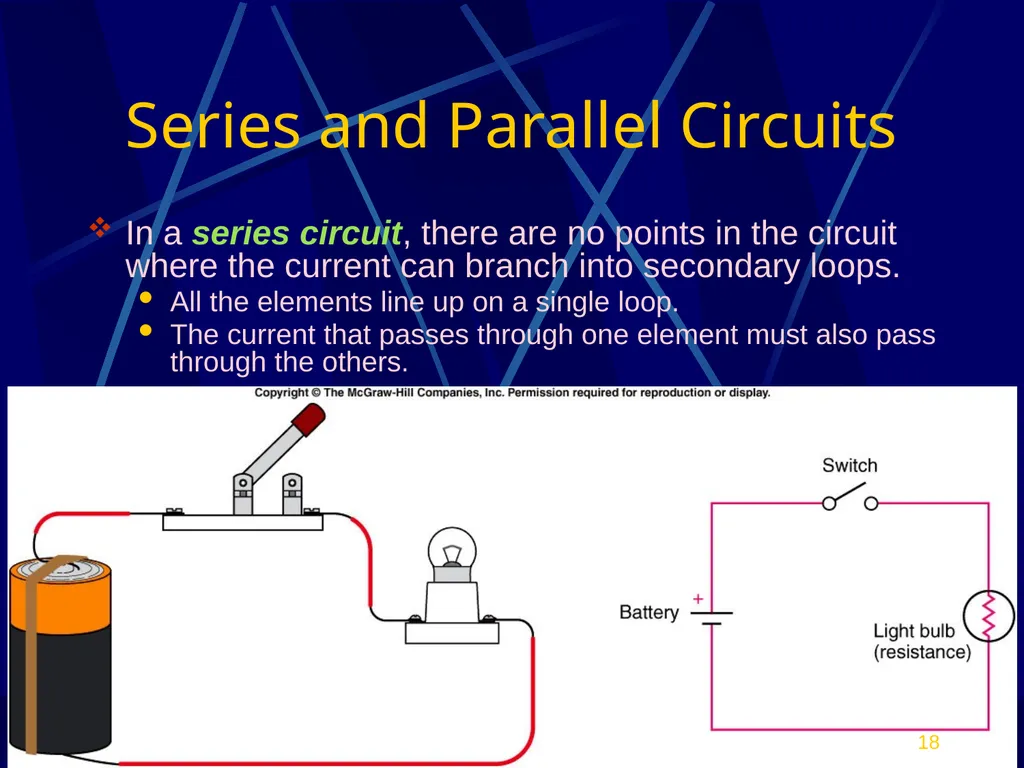
Series and Parallel Circuits In a series circuit, there are no points in the circuit where the current can branch into secondary loops.
All the elements line up on a single loop.
The current that passes through one element must also pass through the others. 18<br>
All the elements line up on a single loop.
The current that passes through one element must also pass through the others. 18<br>
19
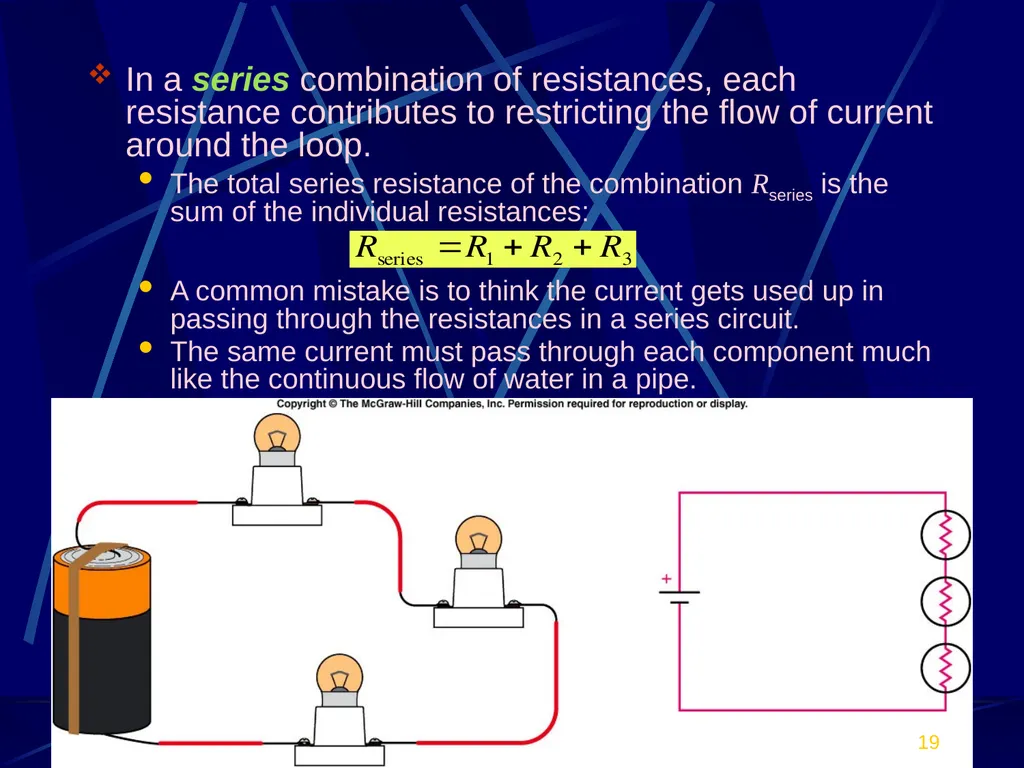
In a series combination of resistances, each resistance contributes to restricting the flow of current around the loop.
The total series resistance of the combination Rseries is the sum of the individual resistances:
A common mistake is to think the current gets used up in passing through the resistances in a series circuit.
The same current must pass through each component much like the continuous flow of water in a pipe. 19<br>
The total series resistance of the combination Rseries is the sum of the individual resistances:
A common mistake is to think the current gets used up in passing through the resistances in a series circuit.
The same current must pass through each component much like the continuous flow of water in a pipe. 19<br>
20
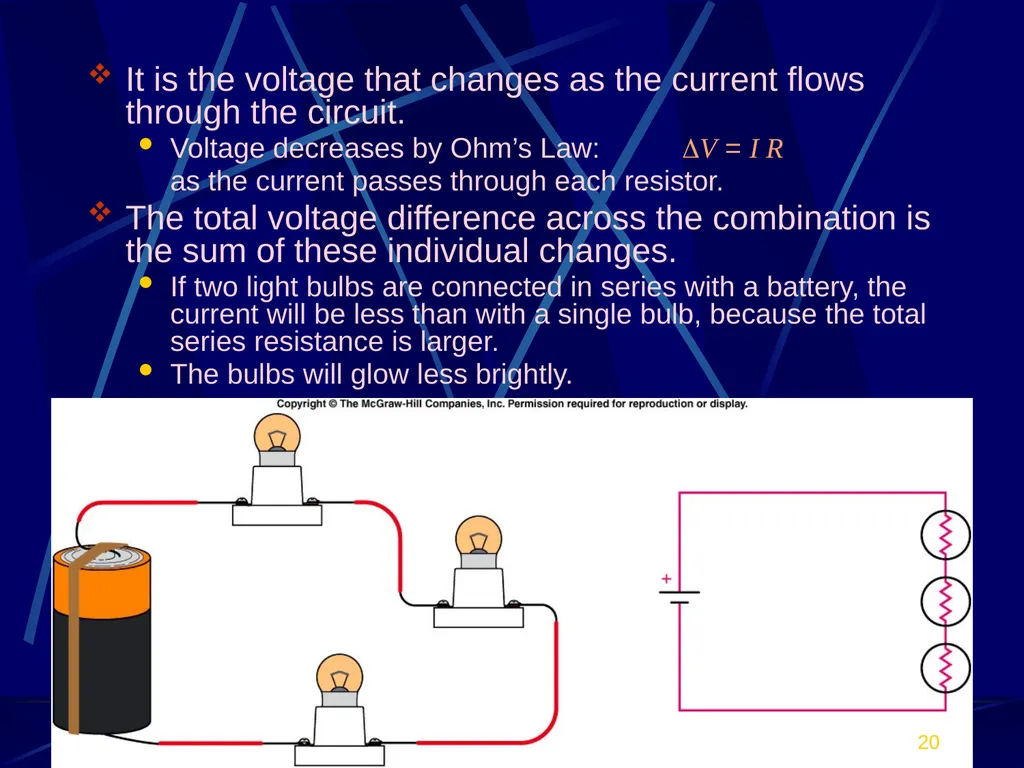
It is the voltage that changes as the current flows through the circuit.
Voltage decreases by Ohm’s Law: V = I R
as the current passes through each resistor.
The total voltage difference across the combination is the sum of these individual changes.
If two light bulbs are connected in series with a battery, the current will be less than with a single bulb, because the total series resistance is larger.
The bulbs will glow less brightly. 20<br>
Voltage decreases by Ohm’s Law: V = I R
as the current passes through each resistor.
The total voltage difference across the combination is the sum of these individual changes.
If two light bulbs are connected in series with a battery, the current will be less than with a single bulb, because the total series resistance is larger.
The bulbs will glow less brightly. 20<br>
21
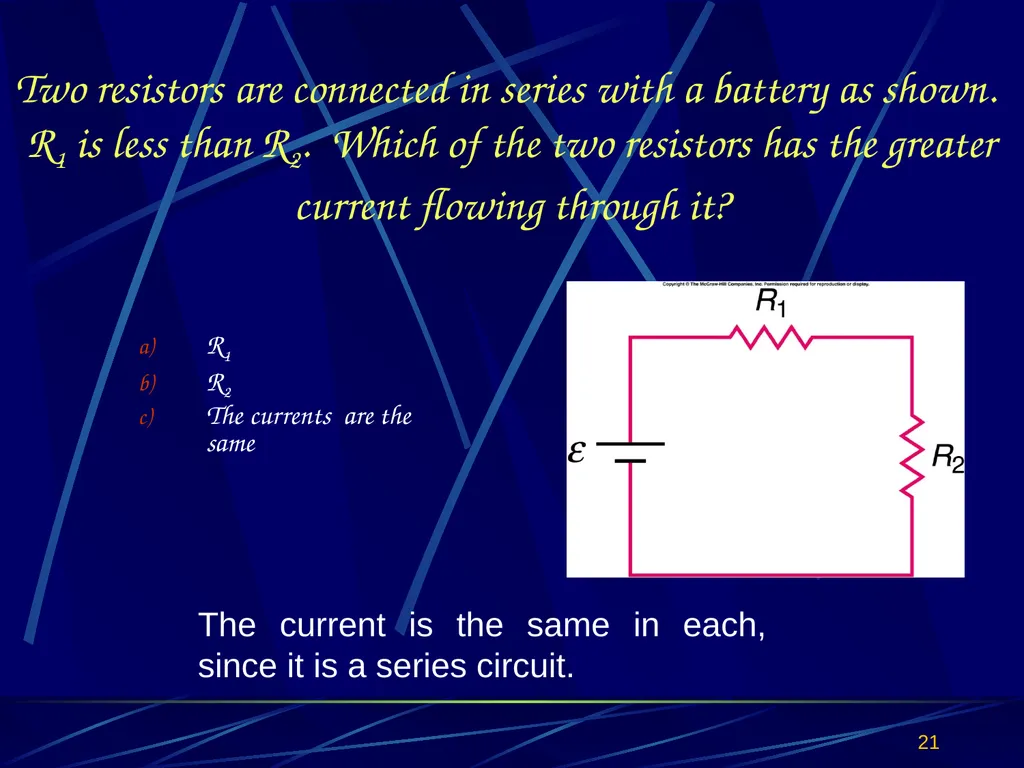
Two resistors are connected in series with a battery as shown. R1 is less than R2. Which of the two resistors has the greater current flowing through it? The current is the same in each, since it is a series circuit. R1
R2
The currents are the same 21<br>
R2
The currents are the same 21<br>
22
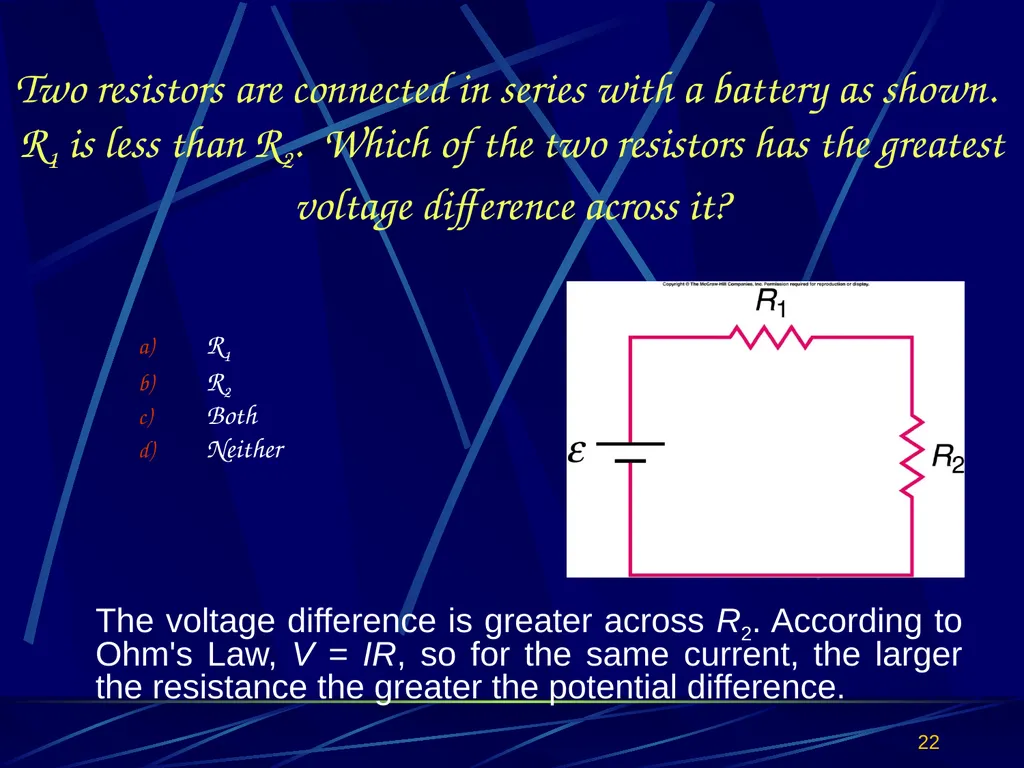
Two resistors are connected in series with a battery as shown. R1 is less than R2. Which of the two resistors has the greatest voltage difference across it? The voltage difference is greater across R2. According to Ohm's Law, V = IR, so for the same current, the larger the resistance the greater the potential difference. R1
R2
Both
Neither 22<br>
R2
Both
Neither 22<br>
23
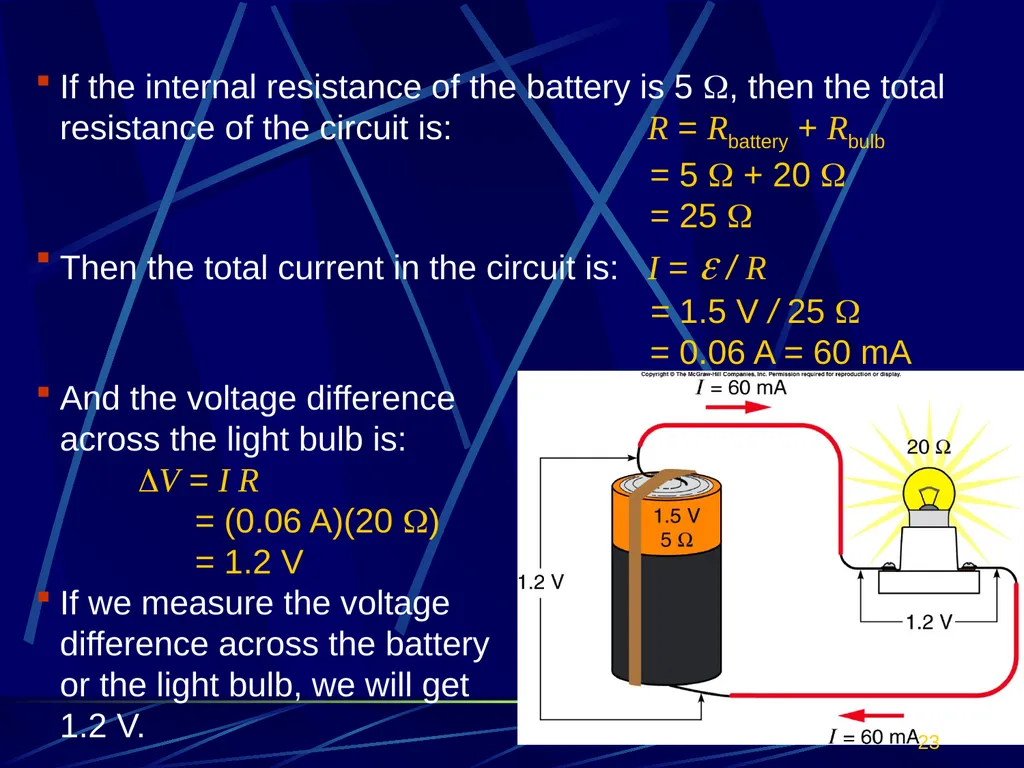
If the internal resistance of the battery is 5 , then the total resistance of the circuit is: R = Rbattery + Rbulb
= 5 + 20
= 25
Then the total current in the circuit is: I = / R
= 1.5 V / 25
= 0.06 A = 60 mA And the voltage difference across the light bulb is:
V = I R
= (0.06 A)(20 )
= 1.2 V
If we measure the voltage difference across the battery or the light bulb, we will get 1.2 V. 23<br>
= 5 + 20
= 25
Then the total current in the circuit is: I = / R
= 1.5 V / 25
= 0.06 A = 60 mA And the voltage difference across the light bulb is:
V = I R
= (0.06 A)(20 )
= 1.2 V
If we measure the voltage difference across the battery or the light bulb, we will get 1.2 V. 23<br>
24
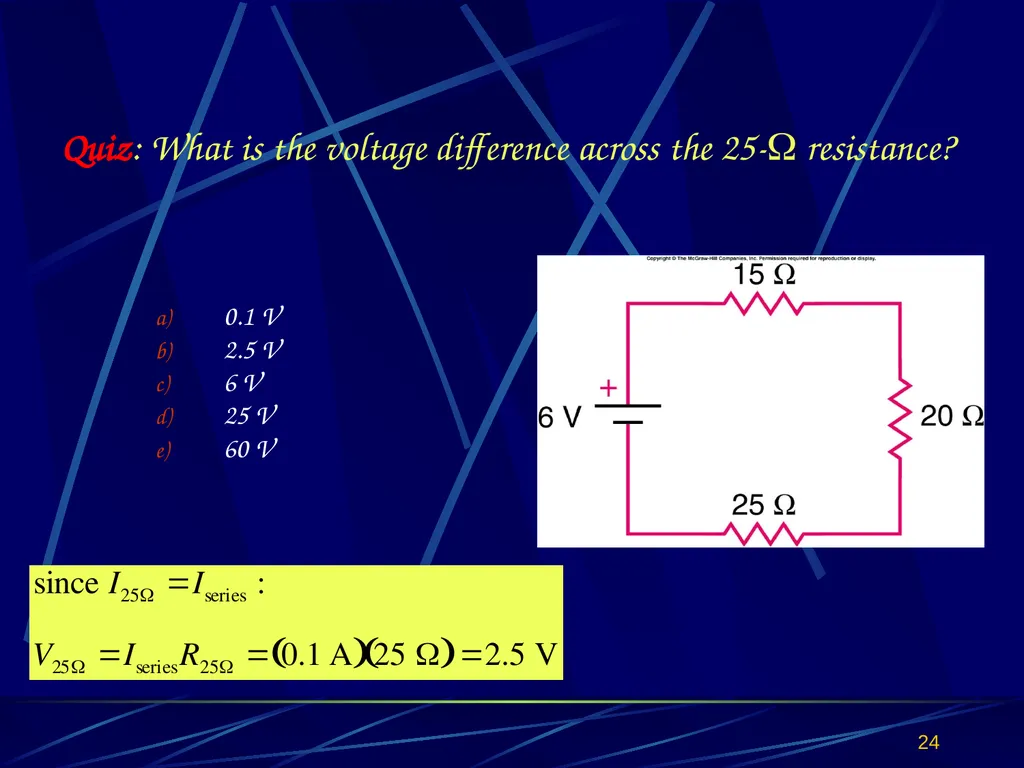
Quiz: What is the voltage difference across the 25- resistance? 0.1 V
2.5 V
6 V
25 V
60 V 24<br>
2.5 V
6 V
25 V
60 V 24<br>