
Electron House Where do the electrons live? Energy
MS
Published · 46 slides · 0 views

1 / 1
Description
Electron House Where do the electrons live? Energy Levels Floors Recall that Bohr was the first scientist to describe electrons using specific energy levels Bohr proposed that an electron is found only in specific circular paths, or
Related Topics
Share
Embed code
Download this presentation From Below
"Electron House Where do the electrons live? Energy" is the property of its rightful owner. Permission is granted to download and print the materials on this website for personal, non-commercial use only, and to display it on your personal computer provided you do not modify the materials and that you retain all copyright notices contained in the materials. By downloading content from our website, you accept the terms of this agreement.
Presentation Transcript
01
Electron House Where do the electrons live?<br>
02
Energy Levels & Floors Recall that Bohr was the first scientist to describe electrons using specific energy levels
Bohr proposed that an electron is found only in specific circular paths, or orbits, around the nucleus
Each possible electron orbit in Bohr’s model has a fixed energy know as energy levels
The 1st energy level could hold a maximum of 2 electrons
The 2nd energy level could hold a maximum of 8 electrons
The 3rd energy level could hold a maximum of 18 electrons
The 4th energy level could hold a maximum of 32 electrons
Mathematical equations for electrons in energy levels is 2n2 where n is the energy level<br>
Bohr proposed that an electron is found only in specific circular paths, or orbits, around the nucleus
Each possible electron orbit in Bohr’s model has a fixed energy know as energy levels
The 1st energy level could hold a maximum of 2 electrons
The 2nd energy level could hold a maximum of 8 electrons
The 3rd energy level could hold a maximum of 18 electrons
The 4th energy level could hold a maximum of 32 electrons
Mathematical equations for electrons in energy levels is 2n2 where n is the energy level<br>
03
Energy Levels & Floors Your House
The house itself, represents the electron cloud
In your house each floor is a different energy level
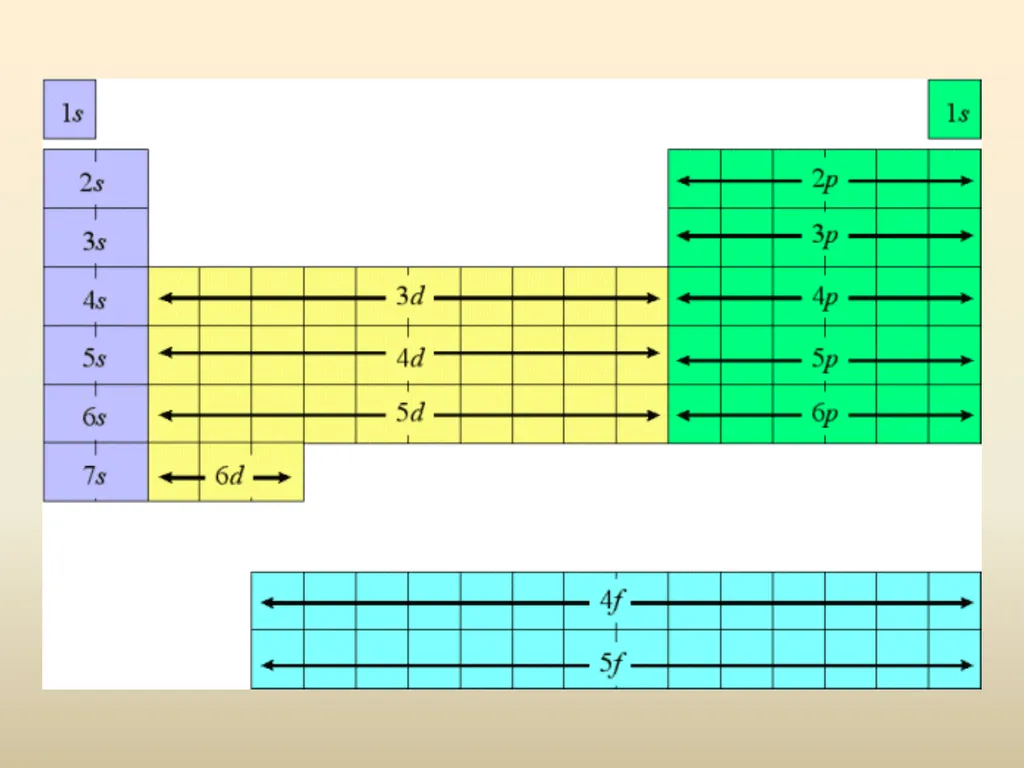
On the periodic table each row is an energy level
Each bedroom represents a sublevel within an energy level.
Sublevels are labeled as s, p, d, or f
Each bed represents an orbital within the sublevel.
Two people (electrons) can occupy the same bed at the same time.<br>
The house itself, represents the electron cloud
In your house each floor is a different energy level
On the periodic table each row is an energy level
Each bedroom represents a sublevel within an energy level.
Sublevels are labeled as s, p, d, or f
Each bed represents an orbital within the sublevel.
Two people (electrons) can occupy the same bed at the same time.<br>
04
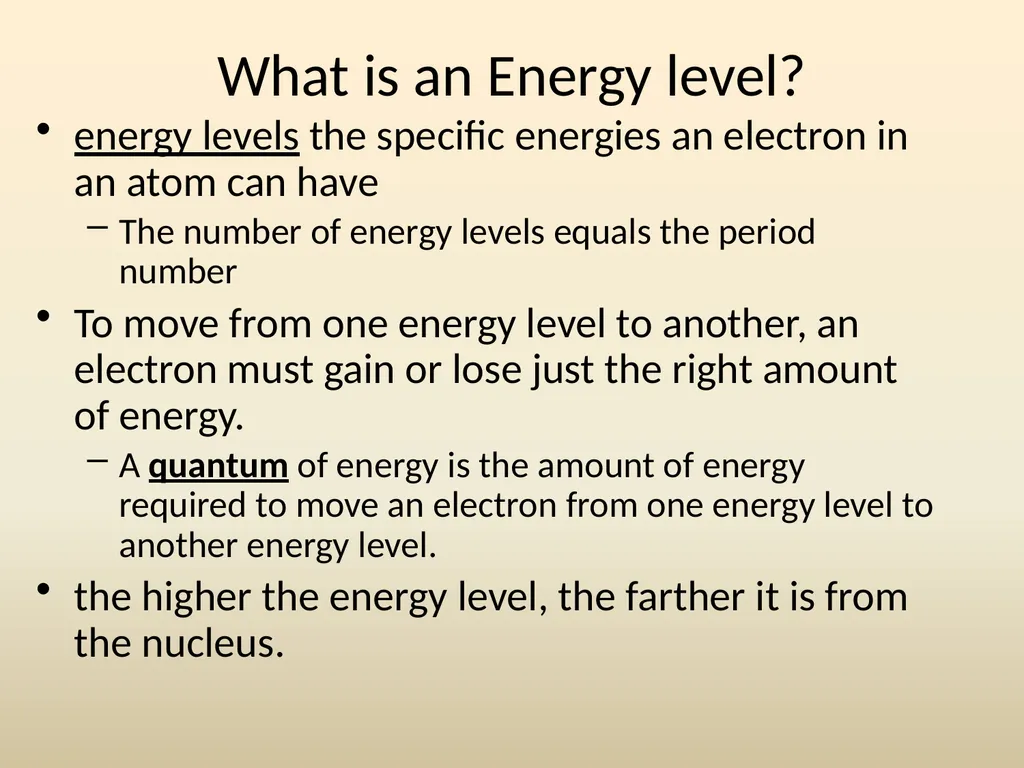
What is an Energy level? energy levels the specific energies an electron in an atom can have
The number of energy levels equals the period number
To move from one energy level to another, an electron must gain or lose just the right amount of energy.
A quantum of energy is the amount of energy required to move an electron from one energy level to another energy level.
the higher the energy level, the farther it is from the nucleus.<br>
The number of energy levels equals the period number
To move from one energy level to another, an electron must gain or lose just the right amount of energy.
A quantum of energy is the amount of energy required to move an electron from one energy level to another energy level.
the higher the energy level, the farther it is from the nucleus.<br>
05
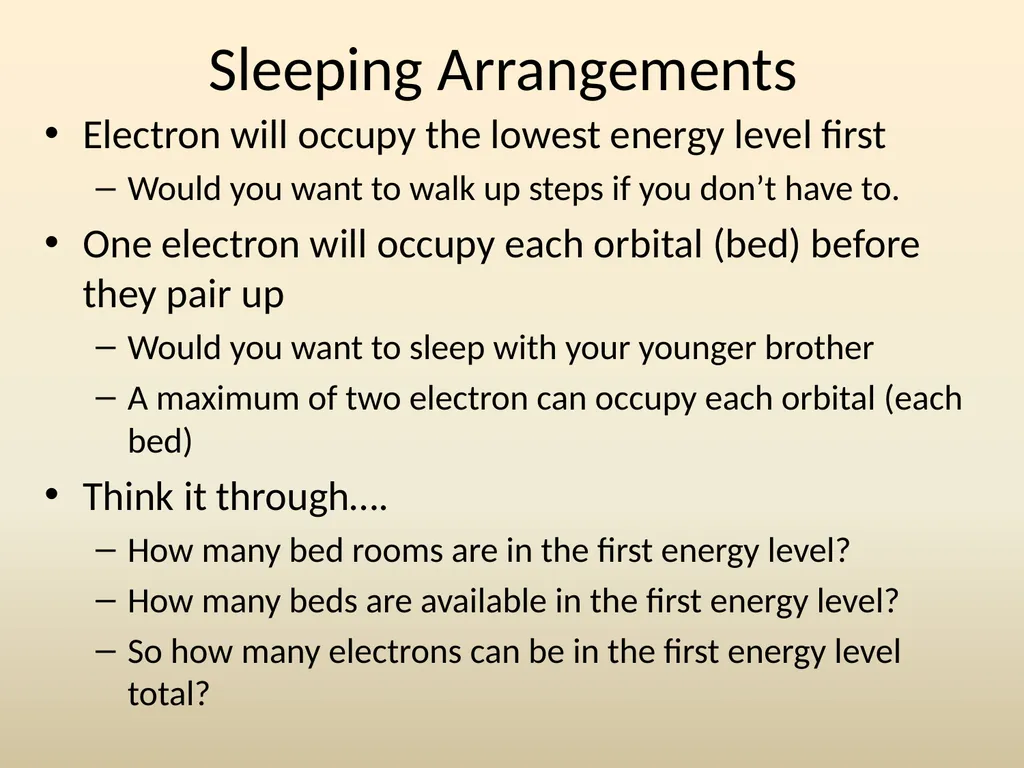
Sleeping Arrangements Electron will occupy the lowest energy level first
Would you want to walk up steps if you don’t have to.
One electron will occupy each orbital (bed) before they pair up
Would you want to sleep with your younger brother
A maximum of two electron can occupy each orbital (each bed)
Think it through….
How many bed rooms are in the first energy level?
How many beds are available in the first energy level?
So how many electrons can be in the first energy level total?<br>
Would you want to walk up steps if you don’t have to.
One electron will occupy each orbital (bed) before they pair up
Would you want to sleep with your younger brother
A maximum of two electron can occupy each orbital (each bed)
Think it through….
How many bed rooms are in the first energy level?
How many beds are available in the first energy level?
So how many electrons can be in the first energy level total?<br>
06
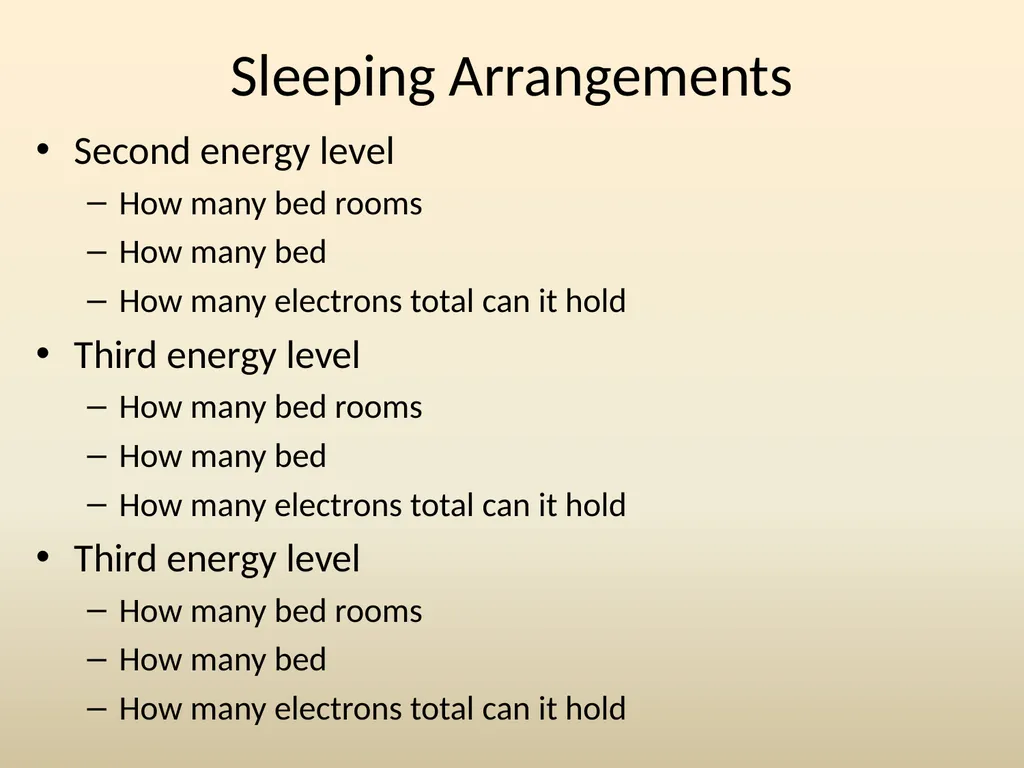
Sleeping Arrangements Second energy level
How many bed rooms
How many bed
How many electrons total can it hold
Third energy level
How many bed rooms
How many bed
How many electrons total can it hold
Third energy level
How many bed rooms
How many bed
How many electrons total can it hold<br>
How many bed rooms
How many bed
How many electrons total can it hold
Third energy level
How many bed rooms
How many bed
How many electrons total can it hold
Third energy level
How many bed rooms
How many bed
How many electrons total can it hold<br>
07
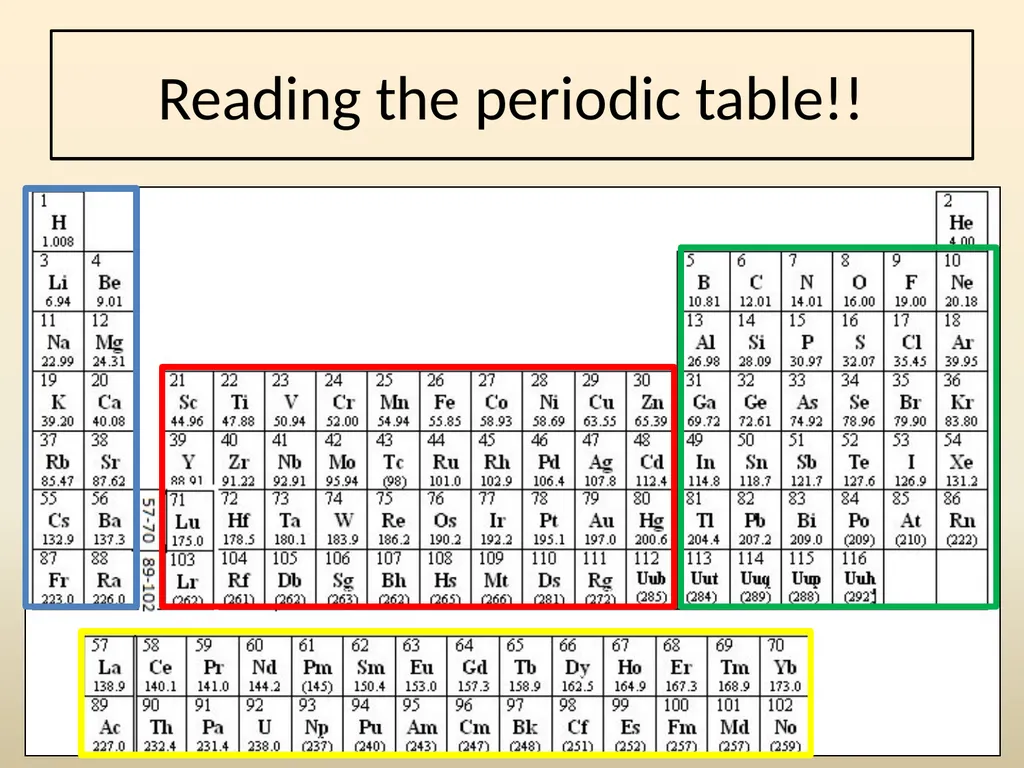
Reading the periodic table!!<br>
08
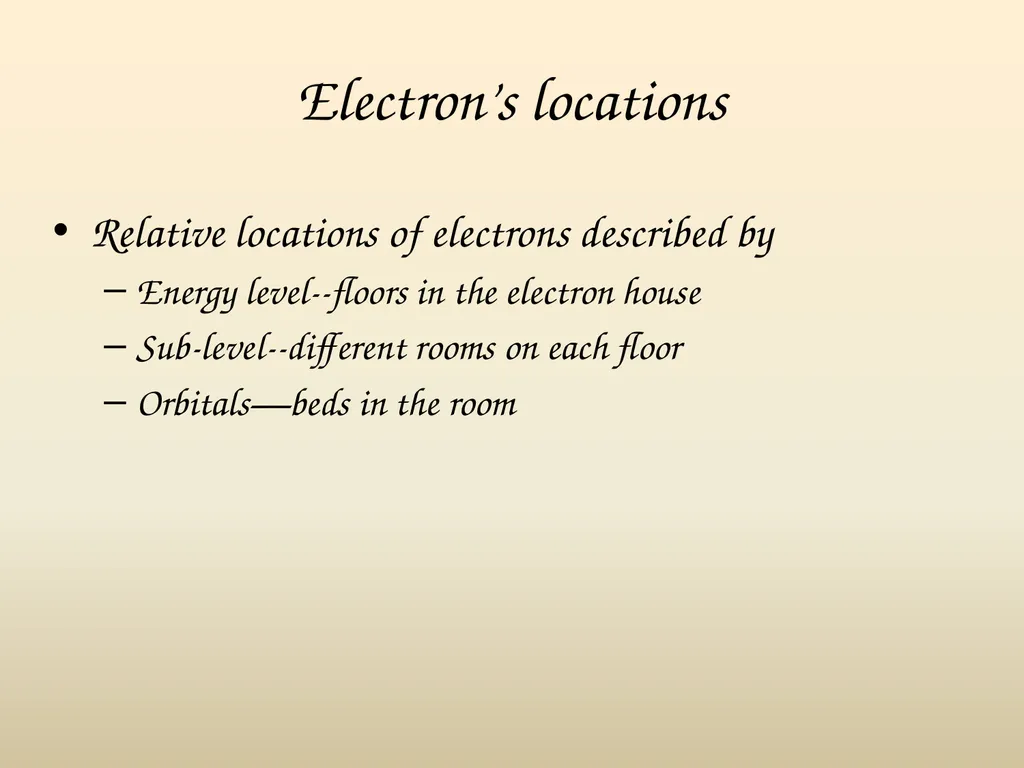
Electron’s locations Relative locations of electrons described by
Energy level--floors in the electron house
Sub-level--different rooms on each floor
Orbitals—beds in the room<br>
Energy level--floors in the electron house
Sub-level--different rooms on each floor
Orbitals—beds in the room<br>
09
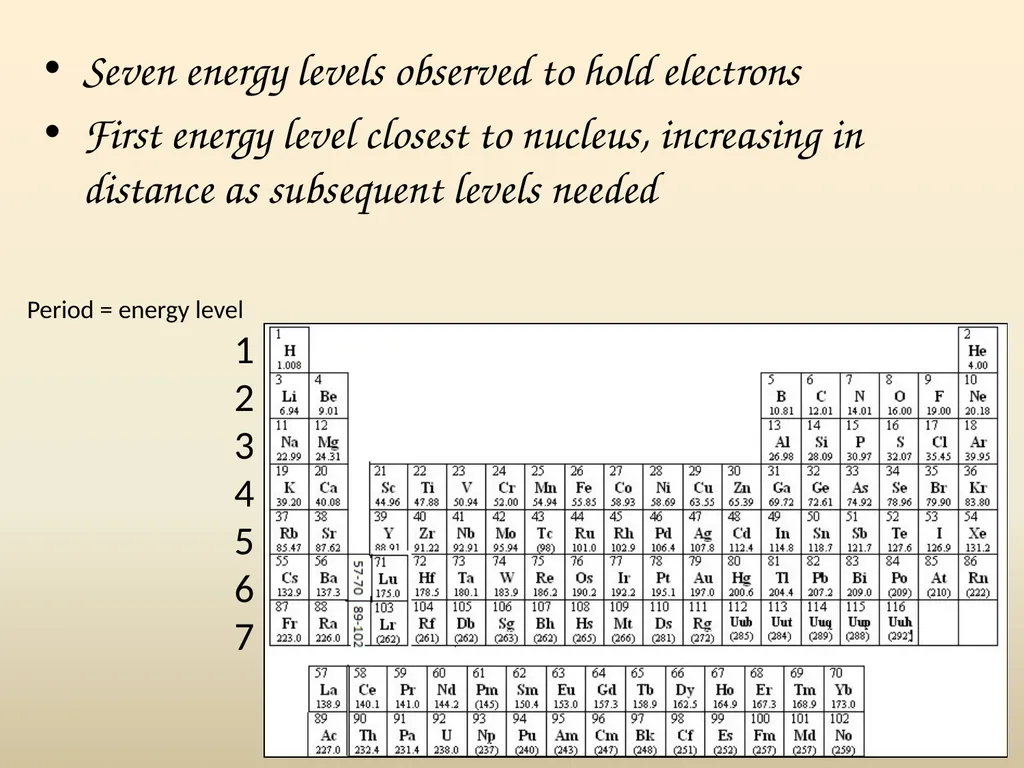
Seven energy levels observed to hold electrons
First energy level closest to nucleus, increasing in distance as subsequent levels needed Period = energy level
1
2
3
4
5
6
7<br>
First energy level closest to nucleus, increasing in distance as subsequent levels needed Period = energy level
1
2
3
4
5
6
7<br>
10
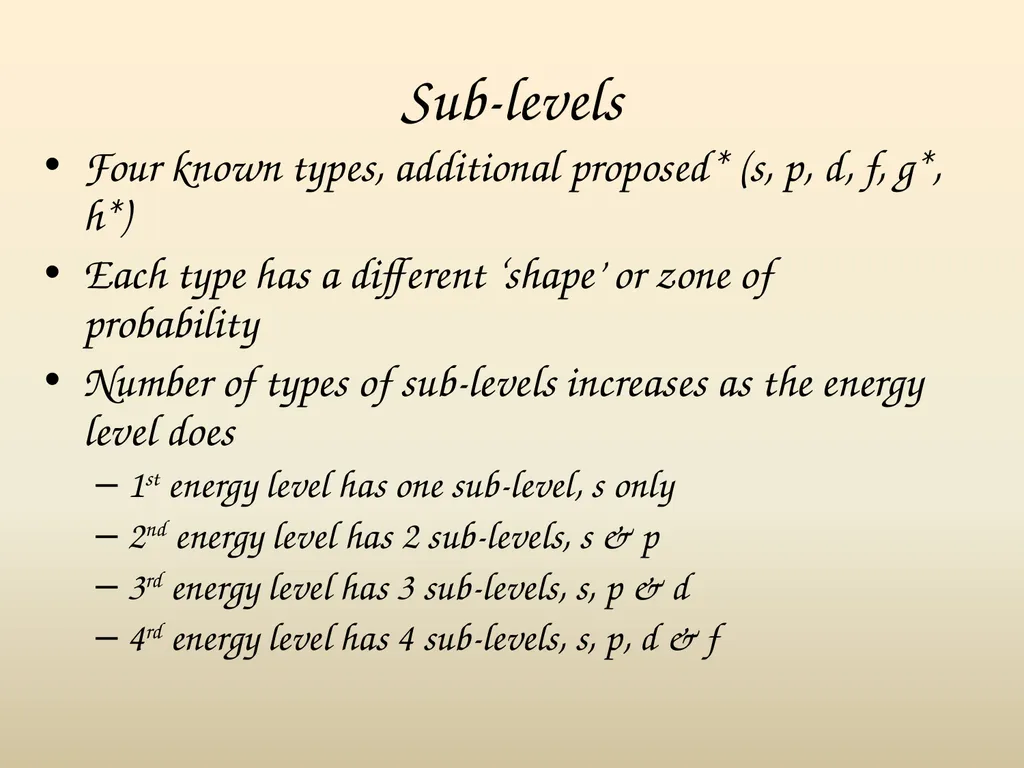
Sub-levels Four known types, additional proposed* (s, p, d, f, g*, h*)
Each type has a different ‘shape’ or zone of probability
Number of types of sub-levels increases as the energy level does
1st energy level has one sub-level, s only
2nd energy level has 2 sub-levels, s & p
3rd energy level has 3 sub-levels, s, p & d
4rd energy level has 4 sub-levels, s, p, d & f<br>
Each type has a different ‘shape’ or zone of probability
Number of types of sub-levels increases as the energy level does
1st energy level has one sub-level, s only
2nd energy level has 2 sub-levels, s & p
3rd energy level has 3 sub-levels, s, p & d
4rd energy level has 4 sub-levels, s, p, d & f<br>
11
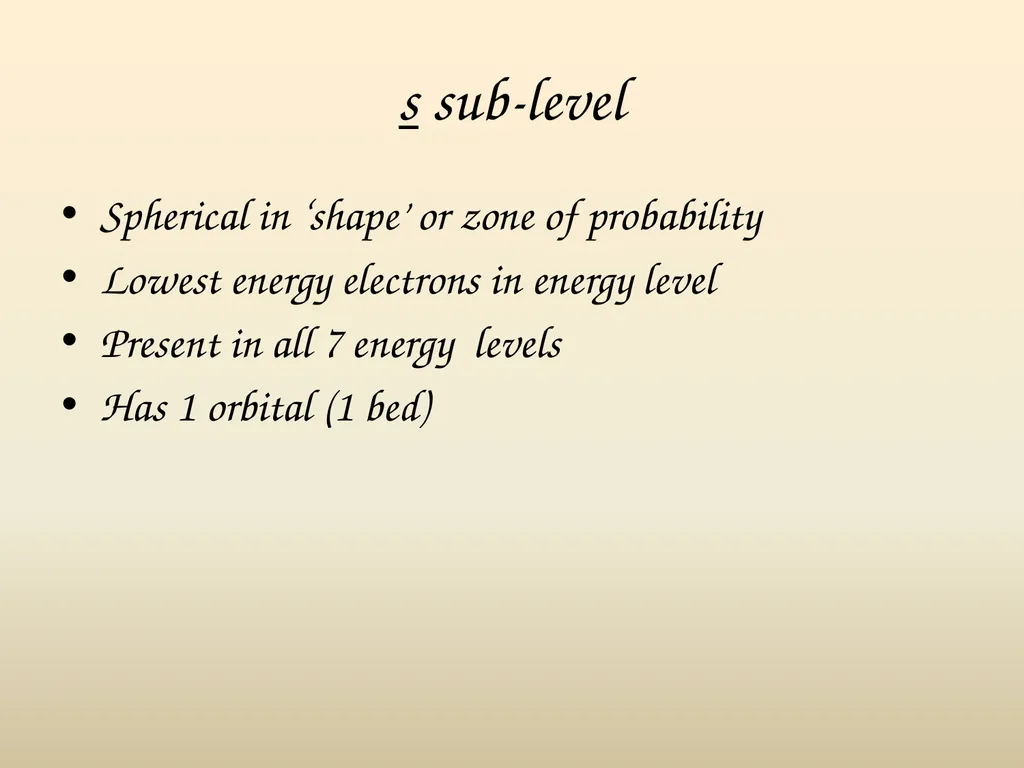
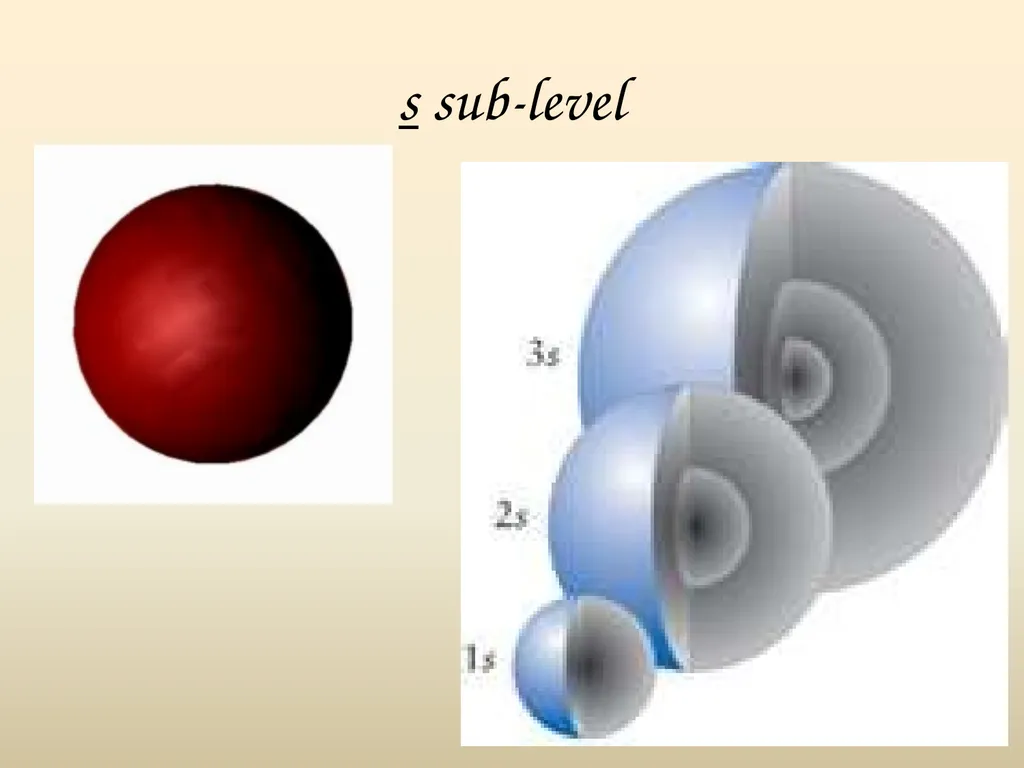
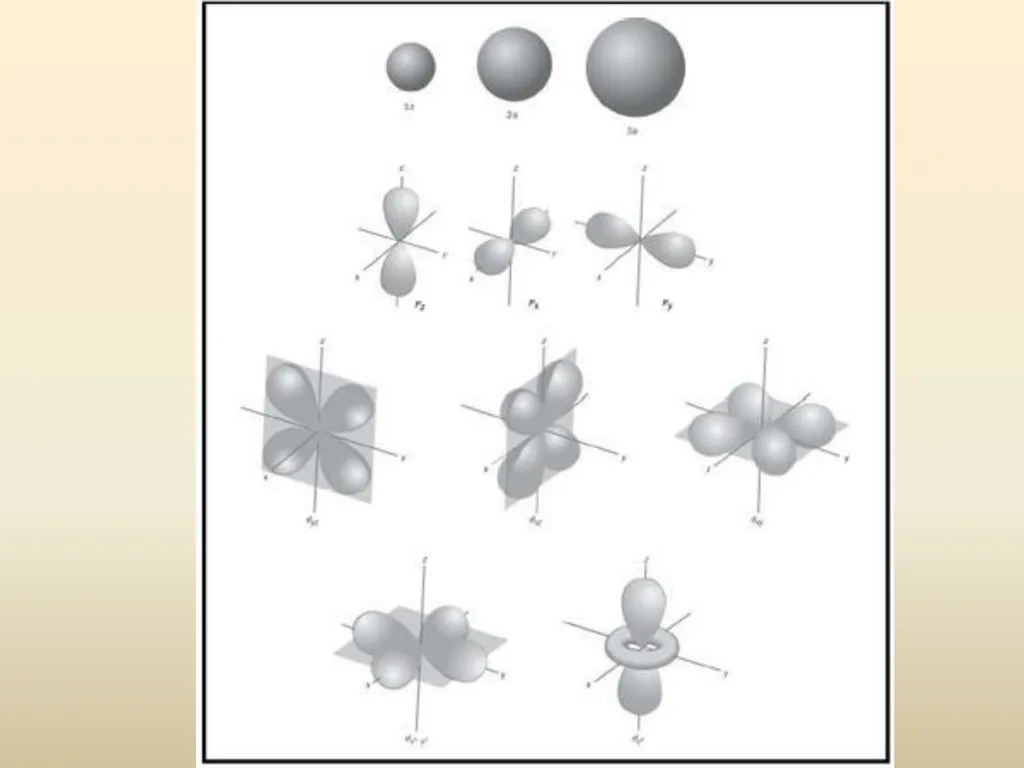
s sub-level Spherical in ‘shape’ or zone of probability
Lowest energy electrons in energy level
Present in all 7 energy levels
Has 1 orbital (1 bed)<br>
Lowest energy electrons in energy level
Present in all 7 energy levels
Has 1 orbital (1 bed)<br>
12
s sub-level<br>
13
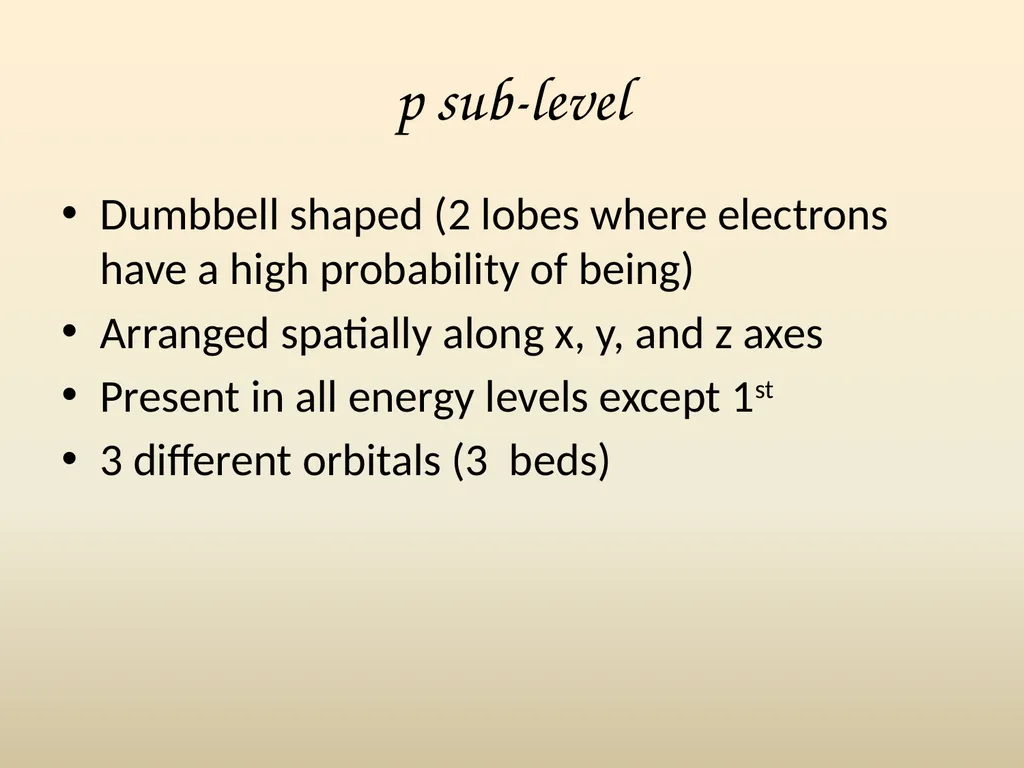
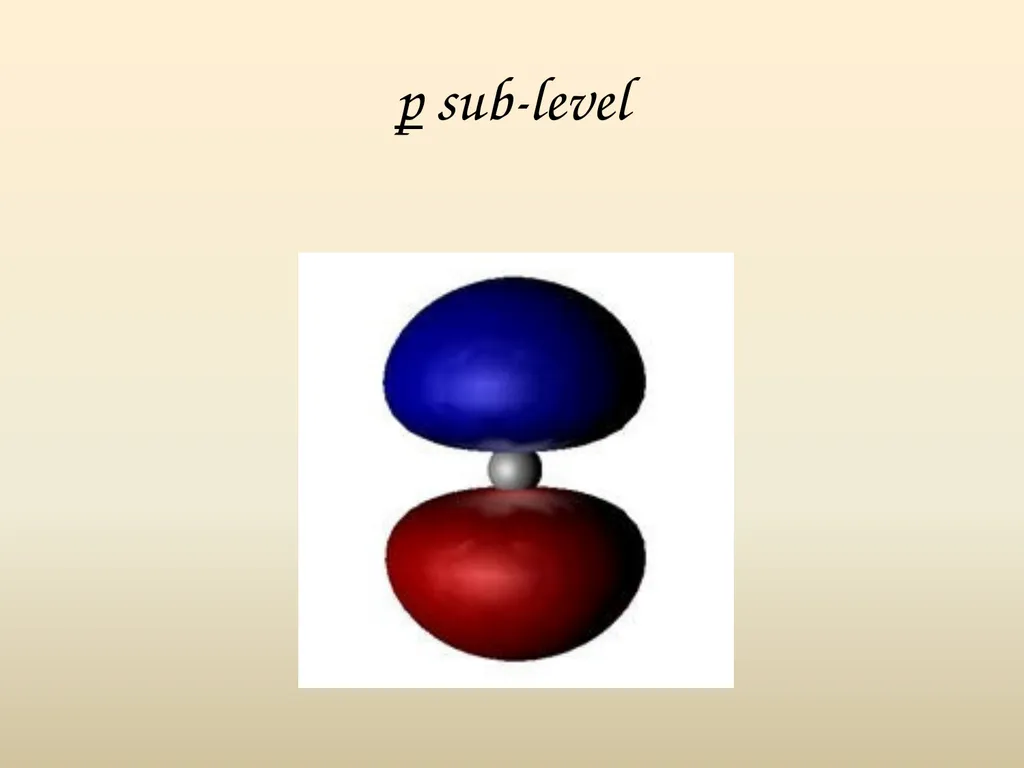
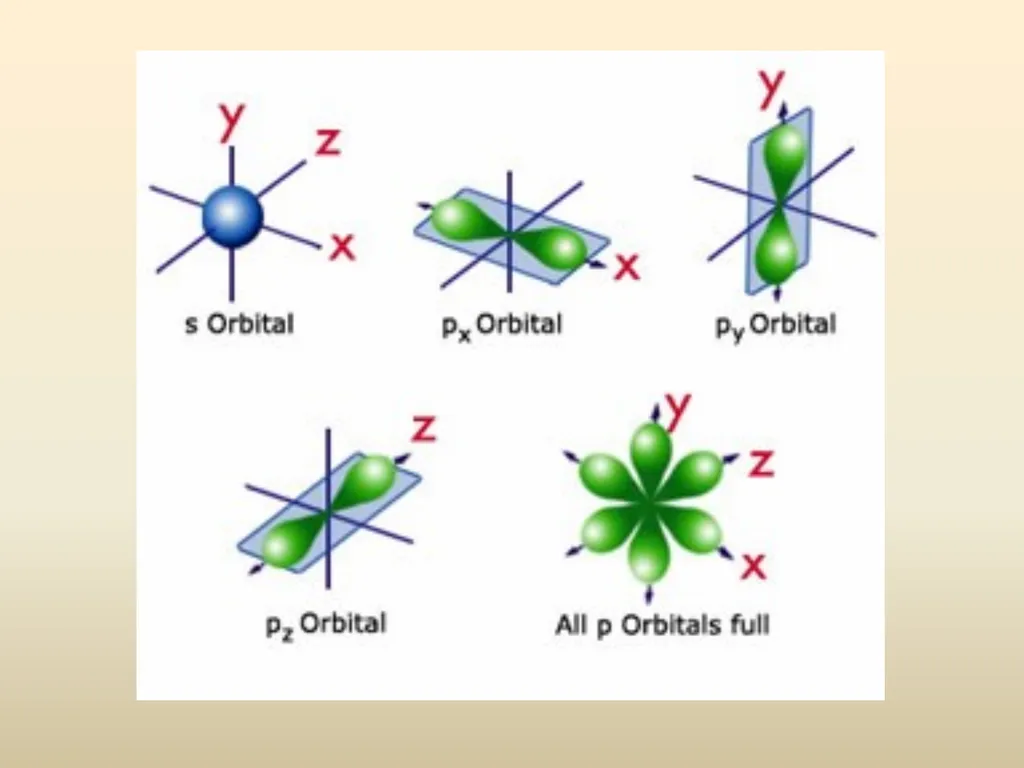
p sub-level Dumbbell shaped (2 lobes where electrons have a high probability of being)
Arranged spatially along x, y, and z axes
Present in all energy levels except 1st
3 different orbitals (3 beds)<br>
Arranged spatially along x, y, and z axes
Present in all energy levels except 1st
3 different orbitals (3 beds)<br>
14
p sub-level<br>
15
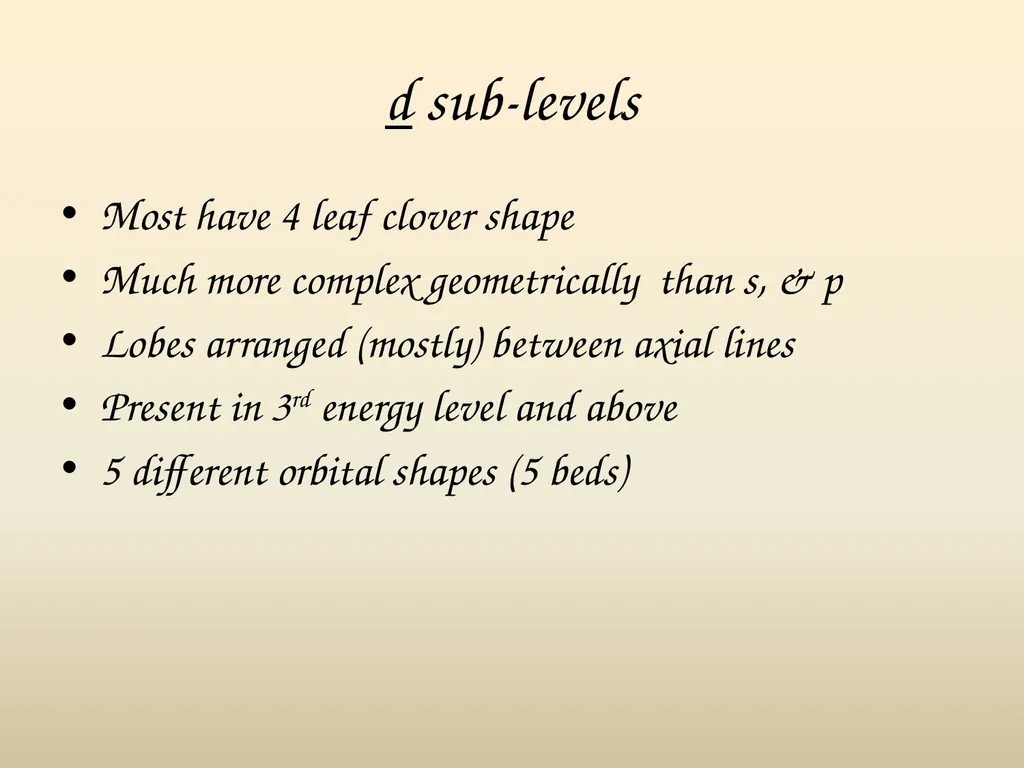
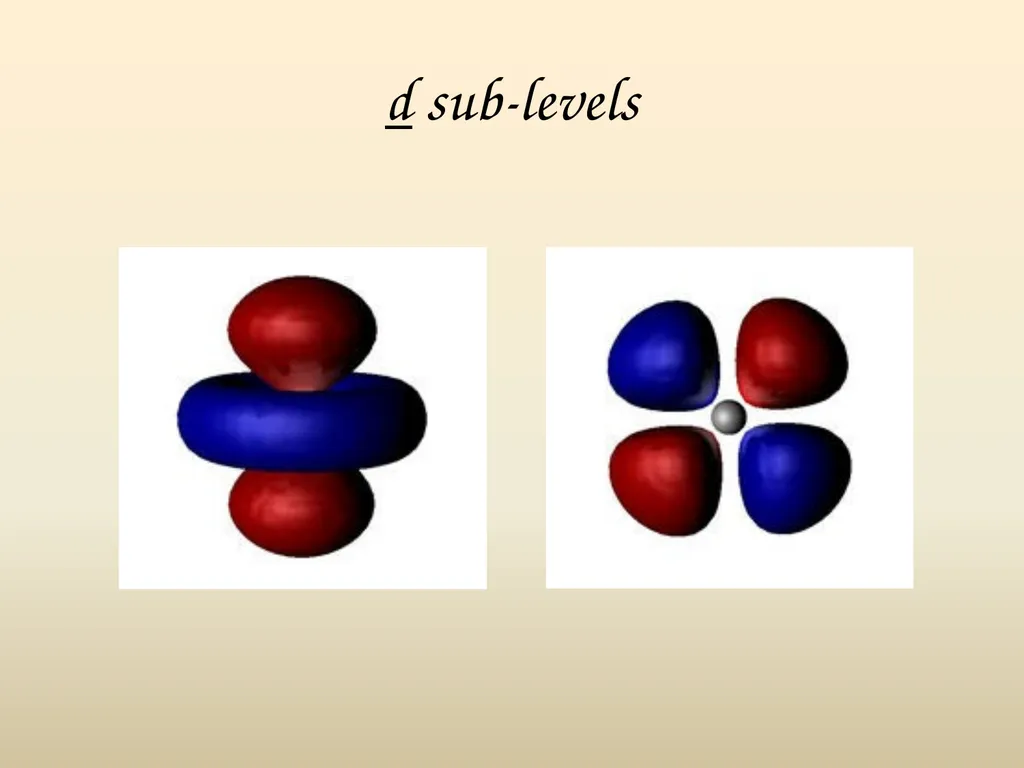
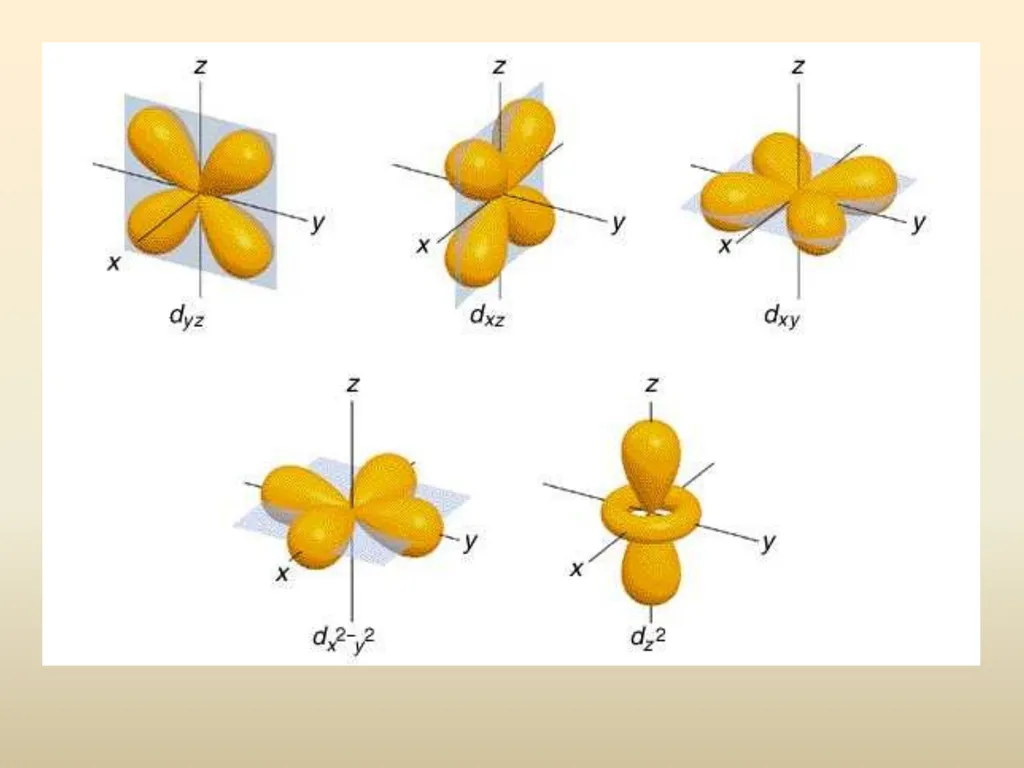
d sub-levels Most have 4 leaf clover shape
Much more complex geometrically than s, & p
Lobes arranged (mostly) between axial lines
Present in 3rd energy level and above
5 different orbital shapes (5 beds)<br>
Much more complex geometrically than s, & p
Lobes arranged (mostly) between axial lines
Present in 3rd energy level and above
5 different orbital shapes (5 beds)<br>
16
d sub-levels<br>
17
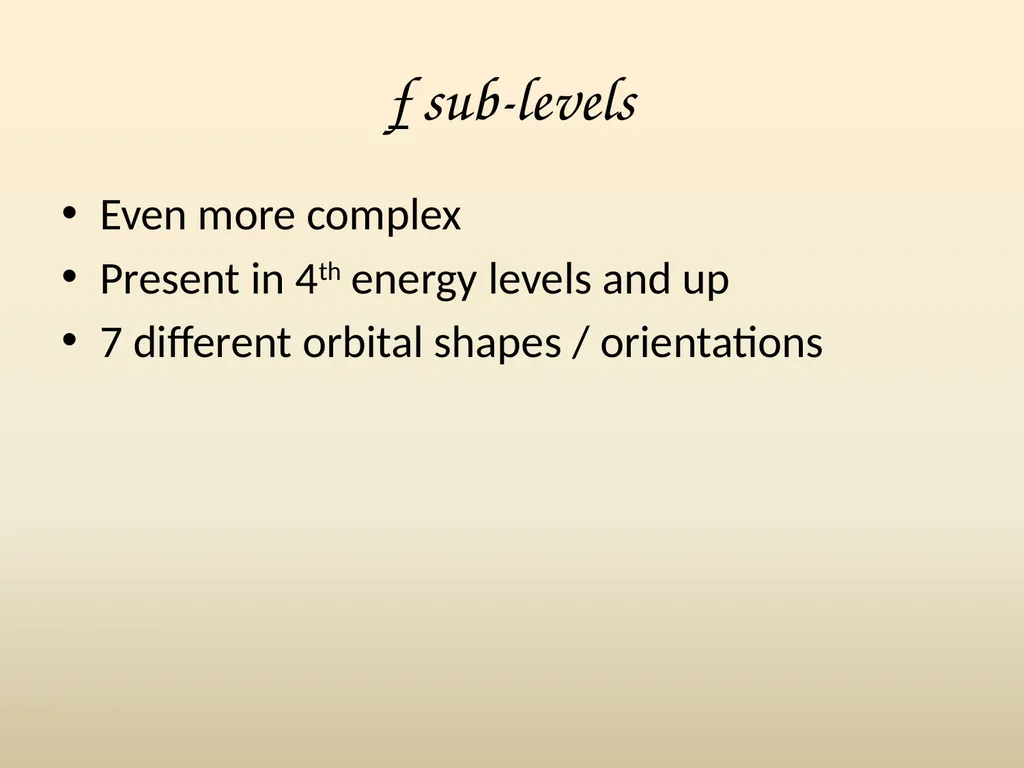
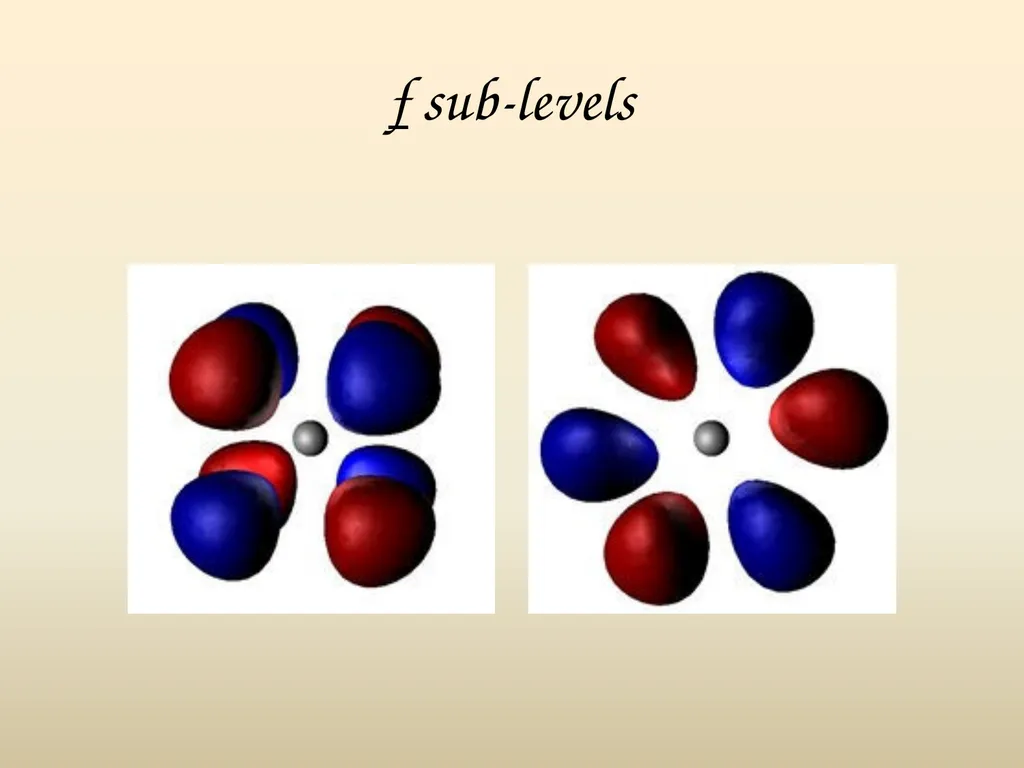
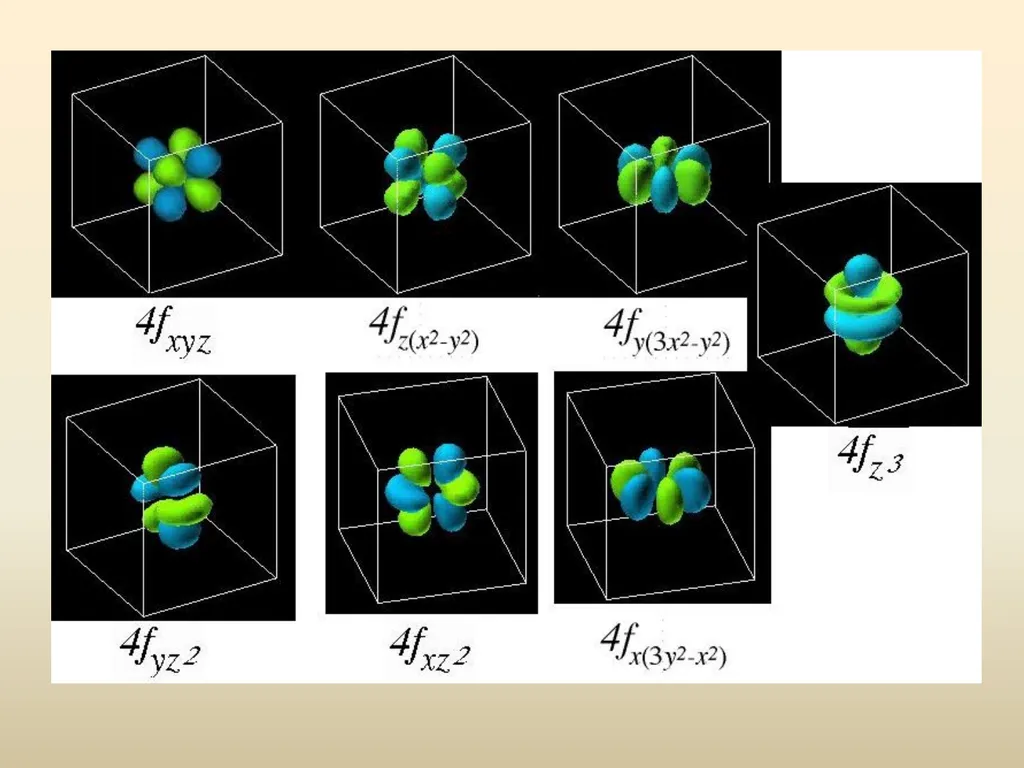
f sub-levels Even more complex
Present in 4th energy levels and up
7 different orbital shapes / orientations<br>
Present in 4th energy levels and up
7 different orbital shapes / orientations<br>
18
f sub-levels<br>
19
Electron Configuration Rules In an atom, electrons and the nucleus interact to make the most stable arrangement possible.
The ways in which electrons are arranged in various orbitals around the nuclei of atoms are called electron configurations.
Three rules—the aufbau principle, the Pauli exclusion principle, and Hund’s rule—tell you how to find the electron configurations of atoms<br>
The ways in which electrons are arranged in various orbitals around the nuclei of atoms are called electron configurations.
Three rules—the aufbau principle, the Pauli exclusion principle, and Hund’s rule—tell you how to find the electron configurations of atoms<br>
20
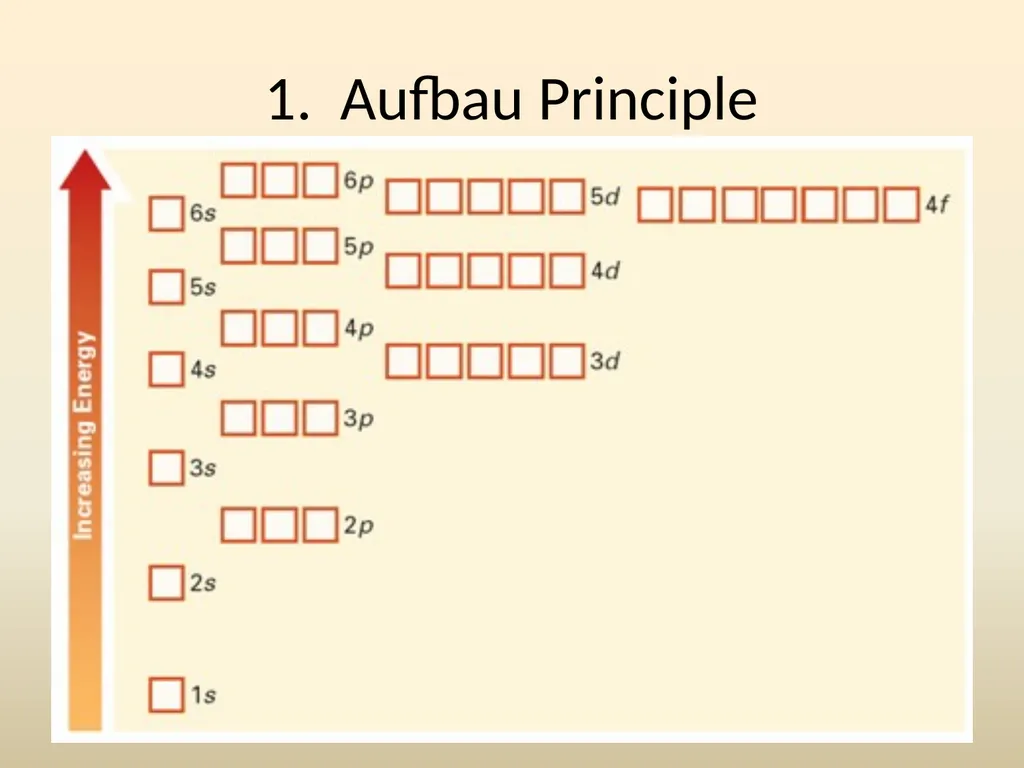
1. Aufbau Principle aufbau principle, electrons occupy the orbitals of lowest energy first.
The orbitals for any sublevel of a principal energy level are always of equal energy.
within a principal energy level the s sublevel is always the lowest-energy sublevel.
range of energy levels within a principal energy level can overlap the energy levels of another principal level.<br>
The orbitals for any sublevel of a principal energy level are always of equal energy.
within a principal energy level the s sublevel is always the lowest-energy sublevel.
range of energy levels within a principal energy level can overlap the energy levels of another principal level.<br>
21
1. Aufbau Principle<br>
22
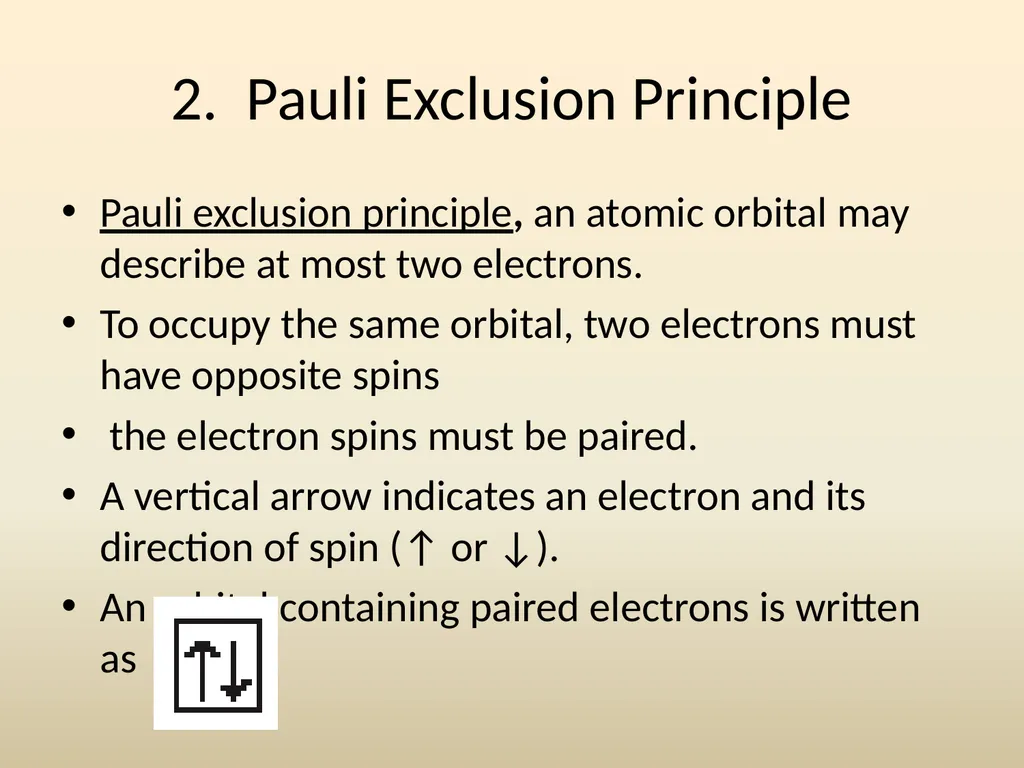
2. Pauli Exclusion Principle Pauli exclusion principle, an atomic orbital may describe at most two electrons.
To occupy the same orbital, two electrons must have opposite spins
the electron spins must be paired.
A vertical arrow indicates an electron and its direction of spin (↑ or ↓).
An orbital containing paired electrons is written as<br>
To occupy the same orbital, two electrons must have opposite spins
the electron spins must be paired.
A vertical arrow indicates an electron and its direction of spin (↑ or ↓).
An orbital containing paired electrons is written as<br>
23
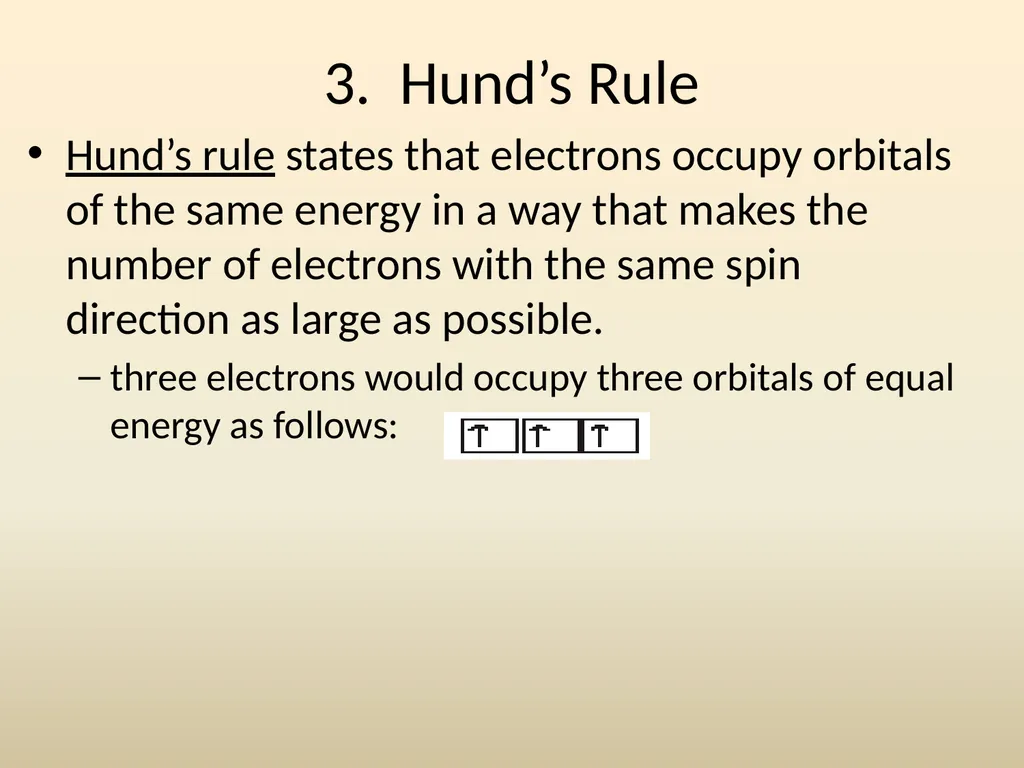
3. Hund’s Rule Hund’s rule states that electrons occupy orbitals of the same energy in a way that makes the number of electrons with the same spin direction as large as possible.
three electrons would occupy three orbitals of equal energy as follows:<br>
three electrons would occupy three orbitals of equal energy as follows:<br>
24
Electron Configuration
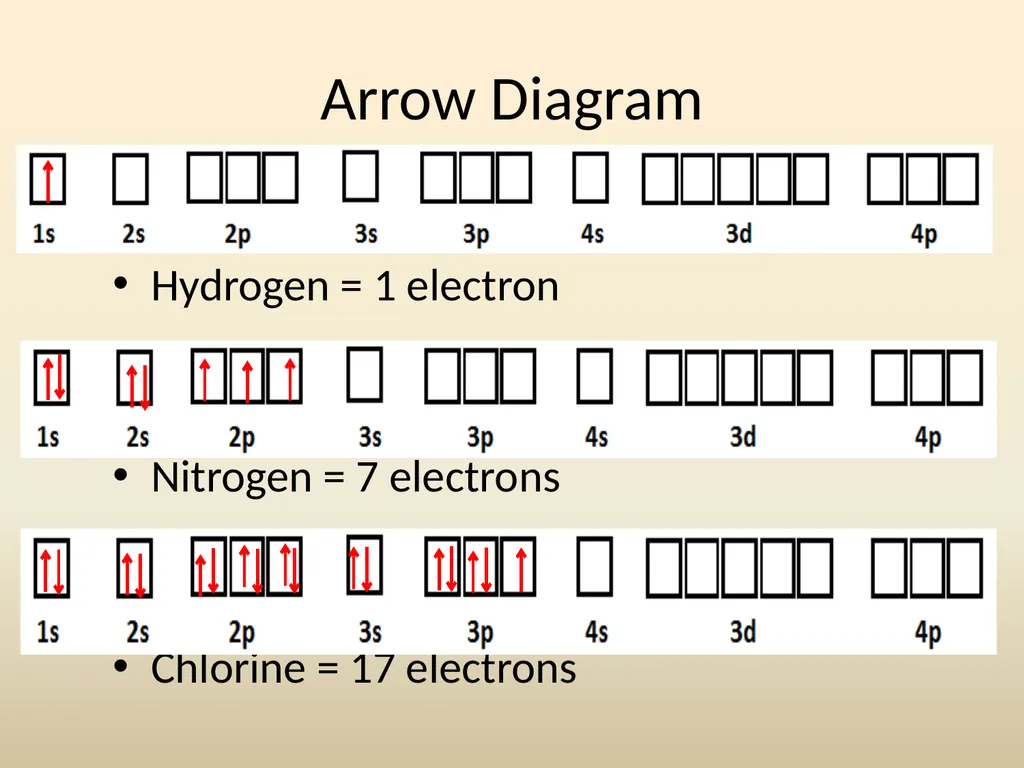
Arrow Diagram Arrow Diagrams use boxes and arrows to represent the atomic orbitals and each electrons location in the orbitals
S sublevel has ONE orbital so it gets 1 box
P sublevel has THREE orbitals so it gets 3 boxes
D sublevel has FIVE orbitals so it gets 5 boxes
F sublevel has SEVEN orbitals so it gets 7 boxes<br>
S sublevel has ONE orbital so it gets 1 box
P sublevel has THREE orbitals so it gets 3 boxes
D sublevel has FIVE orbitals so it gets 5 boxes
F sublevel has SEVEN orbitals so it gets 7 boxes<br>
25
Arrow Diagrams The electrons will fill the lowest energy sub-levels first before moving to the next sub-level (Aufbau Principle)
Electrons will not pair up until each orbital has one electron in it (Hund’s Rule) and when they pair up they have opposite spin (Pauli Exclusion Principle)
Note that the sum of the arrows equals the number of electrons in the atom.<br>
Electrons will not pair up until each orbital has one electron in it (Hund’s Rule) and when they pair up they have opposite spin (Pauli Exclusion Principle)
Note that the sum of the arrows equals the number of electrons in the atom.<br>
26
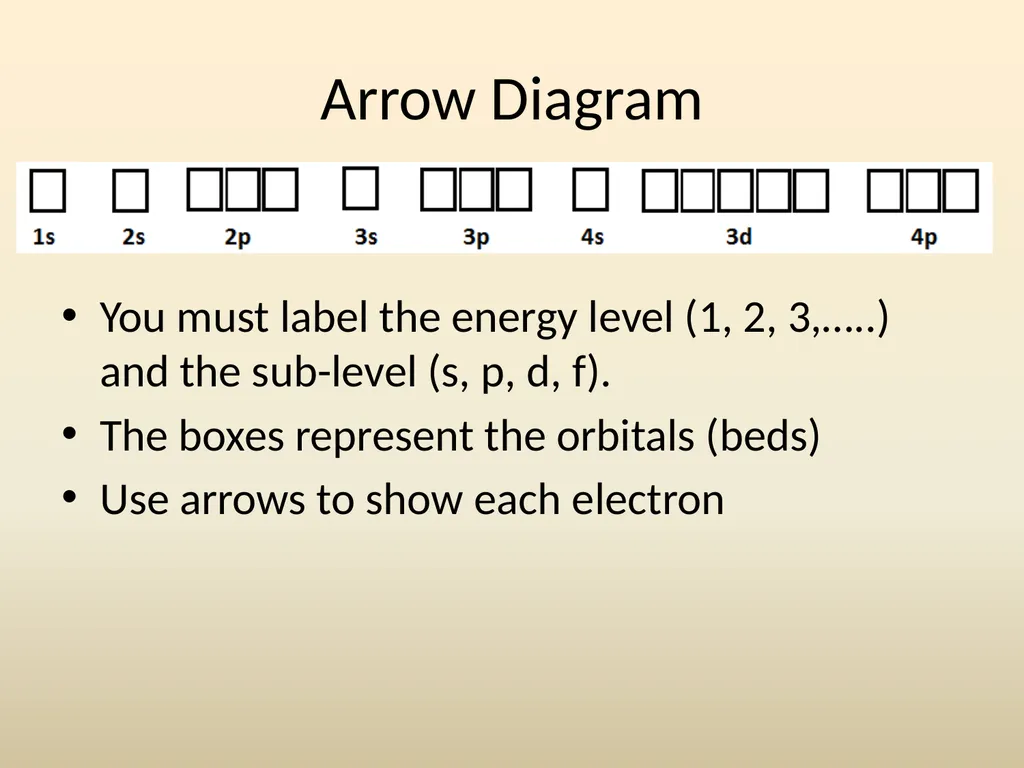
Arrow Diagram You must label the energy level (1, 2, 3,…..) and the sub-level (s, p, d, f).
The boxes represent the orbitals (beds)
Use arrows to show each electron<br>
The boxes represent the orbitals (beds)
Use arrows to show each electron<br>
27
Arrow Diagram Hydrogen = 1 electron
Nitrogen = 7 electrons
Chlorine = 17 electrons<br>
Nitrogen = 7 electrons
Chlorine = 17 electrons<br>
28
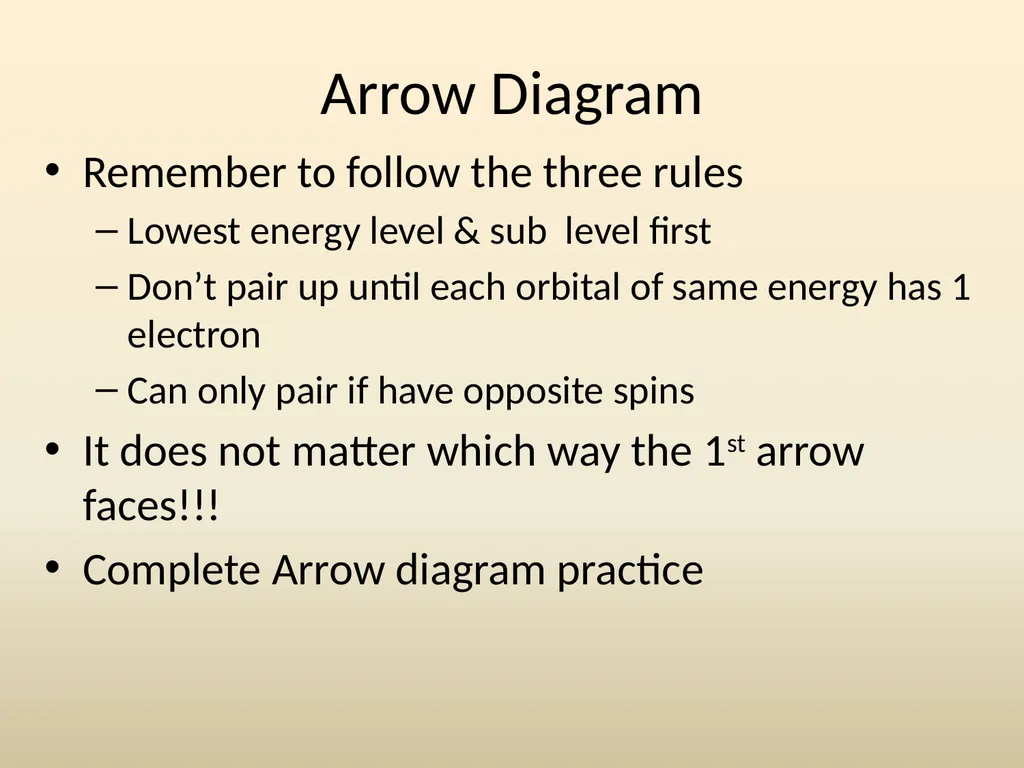
Arrow Diagram Remember to follow the three rules
Lowest energy level & sub level first
Don’t pair up until each orbital of same energy has 1 electron
Can only pair if have opposite spins
It does not matter which way the 1st arrow faces!!!
Complete Arrow diagram practice<br>
Lowest energy level & sub level first
Don’t pair up until each orbital of same energy has 1 electron
Can only pair if have opposite spins
It does not matter which way the 1st arrow faces!!!
Complete Arrow diagram practice<br>
29
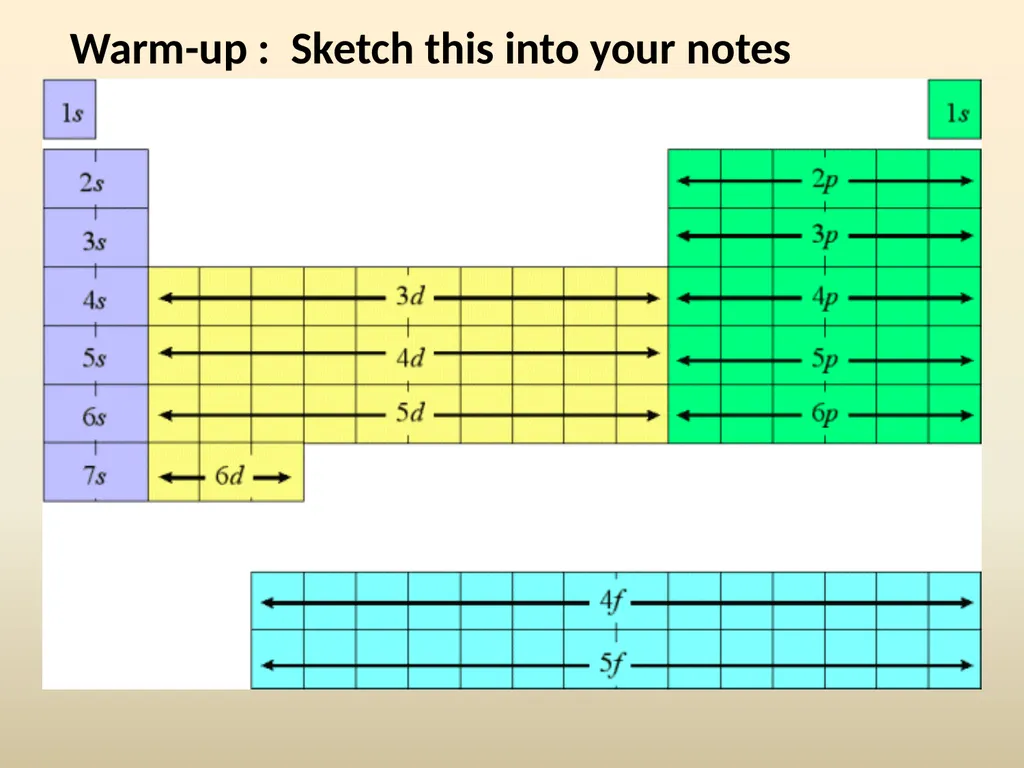
Warm-up : Sketch this into your notes<br>
30
Electron Configuration A convenient shorthand method for showing the electron configuration of an atom
write the energy level and the symbol for every sublevel occupied by an electron.
indicate the number of electrons occupying that sublevel with a superscript.
Example: oxygen= 1s22s22p4.
Note that the sum of the superscripts equals the number of electrons in the atom.<br>
write the energy level and the symbol for every sublevel occupied by an electron.
indicate the number of electrons occupying that sublevel with a superscript.
Example: oxygen= 1s22s22p4.
Note that the sum of the superscripts equals the number of electrons in the atom.<br>
31
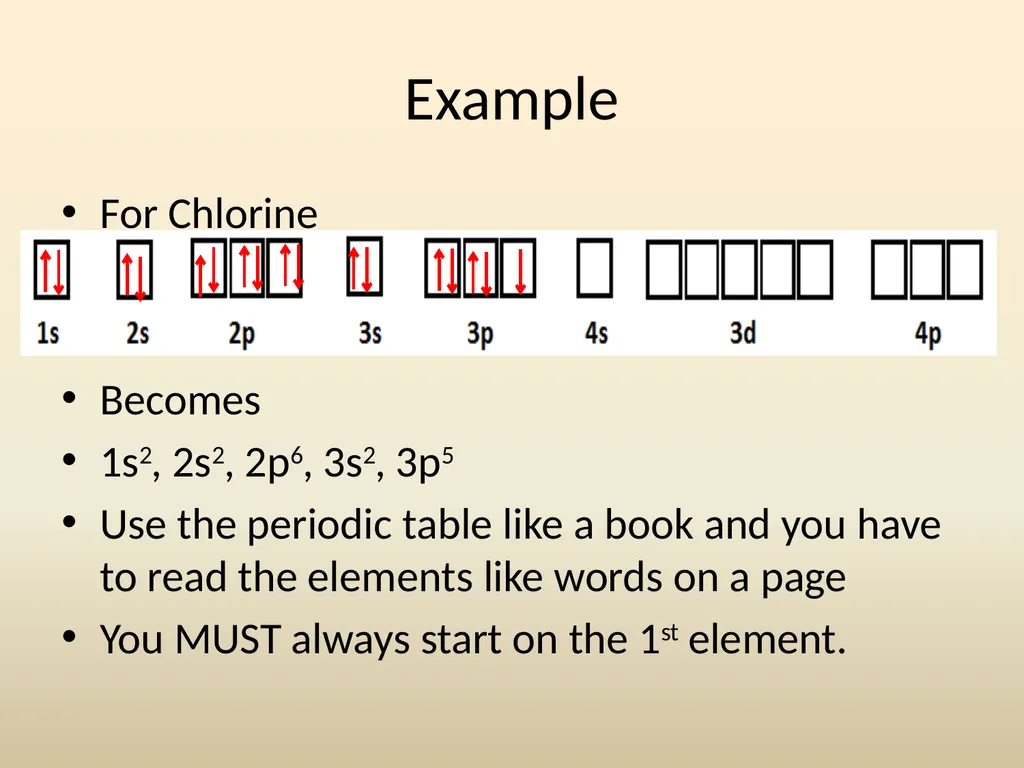
Example For Chlorine
Becomes
1s2, 2s2, 2p6, 3s2, 3p5
Use the periodic table like a book and you have to read the elements like words on a page
You MUST always start on the 1st element.<br>
Becomes
1s2, 2s2, 2p6, 3s2, 3p5
Use the periodic table like a book and you have to read the elements like words on a page
You MUST always start on the 1st element.<br>
32
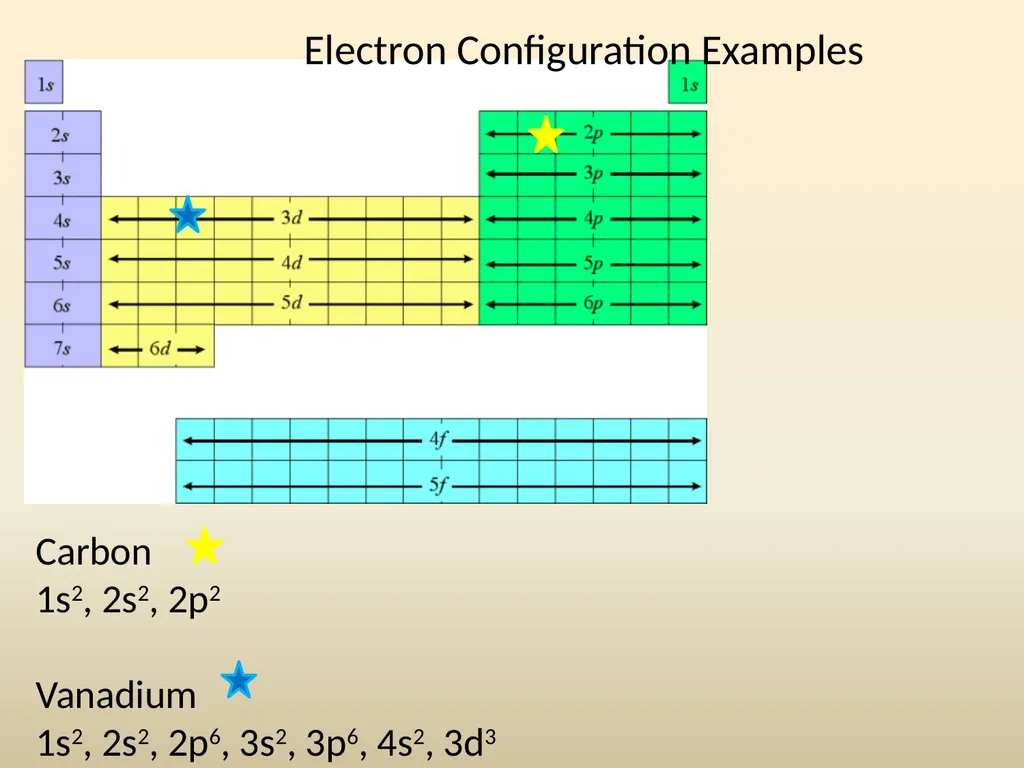
Electron Configuration Examples Carbon
1s2, 2s2, 2p2
Vanadium
1s2, 2s2, 2p6, 3s2, 3p6, 4s2, 3d3<br>
1s2, 2s2, 2p2
Vanadium
1s2, 2s2, 2p6, 3s2, 3p6, 4s2, 3d3<br>
33
Noble Gas Electron Configuration
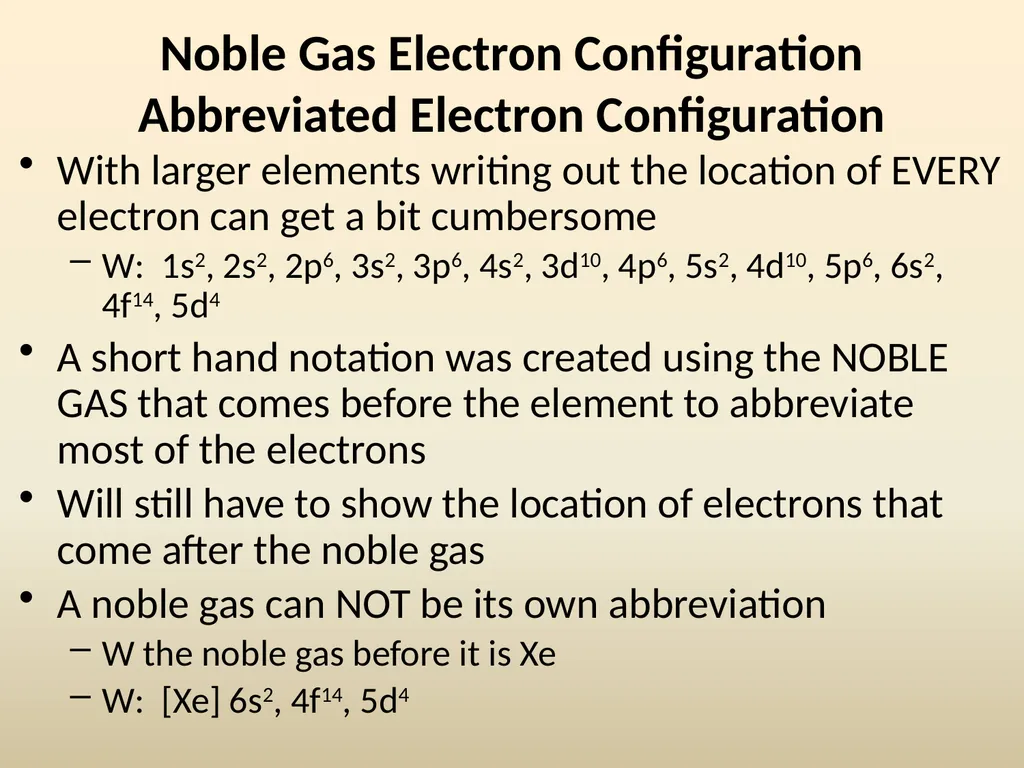
Abbreviated Electron Configuration With larger elements writing out the location of EVERY electron can get a bit cumbersome
W: 1s2, 2s2, 2p6, 3s2, 3p6, 4s2, 3d10, 4p6, 5s2, 4d10, 5p6, 6s2, 4f14, 5d4
A short hand notation was created using the NOBLE GAS that comes before the element to abbreviate most of the electrons
Will still have to show the location of electrons that come after the noble gas
A noble gas can NOT be its own abbreviation
W the noble gas before it is Xe
W: [Xe] 6s2, 4f14, 5d4<br>
W: 1s2, 2s2, 2p6, 3s2, 3p6, 4s2, 3d10, 4p6, 5s2, 4d10, 5p6, 6s2, 4f14, 5d4
A short hand notation was created using the NOBLE GAS that comes before the element to abbreviate most of the electrons
Will still have to show the location of electrons that come after the noble gas
A noble gas can NOT be its own abbreviation
W the noble gas before it is Xe
W: [Xe] 6s2, 4f14, 5d4<br>
34
Noble Gas Electron Configuration
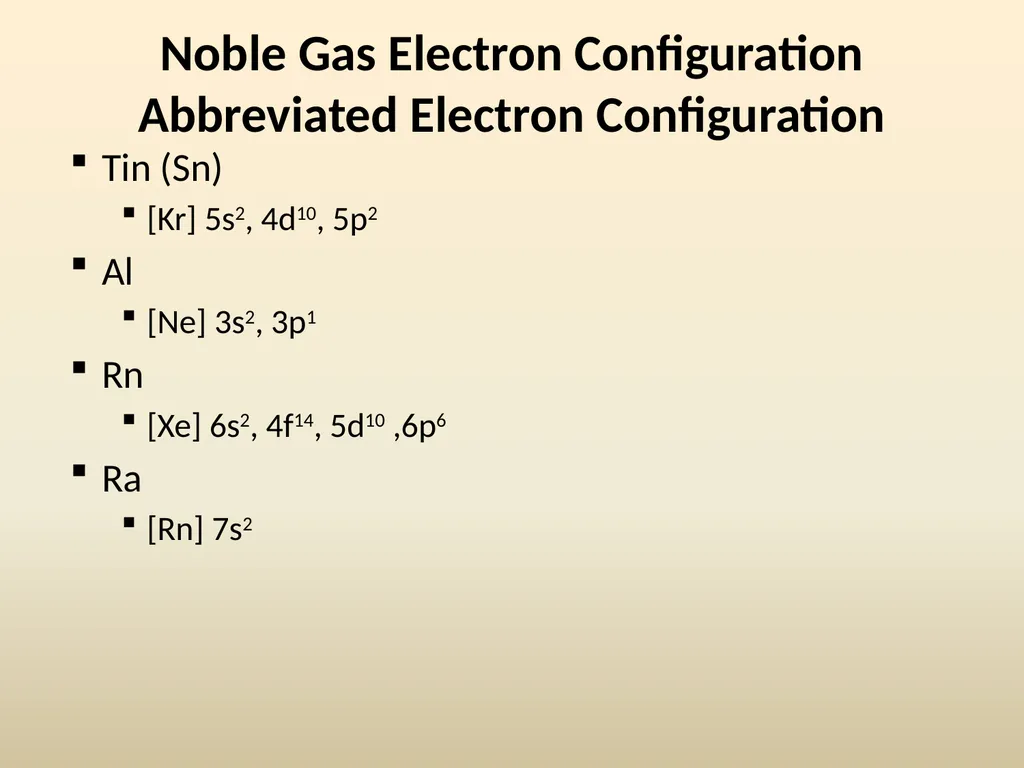
Abbreviated Electron Configuration Tin (Sn)
[Kr] 5s2, 4d10, 5p2
Al
[Ne] 3s2, 3p1
Rn
[Xe] 6s2, 4f14, 5d10 ,6p6
Ra
[Rn] 7s2<br>
[Kr] 5s2, 4d10, 5p2
Al
[Ne] 3s2, 3p1
Rn
[Xe] 6s2, 4f14, 5d10 ,6p6
Ra
[Rn] 7s2<br>
35
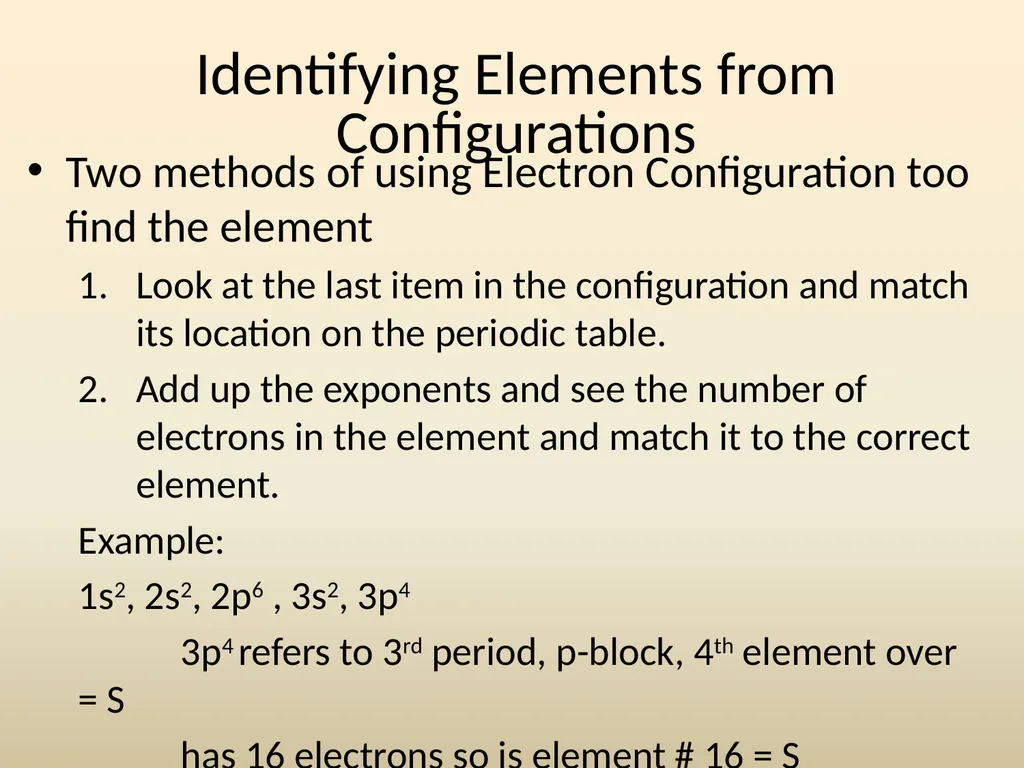
Identifying Elements from Configurations Two methods of using Electron Configuration too find the element
Look at the last item in the configuration and match its location on the periodic table.
Add up the exponents and see the number of electrons in the element and match it to the correct element.
Example:
1s2, 2s2, 2p6 , 3s2, 3p4
3p4 refers to 3rd period, p-block, 4th element over = S
has 16 electrons so is element # 16 = S<br>
Look at the last item in the configuration and match its location on the periodic table.
Add up the exponents and see the number of electrons in the element and match it to the correct element.
Example:
1s2, 2s2, 2p6 , 3s2, 3p4
3p4 refers to 3rd period, p-block, 4th element over = S
has 16 electrons so is element # 16 = S<br>
36
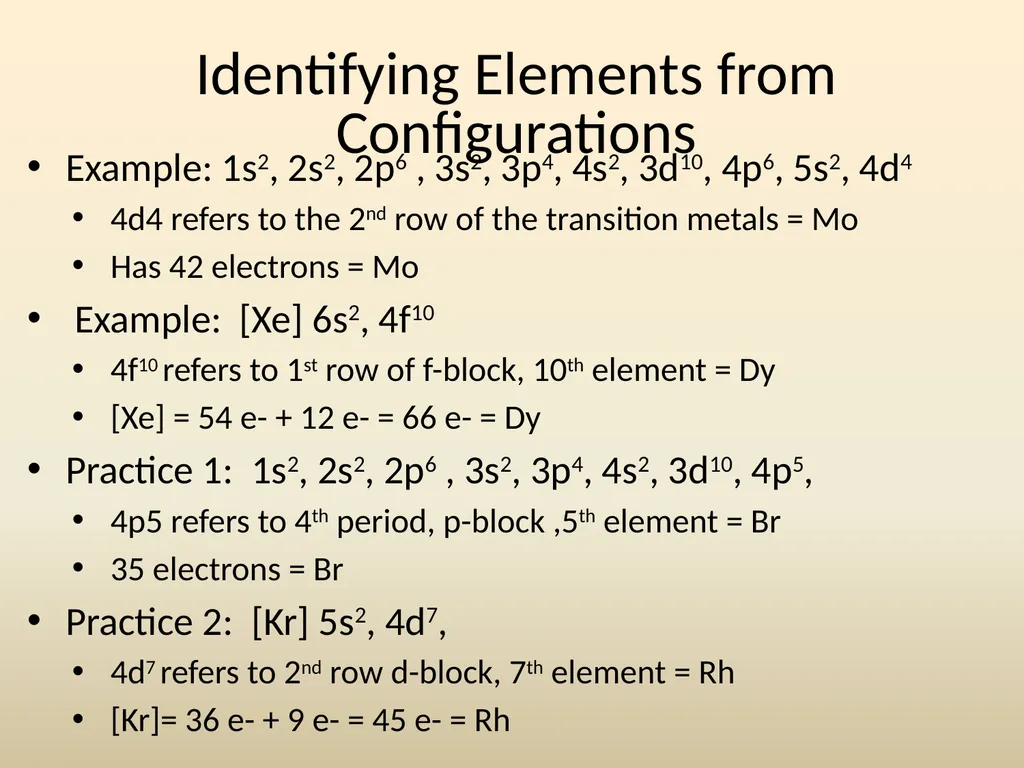
Identifying Elements from Configurations Example: 1s2, 2s2, 2p6 , 3s2, 3p4, 4s2, 3d10, 4p6, 5s2, 4d4
4d4 refers to the 2nd row of the transition metals = Mo
Has 42 electrons = Mo
Example: [Xe] 6s2, 4f10
4f10 refers to 1st row of f-block, 10th element = Dy
[Xe] = 54 e- + 12 e- = 66 e- = Dy
Practice 1: 1s2, 2s2, 2p6 , 3s2, 3p4, 4s2, 3d10, 4p5,
4p5 refers to 4th period, p-block ,5th element = Br
35 electrons = Br
Practice 2: [Kr] 5s2, 4d7,
4d7 refers to 2nd row d-block, 7th element = Rh
[Kr]= 36 e- + 9 e- = 45 e- = Rh<br>
4d4 refers to the 2nd row of the transition metals = Mo
Has 42 electrons = Mo
Example: [Xe] 6s2, 4f10
4f10 refers to 1st row of f-block, 10th element = Dy
[Xe] = 54 e- + 12 e- = 66 e- = Dy
Practice 1: 1s2, 2s2, 2p6 , 3s2, 3p4, 4s2, 3d10, 4p5,
4p5 refers to 4th period, p-block ,5th element = Br
35 electrons = Br
Practice 2: [Kr] 5s2, 4d7,
4d7 refers to 2nd row d-block, 7th element = Rh
[Kr]= 36 e- + 9 e- = 45 e- = Rh<br>
37
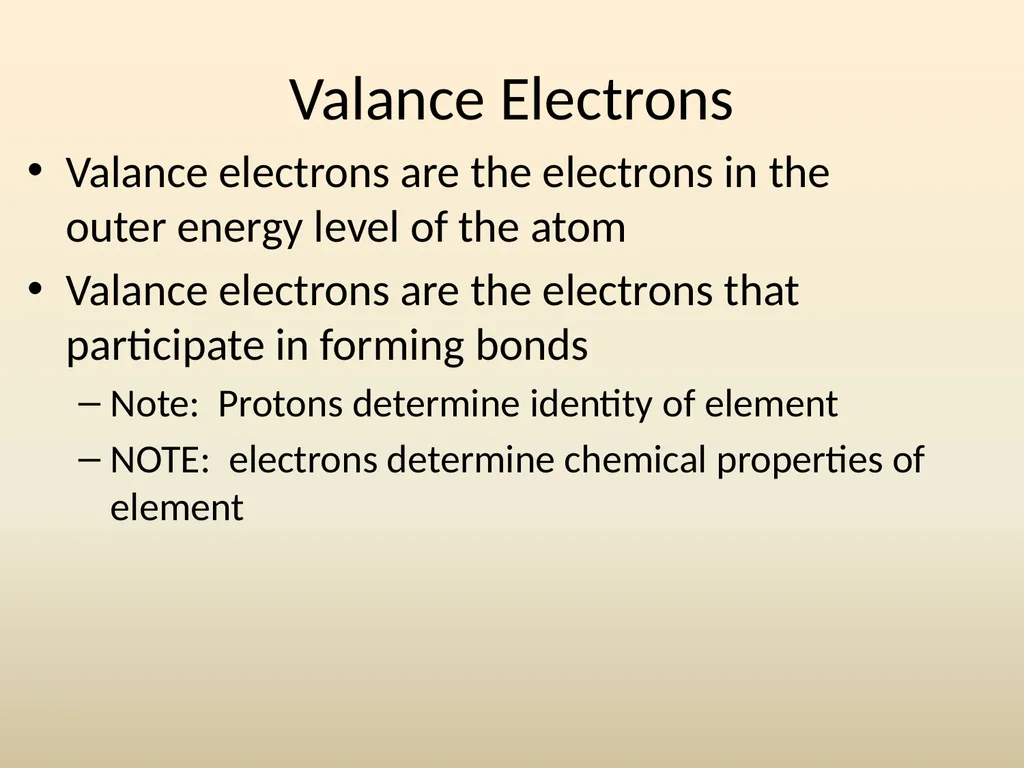
Valance Electrons Valance electrons are the electrons in the outer energy level of the atom
Valance electrons are the electrons that participate in forming bonds
Note: Protons determine identity of element
NOTE: electrons determine chemical properties of element<br>
Valance electrons are the electrons that participate in forming bonds
Note: Protons determine identity of element
NOTE: electrons determine chemical properties of element<br>
38
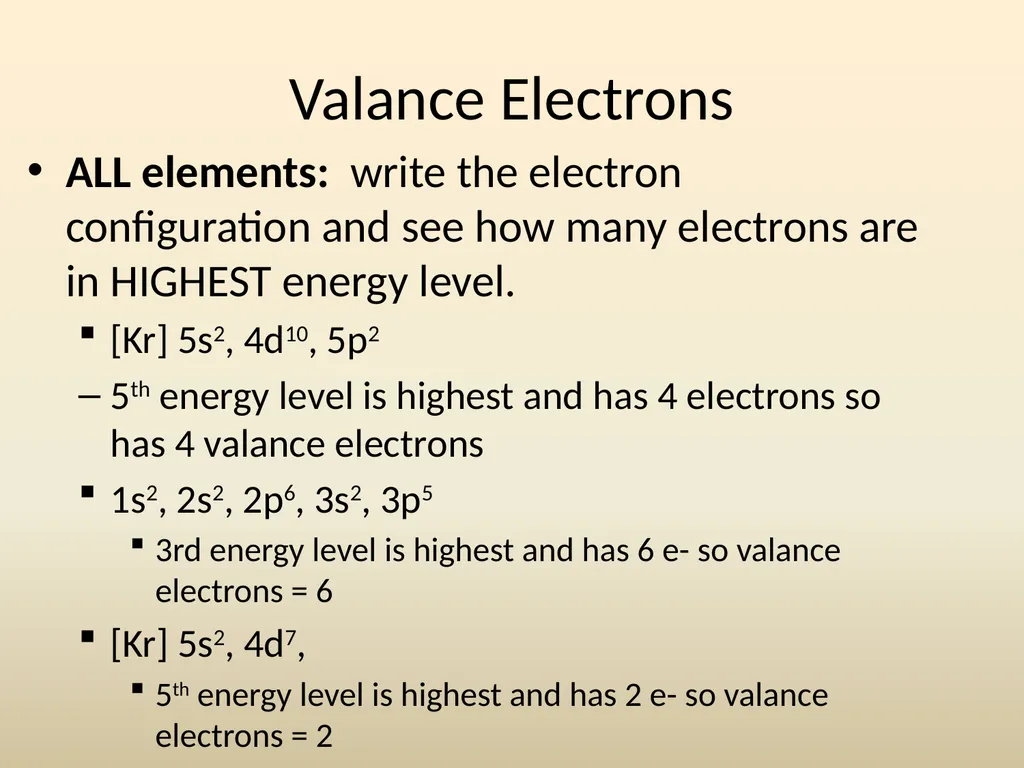
Valance Electrons ALL elements: write the electron configuration and see how many electrons are in HIGHEST energy level.
[Kr] 5s2, 4d10, 5p2
5th energy level is highest and has 4 electrons so has 4 valance electrons
1s2, 2s2, 2p6, 3s2, 3p5
3rd energy level is highest and has 6 e- so valance electrons = 6
[Kr] 5s2, 4d7,
5th energy level is highest and has 2 e- so valance electrons = 2<br>
[Kr] 5s2, 4d10, 5p2
5th energy level is highest and has 4 electrons so has 4 valance electrons
1s2, 2s2, 2p6, 3s2, 3p5
3rd energy level is highest and has 6 e- so valance electrons = 6
[Kr] 5s2, 4d7,
5th energy level is highest and has 2 e- so valance electrons = 2<br>
39
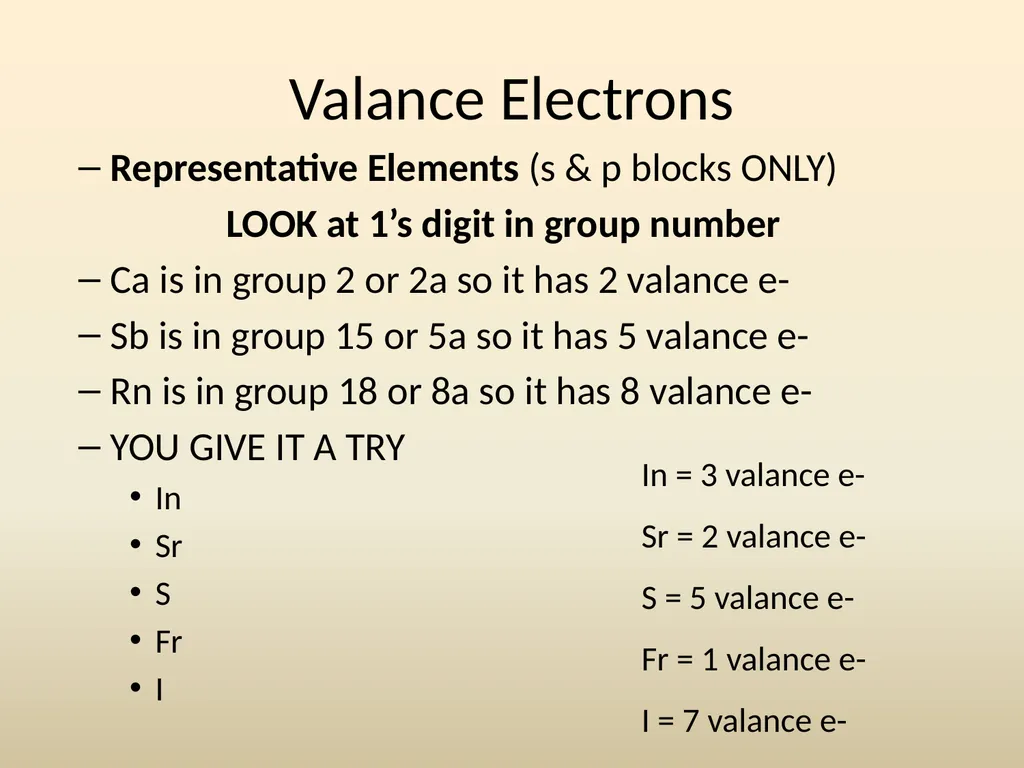
Valance Electrons Representative Elements (s & p blocks ONLY)
LOOK at 1’s digit in group number
Ca is in group 2 or 2a so it has 2 valance e-
Sb is in group 15 or 5a so it has 5 valance e-
Rn is in group 18 or 8a so it has 8 valance e-
YOU GIVE IT A TRY
In
Sr
S
Fr
I In = 3 valance e-
Sr = 2 valance e-
S = 5 valance e-
Fr = 1 valance e-
I = 7 valance e-<br>
LOOK at 1’s digit in group number
Ca is in group 2 or 2a so it has 2 valance e-
Sb is in group 15 or 5a so it has 5 valance e-
Rn is in group 18 or 8a so it has 8 valance e-
YOU GIVE IT A TRY
In
Sr
S
Fr
I In = 3 valance e-
Sr = 2 valance e-
S = 5 valance e-
Fr = 1 valance e-
I = 7 valance e-<br>
40
Quantum Mechanical Model videos Origins of quantum theory (minuet physics): http://www.cleanvideosearch.com/media/action/yt/watch?videoId=i1TVZIBj7UA
Schrodinger’s Cat (minuet physics) http://www.cleanvideosearch.com/media/action/yt/watch?videoId=IOYyCHGWJq4
Wave/particle duality(Double Slit Experiment and Example in Nature) http://www.cleanvideosearch.com/media/action/yt/watch?videoId=tu57B1v0SzI<br>
Schrodinger’s Cat (minuet physics) http://www.cleanvideosearch.com/media/action/yt/watch?videoId=IOYyCHGWJq4
Wave/particle duality(Double Slit Experiment and Example in Nature) http://www.cleanvideosearch.com/media/action/yt/watch?videoId=tu57B1v0SzI<br>