
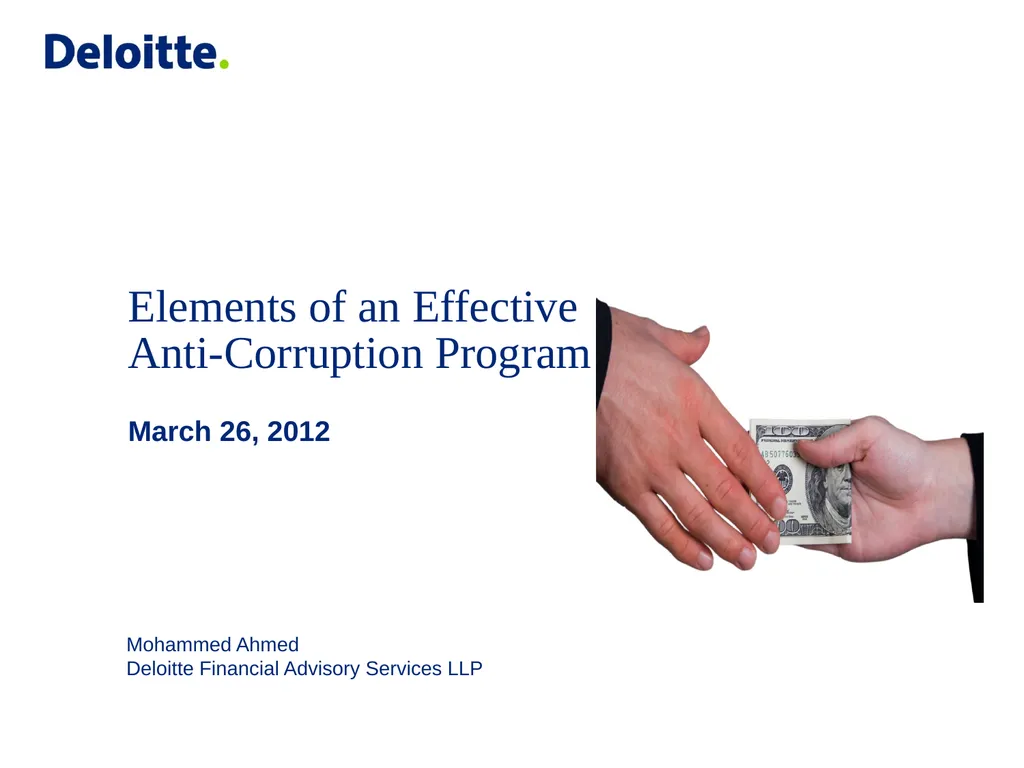
Elements of an Effective Anti-Corruption Program


Description: Elements of an Effective Anti-Corruption Program March 26, 2012 Mohammed Ahmed Deloitte Financial Advisory Services LLP Table of contents Overview of FCPA and UK Bribery Act FCPA overview The FCPA is a US statute enacted in 1977 after
Related Topics
Download Presentation
"Elements of an Effective Anti-Corruption Program" is the property of its rightful owner. Permission is granted to download and print the materials on this website for personal, non-commercial use only, and to display it on your personal computer provided you do not modify the materials and that you retain all copyright notices contained in the materials. By downloading content from our website, you accept the terms of this agreement.
Presentation Transcript
slide1. Elements of an Effective Anti-Corruption Program March 26, 2012 Mohammed Ahmed
Deloitte Financial Advisory Services LLP<br>
slide2. Table of contents<br>
slide3. Overview of FCPA and UK Bribery Act<br>
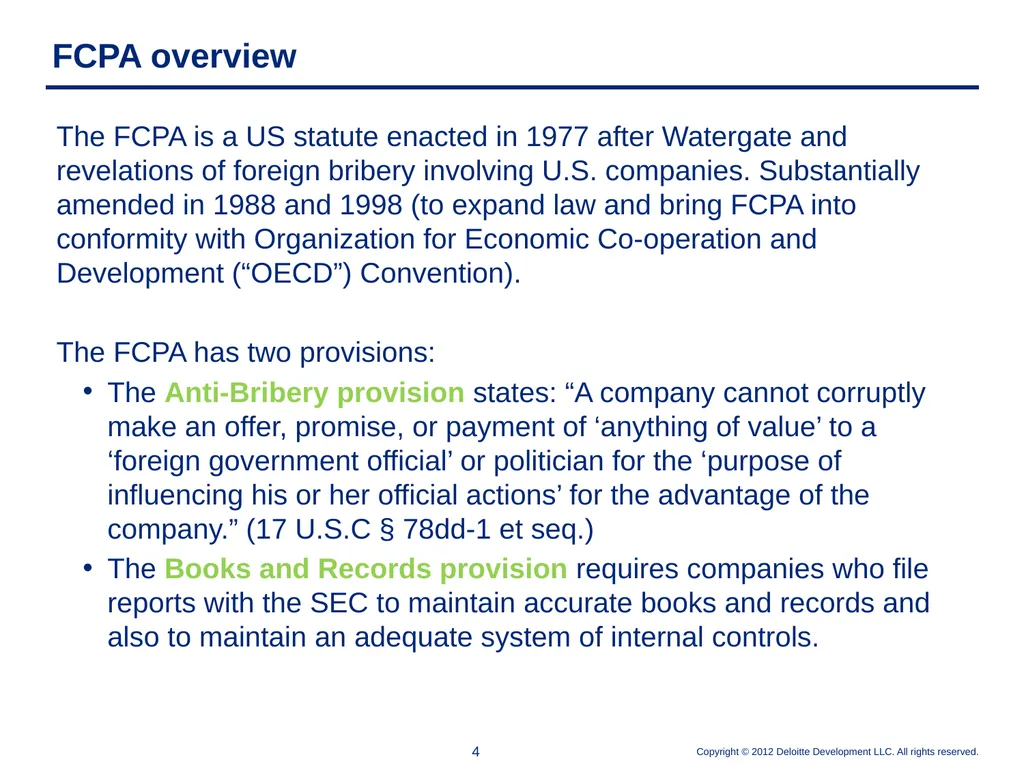
slide4. FCPA overview The FCPA is a US statute enacted in 1977 after Watergate and revelations of foreign bribery involving U.S. companies. Substantially amended in 1988 and 1998 (to expand law and bring FCPA into conformity with Organization for Economic Co-operation and Development (“OECD”) Convention).
The FCPA has two provisions:
The Anti-Bribery provision states: “A company cannot corruptly make an offer, promise, or payment of ‘anything of value’ to a ‘foreign government official’ or politician for the ‘purpose of influencing his or her official actions’ for the advantage of the company.” (17 U.S.C § 78dd-1 et seq.)
The Books and Records provision requires companies who file reports with the SEC to maintain accurate books and records and also to maintain an adequate system of internal controls.<br>
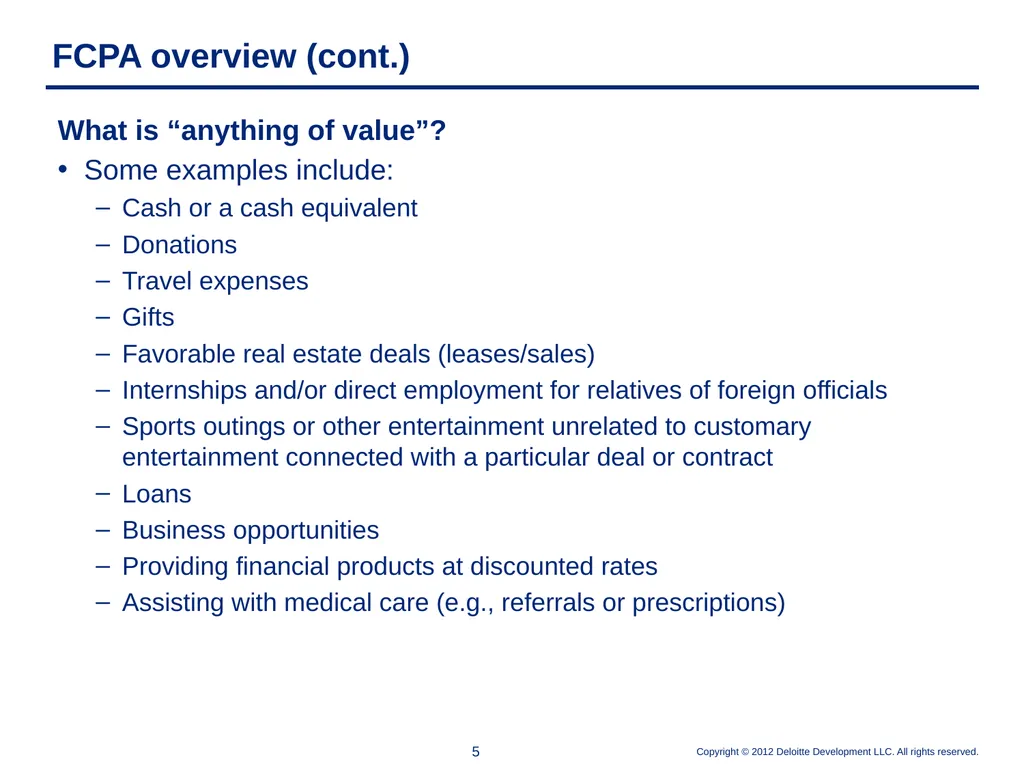
slide5. FCPA overview (cont.) What is “anything of value”?
Some examples include:
Cash or a cash equivalent
Donations
Travel expenses
Gifts
Favorable real estate deals (leases/sales)
Internships and/or direct employment for relatives of foreign officials
Sports outings or other entertainment unrelated to customary entertainment connected with a particular deal or contract
Loans
Business opportunities
Providing financial products at discounted rates
Assisting with medical care (e.g., referrals or prescriptions)<br>
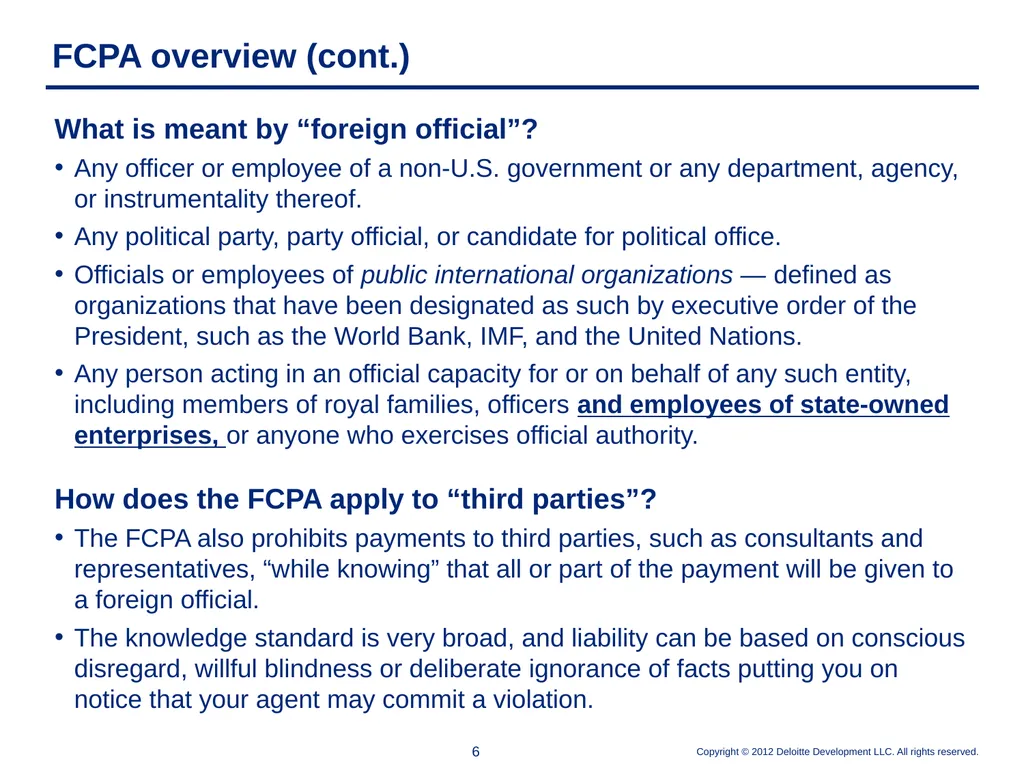
slide6. FCPA overview (cont.) What is meant by “foreign official”?
Any officer or employee of a non-U.S. government or any department, agency, or instrumentality thereof.
Any political party, party official, or candidate for political office.
Officials or employees of public international organizations — defined as organizations that have been designated as such by executive order of the President, such as the World Bank, IMF, and the United Nations.
Any person acting in an official capacity for or on behalf of any such entity, including members of royal families, officers and employees of state-owned enterprises, or anyone who exercises official authority.
How does the FCPA apply to “third parties”?
The FCPA also prohibits payments to third parties, such as consultants and representatives, “while knowing” that all or part of the payment will be given to a foreign official.
The knowledge standard is very broad, and liability can be based on conscious disregard, willful blindness or deliberate ignorance of facts putting you on notice that your agent may commit a violation.<br>
slide7. FCPA books and records provision The books and records provision require companies who file reports with the SEC to maintain records that accurately reflect transactions and the nature and quantity of corporate assets and liabilities.
FCPA books and records focus is on:
How the “bribe” is recorded on the books;
G/L classification for payment;
Business purpose reflected in underlying business records;
Applies even if parent owns less than 50% of a subsidiary
Good faith requirement
Amounts need not be material to constitute violations of the FCPA<br>
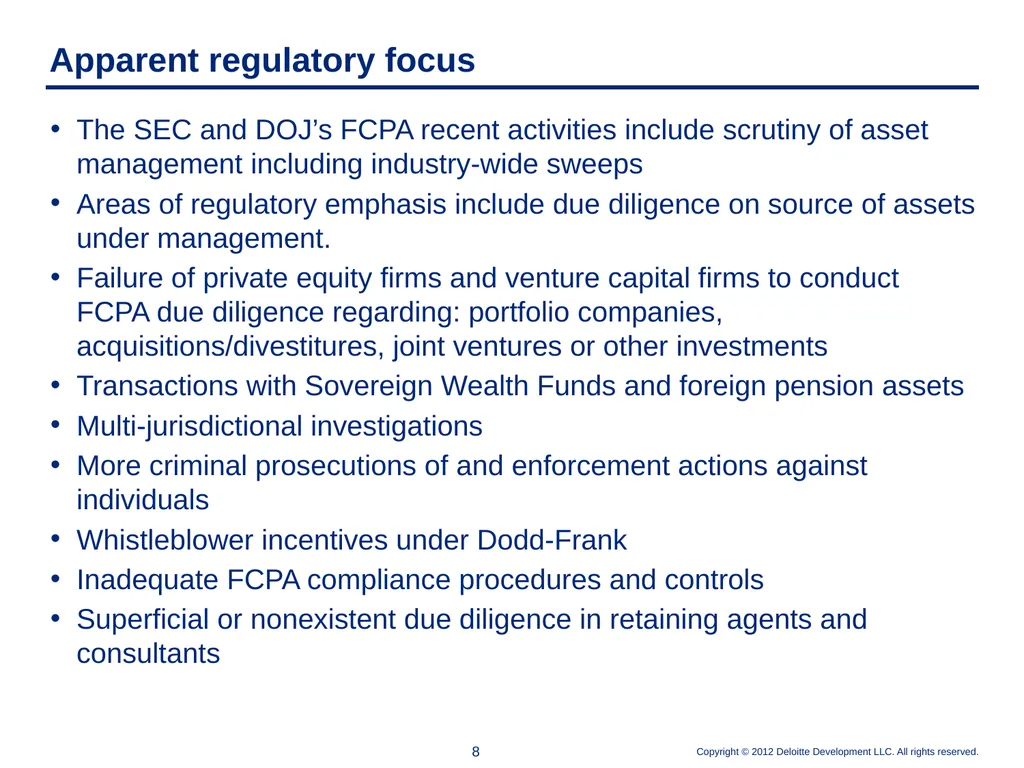
slide8. Apparent regulatory focus The SEC and DOJ’s FCPA recent activities include scrutiny of asset management including industry-wide sweeps
Areas of regulatory emphasis include due diligence on source of assets under management.
Failure of private equity firms and venture capital firms to conduct FCPA due diligence regarding: portfolio companies, acquisitions/divestitures, joint ventures or other investments
Transactions with Sovereign Wealth Funds and foreign pension assets
Multi-jurisdictional investigations
More criminal prosecutions of and enforcement actions against individuals
Whistleblower incentives under Dodd-Frank
Inadequate FCPA compliance procedures and controls
Superficial or nonexistent due diligence in retaining agents and consultants<br>
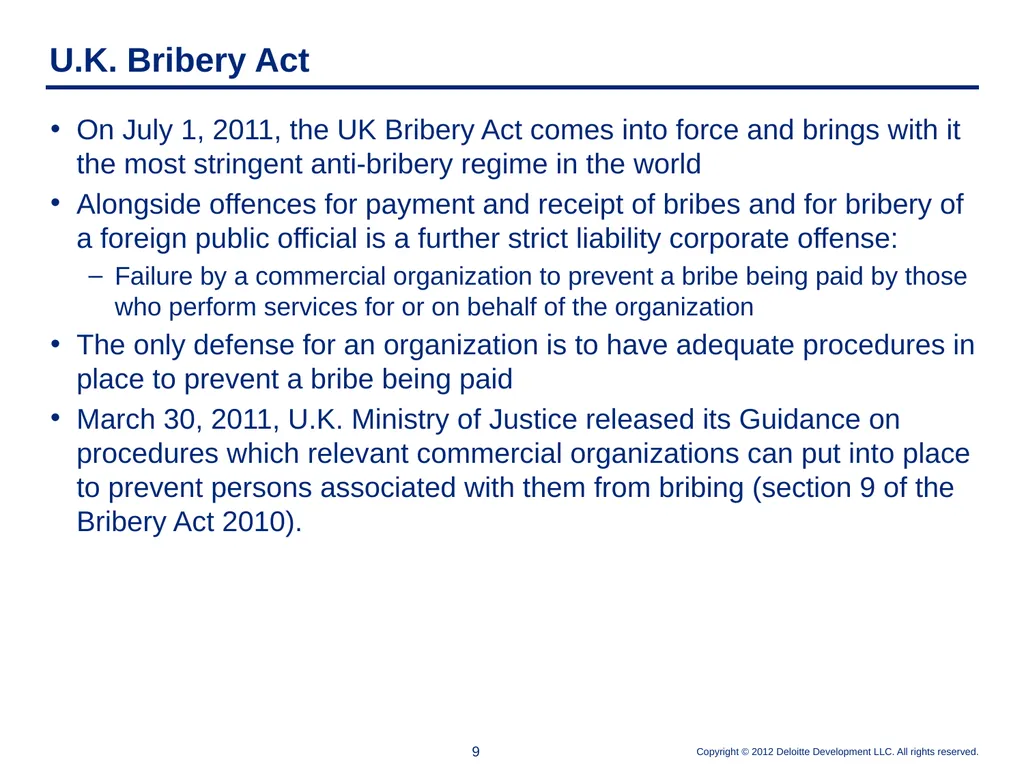
slide9. U.K. Bribery Act On July 1, 2011, the UK Bribery Act comes into force and brings with it the most stringent anti-bribery regime in the world
Alongside offences for payment and receipt of bribes and for bribery of a foreign public official is a further strict liability corporate offense:
Failure by a commercial organization to prevent a bribe being paid by those who perform services for or on behalf of the organization
The only defense for an organization is to have adequate procedures in place to prevent a bribe being paid
March 30, 2011, U.K. Ministry of Justice released its Guidance on procedures which relevant commercial organizations can put into place to prevent persons associated with them from bribing (section 9 of the Bribery Act 2010).<br>
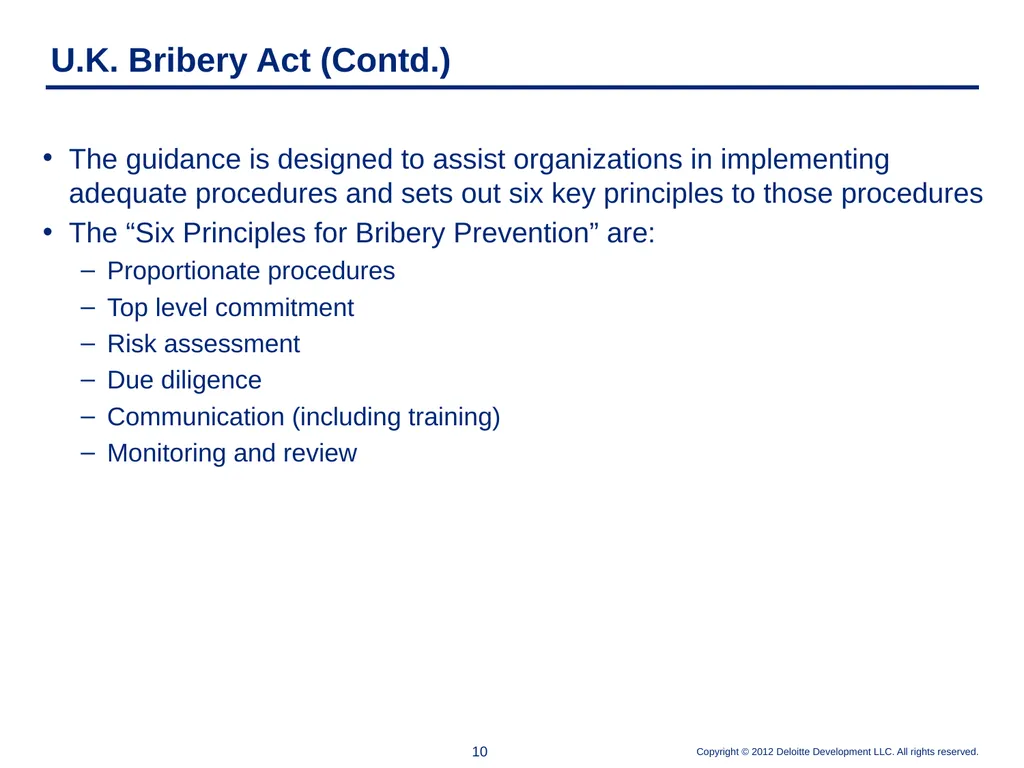
slide10. U.K. Bribery Act (Contd.) The guidance is designed to assist organizations in implementing adequate procedures and sets out six key principles to those procedures
The “Six Principles for Bribery Prevention” are:
Proportionate procedures
Top level commitment
Risk assessment
Due diligence
Communication (including training)
Monitoring and review<br>
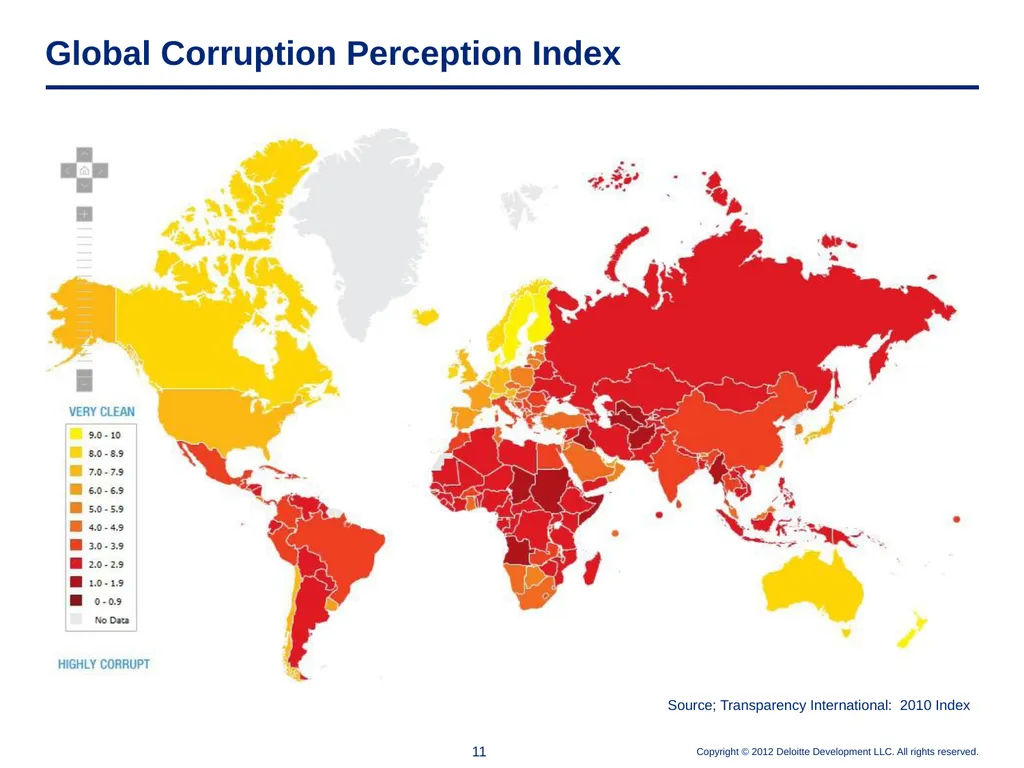
slide11. Global Corruption Perception Index Source; Transparency International: 2010 Index<br>
slide12. Elements of an Effective Anti-Corruption Compliance Program<br>
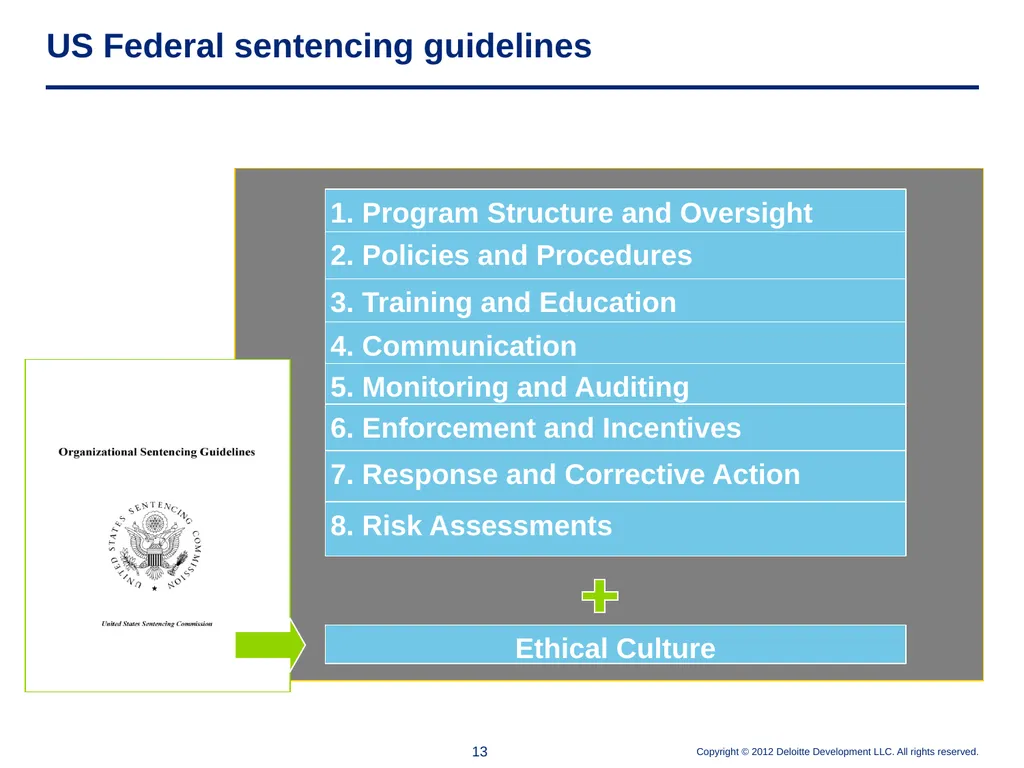
slide13. US Federal sentencing guidelines 1. Program Structure and Oversight 2. Policies and Procedures 3. Training and Education 4. Communication 5. Monitoring and Auditing 6. Enforcement and Incentives 7. Response and Corrective Action Ethical Culture 8. Risk Assessments<br>
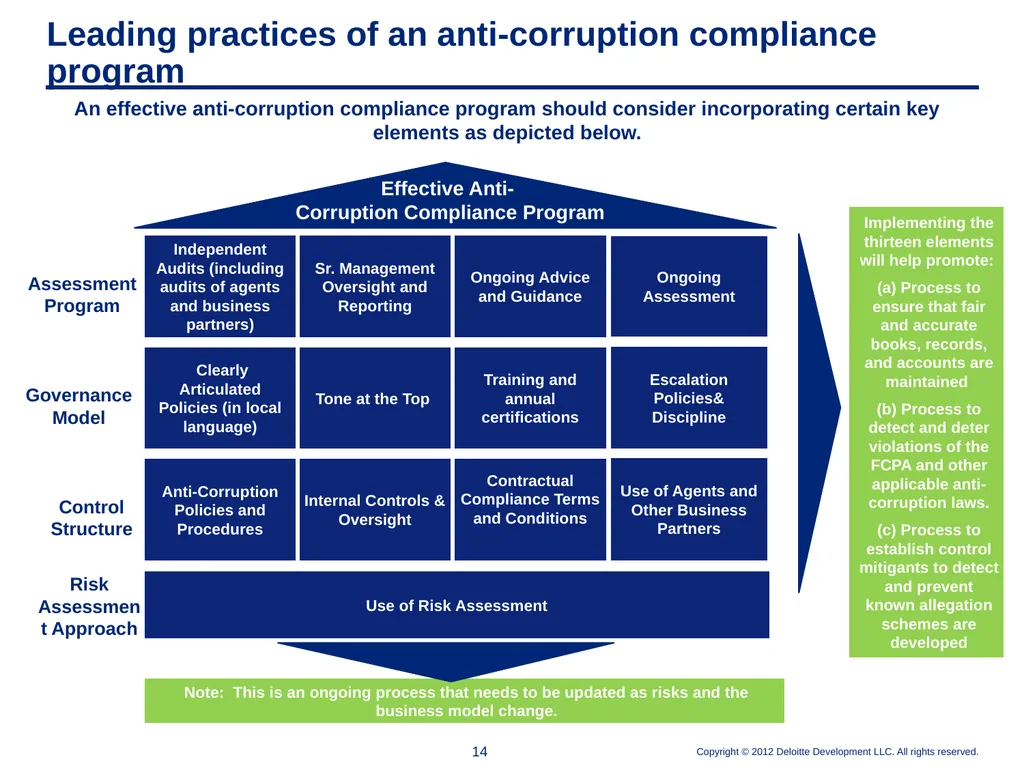
slide14. An effective anti-corruption compliance program should consider incorporating certain key elements as depicted below. Leading practices of an anti-corruption compliance program<br>
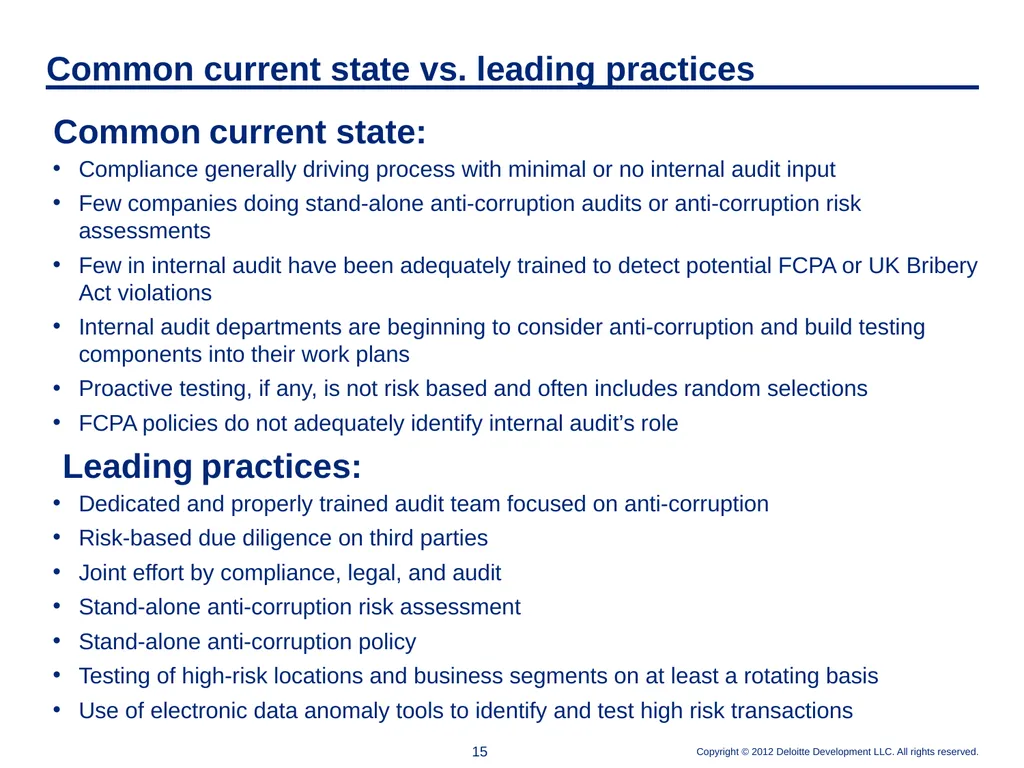
slide15. Common current state vs. leading practices Common current state: Compliance generally driving process with minimal or no internal audit input
Few companies doing stand-alone anti-corruption audits or anti-corruption risk assessments
Few in internal audit have been adequately trained to detect potential FCPA or UK Bribery Act violations
Internal audit departments are beginning to consider anti-corruption and build testing components into their work plans
Proactive testing, if any, is not risk based and often includes random selections
FCPA policies do not adequately identify internal audit’s role Leading practices: Dedicated and properly trained audit team focused on anti-corruption
Risk-based due diligence on third parties
Joint effort by compliance, legal, and audit
Stand-alone anti-corruption risk assessment
Stand-alone anti-corruption policy
Testing of high-risk locations and business segments on at least a rotating basis
Use of electronic data anomaly tools to identify and test high risk transactions<br>
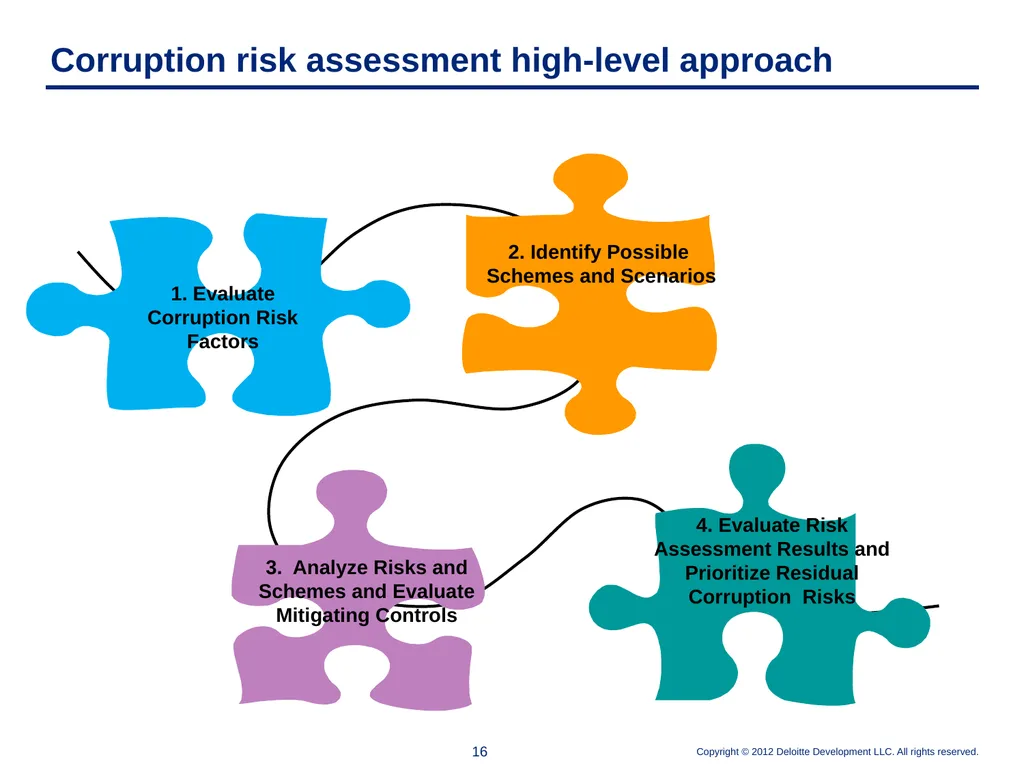
slide16. Corruption risk assessment high-level approach 1. Evaluate Corruption Risk Factors<br>
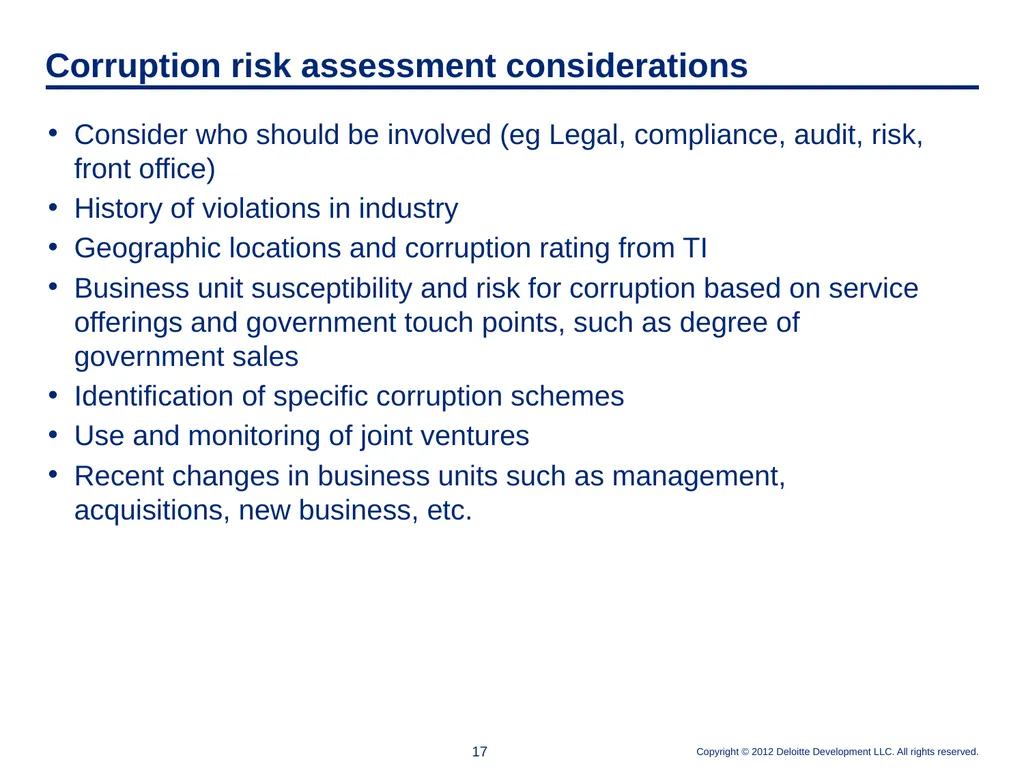
slide17. Corruption risk assessment considerations Consider who should be involved (eg Legal, compliance, audit, risk, front office)
History of violations in industry
Geographic locations and corruption rating from TI
Business unit susceptibility and risk for corruption based on service offerings and government touch points, such as degree of government sales
Identification of specific corruption schemes
Use and monitoring of joint ventures
Recent changes in business units such as management, acquisitions, new business, etc.<br>
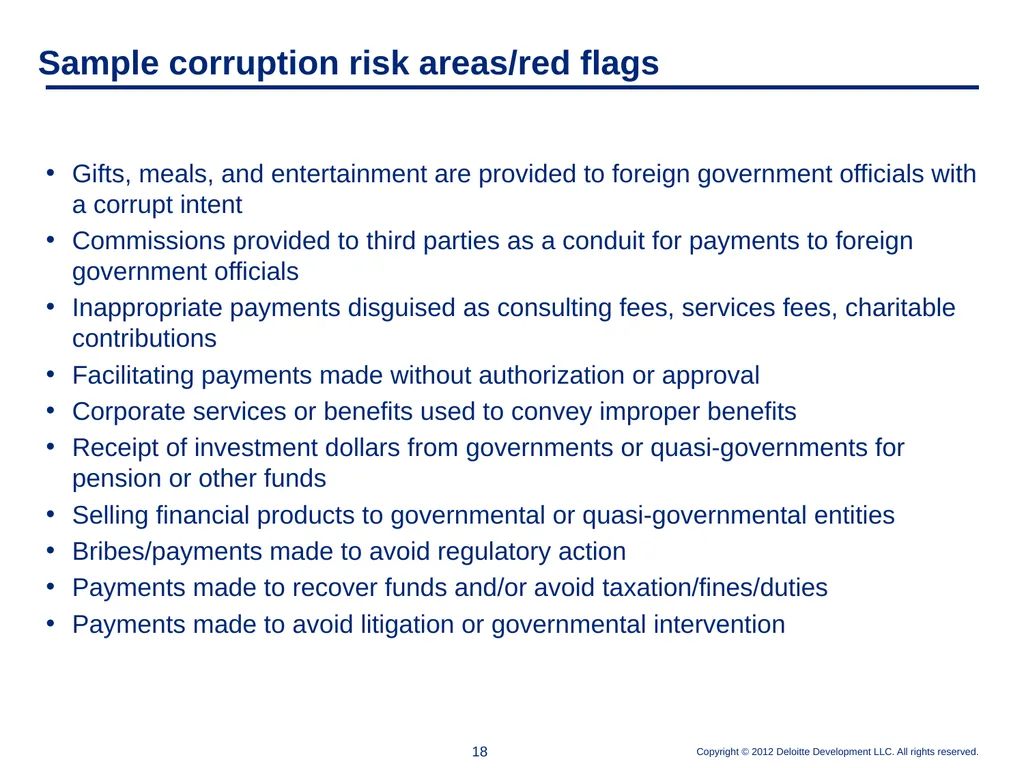
slide18. Sample corruption risk areas/red flags Gifts, meals, and entertainment are provided to foreign government officials with a corrupt intent
Commissions provided to third parties as a conduit for payments to foreign government officials
Inappropriate payments disguised as consulting fees, services fees, charitable contributions
Facilitating payments made without authorization or approval
Corporate services or benefits used to convey improper benefits
Receipt of investment dollars from governments or quasi-governments for pension or other funds
Selling financial products to governmental or quasi-governmental entities
Bribes/payments made to avoid regulatory action
Payments made to recover funds and/or avoid taxation/fines/duties
Payments made to avoid litigation or governmental intervention<br>
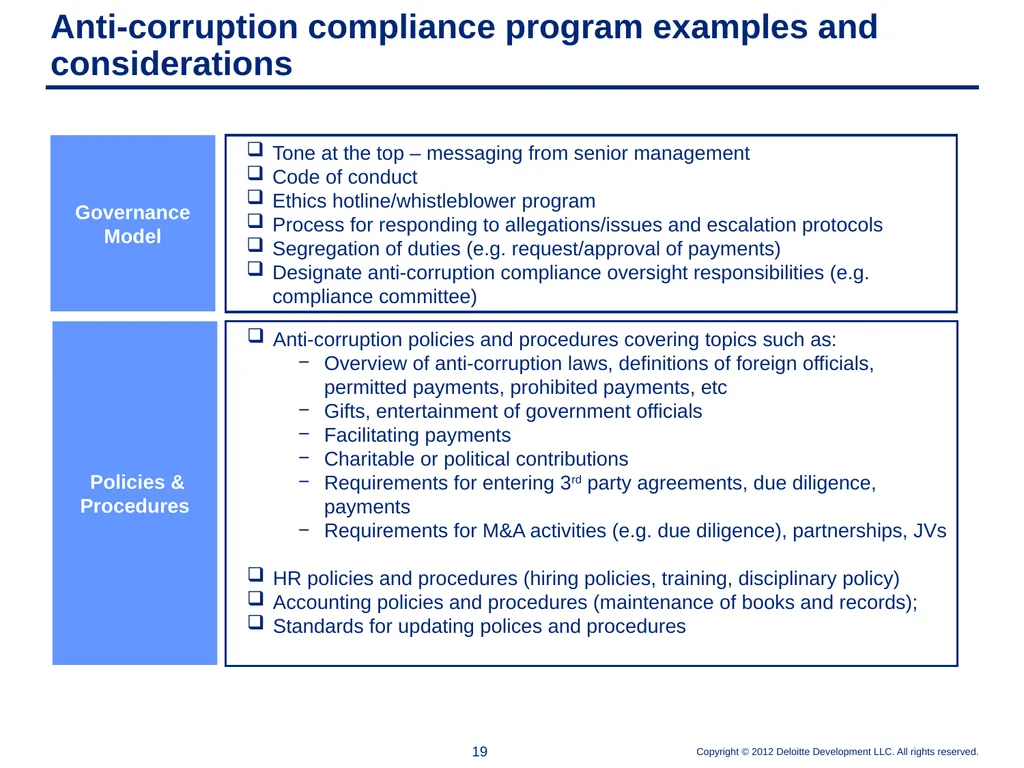
slide19. Anti-corruption compliance program examples and considerations Governance Model Tone at the top – messaging from senior management
Code of conduct
Ethics hotline/whistleblower program
Process for responding to allegations/issues and escalation protocols
Segregation of duties (e.g. request/approval of payments)
Designate anti-corruption compliance oversight responsibilities (e.g. compliance committee) Policies & Procedures Anti-corruption policies and procedures covering topics such as:
Overview of anti-corruption laws, definitions of foreign officials, permitted payments, prohibited payments, etc
Gifts, entertainment of government officials
Facilitating payments
Charitable or political contributions
Requirements for entering 3rd party agreements, due diligence, payments
Requirements for M&A activities (e.g. due diligence), partnerships, JVs
HR policies and procedures (hiring policies, training, disciplinary policy)
Accounting policies and procedures (maintenance of books and records);
Standards for updating polices and procedures<br>
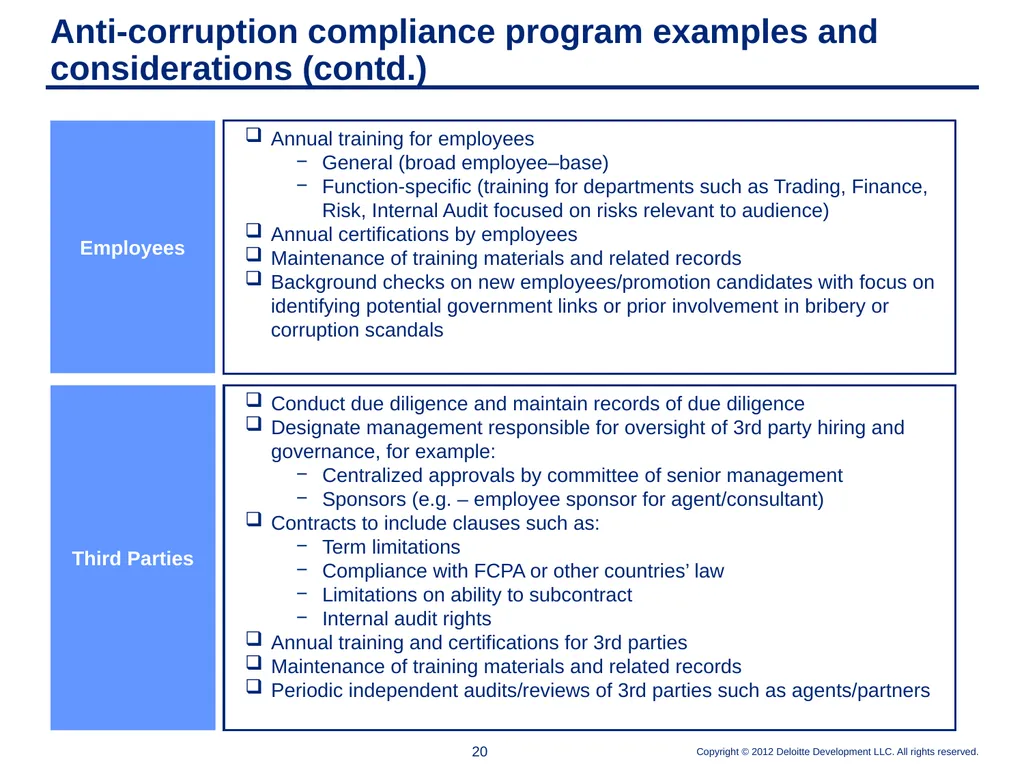
slide20. Anti-corruption compliance program examples and considerations (contd.) Employees Annual training for employees
General (broad employee–base)
Function-specific (training for departments such as Trading, Finance, Risk, Internal Audit focused on risks relevant to audience)
Annual certifications by employees
Maintenance of training materials and related records
Background checks on new employees/promotion candidates with focus on identifying potential government links or prior involvement in bribery or corruption scandals Third Parties Conduct due diligence and maintain records of due diligence
Designate management responsible for oversight of 3rd party hiring and governance, for example:
Centralized approvals by committee of senior management
Sponsors (e.g. – employee sponsor for agent/consultant)
Contracts to include clauses such as:
Term limitations
Compliance with FCPA or other countries’ law
Limitations on ability to subcontract
Internal audit rights
Annual training and certifications for 3rd parties
Maintenance of training materials and related records
Periodic independent audits/reviews of 3rd parties such as agents/partners<br>
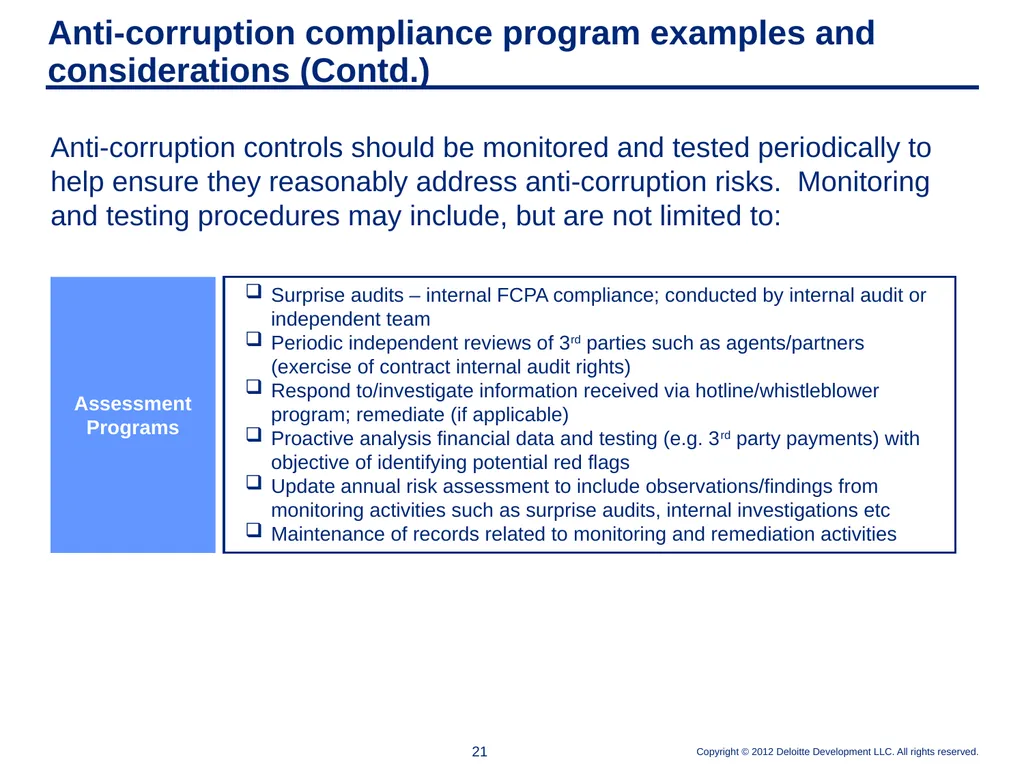
slide21. Anti-corruption compliance program examples and considerations (Contd.) Anti-corruption controls should be monitored and tested periodically to help ensure they reasonably address anti-corruption risks. Monitoring and testing procedures may include, but are not limited to:<br>
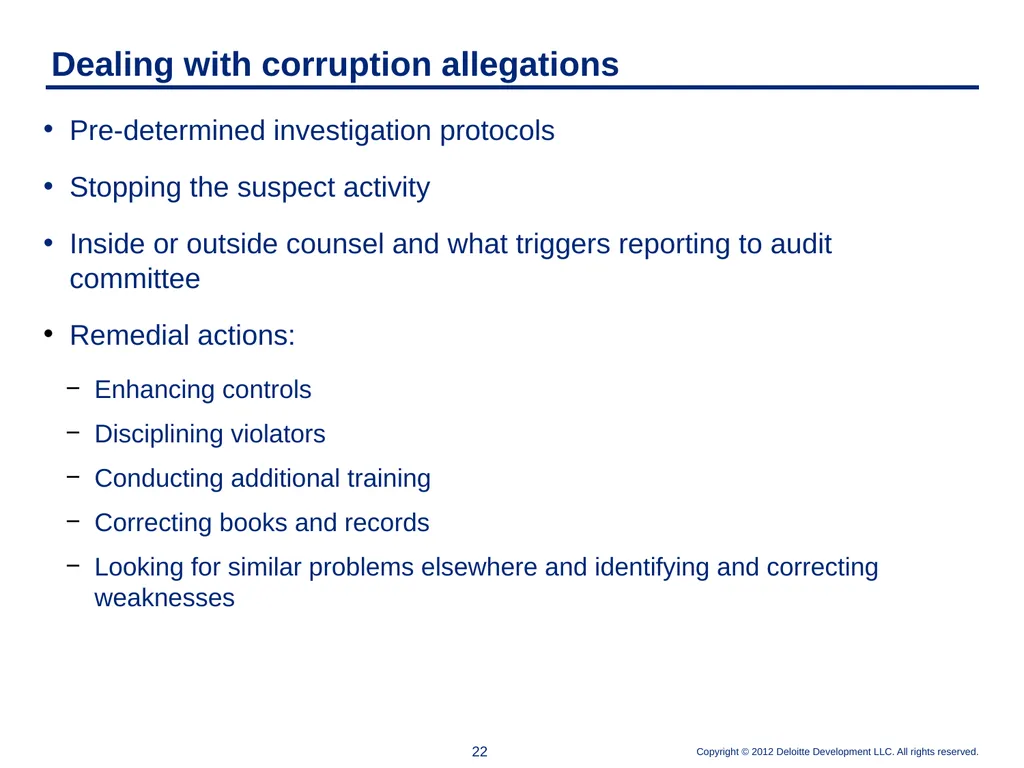
slide22. Pre-determined investigation protocols
Stopping the suspect activity
Inside or outside counsel and what triggers reporting to audit committee
Remedial actions:
Enhancing controls
Disciplining violators
Conducting additional training
Correcting books and records
Looking for similar problems elsewhere and identifying and correcting weaknesses Dealing with corruption allegations<br>
slide23. What questions do you have?<br>
slide24. Mohammed Ahmed, CPA, CFF, CCEP Senior Manager Deloitte Financial Advisory Services LLP +1 212 436 4703 mahmed@deloitte.com Contact information<br>
slide25. This presentation contains general information only and is based on the experiences and research of Deloitte practitioners. Deloitte is not, by means of this presentation, rendering business, financial, investment, or other professional advice or services. This presentation is not a substitute for such professional advice or services, nor should it be used as a basis for any decision or action that may affect your business. Before making any decision or taking any action that may affect your business, you should consult a qualified professional advisor. Deloitte, its affiliates, and related entities shall not be responsible for any loss sustained by any person who relies on this presentation. Certain services may not be available to attest clients under the rules and regulations of public accounting.<br>
slide26. About Deloitte Deloitte refers to one or more of Deloitte Touche Tohmatsu Limited, a UK private company limited by guarantee, and its network of member firms, each of which is a legally separate and independent entity. Please see www.deloitte.com/about for a detailed description of the legal structure of Deloitte Touche Tohmatsu Limited and its member firms. Please see www.deloitte.com/us/about for a detailed description of the legal structure of Deloitte LLP and its subsidiaries. Certain services may not be available to attest clients under the rules and regulations of public accounting. Copyright © 2012 Deloitte Development LLC. All rights reserved. Member of Deloitte Touche Tohmatsu Limited<br>
Deloitte Financial Advisory Services LLP<br>
slide2. Table of contents<br>
slide3. Overview of FCPA and UK Bribery Act<br>
slide4. FCPA overview The FCPA is a US statute enacted in 1977 after Watergate and revelations of foreign bribery involving U.S. companies. Substantially amended in 1988 and 1998 (to expand law and bring FCPA into conformity with Organization for Economic Co-operation and Development (“OECD”) Convention).
The FCPA has two provisions:
The Anti-Bribery provision states: “A company cannot corruptly make an offer, promise, or payment of ‘anything of value’ to a ‘foreign government official’ or politician for the ‘purpose of influencing his or her official actions’ for the advantage of the company.” (17 U.S.C § 78dd-1 et seq.)
The Books and Records provision requires companies who file reports with the SEC to maintain accurate books and records and also to maintain an adequate system of internal controls.<br>
slide5. FCPA overview (cont.) What is “anything of value”?
Some examples include:
Cash or a cash equivalent
Donations
Travel expenses
Gifts
Favorable real estate deals (leases/sales)
Internships and/or direct employment for relatives of foreign officials
Sports outings or other entertainment unrelated to customary entertainment connected with a particular deal or contract
Loans
Business opportunities
Providing financial products at discounted rates
Assisting with medical care (e.g., referrals or prescriptions)<br>
slide6. FCPA overview (cont.) What is meant by “foreign official”?
Any officer or employee of a non-U.S. government or any department, agency, or instrumentality thereof.
Any political party, party official, or candidate for political office.
Officials or employees of public international organizations — defined as organizations that have been designated as such by executive order of the President, such as the World Bank, IMF, and the United Nations.
Any person acting in an official capacity for or on behalf of any such entity, including members of royal families, officers and employees of state-owned enterprises, or anyone who exercises official authority.
How does the FCPA apply to “third parties”?
The FCPA also prohibits payments to third parties, such as consultants and representatives, “while knowing” that all or part of the payment will be given to a foreign official.
The knowledge standard is very broad, and liability can be based on conscious disregard, willful blindness or deliberate ignorance of facts putting you on notice that your agent may commit a violation.<br>
slide7. FCPA books and records provision The books and records provision require companies who file reports with the SEC to maintain records that accurately reflect transactions and the nature and quantity of corporate assets and liabilities.
FCPA books and records focus is on:
How the “bribe” is recorded on the books;
G/L classification for payment;
Business purpose reflected in underlying business records;
Applies even if parent owns less than 50% of a subsidiary
Good faith requirement
Amounts need not be material to constitute violations of the FCPA<br>
slide8. Apparent regulatory focus The SEC and DOJ’s FCPA recent activities include scrutiny of asset management including industry-wide sweeps
Areas of regulatory emphasis include due diligence on source of assets under management.
Failure of private equity firms and venture capital firms to conduct FCPA due diligence regarding: portfolio companies, acquisitions/divestitures, joint ventures or other investments
Transactions with Sovereign Wealth Funds and foreign pension assets
Multi-jurisdictional investigations
More criminal prosecutions of and enforcement actions against individuals
Whistleblower incentives under Dodd-Frank
Inadequate FCPA compliance procedures and controls
Superficial or nonexistent due diligence in retaining agents and consultants<br>
slide9. U.K. Bribery Act On July 1, 2011, the UK Bribery Act comes into force and brings with it the most stringent anti-bribery regime in the world
Alongside offences for payment and receipt of bribes and for bribery of a foreign public official is a further strict liability corporate offense:
Failure by a commercial organization to prevent a bribe being paid by those who perform services for or on behalf of the organization
The only defense for an organization is to have adequate procedures in place to prevent a bribe being paid
March 30, 2011, U.K. Ministry of Justice released its Guidance on procedures which relevant commercial organizations can put into place to prevent persons associated with them from bribing (section 9 of the Bribery Act 2010).<br>
slide10. U.K. Bribery Act (Contd.) The guidance is designed to assist organizations in implementing adequate procedures and sets out six key principles to those procedures
The “Six Principles for Bribery Prevention” are:
Proportionate procedures
Top level commitment
Risk assessment
Due diligence
Communication (including training)
Monitoring and review<br>
slide11. Global Corruption Perception Index Source; Transparency International: 2010 Index<br>
slide12. Elements of an Effective Anti-Corruption Compliance Program<br>
slide13. US Federal sentencing guidelines 1. Program Structure and Oversight 2. Policies and Procedures 3. Training and Education 4. Communication 5. Monitoring and Auditing 6. Enforcement and Incentives 7. Response and Corrective Action Ethical Culture 8. Risk Assessments<br>
slide14. An effective anti-corruption compliance program should consider incorporating certain key elements as depicted below. Leading practices of an anti-corruption compliance program<br>
slide15. Common current state vs. leading practices Common current state: Compliance generally driving process with minimal or no internal audit input
Few companies doing stand-alone anti-corruption audits or anti-corruption risk assessments
Few in internal audit have been adequately trained to detect potential FCPA or UK Bribery Act violations
Internal audit departments are beginning to consider anti-corruption and build testing components into their work plans
Proactive testing, if any, is not risk based and often includes random selections
FCPA policies do not adequately identify internal audit’s role Leading practices: Dedicated and properly trained audit team focused on anti-corruption
Risk-based due diligence on third parties
Joint effort by compliance, legal, and audit
Stand-alone anti-corruption risk assessment
Stand-alone anti-corruption policy
Testing of high-risk locations and business segments on at least a rotating basis
Use of electronic data anomaly tools to identify and test high risk transactions<br>
slide16. Corruption risk assessment high-level approach 1. Evaluate Corruption Risk Factors<br>
slide17. Corruption risk assessment considerations Consider who should be involved (eg Legal, compliance, audit, risk, front office)
History of violations in industry
Geographic locations and corruption rating from TI
Business unit susceptibility and risk for corruption based on service offerings and government touch points, such as degree of government sales
Identification of specific corruption schemes
Use and monitoring of joint ventures
Recent changes in business units such as management, acquisitions, new business, etc.<br>
slide18. Sample corruption risk areas/red flags Gifts, meals, and entertainment are provided to foreign government officials with a corrupt intent
Commissions provided to third parties as a conduit for payments to foreign government officials
Inappropriate payments disguised as consulting fees, services fees, charitable contributions
Facilitating payments made without authorization or approval
Corporate services or benefits used to convey improper benefits
Receipt of investment dollars from governments or quasi-governments for pension or other funds
Selling financial products to governmental or quasi-governmental entities
Bribes/payments made to avoid regulatory action
Payments made to recover funds and/or avoid taxation/fines/duties
Payments made to avoid litigation or governmental intervention<br>
slide19. Anti-corruption compliance program examples and considerations Governance Model Tone at the top – messaging from senior management
Code of conduct
Ethics hotline/whistleblower program
Process for responding to allegations/issues and escalation protocols
Segregation of duties (e.g. request/approval of payments)
Designate anti-corruption compliance oversight responsibilities (e.g. compliance committee) Policies & Procedures Anti-corruption policies and procedures covering topics such as:
Overview of anti-corruption laws, definitions of foreign officials, permitted payments, prohibited payments, etc
Gifts, entertainment of government officials
Facilitating payments
Charitable or political contributions
Requirements for entering 3rd party agreements, due diligence, payments
Requirements for M&A activities (e.g. due diligence), partnerships, JVs
HR policies and procedures (hiring policies, training, disciplinary policy)
Accounting policies and procedures (maintenance of books and records);
Standards for updating polices and procedures<br>
slide20. Anti-corruption compliance program examples and considerations (contd.) Employees Annual training for employees
General (broad employee–base)
Function-specific (training for departments such as Trading, Finance, Risk, Internal Audit focused on risks relevant to audience)
Annual certifications by employees
Maintenance of training materials and related records
Background checks on new employees/promotion candidates with focus on identifying potential government links or prior involvement in bribery or corruption scandals Third Parties Conduct due diligence and maintain records of due diligence
Designate management responsible for oversight of 3rd party hiring and governance, for example:
Centralized approvals by committee of senior management
Sponsors (e.g. – employee sponsor for agent/consultant)
Contracts to include clauses such as:
Term limitations
Compliance with FCPA or other countries’ law
Limitations on ability to subcontract
Internal audit rights
Annual training and certifications for 3rd parties
Maintenance of training materials and related records
Periodic independent audits/reviews of 3rd parties such as agents/partners<br>
slide21. Anti-corruption compliance program examples and considerations (Contd.) Anti-corruption controls should be monitored and tested periodically to help ensure they reasonably address anti-corruption risks. Monitoring and testing procedures may include, but are not limited to:<br>
slide22. Pre-determined investigation protocols
Stopping the suspect activity
Inside or outside counsel and what triggers reporting to audit committee
Remedial actions:
Enhancing controls
Disciplining violators
Conducting additional training
Correcting books and records
Looking for similar problems elsewhere and identifying and correcting weaknesses Dealing with corruption allegations<br>
slide23. What questions do you have?<br>
slide24. Mohammed Ahmed, CPA, CFF, CCEP Senior Manager Deloitte Financial Advisory Services LLP +1 212 436 4703 mahmed@deloitte.com Contact information<br>
slide25. This presentation contains general information only and is based on the experiences and research of Deloitte practitioners. Deloitte is not, by means of this presentation, rendering business, financial, investment, or other professional advice or services. This presentation is not a substitute for such professional advice or services, nor should it be used as a basis for any decision or action that may affect your business. Before making any decision or taking any action that may affect your business, you should consult a qualified professional advisor. Deloitte, its affiliates, and related entities shall not be responsible for any loss sustained by any person who relies on this presentation. Certain services may not be available to attest clients under the rules and regulations of public accounting.<br>
slide26. About Deloitte Deloitte refers to one or more of Deloitte Touche Tohmatsu Limited, a UK private company limited by guarantee, and its network of member firms, each of which is a legally separate and independent entity. Please see www.deloitte.com/about for a detailed description of the legal structure of Deloitte Touche Tohmatsu Limited and its member firms. Please see www.deloitte.com/us/about for a detailed description of the legal structure of Deloitte LLP and its subsidiaries. Certain services may not be available to attest clients under the rules and regulations of public accounting. Copyright © 2012 Deloitte Development LLC. All rights reserved. Member of Deloitte Touche Tohmatsu Limited<br>