
EMRG-1600 Introduction to Emergency Support




Description: EMRG-1600 Introduction to Emergency Support Services We respectfully acknowledge the Justice Institute of British Columbias New Westminster campus is located on the unceded Traditional Territories of the qiqéyt (Qayqayt), xʷməθkʷəyəm
Related Topics
Download Presentation
"EMRG-1600 Introduction to Emergency Support" is the property of its rightful owner. Permission is granted to download and print the materials on this website for personal, non-commercial use only, and to display it on your personal computer provided you do not modify the materials and that you retain all copyright notices contained in the materials. By downloading content from our website, you accept the terms of this agreement.
Presentation Transcript
slide1. EMRG-1600
Introduction to Emergency Support Services<br>
slide2. We respectfully acknowledge the Justice Institute of British Columbia’s New Westminster campus is located on the unceded Traditional Territories of the qiqéyt (Qayqayt), xʷməθkʷəy̓əm (Musqueam) and Coast Salish people.<br>
slide3. Housekeeping Emergency Exits Washrooms Phone Use Breaks Materials<br>
slide4. Information about instructor. Instructor Name Here Instructor Name Here Instructor Introductions Information about instructor.<br>
slide5. Icebreaker Question<br>
slide6. Learning Outcomes Upon completion of this course, you will be able to:
Prepare to be an ESS responder
Explain the role and structure of ESS
Describe the rights and responsibilities of ESS responders<br>
slide7. Module 1: Preparing to be an ESS Responder<br>
slide8. Emergency Support Services (ESS) provides short-term
basic support to people impacted by disasters.
The program is financed by the provincial government and administered by Indigenous communities and local governments.
ESS is designed to provide short-term support following disasters ranging from a single house fire to provincial level events involving large evacuations. These supports enable people to re-establish themselves as quickly as possible after an emergency or disaster. Emergency Support Services (ESS)<br>
slide9. What hazards may threaten your community?<br>
slide10. Effects of Disaster on People Factors Affecting Reaction to Loss
Circumstances, age, life experience, individual personality, value systems, beliefs, coping style, social and financial support
First Reactions
Shock, disbelief, disorientation, numbness, fear, reluctance to leave property
Post-Incident Reactions
Frustration, anxiety, anger, suspicion, irritability, apathy, depression, fatigue, isolation<br>
slide11. Plan for Self-Care ESS responders may be exposed directly or indirectly to heartbreaking devastation and loss, and to the related stress and trauma
Responders may experience stress reactions during or after the response
Responders may feel overwhelmed<br>
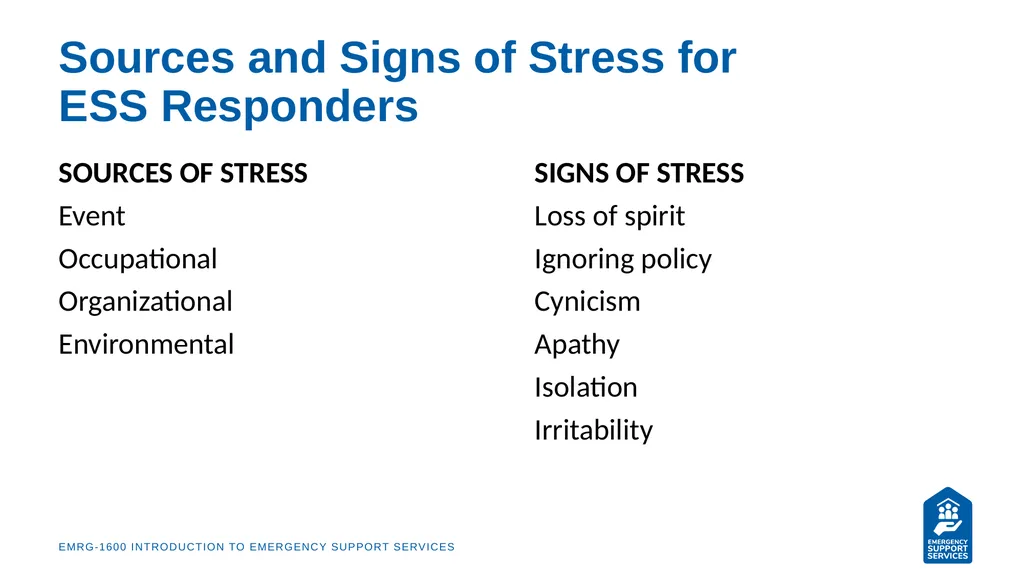
slide12. Sources and Signs of Stress for ESS Responders SOURCES OF STRESS
Event
Occupational
Organizational
Environmental SIGNS OF STRESS
Loss of spirit
Ignoring policy
Cynicism
Apathy
Isolation
Irritability<br>
slide13. On Your Own
What activities would you engage in to care for yourself before, during, and after a response? Activity: Planning for Self-Care<br>
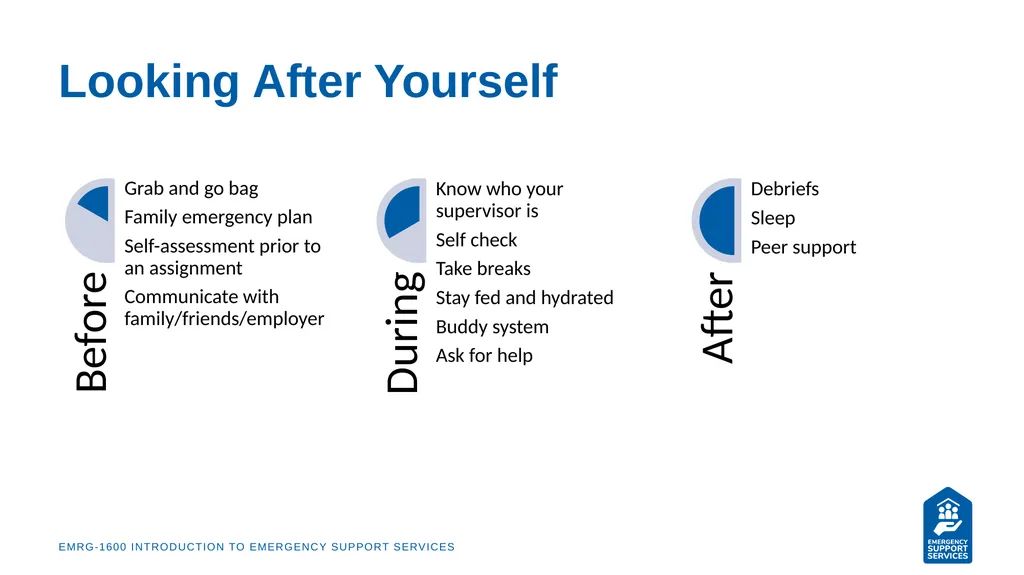
slide14. Looking After Yourself<br>
slide15. [Add Discussion Question(s)]
Reflect on the discussion question(s)
Discuss your responses with a small group
Share with the large group Discuss What You’ve Learned<br>
slide16. Interacting with Evacuees<br>
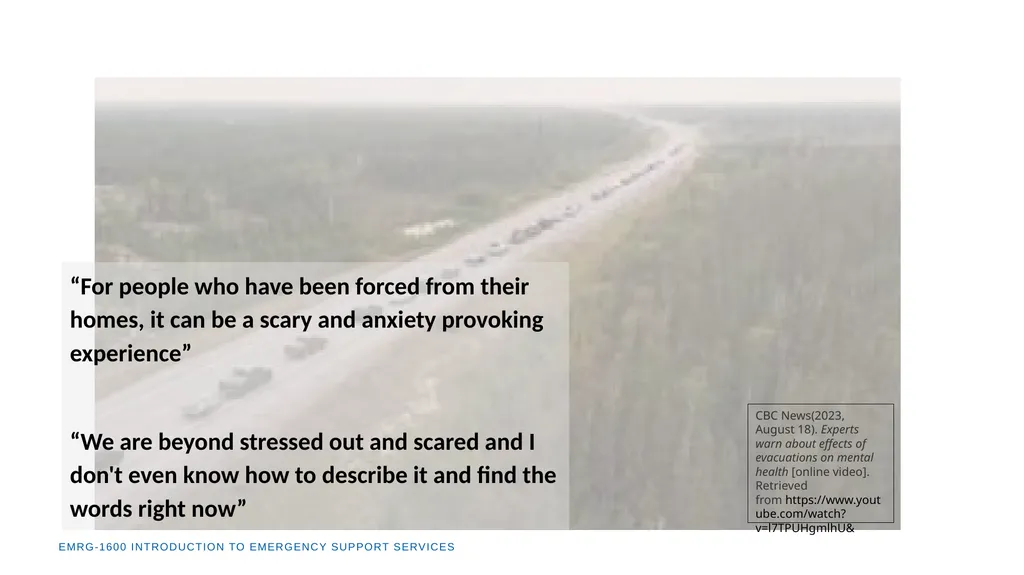
slide17. “For people who have been forced from their homes, it can be a scary and anxiety provoking experience”
“We are beyond stressed out and scared and I don't even know how to describe it and find the words right now” CBC News(2023, August 18). Experts warn about effects of evacuations on mental health [online video]. Retrieved from https://www.youtube.com/watch?v=l7TPUHgmlhU&<br>
slide18. What behaviours from an ESS responder would make you feel supported in the event of an evacuation?<br>
slide20. Why is it important to consider Cultural Humility when working with evacuees?<br>
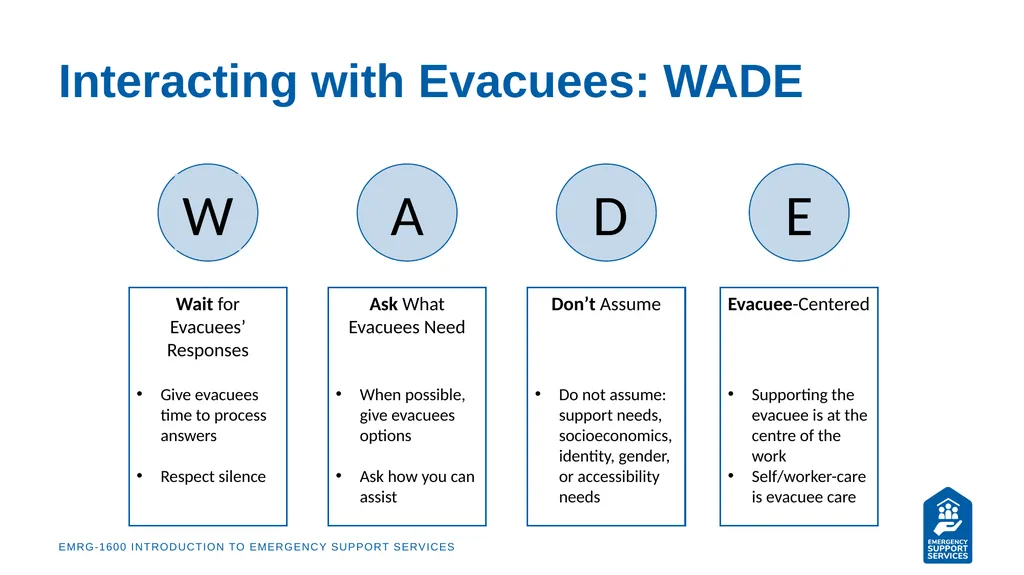
slide21. Interacting with Evacuees: WADE<br>
slide22. Module 2: ESS Overview<br>
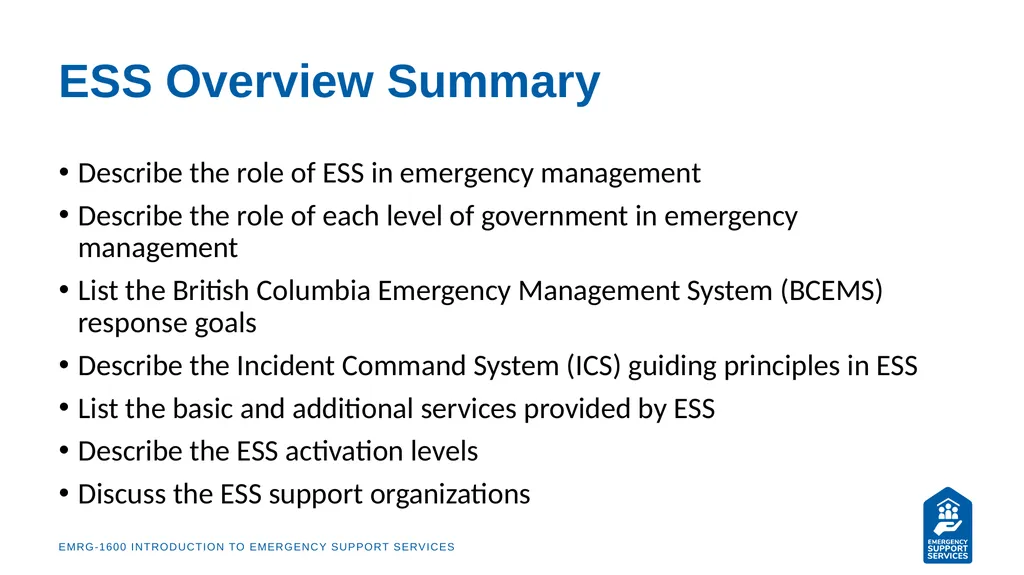
slide23. ESS Overview Summary Describe the role of ESS in emergency management
Describe the role of each level of government in emergency management
List the British Columbia Emergency Management System (BCEMS) response goals
Describe the Incident Command System (ICS) guiding principles in ESS
List the basic and additional services provided by ESS
Describe the ESS activation levels
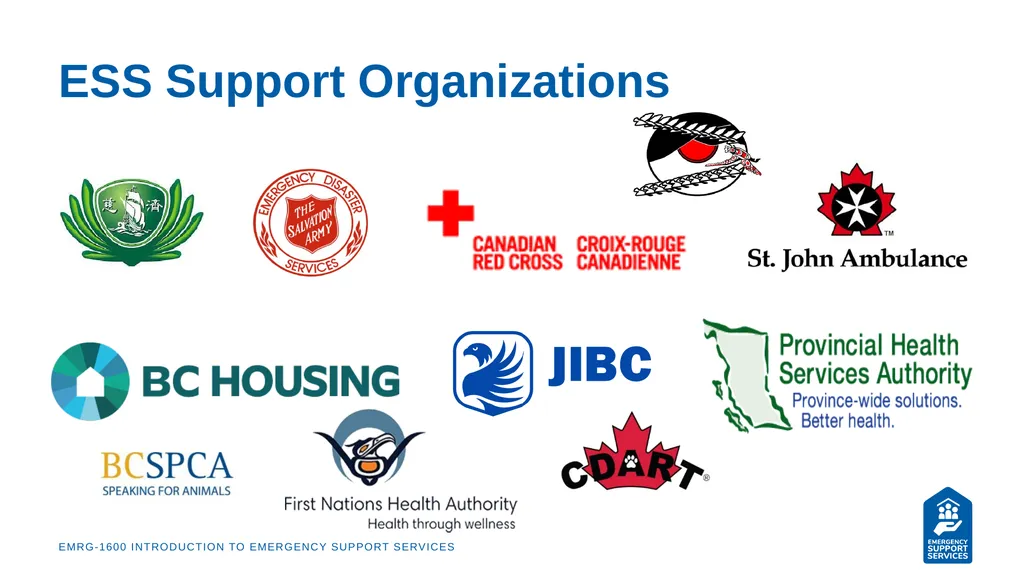
Discuss the ESS support organizations<br>
slide24. The systems and processes for preventing and mitigating, preparing for, responding to, and recovering from emergencies and disasters. Emergency Management<br>
slide25. The ESS Director is appointed by the local Emergency Program Coordinator. They are responsible for the management and coordination of a local ESS program/team, planning, and response activities. ESS Director<br>
slide26. ESS Has a Vital Role in: Assisting people to remain independent and self-sufficient
Assisting people to meet basic needs
Providing accurate and current information
Assisting people to re-establish themselves as soon as possible<br>
slide27. Local Authority Responsibilities The Emergency Program Act, legislates municipalities and regional districts to be responsible for planning and managing emergency response operations within their jurisdiction.
In BC, the Emergency Management Regulation requires local authorities to coordinate the provision of food, clothing, shelter, transportation, and medical services for their residents.<br>
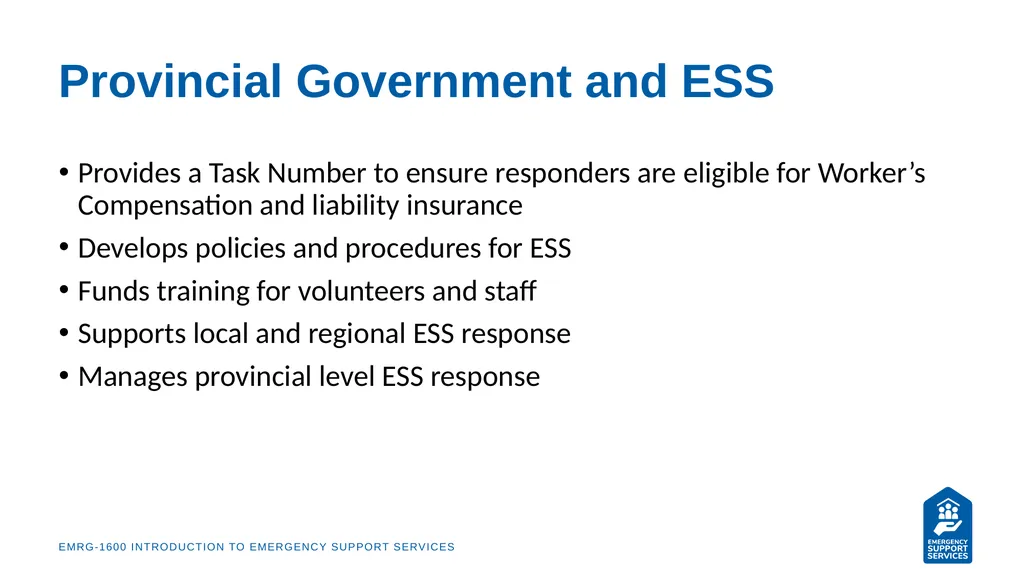
slide28. Provincial Government and ESS Provides a Task Number to ensure responders are eligible for Worker’s Compensation and liability insurance
Develops policies and procedures for ESS
Funds training for volunteers and staff
Supports local and regional ESS response
Manages provincial level ESS response<br>
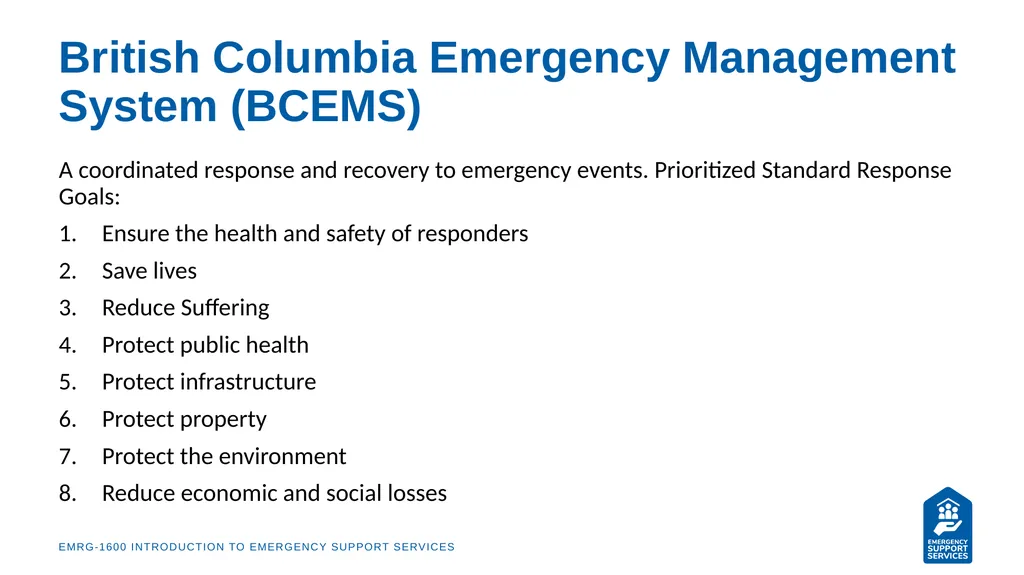
slide29. British Columbia Emergency Management System (BCEMS) A coordinated response and recovery to emergency events. Prioritized Standard Response Goals:
Ensure the health and safety of responders
Save lives
Reduce Suffering
Protect public health
Protect infrastructure
Protect property
Protect the environment
Reduce economic and social losses<br>
slide30. In Small Groups
Work together to answer the questions about emergency management systems. Activity: Emergency Management Systems<br>
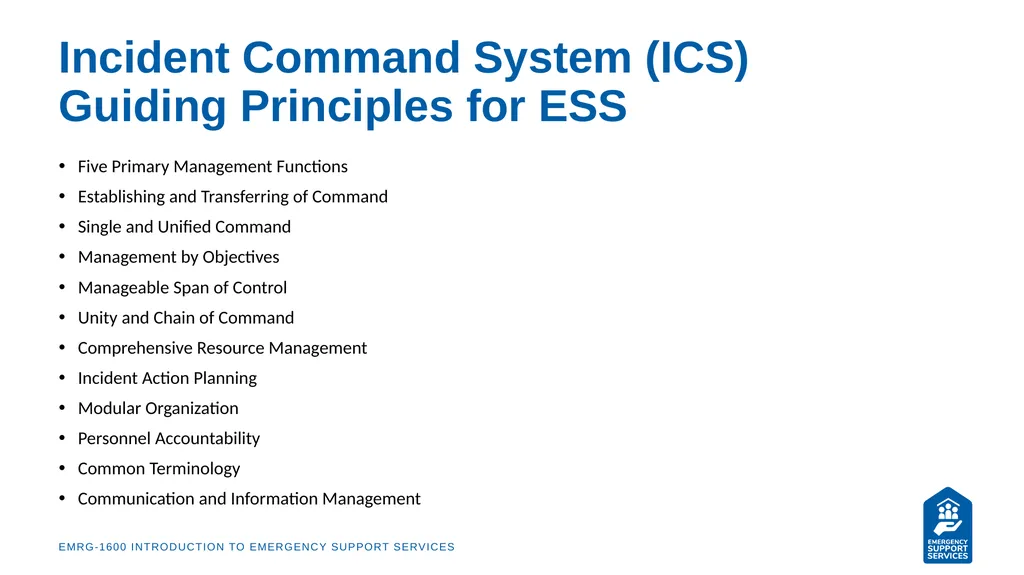
slide31. Incident Command System (ICS) Guiding Principles for ESS Five Primary Management Functions
Establishing and Transferring of Command
Single and Unified Command
Management by Objectives
Manageable Span of Control
Unity and Chain of Command
Comprehensive Resource Management
Incident Action Planning
Modular Organization
Personnel Accountability
Common Terminology
Communication and Information Management<br>
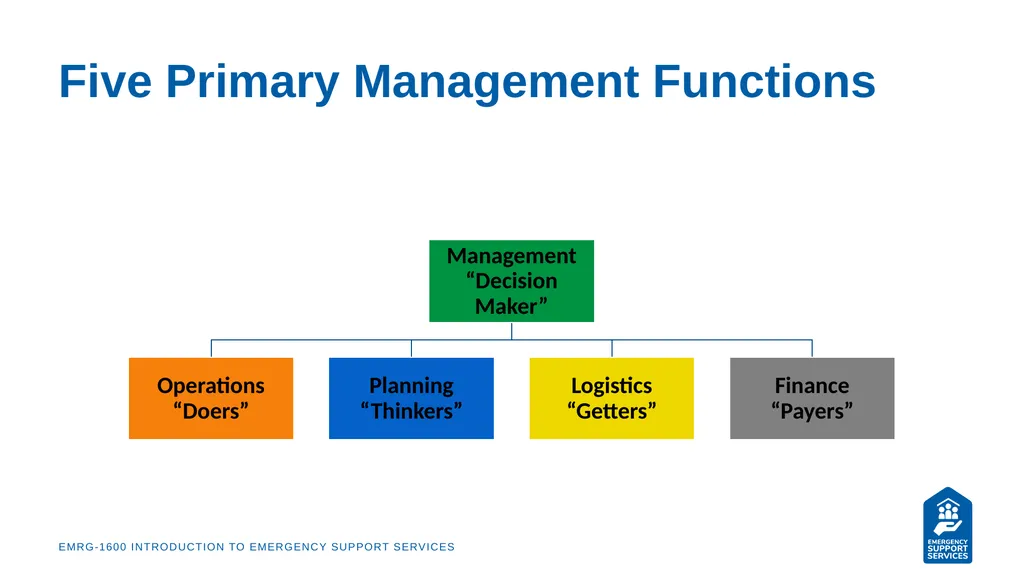
slide32. Five Primary Management Functions<br>
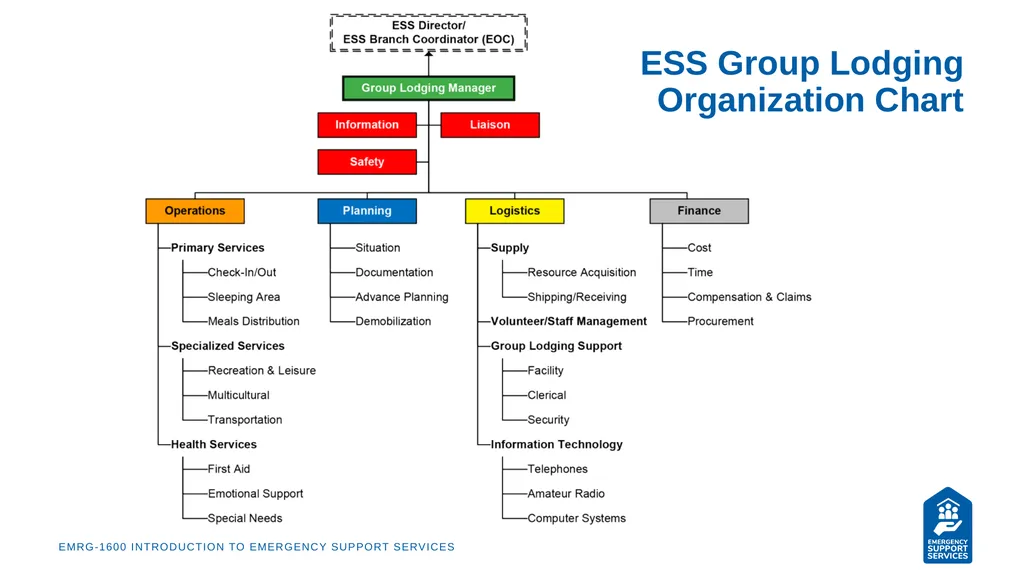
slide33. ESS Group Lodging Organization Chart<br>
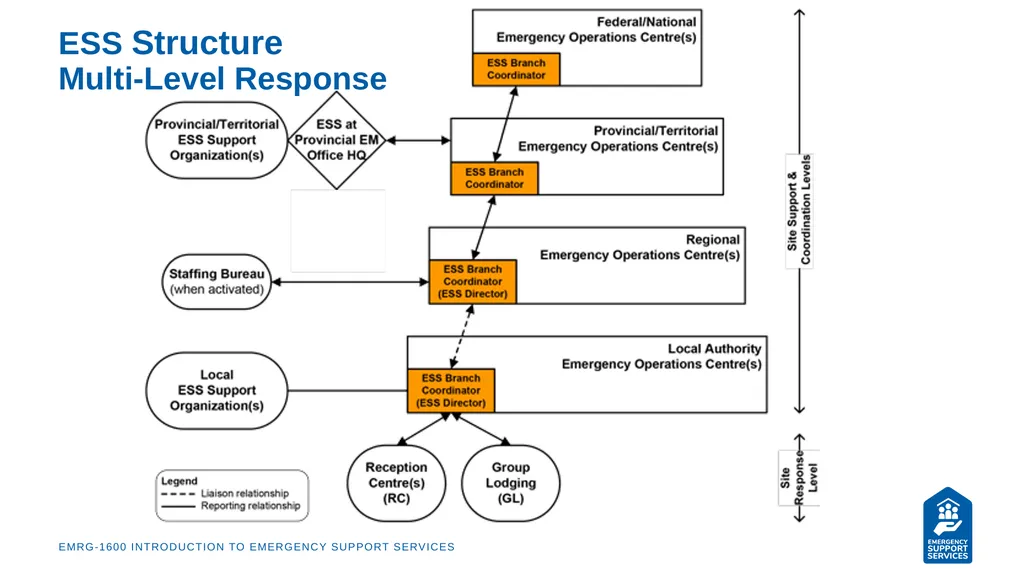
slide34. ESS Structure Multi-Level Response<br>
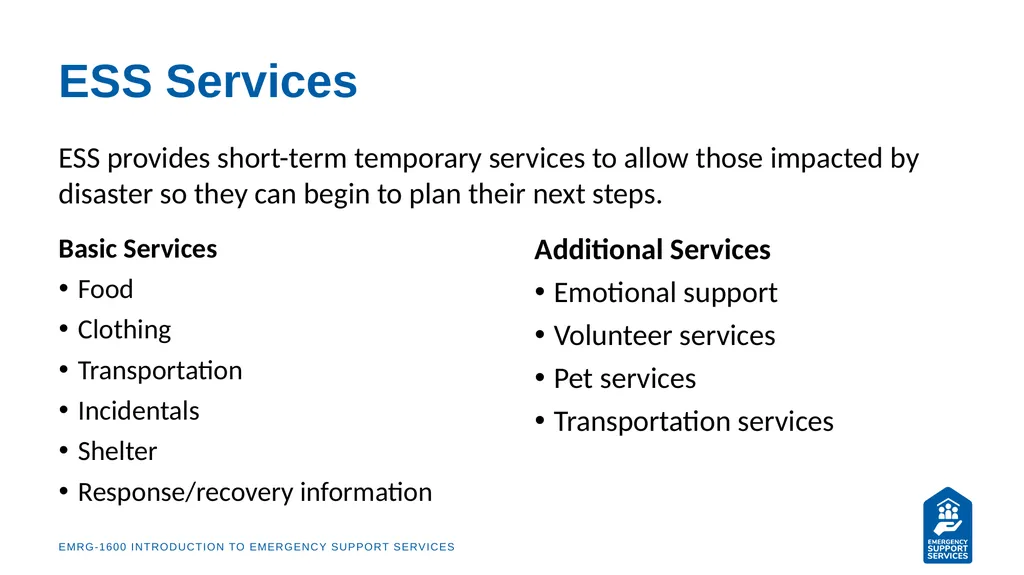
slide35. ESS Services Basic Services
Food
Clothing
Transportation
Incidentals
Shelter
Response/recovery information Additional Services
Emotional support
Volunteer services
Pet services
Transportation services ESS provides short-term temporary services to allow those impacted by disaster so they can begin to plan their next steps.<br>
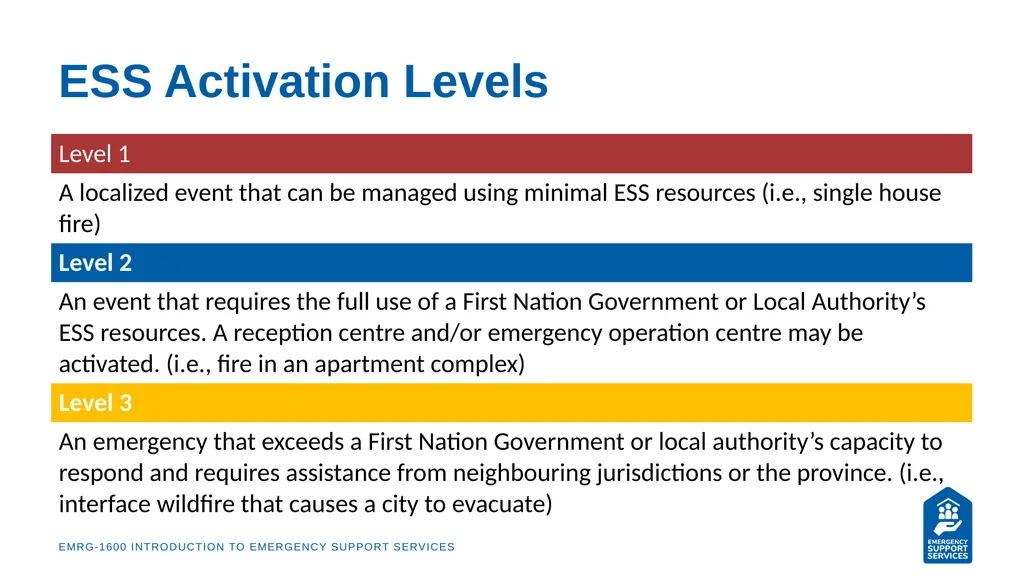
slide36. ESS Activation Levels<br>
slide37. ESS Support Organizations<br>
slide38. [Add Discussion Question(s)]
Reflect on the discussion question(s)
Discuss your responses with a small group
Share with the large group Discuss What You’ve Learned<br>
slide39. In Small Groups
Work together to answer the questions about the ESS response process. Activity: ESS Response Process<br>
slide40. Module 3: ESS Responder Functions<br>
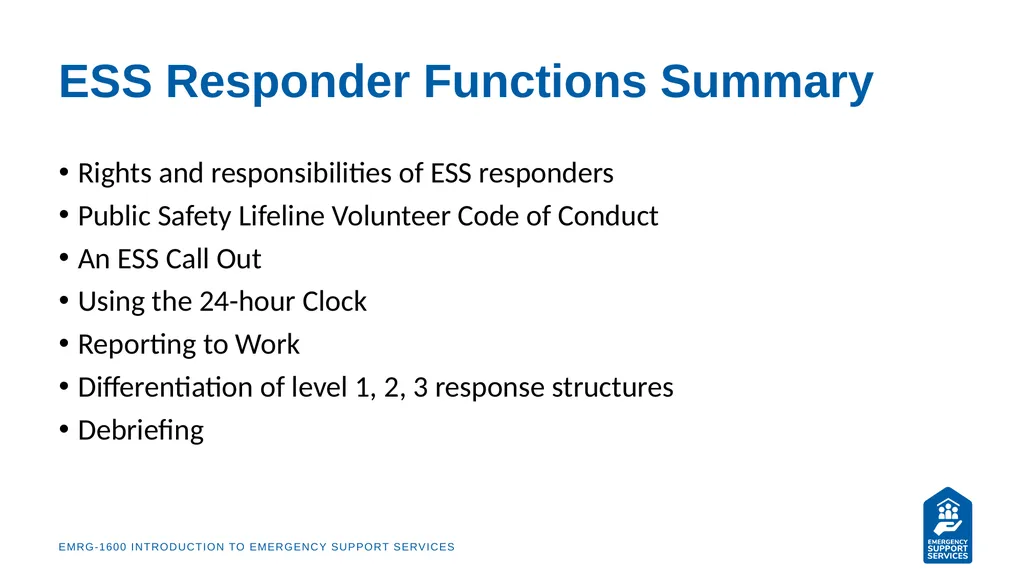
slide41. ESS Responder Functions Summary Rights and responsibilities of ESS responders
Public Safety Lifeline Volunteer Code of Conduct
An ESS Call Out
Using the 24-hour Clock
Reporting to Work
Differentiation of level 1, 2, 3 response structures
Debriefing<br>
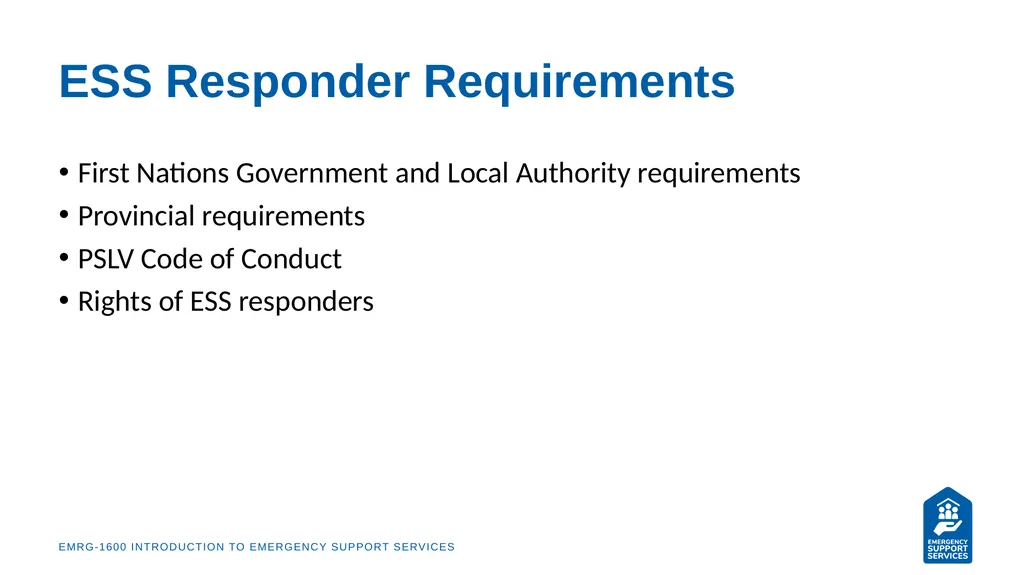
slide42. ESS Responder Requirements First Nations Government and Local Authority requirements
Provincial requirements
PSLV Code of Conduct
Rights of ESS responders<br>
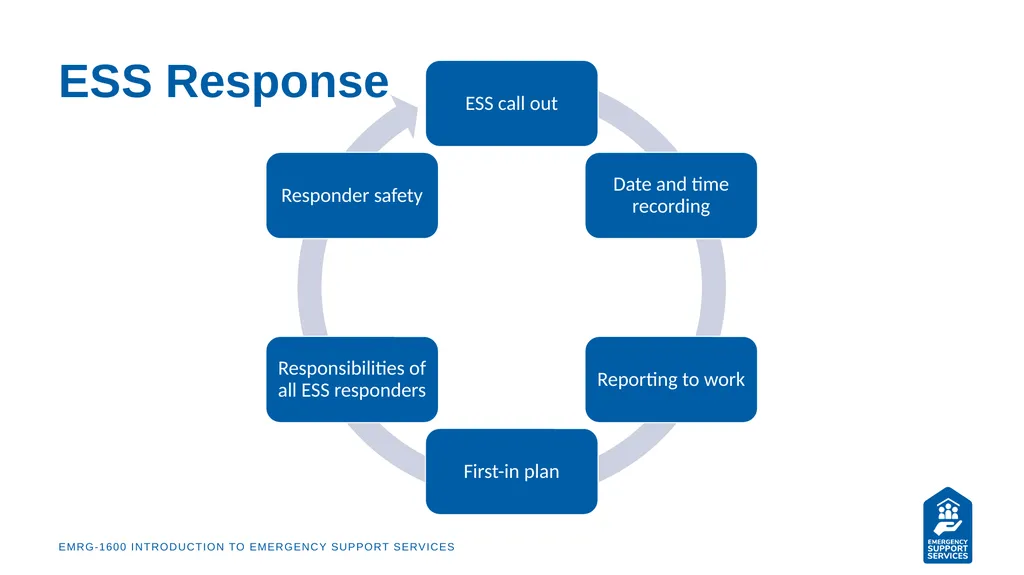
slide43. ESS Response<br>
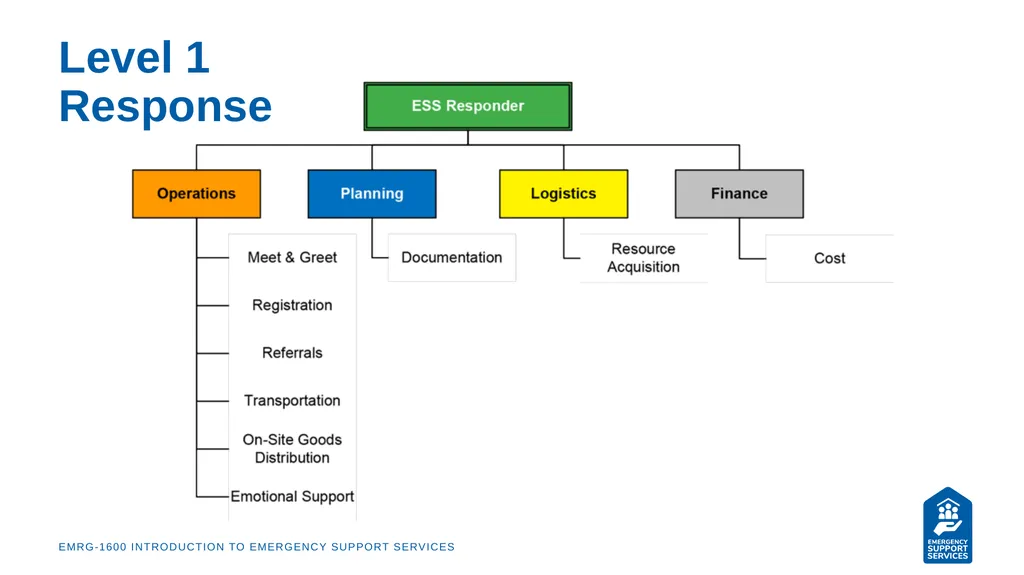
slide44. Level 1 Response<br>
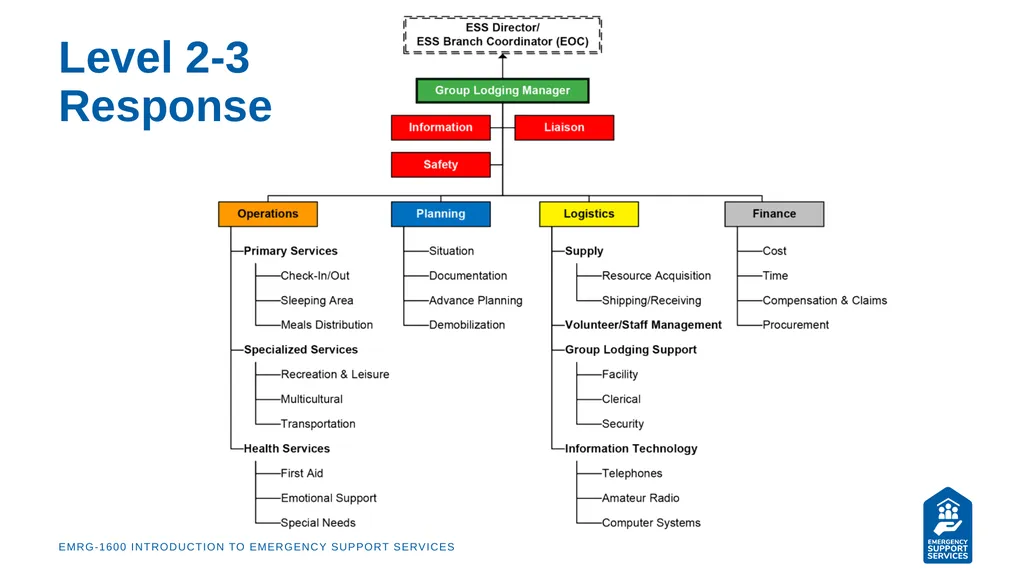
slide45. Level 2-3 Response<br>
slide46. [Add Discussion Question(s)]
Reflect on the discussion question(s)
Discuss your responses with a small group
Share with the large group Discuss What You’ve Learned<br>
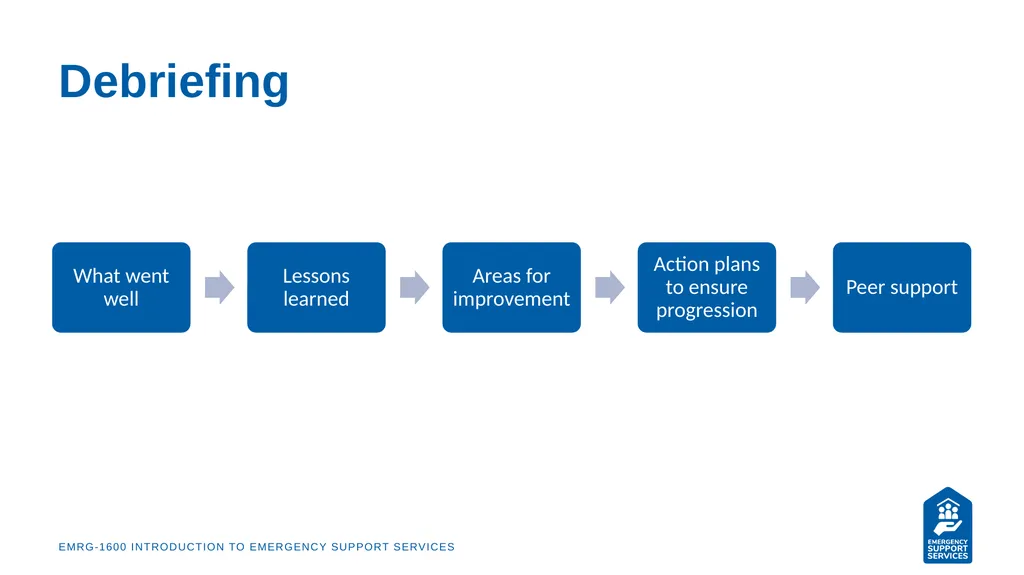
slide47. Debriefing<br>
slide48. In Small Groups
Work together to answer the questions about ESS responder functions. Activity: ESS Responder Functions<br>
slide49. Any remaining questions about the content?<br>
slide50. Quiz Turn to Module 4 in your participant guide. Get into small groups and read the scenario. Complete the quiz with your groups, with a score of 70% or above. You can take the quiz as many times as you like.<br>
slide51. Closing Activity
What is one thing you understand well after the course?
What is one thing you want to learn more about?<br>
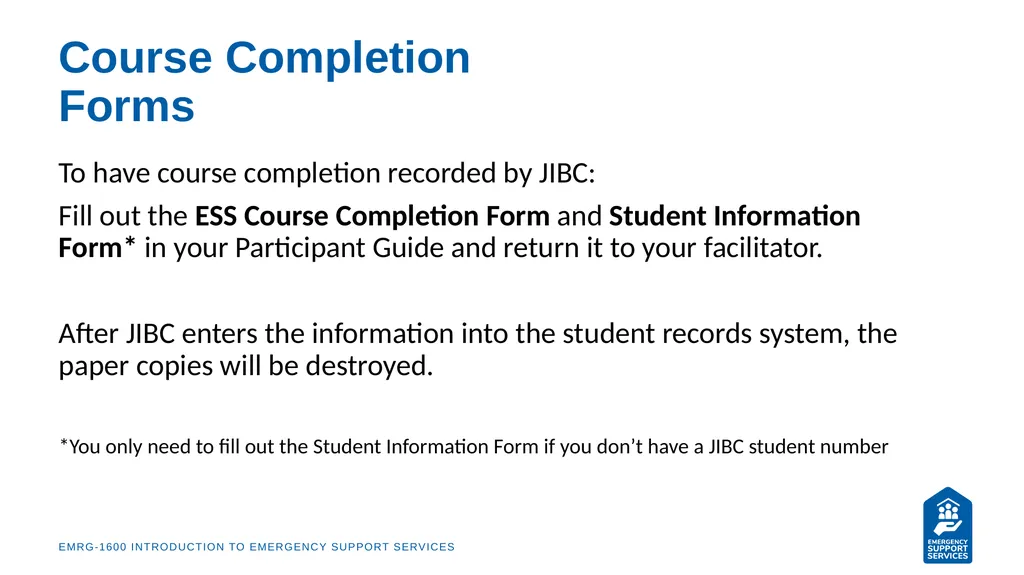
slide52. Course Completion Forms To have course completion recorded by JIBC:
Fill out the ESS Course Completion Form and Student Information Form* in your Participant Guide and return it to your facilitator.
After JIBC enters the information into the student records system, the paper copies will be destroyed.
*You only need to fill out the Student Information Form if you don’t have a JIBC student number<br>
slide53. Thank you! Information about the JIBC ESS Training Program
Website: jibc.ca/ess
Email: ess@jibc.ca<br>
slide2. We respectfully acknowledge the Justice Institute of British Columbia’s New Westminster campus is located on the unceded Traditional Territories of the qiqéyt (Qayqayt), xʷməθkʷəy̓əm (Musqueam) and Coast Salish people.<br>
slide3. Housekeeping Emergency Exits Washrooms Phone Use Breaks Materials<br>
slide4. Information about instructor. Instructor Name Here Instructor Name Here Instructor Introductions Information about instructor.<br>
slide5. Icebreaker Question<br>
slide6. Learning Outcomes Upon completion of this course, you will be able to:
Prepare to be an ESS responder
Explain the role and structure of ESS
Describe the rights and responsibilities of ESS responders<br>
slide7. Module 1: Preparing to be an ESS Responder<br>
slide8. Emergency Support Services (ESS) provides short-term
basic support to people impacted by disasters.
The program is financed by the provincial government and administered by Indigenous communities and local governments.
ESS is designed to provide short-term support following disasters ranging from a single house fire to provincial level events involving large evacuations. These supports enable people to re-establish themselves as quickly as possible after an emergency or disaster. Emergency Support Services (ESS)<br>
slide9. What hazards may threaten your community?<br>
slide10. Effects of Disaster on People Factors Affecting Reaction to Loss
Circumstances, age, life experience, individual personality, value systems, beliefs, coping style, social and financial support
First Reactions
Shock, disbelief, disorientation, numbness, fear, reluctance to leave property
Post-Incident Reactions
Frustration, anxiety, anger, suspicion, irritability, apathy, depression, fatigue, isolation<br>
slide11. Plan for Self-Care ESS responders may be exposed directly or indirectly to heartbreaking devastation and loss, and to the related stress and trauma
Responders may experience stress reactions during or after the response
Responders may feel overwhelmed<br>
slide12. Sources and Signs of Stress for ESS Responders SOURCES OF STRESS
Event
Occupational
Organizational
Environmental SIGNS OF STRESS
Loss of spirit
Ignoring policy
Cynicism
Apathy
Isolation
Irritability<br>
slide13. On Your Own
What activities would you engage in to care for yourself before, during, and after a response? Activity: Planning for Self-Care<br>
slide14. Looking After Yourself<br>
slide15. [Add Discussion Question(s)]
Reflect on the discussion question(s)
Discuss your responses with a small group
Share with the large group Discuss What You’ve Learned<br>
slide16. Interacting with Evacuees<br>
slide17. “For people who have been forced from their homes, it can be a scary and anxiety provoking experience”
“We are beyond stressed out and scared and I don't even know how to describe it and find the words right now” CBC News(2023, August 18). Experts warn about effects of evacuations on mental health [online video]. Retrieved from https://www.youtube.com/watch?v=l7TPUHgmlhU&<br>
slide18. What behaviours from an ESS responder would make you feel supported in the event of an evacuation?<br>
slide20. Why is it important to consider Cultural Humility when working with evacuees?<br>
slide21. Interacting with Evacuees: WADE<br>
slide22. Module 2: ESS Overview<br>
slide23. ESS Overview Summary Describe the role of ESS in emergency management
Describe the role of each level of government in emergency management
List the British Columbia Emergency Management System (BCEMS) response goals
Describe the Incident Command System (ICS) guiding principles in ESS
List the basic and additional services provided by ESS
Describe the ESS activation levels
Discuss the ESS support organizations<br>
slide24. The systems and processes for preventing and mitigating, preparing for, responding to, and recovering from emergencies and disasters. Emergency Management<br>
slide25. The ESS Director is appointed by the local Emergency Program Coordinator. They are responsible for the management and coordination of a local ESS program/team, planning, and response activities. ESS Director<br>
slide26. ESS Has a Vital Role in: Assisting people to remain independent and self-sufficient
Assisting people to meet basic needs
Providing accurate and current information
Assisting people to re-establish themselves as soon as possible<br>
slide27. Local Authority Responsibilities The Emergency Program Act, legislates municipalities and regional districts to be responsible for planning and managing emergency response operations within their jurisdiction.
In BC, the Emergency Management Regulation requires local authorities to coordinate the provision of food, clothing, shelter, transportation, and medical services for their residents.<br>
slide28. Provincial Government and ESS Provides a Task Number to ensure responders are eligible for Worker’s Compensation and liability insurance
Develops policies and procedures for ESS
Funds training for volunteers and staff
Supports local and regional ESS response
Manages provincial level ESS response<br>
slide29. British Columbia Emergency Management System (BCEMS) A coordinated response and recovery to emergency events. Prioritized Standard Response Goals:
Ensure the health and safety of responders
Save lives
Reduce Suffering
Protect public health
Protect infrastructure
Protect property
Protect the environment
Reduce economic and social losses<br>
slide30. In Small Groups
Work together to answer the questions about emergency management systems. Activity: Emergency Management Systems<br>
slide31. Incident Command System (ICS) Guiding Principles for ESS Five Primary Management Functions
Establishing and Transferring of Command
Single and Unified Command
Management by Objectives
Manageable Span of Control
Unity and Chain of Command
Comprehensive Resource Management
Incident Action Planning
Modular Organization
Personnel Accountability
Common Terminology
Communication and Information Management<br>
slide32. Five Primary Management Functions<br>
slide33. ESS Group Lodging Organization Chart<br>
slide34. ESS Structure Multi-Level Response<br>
slide35. ESS Services Basic Services
Food
Clothing
Transportation
Incidentals
Shelter
Response/recovery information Additional Services
Emotional support
Volunteer services
Pet services
Transportation services ESS provides short-term temporary services to allow those impacted by disaster so they can begin to plan their next steps.<br>
slide36. ESS Activation Levels<br>
slide37. ESS Support Organizations<br>
slide38. [Add Discussion Question(s)]
Reflect on the discussion question(s)
Discuss your responses with a small group
Share with the large group Discuss What You’ve Learned<br>
slide39. In Small Groups
Work together to answer the questions about the ESS response process. Activity: ESS Response Process<br>
slide40. Module 3: ESS Responder Functions<br>
slide41. ESS Responder Functions Summary Rights and responsibilities of ESS responders
Public Safety Lifeline Volunteer Code of Conduct
An ESS Call Out
Using the 24-hour Clock
Reporting to Work
Differentiation of level 1, 2, 3 response structures
Debriefing<br>
slide42. ESS Responder Requirements First Nations Government and Local Authority requirements
Provincial requirements
PSLV Code of Conduct
Rights of ESS responders<br>
slide43. ESS Response<br>
slide44. Level 1 Response<br>
slide45. Level 2-3 Response<br>
slide46. [Add Discussion Question(s)]
Reflect on the discussion question(s)
Discuss your responses with a small group
Share with the large group Discuss What You’ve Learned<br>
slide47. Debriefing<br>
slide48. In Small Groups
Work together to answer the questions about ESS responder functions. Activity: ESS Responder Functions<br>
slide49. Any remaining questions about the content?<br>
slide50. Quiz Turn to Module 4 in your participant guide. Get into small groups and read the scenario. Complete the quiz with your groups, with a score of 70% or above. You can take the quiz as many times as you like.<br>
slide51. Closing Activity
What is one thing you understand well after the course?
What is one thing you want to learn more about?<br>
slide52. Course Completion Forms To have course completion recorded by JIBC:
Fill out the ESS Course Completion Form and Student Information Form* in your Participant Guide and return it to your facilitator.
After JIBC enters the information into the student records system, the paper copies will be destroyed.
*You only need to fill out the Student Information Form if you don’t have a JIBC student number<br>
slide53. Thank you! Information about the JIBC ESS Training Program
Website: jibc.ca/ess
Email: ess@jibc.ca<br>