
EMV® 3-D Secure - High Level Overview 3-D (Three
Description: EMV 3-D Secure - High Level Overview 3-D (Three Domain) Secure is a messaging protocol which enables consumers to directly authenticate with the card issuer while shopping online Three domains consist of: Merchant Acquirer Domain
Related Topics
Download Presentation
"EMV® 3-D Secure - High Level Overview 3-D (Three" is the property of its rightful owner. Permission is granted to download and print the materials on this website for personal, non-commercial use only, and to display it on your personal computer provided you do not modify the materials and that you retain all copyright notices contained in the materials. By downloading content from our website, you accept the terms of this agreement.
Presentation Transcript
slide1. EMV® 3-D Secure -
High Level Overview<br>
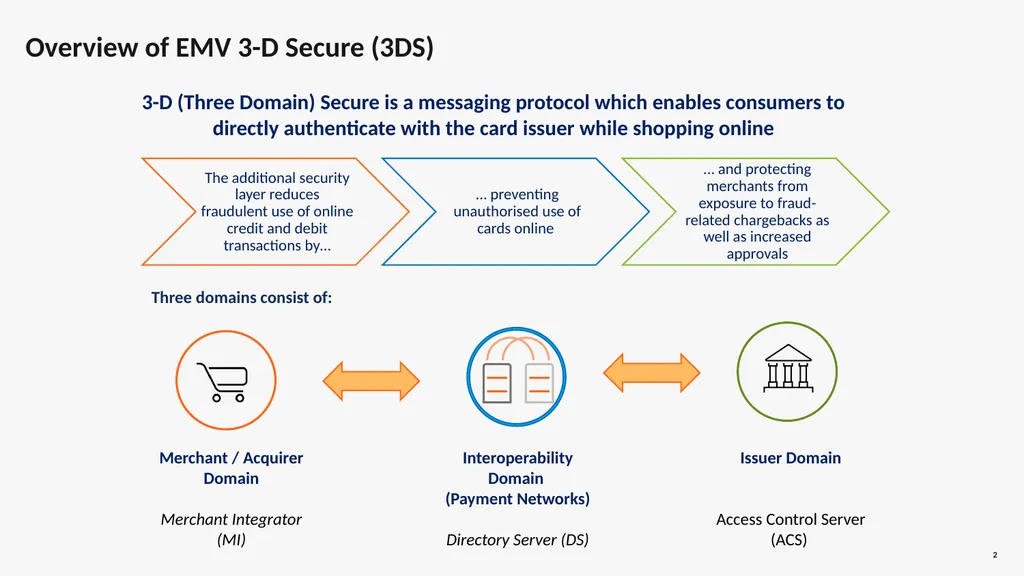
slide2. 3-D (Three Domain) Secure is a messaging protocol which enables consumers to directly authenticate with the card issuer while shopping online Three domains consist of: Merchant / Acquirer Domain
Merchant Integrator (MI) Interoperability Domain
(Payment Networks)
Directory Server (DS) Issuer Domain
Access Control Server
(ACS) Overview of EMV 3-D Secure (3DS) 2<br>
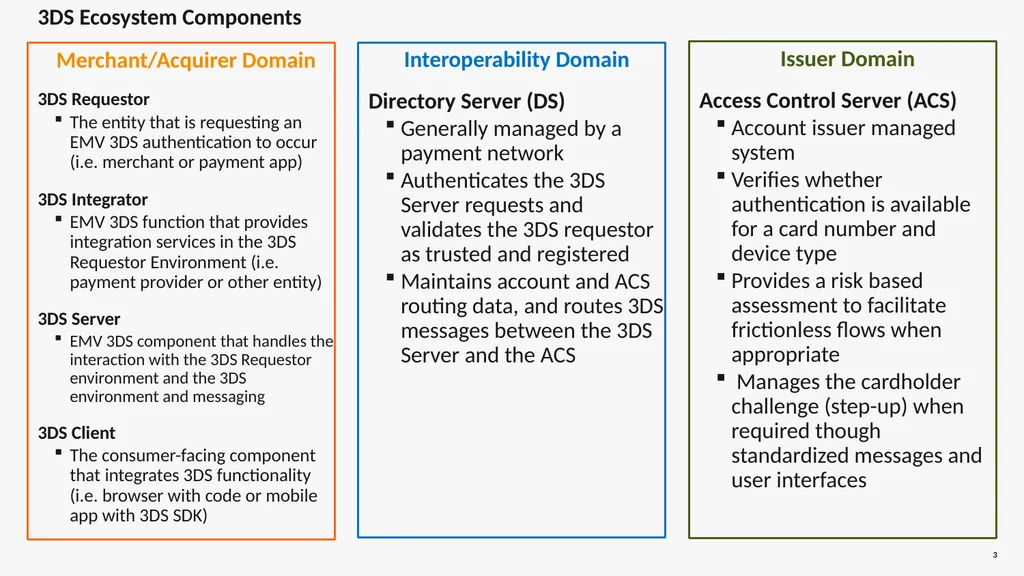
slide3. Merchant/Acquirer Domain
3DS Requestor
The entity that is requesting an EMV 3DS authentication to occur (i.e. merchant or payment app)
3DS Integrator
EMV 3DS function that provides integration services in the 3DS Requestor Environment (i.e. payment provider or other entity)
3DS Server
EMV 3DS component that handles the interaction with the 3DS Requestor environment and the 3DS environment and messaging
3DS Client
The consumer-facing component that integrates 3DS functionality (i.e. browser with code or mobile app with 3DS SDK) Interoperability Domain
Directory Server (DS)
Generally managed by a payment network
Authenticates the 3DS Server requests and validates the 3DS requestor as trusted and registered
Maintains account and ACS routing data, and routes 3DS messages between the 3DS Server and the ACS Issuer Domain
Access Control Server (ACS)
Account issuer managed system
Verifies whether authentication is available for a card number and device type
Provides a risk based assessment to facilitate frictionless flows when appropriate
Manages the cardholder challenge (step-up) when required though standardized messages and user interfaces 3DS Ecosystem Components 3<br>
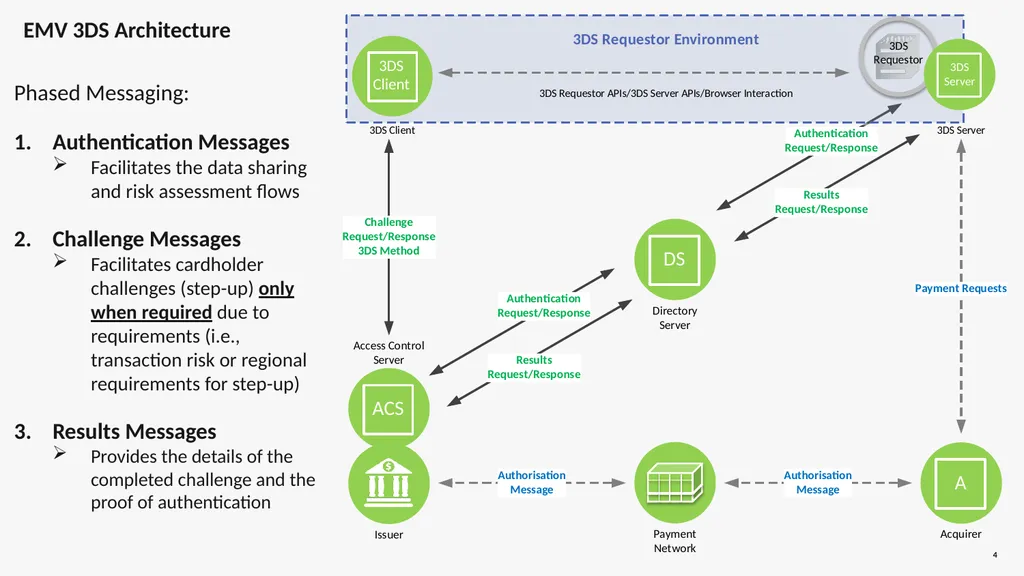
slide4. EMV 3DS Architecture Phased Messaging:
Authentication Messages
Facilitates the data sharing and risk assessment flows
Challenge Messages
Facilitates cardholder challenges (step-up) only when required due to requirements (i.e., transaction risk or regional requirements for step-up)
Results Messages
Provides the details of the completed challenge and the proof of authentication 4<br>
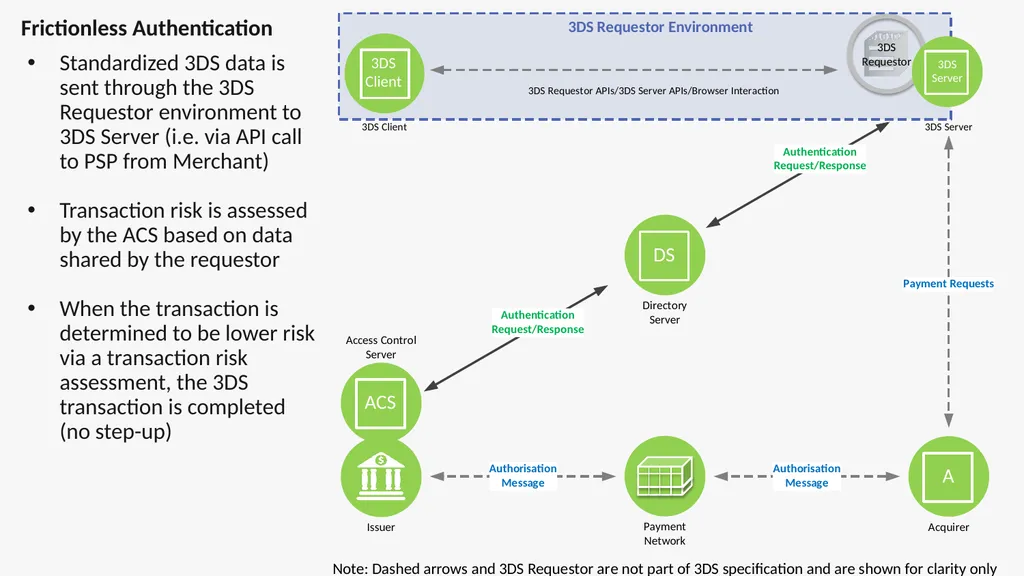
slide5. Frictionless Authentication Standardized 3DS data is sent through the 3DS Requestor environment to 3DS Server (i.e. via API call to PSP from Merchant)
Transaction risk is assessed by the ACS based on data shared by the requestor
When the transaction is determined to be lower risk via a transaction risk assessment, the 3DS transaction is completed (no step-up) 5<br>
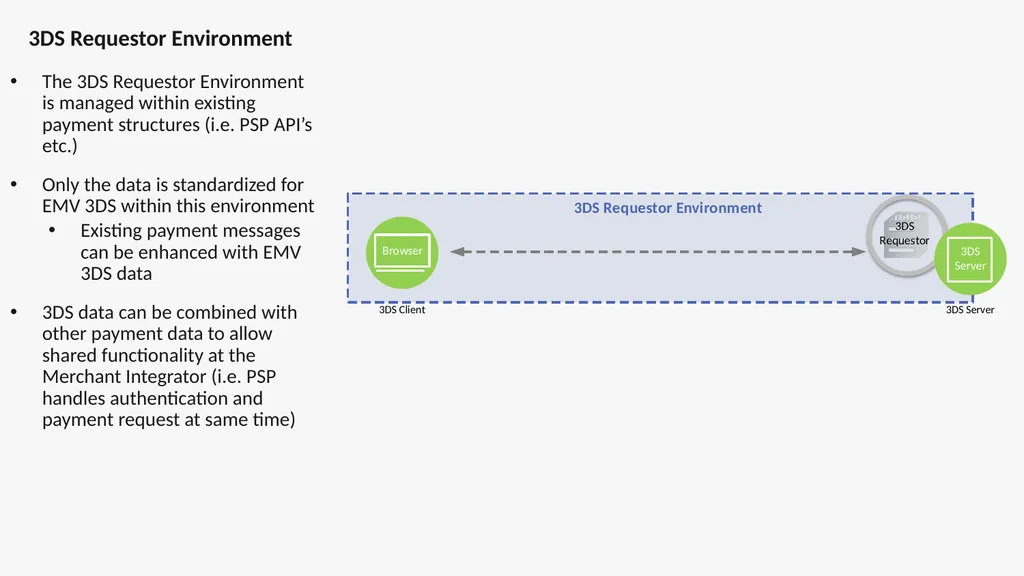
slide6. The 3DS Requestor Environment is managed within existing payment structures (i.e. PSP API’s etc.)
Only the data is standardized for EMV 3DS within this environment
Existing payment messages can be enhanced with EMV 3DS data
3DS data can be combined with other payment data to allow shared functionality at the Merchant Integrator (i.e. PSP handles authentication and payment request at same time) 3DS Requestor Environment 6<br>
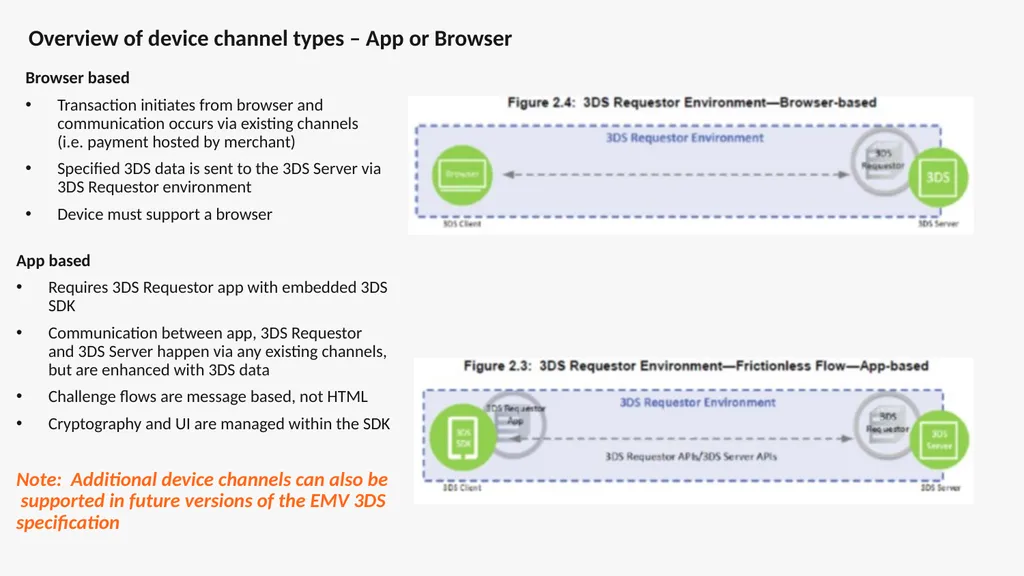
slide7. Overview of device channel types – App or Browser App based
Requires 3DS Requestor app with embedded 3DS SDK
Communication between app, 3DS Requestor and 3DS Server happen via any existing channels, but are enhanced with 3DS data
Challenge flows are message based, not HTML
Cryptography and UI are managed within the SDK
Note: Additional device channels can also be supported in future versions of the EMV 3DS specification Browser based
Transaction initiates from browser and communication occurs via existing channels (i.e. payment hosted by merchant)
Specified 3DS data is sent to the 3DS Server via 3DS Requestor environment
Device must support a browser 7<br>
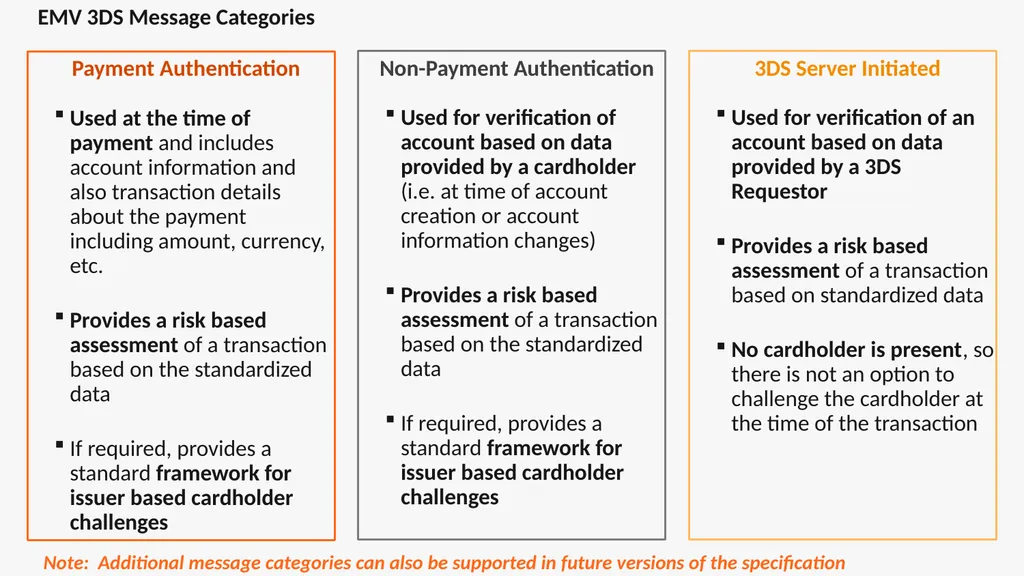
slide8. Payment Authentication
Used at the time of payment and includes account information and also transaction details about the payment including amount, currency, etc.
Provides a risk based assessment of a transaction based on the standardized data
If required, provides a standard framework for issuer based cardholder challenges Non-Payment Authentication
Used for verification of account based on data provided by a cardholder (i.e. at time of account creation or account information changes)
Provides a risk based assessment of a transaction based on the standardized data
If required, provides a standard framework for issuer based cardholder challenges 3DS Server Initiated
Used for verification of an account based on data provided by a 3DS Requestor
Provides a risk based assessment of a transaction based on standardized data
No cardholder is present, so there is not an option to challenge the cardholder at the time of the transaction EMV 3DS Message Categories Note: Additional message categories can also be supported in future versions of the specification 8<br>
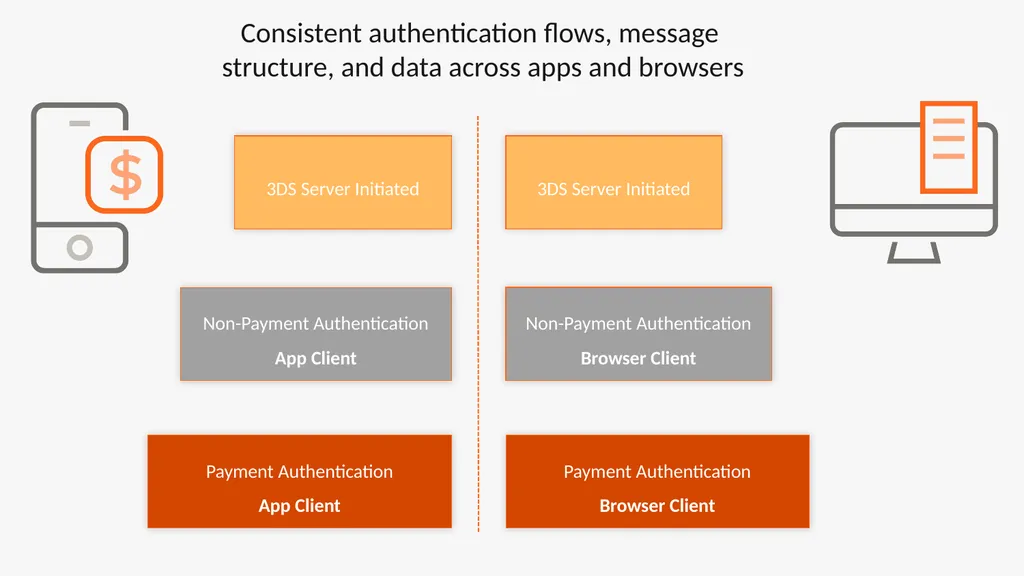
slide9. Payment Authentication
App Client Payment Authentication
Browser Client Non-Payment Authentication
App Client Non-Payment Authentication
Browser Client 3DS Server Initiated 3DS Server Initiated Consistent authentication flows, message
structure, and data across apps and browsers 9<br>
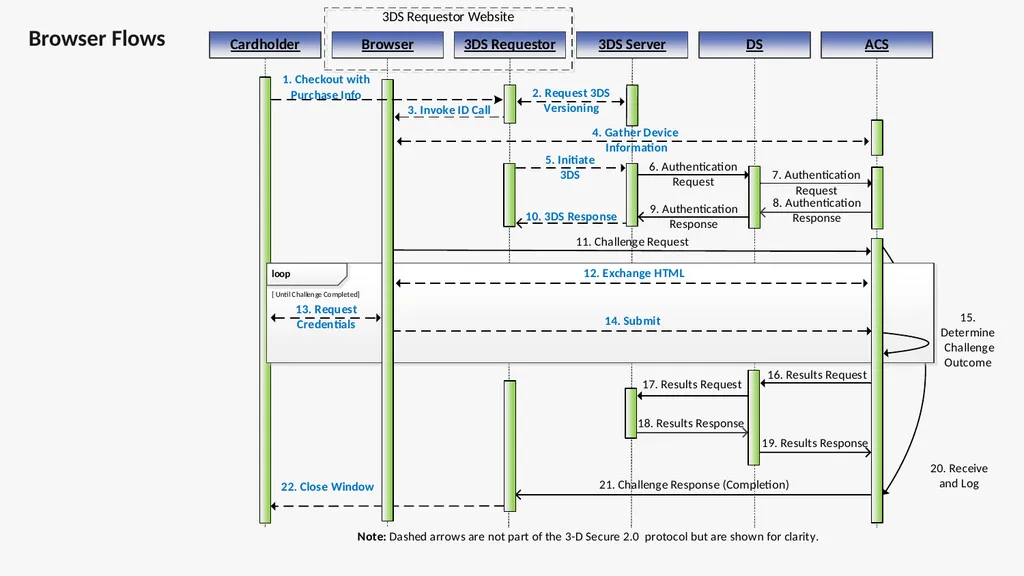
slide10. Browser Flows 10<br>
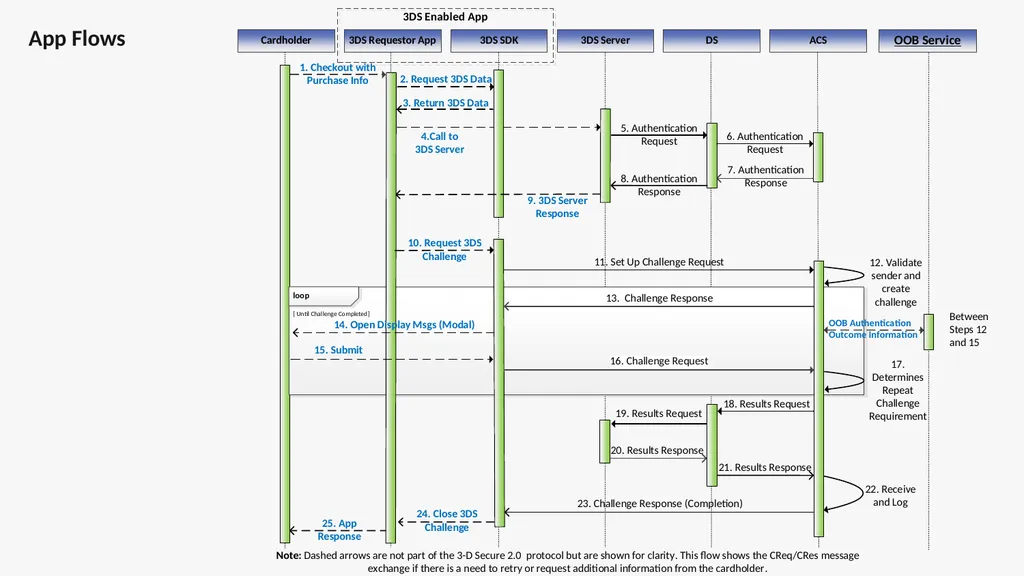
slide11. App Flows 11<br>
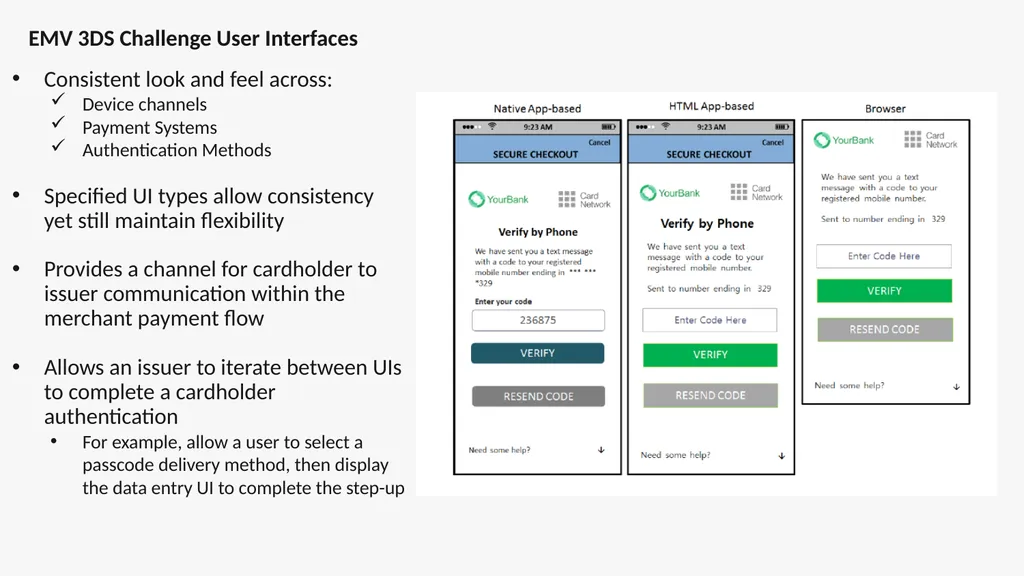
slide12. EMV 3DS Challenge User Interfaces Consistent look and feel across:
Device channels
Payment Systems
Authentication Methods
Specified UI types allow consistency yet still maintain flexibility
Provides a channel for cardholder to issuer communication within the merchant payment flow
Allows an issuer to iterate between UIs to complete a cardholder authentication
For example, allow a user to select a passcode delivery method, then display the data entry UI to complete the step-up 12<br>
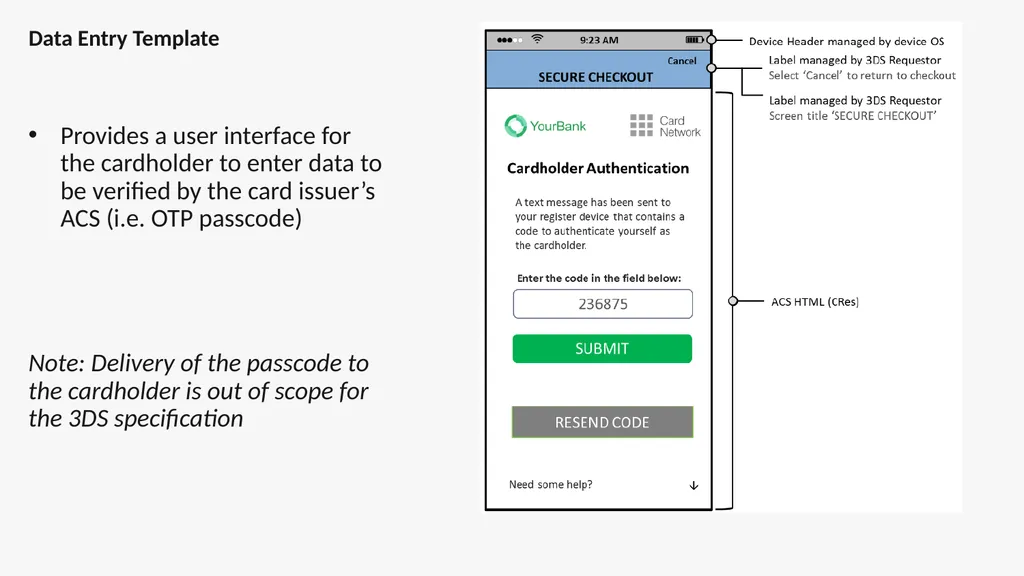
slide13. Data Entry Template Provides a user interface for the cardholder to enter data to be verified by the card issuer’s ACS (i.e. OTP passcode)
Note: Delivery of the passcode to the cardholder is out of scope for the 3DS specification 13<br>
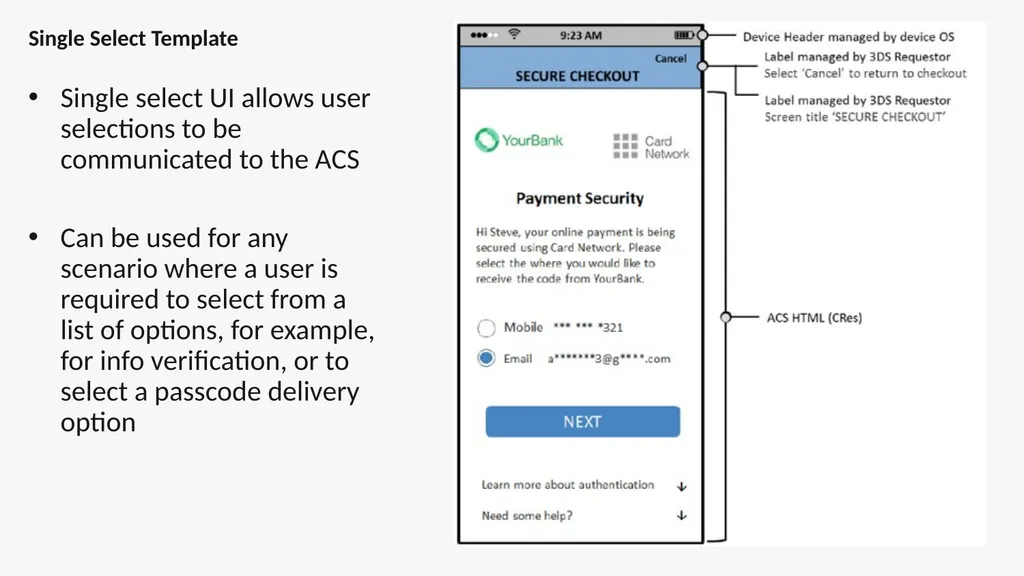
slide14. Single Select Template Single select UI allows user selections to be communicated to the ACS
Can be used for any scenario where a user is required to select from a list of options, for example, for info verification, or to select a passcode delivery option 14<br>
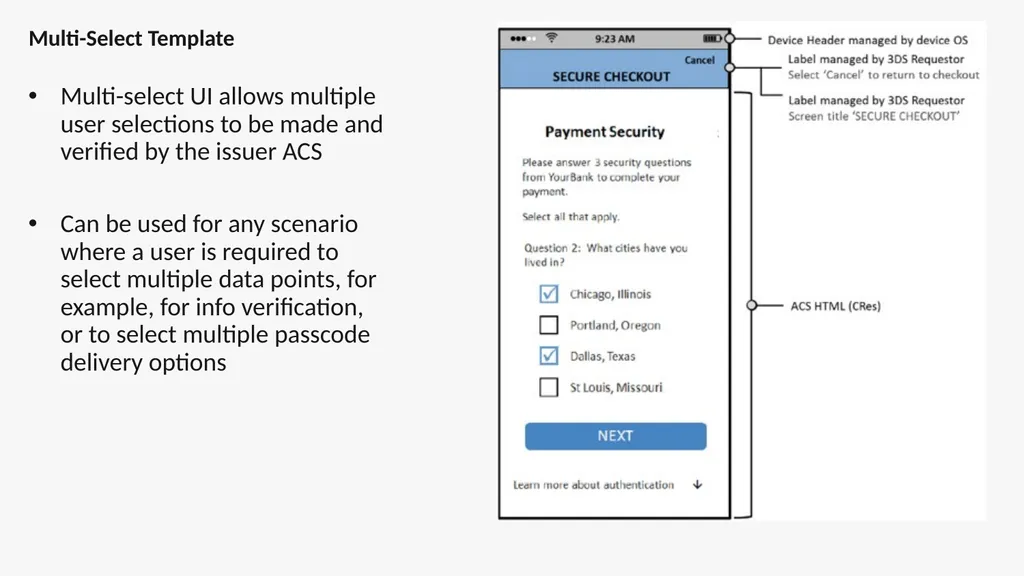
slide15. Multi-Select Template Multi-select UI allows multiple user selections to be made and verified by the issuer ACS
Can be used for any scenario where a user is required to select multiple data points, for example, for info verification, or to select multiple passcode delivery options 15<br>
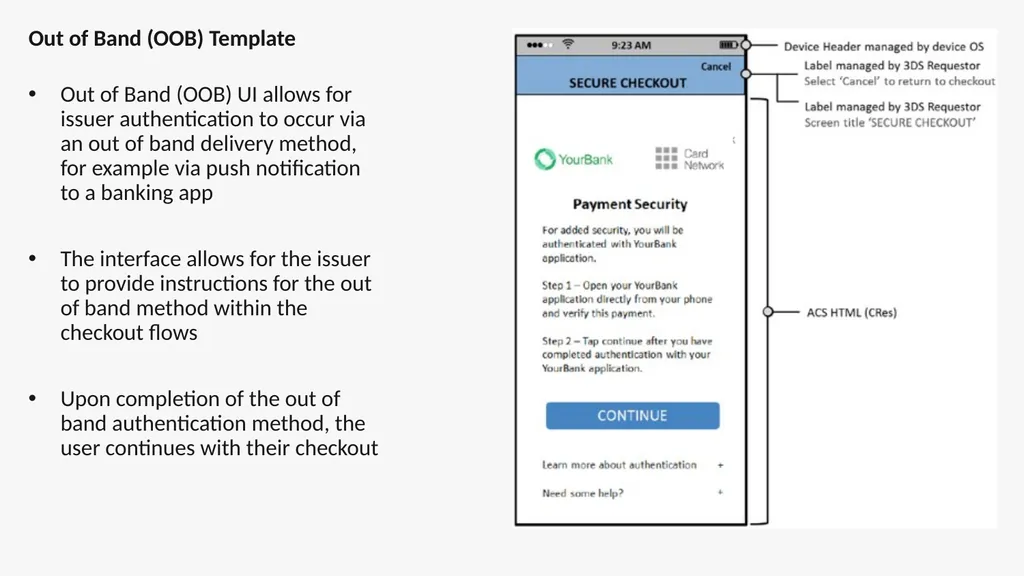
slide16. Out of Band (OOB) Template Out of Band (OOB) UI allows for issuer authentication to occur via an out of band delivery method, for example via push notification to a banking app
The interface allows for the issuer to provide instructions for the out of band method within the checkout flows
Upon completion of the out of band authentication method, the user continues with their checkout 16<br>
slide17. More information and downloadable specifications:
https://www.emvco.com/emv-technologies/3d-secure/ 17<br>
slide2. 3-D (Three Domain) Secure is a messaging protocol which enables consumers to directly authenticate with the card issuer while shopping online Three domains consist of: Merchant / Acquirer Domain
Merchant Integrator (MI) Interoperability Domain
(Payment Networks)
Directory Server (DS) Issuer Domain
Access Control Server
(ACS) Overview of EMV 3-D Secure (3DS) 2<br>
slide3. Merchant/Acquirer Domain
3DS Requestor
The entity that is requesting an EMV 3DS authentication to occur (i.e. merchant or payment app)
3DS Integrator
EMV 3DS function that provides integration services in the 3DS Requestor Environment (i.e. payment provider or other entity)
3DS Server
EMV 3DS component that handles the interaction with the 3DS Requestor environment and the 3DS environment and messaging
3DS Client
The consumer-facing component that integrates 3DS functionality (i.e. browser with code or mobile app with 3DS SDK) Interoperability Domain
Directory Server (DS)
Generally managed by a payment network
Authenticates the 3DS Server requests and validates the 3DS requestor as trusted and registered
Maintains account and ACS routing data, and routes 3DS messages between the 3DS Server and the ACS Issuer Domain
Access Control Server (ACS)
Account issuer managed system
Verifies whether authentication is available for a card number and device type
Provides a risk based assessment to facilitate frictionless flows when appropriate
Manages the cardholder challenge (step-up) when required though standardized messages and user interfaces 3DS Ecosystem Components 3<br>
slide4. EMV 3DS Architecture Phased Messaging:
Authentication Messages
Facilitates the data sharing and risk assessment flows
Challenge Messages
Facilitates cardholder challenges (step-up) only when required due to requirements (i.e., transaction risk or regional requirements for step-up)
Results Messages
Provides the details of the completed challenge and the proof of authentication 4<br>
slide5. Frictionless Authentication Standardized 3DS data is sent through the 3DS Requestor environment to 3DS Server (i.e. via API call to PSP from Merchant)
Transaction risk is assessed by the ACS based on data shared by the requestor
When the transaction is determined to be lower risk via a transaction risk assessment, the 3DS transaction is completed (no step-up) 5<br>
slide6. The 3DS Requestor Environment is managed within existing payment structures (i.e. PSP API’s etc.)
Only the data is standardized for EMV 3DS within this environment
Existing payment messages can be enhanced with EMV 3DS data
3DS data can be combined with other payment data to allow shared functionality at the Merchant Integrator (i.e. PSP handles authentication and payment request at same time) 3DS Requestor Environment 6<br>
slide7. Overview of device channel types – App or Browser App based
Requires 3DS Requestor app with embedded 3DS SDK
Communication between app, 3DS Requestor and 3DS Server happen via any existing channels, but are enhanced with 3DS data
Challenge flows are message based, not HTML
Cryptography and UI are managed within the SDK
Note: Additional device channels can also be supported in future versions of the EMV 3DS specification Browser based
Transaction initiates from browser and communication occurs via existing channels (i.e. payment hosted by merchant)
Specified 3DS data is sent to the 3DS Server via 3DS Requestor environment
Device must support a browser 7<br>
slide8. Payment Authentication
Used at the time of payment and includes account information and also transaction details about the payment including amount, currency, etc.
Provides a risk based assessment of a transaction based on the standardized data
If required, provides a standard framework for issuer based cardholder challenges Non-Payment Authentication
Used for verification of account based on data provided by a cardholder (i.e. at time of account creation or account information changes)
Provides a risk based assessment of a transaction based on the standardized data
If required, provides a standard framework for issuer based cardholder challenges 3DS Server Initiated
Used for verification of an account based on data provided by a 3DS Requestor
Provides a risk based assessment of a transaction based on standardized data
No cardholder is present, so there is not an option to challenge the cardholder at the time of the transaction EMV 3DS Message Categories Note: Additional message categories can also be supported in future versions of the specification 8<br>
slide9. Payment Authentication
App Client Payment Authentication
Browser Client Non-Payment Authentication
App Client Non-Payment Authentication
Browser Client 3DS Server Initiated 3DS Server Initiated Consistent authentication flows, message
structure, and data across apps and browsers 9<br>
slide10. Browser Flows 10<br>
slide11. App Flows 11<br>
slide12. EMV 3DS Challenge User Interfaces Consistent look and feel across:
Device channels
Payment Systems
Authentication Methods
Specified UI types allow consistency yet still maintain flexibility
Provides a channel for cardholder to issuer communication within the merchant payment flow
Allows an issuer to iterate between UIs to complete a cardholder authentication
For example, allow a user to select a passcode delivery method, then display the data entry UI to complete the step-up 12<br>
slide13. Data Entry Template Provides a user interface for the cardholder to enter data to be verified by the card issuer’s ACS (i.e. OTP passcode)
Note: Delivery of the passcode to the cardholder is out of scope for the 3DS specification 13<br>
slide14. Single Select Template Single select UI allows user selections to be communicated to the ACS
Can be used for any scenario where a user is required to select from a list of options, for example, for info verification, or to select a passcode delivery option 14<br>
slide15. Multi-Select Template Multi-select UI allows multiple user selections to be made and verified by the issuer ACS
Can be used for any scenario where a user is required to select multiple data points, for example, for info verification, or to select multiple passcode delivery options 15<br>
slide16. Out of Band (OOB) Template Out of Band (OOB) UI allows for issuer authentication to occur via an out of band delivery method, for example via push notification to a banking app
The interface allows for the issuer to provide instructions for the out of band method within the checkout flows
Upon completion of the out of band authentication method, the user continues with their checkout 16<br>
slide17. More information and downloadable specifications:
https://www.emvco.com/emv-technologies/3d-secure/ 17<br>