
Encountering Bergen-Belsen What were the
TG
Published · 54 slides · 0 views

1 / 1
Description
Encountering Bergen-Belsen What were the experiences of those who worked at Bergen-Belsen 15 April-21 May 1945? Source Cards: Activity 2 Instructions These Source Cards are to be used in Activity 2. Print out these Source Cards to create 5
Related Topics
Share
Embed code
Download this presentation From Below
"Encountering Bergen-Belsen What were the" is the property of its rightful owner. Permission is granted to download and print the materials on this website for personal, non-commercial use only, and to display it on your personal computer provided you do not modify the materials and that you retain all copyright notices contained in the materials. By downloading content from our website, you accept the terms of this agreement.
Presentation Transcript
01
Encountering Bergen-Belsen
What were the experiences of those who worked at Bergen-Belsen 15 April-21 May 1945? Source Cards: Activity 2<br>
02
Instructions These Source Cards are to be used in Activity 2.
Print out these Source Cards to create 5 sets of 10 cards (A, B,C, D, E). Each set contains different cards.<br>
Print out these Source Cards to create 5 sets of 10 cards (A, B,C, D, E). Each set contains different cards.<br>
03
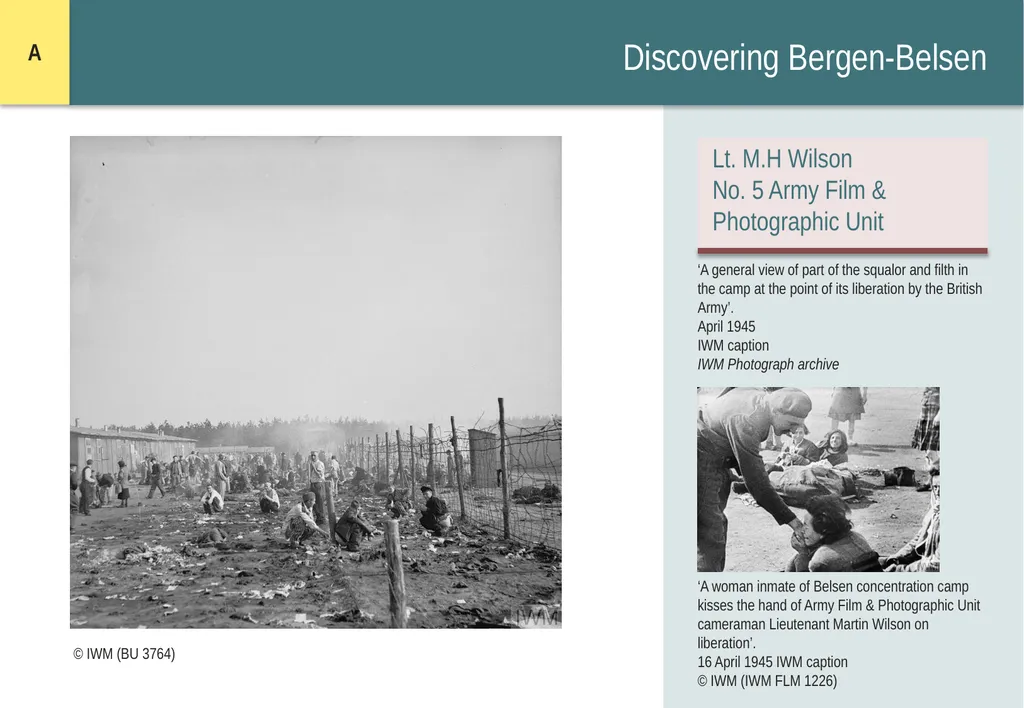
Discovering Bergen-Belsen A © IWM (BU 3764) ‘A general view of part of the squalor and filth in the camp at the point of its liberation by the British Army’.
April 1945
IWM caption
IWM Photograph archive Lt. M.H Wilson
No. 5 Army Film & Photographic Unit ‘A woman inmate of Belsen concentration camp kisses the hand of Army Film & Photographic Unit cameraman Lieutenant Martin Wilson on liberation’.
16 April 1945 IWM caption
© IWM (IWM FLM 1226)<br>
April 1945
IWM caption
IWM Photograph archive Lt. M.H Wilson
No. 5 Army Film & Photographic Unit ‘A woman inmate of Belsen concentration camp kisses the hand of Army Film & Photographic Unit cameraman Lieutenant Martin Wilson on liberation’.
16 April 1945 IWM caption
© IWM (IWM FLM 1226)<br>
04
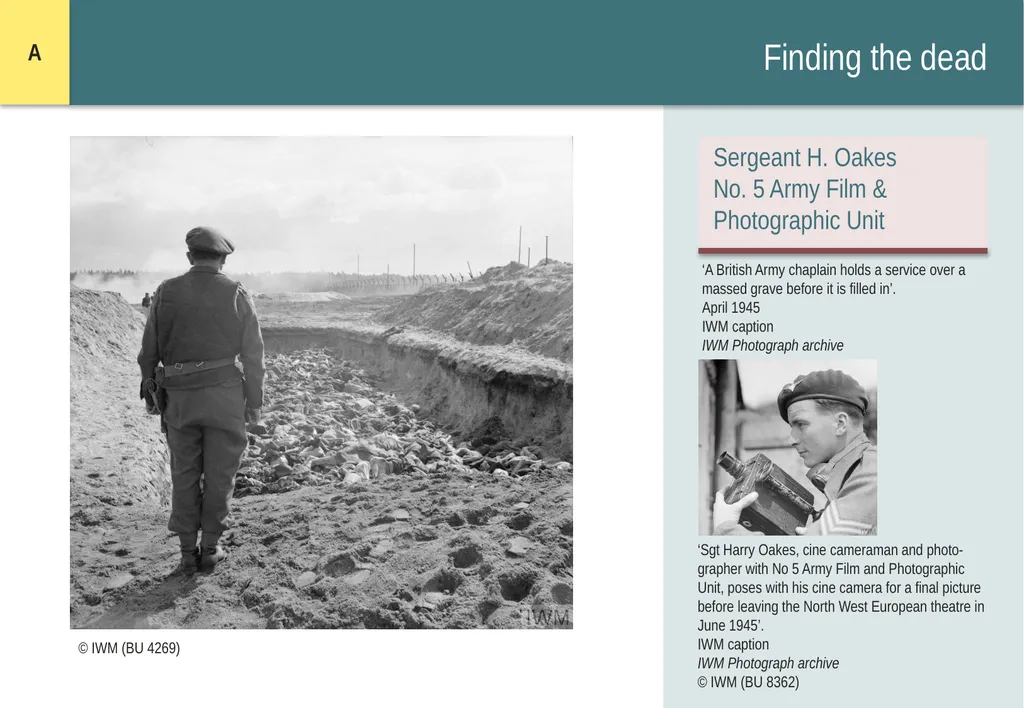
Finding the dead ‘A British Army chaplain holds a service over a massed grave before it is filled in’.
April 1945
IWM caption
IWM Photograph archive Sergeant H. Oakes
No. 5 Army Film & Photographic Unit © IWM (BU 4269) ‘Sgt Harry Oakes, cine cameraman and photo-grapher with No 5 Army Film and Photographic Unit, poses with his cine camera for a final picture before leaving the North West European theatre in June 1945’.
IWM caption
IWM Photograph archive
© IWM (BU 8362) A<br>
05
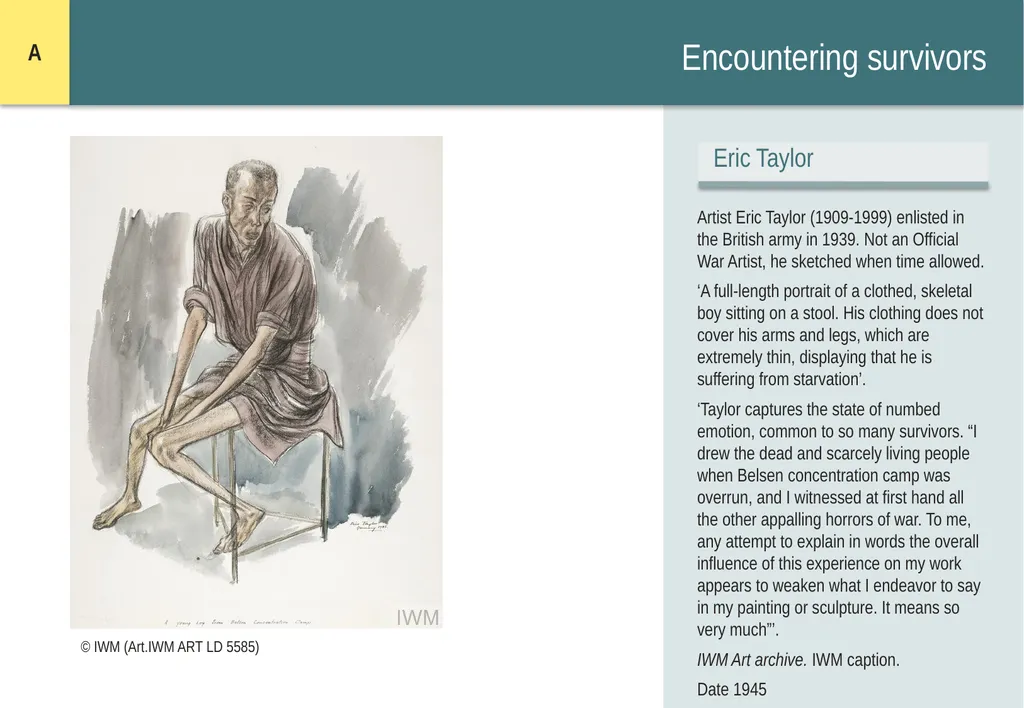
Encountering survivors Eric Taylor Artist Eric Taylor (1909-1999) enlisted in the British army in 1939. Not an Official War Artist, he sketched when time allowed.
‘A full-length portrait of a clothed, skeletal boy sitting on a stool. His clothing does not cover his arms and legs, which are extremely thin, displaying that he is suffering from starvation’.
‘Taylor captures the state of numbed emotion, common to so many survivors. “I drew the dead and scarcely living people when Belsen concentration camp was overrun, and I witnessed at first hand all the other appalling horrors of war. To me, any attempt to explain in words the overall influence of this experience on my work appears to weaken what I endeavor to say in my painting or sculpture. It means so very much”’.
IWM Art archive. IWM caption.
Date 1945 © IWM (Art.IWM ART LD 5585) A<br>
06
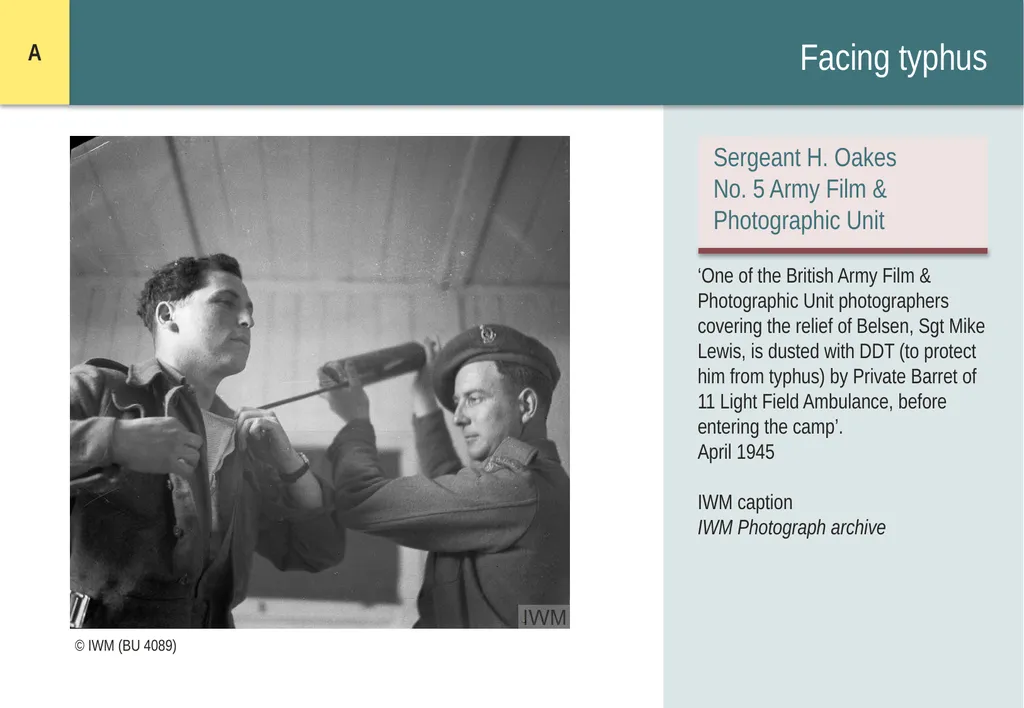
Facing typhus ‘One of the British Army Film & Photographic Unit photographers covering the relief of Belsen, Sgt Mike Lewis, is dusted with DDT (to protect him from typhus) by Private Barret of 11 Light Field Ambulance, before entering the camp’.
April 1945
IWM caption
IWM Photograph archive © IWM (BU 4089) A Sergeant H. Oakes
No. 5 Army Film & Photographic Unit<br>
April 1945
IWM caption
IWM Photograph archive © IWM (BU 4089) A Sergeant H. Oakes
No. 5 Army Film & Photographic Unit<br>
07
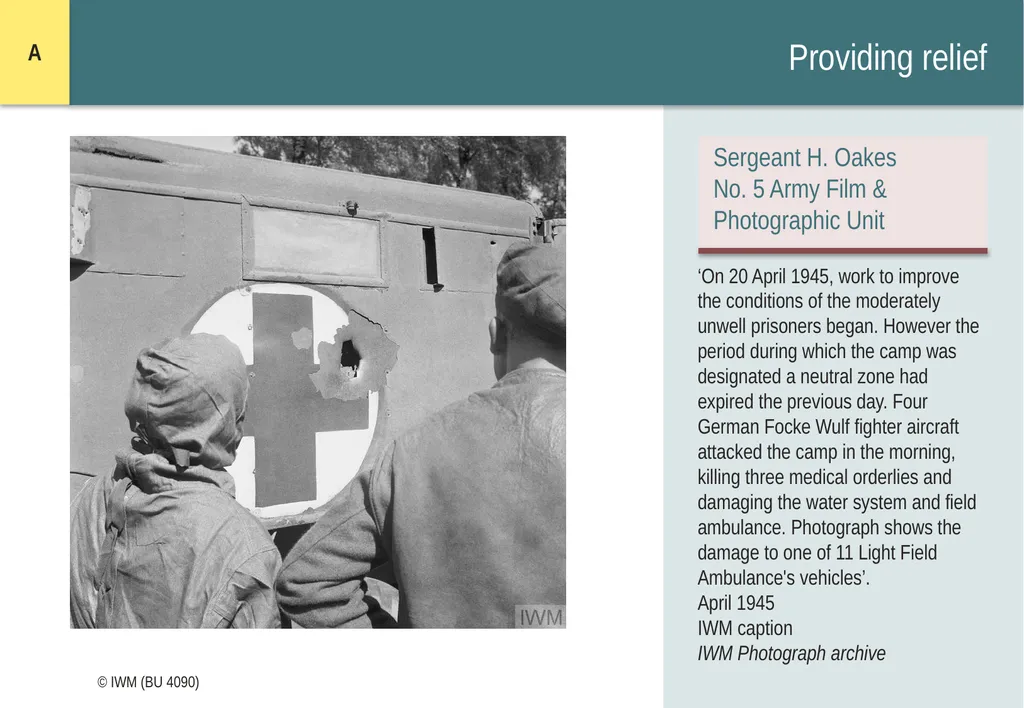
Providing relief ‘On 20 April 1945, work to improve the conditions of the moderately unwell prisoners began. However the period during which the camp was designated a neutral zone had expired the previous day. Four German Focke Wulf fighter aircraft attacked the camp in the morning, killing three medical orderlies and damaging the water system and field ambulance. Photograph shows the damage to one of 11 Light Field Ambulance's vehicles’.
April 1945
IWM caption
IWM Photograph archive © IWM (BU 4090) A Sergeant H. Oakes
No. 5 Army Film & Photographic Unit<br>
April 1945
IWM caption
IWM Photograph archive © IWM (BU 4090) A Sergeant H. Oakes
No. 5 Army Film & Photographic Unit<br>
08
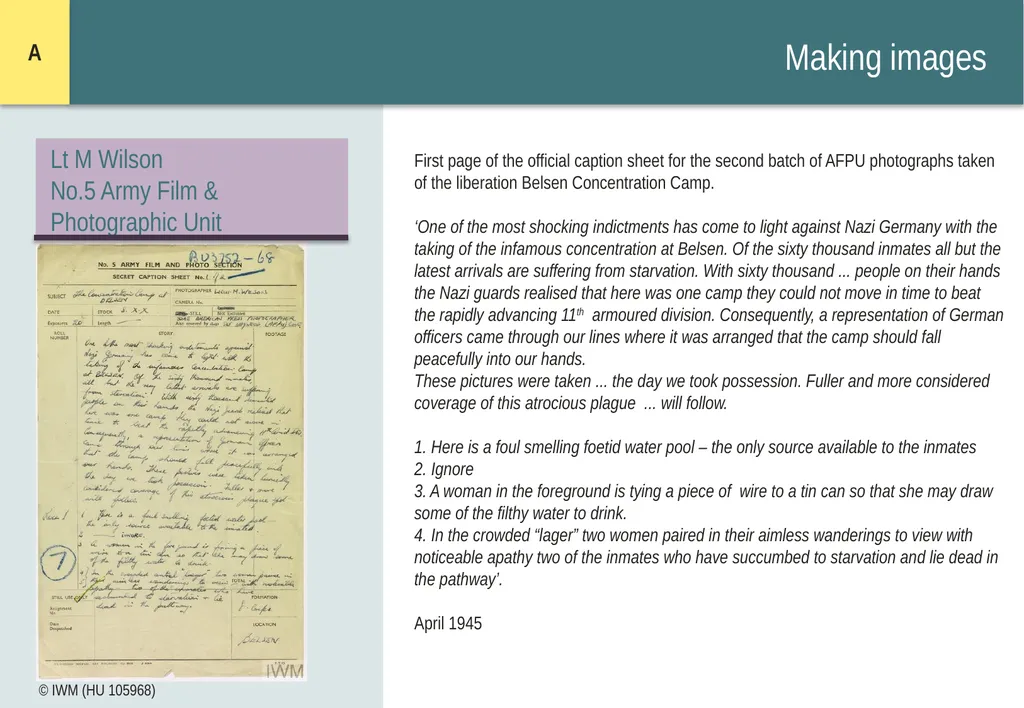
First page of the official caption sheet for the second batch of AFPU photographs taken of the liberation Belsen Concentration Camp.
‘One of the most shocking indictments has come to light against Nazi Germany with the taking of the infamous concentration at Belsen. Of the sixty thousand inmates all but the latest arrivals are suffering from starvation. With sixty thousand ... people on their hands the Nazi guards realised that here was one camp they could not move in time to beat the rapidly advancing 11th armoured division. Consequently, a representation of German officers came through our lines where it was arranged that the camp should fall peacefully into our hands.
These pictures were taken ... the day we took possession. Fuller and more considered coverage of this atrocious plague ... will follow.
1. Here is a foul smelling foetid water pool – the only source available to the inmates
2. Ignore
3. A woman in the foreground is tying a piece of wire to a tin can so that she may draw some of the filthy water to drink.
4. In the crowded “lager” two women paired in their aimless wanderings to view with noticeable apathy two of the inmates who have succumbed to starvation and lie dead in the pathway’.
April 1945 Making images © IWM (HU 105968) Lt M Wilson
No.5 Army Film &
Photographic Unit A<br>
09
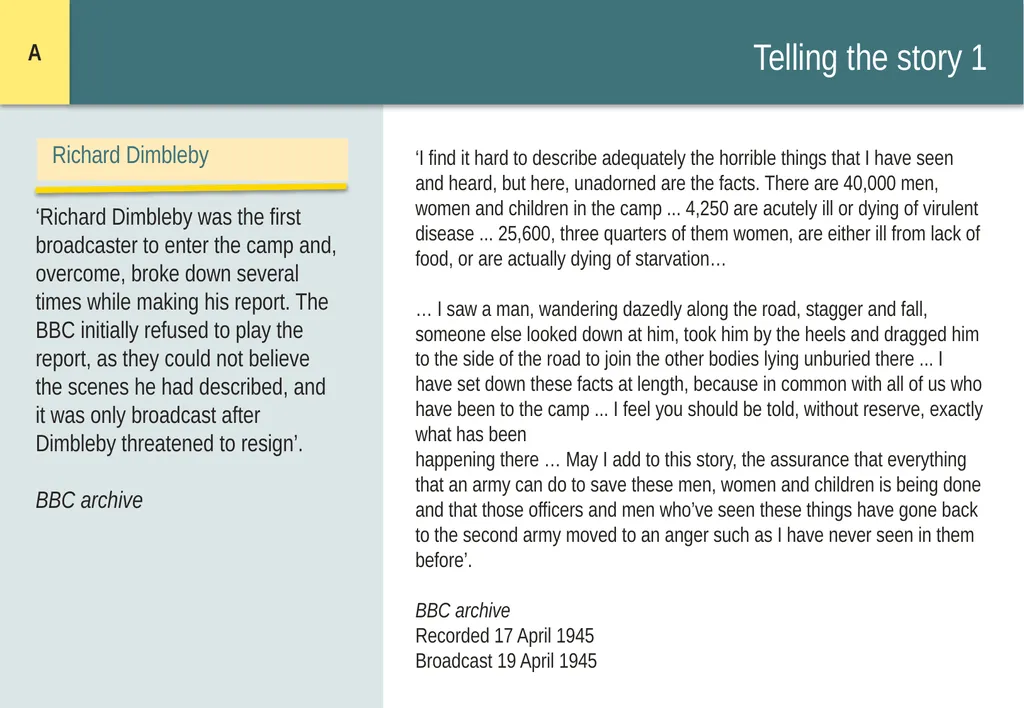
Richard Dimbleby Telling the story 1 ‘I find it hard to describe adequately the horrible things that I have seen and heard, but here, unadorned are the facts. There are 40,000 men, women and children in the camp ... 4,250 are acutely ill or dying of virulent disease ... 25,600, three quarters of them women, are either ill from lack of food, or are actually dying of starvation…
… I saw a man, wandering dazedly along the road, stagger and fall, someone else looked down at him, took him by the heels and dragged him to the side of the road to join the other bodies lying unburied there ... I have set down these facts at length, because in common with all of us who have been to the camp ... I feel you should be told, without reserve, exactly what has been
happening there … May I add to this story, the assurance that everything that an army can do to save these men, women and children is being done and that those officers and men who’ve seen these things have gone back to the second army moved to an anger such as I have never seen in them before’.
BBC archive Recorded 17 April 1945
Broadcast 19 April 1945 ‘Richard Dimbleby was the first broadcaster to enter the camp and, overcome, broke down several times while making his report. The BBC initially refused to play the report, as they could not believe the scenes he had described, and it was only broadcast after Dimbleby threatened to resign’.
BBC archive A<br>
10
Lieutenant-Colonel
MW Gonin Telling the story 2 ‘It was shortly after the BRCS [British Red Cross Section] teams arrived, though it may have no connection, that a very large quantity of lipstick also arrived. This was not at all what we men wanted, we were screaming for hundreds and thousands of other things and I don’t know who asked for lipstick. I wish so much that I could discover who did it, it was an action of genius, sheer unadulterated brilliance. I believe nothing did more for those internees than the lipstick. Women lay in bed with no sheets and no nightie but with scarlet lips …
At last someone had done something to make them individual again, they were someone no longer merely the number tattooed on the arm. At last they could take an interest in their appearance. That lipstick started to give them back their humanity’.
Doc.3713 Mervyn Willet Gonin written 1945-1946.
Documents/Private Papers
IWM Document archive 85/38/1 A Lieutenant-Colonel Gonin was a commanding officer of the Royal Army Medical Corps at Bergen-Belsen.<br>
11
Telling the story 3 Lieutenant-Colonel Gonin was
a commanding officer of the
Royal Army Medical Corps
at Bergen-Belsen.
Staff met every evening at 9pm to review the day and discuss issues.
They went through the issues of the female staff first. They left around 11pm and the men talked till midnight or 1am whilst alcohol would appear. ‘It was not a party but damned hard work which those meetings produced. I am very certain that it was the very considerable quantities of liquor that we got through at those meetings that kept those of us who were responsible for the administration of the place from going as mad as most of the internees in the Horror Camp’.
Doc.3713 Mervyn Willet Gonin Written 1945-1946.
Documents/Private Papers
IWM Document archive 85/38/1 A Lieutenant-Colonel
MW Gonin<br>
12
Dr Laurence Wand Telling the story 4 ‘You see, there was a war still being fought … There was a CCS, there was 32 CCS, there was an anti-aircraft regiment and there was a control unit, there were a few British Army units which had been allowed to be in reserve at Belsen, but their primary function was not to look after Belsen, their primary function was to back up the 21st Army Group in trying to get that war over and there was very little that could be spared. Most of what we had was captured German equipment …There was very, very little in the way of medication or equipment. But then, even if there had been, the problem was one couldn’t have used it because the problem was too overwhelming. One medical student and two Hungarian soldiers are not really a very effective medical team for four hundred people when the definition of a “well person” is a person who can stand. If a person could stand he was “well”, if he couldn’t stand he was “ill”. And this was the arbitrary classification we had to use, whether the individual could literally stand unaided’.
(IWM SR 9082)
Interview recorded 26-09-1985
IWM Sound archive A Dr Laurence Wand was a medical student who volunteered for the relief effort at Bergen-Belsen.<br>
(IWM SR 9082)
Interview recorded 26-09-1985
IWM Sound archive A Dr Laurence Wand was a medical student who volunteered for the relief effort at Bergen-Belsen.<br>
13
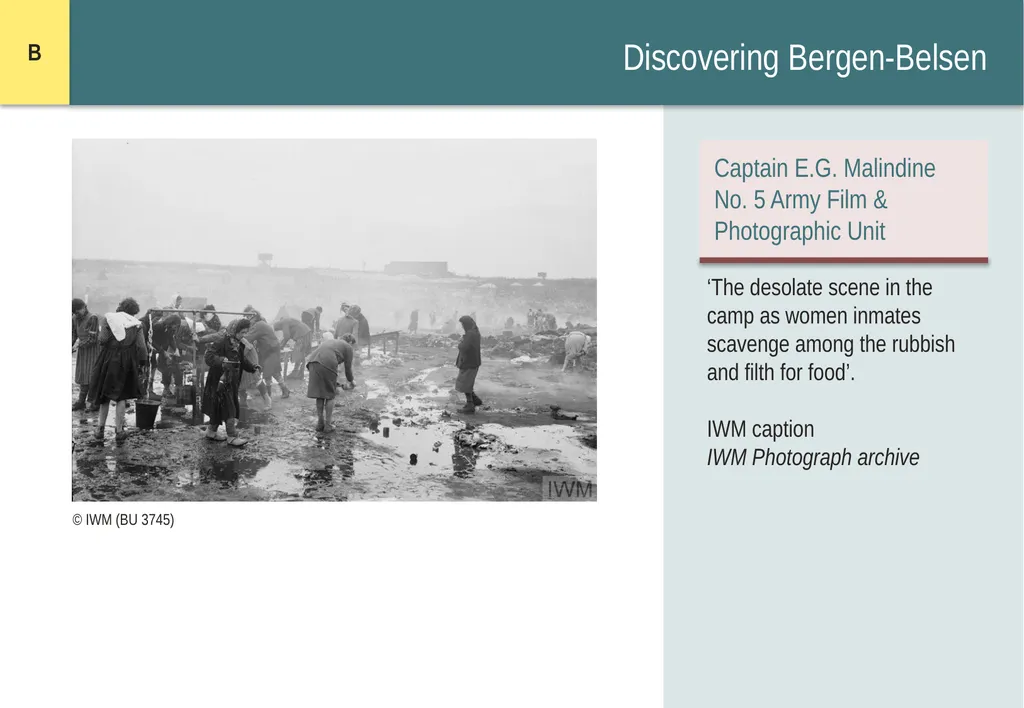
Discovering Bergen-Belsen Captain E.G. Malindine No. 5 Army Film & Photographic Unit ‘The desolate scene in the camp as women inmates scavenge among the rubbish and filth for food’.
IWM caption
IWM Photograph archive © IWM (BU 3745) B<br>
IWM caption
IWM Photograph archive © IWM (BU 3745) B<br>
14
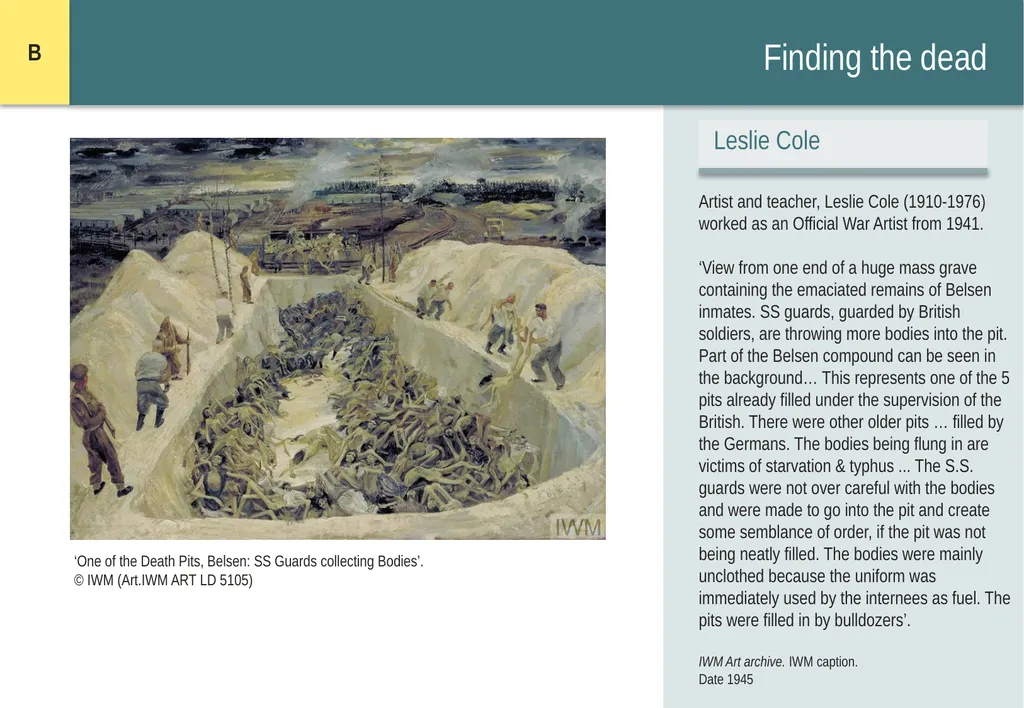
Finding the dead Leslie Cole Artist and teacher, Leslie Cole (1910-1976) worked as an Official War Artist from 1941.
‘View from one end of a huge mass grave containing the emaciated remains of Belsen inmates. SS guards, guarded by British soldiers, are throwing more bodies into the pit. Part of the Belsen compound can be seen in the background… This represents one of the 5 pits already filled under the supervision of the British. There were other older pits … filled by the Germans. The bodies being flung in are victims of starvation & typhus ... The S.S. guards were not over careful with the bodies and were made to go into the pit and create some semblance of order, if the pit was not being neatly filled. The bodies were mainly unclothed because the uniform was immediately used by the internees as fuel. The pits were filled in by bulldozers’.
IWM Art archive. IWM caption.
Date 1945 ‘One of the Death Pits, Belsen: SS Guards collecting Bodies’.
© IWM (Art.IWM ART LD 5105) B<br>
15
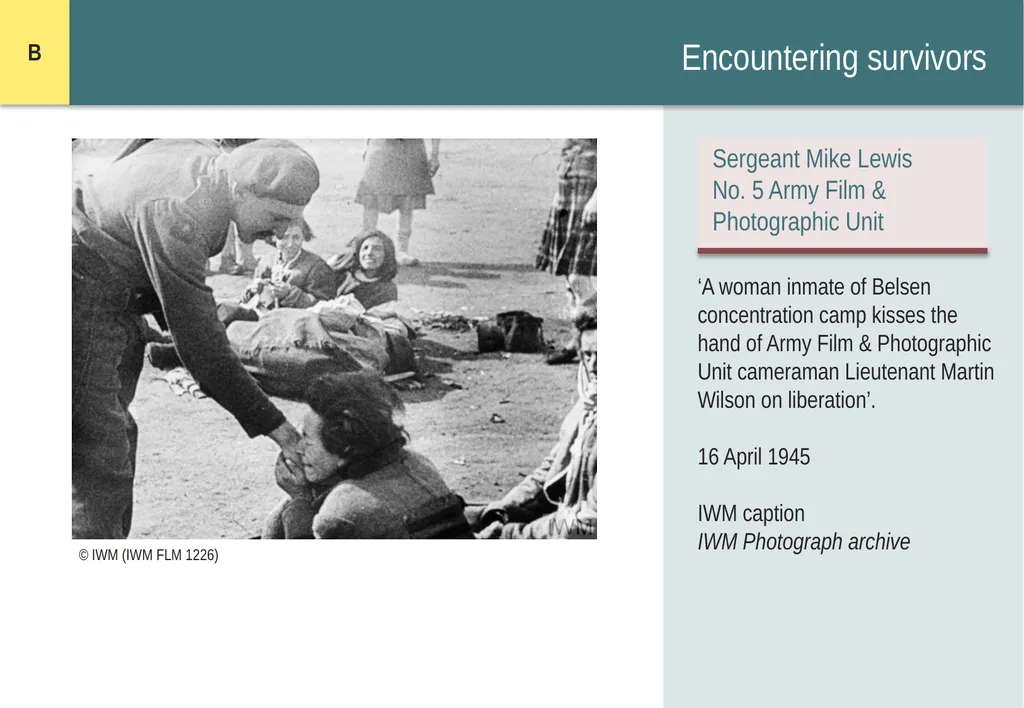
Encountering survivors © IWM (IWM FLM 1226) ‘A woman inmate of Belsen concentration camp kisses the hand of Army Film & Photographic Unit cameraman Lieutenant Martin Wilson on liberation’.
16 April 1945
IWM caption
IWM Photograph archive B Sergeant Mike Lewis
No. 5 Army Film & Photographic Unit<br>
16 April 1945
IWM caption
IWM Photograph archive B Sergeant Mike Lewis
No. 5 Army Film & Photographic Unit<br>
16
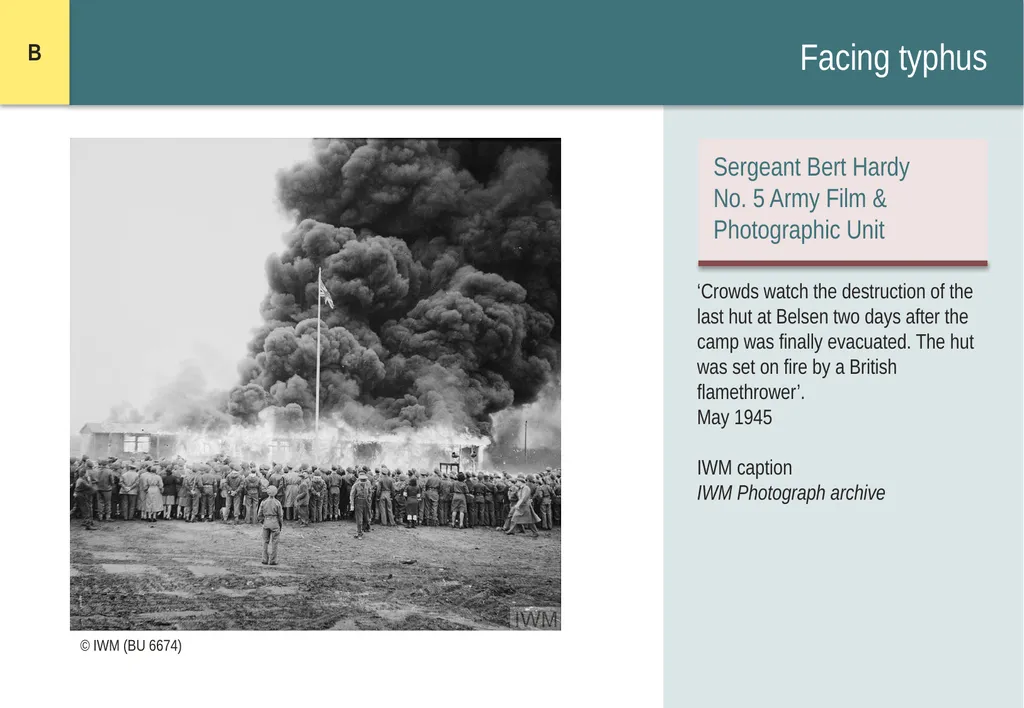
Facing typhus © IWM (BU 6674) ‘Crowds watch the destruction of the last hut at Belsen two days after the camp was finally evacuated. The hut was set on fire by a British flamethrower’.
May 1945
IWM caption
IWM Photograph archive Sergeant Bert Hardy
No. 5 Army Film & Photographic Unit B<br>
May 1945
IWM caption
IWM Photograph archive Sergeant Bert Hardy
No. 5 Army Film & Photographic Unit B<br>
17
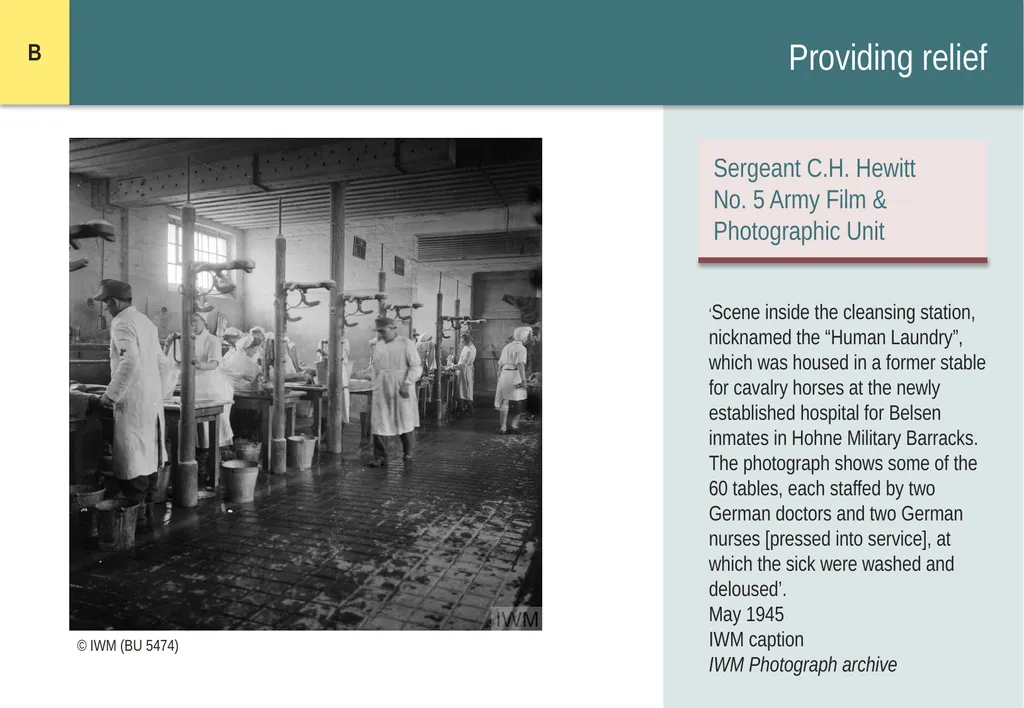
Providing relief © IWM (BU 5474) ‘Scene inside the cleansing station, nicknamed the “Human Laundry”, which was housed in a former stable for cavalry horses at the newly established hospital for Belsen inmates in Hohne Military Barracks. The photograph shows some of the 60 tables, each staffed by two German doctors and two German nurses [pressed into service], at which the sick were washed and deloused’.
May 1945
IWM caption
IWM Photograph archive Sergeant C.H. Hewitt
No. 5 Army Film & Photographic Unit B<br>
May 1945
IWM caption
IWM Photograph archive Sergeant C.H. Hewitt
No. 5 Army Film & Photographic Unit B<br>
18
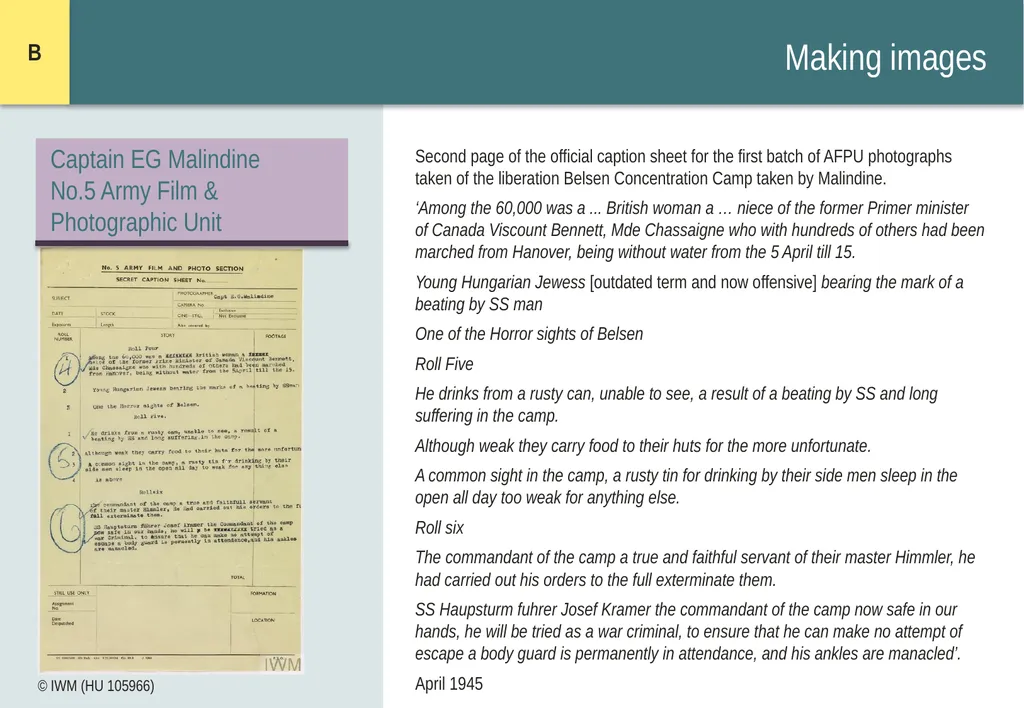
Second page of the official caption sheet for the first batch of AFPU photographs taken of the liberation Belsen Concentration Camp taken by Malindine.
‘Among the 60,000 was a ... British woman a … niece of the former Primer minister of Canada Viscount Bennett, Mde Chassaigne who with hundreds of others had been marched from Hanover, being without water from the 5 April till 15.
Young Hungarian Jewess [outdated term and now offensive] bearing the mark of a beating by SS man
One of the Horror sights of Belsen
Roll Five
He drinks from a rusty can, unable to see, a result of a beating by SS and long suffering in the camp.
Although weak they carry food to their huts for the more unfortunate.
A common sight in the camp, a rusty tin for drinking by their side men sleep in the open all day too weak for anything else.
Roll six
The commandant of the camp a true and faithful servant of their master Himmler, he had carried out his orders to the full exterminate them.
SS Haupsturm fuhrer Josef Kramer the commandant of the camp now safe in our hands, he will be tried as a war criminal, to ensure that he can make no attempt of escape a body guard is permanently in attendance, and his ankles are manacled’.
April 1945 Making images © IWM (HU 105966) Captain EG Malindine
No.5 Army Film & Photographic Unit B<br>
19
Major Dick Williams Telling the story 1 As a Staff Captain, Dick Williams served in the Supplies and Transport branch Headquarters 8th Corps which carried ammunition, petrol and rations to support the fighting Divisions. ‘The food that we’d got, breaking open these compo rations was just not right for these people – their stomachs just couldn’t take anything. The best we could do was the tea and then we decided the best thing we could do would be to open all the tins and make a big mess of it, put as much boiling water in amongst it and make it a thin stew, as we could do. This started to be quite – it seemed to us with what we got, that was the best we could do, so we did that – and those that could come to the cookhouses, we fed them from the cookhouses and eventually we started trying to take that service back out to those who couldn’t even get that far. Some of the people were still in the huts where there were more dead than living and we would take a dixie of this broth and leave it at the door … But from our side, I say that we tried to do the best we could with the substance of the compo rations and that it became such that that’s all we could do, literally. I’m afraid sausages and beef and everything – corn beef – all got mixed up together, but at least it was some sort of liquidy food. Some people who tried to eat the real stuff straight away, I’m afraid it was too much and they, it probably killed them. But it was kindness to give them something, although it is the wrong kind of kindness’.
(IWM SR 15437)
Interview recorded 24-5-1995
IWM Sound archive B<br>
(IWM SR 15437)
Interview recorded 24-5-1995
IWM Sound archive B<br>
20
Lieutenant-Colonel
MW Gonin Telling the story 2 Lieutenant-Colonel Gonin was a commanding officer of the Royal Army Medical Corps at Bergen-Belsen. ‘No one except myself knows what the [medical officers] and stretcher bearers, many of the latter youngsters who had experienced nothing except the clean deaths of the battle. They were magnificent; they spent from 8am to 5pm with an hour for lunch in those huts in the worst stench in the world, the stink of the unwashed living with every disease on God’s earth mixed with that of the long unburied dead. They had to strip those living corpses of their rags, wrap them in blankets and carry them to the ambulance cars … their pride in their job was terrific … I was able to give each man one day’s complete rest in three until these bearers started to go down with typhus themselves. Sixty men including three officers of my unit worked in that camp and twenty one of them and one officer took ill with typhus before we had that camp clear’.
Doc.3713 Mervyn Willet Gonin written 1945-1946.
Documents/Private Papers
IWM Document archive 85/38/1 B<br>
21
William Arthur Wood Telling the story 3 ‘We’d been trained for war wounded, we were used to terrible wounds, especially in my case as I say with the facial wounds that always seemed worse than a lot of the others, and that we’d been trained for – how to behave and how to work. But I’m afraid when we got to Belsen we hadn’t been trained for this, and it was so, so different to, well to anything. I can’t explain it, it was so terrible and so different from anything we’d seen in our move up from D-Day onward. We’d seen distressed people about, people walking from town to town, but nothing like this’.
(IWM SR 15427)
Interview recorded 17-5-05-1995
IWM Sound archive William Arthur Wood, was a medical assistant with 32nd Casualty Clearing Station. B<br>
(IWM SR 15427)
Interview recorded 17-5-05-1995
IWM Sound archive William Arthur Wood, was a medical assistant with 32nd Casualty Clearing Station. B<br>
22
Telling the story 4 ‘I am the Reverend T.J. Stretch attached as padre to the formation concerning this camp … I've been here eight days, and never in my life have I seen such damnable ghastliness.
This morning we buried over five thousand bodies, we don't know who they are. Behind me, you can see a pit which will contain another five thousand. There are two others like it in preparation. All these deaths have been caused by systematic starvation and typhus and disease, which have been spread because of the treatment meted out to these poor people by their SS guards and their SS chief’.
Contemporary undated account
IWM Film archive
Transcript from IWM Document archive: 11561 British army chaplain T.J. Stretch was filmed telling of his experience arriving at Bergen-Belsen. B Reverend T.J. Stretch<br>
23
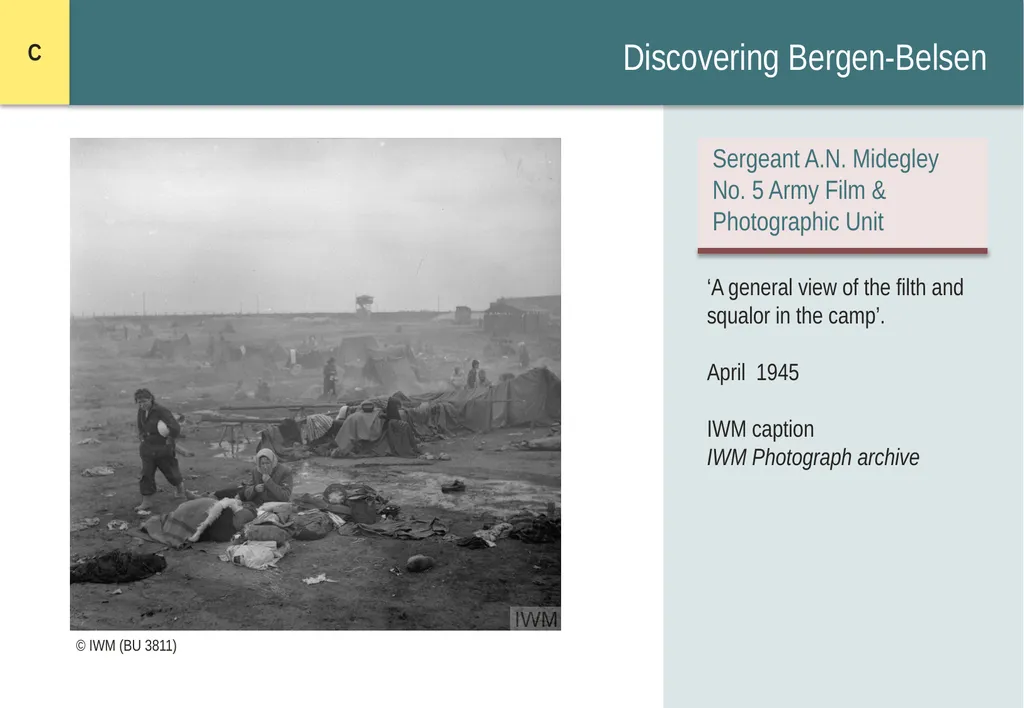
Discovering Bergen-Belsen ‘A general view of the filth and squalor in the camp’.
April 1945
IWM caption
IWM Photograph archive © IWM (BU 3811) C Sergeant A.N. Midegley
No. 5 Army Film & Photographic Unit<br>
April 1945
IWM caption
IWM Photograph archive © IWM (BU 3811) C Sergeant A.N. Midegley
No. 5 Army Film & Photographic Unit<br>
24
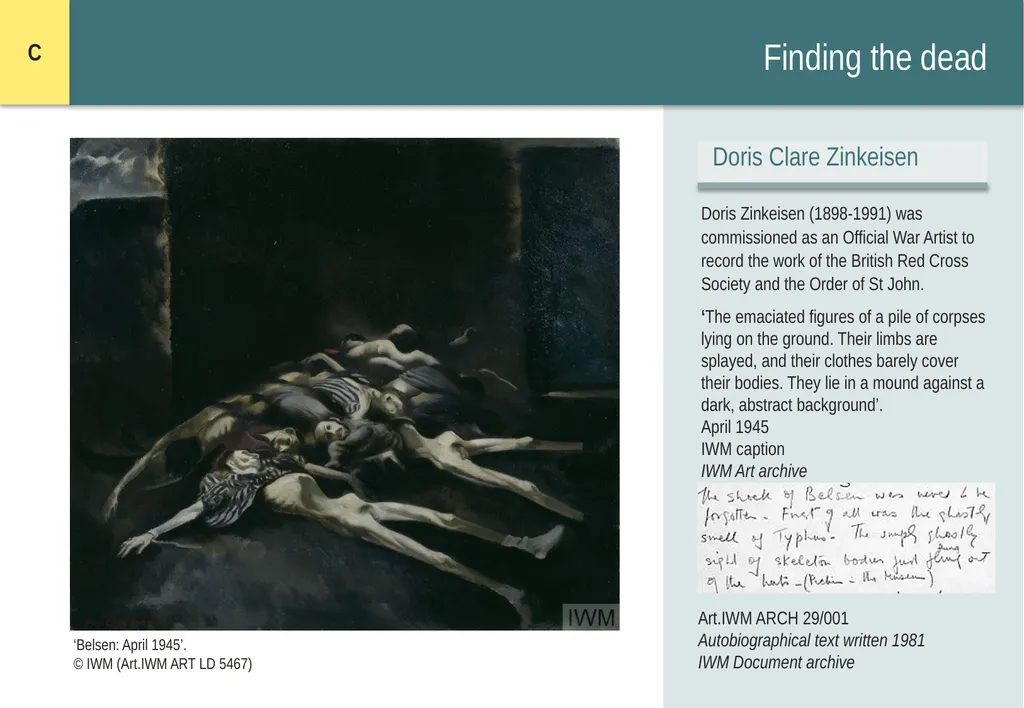
Finding the dead Doris Zinkeisen (1898-1991) was commissioned as an Official War Artist to record the work of the British Red Cross Society and the Order of St John.
‘The emaciated figures of a pile of corpses lying on the ground. Their limbs are splayed, and their clothes barely cover their bodies. They lie in a mound against a dark, abstract background’.
April 1945
IWM caption
IWM Art archive ‘Belsen: April 1945’.
© IWM (Art.IWM ART LD 5467) Doris Clare Zinkeisen Art.IWM ARCH 29/001
Autobiographical text written 1981
IWM Document archive C<br>
25
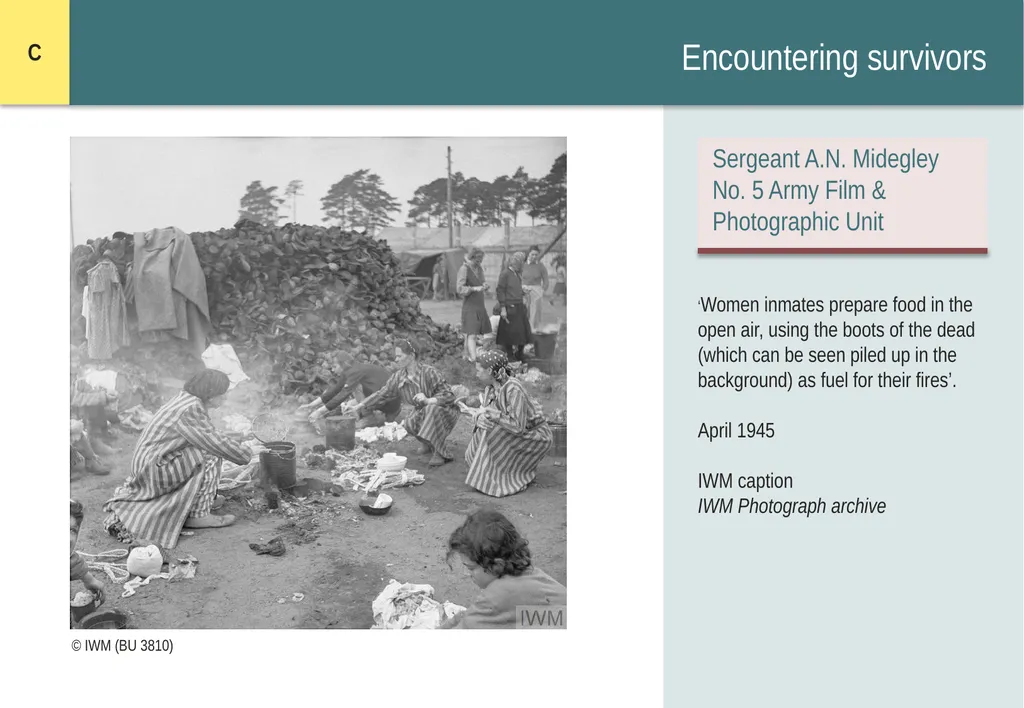
Encountering survivors ‘Women inmates prepare food in the open air, using the boots of the dead (which can be seen piled up in the background) as fuel for their fires’.
April 1945
IWM caption
IWM Photograph archive © IWM (BU 3810) C Sergeant A.N. Midegley
No. 5 Army Film & Photographic Unit<br>
April 1945
IWM caption
IWM Photograph archive © IWM (BU 3810) C Sergeant A.N. Midegley
No. 5 Army Film & Photographic Unit<br>
26
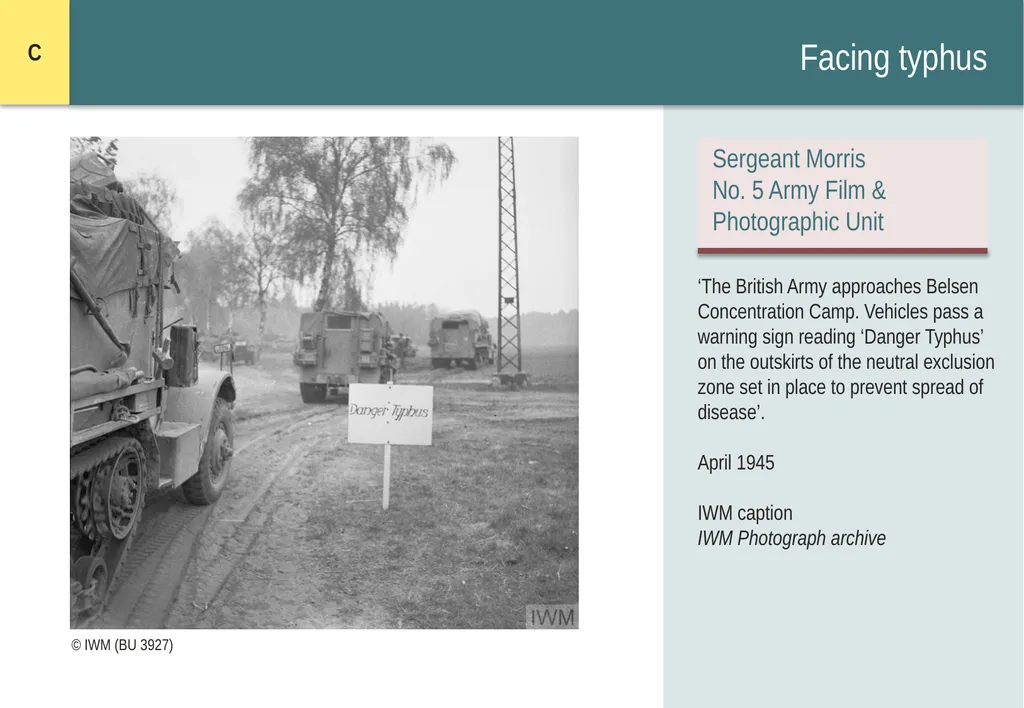
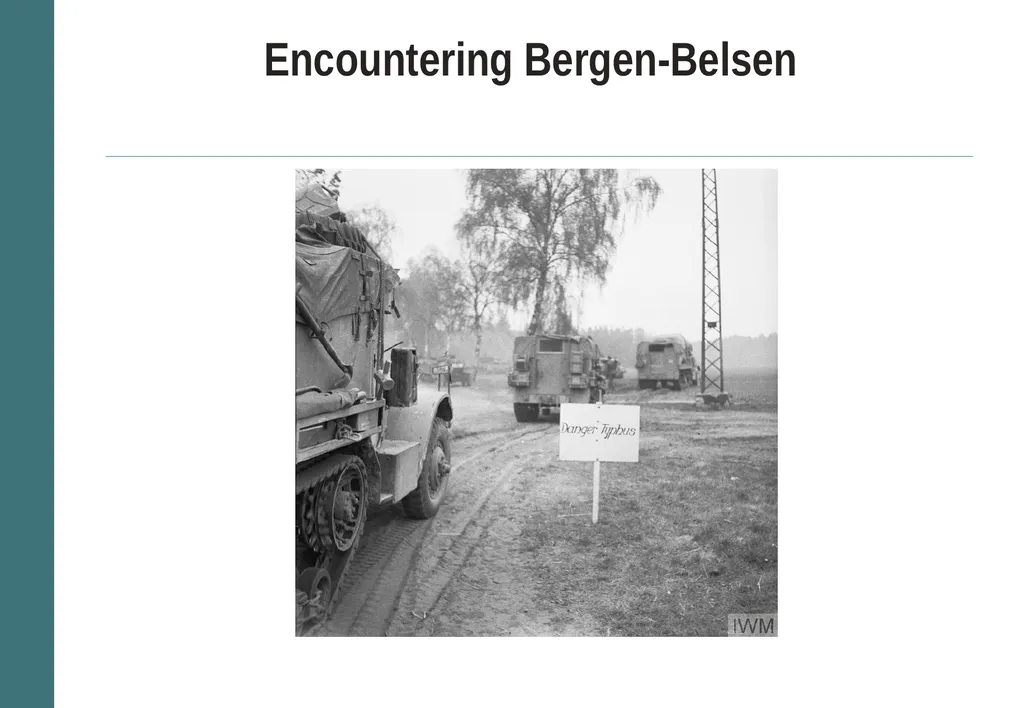
Facing typhus © IWM (BU 3927) ‘The British Army approaches Belsen Concentration Camp. Vehicles pass a warning sign reading ‘Danger Typhus’ on the outskirts of the neutral exclusion zone set in place to prevent spread of disease’.
April 1945
IWM caption
IWM Photograph archive C Sergeant Morris
No. 5 Army Film & Photographic Unit<br>
April 1945
IWM caption
IWM Photograph archive C Sergeant Morris
No. 5 Army Film & Photographic Unit<br>
27
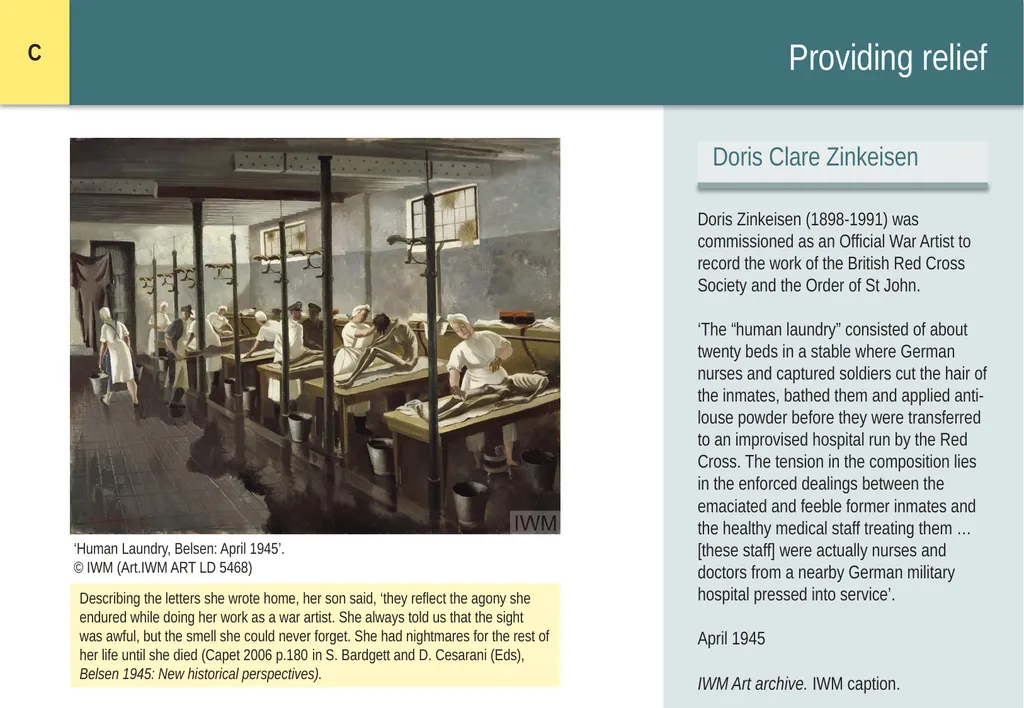
Providing relief Doris Zinkeisen (1898-1991) was commissioned as an Official War Artist to record the work of the British Red Cross Society and the Order of St John.
‘The “human laundry” consisted of about twenty beds in a stable where German nurses and captured soldiers cut the hair of the inmates, bathed them and applied anti-louse powder before they were transferred to an improvised hospital run by the Red Cross. The tension in the composition lies in the enforced dealings between the emaciated and feeble former inmates and the healthy medical staff treating them …
[these staff] were actually nurses and doctors from a nearby German military hospital pressed into service’.
April 1945
IWM Art archive. IWM caption. ‘Human Laundry, Belsen: April 1945’.
© IWM (Art.IWM ART LD 5468) Describing the letters she wrote home, her son said, ‘they reflect the agony she endured while doing her work as a war artist. She always told us that the sight was awful, but the smell she could never forget. She had nightmares for the rest of her life until she died (Capet 2006 p.180 in S. Bardgett and D. Cesarani (Eds), Belsen 1945: New historical perspectives). C Doris Clare Zinkeisen<br>
28
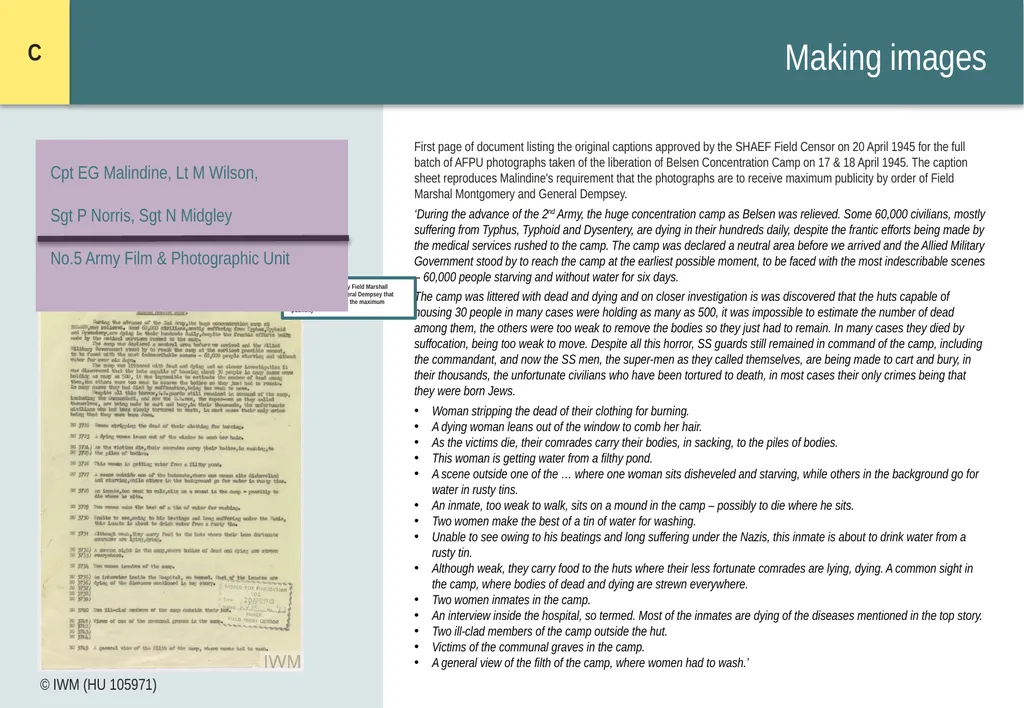
First page of document listing the original captions approved by the SHAEF Field Censor on 20 April 1945 for the full batch of AFPU photographs taken of the liberation of Belsen Concentration Camp on 17 & 18 April 1945. The caption sheet reproduces Malindine's requirement that the photographs are to receive maximum publicity by order of Field Marshal Montgomery and General Dempsey.
‘During the advance of the 2nd Army, the huge concentration camp as Belsen was relieved. Some 60,000 civilians, mostly suffering from Typhus, Typhoid and Dysentery, are dying in their hundreds daily, despite the frantic efforts being made by the medical services rushed to the camp. The camp was declared a neutral area before we arrived and the Allied Military Government stood by to reach the camp at the earliest possible moment, to be faced with the most indescribable scenes – 60,000 people starving and without water for six days.
The camp was littered with dead and dying and on closer investigation is was discovered that the huts capable of housing 30 people in many cases were holding as many as 500, it was impossible to estimate the number of dead among them, the others were too weak to remove the bodies so they just had to remain. In many cases they died by suffocation, being too weak to move. Despite all this horror, SS guards still remained in command of the camp, including the commandant, and now the SS men, the super-men as they called themselves, are being made to cart and bury, in their thousands, the unfortunate civilians who have been tortured to death, in most cases their only crimes being that they were born Jews.
Woman stripping the dead of their clothing for burning.
A dying woman leans out of the window to comb her hair.
As the victims die, their comrades carry their bodies, in sacking, to the piles of bodies.
This woman is getting water from a filthy pond.
A scene outside one of the … where one woman sits disheveled and starving, while others in the background go for water in rusty tins.
An inmate, too weak to walk, sits on a mound in the camp – possibly to die where he sits.
Two women make the best of a tin of water for washing.
Unable to see owing to his beatings and long suffering under the Nazis, this inmate is about to drink water from a rusty tin.
Although weak, they carry food to the huts where their less fortunate comrades are lying, dying. A common sight in the camp, where bodies of dead and dying are strewn everywhere.
Two women inmates in the camp.
An interview inside the hospital, so termed. Most of the inmates are dying of the diseases mentioned in the top story.
Two ill-clad members of the camp outside the hut.
Victims of the communal graves in the camp.
A general view of the filth of the camp, where women had to wash.’ Making images It is to be requested by Field Marshall Montgomery and General Dempsey that these pictures receive the maximum publicity Cpt EG Malindine, Lt M Wilson,
Sgt P Norris, Sgt N Midgley
No.5 Army Film & Photographic Unit © IWM (HU 105971) C<br>
29
Telling the story 1 ‘But we went further on into the camp, and seen these corpses lying everywhere. You didn’t know whether they were living or dead. Most of them were dead. Some were trying to walk, some were stumbling, some on hands and knees, but in the lagers, the barbed wire around the huts, you could see that the doors were open. The stench coming out of them was fearsome. They were lying in the doorways – tried to get down the stairs and fallen and just died on the spot. And it was just everywhere. Going into, more deeper, into the camp the stench got worse and the numbers of dead – they were just impossible to know how many there were … Inside the camp itself, it was just unbelievable. You just couldn’t believe the numbers involved … This was one of the things which struck me when I first went in, that the whole camp was so quiet and yet there were so many people there. You couldn’t hear anything, there was just no sound at all and yet there was some movement – those people who could walk or move – but just so quiet. You just couldn’t understand that all those people could be there and yet everything was so quiet… It was just this oppressive haze over the camp, the smell, the starkness of the barbed wire fences, the dullness of the bare earth, the scattered bodies and these very dull, too, striped grey uniforms – those who had it – it was just so dull. The sun, yes the sun was shining, but they were just didn’t seem to make any life at all in that camp. Everything seemed to be dead. The slowness of the movement of the people who could walk. Everything was just ghost-like and it was just unbelievable that there were literally people living still there. There’s so much death apparent that the living, certainly, were in the minority’.
(IWM SR 15437)
Interview recorded 24-5-1995
IWM Sound archive As a Staff Captain, Dick Williams served in the Supplies and Transport branch Headquarters 8th Corps which carried ammunition, petrol and rations to support the fighting Divisions. C Major Dick Williams<br>
(IWM SR 15437)
Interview recorded 24-5-1995
IWM Sound archive As a Staff Captain, Dick Williams served in the Supplies and Transport branch Headquarters 8th Corps which carried ammunition, petrol and rations to support the fighting Divisions. C Major Dick Williams<br>
30
Molly Silva Jones Telling the story 2 ‘Possibly none of us had ever been so stirred – with pity – shame – remorse – yes, because even in 1934 we had heard of these camps and had not realised, not wanted to realise, that such things could happen. And lastly but not least we were stirred with a cold anger against those primarily responsible, the Germans, an anger which grew daily at Belsen. Stirred also an increased desire to help; nothing we could do was enough to restore… some measure of mental and physical health. We went back to the road without speaking. We knew the uselessness of words, not for the last time at Belsen’.
19 April 1945 (with later additions).
From the diary of Molly Silva Jones (McFarlane papers, 99/86/1).
IWM Document archive
No name. (2006). ‘The Medical Relief Effort at Belsen: Eyewitness Accounts’. In S. Bardgett and D. Cesarani (Eds), Belsen 1945: New historical perspectives (p. 55). London: Vallentine Mitchell. Beatrice Mary (Molly) Silva Jones was one of four nurses who arrived with the Red Cross on 20th April 1945. C<br>
31
Telling the story 3 ‘At this time the battle was going on all round the camp where there were approx 50,000 people of which 10,000 lay dead in the huts or about the camp. Those still alive had had no food for 7 days after a prolonged period of semi starvation … The only water available was from filthy static water tanks most of which contained a body or two when we arrived. The majority of inmates had either had typhus or were suffering from it: most other diseases known to man, except cholera were rife and practically all the internees were abnormal mentally. No human being, even if they were sane when admitted to the camp, and many were not, could remain in the horror camp and keep their sanity’.
Doc.3713 Mervyn Willet Gonin written 1945-1946.
Documents/Private Papers
IWM Document archive 85/38/1 Lieutenant-Colonel Gonin was a commanding officer of the Royal Army Medical Corps at Bergen-Belsen. C Lieutenant-Colonel
MW Gonin<br>
Doc.3713 Mervyn Willet Gonin written 1945-1946.
Documents/Private Papers
IWM Document archive 85/38/1 Lieutenant-Colonel Gonin was a commanding officer of the Royal Army Medical Corps at Bergen-Belsen. C Lieutenant-Colonel
MW Gonin<br>
32
Telling the story 4 ‘There was a young woman at the gates. She saw the Mogen David [Star of David] on my uniform and knew I was Jewish and wanted to rush forward and hug me. She looked so repulsive, but I knew that if I moved backwards as she moved forwards, she was liable to fall. I managed to control myself and kept her on her feet.
A few yards further on there was a group of about eight or ten people lying on the ground.
I said, ‘Why aren’t they in the huts?’
She said, ‘They’re dead and we’ll all be dead if help doesn’t come quickly.’
Then I started to learn about the gruesome things the Nazis did…’
April 1945
Smith, L. (2006). Forgotten Voices of the Holocaust (p. 275). London: Ebury Press IWM Sound Archive 17636 Leslie Hardman
British Jewish chaplain with VIII Corps, 2nd Army.
On 16th April 1945 he was the first British Rabbi to enter Bergen-Belsen. C Leslie Hardman<br>
33
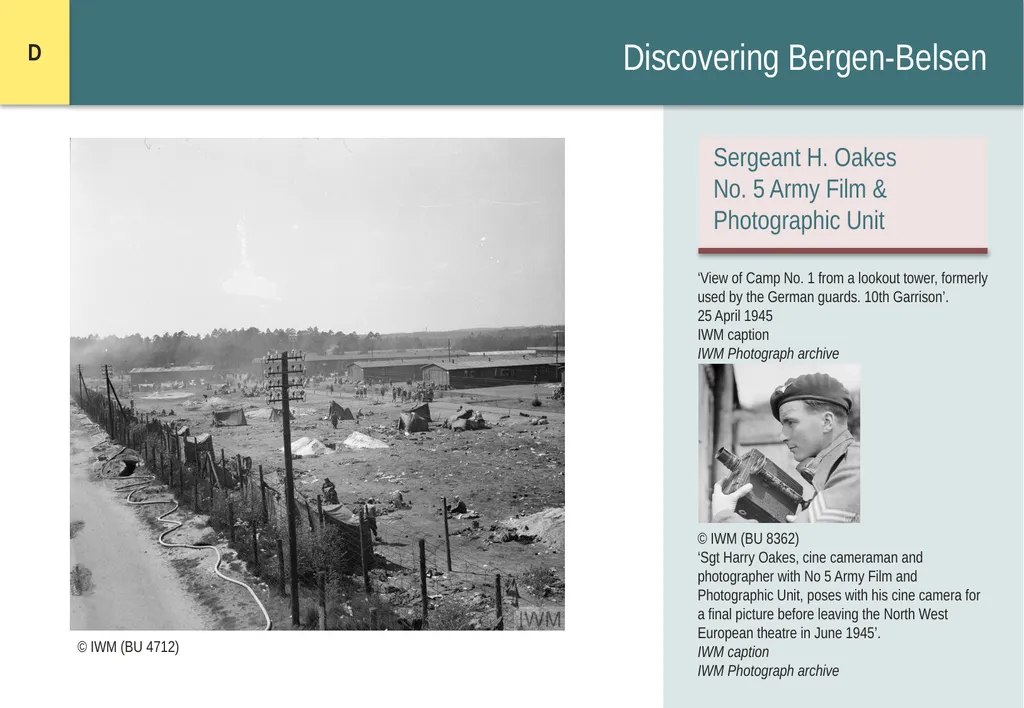
Discovering Bergen-Belsen ‘View of Camp No. 1 from a lookout tower, formerly used by the German guards. 10th Garrison’.
25 April 1945
IWM caption
IWM Photograph archive © IWM (BU 4712) © IWM (BU 8362)
‘Sgt Harry Oakes, cine cameraman and photographer with No 5 Army Film and Photographic Unit, poses with his cine camera for a final picture before leaving the North West European theatre in June 1945’.
IWM caption
IWM Photograph archive D Sergeant H. Oakes
No. 5 Army Film & Photographic Unit<br>
34
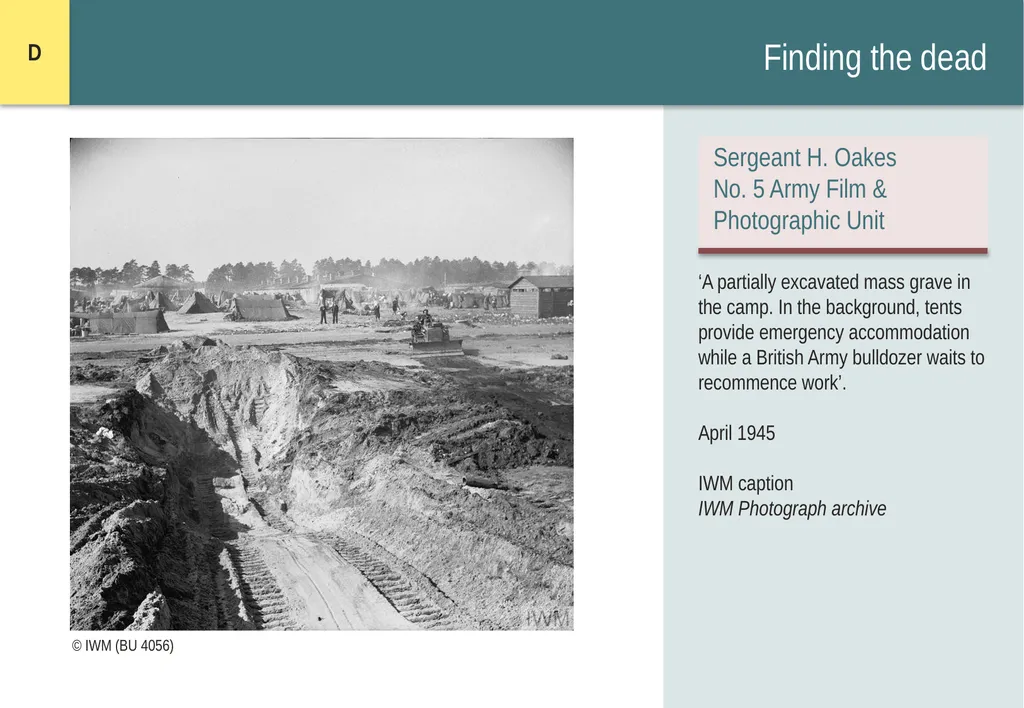
Finding the dead © IWM (BU 4056) ‘A partially excavated mass grave in the camp. In the background, tents provide emergency accommodation while a British Army bulldozer waits to recommence work’.
April 1945
IWM caption
IWM Photograph archive D Sergeant H. Oakes
No. 5 Army Film & Photographic Unit<br>
April 1945
IWM caption
IWM Photograph archive D Sergeant H. Oakes
No. 5 Army Film & Photographic Unit<br>
35
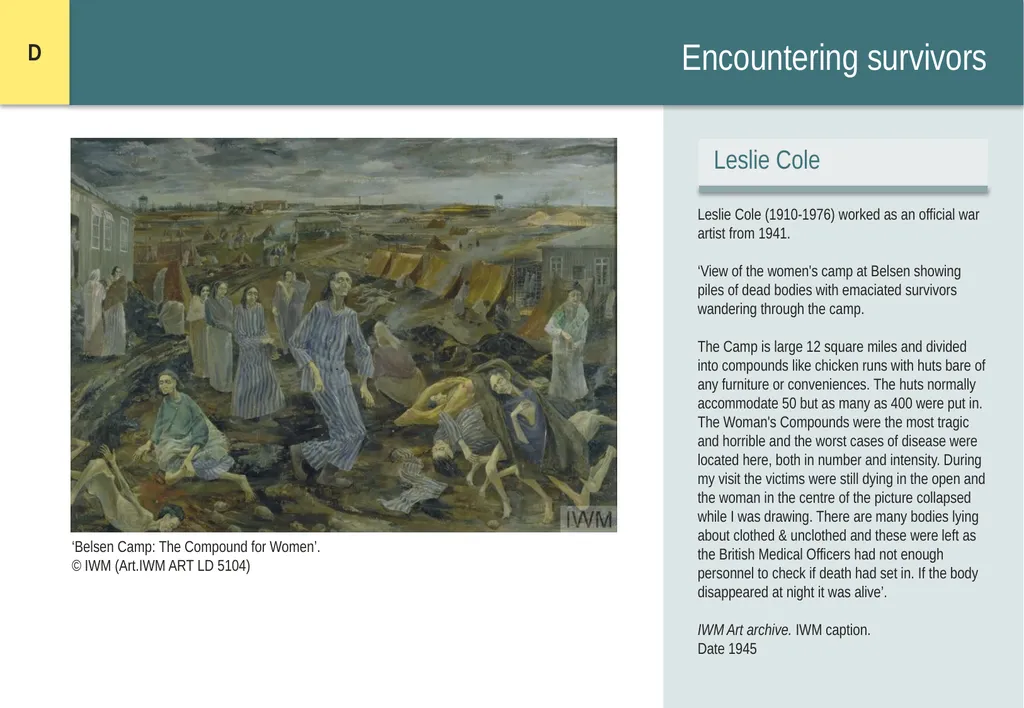
Encountering survivors Leslie Cole (1910-1976) worked as an official war artist from 1941.
‘View of the women's camp at Belsen showing piles of dead bodies with emaciated survivors wandering through the camp.
The Camp is large 12 square miles and divided into compounds like chicken runs with huts bare of any furniture or conveniences. The huts normally accommodate 50 but as many as 400 were put in. The Woman's Compounds were the most tragic and horrible and the worst cases of disease were located here, both in number and intensity. During my visit the victims were still dying in the open and the woman in the centre of the picture collapsed while I was drawing. There are many bodies lying about clothed & unclothed and these were left as the British Medical Officers had not enough personnel to check if death had set in. If the body disappeared at night it was alive’.
IWM Art archive. IWM caption.
Date 1945 ‘Belsen Camp: The Compound for Women’.
© IWM (Art.IWM ART LD 5104) D Leslie Cole<br>
36
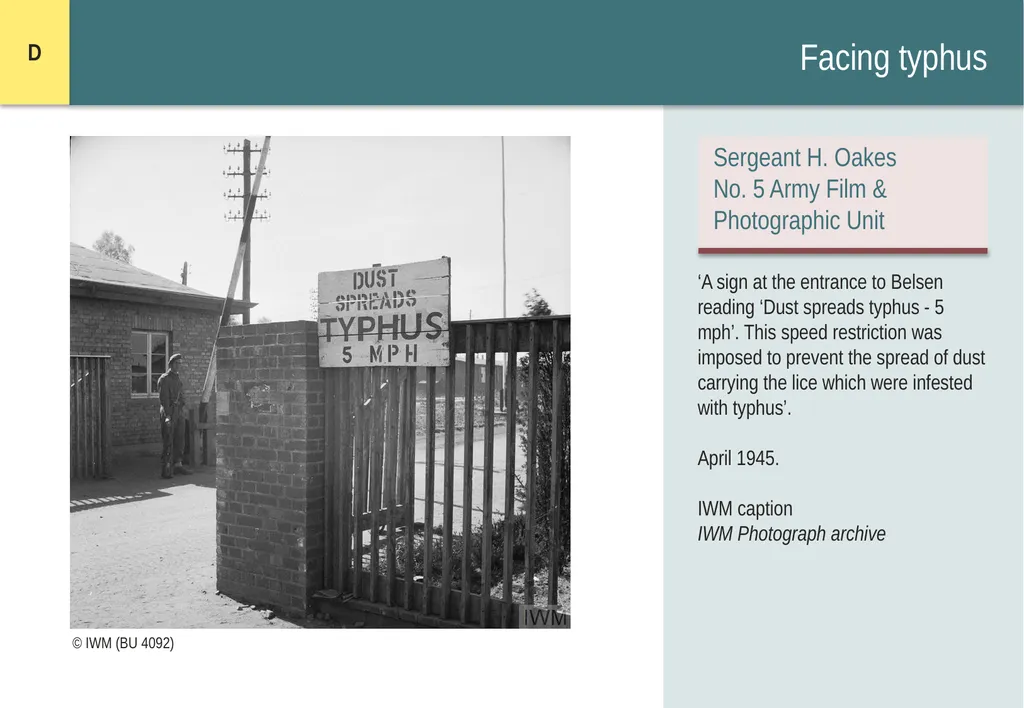
Facing typhus ‘A sign at the entrance to Belsen reading ‘Dust spreads typhus - 5 mph’. This speed restriction was imposed to prevent the spread of dust carrying the lice which were infested with typhus’.
April 1945.
IWM caption
IWM Photograph archive © IWM (BU 4092) D Sergeant H. Oakes
No. 5 Army Film & Photographic Unit<br>
April 1945.
IWM caption
IWM Photograph archive © IWM (BU 4092) D Sergeant H. Oakes
No. 5 Army Film & Photographic Unit<br>
37
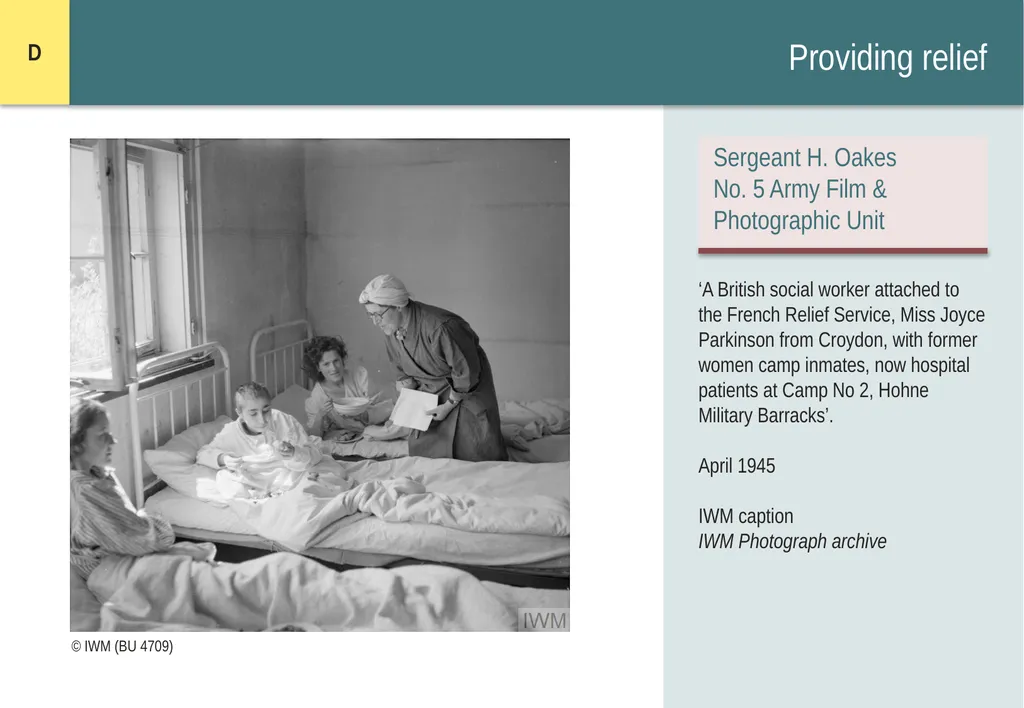
Providing relief ‘A British social worker attached to the French Relief Service, Miss Joyce Parkinson from Croydon, with former women camp inmates, now hospital patients at Camp No 2, Hohne Military Barracks’.
April 1945
IWM caption
IWM Photograph archive © IWM (BU 4709) D Sergeant H. Oakes
No. 5 Army Film & Photographic Unit<br>
April 1945
IWM caption
IWM Photograph archive © IWM (BU 4709) D Sergeant H. Oakes
No. 5 Army Film & Photographic Unit<br>
38
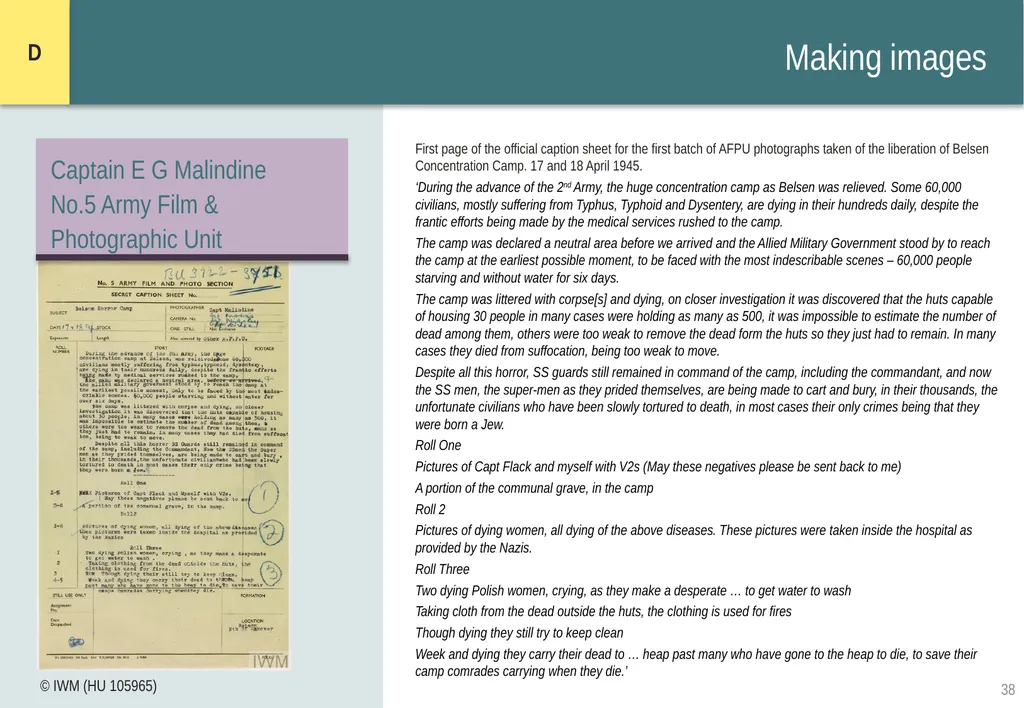
First page of the official caption sheet for the first batch of AFPU photographs taken of the liberation of Belsen Concentration Camp. 17 and 18 April 1945.
‘During the advance of the 2nd Army, the huge concentration camp as Belsen was relieved. Some 60,000 civilians, mostly suffering from Typhus, Typhoid and Dysentery, are dying in their hundreds daily, despite the frantic efforts being made by the medical services rushed to the camp.
The camp was declared a neutral area before we arrived and the Allied Military Government stood by to reach the camp at the earliest possible moment, to be faced with the most indescribable scenes – 60,000 people starving and without water for six days.
The camp was littered with corpse[s] and dying, on closer investigation it was discovered that the huts capable of housing 30 people in many cases were holding as many as 500, it was impossible to estimate the number of dead among them, others were too weak to remove the dead form the huts so they just had to remain. In many cases they died from suffocation, being too weak to move.
Despite all this horror, SS guards still remained in command of the camp, including the commandant, and now the SS men, the super-men as they prided themselves, are being made to cart and bury, in their thousands, the unfortunate civilians who have been slowly tortured to death, in most cases their only crimes being that they were born a Jew.
Roll One
Pictures of Capt Flack and myself with V2s (May these negatives please be sent back to me)
A portion of the communal grave, in the camp
Roll 2
Pictures of dying women, all dying of the above diseases. These pictures were taken inside the hospital as provided by the Nazis.
Roll Three
Two dying Polish women, crying, as they make a desperate … to get water to wash
Taking cloth from the dead outside the huts, the clothing is used for fires
Though dying they still try to keep clean
Week and dying they carry their dead to … heap past many who have gone to the heap to die, to save their camp comrades carrying when they die.’ 38 Making images © IWM (HU 105965) D Captain E G Malindine No.5 Army Film & Photographic Unit<br>
39
Telling the story 1 ‘About that time the chaps attached to 11th Armoured Division had seen a staff car come up to Headquarters one day with a German officer, or two German officers I believe, blindfolded and when they made enquiries they were told that they were from a Political Prison Camp at Belsen. The Germans, anticipating us capturing the camp … wanted the British to send in an advanced party to prevent these prisoners who were supposed to be infected with typhus from escaping …The Germans … would leave 1,000 Wehrmacht behind if we returned them within ten days’.
Harry Oakes (IWM SR 4302)
Interview recorded 15-2-1979
We had this business of the staff car with the white flags telling us that there was a typhus hospital on the way ahead of us, and would we be willing to call a halt to any actual battle until this area was taken over in case of escapees into Europe and the ravage that would take place. And as far as I know, the Brigadier believed this story, and we set sail that evening to have a look at this typhus hospital under a white flag. And there was no typhus hospital. There was barbed wire, sentry boxes, a huge garrison building for SS troopers, and Belsen concentration camp … we drove up in … four jeeps maybe, in the evening, and we saw this concentration camp that we believed was a typhus hospital. But we knew immediately that it wasn’t a typhus hospital’.
Bill Lawrie (IWM SR 7481)
Interview recorded April 1984
IWM Sound archive Sergeant Harry Oakes and Sergeant Bill Lawrie worked for the Army Film and Photographic Unit (AFPU) D Harry Oakes and Bill Lawrie<br>
40
Telling the story 2 ‘What happened was we were all allocated to a hut … the first job to do each day was to go in … and pick out the dead bodies. You’d just go around and see who’s dead and who wasn’t. It was sometimes very difficult to be certain who was dead and who wasn’t. Remove the dead, take them outside, leave them in a heap and the Hungarians then moved them by truck to the mass graves where they were put in the mass graves. And having got rid of the dead you then made a sort of so say ward round to try and do what you could for the remainder … the vast majority had diarrhoea. They all had the most appalling coughs, they all had the most dreadful skin diseases, they were all filthy dirty and they were all absolutely skeletally thin … And we were dealing with the killer, the main killer, which was typhus. And typhus was killing a very large number of people every day’.
(IWM SR 8996)
Interview recorded 19-09-1985
IWM Sound archive Dr Roger Dixey was a medical student who volunteered for the relief effort at Bergen-Belsen. D Dr Roger Dixey<br>
(IWM SR 8996)
Interview recorded 19-09-1985
IWM Sound archive Dr Roger Dixey was a medical student who volunteered for the relief effort at Bergen-Belsen. D Dr Roger Dixey<br>
41
Telling the story 3 ‘The day following admission was never so difficult as the succeeding days when the patients would be less apathetic, less apprehensive and as soon as any meal appeared in the wards, the clamour for food would start. Those cries of the hungry will haunt the ears of those who heard them for a long time to come’.
21 April 1945.
From the diary of Molly Silva Jones (McFarlane papers, 99/86/1).
IWM Document archive
No name. (2006). ‘The Medical Relief Effort at Belsen: Eyewitness Accounts’. In S. Bardgett and D. Cesarani (Eds), Belsen 1945: New historical perspectives (p. 56). London: Vallentine Mitchell. Beatrice Mary (Molly) Silva Jones was one of four nurses who arrived with the Red Cross on 20th April 1945. D Molly Silva Jones<br>
42
Telling the story 4 ‘The policy was, right from the beginning, was to get people out of that awful place into proper surroundings and you couldn’t take them out until they’d been cleaned and the army had set up a “human laundry” – or was in the process of setting up a “human laundry” – which consisted of trestle tables, water supply, trestle tables, a clothing dump, a stretcher dump, old clothing to be discarded, fresh clothing to be provided after the inmates would be brought out of the huts, hosed down, washed down, deloused, and then put into fresh clothes and then evacuated from the camp …The primary task of course was to save life and to get people fed, to get them out of the camp into proper conditions where they could be nursed and looked after and saved from dying’.
(IWM SR 9082)
Interview recorded 26-09-1985
IWM Sound archive Dr Laurence Wand was a medical student who volunteered for the relief effort at Bergen-Belsen. D Dr Laurence Wand<br>
(IWM SR 9082)
Interview recorded 26-09-1985
IWM Sound archive Dr Laurence Wand was a medical student who volunteered for the relief effort at Bergen-Belsen. D Dr Laurence Wand<br>
43
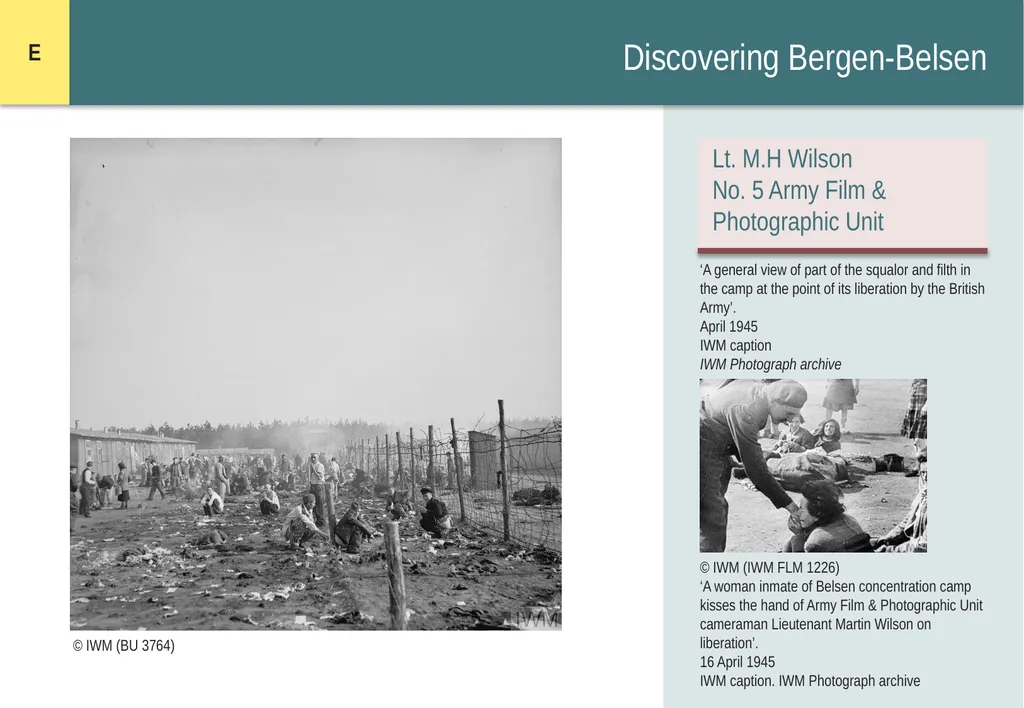
Discovering Bergen-Belsen © IWM (BU 3764) ‘A general view of part of the squalor and filth in the camp at the point of its liberation by the British Army’.
April 1945
IWM caption
IWM Photograph archive © IWM (IWM FLM 1226)
‘A woman inmate of Belsen concentration camp kisses the hand of Army Film & Photographic Unit cameraman Lieutenant Martin Wilson on liberation’.
16 April 1945
IWM caption. IWM Photograph archive E Lt. M.H Wilson
No. 5 Army Film & Photographic Unit<br>
44
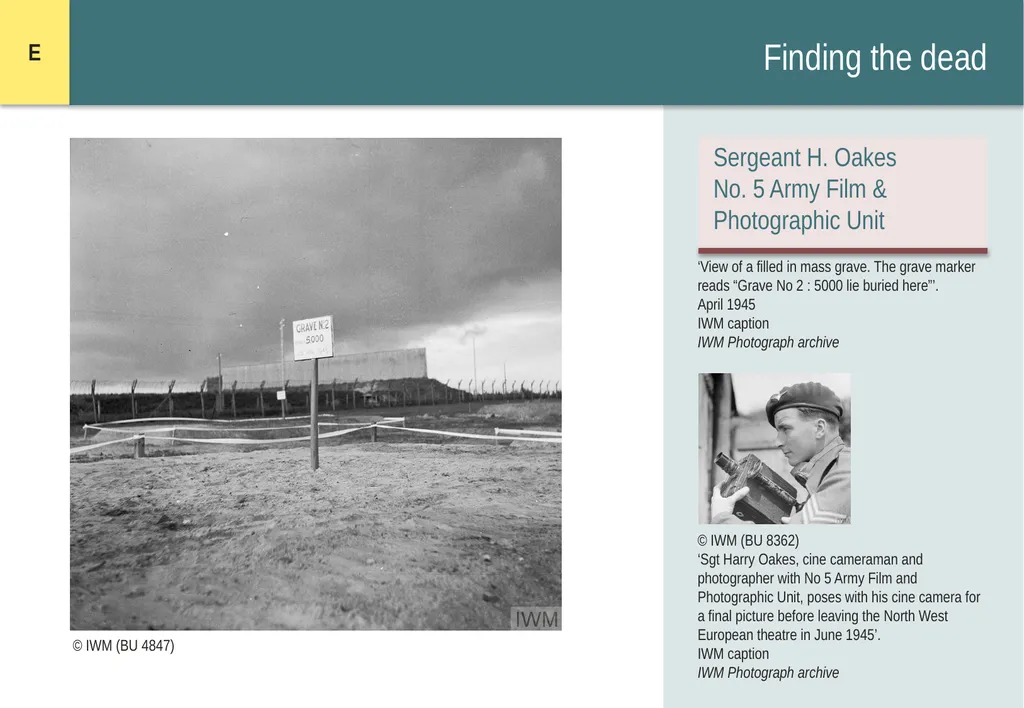
Finding the dead ‘View of a filled in mass grave. The grave marker reads “Grave No 2 : 5000 lie buried here”’.
April 1945
IWM caption
IWM Photograph archive © IWM (BU 4847) © IWM (BU 8362)
‘Sgt Harry Oakes, cine cameraman and photographer with No 5 Army Film and Photographic Unit, poses with his cine camera for a final picture before leaving the North West European theatre in June 1945’.
IWM caption
IWM Photograph archive E Sergeant H. Oakes
No. 5 Army Film & Photographic Unit<br>
45
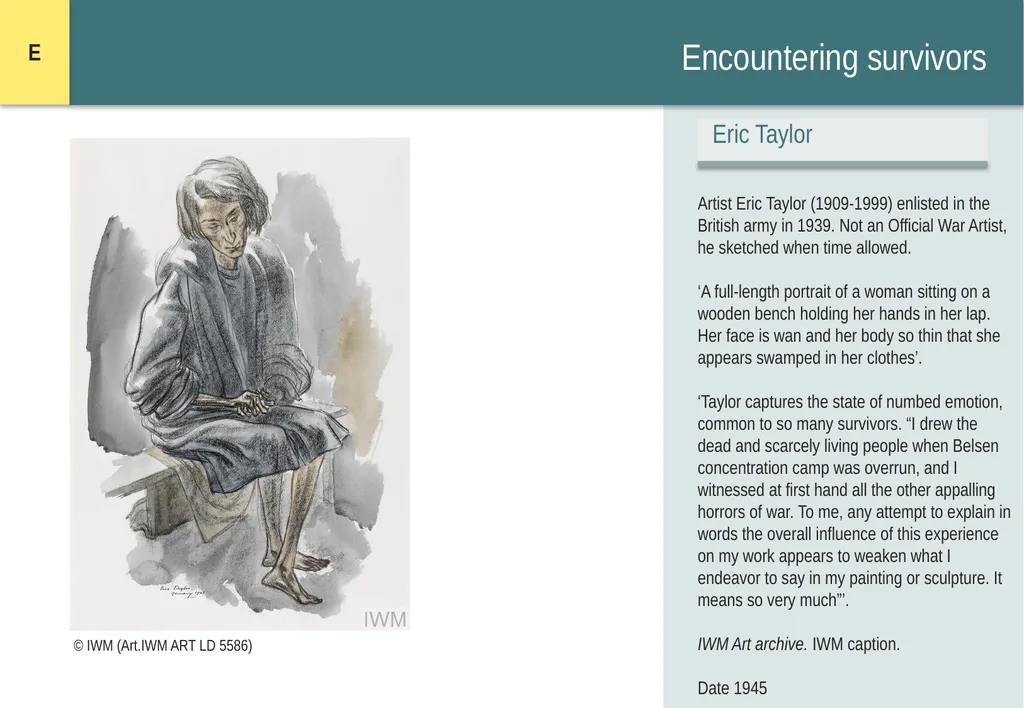
Encountering survivors Artist Eric Taylor (1909-1999) enlisted in the British army in 1939. Not an Official War Artist, he sketched when time allowed.
‘A full-length portrait of a woman sitting on a wooden bench holding her hands in her lap. Her face is wan and her body so thin that she appears swamped in her clothes’.
‘Taylor captures the state of numbed emotion, common to so many survivors. “I drew the dead and scarcely living people when Belsen concentration camp was overrun, and I witnessed at first hand all the other appalling horrors of war. To me, any attempt to explain in words the overall influence of this experience on my work appears to weaken what I endeavor to say in my painting or sculpture. It means so very much”’.
IWM Art archive. IWM caption.
Date 1945 © IWM (Art.IWM ART LD 5586) E Eric Taylor<br>
46
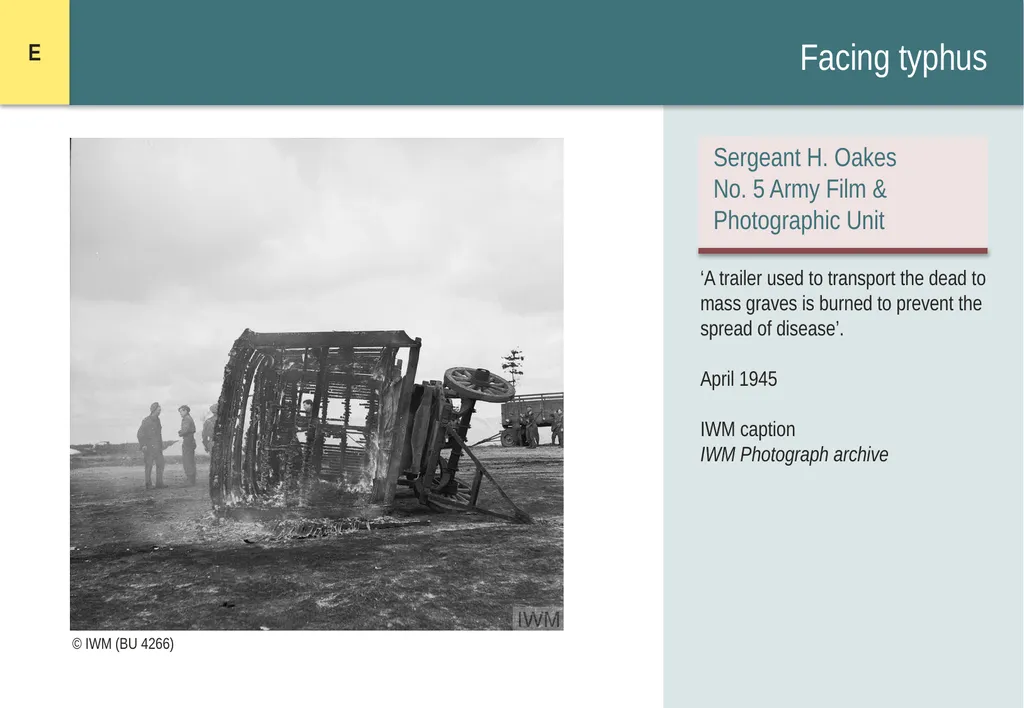
Facing typhus ‘A trailer used to transport the dead to mass graves is burned to prevent the spread of disease’.
April 1945
IWM caption
IWM Photograph archive © IWM (BU 4266) E Sergeant H. Oakes
No. 5 Army Film & Photographic Unit<br>
April 1945
IWM caption
IWM Photograph archive © IWM (BU 4266) E Sergeant H. Oakes
No. 5 Army Film & Photographic Unit<br>
47
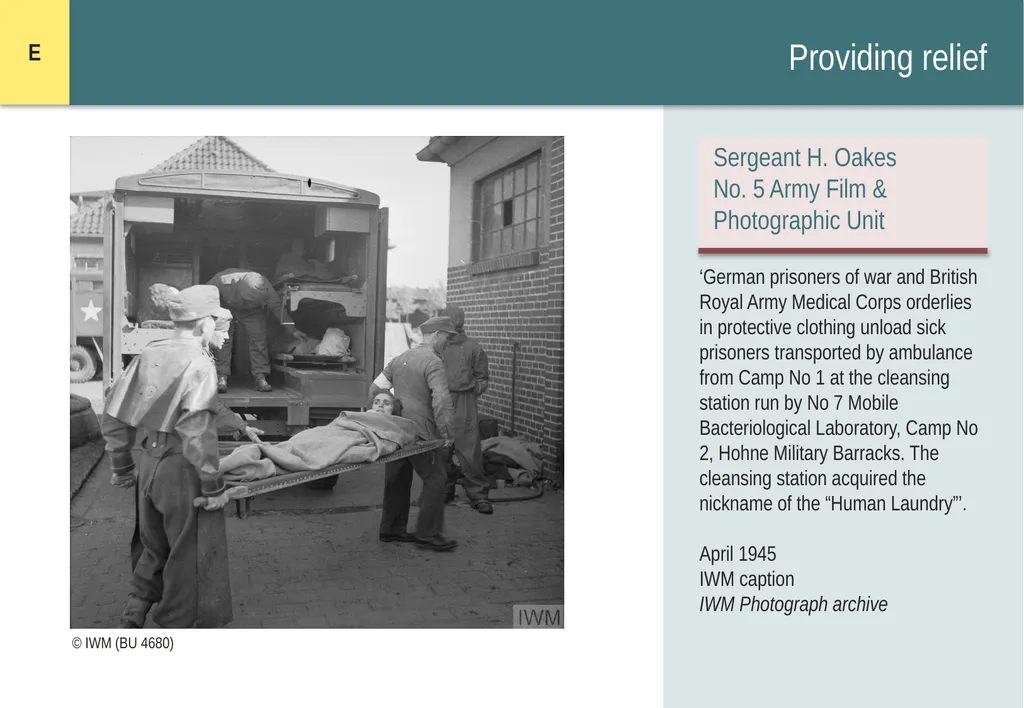
Providing relief ‘German prisoners of war and British Royal Army Medical Corps orderlies in protective clothing unload sick prisoners transported by ambulance from Camp No 1 at the cleansing station run by No 7 Mobile Bacteriological Laboratory, Camp No 2, Hohne Military Barracks. The cleansing station acquired the nickname of the “Human Laundry”’.
April 1945
IWM caption
IWM Photograph archive © IWM (BU 4680) E Sergeant H. Oakes
No. 5 Army Film & Photographic Unit<br>
April 1945
IWM caption
IWM Photograph archive © IWM (BU 4680) E Sergeant H. Oakes
No. 5 Army Film & Photographic Unit<br>
48
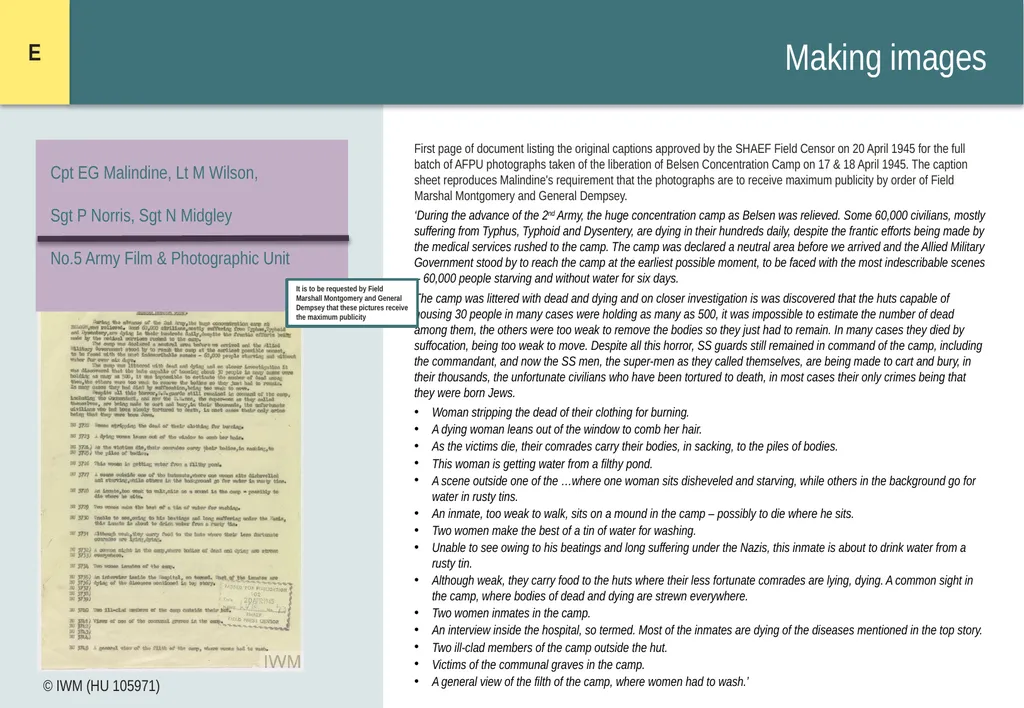
First page of document listing the original captions approved by the SHAEF Field Censor on 20 April 1945 for the full batch of AFPU photographs taken of the liberation of Belsen Concentration Camp on 17 & 18 April 1945. The caption sheet reproduces Malindine's requirement that the photographs are to receive maximum publicity by order of Field Marshal Montgomery and General Dempsey.
‘During the advance of the 2nd Army, the huge concentration camp as Belsen was relieved. Some 60,000 civilians, mostly suffering from Typhus, Typhoid and Dysentery, are dying in their hundreds daily, despite the frantic efforts being made by the medical services rushed to the camp. The camp was declared a neutral area before we arrived and the Allied Military Government stood by to reach the camp at the earliest possible moment, to be faced with the most indescribable scenes – 60,000 people starving and without water for six days.
The camp was littered with dead and dying and on closer investigation is was discovered that the huts capable of housing 30 people in many cases were holding as many as 500, it was impossible to estimate the number of dead among them, the others were too weak to remove the bodies so they just had to remain. In many cases they died by suffocation, being too weak to move. Despite all this horror, SS guards still remained in command of the camp, including the commandant, and now the SS men, the super-men as they called themselves, are being made to cart and bury, in their thousands, the unfortunate civilians who have been tortured to death, in most cases their only crimes being that they were born Jews.
Woman stripping the dead of their clothing for burning.
A dying woman leans out of the window to comb her hair.
As the victims die, their comrades carry their bodies, in sacking, to the piles of bodies.
This woman is getting water from a filthy pond.
A scene outside one of the …where one woman sits disheveled and starving, while others in the background go for water in rusty tins.
An inmate, too weak to walk, sits on a mound in the camp – possibly to die where he sits.
Two women make the best of a tin of water for washing.
Unable to see owing to his beatings and long suffering under the Nazis, this inmate is about to drink water from a rusty tin.
Although weak, they carry food to the huts where their less fortunate comrades are lying, dying. A common sight in the camp, where bodies of dead and dying are strewn everywhere.
Two women inmates in the camp.
An interview inside the hospital, so termed. Most of the inmates are dying of the diseases mentioned in the top story.
Two ill-clad members of the camp outside the hut.
Victims of the communal graves in the camp.
A general view of the filth of the camp, where women had to wash.’ Making images © IWM (HU 105971) E Cpt EG Malindine, Lt M Wilson,
Sgt P Norris, Sgt N Midgley
No.5 Army Film & Photographic Unit It is to be requested by Field Marshall Montgomery and General Dempsey that these pictures receive the maximum publicity<br>
49
Telling the story 1 ‘I remember that night trying to sleep and being completely unable to sleep. And there was no – you couldn’t say it was fear, you couldn’t say it was discomfort, because we were comparatively comfortable, we were under a shelter … There was a kind of terrible horror. I can’t explain it … I didn’t disturb anyone else. And everybody else was there was the same – drivers and cameramen. Everybody pretended to be asleep and nobody was sleeping for some reason or another’.
(IWM SR 7481/03, reel 2)
Interview recorded April 1984
Haggith, T. (2006). ‘The filming of the Liberation of Bergen-Belsen and its Impact on the Understanding of the Holocaust. In S. Bardgett and D. Cesarani (Eds), Belsen 1945: New historical perspectives (p.94). London: Vallentine Mitchell.
IWM Sound archive Sergeant Bill Lawrie worked for the Army Film and Photographic Unit (AFPU).
From Glasgow, he was conscripted in 1939. He went to France in 1940 and returned to Britain via Dunkirk. He served on Gibraltar before joining the Parachute Regiment. He joined the AFPU after this training.
The cameramen entered Bergen-Belsen on the evening of 15th April 1945 to do an initial visit. That night the men found it difficult to sleep, shocked by what they had seen. E Sergeant William (Bill) Lawrie<br>
50
Telling the story 2 ‘The German nurses were an interesting study; at the start they laughed, joked, were definitely truculent, made no effort to get things ready for the job in hand, damned if they were going to work for the something British. And then the first patients started to arrive. I am told by my friend who was in charge of the laundry that this was one of the most dramatic moments at Belsen, the place of unending drama. Those nurses stood with their mouths open and gazed horror struck as those bodies were brought in, first one then another started to sob until almost the whole sixty were weeping. There was no more truculence after that. Those girls worked like slaves, they went down with typhus and they died but others took their place, they grew thin and they grew pale but they worked and they toiled from eight in the morning till six at night. They earnt our respect’.
Doc.3713 Mervyn Willet Gonin written 1945-1946.
Documents/Private Papers
IWM Document archive 85/38/1 E Lieutenant-Colonel
MW Gonin Lieutenant-Colonel Gonin was a commanding officer of the Royal Army Medical Corps at Bergen-Belsen.<br>
Doc.3713 Mervyn Willet Gonin written 1945-1946.
Documents/Private Papers
IWM Document archive 85/38/1 E Lieutenant-Colonel
MW Gonin Lieutenant-Colonel Gonin was a commanding officer of the Royal Army Medical Corps at Bergen-Belsen.<br>
51
Telling the story 3 ‘The terrible discovery came to me, this sort of revelation like a flash of lightning, because it penetrated these terrible scenes to make me think – all the stories I’d heard about the persecution of people from my mother and father, here they were true’.
(IWM SR 4833/9, reel 7)
26-03-1981
Haggith, T. (2006). ‘The filming of the Liberation of Bergen-Belsen and its Impact on the Understanding of the Holocaust. In S. Bardgett and D. Cesarani (Eds), Belsen 1945: New historical perspectives (p. 96). London: Vallentine Mitchell.
IWM Sound archive Sergeant Mike Lewis worked for the Army Film and Photographic Unit (AFPU).
He came from a Polish Jewish family who moved to Britain before the First World War.
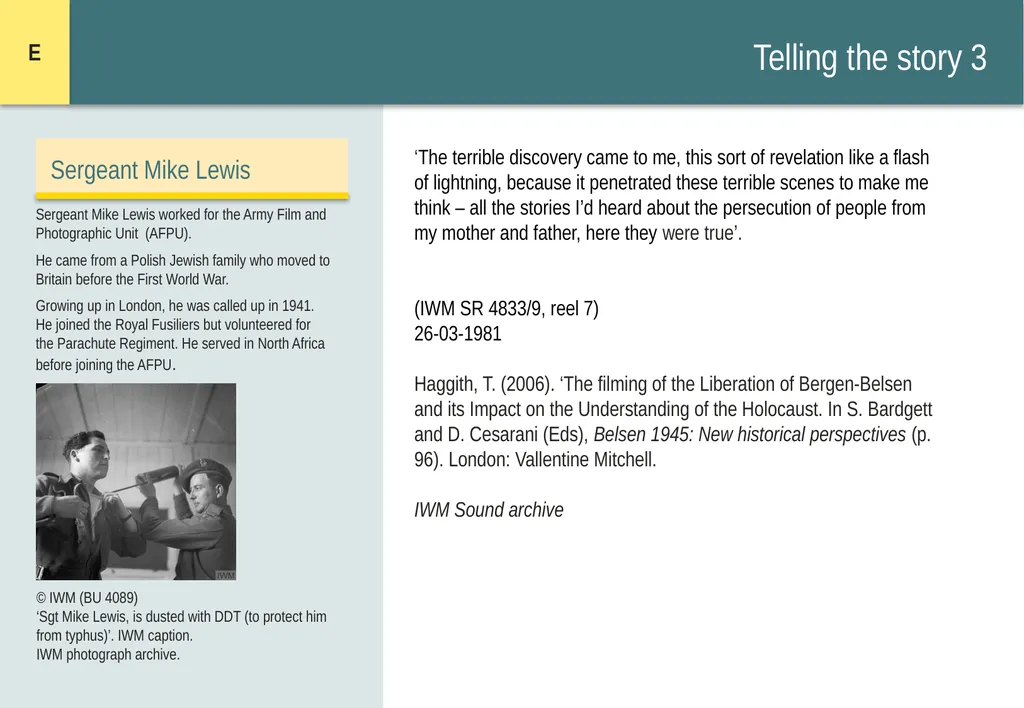
Growing up in London, he was called up in 1941. He joined the Royal Fusiliers but volunteered for the Parachute Regiment. He served in North Africa before joining the AFPU. © IWM (BU 4089)
‘Sgt Mike Lewis, is dusted with DDT (to protect him from typhus)’. IWM caption.
IWM photograph archive. E Sergeant Mike Lewis<br>
52
Telling the story 4 ‘There were no pillows, very few BP’s [bed pans] (augmented by dog bowls, no washing bowls), few towels, not enough cups [and] these had to be washed once or twice during every meal. The food consisted of coffee without milk or sugar, soup and black bread’.
21 April 1945
From the diary of Molly Silva Jones (McFarlane papers, 99/86/1).
IWM Document archive.
No name. (2006). ‘The Medical Relief Effort at Belsen: Eyewitness Accounts’. In S. Bardgett and D. Cesarani (Eds), Belsen 1945: New historical perspectives (p.55). London: Vallentine Mitchell. E Beatrice Mary (Molly) Silva Jones was one of four nurses who arrived with the Red Cross on 20th April 1945. Molly Silva Jones<br>
53
Encountering Bergen-Belsen<br>
54
This programme is delivered by UCL Centre for Holocaust Education, the Holocaust Educational Trust, with support from the National Holocaust Centre and Museum, and made possible thanks to funding from the Department for Education<br>