End of Life Choice Act Implementation Assisted Dying in New Zealand End of Life Choice Act 2019 Overview The End of Life Choice Act 2019 (the Act) comes into force on 7 November 2021. It enables people, who experience unbearable suffering
"End of Life Choice Act Implementation – Assisted" is the property of its rightful owner. Permission is granted to
download and print the materials on this website for personal, non-commercial use only, and to display it
on your personal computer provided you do not modify the materials and that you retain all copyright
notices contained in the materials. By downloading content from our website, you accept the terms of this
agreement.
Presentation Transcript
01
End of Life Choice Act Implementation – Assisted Dying in New Zealand<br>
02
End of Life Choice Act 2019 Overview The End of Life Choice Act 2019 (the Act) comes into force on 7 November 2021.
It enables people, who experience unbearable suffering from a terminal illness, and who meet all the criteria for assisted dying set out in the Act, to legally request medical assistance to end their lives.
The Act includes safeguards to ensure anyone seeking this assistance is making an informed decision of their own accord.<br>
03
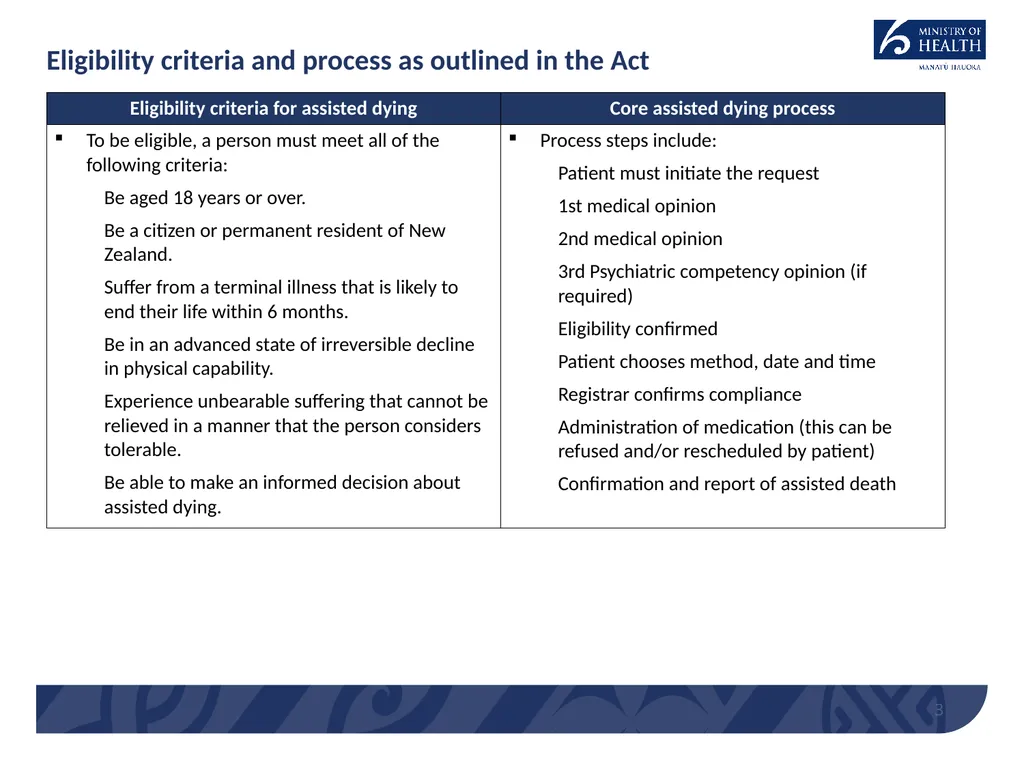
Eligibility criteria and process as outlined in the Act<br>
04
Statutory bodies and roles who have oversight of Assisted Dying<br>
05
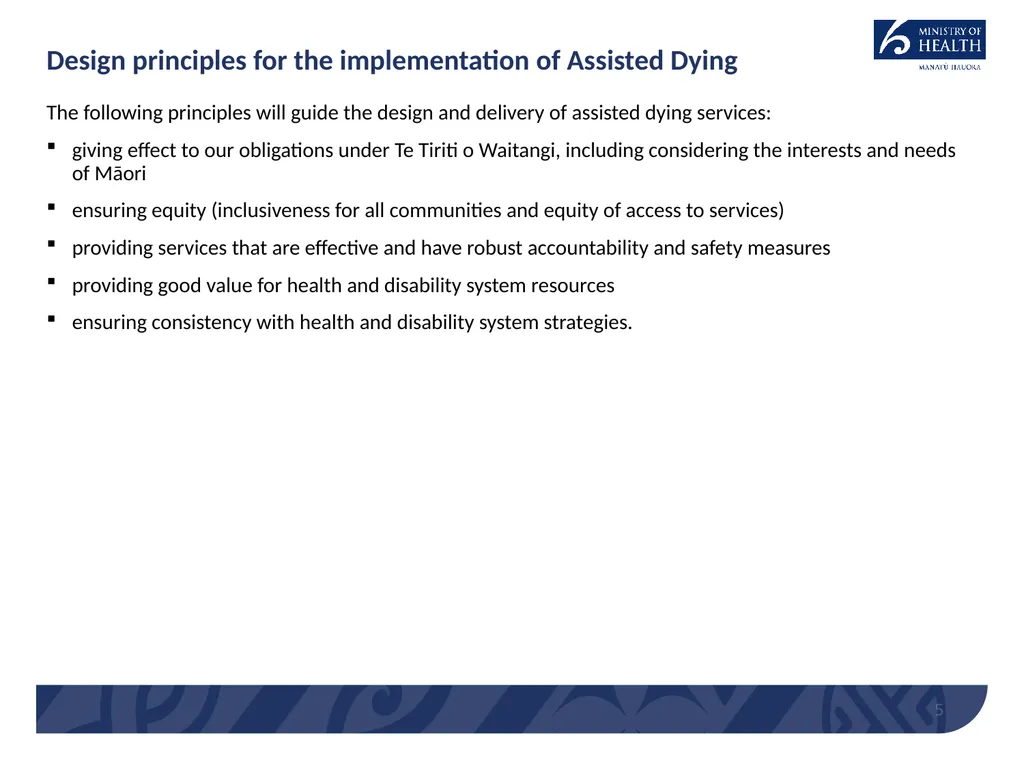
Design principles for the implementation of Assisted Dying The following principles will guide the design and delivery of assisted dying services:
giving effect to our obligations under Te Tiriti o Waitangi, including considering the interests and needs of Māori
ensuring equity (inclusiveness for all communities and equity of access to services)
providing services that are effective and have robust accountability and safety measures
providing good value for health and disability system resources
ensuring consistency with health and disability system strategies.<br>
06
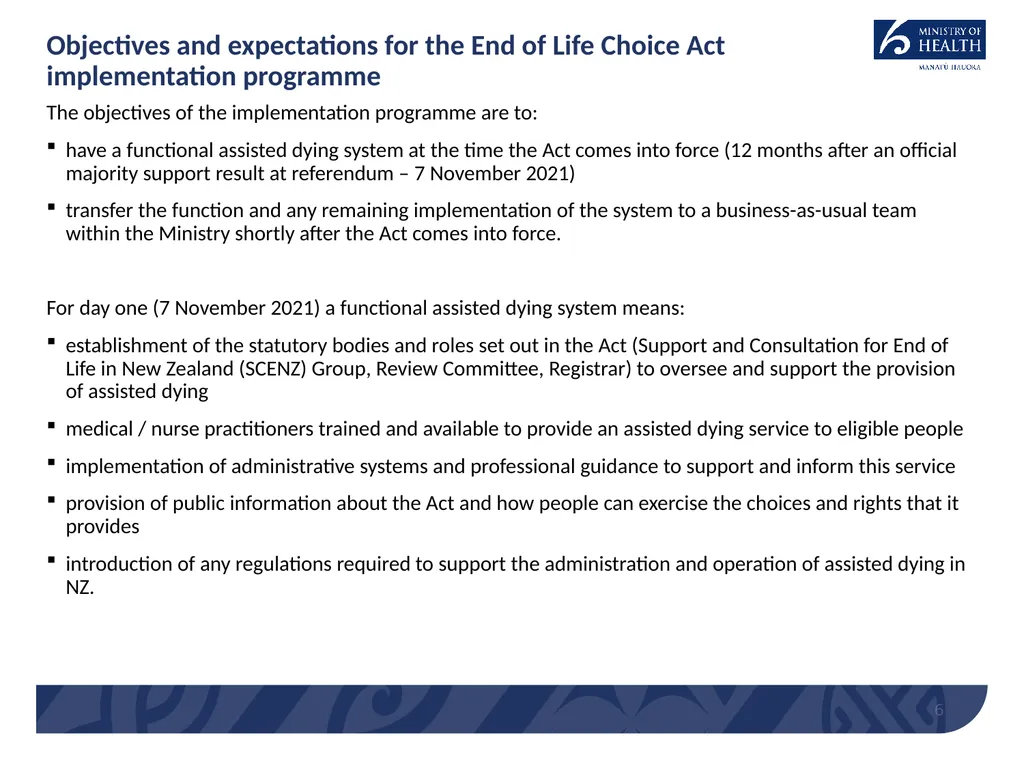
Objectives and expectations for the End of Life Choice Act implementation programme The objectives of the implementation programme are to:
have a functional assisted dying system at the time the Act comes into force (12 months after an official majority support result at referendum – 7 November 2021)
transfer the function and any remaining implementation of the system to a business-as-usual team within the Ministry shortly after the Act comes into force.
For day one (7 November 2021) a functional assisted dying system means:
establishment of the statutory bodies and roles set out in the Act (Support and Consultation for End of Life in New Zealand (SCENZ) Group, Review Committee, Registrar) to oversee and support the provision of assisted dying
medical / nurse practitioners trained and available to provide an assisted dying service to eligible people
implementation of administrative systems and professional guidance to support and inform this service
provision of public information about the Act and how people can exercise the choices and rights that it provides
introduction of any regulations required to support the administration and operation of assisted dying in NZ.<br>
07
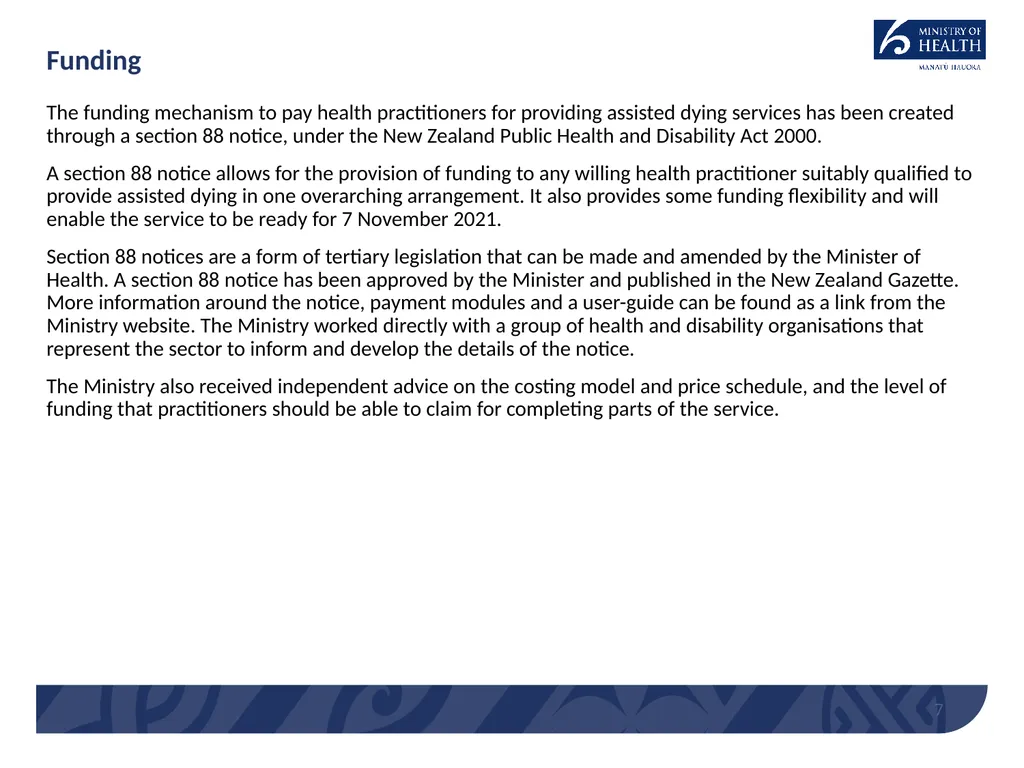
Funding The funding mechanism to pay health practitioners for providing assisted dying services has been created through a section 88 notice, under the New Zealand Public Health and Disability Act 2000.
A section 88 notice allows for the provision of funding to any willing health practitioner suitably qualified to provide assisted dying in one overarching arrangement. It also provides some funding flexibility and will enable the service to be ready for 7 November 2021.
Section 88 notices are a form of tertiary legislation that can be made and amended by the Minister of Health. A section 88 notice has been approved by the Minister and published in the New Zealand Gazette. More information around the notice, payment modules and a user-guide can be found as a link from the Ministry website. The Ministry worked directly with a group of health and disability organisations that represent the sector to inform and develop the details of the notice.
The Ministry also received independent advice on the costing model and price schedule, and the level of funding that practitioners should be able to claim for completing parts of the service.<br>
08
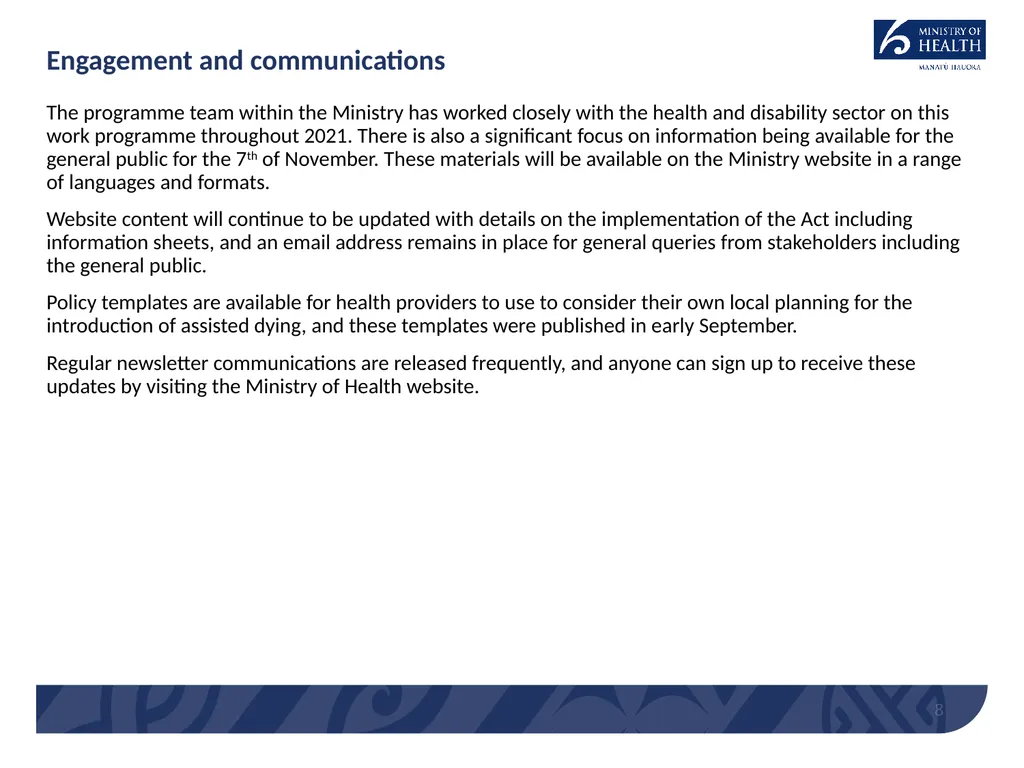
Engagement and communications The programme team within the Ministry has worked closely with the health and disability sector on this work programme throughout 2021. There is also a significant focus on information being available for the general public for the 7th of November. These materials will be available on the Ministry website in a range of languages and formats.
Website content will continue to be updated with details on the implementation of the Act including information sheets, and an email address remains in place for general queries from stakeholders including the general public.
Policy templates are available for health providers to use to consider their own local planning for the introduction of assisted dying, and these templates were published in early September.
Regular newsletter communications are released frequently, and anyone can sign up to receive these updates by visiting the Ministry of Health website.<br>
09
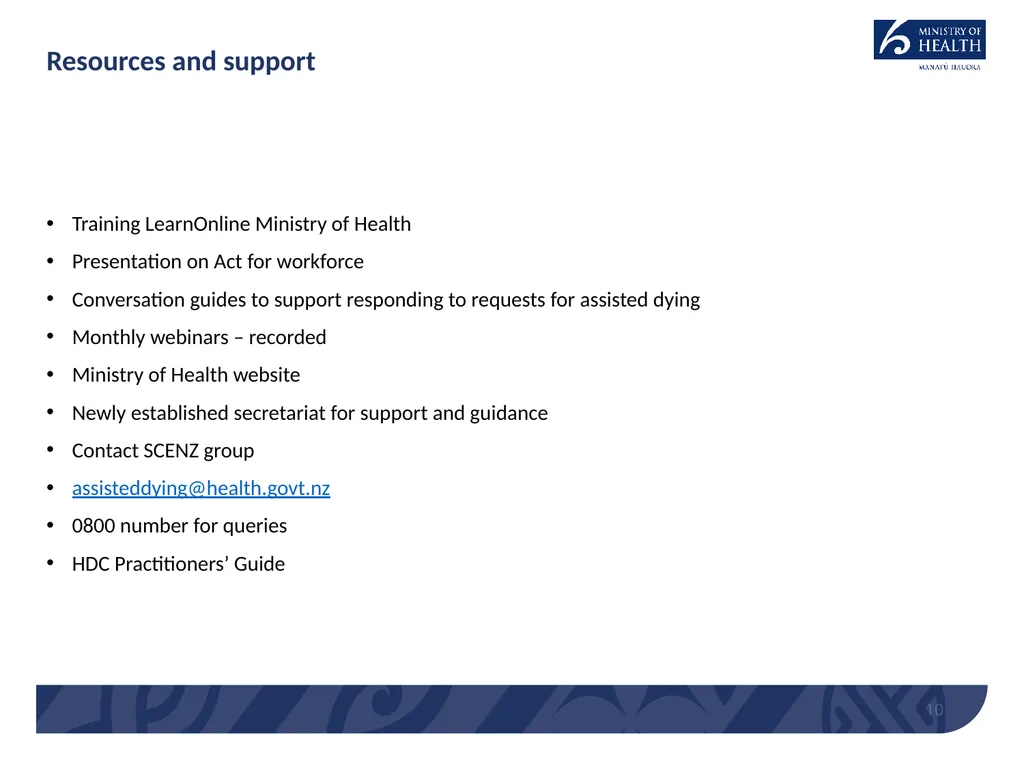
Resources and support Training LearnOnline Ministry of Health
Presentation on Act for workforce
Conversation guides to support responding to requests for assisted dying
Monthly webinars – recorded
Ministry of Health website
Newly established secretariat for support and guidance
Contact SCENZ group
assisteddying@health.govt.nz
0800 number for queries
HDC Practitioners’ Guide<br>
10
The lay perspective “Assisted dying services must be marinated in integrity. Clinicians need to bring their best compassionate self to the table.”<br>
11
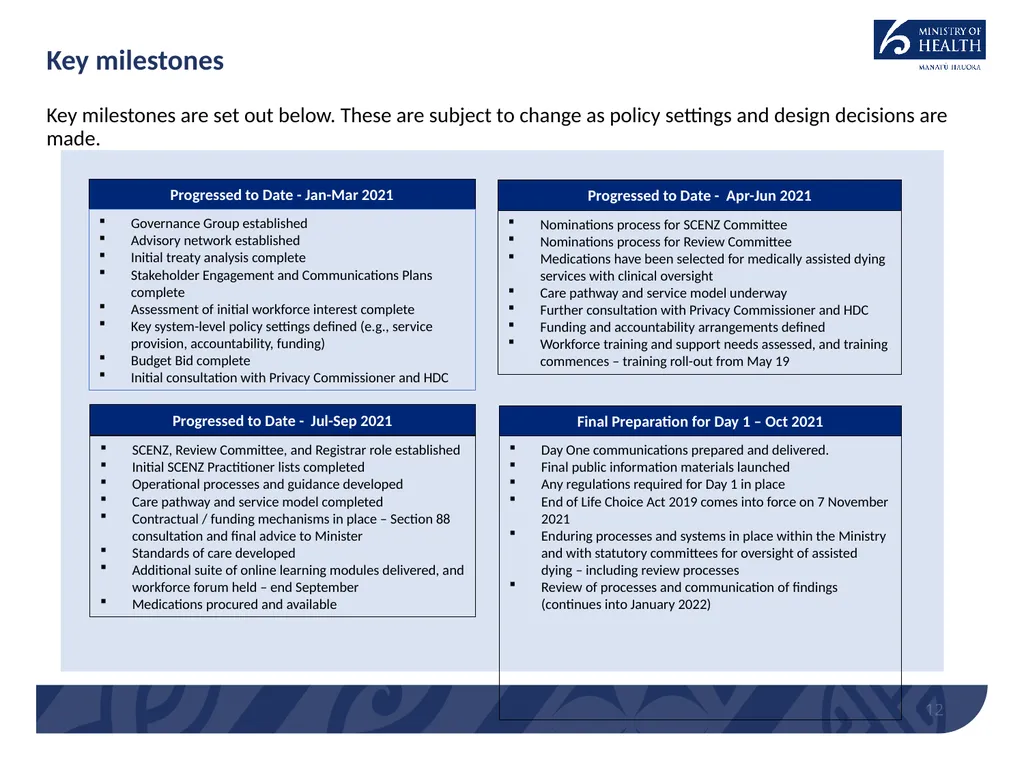
Key milestones Key milestones are set out below. These are subject to change as policy settings and design decisions are made. Final Preparation for Day 1 – Oct 2021 Day One communications prepared and delivered.
Final public information materials launched
Any regulations required for Day 1 in place
End of Life Choice Act 2019 comes into force on 7 November 2021
Enduring processes and systems in place within the Ministry and with statutory committees for oversight of assisted dying – including review processes
Review of processes and communication of findings (continues into January 2022) Progressed to Date - Apr-Jun 2021 Nominations process for SCENZ Committee
Nominations process for Review Committee
Medications have been selected for medically assisted dying services with clinical oversight
Care pathway and service model underway
Further consultation with Privacy Commissioner and HDC
Funding and accountability arrangements defined
Workforce training and support needs assessed, and training commences – training roll-out from May 19 Progressed to Date - Jul-Sep 2021 SCENZ, Review Committee, and Registrar role established
Initial SCENZ Practitioner lists completed
Operational processes and guidance developed
Care pathway and service model completed
Contractual / funding mechanisms in place – Section 88 consultation and final advice to Minister
Standards of care developed
Additional suite of online learning modules delivered, and workforce forum held – end September
Medications procured and available<br>
12
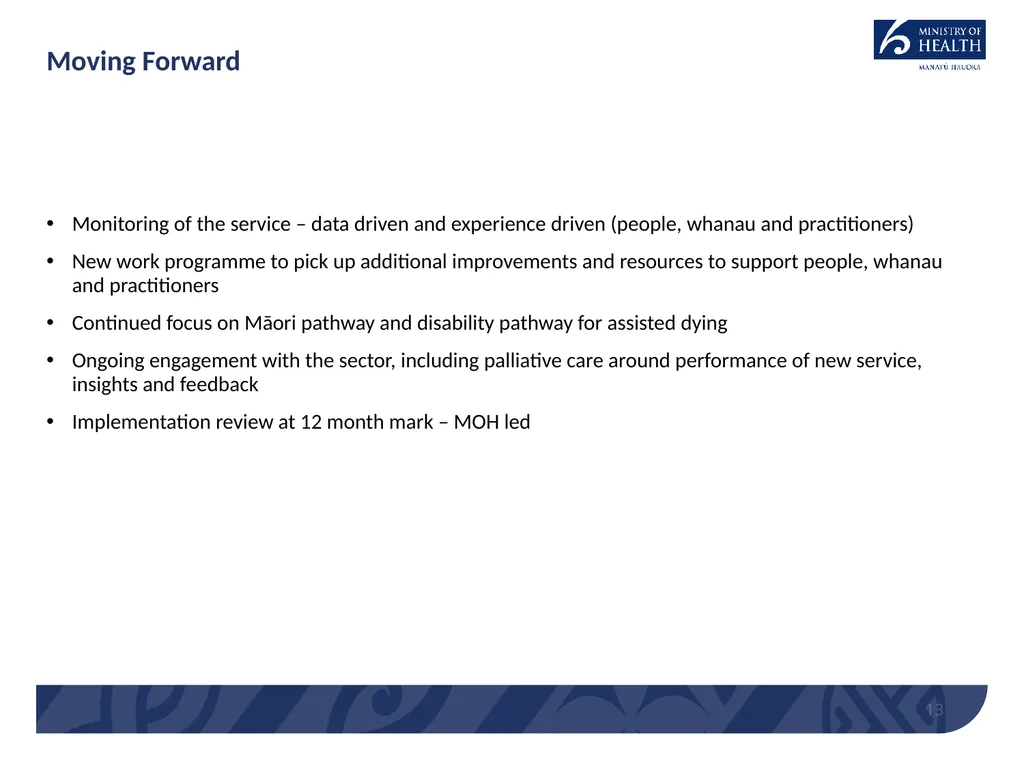
Moving Forward Monitoring of the service – data driven and experience driven (people, whanau and practitioners)
New work programme to pick up additional improvements and resources to support people, whanau and practitioners
Continued focus on Māori pathway and disability pathway for assisted dying
Ongoing engagement with the sector, including palliative care around performance of new service, insights and feedback
Implementation review at 12 month mark – MOH led<br>