
EndoMEtriosis: Advocating for Yourself Before &
YM
Published · 40 slides · 0 views

1 / 1




Description
EndoMEtriosis: Advocating for Yourself Before After Surgery Wendy K. Winer, R.N., B.S.N., CNOR, RNFA Endoscopic Surgery Specialist Director of Research and Technology Development Center for Endometriosis Care Atlanta, GA Riverside
Related Topics
Share
Embed code
Download this presentation From Below
"EndoMEtriosis: Advocating for Yourself Before &" is the property of its rightful owner. Permission is granted to download and print the materials on this website for personal, non-commercial use only, and to display it on your personal computer provided you do not modify the materials and that you retain all copyright notices contained in the materials. By downloading content from our website, you accept the terms of this agreement.
Presentation Transcript
01
EndoMEtriosis:
Advocating for Yourself
Before & After Surgery Wendy K. Winer, R.N., B.S.N., CNOR, RNFA
Endoscopic Surgery Specialist
Director of Research and Technology Development
Center for Endometriosis Care | Atlanta, GA
Riverside Medical Clinic Charity Foundation | March 16, 2020<br>
Director of Research and Technology Development
Center for Endometriosis Care | Atlanta, GA
Riverside Medical Clinic Charity Foundation | March 16, 2020<br>
02
Disclosures No financial relationships to disclose. Copyright © Center for Endometriosis Care & Kenny R. Sinervo MD FRCSC LLC except where otherwise noted. No use or reproduction permitted without express permission.<br>
03
Disclaimers This presentation is provided for educational purposes only. No information herein may be construed as medical advice or directive. Any and all material(s) presented are offered strictly for informational purposes only. Such material neither offers nor replaces medical advice given by your personal physicians and/or healthcare professionals. No portion of this presentation should be considered as party to any CEC doctor/patient relationship. Materials presented are suited for an international audience, but may contain references to products or other data pertinent to the United States and its territories. This presentation may contain organizational, brand name, generic and/or other specific personnel or product mention(s), including those products intended for either on- or off-label usage. Such inclusion herein does not imply any endorsement by or affiliation with the Center for Endometriosis Care. All contents herein are © copyright by the Center for Endometriosis Care/Kenny R. Sinervo MD MSc, LLC except where otherwise explicitly noted. All rights reserved. Absolutely no part of this presentation may be shared with third parties, reproduced or utilized in any form, including electronic or mechanical, photocopying, recording or by any information storage and retrieval system. Thank you. Copyright © Center for Endometriosis Care & Kenny R. Sinervo MD FRCSC LLC except where otherwise noted. No use or reproduction permitted without express permission.<br>
04
Objectives Define endometriosis as systemic and potentially chronic condition.
Review what to ask the doctor when choosing a physician for your care.
Understand how to best prepare for surgery.
Illustrate how to enhance healing postoperatively.
Discuss how to advocate for yourself to ensure you are the leader of your healthcare team. Copyright © Center for Endometriosis Care & Kenny R. Sinervo MD FRCSC LLC except where otherwise noted. No use or reproduction permitted without express permission.<br>
Review what to ask the doctor when choosing a physician for your care.
Understand how to best prepare for surgery.
Illustrate how to enhance healing postoperatively.
Discuss how to advocate for yourself to ensure you are the leader of your healthcare team. Copyright © Center for Endometriosis Care & Kenny R. Sinervo MD FRCSC LLC except where otherwise noted. No use or reproduction permitted without express permission.<br>
05
Endometriosis: a Systemic Disease ‘Endometriosis, a major contributor to pain and subfertility, is characterized by endometrial-like tissue found outside the uterus. The disease is primarily found on the pelvic peritoneum, ovaries and rectovaginal septum, but also in less common areas outside the pelvis such as the diaphragm or lungs.’ - Giudice LC. Clinical practice. Endometriosis. N Engl J Med. 2010;362(25):2389–2398.
Common symptoms (include but are not limited to):
Severe period pain in people who menstruate
Abdominopelvic pain at any time, often intractable and chronic (meaning 6 months or longer of non-menstrual pelvic pain)
Bowel or urinary disorders/pain/dysfunction
Painful intercourse/penetration/sexual activity
Pain with tampon insertion/inability to use tampons due to pain
Infertility/pregnancy loss/possible link to preterm births/pregnancy complications
Possible immune-related and other comorbid disorders
Coughing up blood in cases of pleural/thoracic endometriosis
Leg and lower back pain, particularly in cases of sciatic endometriosis<br>
Common symptoms (include but are not limited to):
Severe period pain in people who menstruate
Abdominopelvic pain at any time, often intractable and chronic (meaning 6 months or longer of non-menstrual pelvic pain)
Bowel or urinary disorders/pain/dysfunction
Painful intercourse/penetration/sexual activity
Pain with tampon insertion/inability to use tampons due to pain
Infertility/pregnancy loss/possible link to preterm births/pregnancy complications
Possible immune-related and other comorbid disorders
Coughing up blood in cases of pleural/thoracic endometriosis
Leg and lower back pain, particularly in cases of sciatic endometriosis<br>
06
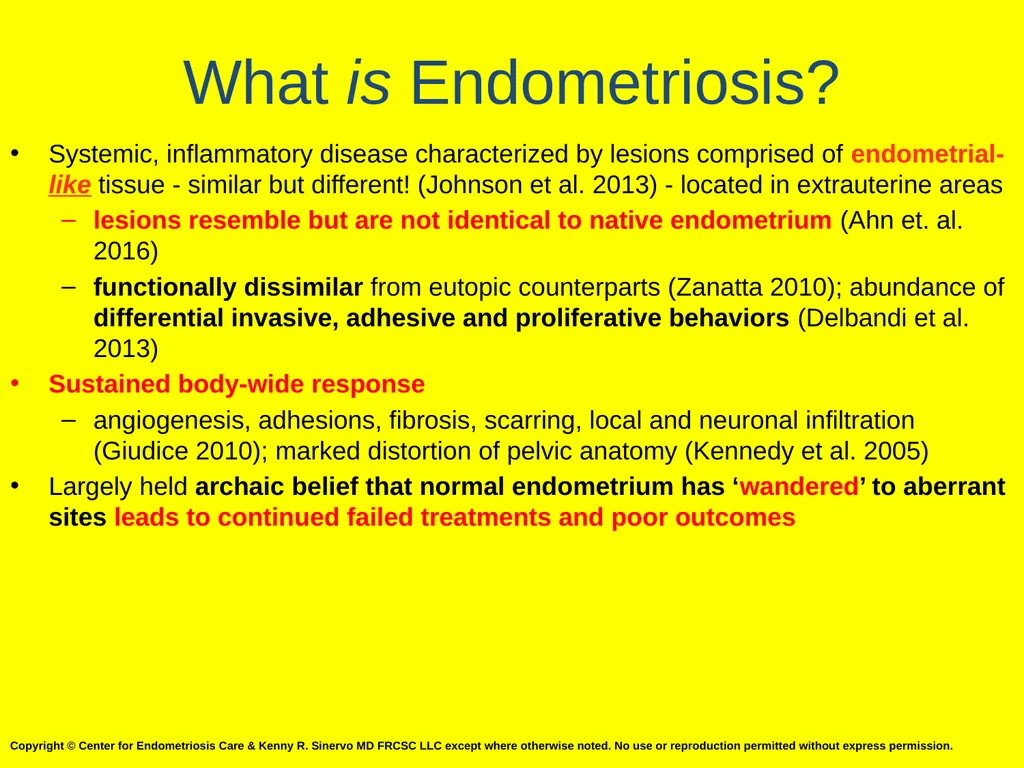
What is Endometriosis? Systemic, inflammatory disease characterized by lesions comprised of endometrial-like tissue - similar but different! (Johnson et al. 2013) - located in extrauterine areas
lesions resemble but are not identical to native endometrium (Ahn et. al. 2016)
functionally dissimilar from eutopic counterparts (Zanatta 2010); abundance of differential invasive, adhesive and proliferative behaviors (Delbandi et al. 2013)
Sustained body-wide response
angiogenesis, adhesions, fibrosis, scarring, local and neuronal infiltration (Giudice 2010); marked distortion of pelvic anatomy (Kennedy et al. 2005)
Largely held archaic belief that normal endometrium has ‘wandered’ to aberrant sites leads to continued failed treatments and poor outcomes Copyright © Center for Endometriosis Care & Kenny R. Sinervo MD FRCSC LLC except where otherwise noted. No use or reproduction permitted without express permission.<br>
lesions resemble but are not identical to native endometrium (Ahn et. al. 2016)
functionally dissimilar from eutopic counterparts (Zanatta 2010); abundance of differential invasive, adhesive and proliferative behaviors (Delbandi et al. 2013)
Sustained body-wide response
angiogenesis, adhesions, fibrosis, scarring, local and neuronal infiltration (Giudice 2010); marked distortion of pelvic anatomy (Kennedy et al. 2005)
Largely held archaic belief that normal endometrium has ‘wandered’ to aberrant sites leads to continued failed treatments and poor outcomes Copyright © Center for Endometriosis Care & Kenny R. Sinervo MD FRCSC LLC except where otherwise noted. No use or reproduction permitted without express permission.<br>
07
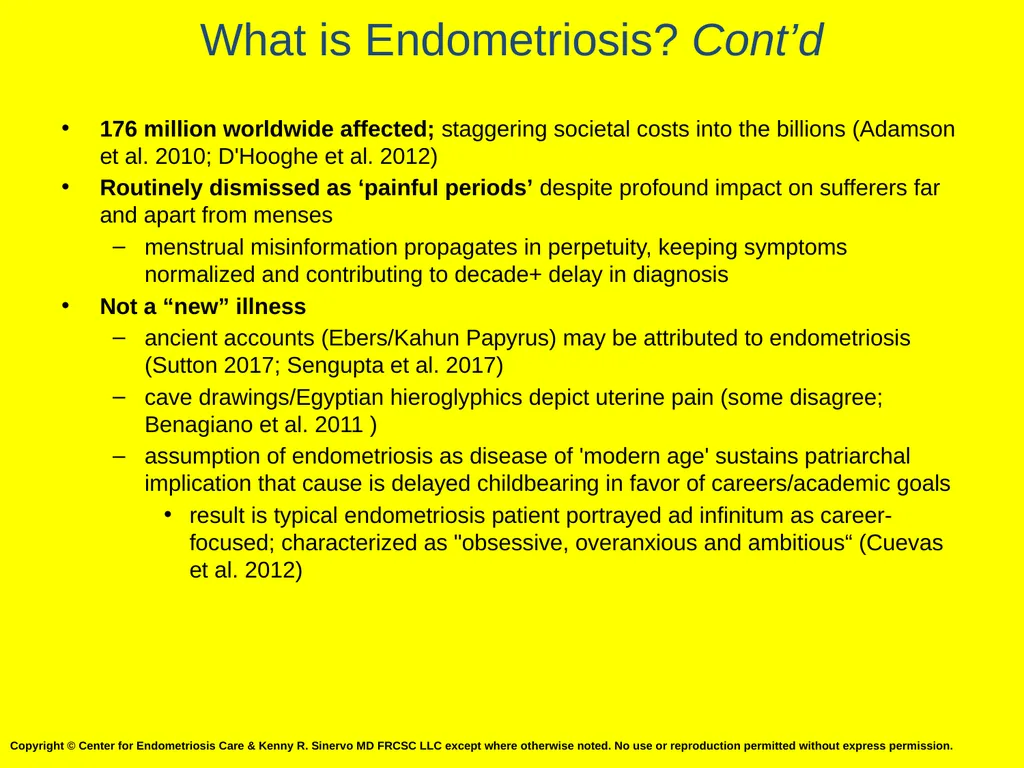
What is Endometriosis? Cont’d 176 million worldwide affected; staggering societal costs into the billions (Adamson et al. 2010; D'Hooghe et al. 2012)
Routinely dismissed as ‘painful periods’ despite profound impact on sufferers far and apart from menses
menstrual misinformation propagates in perpetuity, keeping symptoms normalized and contributing to decade+ delay in diagnosis
Not a “new” illness
ancient accounts (Ebers/Kahun Papyrus) may be attributed to endometriosis (Sutton 2017; Sengupta et al. 2017)
cave drawings/Egyptian hieroglyphics depict uterine pain (some disagree; Benagiano et al. 2011 )
assumption of endometriosis as disease of 'modern age' sustains patriarchal implication that cause is delayed childbearing in favor of careers/academic goals
result is typical endometriosis patient portrayed ad infinitum as career-focused; characterized as "obsessive, overanxious and ambitious“ (Cuevas et al. 2012) Copyright © Center for Endometriosis Care & Kenny R. Sinervo MD FRCSC LLC except where otherwise noted. No use or reproduction permitted without express permission.<br>
Routinely dismissed as ‘painful periods’ despite profound impact on sufferers far and apart from menses
menstrual misinformation propagates in perpetuity, keeping symptoms normalized and contributing to decade+ delay in diagnosis
Not a “new” illness
ancient accounts (Ebers/Kahun Papyrus) may be attributed to endometriosis (Sutton 2017; Sengupta et al. 2017)
cave drawings/Egyptian hieroglyphics depict uterine pain (some disagree; Benagiano et al. 2011 )
assumption of endometriosis as disease of 'modern age' sustains patriarchal implication that cause is delayed childbearing in favor of careers/academic goals
result is typical endometriosis patient portrayed ad infinitum as career-focused; characterized as "obsessive, overanxious and ambitious“ (Cuevas et al. 2012) Copyright © Center for Endometriosis Care & Kenny R. Sinervo MD FRCSC LLC except where otherwise noted. No use or reproduction permitted without express permission.<br>
08
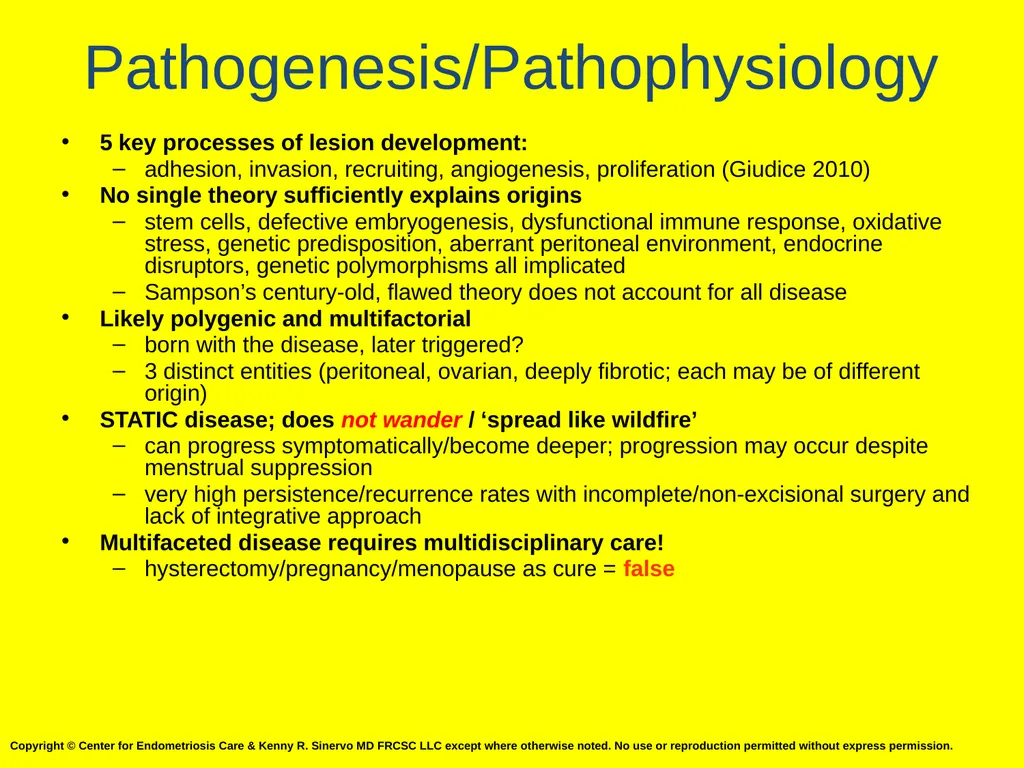
Pathogenesis/Pathophysiology 5 key processes of lesion development:
adhesion, invasion, recruiting, angiogenesis, proliferation (Giudice 2010)
No single theory sufficiently explains origins
stem cells, defective embryogenesis, dysfunctional immune response, oxidative stress, genetic predisposition, aberrant peritoneal environment, endocrine disruptors, genetic polymorphisms all implicated
Sampson’s century-old, flawed theory does not account for all disease
Likely polygenic and multifactorial
born with the disease, later triggered?
3 distinct entities (peritoneal, ovarian, deeply fibrotic; each may be of different origin)
STATIC disease; does not wander / ‘spread like wildfire’
can progress symptomatically/become deeper; progression may occur despite menstrual suppression
very high persistence/recurrence rates with incomplete/non-excisional surgery and lack of integrative approach
Multifaceted disease requires multidisciplinary care!
hysterectomy/pregnancy/menopause as cure = false Copyright © Center for Endometriosis Care & Kenny R. Sinervo MD FRCSC LLC except where otherwise noted. No use or reproduction permitted without express permission.<br>
adhesion, invasion, recruiting, angiogenesis, proliferation (Giudice 2010)
No single theory sufficiently explains origins
stem cells, defective embryogenesis, dysfunctional immune response, oxidative stress, genetic predisposition, aberrant peritoneal environment, endocrine disruptors, genetic polymorphisms all implicated
Sampson’s century-old, flawed theory does not account for all disease
Likely polygenic and multifactorial
born with the disease, later triggered?
3 distinct entities (peritoneal, ovarian, deeply fibrotic; each may be of different origin)
STATIC disease; does not wander / ‘spread like wildfire’
can progress symptomatically/become deeper; progression may occur despite menstrual suppression
very high persistence/recurrence rates with incomplete/non-excisional surgery and lack of integrative approach
Multifaceted disease requires multidisciplinary care!
hysterectomy/pregnancy/menopause as cure = false Copyright © Center for Endometriosis Care & Kenny R. Sinervo MD FRCSC LLC except where otherwise noted. No use or reproduction permitted without express permission.<br>
09
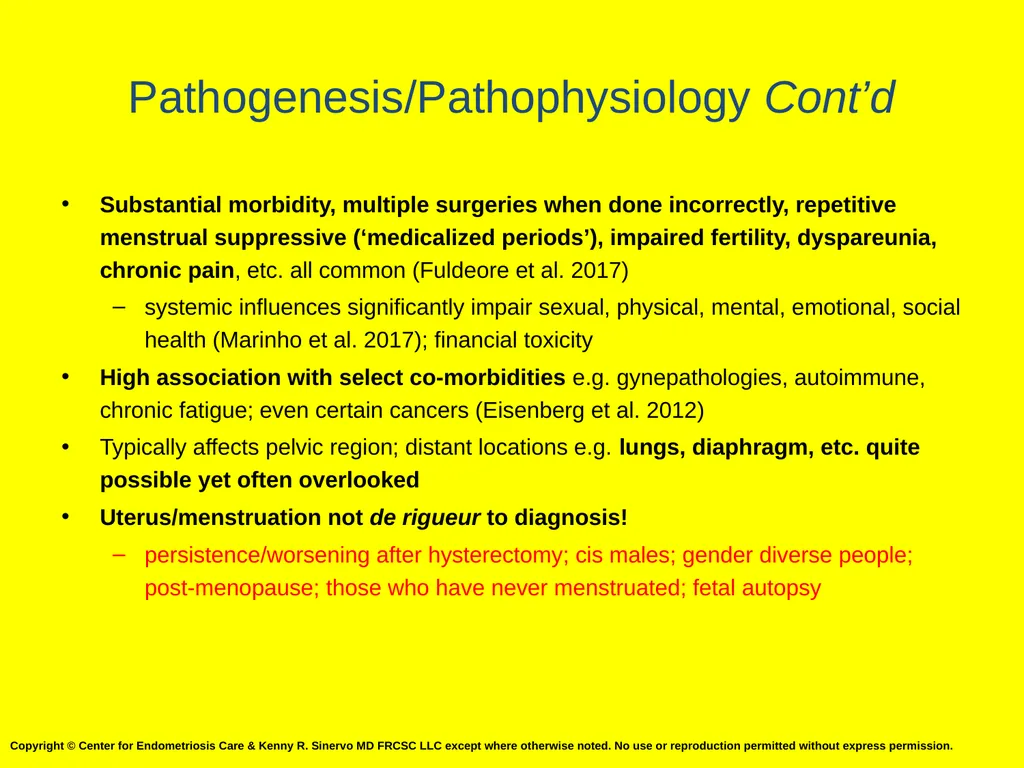
Pathogenesis/Pathophysiology Cont’d Substantial morbidity, multiple surgeries when done incorrectly, repetitive menstrual suppressive (‘medicalized periods’), impaired fertility, dyspareunia, chronic pain, etc. all common (Fuldeore et al. 2017)
systemic influences significantly impair sexual, physical, mental, emotional, social health (Marinho et al. 2017); financial toxicity
High association with select co-morbidities e.g. gynepathologies, autoimmune, chronic fatigue; even certain cancers (Eisenberg et al. 2012)
Typically affects pelvic region; distant locations e.g. lungs, diaphragm, etc. quite possible yet often overlooked
Uterus/menstruation not de rigueur to diagnosis!
persistence/worsening after hysterectomy; cis males; gender diverse people; post-menopause; those who have never menstruated; fetal autopsy Copyright © Center for Endometriosis Care & Kenny R. Sinervo MD FRCSC LLC except where otherwise noted. No use or reproduction permitted without express permission.<br>
systemic influences significantly impair sexual, physical, mental, emotional, social health (Marinho et al. 2017); financial toxicity
High association with select co-morbidities e.g. gynepathologies, autoimmune, chronic fatigue; even certain cancers (Eisenberg et al. 2012)
Typically affects pelvic region; distant locations e.g. lungs, diaphragm, etc. quite possible yet often overlooked
Uterus/menstruation not de rigueur to diagnosis!
persistence/worsening after hysterectomy; cis males; gender diverse people; post-menopause; those who have never menstruated; fetal autopsy Copyright © Center for Endometriosis Care & Kenny R. Sinervo MD FRCSC LLC except where otherwise noted. No use or reproduction permitted without express permission.<br>
10
Patient-Centered Care “That which honors patients' preferences, needs, and values; applies a biopsychosocial perspective rather than a purely biomedical perspective; and forges a strong partnership between patient and clinician.”-Greene et al. 2012
Imperative for all health systems to practice, from solo practitioner to large multispecialty group to federally qualified health center providing care to underserved populations alike<br>
Imperative for all health systems to practice, from solo practitioner to large multispecialty group to federally qualified health center providing care to underserved populations alike<br>
11
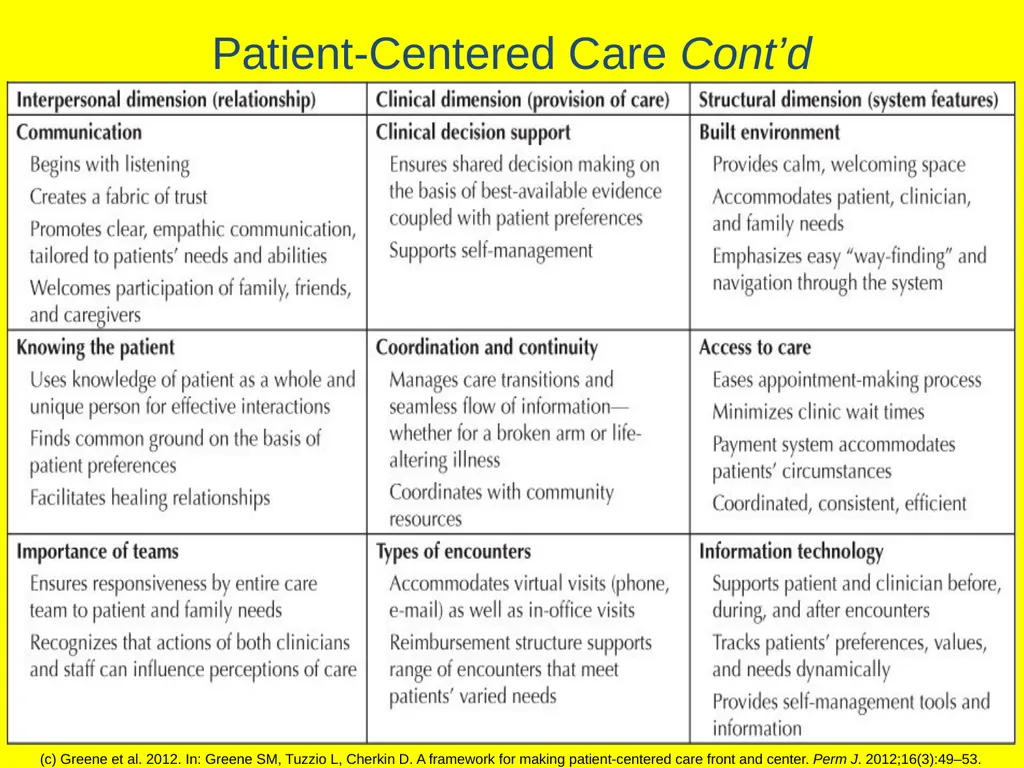
Patient-Centered Care Cont’d (c) Greene et al. 2012. In: Greene SM, Tuzzio L, Cherkin D. A framework for making patient-centered care front and center. Perm J. 2012;16(3):49–53.<br>
12
Patient-Centered Care in Endometriosis “Management should be shaped on the main clinical problem, taking into consideration a woman's preferences and priorities. Quantitative information should be provided to describe the potential benefits, potential harms, and costs of each treatment alternative. Counseling should be complete and transparent, and the duty of the caring gynecologist is to inform the woman on the pros and cons of each option and support her in the shared decision-making process. The physician should be able to look the patient in the eye and explain in detail all the available treatments, and not only those that the physician prefers or is able to offer.”
Vercellini P. Introduction: Management of endometriosis: moving toward a problem-oriented and patient-centered approach. Fertil Steril. 2015;104(4):761–763.<br>
Vercellini P. Introduction: Management of endometriosis: moving toward a problem-oriented and patient-centered approach. Fertil Steril. 2015;104(4):761–763.<br>
13
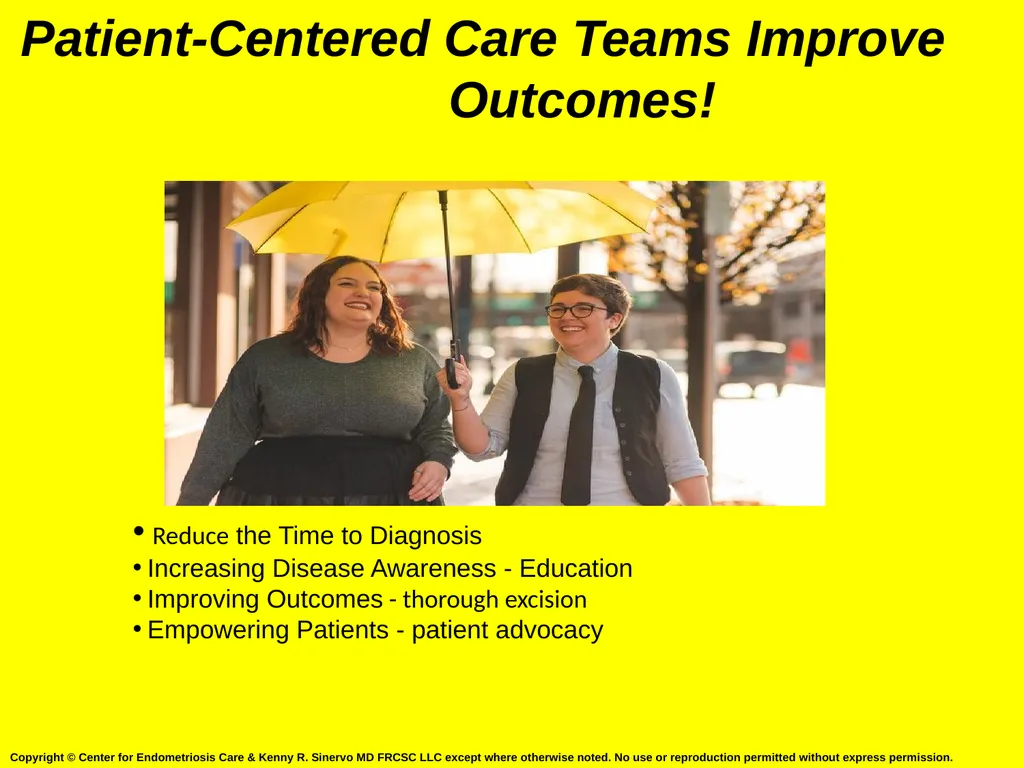
Copyright © Center for Endometriosis Care & Kenny R. Sinervo MD FRCSC LLC except where otherwise noted. No use or reproduction permitted without express permission. Patient-Centered Care Teams Improve Outcomes! Reduce the Time to Diagnosis
Increasing Disease Awareness - Education
Improving Outcomes - thorough excision
Empowering Patients - patient advocacy<br>
Increasing Disease Awareness - Education
Improving Outcomes - thorough excision
Empowering Patients - patient advocacy<br>
14
Diagnosis Endometriosis is a SURGICAL diagnosis; anything less than biopsy confirmation is considered uncertain
Physical examination has poor sensitivity, specificity and predictive value
Combination of history, physical examination and laboratory/diagnostic studies may help rule out non-endometriosis concerns
Imaging (office vaginal u/s by the physician) can help isolate location-specific disease e.g. nodular mass in posterior rectovaginal septum, ovaries, uterus etc.
Absence of evidence is not evidence of absence!
82% of gynecologists admit to not being able to perform advanced laparoscopic surgery – when in doubt, refer them out! Copyright © Center for Endometriosis Care & Kenny R. Sinervo MD FRCSC LLC except where otherwise noted. No use or reproduction permitted without express permission.<br>
Physical examination has poor sensitivity, specificity and predictive value
Combination of history, physical examination and laboratory/diagnostic studies may help rule out non-endometriosis concerns
Imaging (office vaginal u/s by the physician) can help isolate location-specific disease e.g. nodular mass in posterior rectovaginal septum, ovaries, uterus etc.
Absence of evidence is not evidence of absence!
82% of gynecologists admit to not being able to perform advanced laparoscopic surgery – when in doubt, refer them out! Copyright © Center for Endometriosis Care & Kenny R. Sinervo MD FRCSC LLC except where otherwise noted. No use or reproduction permitted without express permission.<br>
15
Endometriosis Treatments Laparoscopic Excision (LAPEX) – permits both diagnostic confirmation via biopsy and treatment; most effective way of treating both superficial and deeply invasive disease and allowing for histological confirmation
Confers high rates of symptomatic relief (Redwine et al.)
Restores normal anatomy and treats pelvic pain, infertility, or both by sharply dissecting and excision of deep fibrotic nodules which may be causing partial or complete cul-de-sac obliteration Copyright © Center for Endometriosis Care & Kenny R. Sinervo MD FRCSC LLC except where otherwise noted. No use or reproduction permitted without express permission.<br>
Confers high rates of symptomatic relief (Redwine et al.)
Restores normal anatomy and treats pelvic pain, infertility, or both by sharply dissecting and excision of deep fibrotic nodules which may be causing partial or complete cul-de-sac obliteration Copyright © Center for Endometriosis Care & Kenny R. Sinervo MD FRCSC LLC except where otherwise noted. No use or reproduction permitted without express permission.<br>
16
Treatments Cont’d Medical suppressives - gonadotropin-releasing hormone agonists and antagonists (GnRH), oral contraceptives, Danazol®, aromatase inhibitors and progestins are mainstays – only temporary effect
No evidence that medical treatment improves fertility; fertility eliminated during treatments as medical suppression inhibits ovulation
Rationale is to induce amenorrhea and create hypoestrogenic environment, theoretically inhibiting growths
Side effects may be intolerable for some; symptoms recur upon cessation of therapy
Selection of medical therapy often depends on physician experience and preference, not efficacy Copyright © Center for Endometriosis Care & Kenny R. Sinervo MD FRCSC LLC except where otherwise noted. No use or reproduction permitted without express permission.<br>
No evidence that medical treatment improves fertility; fertility eliminated during treatments as medical suppression inhibits ovulation
Rationale is to induce amenorrhea and create hypoestrogenic environment, theoretically inhibiting growths
Side effects may be intolerable for some; symptoms recur upon cessation of therapy
Selection of medical therapy often depends on physician experience and preference, not efficacy Copyright © Center for Endometriosis Care & Kenny R. Sinervo MD FRCSC LLC except where otherwise noted. No use or reproduction permitted without express permission.<br>
17
Treatment - is not just surgery Pelvic Floor Therapy
Pain Management
Naturopathy/Exercise/Osteopathy (meditation, yoga, breathing exercises…)
Diet & Nutrition
Combination Therapies
Role of support groups/psychological support cannot be undervalued Copyright © Center for Endometriosis Care & Kenny R. Sinervo MD FRCSC LLC except where otherwise noted. No use or reproduction permitted without express permission.<br>
Pain Management
Naturopathy/Exercise/Osteopathy (meditation, yoga, breathing exercises…)
Diet & Nutrition
Combination Therapies
Role of support groups/psychological support cannot be undervalued Copyright © Center for Endometriosis Care & Kenny R. Sinervo MD FRCSC LLC except where otherwise noted. No use or reproduction permitted without express permission.<br>
18
Who is the person you love more than anyone? 1.Take care of your patient the way you would take care of your closest loved one.
2.Imagine how you would feel if that patient was you.
3.Imagine how you would feel if you were that patient’s parent, spouse/partner or daughter…<br>
2.Imagine how you would feel if that patient was you.
3.Imagine how you would feel if you were that patient’s parent, spouse/partner or daughter…<br>
19
Care of Patients in the Intraoperative Setting:
Know Your Equipment & Instrumentation, Troubleshooting and Guaranteed ways to Improve Efficiency in the O.R. O.R. etiquette - professionalism - empathy, compassion/focus on pt care.
Anesthesia – monitors, IV, positioning, temperature (before/during/after)
Patient positioning – patient safety and comfort - pt hx
Patient allergies – prep, adhesives, latex
Time out – procedure, unilaterality, antibiotics, allergies
Efficiency and safety – ongoing, not just when things are new! (insufflation, cameras, light sources, suction/irrigation, energy sources) Copyright © Center for Endometriosis Care & Kenny R. Sinervo MD FRCSC LLC except where otherwise noted. No use or reproduction permitted without express permission.<br>
Anesthesia – monitors, IV, positioning, temperature (before/during/after)
Patient positioning – patient safety and comfort - pt hx
Patient allergies – prep, adhesives, latex
Time out – procedure, unilaterality, antibiotics, allergies
Efficiency and safety – ongoing, not just when things are new! (insufflation, cameras, light sources, suction/irrigation, energy sources) Copyright © Center for Endometriosis Care & Kenny R. Sinervo MD FRCSC LLC except where otherwise noted. No use or reproduction permitted without express permission.<br>
20
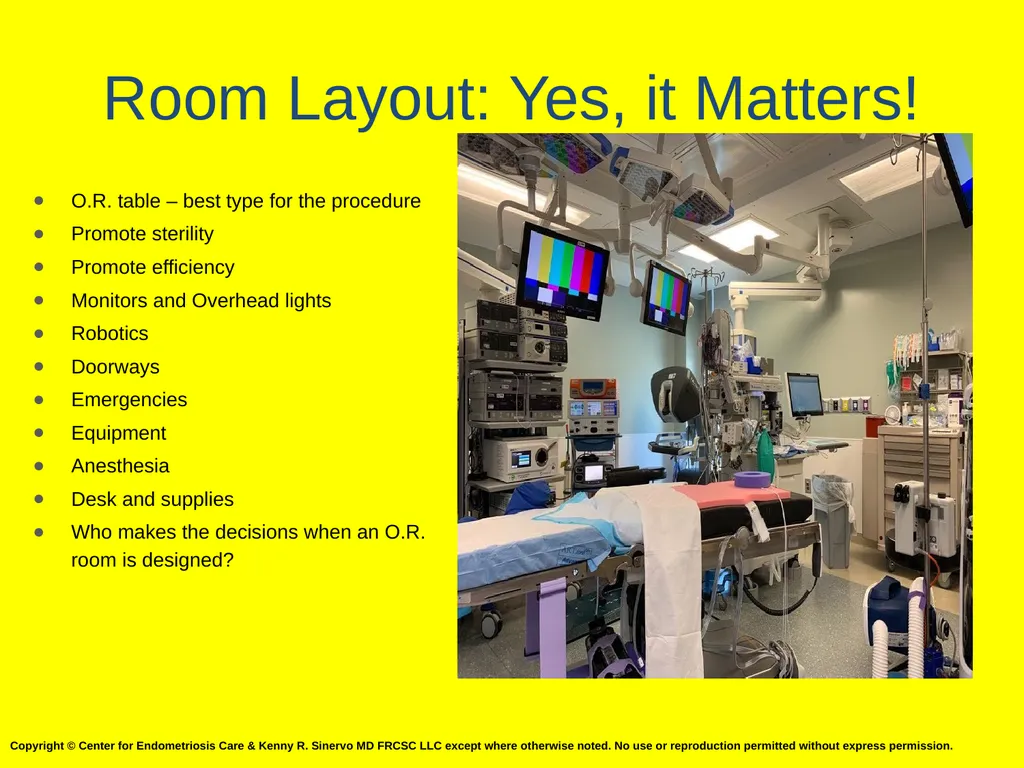
Room Layout: Yes, it Matters! O.R. table – best type for the procedure
Promote sterility
Promote efficiency
Monitors and Overhead lights
Robotics
Doorways
Emergencies
Equipment
Anesthesia
Desk and supplies
Who makes the decisions when an O.R. room is designed? Copyright © Center for Endometriosis Care & Kenny R. Sinervo MD FRCSC LLC except where otherwise noted. No use or reproduction permitted without express permission.<br>
Promote sterility
Promote efficiency
Monitors and Overhead lights
Robotics
Doorways
Emergencies
Equipment
Anesthesia
Desk and supplies
Who makes the decisions when an O.R. room is designed? Copyright © Center for Endometriosis Care & Kenny R. Sinervo MD FRCSC LLC except where otherwise noted. No use or reproduction permitted without express permission.<br>
21
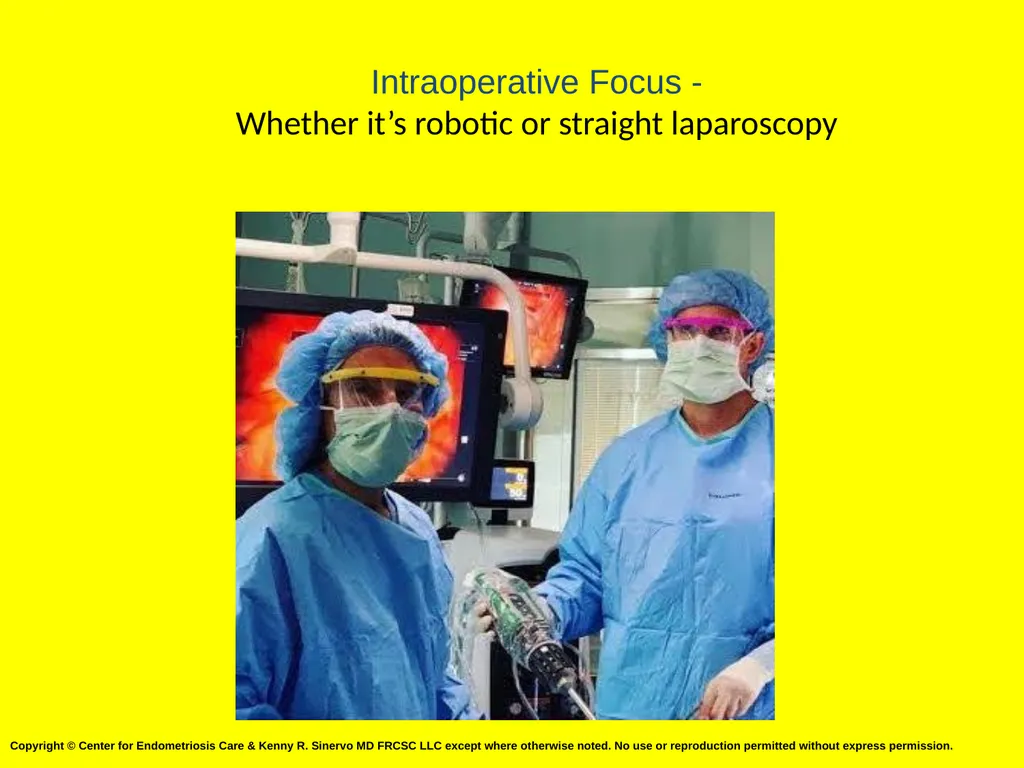
Intraoperative Focus -
Whether it’s robotic or straight laparoscopy Copyright © Center for Endometriosis Care & Kenny R. Sinervo MD FRCSC LLC except where otherwise noted. No use or reproduction permitted without express permission.<br>
Whether it’s robotic or straight laparoscopy Copyright © Center for Endometriosis Care & Kenny R. Sinervo MD FRCSC LLC except where otherwise noted. No use or reproduction permitted without express permission.<br>
22
Team:
Working Together for the Patient Who’s in charge?
Always introduce yourself if you’re a visitor no matter who you are…proper ID for everyone
TEAM – FOCUS
Team – respect and communication among the team
Morale
“The surgeon is the captain of the ship”
Music?
Patient safety is ALWAYS NUMBER ONE!!!! Copyright © Center for Endometriosis Care & Kenny R. Sinervo MD FRCSC LLC except where otherwise noted. No use or reproduction permitted without express permission.<br>
Always introduce yourself if you’re a visitor no matter who you are…proper ID for everyone
TEAM – FOCUS
Team – respect and communication among the team
Morale
“The surgeon is the captain of the ship”
Music?
Patient safety is ALWAYS NUMBER ONE!!!! Copyright © Center for Endometriosis Care & Kenny R. Sinervo MD FRCSC LLC except where otherwise noted. No use or reproduction permitted without express permission.<br>
23
Patient-Centered Care in Endometriosis “Management should be shaped on the main clinical problem, taking into consideration a woman's preferences and priorities. Quantitative information should be provided to describe the potential benefits, potential harms, and costs of each treatment alternative. Counseling should be complete and transparent, and the duty of the caring gynecologist is to inform the woman on the pros and cons of each option and support her in the shared decision-making process. The physician should be able to look the patient in the eye and explain in detail all the available treatments, and not only those that the physician prefers or is able to offer.”
Vercellini P. Introduction: Management of endometriosis: moving toward a problem-oriented and patient-centered approach. Fertil Steril. 2015;104(4):761–763.<br>
Vercellini P. Introduction: Management of endometriosis: moving toward a problem-oriented and patient-centered approach. Fertil Steril. 2015;104(4):761–763.<br>
24
Surgery may be the focus of your treatment, but the care you receive before and after is also vitally important to the entire process and helps provide optimal results
When you see the Dr. for your preoperative appointment, bring your caregiver and your questions (write them down)….do not be intimidated. Advocating for Yourself<br>
When you see the Dr. for your preoperative appointment, bring your caregiver and your questions (write them down)….do not be intimidated. Advocating for Yourself<br>
25
How much of your practice is dedicated to the care of endometriosis and pelvic pain patients? How much to general gyn and obstetrics?
Where, with whom and for how long did you undergo FMIGS training? How much of it was dedicated specifically to endometriosis surgery, and was multidisciplinary excision the method of lesion removal used throughout your Fellowship?
How many cases of endometriosis do you treat annually? Medically? Surgically? Both? What are the pros and cons of each option?
Do you use pre- or post-operative medical suppression? Which one(s)? Why? For how long? What are the pros and cons of the suppressive approach?
What kind of complex cases do you see? Thoracic, diaphragmatic, sciatic, nerve, etc.? How do you treat them?
Do you exclusively perform excision to cut out all endometriosis, or do you superficially ablate/cauterize, etc.? (We use near-contact excision to dissect all lesions from all areas)
What are your outcomes? How many of your patients require additional surgery with you or someone else, and what was found on pathology during such reoperative events? What are the actual endometriosis recurrence/persistence rates in your patient population on average? Advocating for Yourself<br>
Where, with whom and for how long did you undergo FMIGS training? How much of it was dedicated specifically to endometriosis surgery, and was multidisciplinary excision the method of lesion removal used throughout your Fellowship?
How many cases of endometriosis do you treat annually? Medically? Surgically? Both? What are the pros and cons of each option?
Do you use pre- or post-operative medical suppression? Which one(s)? Why? For how long? What are the pros and cons of the suppressive approach?
What kind of complex cases do you see? Thoracic, diaphragmatic, sciatic, nerve, etc.? How do you treat them?
Do you exclusively perform excision to cut out all endometriosis, or do you superficially ablate/cauterize, etc.? (We use near-contact excision to dissect all lesions from all areas)
What are your outcomes? How many of your patients require additional surgery with you or someone else, and what was found on pathology during such reoperative events? What are the actual endometriosis recurrence/persistence rates in your patient population on average? Advocating for Yourself<br>
26
Do you engage a multidisciplinary team in your OR to remove all the disease during one surgical encounter? Urology, colorectal, cardiothoracic, etc.?
Will you be performing my surgery yourself, or will your Fellow/Student? Who will be assisting you?
Are you fully prepared to excise/resect all disease, no matter where it is located? Is all tissue that is removed during surgery sent to pathology, so I know what was found?
Is my surgery intended to be organ-sparing, or will hysterectomy/oophorectomy/salpingectomy/appendectomy/etc. be performed and if so, why?
Do you lyse adhesions and restore normal anatomy during surgery?
Do you remove as much of the gas as possible before the end of surgery to lessen referred shoulder pain common with laparoscopy?
Do you use an adhesion barrier and/or PRP? Advocating for Yourself<br>
Will you be performing my surgery yourself, or will your Fellow/Student? Who will be assisting you?
Are you fully prepared to excise/resect all disease, no matter where it is located? Is all tissue that is removed during surgery sent to pathology, so I know what was found?
Is my surgery intended to be organ-sparing, or will hysterectomy/oophorectomy/salpingectomy/appendectomy/etc. be performed and if so, why?
Do you lyse adhesions and restore normal anatomy during surgery?
Do you remove as much of the gas as possible before the end of surgery to lessen referred shoulder pain common with laparoscopy?
Do you use an adhesion barrier and/or PRP? Advocating for Yourself<br>
27
How long will I be in the hospital?
How can I best prepare for my surgery? Is there a nutritional approach? Should I be off – or take – any medications or supplements and if so, when should I start/stop them?
Do you require preop bowel prep?
Will your office provide assistance with completion of FMLA and/or other supporting paperwork?
What tests do I need in advance of my surgery, and why (labwork, imaging, etc.)?
Will a pelvic exam/vaginal ultrasound be done at my preop or in the OR prior to surgery?
What postop adjuncts will be recommended? Pelvic floor therapy, diet/nutrition, etc.?
Follow-up care….? Advocating for Yourself<br>
How can I best prepare for my surgery? Is there a nutritional approach? Should I be off – or take – any medications or supplements and if so, when should I start/stop them?
Do you require preop bowel prep?
Will your office provide assistance with completion of FMLA and/or other supporting paperwork?
What tests do I need in advance of my surgery, and why (labwork, imaging, etc.)?
Will a pelvic exam/vaginal ultrasound be done at my preop or in the OR prior to surgery?
What postop adjuncts will be recommended? Pelvic floor therapy, diet/nutrition, etc.?
Follow-up care….? Advocating for Yourself<br>
28
What if I have complications during or after surgery? What is the expected follow-up plan?
What is your postsurgical pain management protocol? What pain medications are used for post-op recovery and for how long? Do you work with or refer to pain management professionals if needed?
How long should I reasonably expect to be out of school/off work/on limited activity? When can I drive, shower/take a bath/have sex?
If I have issues post-operatively, who can I call (is there 24 hour coverage 7 days a week?
Will I be treated as a partner in my own care, with the autonomy to make my own decisions about all treatments presented to me, after fully informed consent? Advocating for Yourself<br>
What is your postsurgical pain management protocol? What pain medications are used for post-op recovery and for how long? Do you work with or refer to pain management professionals if needed?
How long should I reasonably expect to be out of school/off work/on limited activity? When can I drive, shower/take a bath/have sex?
If I have issues post-operatively, who can I call (is there 24 hour coverage 7 days a week?
Will I be treated as a partner in my own care, with the autonomy to make my own decisions about all treatments presented to me, after fully informed consent? Advocating for Yourself<br>
29
Fill any prescriptions you get from your Dr prior to surgery
Shower the night prior
we recommend NOT shaving pubic area prior to surgery
No perfumes, dyes or creams the morning of surgery
using unscented soaps in general is recommended
Nail polish may be fine; check with your surgeon Preparing for Your Surgery: Getting Ready<br>
Shower the night prior
we recommend NOT shaving pubic area prior to surgery
No perfumes, dyes or creams the morning of surgery
using unscented soaps in general is recommended
Nail polish may be fine; check with your surgeon Preparing for Your Surgery: Getting Ready<br>
30
Preparing for Your Surgery: Diet Good nutrition is always important, especially leading up to surgery
stay away from big, heavy and/or spicy meals
hydrate well; try to regulate with more fiber in diet (ground flax seed, fiber one cereal if you’re not gluten free), fresh fruits and vegetables
as long as it doesn’t bother your stomach, consider an over the counter daily probiotic<br>
stay away from big, heavy and/or spicy meals
hydrate well; try to regulate with more fiber in diet (ground flax seed, fiber one cereal if you’re not gluten free), fresh fruits and vegetables
as long as it doesn’t bother your stomach, consider an over the counter daily probiotic<br>
31
No valuables! Don’t bring anything to the hospital that you don’t absolutely need – travel light! PHONE is okay; leave with your caregiver – see below.
Wear comfortable clothing!
Do bring ID and any insurance cards/etc. that administration may need for checking you in.
Bring some type of recording device (a cell phone is fine) so that after surgery when your Dr. goes out to speak to whomever is with you, they are able to record what the surgeon says.
Bring a small flash/jump drive and give to your Dr. or her/his assistant ; ask if they will record your surgery for your personal use.
Don’t forget your companion! Pack some snacks, a water bottle or have money handy for them to go to get something to eat at the hospital when they can; they should bring something to work on or reading material to occupy them while you’re in surgery as well. Preparing for Your Surgery: What’s in my Hospital Bag?<br>
Wear comfortable clothing!
Do bring ID and any insurance cards/etc. that administration may need for checking you in.
Bring some type of recording device (a cell phone is fine) so that after surgery when your Dr. goes out to speak to whomever is with you, they are able to record what the surgeon says.
Bring a small flash/jump drive and give to your Dr. or her/his assistant ; ask if they will record your surgery for your personal use.
Don’t forget your companion! Pack some snacks, a water bottle or have money handy for them to go to get something to eat at the hospital when they can; they should bring something to work on or reading material to occupy them while you’re in surgery as well. Preparing for Your Surgery: What’s in my Hospital Bag?<br>
32
After Surgery & Discharge... Review your written going home instructions after you are discharged.
If you have questions or concerns, please do not post them on Facebook or social media sites! Call your Dr’s office.
Have a thermometer so you can monitor your temperature once you leave the hospital.
Pedialyte® (flavored) if there’s concern about getting enough electrolytes (preferred to some of the sports drinks that have higher sugar/water content).
Questions? Concerns? Not feeling/looking right? Call!<br>
If you have questions or concerns, please do not post them on Facebook or social media sites! Call your Dr’s office.
Have a thermometer so you can monitor your temperature once you leave the hospital.
Pedialyte® (flavored) if there’s concern about getting enough electrolytes (preferred to some of the sports drinks that have higher sugar/water content).
Questions? Concerns? Not feeling/looking right? Call!<br>
33
When to Consider the ED SOB – possible air embolism, pneumonia, atelectesis or blood clot.
Bowel perforation/leak in the bowel or fistula….what to watch for.
Bladder full and unable to void, ureteral injury.
Dehydration...adult flavored pedialyte but may need IV fluids if vitals not normal.
Severe constipation….unable to resolve at home.
Infection – could be an abscess/hematoma….temperature of 101.5 or higher.
Bleeding…abdominal, vaginal, incisional or from anywhere.
C diff…diarrhea/nausea from antibiotics possibly that doesn’t improve with bland diet and/or fluids.
Skin reaction to adhesives – cellulitis or other skin irritation.
Any kind of cardiac episode.
Common sense – anything that doesn’t sound or feel normal. Copyright © Center for Endometriosis Care & Kenny R. Sinervo MD FRCSC LLC except where otherwise noted. No use or reproduction permitted without express permission.<br>
Bowel perforation/leak in the bowel or fistula….what to watch for.
Bladder full and unable to void, ureteral injury.
Dehydration...adult flavored pedialyte but may need IV fluids if vitals not normal.
Severe constipation….unable to resolve at home.
Infection – could be an abscess/hematoma….temperature of 101.5 or higher.
Bleeding…abdominal, vaginal, incisional or from anywhere.
C diff…diarrhea/nausea from antibiotics possibly that doesn’t improve with bland diet and/or fluids.
Skin reaction to adhesives – cellulitis or other skin irritation.
Any kind of cardiac episode.
Common sense – anything that doesn’t sound or feel normal. Copyright © Center for Endometriosis Care & Kenny R. Sinervo MD FRCSC LLC except where otherwise noted. No use or reproduction permitted without express permission.<br>
34
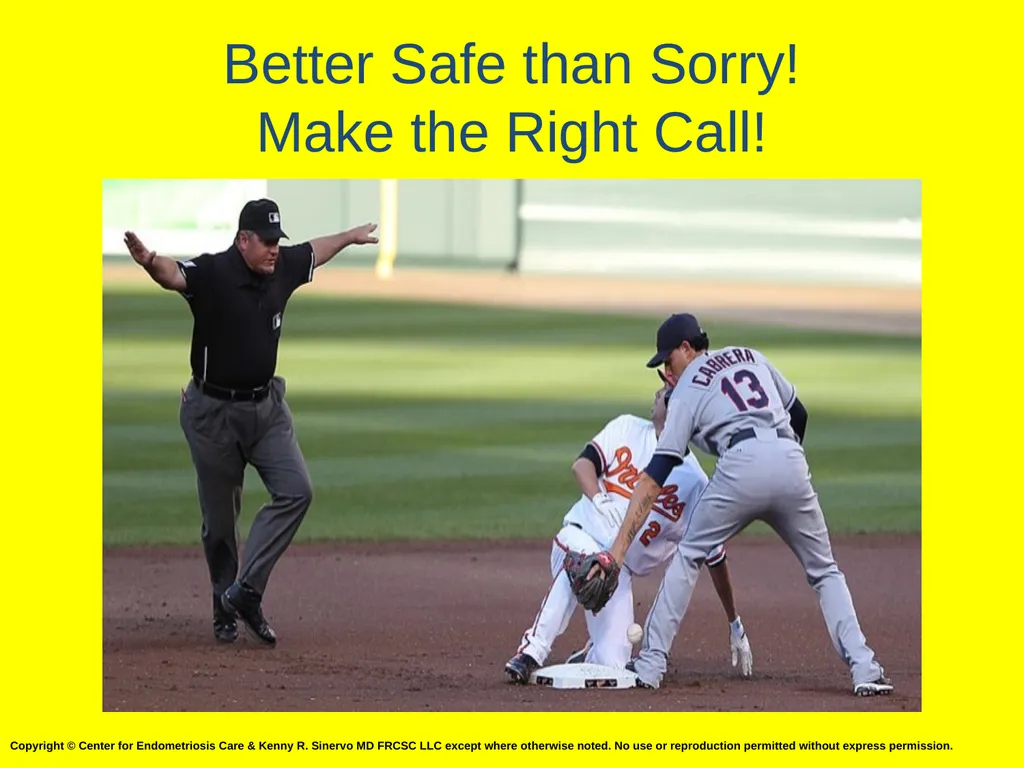
Better Safe than Sorry!
Make the Right Call! Copyright © Center for Endometriosis Care & Kenny R. Sinervo MD FRCSC LLC except where otherwise noted. No use or reproduction permitted without express permission.<br>
35
ED Assessment ED - assess patient
Labs – H & H, WBC, electrolytes, urine
Chest xray
Vitals
Bladder scan – catheter if necessary.
IV fluids and pain meds as needed.
CT of abdomen/pelvis with contrast
Venous doppler study (if calf pain)
Stool test
Vag exam if indicated Copyright © Center for Endometriosis Care & Kenny R. Sinervo MD FRCSC LLC except where otherwise noted. No use or reproduction permitted without express permission.<br>
Labs – H & H, WBC, electrolytes, urine
Chest xray
Vitals
Bladder scan – catheter if necessary.
IV fluids and pain meds as needed.
CT of abdomen/pelvis with contrast
Venous doppler study (if calf pain)
Stool test
Vag exam if indicated Copyright © Center for Endometriosis Care & Kenny R. Sinervo MD FRCSC LLC except where otherwise noted. No use or reproduction permitted without express permission.<br>
36
YOU are the Captain of the Ship! Everyone you see should be focused on giving you the best possible care (before, during and after surgery). If you have any questions or concerns at anytime, please do not hesitate to ask or call them!
It’s important for your Dr. to know short term and long term how you are doing!<br>
It’s important for your Dr. to know short term and long term how you are doing!<br>
37
Thank you! Questions? Copyright © Center for Endometriosis Care & Kenny R. Sinervo MD FRCSC LLC except where otherwise noted. No use or reproduction permitted without express permission.<br>
38
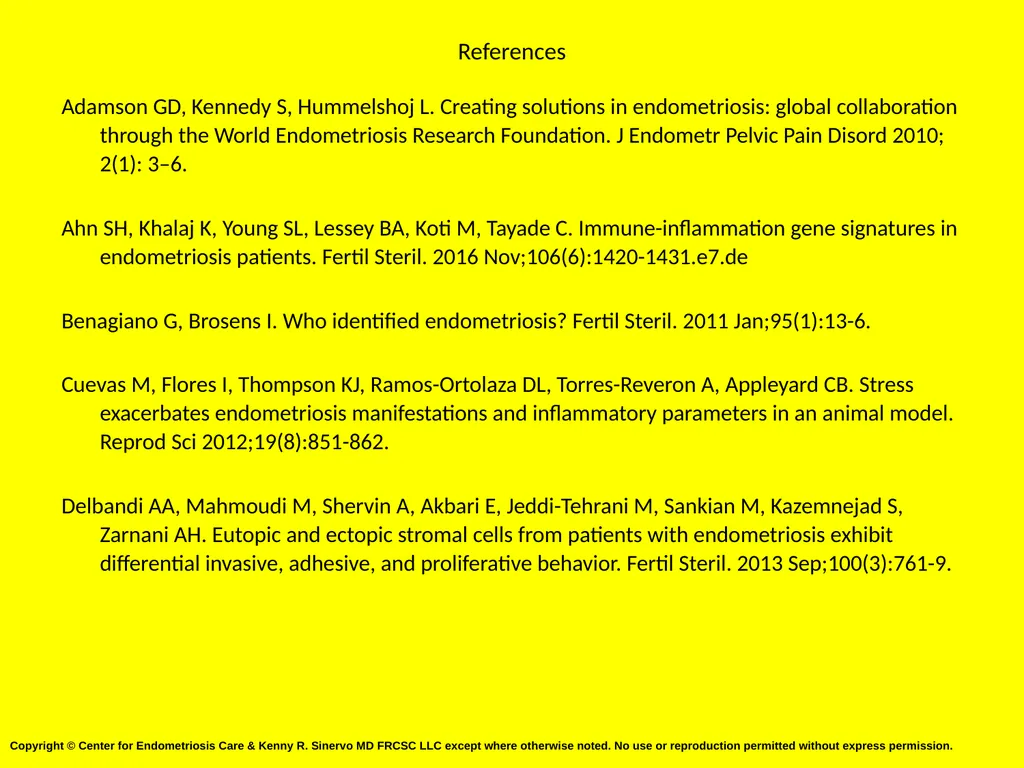
References Adamson GD, Kennedy S, Hummelshoj L. Creating solutions in endometriosis: global collaboration through the World Endometriosis Research Foundation. J Endometr Pelvic Pain Disord 2010; 2(1): 3–6.
Ahn SH, Khalaj K, Young SL, Lessey BA, Koti M, Tayade C. Immune-inflammation gene signatures in endometriosis patients. Fertil Steril. 2016 Nov;106(6):1420-1431.e7.de
Benagiano G, Brosens I. Who identified endometriosis? Fertil Steril. 2011 Jan;95(1):13-6.
Cuevas M, Flores I, Thompson KJ, Ramos-Ortolaza DL, Torres-Reveron A, Appleyard CB. Stress exacerbates endometriosis manifestations and inflammatory parameters in an animal model. Reprod Sci 2012;19(8):851-862.
Delbandi AA, Mahmoudi M, Shervin A, Akbari E, Jeddi-Tehrani M, Sankian M, Kazemnejad S, Zarnani AH. Eutopic and ectopic stromal cells from patients with endometriosis exhibit differential invasive, adhesive, and proliferative behavior. Fertil Steril. 2013 Sep;100(3):761-9. Copyright © Center for Endometriosis Care & Kenny R. Sinervo MD FRCSC LLC except where otherwise noted. No use or reproduction permitted without express permission.<br>
Ahn SH, Khalaj K, Young SL, Lessey BA, Koti M, Tayade C. Immune-inflammation gene signatures in endometriosis patients. Fertil Steril. 2016 Nov;106(6):1420-1431.e7.de
Benagiano G, Brosens I. Who identified endometriosis? Fertil Steril. 2011 Jan;95(1):13-6.
Cuevas M, Flores I, Thompson KJ, Ramos-Ortolaza DL, Torres-Reveron A, Appleyard CB. Stress exacerbates endometriosis manifestations and inflammatory parameters in an animal model. Reprod Sci 2012;19(8):851-862.
Delbandi AA, Mahmoudi M, Shervin A, Akbari E, Jeddi-Tehrani M, Sankian M, Kazemnejad S, Zarnani AH. Eutopic and ectopic stromal cells from patients with endometriosis exhibit differential invasive, adhesive, and proliferative behavior. Fertil Steril. 2013 Sep;100(3):761-9. Copyright © Center for Endometriosis Care & Kenny R. Sinervo MD FRCSC LLC except where otherwise noted. No use or reproduction permitted without express permission.<br>
39
D'ooghe, T., C.D. Dirksen, G.A.J. Dunselman, A. de Graaff, and S. Simoens (2012). The costs of endometriosis: it's the economy, stupid. FertilSteril 98(3), S218-S219
Eisenberg VH, Zolti M, Soriano D. Is there an association between autoimmunity and endometriosis? Autoimmun Rev. 2012;11:806-814.
Fuldeore MJ, Soliman AM. Prevalence and Symptomatic Burden of Diagnosed Endometriosis in the United States: National Estimates from a Cross-Sectional Survey of 59,411 Women. Gynecol Obstet Invest. 2017;82(5):453-461.
Giudice LC. Clinical practice: Endometriosis. N Engl J Med. 2010;362(25):2389-2398.
Greene SM, Tuzzio L, Cherkin D. A framework for making patient-centered care front and center. Perm J. 2012;16(3):49–53.
Johnson NP, Hummelshoj L for the World Endometriosis Society Montpellier Consortium. Consensus on current management of endometriosis. Human Reproduction, Volume 28, Issue 6, 1 June 2013, Pages 1552–1568. Copyright © Center for Endometriosis Care & Kenny R. Sinervo MD FRCSC LLC except where otherwise noted. No use or reproduction permitted without express permission.<br>
Eisenberg VH, Zolti M, Soriano D. Is there an association between autoimmunity and endometriosis? Autoimmun Rev. 2012;11:806-814.
Fuldeore MJ, Soliman AM. Prevalence and Symptomatic Burden of Diagnosed Endometriosis in the United States: National Estimates from a Cross-Sectional Survey of 59,411 Women. Gynecol Obstet Invest. 2017;82(5):453-461.
Giudice LC. Clinical practice: Endometriosis. N Engl J Med. 2010;362(25):2389-2398.
Greene SM, Tuzzio L, Cherkin D. A framework for making patient-centered care front and center. Perm J. 2012;16(3):49–53.
Johnson NP, Hummelshoj L for the World Endometriosis Society Montpellier Consortium. Consensus on current management of endometriosis. Human Reproduction, Volume 28, Issue 6, 1 June 2013, Pages 1552–1568. Copyright © Center for Endometriosis Care & Kenny R. Sinervo MD FRCSC LLC except where otherwise noted. No use or reproduction permitted without express permission.<br>
40
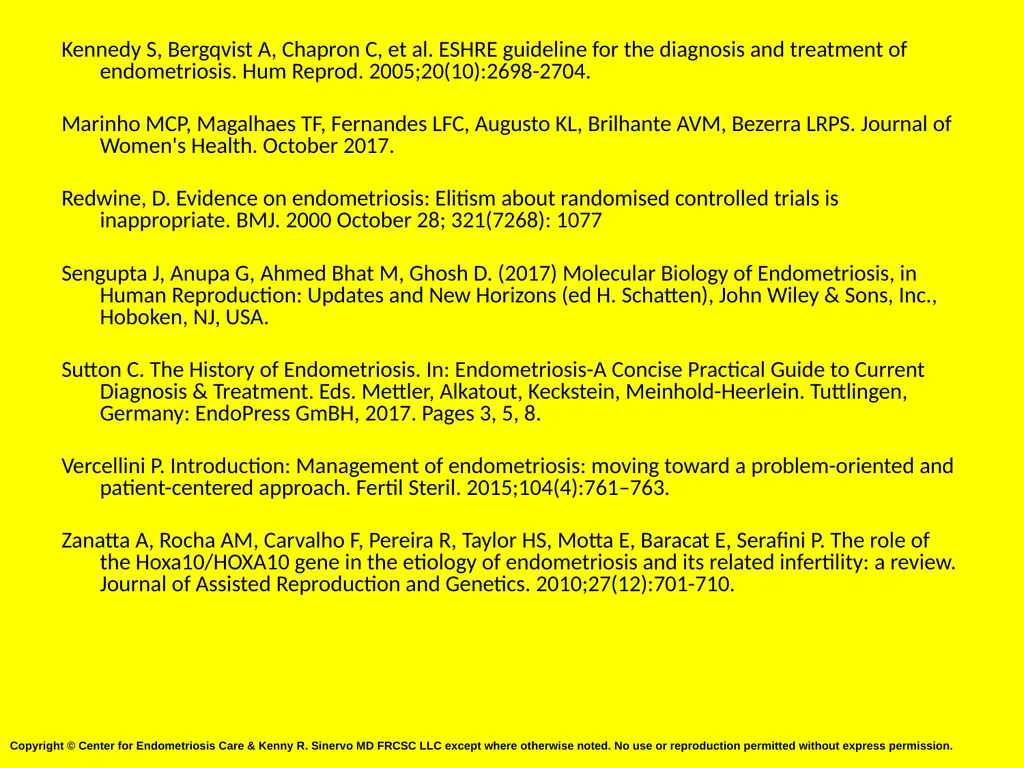
Kennedy S, Bergqvist A, Chapron C, et al. ESHRE guideline for the diagnosis and treatment of endometriosis. Hum Reprod. 2005;20(10):2698-2704.
Marinho MCP, Magalhaes TF, Fernandes LFC, Augusto KL, Brilhante AVM, Bezerra LRPS. Journal of Women's Health. October 2017.
Redwine, D. Evidence on endometriosis: Elitism about randomised controlled trials is inappropriate. BMJ. 2000 October 28; 321(7268): 1077
Sengupta J, Anupa G, Ahmed Bhat M, Ghosh D. (2017) Molecular Biology of Endometriosis, in Human Reproduction: Updates and New Horizons (ed H. Schatten), John Wiley & Sons, Inc., Hoboken, NJ, USA.
Sutton C. The History of Endometriosis. In: Endometriosis-A Concise Practical Guide to Current Diagnosis & Treatment. Eds. Mettler, Alkatout, Keckstein, Meinhold-Heerlein. Tuttlingen, Germany: EndoPress GmBH, 2017. Pages 3, 5, 8.
Vercellini P. Introduction: Management of endometriosis: moving toward a problem-oriented and patient-centered approach. Fertil Steril. 2015;104(4):761–763.
Zanatta A, Rocha AM, Carvalho F, Pereira R, Taylor HS, Motta E, Baracat E, Serafini P. The role of the Hoxa10/HOXA10 gene in the etiology of endometriosis and its related infertility: a review. Journal of Assisted Reproduction and Genetics. 2010;27(12):701-710. Copyright © Center for Endometriosis Care & Kenny R. Sinervo MD FRCSC LLC except where otherwise noted. No use or reproduction permitted without express permission.<br>
Marinho MCP, Magalhaes TF, Fernandes LFC, Augusto KL, Brilhante AVM, Bezerra LRPS. Journal of Women's Health. October 2017.
Redwine, D. Evidence on endometriosis: Elitism about randomised controlled trials is inappropriate. BMJ. 2000 October 28; 321(7268): 1077
Sengupta J, Anupa G, Ahmed Bhat M, Ghosh D. (2017) Molecular Biology of Endometriosis, in Human Reproduction: Updates and New Horizons (ed H. Schatten), John Wiley & Sons, Inc., Hoboken, NJ, USA.
Sutton C. The History of Endometriosis. In: Endometriosis-A Concise Practical Guide to Current Diagnosis & Treatment. Eds. Mettler, Alkatout, Keckstein, Meinhold-Heerlein. Tuttlingen, Germany: EndoPress GmBH, 2017. Pages 3, 5, 8.
Vercellini P. Introduction: Management of endometriosis: moving toward a problem-oriented and patient-centered approach. Fertil Steril. 2015;104(4):761–763.
Zanatta A, Rocha AM, Carvalho F, Pereira R, Taylor HS, Motta E, Baracat E, Serafini P. The role of the Hoxa10/HOXA10 gene in the etiology of endometriosis and its related infertility: a review. Journal of Assisted Reproduction and Genetics. 2010;27(12):701-710. Copyright © Center for Endometriosis Care & Kenny R. Sinervo MD FRCSC LLC except where otherwise noted. No use or reproduction permitted without express permission.<br>