Endothermic and Exothermic Reactions Fall 2017 I. Introduction Have students look at the energy diagrams and explain how reactions can be exothermic or endothermic. Tell students that the word exothermic describes processes that give off
"Endothermic and Exothermic Reactions Fall 2017 I." is the property of its rightful owner. Permission is granted to
download and print the materials on this website for personal, non-commercial use only, and to display it
on your personal computer provided you do not modify the materials and that you retain all copyright
notices contained in the materials. By downloading content from our website, you accept the terms of this
agreement.
Presentation Transcript
01
Endothermic and Exothermic Reactions Fall 2017<br>
02
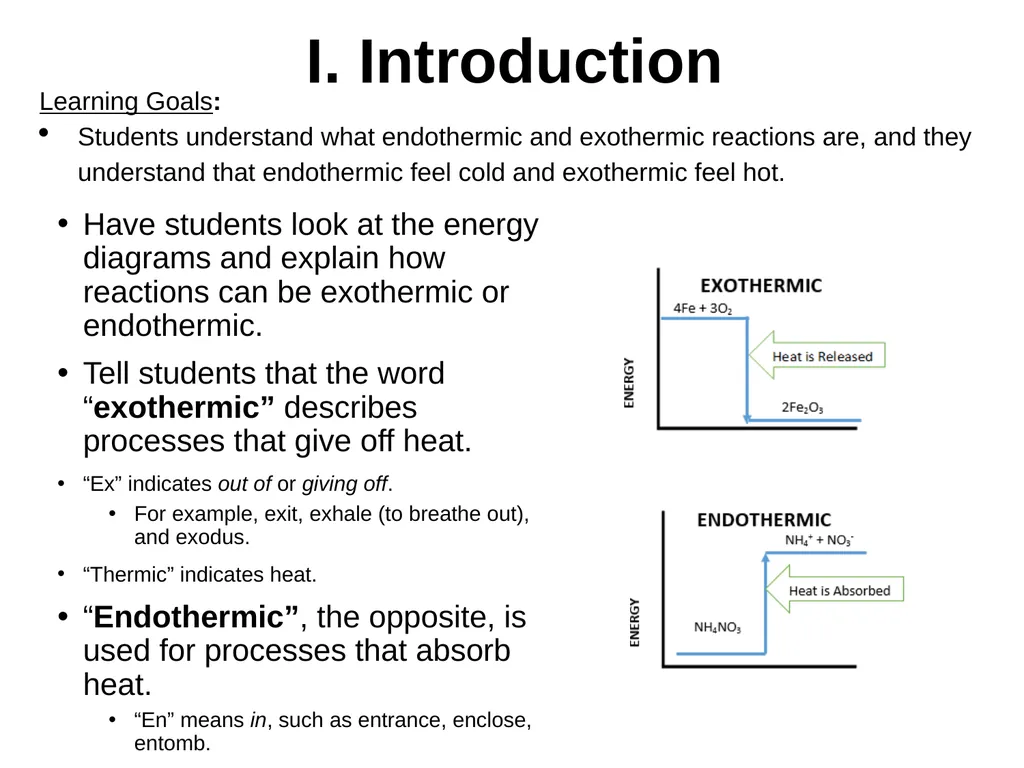
I. Introduction Have students look at the energy diagrams and explain how reactions can be exothermic or endothermic.
Tell students that the word “exothermic” describes processes that give off heat.
“Ex” indicates out of or giving off.
For example, exit, exhale (to breathe out), and exodus.
“Thermic” indicates heat.
“Endothermic”, the opposite, is used for processes that absorb heat.
“En” means in, such as entrance, enclose, entomb. Learning Goals:
Students understand what endothermic and exothermic reactions are, and they understand that endothermic feel cold and exothermic feel hot.<br>
03
IA. Preparation Pass out a plate, a test tube holder, three test tubes, yellow spoon, white taster spoon, a thermometer, and a stirrer to each pair.
Goggles for EVERYONE
Give each student an observation sheet, an instruction sheet, and a Handout. Learning Goals:
Students perform a variety of endothermic reactions and are able to identify them by feel and looking at a thermometer.
Students can explain what is happening with the bonds of the molecules in endothermic reaction.<br>
04
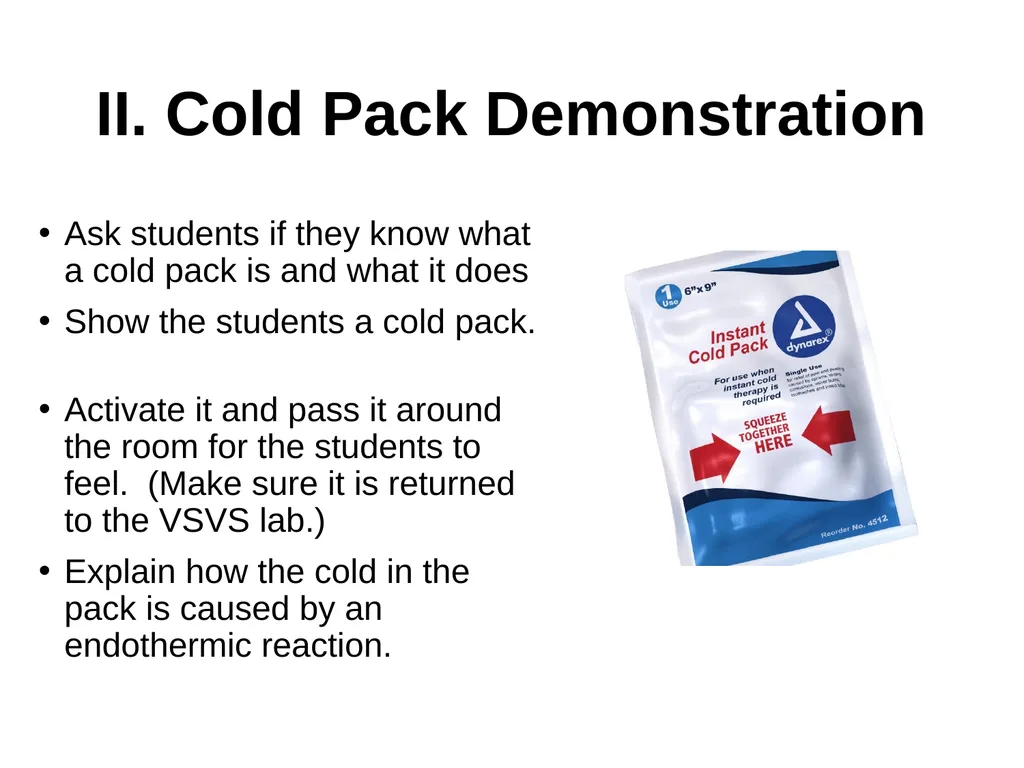
II. Cold Pack Demonstration Ask students if they know what a cold pack is and what it does
Show the students a cold pack.
Activate it and pass it around the room for the students to feel. (Make sure it is returned to the VSVS lab.)
Explain how the cold in the pack is caused by an endothermic reaction.<br>
05
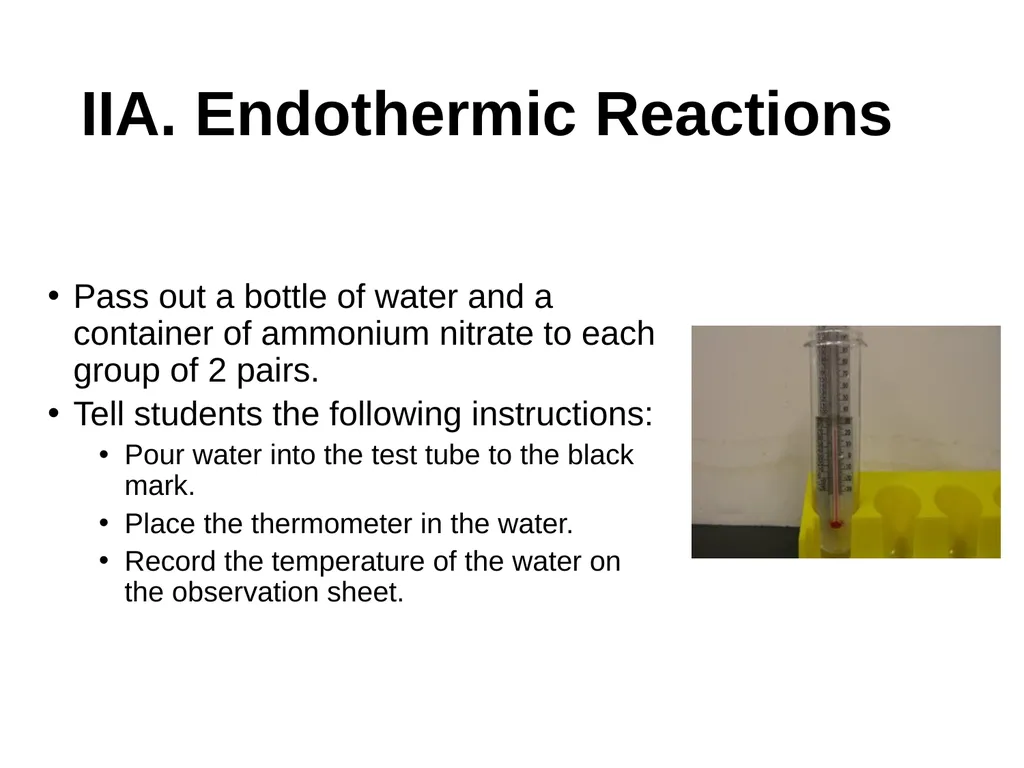
IIA. Endothermic Reactions Pass out a bottle of water and a container of ammonium nitrate to each group of 2 pairs.
Tell students the following instructions:
Pour water into the test tube to the black mark.
Place the thermometer in the water.
Record the temperature of the water on the observation sheet.<br>
06
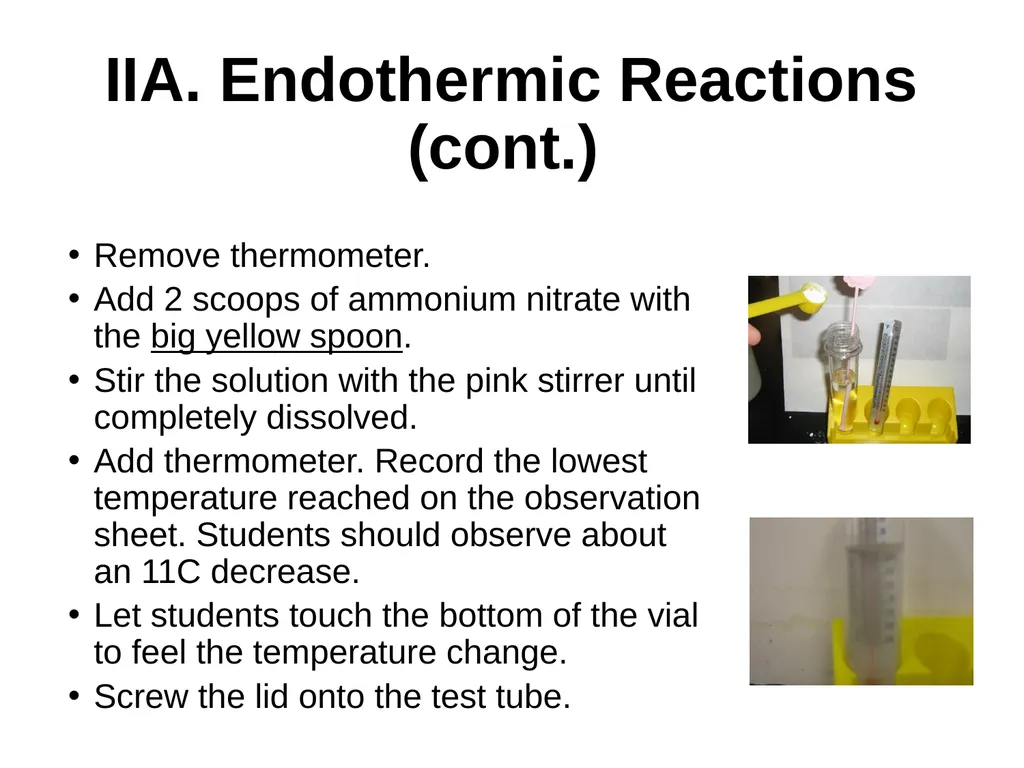
IIA. Endothermic Reactions (cont.) Remove thermometer.
Add 2 scoops of ammonium nitrate with the big yellow spoon.
Stir the solution with the pink stirrer until completely dissolved.
Add thermometer. Record the lowest temperature reached on the observation sheet. Students should observe about an 11C decrease.
Let students touch the bottom of the vial to feel the temperature change.
Screw the lid onto the test tube.<br>
07
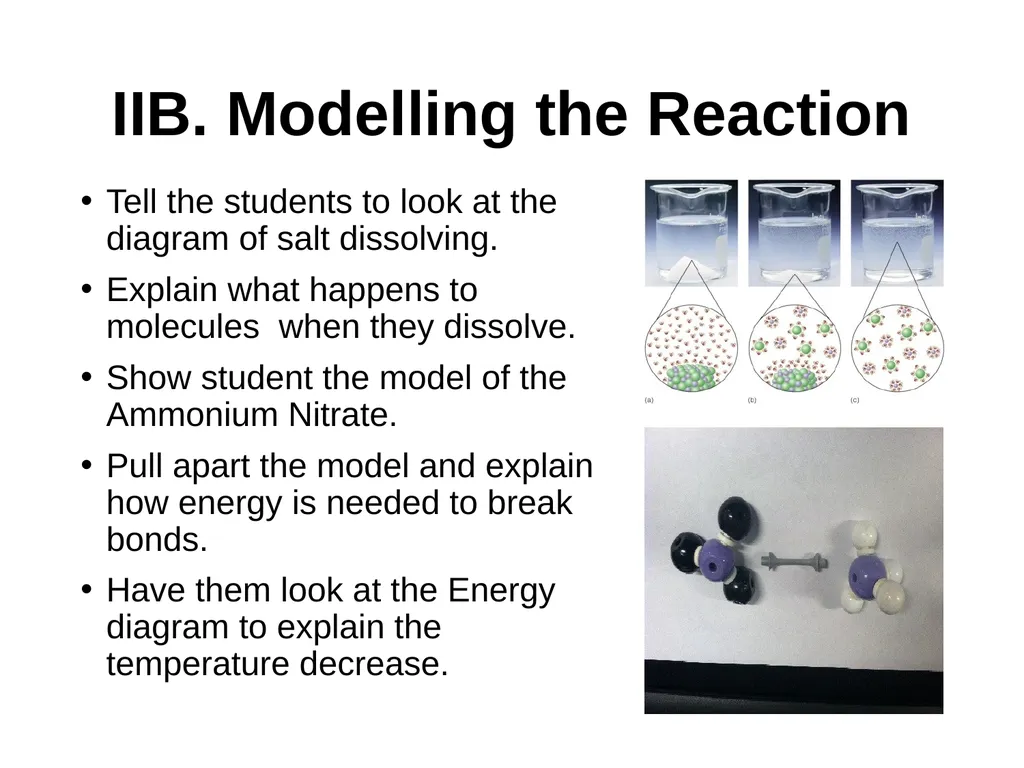
IIB. Modelling the Reaction Tell the students to look at the diagram of salt dissolving.
Explain what happens to molecules when they dissolve.
Show student the model of the Ammonium Nitrate.
Pull apart the model and explain how energy is needed to break bonds.
Have them look at the Energy diagram to explain the temperature decrease.<br>
08
IIC. Endothermic Chemical Reaction Pass a bottle of citric acid to each pair and a container of baking soda (sodium bicarbonate) to each group of 2 pairs
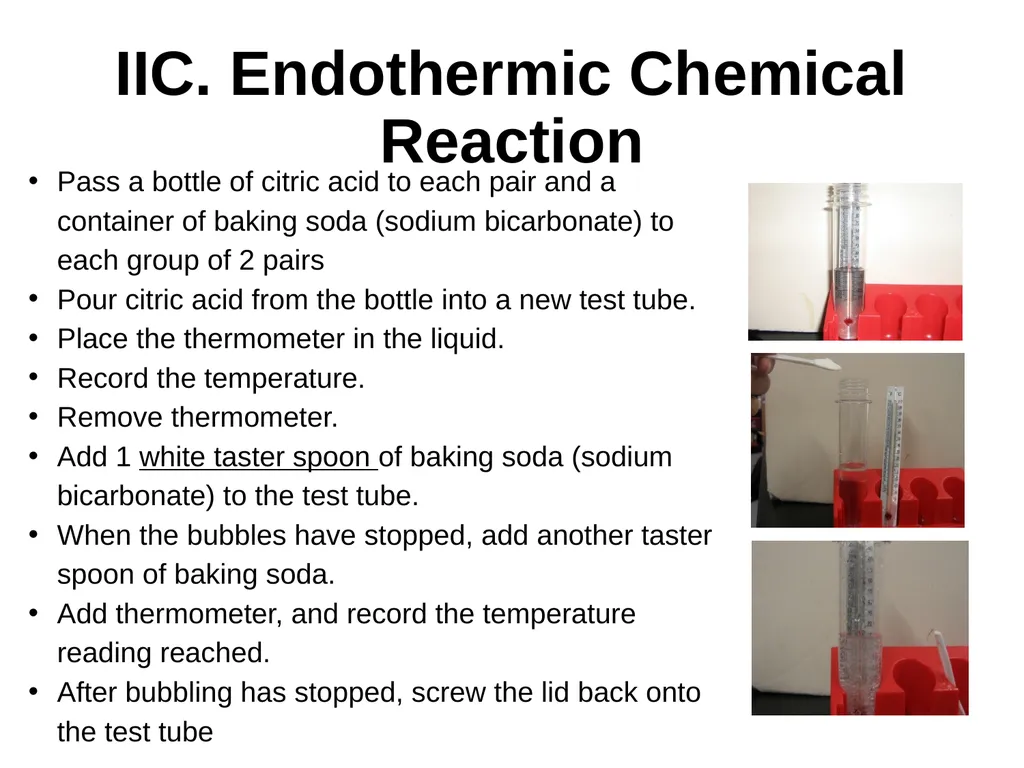
Pour citric acid from the bottle into a new test tube.
Place the thermometer in the liquid.
Record the temperature.
Remove thermometer.
Add 1 white taster spoon of baking soda (sodium bicarbonate) to the test tube.
When the bubbles have stopped, add another taster spoon of baking soda.
Add thermometer, and record the temperature reading reached.
After bubbling has stopped, screw the lid back onto the test tube<br>
09
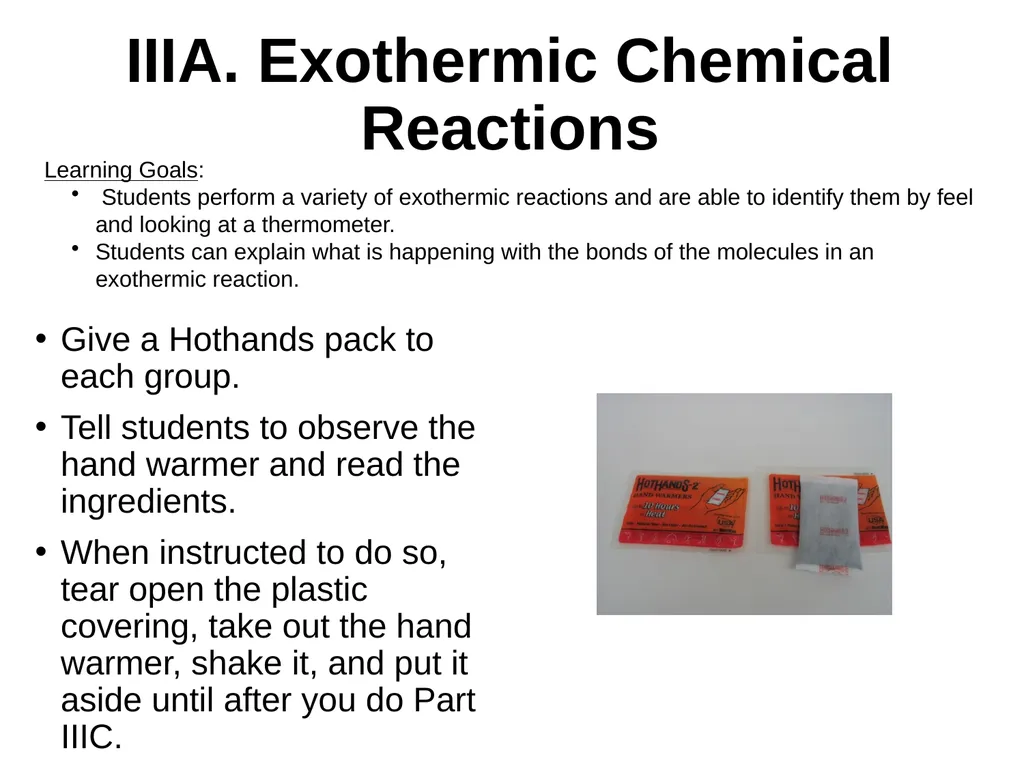
IIIA. Exothermic Chemical Reactions Give a Hothands pack to each group.
Tell students to observe the hand warmer and read the ingredients.
When instructed to do so, tear open the plastic covering, take out the hand warmer, shake it, and put it aside until after you do Part IIIC. Learning Goals:
Students perform a variety of exothermic reactions and are able to identify them by feel and looking at a thermometer.
Students can explain what is happening with the bonds of the molecules in an exothermic reaction.<br>
10
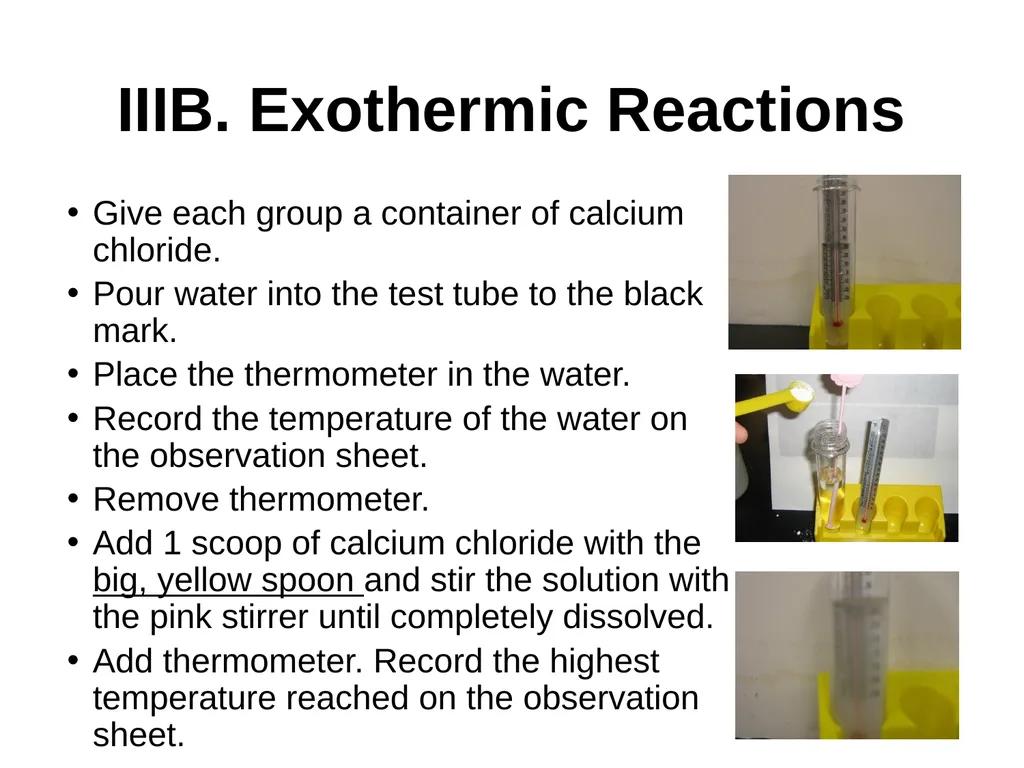
IIIB. Exothermic Reactions Give each group a container of calcium chloride.
Pour water into the test tube to the black mark.
Place the thermometer in the water.
Record the temperature of the water on the observation sheet.
Remove thermometer.
Add 1 scoop of calcium chloride with the big, yellow spoon and stir the solution with the pink stirrer until completely dissolved.
Add thermometer. Record the highest temperature reached on the observation sheet.<br>
11
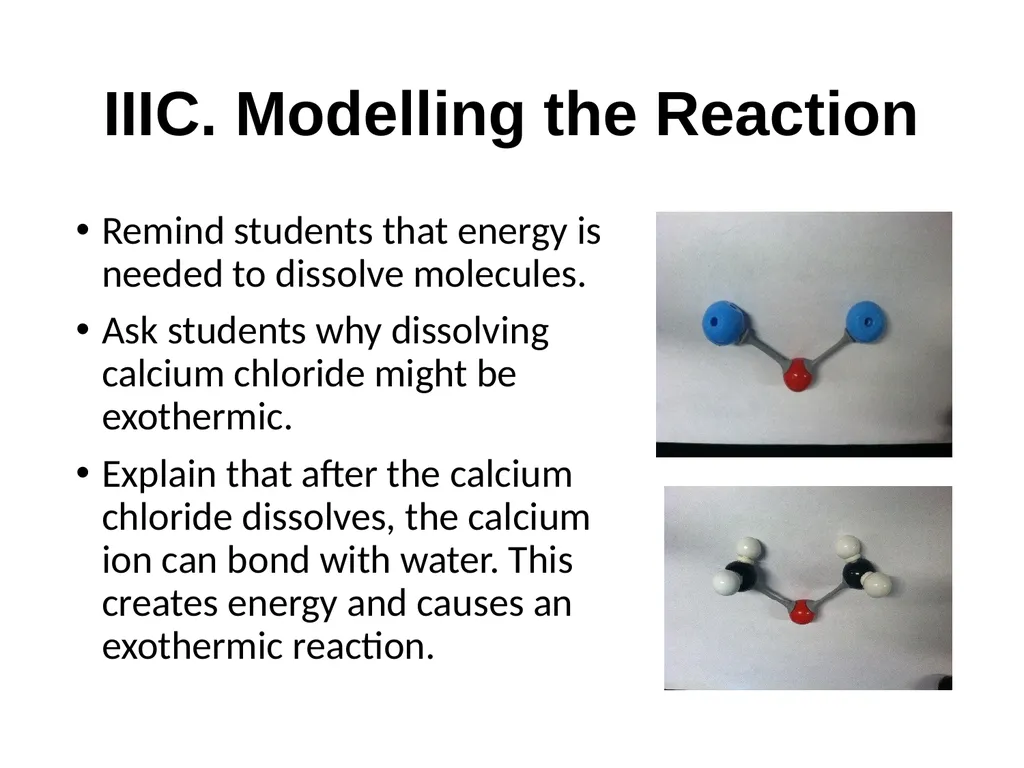
IIIC. Modelling the Reaction Remind students that energy is needed to dissolve molecules.
Ask students why dissolving calcium chloride might be exothermic.
Explain that after the calcium chloride dissolves, the calcium ion can bond with water. This creates energy and causes an exothermic reaction.<br>
12
IIID. Exothermic Chemical Reaction(cont.) Check the hand warmer.
Record your observations on the observation sheet.
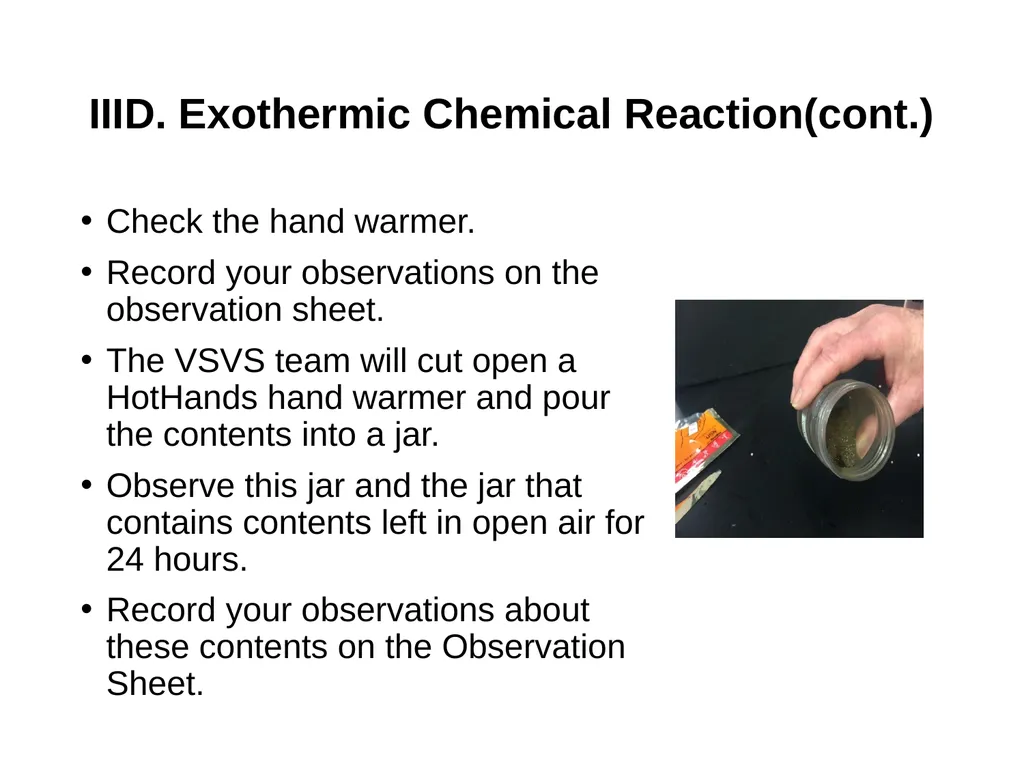
The VSVS team will cut open a HotHands hand warmer and pour the contents into a jar.
Observe this jar and the jar that contains contents left in open air for 24 hours.
Record your observations about these contents on the Observation Sheet.<br>
13
IV. Review and Cleanup All of the solutions down the sink OR return to VSVS lab (lids must be on test tubes, test tubes all in a closed plastic container, to avoid leaks into main kit)
Students may keep the HotHands packets.
The coldpack should be brought back.
Have some members collect all of the materials, while one person reviews with the class.
Key terms for students to know: exothermic, endothermic, dissolving, bonds<br>