
Energy, the Environment, and Climate Change

Description: Energy, the Environment, and Climate Change Pandemic Economics Chapter 9 Pandemic Economics 9 1 Topics Global Environment Environmental Framework Energy Effects Environmental Effects Climate Effects Strategies for Environmental
Related Topics
Download Presentation
"Energy, the Environment, and Climate Change" is the property of its rightful owner. Permission is granted to download and print the materials on this website for personal, non-commercial use only, and to display it on your personal computer provided you do not modify the materials and that you retain all copyright notices contained in the materials. By downloading content from our website, you accept the terms of this agreement.
Presentation Transcript
slide1. Energy, the Environment, and Climate Change Pandemic Economics
Chapter 9 Pandemic Economics 9 1<br>
slide2. Topics Global Environment
Environmental Framework
Energy Effects
Environmental Effects
Climate Effects
Strategies for Environmental Sustainability Pandemic Economics 9 2<br>
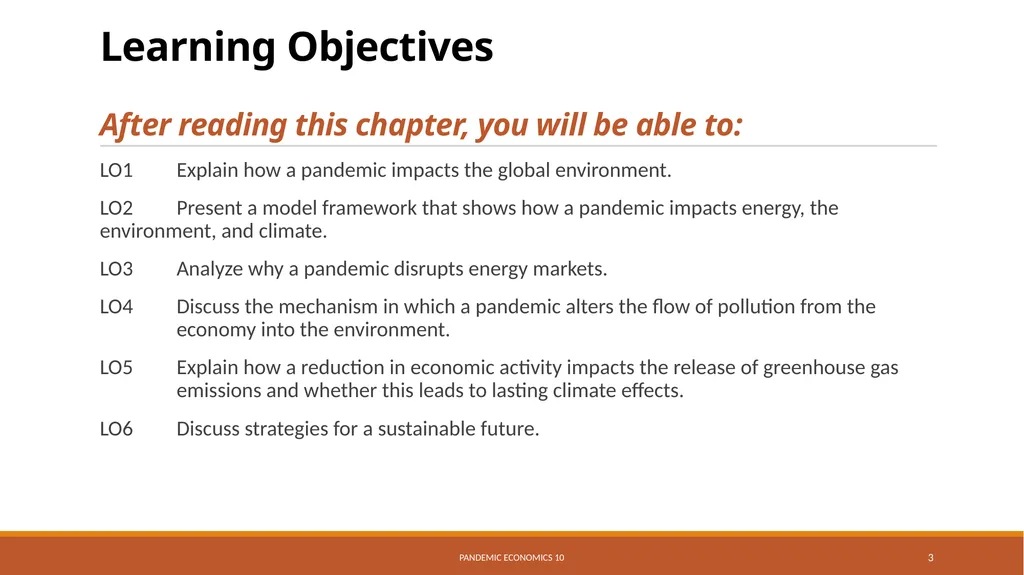
slide3. Learning Objectives After reading this chapter, you will be able to: LO1 Explain how a pandemic impacts the global environment.
LO2 Present a model framework that shows how a pandemic impacts energy, the environment, and climate.
LO3 Analyze why a pandemic disrupts energy markets.
LO4 Discuss the mechanism in which a pandemic alters the flow of pollution from the economy into the environment.
LO5 Explain how a reduction in economic activity impacts the release of greenhouse gas emissions and whether this leads to lasting climate effects.
LO6 Discuss strategies for a sustainable future. Pandemic Economics 10 3<br>
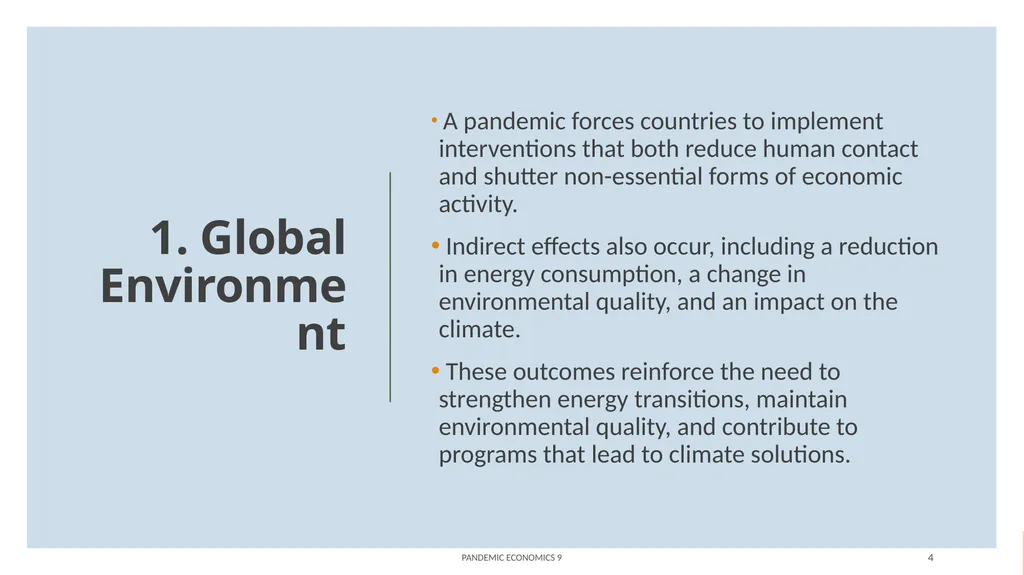
slide4. 1. Global Environment A pandemic forces countries to implement interventions that both reduce human contact and shutter non-essential forms of economic activity.
Indirect effects also occur, including a reduction in energy consumption, a change in environmental quality, and an impact on the climate.
These outcomes reinforce the need to strengthen energy transitions, maintain environmental quality, and contribute to programs that lead to climate solutions. Pandemic Economics 9 4<br>
slide5. Specific Effects First, a reduction in economic activity from shutdown interventions leads to a decrease in energy demand.
Second, a reduction in the production of output leads to less pollution and an improvement in environmental quality.
Third, a decline in energy demand reduces fossil fuel consumption, which leads to a decrease in greenhouse gases (GHG), a byproduct of combustion. Pandemic Economics 9 5<br>
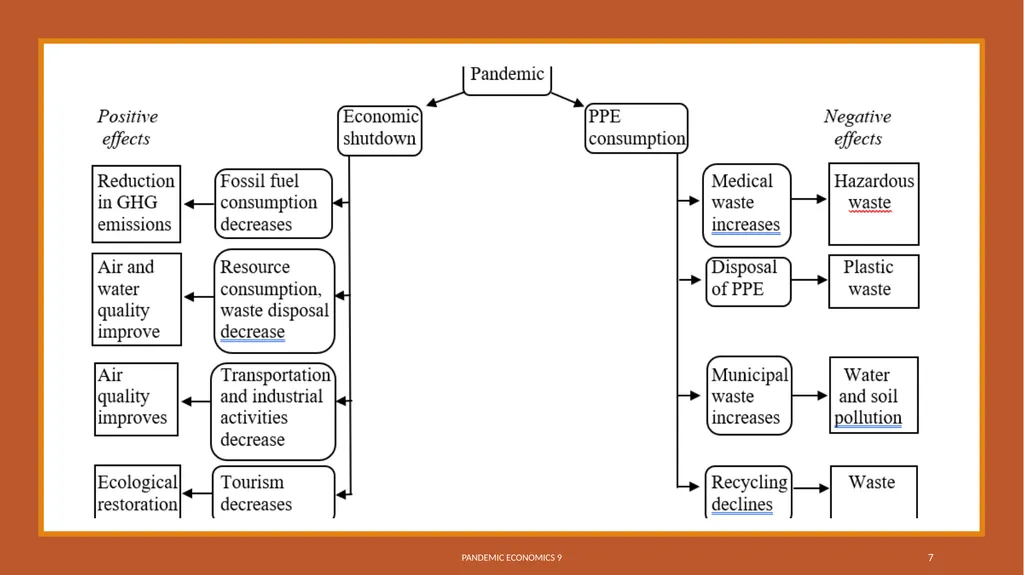
slide6. 2. Environmental Framework Because of a reduction in transportation, industry, and tourism, both fossil fuel consumption and GHG decline while air quality improves.
But the disposal of personal protective equipment (PPE), including face masks and hand gloves, and the generation of hospital waste leads to negative environmental outcomes.
Taken together, a pandemic creates both positive and negative effects. Pandemic Economics 9 6<br>
slide7. Pandemic Economics 9 7<br>
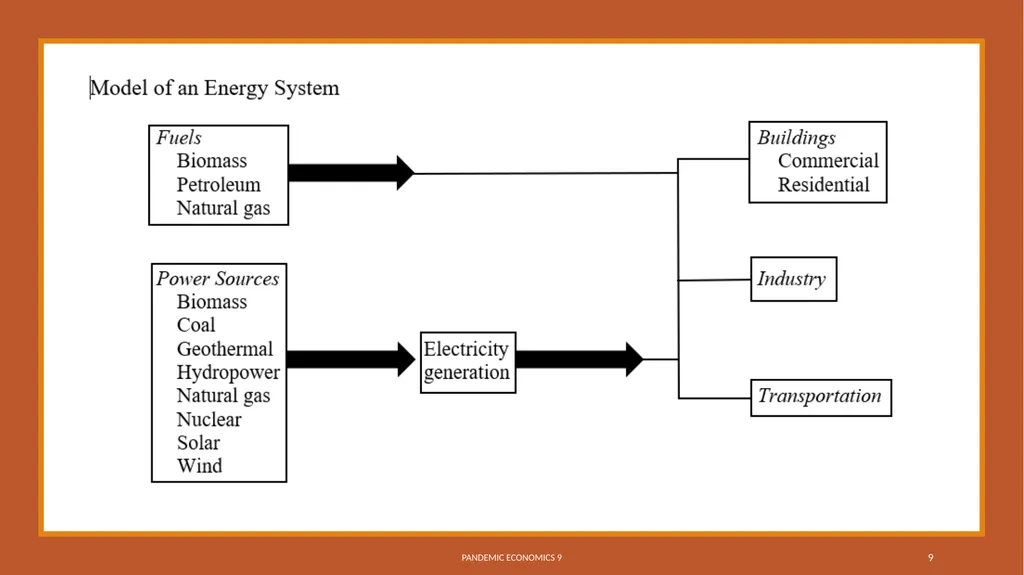
slide8. 3. Energy Effects It is important to distinguish between an energy system and an energy sector.
Energy system: a network that links energy sources, storage, and transmission to the agents of energy demand.
Energy sector: serves a purpose within the energy system, including power sources, fuels, electricity generation, buildings, industry, and transportation. Pandemic Economics 9 8<br>
slide9. Pandemic Economics 9 9<br>
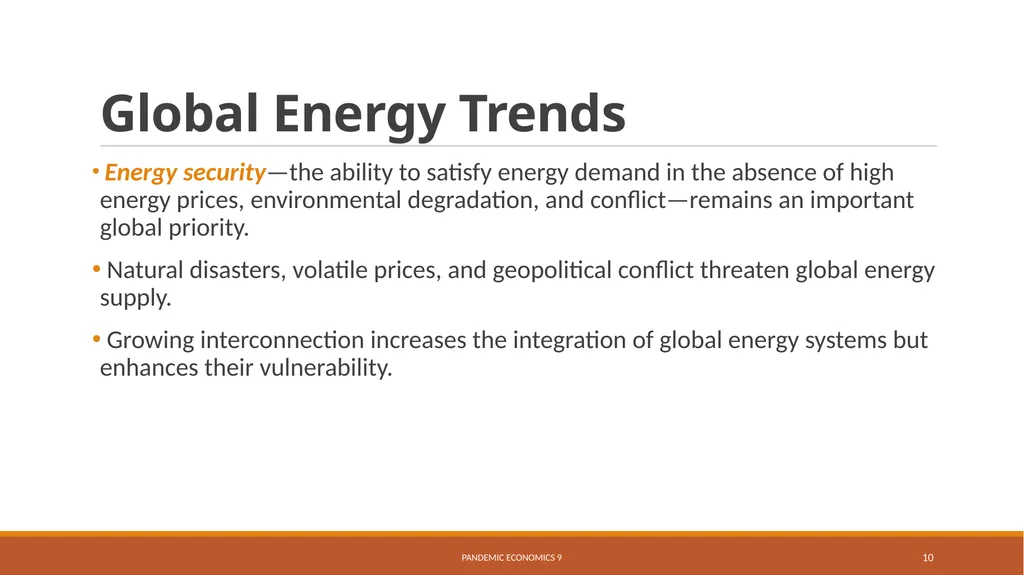
slide10. Global Energy Trends Energy security—the ability to satisfy energy demand in the absence of high energy prices, environmental degradation, and conflict—remains an important global priority.
Natural disasters, volatile prices, and geopolitical conflict threaten global energy supply.
Growing interconnection increases the integration of global energy systems but enhances their vulnerability. Pandemic Economics 9 10<br>
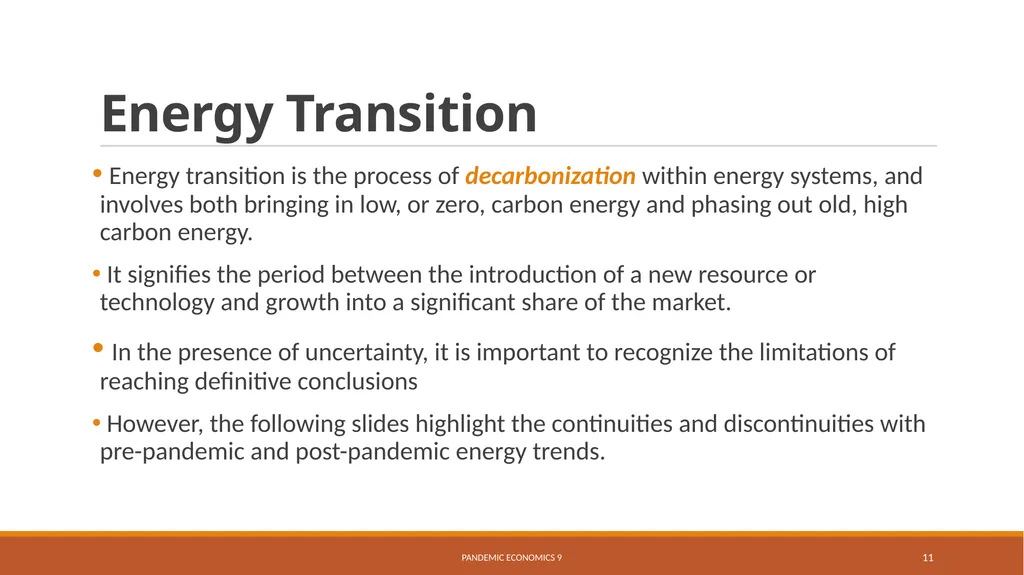
slide11. Energy Transition Energy transition is the process of decarbonization within energy systems, and involves both bringing in low, or zero, carbon energy and phasing out old, high carbon energy.
It signifies the period between the introduction of a new resource or technology and growth into a significant share of the market.
In the presence of uncertainty, it is important to recognize the limitations of reaching definitive conclusions
However, the following slides highlight the continuities and discontinuities with pre-pandemic and post-pandemic energy trends. Pandemic Economics 9 11<br>
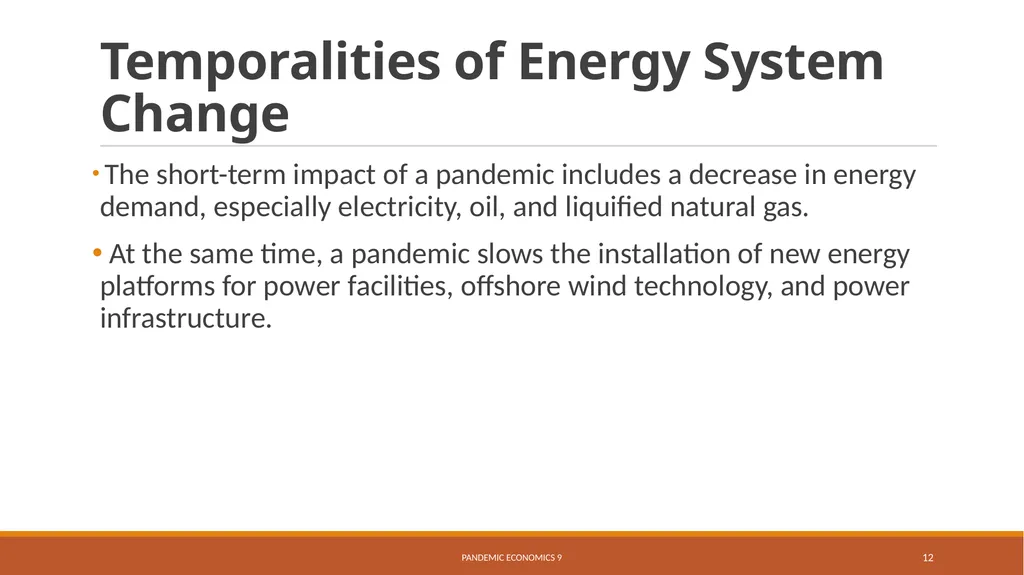
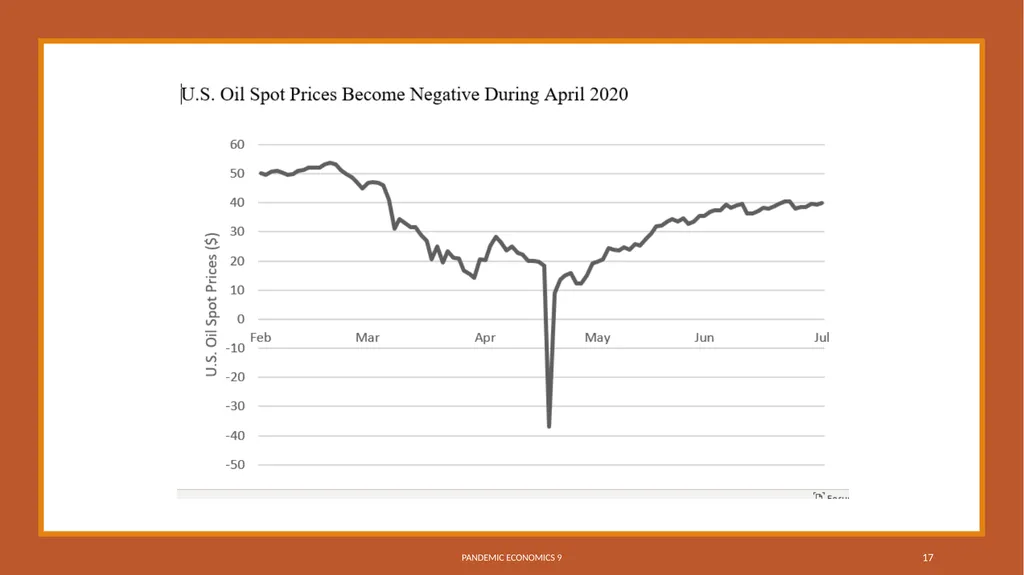
slide12. Temporalities of Energy System Change The short-term impact of a pandemic includes a decrease in energy demand, especially electricity, oil, and liquified natural gas.
At the same time, a pandemic slows the installation of new energy platforms for power facilities, offshore wind technology, and power infrastructure. Pandemic Economics 9 12<br>
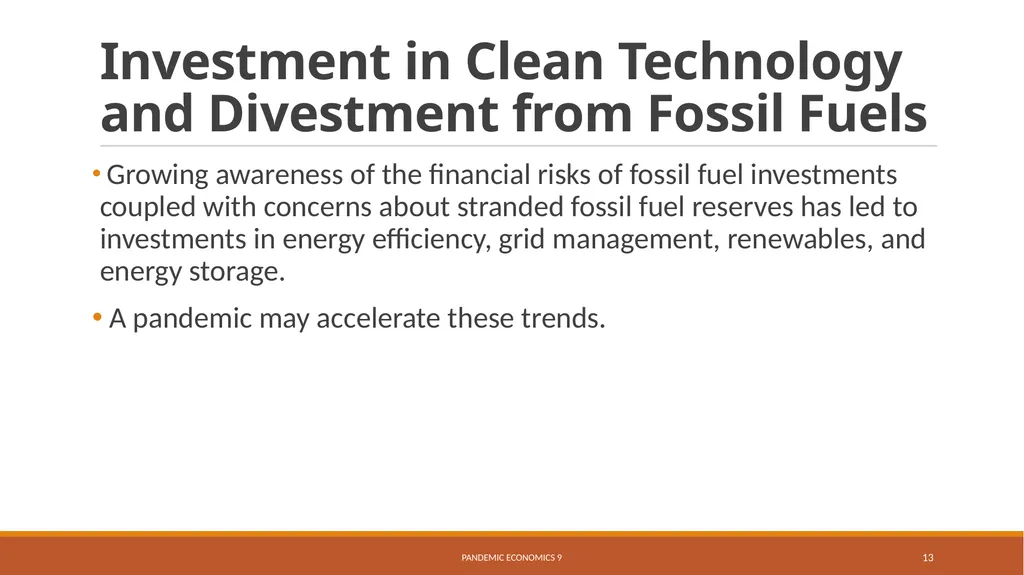
slide13. Investment in Clean Technology and Divestment from Fossil Fuels Growing awareness of the financial risks of fossil fuel investments coupled with concerns about stranded fossil fuel reserves has led to investments in energy efficiency, grid management, renewables, and energy storage.
A pandemic may accelerate these trends. Pandemic Economics 9 13<br>
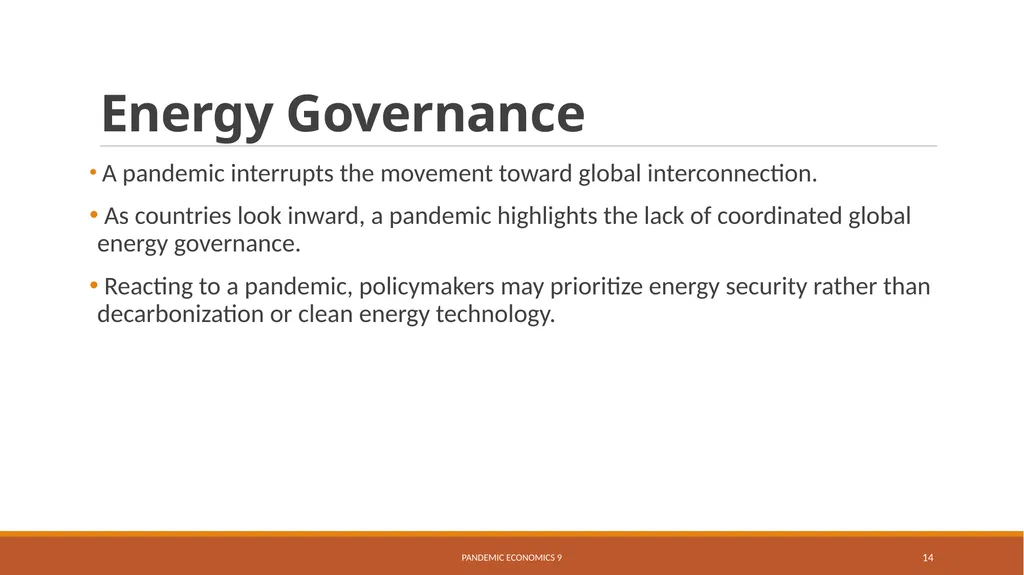
slide14. Energy Governance A pandemic interrupts the movement toward global interconnection.
As countries look inward, a pandemic highlights the lack of coordinated global energy governance.
Reacting to a pandemic, policymakers may prioritize energy security rather than decarbonization or clean energy technology. Pandemic Economics 9 14<br>
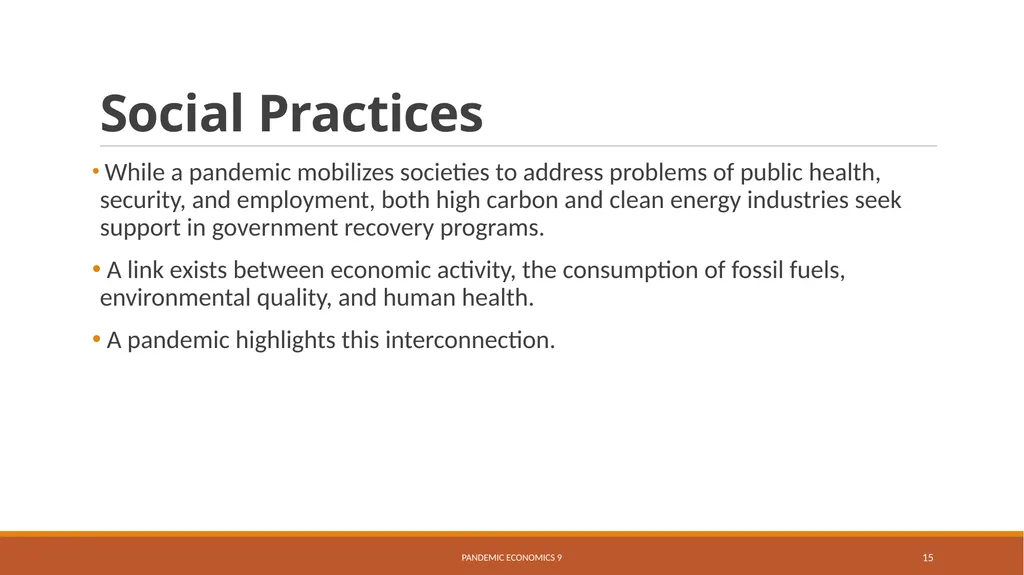
slide15. Social Practices While a pandemic mobilizes societies to address problems of public health, security, and employment, both high carbon and clean energy industries seek support in government recovery programs.
A link exists between economic activity, the consumption of fossil fuels, environmental quality, and human health.
A pandemic highlights this interconnection. Pandemic Economics 9 15<br>
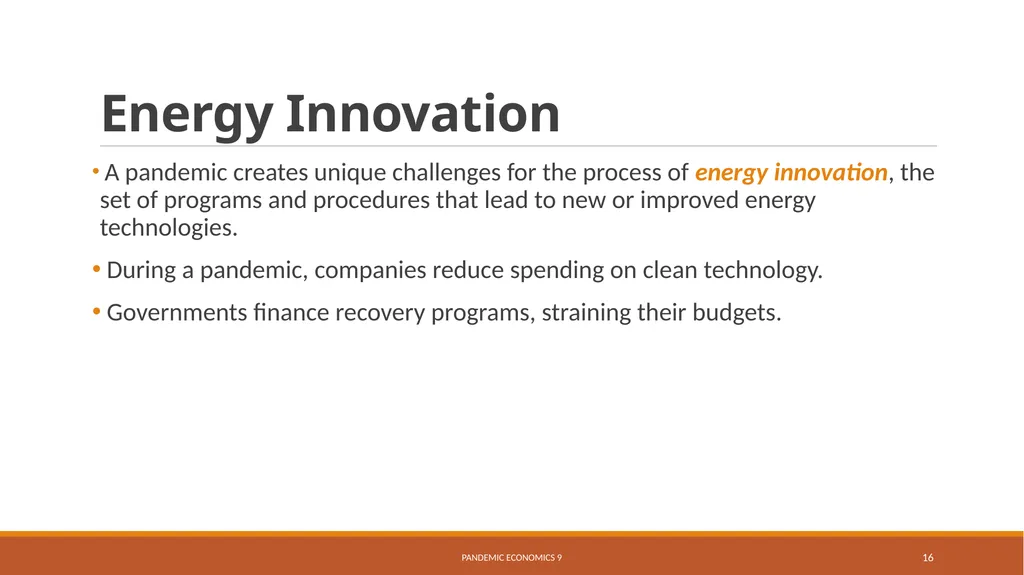
slide16. Energy Innovation A pandemic creates unique challenges for the process of energy innovation, the set of programs and procedures that lead to new or improved energy technologies.
During a pandemic, companies reduce spending on clean technology.
Governments finance recovery programs, straining their budgets. Pandemic Economics 9 16<br>
slide17. Pandemic Economics 9 17<br>
slide18. 4. Environmental Effects In the field of economics, the environment is considered an asset that provides services for the economy.
After production and human consumption, energy and raw materials eventually return to the environment in the form of air and water pollution, solid waste, and waste heat. Pandemic Economics 9 18<br>
slide19. Pollution Taxonomy The damage from pollution depends on the environment’s absorptive capacity, the ability of the environment to assimilate waste and pollution.
The environment has little or no absorptive capacity for stock pollutants such as lead, persistent synthetic chemicals, and nonbiodegradable bottles.
The environment has higher absorptive capacity for fund pollutants, the pollutants that become diluted, disperse, or transform into substances that are harmless to ecological systems and human health. Pandemic Economics 9 19<br>
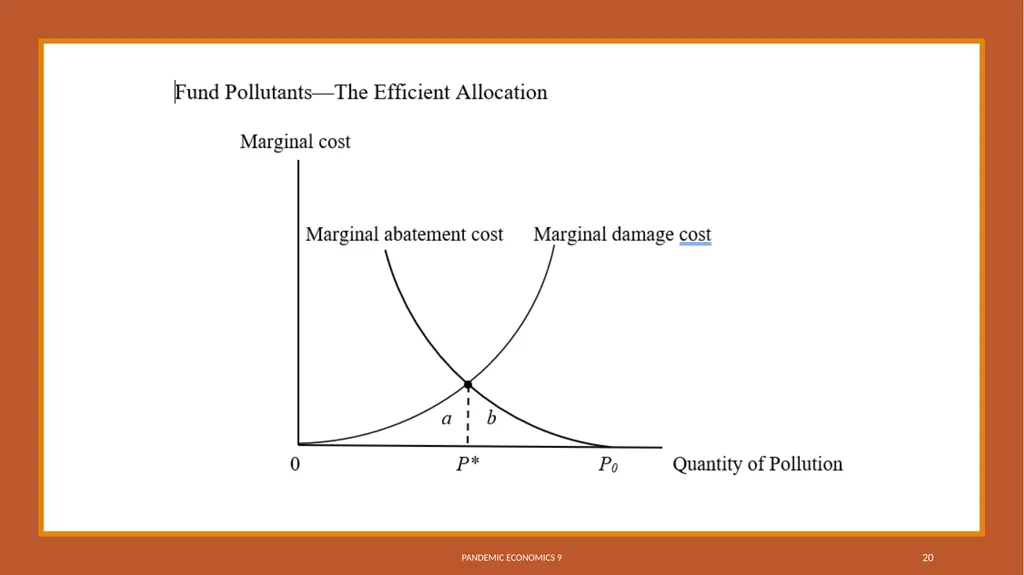
slide20. Pandemic Economics 9 20<br>
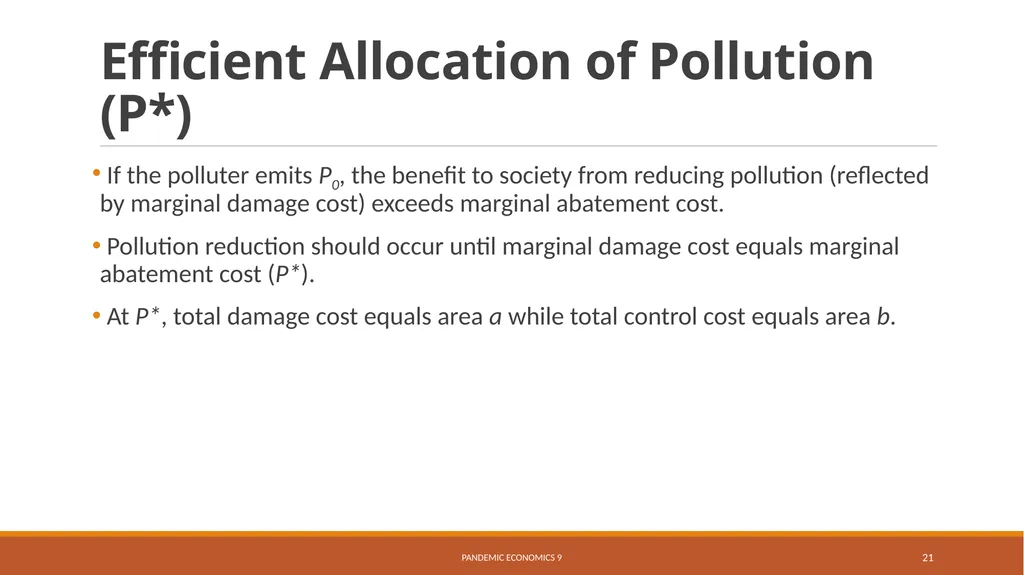
slide21. Efficient Allocation of Pollution (P*) If the polluter emits P0, the benefit to society from reducing pollution (reflected by marginal damage cost) exceeds marginal abatement cost.
Pollution reduction should occur until marginal damage cost equals marginal abatement cost (P*).
At P*, total damage cost equals area a while total control cost equals area b. Pandemic Economics 9 21<br>
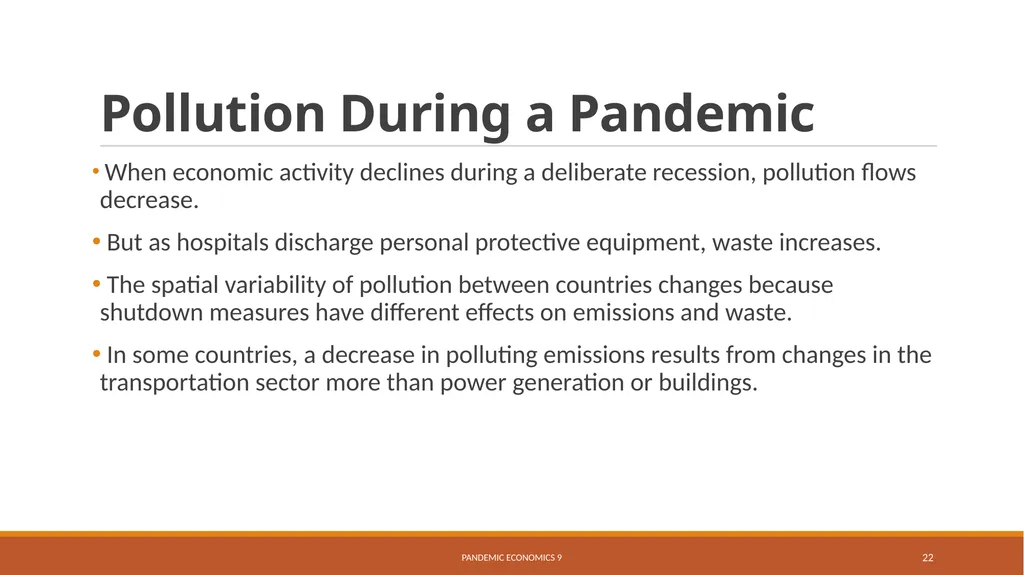
slide22. Pollution During a Pandemic When economic activity declines during a deliberate recession, pollution flows decrease.
But as hospitals discharge personal protective equipment, waste increases.
The spatial variability of pollution between countries changes because shutdown measures have different effects on emissions and waste.
In some countries, a decrease in polluting emissions results from changes in the transportation sector more than power generation or buildings. Pandemic Economics 9 22<br>
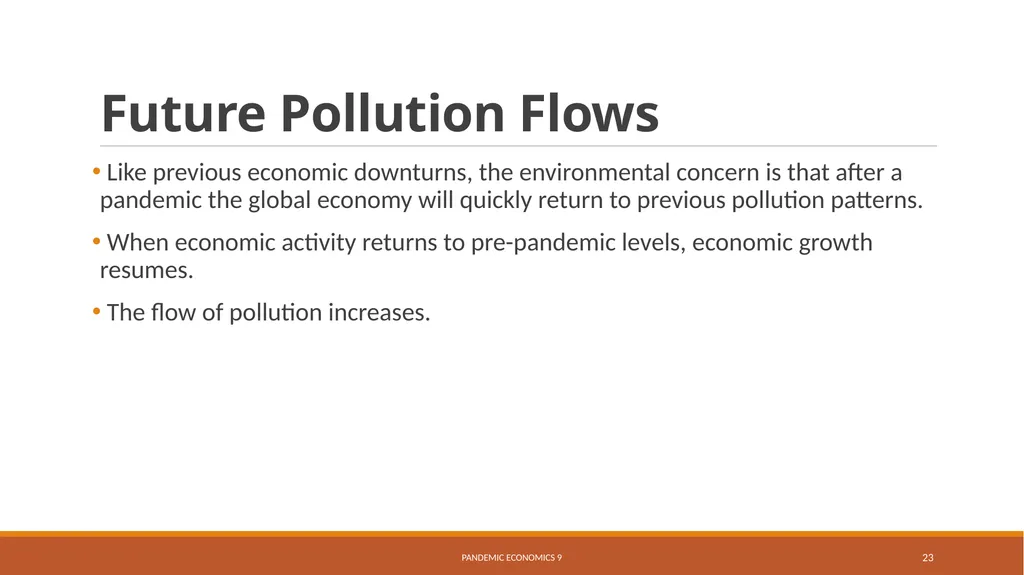
slide23. Future Pollution Flows Like previous economic downturns, the environmental concern is that after a pandemic the global economy will quickly return to previous pollution patterns.
When economic activity returns to pre-pandemic levels, economic growth resumes.
The flow of pollution increases. Pandemic Economics 9 23<br>
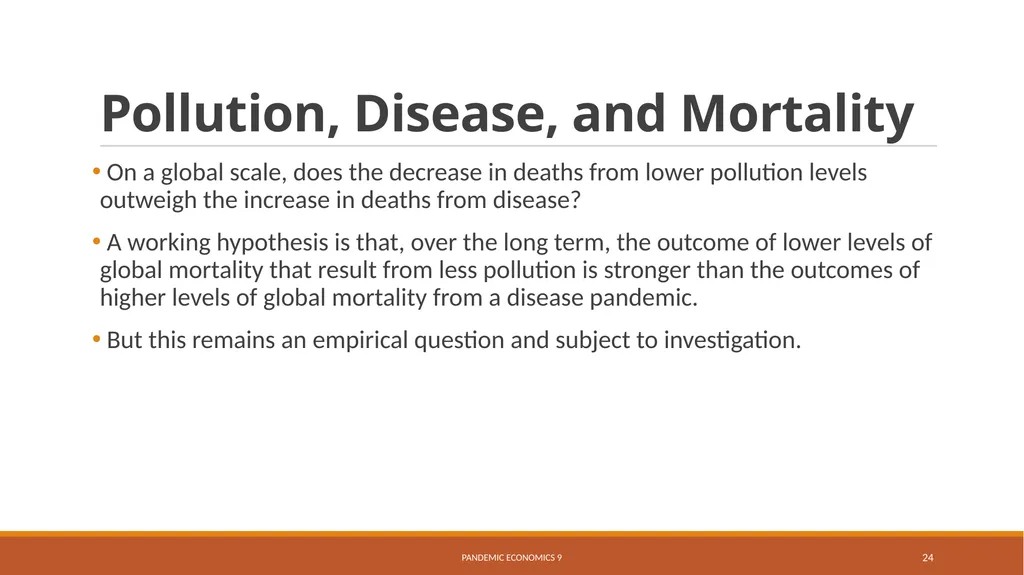
slide24. Pollution, Disease, and Mortality On a global scale, does the decrease in deaths from lower pollution levels outweigh the increase in deaths from disease?
A working hypothesis is that, over the long term, the outcome of lower levels of global mortality that result from less pollution is stronger than the outcomes of higher levels of global mortality from a disease pandemic.
But this remains an empirical question and subject to investigation. Pandemic Economics 9 24<br>
slide25. 5. Climate Effects Climate change, the alteration of climate patterns resulting from higher global average surface temperatures, serves as the world’s most important environmental challenge.
Without major changes to economic activity and energy choices, especially with respect to decarbonization, renewable energy, and climate policy, the climate crisis will continue. Pandemic Economics 9 25<br>
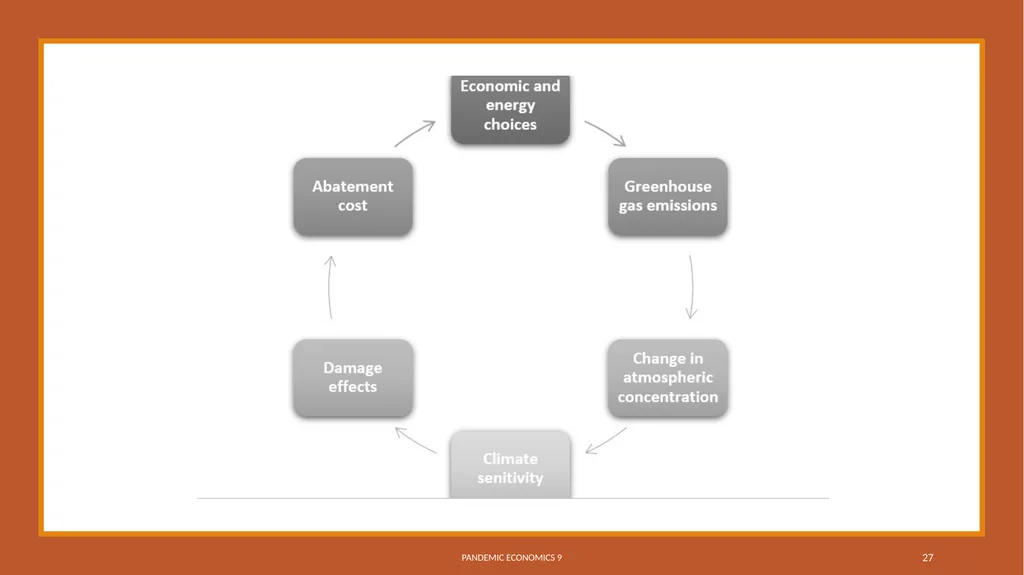
slide26. Integrated Assessment Model of Climate Change Uses both economic and climate research to simulate economic, energy, and climate activity.
Addresses how economic choices lead to climate outcomes
Determines how changes in average global surface temperature alter climate effects. Pandemic Economics 9 26<br>
slide27. Pandemic Economics 9 27<br>
slide28. Economic and Energy Choices Globalization, modernization, and urbanization increase global economic activity.
During the next several decades, almost all the world’s population growth will occur in urban areas.
The result of these trends will be an increase in the demand for energy. Pandemic Economics 9 28<br>
slide29. Greenhouse Gas Emissions Economic and energy choices lead to fossil fuel combustion and GHG, including carbon dioxide, methane, and nitrous oxide, which absorb and emit radiant energy within the infrared range.
The GHG, like economic problems like pollution, involve a negative externality, impacting people on a global scale at no cost to the responsible agents. Pandemic Economics 9 29<br>
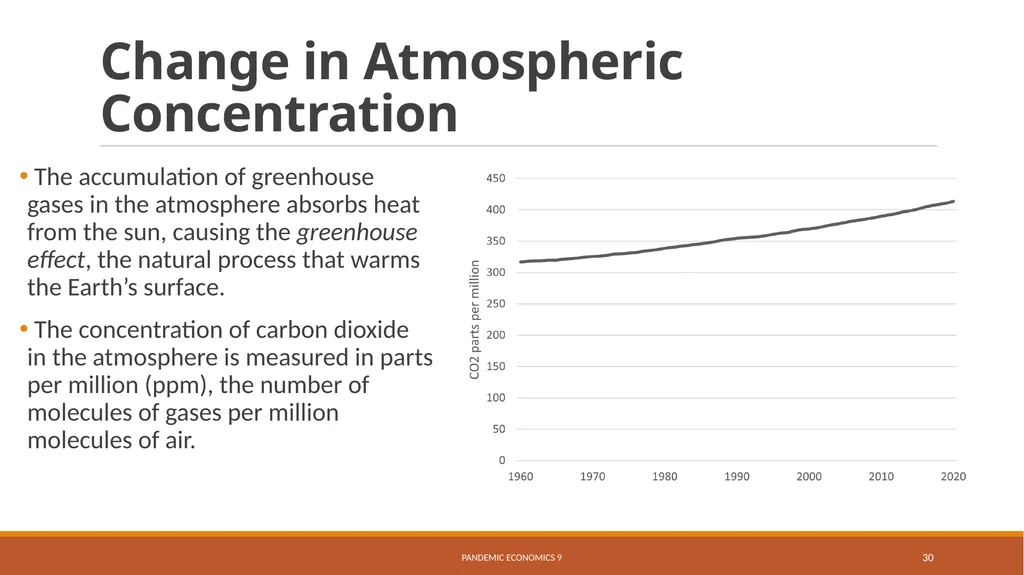
slide30. Change in Atmospheric Concentration The accumulation of greenhouse gases in the atmosphere absorbs heat from the sun, causing the greenhouse effect, the natural process that warms the Earth’s surface.
The concentration of carbon dioxide in the atmosphere is measured in parts per million (ppm), the number of molecules of gases per million molecules of air. Pandemic Economics 9 30<br>
slide31. Climate Sensitivity Climate sensitivity—the link between greenhouse gas concentrations in the atmosphere and average global surface temperatures—is determined by the factors that alter the energy balance of the Earth, including a change in GHG, intensity of the Sun’s energy, and cloud reflectivity.
Changes in these natural and anthropogenic factors may increase GHG atmospheric concentration. Pandemic Economics 9 31<br>
slide32. Damage Effects Economists quantify the monetary value of emission damage, the social cost of carbon (SCC), which is the harm that additional carbon emissions will cause in future decades.
For policy, the SCC provides an economic valuation of damages.
The SCC translates damage from climate change into economic terms, helping policymakers allocate resources to address the climate crisis. Pandemic Economics 9 32<br>
slide33. Abatement Cost Climate Adaptation Moving forward, the world should determine the adverse effects of climate change and implement appropriate measures to minimize economic damages. Climate mitigation The objective of climate mitigation is to reduce human interference in the climate system, a goal that requires significant expenditure over multiple generations. Pandemic Economics 9 33<br>
slide34. The Pandemic and the Climate Crisis The spread of infections during a pandemic leads to restrictions on economic activity and travel.
With respect to the coronavirus pandemic, daily CO2 emissions decreased during the months following initial lockdown in 2020, compared with mean levels during the same months in 2019.
The long-term effect depends on lasting changes to global networks, market incentives, and public policy. Pandemic Economics 9 34<br>
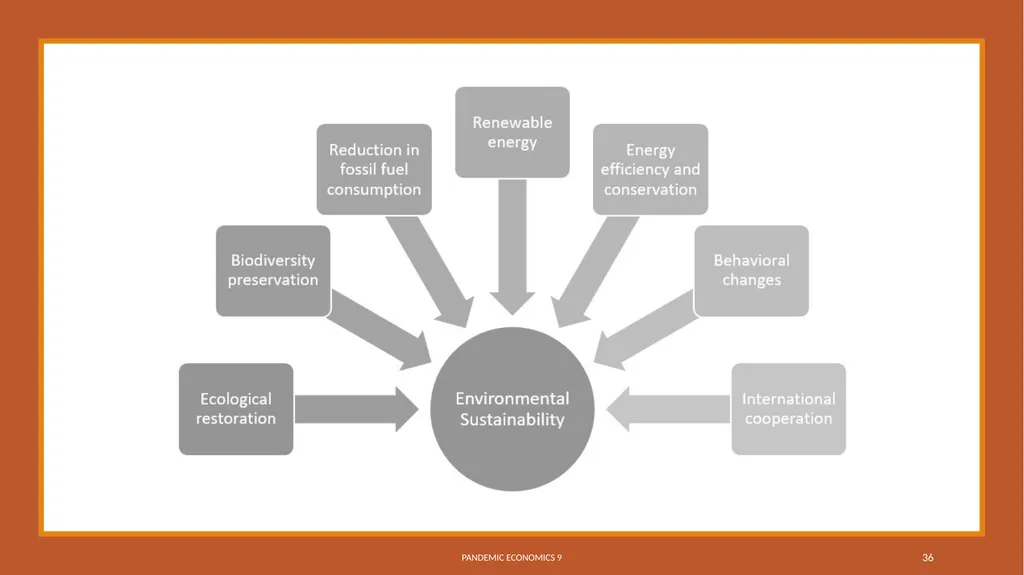
slide35. 6. Strategies for Environmental Sustainability Taken together, the energy, environmental, and climate effects demonstrate the need for sustainability, the priority of maintaining resources to meet the needs of the current generation while maintaining the resource base for future generations. Pandemic Economics 9 35<br>
slide36. Pandemic Economics 9 36<br>
Chapter 9 Pandemic Economics 9 1<br>
slide2. Topics Global Environment
Environmental Framework
Energy Effects
Environmental Effects
Climate Effects
Strategies for Environmental Sustainability Pandemic Economics 9 2<br>
slide3. Learning Objectives After reading this chapter, you will be able to: LO1 Explain how a pandemic impacts the global environment.
LO2 Present a model framework that shows how a pandemic impacts energy, the environment, and climate.
LO3 Analyze why a pandemic disrupts energy markets.
LO4 Discuss the mechanism in which a pandemic alters the flow of pollution from the economy into the environment.
LO5 Explain how a reduction in economic activity impacts the release of greenhouse gas emissions and whether this leads to lasting climate effects.
LO6 Discuss strategies for a sustainable future. Pandemic Economics 10 3<br>
slide4. 1. Global Environment A pandemic forces countries to implement interventions that both reduce human contact and shutter non-essential forms of economic activity.
Indirect effects also occur, including a reduction in energy consumption, a change in environmental quality, and an impact on the climate.
These outcomes reinforce the need to strengthen energy transitions, maintain environmental quality, and contribute to programs that lead to climate solutions. Pandemic Economics 9 4<br>
slide5. Specific Effects First, a reduction in economic activity from shutdown interventions leads to a decrease in energy demand.
Second, a reduction in the production of output leads to less pollution and an improvement in environmental quality.
Third, a decline in energy demand reduces fossil fuel consumption, which leads to a decrease in greenhouse gases (GHG), a byproduct of combustion. Pandemic Economics 9 5<br>
slide6. 2. Environmental Framework Because of a reduction in transportation, industry, and tourism, both fossil fuel consumption and GHG decline while air quality improves.
But the disposal of personal protective equipment (PPE), including face masks and hand gloves, and the generation of hospital waste leads to negative environmental outcomes.
Taken together, a pandemic creates both positive and negative effects. Pandemic Economics 9 6<br>
slide7. Pandemic Economics 9 7<br>
slide8. 3. Energy Effects It is important to distinguish between an energy system and an energy sector.
Energy system: a network that links energy sources, storage, and transmission to the agents of energy demand.
Energy sector: serves a purpose within the energy system, including power sources, fuels, electricity generation, buildings, industry, and transportation. Pandemic Economics 9 8<br>
slide9. Pandemic Economics 9 9<br>
slide10. Global Energy Trends Energy security—the ability to satisfy energy demand in the absence of high energy prices, environmental degradation, and conflict—remains an important global priority.
Natural disasters, volatile prices, and geopolitical conflict threaten global energy supply.
Growing interconnection increases the integration of global energy systems but enhances their vulnerability. Pandemic Economics 9 10<br>
slide11. Energy Transition Energy transition is the process of decarbonization within energy systems, and involves both bringing in low, or zero, carbon energy and phasing out old, high carbon energy.
It signifies the period between the introduction of a new resource or technology and growth into a significant share of the market.
In the presence of uncertainty, it is important to recognize the limitations of reaching definitive conclusions
However, the following slides highlight the continuities and discontinuities with pre-pandemic and post-pandemic energy trends. Pandemic Economics 9 11<br>
slide12. Temporalities of Energy System Change The short-term impact of a pandemic includes a decrease in energy demand, especially electricity, oil, and liquified natural gas.
At the same time, a pandemic slows the installation of new energy platforms for power facilities, offshore wind technology, and power infrastructure. Pandemic Economics 9 12<br>
slide13. Investment in Clean Technology and Divestment from Fossil Fuels Growing awareness of the financial risks of fossil fuel investments coupled with concerns about stranded fossil fuel reserves has led to investments in energy efficiency, grid management, renewables, and energy storage.
A pandemic may accelerate these trends. Pandemic Economics 9 13<br>
slide14. Energy Governance A pandemic interrupts the movement toward global interconnection.
As countries look inward, a pandemic highlights the lack of coordinated global energy governance.
Reacting to a pandemic, policymakers may prioritize energy security rather than decarbonization or clean energy technology. Pandemic Economics 9 14<br>
slide15. Social Practices While a pandemic mobilizes societies to address problems of public health, security, and employment, both high carbon and clean energy industries seek support in government recovery programs.
A link exists between economic activity, the consumption of fossil fuels, environmental quality, and human health.
A pandemic highlights this interconnection. Pandemic Economics 9 15<br>
slide16. Energy Innovation A pandemic creates unique challenges for the process of energy innovation, the set of programs and procedures that lead to new or improved energy technologies.
During a pandemic, companies reduce spending on clean technology.
Governments finance recovery programs, straining their budgets. Pandemic Economics 9 16<br>
slide17. Pandemic Economics 9 17<br>
slide18. 4. Environmental Effects In the field of economics, the environment is considered an asset that provides services for the economy.
After production and human consumption, energy and raw materials eventually return to the environment in the form of air and water pollution, solid waste, and waste heat. Pandemic Economics 9 18<br>
slide19. Pollution Taxonomy The damage from pollution depends on the environment’s absorptive capacity, the ability of the environment to assimilate waste and pollution.
The environment has little or no absorptive capacity for stock pollutants such as lead, persistent synthetic chemicals, and nonbiodegradable bottles.
The environment has higher absorptive capacity for fund pollutants, the pollutants that become diluted, disperse, or transform into substances that are harmless to ecological systems and human health. Pandemic Economics 9 19<br>
slide20. Pandemic Economics 9 20<br>
slide21. Efficient Allocation of Pollution (P*) If the polluter emits P0, the benefit to society from reducing pollution (reflected by marginal damage cost) exceeds marginal abatement cost.
Pollution reduction should occur until marginal damage cost equals marginal abatement cost (P*).
At P*, total damage cost equals area a while total control cost equals area b. Pandemic Economics 9 21<br>
slide22. Pollution During a Pandemic When economic activity declines during a deliberate recession, pollution flows decrease.
But as hospitals discharge personal protective equipment, waste increases.
The spatial variability of pollution between countries changes because shutdown measures have different effects on emissions and waste.
In some countries, a decrease in polluting emissions results from changes in the transportation sector more than power generation or buildings. Pandemic Economics 9 22<br>
slide23. Future Pollution Flows Like previous economic downturns, the environmental concern is that after a pandemic the global economy will quickly return to previous pollution patterns.
When economic activity returns to pre-pandemic levels, economic growth resumes.
The flow of pollution increases. Pandemic Economics 9 23<br>
slide24. Pollution, Disease, and Mortality On a global scale, does the decrease in deaths from lower pollution levels outweigh the increase in deaths from disease?
A working hypothesis is that, over the long term, the outcome of lower levels of global mortality that result from less pollution is stronger than the outcomes of higher levels of global mortality from a disease pandemic.
But this remains an empirical question and subject to investigation. Pandemic Economics 9 24<br>
slide25. 5. Climate Effects Climate change, the alteration of climate patterns resulting from higher global average surface temperatures, serves as the world’s most important environmental challenge.
Without major changes to economic activity and energy choices, especially with respect to decarbonization, renewable energy, and climate policy, the climate crisis will continue. Pandemic Economics 9 25<br>
slide26. Integrated Assessment Model of Climate Change Uses both economic and climate research to simulate economic, energy, and climate activity.
Addresses how economic choices lead to climate outcomes
Determines how changes in average global surface temperature alter climate effects. Pandemic Economics 9 26<br>
slide27. Pandemic Economics 9 27<br>
slide28. Economic and Energy Choices Globalization, modernization, and urbanization increase global economic activity.
During the next several decades, almost all the world’s population growth will occur in urban areas.
The result of these trends will be an increase in the demand for energy. Pandemic Economics 9 28<br>
slide29. Greenhouse Gas Emissions Economic and energy choices lead to fossil fuel combustion and GHG, including carbon dioxide, methane, and nitrous oxide, which absorb and emit radiant energy within the infrared range.
The GHG, like economic problems like pollution, involve a negative externality, impacting people on a global scale at no cost to the responsible agents. Pandemic Economics 9 29<br>
slide30. Change in Atmospheric Concentration The accumulation of greenhouse gases in the atmosphere absorbs heat from the sun, causing the greenhouse effect, the natural process that warms the Earth’s surface.
The concentration of carbon dioxide in the atmosphere is measured in parts per million (ppm), the number of molecules of gases per million molecules of air. Pandemic Economics 9 30<br>
slide31. Climate Sensitivity Climate sensitivity—the link between greenhouse gas concentrations in the atmosphere and average global surface temperatures—is determined by the factors that alter the energy balance of the Earth, including a change in GHG, intensity of the Sun’s energy, and cloud reflectivity.
Changes in these natural and anthropogenic factors may increase GHG atmospheric concentration. Pandemic Economics 9 31<br>
slide32. Damage Effects Economists quantify the monetary value of emission damage, the social cost of carbon (SCC), which is the harm that additional carbon emissions will cause in future decades.
For policy, the SCC provides an economic valuation of damages.
The SCC translates damage from climate change into economic terms, helping policymakers allocate resources to address the climate crisis. Pandemic Economics 9 32<br>
slide33. Abatement Cost Climate Adaptation Moving forward, the world should determine the adverse effects of climate change and implement appropriate measures to minimize economic damages. Climate mitigation The objective of climate mitigation is to reduce human interference in the climate system, a goal that requires significant expenditure over multiple generations. Pandemic Economics 9 33<br>
slide34. The Pandemic and the Climate Crisis The spread of infections during a pandemic leads to restrictions on economic activity and travel.
With respect to the coronavirus pandemic, daily CO2 emissions decreased during the months following initial lockdown in 2020, compared with mean levels during the same months in 2019.
The long-term effect depends on lasting changes to global networks, market incentives, and public policy. Pandemic Economics 9 34<br>
slide35. 6. Strategies for Environmental Sustainability Taken together, the energy, environmental, and climate effects demonstrate the need for sustainability, the priority of maintaining resources to meet the needs of the current generation while maintaining the resource base for future generations. Pandemic Economics 9 35<br>
slide36. Pandemic Economics 9 36<br>