
Engineering materials 2. Physical and mechanical
AM
Published · 16 slides · 0 views
1 / 1







Description
Engineering materials 2. Physical and mechanical properties of materials Practitioner guide 2. Physical and mechanical properties of materials 2 Introduction and overview These resources help practitioners to deliver the materials
Related Topics
Share
Embed code
Download this presentation From Below
"Engineering materials 2. Physical and mechanical" is the property of its rightful owner. Permission is granted to download and print the materials on this website for personal, non-commercial use only, and to display it on your personal computer provided you do not modify the materials and that you retain all copyright notices contained in the materials. By downloading content from our website, you accept the terms of this agreement.
Presentation Transcript
01
Engineering
materials
2. Physical and mechanical properties of materials<br>
materials
2. Physical and mechanical properties of materials<br>
02
Practitioner
guide 2. Physical and mechanical
properties of materials 2<br>
03
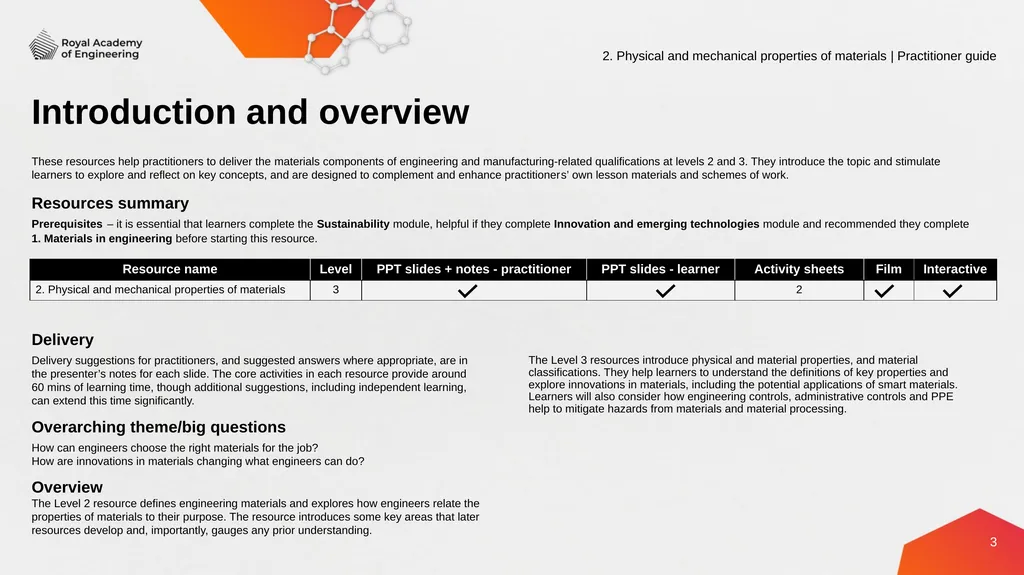
Introduction and overview These resources help practitioners to deliver the materials components of engineering and manufacturing-related qualifications at levels 2 and 3. They introduce the topic and stimulate learners to explore and reflect on key concepts, and are designed to complement and enhance practitioners’ own lesson materials and schemes of work. Resources summary
Prerequisites – it is essential that learners complete the Sustainability module, helpful if they complete Innovation and emerging technologies module and recommended they complete 1. Materials in engineering before starting this resource. The Level 3 resources introduce physical and material properties, and material classifications. They help learners to understand the definitions of key properties and explore innovations in materials, including the potential applications of smart materials. Learners will also consider how engineering controls, administrative controls and PPE help to mitigate hazards from materials and material processing. Delivery
Delivery suggestions for practitioners, and suggested answers where appropriate, are in the presenter’s notes for each slide. The core activities in each resource provide around 60 mins of learning time, though additional suggestions, including independent learning, can extend this time significantly.
Overarching theme/big questions
How can engineers choose the right materials for the job?
How are innovations in materials changing what engineers can do?
Overview
The Level 2 resource defines engineering materials and explores how engineers relate the properties of materials to their purpose. The resource introduces some key areas that later resources develop and, importantly, gauges any prior understanding. 3 2. Physical and mechanical properties of materials | Practitioner guide<br>
Prerequisites – it is essential that learners complete the Sustainability module, helpful if they complete Innovation and emerging technologies module and recommended they complete 1. Materials in engineering before starting this resource. The Level 3 resources introduce physical and material properties, and material classifications. They help learners to understand the definitions of key properties and explore innovations in materials, including the potential applications of smart materials. Learners will also consider how engineering controls, administrative controls and PPE help to mitigate hazards from materials and material processing. Delivery
Delivery suggestions for practitioners, and suggested answers where appropriate, are in the presenter’s notes for each slide. The core activities in each resource provide around 60 mins of learning time, though additional suggestions, including independent learning, can extend this time significantly.
Overarching theme/big questions
How can engineers choose the right materials for the job?
How are innovations in materials changing what engineers can do?
Overview
The Level 2 resource defines engineering materials and explores how engineers relate the properties of materials to their purpose. The resource introduces some key areas that later resources develop and, importantly, gauges any prior understanding. 3 2. Physical and mechanical properties of materials | Practitioner guide<br>
04
Learning outcomes and resource links Level 3 resource 1
Physical and mechanical properties of materials
Explain the meaning of physical and mechanical properties.
Name and define a range of physical and mechanical properties.
Consider how to work safely and avoid potential hazards when using and processing materials. Full resource list available for the topic of Engineering materials:
1. Materials in engineering (Level 2)
2. Physical and mechanical properties of materials (Level 3)
3. Innovations and modern materials (Level 3)
4. Smart materials (Level 3)
Links to other supported topics
Battery technologies, Electrical machines, Innovation and emerging technologies, Renewable energy, Sustainability. 4 2. Physical and mechanical properties of materials | Practitioner guide<br>
Physical and mechanical properties of materials
Explain the meaning of physical and mechanical properties.
Name and define a range of physical and mechanical properties.
Consider how to work safely and avoid potential hazards when using and processing materials. Full resource list available for the topic of Engineering materials:
1. Materials in engineering (Level 2)
2. Physical and mechanical properties of materials (Level 3)
3. Innovations and modern materials (Level 3)
4. Smart materials (Level 3)
Links to other supported topics
Battery technologies, Electrical machines, Innovation and emerging technologies, Renewable energy, Sustainability. 4 2. Physical and mechanical properties of materials | Practitioner guide<br>
05
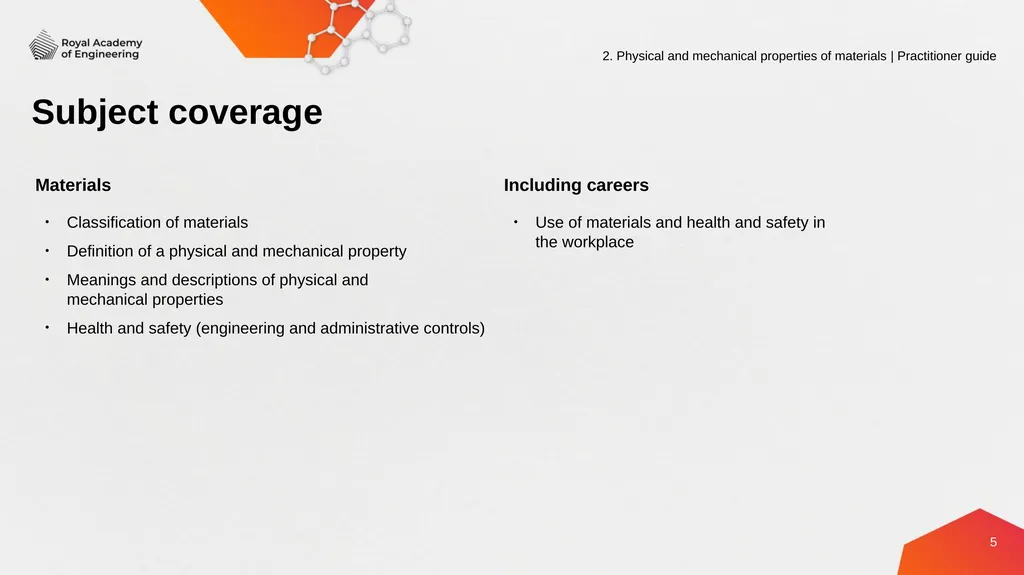
Subject coverage 5 Materials
Classification of materials
Definition of a physical and mechanical property
Meanings and descriptions of physical and mechanical properties
Health and safety (engineering and administrative controls) Including careers
Use of materials and health and safety in the workplace 2. Physical and mechanical properties of materials | Practitioner guide<br>
Classification of materials
Definition of a physical and mechanical property
Meanings and descriptions of physical and mechanical properties
Health and safety (engineering and administrative controls) Including careers
Use of materials and health and safety in the workplace 2. Physical and mechanical properties of materials | Practitioner guide<br>
06
2. Physical
and mechanical
properties of materials 6<br>
07
Learning outcomes You will be able to: Make calculations
of battery capacity in
Watt-hours (Wh). Name and define a
range of physical and mechanical properties. Explain the meaning of physical and mechanical properties. Consider how to work
safely and avoid potential hazards when using and processing materials. 2. Physical and mechanical properties of materials 7 Image © This Is Engineering<br>
08
Classification of engineering materials An engineering material is any material used in the construction
or production of artificial structures and objects. Dyneema composite fabric (DCF) Glass-reinforced plastic (GRP) ABS Brass Copper Glass Iron 7000 series aluminium MDF Nylon Oak Plywood Polyurethane Porcelain Spruce Steel 2. Physical and mechanical
properties of materials 8 Carbon fibre reinforced polymer (CFRP)<br>
09
How can we classify these engineering materials? Non-ferrous Timber Non-metals Thermo-
sets Thermo-
plastics 2. Physical and mechanical properties of materials 9 Iron Steel Polyurethane Oak
Spruce Copper 7000 series
aluminium
Brass CFRP
DCF
GRP
MDF
Plywood Glass
Porcelain Nylon
ABS Ceramics Composites Metals Polymers Alloys Pure Alloys Pure Ferrous<br>
Spruce Copper 7000 series
aluminium
Brass CFRP
DCF
GRP
MDF
Plywood Glass
Porcelain Nylon
ABS Ceramics Composites Metals Polymers Alloys Pure Alloys Pure Ferrous<br>
10
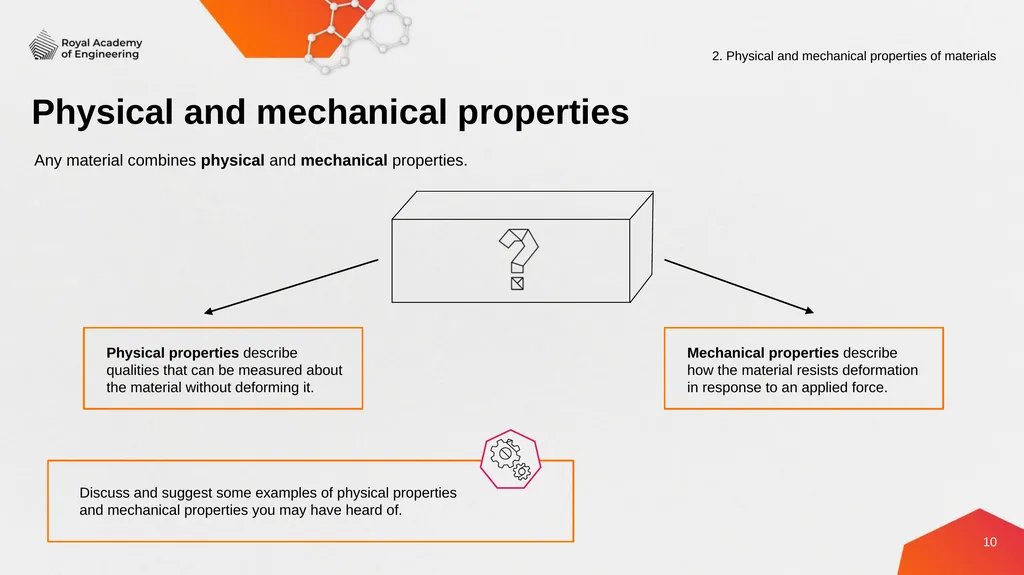
Physical and mechanical properties Any material combines physical and mechanical properties. Physical properties describe qualities that can be measured about the material without deforming it. Mechanical properties describe
how the material resists deformation in response to an applied force. Discuss and suggest some examples of physical properties
and mechanical properties you may have heard of. 10 2. Physical and mechanical properties of materials<br>
11
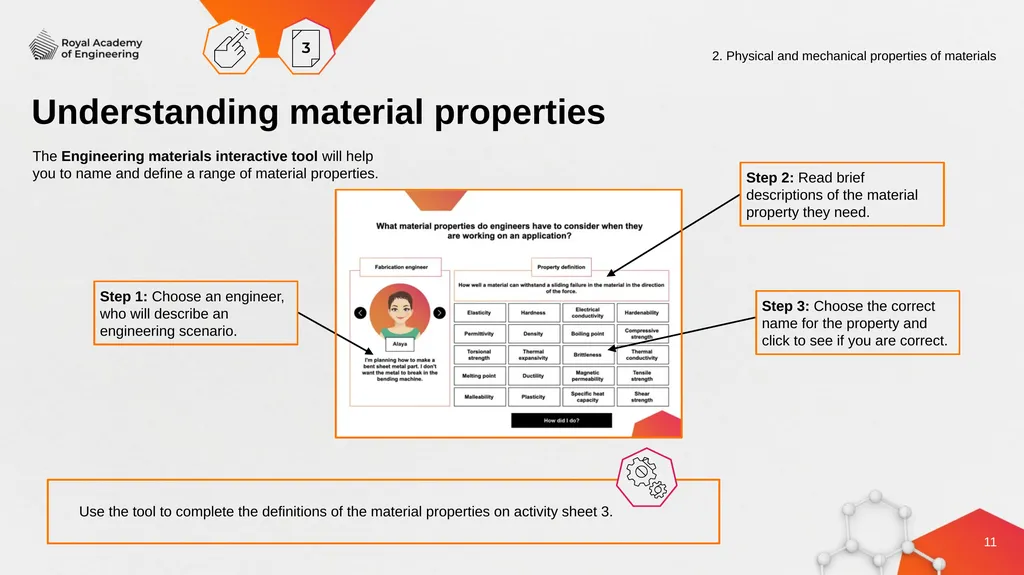
Understanding material properties The Engineering materials interactive tool will help
you to name and define a range of material properties. Use the tool to complete the definitions of the material properties on activity sheet 3. 11 2. Physical and mechanical properties of materials Step 3: Choose the correct name for the property and click to see if you are correct. Step 2: Read brief descriptions of the material property they need. Step 1: Choose an engineer, who will describe an engineering scenario.<br>
12
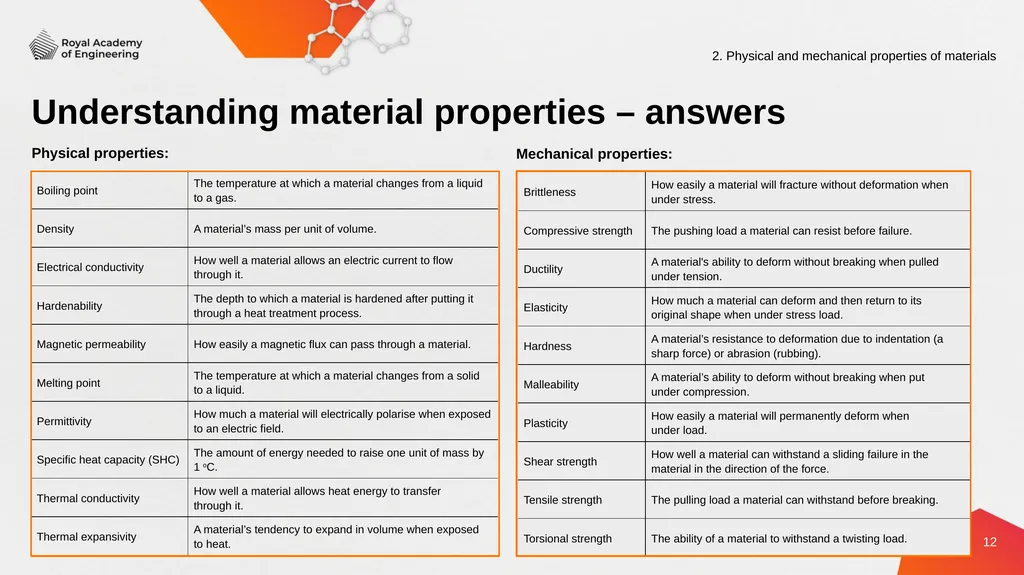
Understanding material properties – answers Physical properties: 2. Physical and mechanical properties of materials Mechanical properties: 12<br>
13
Material processing to create the desired properties Engineers process materials to create or increase desirable properties: High speed steel (HSS) Stainless steel High carbon steel Medium
carbon steel Low carbon steel Iron Wrought iron Cast iron Cast Low melting point
Hard, brittle
Pans, stoves High melting point
Malleable, ductile
Decorative ironwork Softer, lower strength, good to machine weld Car bodies, building frames Corrosion resistance
Marine hardware High tungsten
or molybdenum Very hard but brittle Machine tools Hard outer layer
Gears, bolts Hardening
Blades, heavy plant Ductile, softer
Wires High chromium Hardness at high temperature
Drill bits, tool heads Control carbon content Add more alloy materials When other elements are added to a pure metal it becomes an alloy. Hammer 2. Physical and mechanical properties of materials Case hardening Annealing Quenching/
tempering 13<br>
Hard, brittle
Pans, stoves High melting point
Malleable, ductile
Decorative ironwork Softer, lower strength, good to machine weld Car bodies, building frames Corrosion resistance
Marine hardware High tungsten
or molybdenum Very hard but brittle Machine tools Hard outer layer
Gears, bolts Hardening
Blades, heavy plant Ductile, softer
Wires High chromium Hardness at high temperature
Drill bits, tool heads Control carbon content Add more alloy materials When other elements are added to a pure metal it becomes an alloy. Hammer 2. Physical and mechanical properties of materials Case hardening Annealing Quenching/
tempering 13<br>
14
Engineering materials, hazards and safety Engineers process materials to modify their properties and to produce finished structures or components. They will use a range of machines, from CNC mills and lathes, to presses or furnaces, and may use chemical treatments for hardening and other surface treatments or oil/water quenching baths.
Processing methods, or the materials themselves, can present risks to personal safety. Where a risk cannot be eliminated or substituted, engineering controls and administrative controls work alongside personal protective equipment (PPE) to protect against risks: Engineering controls are design solutions that isolate people from the hazard. Administrative controls are training solutions that change how people work, to remove the hazard. PPE provides a final barrier that protects people from any remaining hazard. 14 Think about what type of workplace you might or did enter for your industry placement or first job.
On your activity sheet, suggest what materials and equipment you might use or observe.
Suggest some general engineering controls and administrative controls that might remove risks from the materials you might work with and any other materials or chemicals you may need to use. How might your workplace or machines be designed and how might you be trained? 2. Physical and mechanical properties of materials<br>
Processing methods, or the materials themselves, can present risks to personal safety. Where a risk cannot be eliminated or substituted, engineering controls and administrative controls work alongside personal protective equipment (PPE) to protect against risks: Engineering controls are design solutions that isolate people from the hazard. Administrative controls are training solutions that change how people work, to remove the hazard. PPE provides a final barrier that protects people from any remaining hazard. 14 Think about what type of workplace you might or did enter for your industry placement or first job.
On your activity sheet, suggest what materials and equipment you might use or observe.
Suggest some general engineering controls and administrative controls that might remove risks from the materials you might work with and any other materials or chemicals you may need to use. How might your workplace or machines be designed and how might you be trained? 2. Physical and mechanical properties of materials<br>
15
Engineering materials, hazards and safety – answers Engineering controls
Design to remove excessive noise, temperature or physical effort, or the use of toxic materials.
Isolation from toxic materials.
Enclosure of high-risk parts, machines or workstations.
Extraction of toxic chemicals or particles, along with ventilation using fresh air.
Automation of processes using toxic materials. Administrative controls
Training in safe working practices and hazard awareness.
Monitoring of hazardous materials or processes.
Maintenance to ensure safe operation.
Process improvement to reduce risks.
Rotation and breaks to remove workers from environments.
Signage to highlight risks and promote safe behavior. 2. Physical and mechanical properties of materials 15 Materials might include ferrous metals and alloys like steel or stainless steel, or non-ferrous examples like aluminium and its alloys, bronze or brass; polymers, or composite materials. Machines might include manual or CNC mills, drills, lathes or grinders, laser cutting, power and manual hand tools, or additive machines like 3D printers or laser sintering.<br>
Design to remove excessive noise, temperature or physical effort, or the use of toxic materials.
Isolation from toxic materials.
Enclosure of high-risk parts, machines or workstations.
Extraction of toxic chemicals or particles, along with ventilation using fresh air.
Automation of processes using toxic materials. Administrative controls
Training in safe working practices and hazard awareness.
Monitoring of hazardous materials or processes.
Maintenance to ensure safe operation.
Process improvement to reduce risks.
Rotation and breaks to remove workers from environments.
Signage to highlight risks and promote safe behavior. 2. Physical and mechanical properties of materials 15 Materials might include ferrous metals and alloys like steel or stainless steel, or non-ferrous examples like aluminium and its alloys, bronze or brass; polymers, or composite materials. Machines might include manual or CNC mills, drills, lathes or grinders, laser cutting, power and manual hand tools, or additive machines like 3D printers or laser sintering.<br>
16
Learning outcomes You will be able to: Make calculations
of battery capacity in
Watt-hours (Wh). Name and define a
range of physical and mechanical properties. Explain the meaning of physical and mechanical properties. Consider how to work
safely and avoid potential hazards when using and processing materials. 2. Physical and mechanical properties of materials 16 Image © This Is Engineering<br>