
ENGINEERING STRATEGIES FOR HANDLING COVID-19 FOR
LV
Published · 22 slides · 0 views

1 / 1

Description
ENGINEERING STRATEGIES FOR HANDLING COVID-19 FOR ENVIROMENTAL HEALTH AND ECONOMIC HEALTH AND ECONOMIC SUSTAINABILITY Presented by: Iwatt Enobong Udo Department: ElectricalElectronics Engineering Matric No: 18Eng04080 ABSTRACT Modern
Related Topics
Share
Embed code
Download this presentation From Below
"ENGINEERING STRATEGIES FOR HANDLING COVID-19 FOR" is the property of its rightful owner. Permission is granted to download and print the materials on this website for personal, non-commercial use only, and to display it on your personal computer provided you do not modify the materials and that you retain all copyright notices contained in the materials. By downloading content from our website, you accept the terms of this agreement.
Presentation Transcript
01
ENGINEERING STRATEGIES FOR HANDLING COVID-19 FOR ENVIROMENTAL HEALTH AND ECONOMIC HEALTH AND ECONOMIC SUSTAINABILITY Presented by: Iwatt Enobong Udo
Department: Electrical/Electronics Engineering
Matric No: 18/Eng04/080<br>
Department: Electrical/Electronics Engineering
Matric No: 18/Eng04/080<br>
02
ABSTRACT Modern medicine and healthcare rely heavily on engineering to deliver improved prevention, diagnosis and treatment of illness. These technologies are vital to the delivery of efficient health services through the National Health Service (NHS). However, in the health sector the contribution of engineering is often hidden. This paper looks at key areas of medical science and technology, specific issues within healthcare and medicine and uses examples to show the contribution of engineering in each area, and to highlight its contribution to the battle with the covid-19 pandemic.Our digital infrastructure needs strengthening to deal with the impact of COVID-19 and future public health crises; Better integration of Artificial Intelligence in to the public health response should be a priority; Analysis of big data relating to citizens' movement, disease transmission patters and health monitoring could be used to aid prevention measures. In recent years, the world has witnessed the rise of SARS, Zika virus, Ebola and now COVID-19. Epidemics are a rising threat. Cities across the world have made infrastructure innovation a priority to safeguard their physical systems so they can stay robust and antifragile during natural disasters such as earthquakes, tsunami and hurricanes. But pandemics have shown that these methods aren’t enough when it comes to ensuring connectivity and accessing our society during biological disasters.<br>
03
ABSTRACT Much remains unknown about how SARS-CoV-2, the virus that causes COVID-19, spreads through the environment. A major reason for this is that the behaviors and traits of viruses are highly variable—some spread more easily through water, others through air; some are wrapped in layers of fatty molecules that help them avoid their host's immune system, while others are "naked." This makes it urgent for environmental engineers and scientists to collaborate on pinpointing viral and environmental characteristics that affect transmission via surfaces, the air and fecal matter, this paper will highlight engineering contribution in the effort to overcome the covid-19 pandemic.<br>
04
INTRODUCTION
1.1 ENGINEERING IN MEDICINE The practice of medicine is no longer an independent arena. The art of medicine is exclusively exposed through its inherent interdisciplinary nature. Research scientists continue to elegantly discover what exists within various diseases; they inform the biomedical community of what already exists. Engineers utilize this information to create that which is yet to exist ; they develop novel tools that can be implemented into clinical practice. And the physician of the future holds the honorable responsibility of bridging the gap between these once distant worlds. A physician of the future connects the dots, and pushes the limits of what we can offer patients. A physician of the future constantly searchers for the answers through an interdisciplinary approach involving bioengineers and scientists. Bioinformatics and open access medical data has ushered in an era of medical practice infused with information unseen hitherto. And now, the responsibility to formulate solutions to unresolved clinical problems rests within the collaborative efforts of the biomedical community.<br>
05
. When it comes to medical field the primary goal is to improve the health of people. Doctors have the knowledge of human body. They know what is good for a person and what not. But to build anything, you need engineers.
Electronic Engineers can develop and build new gadgets that can help people improve their health. Software Engineers can write software that uses algorithms to analyze massive amount of health information and generate results that help people and doctors in making healthy decisions. Plus making health information readily available using cloud, is something that is being done these days. In India especially.Chemical engineers can contribute to development and testing of new drugs and medicines. Same goes for genetic engineers.And wherever you can find application of robotics in medical field, mechanical engineers also kick in.
Engineering is everywhere. Even in medical field.<br>
06
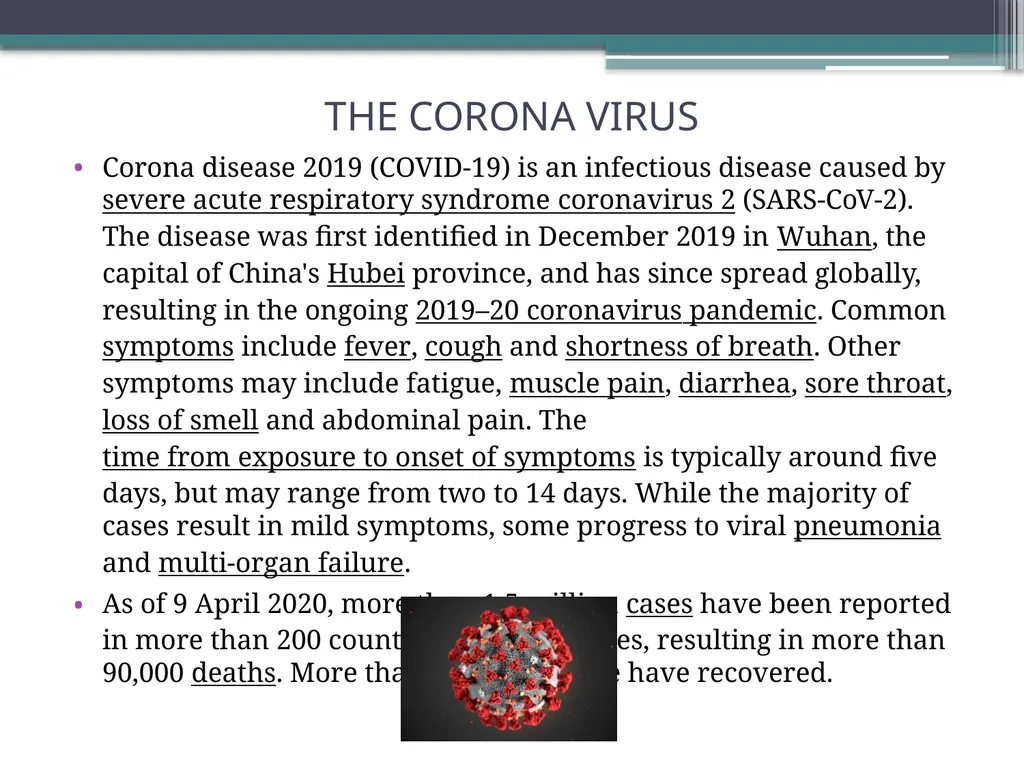
THE CORONA VIRUS Corona disease 2019 (COVID-19) is an infectious disease caused by severe acute respiratory syndrome coronavirus 2 (SARS-CoV-2). The disease was first identified in December 2019 in Wuhan, the capital of China's Hubei province, and has since spread globally, resulting in the ongoing 2019–20 coronavirus pandemic. Common symptoms include fever, cough and shortness of breath. Other symptoms may include fatigue, muscle pain, diarrhea, sore throat, loss of smell and abdominal pain. The time from exposure to onset of symptoms is typically around five days, but may range from two to 14 days. While the majority of cases result in mild symptoms, some progress to viral pneumonia and multi-organ failure.
As of 9 April 2020, more than 1.5 million cases have been reported in more than 200 countries and territories, resulting in more than 90,000 deaths. More than 340,000 people have recovered.<br>
As of 9 April 2020, more than 1.5 million cases have been reported in more than 200 countries and territories, resulting in more than 90,000 deaths. More than 340,000 people have recovered.<br>
07
. The virus is mainly spread between people during close contact, often via small droplets produced during cough, sneeze, or talk. While these droplets are produced when breathing out, they usually fall to the ground or surfaces rather than being infectious in the air over large distances. People may also become infected by touching a contaminated surface and then their face. The virus can survive on surfaces for up to 72 hours. Coronavirus is most contagious during the first three days after onset of symptoms, although spread may be possible before symptoms appear and in later stages of the disease.
Recommended measures to prevent infection include frequent hand washing, social distancing (maintaining physical distance from others, especially from those with symptoms), covering coughs and sneezes with a tissue or inner elbow and keeping unwashed hands away from the face. The use of masks is recommended for those who suspect they have the virus and their caregivers. Recommendations for mask use by the general public vary, with some authorities recommending against their use, some recommending their use and others requiring their use. Currently, there is no vaccine or specific antiviral treatment for COVID-19. Management involves treatment of symptoms, supportive care, isolation and experimental measures.<br>
Recommended measures to prevent infection include frequent hand washing, social distancing (maintaining physical distance from others, especially from those with symptoms), covering coughs and sneezes with a tissue or inner elbow and keeping unwashed hands away from the face. The use of masks is recommended for those who suspect they have the virus and their caregivers. Recommendations for mask use by the general public vary, with some authorities recommending against their use, some recommending their use and others requiring their use. Currently, there is no vaccine or specific antiviral treatment for COVID-19. Management involves treatment of symptoms, supportive care, isolation and experimental measures.<br>
08
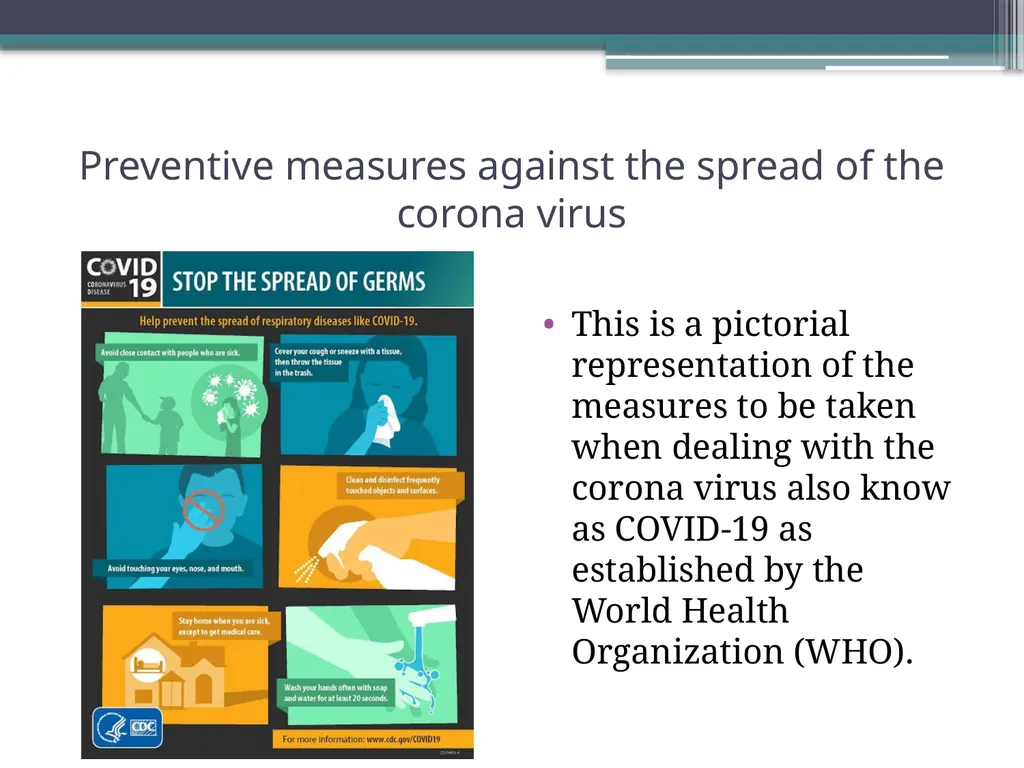
Preventive measures against the spread of the corona virus This is a pictorial representation of the measures to be taken when dealing with the corona virus also know as COVID-19 as established by the World Health Organization (WHO).<br>
09
LITERATURE REVIEW ELECRTRICAL/ELECTRONIC ENGINNERING IN MEDICINE
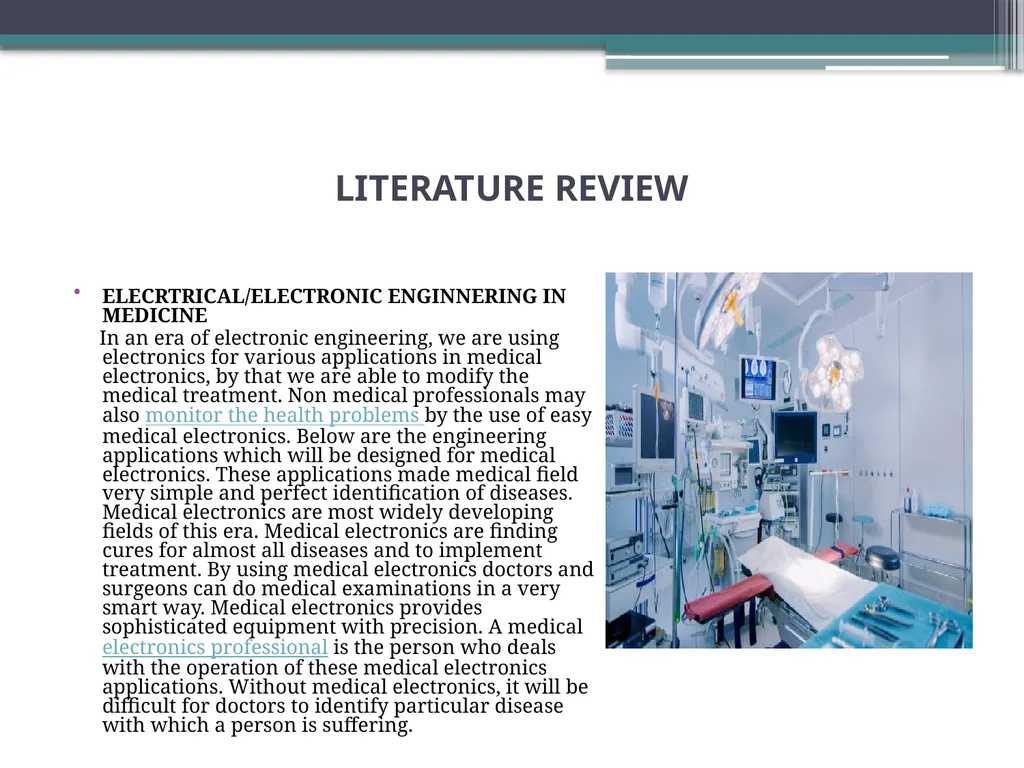
In an era of electronic engineering, we are using electronics for various applications in medical electronics, by that we are able to modify the medical treatment. Non medical professionals may also monitor the health problems by the use of easy medical electronics. Below are the engineering applications which will be designed for medical electronics. These applications made medical field very simple and perfect identification of diseases. Medical electronics are most widely developing fields of this era. Medical electronics are finding cures for almost all diseases and to implement treatment. By using medical electronics doctors and surgeons can do medical examinations in a very smart way. Medical electronics provides sophisticated equipment with precision. A medical electronics professional is the person who deals with the operation of these medical electronics applications. Without medical electronics, it will be difficult for doctors to identify particular disease with which a person is suffering.<br>
In an era of electronic engineering, we are using electronics for various applications in medical electronics, by that we are able to modify the medical treatment. Non medical professionals may also monitor the health problems by the use of easy medical electronics. Below are the engineering applications which will be designed for medical electronics. These applications made medical field very simple and perfect identification of diseases. Medical electronics are most widely developing fields of this era. Medical electronics are finding cures for almost all diseases and to implement treatment. By using medical electronics doctors and surgeons can do medical examinations in a very smart way. Medical electronics provides sophisticated equipment with precision. A medical electronics professional is the person who deals with the operation of these medical electronics applications. Without medical electronics, it will be difficult for doctors to identify particular disease with which a person is suffering.<br>
10
ENGINEERING INVOLVEMENT IN THE COVID-19 PANDEMIC As the COVID-19 pandemic spreads around the world, it is straining medical systems and supplies, and changing daily life as people practice social distancing, schools close, and organizations tell their employees to work from home. Medical professionals are on the frontlines in the fight against COVID-19 as they care for patients and work to create a vaccine. These unprecedented times have left other professionals wondering what they can do? How can they contribute to help society through this pandemic? Every profession has a role to play, and they’re probably more effective when they’re working in concert with others, and among engineers there are many ways in which the engineering community can contribute during this pandemic—from manufacturing supplies for frontline medical workers, to ensuring that essential services continue to serve. . For example, conducting research to adapt a hand-held, portable technology to detect whether someone carries the corona virus that causes COVID-19.<br>
11
ENGINEERINGS MOST NOTABLE CONTRIBUTION TO THE COVID-19 PANDEMIC
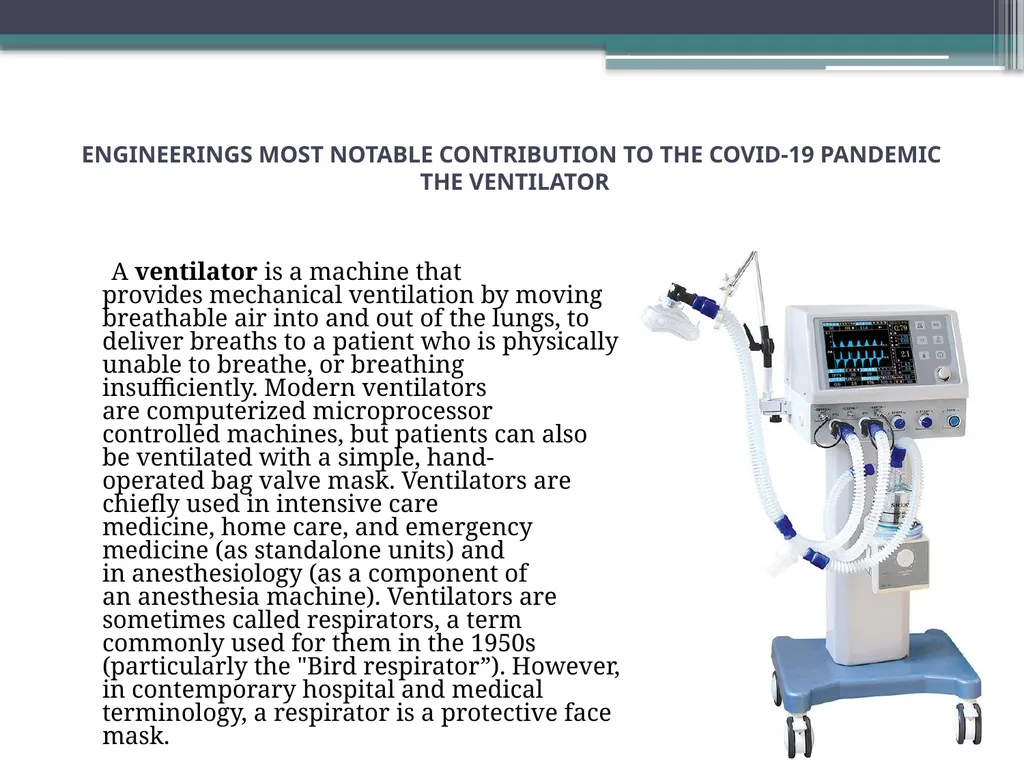
THE VENTILATOR A ventilator is a machine that provides mechanical ventilation by moving breathable air into and out of the lungs, to deliver breaths to a patient who is physically unable to breathe, or breathing insufficiently. Modern ventilators are computerized microprocessor controlled machines, but patients can also be ventilated with a simple, hand-operated bag valve mask. Ventilators are chiefly used in intensive care medicine, home care, and emergency medicine (as standalone units) and in anesthesiology (as a component of an anesthesia machine). Ventilators are sometimes called respirators, a term commonly used for them in the 1950s (particularly the "Bird respirator”). However, in contemporary hospital and medical terminology, a respirator is a protective face mask.<br>
12
FUNCTION OF A VENTILATOR In its simplest form, a modern positive pressure ventilator consists of a compressible air reservoir or turbine, air and oxygen supplies, a set of valves and tubes, and a disposable or reusable "patient circuit". The air reservoir is pneumatically compressed several times a minute to deliver room-air, or in most cases, an air/oxygen mixture to the patient. If a turbine is used, the turbine pushes air through the ventilator, with a flow valve adjusting pressure to meet patient-specific parameters. When over pressure is released, the patient will exhale passively due to the lungs' elasticity, the exhaled air being released usually through a one-way valve within the patient circuit called the patient manifold.
Ventilators may also be equipped with monitoring and alarm systems for patient-related parameters (e.g. pressure, volume, and flow) and ventilator function (e.g. air leakage, power failure, mechanical failure), backup batteries, oxygen tanks, and remote control. The pneumatic system is nowadays often replaced by a computer-controlled turbo pump.
Modern ventilators are electronically controlled by a small embedded system to allow exact adaptation of pressure and flow characteristics to an individual patient's needs. Fine-tuned ventilator settings also serve to make ventilation more tolerable and comfortable for the patient. In Canada and the United States, respiratory therapists are responsible for tuning these settings, while biomedical technologists are responsible for the maintenance. In the United Kingdom and Europe the management of the patient's interaction with the ventilator is done by critical care nurses.<br>
Ventilators may also be equipped with monitoring and alarm systems for patient-related parameters (e.g. pressure, volume, and flow) and ventilator function (e.g. air leakage, power failure, mechanical failure), backup batteries, oxygen tanks, and remote control. The pneumatic system is nowadays often replaced by a computer-controlled turbo pump.
Modern ventilators are electronically controlled by a small embedded system to allow exact adaptation of pressure and flow characteristics to an individual patient's needs. Fine-tuned ventilator settings also serve to make ventilation more tolerable and comfortable for the patient. In Canada and the United States, respiratory therapists are responsible for tuning these settings, while biomedical technologists are responsible for the maintenance. In the United Kingdom and Europe the management of the patient's interaction with the ventilator is done by critical care nurses.<br>
13
Roles for engineers in the covid-19 pandemic preparedness and response. The worldwide impact of the COVID-19 virus has been sudden and dramatic. While the immediate effects are seen in terms of the humanitarian crisis and the threat to the ability of all health care systems to function - the social, political and economic effects of this virus are also profound. Engineering has a huge role in both to play in both the short term and in the immediate future. In response to cases of COVID-19 rising worldwide, the World Health Organization has recently warned that the pandemic is "accelerating." Thankfully, it does say the trajectory can still be changed. That’s why the global scientific community is pulling together in order to develop viable treatments and vaccines to combat the spread of the infectious disease. Much in the same vein, the world is in desperate need of ingenious solutions to widespread issues such as supply shortages of medical equipment.<br>
14
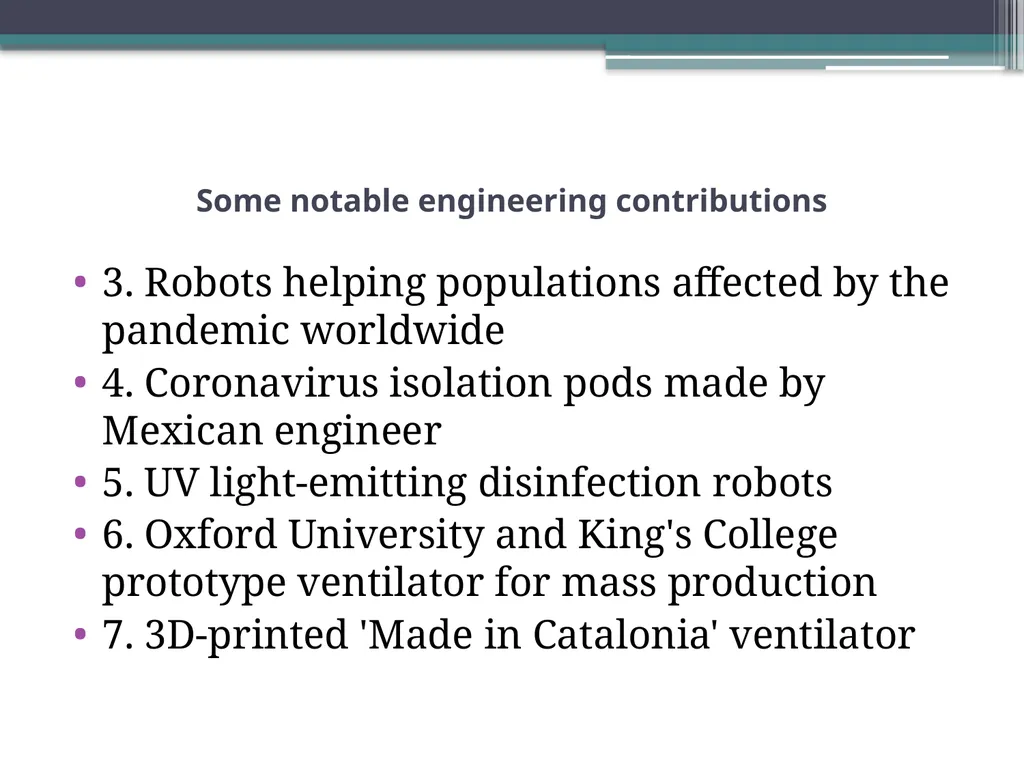
Some notable engineering contributions 1. Italy's reverse-engineered 3D-printed ventilators 2. The snorkeling mask ventilator<br>
15
Some notable engineering contributions 3. Robots helping populations affected by the pandemic worldwide
4. Coronavirus isolation pods made by Mexican engineer
5. UV light-emitting disinfection robots
6. Oxford University and King's College prototype ventilator for mass production
7. 3D-printed 'Made in Catalonia' ventilator<br>
4. Coronavirus isolation pods made by Mexican engineer
5. UV light-emitting disinfection robots
6. Oxford University and King's College prototype ventilator for mass production
7. 3D-printed 'Made in Catalonia' ventilator<br>
16
Some notable engineering contributions 8. More open-source ventilator designs
9. Artificial intelligence used to analyze self-isolation habits
10. U.S. army corps engineers convert buildings to provide 10,000 new beds
11. Spain to use AI and robots to quadruple testing capacity<br>
9. Artificial intelligence used to analyze self-isolation habits
10. U.S. army corps engineers convert buildings to provide 10,000 new beds
11. Spain to use AI and robots to quadruple testing capacity<br>
17
IMPORTANCE OF ENGINEERING IN HANDLING A PANDEMIC The world is considered a global village, due to the ease of access to information and connectivity but it also isn’t the only reason the world is a global village. Other examples of why the world can be considered a global village is trade, ease of transportation thus factors can be detrimental in a case of a pandemic especially if the virus is easily transmitted, various precautions can be taking to reduce the impact of such pandemics like social distancing and basic hygiene but such measures aren’t enough. For the safety of the health workers and citizens connectivity and robotics comes into play.<br>
18
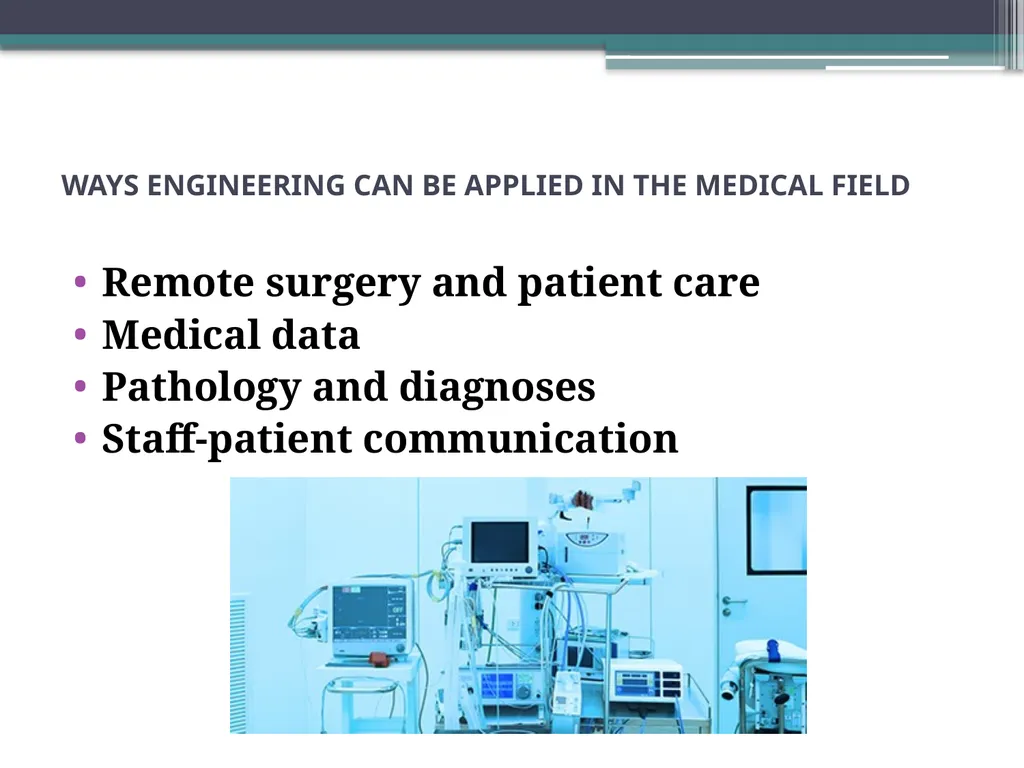
WAYS ENGINEERING CAN BE APPLIED IN THE MEDICAL FIELD Remote surgery and patient care
Medical data
Pathology and diagnoses
Staff-patient communication<br>
Medical data
Pathology and diagnoses
Staff-patient communication<br>
19
CONCLUSION AND RECOMMENDATIONS CONCLUSION
Engineering has a vital role in improving health and healthcare services. The Royal Academy of Engineering is active in the field of biomedical engineering through the Panel for Biomedical Engineering. The group provides advice to government, organises briefing seminars and engages with the policy community to promote awareness of new technologies, their applications and implications for the delivery of healthcare.
In this report I have outlined ways engineering can be effective in the medical field and how connectivity will support growth in a modern society. I have also shown some engineering strategies for handling covid-19 for environmental health and economic health and economic sustainability and how engineers are contributing to the covid-19 pandemic.<br>
Engineering has a vital role in improving health and healthcare services. The Royal Academy of Engineering is active in the field of biomedical engineering through the Panel for Biomedical Engineering. The group provides advice to government, organises briefing seminars and engages with the policy community to promote awareness of new technologies, their applications and implications for the delivery of healthcare.
In this report I have outlined ways engineering can be effective in the medical field and how connectivity will support growth in a modern society. I have also shown some engineering strategies for handling covid-19 for environmental health and economic health and economic sustainability and how engineers are contributing to the covid-19 pandemic.<br>
20
RECOMMENDATIONS I recommend that more funds be provided to engineers to aid in supporting the covid-19 response
I recommend that the government work with engineers to help the public health.
I recommend proper safety measures are taken bt all, so the virus can be contained and dealt with properly.<br>
I recommend that the government work with engineers to help the public health.
I recommend proper safety measures are taken bt all, so the virus can be contained and dealt with properly.<br>
21
REFERENCE Chen N, Zhou M, Dong X, Qu J, Gong F, Han Y, et al. (February 2020). "Epidemiological and clinical characteristics of 99 cases of 2019 novel coronavirus pneumonia in Wuhan, China: a descriptive study". Lancet. 395 (10223): 507–513. doi:10.1016/S0140-6736(20)30211-7. PMC 7135076. PMID 32007143.
^ Han X, Cao Y, Jiang N, Chen Y, Alwalid O, Zhang X, et al. (March 2020). "Novel Coronavirus Pneumonia (COVID-19) Progression Course in 17 Discharged Patients: Comparison of Clinical and Thin-Section CT Features During Recovery". Clinical Infectious Diseases. doi:10.1093/cid/ciaa271. PMID 32227091.
^ Campbell C (20 January 2020). "The Wuhan Pneumonia Crisis Highlights the Danger in China's Opaque Way of Doing Things". Time. Archived from the original on 13 March 2020. Retrieved 13 March 2020.
^ Lucey D, Sparrow A (14 January 2020). "China Deserves Some Credit for Its Handling of the Wuhan Pneumonia". Foreign Policy. Archived from the original on 15 January 2020. Retrieved 13 March 2020.
^ Jump up to: a b c d e f "Symptoms of Coronavirus". U.S. Centers for Disease Control and Prevention (CDC). 10 February 2020. Archived from the original on 30 January 2020.
^ Jump up to: a b c d e f g h i j k l m "Q&A on coronaviruses". World Health Organization. 11 February 2020. Archived from the original on 20 January 2020. Retrieved 24 February 2020.
^ Jump up to: a b c d e "Coronavirus COVID-19 Global Cases by the Center for Systems Science and Engineering (CSSE) at Johns Hopkins University (JHU)". ArcGIS. Johns Hopkins CSSE. Retrieved 12 April 2020.
^ "Naming the coronavirus disease (COVID-19) and the virus that causes it". World Health Organization (WHO). Archived from the original on 28 February 2020. Retrieved 28 February 2020.<br>
^ Han X, Cao Y, Jiang N, Chen Y, Alwalid O, Zhang X, et al. (March 2020). "Novel Coronavirus Pneumonia (COVID-19) Progression Course in 17 Discharged Patients: Comparison of Clinical and Thin-Section CT Features During Recovery". Clinical Infectious Diseases. doi:10.1093/cid/ciaa271. PMID 32227091.
^ Campbell C (20 January 2020). "The Wuhan Pneumonia Crisis Highlights the Danger in China's Opaque Way of Doing Things". Time. Archived from the original on 13 March 2020. Retrieved 13 March 2020.
^ Lucey D, Sparrow A (14 January 2020). "China Deserves Some Credit for Its Handling of the Wuhan Pneumonia". Foreign Policy. Archived from the original on 15 January 2020. Retrieved 13 March 2020.
^ Jump up to: a b c d e f "Symptoms of Coronavirus". U.S. Centers for Disease Control and Prevention (CDC). 10 February 2020. Archived from the original on 30 January 2020.
^ Jump up to: a b c d e f g h i j k l m "Q&A on coronaviruses". World Health Organization. 11 February 2020. Archived from the original on 20 January 2020. Retrieved 24 February 2020.
^ Jump up to: a b c d e "Coronavirus COVID-19 Global Cases by the Center for Systems Science and Engineering (CSSE) at Johns Hopkins University (JHU)". ArcGIS. Johns Hopkins CSSE. Retrieved 12 April 2020.
^ "Naming the coronavirus disease (COVID-19) and the virus that causes it". World Health Organization (WHO). Archived from the original on 28 February 2020. Retrieved 28 February 2020.<br>
22
to global health—The latest 2019 novel coronavirus outbreak in Wuhan, China". Int J Infect Dis. 91: 264–66. doi:10.1016/j.ijid.2020.01.009. PMID 31953166.
^ Jump up to: a b "WHO Director-General's opening remarks at the media briefing on COVID-19". World Health Organization (WHO) (Press release). 11 March 2020. Archived from the original on 11 March 2020. Retrieved 12 March 2020.
^ "Q&A on coronaviruses (COVID-19)". World Health Organization (WHO). Archived from the original on 20 January 2020. Retrieved 11 March 2020.
^ Jump up to: a b c Hopkins, Claire. "Loss of sense of smell as marker of COVID-19 infection". Ear, Nose and Throat surgery body of United Kingdom. Retrieved 28 March 2020.
^ Velavan, T. P.; Meyer, C. G. (March 2020). "The COVID-19 epidemic". Tropical Medicine & International Health. n/a (n/a): 278–80. doi:10.1111/tmi.13383. PMID 32052514.
^ Jump up to: a b "Q&A on coronaviruses". World Health Organization (WHO). Archived from the original on 20 January 2020. Retrieved 27 January 2020.
^ "Coronavirus Update (Live)—Worldometer". ncov2019.live.
^ Jump up to: a b Politi, Daniel (11 April 2020). "WHO Investigating Reports of Coronavirus Patients Testing Positive Again After Recovery". Slate. Retrieved 11 April 2020.
^ Feng, Emily (27 March 2020). "Mystery In Wuhan: Recovered Coronavirus Patients Test Negative ... Then Positive". NPR. Retrieved 11 April 2020.
^ Jump up to: a b c d e f g h "How COVID-19 Spreads". Centers for Disease Control and Prevention (CDC). 2 April 2020. Archived from the original on 3 April 2020. Retrieved 3 April 2020.
^ Jump up to: a b Bourouiba L (March 2020). "Turbulent Gas Clouds and Respiratory Pathogen Emissions: Potential Implications for Reducing Transmission of COVID-19". JAMA. doi:10.1001/jama.2020.4756. PMID 32215590.
^ Jump up to: a b c d "Q & A on COVID-19". European Centre for Disease Prevention and Control. Archived from the original on 5 February 2020. Retrieved 23 March 2020<br>
^ Jump up to: a b "WHO Director-General's opening remarks at the media briefing on COVID-19". World Health Organization (WHO) (Press release). 11 March 2020. Archived from the original on 11 March 2020. Retrieved 12 March 2020.
^ "Q&A on coronaviruses (COVID-19)". World Health Organization (WHO). Archived from the original on 20 January 2020. Retrieved 11 March 2020.
^ Jump up to: a b c Hopkins, Claire. "Loss of sense of smell as marker of COVID-19 infection". Ear, Nose and Throat surgery body of United Kingdom. Retrieved 28 March 2020.
^ Velavan, T. P.; Meyer, C. G. (March 2020). "The COVID-19 epidemic". Tropical Medicine & International Health. n/a (n/a): 278–80. doi:10.1111/tmi.13383. PMID 32052514.
^ Jump up to: a b "Q&A on coronaviruses". World Health Organization (WHO). Archived from the original on 20 January 2020. Retrieved 27 January 2020.
^ "Coronavirus Update (Live)—Worldometer". ncov2019.live.
^ Jump up to: a b Politi, Daniel (11 April 2020). "WHO Investigating Reports of Coronavirus Patients Testing Positive Again After Recovery". Slate. Retrieved 11 April 2020.
^ Feng, Emily (27 March 2020). "Mystery In Wuhan: Recovered Coronavirus Patients Test Negative ... Then Positive". NPR. Retrieved 11 April 2020.
^ Jump up to: a b c d e f g h "How COVID-19 Spreads". Centers for Disease Control and Prevention (CDC). 2 April 2020. Archived from the original on 3 April 2020. Retrieved 3 April 2020.
^ Jump up to: a b Bourouiba L (March 2020). "Turbulent Gas Clouds and Respiratory Pathogen Emissions: Potential Implications for Reducing Transmission of COVID-19". JAMA. doi:10.1001/jama.2020.4756. PMID 32215590.
^ Jump up to: a b c d "Q & A on COVID-19". European Centre for Disease Prevention and Control. Archived from the original on 5 February 2020. Retrieved 23 March 2020<br>