
English Morphology Dott.ssa Gloria Cappelli What
FD
Published · 49 slides · 0 views

1 / 1

Description
English Morphology Dott.ssa Gloria Cappelli What is a word? Word: not a strightforward notion. The smallest meaningful unit of language is a MORPHEME certain, mean, linguist: free morphemes (they can stand on their own) -ly, -ing, -less:
Related Topics
Share
Embed code
Download this presentation From Below
"English Morphology Dott.ssa Gloria Cappelli What" is the property of its rightful owner. Permission is granted to download and print the materials on this website for personal, non-commercial use only, and to display it on your personal computer provided you do not modify the materials and that you retain all copyright notices contained in the materials. By downloading content from our website, you accept the terms of this agreement.
Presentation Transcript
01
English Morphology
Dott.ssa Gloria Cappelli<br>
02
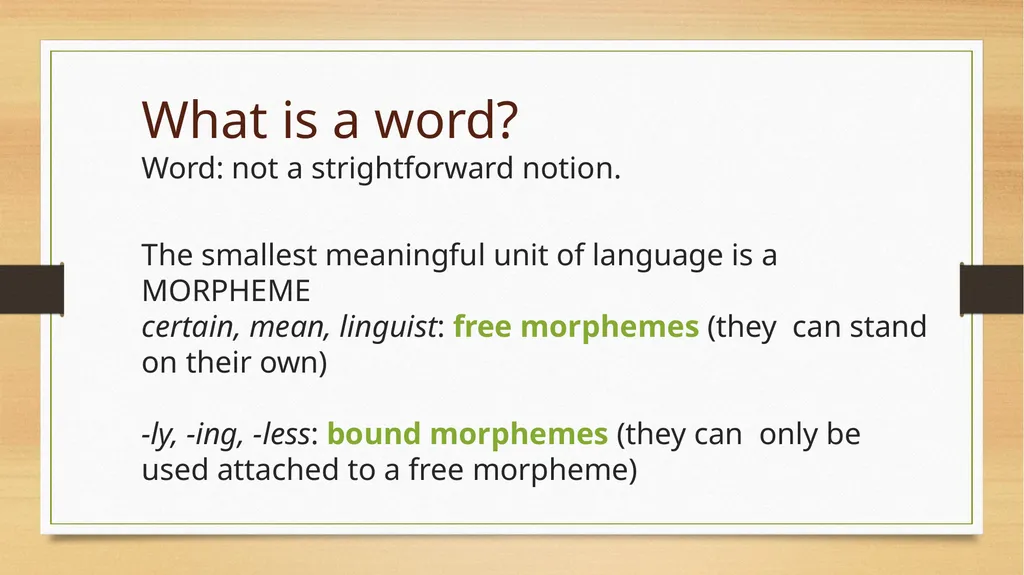
What is a word?
Word: not a strightforward notion.
The smallest meaningful unit of language is a MORPHEME
certain, mean, linguist: free morphemes (they can stand on their own)
-ly, -ing, -less: bound morphemes (they can only be used attached to a free morpheme)<br>
03
What is morphology? The subdiscipline of linguistics which studies the internal structure of words, the rules that govern it, as well as the ways of creating new words.<br>
04
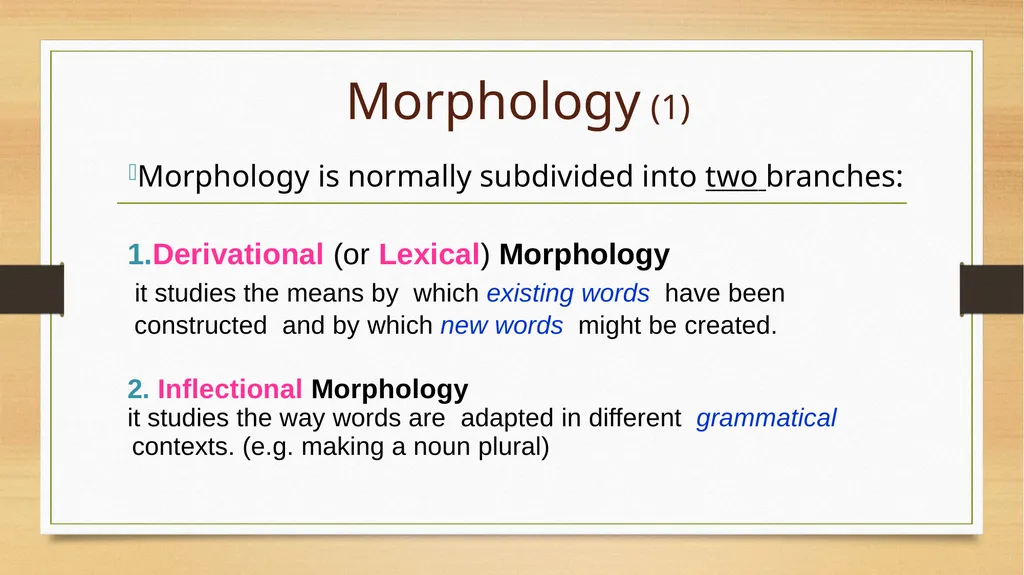
Morphology (1) Morphology is normally subdivided into two branches:
1.Derivational (or Lexical) Morphology
it studies the means by which existing words have been constructed and by which new words might be created.
2. Inflectional Morphology
it studies the way words are adapted in different grammatical contexts. (e.g. making a noun plural)<br>
1.Derivational (or Lexical) Morphology
it studies the means by which existing words have been constructed and by which new words might be created.
2. Inflectional Morphology
it studies the way words are adapted in different grammatical contexts. (e.g. making a noun plural)<br>
05
Morphemes
Word analysis involves breaking a word into its
morphemes.
Literally, the word "morpheme" means 'an element in a system of forms.'
Linguists define it more precisely as the smallest form which is paired with a particular meaning.
We say that each form (i.e. MORPH) plus the
meaning linked to it is a single morpheme.<br>
06
Meaningful units (1) How can we identify which part in a word is meaningful and what meaning it has?
SHYNESS
‘shy’ = ‘nervous and embarrassed about meeting and speaking to other people’.
a meaningful unit, a morpheme.
-ness = ?
There is no such a word in English. BUT the fact that there are many words that contain the unit ‘ness’ makes us think that it might be a morpheme.
To verify this, we should find out if it has a meaning, by paraphrasing different words containing ‘-ness’, in order to see whether it contributes any meaning to the overall meaning of these words.<br>
07
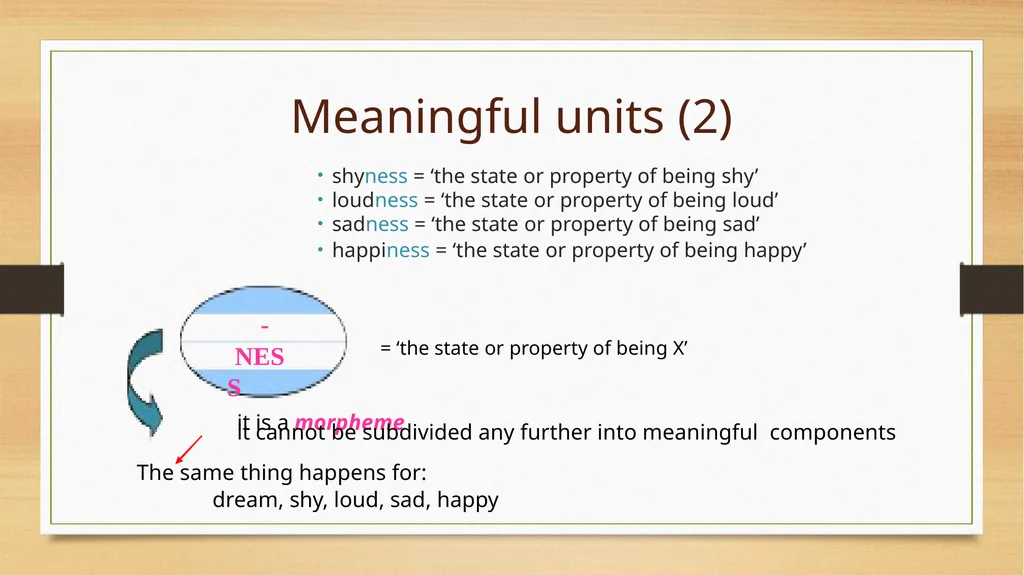
Meaningful units (2)
shyness = ‘the state or property of being shy’
loudness = ‘the state or property of being loud’
sadness = ‘the state or property of being sad’
happiness = ‘the state or property of being happy’ -
NESS = ‘the state or property of being X’ it is a morpheme
it cannot be subdivided any further into meaningful components
The same thing happens for:
dream, shy, loud, sad, happy<br>
08
dream
shy
happy
sad
loud These words consist of
only one morpheme. MONOMORPHEMIC or POLYMORPHEMIC or
SIMPLEX words v COMPLEX words These words consist of
more than one morpheme. Types of Words<br>
shy
happy
sad
loud These words consist of
only one morpheme. MONOMORPHEMIC or POLYMORPHEMIC or
SIMPLEX words v COMPLEX words These words consist of
more than one morpheme. Types of Words<br>
09
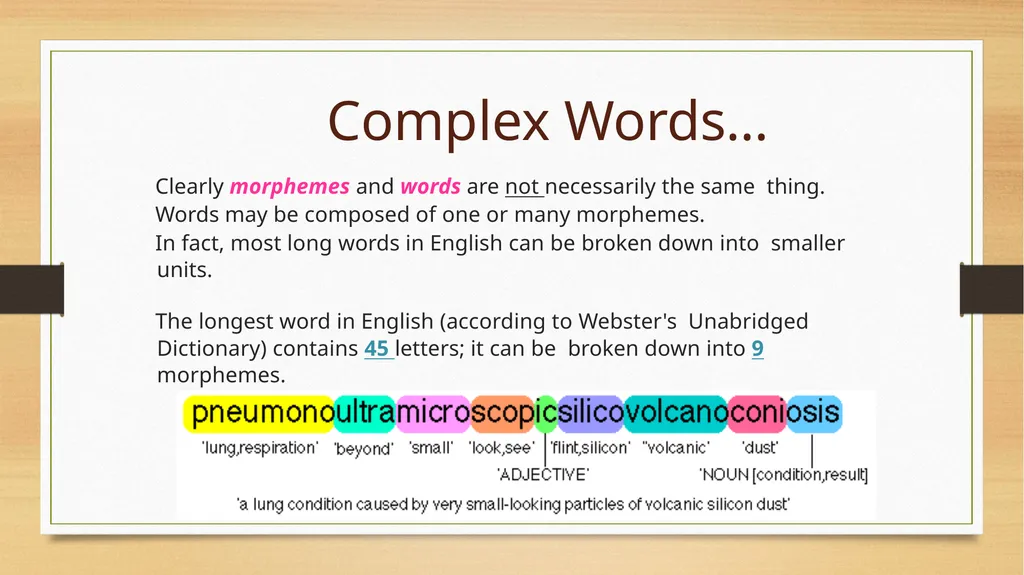
Complex Words…
Clearly morphemes and words are not necessarily the same thing.
Words may be composed of one or many morphemes.
In fact, most long words in English can be broken down into smaller units.
The longest word in English (according to Webster's Unabridged Dictionary) contains 45 letters; it can be broken down into 9 morphemes.<br>
10
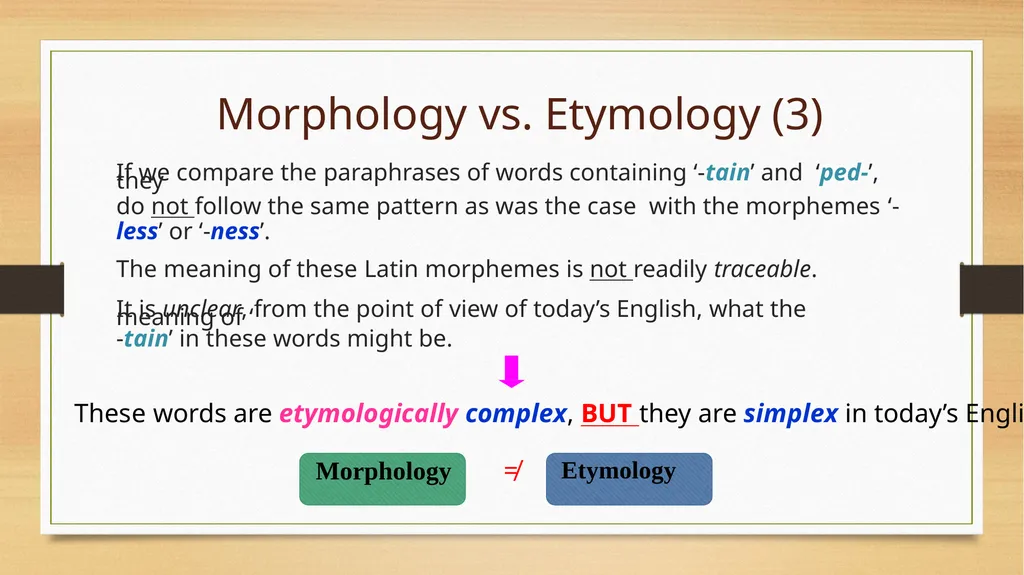
Morphology vs. Etymology (3)
If we compare the paraphrases of words containing ‘-tain’ and ‘ped-’, they
do not follow the same pattern as was the case with the morphemes ‘-
less’ or ‘-ness’.
The meaning of these Latin morphemes is not readily traceable.
It is unclear, from the point of view of today’s English, what the meaning of ‘
-tain’ in these words might be. These words are etymologically complex, BUT they are simplex in today’s English
Morphology ≠ Etymology<br>
11
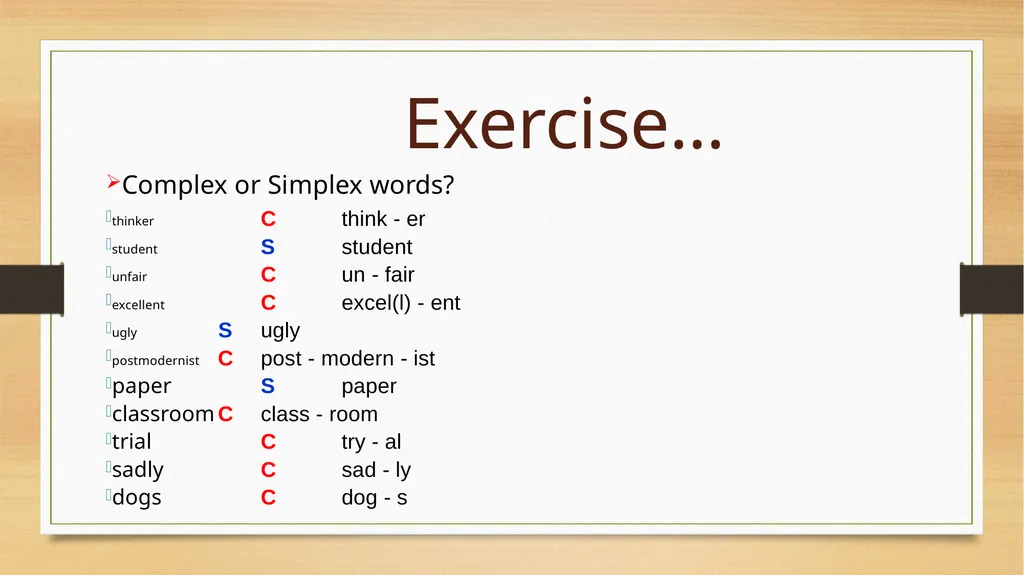
Exercise…
Complex or Simplex words?
thinker C think - er
student S student
unfair C un - fair
excellent C excel(l) - ent
ugly S ugly
postmodernist C post - modern - ist
paper S paper
classroom C class - room
trial C try - al
sadly C sad - ly
dogs C dog - s<br>
Complex or Simplex words?
thinker C think - er
student S student
unfair C un - fair
excellent C excel(l) - ent
ugly S ugly
postmodernist C post - modern - ist
paper S paper
classroom C class - room
trial C try - al
sadly C sad - ly
dogs C dog - s<br>
12
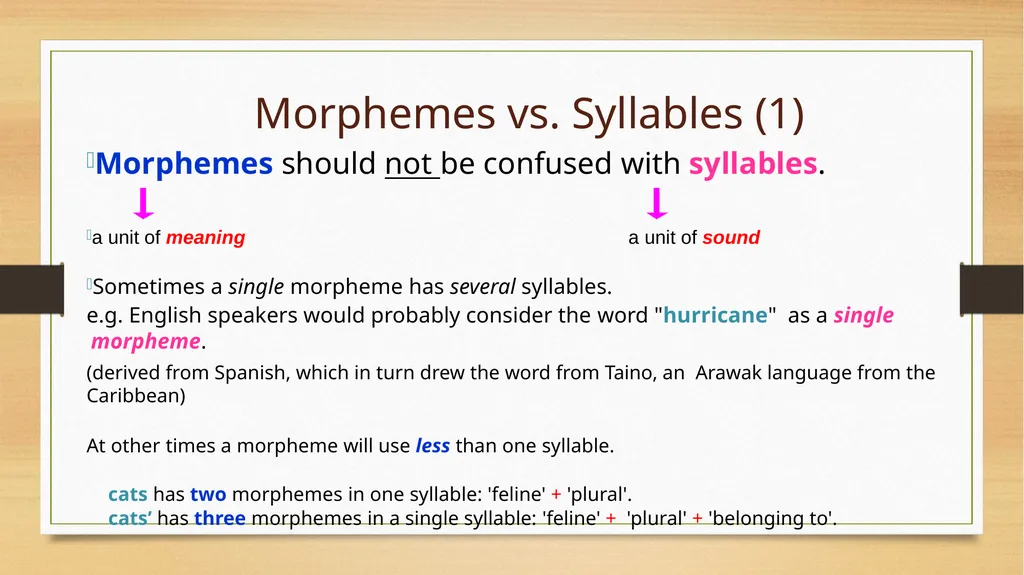
Morphemes vs. Syllables (1)
Morphemes should not be confused with syllables.
a unit of meaning a unit of sound
Sometimes a single morpheme has several syllables.
e.g. English speakers would probably consider the word "hurricane" as a single morpheme.
(derived from Spanish, which in turn drew the word from Taino, an Arawak language from the Caribbean)
At other times a morpheme will use less than one syllable.
cats has two morphemes in one syllable: 'feline' + 'plural'.
cats’ has three morphemes in a single syllable: 'feline' + 'plural' + 'belonging to'.<br>
13
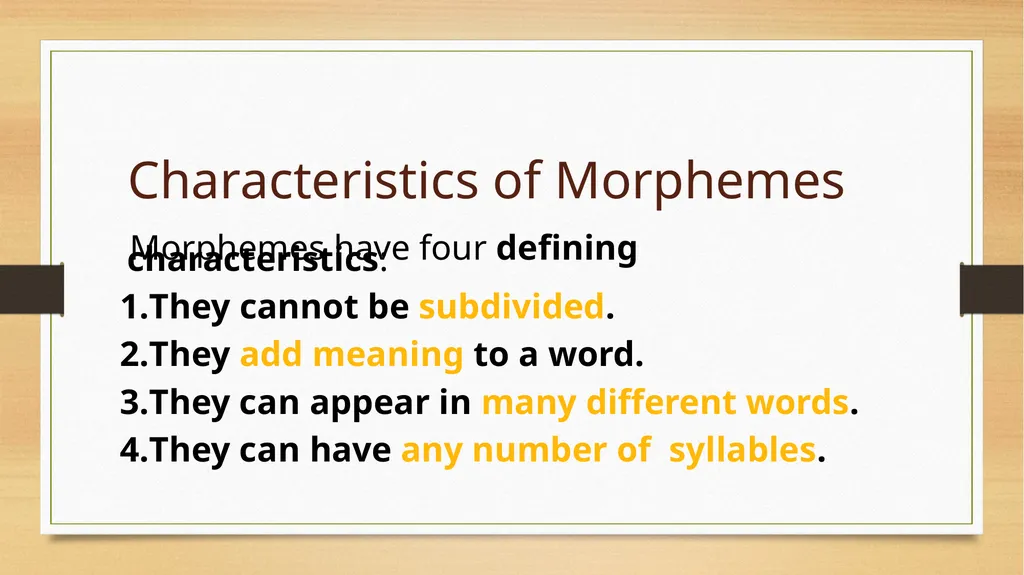
Characteristics of Morphemes
Morphemes have four defining characteristics:
They cannot be subdivided.
They add meaning to a word.
They can appear in many different words.
They can have any number of syllables.<br>
Morphemes have four defining characteristics:
They cannot be subdivided.
They add meaning to a word.
They can appear in many different words.
They can have any number of syllables.<br>
14
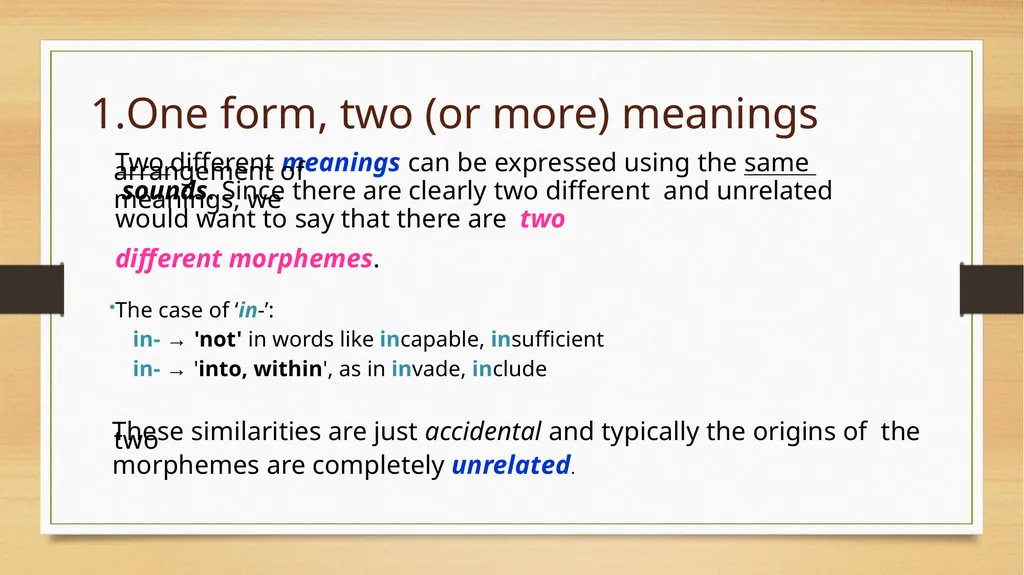
One form, two (or more) meanings
Two different meanings can be expressed using the same arrangement of
sounds. Since there are clearly two different and unrelated meanings, we
would want to say that there are two
different morphemes.
The case of ‘in-’:
in- → 'not' in words like incapable, insufficient
in- → 'into, within', as in invade, include
These similarities are just accidental and typically the origins of the two
morphemes are completely unrelated.<br>
15
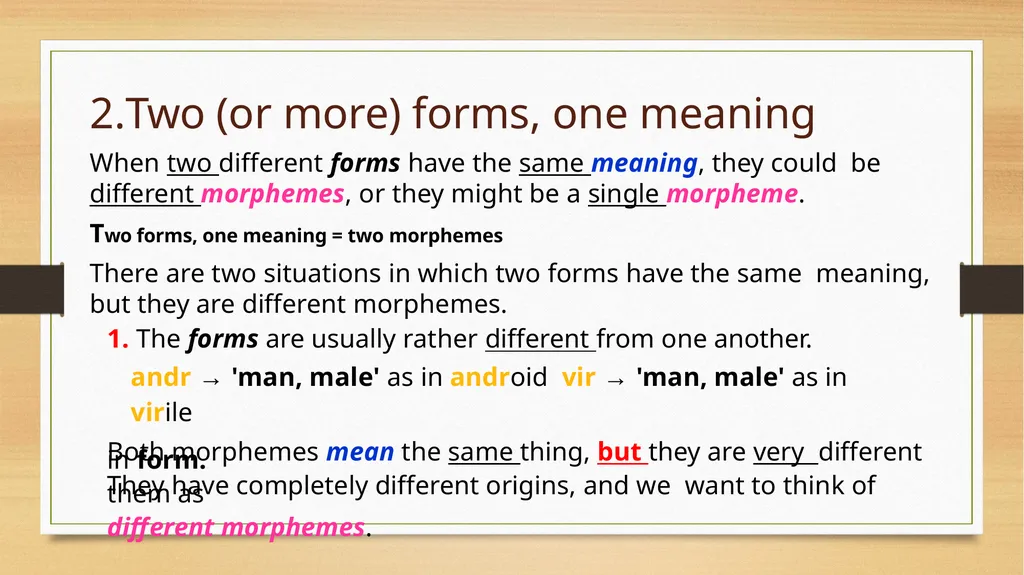
Two (or more) forms, one meaning
When two different forms have the same meaning, they could be different morphemes, or they might be a single morpheme.
Two forms, one meaning = two morphemes
There are two situations in which two forms have the same meaning, but they are different morphemes.
1. The forms are usually rather different from one another.
andr → 'man, male' as in android vir → 'man, male' as in virile
Both morphemes mean the same thing, but they are very different in form.
They have completely different origins, and we want to think of them as
different morphemes.<br>
16
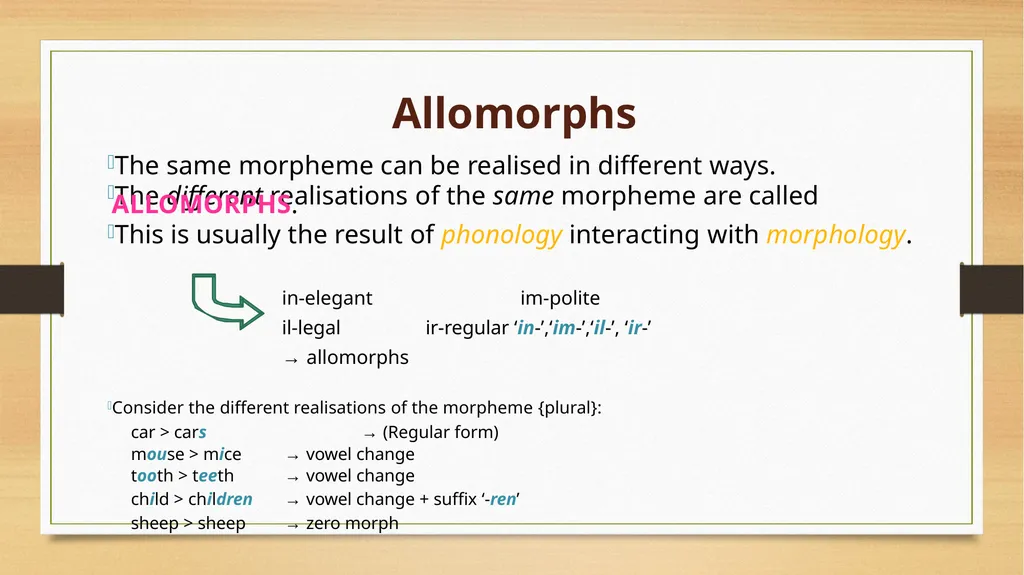
Allomorphs
The same morpheme can be realised in different ways.
The different realisations of the same morpheme are called ALLOMORPHS.
This is usually the result of phonology interacting with morphology.
in-elegant im-polite
il-legal ir-regular ‘in-’,‘im-’,‘il-’, ‘ir-’
→ allomorphs
Consider the different realisations of the morpheme {plural}:
car > cars → (Regular form)
mouse > mice → vowel change
tooth > teeth → vowel change
child > children → vowel change + suffix ‘-ren’
sheep > sheep → zero morph<br>
17
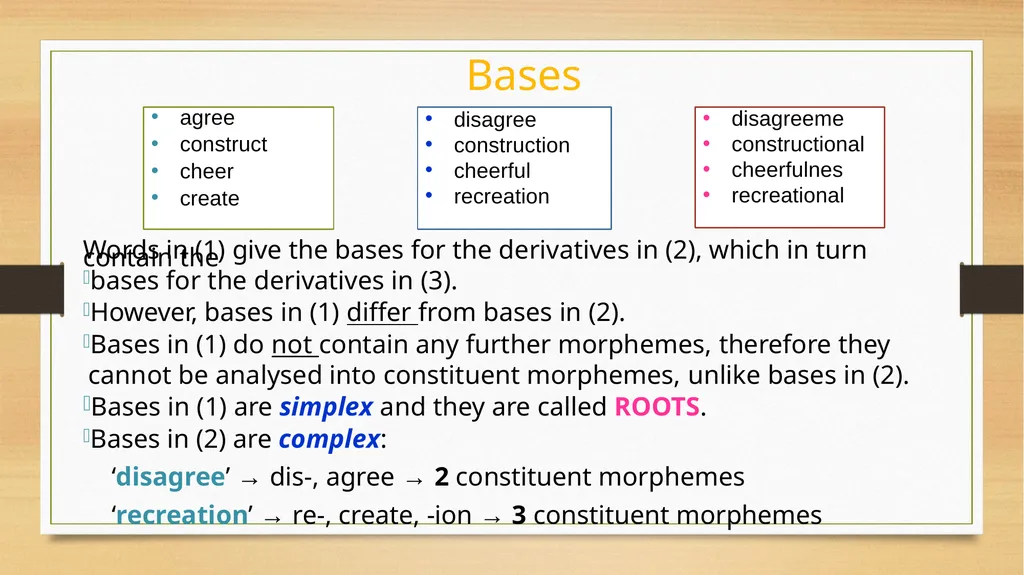
Bases agree
construct
cheer
create disagree
construction
cheerful
recreation disagreeme
constructional
cheerfulnes
recreational Words in (1) give the bases for the derivatives in (2), which in turn contain the
bases for the derivatives in (3).
However, bases in (1) differ from bases in (2).
Bases in (1) do not contain any further morphemes, therefore they cannot be analysed into constituent morphemes, unlike bases in (2).
Bases in (1) are simplex and they are called ROOTS.
Bases in (2) are complex:
‘disagree’ → dis-, agree → 2 constituent morphemes
‘recreation’ → re-, create, -ion → 3 constituent morphemes<br>
18
Roots, Bases and Stems
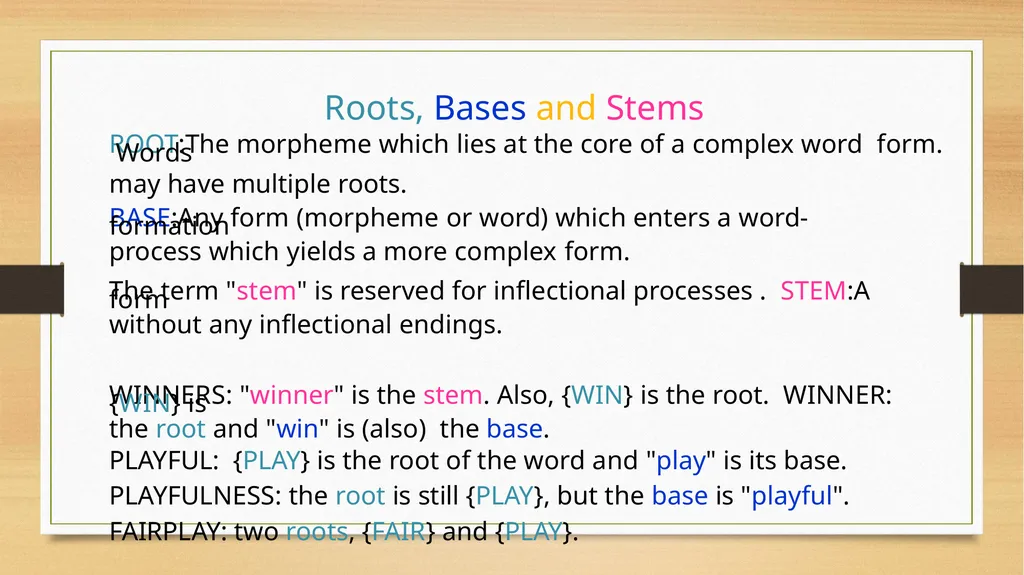
ROOT:The morpheme which lies at the core of a complex word form. Words
may have multiple roots.
BASE:Any form (morpheme or word) which enters a word- formation
process which yields a more complex form.
The term "stem" is reserved for inflectional processes . STEM:A form
without any inflectional endings.
WINNERS: "winner" is the stem. Also, {WIN} is the root. WINNER: {WIN} is
the root and "win" is (also) the base.
PLAYFUL: {PLAY} is the root of the word and "play" is its base.
PLAYFULNESS: the root is still {PLAY}, but the base is "playful".
FAIRPLAY: two roots, {FAIR} and {PLAY}.<br>
19
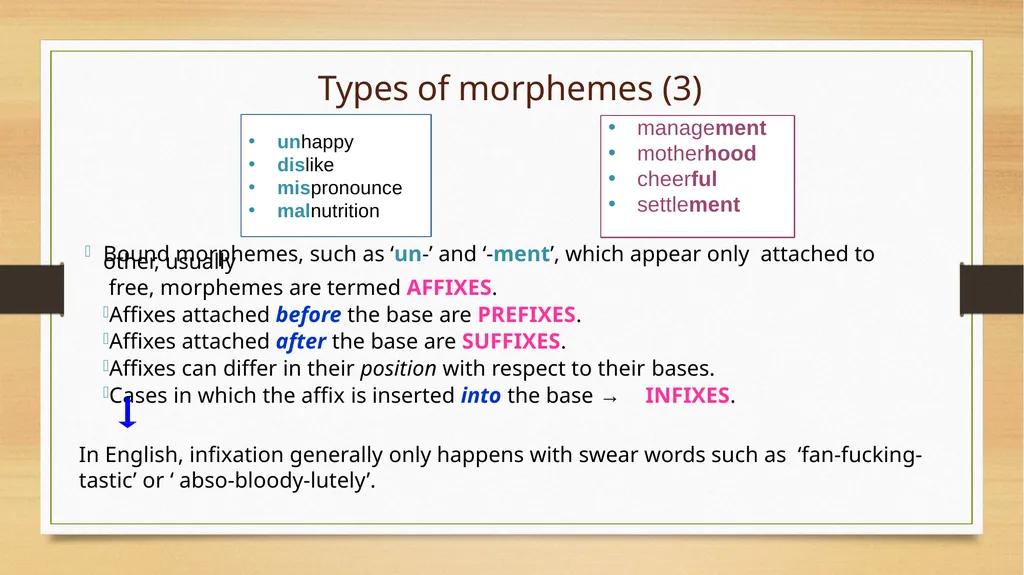
Types of morphemes (3) unhappy
dislike
mispronounce
malnutrition management
motherhood
cheerful
settlement Bound morphemes, such as ‘un-’ and ‘-ment’, which appear only attached to other, usually
free, morphemes are termed AFFIXES.
Affixes attached before the base are PREFIXES.
Affixes attached after the base are SUFFIXES.
Affixes can differ in their position with respect to their bases.
Cases in which the affix is inserted into the base → INFIXES.
In English, infixation generally only happens with swear words such as ‘fan-fucking-tastic’ or ‘ abso-bloody-lutely’.<br>
20
Types of morphemes (4)
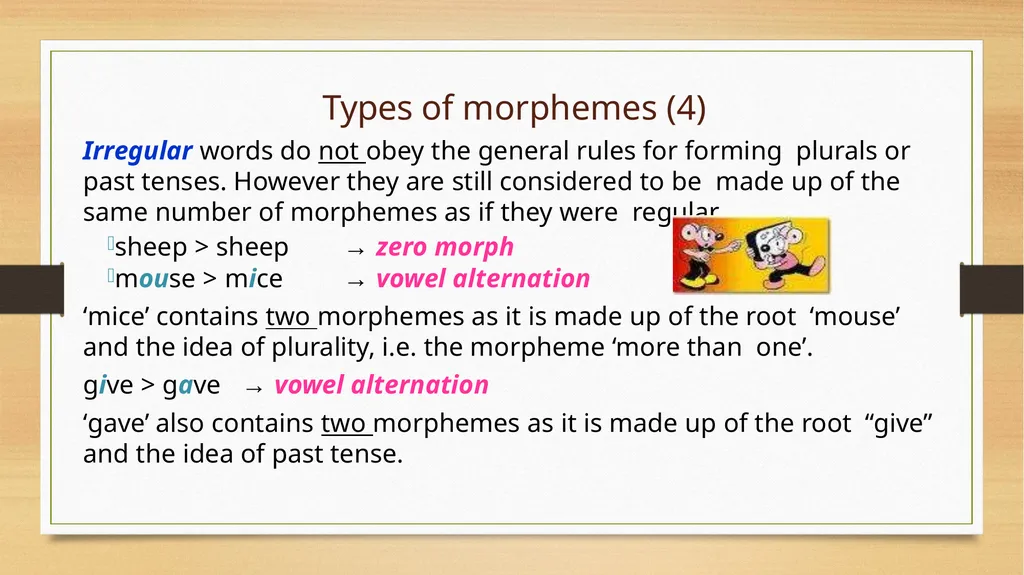
Irregular words do not obey the general rules for forming plurals or past tenses. However they are still considered to be made up of the same number of morphemes as if they were regular.
sheep > sheep → zero morph
mouse > mice → vowel alternation
‘mice’ contains two morphemes as it is made up of the root ‘mouse’ and the idea of plurality, i.e. the morpheme ‘more than one’.
give > gave → vowel alternation
‘gave’ also contains two morphemes as it is made up of the root “give” and the idea of past tense.<br>
21
Morphological Analysis (1)
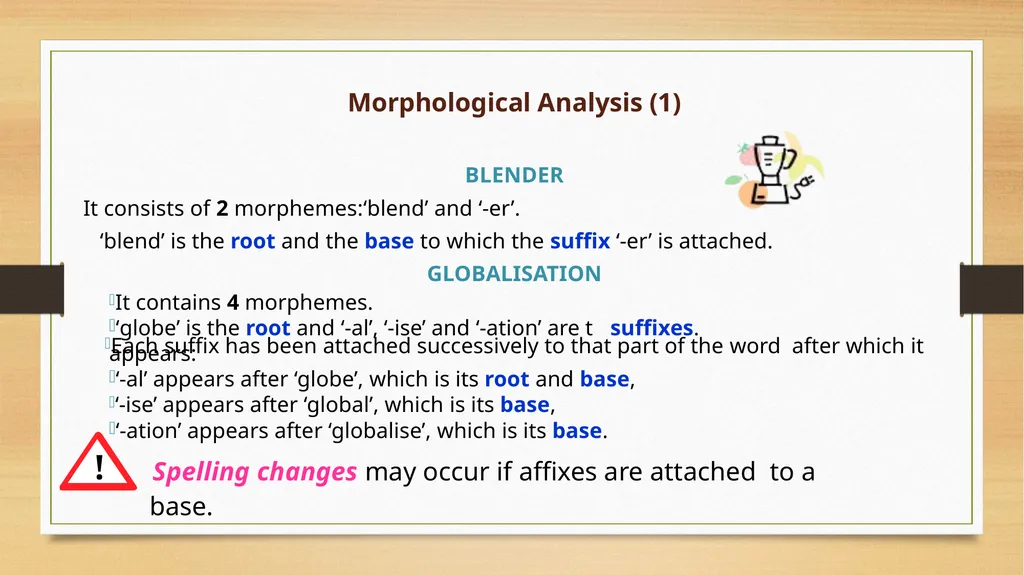
BLENDER
It consists of 2 morphemes:‘blend’ and ‘-er’.
‘blend’ is the root and the base to which the suffix ‘-er’ is attached.
GLOBALISATION
It contains 4 morphemes.
‘globe’ is the root and ‘-al’, ‘-ise’ and ‘-ation’ are t suffixes.
Each suffix has been attached successively to that part of the word after which it appears:
‘-al’ appears after ‘globe’, which is its root and base,
‘-ise’ appears after ‘global’, which is its base,
‘-ation’ appears after ‘globalise’, which is its base.
Spelling changes may occur if affixes are attached to a
base. !<br>
22
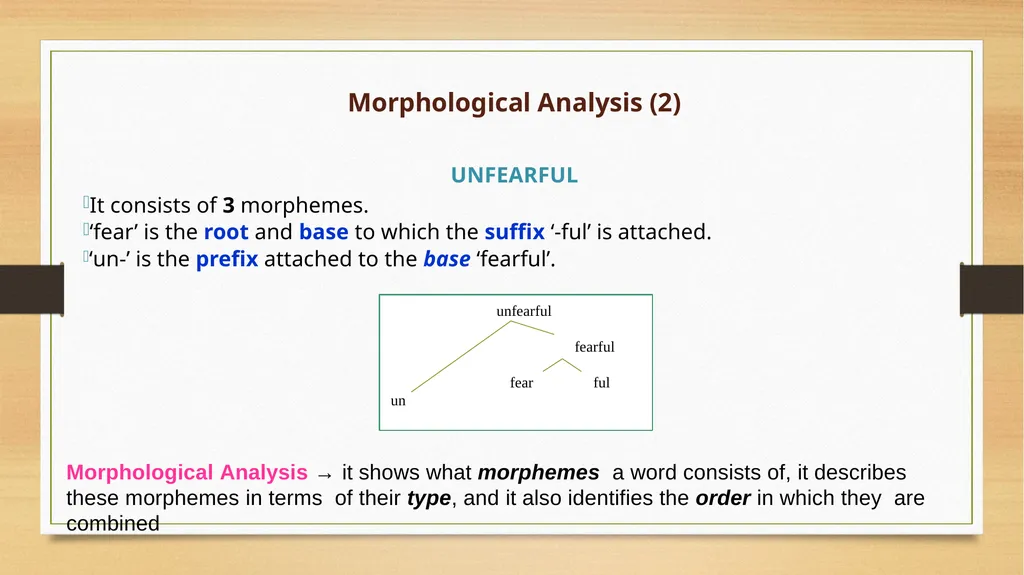
Morphological Analysis (2)
UNFEARFUL
It consists of 3 morphemes.
‘fear’ is the root and base to which the suffix ‘-ful’ is attached.
‘un-’ is the prefix attached to the base ‘fearful’. unfearful
fearful
fear ful
un Morphological Analysis → it shows what morphemes a word consists of, it describes these morphemes in terms of their type, and it also identifies the order in which they are combined<br>
23
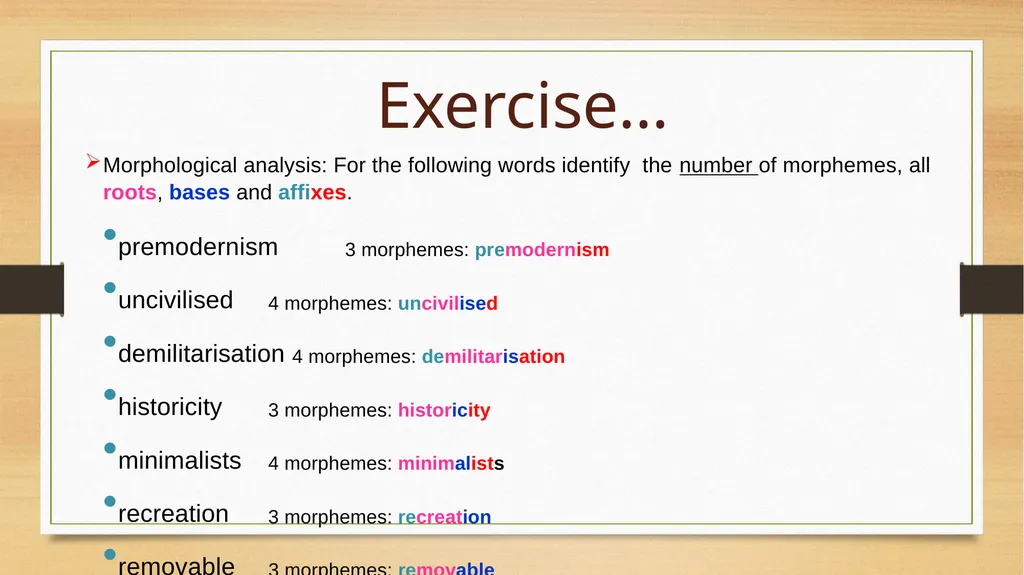
Exercise…
Morphological analysis: For the following words identify the number of morphemes, all roots, bases and affixes.
premodernism 3 morphemes: premodernism
uncivilised 4 morphemes: uncivilised
demilitarisation 4 morphemes: demilitarisation
historicity 3 morphemes: historicity
minimalists 4 morphemes: minimalists
recreation 3 morphemes: recreation
removable 3 morphemes: removable
exceptionally 4 morphemes: exceptionally<br>
24
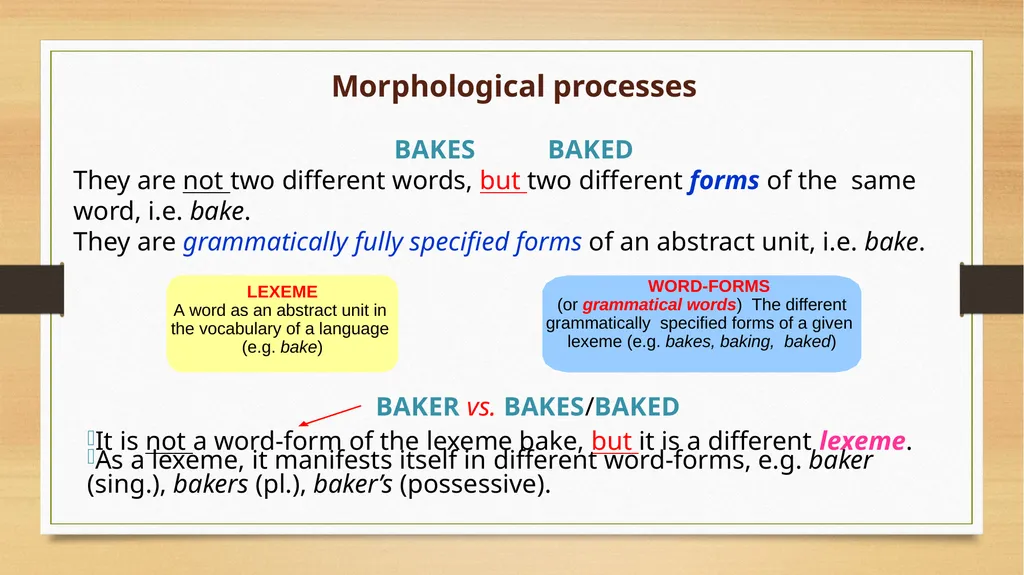
Morphological processes
BAKES BAKED
They are not two different words, but two different forms of the same word, i.e. bake.
They are grammatically fully specified forms of an abstract unit, i.e. bake. LEXEME
A word as an abstract unit in the vocabulary of a language (e.g. bake) WORD-FORMS
(or grammatical words) The different grammatically specified forms of a given lexeme (e.g. bakes, baking, baked) BAKER vs. BAKES/BAKED
It is not a word-form of the lexeme bake, but it is a different lexeme.
As a lexeme, it manifests itself in different word-forms, e.g. baker
(sing.), bakers (pl.), baker’s (possessive).<br>
25
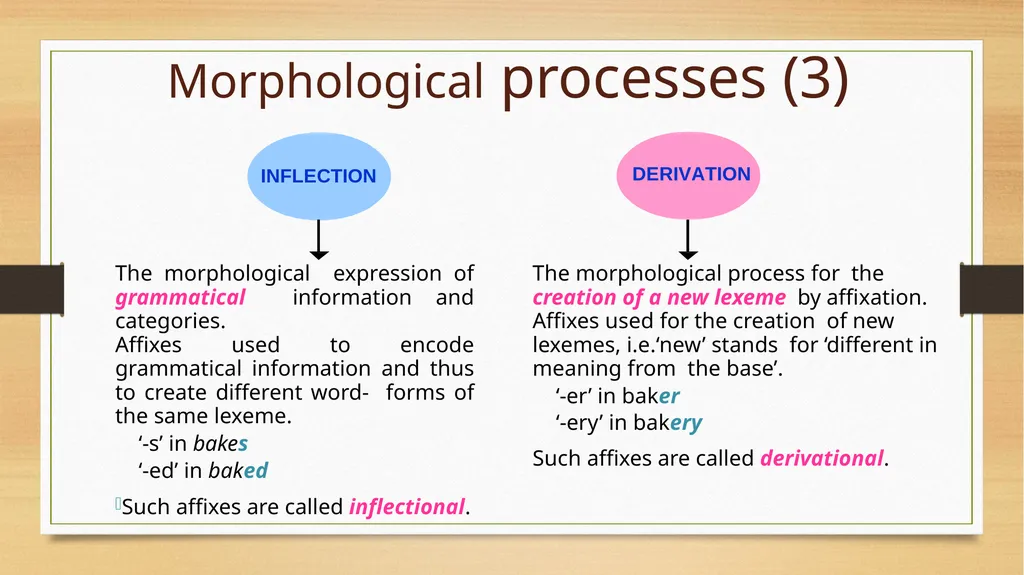
Morphological processes (3) INFLECTION DERIVATION The morphological expression of grammatical information and categories.
Affixes used to encode grammatical information and thus to create different word- forms of the same lexeme.
‘-s’ in bakes
‘-ed’ in baked
Such affixes are called inflectional. The morphological process for the creation of a new lexeme by affixation.
Affixes used for the creation of new lexemes, i.e.‘new’ stands for ‘different in meaning from the base’.
‘-er’ in baker
‘-ery’ in bakery
Such affixes are called derivational.<br>
26
Inflectional Affixes
The inventory of English inflectional affixes is quite small.
See Ballard, The Frameworks of English, Chapter 4<br>
The inventory of English inflectional affixes is quite small.
See Ballard, The Frameworks of English, Chapter 4<br>
27
Derivational Affixes
See Ballard, The Frameworks of English, Chapter 3.<br>
See Ballard, The Frameworks of English, Chapter 3.<br>
28
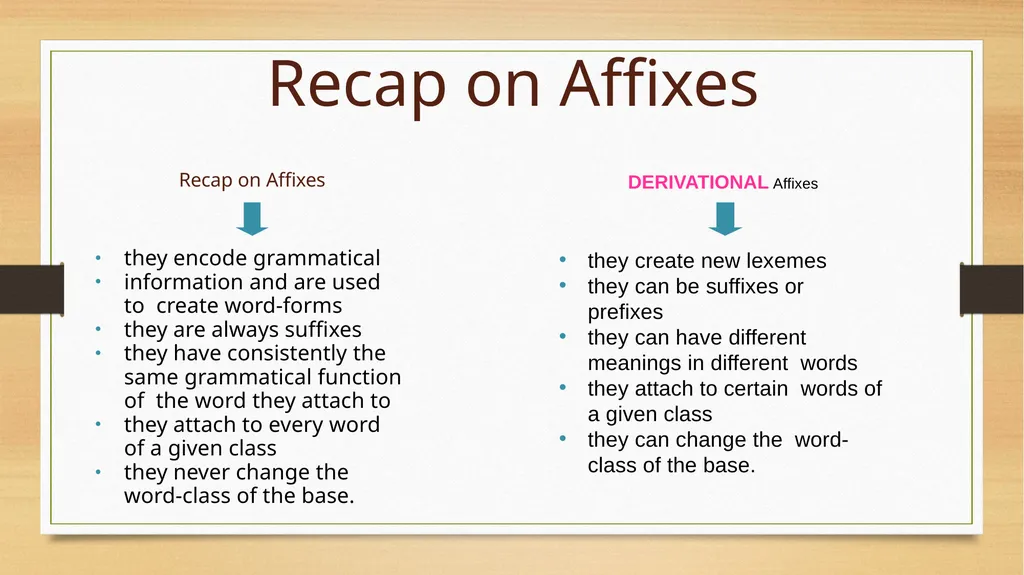
Recap on Affixes Recap on Affixes DERIVATIONAL Affixes they encode grammatical
information and are used to create word-forms
they are always suffixes
they have consistently the same grammatical function of the word they attach to
they attach to every word of a given class
they never change the word-class of the base. they create new lexemes
they can be suffixes or prefixes
they can have different meanings in different words
they attach to certain words of a given class
they can change the word-class of the base.<br>
29
Word Formation
See Ballard, The Frameworks of English, Chapter 3.<br>
See Ballard, The Frameworks of English, Chapter 3.<br>
30
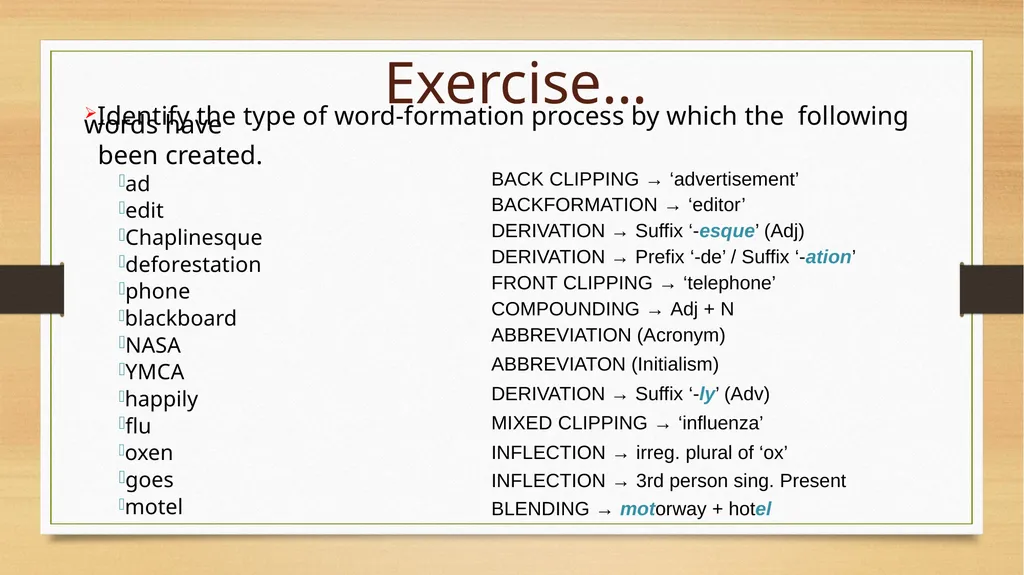
Exercise…
Identify the type of word-formation process by which the following words have
been created. ad
edit
Chaplinesque
deforestation
phone
blackboard
NASA
YMCA
happily
flu
oxen
goes
motel BACK CLIPPING → ‘advertisement’
BACKFORMATION → ‘editor’
DERIVATION → Suffix ‘-esque’ (Adj)
DERIVATION → Prefix ‘-de’ / Suffix ‘-ation’
FRONT CLIPPING → ‘telephone’
COMPOUNDING → Adj + N
ABBREVIATION (Acronym)
ABBREVIATON (Initialism)
DERIVATION → Suffix ‘-ly’ (Adv)
MIXED CLIPPING → ‘influenza’
INFLECTION → irreg. plural of ‘ox’
INFLECTION → 3rd person sing. Present
BLENDING → motorway + hotel<br>
31
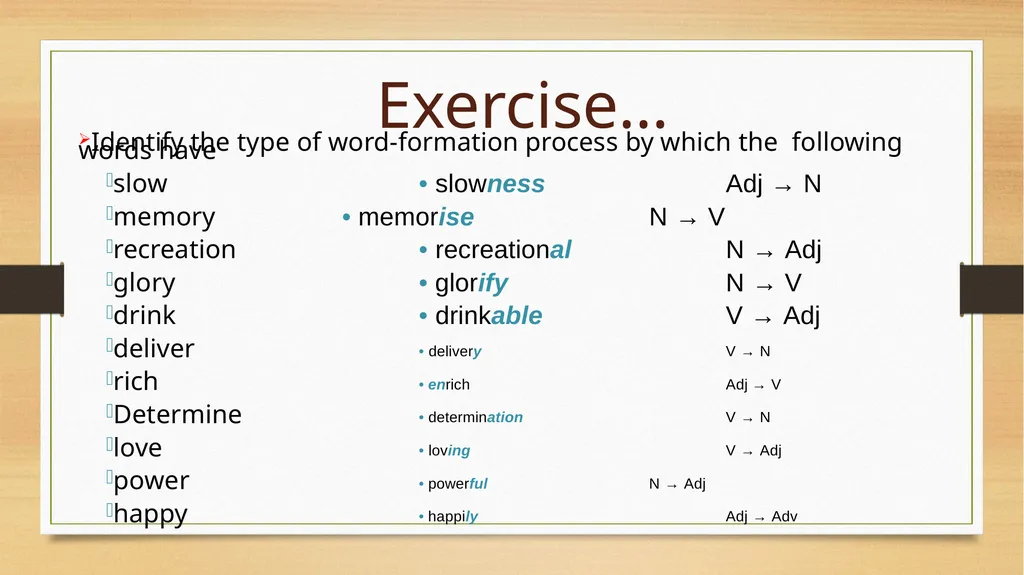
Exercise…
Identify the type of word-formation process by which the following words have
slow • slowness Adj → N
memory • memorise N → V
recreation • recreational N → Adj
glory • glorify N → V
drink • drinkable V → Adj
deliver • delivery V → N
rich • enrich Adj → V
Determine • determination V → N
love • loving V → Adj
power • powerful N → Adj
happy • happily Adj → Adv<br>
32
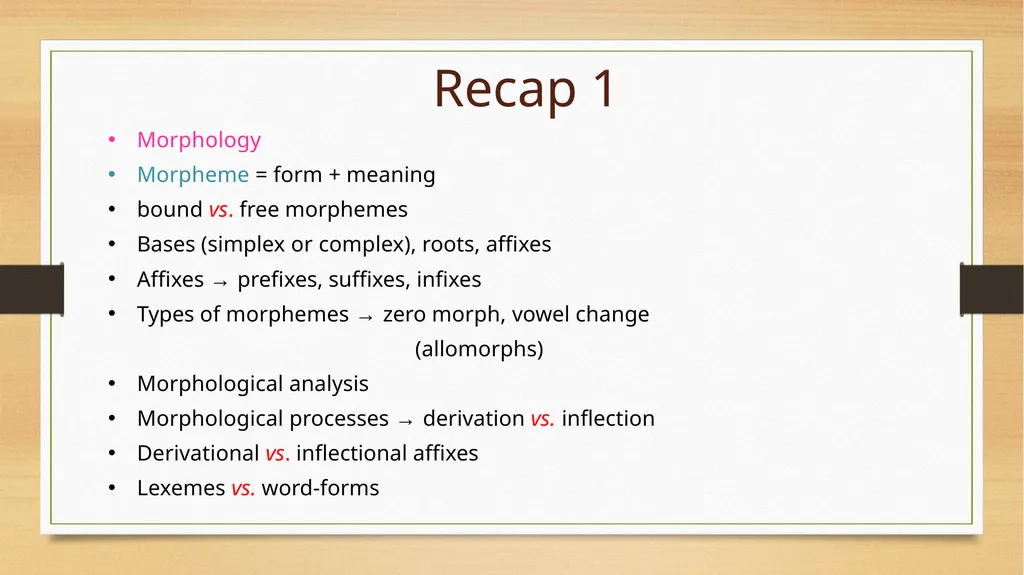
Recap 1
Morphology
Morpheme = form + meaning
bound vs. free morphemes
Bases (simplex or complex), roots, affixes
Affixes → prefixes, suffixes, infixes
Types of morphemes → zero morph, vowel change
(allomorphs)
Morphological analysis
Morphological processes → derivation vs. inflection
Derivational vs. inflectional affixes
Lexemes vs. word-forms<br>
33
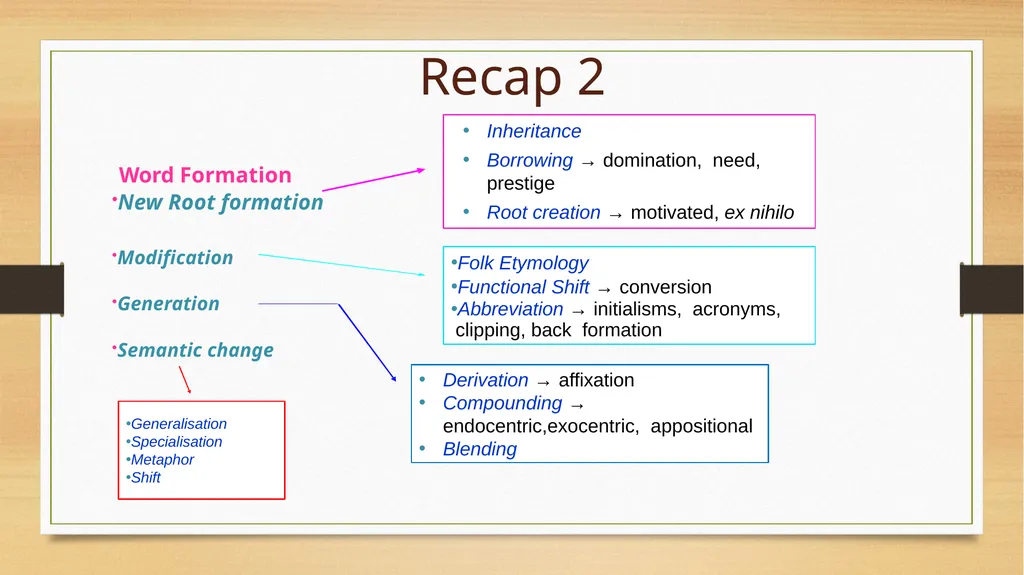
Recap 2 Word Formation
New Root formation Inheritance
Borrowing → domination, need, prestige
Root creation → motivated, ex nihilo Modification
Generation
Semantic change Folk Etymology
Functional Shift → conversion
Abbreviation → initialisms, acronyms, clipping, back formation Derivation → affixation
Compounding → endocentric,exocentric, appositional
Blending Generalisation
Specialisation
Metaphor
Shift<br>
34
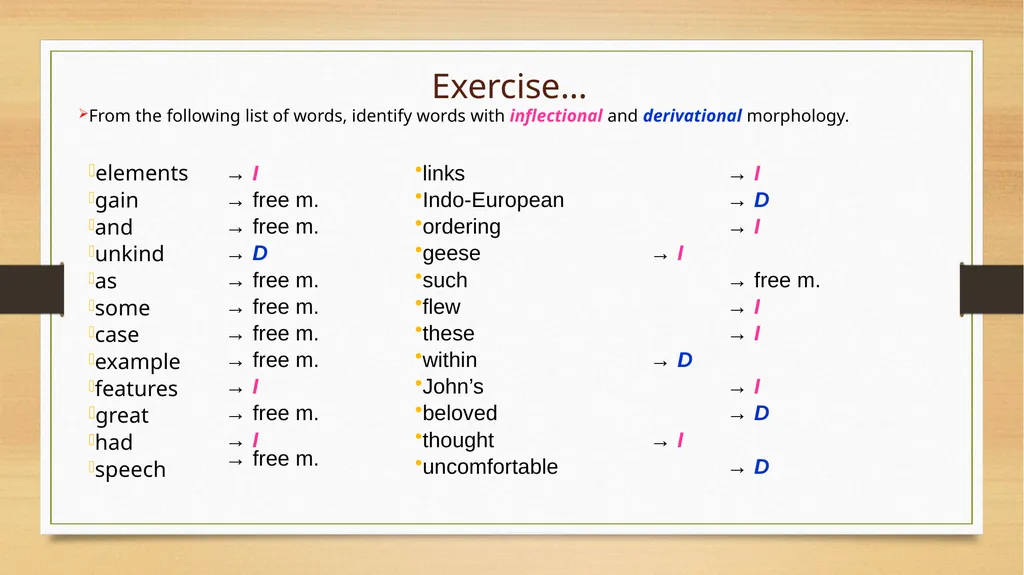
Exercise…
From the following list of words, identify words with inflectional and derivational morphology. elements
gain
and
unkind
as
some
case
example
features
great
had
speech → I
→ free m.
→ free m.
→ D
→ free m.
→ free m.
→ free m.
→ free m.
→ I
→ free m.
→ I
→ free m. links → I
Indo-European → D
ordering → I
geese → I
such → free m.
flew → I
these → I
within → D
John’s → I
beloved → D
thought → I
uncomfortable → D<br>
35
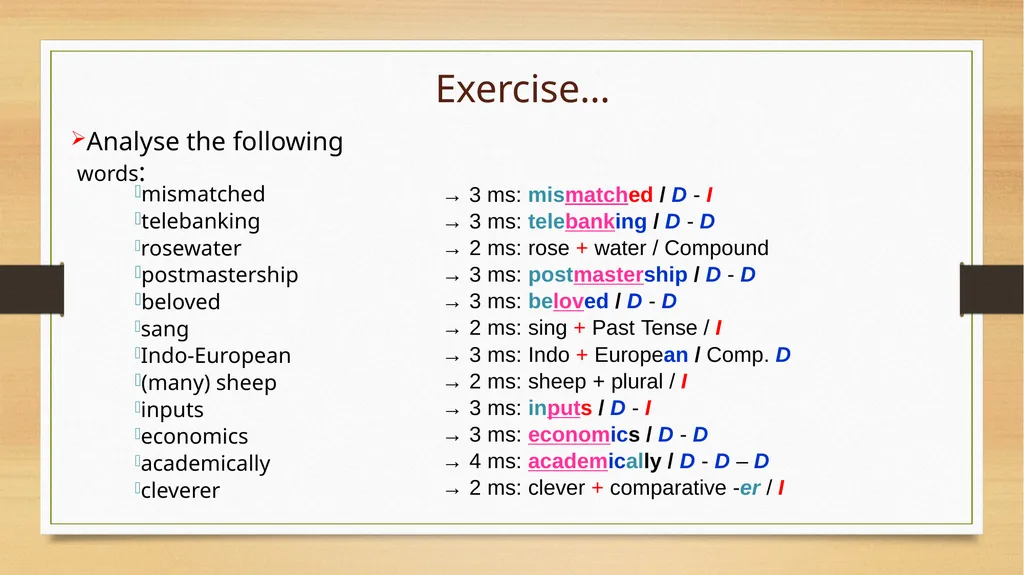
Exercise… Analyse the following words: mismatched
telebanking
rosewater
postmastership
beloved
sang
Indo-European
(many) sheep
inputs
economics
academically
cleverer → 3 ms: mismatched / D - I
→ 3 ms: telebanking / D - D
→ 2 ms: rose + water / Compound
→ 3 ms: postmastership / D - D
→ 3 ms: beloved / D - D
→ 2 ms: sing + Past Tense / I
→ 3 ms: Indo + European / Comp. D
→ 2 ms: sheep + plural / I
→ 3 ms: inputs / D - I
→ 3 ms: economics / D - D
→ 4 ms: academically / D - D – D
→ 2 ms: clever + comparative -er / I<br>
36
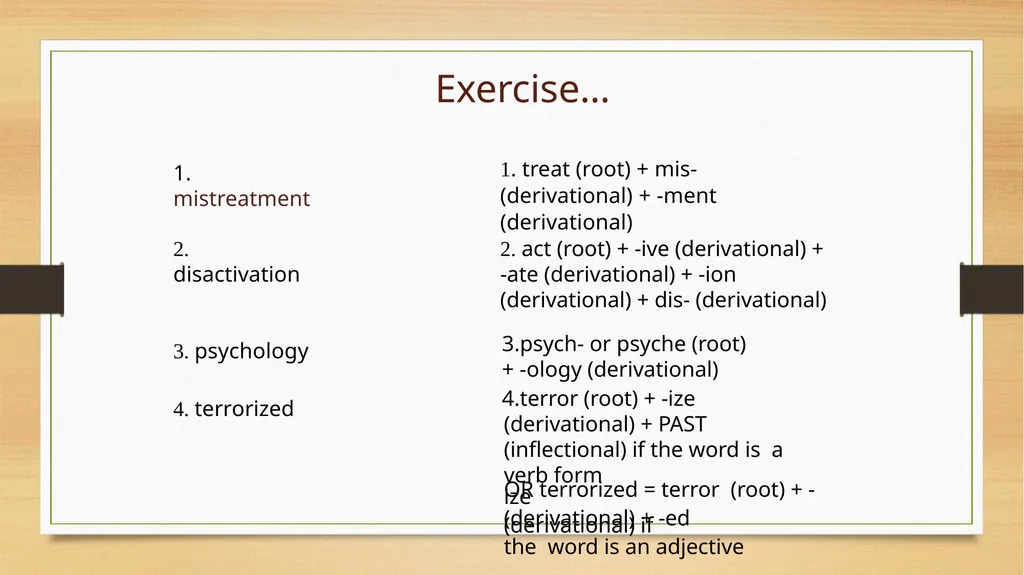
Exercise… 1. mistreatment 1. treat (root) + mis- (derivational) + -ment (derivational) 2. disactivation 3. psychology
4. terrorized 2. act (root) + -ive (derivational) +
-ate (derivational) + -ion (derivational) + dis- (derivational)
psych- or psyche (root)
+ -ology (derivational)
terror (root) + -ize (derivational) + PAST (inflectional) if the word is a verb form
OR terrorized = terror (root) + -ize
(derivational) + -ed (derivational) if
the word is an adjective<br>
37
Exercise…
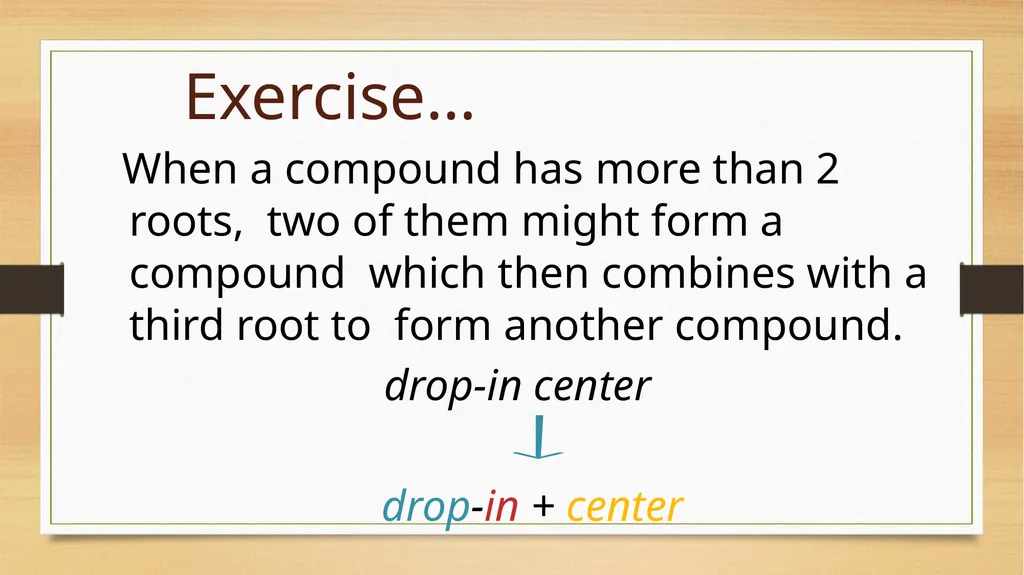
When a compound has more than 2 roots, two of them might form a compound which then combines with a third root to form another compound.
drop-in center
drop-in + center<br>
When a compound has more than 2 roots, two of them might form a compound which then combines with a third root to form another compound.
drop-in center
drop-in + center<br>
38
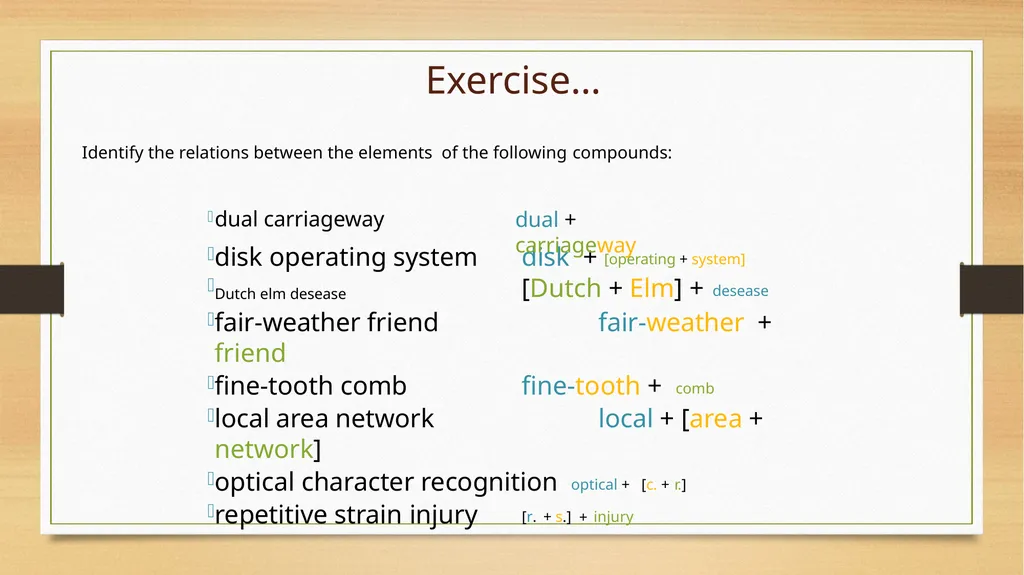
Exercise…
Identify the relations between the elements of the following compounds: disk operating system disk + [operating + system]
Dutch elm desease [Dutch + Elm] + desease
fair-weather friend fair-weather + friend
fine-tooth comb fine-tooth + comb
local area network local + [area + network]
optical character recognition optical + [c. + r.]
repetitive strain injury [r. + s.] + injury dual carriageway dual + carriageway<br>
39
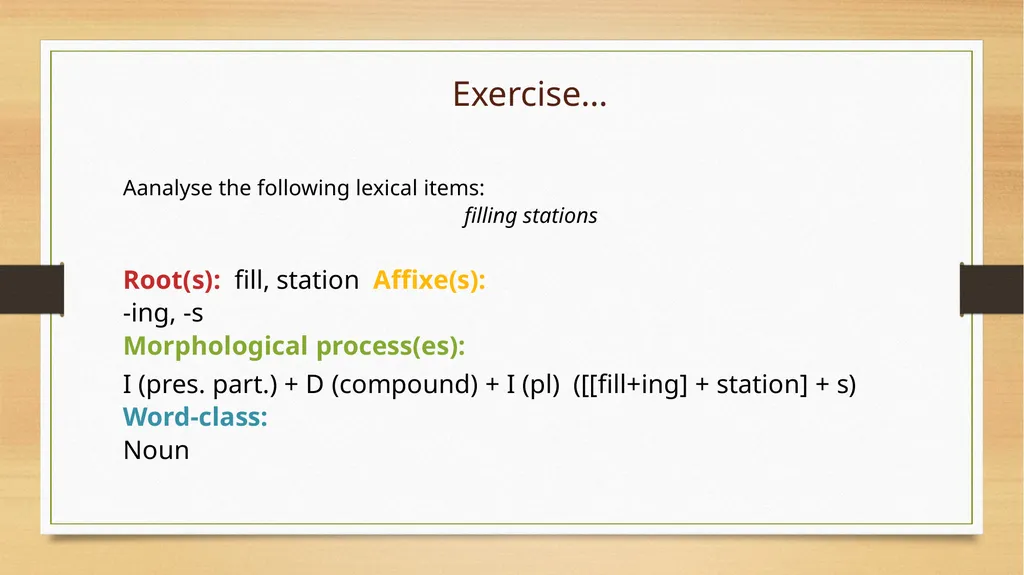
Exercise…
Aanalyse the following lexical items:
filling stations
Root(s): fill, station Affixe(s):
-ing, -s
Morphological process(es):
I (pres. part.) + D (compound) + I (pl) ([[fill+ing] + station] + s)
Word-class:
Noun<br>
Aanalyse the following lexical items:
filling stations
Root(s): fill, station Affixe(s):
-ing, -s
Morphological process(es):
I (pres. part.) + D (compound) + I (pl) ([[fill+ing] + station] + s)
Word-class:
Noun<br>
40
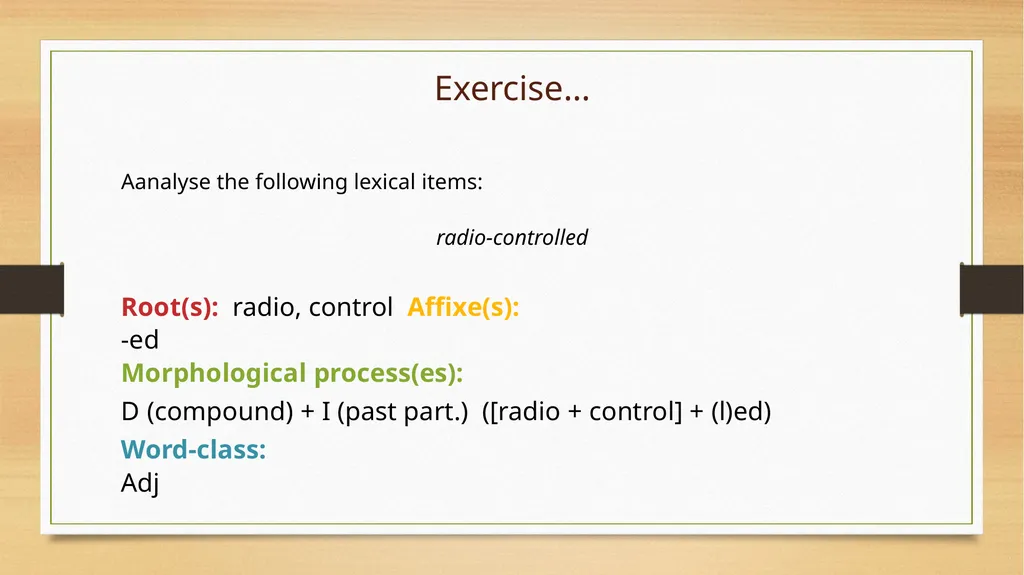
Exercise…
Aanalyse the following lexical items:
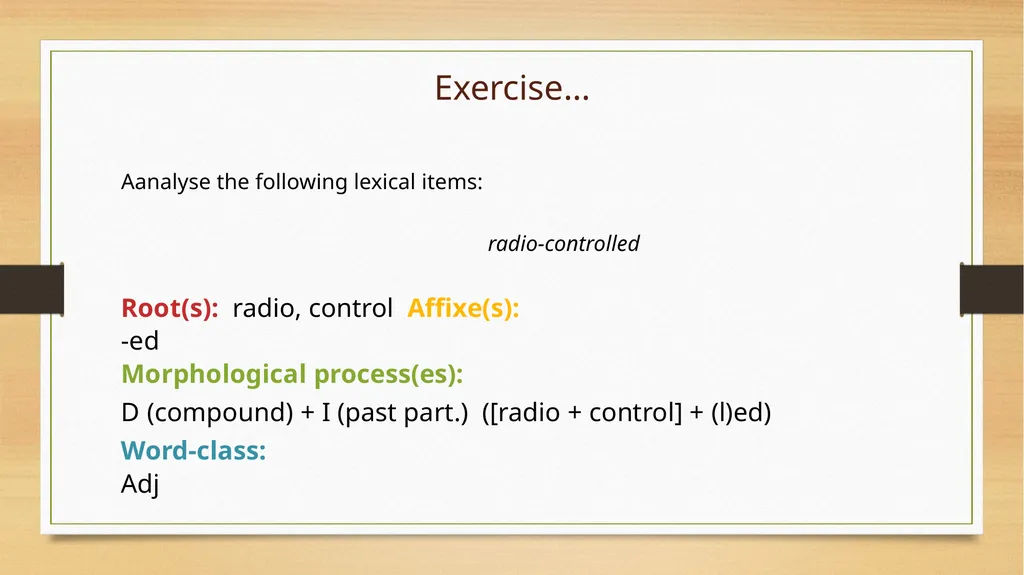
radio-controlled
Root(s): radio, control Affixe(s):
-ed
Morphological process(es):
D (compound) + I (past part.) ([radio + control] + (l)ed) Word-class:
Adj<br>
Aanalyse the following lexical items:
radio-controlled
Root(s): radio, control Affixe(s):
-ed
Morphological process(es):
D (compound) + I (past part.) ([radio + control] + (l)ed) Word-class:
Adj<br>
41
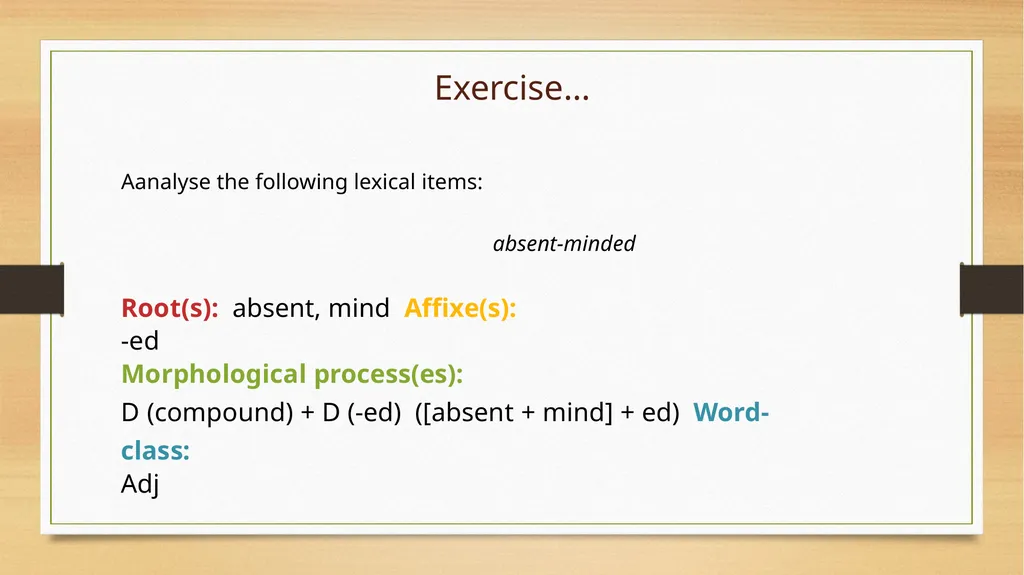
Exercise…
Aanalyse the following lexical items:
absent-minded
Root(s): absent, mind Affixe(s):
-ed
Morphological process(es):
D (compound) + D (-ed) ([absent + mind] + ed) Word-class:
Adj<br>
Aanalyse the following lexical items:
absent-minded
Root(s): absent, mind Affixe(s):
-ed
Morphological process(es):
D (compound) + D (-ed) ([absent + mind] + ed) Word-class:
Adj<br>
42
Exercise…
Aanalyse the following lexical items:
radio-controlled
Root(s): radio, control Affixe(s):
-ed
Morphological process(es):
D (compound) + I (past part.) ([radio + control] + (l)ed) Word-class:
Adj<br>
Aanalyse the following lexical items:
radio-controlled
Root(s): radio, control Affixe(s):
-ed
Morphological process(es):
D (compound) + I (past part.) ([radio + control] + (l)ed) Word-class:
Adj<br>
43
Exercise…
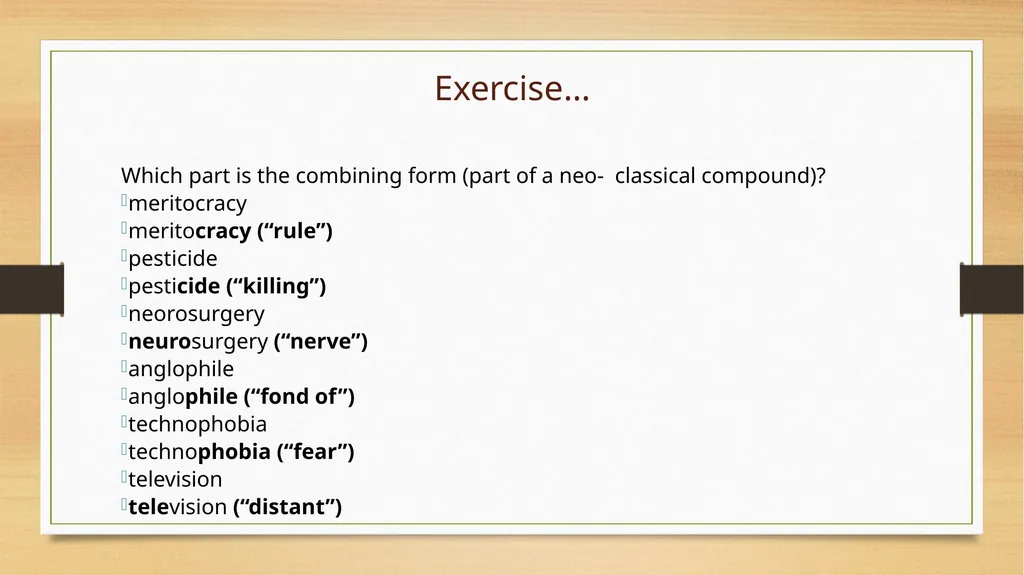
Which part is the combining form (part of a neo- classical compound)?
meritocracy
meritocracy (“rule”)
pesticide
pesticide (“killing”)
neorosurgery
neurosurgery (“nerve”)
anglophile
anglophile (“fond of”)
technophobia
technophobia (“fear”)
television
television (“distant”)<br>
Which part is the combining form (part of a neo- classical compound)?
meritocracy
meritocracy (“rule”)
pesticide
pesticide (“killing”)
neorosurgery
neurosurgery (“nerve”)
anglophile
anglophile (“fond of”)
technophobia
technophobia (“fear”)
television
television (“distant”)<br>
44
Exercise…
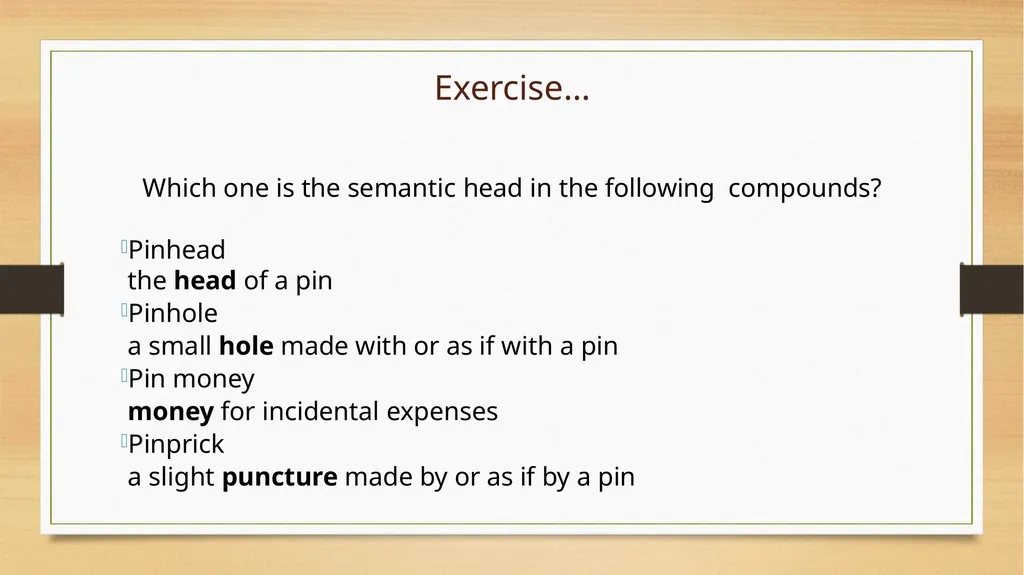
Which one is the semantic head in the following compounds?
Pinhead
the head of a pin
Pinhole
a small hole made with or as if with a pin
Pin money
money for incidental expenses
Pinprick
a slight puncture made by or as if by a pin<br>
Which one is the semantic head in the following compounds?
Pinhead
the head of a pin
Pinhole
a small hole made with or as if with a pin
Pin money
money for incidental expenses
Pinprick
a slight puncture made by or as if by a pin<br>
45
Exercise…
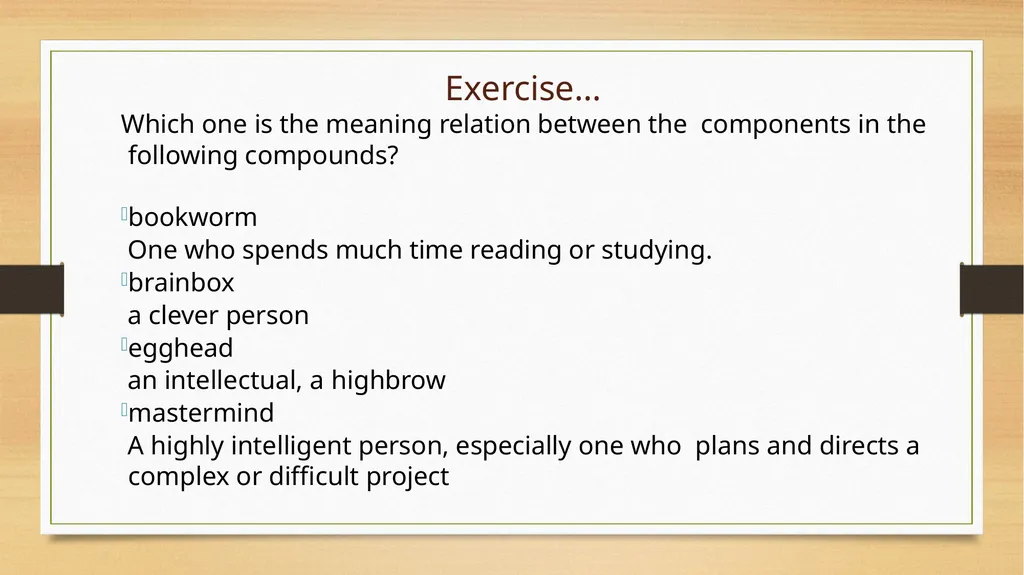
Which one is the meaning relation between the components in the following compounds?
bookworm
One who spends much time reading or studying.
brainbox
a clever person
egghead
an intellectual, a highbrow
mastermind
A highly intelligent person, especially one who plans and directs a complex or difficult project<br>
46
Identify the inflectional morphemes
The place fascinated us, as it should have. For this was the kitchen midden of all the civilization we knew. It gave us the most tantalizing glimpses into our neighbors' lives and our own; it provided an aesthetic distance from which to know ourselves.
The town dump was our poetry and our history.We took it home with us by the wagonload, bringing back into town the things the town had used and thrown away. Some little part of what we gathered, mainly bottles, we managed to bring back to usefulness, but most of our gleanings we left lying around barn or attic or cellar until in some renewed fury of spring cleanup our families carted them off to the dump again, to be rescued and briefly treasured by some other boy. Occasionally something we really valued with a passion was snatched from us in horror and returned at once.That happened to the mounted head of a white mountain goat, somebody's trophy from old times and the far Rocky Mountains, that I brought home one day. My mother took one look and discovered that his beard was full of moths.
I remember that goat; I regret him yet. Poetry is seldom useful, but always memorable. If I were a sociologist anxious to study in detail the life of any community I would go very early to its refuse piles. For a community may be as well judged by what it throws away - what it has to throw away and what it chooses to - as by any other evidence. For whole civilizations we sometimes have no more of the poetry and little more of the history than this (from Wolf Willow 1955: 35-36).<br>
47
Additional Readings
The Cambridge Encyclopedia of the English Language, Chapter 14, p. 198-205.<br>
The Cambridge Encyclopedia of the English Language, Chapter 14, p. 198-205.<br>
48
Mandatory Readings
Introducing English Language, Sections A2, C2.
The Frameworks of English, Chapters 3 and 4.<br>
Introducing English Language, Sections A2, C2.
The Frameworks of English, Chapters 3 and 4.<br>
49
Possible questions
Analyse the following words in terms of base, affixes, morphological process(es), word category
Identify bound and free morphemes
Identify the morphological process at work<br>
Analyse the following words in terms of base, affixes, morphological process(es), word category
Identify bound and free morphemes
Identify the morphological process at work<br>