
Enhancing Family Engagement Module 3 Supporting
KL
Published · 41 slides · 0 views
1 / 1

Description
Enhancing Family Engagement Module 3 Supporting Student Success PaTTANs Mission The mission of the Pennsylvania Training and Technical Assistance Network (PaTTAN) is to support the efforts and initiatives of the Bureau of Special
Related Topics
Share
Embed code
Download this presentation From Below
"Enhancing Family Engagement Module 3 Supporting" is the property of its rightful owner. Permission is granted to download and print the materials on this website for personal, non-commercial use only, and to display it on your personal computer provided you do not modify the materials and that you retain all copyright notices contained in the materials. By downloading content from our website, you accept the terms of this agreement.
Presentation Transcript
01
Enhancing Family Engagement Module 3 Supporting Student Success<br>
02
PaTTAN’s
Mission The mission of the Pennsylvania Training and Technical Assistance Network (PaTTAN) is to support the efforts and initiatives of the Bureau of Special Education, and to build the capacity of local educational agencies to serve students who receive special education services.<br>
03
PDE’s Commitment to Least Restrictive Environment (LRE) Our goal for each child is to ensure Individualized Education Program (IEP) teams begin with the general education setting with the use of Supplementary Aids and Services before considering a more restrictive environment.<br>
04
Module 3 Goals Discuss research on family-school relationships and students’ success
Examine key elements of engaging families
Explore strategies at various levels to enhance family engagement and increase student achievement<br>
Examine key elements of engaging families
Explore strategies at various levels to enhance family engagement and increase student achievement<br>
05
Family
Engagement Family Engagement promotes equitable partnerships among schools, families and communities to actively promote student achievement through shared commitment, decision-making and responsibility.
#PAFamilyEngagement<br>
#PAFamilyEngagement<br>
06
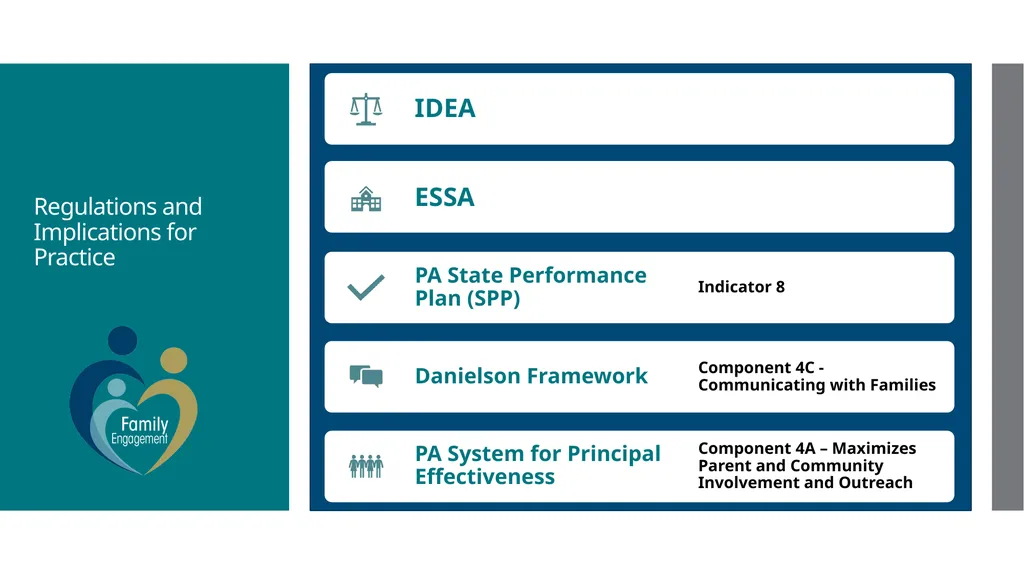
Regulations and Implications for Practice<br>
07
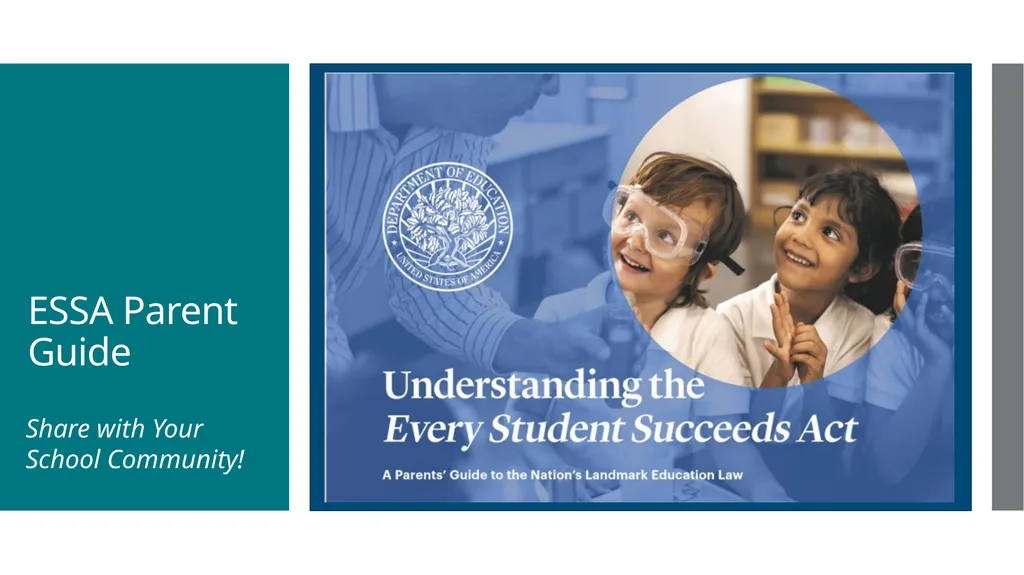
ESSA Parent Guide Share with Your School Community!<br>
08
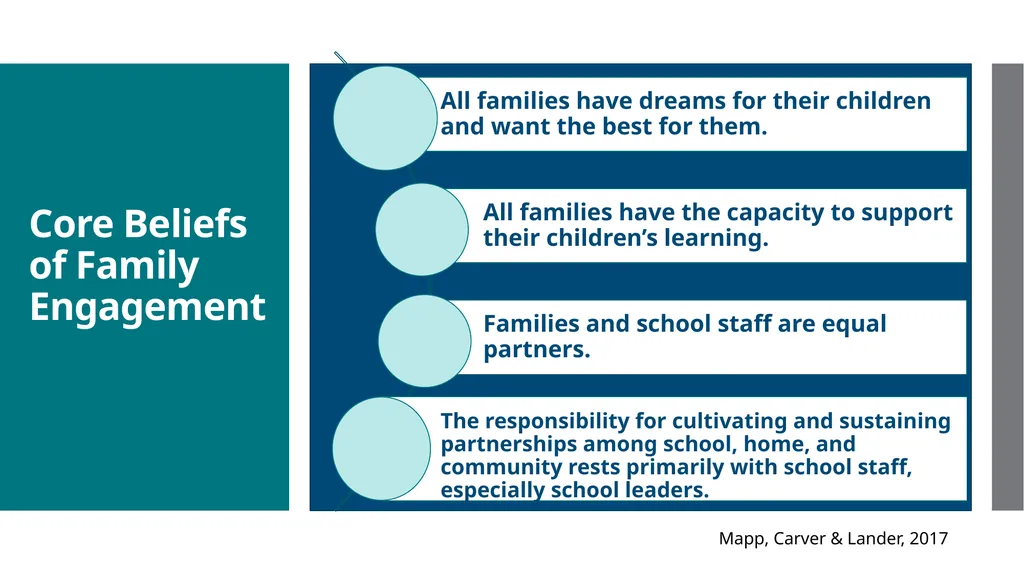
Core Beliefs of Family Engagement Mapp, Carver & Lander, 2017<br>
09
FAMILY ENGAGEMENT AND STUDENT ACHIEVEMENT SECTION 1<br>
10
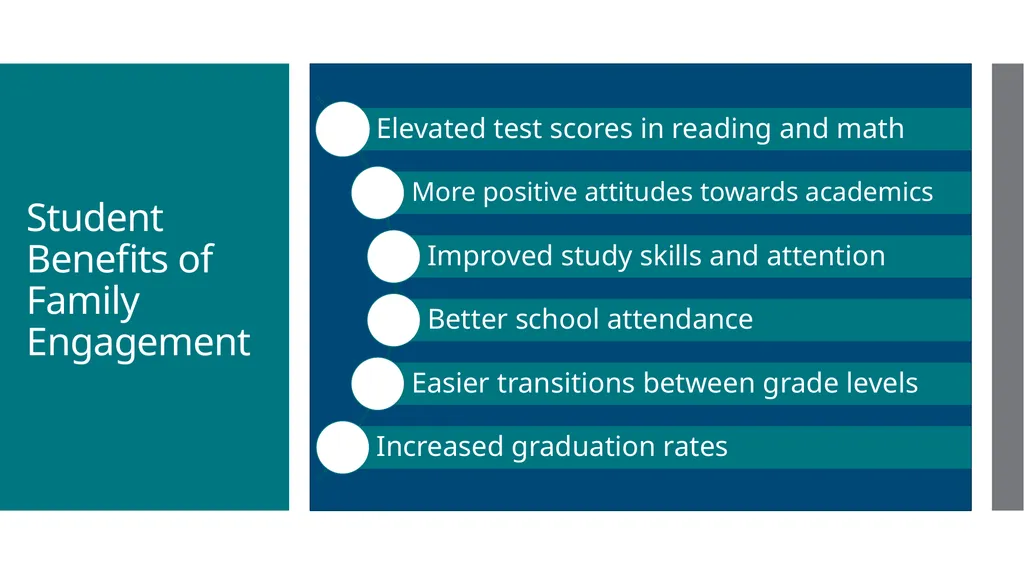
Student Benefits of Family Engagement<br>
11
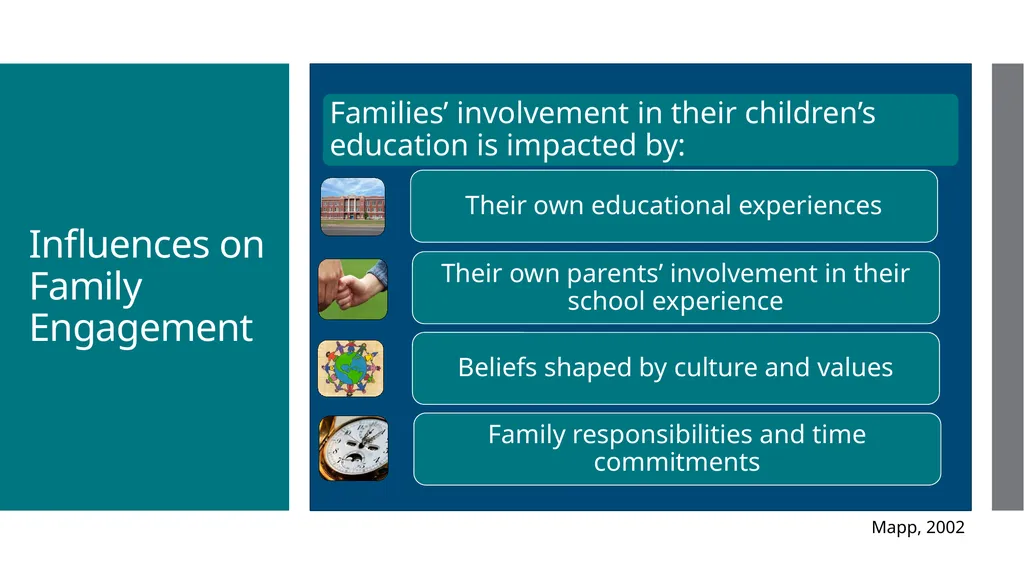
Influences on Family Engagement Mapp, 2002<br>
12
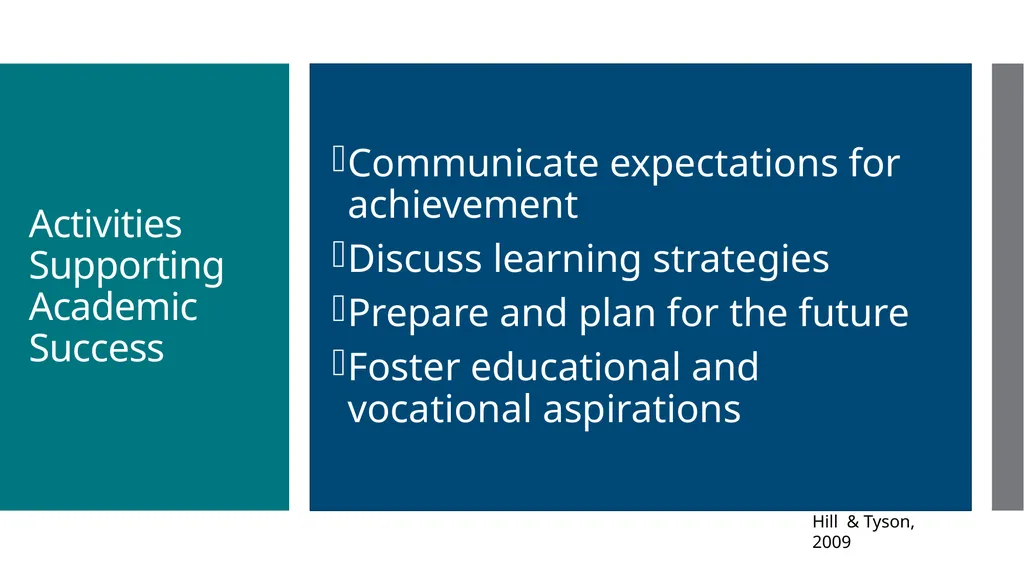
Activities Supporting Academic Success Communicate expectations for achievement
Discuss learning strategies
Prepare and plan for the future
Foster educational and vocational aspirations Hill & Tyson, 2009<br>
Discuss learning strategies
Prepare and plan for the future
Foster educational and vocational aspirations Hill & Tyson, 2009<br>
13
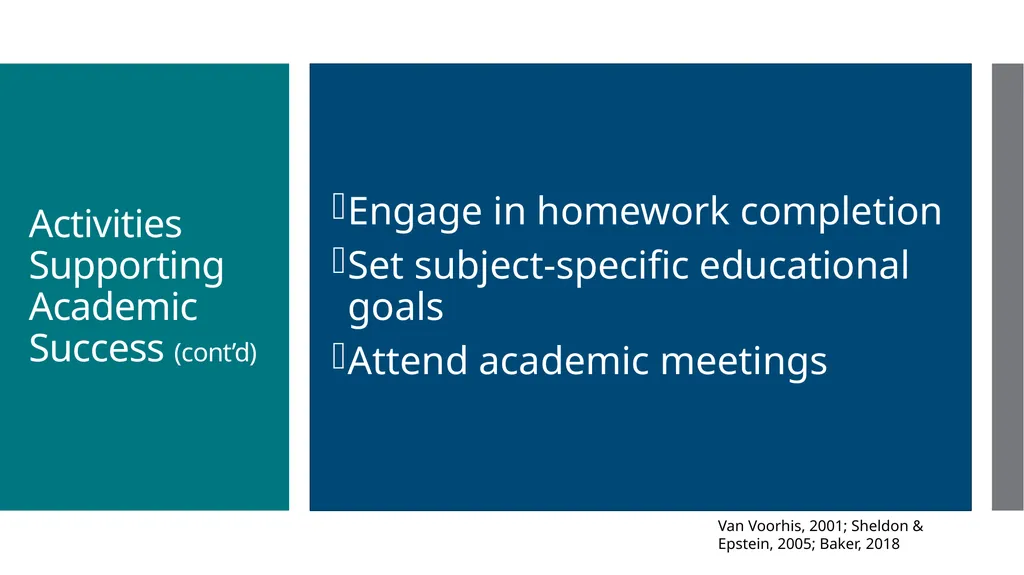
Activities Supporting Academic Success (cont’d) Engage in homework completion
Set subject-specific educational goals
Attend academic meetings Van Voorhis, 2001; Sheldon & Epstein, 2005; Baker, 2018<br>
Set subject-specific educational goals
Attend academic meetings Van Voorhis, 2001; Sheldon & Epstein, 2005; Baker, 2018<br>
14
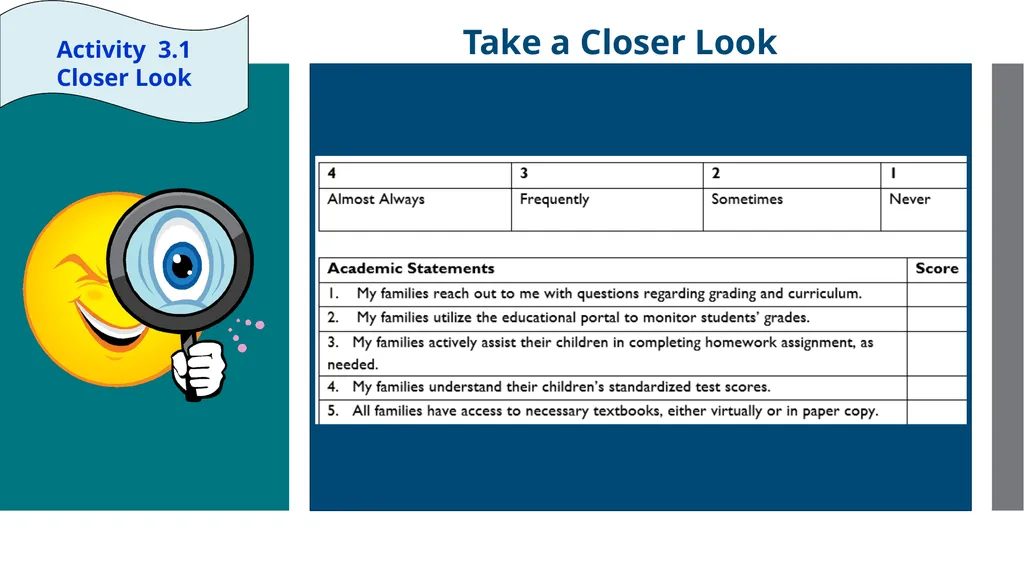
.Activity 3.1 Closer Look Take a Closer Look Activity 3.1
Closer Look<br>
Closer Look<br>
15
LEA-Level Strategies for Enhancing Student Achievement by Engaging Families SECTION 2<br>
16
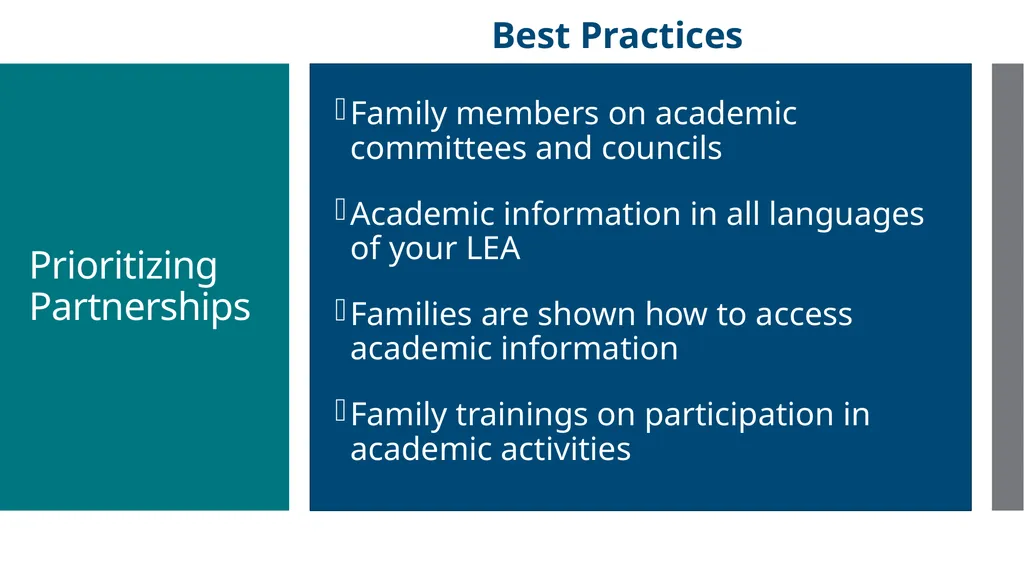
Prioritizing Partnerships Family members on academic committees and councils
Academic information in all languages of your LEA
Families are shown how to access academic information
Family trainings on participation in academic activities Best Practices<br>
Academic information in all languages of your LEA
Families are shown how to access academic information
Family trainings on participation in academic activities Best Practices<br>
17
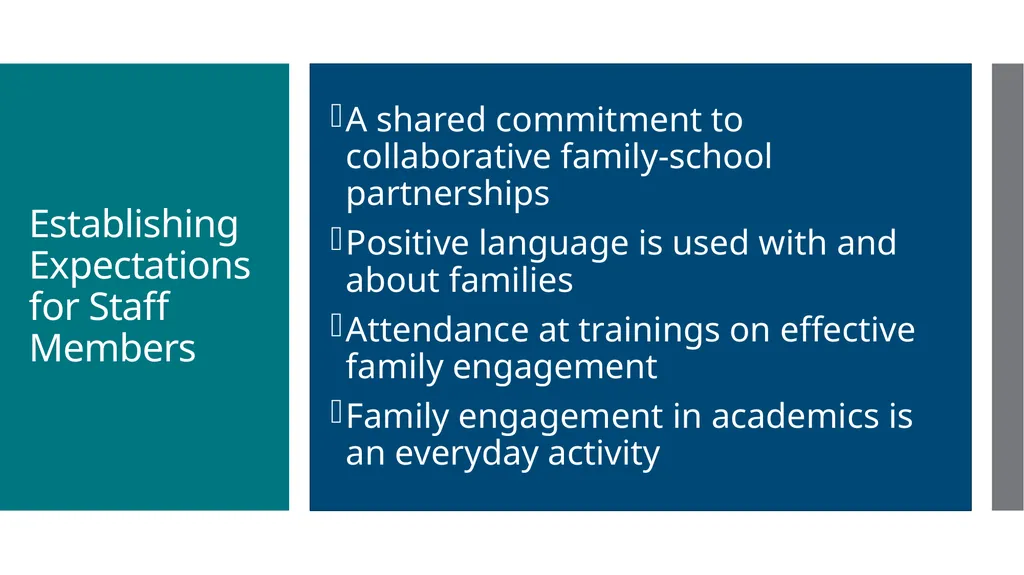
Establishing Expectations for Staff Members A shared commitment to collaborative family-school partnerships
Positive language is used with and about families
Attendance at trainings on effective family engagement
Family engagement in academics is an everyday activity<br>
Positive language is used with and about families
Attendance at trainings on effective family engagement
Family engagement in academics is an everyday activity<br>
18
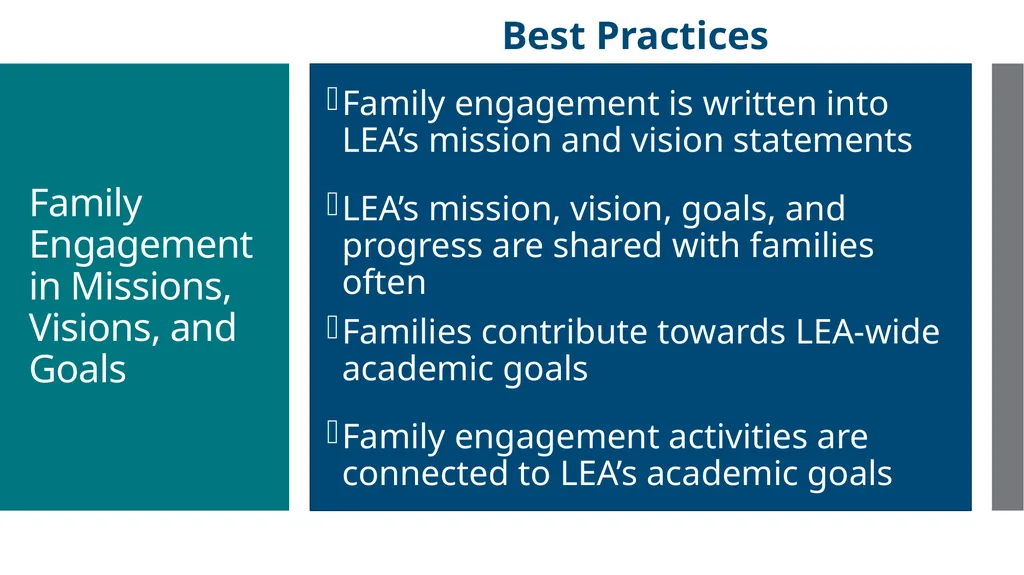
Family Engagement in Missions, Visions, and Goals Family engagement is written into LEA’s mission and vision statements
LEA’s mission, vision, goals, and progress are shared with families often
Families contribute towards LEA-wide academic goals
Family engagement activities are connected to LEA’s academic goals Best Practices<br>
LEA’s mission, vision, goals, and progress are shared with families often
Families contribute towards LEA-wide academic goals
Family engagement activities are connected to LEA’s academic goals Best Practices<br>
19
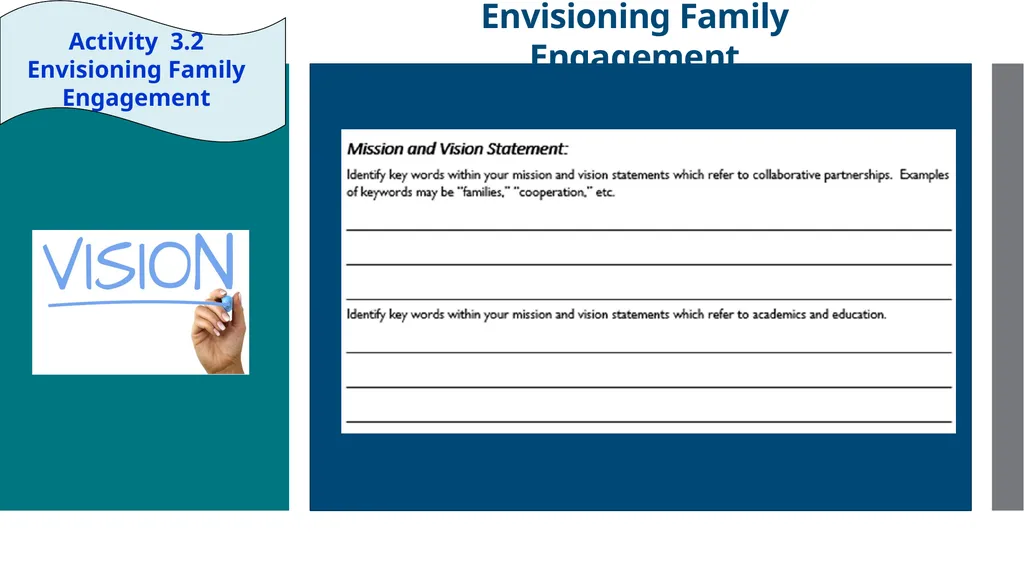
Envisioning Family Engagement<br>
20
BUILDING/SCHOOL LEVEL STRATEGIES FOR ENHANCING STUDENT ACHIEVEMENT SECTION 3<br>
21
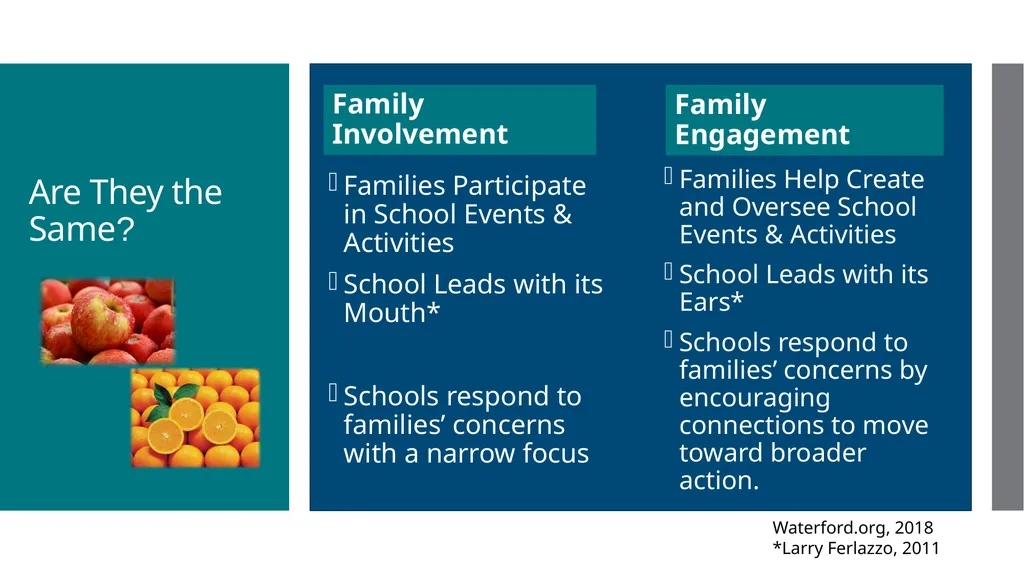
Are They the Same? Family Involvement Families Participate in School Events & Activities
School Leads with its Mouth*
Schools respond to families’ concerns with a narrow focus Family Engagement Families Help Create and Oversee School Events & Activities
School Leads with its Ears*
Schools respond to families’ concerns by encouraging connections to move toward broader action. Waterford.org, 2018
*Larry Ferlazzo, 2011<br>
22
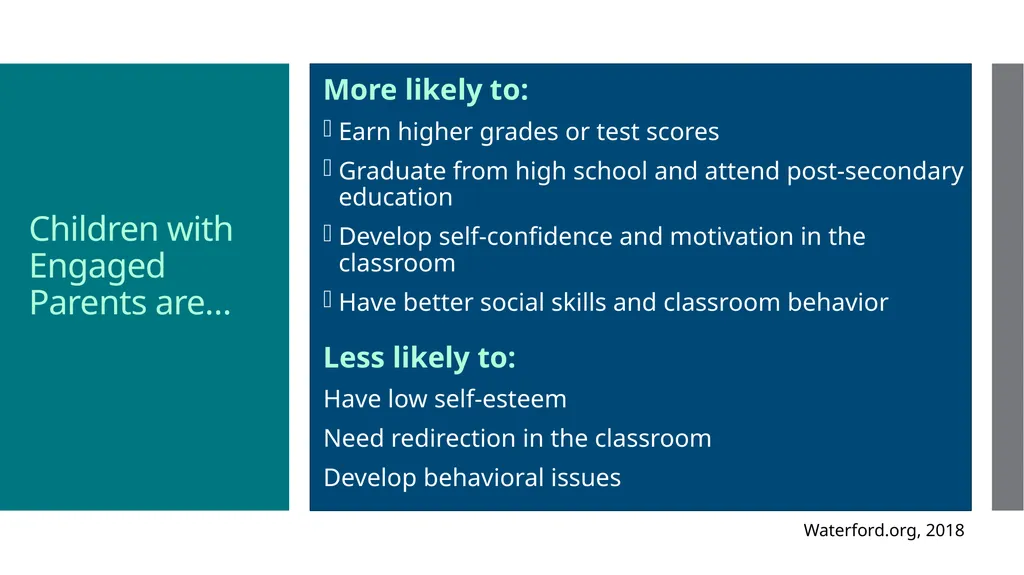
Children with Engaged Parents are… More likely to:
Earn higher grades or test scores
Graduate from high school and attend post-secondary education
Develop self-confidence and motivation in the classroom
Have better social skills and classroom behavior
Less likely to:
Have low self-esteem
Need redirection in the classroom
Develop behavioral issues Waterford.org, 2018<br>
23
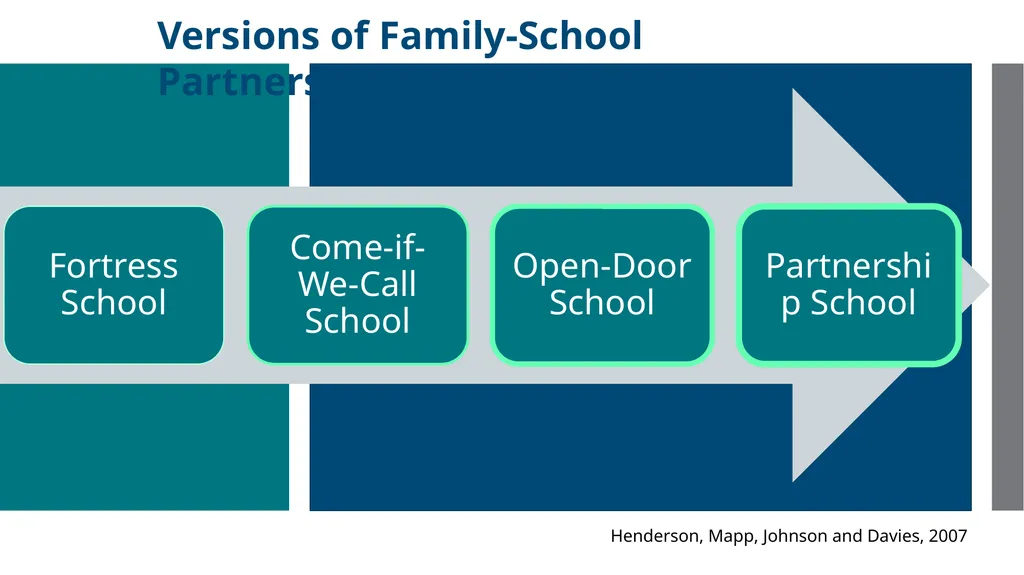
Versions of Family-School Partnerships Henderson, Mapp, Johnson and Davies, 2007<br>
24
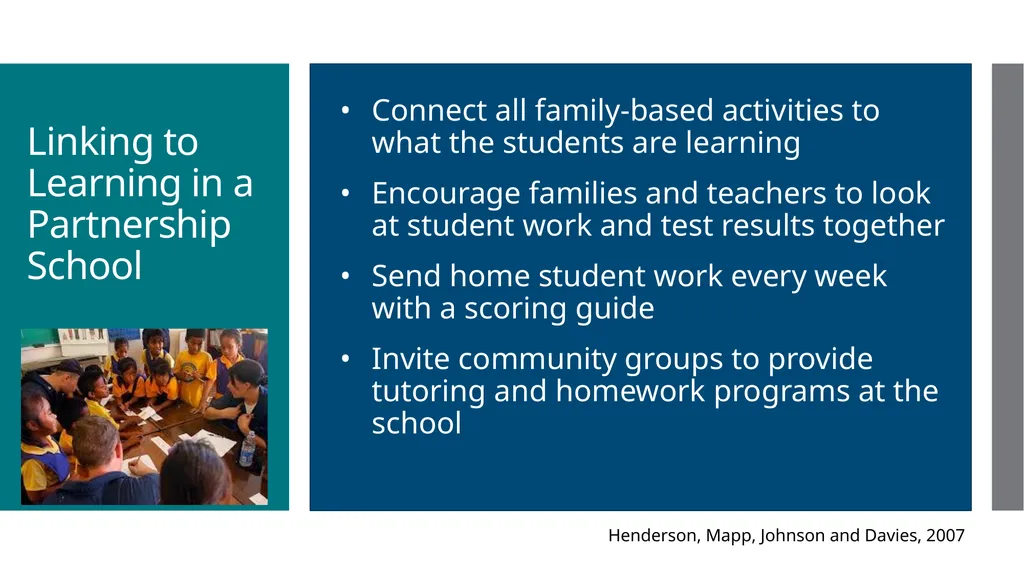
Linking to Learning in a Partnership School Connect all family-based activities to what the students are learning
Encourage families and teachers to look at student work and test results together
Send home student work every week with a scoring guide
Invite community groups to provide tutoring and homework programs at the school Henderson, Mapp, Johnson and Davies, 2007<br>
Encourage families and teachers to look at student work and test results together
Send home student work every week with a scoring guide
Invite community groups to provide tutoring and homework programs at the school Henderson, Mapp, Johnson and Davies, 2007<br>
25
Strategies to Promote Student Success Create a school climate and structures that support student success
Create a family resource center
Designate a Parent Representative (family) and a Family Liaison (staff)
Set up a homework helpline
Utilize the Academic Parent-Teacher Teams (APTT) model<br>
Create a family resource center
Designate a Parent Representative (family) and a Family Liaison (staff)
Set up a homework helpline
Utilize the Academic Parent-Teacher Teams (APTT) model<br>
26
More Building-Level Strategies Provide Access to Families
Home Visits
Comprehensive Services and Centers
Two-Generation Strategies
Oversight and Accountability NCLS 2018<br>
Home Visits
Comprehensive Services and Centers
Two-Generation Strategies
Oversight and Accountability NCLS 2018<br>
27
Building-Level Strategies (cont’d) Communicate with families often and with a professional approach
Offer family workshops and trainings
Family report card
Create opportunities for families, teachers, students, and community members to share ideas on:
improving student success
addressing barriers to family engagement
school improvement<br>
Offer family workshops and trainings
Family report card
Create opportunities for families, teachers, students, and community members to share ideas on:
improving student success
addressing barriers to family engagement
school improvement<br>
28
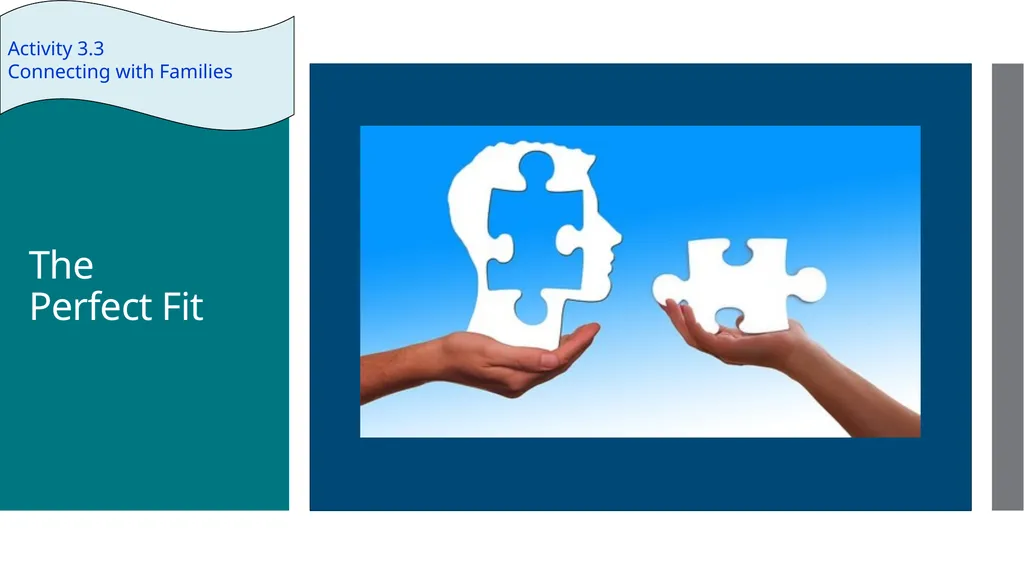
The
Perfect Fit Activity 3.3
Connecting with Families<br>
Connecting with Families<br>
29
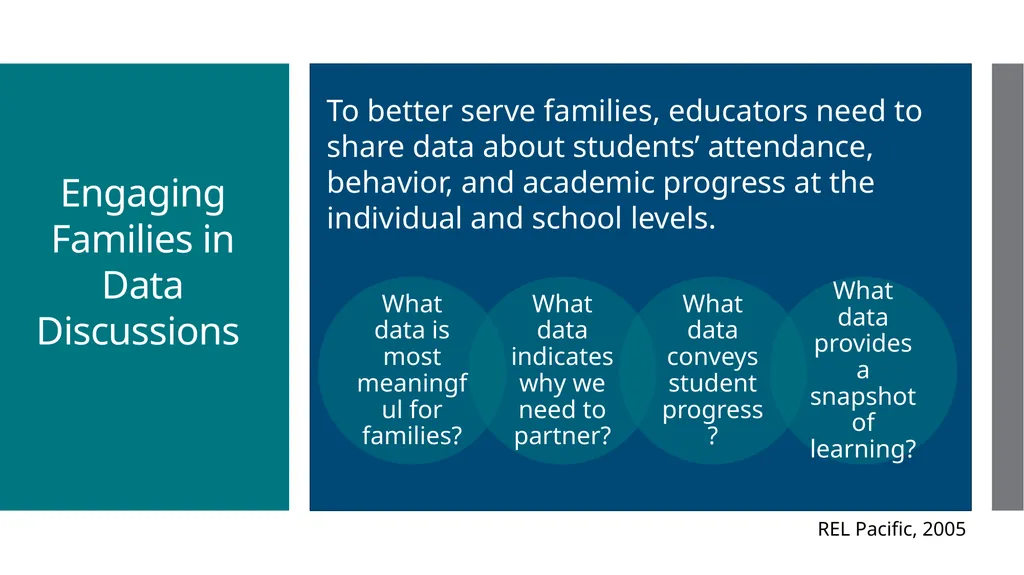
Engaging Families in Data Discussions To better serve families, educators need to share data about students’ attendance, behavior, and academic progress at the individual and school levels. REL Pacific, 2005<br>
30
CLASSROOM-LEVEL STRATEGIES FOR ENHANCING STUDENT ACHIEVEMENT SECTION 4<br>
31
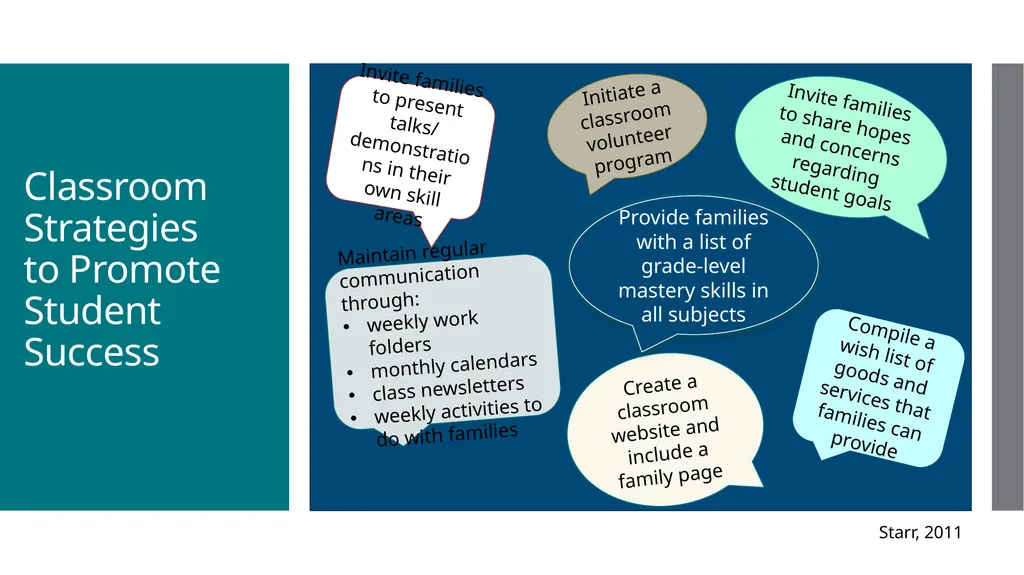
Classroom Strategies
to Promote Student Success Invite families to share hopes and concerns regarding student goals Compile a wish list of goods and services that families can provide Create a classroom website and include a family page Invite families to present talks/ demonstrations in their own skill areas Maintain regular communication through:
weekly work folders
monthly calendars
class newsletters
weekly activities to do with families Initiate a classroom volunteer program Provide families with a list of grade-level mastery skills in all subjects Starr, 2011<br>
weekly work folders
monthly calendars
class newsletters
weekly activities to do with families Initiate a classroom volunteer program Provide families with a list of grade-level mastery skills in all subjects Starr, 2011<br>
32
More Classroom Strategies Share students’ non-academic accomplishments with families
Consult with families on:
gaps in students’ background knowledge
cultural norms and practices
how students learn best
students’ histories (e.g., traumas, athletics)
family culture<br>
Consult with families on:
gaps in students’ background knowledge
cultural norms and practices
how students learn best
students’ histories (e.g., traumas, athletics)
family culture<br>
33
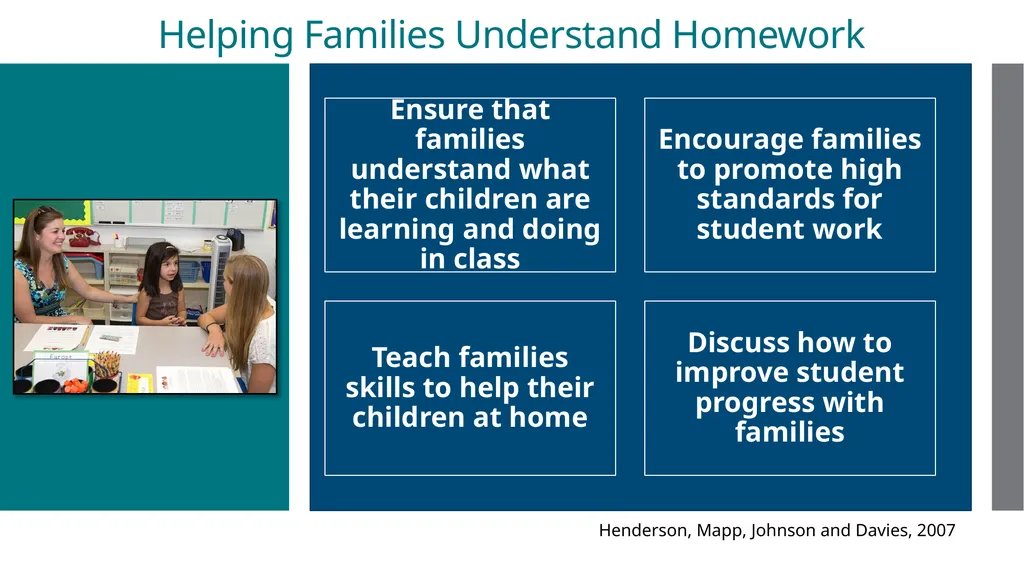
Helping Families Understand Homework Henderson, Mapp, Johnson and Davies, 2007 .<br>
34
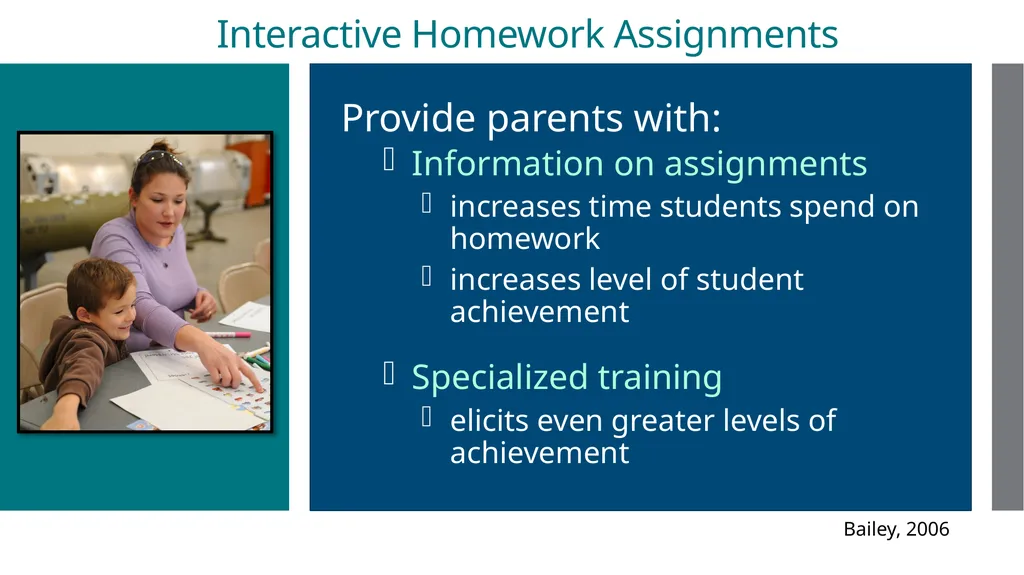
Interactive Homework Assignments Provide parents with:
Information on assignments
increases time students spend on homework
increases level of student achievement
Specialized training
elicits even greater levels of achievement Bailey, 2006<br>
Information on assignments
increases time students spend on homework
increases level of student achievement
Specialized training
elicits even greater levels of achievement Bailey, 2006<br>
35
Building Capacity for Academic Collaboration Meet with families more than annually
Become a partner with families
Share data on aggregate classroom performance & individual students’
Set educational goals together with families
Model strategies to support learning at home Best Practices<br>
Become a partner with families
Share data on aggregate classroom performance & individual students’
Set educational goals together with families
Model strategies to support learning at home Best Practices<br>
36
References (1) American Psychological Association. Parent Engagement in Schools. Retrieved from apa.org: https://www.apa.org/pi/lgbt/programs/safe-supportive/parental-engagement/default.aspx
Bailey, Lora B,. (2006). Interactive Homework: A Tool for Fostering Parent-Child Interactions and Improving Learning Outcomes for At-risk Young Children. Early Childhood Education Journal, 34(2), 155-167. 10.10007/s10643-006-0114-y.
Barnyak, N. C., & McNelly, T.A., (2009). An urban school district’s parent involvement: A study of teachers’ and administrators’ beliefs and practices. The School Community Journal, 19(1), 33-58.
Bryk, A., Sebring, P., Allensworth, E., Luppescu, S., & Easton, J. (2010). Organizing Schools for Improvement: Lessons from Chicago. University of Chicago Press. Cox, D. D. (2005). Evidence-based interventions using home–school collaboration. School Psychology Quarterly, 20(4), 473–497.
Epstein, J.L., Coates, L., Salinas, K.C., Sanders, M.G., & Simon, B.S. (2008). School, Family, and Community Partnerships: Your Handbook for Action. (3rd ed.) Thousand Oaks, CA: Corwin Press.
Ferlazzo, L. (2011, May). Involvement or Engagement? Retrieved July 02, 2020, from http://www.ascd.org/publications/educational-leadership/may11/vol68/num08/Involvement-or-Engagement%C2%A2.aspx, pp 10-14<br>
37
Resources References (2) Grand Rapids Public School District. What Is Parental Engagement? Retrieved from grps.org: https://www.grps.org/parents/parental-engagement.
Henderson, A. T., & Mapp, K. L., (2002). A new wave of evidence: The impact of school, family, and community connections on student achievement. Austin, TX: National Center for Family and Community Schools, Southwest Educational Development Laboratory.
Hill, N., & Tyson, D. (2009). Parental Involvement in Middle School: A Meta-Analytic Assessment of the Strategies That Promote Achievement. Developmental Psychology, 45(3), 740-763.
Hoover-Dempsey, K., Walker, J., Sandler, H., Whetsel, D., Green, C., Wilkins, A., & Closson, K. (2005). Why do parents become involved? Research findings and implications. The Elementary School Journal, 106(2), 105–130.
How Parent Involvement Leads to Student Success. (2018, November 1). Retrieved July 02, 2020, from https://www.waterford.org/education/how-parent-involvment-leads-to-student-success/<br>
38
References (3) Kaufman, T. Family Engagement and Student Success: What the Research Says. Retrieved July 02, 2020, from https://www.understood.org/en/school-learning/for-educators/partnering-with-families/family-engagement-and-student-success?_ul=1*1mv0hdh*domain_userid*YW1wLU9qT3FFYmFXeU85WkU5TEdRaDV6bUE.
Mapp, K. L., Carver, I., & Lander, J. (2017). Powerful partnerships: a teachers guide to engaging families for student success. New York, NY: Scholastic.
Mapp, K. L., (2002). Having their say: Parents describe how and why they are involved in their children’s education. Paper presented at the Annual Meeting of the American Educational Research Association, New Orleans, LA.
McDonald, C. (2016, June 3, personal communication); Dawson, K., & Berry, M. (2002). Engaging families in child welfare services: An evidence-based approach to best practice. Child Welfare, 81, 293-317.
Parallelus. (n.d.). National Network of Partnership Schools: Johns Hopkins University School of Education. Retrieved from https://www.partnershipschools.org<br>
39
References (4) Pena, D. C., (2000). Parent Involvement: Influencing factors and implications. The Journal of Educational Research. 94(1), 42-54.
REL PACIFIC, (2015). Toolkit of Resources for Engaging Parents and Community as Partners in Education Part 4: Engaging All in Data Conversations. Retrieved October 16, 2015, from http://relpacific.mcrel.org/resources/~/media/RELPacific/Files/Part4_Mar2015.ashx
Sheldon, S. B., & Jung, S. B. (2015). Parent Involvement and Children’s Academic and Social Development in Elementary School. Johns Hopkins University, School of Education.
Sheldon, Steven B., and J. L. Epstein. “Involvement Counts: Family and Community Partnerships and Mathematics Achievement.” The Journal of Longitudinal Research. 98(4), 196-206
Starr, L. (2011, January 1). A Dozen Activities to Promote Parent Involvement. Retrieved February 27, 2015, from http://www.educationworld.com/a_curr/curr200.shtml
Wairimu, M.J., Macharia, S.M., Muiru, A. (2016, November 27). Analysis of Parental Involvement and Self-Esteem on Secondary School Students in Kieni West Sub-County, Nyeri County, Kenya. Journal of Education and Practice, Vol 7. (82-98)<br>
40
References (5) Weyer, M. (2018, September 24). Family Engagement in Education, Retrieved July 02, 2020, from https://www.ncsl.org/research/education/family-engagement.aspx
Weiss, H. B., & Lopez, M. E. (2011). Making data matter in family engagement. In, Sam Redding, Marilyn Murphy, & Pam Sheley (Eds.), The handbook on family and community engagement, pp. 21-28. Retrieved from http://www.schoolcommunitynetwork.org/downloads/FACEHandbook.pdf
Xu, Z., & Gulosino, C. A., (2006). How does teacher quality matter? The effect of teacher-parent partnership on early childhood performance in public and private schools. Education Economics, 14(3), 345-367.<br>
41
PaTTAN – East
1-800-441-3215
Kimberly Jenkins
kjenkins@pattan.net
PaTTAN – Harrisburg
1-800-360-7282
Erin Campion
ecampion@pattan.net
PaTTAN – Pittsburgh
1-800-446-5607
Jennifer Geibel
jgeibel@pattan.net<br>