Enhancing RESILIENCY AND Supporting sustainable Growth The role of the IDF and related initiatives Bill Marcoux IAIS Conference Asunción Paraguay November 11, 2016 What is it? Why is it? What can it (hopefully) do? Why does it matter? The
"Enhancing RESILIENCY AND Supporting sustainable" is the property of its rightful owner. Permission is granted to
download and print the materials on this website for personal, non-commercial use only, and to display it
on your personal computer provided you do not modify the materials and that you retain all copyright
notices contained in the materials. By downloading content from our website, you accept the terms of this
agreement.
Presentation Transcript
01
Enhancing RESILIENCY AND Supporting sustainable Growth "The role of the IDF and related initiatives" Bill Marcoux
IAIS Conference
Asunción Paraguay
November 11, 2016<br>
02
What is it?
Why is it?
What can it (hopefully) do?
Why does it matter? The Insurance Development Forum<br>
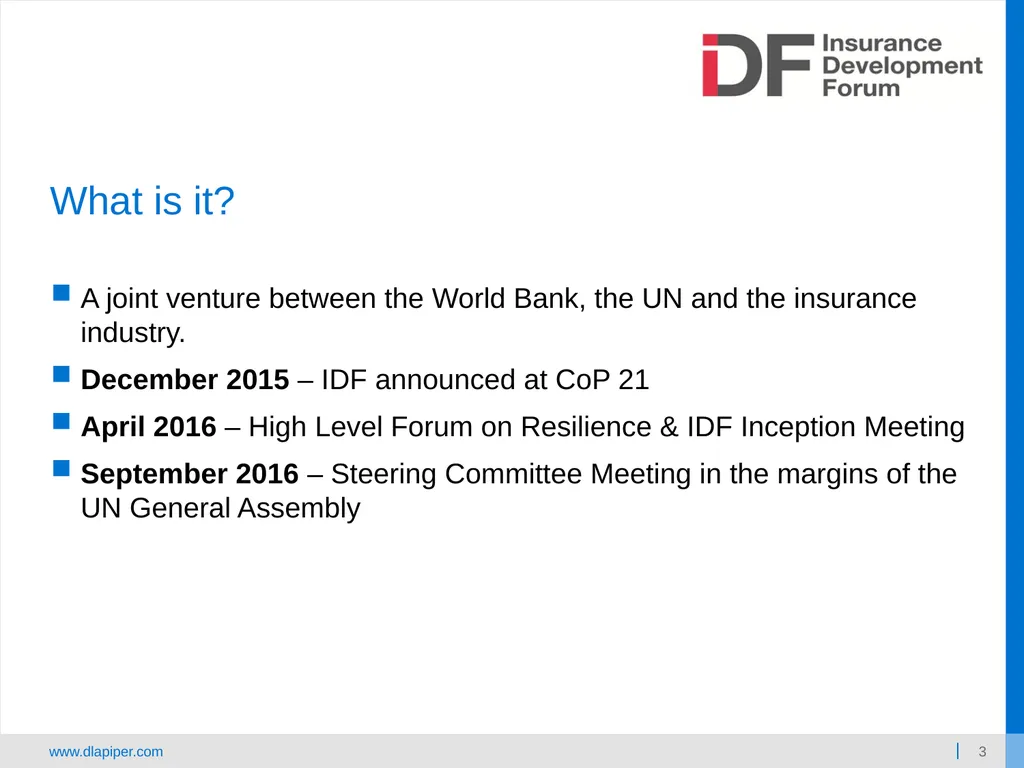
03
A joint venture between the World Bank, the UN and the insurance industry.
December 2015 – IDF announced at CoP 21
April 2016 – High Level Forum on Resilience & IDF Inception Meeting
September 2016 – Steering Committee Meeting in the margins of the UN General Assembly What is it?<br>
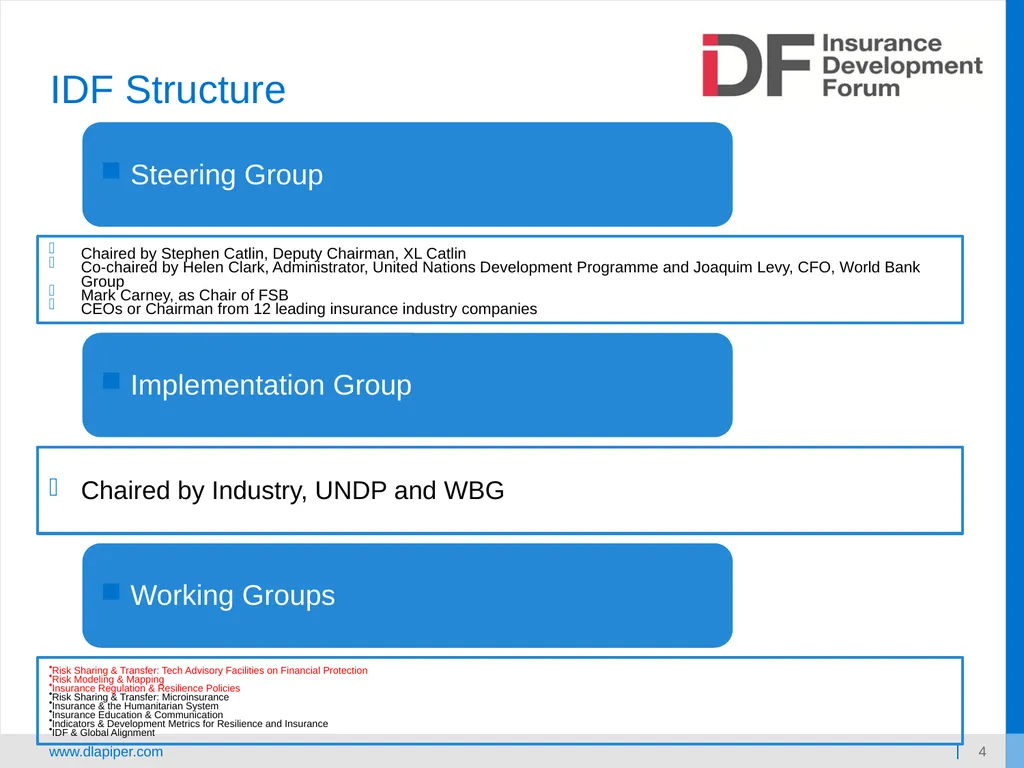
04
IDF Structure<br>
05
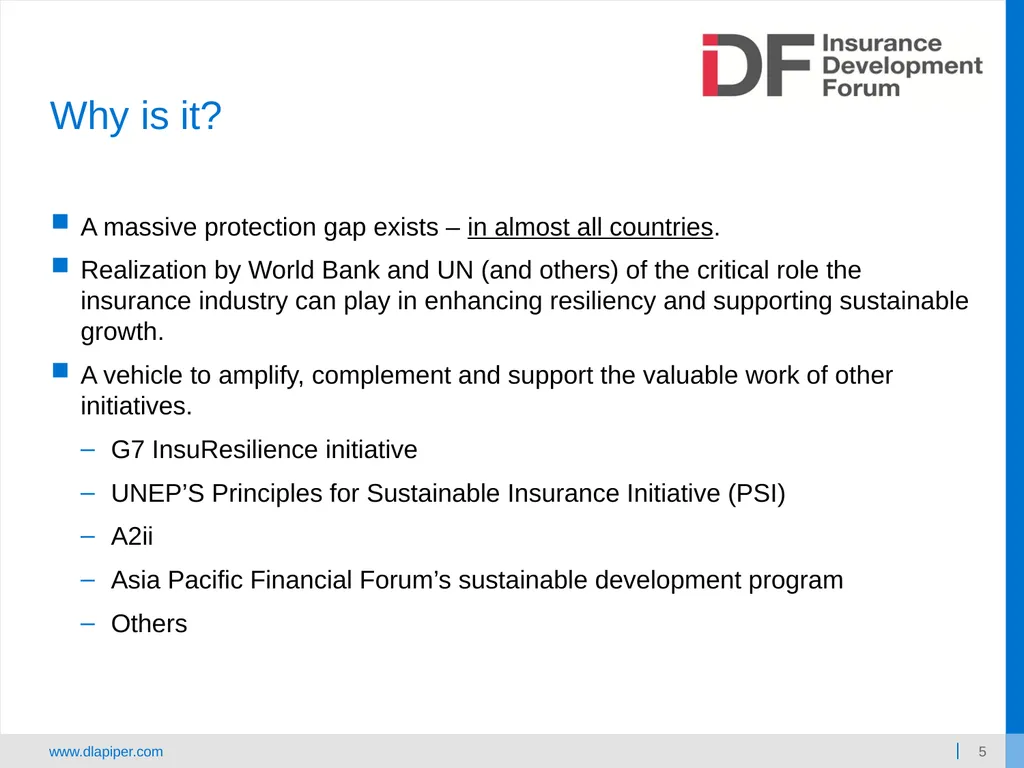
A massive protection gap exists – in almost all countries.
Realization by World Bank and UN (and others) of the critical role the insurance industry can play in enhancing resiliency and supporting sustainable growth.
A vehicle to amplify, complement and support the valuable work of other initiatives.
G7 InsuResilience initiative
UNEP’S Principles for Sustainable Insurance Initiative (PSI)
A2ii
Asia Pacific Financial Forum’s sustainable development program
Others Why is it?<br>
06
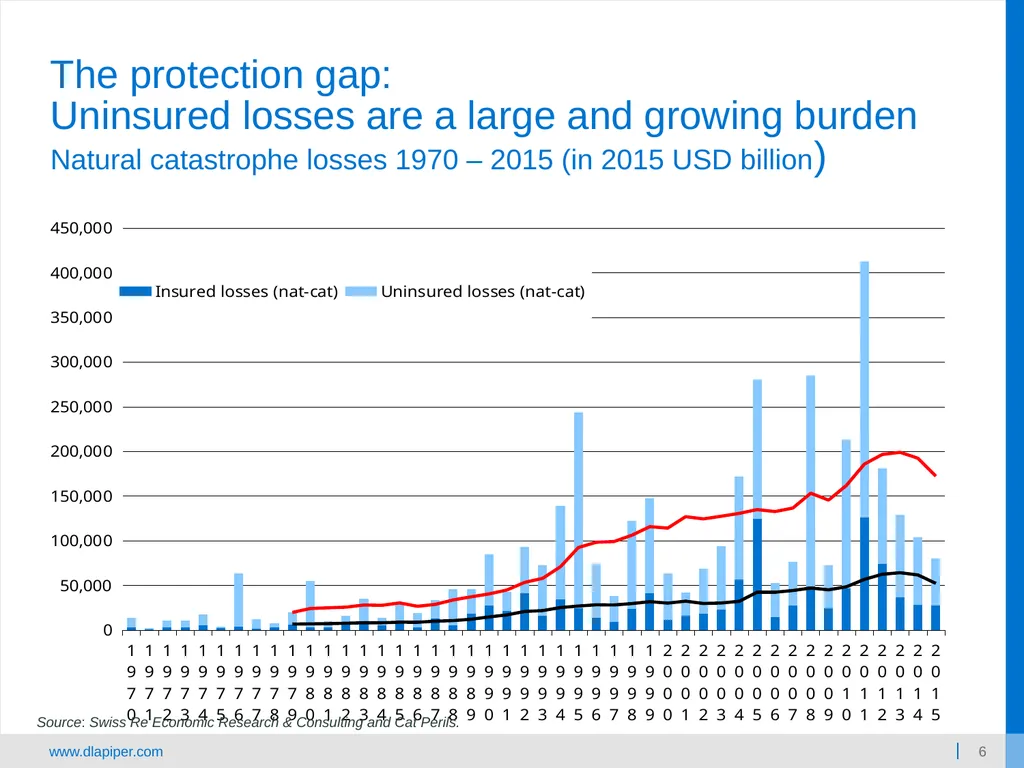
The protection gap: Uninsured losses are a large and growing burden Natural catastrophe losses 1970 – 2015 (in 2015 USD billion) Source: Swiss Re Economic Research & Consulting and Cat Perils.<br>
07
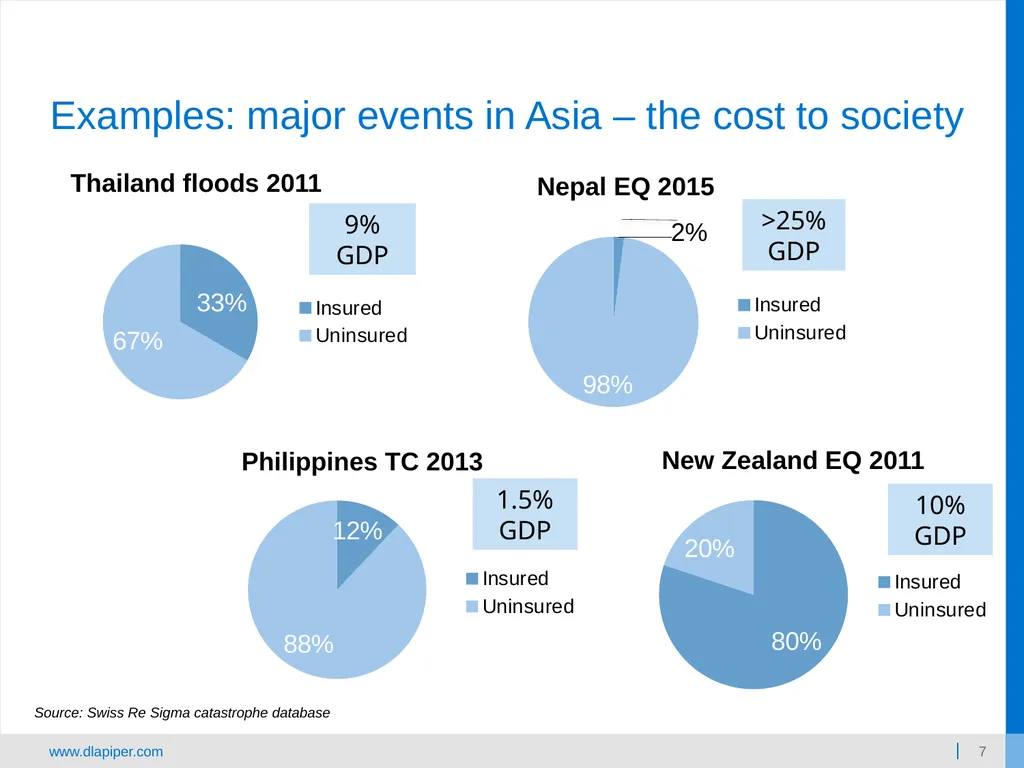
Examples: major events in Asia – the cost to society Thailand floods 2011 9% GDP 1.5% GDP 10% GDP >25% GDP Source: Swiss Re Sigma catastrophe database<br>
08
Impact on public finances and economic growth "Major natural catastrophes have large and significant negative effects on economic activity... However, it is mainly the uninsured losses that drive the subsequent macroeconomic cost, whereas sufficiently insured events are inconsequential in terms of foregone output.“
Working Paper No. 394, December 2012 "Natural disasters can damage sovereign creditworthiness”
"One way to mitigate the economic and ratings impact of natural disasters [on sovereign creditworthiness] is catastrophe insurance.”
Storm Alert: Natural Disasters Can Damage Sovereign Creditworthiness, September 2015 "Finance Ministries play a pivotal role in DRM strategies [by] ensuring proper fiscal management of disaster risks by anticipating potential budgetary impacts and planning ahead to ensure adequate financial capacity and rapid release of funds, thus enabling emergency response, reconstruction of public assets and infrastructure, and targeted financial assistance."
Disaster Risk Assessment and Risk Financing - A G20/OECD Methodological Framework<br>
09
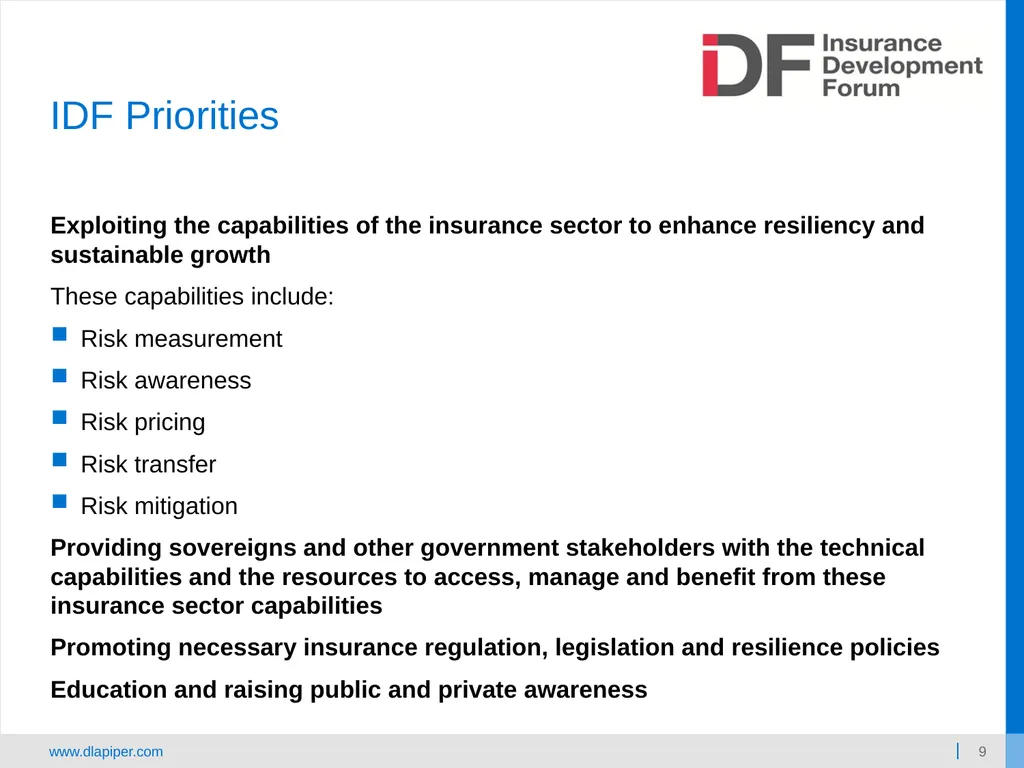
Exploiting the capabilities of the insurance sector to enhance resiliency and sustainable growth
These capabilities include:
Risk measurement
Risk awareness
Risk pricing
Risk transfer
Risk mitigation
Providing sovereigns and other government stakeholders with the technical capabilities and the resources to access, manage and benefit from these insurance sector capabilities
Promoting necessary insurance regulation, legislation and resilience policies
Education and raising public and private awareness IDF Priorities<br>
10
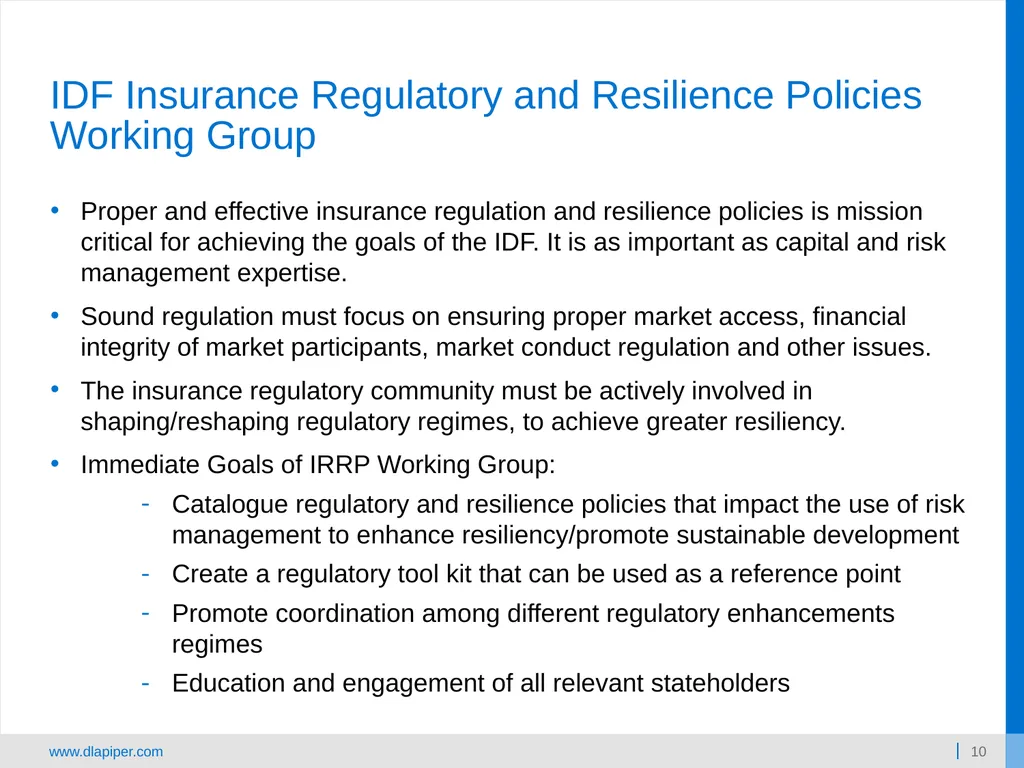
Proper and effective insurance regulation and resilience policies is mission critical for achieving the goals of the IDF. It is as important as capital and risk management expertise.
Sound regulation must focus on ensuring proper market access, financial integrity of market participants, market conduct regulation and other issues.
The insurance regulatory community must be actively involved in shaping/reshaping regulatory regimes, to achieve greater resiliency.
Immediate Goals of IRRP Working Group:
Catalogue regulatory and resilience policies that impact the use of risk management to enhance resiliency/promote sustainable development
Create a regulatory tool kit that can be used as a reference point
Promote coordination among different regulatory enhancements regimes
Education and engagement of all relevant stateholders IDF Insurance Regulatory and Resilience Policies Working Group<br>
11
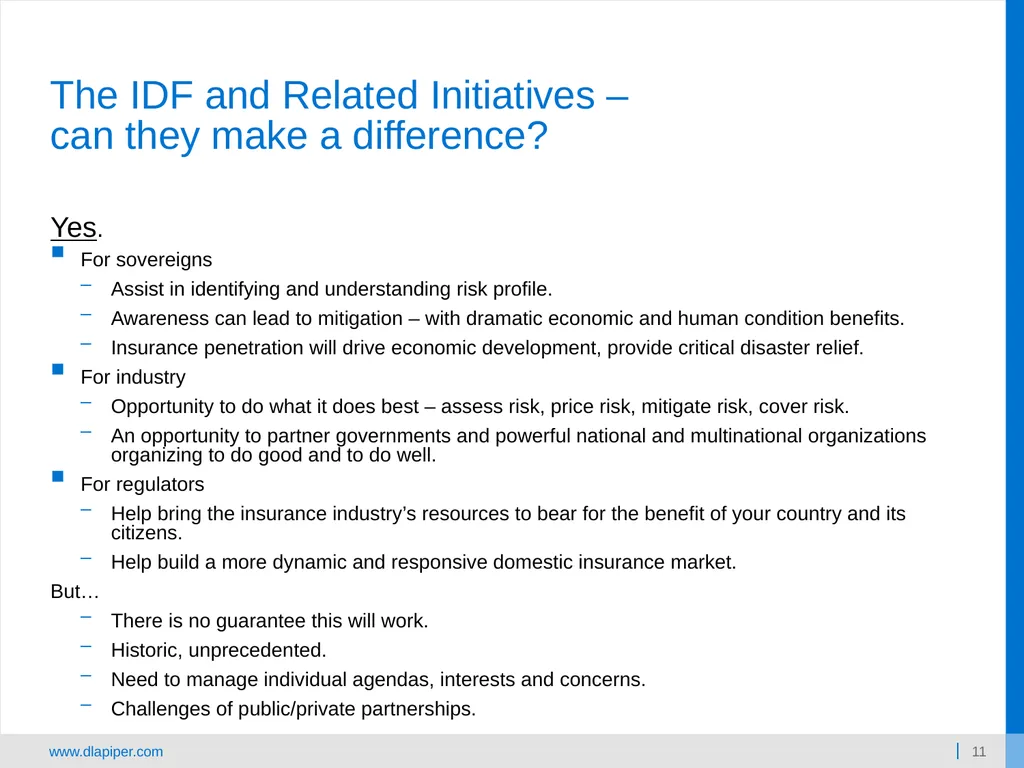
Yes.
For sovereigns
Assist in identifying and understanding risk profile.
Awareness can lead to mitigation – with dramatic economic and human condition benefits.
Insurance penetration will drive economic development, provide critical disaster relief.
For industry
Opportunity to do what it does best – assess risk, price risk, mitigate risk, cover risk.
An opportunity to partner governments and powerful national and multinational organizations organizing to do good and to do well.
For regulators
Help bring the insurance industry’s resources to bear for the benefit of your country and its citizens.
Help build a more dynamic and responsive domestic insurance market.
But…
There is no guarantee this will work.
Historic, unprecedented.
Need to manage individual agendas, interests and concerns.
Challenges of public/private partnerships. The IDF and Related Initiatives – can they make a difference?<br>
12
There is a unique opportunity.
Success will require cooperation, innovation and boldness.
The IDF will not become a think tank. It will either make a difference soon, or it will disappear.
A potential win/win situation. Conclusion<br>