
ENLS Version 5.0 Resuscitation Following Cardiac



Description: ENLS Version 5.0 Resuscitation Following Cardiac Arrest Content: Kara R. Melmed, MD; Sarah Livesay, DNP, APRN, FNCS, FAAN; Matthew Kirschen, MD, PhD; With contributions from: Jason McMullan, MD, Scott Thomas May, PharmD, BCPS, BCCCP,
Related Topics
Download Presentation
"ENLS Version 5.0 Resuscitation Following Cardiac" is the property of its rightful owner. Permission is granted to download and print the materials on this website for personal, non-commercial use only, and to display it on your personal computer provided you do not modify the materials and that you retain all copyright notices contained in the materials. By downloading content from our website, you accept the terms of this agreement.
Presentation Transcript
slide2. ENLS Version 5.0
Resuscitation Following Cardiac Arrest Content: Kara R. Melmed, MD; Sarah Livesay, DNP, APRN, FNCS, FAAN; Matthew Kirschen, MD, PhD;
With contributions from: Jason McMullan, MD, Scott Thomas May, PharmD, BCPS, BCCCP, Victoria McCriedie, MBChB, PhD, FRCPC, MRCPUK, UNCS
Slides: Sarah Livesay<br>
slide3. Presenter: Your name Your institution Conflicts: No conflicts<br>
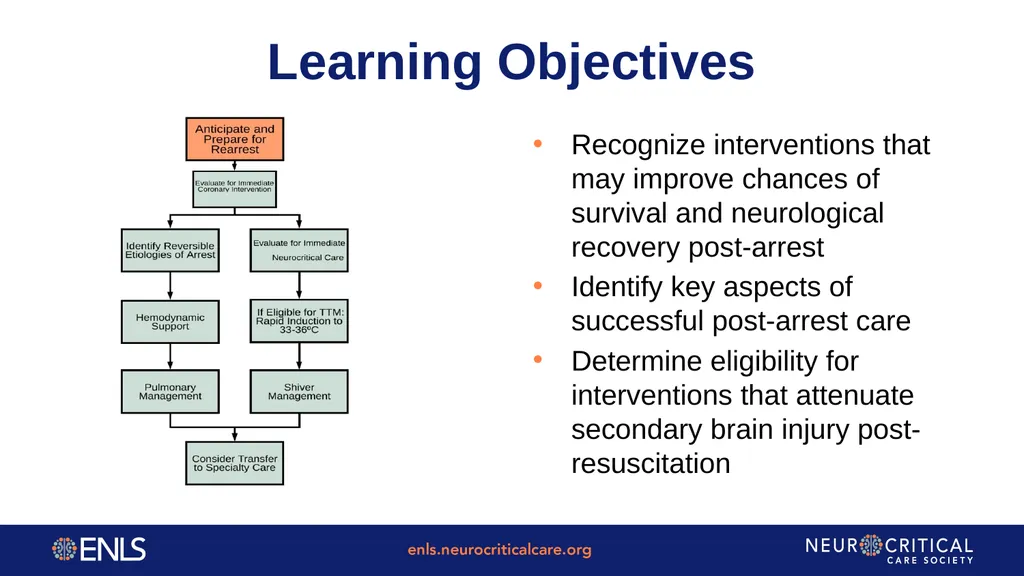
slide4. Learning Objectives Recognize interventions that may improve chances of survival and neurological recovery post-arrest
Identify key aspects of successful post-arrest care
Determine eligibility for interventions that attenuate secondary brain injury post-resuscitation<br>
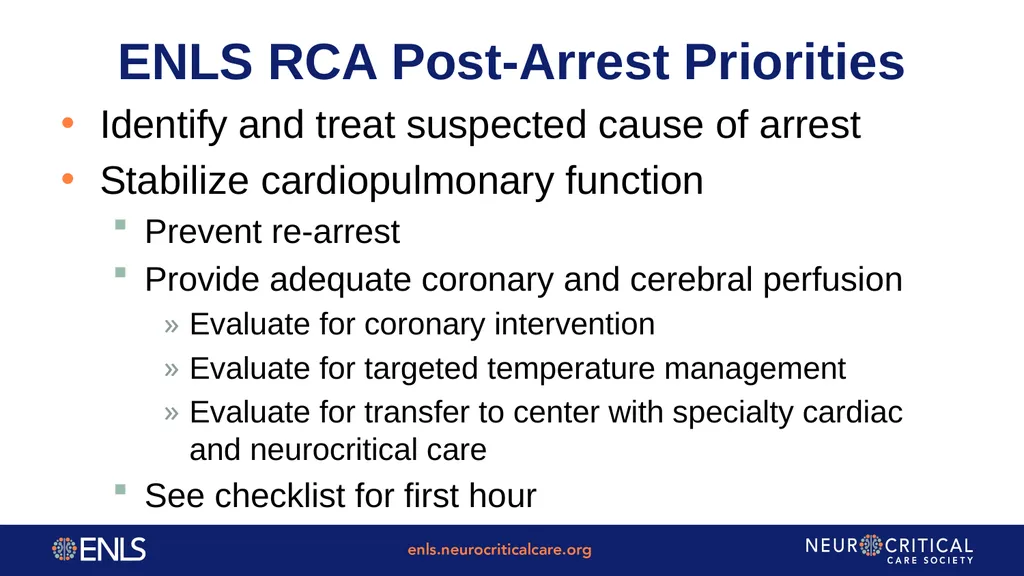
slide5. ENLS RCA Post-Arrest Priorities Identify and treat suspected cause of arrest
Stabilize cardiopulmonary function
Prevent re-arrest
Provide adequate coronary and cerebral perfusion
Evaluate for coronary intervention
Evaluate for targeted temperature management
Evaluate for transfer to center with specialty cardiac and neurocritical care
See checklist for first hour<br>
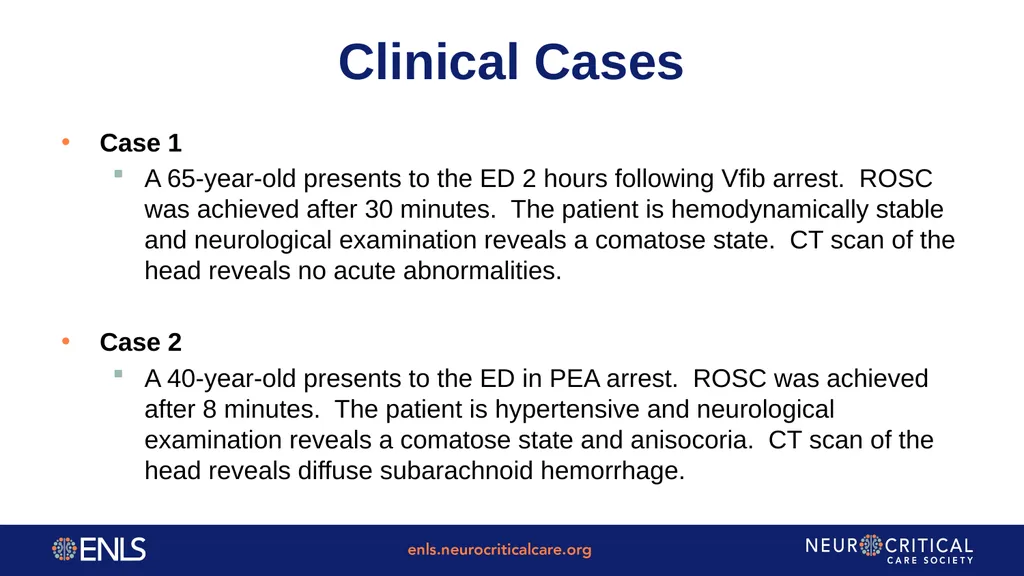
slide6. Clinical Cases Case 1
A 65-year-old presents to the ED 2 hours following Vfib arrest. ROSC was achieved after 30 minutes. The patient is hemodynamically stable and neurological examination reveals a comatose state. CT scan of the head reveals no acute abnormalities.
Case 2
A 40-year-old presents to the ED in PEA arrest. ROSC was achieved after 8 minutes. The patient is hypertensive and neurological examination reveals a comatose state and anisocoria. CT scan of the head reveals diffuse subarachnoid hemorrhage.<br>
slide7. Prehospital Care and Immediate Stabilization Arrhythmia stabilization
Hemodynamic stabilization
Hypotension and hypoxia associated with worse outcomes
Volume and electrolyte correction
Ventilation and oxygenation
Then rapid consideration for:
Coronary (PCI) intervention as appropriate
Prevention of secondary brain injury<br>
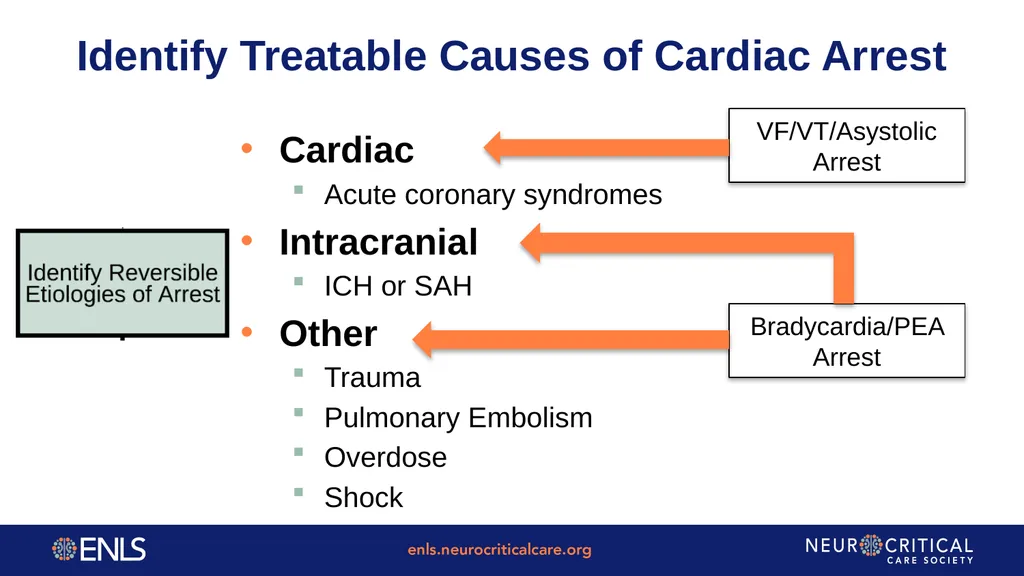
slide8. Identify Treatable Causes of Cardiac Arrest Cardiac
Acute coronary syndromes
Intracranial
ICH or SAH
Other
Trauma
Pulmonary Embolism
Overdose
Shock VF/VT/Asystolic Arrest Bradycardia/PEA Arrest<br>
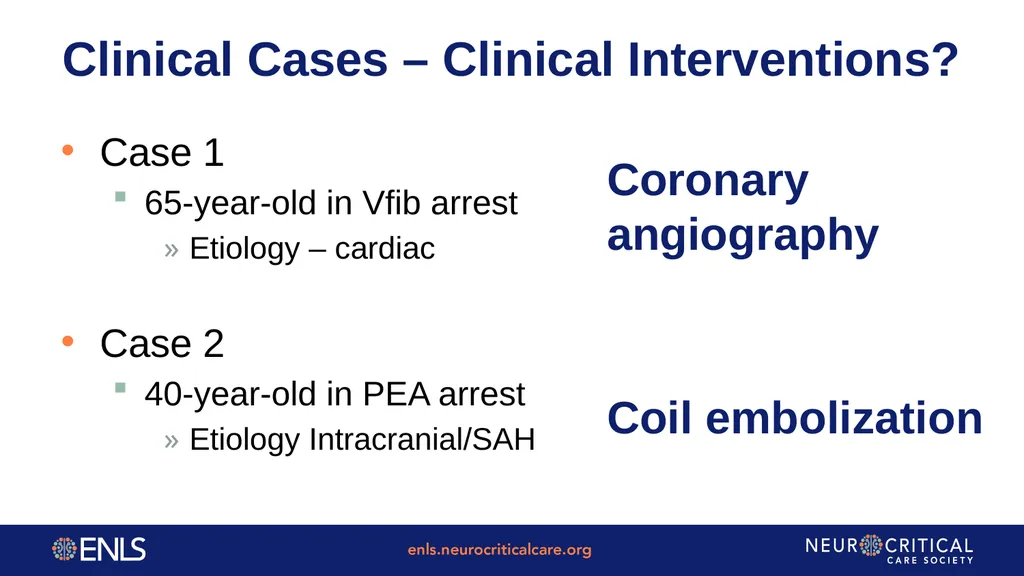
slide9. Clinical Cases – Clinical Interventions? Case 1
65-year-old in Vfib arrest
Etiology – cardiac
Case 2
40-year-old in PEA arrest
Etiology Intracranial/SAH Coronary angiography Coil embolization<br>
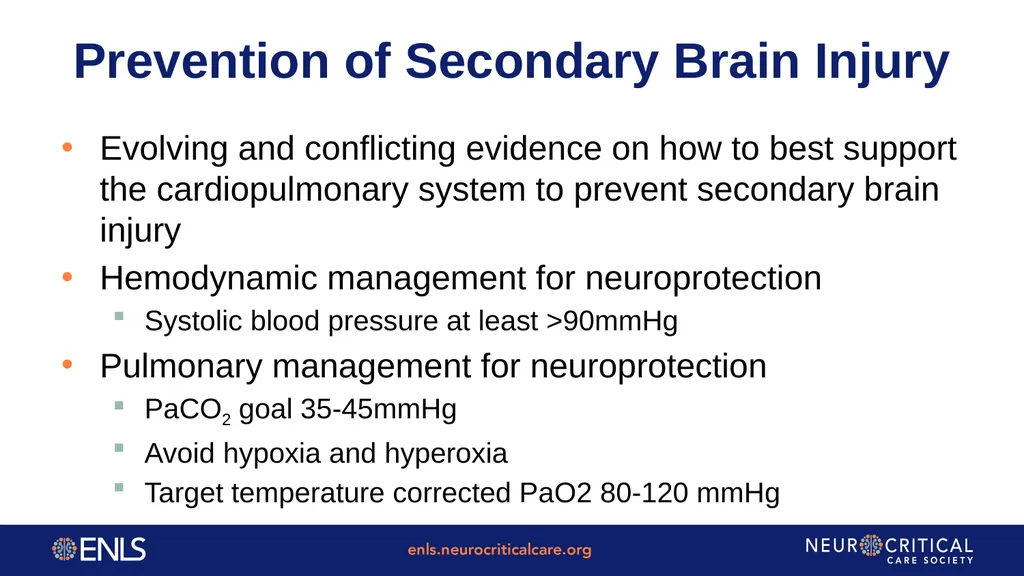
slide10. Prevention of Secondary Brain Injury Evolving and conflicting evidence on how to best support the cardiopulmonary system to prevent secondary brain injury
Hemodynamic management for neuroprotection
Systolic blood pressure at least >90mmHg
Pulmonary management for neuroprotection
PaCO2 goal 35-45mmHg
Avoid hypoxia and hyperoxia
Target temperature corrected PaO2 80-120 mmHg<br>
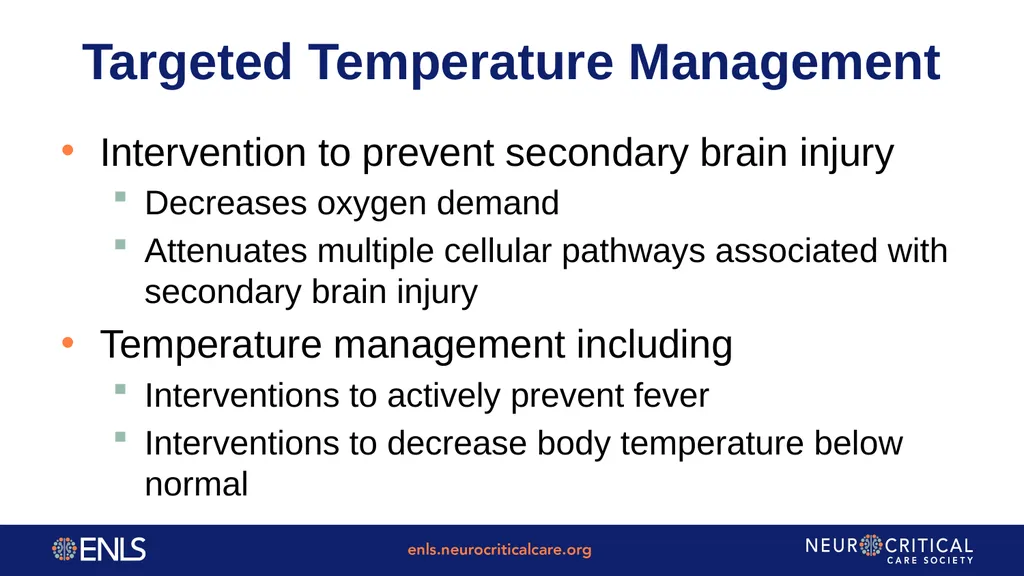
slide11. Targeted Temperature Management Intervention to prevent secondary brain injury
Decreases oxygen demand
Attenuates multiple cellular pathways associated with secondary brain injury
Temperature management including
Interventions to actively prevent fever
Interventions to decrease body temperature below normal<br>
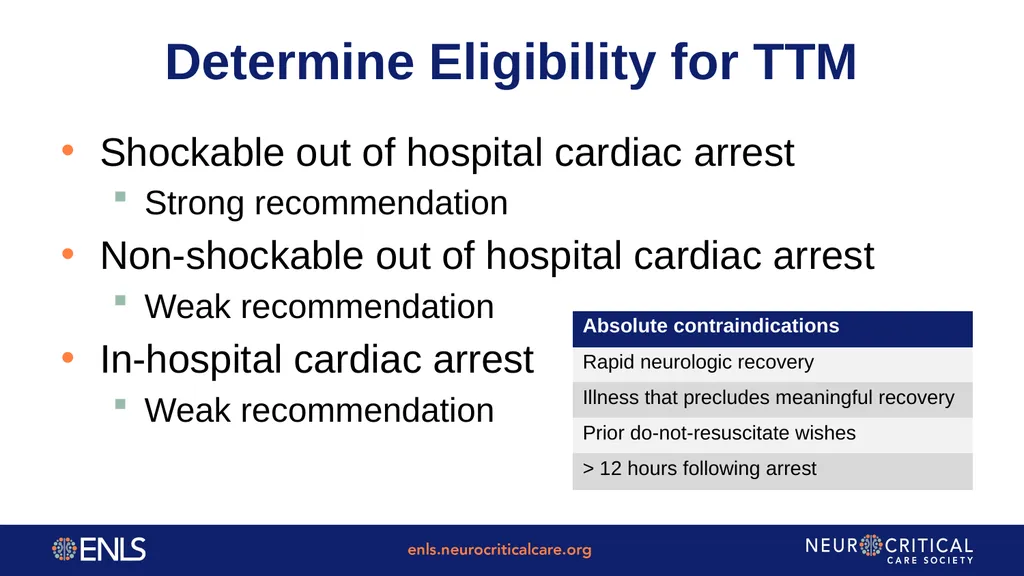
slide12. Determine Eligibility for TTM Shockable out of hospital cardiac arrest
Strong recommendation
Non-shockable out of hospital cardiac arrest
Weak recommendation
In-hospital cardiac arrest
Weak recommendation<br>
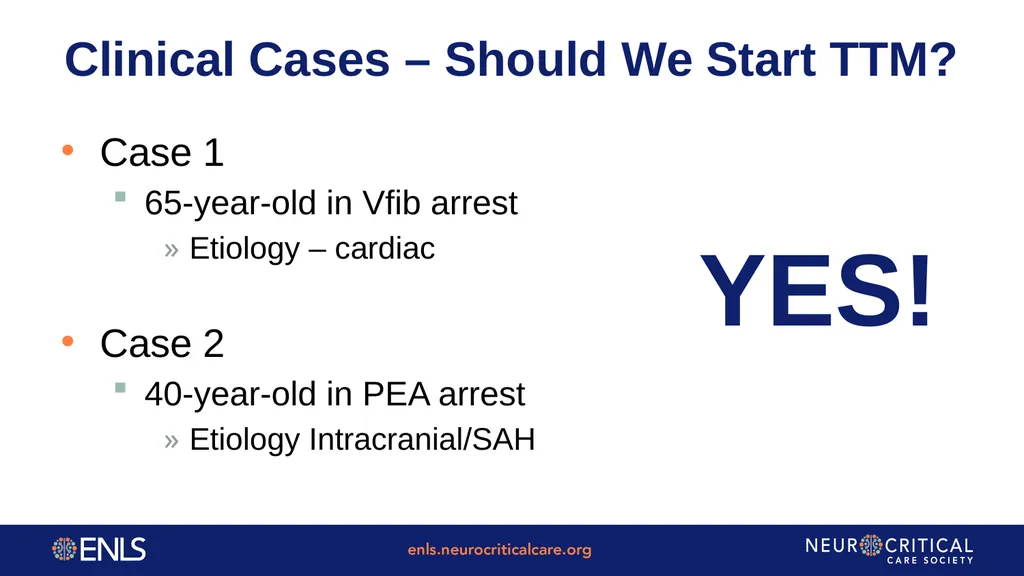
slide13. Clinical Cases – Should We Start TTM? Case 1
65-year-old in Vfib arrest
Etiology – cardiac
Case 2
40-year-old in PEA arrest
Etiology Intracranial/SAH YES!<br>
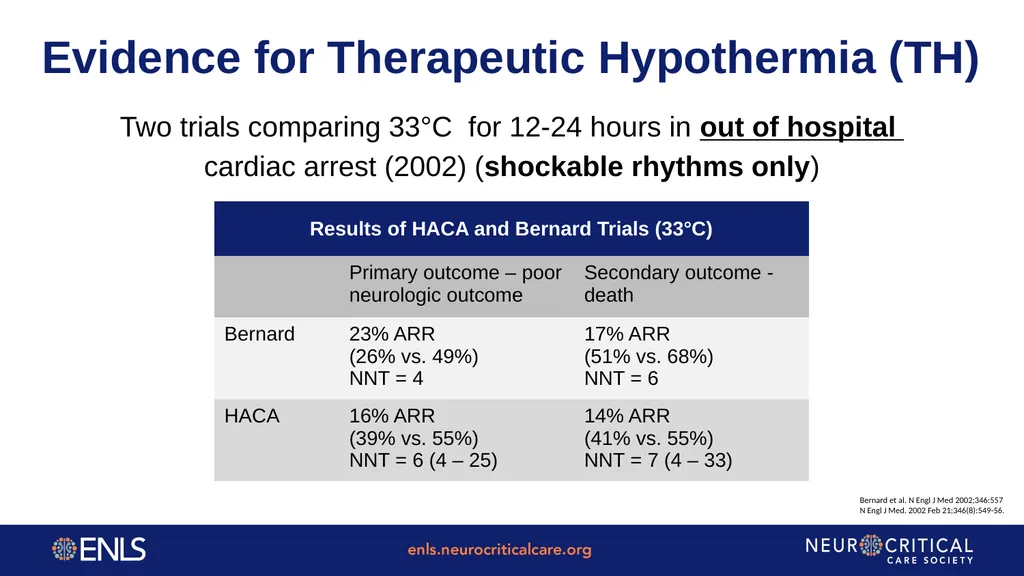
slide14. Evidence for Therapeutic Hypothermia (TH) Two trials comparing 33°C for 12-24 hours in out of hospital
cardiac arrest (2002) (shockable rhythms only) Bernard et al. N Engl J Med 2002;346:557
N Engl J Med. 2002 Feb 21;346(8):549-56.<br>
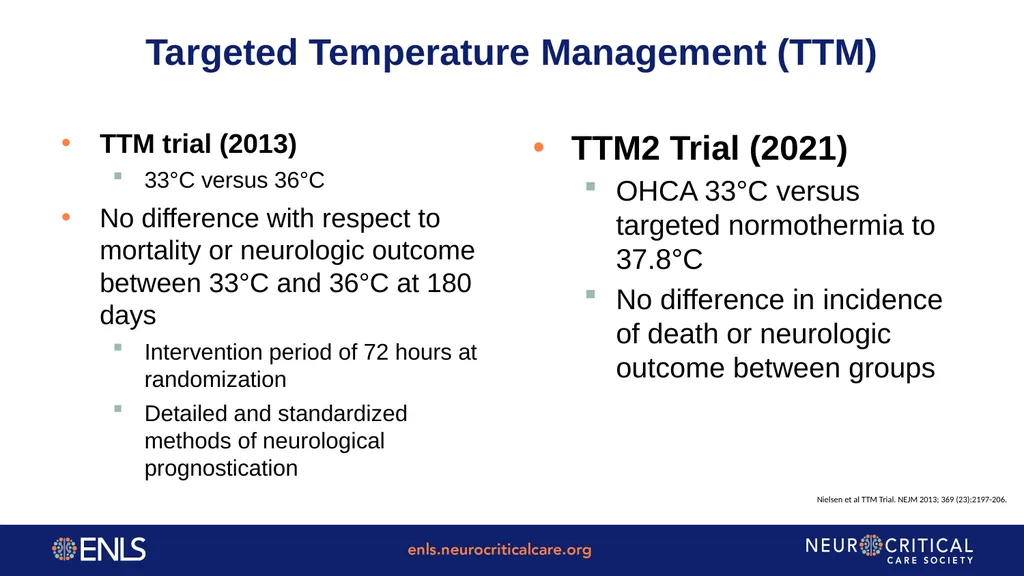
slide15. Targeted Temperature Management (TTM) TTM trial (2013)
33°C versus 36°C
No difference with respect to mortality or neurologic outcome between 33°C and 36°C at 180 days
Intervention period of 72 hours at randomization
Detailed and standardized methods of neurological prognostication TTM2 Trial (2021)
OHCA 33°C versus targeted normothermia to 37.8°C
No difference in incidence of death or neurologic outcome between groups Nielsen et al TTM Trial. NEJM 2013; 369 (23):2197-206.<br>
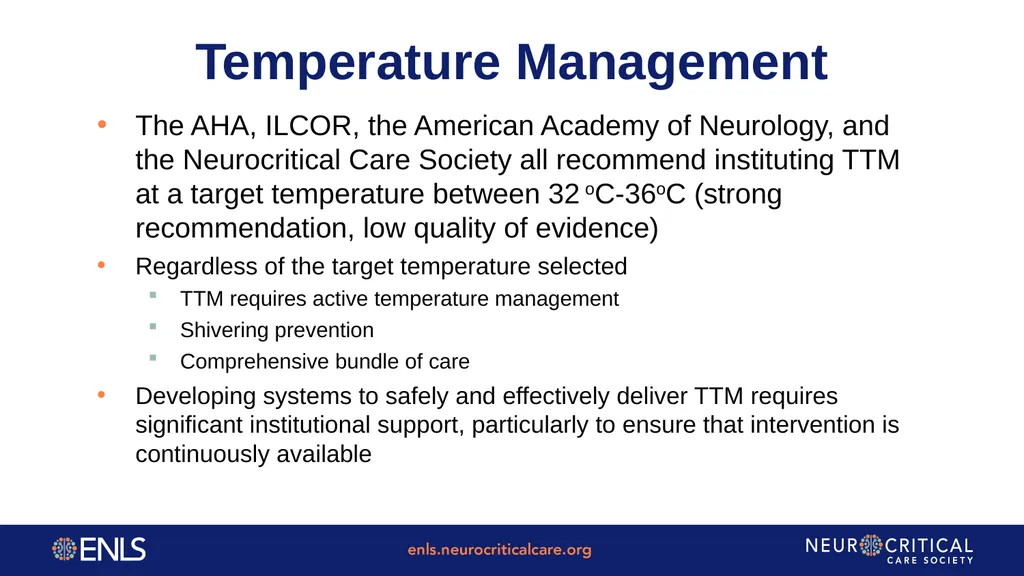
slide16. Temperature Management The AHA, ILCOR, the American Academy of Neurology, and the Neurocritical Care Society all recommend instituting TTM at a target temperature between 32 oC-36oC (strong recommendation, low quality of evidence)
Regardless of the target temperature selected
TTM requires active temperature management
Shivering prevention
Comprehensive bundle of care
Developing systems to safely and effectively deliver TTM requires significant institutional support, particularly to ensure that intervention is continuously available<br>
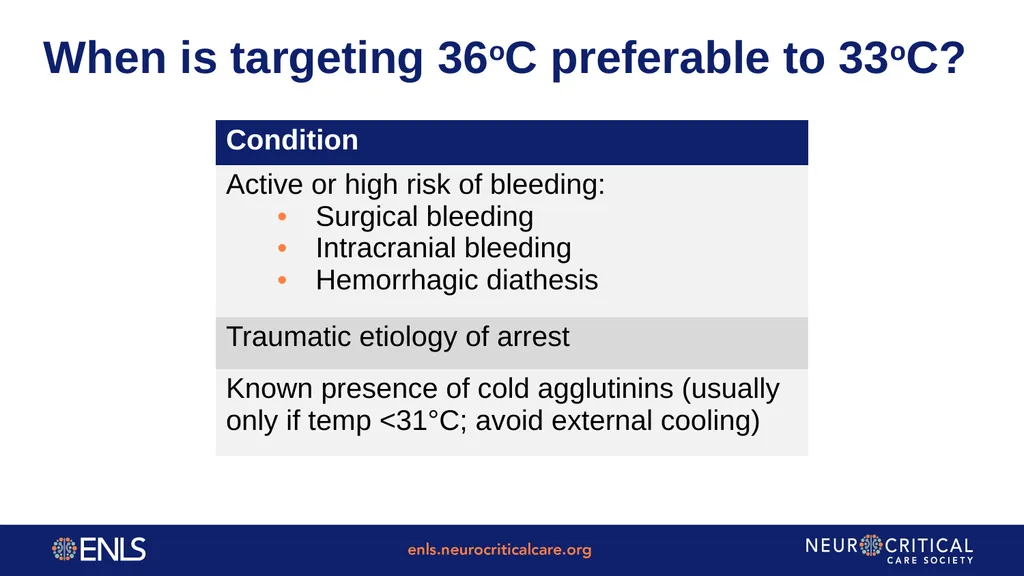
slide17. When is targeting 36oC preferable to 33oC?<br>
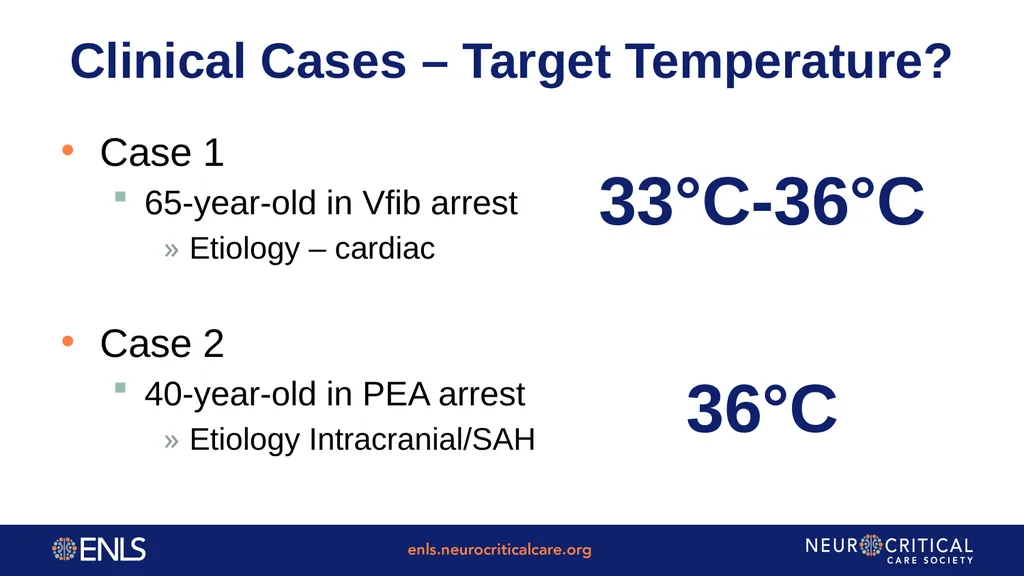
slide18. Clinical Cases – Target Temperature? Case 1
65-year-old in Vfib arrest
Etiology – cardiac
Case 2
40-year-old in PEA arrest
Etiology Intracranial/SAH 33°C-36°C 36°C<br>
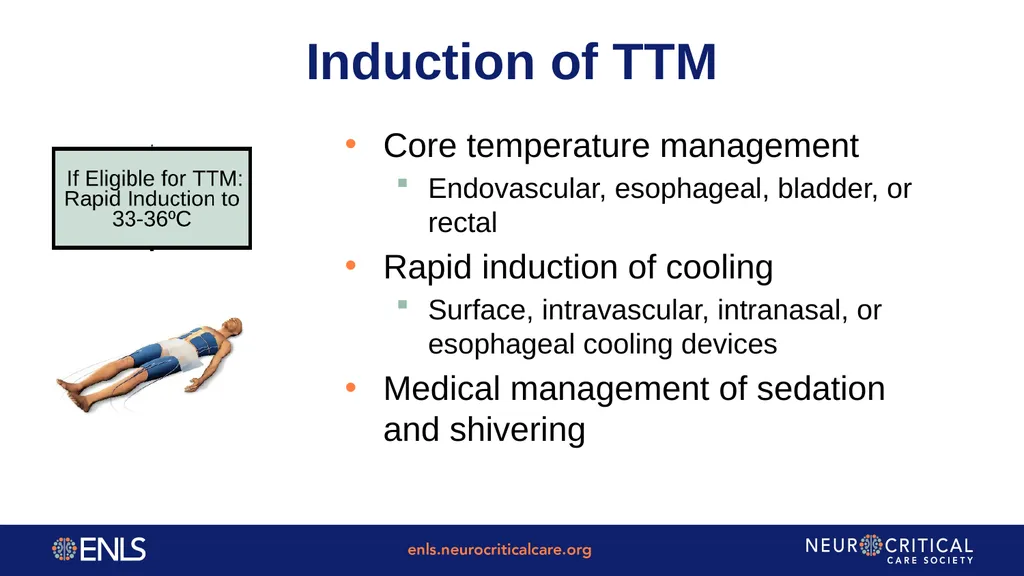
slide19. Induction of TTM Core temperature management
Endovascular, esophageal, bladder, or rectal
Rapid induction of cooling
Surface, intravascular, intranasal, or esophageal cooling devices
Medical management of sedation and shivering<br>
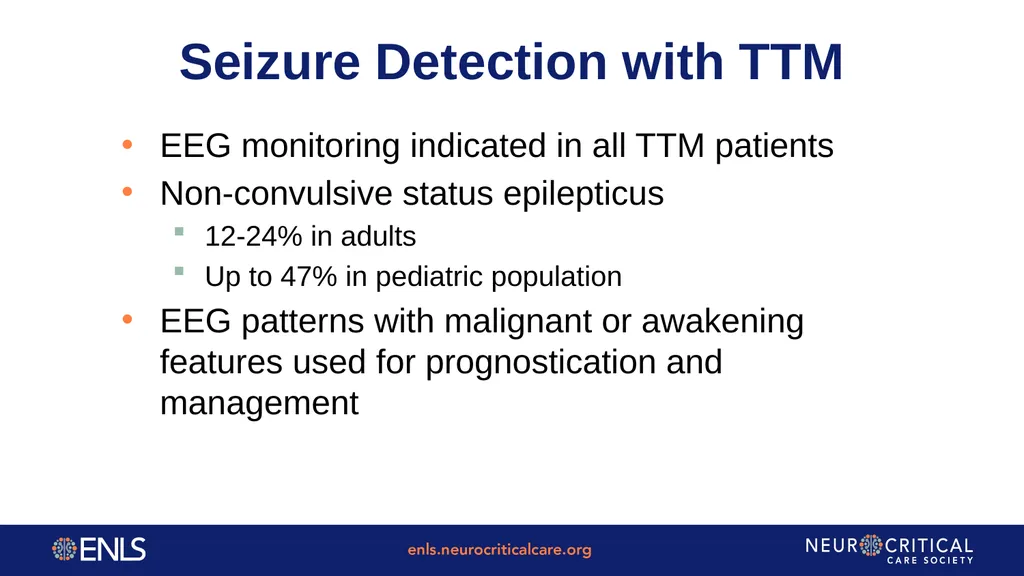
slide20. Seizure Detection with TTM EEG monitoring indicated in all TTM patients
Non-convulsive status epilepticus
12-24% in adults
Up to 47% in pediatric population
EEG patterns with malignant or awakening features used for prognostication and management<br>
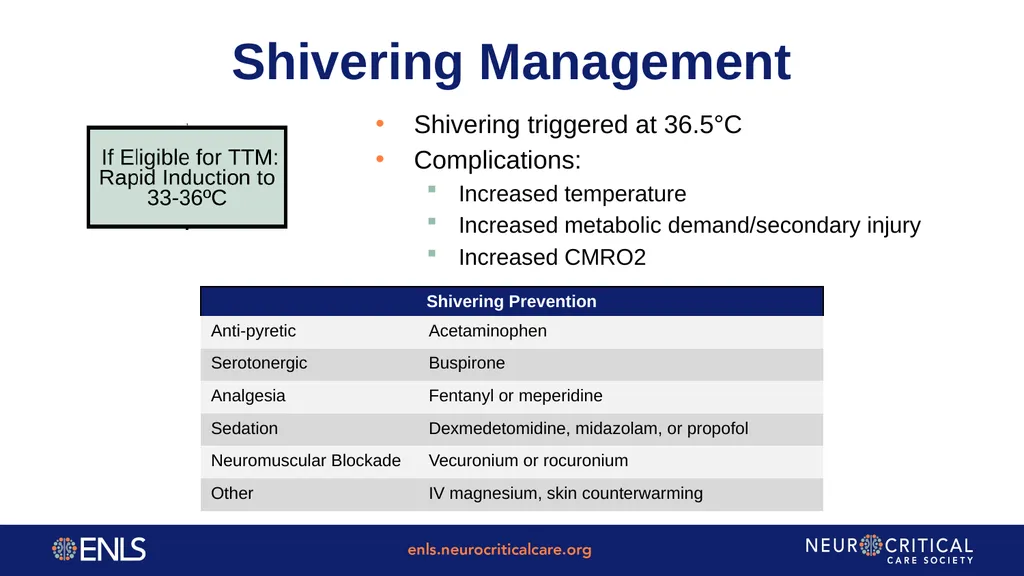
slide21. Shivering Management Shivering triggered at 36.5°C
Complications:
Increased temperature
Increased metabolic demand/secondary injury
Increased CMRO2<br>
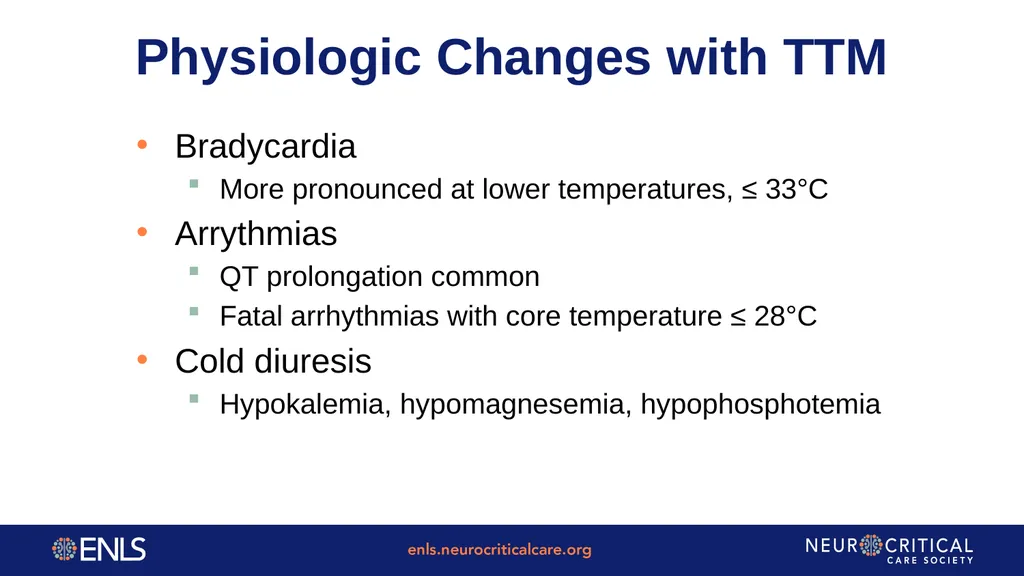
slide22. Physiologic Changes with TTM Bradycardia
More pronounced at lower temperatures, ≤ 33°C
Arrythmias
QT prolongation common
Fatal arrhythmias with core temperature ≤ 28°C
Cold diuresis
Hypokalemia, hypomagnesemia, hypophosphotemia<br>
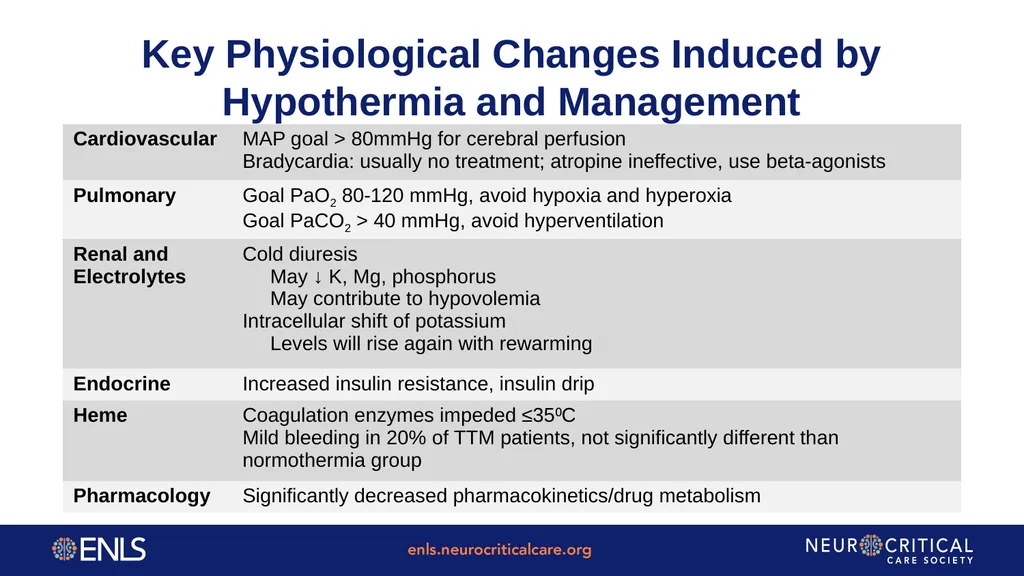
slide23. Key Physiological Changes Induced by Hypothermia and Management<br>
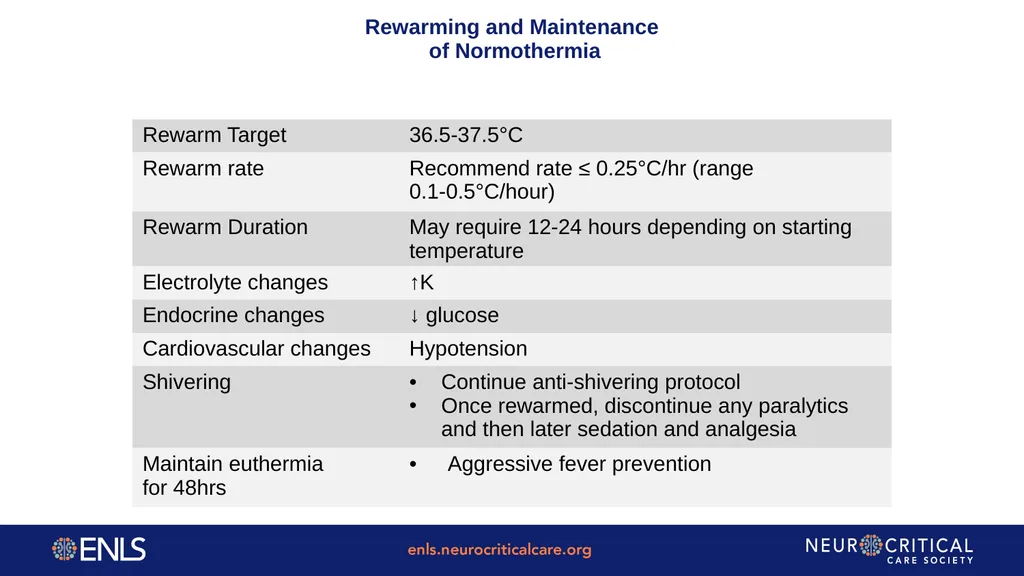
slide24. Rewarming and Maintenance of Normothermia<br>
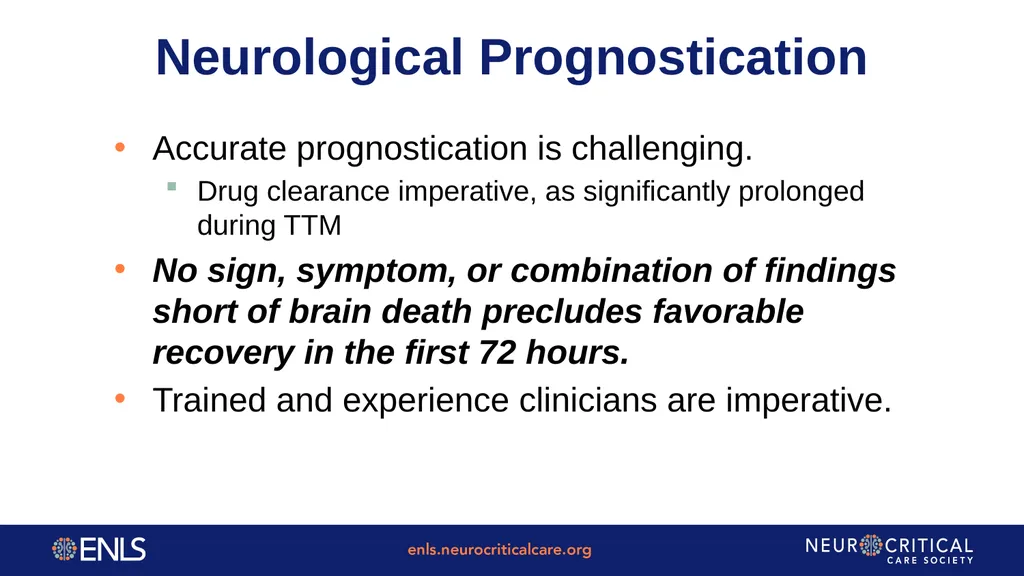
slide25. Neurological Prognostication Accurate prognostication is challenging.
Drug clearance imperative, as significantly prolonged during TTM
No sign, symptom, or combination of findings short of brain death precludes favorable recovery in the first 72 hours.
Trained and experience clinicians are imperative.<br>
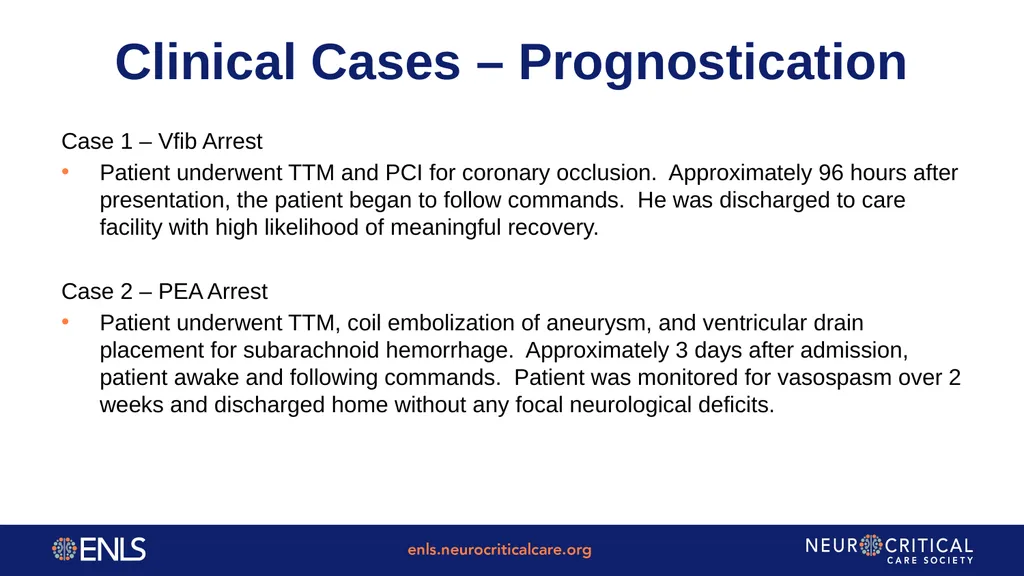
slide26. Clinical Cases – Prognostication Case 1 – Vfib Arrest
Patient underwent TTM and PCI for coronary occlusion. Approximately 96 hours after presentation, the patient began to follow commands. He was discharged to care facility with high likelihood of meaningful recovery.
Case 2 – PEA Arrest
Patient underwent TTM, coil embolization of aneurysm, and ventricular drain placement for subarachnoid hemorrhage. Approximately 3 days after admission, patient awake and following commands. Patient was monitored for vasospasm over 2 weeks and discharged home without any focal neurological deficits.<br>
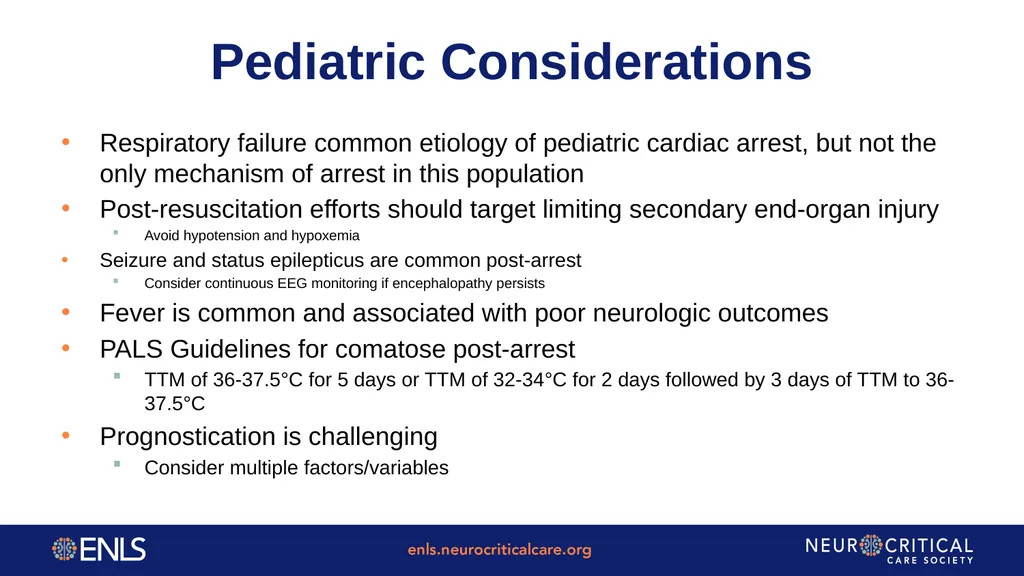
slide27. Pediatric Considerations Respiratory failure common etiology of pediatric cardiac arrest, but not the only mechanism of arrest in this population
Post-resuscitation efforts should target limiting secondary end-organ injury
Avoid hypotension and hypoxemia
Seizure and status epilepticus are common post-arrest
Consider continuous EEG monitoring if encephalopathy persists
Fever is common and associated with poor neurologic outcomes
PALS Guidelines for comatose post-arrest
TTM of 36-37.5°C for 5 days or TTM of 32-34°C for 2 days followed by 3 days of TTM to 36-37.5°C
Prognostication is challenging
Consider multiple factors/variables<br>
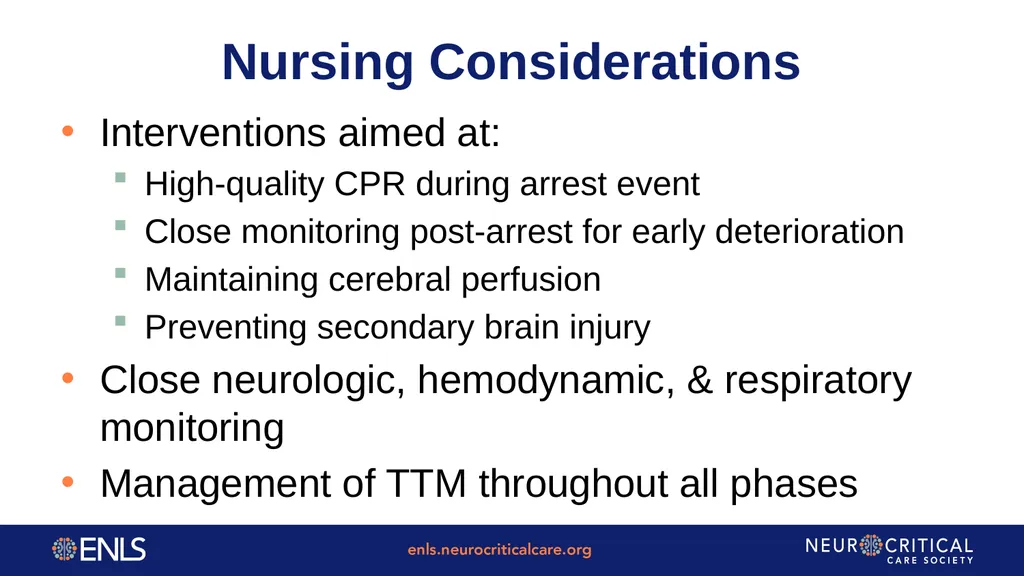
slide28. Nursing Considerations Interventions aimed at:
High-quality CPR during arrest event
Close monitoring post-arrest for early deterioration
Maintaining cerebral perfusion
Preventing secondary brain injury
Close neurologic, hemodynamic, & respiratory monitoring
Management of TTM throughout all phases<br>
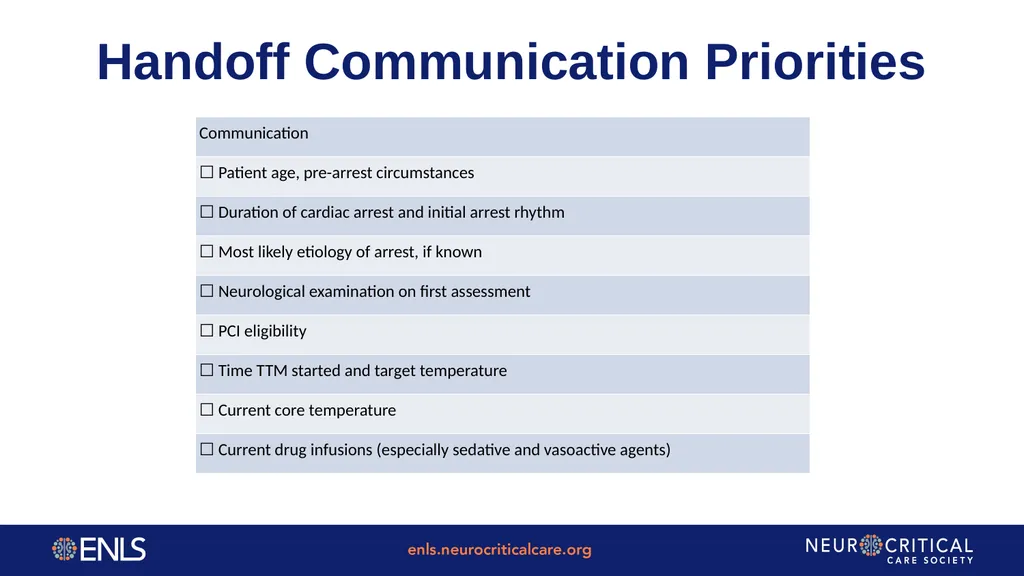
slide29. Handoff Communication Priorities<br>
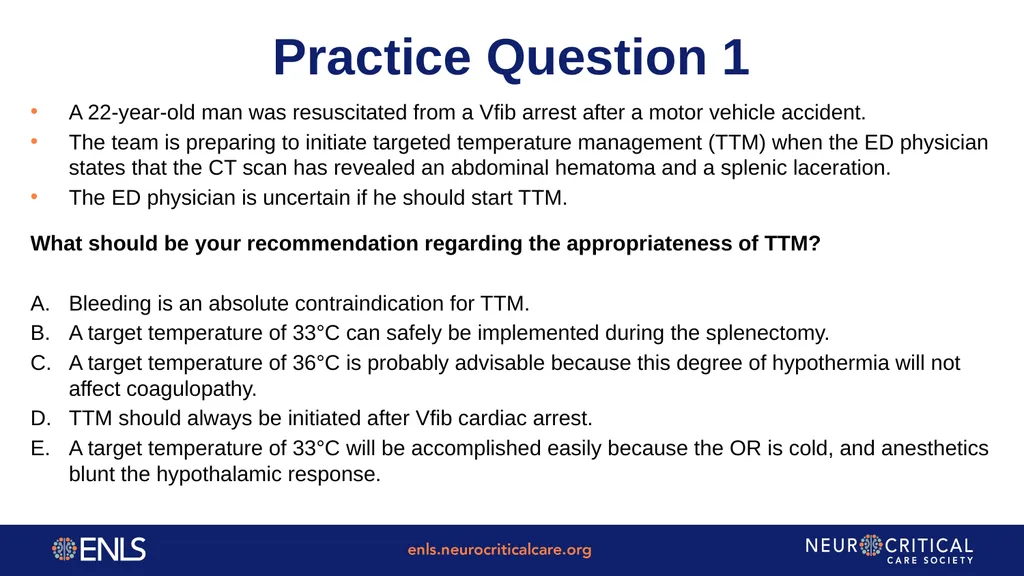
slide30. Practice Question 1 A 22-year-old man was resuscitated from a Vfib arrest after a motor vehicle accident.
The team is preparing to initiate targeted temperature management (TTM) when the ED physician states that the CT scan has revealed an abdominal hematoma and a splenic laceration.
The ED physician is uncertain if he should start TTM.
What should be your recommendation regarding the appropriateness of TTM?
Bleeding is an absolute contraindication for TTM.
A target temperature of 33°C can safely be implemented during the splenectomy.
A target temperature of 36°C is probably advisable because this degree of hypothermia will not affect coagulopathy.
TTM should always be initiated after Vfib cardiac arrest.
A target temperature of 33°C will be accomplished easily because the OR is cold, and anesthetics blunt the hypothalamic response.<br>
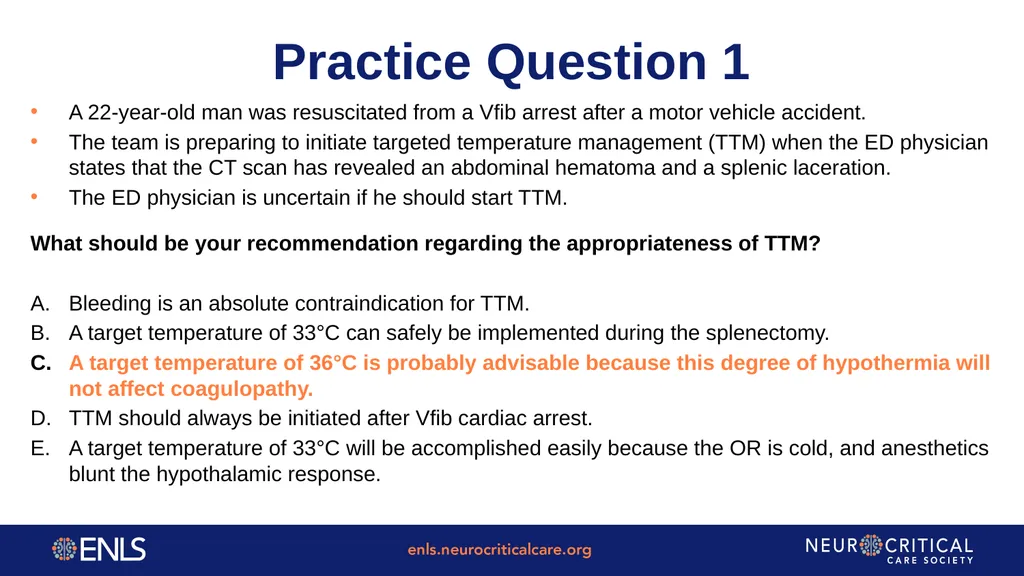
slide31. Practice Question 1 A 22-year-old man was resuscitated from a Vfib arrest after a motor vehicle accident.
The team is preparing to initiate targeted temperature management (TTM) when the ED physician states that the CT scan has revealed an abdominal hematoma and a splenic laceration.
The ED physician is uncertain if he should start TTM.
What should be your recommendation regarding the appropriateness of TTM?
Bleeding is an absolute contraindication for TTM.
A target temperature of 33°C can safely be implemented during the splenectomy.
A target temperature of 36°C is probably advisable because this degree of hypothermia will not affect coagulopathy.
TTM should always be initiated after Vfib cardiac arrest.
A target temperature of 33°C will be accomplished easily because the OR is cold, and anesthetics blunt the hypothalamic response.<br>
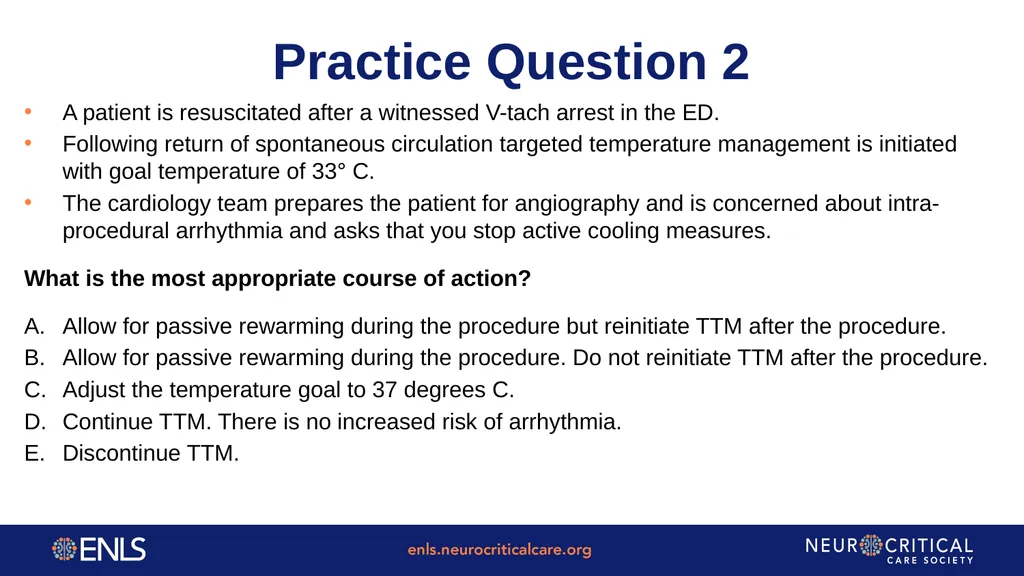
slide32. Practice Question 2 A patient is resuscitated after a witnessed V-tach arrest in the ED.
Following return of spontaneous circulation targeted temperature management is initiated with goal temperature of 33° C.
The cardiology team prepares the patient for angiography and is concerned about intra-procedural arrhythmia and asks that you stop active cooling measures.
What is the most appropriate course of action?
Allow for passive rewarming during the procedure but reinitiate TTM after the procedure.
Allow for passive rewarming during the procedure. Do not reinitiate TTM after the procedure.
Adjust the temperature goal to 37 degrees C.
Continue TTM. There is no increased risk of arrhythmia.
Discontinue TTM.<br>
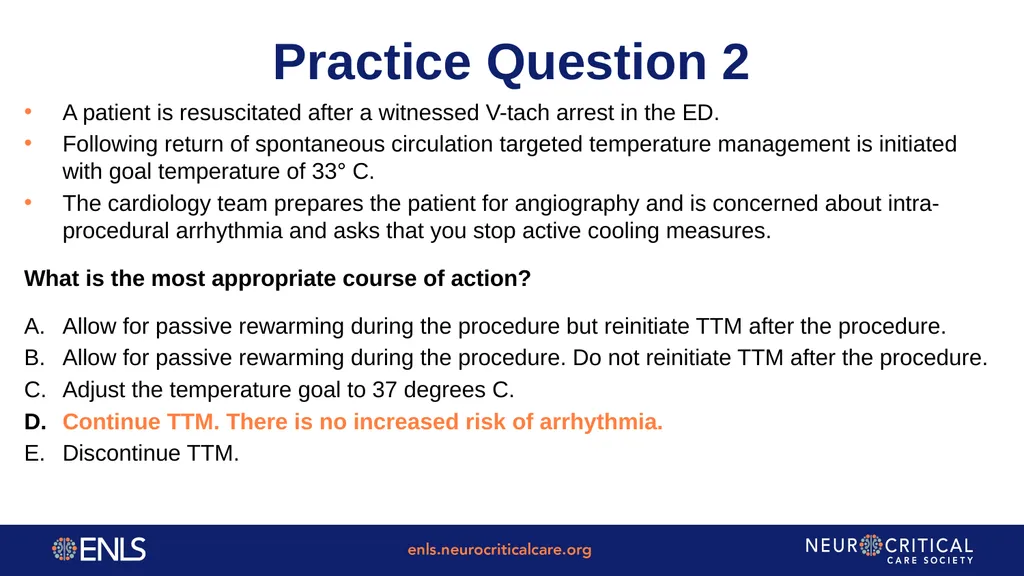
slide33. Practice Question 2 A patient is resuscitated after a witnessed V-tach arrest in the ED.
Following return of spontaneous circulation targeted temperature management is initiated with goal temperature of 33° C.
The cardiology team prepares the patient for angiography and is concerned about intra-procedural arrhythmia and asks that you stop active cooling measures.
What is the most appropriate course of action?
Allow for passive rewarming during the procedure but reinitiate TTM after the procedure.
Allow for passive rewarming during the procedure. Do not reinitiate TTM after the procedure.
Adjust the temperature goal to 37 degrees C.
Continue TTM. There is no increased risk of arrhythmia.
Discontinue TTM.<br>
With contributions from: Jason McMullan, MD, Scott Thomas May, PharmD, BCPS, BCCCP, Victoria McCriedie, MBChB, PhD, FRCPC, MRCPUK, UNCS
Slides: Sarah Livesay<br>
slide3. Presenter: Your name Your institution Conflicts: No conflicts<br>
slide4. Learning Objectives Recognize interventions that may improve chances of survival and neurological recovery post-arrest
Identify key aspects of successful post-arrest care
Determine eligibility for interventions that attenuate secondary brain injury post-resuscitation<br>
slide5. ENLS RCA Post-Arrest Priorities Identify and treat suspected cause of arrest
Stabilize cardiopulmonary function
Prevent re-arrest
Provide adequate coronary and cerebral perfusion
Evaluate for coronary intervention
Evaluate for targeted temperature management
Evaluate for transfer to center with specialty cardiac and neurocritical care
See checklist for first hour<br>
slide6. Clinical Cases Case 1
A 65-year-old presents to the ED 2 hours following Vfib arrest. ROSC was achieved after 30 minutes. The patient is hemodynamically stable and neurological examination reveals a comatose state. CT scan of the head reveals no acute abnormalities.
Case 2
A 40-year-old presents to the ED in PEA arrest. ROSC was achieved after 8 minutes. The patient is hypertensive and neurological examination reveals a comatose state and anisocoria. CT scan of the head reveals diffuse subarachnoid hemorrhage.<br>
slide7. Prehospital Care and Immediate Stabilization Arrhythmia stabilization
Hemodynamic stabilization
Hypotension and hypoxia associated with worse outcomes
Volume and electrolyte correction
Ventilation and oxygenation
Then rapid consideration for:
Coronary (PCI) intervention as appropriate
Prevention of secondary brain injury<br>
slide8. Identify Treatable Causes of Cardiac Arrest Cardiac
Acute coronary syndromes
Intracranial
ICH or SAH
Other
Trauma
Pulmonary Embolism
Overdose
Shock VF/VT/Asystolic Arrest Bradycardia/PEA Arrest<br>
slide9. Clinical Cases – Clinical Interventions? Case 1
65-year-old in Vfib arrest
Etiology – cardiac
Case 2
40-year-old in PEA arrest
Etiology Intracranial/SAH Coronary angiography Coil embolization<br>
slide10. Prevention of Secondary Brain Injury Evolving and conflicting evidence on how to best support the cardiopulmonary system to prevent secondary brain injury
Hemodynamic management for neuroprotection
Systolic blood pressure at least >90mmHg
Pulmonary management for neuroprotection
PaCO2 goal 35-45mmHg
Avoid hypoxia and hyperoxia
Target temperature corrected PaO2 80-120 mmHg<br>
slide11. Targeted Temperature Management Intervention to prevent secondary brain injury
Decreases oxygen demand
Attenuates multiple cellular pathways associated with secondary brain injury
Temperature management including
Interventions to actively prevent fever
Interventions to decrease body temperature below normal<br>
slide12. Determine Eligibility for TTM Shockable out of hospital cardiac arrest
Strong recommendation
Non-shockable out of hospital cardiac arrest
Weak recommendation
In-hospital cardiac arrest
Weak recommendation<br>
slide13. Clinical Cases – Should We Start TTM? Case 1
65-year-old in Vfib arrest
Etiology – cardiac
Case 2
40-year-old in PEA arrest
Etiology Intracranial/SAH YES!<br>
slide14. Evidence for Therapeutic Hypothermia (TH) Two trials comparing 33°C for 12-24 hours in out of hospital
cardiac arrest (2002) (shockable rhythms only) Bernard et al. N Engl J Med 2002;346:557
N Engl J Med. 2002 Feb 21;346(8):549-56.<br>
slide15. Targeted Temperature Management (TTM) TTM trial (2013)
33°C versus 36°C
No difference with respect to mortality or neurologic outcome between 33°C and 36°C at 180 days
Intervention period of 72 hours at randomization
Detailed and standardized methods of neurological prognostication TTM2 Trial (2021)
OHCA 33°C versus targeted normothermia to 37.8°C
No difference in incidence of death or neurologic outcome between groups Nielsen et al TTM Trial. NEJM 2013; 369 (23):2197-206.<br>
slide16. Temperature Management The AHA, ILCOR, the American Academy of Neurology, and the Neurocritical Care Society all recommend instituting TTM at a target temperature between 32 oC-36oC (strong recommendation, low quality of evidence)
Regardless of the target temperature selected
TTM requires active temperature management
Shivering prevention
Comprehensive bundle of care
Developing systems to safely and effectively deliver TTM requires significant institutional support, particularly to ensure that intervention is continuously available<br>
slide17. When is targeting 36oC preferable to 33oC?<br>
slide18. Clinical Cases – Target Temperature? Case 1
65-year-old in Vfib arrest
Etiology – cardiac
Case 2
40-year-old in PEA arrest
Etiology Intracranial/SAH 33°C-36°C 36°C<br>
slide19. Induction of TTM Core temperature management
Endovascular, esophageal, bladder, or rectal
Rapid induction of cooling
Surface, intravascular, intranasal, or esophageal cooling devices
Medical management of sedation and shivering<br>
slide20. Seizure Detection with TTM EEG monitoring indicated in all TTM patients
Non-convulsive status epilepticus
12-24% in adults
Up to 47% in pediatric population
EEG patterns with malignant or awakening features used for prognostication and management<br>
slide21. Shivering Management Shivering triggered at 36.5°C
Complications:
Increased temperature
Increased metabolic demand/secondary injury
Increased CMRO2<br>
slide22. Physiologic Changes with TTM Bradycardia
More pronounced at lower temperatures, ≤ 33°C
Arrythmias
QT prolongation common
Fatal arrhythmias with core temperature ≤ 28°C
Cold diuresis
Hypokalemia, hypomagnesemia, hypophosphotemia<br>
slide23. Key Physiological Changes Induced by Hypothermia and Management<br>
slide24. Rewarming and Maintenance of Normothermia<br>
slide25. Neurological Prognostication Accurate prognostication is challenging.
Drug clearance imperative, as significantly prolonged during TTM
No sign, symptom, or combination of findings short of brain death precludes favorable recovery in the first 72 hours.
Trained and experience clinicians are imperative.<br>
slide26. Clinical Cases – Prognostication Case 1 – Vfib Arrest
Patient underwent TTM and PCI for coronary occlusion. Approximately 96 hours after presentation, the patient began to follow commands. He was discharged to care facility with high likelihood of meaningful recovery.
Case 2 – PEA Arrest
Patient underwent TTM, coil embolization of aneurysm, and ventricular drain placement for subarachnoid hemorrhage. Approximately 3 days after admission, patient awake and following commands. Patient was monitored for vasospasm over 2 weeks and discharged home without any focal neurological deficits.<br>
slide27. Pediatric Considerations Respiratory failure common etiology of pediatric cardiac arrest, but not the only mechanism of arrest in this population
Post-resuscitation efforts should target limiting secondary end-organ injury
Avoid hypotension and hypoxemia
Seizure and status epilepticus are common post-arrest
Consider continuous EEG monitoring if encephalopathy persists
Fever is common and associated with poor neurologic outcomes
PALS Guidelines for comatose post-arrest
TTM of 36-37.5°C for 5 days or TTM of 32-34°C for 2 days followed by 3 days of TTM to 36-37.5°C
Prognostication is challenging
Consider multiple factors/variables<br>
slide28. Nursing Considerations Interventions aimed at:
High-quality CPR during arrest event
Close monitoring post-arrest for early deterioration
Maintaining cerebral perfusion
Preventing secondary brain injury
Close neurologic, hemodynamic, & respiratory monitoring
Management of TTM throughout all phases<br>
slide29. Handoff Communication Priorities<br>
slide30. Practice Question 1 A 22-year-old man was resuscitated from a Vfib arrest after a motor vehicle accident.
The team is preparing to initiate targeted temperature management (TTM) when the ED physician states that the CT scan has revealed an abdominal hematoma and a splenic laceration.
The ED physician is uncertain if he should start TTM.
What should be your recommendation regarding the appropriateness of TTM?
Bleeding is an absolute contraindication for TTM.
A target temperature of 33°C can safely be implemented during the splenectomy.
A target temperature of 36°C is probably advisable because this degree of hypothermia will not affect coagulopathy.
TTM should always be initiated after Vfib cardiac arrest.
A target temperature of 33°C will be accomplished easily because the OR is cold, and anesthetics blunt the hypothalamic response.<br>
slide31. Practice Question 1 A 22-year-old man was resuscitated from a Vfib arrest after a motor vehicle accident.
The team is preparing to initiate targeted temperature management (TTM) when the ED physician states that the CT scan has revealed an abdominal hematoma and a splenic laceration.
The ED physician is uncertain if he should start TTM.
What should be your recommendation regarding the appropriateness of TTM?
Bleeding is an absolute contraindication for TTM.
A target temperature of 33°C can safely be implemented during the splenectomy.
A target temperature of 36°C is probably advisable because this degree of hypothermia will not affect coagulopathy.
TTM should always be initiated after Vfib cardiac arrest.
A target temperature of 33°C will be accomplished easily because the OR is cold, and anesthetics blunt the hypothalamic response.<br>
slide32. Practice Question 2 A patient is resuscitated after a witnessed V-tach arrest in the ED.
Following return of spontaneous circulation targeted temperature management is initiated with goal temperature of 33° C.
The cardiology team prepares the patient for angiography and is concerned about intra-procedural arrhythmia and asks that you stop active cooling measures.
What is the most appropriate course of action?
Allow for passive rewarming during the procedure but reinitiate TTM after the procedure.
Allow for passive rewarming during the procedure. Do not reinitiate TTM after the procedure.
Adjust the temperature goal to 37 degrees C.
Continue TTM. There is no increased risk of arrhythmia.
Discontinue TTM.<br>
slide33. Practice Question 2 A patient is resuscitated after a witnessed V-tach arrest in the ED.
Following return of spontaneous circulation targeted temperature management is initiated with goal temperature of 33° C.
The cardiology team prepares the patient for angiography and is concerned about intra-procedural arrhythmia and asks that you stop active cooling measures.
What is the most appropriate course of action?
Allow for passive rewarming during the procedure but reinitiate TTM after the procedure.
Allow for passive rewarming during the procedure. Do not reinitiate TTM after the procedure.
Adjust the temperature goal to 37 degrees C.
Continue TTM. There is no increased risk of arrhythmia.
Discontinue TTM.<br>