
Ensuring Meaningful Performance Assessment

Description: Ensuring Meaningful Performance Assessment Results: A Reflective Practice Model for Examining Validity and Reliability Cynthia Conn, PhD Assistant Vice Provost, Professional Education Programs Kathy Bohan, EdD Associate Dean, College of
Related Topics
Download Presentation
"Ensuring Meaningful Performance Assessment" is the property of its rightful owner. Permission is granted to download and print the materials on this website for personal, non-commercial use only, and to display it on your personal computer provided you do not modify the materials and that you retain all copyright notices contained in the materials. By downloading content from our website, you accept the terms of this agreement.
Presentation Transcript
slide1. Ensuring Meaningful Performance Assessment Results: A Reflective Practice Model for Examining Validity and Reliability Cynthia Conn, PhD
Assistant Vice Provost, Professional Education Programs
Kathy Bohan, EdD
Associate Dean, College of Education
Sue Pieper, PhD
Assessment Coordinator, Office of Curriculum, Learning Design, & Academic Assessment<br>
slide2. Introduction<br>
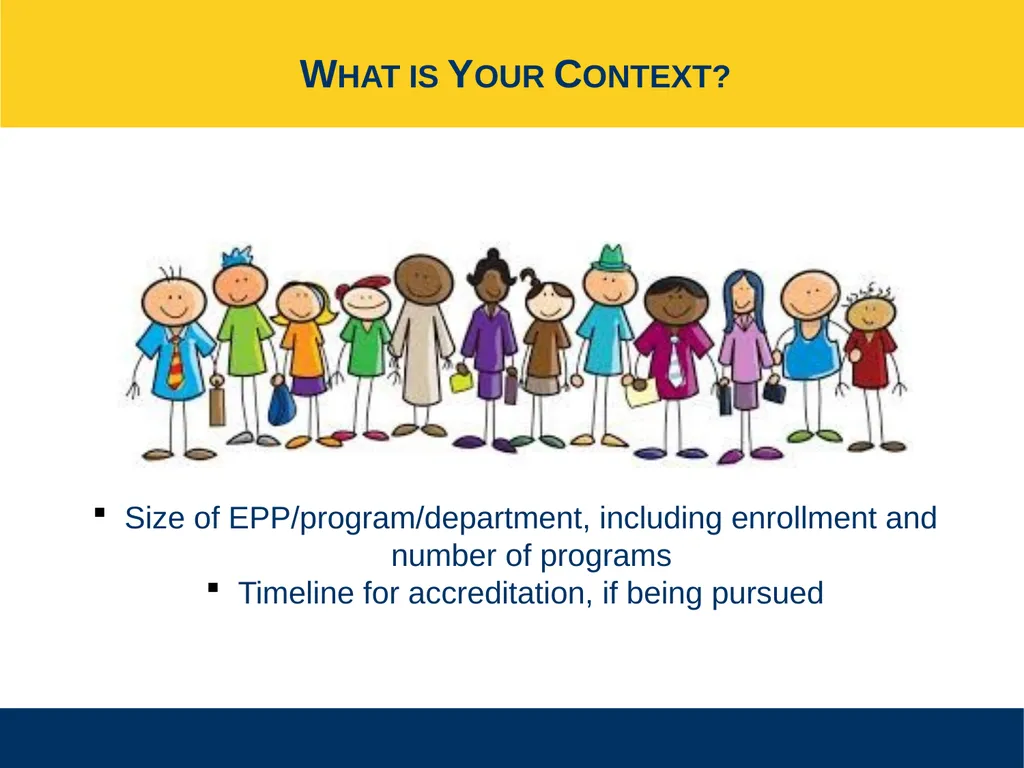
slide3. What is Your Context? Size of EPP/program/department, including enrollment and number of programs
Timeline for accreditation, if being pursued<br>
slide4. Session Outline Introductions
Overview of Validity Inquiry Process Model
Discuss the implementation of the Validity Inquiry Process Model at NAU
Interactive practice using two Validity Inquiry Model instruments
Discuss lessons learned from the implementation of the Validity Inquiry Process Model at NAU
Group discussion of process and how model might apply in participants’ settings<br>
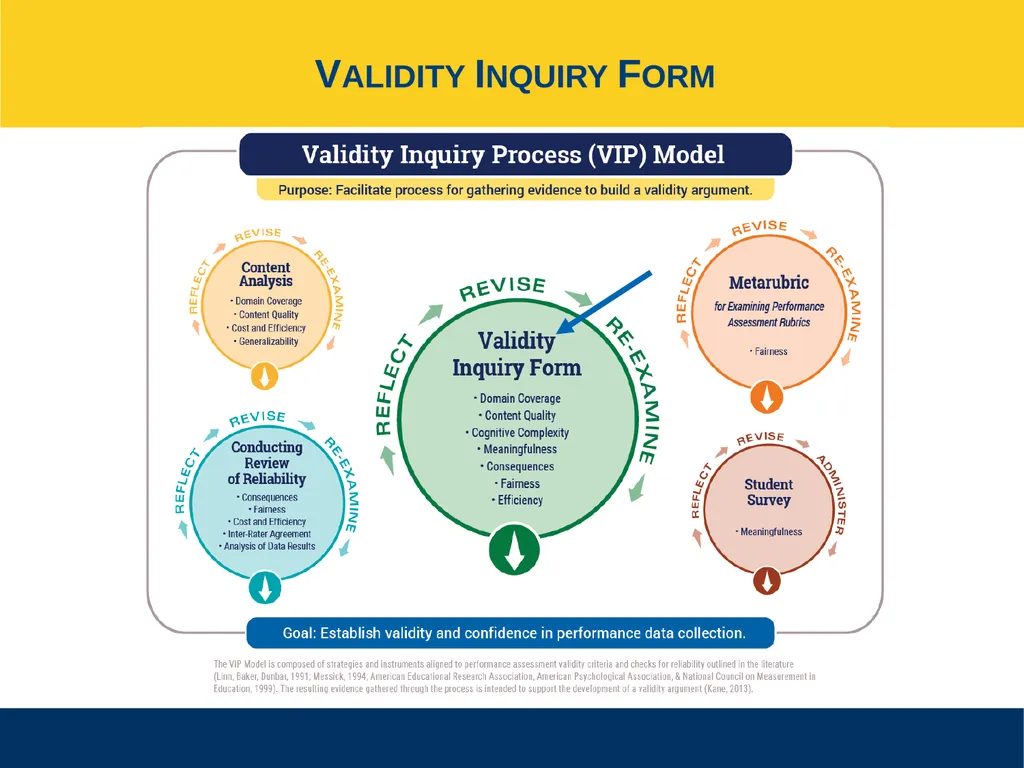
slide5. Purpose of the Validity Inquiry Process (VIP) Model Purpose
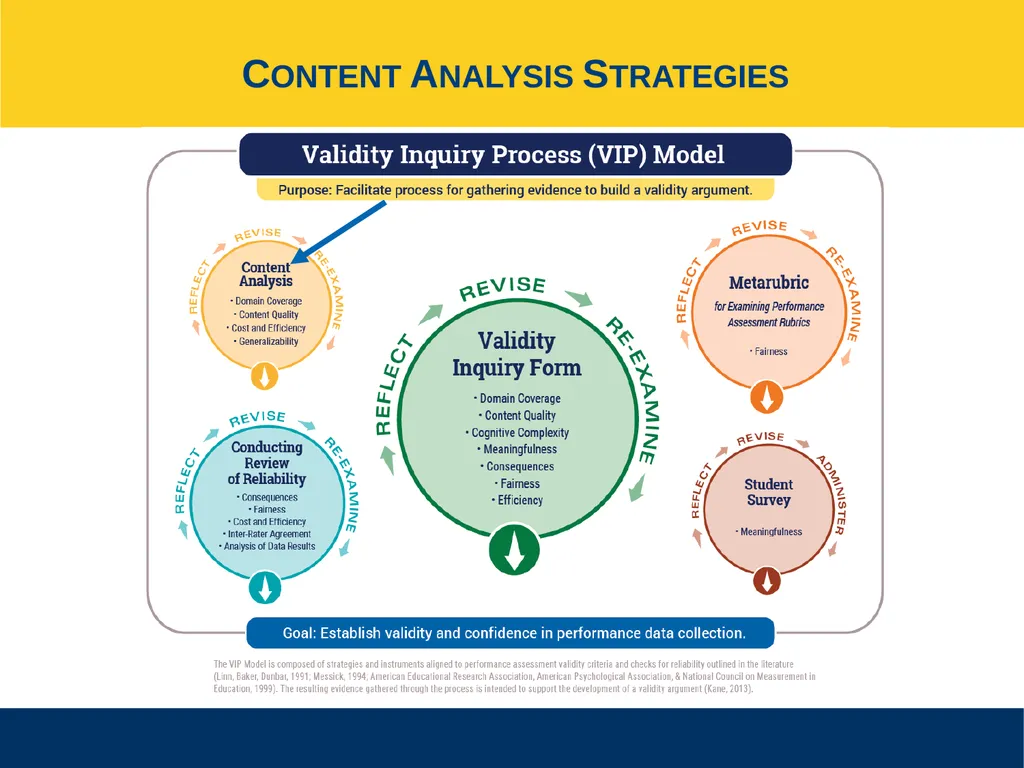
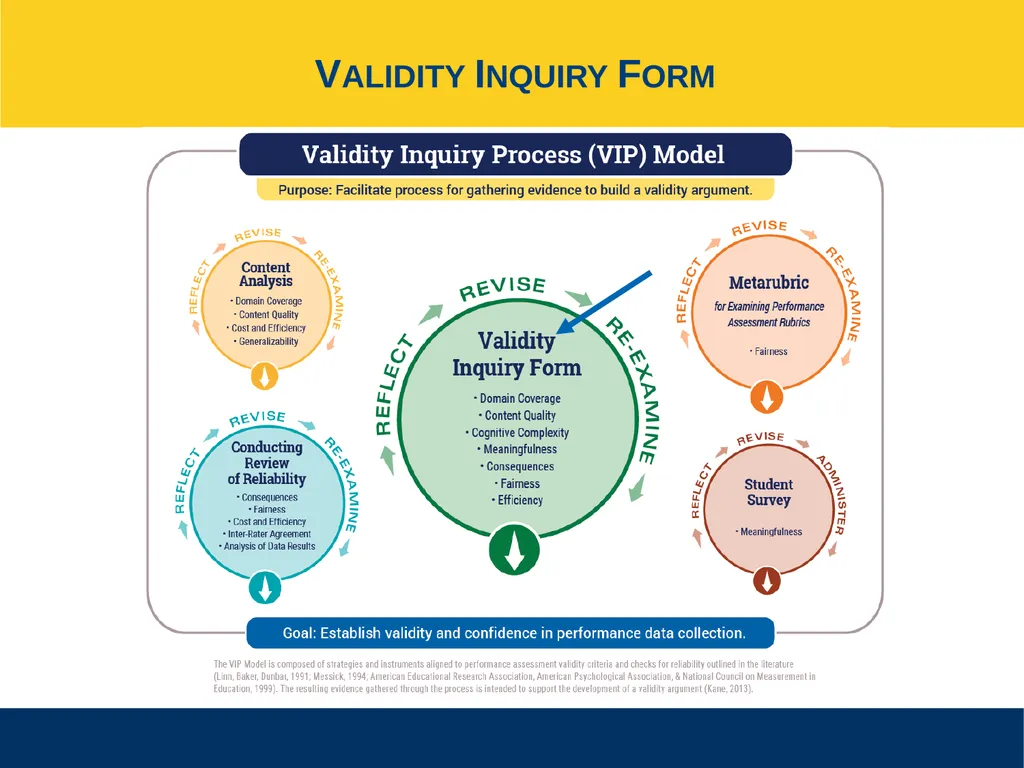
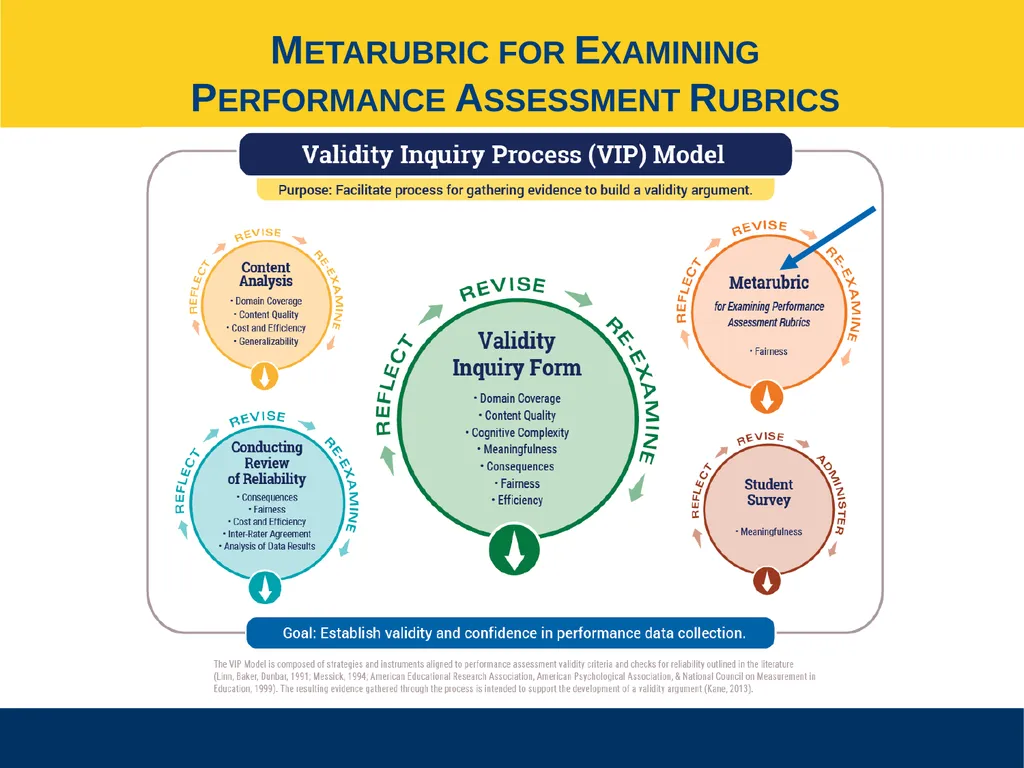
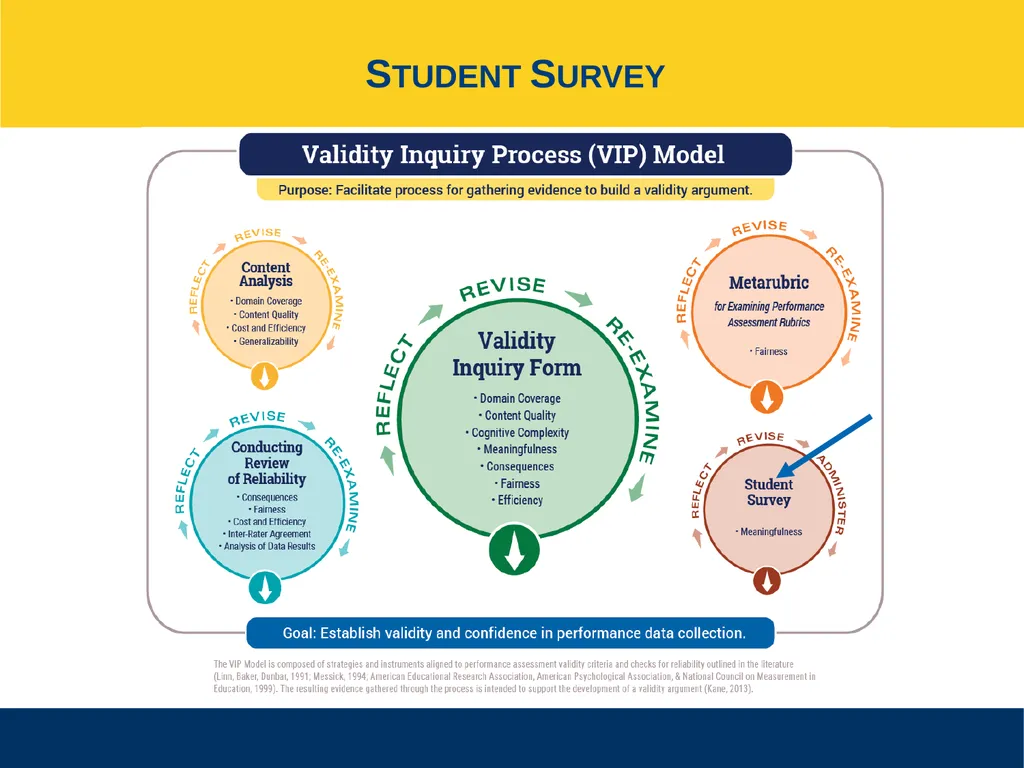
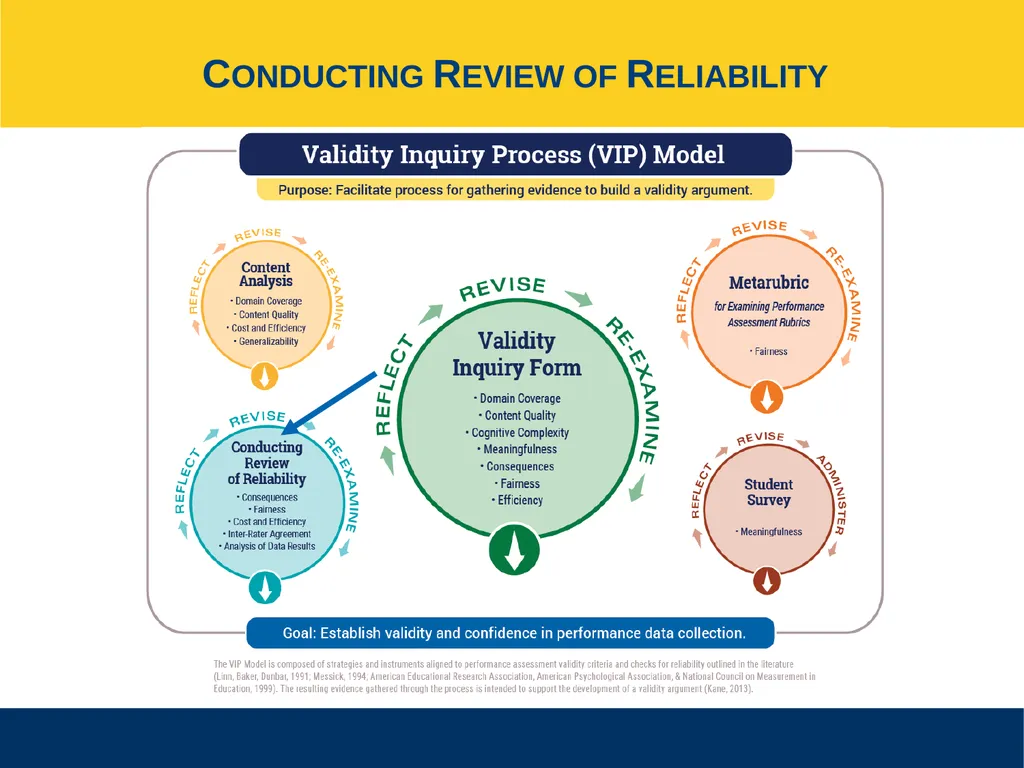
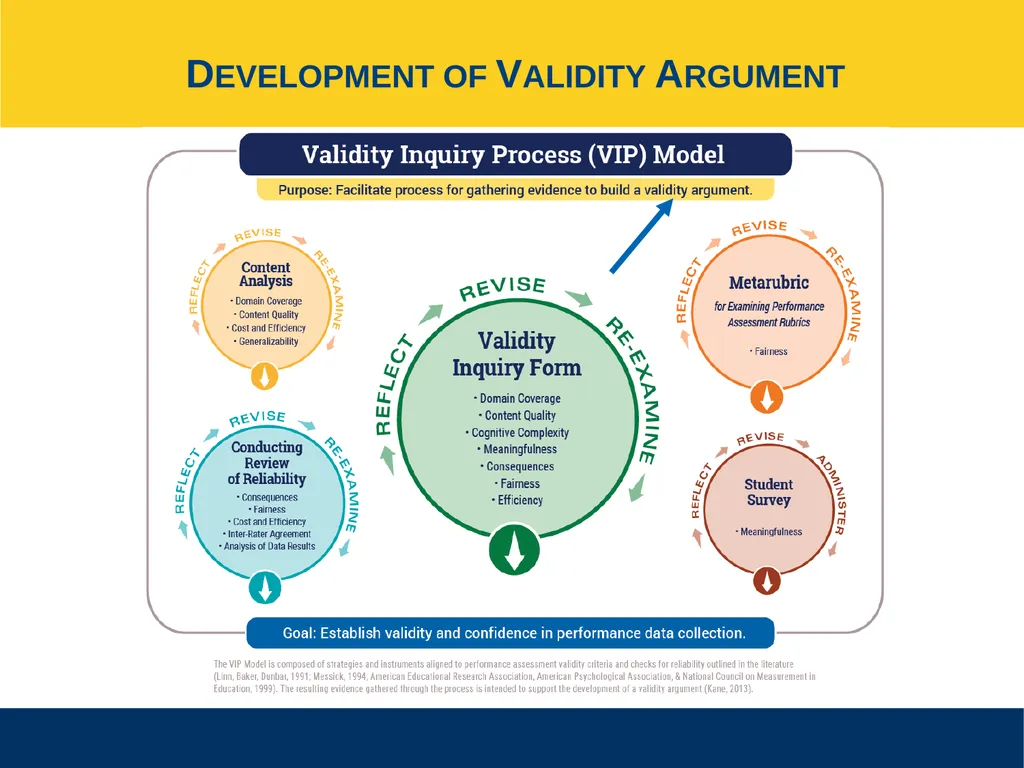
The purpose of the Validity Inquiry Process (VIP) Model is to assist in examining and gathering evidence to build a validity argument for the interpretation and use of data from locally developed performance assessment instruments.<br>
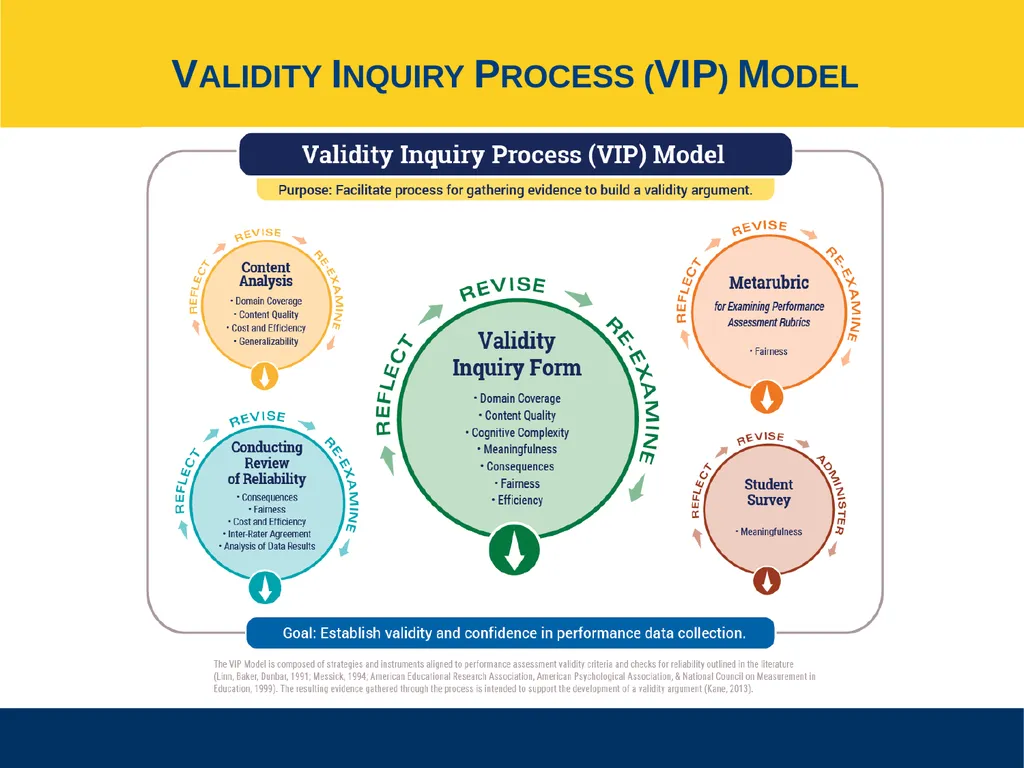
slide6. Validity Inquiry Process (VIP) Model<br>
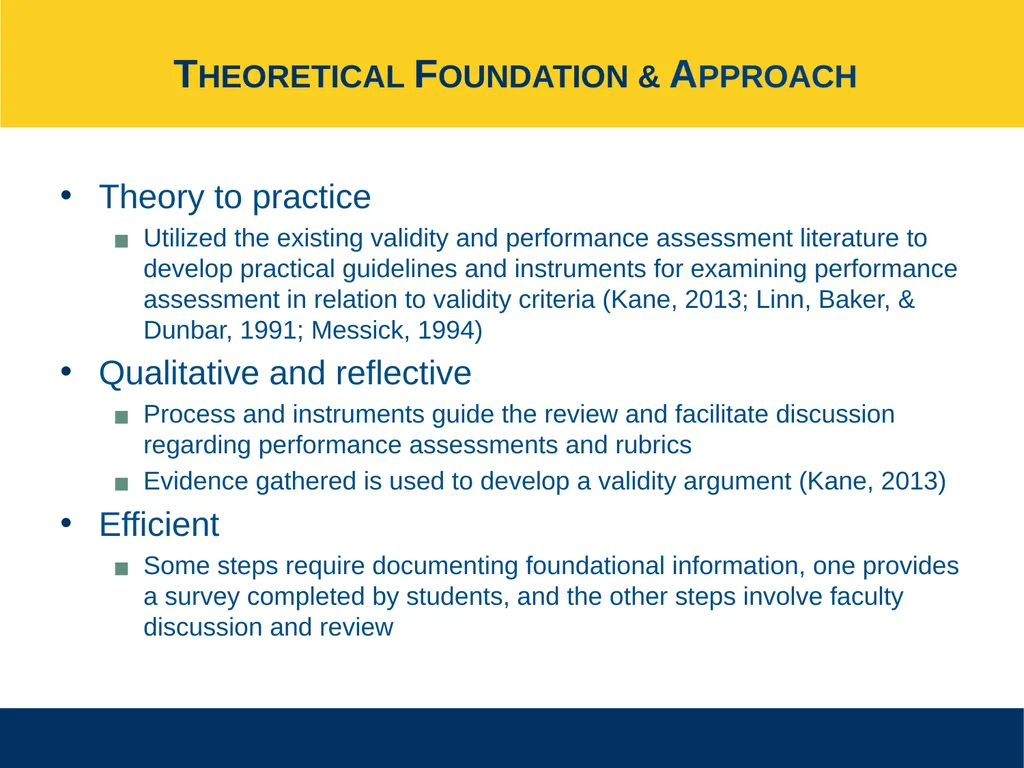
slide7. Theoretical Foundation & Approach Theory to practice
Utilized the existing validity and performance assessment literature to develop practical guidelines and instruments for examining performance assessment in relation to validity criteria (Kane, 2013; Linn, Baker, & Dunbar, 1991; Messick, 1994)
Qualitative and reflective
Process and instruments guide the review and facilitate discussion regarding performance assessments and rubrics
Evidence gathered is used to develop a validity argument (Kane, 2013)
Efficient
Some steps require documenting foundational information, one provides a survey completed by students, and the other steps involve faculty discussion and review<br>
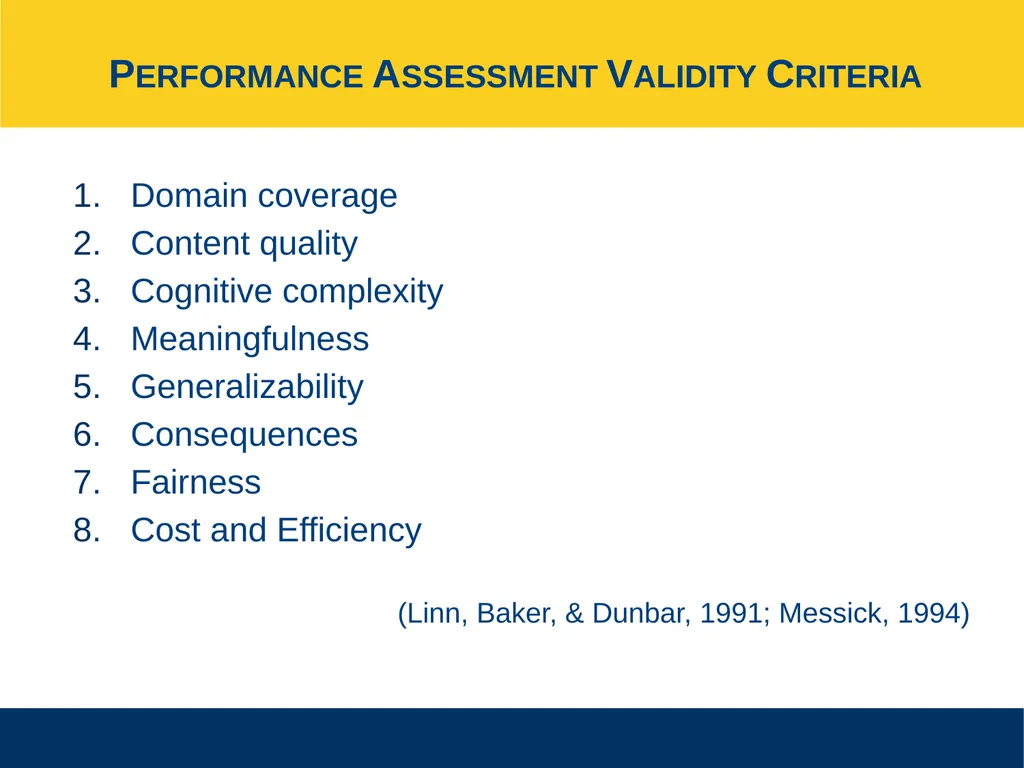
slide8. Performance Assessment Validity Criteria Domain coverage
Content quality
Cognitive complexity
Meaningfulness
Generalizability
Consequences
Fairness
Cost and Efficiency
(Linn, Baker, & Dunbar, 1991; Messick, 1994)<br>
slide9. Content Analysis Strategies<br>
slide10. Validity Inquiry Form<br>
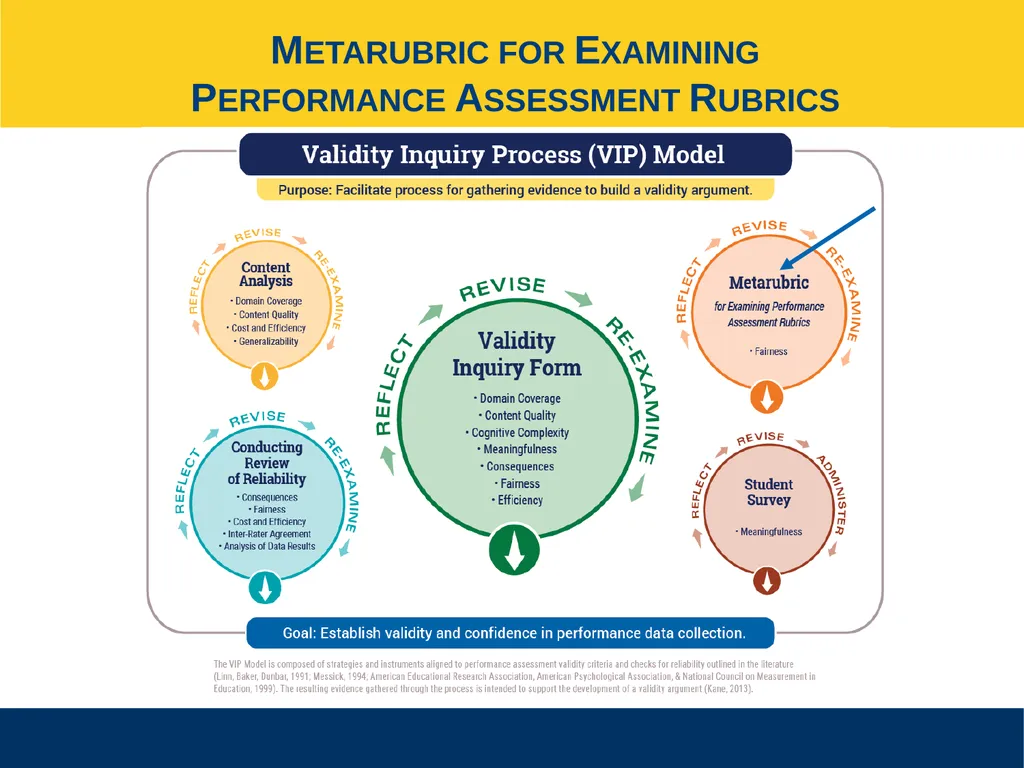
slide11. Metarubric for Examining Performance Assessment Rubrics<br>
slide12. Student Survey<br>
slide13. Conducting Review of Reliability<br>
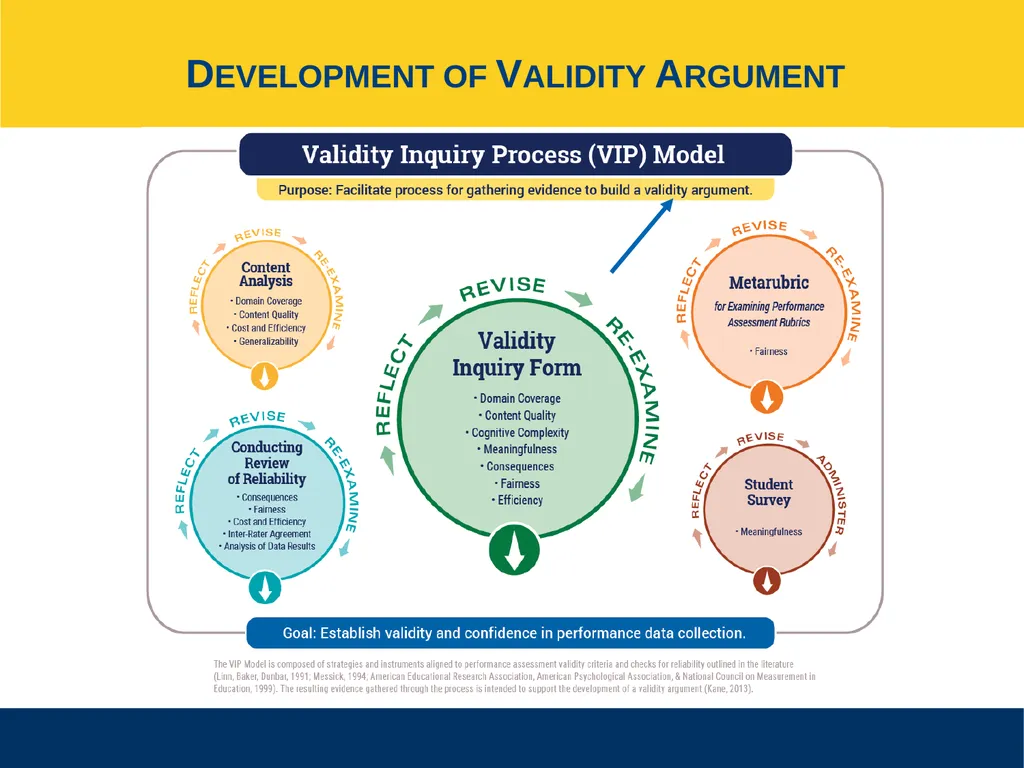
slide14. Development of Validity Argument<br>
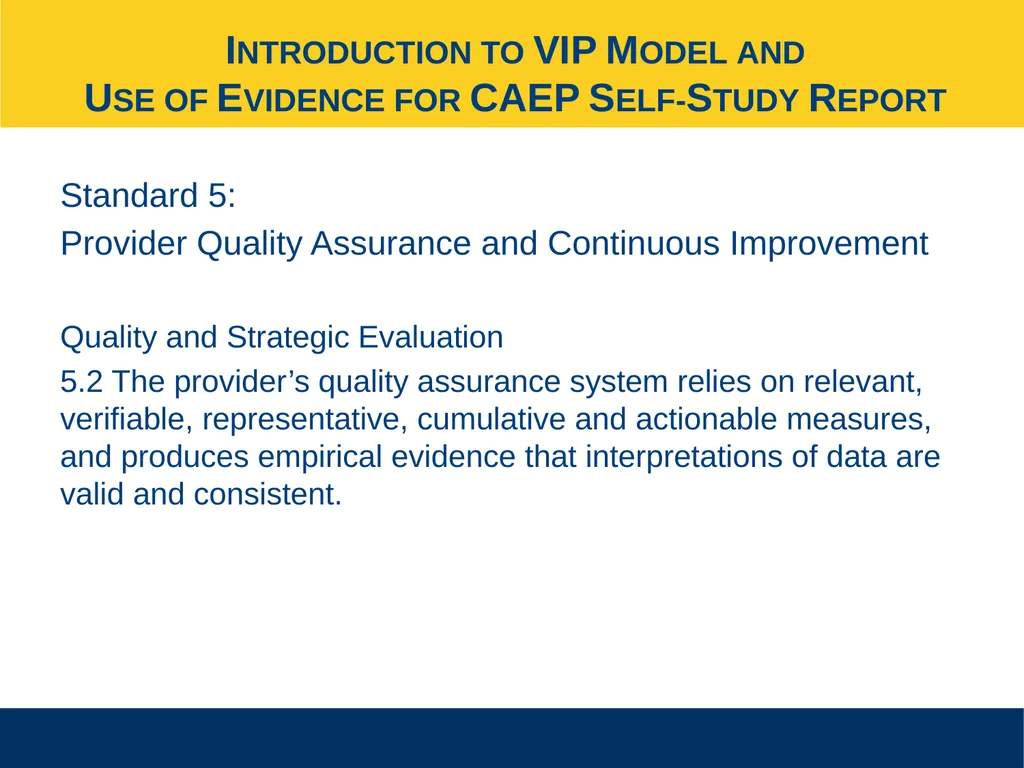
slide15. Introduction to VIP Model and Use of Evidence for CAEP Self-Study Report Standard 5:
Provider Quality Assurance and Continuous Improvement
Quality and Strategic Evaluation
5.2 The provider’s quality assurance system relies on relevant, verifiable, representative, cumulative and actionable measures, and produces empirical evidence that interpretations of data are valid and consistent.<br>
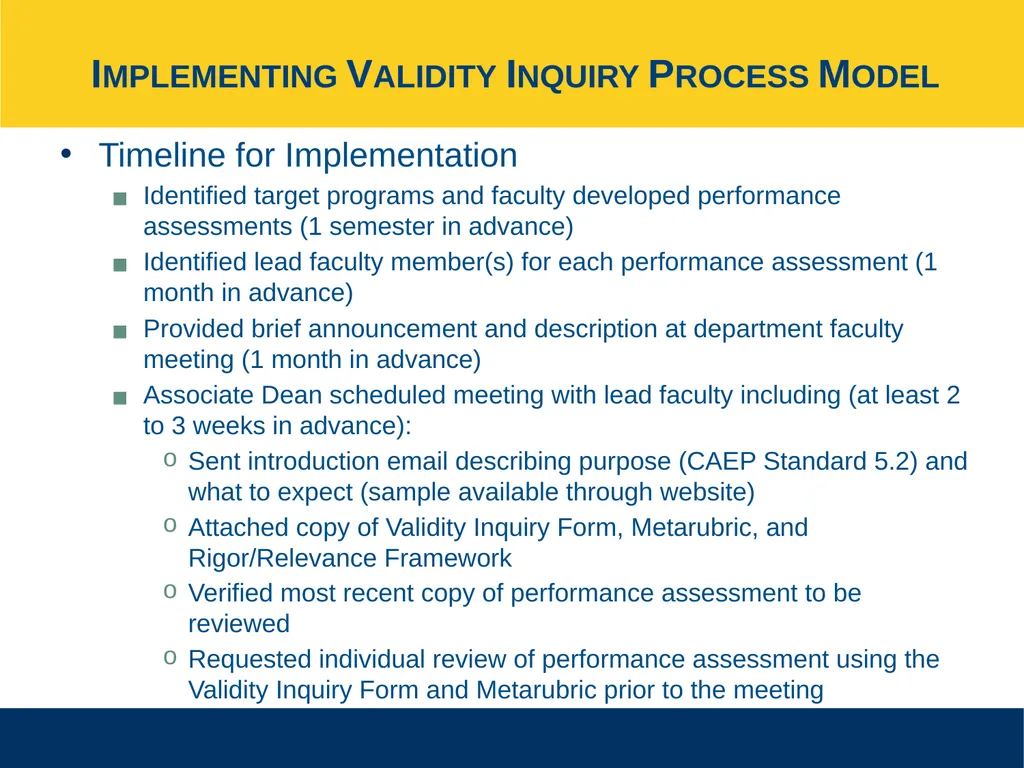
slide16. Implementing Validity Inquiry Process Model Timeline for Implementation
Identified target programs and faculty developed performance assessments (1 semester in advance)
Identified lead faculty member(s) for each performance assessment (1 month in advance)
Provided brief announcement and description at department faculty meeting (1 month in advance)
Associate Dean scheduled meeting with lead faculty including (at least 2 to 3 weeks in advance):
Sent introduction email describing purpose (CAEP Standard 5.2) and what to expect (sample available through website)
Attached copy of Validity Inquiry Form, Metarubric, and Rigor/Relevance Framework
Verified most recent copy of performance assessment to be reviewed
Requested individual review of performance assessment using the Validity Inquiry Form and Metarubric prior to the meeting<br>
slide17. Performance Assessment Review Meeting Logistics for Meeting
Individual review meetings were scheduled for 2 hours
Skype was utilized for connecting with faculty at statewide campuses
Participants included 2 to 3 lead faculty members, facilitators (Associate Dean & Assessment Coordinator), and a part-time employee or Graduate Assistant to take notes<br>
slide18. Interactive Practice Performance Assessment Review Model Meeting Agenda
Purpose of performance assessment (Activity #1)
Validity Inquiry Form (Activity #2)
Metarubric (Activity #3)
Feedback on the meeting and overview of next steps
Next Steps (meeting notes) sent to faculty within 1 week (included timelines, responsibilities, plan for writing Validity Argument)<br>
slide19. Validity Inquiry Form<br>
slide20. Activity #1: Using the Validity Inquiry Form Discuss in small groups the stated purpose of this performance assessment and if it is an effective purpose statement.
Course & Name of Performance Assessment:
Student Teaching: Candidate Work Sample
Purpose of Performance Assessment
The purpose of the Candidate Work Sample is to provide evidence of how your teaching impacts student learning.<br>
slide21. Activity #1: Small Group Discussion What are the results of your small group discussion?<br>
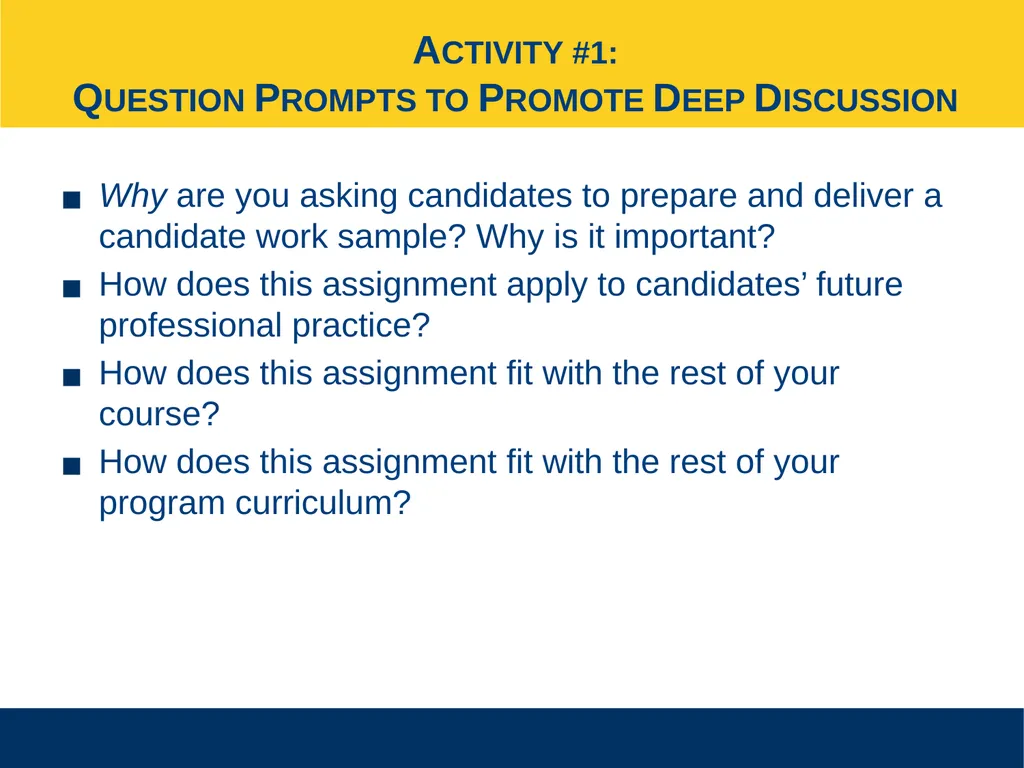
slide22. Activity #1: Question Prompts to Promote Deep Discussion Why are you asking candidates to prepare and deliver a candidate work sample? Why is it important?
How does this assignment apply to candidates’ future professional practice?
How does this assignment fit with the rest of your course?
How does this assignment fit with the rest of your program curriculum?<br>
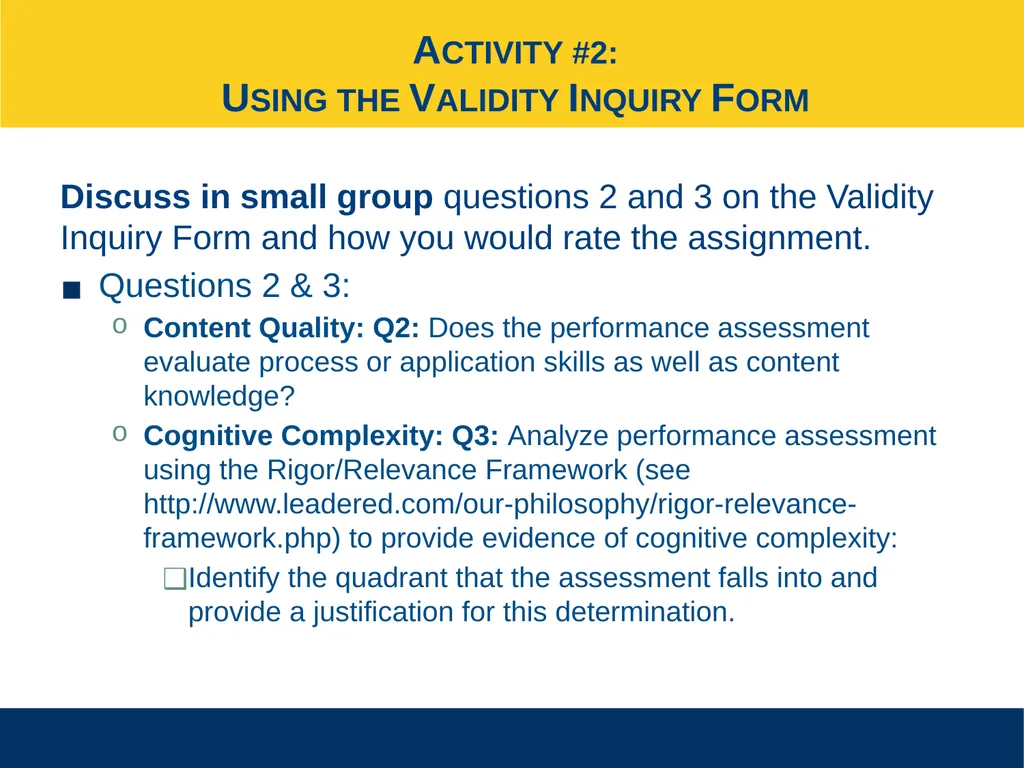
slide23. Activity #2: Using the Validity Inquiry Form Discuss in small group questions 2 and 3 on the Validity Inquiry Form and how you would rate the assignment.
Questions 2 & 3:
Content Quality: Q2: Does the performance assessment evaluate process or application skills as well as content knowledge?
Cognitive Complexity: Q3: Analyze performance assessment using the Rigor/Relevance Framework (see http://www.leadered.com/our-philosophy/rigor-relevance-framework.php) to provide evidence of cognitive complexity:
Identify the quadrant that the assessment falls into and provide a justification for this determination.<br>
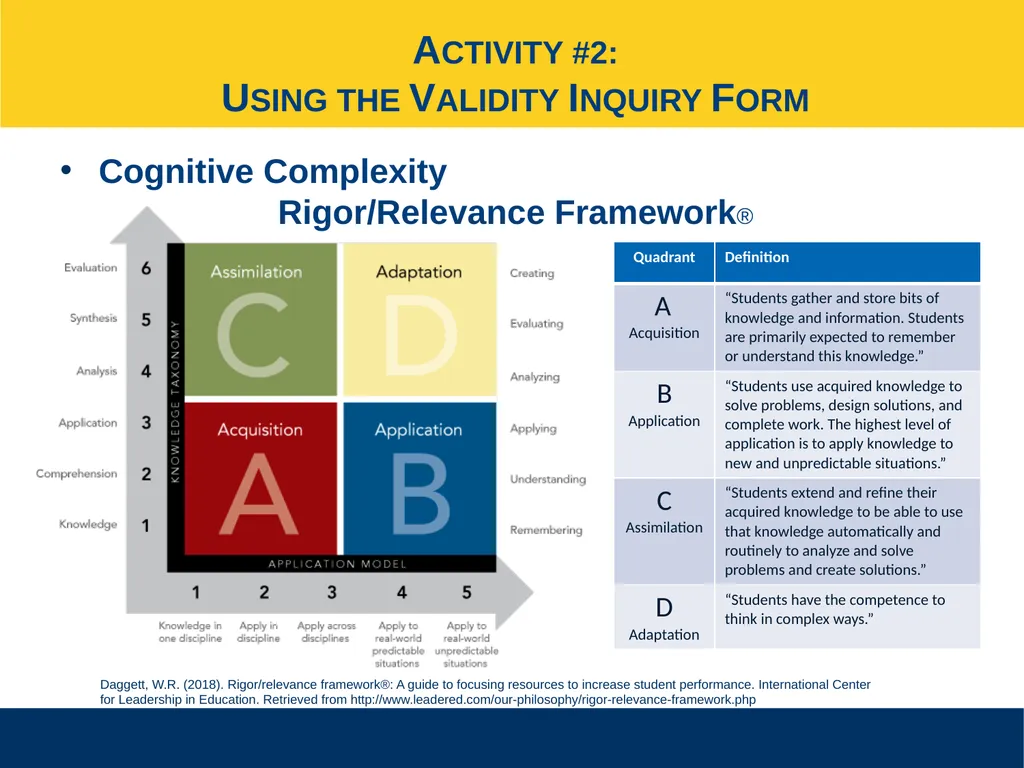
slide24. Activity #2: Using the Validity Inquiry Form Cognitive Complexity
Rigor/Relevance Framework® Daggett, W.R. (2018). Rigor/relevance framework®: A guide to focusing resources to increase student performance. International Center for Leadership in Education. Retrieved from http://www.leadered.com/our-philosophy/rigor-relevance-framework.php<br>
slide25. Activity #2: Discussion What are the results of your small group discussion?<br>
slide26. Activity #2: Question Prompts to Promote Deep Discussion How well does the assignment or performance assessment evaluate content knowledge?
How well does the assignment or performance assessment evaluate process or applications skills?
Using the Rigor/Relevance Framework®
What quadrant did the assessment fall into and why?
How did your group establish consensus on the quadrant determination?<br>
slide27. Metarubric for Examining Performance Assessment Rubrics<br>
slide28. Activity #3: Using the Metarubric As a large group, we will go through the following process for Question 2 (Q2) on the Metarubric:
Read the example assignment rubric provided as well as the Metarubric questions.
Criteria: Q2: Does each rubric criterion align directly with the assignment instructions? (Pieper, 2012)<br>
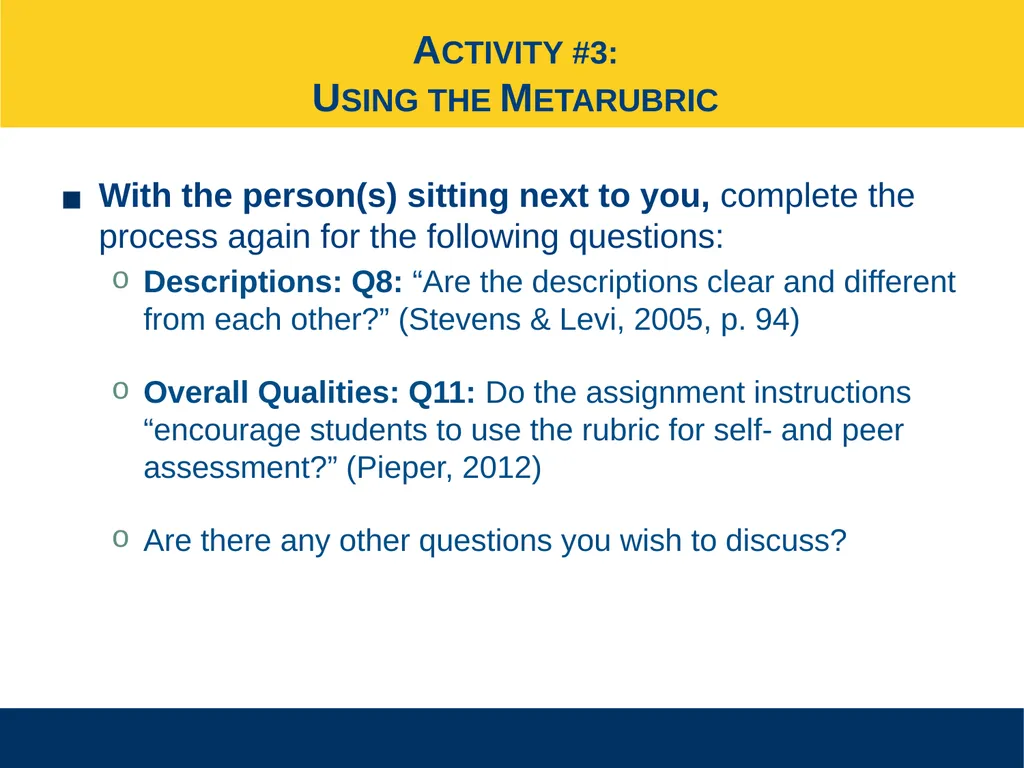
slide29. Activity #3: Using the Metarubric With the person(s) sitting next to you, complete the process again for the following questions:
Descriptions: Q8: “Are the descriptions clear and different from each other?” (Stevens & Levi, 2005, p. 94)
Overall Qualities: Q11: Do the assignment instructions “encourage students to use the rubric for self- and peer assessment?” (Pieper, 2012)
Are there any other questions you wish to discuss?<br>
slide30. Activity #3: Discussion What are the results of your discussion?<br>
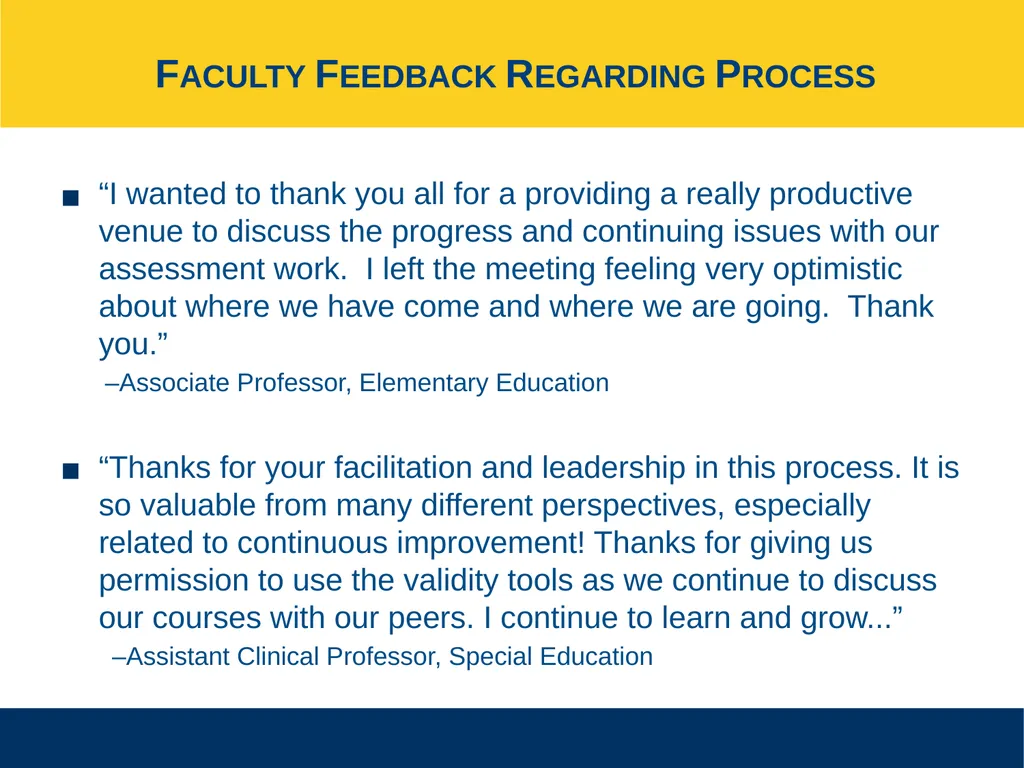
slide31. Faculty Feedback Regarding Process “I wanted to thank you all for a providing a really productive venue to discuss the progress and continuing issues with our assessment work. I left the meeting feeling very optimistic about where we have come and where we are going. Thank you.”
–Associate Professor, Elementary Education
“Thanks for your facilitation and leadership in this process. It is so valuable from many different perspectives, especially related to continuous improvement! Thanks for giving us permission to use the validity tools as we continue to discuss our courses with our peers. I continue to learn and grow...”
–Assistant Clinical Professor, Special Education<br>
slide32. strategies for implementing calibration trainings and determining inter-rater Agreement Strategies for
Implementing Calibration Trainings &
Determining Inter-Rater Agreement<br>
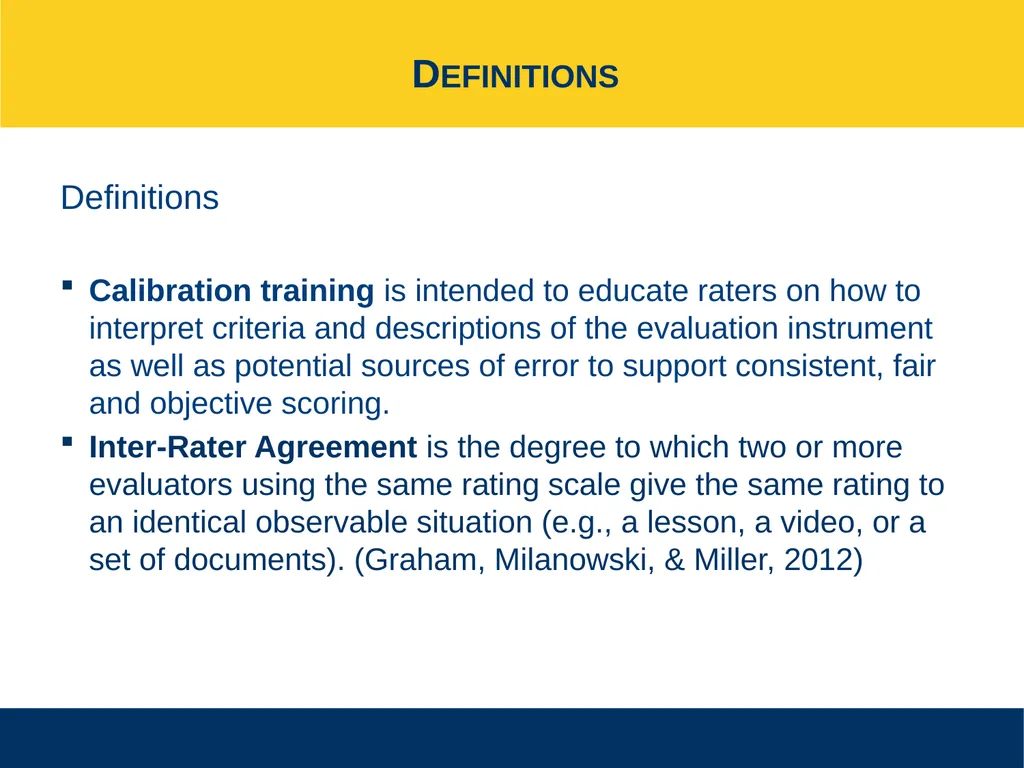
slide33. Definitions Definitions
Calibration training is intended to educate raters on how to interpret criteria and descriptions of the evaluation instrument as well as potential sources of error to support consistent, fair and objective scoring.
Inter-Rater Agreement is the degree to which two or more evaluators using the same rating scale give the same rating to an identical observable situation (e.g., a lesson, a video, or a set of documents). (Graham, Milanowski, & Miller, 2012)<br>
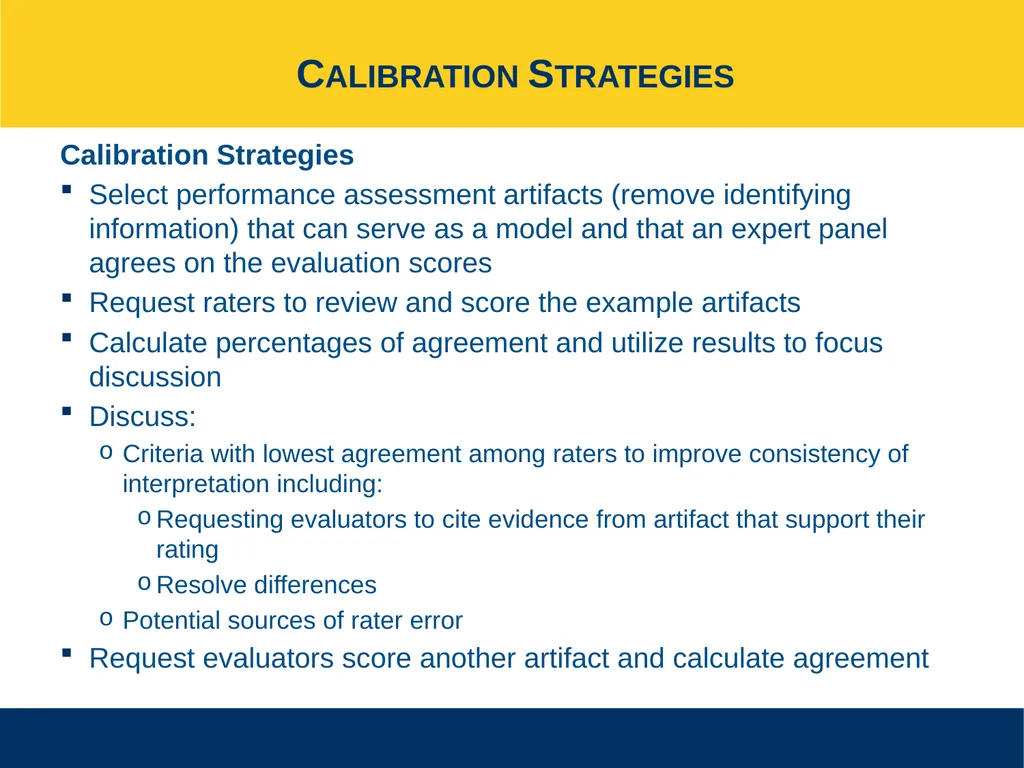
slide34. Calibration Strategies Calibration Strategies
Select performance assessment artifacts (remove identifying information) that can serve as a model and that an expert panel agrees on the evaluation scores
Request raters to review and score the example artifacts
Calculate percentages of agreement and utilize results to focus discussion
Discuss:
Criteria with lowest agreement among raters to improve consistency of interpretation including:
Requesting evaluators to cite evidence from artifact that support their rating
Resolve differences
Potential sources of rater error
Request evaluators score another artifact and calculate agreement<br>
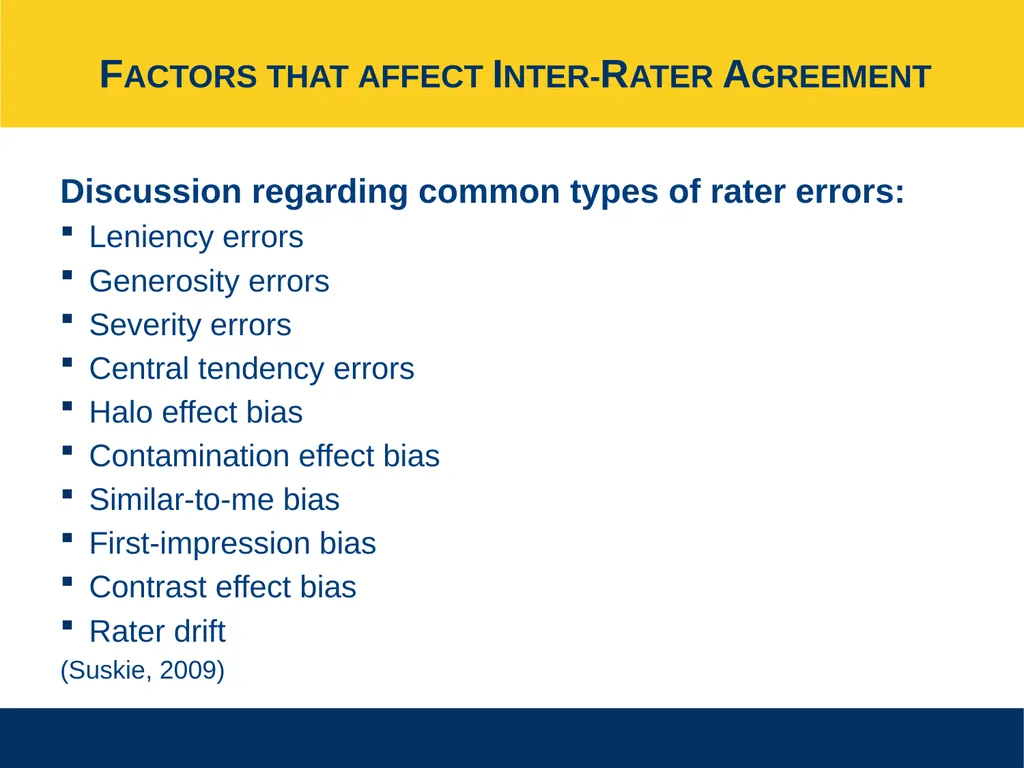
slide35. Factors that affect Inter-Rater Agreement Discussion regarding common types of rater errors:
Leniency errors
Generosity errors
Severity errors
Central tendency errors
Halo effect bias
Contamination effect bias
Similar-to-me bias
First-impression bias
Contrast effect bias
Rater drift
(Suskie, 2009)<br>
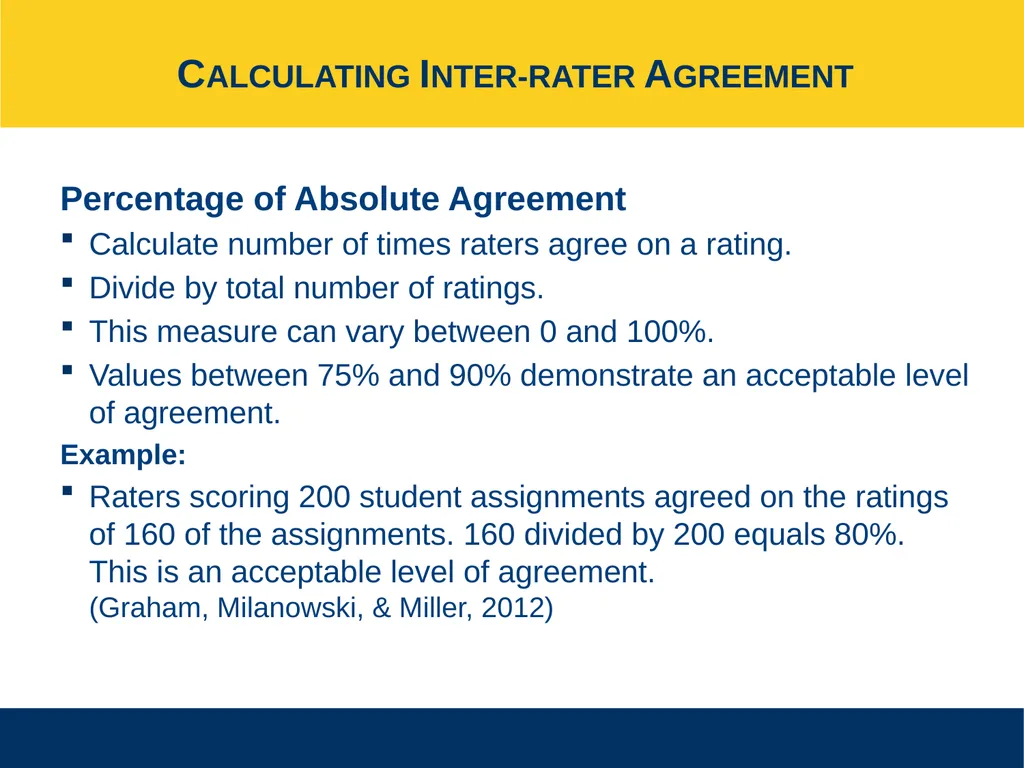
slide36. Calculating Inter-rater Agreement Percentage of Absolute Agreement
Calculate number of times raters agree on a rating.
Divide by total number of ratings.
This measure can vary between 0 and 100%.
Values between 75% and 90% demonstrate an acceptable level of agreement.
Example:
Raters scoring 200 student assignments agreed on the ratings of 160 of the assignments. 160 divided by 200 equals 80%. This is an acceptable level of agreement. (Graham, Milanowski, & Miller, 2012)<br>
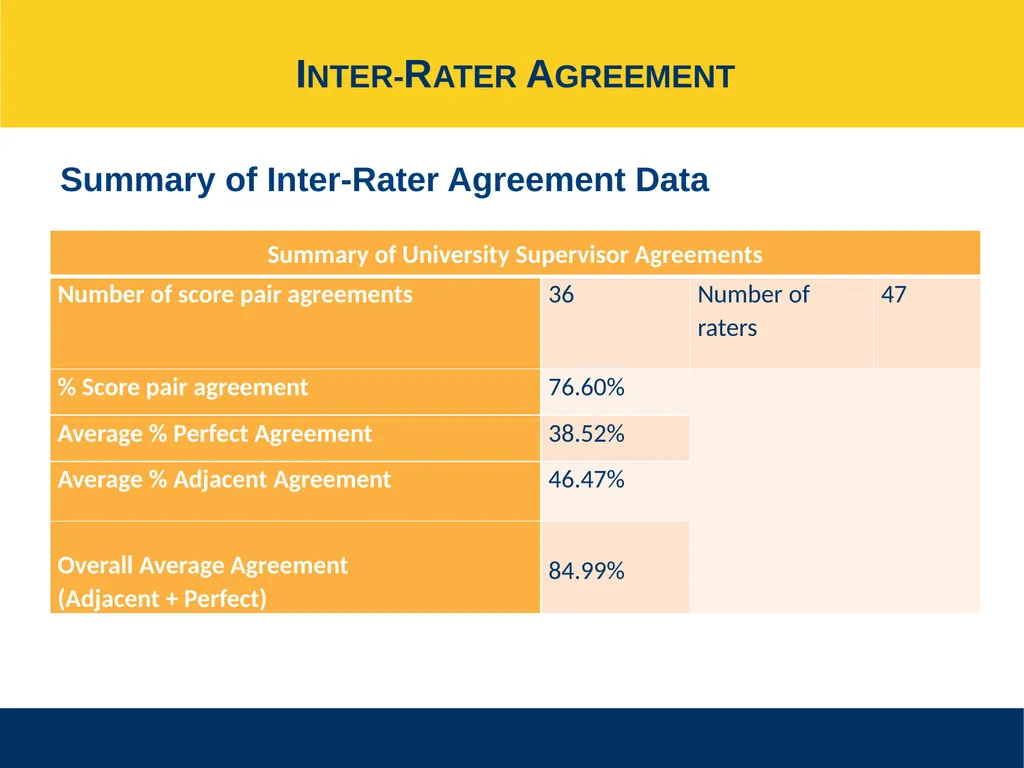
slide37. Inter-Rater Agreement Summary of Inter-Rater Agreement Data<br>
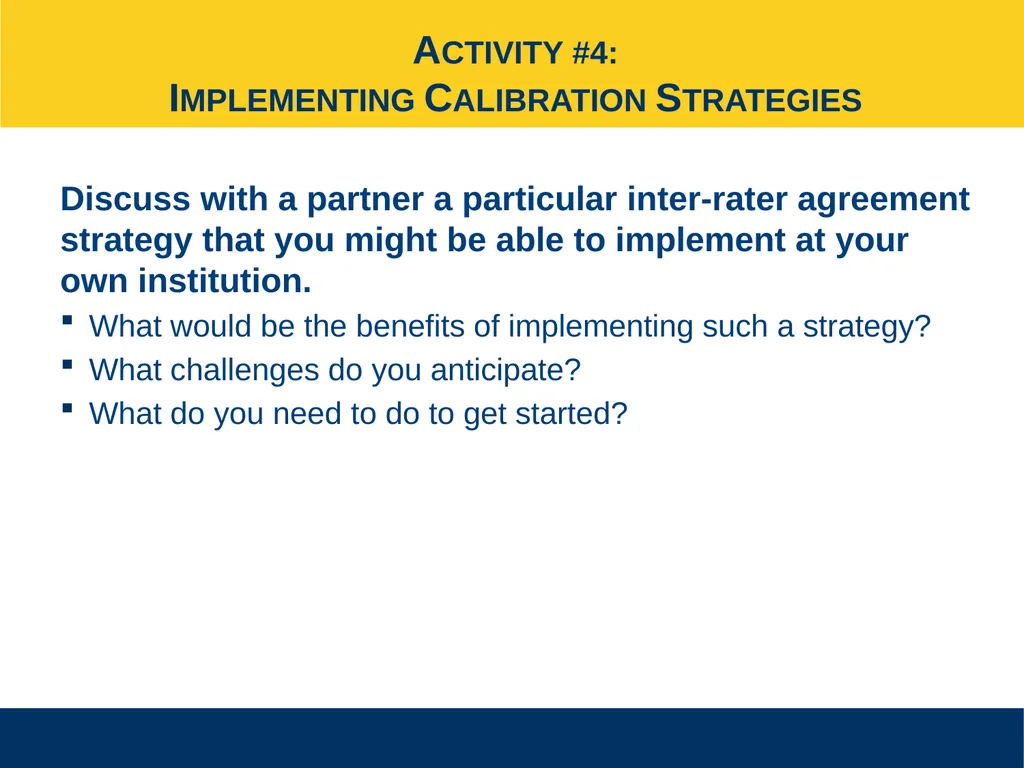
slide38. Activity #4: Implementing Calibration Strategies Discuss with a partner a particular inter-rater agreement strategy that you might be able to implement at your own institution.
What would be the benefits of implementing such a strategy?
What challenges do you anticipate?
What do you need to do to get started?<br>
slide39. Development of Validity Argument<br>
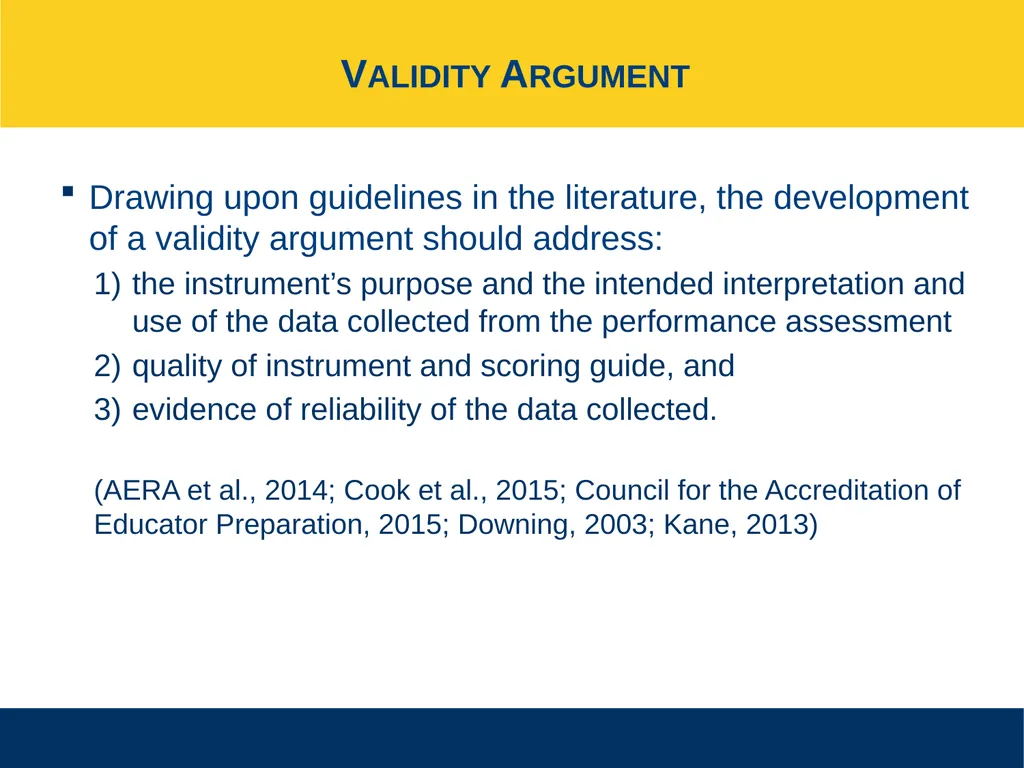
slide40. Validity Argument Drawing upon guidelines in the literature, the development of a validity argument should address:
the instrument’s purpose and the intended interpretation and use of the data collected from the performance assessment
quality of instrument and scoring guide, and
evidence of reliability of the data collected.
(AERA et al., 2014; Cook et al., 2015; Council for the Accreditation of Educator Preparation, 2015; Downing, 2003; Kane, 2013)<br>
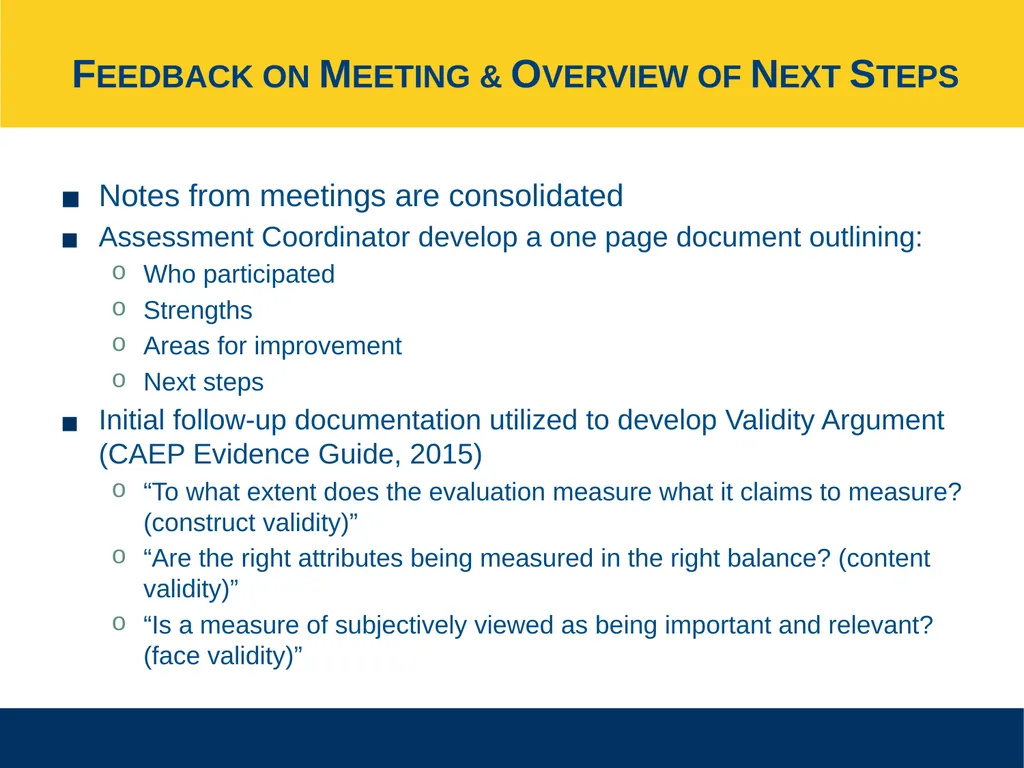
slide41. Feedback on Meeting & Overview of Next Steps Notes from meetings are consolidated
Assessment Coordinator develop a one page document outlining:
Who participated
Strengths
Areas for improvement
Next steps
Initial follow-up documentation utilized to develop Validity Argument (CAEP Evidence Guide, 2015)
“To what extent does the evaluation measure what it claims to measure? (construct validity)”
“Are the right attributes being measured in the right balance? (content validity)”
“Is a measure of subjectively viewed as being important and relevant? (face validity)”<br>
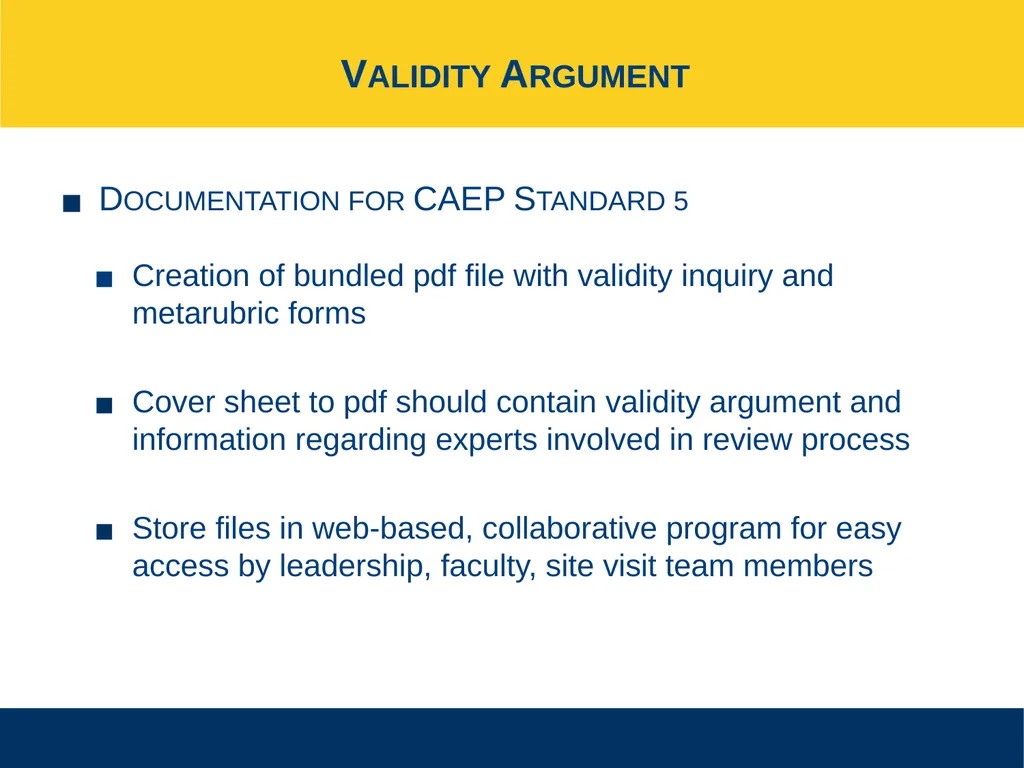
slide42. Validity Argument Documentation for CAEP Standard 5
Creation of bundled pdf file with validity inquiry and metarubric forms
Cover sheet to pdf should contain validity argument and information regarding experts involved in review process
Store files in web-based, collaborative program for easy access by leadership, faculty, site visit team members<br>
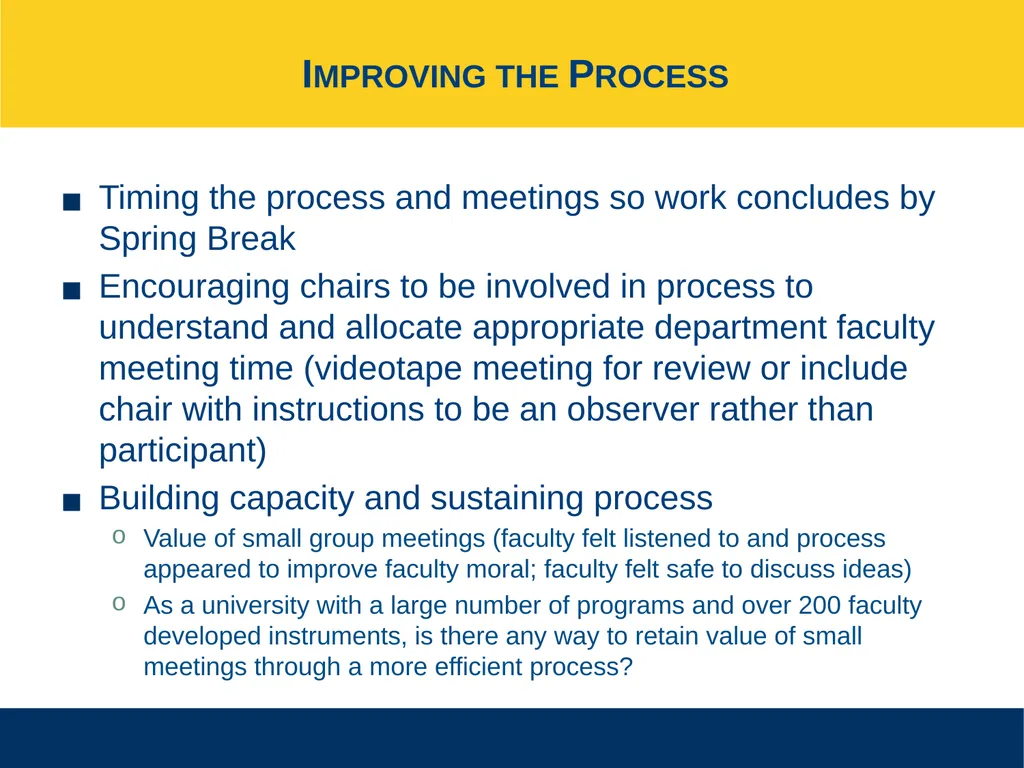
slide43. Improving the Process Timing the process and meetings so work concludes by Spring Break
Encouraging chairs to be involved in process to understand and allocate appropriate department faculty meeting time (videotape meeting for review or include chair with instructions to be an observer rather than participant)
Building capacity and sustaining process
Value of small group meetings (faculty felt listened to and process appeared to improve faculty moral; faculty felt safe to discuss ideas)
As a university with a large number of programs and over 200 faculty developed instruments, is there any way to retain value of small meetings through a more efficient process?<br>
slide44. Resources & Contact Information Website: https://nau.edu/Provost/PEP/Quality-Assurance-System/
Contact Information:
Cynthia Conn, PhD
Assistant Vice Provost, Professional Education Programs
Cynthia.Conn@nau.edu
Kathy Bohan, EdD
Associate Dean, College of Education
Kathy.Bohan@nau.edu
Sue Pieper, PhD
Assessment Coordinator, Office of Curriculum, Learning Design, & Academic Assessment
Sue.Pieper@nau.edu<br>
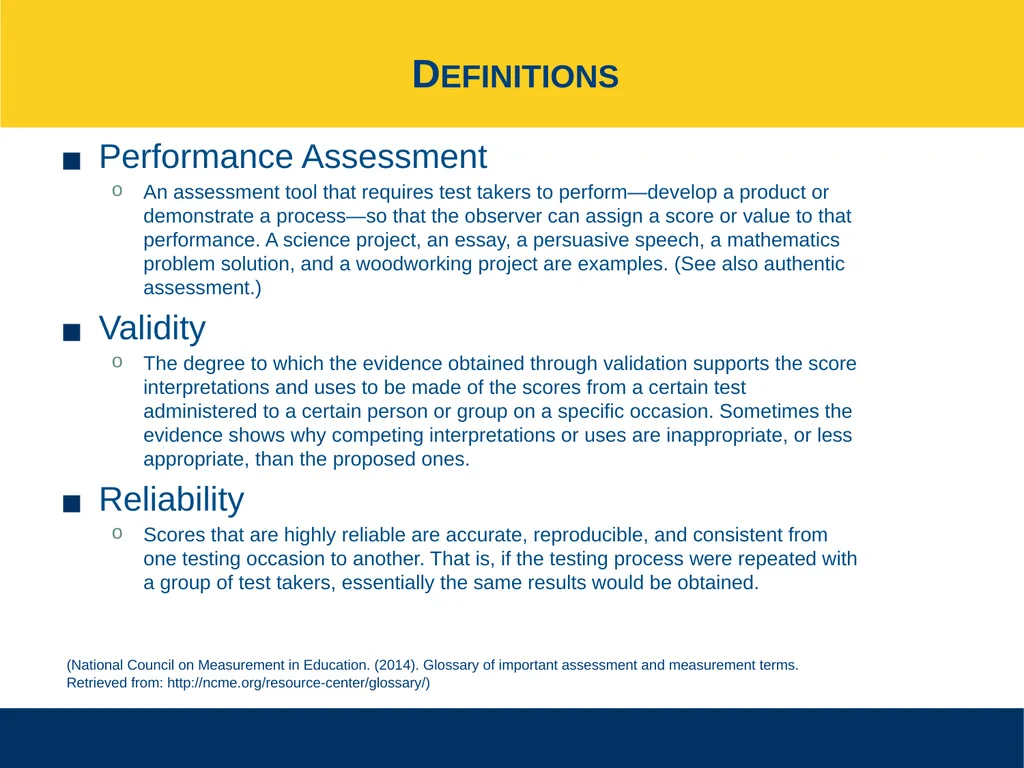
slide45. Definitions Performance Assessment
An assessment tool that requires test takers to perform—develop a product or demonstrate a process—so that the observer can assign a score or value to that performance. A science project, an essay, a persuasive speech, a mathematics problem solution, and a woodworking project are examples. (See also authentic assessment.)
Validity
The degree to which the evidence obtained through validation supports the score interpretations and uses to be made of the scores from a certain test administered to a certain person or group on a specific occasion. Sometimes the evidence shows why competing interpretations or uses are inappropriate, or less appropriate, than the proposed ones.
Reliability
Scores that are highly reliable are accurate, reproducible, and consistent from one testing occasion to another. That is, if the testing process were repeated with a group of test takers, essentially the same results would be obtained.
(National Council on Measurement in Education. (2014). Glossary of important assessment and measurement terms. Retrieved from: http://ncme.org/resource-center/glossary/)<br>
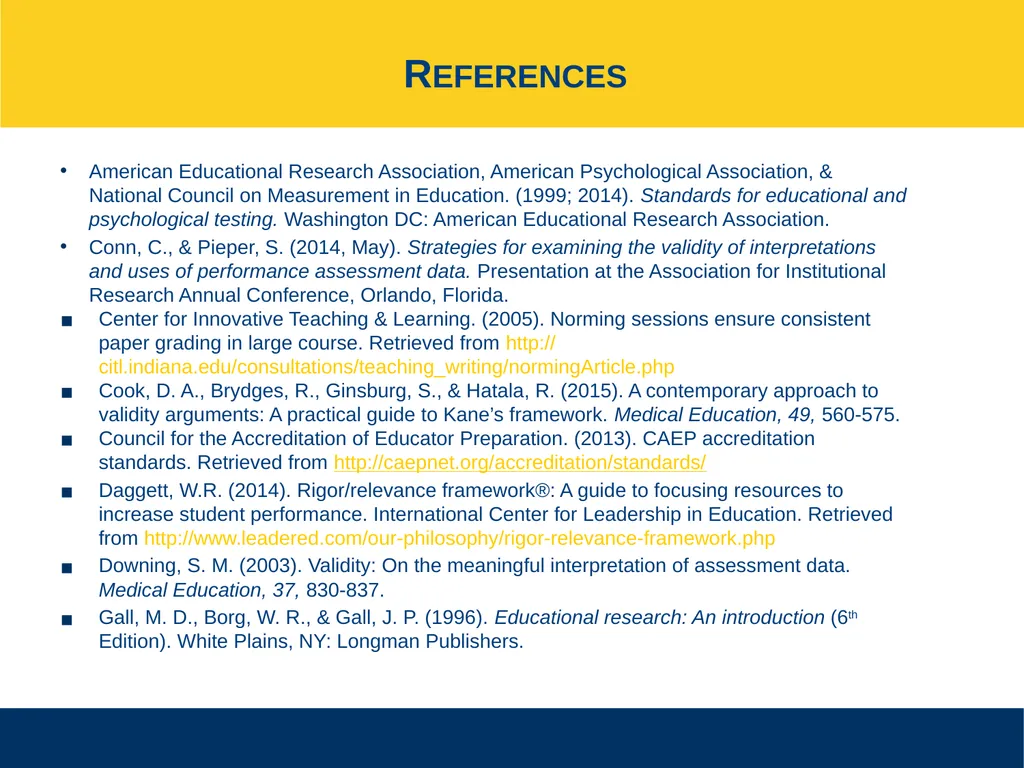
slide46. References American Educational Research Association, American Psychological Association, & National Council on Measurement in Education. (1999; 2014). Standards for educational and psychological testing. Washington DC: American Educational Research Association.
Conn, C., & Pieper, S. (2014, May). Strategies for examining the validity of interpretations and uses of performance assessment data. Presentation at the Association for Institutional Research Annual Conference, Orlando, Florida.
Center for Innovative Teaching & Learning. (2005). Norming sessions ensure consistent paper grading in large course. Retrieved from http://citl.indiana.edu/consultations/teaching_writing/normingArticle.php
Cook, D. A., Brydges, R., Ginsburg, S., & Hatala, R. (2015). A contemporary approach to validity arguments: A practical guide to Kane’s framework. Medical Education, 49, 560-575.
Council for the Accreditation of Educator Preparation. (2013). CAEP accreditation standards. Retrieved from http://caepnet.org/accreditation/standards/
Daggett, W.R. (2014). Rigor/relevance framework®: A guide to focusing resources to increase student performance. International Center for Leadership in Education. Retrieved from http://www.leadered.com/our-philosophy/rigor-relevance-framework.php
Downing, S. M. (2003). Validity: On the meaningful interpretation of assessment data. Medical Education, 37, 830-837.
Gall, M. D., Borg, W. R., & Gall, J. P. (1996). Educational research: An introduction (6th Edition). White Plains, NY: Longman Publishers.<br>
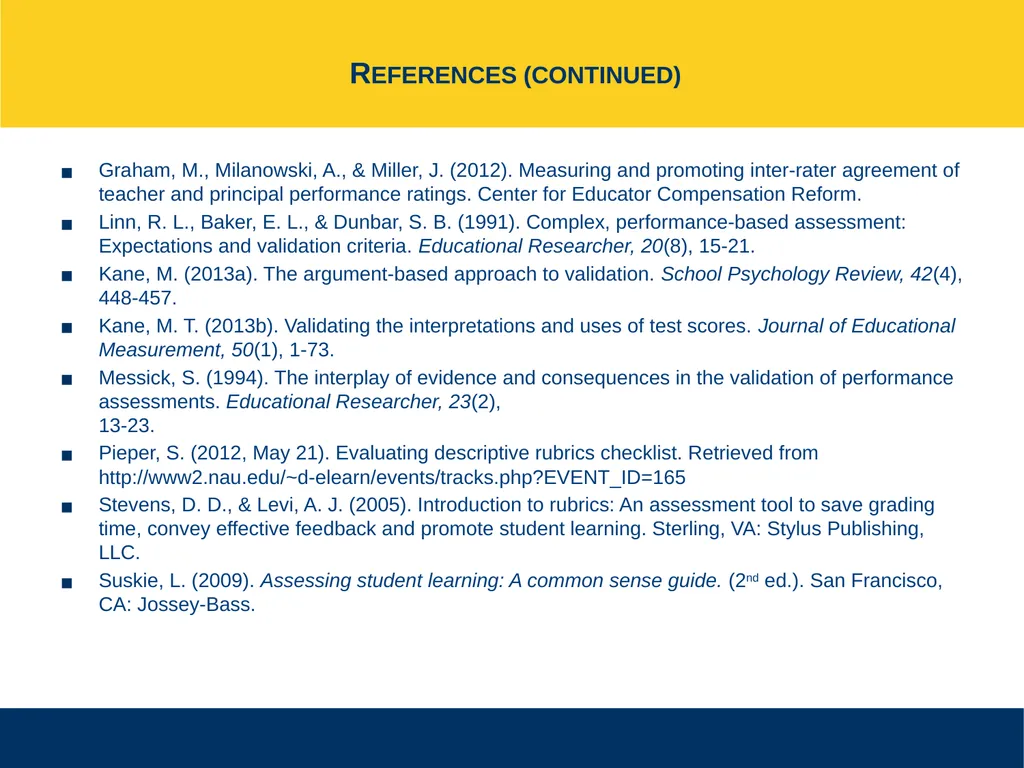
slide47. References (continued) Graham, M., Milanowski, A., & Miller, J. (2012). Measuring and promoting inter-rater agreement of teacher and principal performance ratings. Center for Educator Compensation Reform.
Linn, R. L., Baker, E. L., & Dunbar, S. B. (1991). Complex, performance-based assessment: Expectations and validation criteria. Educational Researcher, 20(8), 15-21.
Kane, M. (2013a). The argument-based approach to validation. School Psychology Review, 42(4), 448-457.
Kane, M. T. (2013b). Validating the interpretations and uses of test scores. Journal of Educational Measurement, 50(1), 1-73.
Messick, S. (1994). The interplay of evidence and consequences in the validation of performance assessments. Educational Researcher, 23(2), 13-23.
Pieper, S. (2012, May 21). Evaluating descriptive rubrics checklist. Retrieved from http://www2.nau.edu/~d-elearn/events/tracks.php?EVENT_ID=165
Stevens, D. D., & Levi, A. J. (2005). Introduction to rubrics: An assessment tool to save grading time, convey effective feedback and promote student learning. Sterling, VA: Stylus Publishing, LLC.
Suskie, L. (2009). Assessing student learning: A common sense guide. (2nd ed.). San Francisco, CA: Jossey-Bass.<br>
Assistant Vice Provost, Professional Education Programs
Kathy Bohan, EdD
Associate Dean, College of Education
Sue Pieper, PhD
Assessment Coordinator, Office of Curriculum, Learning Design, & Academic Assessment<br>
slide2. Introduction<br>
slide3. What is Your Context? Size of EPP/program/department, including enrollment and number of programs
Timeline for accreditation, if being pursued<br>
slide4. Session Outline Introductions
Overview of Validity Inquiry Process Model
Discuss the implementation of the Validity Inquiry Process Model at NAU
Interactive practice using two Validity Inquiry Model instruments
Discuss lessons learned from the implementation of the Validity Inquiry Process Model at NAU
Group discussion of process and how model might apply in participants’ settings<br>
slide5. Purpose of the Validity Inquiry Process (VIP) Model Purpose
The purpose of the Validity Inquiry Process (VIP) Model is to assist in examining and gathering evidence to build a validity argument for the interpretation and use of data from locally developed performance assessment instruments.<br>
slide6. Validity Inquiry Process (VIP) Model<br>
slide7. Theoretical Foundation & Approach Theory to practice
Utilized the existing validity and performance assessment literature to develop practical guidelines and instruments for examining performance assessment in relation to validity criteria (Kane, 2013; Linn, Baker, & Dunbar, 1991; Messick, 1994)
Qualitative and reflective
Process and instruments guide the review and facilitate discussion regarding performance assessments and rubrics
Evidence gathered is used to develop a validity argument (Kane, 2013)
Efficient
Some steps require documenting foundational information, one provides a survey completed by students, and the other steps involve faculty discussion and review<br>
slide8. Performance Assessment Validity Criteria Domain coverage
Content quality
Cognitive complexity
Meaningfulness
Generalizability
Consequences
Fairness
Cost and Efficiency
(Linn, Baker, & Dunbar, 1991; Messick, 1994)<br>
slide9. Content Analysis Strategies<br>
slide10. Validity Inquiry Form<br>
slide11. Metarubric for Examining Performance Assessment Rubrics<br>
slide12. Student Survey<br>
slide13. Conducting Review of Reliability<br>
slide14. Development of Validity Argument<br>
slide15. Introduction to VIP Model and Use of Evidence for CAEP Self-Study Report Standard 5:
Provider Quality Assurance and Continuous Improvement
Quality and Strategic Evaluation
5.2 The provider’s quality assurance system relies on relevant, verifiable, representative, cumulative and actionable measures, and produces empirical evidence that interpretations of data are valid and consistent.<br>
slide16. Implementing Validity Inquiry Process Model Timeline for Implementation
Identified target programs and faculty developed performance assessments (1 semester in advance)
Identified lead faculty member(s) for each performance assessment (1 month in advance)
Provided brief announcement and description at department faculty meeting (1 month in advance)
Associate Dean scheduled meeting with lead faculty including (at least 2 to 3 weeks in advance):
Sent introduction email describing purpose (CAEP Standard 5.2) and what to expect (sample available through website)
Attached copy of Validity Inquiry Form, Metarubric, and Rigor/Relevance Framework
Verified most recent copy of performance assessment to be reviewed
Requested individual review of performance assessment using the Validity Inquiry Form and Metarubric prior to the meeting<br>
slide17. Performance Assessment Review Meeting Logistics for Meeting
Individual review meetings were scheduled for 2 hours
Skype was utilized for connecting with faculty at statewide campuses
Participants included 2 to 3 lead faculty members, facilitators (Associate Dean & Assessment Coordinator), and a part-time employee or Graduate Assistant to take notes<br>
slide18. Interactive Practice Performance Assessment Review Model Meeting Agenda
Purpose of performance assessment (Activity #1)
Validity Inquiry Form (Activity #2)
Metarubric (Activity #3)
Feedback on the meeting and overview of next steps
Next Steps (meeting notes) sent to faculty within 1 week (included timelines, responsibilities, plan for writing Validity Argument)<br>
slide19. Validity Inquiry Form<br>
slide20. Activity #1: Using the Validity Inquiry Form Discuss in small groups the stated purpose of this performance assessment and if it is an effective purpose statement.
Course & Name of Performance Assessment:
Student Teaching: Candidate Work Sample
Purpose of Performance Assessment
The purpose of the Candidate Work Sample is to provide evidence of how your teaching impacts student learning.<br>
slide21. Activity #1: Small Group Discussion What are the results of your small group discussion?<br>
slide22. Activity #1: Question Prompts to Promote Deep Discussion Why are you asking candidates to prepare and deliver a candidate work sample? Why is it important?
How does this assignment apply to candidates’ future professional practice?
How does this assignment fit with the rest of your course?
How does this assignment fit with the rest of your program curriculum?<br>
slide23. Activity #2: Using the Validity Inquiry Form Discuss in small group questions 2 and 3 on the Validity Inquiry Form and how you would rate the assignment.
Questions 2 & 3:
Content Quality: Q2: Does the performance assessment evaluate process or application skills as well as content knowledge?
Cognitive Complexity: Q3: Analyze performance assessment using the Rigor/Relevance Framework (see http://www.leadered.com/our-philosophy/rigor-relevance-framework.php) to provide evidence of cognitive complexity:
Identify the quadrant that the assessment falls into and provide a justification for this determination.<br>
slide24. Activity #2: Using the Validity Inquiry Form Cognitive Complexity
Rigor/Relevance Framework® Daggett, W.R. (2018). Rigor/relevance framework®: A guide to focusing resources to increase student performance. International Center for Leadership in Education. Retrieved from http://www.leadered.com/our-philosophy/rigor-relevance-framework.php<br>
slide25. Activity #2: Discussion What are the results of your small group discussion?<br>
slide26. Activity #2: Question Prompts to Promote Deep Discussion How well does the assignment or performance assessment evaluate content knowledge?
How well does the assignment or performance assessment evaluate process or applications skills?
Using the Rigor/Relevance Framework®
What quadrant did the assessment fall into and why?
How did your group establish consensus on the quadrant determination?<br>
slide27. Metarubric for Examining Performance Assessment Rubrics<br>
slide28. Activity #3: Using the Metarubric As a large group, we will go through the following process for Question 2 (Q2) on the Metarubric:
Read the example assignment rubric provided as well as the Metarubric questions.
Criteria: Q2: Does each rubric criterion align directly with the assignment instructions? (Pieper, 2012)<br>
slide29. Activity #3: Using the Metarubric With the person(s) sitting next to you, complete the process again for the following questions:
Descriptions: Q8: “Are the descriptions clear and different from each other?” (Stevens & Levi, 2005, p. 94)
Overall Qualities: Q11: Do the assignment instructions “encourage students to use the rubric for self- and peer assessment?” (Pieper, 2012)
Are there any other questions you wish to discuss?<br>
slide30. Activity #3: Discussion What are the results of your discussion?<br>
slide31. Faculty Feedback Regarding Process “I wanted to thank you all for a providing a really productive venue to discuss the progress and continuing issues with our assessment work. I left the meeting feeling very optimistic about where we have come and where we are going. Thank you.”
–Associate Professor, Elementary Education
“Thanks for your facilitation and leadership in this process. It is so valuable from many different perspectives, especially related to continuous improvement! Thanks for giving us permission to use the validity tools as we continue to discuss our courses with our peers. I continue to learn and grow...”
–Assistant Clinical Professor, Special Education<br>
slide32. strategies for implementing calibration trainings and determining inter-rater Agreement Strategies for
Implementing Calibration Trainings &
Determining Inter-Rater Agreement<br>
slide33. Definitions Definitions
Calibration training is intended to educate raters on how to interpret criteria and descriptions of the evaluation instrument as well as potential sources of error to support consistent, fair and objective scoring.
Inter-Rater Agreement is the degree to which two or more evaluators using the same rating scale give the same rating to an identical observable situation (e.g., a lesson, a video, or a set of documents). (Graham, Milanowski, & Miller, 2012)<br>
slide34. Calibration Strategies Calibration Strategies
Select performance assessment artifacts (remove identifying information) that can serve as a model and that an expert panel agrees on the evaluation scores
Request raters to review and score the example artifacts
Calculate percentages of agreement and utilize results to focus discussion
Discuss:
Criteria with lowest agreement among raters to improve consistency of interpretation including:
Requesting evaluators to cite evidence from artifact that support their rating
Resolve differences
Potential sources of rater error
Request evaluators score another artifact and calculate agreement<br>
slide35. Factors that affect Inter-Rater Agreement Discussion regarding common types of rater errors:
Leniency errors
Generosity errors
Severity errors
Central tendency errors
Halo effect bias
Contamination effect bias
Similar-to-me bias
First-impression bias
Contrast effect bias
Rater drift
(Suskie, 2009)<br>
slide36. Calculating Inter-rater Agreement Percentage of Absolute Agreement
Calculate number of times raters agree on a rating.
Divide by total number of ratings.
This measure can vary between 0 and 100%.
Values between 75% and 90% demonstrate an acceptable level of agreement.
Example:
Raters scoring 200 student assignments agreed on the ratings of 160 of the assignments. 160 divided by 200 equals 80%. This is an acceptable level of agreement. (Graham, Milanowski, & Miller, 2012)<br>
slide37. Inter-Rater Agreement Summary of Inter-Rater Agreement Data<br>
slide38. Activity #4: Implementing Calibration Strategies Discuss with a partner a particular inter-rater agreement strategy that you might be able to implement at your own institution.
What would be the benefits of implementing such a strategy?
What challenges do you anticipate?
What do you need to do to get started?<br>
slide39. Development of Validity Argument<br>
slide40. Validity Argument Drawing upon guidelines in the literature, the development of a validity argument should address:
the instrument’s purpose and the intended interpretation and use of the data collected from the performance assessment
quality of instrument and scoring guide, and
evidence of reliability of the data collected.
(AERA et al., 2014; Cook et al., 2015; Council for the Accreditation of Educator Preparation, 2015; Downing, 2003; Kane, 2013)<br>
slide41. Feedback on Meeting & Overview of Next Steps Notes from meetings are consolidated
Assessment Coordinator develop a one page document outlining:
Who participated
Strengths
Areas for improvement
Next steps
Initial follow-up documentation utilized to develop Validity Argument (CAEP Evidence Guide, 2015)
“To what extent does the evaluation measure what it claims to measure? (construct validity)”
“Are the right attributes being measured in the right balance? (content validity)”
“Is a measure of subjectively viewed as being important and relevant? (face validity)”<br>
slide42. Validity Argument Documentation for CAEP Standard 5
Creation of bundled pdf file with validity inquiry and metarubric forms
Cover sheet to pdf should contain validity argument and information regarding experts involved in review process
Store files in web-based, collaborative program for easy access by leadership, faculty, site visit team members<br>
slide43. Improving the Process Timing the process and meetings so work concludes by Spring Break
Encouraging chairs to be involved in process to understand and allocate appropriate department faculty meeting time (videotape meeting for review or include chair with instructions to be an observer rather than participant)
Building capacity and sustaining process
Value of small group meetings (faculty felt listened to and process appeared to improve faculty moral; faculty felt safe to discuss ideas)
As a university with a large number of programs and over 200 faculty developed instruments, is there any way to retain value of small meetings through a more efficient process?<br>
slide44. Resources & Contact Information Website: https://nau.edu/Provost/PEP/Quality-Assurance-System/
Contact Information:
Cynthia Conn, PhD
Assistant Vice Provost, Professional Education Programs
Cynthia.Conn@nau.edu
Kathy Bohan, EdD
Associate Dean, College of Education
Kathy.Bohan@nau.edu
Sue Pieper, PhD
Assessment Coordinator, Office of Curriculum, Learning Design, & Academic Assessment
Sue.Pieper@nau.edu<br>
slide45. Definitions Performance Assessment
An assessment tool that requires test takers to perform—develop a product or demonstrate a process—so that the observer can assign a score or value to that performance. A science project, an essay, a persuasive speech, a mathematics problem solution, and a woodworking project are examples. (See also authentic assessment.)
Validity
The degree to which the evidence obtained through validation supports the score interpretations and uses to be made of the scores from a certain test administered to a certain person or group on a specific occasion. Sometimes the evidence shows why competing interpretations or uses are inappropriate, or less appropriate, than the proposed ones.
Reliability
Scores that are highly reliable are accurate, reproducible, and consistent from one testing occasion to another. That is, if the testing process were repeated with a group of test takers, essentially the same results would be obtained.
(National Council on Measurement in Education. (2014). Glossary of important assessment and measurement terms. Retrieved from: http://ncme.org/resource-center/glossary/)<br>
slide46. References American Educational Research Association, American Psychological Association, & National Council on Measurement in Education. (1999; 2014). Standards for educational and psychological testing. Washington DC: American Educational Research Association.
Conn, C., & Pieper, S. (2014, May). Strategies for examining the validity of interpretations and uses of performance assessment data. Presentation at the Association for Institutional Research Annual Conference, Orlando, Florida.
Center for Innovative Teaching & Learning. (2005). Norming sessions ensure consistent paper grading in large course. Retrieved from http://citl.indiana.edu/consultations/teaching_writing/normingArticle.php
Cook, D. A., Brydges, R., Ginsburg, S., & Hatala, R. (2015). A contemporary approach to validity arguments: A practical guide to Kane’s framework. Medical Education, 49, 560-575.
Council for the Accreditation of Educator Preparation. (2013). CAEP accreditation standards. Retrieved from http://caepnet.org/accreditation/standards/
Daggett, W.R. (2014). Rigor/relevance framework®: A guide to focusing resources to increase student performance. International Center for Leadership in Education. Retrieved from http://www.leadered.com/our-philosophy/rigor-relevance-framework.php
Downing, S. M. (2003). Validity: On the meaningful interpretation of assessment data. Medical Education, 37, 830-837.
Gall, M. D., Borg, W. R., & Gall, J. P. (1996). Educational research: An introduction (6th Edition). White Plains, NY: Longman Publishers.<br>
slide47. References (continued) Graham, M., Milanowski, A., & Miller, J. (2012). Measuring and promoting inter-rater agreement of teacher and principal performance ratings. Center for Educator Compensation Reform.
Linn, R. L., Baker, E. L., & Dunbar, S. B. (1991). Complex, performance-based assessment: Expectations and validation criteria. Educational Researcher, 20(8), 15-21.
Kane, M. (2013a). The argument-based approach to validation. School Psychology Review, 42(4), 448-457.
Kane, M. T. (2013b). Validating the interpretations and uses of test scores. Journal of Educational Measurement, 50(1), 1-73.
Messick, S. (1994). The interplay of evidence and consequences in the validation of performance assessments. Educational Researcher, 23(2), 13-23.
Pieper, S. (2012, May 21). Evaluating descriptive rubrics checklist. Retrieved from http://www2.nau.edu/~d-elearn/events/tracks.php?EVENT_ID=165
Stevens, D. D., & Levi, A. J. (2005). Introduction to rubrics: An assessment tool to save grading time, convey effective feedback and promote student learning. Sterling, VA: Stylus Publishing, LLC.
Suskie, L. (2009). Assessing student learning: A common sense guide. (2nd ed.). San Francisco, CA: Jossey-Bass.<br>