
Enterprice Risk Management and Internal Control
CS
Published · 24 slides · 0 views
1 / 1
Description
Enterprice Risk Management and Internal Control Practices in Financial Audit ERM and IC Practices in Turkey and the TCA ANKARA, May 2021 1 Learning Objective To understand the framework of enterprice risk management and internal control
Related Topics
Share
Embed code
Download this presentation From Below
"Enterprice Risk Management and Internal Control" is the property of its rightful owner. Permission is granted to download and print the materials on this website for personal, non-commercial use only, and to display it on your personal computer provided you do not modify the materials and that you retain all copyright notices contained in the materials. By downloading content from our website, you accept the terms of this agreement.
Presentation Transcript
01
Enterprice Risk Management and Internal Control Practices in Financial Audit
ERM and IC Practices in Turkey and the TCA
ANKARA, May 2021 1<br>
02
Learning Objective To understand the framework of enterprice risk management and internal control practices in Turkey To understand briefly how enterprice risk management and Internal Control is applied in the Turkish Court of Accouts(TCA), and what duties the TCA has in this field in its audits.<br>
03
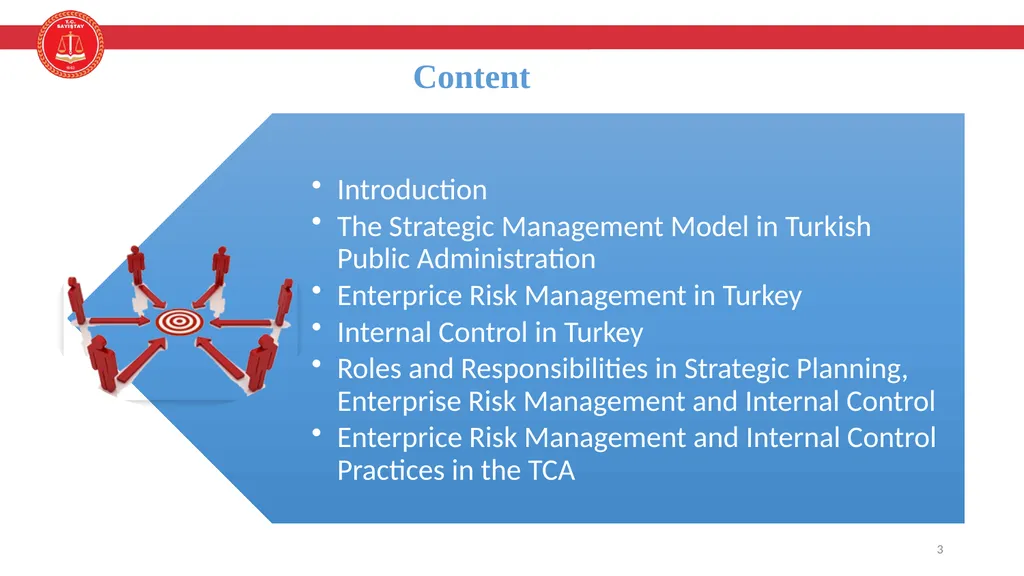
Content 3<br>
04
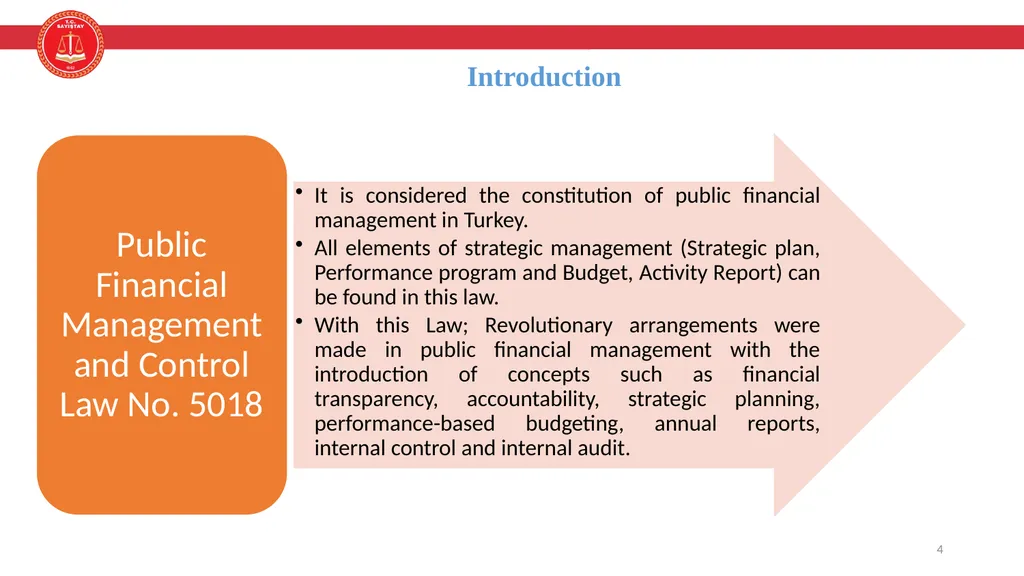
Introduction 4<br>
05
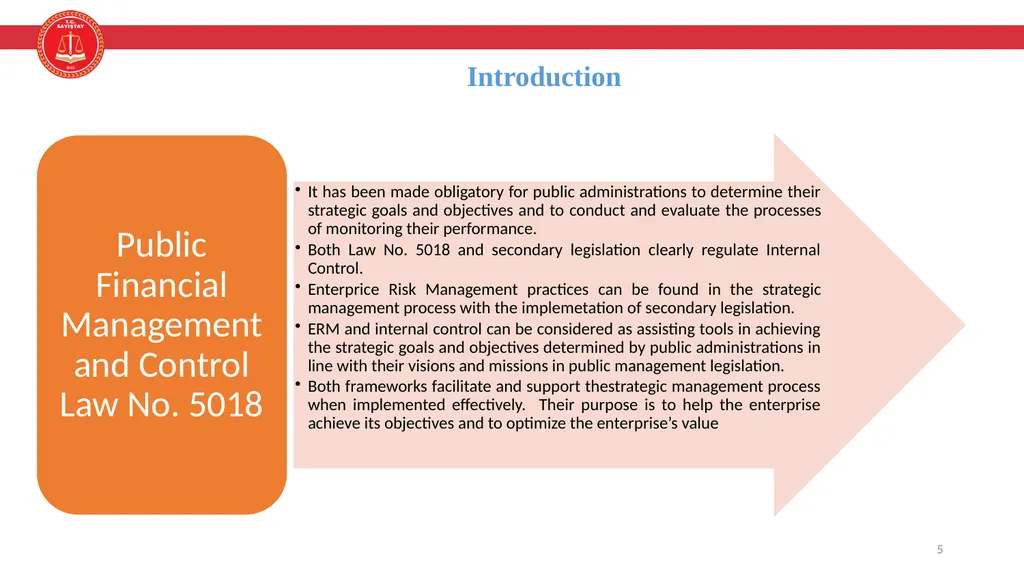
Introduction 5<br>
06
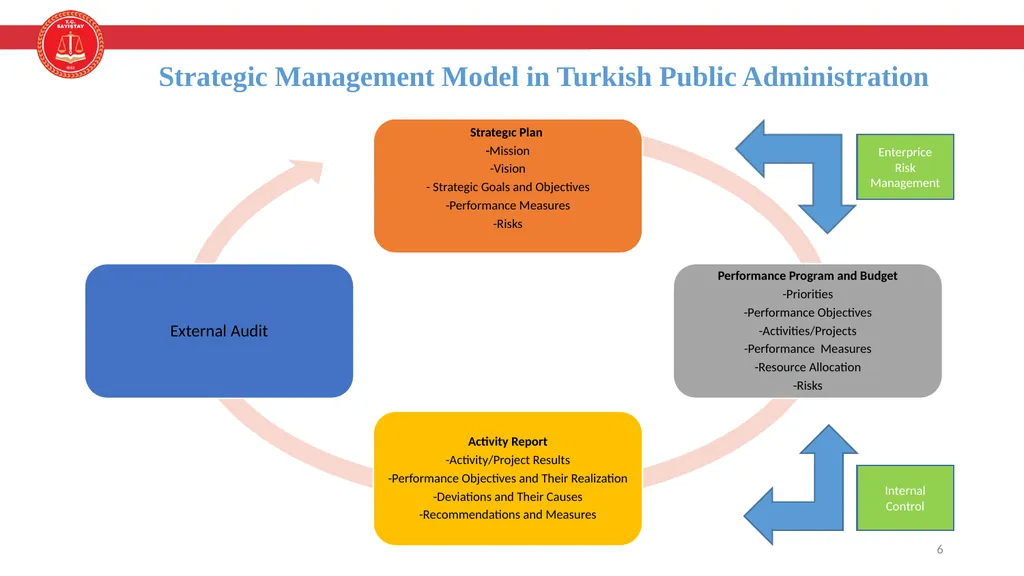
Strategic Management Model in Turkish Public Administration 6 Enterprice Risk Management Internal Control<br>
07
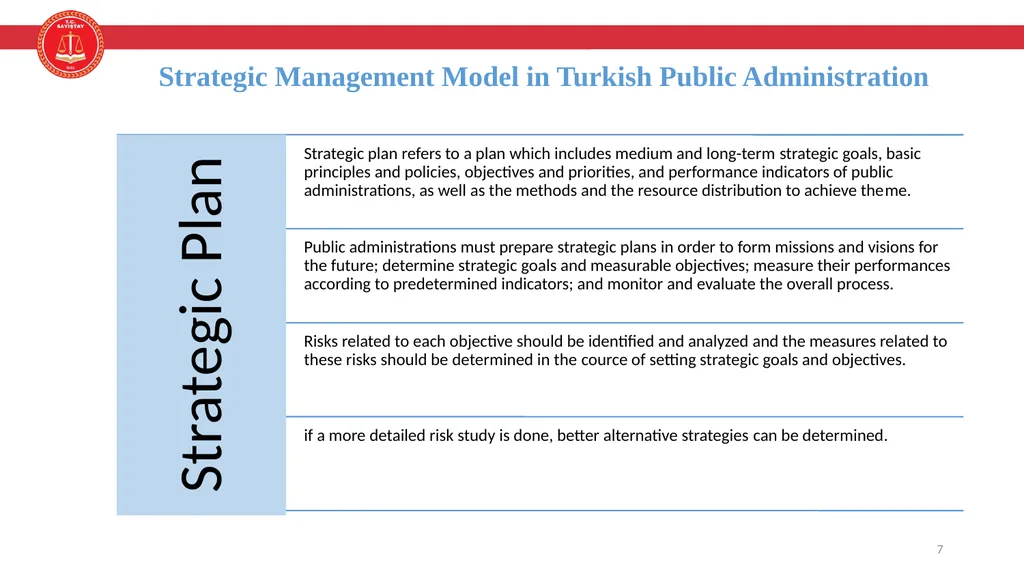
Strategic Management Model in Turkish Public Administration 7<br>
08
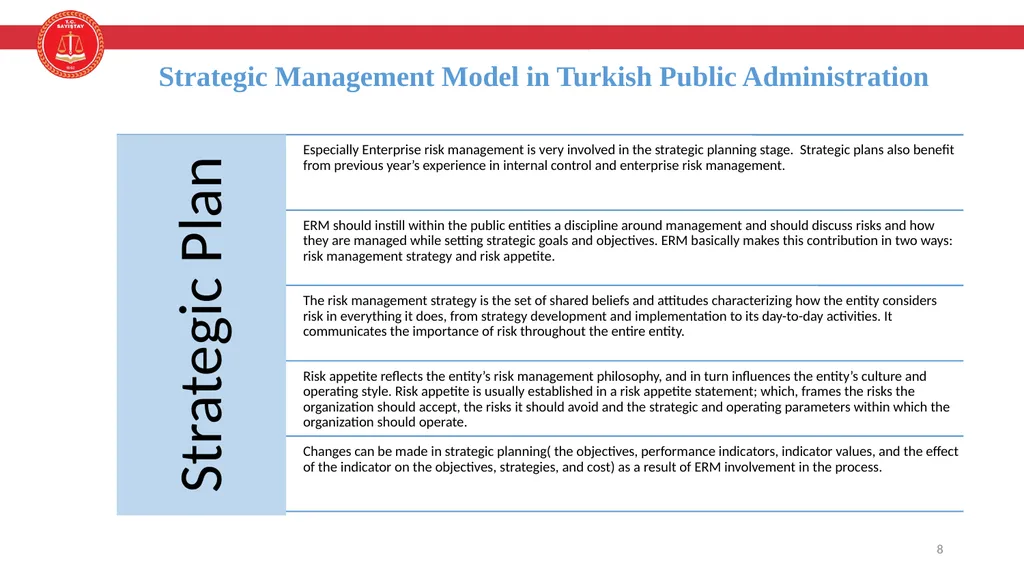
Strategic Management Model in Turkish Public Administration 8<br>
09
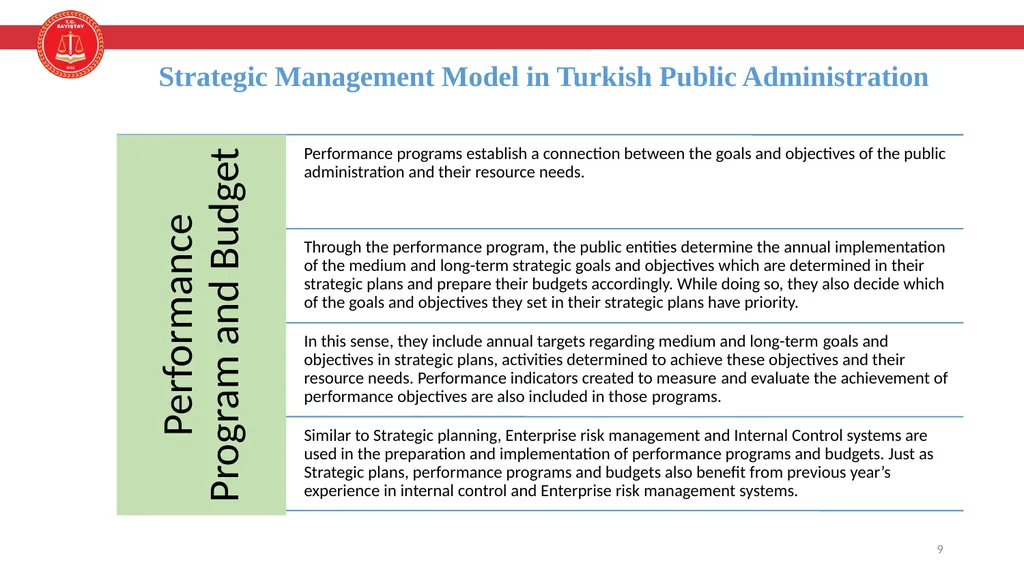
Strategic Management Model in Turkish Public Administration 9<br>
10
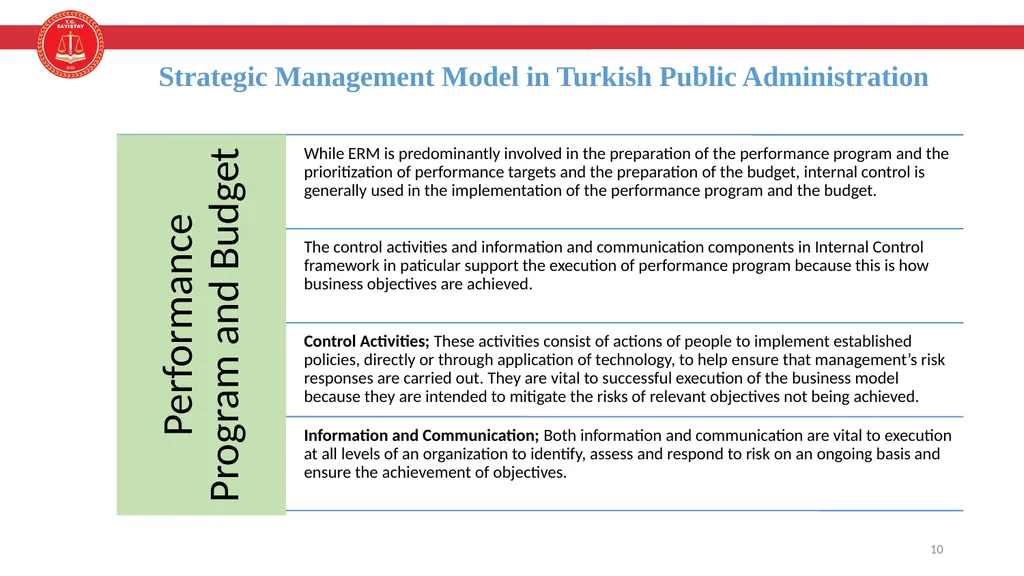
Strategic Management Model in Turkish Public Administration 10<br>
11
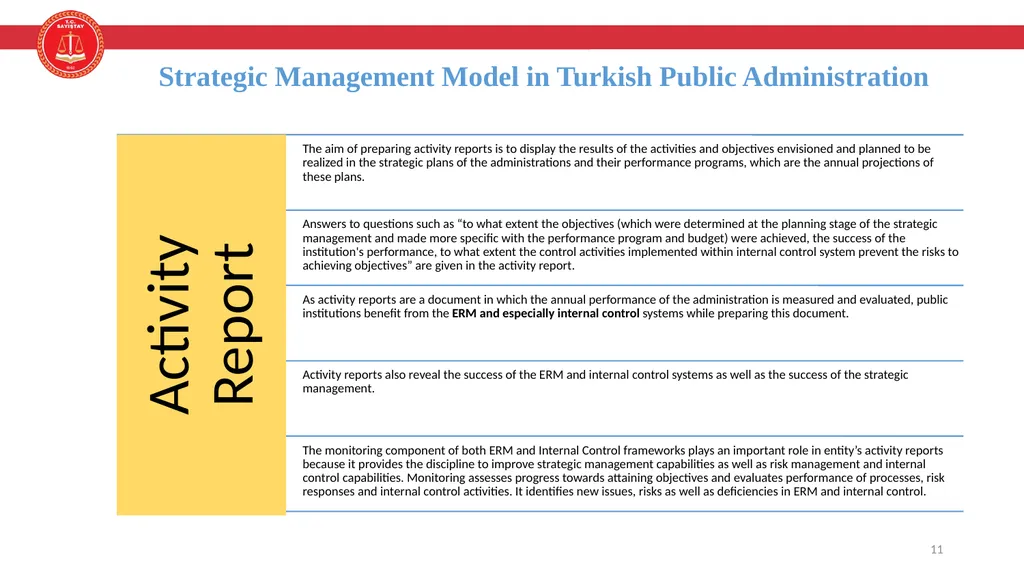
Strategic Management Model in Turkish Public Administration 11<br>
12
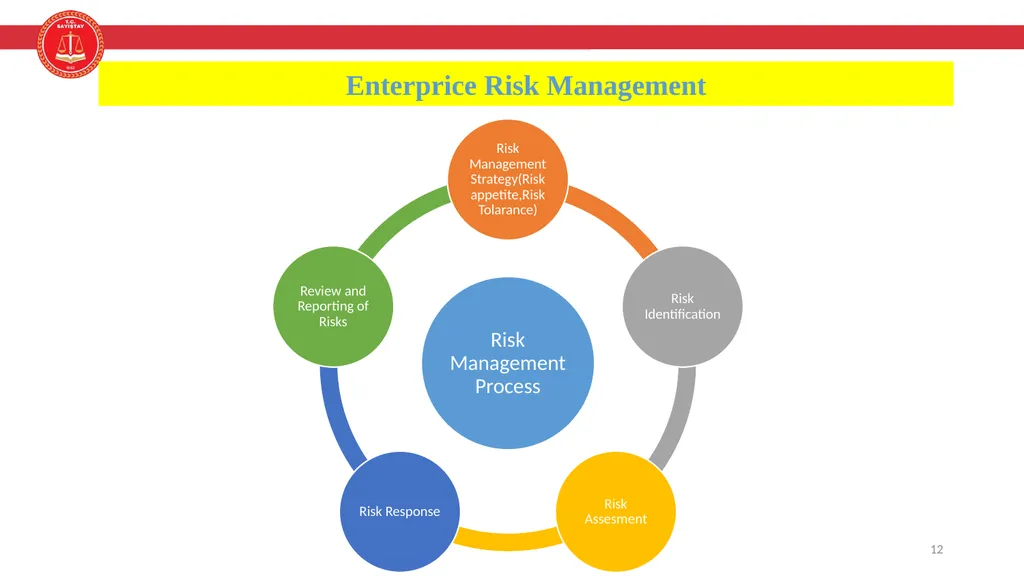
Enterprice Risk Management 12<br>
13
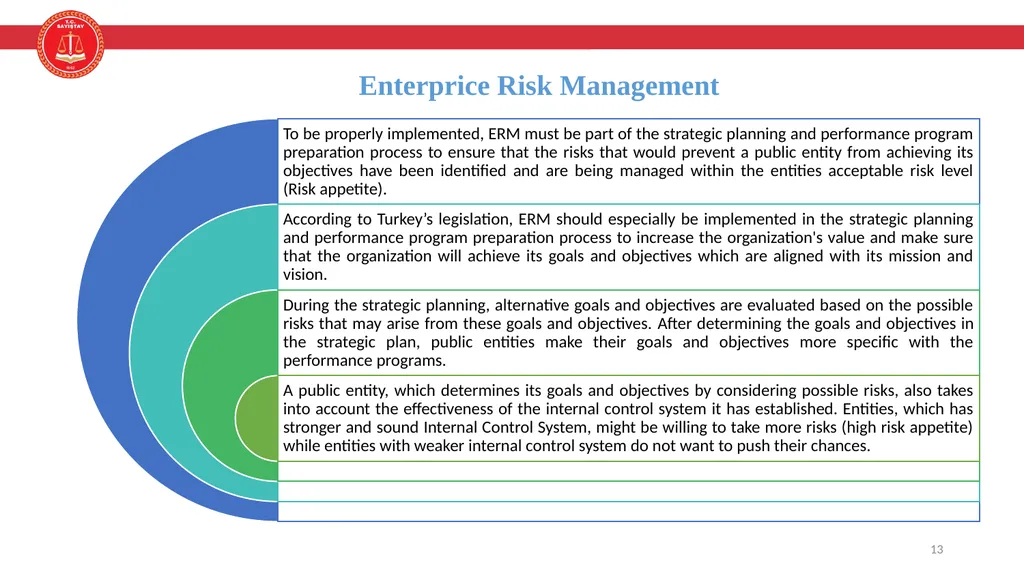
Enterprice Risk Management 13<br>
14
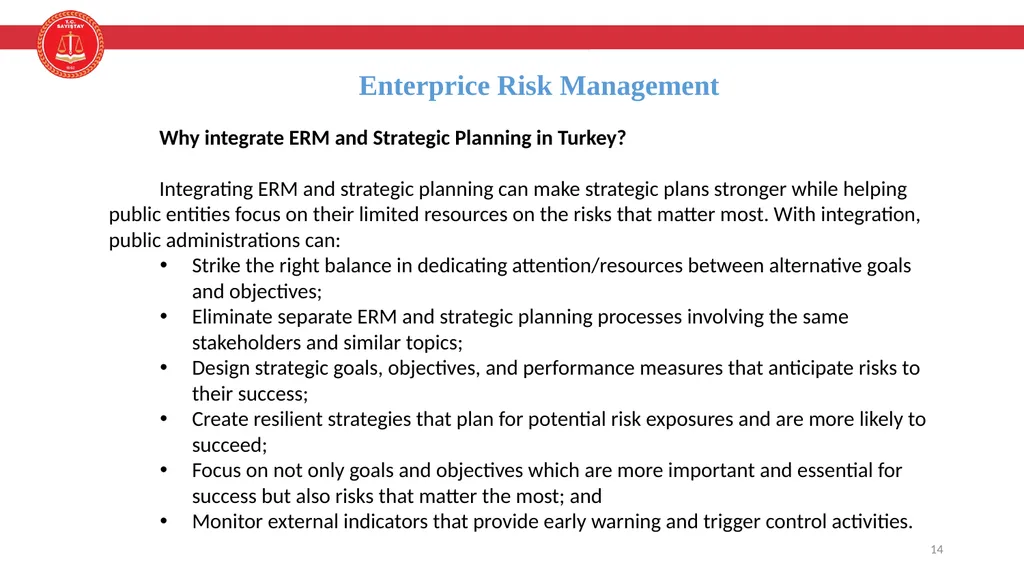
Enterprice Risk Management 14 Why integrate ERM and Strategic Planning in Turkey?
Integrating ERM and strategic planning can make strategic plans stronger while helping public entities focus on their limited resources on the risks that matter most. With integration, public administrations can:
Strike the right balance in dedicating attention/resources between alternative goals and objectives;
Eliminate separate ERM and strategic planning processes involving the same stakeholders and similar topics;
Design strategic goals, objectives, and performance measures that anticipate risks to their success;
Create resilient strategies that plan for potential risk exposures and are more likely to succeed;
Focus on not only goals and objectives which are more important and essential for success but also risks that matter the most; and
Monitor external indicators that provide early warning and trigger control activities.<br>
Integrating ERM and strategic planning can make strategic plans stronger while helping public entities focus on their limited resources on the risks that matter most. With integration, public administrations can:
Strike the right balance in dedicating attention/resources between alternative goals and objectives;
Eliminate separate ERM and strategic planning processes involving the same stakeholders and similar topics;
Design strategic goals, objectives, and performance measures that anticipate risks to their success;
Create resilient strategies that plan for potential risk exposures and are more likely to succeed;
Focus on not only goals and objectives which are more important and essential for success but also risks that matter the most; and
Monitor external indicators that provide early warning and trigger control activities.<br>
15
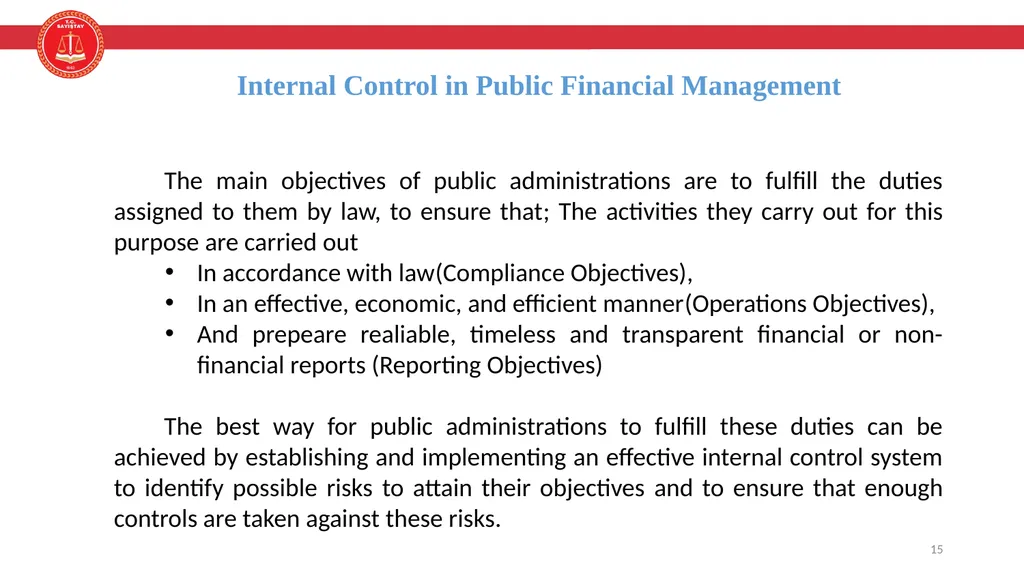
Internal Control in Public Financial Management 15 The main objectives of public administrations are to fulfill the duties assigned to them by law, to ensure that; The activities they carry out for this purpose are carried out
In accordance with law(Compliance Objectives),
In an effective, economic, and efficient manner(Operations Objectives),
And prepeare realiable, timeless and transparent financial or non-financial reports (Reporting Objectives)
The best way for public administrations to fulfill these duties can be achieved by establishing and implementing an effective internal control system to identify possible risks to attain their objectives and to ensure that enough controls are taken against these risks.<br>
In accordance with law(Compliance Objectives),
In an effective, economic, and efficient manner(Operations Objectives),
And prepeare realiable, timeless and transparent financial or non-financial reports (Reporting Objectives)
The best way for public administrations to fulfill these duties can be achieved by establishing and implementing an effective internal control system to identify possible risks to attain their objectives and to ensure that enough controls are taken against these risks.<br>
16
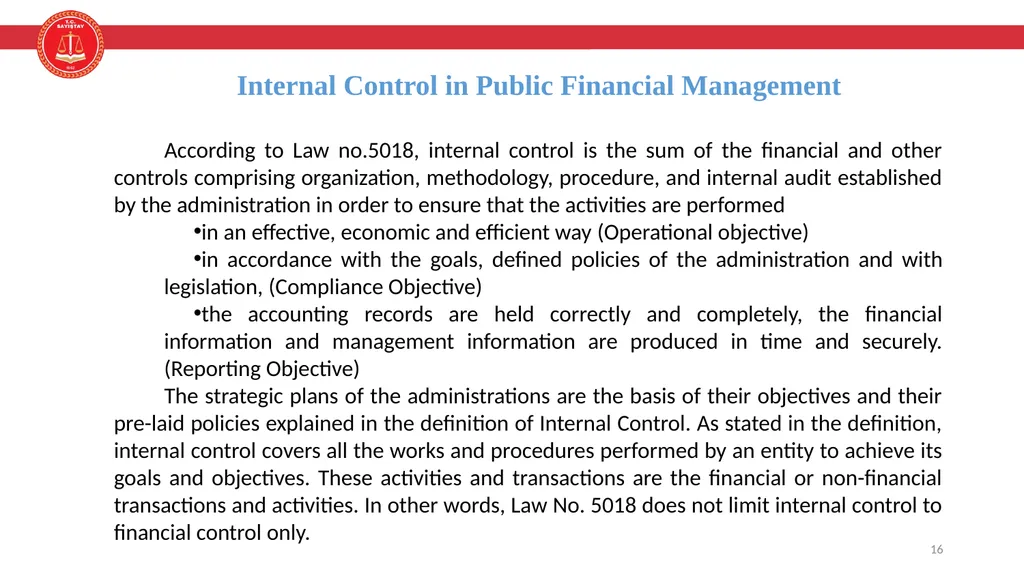
Internal Control in Public Financial Management 16 According to Law no.5018, internal control is the sum of the financial and other controls comprising organization, methodology, procedure, and internal audit established by the administration in order to ensure that the activities are performed
in an effective, economic and efficient way (Operational objective)
in accordance with the goals, defined policies of the administration and with legislation, (Compliance Objective)
the accounting records are held correctly and completely, the financial information and management information are produced in time and securely.(Reporting Objective)
The strategic plans of the administrations are the basis of their objectives and their pre-laid policies explained in the definition of Internal Control. As stated in the definition, internal control covers all the works and procedures performed by an entity to achieve its goals and objectives. These activities and transactions are the financial or non-financial transactions and activities. In other words, Law No. 5018 does not limit internal control to financial control only.<br>
in an effective, economic and efficient way (Operational objective)
in accordance with the goals, defined policies of the administration and with legislation, (Compliance Objective)
the accounting records are held correctly and completely, the financial information and management information are produced in time and securely.(Reporting Objective)
The strategic plans of the administrations are the basis of their objectives and their pre-laid policies explained in the definition of Internal Control. As stated in the definition, internal control covers all the works and procedures performed by an entity to achieve its goals and objectives. These activities and transactions are the financial or non-financial transactions and activities. In other words, Law No. 5018 does not limit internal control to financial control only.<br>
17
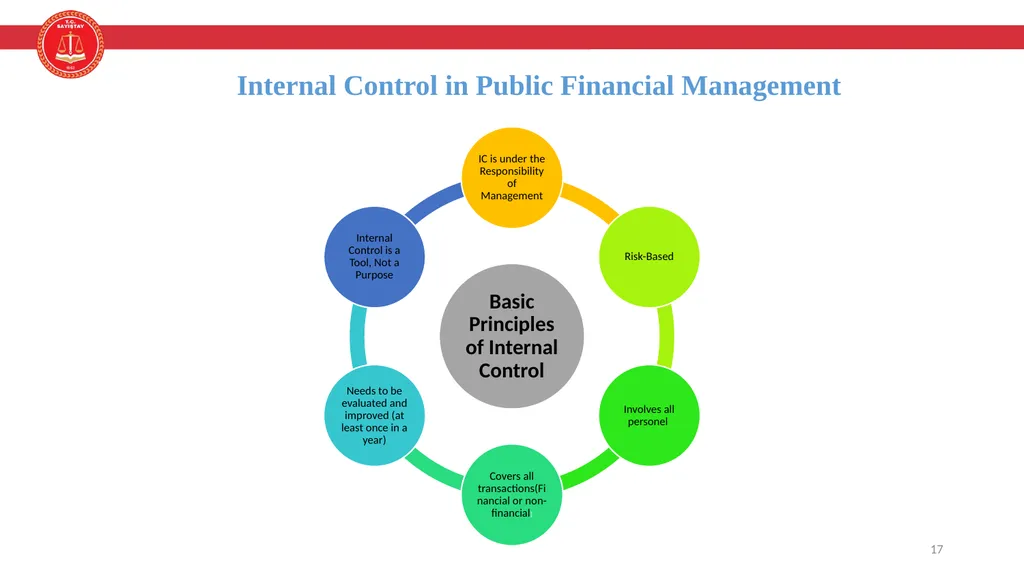
Internal Control in Public Financial Management 17<br>
18
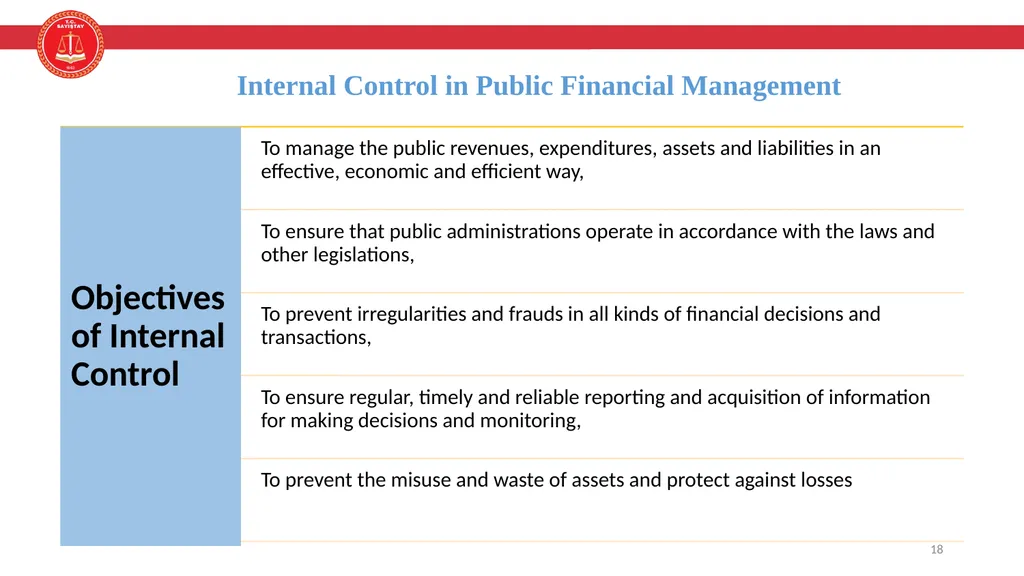
Internal Control in Public Financial Management 18<br>
19
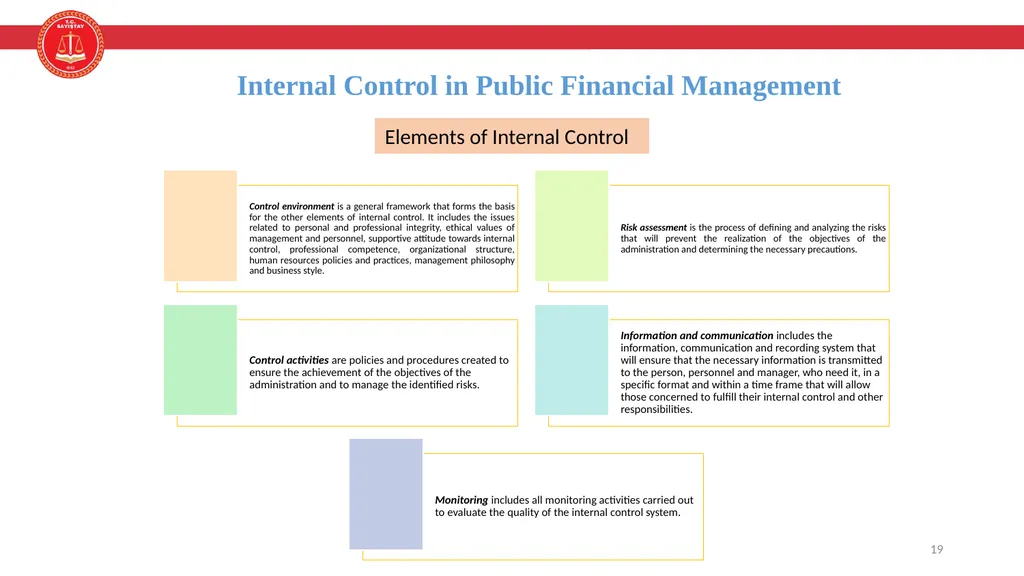
Internal Control in Public Financial Management 19 Elements of Internal Control<br>
20
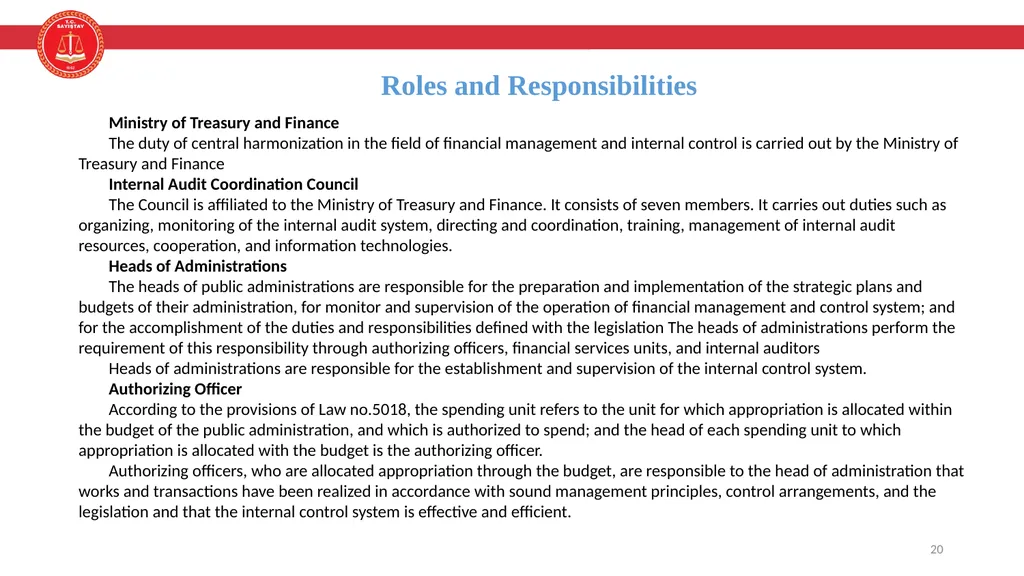
Roles and Responsibilities 20 Ministry of Treasury and Finance
The duty of central harmonization in the field of financial management and internal control is carried out by the Ministry of Treasury and Finance
Internal Audit Coordination Council
The Council is affiliated to the Ministry of Treasury and Finance. It consists of seven members. It carries out duties such as organizing, monitoring of the internal audit system, directing and coordination, training, management of internal audit resources, cooperation, and information technologies.
Heads of Administrations
The heads of public administrations are responsible for the preparation and implementation of the strategic plans and budgets of their administration, for monitor and supervision of the operation of financial management and control system; and for the accomplishment of the duties and responsibilities defined with the legislation The heads of administrations perform the requirement of this responsibility through authorizing officers, financial services units, and internal auditors
Heads of administrations are responsible for the establishment and supervision of the internal control system.
Authorizing Officer
According to the provisions of Law no.5018, the spending unit refers to the unit for which appropriation is allocated within the budget of the public administration, and which is authorized to spend; and the head of each spending unit to which appropriation is allocated with the budget is the authorizing officer.
Authorizing officers, who are allocated appropriation through the budget, are responsible to the head of administration that works and transactions have been realized in accordance with sound management principles, control arrangements, and the legislation and that the internal control system is effective and efficient.<br>
The duty of central harmonization in the field of financial management and internal control is carried out by the Ministry of Treasury and Finance
Internal Audit Coordination Council
The Council is affiliated to the Ministry of Treasury and Finance. It consists of seven members. It carries out duties such as organizing, monitoring of the internal audit system, directing and coordination, training, management of internal audit resources, cooperation, and information technologies.
Heads of Administrations
The heads of public administrations are responsible for the preparation and implementation of the strategic plans and budgets of their administration, for monitor and supervision of the operation of financial management and control system; and for the accomplishment of the duties and responsibilities defined with the legislation The heads of administrations perform the requirement of this responsibility through authorizing officers, financial services units, and internal auditors
Heads of administrations are responsible for the establishment and supervision of the internal control system.
Authorizing Officer
According to the provisions of Law no.5018, the spending unit refers to the unit for which appropriation is allocated within the budget of the public administration, and which is authorized to spend; and the head of each spending unit to which appropriation is allocated with the budget is the authorizing officer.
Authorizing officers, who are allocated appropriation through the budget, are responsible to the head of administration that works and transactions have been realized in accordance with sound management principles, control arrangements, and the legislation and that the internal control system is effective and efficient.<br>
21
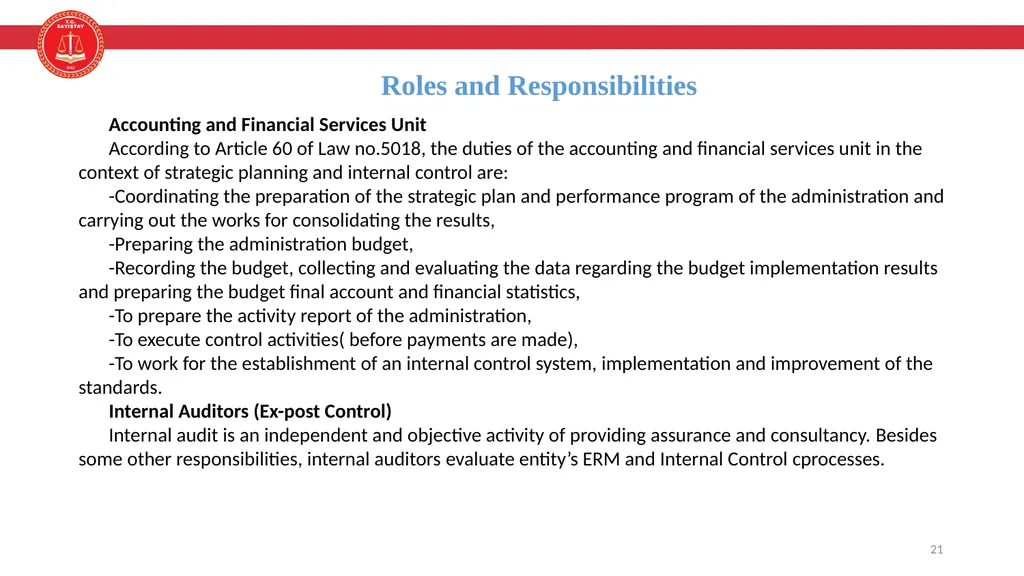
Roles and Responsibilities 21 Accounting and Financial Services Unit
According to Article 60 of Law no.5018, the duties of the accounting and financial services unit in the context of strategic planning and internal control are:
-Coordinating the preparation of the strategic plan and performance program of the administration and carrying out the works for consolidating the results,
-Preparing the administration budget,
-Recording the budget, collecting and evaluating the data regarding the budget implementation results and preparing the budget final account and financial statistics,
-To prepare the activity report of the administration,
-To execute control activities( before payments are made),
-To work for the establishment of an internal control system, implementation and improvement of the standards.
Internal Auditors (Ex-post Control)
Internal audit is an independent and objective activity of providing assurance and consultancy. Besides some other responsibilities, internal auditors evaluate entity’s ERM and Internal Control cprocesses.<br>
According to Article 60 of Law no.5018, the duties of the accounting and financial services unit in the context of strategic planning and internal control are:
-Coordinating the preparation of the strategic plan and performance program of the administration and carrying out the works for consolidating the results,
-Preparing the administration budget,
-Recording the budget, collecting and evaluating the data regarding the budget implementation results and preparing the budget final account and financial statistics,
-To prepare the activity report of the administration,
-To execute control activities( before payments are made),
-To work for the establishment of an internal control system, implementation and improvement of the standards.
Internal Auditors (Ex-post Control)
Internal audit is an independent and objective activity of providing assurance and consultancy. Besides some other responsibilities, internal auditors evaluate entity’s ERM and Internal Control cprocesses.<br>
22
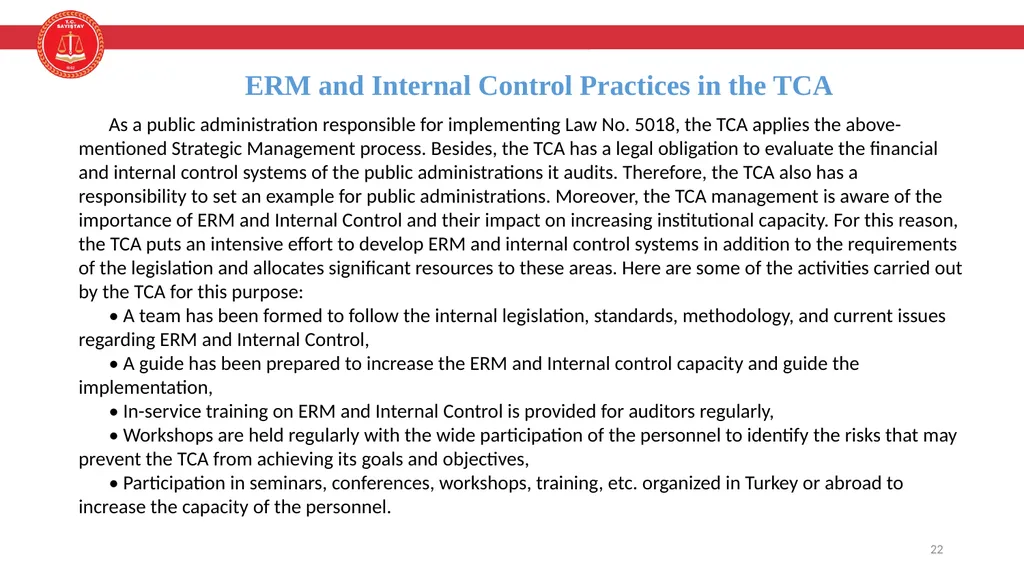
ERM and Internal Control Practices in the TCA 22 As a public administration responsible for implementing Law No. 5018, the TCA applies the above-mentioned Strategic Management process. Besides, the TCA has a legal obligation to evaluate the financial and internal control systems of the public administrations it audits. Therefore, the TCA also has a responsibility to set an example for public administrations. Moreover, the TCA management is aware of the importance of ERM and Internal Control and their impact on increasing institutional capacity. For this reason, the TCA puts an intensive effort to develop ERM and internal control systems in addition to the requirements of the legislation and allocates significant resources to these areas. Here are some of the activities carried out by the TCA for this purpose:
• A team has been formed to follow the internal legislation, standards, methodology, and current issues regarding ERM and Internal Control,
• A guide has been prepared to increase the ERM and Internal control capacity and guide the implementation,
• In-service training on ERM and Internal Control is provided for auditors regularly,
• Workshops are held regularly with the wide participation of the personnel to identify the risks that may prevent the TCA from achieving its goals and objectives,
• Participation in seminars, conferences, workshops, training, etc. organized in Turkey or abroad to increase the capacity of the personnel.<br>
• A team has been formed to follow the internal legislation, standards, methodology, and current issues regarding ERM and Internal Control,
• A guide has been prepared to increase the ERM and Internal control capacity and guide the implementation,
• In-service training on ERM and Internal Control is provided for auditors regularly,
• Workshops are held regularly with the wide participation of the personnel to identify the risks that may prevent the TCA from achieving its goals and objectives,
• Participation in seminars, conferences, workshops, training, etc. organized in Turkey or abroad to increase the capacity of the personnel.<br>
23
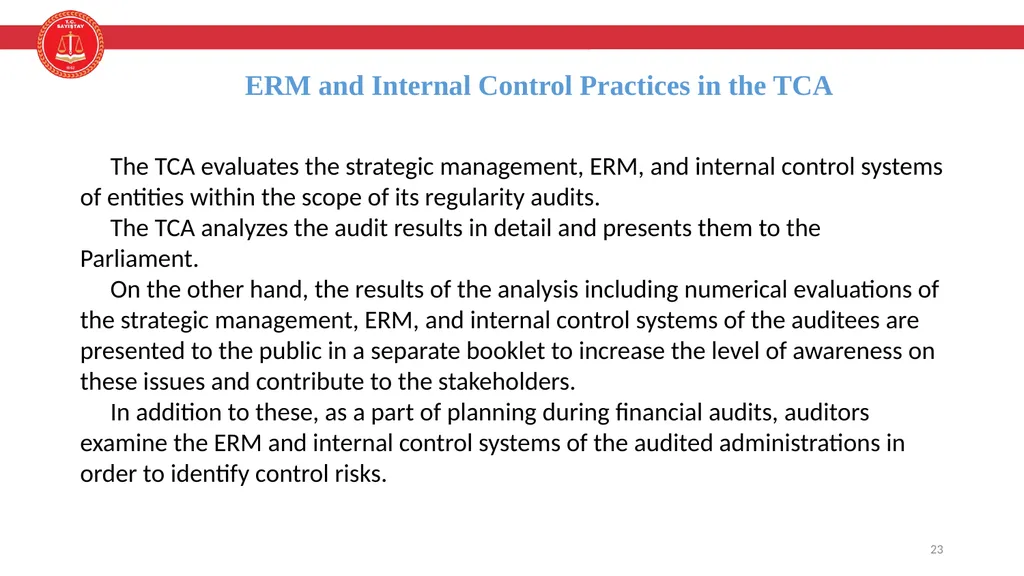
ERM and Internal Control Practices in the TCA 23 The TCA evaluates the strategic management, ERM, and internal control systems of entities within the scope of its regularity audits.
The TCA analyzes the audit results in detail and presents them to the Parliament.
On the other hand, the results of the analysis including numerical evaluations of the strategic management, ERM, and internal control systems of the auditees are presented to the public in a separate booklet to increase the level of awareness on these issues and contribute to the stakeholders.
In addition to these, as a part of planning during financial audits, auditors examine the ERM and internal control systems of the audited administrations in order to identify control risks.<br>
The TCA analyzes the audit results in detail and presents them to the Parliament.
On the other hand, the results of the analysis including numerical evaluations of the strategic management, ERM, and internal control systems of the auditees are presented to the public in a separate booklet to increase the level of awareness on these issues and contribute to the stakeholders.
In addition to these, as a part of planning during financial audits, auditors examine the ERM and internal control systems of the audited administrations in order to identify control risks.<br>
24
Thank You 24<br>