
Entrepreneurship & Business Management N6
SN
Published · 49 slides · 0 views

1 / 1
Description
Entrepreneurship Business Management N6 www.futuremanagers.com INTRODUCTION There are certain specific characteristics that high-performing companies have which separate them from low-performing companies: There is a clear sense of
Related Topics
Share
Embed code
Download this presentation From Below
"Entrepreneurship & Business Management N6" is the property of its rightful owner. Permission is granted to download and print the materials on this website for personal, non-commercial use only, and to display it on your personal computer provided you do not modify the materials and that you retain all copyright notices contained in the materials. By downloading content from our website, you accept the terms of this agreement.
Presentation Transcript
01
Entrepreneurship & Business Management N6<br>
02
www.futuremanagers.com INTRODUCTION
There are certain specific characteristics that high-performing companies have which separate them from low-performing companies:
There is a clear sense of direction;
There is an abundance of skilled entrepreneurship;
Managers are committed to having a good strategic action plan;
Management is results-orientated and performance conscious; and
Managers are strongly involved in implementing the chosen strategy. Chapter 1: Strategic planning in your business<br>
03
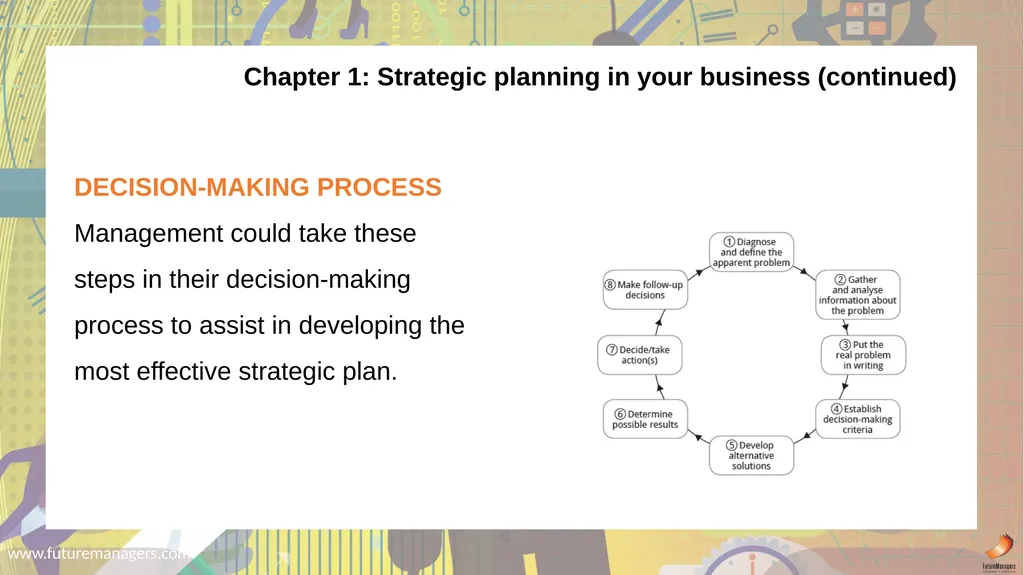
www.futuremanagers.com Chapter 1: Strategic planning in your business (continued) DECISION-MAKING PROCESS
Management could take these steps in their decision-making process to assist in developing the most effective strategic plan.<br>
04
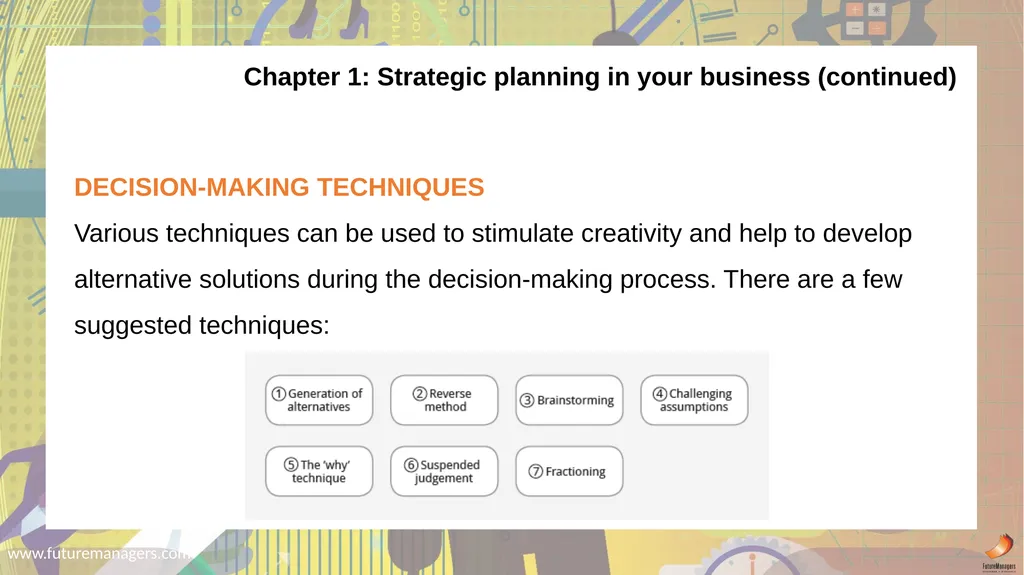
www.futuremanagers.com Chapter 1: Strategic planning in your business (continued) DECISION-MAKING TECHNIQUES
Various techniques can be used to stimulate creativity and help to develop alternative solutions during the decision-making process. There are a few suggested techniques:<br>
05
www.futuremanagers.com INTRODUCTION
There are more than 1 million small, medium and micro-enterprises in the country, employing almost half of the labour force. These enterprises include:
Survivalist enterprises;
Micro-enterprises;
Small enterprises; and
Medium enterprises. Chapter 2: Dynamic business environment<br>
06
www.futuremanagers.com Chapter 2: Dynamic business environment (continued) THE GROWTH IN ENTREPRENEURSHIP
There is a growing awareness that people have to create their own jobs to become economically viable. This has led to a large increase in the creation of various types of small businesses and a strong emphasis on the development of Entrepreneurship. The growth in Entrepreneurship plays a critical role in the economic development of the country.<br>
07
www.futuremanagers.com Chapter 2: Dynamic business environment (continued) ENTREPRENEURIAL PROFILES
There is a large variety of entrepreneurs who have made a success of their specific enterprises. Broad categories of entrepreneurial profiles include: Women entrepreneurs;
Part-time entrepreneurs;
Home-based entrepreneurs;
Family business owners;
Copreneurs; and
Intrapreneurs.<br>
08
www.futuremanagers.com Chapter 2: Dynamic business environment (continued) THE POWER OF SMALL BUSINESS
Small businesses are vitally important because:
They constitute more than 90% of the businesses in South Africa;
They create most of the new job opportunities;
They take the initiative and create innovative ideas;
They serve as a manifestation of the free market system;
They are flexible and adaptable; and
• They provide access to the business world for many people.<br>
09
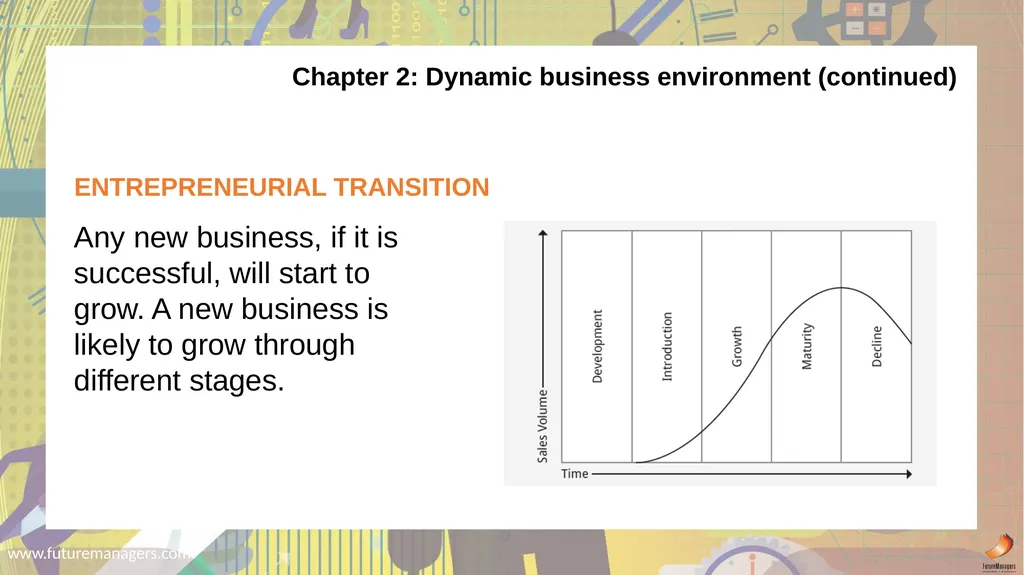
www.futuremanagers.com Chapter 2: Dynamic business environment (continued) ENTREPRENEURIAL TRANSITION Any new business, if it is successful, will start to grow. A new business is likely to grow through different stages.<br>
10
www.futuremanagers.com Chapter 2: Dynamic business environment (continued) CHANGE
Organisations are influenced by economic, political, technological, climatic and various other changes. There are reasons for the benefits of change for a business:
Competition;
Government;
Employees; and
Environment.<br>
11
www.futuremanagers.com INTRODUCTION
A company’s mission is the vision a manager has of what his or her business is trying to do and to become in the future. A mission statement indicates the route the company is going to follow in future. Chapter 3: Implementation of strategic planning in your business<br>
12
www.futuremanagers.com Chapter 3: Implementation of strategic planning in your business (continued) BUSINESS STRATEGY
Strategies guide companies on how to achieve long-term objectives and how to strive towards the company’s mission. Strategies indicate how to reach performance targets, how to compete successfully against rivals, and how to obtain a competitive advantage. Implementing a strategy is the beginning of an ongoing process in business management.<br>
13
www.futuremanagers.com Chapter 3: Implementation of strategic planning in your business (continued) STRATEGY IMPLEMENTATION
There are several factors that will influence implementation of strategies:
Buy-in from workforce;
Sufficient resources;
Existing structures, policies and procedures; and
Incentives.<br>
14
www.futuremanagers.com INTRODUCTION
An industry competitive analysis refers to the external situational analysis of a single-business company. It looks at the macro-environment of the business; analyses the overall position of an industry and then makes decisions whether the industry is an attractive option. Chapter 4: Competitive analysis<br>
15
www.futuremanagers.com Chapter 4: Competitive analysis (continued) DOMINANT ECONOMIC CHARACTERISTICS
There are certain basic factors to consider when you want to identify the primary economic features of a specific industry, such as the: Size of the market;
Scope of competition;
Market growth rate;
Number of competitors;
Number of buyers;
Capital requirements;
Industry probability; and
Rapid technology change.<br>
16
www.futuremanagers.com Chapter 4: Competitive analysis (continued) DRIVING FORCES
There are forces in motion that create incentives or pressures for change. These are the driving forces. They have the biggest influence on the kind of changes that will take place in an industry and its environment.<br>
17
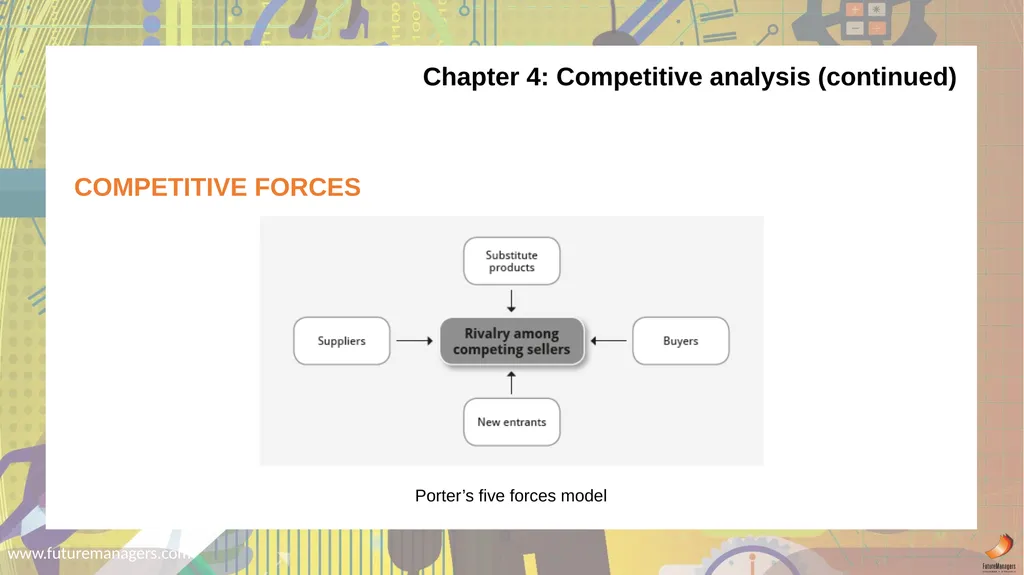
www.futuremanagers.com Porter’s five forces model Chapter 4: Competitive analysis (continued) COMPETITIVE FORCES Porter’s five forces model<br>
18
www.futuremanagers.com Chapter 4: Competitive analysis (continued) KEY SUCCESS FACTORS
Key success factors are those things that are critical for a business to succeed. These are:
Managing and developing people;
Strategic focus;
Effective operations;
Physical resources; and
Customer relations.<br>
19
www.futuremanagers.com INTRODUCTION
A company achieves a competitive advantage when its business strategy succeeds in making its product or service more attractive than those of other companies. Chapter 5: Strategy and competitive advantage<br>
20
www.futuremanagers.com Chapter 5: Strategy and competitive advantage (continued) GENERIC COMPETITIVE STRATEGIES
There are three generic approaches to competitive strategy that stand out:
Striving to be the low-cost producer;
Differentiation of your product from a rival’s products; and
Focusing on a narrow portion of the market, rather than going for the whole market.<br>
21
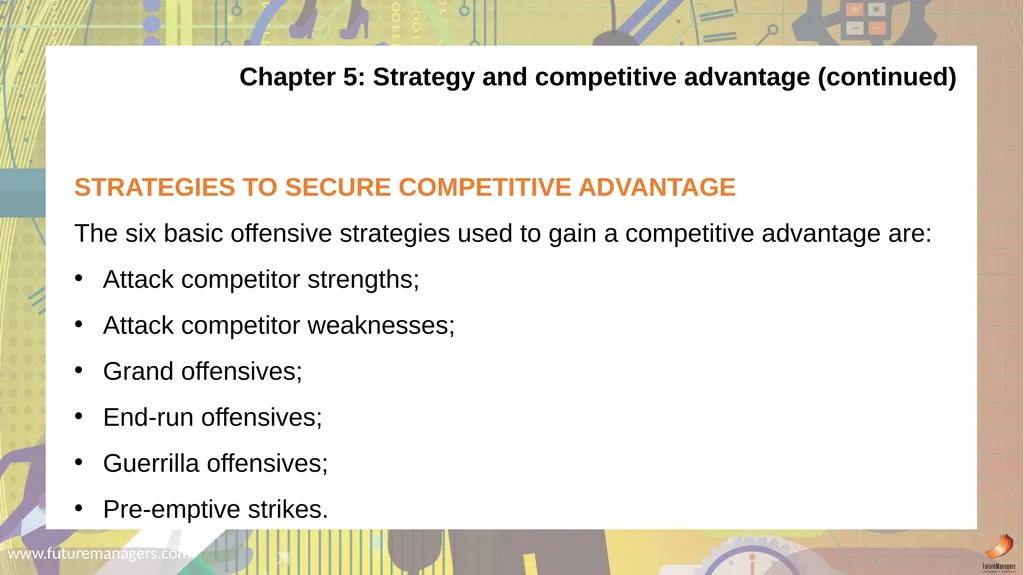
www.futuremanagers.com Chapter 5: Strategy and competitive advantage (continued) STRATEGIES TO SECURE COMPETITIVE ADVANTAGE
The six basic offensive strategies used to gain a competitive advantage are:
Attack competitor strengths;
Attack competitor weaknesses;
Grand offensives;
End-run offensives;
Guerrilla offensives;
Pre-emptive strikes.<br>
22
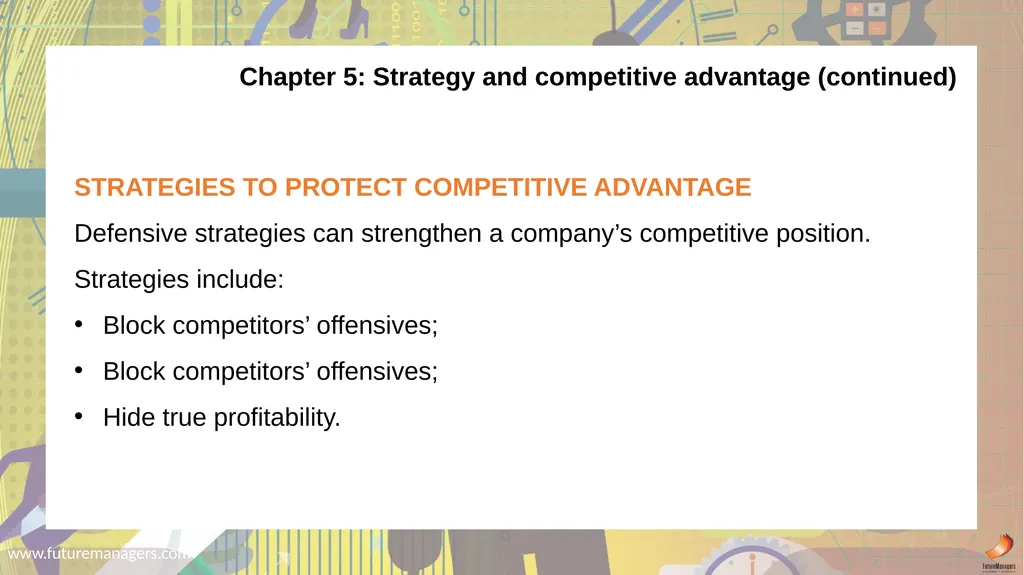
www.futuremanagers.com Chapter 5: Strategy and competitive advantage (continued) STRATEGIES TO PROTECT COMPETITIVE ADVANTAGE
Defensive strategies can strengthen a company’s competitive position. Strategies include:
Block competitors’ offensives;
Block competitors’ offensives;
Hide true profitability.<br>
23
www.futuremanagers.com INTRODUCTION
When an entrepreneur has decided to start his or her own business, /she can decide to start a business from scratch, buy an existing business or buy into
a franchise operation. Many people may go for the option of buying
an existing business. Chapter 6: Buying an existing business<br>
24
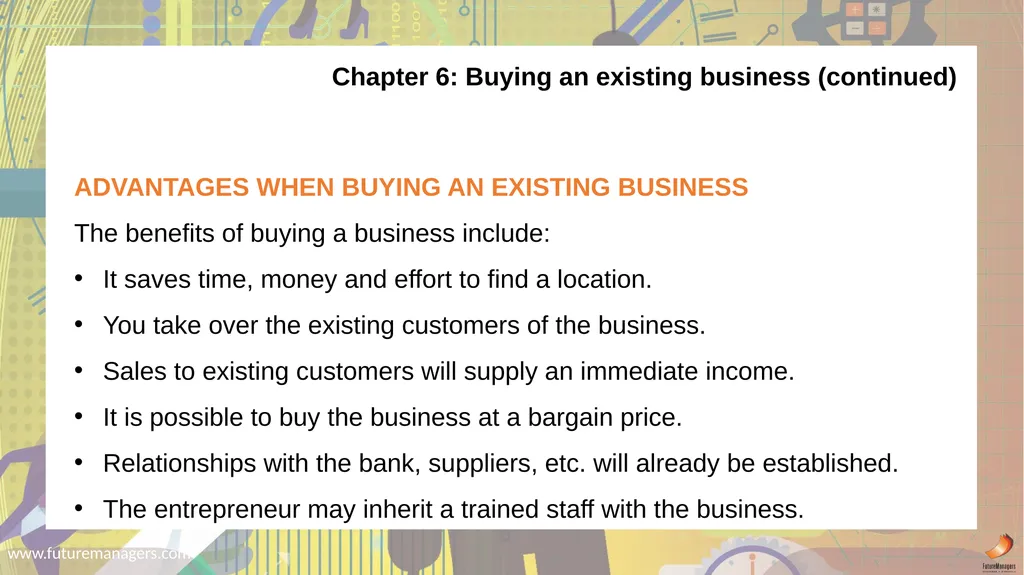
www.futuremanagers.com Chapter 6: Buying an existing business (continued) ADVANTAGES WHEN BUYING AN EXISTING BUSINESS
The benefits of buying a business include:
It saves time, money and effort to find a location.
You take over the existing customers of the business.
Sales to existing customers will supply an immediate income.
It is possible to buy the business at a bargain price.
Relationships with the bank, suppliers, etc. will already be established.
The entrepreneur may inherit a trained staff with the business.<br>
25
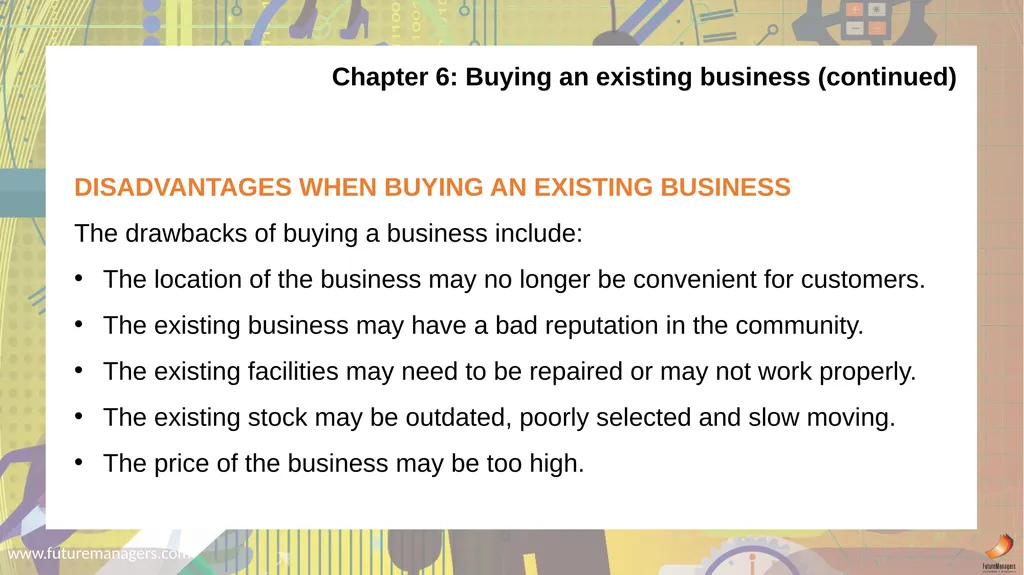
www.futuremanagers.com Chapter 6: Buying an existing business (continued) DISADVANTAGES WHEN BUYING AN EXISTING BUSINESS
The drawbacks of buying a business include:
The location of the business may no longer be convenient for customers.
The existing business may have a bad reputation in the community.
The existing facilities may need to be repaired or may not work properly.
The existing stock may be outdated, poorly selected and slow moving.
The price of the business may be too high.<br>
26
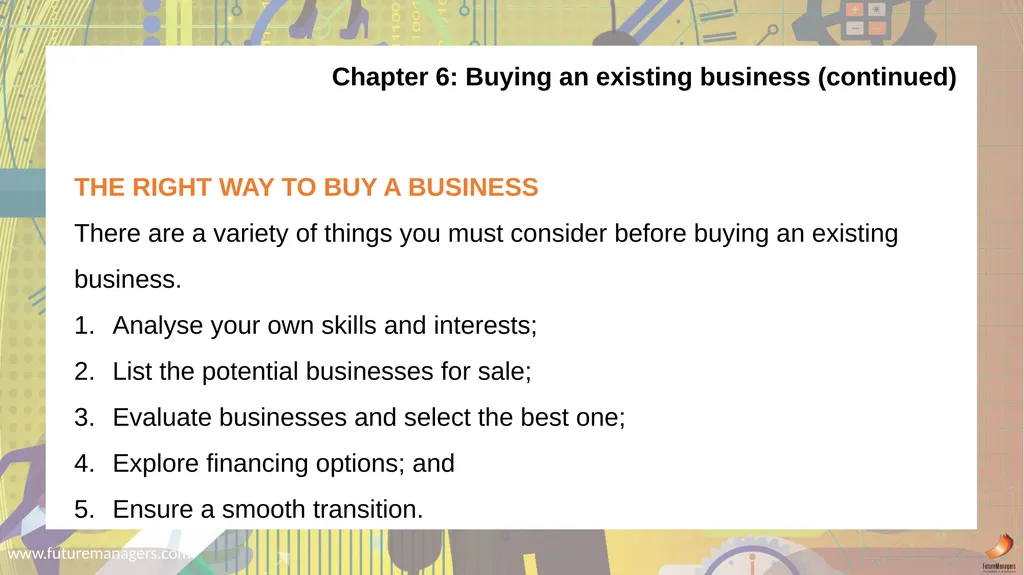
www.futuremanagers.com Chapter 6: Buying an existing business (continued) THE RIGHT WAY TO BUY A BUSINESS
There are a variety of things you must consider before buying an existing business.
Analyse your own skills and interests;
List the potential businesses for sale;
Evaluate businesses and select the best one;
Explore financing options; and
Ensure a smooth transition.<br>
27
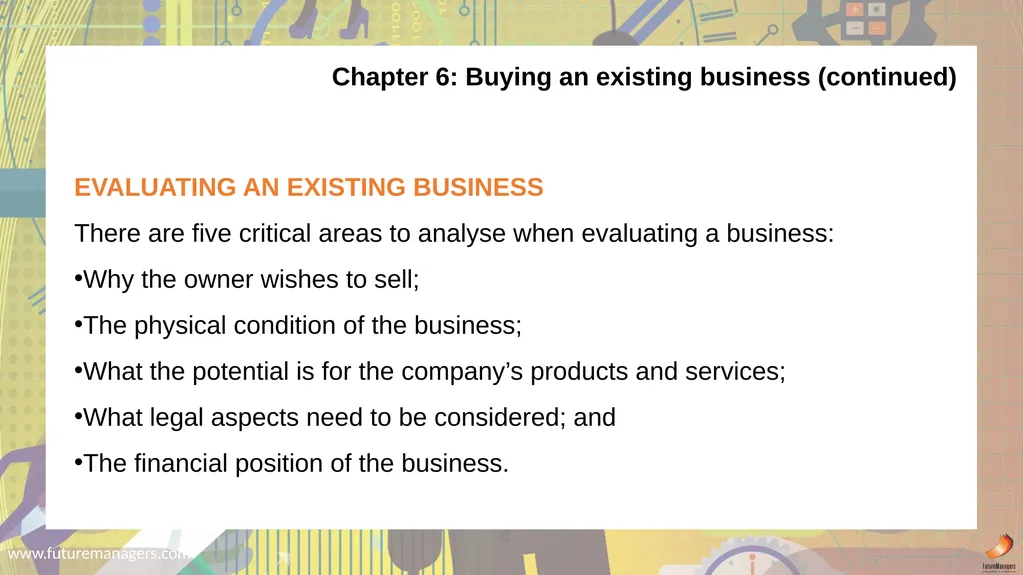
www.futuremanagers.com Chapter 6: Buying an existing business (continued) EVALUATING AN EXISTING BUSINESS
There are five critical areas to analyse when evaluating a business:
Why the owner wishes to sell;
The physical condition of the business;
What the potential is for the company’s products and services;
What legal aspects need to be considered; and
The financial position of the business.<br>
28
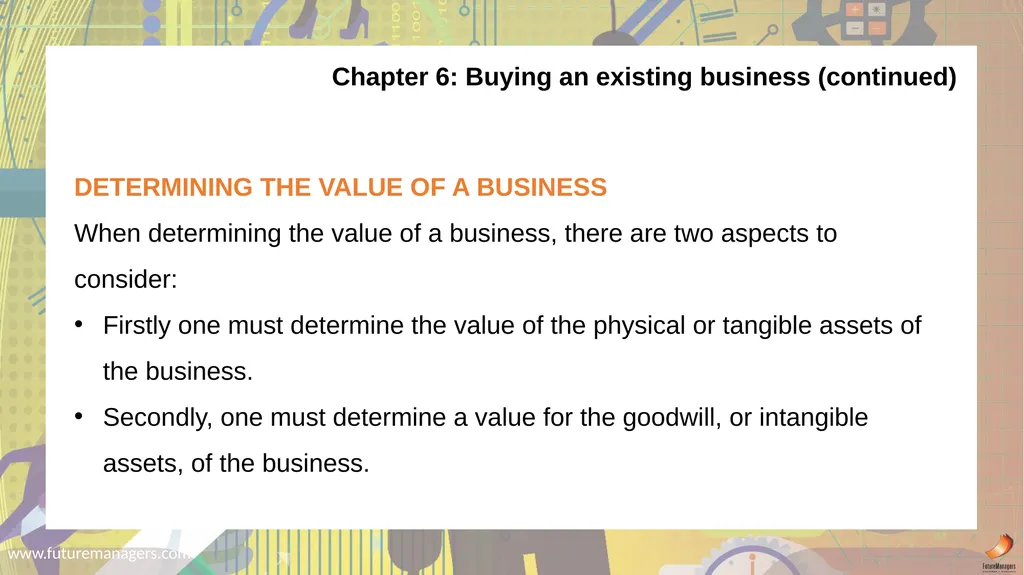
www.futuremanagers.com Chapter 6: Buying an existing business (continued) DETERMINING THE VALUE OF A BUSINESS
When determining the value of a business, there are two aspects to consider:
Firstly one must determine the value of the physical or tangible assets of the business.
Secondly, one must determine a value for the goodwill, or intangible assets, of the business.<br>
29
www.futuremanagers.com INTRODUCTION
Franchising can be defined as the marketing system which revolves around a mutual agreement whereby one party is granted the privilege of conducting business as an individual business owner but is required to operate according to certain methods and terms specified by the other party. Chapter 7: Franchising<br>
30
www.futuremanagers.com Chapter 7: Franchising (continued) FRANCHISING AS BUSINESS OPTION
The franchise agreement works as follows:
A company which runs a successful business grants another person the right to sell the same goods and services according to its guidelines.The goods and services are already well known in the marketplace and the franchisee can rely on the franchising company for advertising and promotion.<br>
31
www.futuremanagers.com Chapter 7: Franchising (continued) TYPES OF FRANCHISING
There are four basic types of franchising systems:
Manufacturer – retailer;
Manufacturer – wholesaler;
Wholesaler – retailer; and
Service/trademark holder – retailer.<br>
32
www.futuremanagers.com Chapter 7: Franchising (continued) ADVANTAGES OF FRANCHISING
The benefits of franchising include:
Many franchise systems have developed good training programmes.
The business will open with a well-established name.
The franchisee will need less capital to start up than starting his/her own business from scratch.
The franchisee gets the benefits of the franchisor’s advertising and promotional efforts on a national and/or regional scale.<br>
33
www.futuremanagers.com Chapter 7: Franchising (continued) DISADVANTAGES OF FRANCHISING
The drawbacks of franchising include:
The franchisor will control the quality of the franchisee’s business.
The franchisee must pay the franchisor for the services provided and for the use of the company name.
The franchisee will not be able to sell the franchised business to anybody without the approval of the franchisor
Certain policies may affect the profitability of the franchisee.<br>
34
www.futuremanagers.com Chapter 7: Franchising (continued) GETTING TO KNOW THE FRANCHISE BUSINESS
Before getting into a franchise business, get to know details on:
The franchisor;
The franchise concept;
Operational details;
Franchise fees;
Franchise contract; and
Franchise agreement.<br>
35
www.futuremanagers.com Chapter 7: Franchising (continued) FRANCHISE ASSOCIATION OF SOUTH AFRICA (FASA)
FASA is a voluntary body created in order to regulate the franchise industry in South Africa.<br>
36
www.futuremanagers.com INTRODUCTION
International trade can broadly be defined as the exchange of goods and services between two countries or political entities.
The South African Government through its Department of Trade and Industry encourages foreign trade through a variety of initiatives. Chapter 8: International Business Plan<br>
37
www.futuremanagers.com Chapter 8: International Business Plan (continued) THE ROLE OF GOVERNMENT IN INTERNATIONAL TRADE
It is in a government’s interest to support and encourage trade with other countries. There are several reasons why:
It leads to an expansion of the economy;
Money comes into the country, which means better balances of payments;
It creates employment;
New technology and knowledge are imported;
Additional taxes are generated through tariffs that are levied on imports.<br>
38
www.futuremanagers.com Chapter 8: International Business Plan (continued) INTERNATIONAL MARKETING
Marketing consists of activities that are aimed at offering products and services to satisfy the needs of customers. International marketing involves the same process but takes place across national boundaries.<br>
39
www.futuremanagers.com Chapter 8: International Business Plan (continued) THE INTERNATIONAL MARKETING ENVIRONMENT
A company needs to do a lot of research specific country before deciding on an export destination. It is important to understand:
A country’s economic situation;
The culture of the country; and
Any political and legal issues in the country.<br>
40
www.futuremanagers.com Chapter 8: International Business Plan (continued) MARKETING INFORMATION
It is important for a company to research marketing information regarding a country which might be an export potential. There are three basic sources of information for the exporter:
Secondary or published information;
Knowledgeable individuals within the market; and
Personal investigation.<br>
41
www.futuremanagers.com INTRODUCTION
Consultancies can mean two things to a prospective entrepreneur or small business owner:
Firstly, consulting can be a possible business option for the person who has skills and knowledge;
Secondly, if a person has started a business already, consultancies can help him to run the business effectively Chapter 9: Consultancy<br>
42
www.futuremanagers.com Chapter 9: Consultancy (continued) FUNCTIONS OF A CONSULTANT
The consultant analyses the problems in the small business.
The consultant advises the client on alternative ways to solve a problem.
The consultant is a teacher and instructor who uses his knowledge and experience to open up a new field of systems, methods and thoughts for the entrepreneur.
The consultant is also an initiator and innovator. He initiates change and renewal in a business to find solutions for specific problems.<br>
43
www.futuremanagers.com Chapter 9: Consultancy (continued) CONSULTANCY OPPORTUNITIES
The four main categories of consultancy types which offer consultancy opportunities are:
Personal consultants;
Business consultants;
Technical consultants; and
Executive consultants.<br>
44
www.futuremanagers.com Chapter 9: Consultancy (continued) MERITS OF CONSULTANCIES
There are benefits in consulting: Advantages:
Challenging career;
Varied work assignments;
You can employ your skills, talents and abilities to the fullest;
You don’t have to follow an 8-to-5;
The satisfaction of helping others;
It can be very rewarding financially; and
Exciting opportunities may open up for the consultant.<br>
45
www.futuremanagers.com Chapter 9: Consultancy (continued) MERITS OF CONSULTANCIES
There are also drawbacks in consulting: Disadvantages:
Irregular living conditions on certain occasions (long work days and days away from home);
Tremendous job stress and pressures in certain situations
Stress in finding clients; and
No long-term job security.<br>
46
www.futuremanagers.com Chapter 9: Consultancy (continued) CONTRACTORS AND SUB-CONTRACTORS
A contractor takes responsibility for a specific job and has control over the job contract.
The sub-contractor is a person or company who does a specific part or aspect of a job for the main contractor. His contract is therefore with the contractor and not with the final consumer.<br>
47
www.futuremanagers.com MARKETING PLAN
There are main components of marketing:
Identify the target market;
Determine the needs and wants of this market;
Develop a suitable product range;
Promote and sell the product/service;
Distribute the product; and
Provide after-sales service. Chapter 10: Overview of a Business Plan<br>
48
www.futuremanagers.com Chapter 10: Overview of a Business Plan (continued) FINANCIAL PLAN
Performing a financial feasibility study helps determine whether or not a business idea is a good one. Important questions that one should be able to answer are:
What are the costs involved in my business and how can I finance them?
What is profit, how is it calculated, and will I make a profit?
How much are my products actually costing?
How much are my competitors charging for the same product?<br>
49
www.futuremanagers.com Chapter 10: Overview of a Business Plan (continued) FUNDING OPTIONS TO START YOUR BUSINESS
A business owner could find funding from:
Personal funds;
Friends and relatives;
Equity shares; and
Loans.<br>