
Environmental Education EDU 211 Topic-Disaster

Description: Environmental Education EDU 211 Topic-Disaster Management : Role of Educational Institutions and Teachers Dr. Razia B Assistant Professor Department of Education Aligarh Muslim University Aligarh, Uttar Pradesh , India Dr.Razia B, AMU
Related Topics
Download Presentation
"Environmental Education EDU 211 Topic-Disaster" is the property of its rightful owner. Permission is granted to download and print the materials on this website for personal, non-commercial use only, and to display it on your personal computer provided you do not modify the materials and that you retain all copyright notices contained in the materials. By downloading content from our website, you accept the terms of this agreement.
Presentation Transcript
slide1. Environmental Education
EDU 211
Topic-Disaster Management : Role of Educational Institutions and Teachers Dr. Razia B
Assistant Professor
Department of Education
Aligarh Muslim University
Aligarh, Uttar Pradesh , India Dr.Razia B, AMU<br>
slide2. Intended Learning Outcomes By the end of this Lesson, the learners will be able to
Define the term -Disaster
Differentiate between Natural and Manmade Disaster
Highlight the adverse impact of a disaster on earth
Explain disaster management in detail
Elaborate the steps of disaster cycle
Discuss the role of Educational Institutions in Disaster Management
Discuss the vital role of teachers in Disaster Management Dr.Razia B, AMU<br>
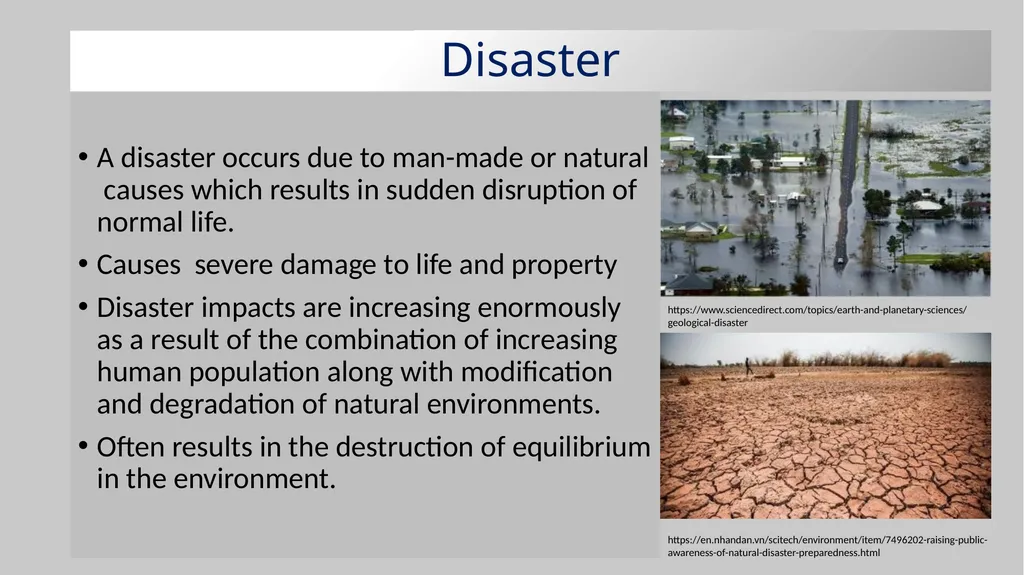
slide3. Disaster A disaster occurs due to man-made or natural causes which results in sudden disruption of normal life.
Causes severe damage to life and property
Disaster impacts are increasing enormously as a result of the combination of increasing human population along with modification and degradation of natural environments.
Often results in the destruction of equilibrium in the environment. https://www.sciencedirect.com/topics/earth-and-planetary-sciences/geological-disaster https://en.nhandan.vn/scitech/environment/item/7496202-raising-public-awareness-of-natural-disaster-preparedness.html Dr.Razia B, AMU<br>
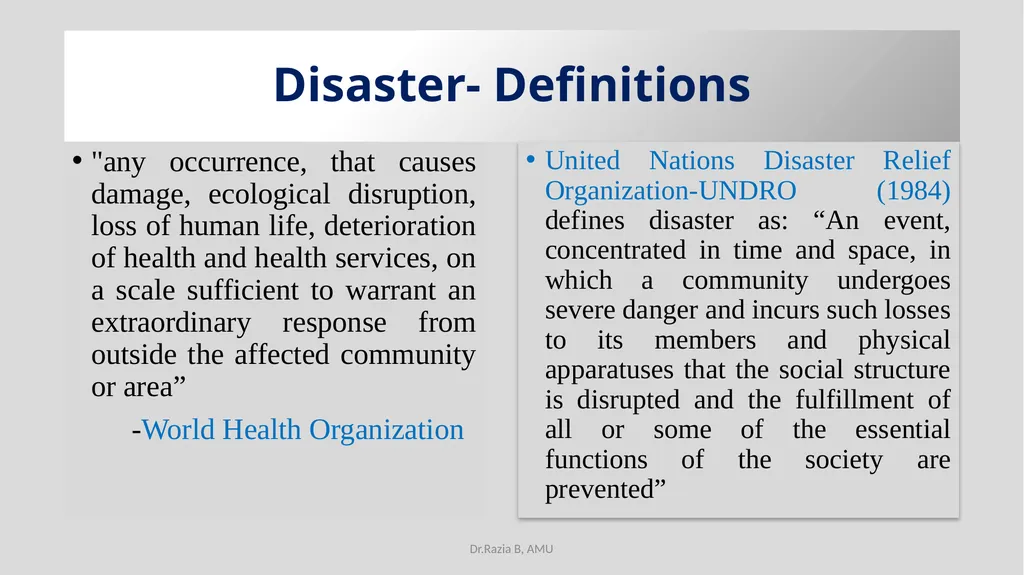
slide4. Disaster- Definitions "any occurrence, that causes damage, ecological disruption, loss of human life, deterioration of health and health services, on a scale sufficient to warrant an extraordinary response from outside the affected community or area”
-World Health Organization United Nations Disaster Relief Organization-UNDRO (1984) defines disaster as: “An event, concentrated in time and space, in which a community undergoes severe danger and incurs such losses to its members and physical apparatuses that the social structure is disrupted and the fulfillment of all or some of the essential functions of the society are prevented” Dr.Razia B, AMU<br>
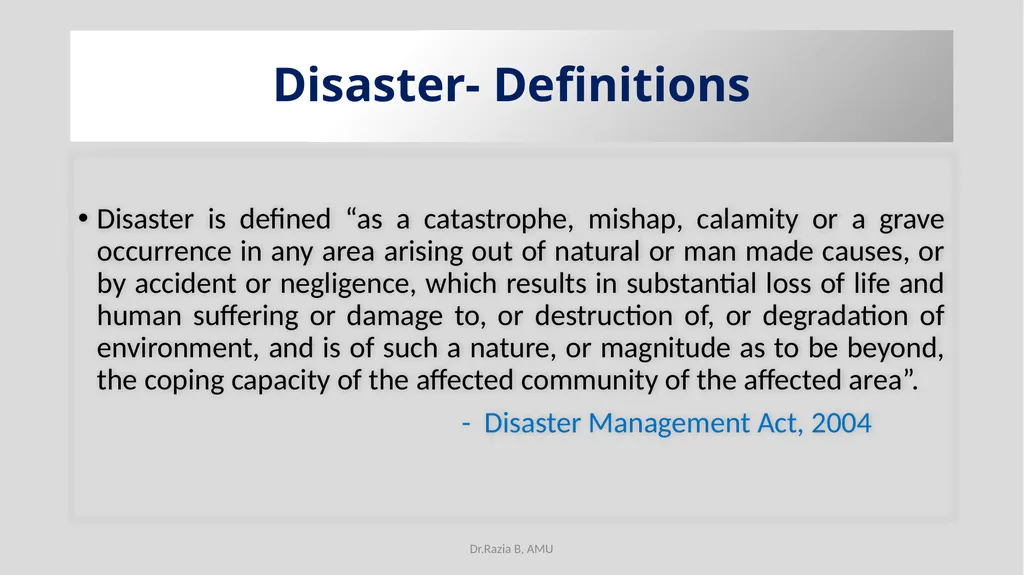
slide5. Disaster- Definitions Disaster is defined “as a catastrophe, mishap, calamity or a grave occurrence in any area arising out of natural or man made causes, or by accident or negligence, which results in substantial loss of life and human suffering or damage to, or destruction of, or degradation of environment, and is of such a nature, or magnitude as to be beyond, the coping capacity of the affected community of the affected area”.
- Disaster Management Act, 2004 Dr.Razia B, AMU<br>
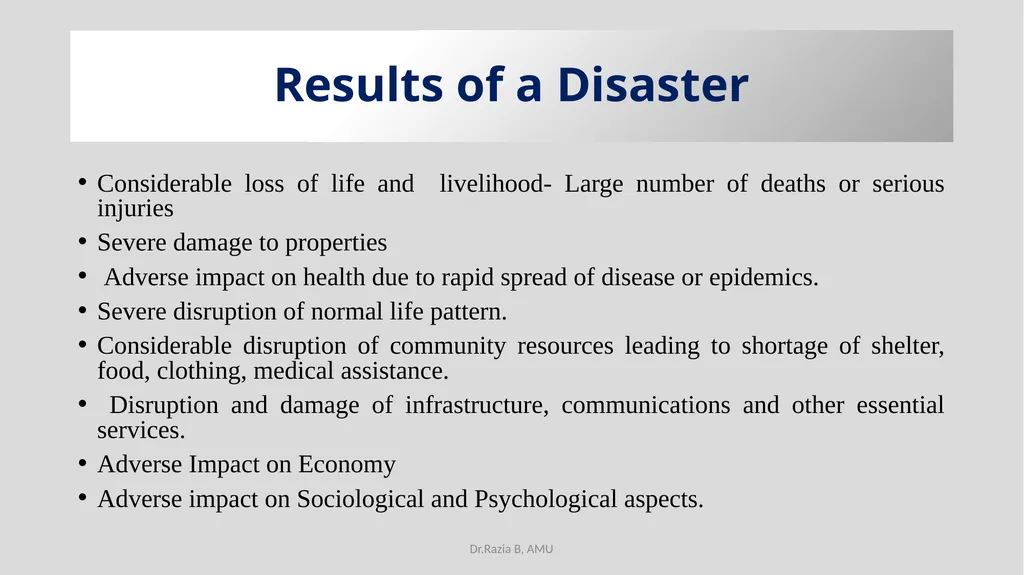
slide6. Results of a Disaster Considerable loss of life and livelihood- Large number of deaths or serious injuries
Severe damage to properties
Adverse impact on health due to rapid spread of disease or epidemics.
Severe disruption of normal life pattern.
Considerable disruption of community resources leading to shortage of shelter, food, clothing, medical assistance.
Disruption and damage of infrastructure, communications and other essential services.
Adverse Impact on Economy
Adverse impact on Sociological and Psychological aspects. Dr.Razia B, AMU<br>
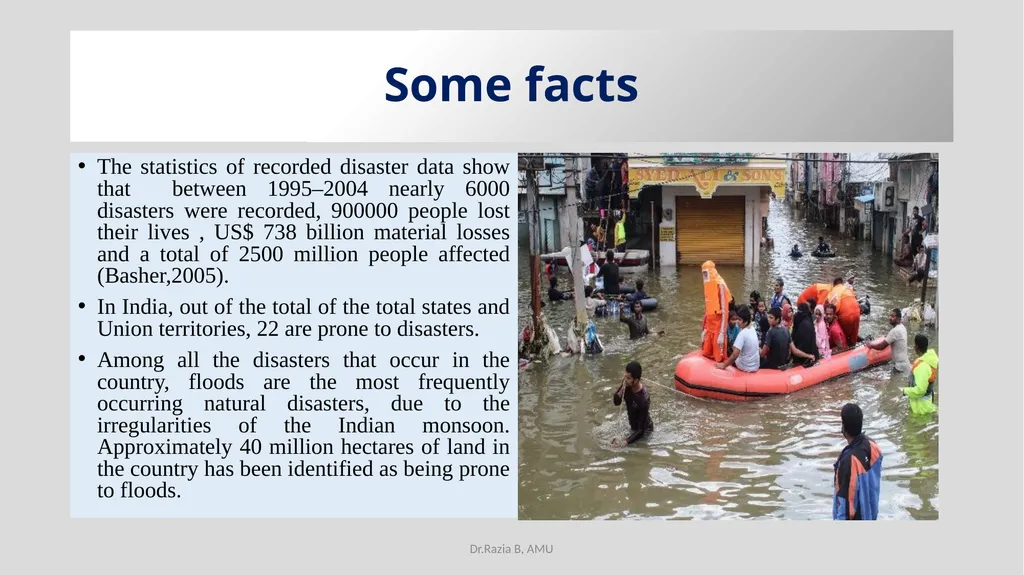
slide7. Some facts The statistics of recorded disaster data show that between 1995–2004 nearly 6000 disasters were recorded, 900000 people lost their lives , US$ 738 billion material losses and a total of 2500 million people affected (Basher,2005).
In India, out of the total of the total states and Union territories, 22 are prone to disasters.
Among all the disasters that occur in the country, floods are the most frequently occurring natural disasters, due to the irregularities of the Indian monsoon. Approximately 40 million hectares of land in the country has been identified as being prone to floods. Dr.Razia B, AMU<br>
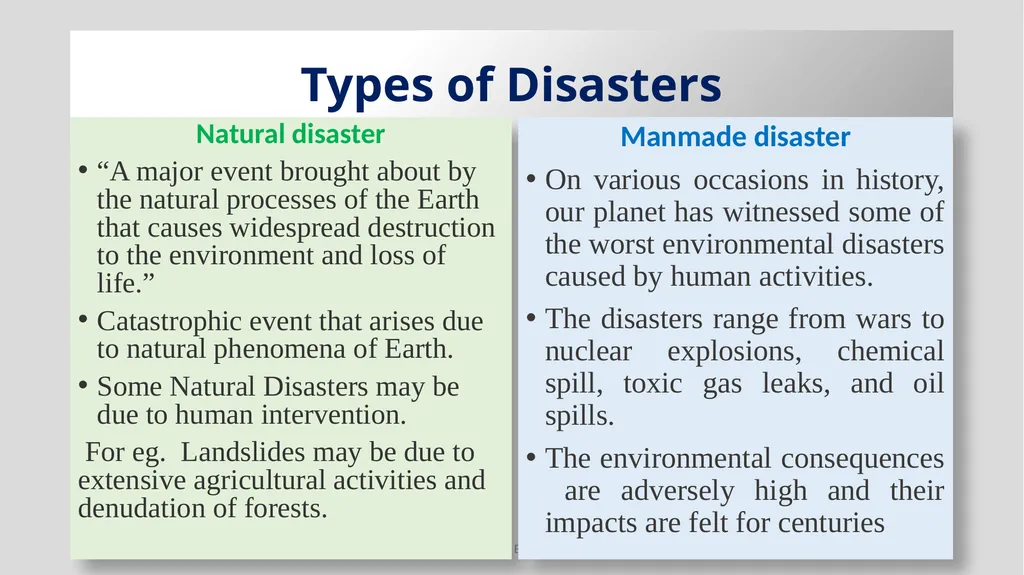
slide8. Types of Disasters Natural disaster
“A major event brought about by the natural processes of the Earth that causes widespread destruction to the environment and loss of life.”
Catastrophic event that arises due to natural phenomena of Earth.
Some Natural Disasters may be due to human intervention.
For eg. Landslides may be due to extensive agricultural activities and denudation of forests. Manmade disaster
On various occasions in history, our planet has witnessed some of the worst environmental disasters caused by human activities.
The disasters range from wars to nuclear explosions, chemical spill, toxic gas leaks, and oil spills.
The environmental consequences are adversely high and their impacts are felt for centuries Dr.Razia B, AMU<br>
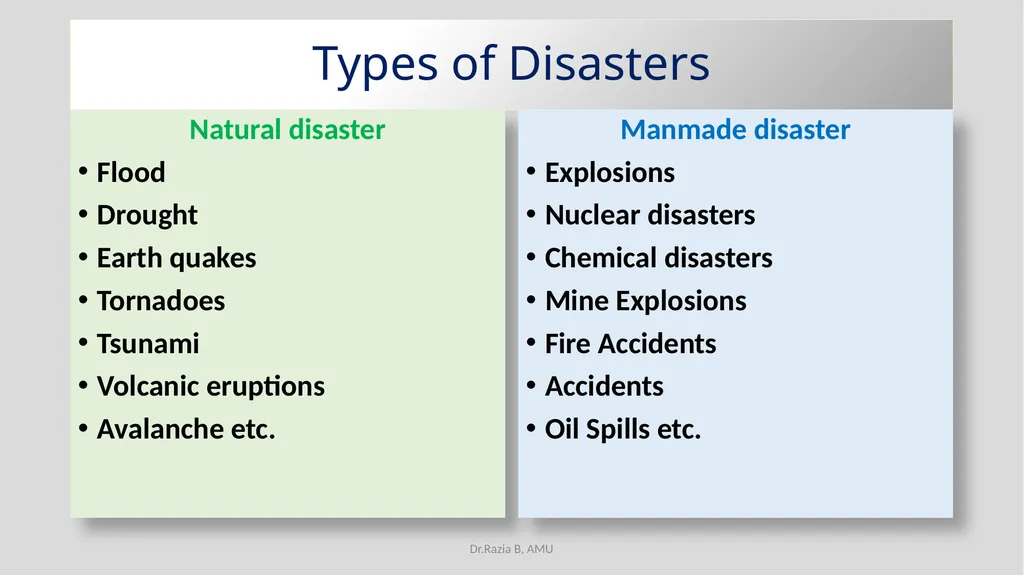
slide9. Types of Disasters Natural disaster
Flood
Drought
Earth quakes
Tornadoes
Tsunami
Volcanic eruptions
Avalanche etc. Manmade disaster
Explosions
Nuclear disasters
Chemical disasters
Mine Explosions
Fire Accidents
Accidents
Oil Spills etc. Dr.Razia B, AMU<br>
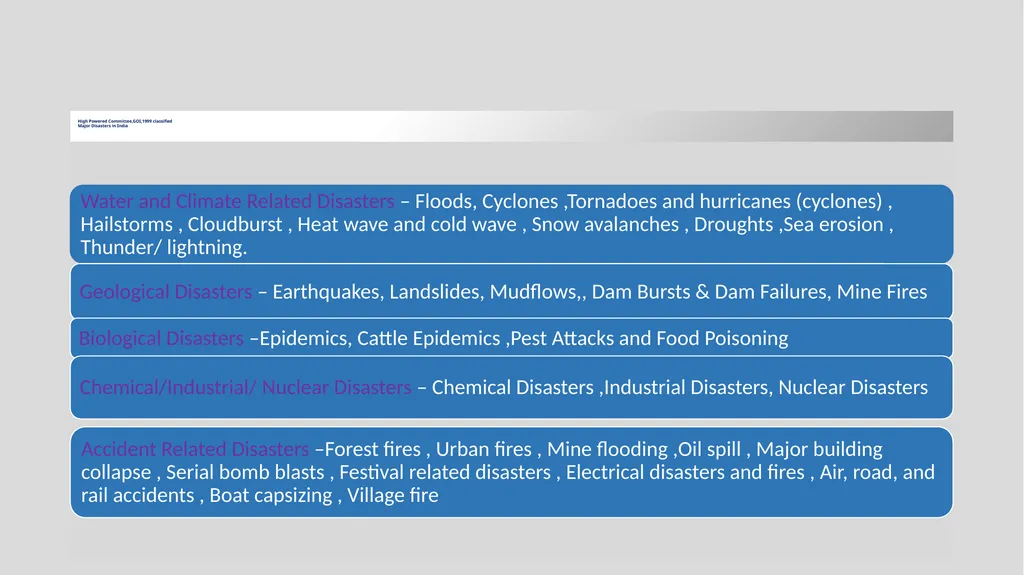
slide10. High Powered Committee,GOI,1999 classified Major Disasters in India Dr.Razia B, AMU<br>
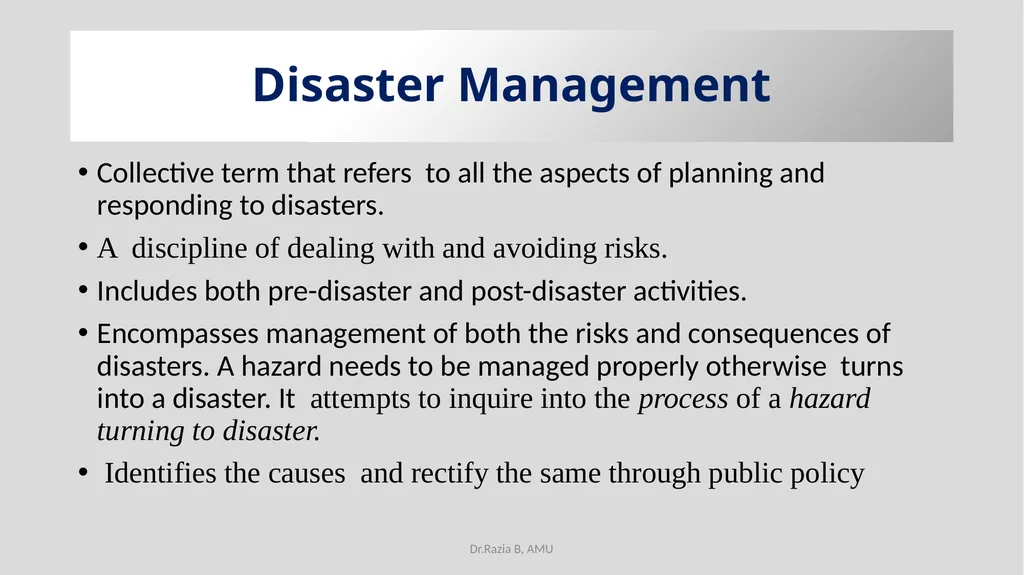
slide11. Disaster Management Collective term that refers to all the aspects of planning and responding to disasters.
A discipline of dealing with and avoiding risks.
Includes both pre-disaster and post-disaster activities.
Encompasses management of both the risks and consequences of disasters. A hazard needs to be managed properly otherwise turns into a disaster. It attempts to inquire into the process of a hazard turning to disaster.
Identifies the causes and rectify the same through public policy Dr.Razia B, AMU<br>
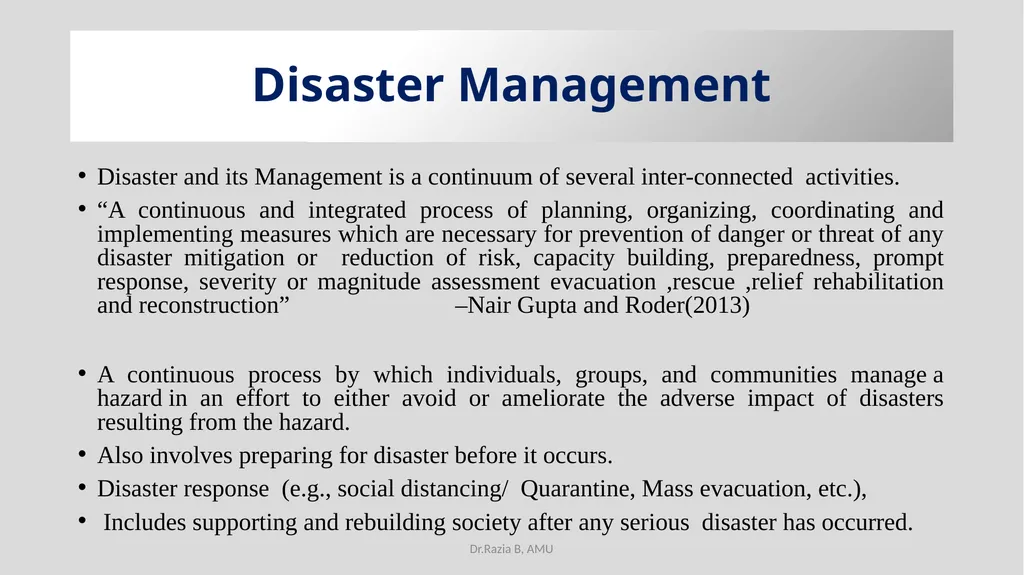
slide12. Disaster and its Management is a continuum of several inter-connected activities.
“A continuous and integrated process of planning, organizing, coordinating and implementing measures which are necessary for prevention of danger or threat of any disaster mitigation or reduction of risk, capacity building, preparedness, prompt response, severity or magnitude assessment evacuation ,rescue ,relief rehabilitation and reconstruction” –Nair Gupta and Roder(2013)
A continuous process by which individuals, groups, and communities manage a hazard in an effort to either avoid or ameliorate the adverse impact of disasters resulting from the hazard.
Also involves preparing for disaster before it occurs.
Disaster response (e.g., social distancing/ Quarantine, Mass evacuation, etc.),
Includes supporting and rebuilding society after any serious disaster has occurred. Disaster Management Dr.Razia B, AMU<br>
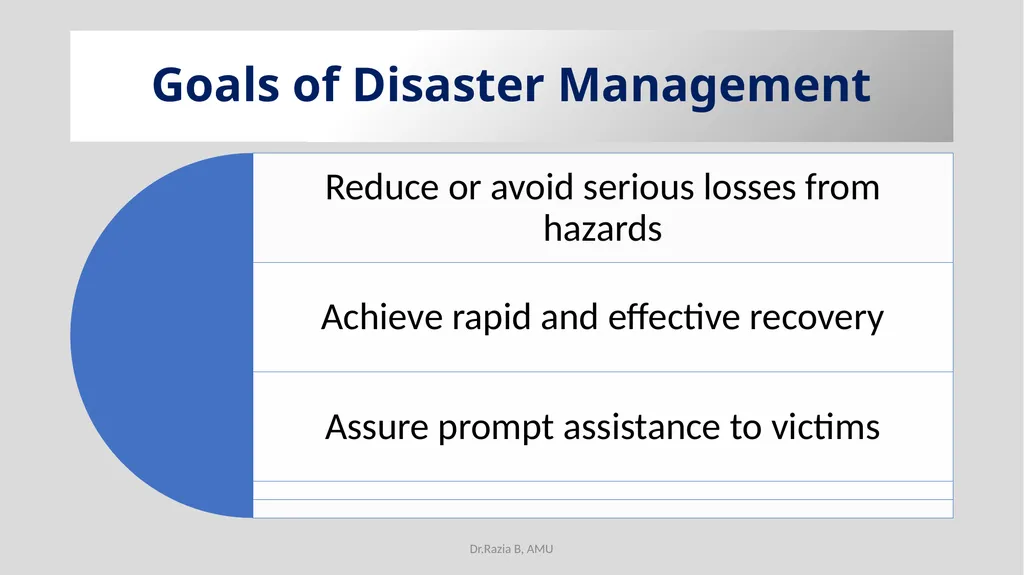
slide13. Goals of Disaster Management Dr.Razia B, AMU<br>
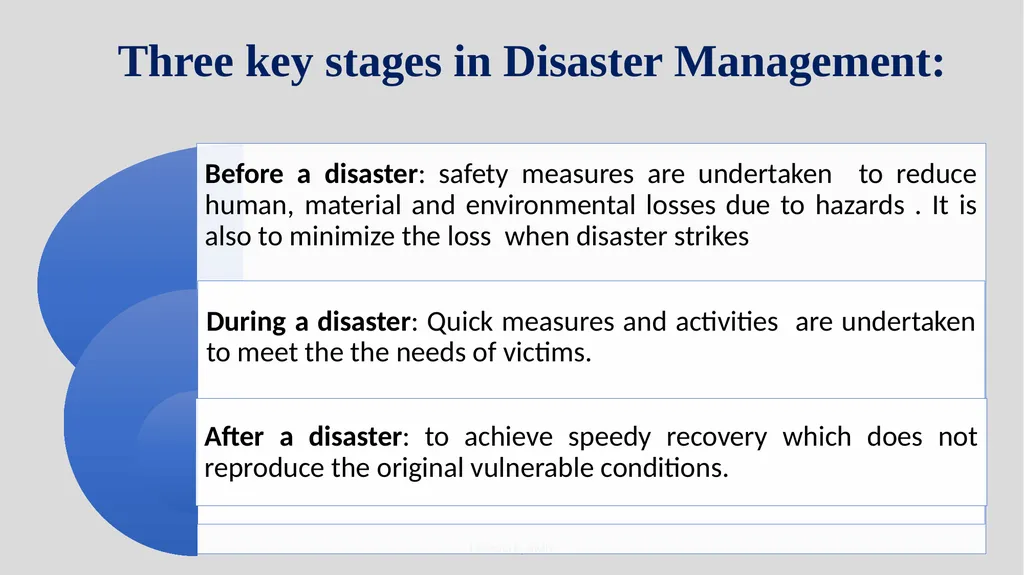
slide14. Three key stages in Disaster Management: Dr.Razia B, AMU<br>
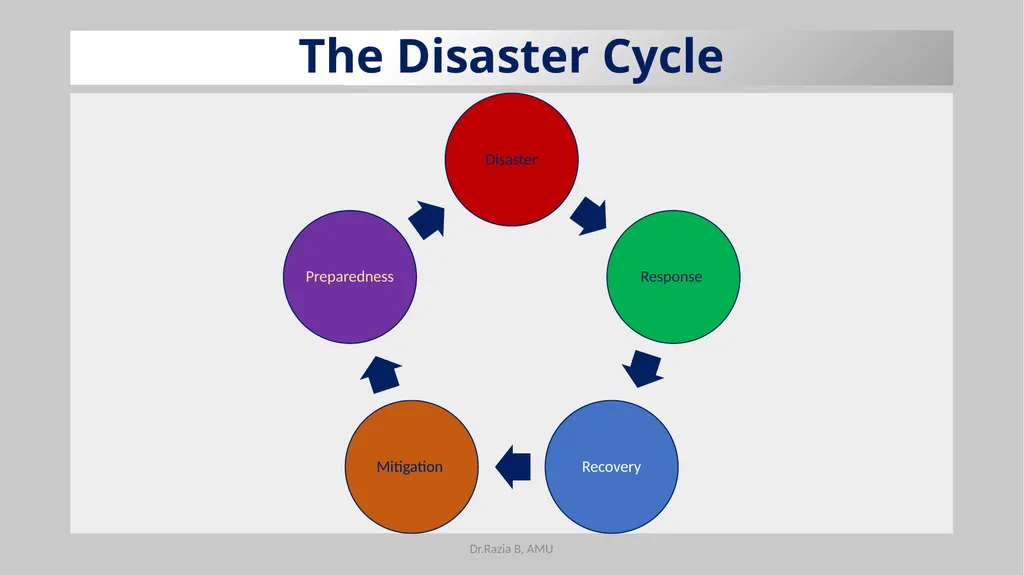
slide15. The Disaster Cycle Dr.Razia B, AMU<br>
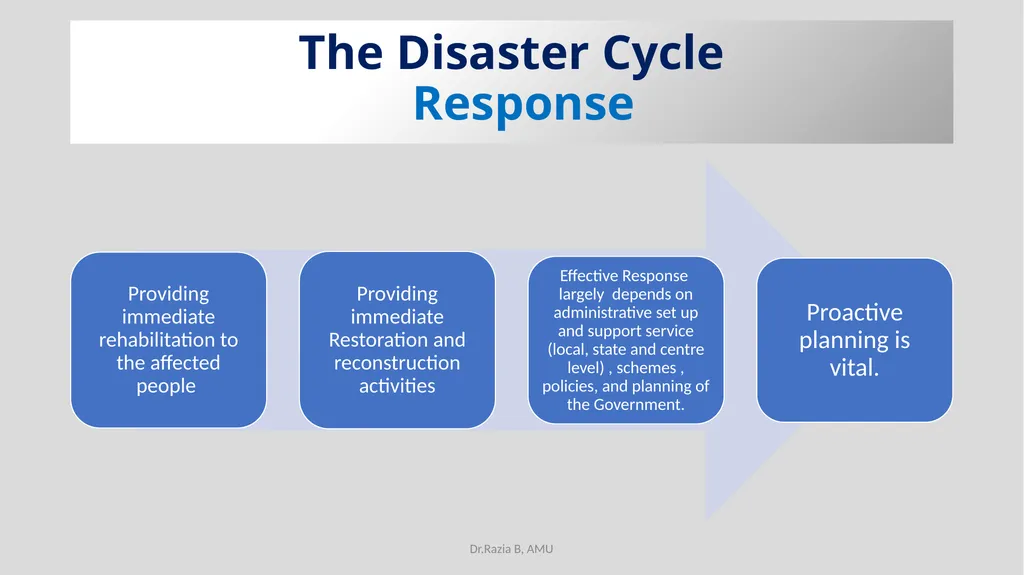
slide16. The Disaster Cycle Response Dr.Razia B, AMU<br>
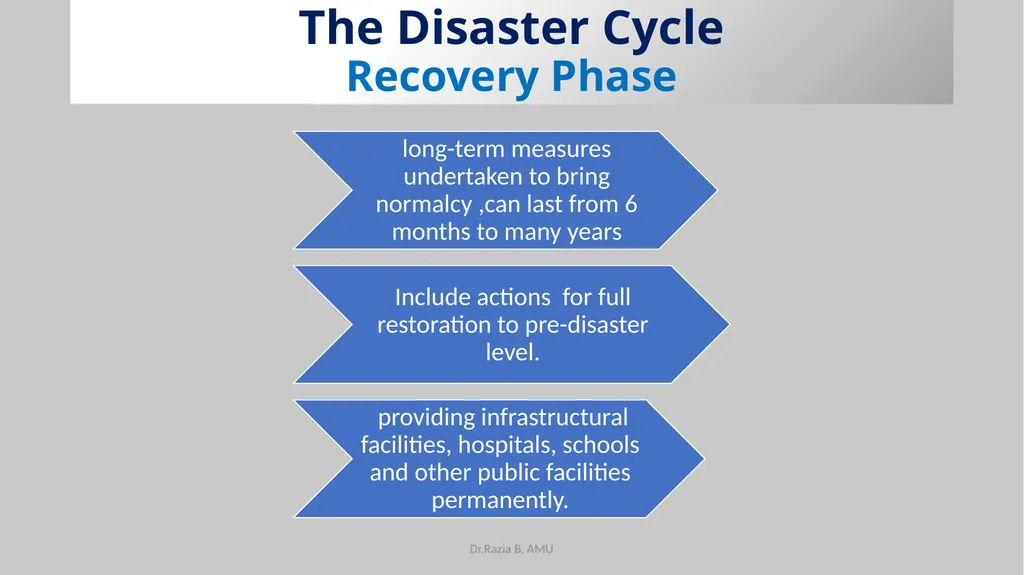
slide17. The Disaster Cycle Recovery Phase Dr.Razia B, AMU<br>
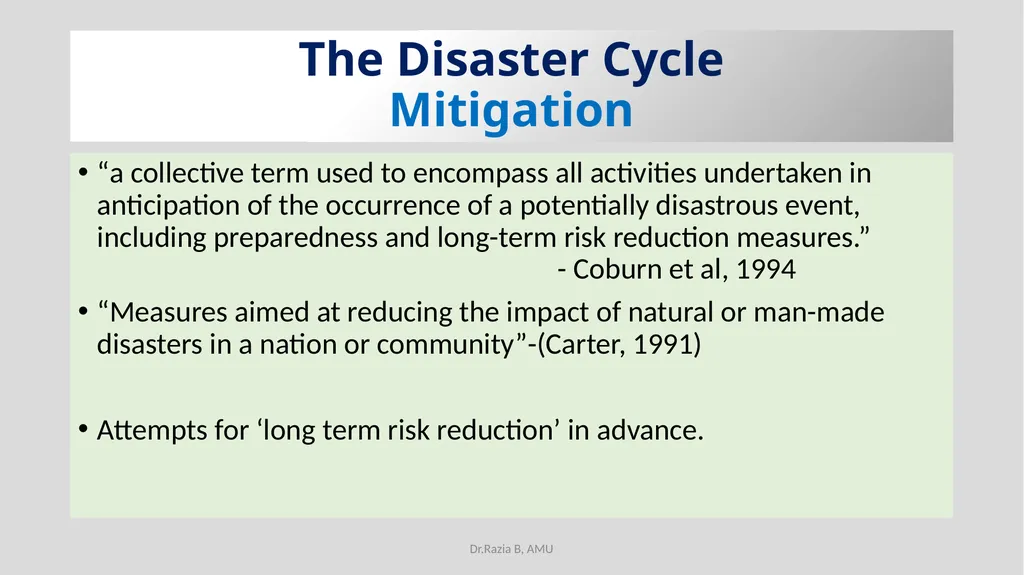
slide18. The Disaster Cycle Mitigation “a collective term used to encompass all activities undertaken in anticipation of the occurrence of a potentially disastrous event, including preparedness and long-term risk reduction measures.” - Coburn et al, 1994
“Measures aimed at reducing the impact of natural or man-made disasters in a nation or community”-(Carter, 1991)
Attempts for ‘long term risk reduction’ in advance. Dr.Razia B, AMU<br>
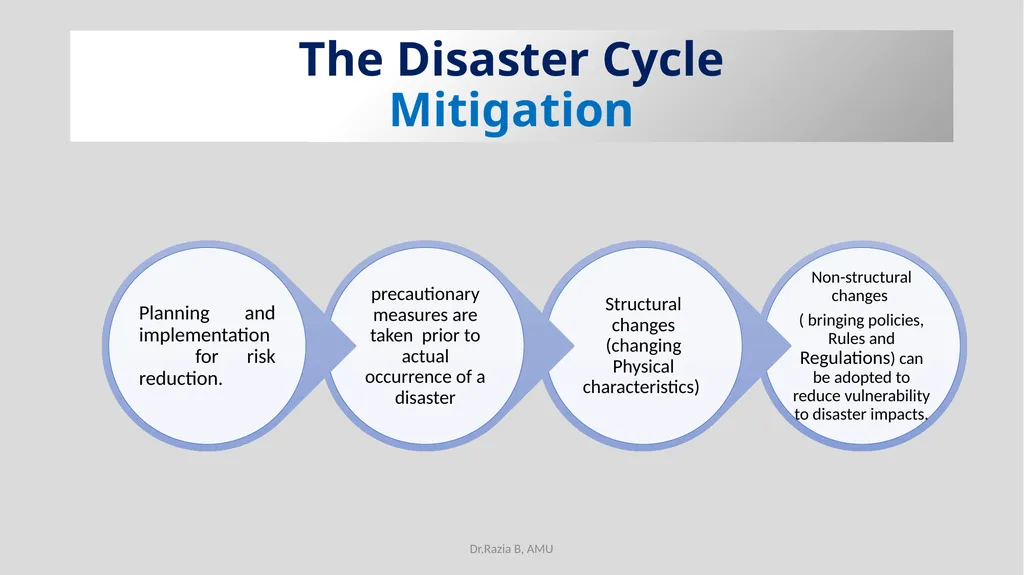
slide19. The Disaster Cycle Mitigation Dr.Razia B, AMU<br>
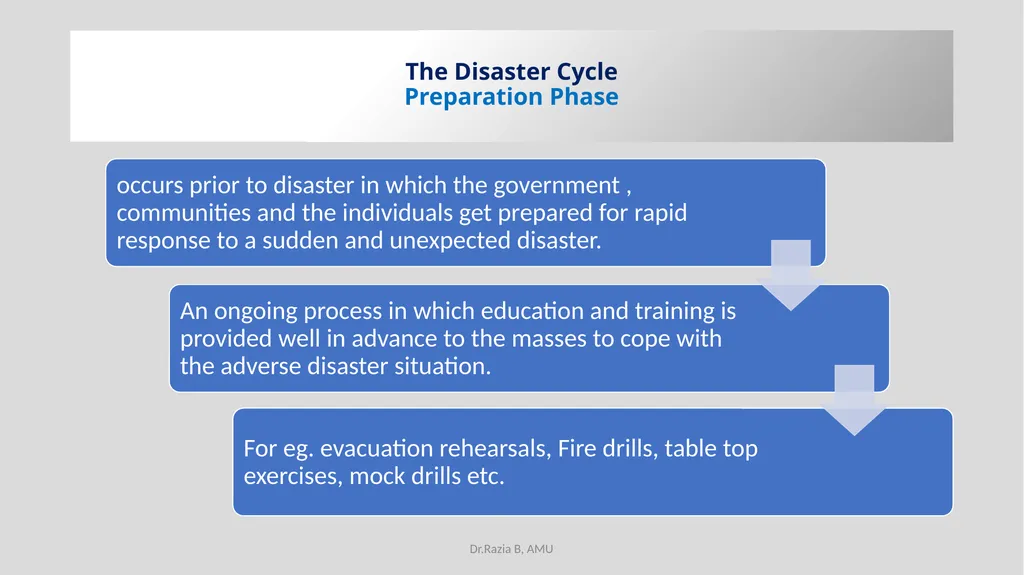
slide20. The Disaster Cycle Preparation Phase Dr.Razia B, AMU<br>
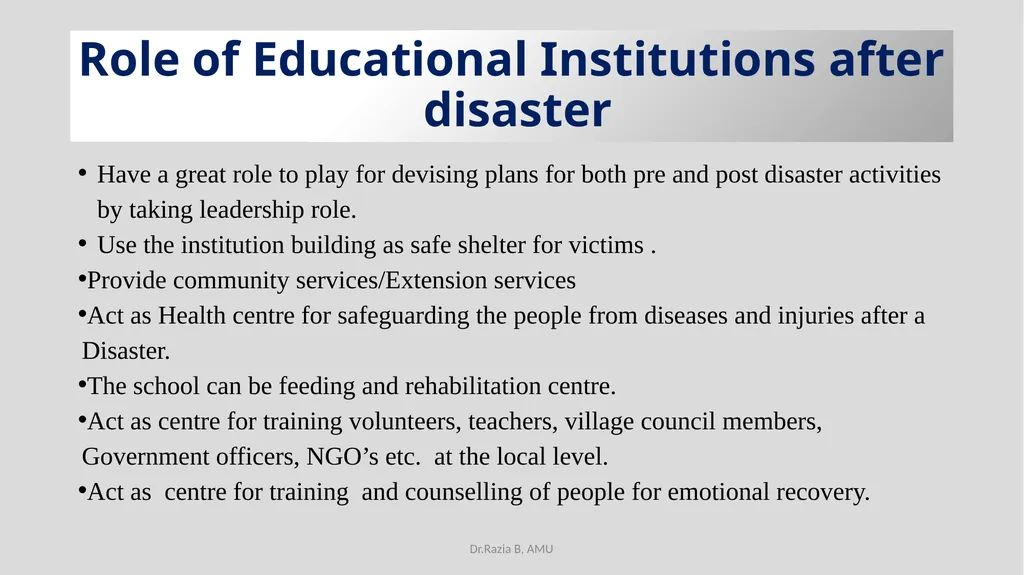
slide21. Role of Educational Institutions after disaster Have a great role to play for devising plans for both pre and post disaster activities by taking leadership role.
Use the institution building as safe shelter for victims .
Provide community services/Extension services
Act as Health centre for safeguarding the people from diseases and injuries after a Disaster.
The school can be feeding and rehabilitation centre.
Act as centre for training volunteers, teachers, village council members, Government officers, NGO’s etc. at the local level.
Act as centre for training and counselling of people for emotional recovery. Dr.Razia B, AMU<br>
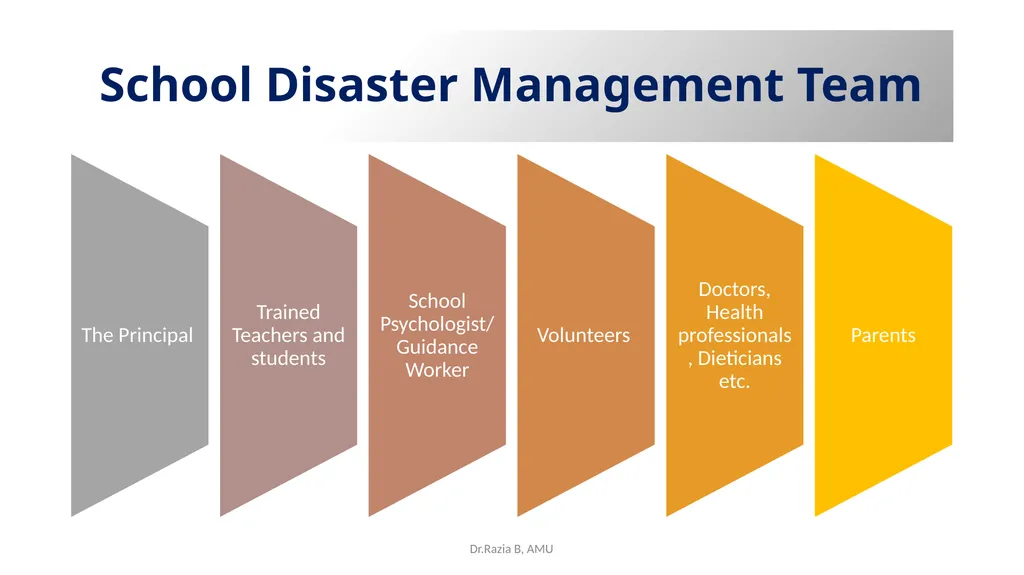
slide22. School Disaster Management Team Dr.Razia B, AMU<br>
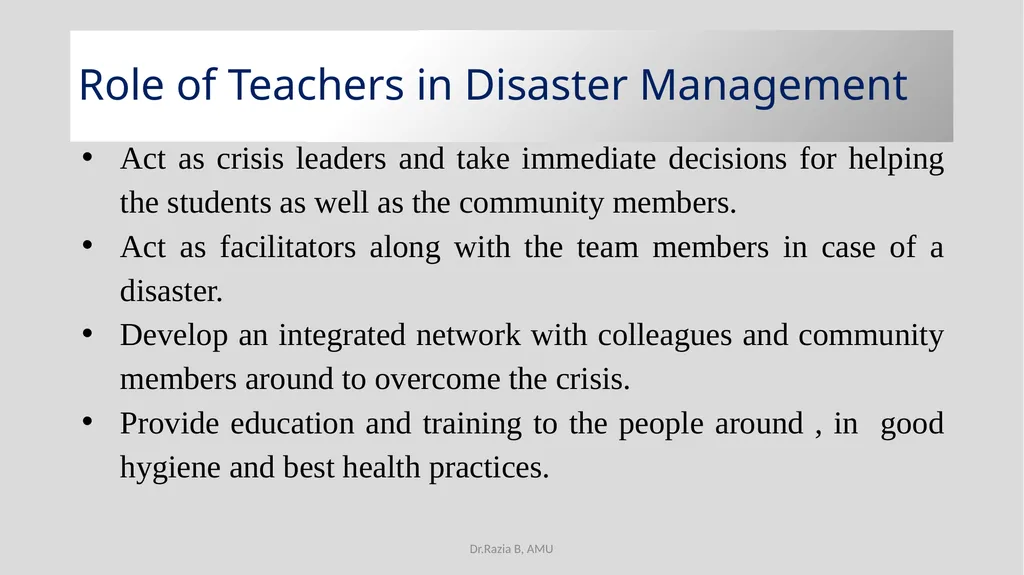
slide23. Role of Teachers in Disaster Management Act as crisis leaders and take immediate decisions for helping the students as well as the community members.
Act as facilitators along with the team members in case of a disaster.
Develop an integrated network with colleagues and community members around to overcome the crisis.
Provide education and training to the people around , in good hygiene and best health practices. Dr.Razia B, AMU<br>
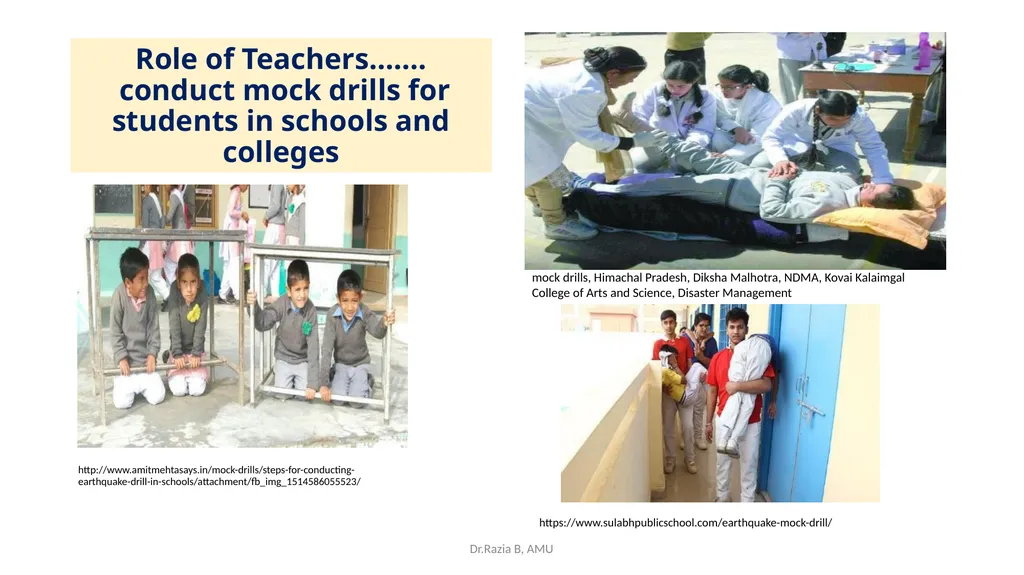
slide24. Role of Teachers….… conduct mock drills for students in schools and colleges http://www.amitmehtasays.in/mock-drills/steps-for-conducting-earthquake-drill-in-schools/attachment/fb_img_1514586055523/ Dr.Razia B, AMU mock drills, Himachal Pradesh, Diksha Malhotra, NDMA, Kovai Kalaimgal College of Arts and Science, Disaster Management https://www.sulabhpublicschool.com/earthquake-mock-drill/<br>
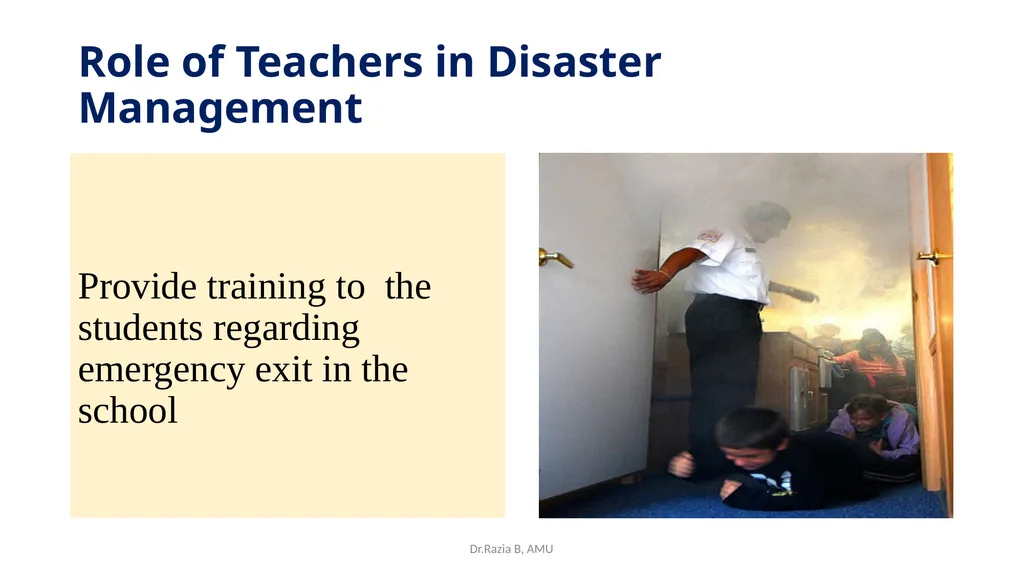
slide25. Role of Teachers in Disaster Management Provide training to the students regarding emergency exit in the school Dr.Razia B, AMU<br>
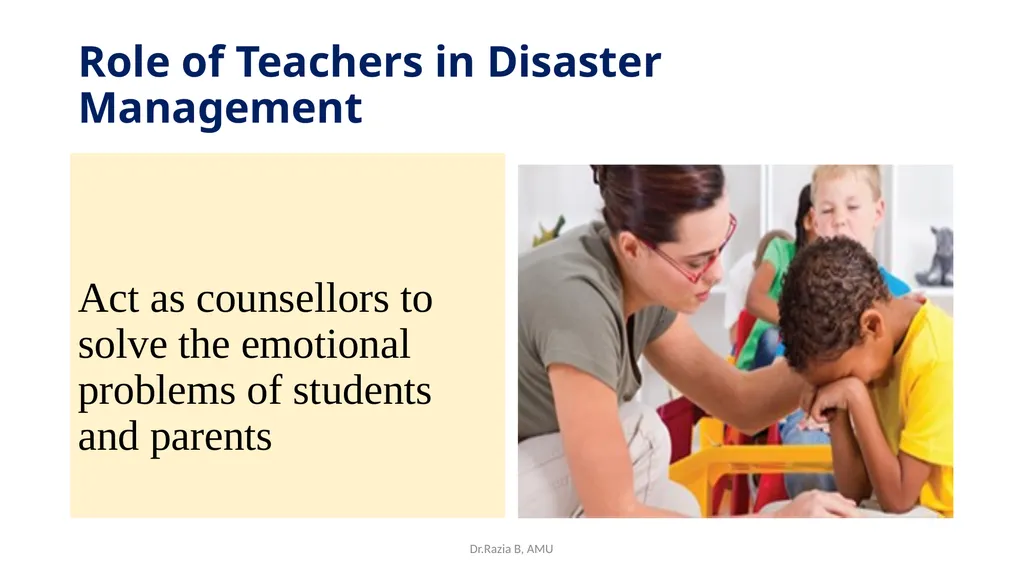
slide26. Role of Teachers in Disaster Management Act as counsellors to solve the emotional problems of students and parents Dr.Razia B, AMU<br>
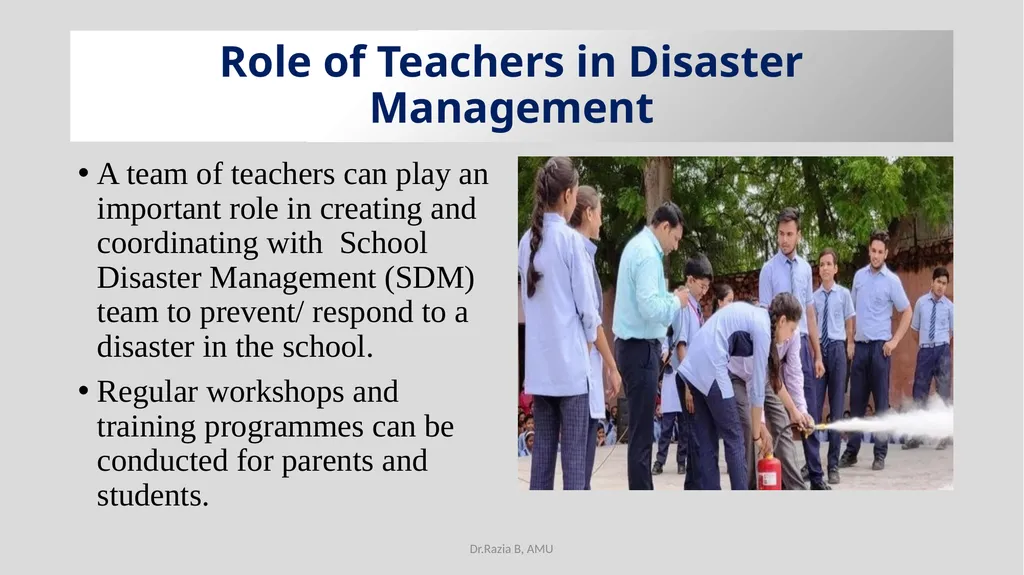
slide27. Role of Teachers in Disaster Management A team of teachers can play an important role in creating and coordinating with School Disaster Management (SDM) team to prevent/ respond to a disaster in the school.
Regular workshops and training programmes can be conducted for parents and students. Dr.Razia B, AMU<br>
slide28. Conclusion Day by day, the earth is becoming extremely vulnerable to various kinds of disasters. Educational Institutions and teachers (being a member of school core team) have vital role to play in preparation , response and recovery activities of disaster management in their institutions as well as their immediate locality. Dr.Razia B, AMU<br>
slide29. Suggested Readings Carol, Mutch. (2015). The role of schools in disaster settings: Learning from the 2010–2011 New Zealand earthquakes. International Journal of Educational Development, 41, 283-291p, Retrieved from (https://www.sciencedirect.com/science/article/pii/S0738059314000558)
Coburn, Sspence & Pomonis( 1994). Vulnerability analysis and risk assessment, Disaster Management Training Programme, United Nations Development Programme, UN
Das,P.,and Malaviya,R.(2013). Role and Capacity Building of School Teachers in Disaster Preparedness and Prevention. International Journal of Education, 2.Retrieved from http://www.ijoe.vidyapublications.com
MPA-018 Disaster Management.2017. IGNOU.Retrieved from https://egyankosh.ac.in/bitstream/123456789/25910/1/Unit-2.pdf
MPA-018 Disaster Management.2017. IGNOU. Retrieved from https://egyankosh.ac.in/bitstream/123456789/25912/1/Unit-1.pdf
Nair,S.S., Gupta ,A.K., and Roder,K.(2013).Database and statistics for disaster risk management.228p. New Delhi, National Institute of Disaster Management, Ministry of home Affairs(NIDM) and Deutsche Gesellschaft Fur Internationale Zusammenarbeit (GIZ)Gmbh. Retrieved from https://nidm.gov.in/pdf/modules/db%20stat.pdf
Singh, S.K., & Singh,S.(1998). Disaster Management. New Delhi: Mittal Publications
https://www.patnauniversity.ac.in/e-content/social_sciences/geography/MAGeog16.pdf Dr.Razia B, AMU<br>
slide30. Stay safe and stay healthy
Thank You Dr.Razia B, AMU<br>
Assistant Professor
Department of Education
Aligarh Muslim University
Aligarh, Uttar Pradesh , India Dr.Razia B, AMU<br>
slide2. Intended Learning Outcomes By the end of this Lesson, the learners will be able to
Define the term -Disaster
Differentiate between Natural and Manmade Disaster
Highlight the adverse impact of a disaster on earth
Explain disaster management in detail
Elaborate the steps of disaster cycle
Discuss the role of Educational Institutions in Disaster Management
Discuss the vital role of teachers in Disaster Management Dr.Razia B, AMU<br>
slide3. Disaster A disaster occurs due to man-made or natural causes which results in sudden disruption of normal life.
Causes severe damage to life and property
Disaster impacts are increasing enormously as a result of the combination of increasing human population along with modification and degradation of natural environments.
Often results in the destruction of equilibrium in the environment. https://www.sciencedirect.com/topics/earth-and-planetary-sciences/geological-disaster https://en.nhandan.vn/scitech/environment/item/7496202-raising-public-awareness-of-natural-disaster-preparedness.html Dr.Razia B, AMU<br>
slide4. Disaster- Definitions "any occurrence, that causes damage, ecological disruption, loss of human life, deterioration of health and health services, on a scale sufficient to warrant an extraordinary response from outside the affected community or area”
-World Health Organization United Nations Disaster Relief Organization-UNDRO (1984) defines disaster as: “An event, concentrated in time and space, in which a community undergoes severe danger and incurs such losses to its members and physical apparatuses that the social structure is disrupted and the fulfillment of all or some of the essential functions of the society are prevented” Dr.Razia B, AMU<br>
slide5. Disaster- Definitions Disaster is defined “as a catastrophe, mishap, calamity or a grave occurrence in any area arising out of natural or man made causes, or by accident or negligence, which results in substantial loss of life and human suffering or damage to, or destruction of, or degradation of environment, and is of such a nature, or magnitude as to be beyond, the coping capacity of the affected community of the affected area”.
- Disaster Management Act, 2004 Dr.Razia B, AMU<br>
slide6. Results of a Disaster Considerable loss of life and livelihood- Large number of deaths or serious injuries
Severe damage to properties
Adverse impact on health due to rapid spread of disease or epidemics.
Severe disruption of normal life pattern.
Considerable disruption of community resources leading to shortage of shelter, food, clothing, medical assistance.
Disruption and damage of infrastructure, communications and other essential services.
Adverse Impact on Economy
Adverse impact on Sociological and Psychological aspects. Dr.Razia B, AMU<br>
slide7. Some facts The statistics of recorded disaster data show that between 1995–2004 nearly 6000 disasters were recorded, 900000 people lost their lives , US$ 738 billion material losses and a total of 2500 million people affected (Basher,2005).
In India, out of the total of the total states and Union territories, 22 are prone to disasters.
Among all the disasters that occur in the country, floods are the most frequently occurring natural disasters, due to the irregularities of the Indian monsoon. Approximately 40 million hectares of land in the country has been identified as being prone to floods. Dr.Razia B, AMU<br>
slide8. Types of Disasters Natural disaster
“A major event brought about by the natural processes of the Earth that causes widespread destruction to the environment and loss of life.”
Catastrophic event that arises due to natural phenomena of Earth.
Some Natural Disasters may be due to human intervention.
For eg. Landslides may be due to extensive agricultural activities and denudation of forests. Manmade disaster
On various occasions in history, our planet has witnessed some of the worst environmental disasters caused by human activities.
The disasters range from wars to nuclear explosions, chemical spill, toxic gas leaks, and oil spills.
The environmental consequences are adversely high and their impacts are felt for centuries Dr.Razia B, AMU<br>
slide9. Types of Disasters Natural disaster
Flood
Drought
Earth quakes
Tornadoes
Tsunami
Volcanic eruptions
Avalanche etc. Manmade disaster
Explosions
Nuclear disasters
Chemical disasters
Mine Explosions
Fire Accidents
Accidents
Oil Spills etc. Dr.Razia B, AMU<br>
slide10. High Powered Committee,GOI,1999 classified Major Disasters in India Dr.Razia B, AMU<br>
slide11. Disaster Management Collective term that refers to all the aspects of planning and responding to disasters.
A discipline of dealing with and avoiding risks.
Includes both pre-disaster and post-disaster activities.
Encompasses management of both the risks and consequences of disasters. A hazard needs to be managed properly otherwise turns into a disaster. It attempts to inquire into the process of a hazard turning to disaster.
Identifies the causes and rectify the same through public policy Dr.Razia B, AMU<br>
slide12. Disaster and its Management is a continuum of several inter-connected activities.
“A continuous and integrated process of planning, organizing, coordinating and implementing measures which are necessary for prevention of danger or threat of any disaster mitigation or reduction of risk, capacity building, preparedness, prompt response, severity or magnitude assessment evacuation ,rescue ,relief rehabilitation and reconstruction” –Nair Gupta and Roder(2013)
A continuous process by which individuals, groups, and communities manage a hazard in an effort to either avoid or ameliorate the adverse impact of disasters resulting from the hazard.
Also involves preparing for disaster before it occurs.
Disaster response (e.g., social distancing/ Quarantine, Mass evacuation, etc.),
Includes supporting and rebuilding society after any serious disaster has occurred. Disaster Management Dr.Razia B, AMU<br>
slide13. Goals of Disaster Management Dr.Razia B, AMU<br>
slide14. Three key stages in Disaster Management: Dr.Razia B, AMU<br>
slide15. The Disaster Cycle Dr.Razia B, AMU<br>
slide16. The Disaster Cycle Response Dr.Razia B, AMU<br>
slide17. The Disaster Cycle Recovery Phase Dr.Razia B, AMU<br>
slide18. The Disaster Cycle Mitigation “a collective term used to encompass all activities undertaken in anticipation of the occurrence of a potentially disastrous event, including preparedness and long-term risk reduction measures.” - Coburn et al, 1994
“Measures aimed at reducing the impact of natural or man-made disasters in a nation or community”-(Carter, 1991)
Attempts for ‘long term risk reduction’ in advance. Dr.Razia B, AMU<br>
slide19. The Disaster Cycle Mitigation Dr.Razia B, AMU<br>
slide20. The Disaster Cycle Preparation Phase Dr.Razia B, AMU<br>
slide21. Role of Educational Institutions after disaster Have a great role to play for devising plans for both pre and post disaster activities by taking leadership role.
Use the institution building as safe shelter for victims .
Provide community services/Extension services
Act as Health centre for safeguarding the people from diseases and injuries after a Disaster.
The school can be feeding and rehabilitation centre.
Act as centre for training volunteers, teachers, village council members, Government officers, NGO’s etc. at the local level.
Act as centre for training and counselling of people for emotional recovery. Dr.Razia B, AMU<br>
slide22. School Disaster Management Team Dr.Razia B, AMU<br>
slide23. Role of Teachers in Disaster Management Act as crisis leaders and take immediate decisions for helping the students as well as the community members.
Act as facilitators along with the team members in case of a disaster.
Develop an integrated network with colleagues and community members around to overcome the crisis.
Provide education and training to the people around , in good hygiene and best health practices. Dr.Razia B, AMU<br>
slide24. Role of Teachers….… conduct mock drills for students in schools and colleges http://www.amitmehtasays.in/mock-drills/steps-for-conducting-earthquake-drill-in-schools/attachment/fb_img_1514586055523/ Dr.Razia B, AMU mock drills, Himachal Pradesh, Diksha Malhotra, NDMA, Kovai Kalaimgal College of Arts and Science, Disaster Management https://www.sulabhpublicschool.com/earthquake-mock-drill/<br>
slide25. Role of Teachers in Disaster Management Provide training to the students regarding emergency exit in the school Dr.Razia B, AMU<br>
slide26. Role of Teachers in Disaster Management Act as counsellors to solve the emotional problems of students and parents Dr.Razia B, AMU<br>
slide27. Role of Teachers in Disaster Management A team of teachers can play an important role in creating and coordinating with School Disaster Management (SDM) team to prevent/ respond to a disaster in the school.
Regular workshops and training programmes can be conducted for parents and students. Dr.Razia B, AMU<br>
slide28. Conclusion Day by day, the earth is becoming extremely vulnerable to various kinds of disasters. Educational Institutions and teachers (being a member of school core team) have vital role to play in preparation , response and recovery activities of disaster management in their institutions as well as their immediate locality. Dr.Razia B, AMU<br>
slide29. Suggested Readings Carol, Mutch. (2015). The role of schools in disaster settings: Learning from the 2010–2011 New Zealand earthquakes. International Journal of Educational Development, 41, 283-291p, Retrieved from (https://www.sciencedirect.com/science/article/pii/S0738059314000558)
Coburn, Sspence & Pomonis( 1994). Vulnerability analysis and risk assessment, Disaster Management Training Programme, United Nations Development Programme, UN
Das,P.,and Malaviya,R.(2013). Role and Capacity Building of School Teachers in Disaster Preparedness and Prevention. International Journal of Education, 2.Retrieved from http://www.ijoe.vidyapublications.com
MPA-018 Disaster Management.2017. IGNOU.Retrieved from https://egyankosh.ac.in/bitstream/123456789/25910/1/Unit-2.pdf
MPA-018 Disaster Management.2017. IGNOU. Retrieved from https://egyankosh.ac.in/bitstream/123456789/25912/1/Unit-1.pdf
Nair,S.S., Gupta ,A.K., and Roder,K.(2013).Database and statistics for disaster risk management.228p. New Delhi, National Institute of Disaster Management, Ministry of home Affairs(NIDM) and Deutsche Gesellschaft Fur Internationale Zusammenarbeit (GIZ)Gmbh. Retrieved from https://nidm.gov.in/pdf/modules/db%20stat.pdf
Singh, S.K., & Singh,S.(1998). Disaster Management. New Delhi: Mittal Publications
https://www.patnauniversity.ac.in/e-content/social_sciences/geography/MAGeog16.pdf Dr.Razia B, AMU<br>
slide30. Stay safe and stay healthy
Thank You Dr.Razia B, AMU<br>