
Environmental Emergencies CHAPTER 39 Introduction
TG
Published · 206 slides · 0 views

1 / 1

Description
Environmental Emergencies CHAPTER 39 Introduction (1 of 5) Environmental emergencies Medical conditions caused or worsened by weather, terrain, fauna, or unique atmospheric conditions at high altitude or underwater Introduction (2 of 5)
Related Topics
Share
Embed code
Download this presentation From Below
"Environmental Emergencies CHAPTER 39 Introduction" is the property of its rightful owner. Permission is granted to download and print the materials on this website for personal, non-commercial use only, and to display it on your personal computer provided you do not modify the materials and that you retain all copyright notices contained in the materials. By downloading content from our website, you accept the terms of this agreement.
Presentation Transcript
01
Environmental Emergencies CHAPTER 39<br>
02
Introduction (1 of 5) Environmental emergencies
Medical conditions caused or worsened by weather, terrain, fauna, or unique atmospheric conditions at high altitude or underwater<br>
Medical conditions caused or worsened by weather, terrain, fauna, or unique atmospheric conditions at high altitude or underwater<br>
03
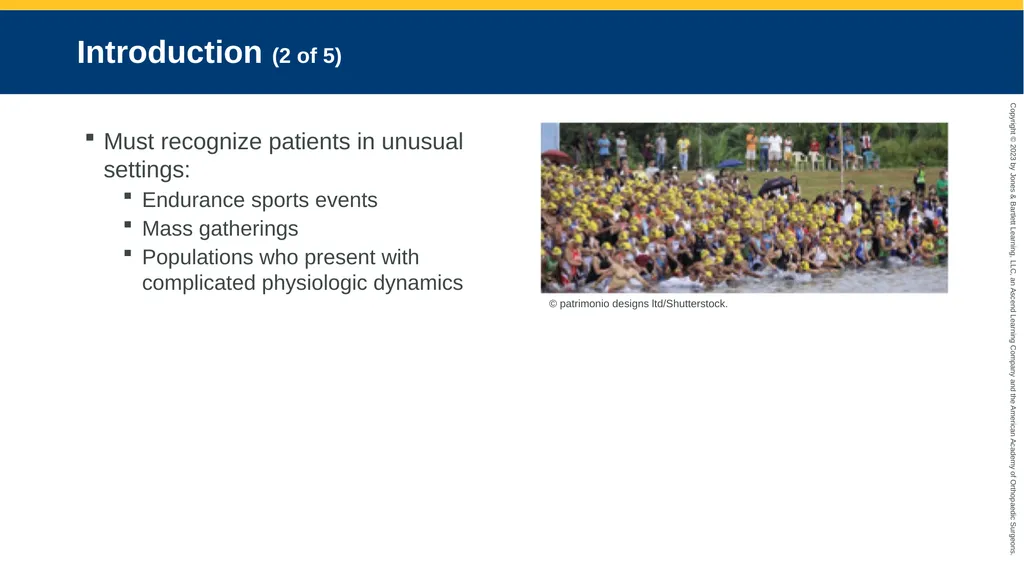
Introduction (2 of 5) Must recognize patients in unusual settings:
Endurance sports events
Mass gatherings
Populations who present with complicated physiologic dynamics © patrimonio designs ltd/Shutterstock.<br>
Endurance sports events
Mass gatherings
Populations who present with complicated physiologic dynamics © patrimonio designs ltd/Shutterstock.<br>
04
Introduction (3 of 5) Certain weather conditions affect one’s ability to adapt to the environment:
Wind
Rain
Snow
Temperature extremes
Humidity<br>
Wind
Rain
Snow
Temperature extremes
Humidity<br>
05
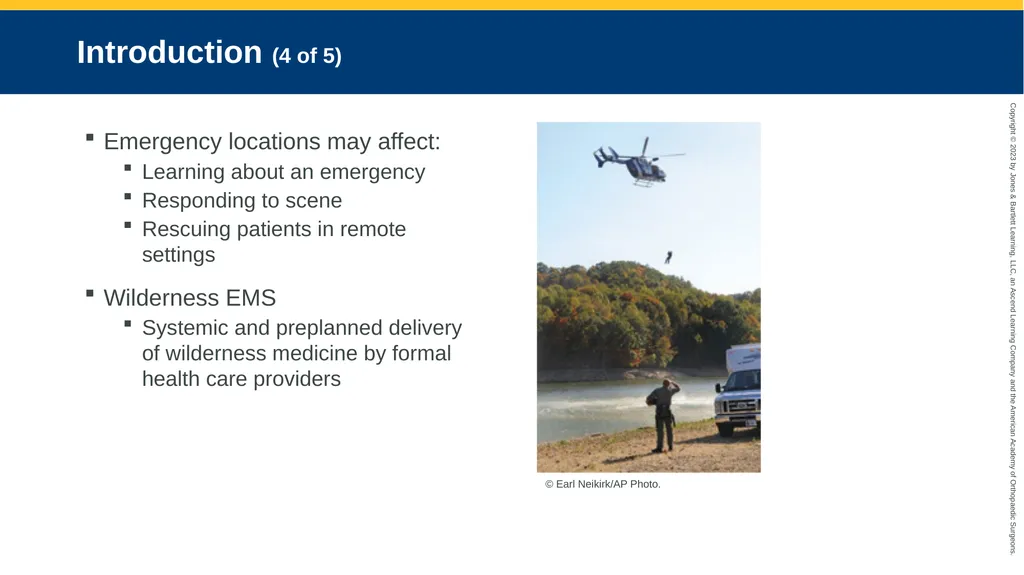
Introduction (4 of 5) Emergency locations may affect:
Learning about an emergency
Responding to scene
Rescuing patients in remote settings
Wilderness EMS
Systemic and preplanned delivery of wilderness medicine by formal health care providers © Earl Neikirk/AP Photo.<br>
Learning about an emergency
Responding to scene
Rescuing patients in remote settings
Wilderness EMS
Systemic and preplanned delivery of wilderness medicine by formal health care providers © Earl Neikirk/AP Photo.<br>
06
Introduction (5 of 5) Common risk factors predispose people to environmental emergencies.
Preexisting conditions
Younger and older people
Dehydration
Overall health and fitness<br>
Preexisting conditions
Younger and older people
Dehydration
Overall health and fitness<br>
07
Anatomy and Physiology Review<br>
08
Homeostasis and Body Temperature (1 of 3) Homeostasis
Body processes that balance supply and demand of the body’s needs
Thermoregulation
Thermosensitive neurons in the anterior hypothalamus balance heat production and dissipation.<br>
Body processes that balance supply and demand of the body’s needs
Thermoregulation
Thermosensitive neurons in the anterior hypothalamus balance heat production and dissipation.<br>
09
Homeostasis and Body Temperature (2 of 3) The body tries to keep a temperature of 98.6°F.
Periphery temperatures in the skin and extremities fluctuate.
Definitions for starting temperatures include:
Hypothermia: decreased CBT starting at 95°F
Hyperthermia: elevated CBT starting at 100.4°F<br>
Periphery temperatures in the skin and extremities fluctuate.
Definitions for starting temperatures include:
Hypothermia: decreased CBT starting at 95°F
Hyperthermia: elevated CBT starting at 100.4°F<br>
10
Homeostasis and Body Temperature (3 of 3) Oral temperature can vary dramatically from CBT if the patient is:
Breathing by mouth
Drinking hot or cold liquids
Rectal temperatures are generally more reliable.
Tympanic temperatures may be more appropriate for field operations.<br>
Breathing by mouth
Drinking hot or cold liquids
Rectal temperatures are generally more reliable.
Tympanic temperatures may be more appropriate for field operations.<br>
11
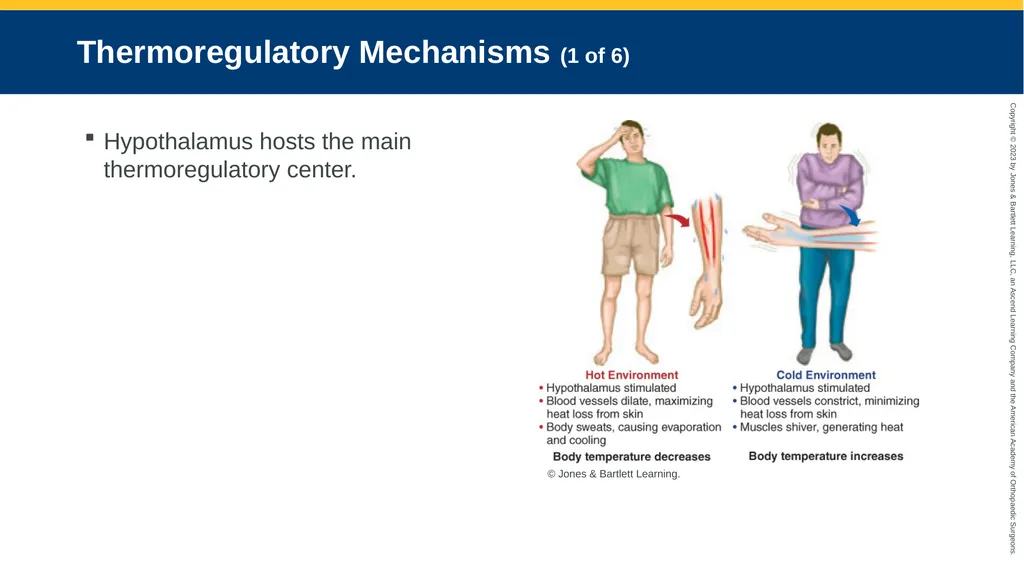
Thermoregulatory Mechanisms (1 of 6) Hypothalamus hosts the main thermoregulatory center. © Jones & Bartlett Learning.<br>
12
Thermoregulatory Mechanisms (2 of 6) At rest, the body produces heat by metabolism of nutrients.
Basal metabolic rate (BMR) is heat energy produced at rest from normal body metabolic reactions.<br>
Basal metabolic rate (BMR) is heat energy produced at rest from normal body metabolic reactions.<br>
13
Thermoregulatory Mechanisms (3 of 6) BMR of average 70-kg person is around
70 kcal/hour, based on factors including:
Age
Sex
Stress
Hormones<br>
Age
Sex
Stress
Hormones<br>
14
Thermoregulatory Mechanisms (4 of 6) Heat loss to the environment increases as the ratio of body surface area to body volume increases.
With two people of the same weight, the taller will have a higher BMR.
Exertion affects metabolic rate.<br>
With two people of the same weight, the taller will have a higher BMR.
Exertion affects metabolic rate.<br>
15
Thermoregulatory Mechanisms (5 of 6) Heat generated by metabolism and glycogen breakdown warms the body.
Excess heat is dissipated by the temperature gradient between the body and the outside environment.
If environmental temperatures are higher, the body heats by absorption of outside heat.<br>
Excess heat is dissipated by the temperature gradient between the body and the outside environment.
If environmental temperatures are higher, the body heats by absorption of outside heat.<br>
16
Thermoregulatory Mechanisms (6 of 6) Skin plays a vital role in body temperature regulation.
Conserves and liberates heat energy through skin by regulating blood flow<br>
Conserves and liberates heat energy through skin by regulating blood flow<br>
17
Physiologic Responses to Heat and Cold (1 of 4) Thermolysis
The release of stored heat and energy of the body
An increase in CBT causes vasodilation and sweating, which causes increased:
Effective vascular system volume
Cardiac output
Pulse rate and stroke volume<br>
The release of stored heat and energy of the body
An increase in CBT causes vasodilation and sweating, which causes increased:
Effective vascular system volume
Cardiac output
Pulse rate and stroke volume<br>
18
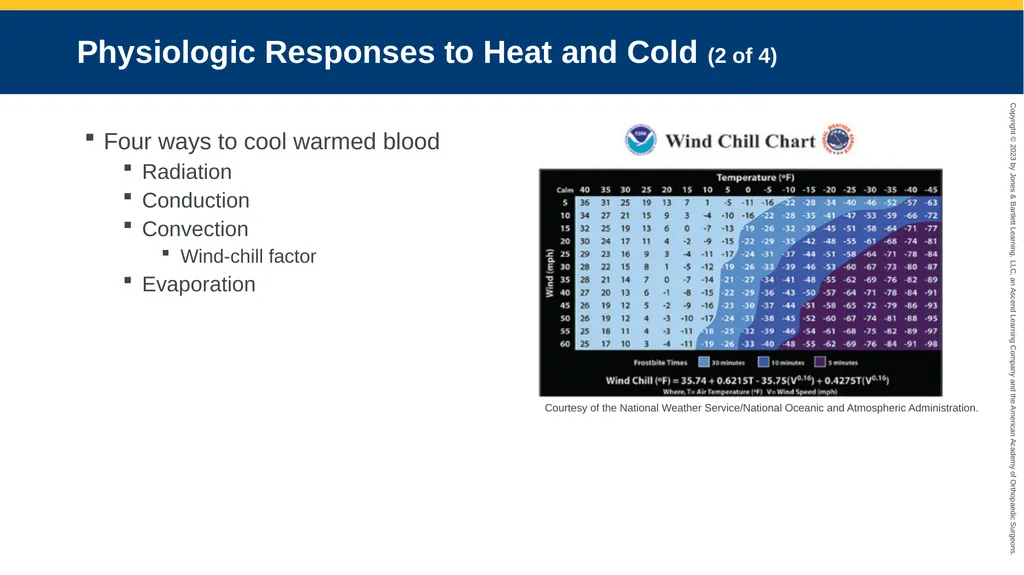
Physiologic Responses to Heat and Cold (2 of 4) Four ways to cool warmed blood
Radiation
Conduction
Convection
Wind-chill factor
Evaporation Courtesy of the National Weather Service/National Oceanic and Atmospheric Administration.<br>
Radiation
Conduction
Convection
Wind-chill factor
Evaporation Courtesy of the National Weather Service/National Oceanic and Atmospheric Administration.<br>
19
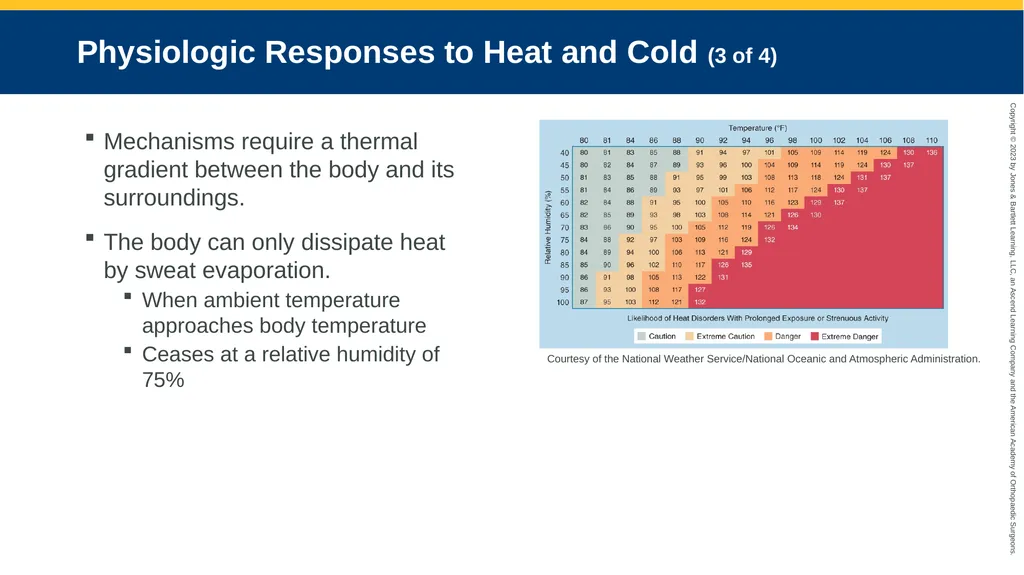
Physiologic Responses to Heat and Cold (3 of 4) Mechanisms require a thermal gradient between the body and its surroundings.
The body can only dissipate heat by sweat evaporation.
When ambient temperature approaches body temperature
Ceases at a relative humidity of 75% Courtesy of the National Weather Service/National Oceanic and Atmospheric Administration.<br>
The body can only dissipate heat by sweat evaporation.
When ambient temperature approaches body temperature
Ceases at a relative humidity of 75% Courtesy of the National Weather Service/National Oceanic and Atmospheric Administration.<br>
20
Physiologic Responses to Heat and Cold (4 of 4) Thermogenesis
Production of heat and energy to deal with cold stressors
Hypothalamic center and sympathetic nervous system
Increase muscle tone and initiate shivering
Increase thyroid levels<br>
Production of heat and energy to deal with cold stressors
Hypothalamic center and sympathetic nervous system
Increase muscle tone and initiate shivering
Increase thyroid levels<br>
21
Pathophysiology, Assessment, and Management of Heat Injuries<br>
22
Heat Illness Increase in CBT due to inadequate thermolysis
Inability to rid heat buildup from body because of:
Hot and humid conditions
Mobility/general health/preexisting illness/age<br>
Inability to rid heat buildup from body because of:
Hot and humid conditions
Mobility/general health/preexisting illness/age<br>
23
Risk Factors for Heat Illness (1 of 3) Older people are at particular risk:
Perspire less
Acclimatize more slowly
Feel thirst less readily
Decreased mobility
Chronic conditions
Take medications that hinder heat dissipation<br>
Perspire less
Acclimatize more slowly
Feel thirst less readily
Decreased mobility
Chronic conditions
Take medications that hinder heat dissipation<br>
24
Risk Factors for Heat Illness (2 of 3) Medications that affect temperature regulation ability include:
Diuretics
Beta-blockers<br>
Diuretics
Beta-blockers<br>
25
Risk Factors for Heat Illness (3 of 3) Infants and young children are vulnerable.
Proportionately higher metabolic heat production
CBT rises faster during dehydration.
Smaller organ and vascular systems do not dissipate heat as well.
Military recruits and athletes are at increased risk.<br>
Proportionately higher metabolic heat production
CBT rises faster during dehydration.
Smaller organ and vascular systems do not dissipate heat as well.
Military recruits and athletes are at increased risk.<br>
26
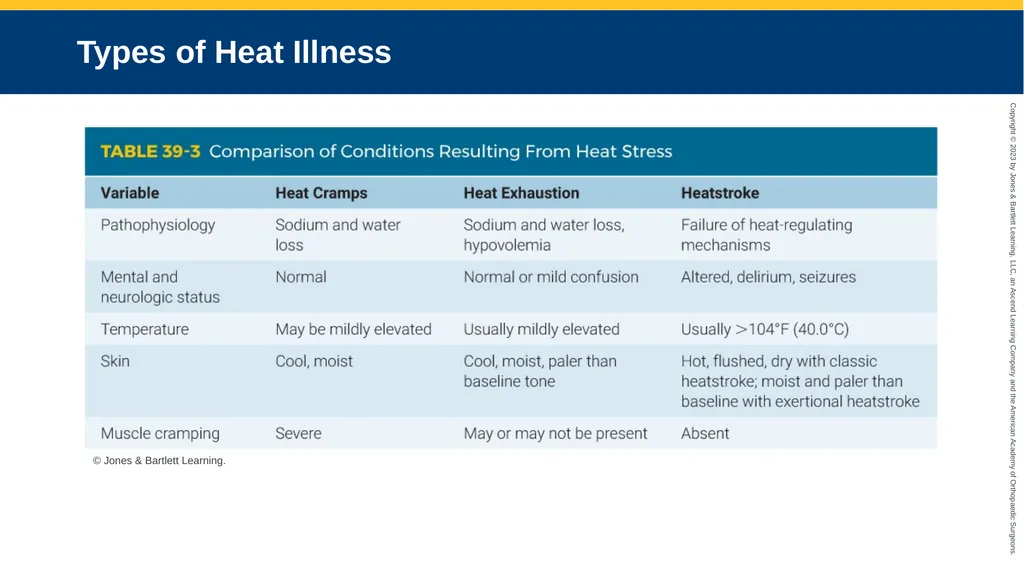
Types of Heat Illness © Jones & Bartlett Learning.<br>
27
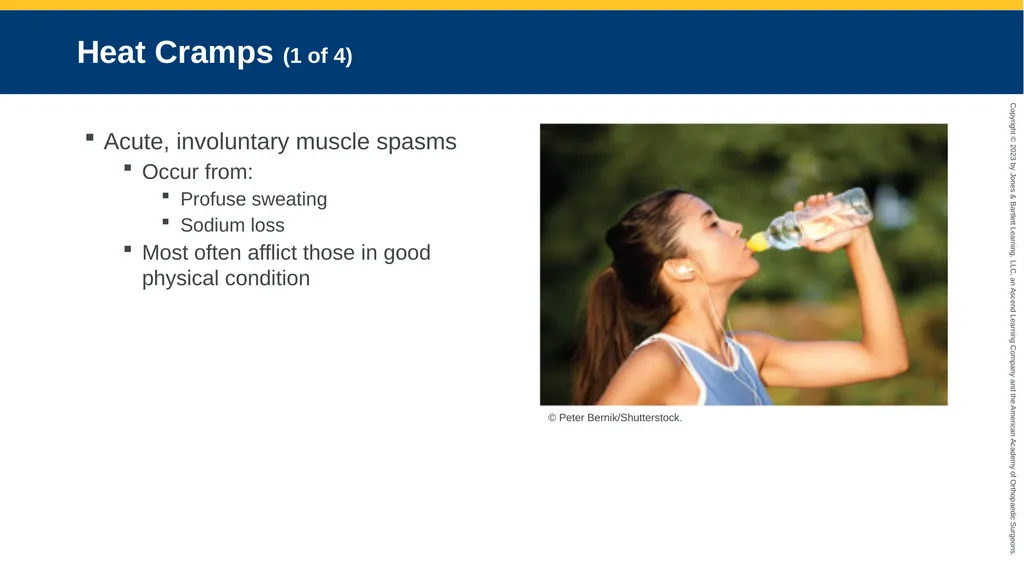
Heat Cramps (1 of 4) Acute, involuntary muscle spasms
Occur from:
Profuse sweating
Sodium loss
Most often afflict those in good physical condition © Peter Bernik/Shutterstock.<br>
Occur from:
Profuse sweating
Sodium loss
Most often afflict those in good physical condition © Peter Bernik/Shutterstock.<br>
28
Heat Cramps (2 of 4) Assessment
Starts during strenuous or prolonged activity
Usual presentation:
Severe, incapacitating pain
Nausea
Rapid pulse
Pale and moist skin
Normal or mildly elevated temperature<br>
Starts during strenuous or prolonged activity
Usual presentation:
Severe, incapacitating pain
Nausea
Rapid pulse
Pale and moist skin
Normal or mildly elevated temperature<br>
29
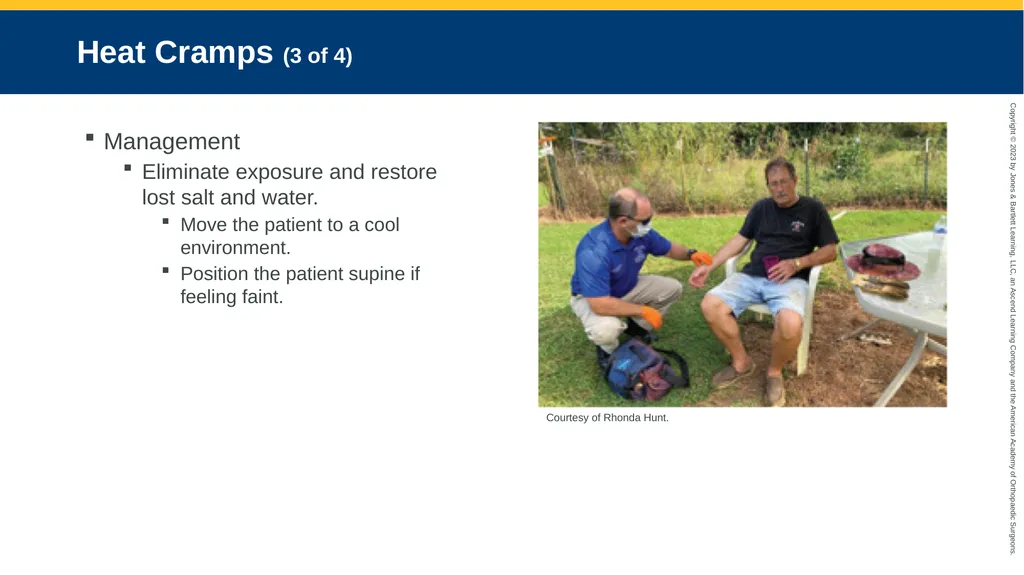
Heat Cramps (3 of 4) Management
Eliminate exposure and restore lost salt and water.
Move the patient to a cool environment.
Position the patient supine if feeling faint. Courtesy of Rhonda Hunt.<br>
Eliminate exposure and restore lost salt and water.
Move the patient to a cool environment.
Position the patient supine if feeling faint. Courtesy of Rhonda Hunt.<br>
30
Heat Cramps (4 of 4) Management (cont’d)
If not nauseated:
Give balanced electrolyte liquid
Give salty chips or pretzels
If nauseated:
Rapidly infuse normal saline by IV
Decision to resume activity is made by medical control.<br>
If not nauseated:
Give balanced electrolyte liquid
Give salty chips or pretzels
If nauseated:
Rapidly infuse normal saline by IV
Decision to resume activity is made by medical control.<br>
31
Heat Syncope (1 of 2) Pathophysiology
Orthostatic syncopal episode in non-acclimated people under heat stress
Can occur from:
Prolonged standing
Standing suddenly from a sitting or lying position<br>
Orthostatic syncopal episode in non-acclimated people under heat stress
Can occur from:
Prolonged standing
Standing suddenly from a sitting or lying position<br>
32
Heat Syncope (2 of 2) Assessment and management
Place patient in supine position.
Replace fluid deficits.
If the patient does not recover quickly, suspect:
Heatstroke
Cardiac syncope
Hyperglycemia
Atypical acute coronary syndromes<br>
Place patient in supine position.
Replace fluid deficits.
If the patient does not recover quickly, suspect:
Heatstroke
Cardiac syncope
Hyperglycemia
Atypical acute coronary syndromes<br>
33
Heat Exhaustion (1 of 5) Pathophysiology
Milder form of heat illness, with:
Volume depletion
Heat stress
Two types:
Water depleted
Sodium depleted<br>
Milder form of heat illness, with:
Volume depletion
Heat stress
Two types:
Water depleted
Sodium depleted<br>
34
Heat Exhaustion (2 of 5) Exercise-associated hyponatremia
Acute decrease in the serum sodium concentration
During or up to 24 hours after prolonged activity<br>
Acute decrease in the serum sodium concentration
During or up to 24 hours after prolonged activity<br>
35
Heat Exhaustion (3 of 5) Symptoms include:
Headache
Fatigue
Weakness
Dizziness
Nausea
Vomiting
Abdominal cramping Other signs and symptoms:
Profuse sweating
Pale, clammy skin
CBT normal or slightly elevated
Tachycardia
Orthostatic hypotension<br>
Headache
Fatigue
Weakness
Dizziness
Nausea
Vomiting
Abdominal cramping Other signs and symptoms:
Profuse sweating
Pale, clammy skin
CBT normal or slightly elevated
Tachycardia
Orthostatic hypotension<br>
36
Heat Exhaustion (4 of 5) Management
Move to cool environment.
Remove excess clothes.
Place supine with legs elevated.
If temperature is elevated:
Sponge, spray, or drip with tepid water and fan gently.
Provide oral hydration.<br>
Move to cool environment.
Remove excess clothes.
Place supine with legs elevated.
If temperature is elevated:
Sponge, spray, or drip with tepid water and fan gently.
Provide oral hydration.<br>
37
Heat Exhaustion (5 of 5) If suspected exercise-associated hyponatremia, no fluids by mouth
Check blood sodium level.
Administer IV normal saline or hypertonic saline.
Monitor cardiac rhythm, vital signs, temperature, and end-tidal carbon dioxide.
Rapid transport to the ED depends on patient’s symptoms and history.<br>
Check blood sodium level.
Administer IV normal saline or hypertonic saline.
Monitor cardiac rhythm, vital signs, temperature, and end-tidal carbon dioxide.
Rapid transport to the ED depends on patient’s symptoms and history.<br>
38
Heatstroke (1 of 5) Pathophysiology
Least common but most deadly
Caused by severe disturbance in body’s thermoregulation
Findings to determine heatstroke:
Elevated core temperature
Altered mental status<br>
Least common but most deadly
Caused by severe disturbance in body’s thermoregulation
Findings to determine heatstroke:
Elevated core temperature
Altered mental status<br>
39
Heatstroke (2 of 5) Consequences are related to effects of elevated temperatures on the body’s cells.
Two heatstroke syndromes
Classic heatstroke
Exertional heatstroke<br>
Two heatstroke syndromes
Classic heatstroke
Exertional heatstroke<br>
40
Heatstroke (3 of 5) Assessment
Signs include:
Irritability, combativeness
Signs of hallucination
Dehydration
Dry, flushed, hot skin (classic heatstroke)
Pale and sweaty skin (exertional heatstroke)<br>
Signs include:
Irritability, combativeness
Signs of hallucination
Dehydration
Dry, flushed, hot skin (classic heatstroke)
Pale and sweaty skin (exertional heatstroke)<br>
41
Heatstroke (4 of 5) Fever and conditions may mimic heatstroke.
A fight against infection
Anticholinergic poisoning
Neuroleptic malignant syndrome (NMS)
Malignant hyperthermia<br>
A fight against infection
Anticholinergic poisoning
Neuroleptic malignant syndrome (NMS)
Malignant hyperthermia<br>
42
Heatstroke (5 of 5) Management
Evaluate ABCs.
Move the patient to a cool environment.
Cool as rapidly as possible.
Start an IV line and monitor cardiac rhythm.
Prepare to treat for seizures.<br>
Evaluate ABCs.
Move the patient to a cool environment.
Cool as rapidly as possible.
Start an IV line and monitor cardiac rhythm.
Prepare to treat for seizures.<br>
43
Prevention of Heat Illness (1 of 2) Measures to protect from heat illness:
Acclimatize when possible.
Maintain personal fitness.
Limit time spent in heavy activity in PPE, especially during hot periods.
Maintain hydration, eat appropriately, and rest.
Develop or research standards on activities in hot weather.
Improve cardiovascular and muscular strength.<br>
Acclimatize when possible.
Maintain personal fitness.
Limit time spent in heavy activity in PPE, especially during hot periods.
Maintain hydration, eat appropriately, and rest.
Develop or research standards on activities in hot weather.
Improve cardiovascular and muscular strength.<br>
44
Prevention of Heat Illness (2 of 2) Be alert for early heat illness symptoms:
Headache
Nausea
Cramps
Dizziness<br>
Headache
Nausea
Cramps
Dizziness<br>
45
Pathophysiology, Assessment, and Management of Cold Injuries<br>
46
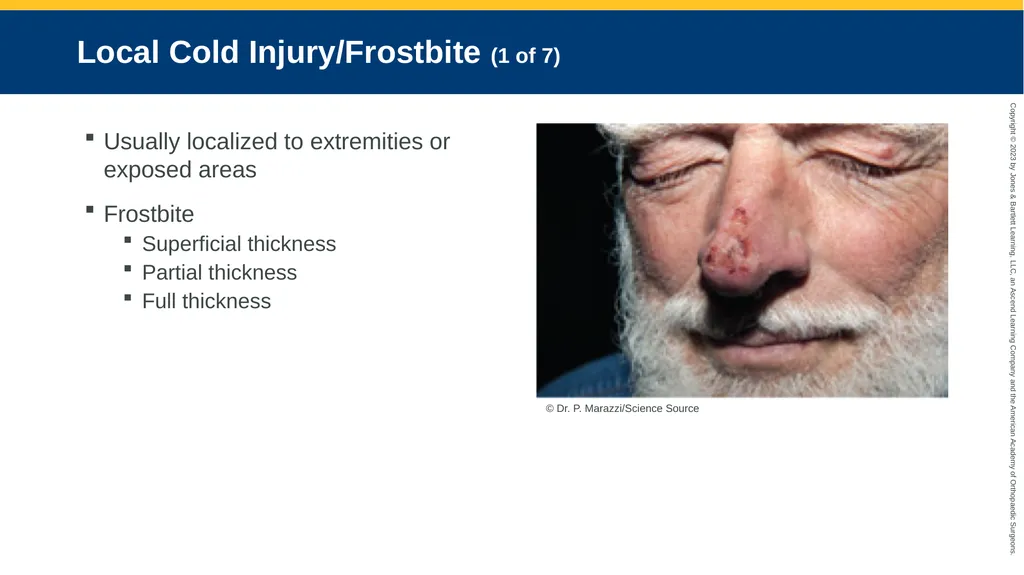
Local Cold Injury/Frostbite (1 of 7) Usually localized to extremities or exposed areas
Frostbite
Superficial thickness
Partial thickness
Full thickness © Dr. P. Marazzi/Science Source<br>
Frostbite
Superficial thickness
Partial thickness
Full thickness © Dr. P. Marazzi/Science Source<br>
47
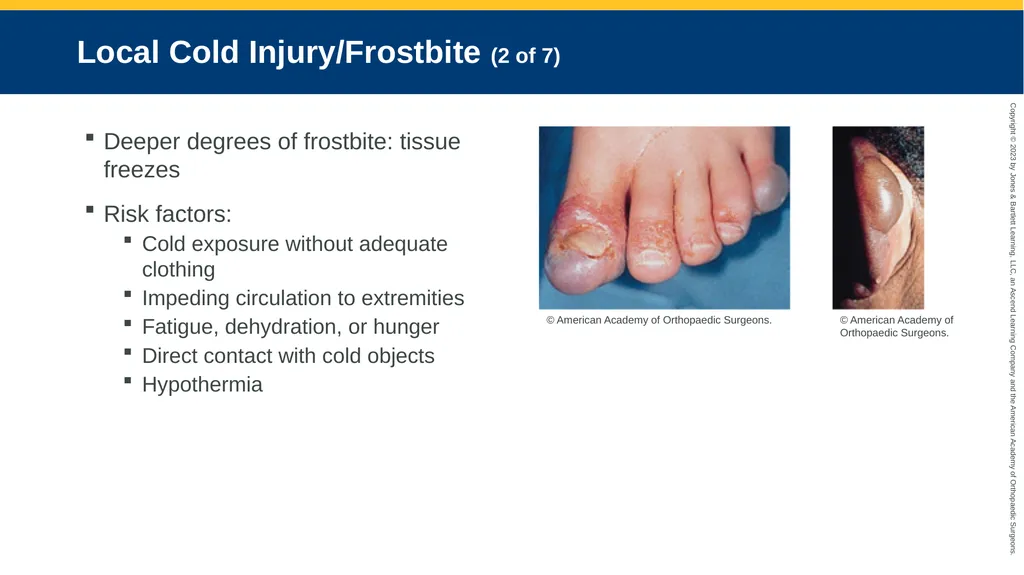
Local Cold Injury/Frostbite (2 of 7) Deeper degrees of frostbite: tissue freezes
Risk factors:
Cold exposure without adequate clothing
Impeding circulation to extremities
Fatigue, dehydration, or hunger
Direct contact with cold objects
Hypothermia © American Academy of Orthopaedic Surgeons. © American Academy of Orthopaedic Surgeons.<br>
Risk factors:
Cold exposure without adequate clothing
Impeding circulation to extremities
Fatigue, dehydration, or hunger
Direct contact with cold objects
Hypothermia © American Academy of Orthopaedic Surgeons. © American Academy of Orthopaedic Surgeons.<br>
48
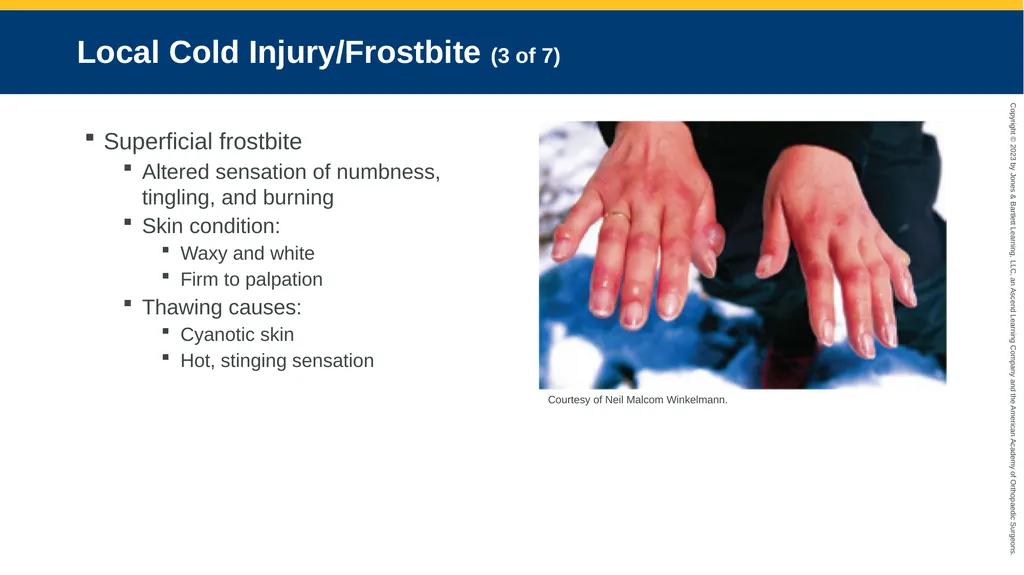
Local Cold Injury/Frostbite (3 of 7) Superficial frostbite
Altered sensation of numbness, tingling, and burning
Skin condition:
Waxy and white
Firm to palpation
Thawing causes:
Cyanotic skin
Hot, stinging sensation Courtesy of Neil Malcom Winkelmann.<br>
Altered sensation of numbness, tingling, and burning
Skin condition:
Waxy and white
Firm to palpation
Thawing causes:
Cyanotic skin
Hot, stinging sensation Courtesy of Neil Malcom Winkelmann.<br>
49
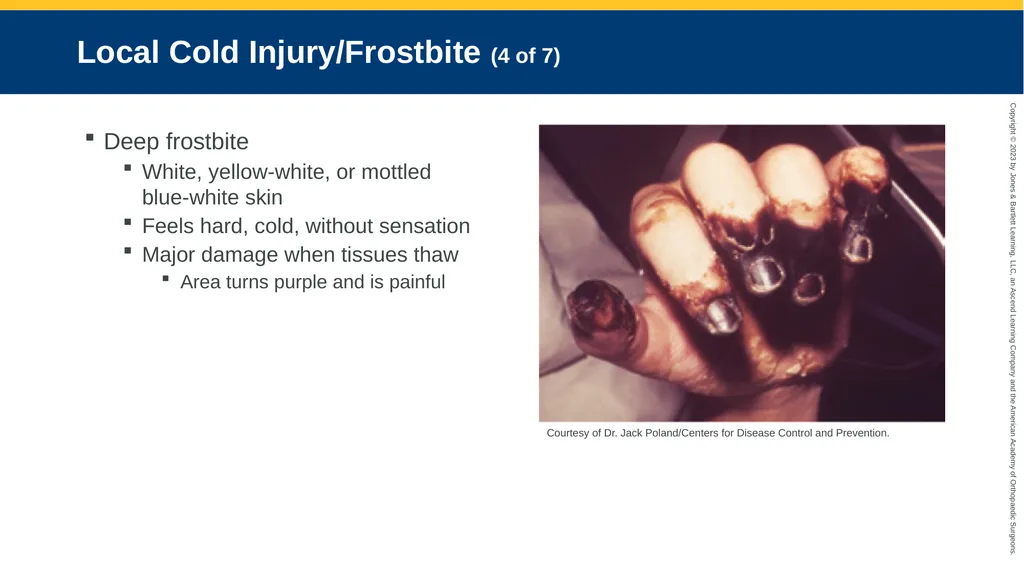
Local Cold Injury/Frostbite (4 of 7) Deep frostbite
White, yellow-white, or mottled blue-white skin
Feels hard, cold, without sensation
Major damage when tissues thaw
Area turns purple and is painful Courtesy of Dr. Jack Poland/Centers for Disease Control and Prevention.<br>
White, yellow-white, or mottled blue-white skin
Feels hard, cold, without sensation
Major damage when tissues thaw
Area turns purple and is painful Courtesy of Dr. Jack Poland/Centers for Disease Control and Prevention.<br>
50
Local Cold Injury/Frostbite (5 of 7) Management
It is difficult to determine the depth of injury.
Reperfusion injury can be excruciating.
Treatment is determined by the distance to the hospital and whether the affected area is partially or completely thawed.
Rapid rewarming is difficult in the field.<br>
It is difficult to determine the depth of injury.
Reperfusion injury can be excruciating.
Treatment is determined by the distance to the hospital and whether the affected area is partially or completely thawed.
Rapid rewarming is difficult in the field.<br>
51
Local Cold Injury/Frostbite (6 of 7) General principles:
Remove from cold and remove wet clothing.
Do not rub or massage area.
Transport with injured area elevated.
Give pain medication as needed.
Cover blisters with a dry, sterile dressing.
Consider rewarming if there is no potential of refreezing.<br>
Remove from cold and remove wet clothing.
Do not rub or massage area.
Transport with injured area elevated.
Give pain medication as needed.
Cover blisters with a dry, sterile dressing.
Consider rewarming if there is no potential of refreezing.<br>
52
Local Cold Injury/Frostbite (7 of 7) Principles of rewarming:
Rewarm before transport if medical control agrees.
Water bath—immersion without touching container
Temperature between 102°F and 104°F
IV analgesia<br>
Rewarm before transport if medical control agrees.
Water bath—immersion without touching container
Temperature between 102°F and 104°F
IV analgesia<br>
53
Trench Foot and Chilblains (1 of 2) Trench foot
Similar to frostbite but can occur at temperatures as high as 60°F
Caused by prolonged exposure to cool, wet conditions
Best treatment: prevention<br>
Similar to frostbite but can occur at temperatures as high as 60°F
Caused by prolonged exposure to cool, wet conditions
Best treatment: prevention<br>
54
Trench Foot and Chilblains (2 of 2) Chilblains
Itchy reddish or purple lesions on face or extremities
Long exposure to temperature just above freezing
Treatment:
Remove from extreme environments.
Rewarm at room temperature.<br>
Itchy reddish or purple lesions on face or extremities
Long exposure to temperature just above freezing
Treatment:
Remove from extreme environments.
Rewarm at room temperature.<br>
55
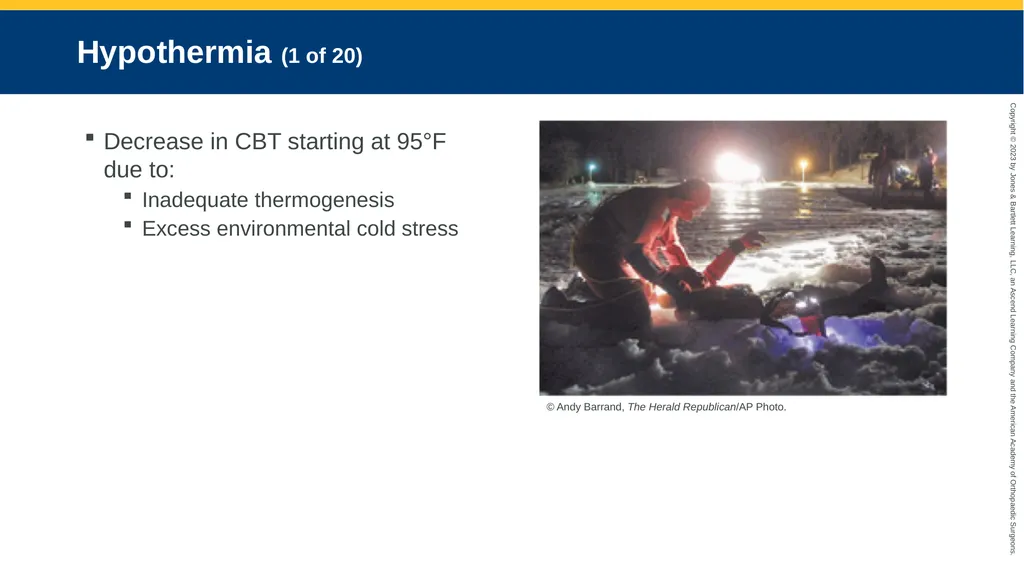
Hypothermia (1 of 20) Decrease in CBT starting at 95°F due to:
Inadequate thermogenesis
Excess environmental cold stress © Andy Barrand, The Herald Republican/AP Photo.<br>
Inadequate thermogenesis
Excess environmental cold stress © Andy Barrand, The Herald Republican/AP Photo.<br>
56
Hypothermia (2 of 20) Body regulates cold stress by:
Increasing thermogenesis
Decreasing thermolysis
Adaptive behavioral changes
Vasoconstriction<br>
Increasing thermogenesis
Decreasing thermolysis
Adaptive behavioral changes
Vasoconstriction<br>
57
Hypothermia (3 of 20) Risk factors:
Increased thermolysis
Decreased thermogenesis
Impaired thermoregulation<br>
Increased thermolysis
Decreased thermogenesis
Impaired thermoregulation<br>
58
Hypothermia (4 of 20) Hypothermic condition results from:
Cold temperatures
Fatigue
Improper gear
Wetness and dehydration
Length of exposure
Intensity of weather conditions<br>
Cold temperatures
Fatigue
Improper gear
Wetness and dehydration
Length of exposure
Intensity of weather conditions<br>
59
Hypothermia (5 of 20) Alcohol predisposes patients to hypothermia.
Impairs shivering thermogenesis
Promotes cutaneous vasodilation
Inadequate glycogen stores from liver disease
Subnormal nutritional status
Impairs judgment<br>
Impairs shivering thermogenesis
Promotes cutaneous vasodilation
Inadequate glycogen stores from liver disease
Subnormal nutritional status
Impairs judgment<br>
60
Hypothermia (6 of 20) Others at risk include:
Those using sedative medications
Those using tricyclic antidepressants
Those using phenothiazines
Older patients
Trauma patients<br>
Those using sedative medications
Those using tricyclic antidepressants
Those using phenothiazines
Older patients
Trauma patients<br>
61
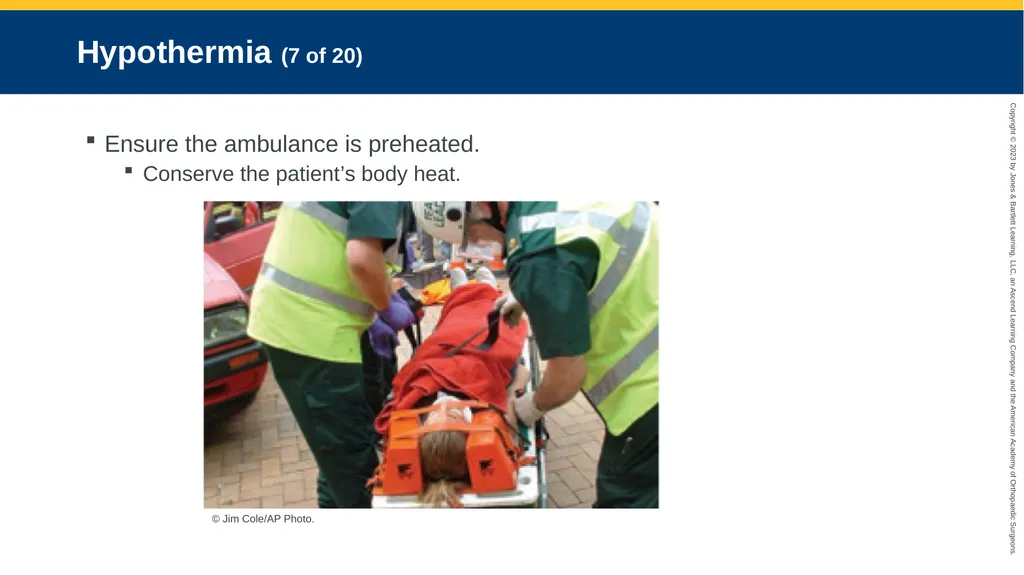
Hypothermia (7 of 20) Ensure the ambulance is preheated.
Conserve the patient’s body heat. © Jim Cole/AP Photo.<br>
Conserve the patient’s body heat. © Jim Cole/AP Photo.<br>
62
Hypothermia (8 of 20) National Institutes of Health campaign: watch for “umbles” in early stages:
Stumbles
Mumbles
Fumbles
Grumbles
Crumbles<br>
Stumbles
Mumbles
Fumbles
Grumbles
Crumbles<br>
63
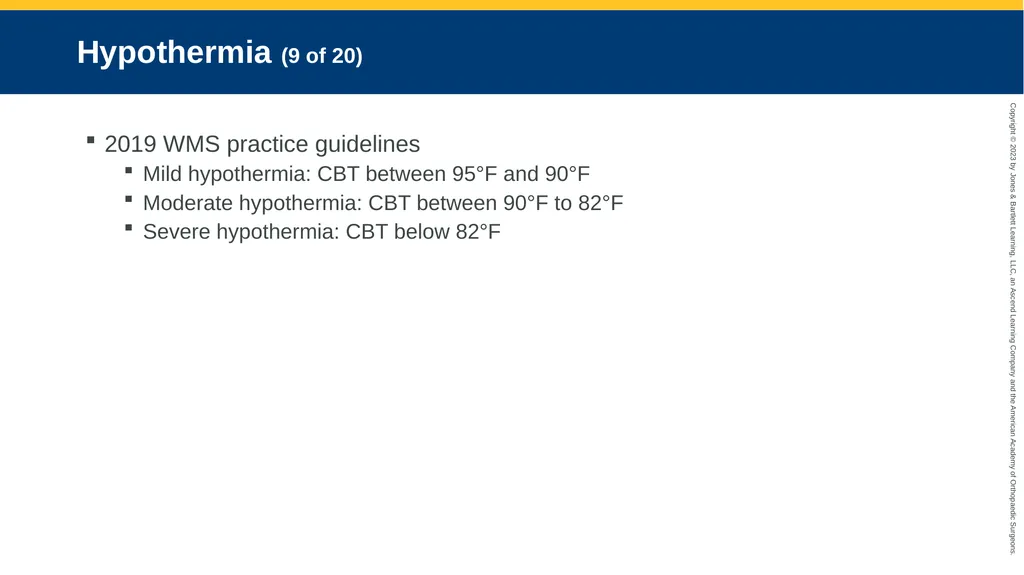
Hypothermia (9 of 20) 2019 WMS practice guidelines
Mild hypothermia: CBT between 95°F and 90°F
Moderate hypothermia: CBT between 90°F to 82°F
Severe hypothermia: CBT below 82°F<br>
Mild hypothermia: CBT between 95°F and 90°F
Moderate hypothermia: CBT between 90°F to 82°F
Severe hypothermia: CBT below 82°F<br>
64
Hypothermia (10 of 20) Classifications:
Acute
Subacute
Chronic
Also classified as:
Primary
Caused by cold exposure
Secondary
Caused by problems such as sepsis<br>
Acute
Subacute
Chronic
Also classified as:
Primary
Caused by cold exposure
Secondary
Caused by problems such as sepsis<br>
65
Hypothermia (11 of 20) There is no strong correlation between specific CBT and signs and symptoms.
Body systems react in different ways.
In the CNS, everything slows<br>
Body systems react in different ways.
In the CNS, everything slows<br>
66
Hypothermia (12 of 20) Signs and symptoms may resemble:
Stroke
Head injury
Acute psychiatric disturbance
Alcohol intoxication<br>
Stroke
Head injury
Acute psychiatric disturbance
Alcohol intoxication<br>
67
Hypothermia (13 of 20) Changes in cardiovascular system lead to:
Increase in blood viscosity
Impaired circulation
State of hypovolemia<br>
Increase in blood viscosity
Impaired circulation
State of hypovolemia<br>
68
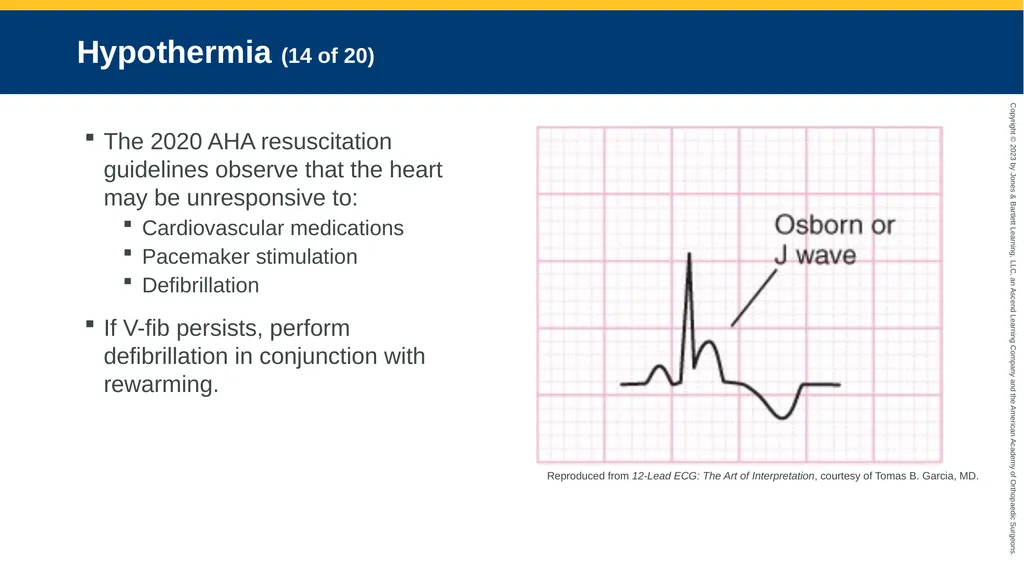
Hypothermia (14 of 20) The 2020 AHA resuscitation guidelines observe that the heart may be unresponsive to:
Cardiovascular medications
Pacemaker stimulation
Defibrillation
If V-fib persists, perform defibrillation in conjunction with rewarming. Reproduced from 12-Lead ECG: The Art of Interpretation, courtesy of Tomas B. Garcia, MD.<br>
Cardiovascular medications
Pacemaker stimulation
Defibrillation
If V-fib persists, perform defibrillation in conjunction with rewarming. Reproduced from 12-Lead ECG: The Art of Interpretation, courtesy of Tomas B. Garcia, MD.<br>
69
Hypothermia (15 of 20) The respiratory rate initially speeds up, then slows, with decreased minute volume.
Increase in tracheobronchial secretions
Bronchospasm
Pulmonary edema<br>
Increase in tracheobronchial secretions
Bronchospasm
Pulmonary edema<br>
70
Hypothermia (16 of 20) Muscular system slows.
Initial reaction is shivering.
Shivering stops at around 91°F.
Cold muscles become progressively weaker and stiffer.
Cold affects body’s metabolism.<br>
Initial reaction is shivering.
Shivering stops at around 91°F.
Cold muscles become progressively weaker and stiffer.
Cold affects body’s metabolism.<br>
71
Hypothermia (17 of 20) Care is aimed at preventing more heat loss and rewarming.
Strip the patient of wet clothes.
Insulate the patient from further heat loss.<br>
Strip the patient of wet clothes.
Insulate the patient from further heat loss.<br>
72
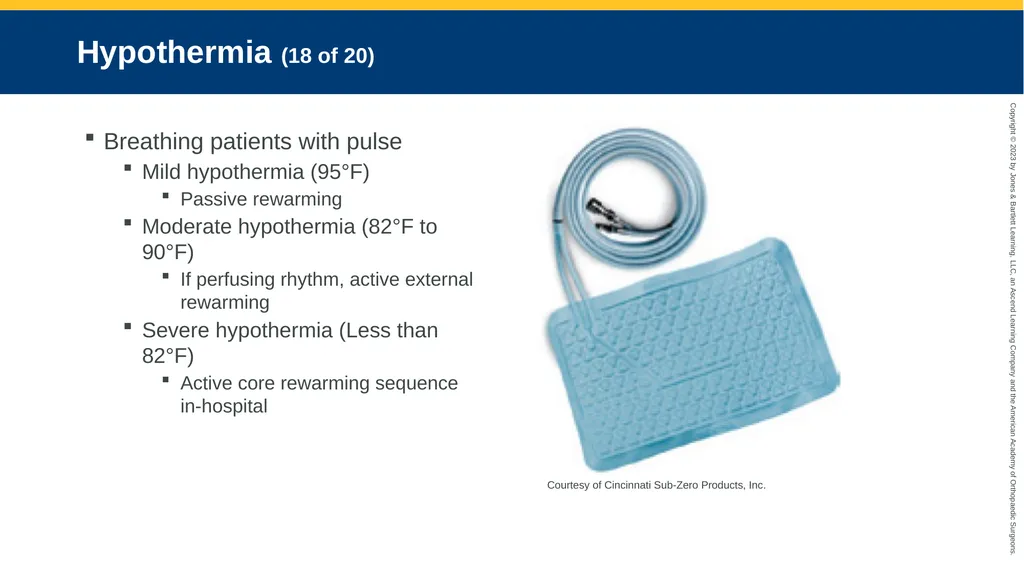
Hypothermia (18 of 20) Breathing patients with pulse
Mild hypothermia (95°F)
Passive rewarming
Moderate hypothermia (82°F to 90°F)
If perfusing rhythm, active external rewarming
Severe hypothermia (Less than 82°F)
Active core rewarming sequence in-hospital Courtesy of Cincinnati Sub-Zero Products, Inc.<br>
Mild hypothermia (95°F)
Passive rewarming
Moderate hypothermia (82°F to 90°F)
If perfusing rhythm, active external rewarming
Severe hypothermia (Less than 82°F)
Active core rewarming sequence in-hospital Courtesy of Cincinnati Sub-Zero Products, Inc.<br>
73
Hypothermia (19 of 20) Patients with no pulse or not breathing
The 2020 AHA resuscitation guidelines recommend full resuscitative measures.
Do not consider patients dead before rewarming has been provided (without obvious signs).
Rapid rhythm identification
One defibrillation attempt
IV access and infusion with warm normal saline
Advanced airway, and warm, humidified oxygen<br>
The 2020 AHA resuscitation guidelines recommend full resuscitative measures.
Do not consider patients dead before rewarming has been provided (without obvious signs).
Rapid rhythm identification
One defibrillation attempt
IV access and infusion with warm normal saline
Advanced airway, and warm, humidified oxygen<br>
74
Hypothermia (20 of 20) Patients are generally considered dead if:
There are obvious lethal traumatic injuries.
The patient is so solidly frozen airway or chest compression efforts are blocked.
Resuscitation is unlikely if submersion precedes arrest.
An exception is immersion in icy waters.<br>
There are obvious lethal traumatic injuries.
The patient is so solidly frozen airway or chest compression efforts are blocked.
Resuscitation is unlikely if submersion precedes arrest.
An exception is immersion in icy waters.<br>
75
Pathophysiology, Assessment, and Management of Drowning<br>
76
Drowning (1 of 16) Highly preventable
Process of experiencing respiratory impairment from submersion or immersion in liquid
Outcomes:
Death
Morbidity
No morbidity<br>
Process of experiencing respiratory impairment from submersion or immersion in liquid
Outcomes:
Death
Morbidity
No morbidity<br>
77
Drowning (2 of 16) Drowning continuum:
Breath holding
Laryngospasm
Accumulation of carbon dioxide/inability to oxygenate lungs
Respiratory and cardiac arrest from tissue hypoxia<br>
Breath holding
Laryngospasm
Accumulation of carbon dioxide/inability to oxygenate lungs
Respiratory and cardiac arrest from tissue hypoxia<br>
78
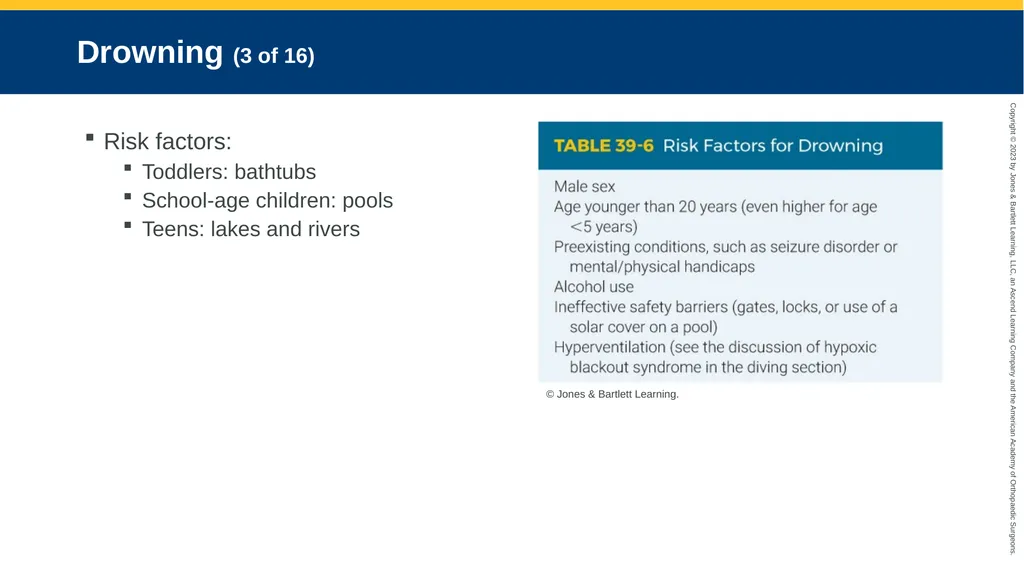
Drowning (3 of 16) Risk factors:
Toddlers: bathtubs
School-age children: pools
Teens: lakes and rivers © Jones & Bartlett Learning.<br>
Toddlers: bathtubs
School-age children: pools
Teens: lakes and rivers © Jones & Bartlett Learning.<br>
79
Drowning (4 of 16) Predictable sequences starting with inability to keep one’s face out of liquid
As water enters the mouth and nose, the victim may swallow large amounts of water during coughing and gasping.
Laryngospasm leads to asphyxia, and the patient may lose consciousness.<br>
As water enters the mouth and nose, the victim may swallow large amounts of water during coughing and gasping.
Laryngospasm leads to asphyxia, and the patient may lose consciousness.<br>
80
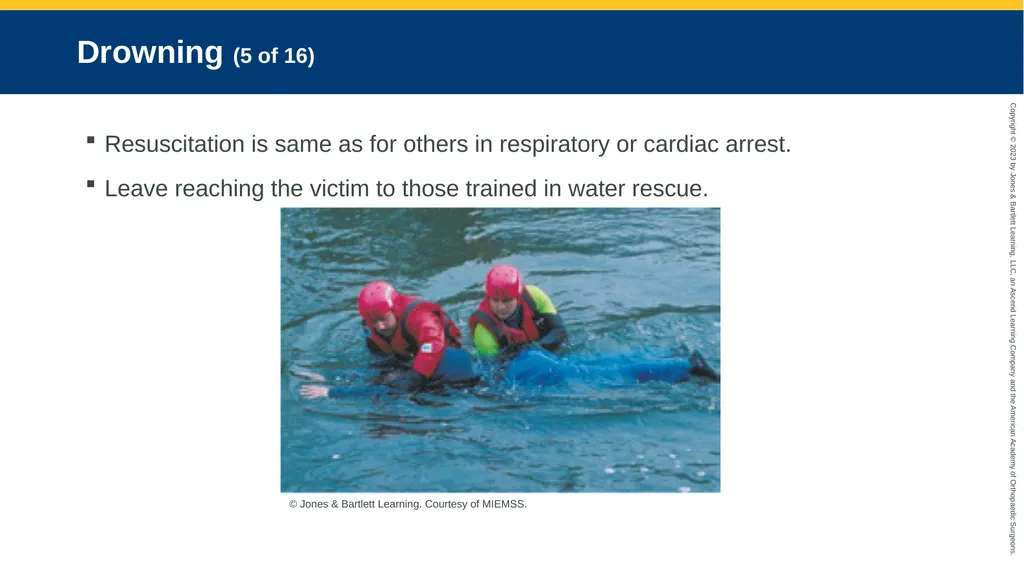
Drowning (5 of 16) Resuscitation is same as for others in respiratory or cardiac arrest.
Leave reaching the victim to those trained in water rescue. © Jones & Bartlett Learning. Courtesy of MIEMSS.<br>
Leave reaching the victim to those trained in water rescue. © Jones & Bartlett Learning. Courtesy of MIEMSS.<br>
81
Drowning (6 of 16) Treatment follows ABCs.
Establish airway.
Use cervical spine precautions if the following apply:
History of diving or water slide
Signs of injury
Alcohol intoxication
In-water resuscitation (IWR) may be warranted under special circumstances.
Prioritize oxygenation and ventilation once a patient is brought to a firm surface.<br>
Establish airway.
Use cervical spine precautions if the following apply:
History of diving or water slide
Signs of injury
Alcohol intoxication
In-water resuscitation (IWR) may be warranted under special circumstances.
Prioritize oxygenation and ventilation once a patient is brought to a firm surface.<br>
82
Drowning (7 of 16) Continue rescue breathing until on land.
Once the victim is on a solid surface:
Start supplementary oxygen.
Determine pulse.
Continue to treat according to ABC guidelines.<br>
Once the victim is on a solid surface:
Start supplementary oxygen.
Determine pulse.
Continue to treat according to ABC guidelines.<br>
83
Drowning (8 of 16) Follow ACLS and Pediatric Advanced Life support guidelines.
Suction to clear the airway.
Do not perform manual abdominal thrusts.<br>
Suction to clear the airway.
Do not perform manual abdominal thrusts.<br>
84
Drowning (9 of 16) Most drowning victims receiving rescue breathing or compressions will vomit.
Remove vomit from mouth via:
Suction
Finger swipes
Other devices
Consider placing the patient on the side.<br>
Remove vomit from mouth via:
Suction
Finger swipes
Other devices
Consider placing the patient on the side.<br>
85
Drowning (10 of 16) Maintain some positive pressure at the end of exhalation to:
Keep alveoli open
Drive fluid accumulated in alveoli back into interstitium or capillaries<br>
Keep alveoli open
Drive fluid accumulated in alveoli back into interstitium or capillaries<br>
86
Drowning (11 of 16) If an ET tube is inserted, insert a nasogastric tube to decompress the stomach.
If the pulse is absent, implement ALS measures for cardiopulmonary arrest.<br>
If the pulse is absent, implement ALS measures for cardiopulmonary arrest.<br>
87
Drowning (12 of 16) Do not give up on submersion patient.
Successful resuscitation has occurred with complete neurologic recovery in more than 1 hour of submersion in icy water.
Hypothermia protects the body and brain from hypoxia.<br>
Successful resuscitation has occurred with complete neurologic recovery in more than 1 hour of submersion in icy water.
Hypothermia protects the body and brain from hypoxia.<br>
88
Drowning (13 of 16) Search for comorbidities:
Trauma
Hypoglycemia
Acute coronary syndrome
Cerebrovascular accident<br>
Trauma
Hypoglycemia
Acute coronary syndrome
Cerebrovascular accident<br>
89
Drowning (14 of 16) Evidence-based guidelines maintain that length of submersion alone predicts survival.
Paramedics may participate in injury-prevention activities.<br>
Paramedics may participate in injury-prevention activities.<br>
90
Drowning (15 of 16) Postresuscitation complications
Occur hours to days after submersion
Adult respiratory distress syndrome
Hypoxic brain injury
Multiorgan failure
Sepsis syndrome<br>
Occur hours to days after submersion
Adult respiratory distress syndrome
Hypoxic brain injury
Multiorgan failure
Sepsis syndrome<br>
91
Drowning (16 of 16) Submerged vehicle incidents
Safest time to escape is immediately after entering water
Sequence of steps for egress:
Seat belts
Windows
Children
Out<br>
Safest time to escape is immediately after entering water
Sequence of steps for egress:
Seat belts
Windows
Children
Out<br>
92
Pathophysiology, Assessment, and Management of Diving Injuries<br>
93
Diving Injuries Four modes of diving
Scuba
Breath hold
Surface tended
Saturation
Increased ambient pressures found underwater<br>
Scuba
Breath hold
Surface tended
Saturation
Increased ambient pressures found underwater<br>
94
Physical Principles of Pressure Effects (1 of 9) Pressure: force per unit area
Different ways to express
For example, weight of air at sea level:
14.7 pounds per square inch
760 mm Hg
1 atmosphere absolute (ATA) (most common)<br>
Different ways to express
For example, weight of air at sea level:
14.7 pounds per square inch
760 mm Hg
1 atmosphere absolute (ATA) (most common)<br>
95
Physical Principles of Pressure Effects (2 of 9) Water much denser than air.
For every 33 feet of seawater (fsw), pressure increases 1 ATA.
Sea level—pressure is 1 ATA
33 fsw—pressure is 2 ATA
66 fsw—pressure is 3 ATA
Majority of scuba diving is at depths between 60 and 120 fsw (3 to 5 ATA).<br>
For every 33 feet of seawater (fsw), pressure increases 1 ATA.
Sea level—pressure is 1 ATA
33 fsw—pressure is 2 ATA
66 fsw—pressure is 3 ATA
Majority of scuba diving is at depths between 60 and 120 fsw (3 to 5 ATA).<br>
96
Physical Principles of Pressure Effects (3 of 9) Liquid volume does not change with pressure.
Body and tissues are primarily water—they are not so affected by pressure changes in descent or ascent.
Gas-filled organs are compressible and follow several physical laws.<br>
Body and tissues are primarily water—they are not so affected by pressure changes in descent or ascent.
Gas-filled organs are compressible and follow several physical laws.<br>
97
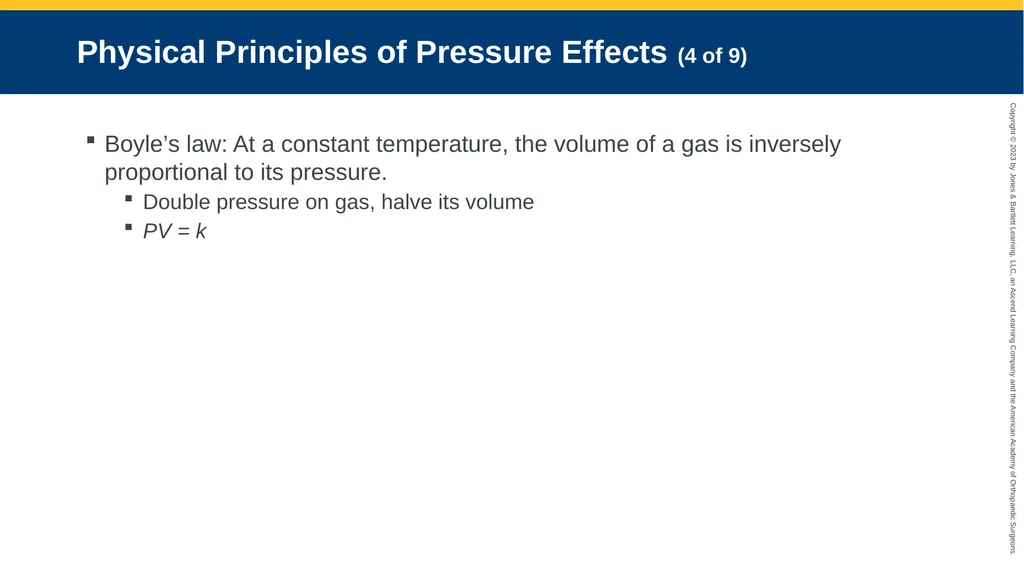
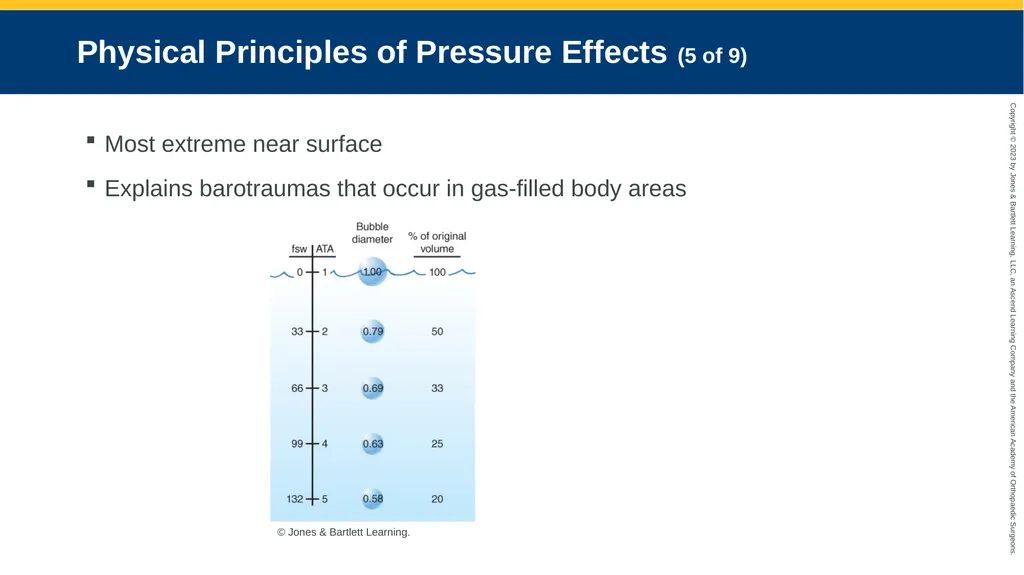
Physical Principles of Pressure Effects (4 of 9) Boyle’s law: At a constant temperature, the volume of a gas is inversely proportional to its pressure.
Double pressure on gas, halve its volume
PV = k<br>
Double pressure on gas, halve its volume
PV = k<br>
98
Physical Principles of Pressure Effects (5 of 9) Most extreme near surface
Explains barotraumas that occur in gas-filled body areas © Jones & Bartlett Learning.<br>
Explains barotraumas that occur in gas-filled body areas © Jones & Bartlett Learning.<br>
99
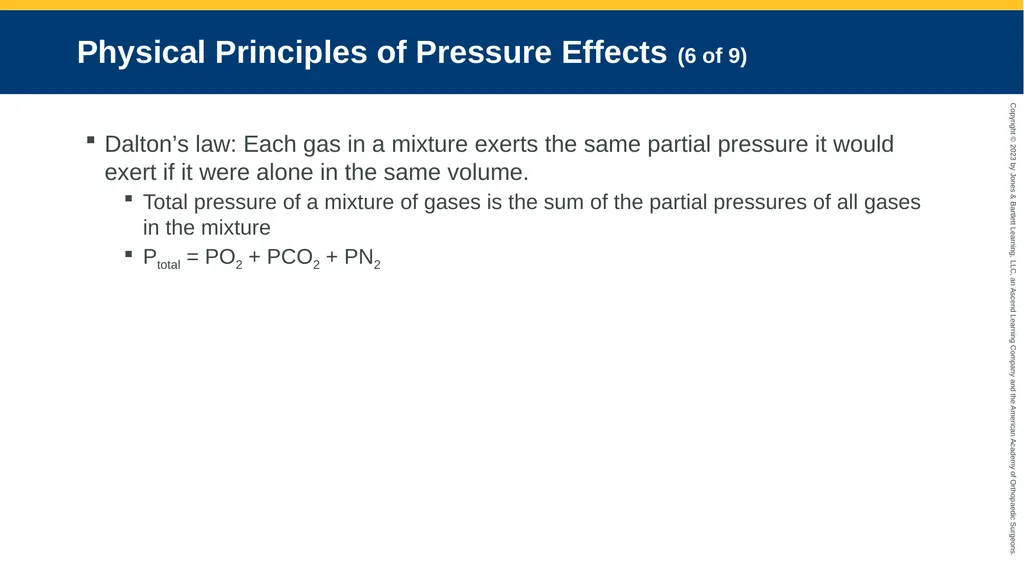
Physical Principles of Pressure Effects (6 of 9) Dalton’s law: Each gas in a mixture exerts the same partial pressure it would exert if it were alone in the same volume.
Total pressure of a mixture of gases is the sum of the partial pressures of all gases in the mixture
Ptotal = PO2 + PCO2 + PN2<br>
Total pressure of a mixture of gases is the sum of the partial pressures of all gases in the mixture
Ptotal = PO2 + PCO2 + PN2<br>
100
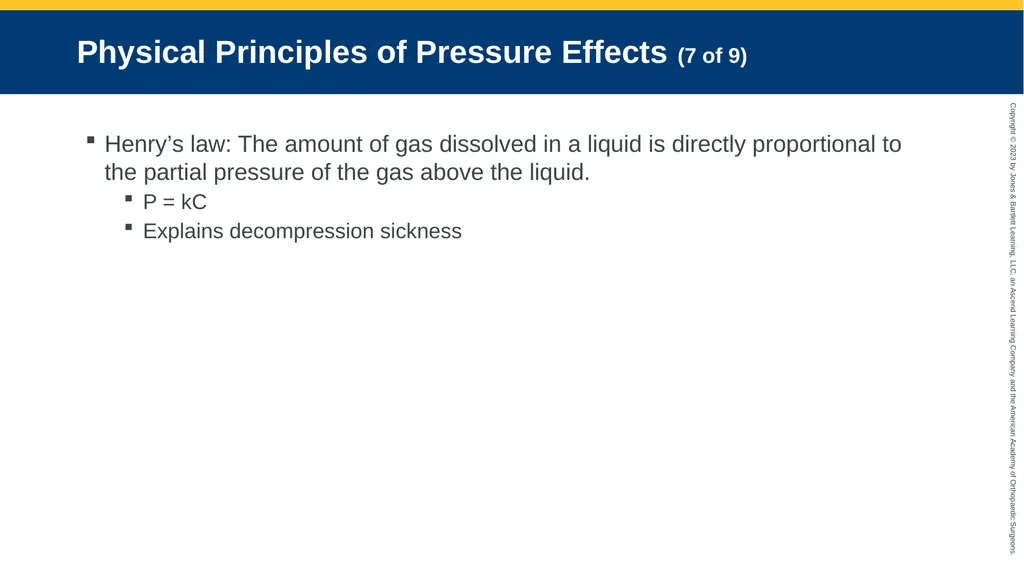
Physical Principles of Pressure Effects (7 of 9) Henry’s law: The amount of gas dissolved in a liquid is directly proportional to the partial pressure of the gas above the liquid.
P = kC
Explains decompression sickness<br>
P = kC
Explains decompression sickness<br>
101
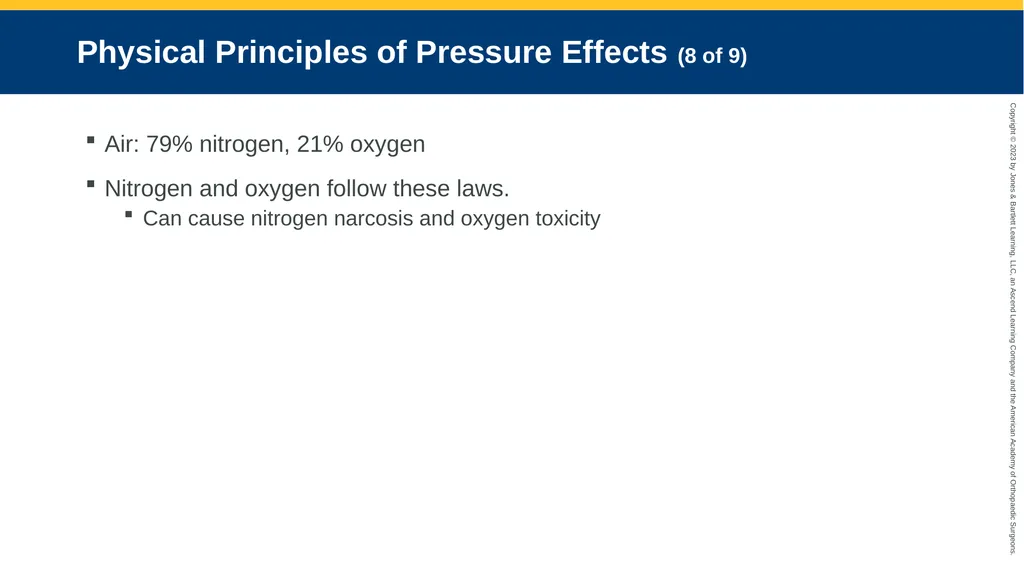
Physical Principles of Pressure Effects (8 of 9) Air: 79% nitrogen, 21% oxygen
Nitrogen and oxygen follow these laws.
Can cause nitrogen narcosis and oxygen toxicity<br>
Nitrogen and oxygen follow these laws.
Can cause nitrogen narcosis and oxygen toxicity<br>
102
Physical Principles of Pressure Effects (9 of 9) Commercial divers use a decompression schedule.
Allows gases time to equilibrate
Recreational divers—no-decompression limit to keep from decompressing
Enriched Nitrox gas to decrease risk of nitrogen narcosis<br>
Allows gases time to equilibrate
Recreational divers—no-decompression limit to keep from decompressing
Enriched Nitrox gas to decrease risk of nitrogen narcosis<br>
103
General Assessment of Diving History (1 of 2) Obtain diving history
When symptoms started
Type of diving and equipment
Type of tank
Diving site and water temperature
Number of dives in the last 72 hours
Depth
Bottom time
Surface interval<br>
When symptoms started
Type of diving and equipment
Type of tank
Diving site and water temperature
Number of dives in the last 72 hours
Depth
Bottom time
Surface interval<br>
104
General Assessment of Diving History (2 of 2) Diving history (cont’d)
Dive computer or safety stops used
Any attempts at in-water decompression
Any dive complications
Predive and postdive activities<br>
Dive computer or safety stops used
Any attempts at in-water decompression
Any dive complications
Predive and postdive activities<br>
105
Injuries at Depth (1 of 3) Nitrogen narcosis
Altered mental status from breathing compressed nitrogen-containing air at depth
At a partial pressure of about 3.2 ATA, nitrogen begins to have anesthetic properties.<br>
Altered mental status from breathing compressed nitrogen-containing air at depth
At a partial pressure of about 3.2 ATA, nitrogen begins to have anesthetic properties.<br>
106
Injuries at Depth (2 of 3) Signs and symptoms:
Euphoria
Inappropriate and dangerous behavior
Tingling of lips, gums, and legs
Panic and too-quick surfacing<br>
Euphoria
Inappropriate and dangerous behavior
Tingling of lips, gums, and legs
Panic and too-quick surfacing<br>
107
Injuries at Depth (3 of 3) Management
Lower nitrogen partial pressure through:
Controlled ascent
Use of a mixed gas for diving with a decreased nitrogen percentage<br>
Lower nitrogen partial pressure through:
Controlled ascent
Use of a mixed gas for diving with a decreased nitrogen percentage<br>
108
Barotrauma (1 of 3) Result of pressure imbalance between gas-filled spaces in the body and external atmosphere
Can affect any gas-filled space in the body
As a diver ascends and ambient pressure decreases, gases in the body’s air-filled spaces expand.<br>
Can affect any gas-filled space in the body
As a diver ascends and ambient pressure decreases, gases in the body’s air-filled spaces expand.<br>
109
Barotrauma (2 of 3) Pressure in the middle ear cannot be equalized with outside water pressure if:
There is blockage of the eustachian tube.
The Valsalva maneuver does not equalize pressure.
Middle ear squeeze syndrome causes severe pain.
The tympanic membrane may rupture.<br>
There is blockage of the eustachian tube.
The Valsalva maneuver does not equalize pressure.
Middle ear squeeze syndrome causes severe pain.
The tympanic membrane may rupture.<br>
110
Barotrauma (3 of 3) Treatment
Loose dressing for bleeding ear
IV antiemetics or sedatives
Possible decompression symptoms:
Hearing loss
Vertigo<br>
Loose dressing for bleeding ear
IV antiemetics or sedatives
Possible decompression symptoms:
Hearing loss
Vertigo<br>
111
Pulmonary Overpressurization Syndrome (POPS) (1 of 5) If divers fail to exhale during ascent, pressure in lungs increases.
Can cause:
Pneumothorax
Mediastinal/subcutaneous emphysema
Alveolar hemorrhage
Lethal arterial gas embolism (AGE)<br>
Can cause:
Pneumothorax
Mediastinal/subcutaneous emphysema
Alveolar hemorrhage
Lethal arterial gas embolism (AGE)<br>
112
Pulmonary Overpressurization Syndrome (POPS) (2 of 5) Relative pressure and volume changes are greatest near the surface of the water.
Small overpressurization can rupture alveoli.
COPD and asthma patients have slightly higher risk.<br>
Small overpressurization can rupture alveoli.
COPD and asthma patients have slightly higher risk.<br>
113
Pulmonary Overpressurization Syndrome (POPS) (3 of 5) Signs and symptoms depend on where escaping air ends up.
Most often, the air leaks into the mediastinum and beneath the skin, causing:
Full sensation in throat
Pain on swelling
Dyspnea
Substernal chest pain
Hoarseness or brassy quality to the voice<br>
Most often, the air leaks into the mediastinum and beneath the skin, causing:
Full sensation in throat
Pain on swelling
Dyspnea
Substernal chest pain
Hoarseness or brassy quality to the voice<br>
114
Pulmonary Overpressurization Syndrome (POPS) (4 of 5) Physical examination may show:
Palpable subcutaneous air above clavicles
Crunching noise synchronous with heartbeat audible by auscultation (Hamman sign)
Pneumothorax (less likely)<br>
Palpable subcutaneous air above clavicles
Crunching noise synchronous with heartbeat audible by auscultation (Hamman sign)
Pneumothorax (less likely)<br>
115
Pulmonary Overpressurization Syndrome (POPS) (5 of 5) Prehospital treatment depends on whether an arterial gas embolism is present.
In the field, provide 100% oxygen by nonrebreathing mask.<br>
In the field, provide 100% oxygen by nonrebreathing mask.<br>
116
Arterial Gas Embolism (AGE) (1 of 5) Air bubbles from ruptured alveoli enter pulmonary capillaries and travel back to the left side of the heart.
Bubbles may enter the coronary arteries and produce effects of acute myocardial infarction.
The majority rise to the head, causing strokelike symptoms.<br>
Bubbles may enter the coronary arteries and produce effects of acute myocardial infarction.
The majority rise to the head, causing strokelike symptoms.<br>
117
Arterial Gas Embolism (AGE) (2 of 5) Dramatic clinical picture, with symptoms:
Involving most cerebral functions
Appearing within seconds to minutes (usually 10 minutes) after surfacing
History of panic or uncontrolled ascent, but can occur in shallow water<br>
Involving most cerebral functions
Appearing within seconds to minutes (usually 10 minutes) after surfacing
History of panic or uncontrolled ascent, but can occur in shallow water<br>
118
Arterial Gas Embolism (AGE) (3 of 5) Patient can experience:
Weakness or paralysis of extremities
Seizure activity
Unresponsiveness
Paresthesias
Visual disturbances
Deafness
Changes in mental status<br>
Weakness or paralysis of extremities
Seizure activity
Unresponsiveness
Paresthesias
Visual disturbances
Deafness
Changes in mental status<br>
119
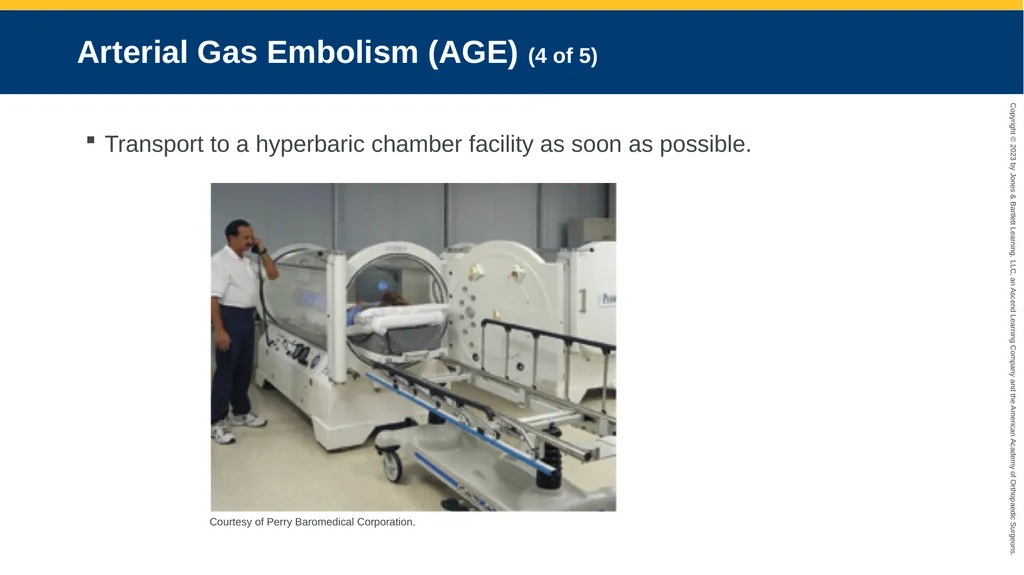
Arterial Gas Embolism (AGE) (4 of 5) Transport to a hyperbaric chamber facility as soon as possible. Courtesy of Perry Baromedical Corporation.<br>
120
Arterial Gas Embolism (AGE) (5 of 5) Treatment:
Ensure adequate airway.
Administer 100% supplemental oxygen.
Transport in supine position by ground.
Establish IV access and administer normal saline.
Monitor cardiac rhythm.<br>
Ensure adequate airway.
Administer 100% supplemental oxygen.
Transport in supine position by ground.
Establish IV access and administer normal saline.
Monitor cardiac rhythm.<br>
121
Decompression Sickness (DCS) (1 of 7) Nitrogen bubbles in blood and tissue coming out of solution during ascent
The bubbles cause damage by:
Interfering mechanically with tissue perfusion
Triggering chemical changes in the body
Can potentially affect every organ in the body<br>
The bubbles cause damage by:
Interfering mechanically with tissue perfusion
Triggering chemical changes in the body
Can potentially affect every organ in the body<br>
122
Decompression Sickness (DCS) (2 of 7) Nitrogen and oxygen are carried to tissues; oxygen is metabolized, but nitrogen remains.
If the ascent is slow enough, enough nitrogen will escape with each breath.
If the ascent is more rapid than nitrogen can be removed, diver’s tissues will begin to bubble.<br>
If the ascent is slow enough, enough nitrogen will escape with each breath.
If the ascent is more rapid than nitrogen can be removed, diver’s tissues will begin to bubble.<br>
123
Decompression Sickness (DCS) (3 of 7) Risk factors include:
Multiple dive in short time
Obesity
Dehydration
Fatigue
Flying within 12 to14 hours of diving<br>
Multiple dive in short time
Obesity
Dehydration
Fatigue
Flying within 12 to14 hours of diving<br>
124
Decompression Sickness (DCS) (4 of 7) Risk of severe neurologic DCS if patient has a patent foramen ovale
May allow nitrogen bubbles to travel from pulmonary circulation into systemic circulation
Increased damage to CNS and proximal spinal cord<br>
May allow nitrogen bubbles to travel from pulmonary circulation into systemic circulation
Increased damage to CNS and proximal spinal cord<br>
125
Decompression Sickness (DCS) (5 of 7) Type I: mild form that involves only:
Skin
Lymphatic system
Musculoskeletal system
Symptoms:
Joint pain
Mottled and pruritic skin
Fatigue and weakness
Lymph dysfunction leading to edema (rare)<br>
Skin
Lymphatic system
Musculoskeletal system
Symptoms:
Joint pain
Mottled and pruritic skin
Fatigue and weakness
Lymph dysfunction leading to edema (rare)<br>
126
Decompression Sickness (DCS) (6 of 7) Type II: symptoms in all other organ systems
Pulmonary
Cardiovascular
Nervous<br>
Pulmonary
Cardiovascular
Nervous<br>
127
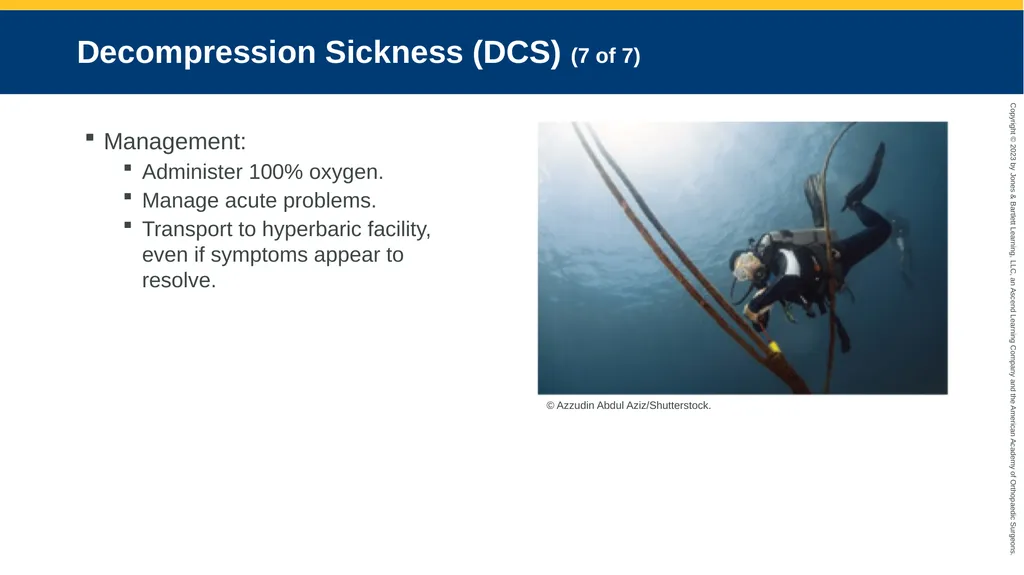
Decompression Sickness (DCS) (7 of 7) Management:
Administer 100% oxygen.
Manage acute problems.
Transport to hyperbaric facility, even if symptoms appear to resolve. © Azzudin Abdul Aziz/Shutterstock.<br>
Administer 100% oxygen.
Manage acute problems.
Transport to hyperbaric facility, even if symptoms appear to resolve. © Azzudin Abdul Aziz/Shutterstock.<br>
128
Hyperbaric Oxygen Therapy (1 of 4) Intermittent inhalation of pure oxygen under pressure greater than 1 ATA
Mechanically reduces bubble size
Reduces nitrogen content
Increases oxygen delivery to ischemic tissues
Treatment pressures and times from established tables<br>
Mechanically reduces bubble size
Reduces nitrogen content
Increases oxygen delivery to ischemic tissues
Treatment pressures and times from established tables<br>
129
Hyperbaric Oxygen Therapy (2 of 4) Indicated in patients with:
AGE
DCS
Carbon monoxide poisoning
Other subacute or chronic medical conditions
Also used in routine decompression of industrial divers<br>
AGE
DCS
Carbon monoxide poisoning
Other subacute or chronic medical conditions
Also used in routine decompression of industrial divers<br>
130
Hyperbaric Oxygen Therapy (3 of 4) Risks:
May convert a pneumothorax into a tension pneumothorax if no chest tube
Seizures from oxygen toxicity
Barotrauma<br>
May convert a pneumothorax into a tension pneumothorax if no chest tube
Seizures from oxygen toxicity
Barotrauma<br>
131
Hyperbaric Oxygen Therapy (4 of 4) Care is recommended in patients who:
Are pregnant
Have lung disease
Have fever
Have seizure disorders<br>
Are pregnant
Have lung disease
Have fever
Have seizure disorders<br>
132
Other Gas-Related Problems (1 of 4) Most recreational divers use compressed air.
Tanks with various mixtures of nitrogen/oxygen allow divers to be underwater longer.
Less nitrogen—less likely to develop DCS
More oxygen—prone to oxygen toxicity<br>
Tanks with various mixtures of nitrogen/oxygen allow divers to be underwater longer.
Less nitrogen—less likely to develop DCS
More oxygen—prone to oxygen toxicity<br>
133
Other Gas-Related Problems (2 of 4) Signs and symptoms include:
Dizziness
Lack of coordination
Confusion
Twitching or paresthesia
Underwater seizures<br>
Dizziness
Lack of coordination
Confusion
Twitching or paresthesia
Underwater seizures<br>
134
Other Gas-Related Problems (3 of 4) Evacuation from water involves:
Controlled ascent
Ensuring the diver maintains airway and has air access during ascent
AGE risk does not increase when a seizing or postictal patient is brought to surface.
DCS may be a concern.<br>
Controlled ascent
Ensuring the diver maintains airway and has air access during ascent
AGE risk does not increase when a seizing or postictal patient is brought to surface.
DCS may be a concern.<br>
135
Other Gas-Related Problems (4 of 4) A contaminated air tank affects a diver early in the dive.
Once back in the boat or on the shore, treatment includes:
100% oxygen
Supportive therapy
Hyperbaric oxygen therapy in pregnant patients or those with significant exposure<br>
Once back in the boat or on the shore, treatment includes:
100% oxygen
Supportive therapy
Hyperbaric oxygen therapy in pregnant patients or those with significant exposure<br>
136
Hypoxic Blackout (1 of 4) Frequently seen in swimmers performing breath-holding exercises
May hyperventilate just before going under to extend endurance
Decreases PaCO2, causing cerebral vasoconstriction
PaO2 increases as swimmer descends<br>
May hyperventilate just before going under to extend endurance
Decreases PaCO2, causing cerebral vasoconstriction
PaO2 increases as swimmer descends<br>
137
Hypoxic Blackout (2 of 4) Because PaCO2 is relatively low, respiratory drive is suppressed.
A diver can remain underwater longer, but oxygen continues to be removed from the alveoli.
Cerebral function is maintained at depth by increased PaO2.<br>
A diver can remain underwater longer, but oxygen continues to be removed from the alveoli.
Cerebral function is maintained at depth by increased PaO2.<br>
138
Hypoxic Blackout (3 of 4) On surfacing:
Ambient pressure rapidly decreases.
PaO2 plummets.
Hypoxemia and cerebral vasoconstriction together cause blackout just before reaching the surface.<br>
Ambient pressure rapidly decreases.
PaO2 plummets.
Hypoxemia and cerebral vasoconstriction together cause blackout just before reaching the surface.<br>
139
Hypoxic Blackout (4 of 4) Treat as for any other case of submersion.
When the patient regains consciousness, explain the seriousness of the injury.<br>
When the patient regains consciousness, explain the seriousness of the injury.<br>
140
Getting Help for Diving Injuries DAN: 24-hour consultation service
Resource for emergency medical personnel dealing with underwater diving accidents
(919) 684-8111
Connect with physician experienced in diving medicine<br>
Resource for emergency medical personnel dealing with underwater diving accidents
(919) 684-8111
Connect with physician experienced in diving medicine<br>
141
Pathophysiology, Assessment, and Management of Altitude Illness<br>
142
Altitude Illness (1 of 18) Altitude: terrestrial elevation above 5,000 ft (1,500 m)
Level where physiologic changes from hypobaric hypoxia begin
Altitude illness: low partial pressure of oxygen leads to hypoxia<br>
Level where physiologic changes from hypobaric hypoxia begin
Altitude illness: low partial pressure of oxygen leads to hypoxia<br>
143
Altitude Illness (2 of 18) Barometric pressure varies according to:
Distance from the equator
Season (typically lower in winter)
Local changes in barometric pressure<br>
Distance from the equator
Season (typically lower in winter)
Local changes in barometric pressure<br>
144
Altitude Illness (3 of 18) Illness caused by effects of hypobaric hypoxia on the CNS and pulmonary system
Types:
Acute mountain sickness (AMS)
High-altitude cerebral edema (HACE)
High-altitude pulmonary edema (HAPE)<br>
Types:
Acute mountain sickness (AMS)
High-altitude cerebral edema (HACE)
High-altitude pulmonary edema (HAPE)<br>
145
Altitude Illness (4 of 18) Typically occurs in those rapidly ascending to above 8,000 ft, but can occur as low as 6,500 ft
Symptoms usually within 6 to 10 hours
Directly related to how high and how quickly people ascend<br>
Symptoms usually within 6 to 10 hours
Directly related to how high and how quickly people ascend<br>
146
Altitude Illness (5 of 18) The body adjusts by defending the amount of oxygen available for delivery to tissues.
First response is hyperventilation
Quickly leads to respiratory alkalosis
Secretion of bicarbonate in urine
Causes compensatory metabolic acidosis<br>
First response is hyperventilation
Quickly leads to respiratory alkalosis
Secretion of bicarbonate in urine
Causes compensatory metabolic acidosis<br>
147
Altitude Illness (6 of 18) Hypoxemia is a main problem, but the mechanism is poorly understood.
Initiates a series of reactions that cause overperfusion to the brain and lungs, increasing:
Capillary pressures
Leakage
Cerebral and pulmonary edema<br>
Initiates a series of reactions that cause overperfusion to the brain and lungs, increasing:
Capillary pressures
Leakage
Cerebral and pulmonary edema<br>
148
Altitude Illness (7 of 18) HAPE results from marked vasospasm of pulmonary arteries.
Results in high pressure driving fluid from pulmonary vasculature into lungs
Does not result from volume overload state
No nitroglycerin or furosemide for HAPE<br>
Results in high pressure driving fluid from pulmonary vasculature into lungs
Does not result from volume overload state
No nitroglycerin or furosemide for HAPE<br>
149
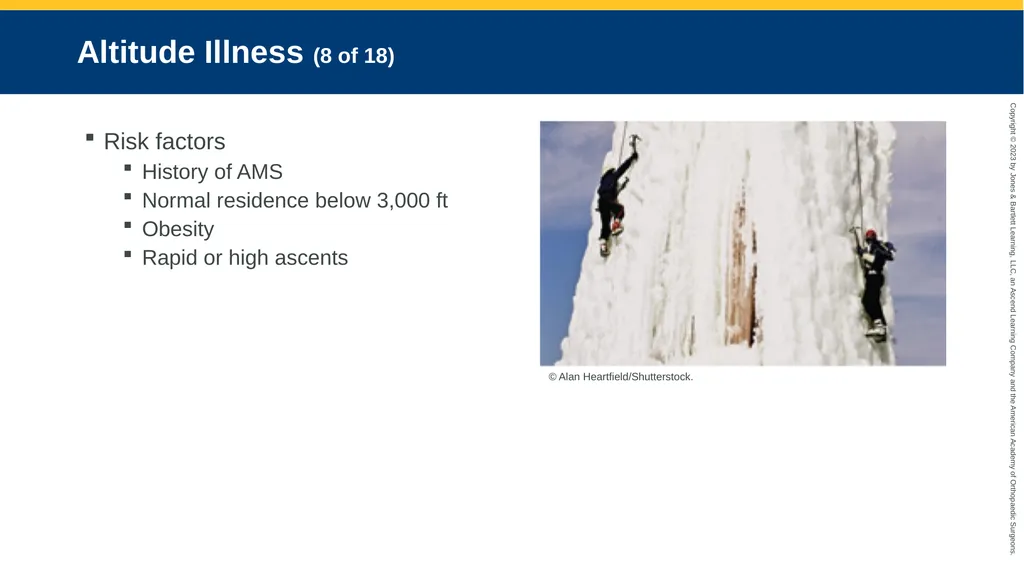
Altitude Illness (8 of 18) Risk factors
History of AMS
Normal residence below 3,000 ft
Obesity
Rapid or high ascents © Alan Heartfield/Shutterstock.<br>
History of AMS
Normal residence below 3,000 ft
Obesity
Rapid or high ascents © Alan Heartfield/Shutterstock.<br>
150
Altitude Illness (9 of 18) Acute mountain sickness (AMS) symptoms include:
Headache
Fatigue or weakness
GI symptoms
Dizziness or light-headedness
Difficulty sleeping<br>
Headache
Fatigue or weakness
GI symptoms
Dizziness or light-headedness
Difficulty sleeping<br>
151
Altitude Illness (10 of 18) High-altitude pulmonary edema (HAPE)
Dyspnea at rest
Cough
Weakness
Chest tightness or congestion
Central cyanosis
Audible crackles (rales) or wheezing
Tachypnea
Tachycardia<br>
Dyspnea at rest
Cough
Weakness
Chest tightness or congestion
Central cyanosis
Audible crackles (rales) or wheezing
Tachypnea
Tachycardia<br>
152
Altitude Illness (11 of 18) High-altitude cerebral edema (HACE)
Change in mental status or ataxia in a person with AMS
Mental status changes and ataxia in a person without AMS<br>
Change in mental status or ataxia in a person with AMS
Mental status changes and ataxia in a person without AMS<br>
153
Altitude Illness (12 of 18) Signs of possible causes other than AMS:
Symptoms developing 4 or more days after higher elevations
Lack of headache
Failure of descent to improve signs or symptoms<br>
Symptoms developing 4 or more days after higher elevations
Lack of headache
Failure of descent to improve signs or symptoms<br>
154
Altitude Illness (13 of 18) Management of all altitude illnesses includes:
Oxygen
Descent
Evacuation
Various treatments specific to illness<br>
Oxygen
Descent
Evacuation
Various treatments specific to illness<br>
155
Altitude Illness (14 of 18) Prevention by:
Acclimatization
Slow ascent
Use of acetazolamide for most susceptible<br>
Acclimatization
Slow ascent
Use of acetazolamide for most susceptible<br>
156
Altitude Illness (15 of 18) AMS treatment:
Acetaminophen or aspirin for headaches
Antiemetics for nausea
Acetazolamide for AMS and acclimatization
Oxygen
No further ascension until symptoms resolve<br>
Acetaminophen or aspirin for headaches
Antiemetics for nausea
Acetazolamide for AMS and acclimatization
Oxygen
No further ascension until symptoms resolve<br>
157
Altitude Illness (16 of 18) HAPE treatment:
Immediate descent
Oxygen
Medication as adjunctive treatment limited to patients where:
Descent and oxygen are not easily available
Descent and oxygen do not rapidly help patient<br>
Immediate descent
Oxygen
Medication as adjunctive treatment limited to patients where:
Descent and oxygen are not easily available
Descent and oxygen do not rapidly help patient<br>
158
Altitude Illness (17 of 18) HACE treatment:
Oxygen
Mandatory descent
Dexamethasone given as soon as possible
8 mg by any accessible route, followed by 4 mg every 6 hours during descent/evacuation<br>
Oxygen
Mandatory descent
Dexamethasone given as soon as possible
8 mg by any accessible route, followed by 4 mg every 6 hours during descent/evacuation<br>
159
Altitude Illness (18 of 18) Portable hyperbaric chambers
Useful when descent cannot be carried out
Patient placed inside bag and pressurized air pumped in
Provides equivalent of descent of several hundred to several thousand feet<br>
Useful when descent cannot be carried out
Patient placed inside bag and pressurized air pumped in
Provides equivalent of descent of several hundred to several thousand feet<br>
160
Pathophysiology, Assessment, and Management of Lightening Strike<br>
161
Lightning Strike (1 of 5) 43 deaths per year
Different than industrial electrical injuries:
Not AC or DC current
Massive unidirectional flow, voltages in millions
Duration miniscule
Flow of energy over victim<br>
Different than industrial electrical injuries:
Not AC or DC current
Massive unidirectional flow, voltages in millions
Duration miniscule
Flow of energy over victim<br>
162
Lightning Strike (2 of 5) The most common injury is side splash injury.
A lightning bolt’s energy may act as a giant depolarizing charge to the body.
Can cause asystole and respiratory arrest<br>
A lightning bolt’s energy may act as a giant depolarizing charge to the body.
Can cause asystole and respiratory arrest<br>
163
Lightning Strike (3 of 5) After depolarization:
Heart usually spontaneously resumes sinus rhythm.
Respiratory effort does not restart.
If apnea remains, the heart will go into secondary hypoxic arrest.<br>
Heart usually spontaneously resumes sinus rhythm.
Respiratory effort does not restart.
If apnea remains, the heart will go into secondary hypoxic arrest.<br>
164
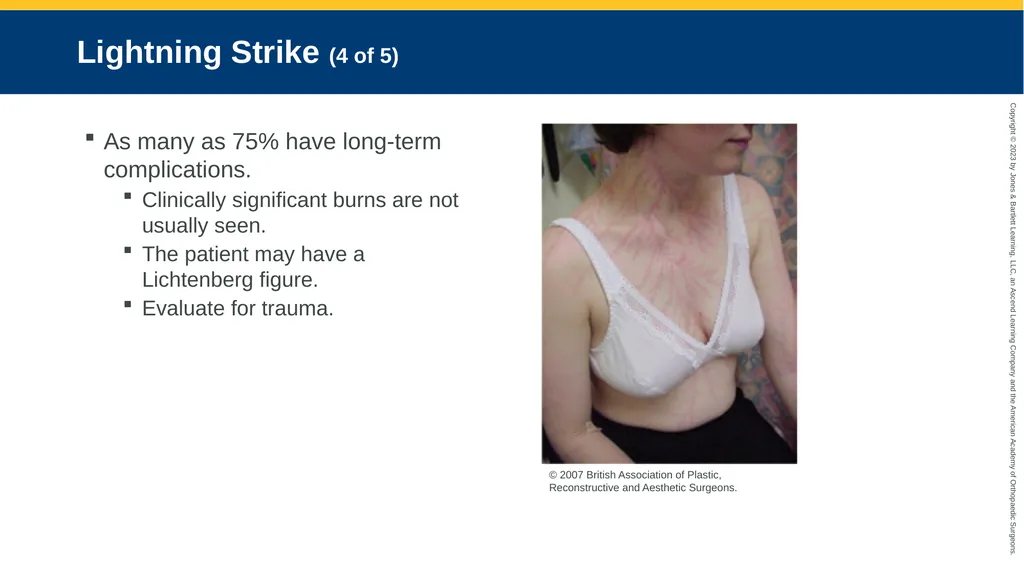
Lightning Strike (4 of 5) As many as 75% have long-term complications.
Clinically significant burns are not usually seen.
The patient may have a Lichtenberg figure.
Evaluate for trauma. © 2007 British Association of Plastic, Reconstructive and Aesthetic Surgeons.<br>
Clinically significant burns are not usually seen.
The patient may have a Lichtenberg figure.
Evaluate for trauma. © 2007 British Association of Plastic, Reconstructive and Aesthetic Surgeons.<br>
165
Lightning Strike (5 of 5) Reverse triage
Strikes induce cardiac and respiratory arrest.
All lightning strike victims should be evaluated at a medical facility.<br>
Strikes induce cardiac and respiratory arrest.
All lightning strike victims should be evaluated at a medical facility.<br>
166
Pathophysiology, Assessment, and Management of Envenomation: Bites and Stings<br>
167
Envenomation: Bites and Stings (1 of 3) Most common venomous creatures
Bees, wasps, hornets, fire ants (Hymenoptera)
Snakes (Elapidae family and Crotalinae subfamily)
Black widow, brown recluse, hobo spiders
Scorpions (genus Centruroides)<br>
Bees, wasps, hornets, fire ants (Hymenoptera)
Snakes (Elapidae family and Crotalinae subfamily)
Black widow, brown recluse, hobo spiders
Scorpions (genus Centruroides)<br>
168
Envenomation: Bites and Stings (2 of 3) The most frequent cause of mortality is anaphylactic reaction.
The most common and most deaths from hymenoptera bites
Treatment is same as in other cases of anaphylaxis.<br>
The most common and most deaths from hymenoptera bites
Treatment is same as in other cases of anaphylaxis.<br>
169
Envenomation: Bites and Stings (3 of 3) Treatment includes:
ABCs management
Transport
Obtaining vascular access
Ensuring the scene is safe from venomous creatures<br>
ABCs management
Transport
Obtaining vascular access
Ensuring the scene is safe from venomous creatures<br>
170
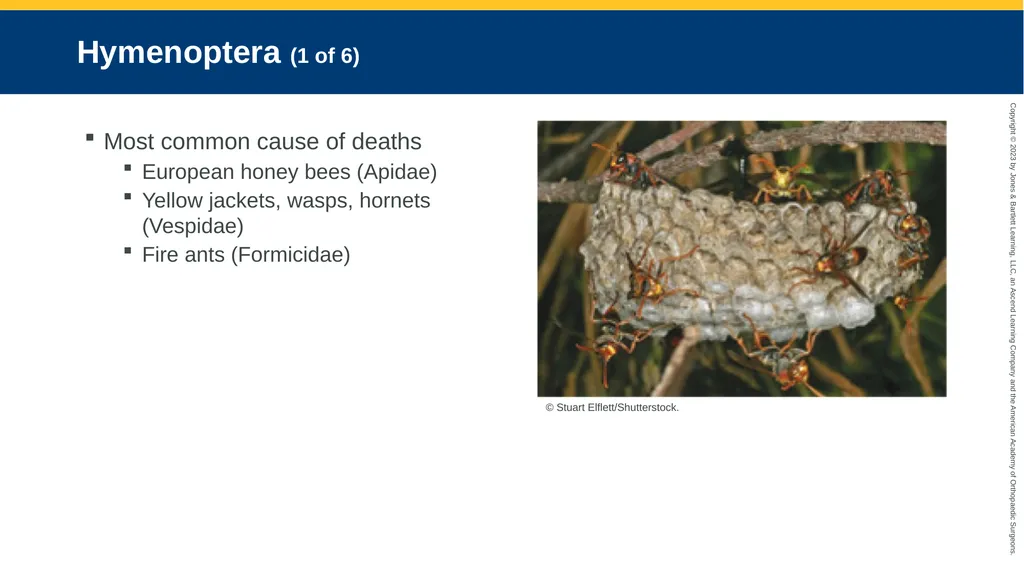
Hymenoptera (1 of 6) Most common cause of deaths
European honey bees (Apidae)
Yellow jackets, wasps, hornets (Vespidae)
Fire ants (Formicidae) © Stuart Elflett/Shutterstock.<br>
European honey bees (Apidae)
Yellow jackets, wasps, hornets (Vespidae)
Fire ants (Formicidae) © Stuart Elflett/Shutterstock.<br>
171
Hymenoptera (2 of 6) Venom is a mixture of proteins causing local reactions.
Erythema
Swelling
Pruritus
Melittin is a protein that causes immediate pain.<br>
Erythema
Swelling
Pruritus
Melittin is a protein that causes immediate pain.<br>
172
Hymenoptera (3 of 6) Local reaction in a quarter of stings.
Anaphylaxis occurs rapidly, typically within 10 minutes.<br>
Anaphylaxis occurs rapidly, typically within 10 minutes.<br>
173
Hymenoptera (4 of 6) If no history of allergic reaction and no systemic reaction, transport is not necessary.
Advise the patient of anaphylaxis signs.
The wound should be checked if there is no improvement in 24 hours.
Infection is likely from fire ant stings.<br>
Advise the patient of anaphylaxis signs.
The wound should be checked if there is no improvement in 24 hours.
Infection is likely from fire ant stings.<br>
174
Hymenoptera (5 of 6) Treatment focuses on pain and minimization of infection risk.
Determine if the stinger and venom sac are still attached.
If so, remove as rapidly as possible.
Clean the wound thoroughly.
Apply cool compresses and elevation for reaction.
Administer antihistamines for symptomatic treatment.<br>
Determine if the stinger and venom sac are still attached.
If so, remove as rapidly as possible.
Clean the wound thoroughly.
Apply cool compresses and elevation for reaction.
Administer antihistamines for symptomatic treatment.<br>
175
Hymenoptera (6 of 6) For fire ant stings:
Move patient and crew away from site.
Brush off ants.
Provide supportive care.<br>
Move patient and crew away from site.
Brush off ants.
Provide supportive care.<br>
176
Snake Bites (1 of 11) Two snake families of concern in United States:
Viperidae (subfamily Crotalinae)
99% of all bites
Elapidae
Most common in southeastern United States<br>
Viperidae (subfamily Crotalinae)
99% of all bites
Elapidae
Most common in southeastern United States<br>
177
Snake Bites (2 of 11) Pit viper venom has both hemolytic and proteolytic enzymes
Causes extensive local tissue damage and systemic effects
Soft-tissue swelling and necrosis
Local, then systemic bleeding
Coagulopathies<br>
Causes extensive local tissue damage and systemic effects
Soft-tissue swelling and necrosis
Local, then systemic bleeding
Coagulopathies<br>
178
Snake Bites (3 of 11) Coral snakes have potent neurotoxic venom.
Paresthesias
Fasciculations
Weakness
Respiratory difficulty
Strokelike symptoms<br>
Paresthesias
Fasciculations
Weakness
Respiratory difficulty
Strokelike symptoms<br>
179
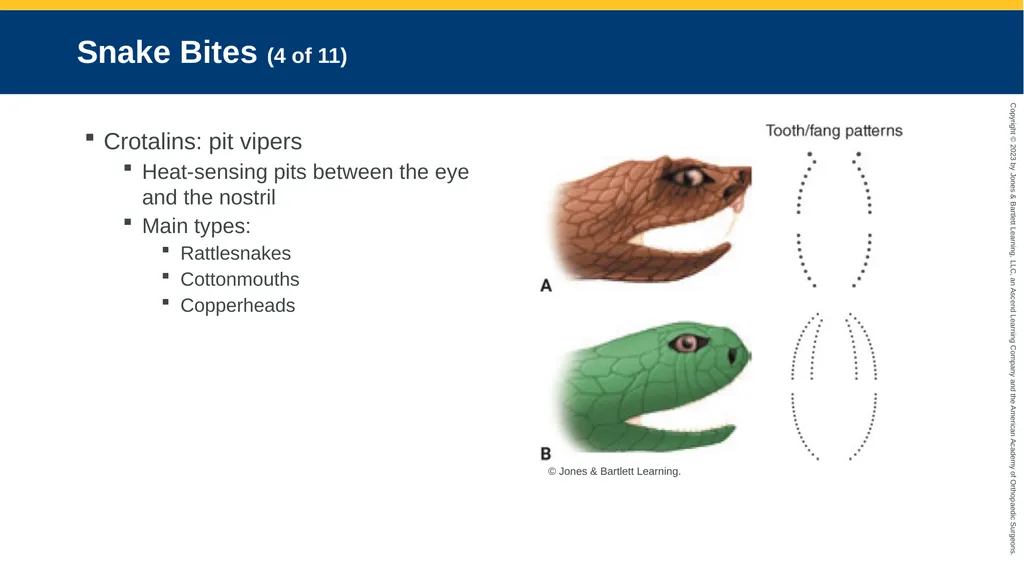
Snake Bites (4 of 11) Crotalins: pit vipers
Heat-sensing pits between the eye and the nostril
Main types:
Rattlesnakes
Cottonmouths
Copperheads © Jones & Bartlett Learning.<br>
Heat-sensing pits between the eye and the nostril
Main types:
Rattlesnakes
Cottonmouths
Copperheads © Jones & Bartlett Learning.<br>
180
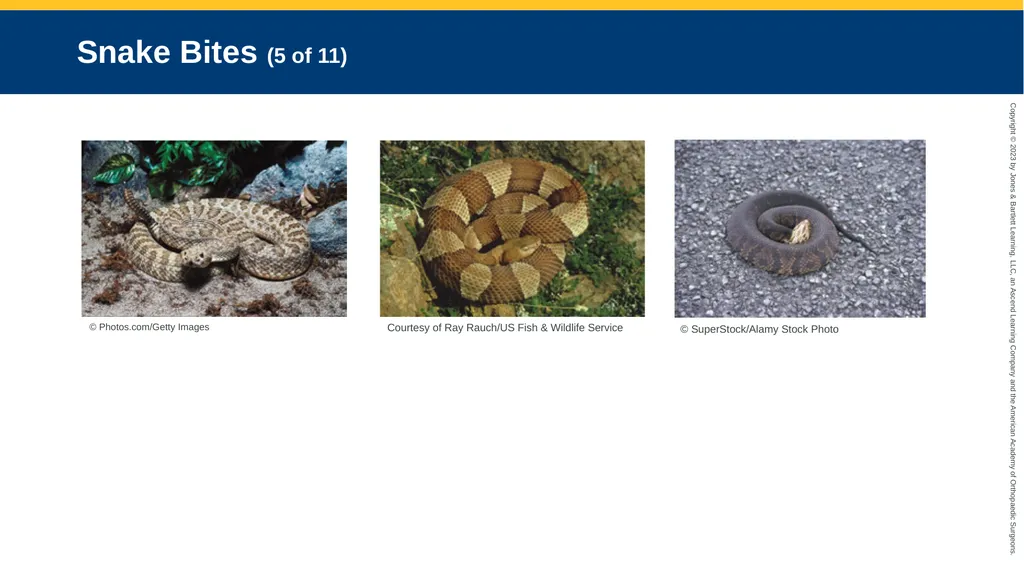
Snake Bites (5 of 11) © Photos.com/Getty Images Courtesy of Ray Rauch/US Fish & Wildlife Service © SuperStock/Alamy Stock Photo<br>
181
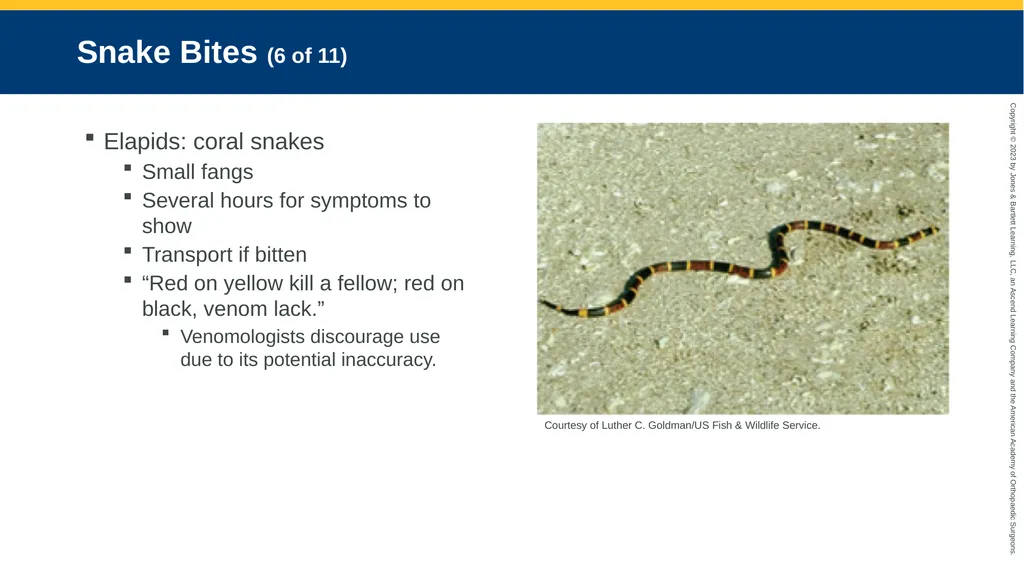
Snake Bites (6 of 11) Elapids: coral snakes
Small fangs
Several hours for symptoms to show
Transport if bitten
“Red on yellow kill a fellow; red on black, venom lack.”
Venomologists discourage use due to its potential inaccuracy. Courtesy of Luther C. Goldman/US Fish & Wildlife Service.<br>
Small fangs
Several hours for symptoms to show
Transport if bitten
“Red on yellow kill a fellow; red on black, venom lack.”
Venomologists discourage use due to its potential inaccuracy. Courtesy of Luther C. Goldman/US Fish & Wildlife Service.<br>
182
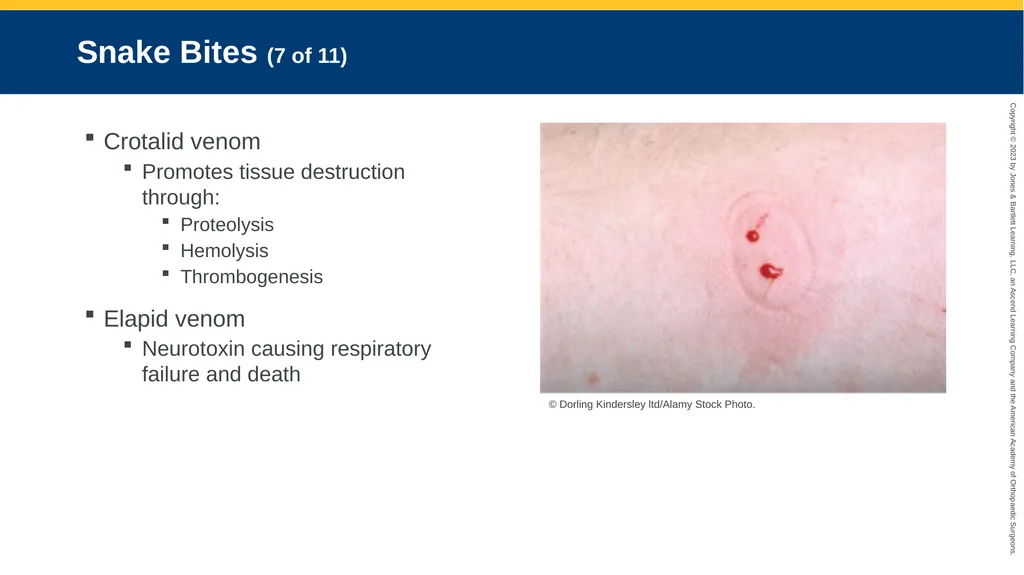
Snake Bites (7 of 11) Crotalid venom
Promotes tissue destruction through:
Proteolysis
Hemolysis
Thrombogenesis
Elapid venom
Neurotoxin causing respiratory failure and death © Dorling Kindersley ltd/Alamy Stock Photo.<br>
Promotes tissue destruction through:
Proteolysis
Hemolysis
Thrombogenesis
Elapid venom
Neurotoxin causing respiratory failure and death © Dorling Kindersley ltd/Alamy Stock Photo.<br>
183
Snake Bites (8 of 11) Be certain snake is no longer a danger.
Note time of bite.
Determine type of snake.
Remember dead snakes can still bite.<br>
Note time of bite.
Determine type of snake.
Remember dead snakes can still bite.<br>
184
Snake Bites (9 of 11) Signs and symptoms include:
Swelling, bleeding
Metallic taste in mouth
Weakness
Unconsciousness
Tachycardia
Coagulopathies
Shock
Cardiovascular collapse<br>
Swelling, bleeding
Metallic taste in mouth
Weakness
Unconsciousness
Tachycardia
Coagulopathies
Shock
Cardiovascular collapse<br>
185
Snake Bites (10 of 11) Degree of envenomation determined by systemic symptoms
Mild—minimal local swelling with no systemic symptoms
Moderate—swelling extending up extremity, systemic symptoms; no significant bleeding
Severe—extensive soft-tissue swelling and severe systemic effects and bleeding<br>
Mild—minimal local swelling with no systemic symptoms
Moderate—swelling extending up extremity, systemic symptoms; no significant bleeding
Severe—extensive soft-tissue swelling and severe systemic effects and bleeding<br>
186
Snake Bites (11 of 11) Treatment is antivenin (at hospital).
Monitor ABCs.
Clean the wound with antimicrobials.
Draw blood for hospital use (if protocols allow).
Immobilize the involved extremity in a neutral position below the heart level.
Avoid excessive constriction.
Remove constricting jewelry.<br>
Monitor ABCs.
Clean the wound with antimicrobials.
Draw blood for hospital use (if protocols allow).
Immobilize the involved extremity in a neutral position below the heart level.
Avoid excessive constriction.
Remove constricting jewelry.<br>
187
Spider Bites (1 of 9) Estimated 34,000 species worldwide
Three species of concern in United States:
Black widow spiders
Brown recluse spiders
Hobo spiders<br>
Three species of concern in United States:
Black widow spiders
Brown recluse spiders
Hobo spiders<br>
188
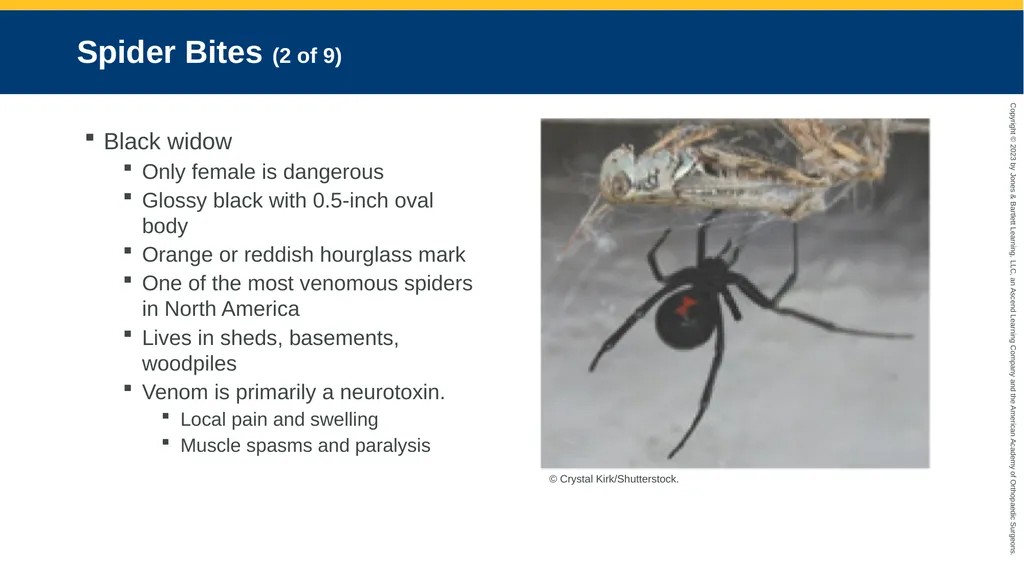
Spider Bites (2 of 9) Black widow
Only female is dangerous
Glossy black with 0.5-inch oval body
Orange or reddish hourglass mark
One of the most venomous spiders in North America
Lives in sheds, basements, woodpiles
Venom is primarily a neurotoxin.
Local pain and swelling
Muscle spasms and paralysis © Crystal Kirk/Shutterstock.<br>
Only female is dangerous
Glossy black with 0.5-inch oval body
Orange or reddish hourglass mark
One of the most venomous spiders in North America
Lives in sheds, basements, woodpiles
Venom is primarily a neurotoxin.
Local pain and swelling
Muscle spasms and paralysis © Crystal Kirk/Shutterstock.<br>
189
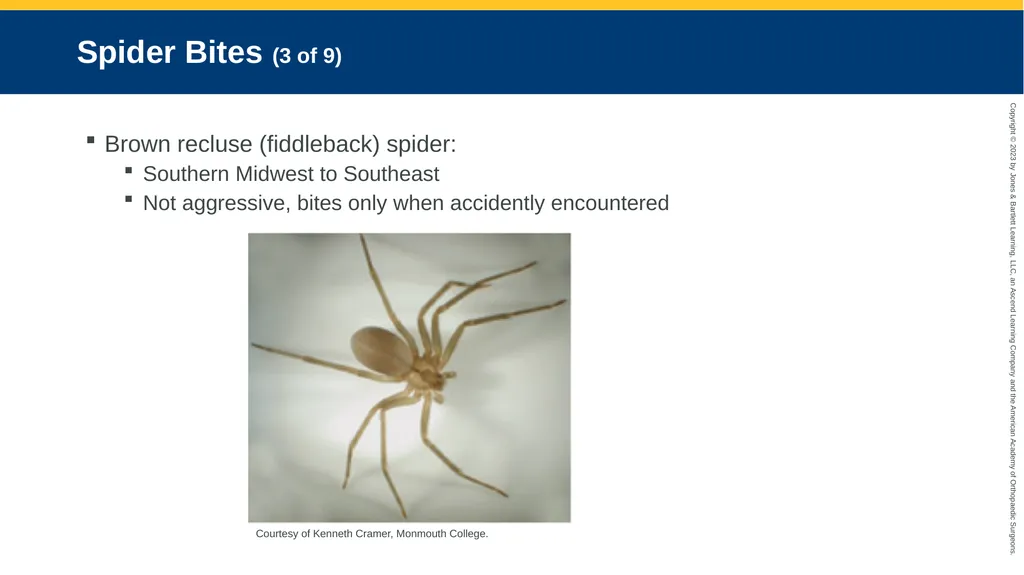
Spider Bites (3 of 9) Brown recluse (fiddleback) spider:
Southern Midwest to Southeast
Not aggressive, bites only when accidently encountered Courtesy of Kenneth Cramer, Monmouth College.<br>
Southern Midwest to Southeast
Not aggressive, bites only when accidently encountered Courtesy of Kenneth Cramer, Monmouth College.<br>
190
Spider Bites (4 of 9) Hobo spiders
Found in Northwest
Bite clinically similar to brown recluse
Slightly more aggressive than brown recluse<br>
Found in Northwest
Bite clinically similar to brown recluse
Slightly more aggressive than brown recluse<br>
191
Spider Bites (5 of 9) History of spider bite not always confirmed
Patient may report:
Sudden, sharp prick followed by cramping
Numbing pain beginning at bite area and gradually spreading
Extreme restlessness (black widow bite)<br>
Patient may report:
Sudden, sharp prick followed by cramping
Numbing pain beginning at bite area and gradually spreading
Extreme restlessness (black widow bite)<br>
192
Spider Bites (6 of 9) Local pain associated with a black widow bite is rapid in onset.
Within 30 to 60 min
Local muscle spasm and localized diaphoresis
Diffuse and more muscle spasms
Respiratory difficulty if diaphragm affected<br>
Within 30 to 60 min
Local muscle spasm and localized diaphoresis
Diffuse and more muscle spasms
Respiratory difficulty if diaphragm affected<br>
193
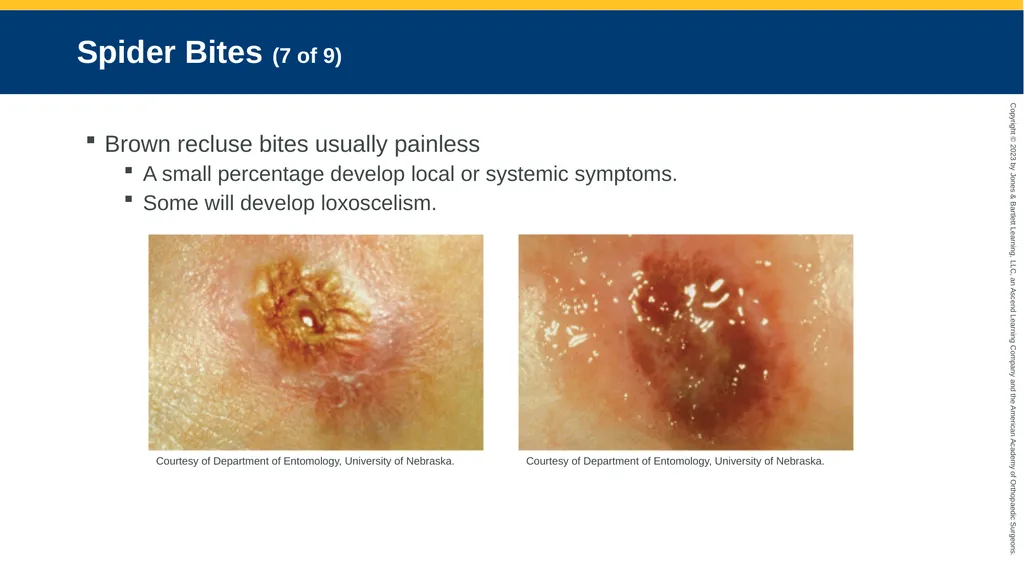
Spider Bites (7 of 9) Brown recluse bites usually painless
A small percentage develop local or systemic symptoms.
Some will develop loxoscelism. Courtesy of Department of Entomology, University of Nebraska. Courtesy of Department of Entomology, University of Nebraska.<br>
A small percentage develop local or systemic symptoms.
Some will develop loxoscelism. Courtesy of Department of Entomology, University of Nebraska. Courtesy of Department of Entomology, University of Nebraska.<br>
194
Spider Bites (8 of 9) Black widow spider bite treatment:
Intermittent ice use
Antimicrobial cleansing of wound
Pain and muscle spasm relief
Prompt transport
Monitoring of ABCs
Obtaining IV access and applying oxygen
Narcotics, muscle relaxants/sedatives
Antivenin reserved for:
Severe envenomation in extremes of patient age
Immunocompromised patients<br>
Intermittent ice use
Antimicrobial cleansing of wound
Pain and muscle spasm relief
Prompt transport
Monitoring of ABCs
Obtaining IV access and applying oxygen
Narcotics, muscle relaxants/sedatives
Antivenin reserved for:
Severe envenomation in extremes of patient age
Immunocompromised patients<br>
195
Spider Bites (9 of 9) Brown recluse/hobo spider bite treatment is supportive.
Antivenin not routinely available<br>
Antivenin not routinely available<br>
196
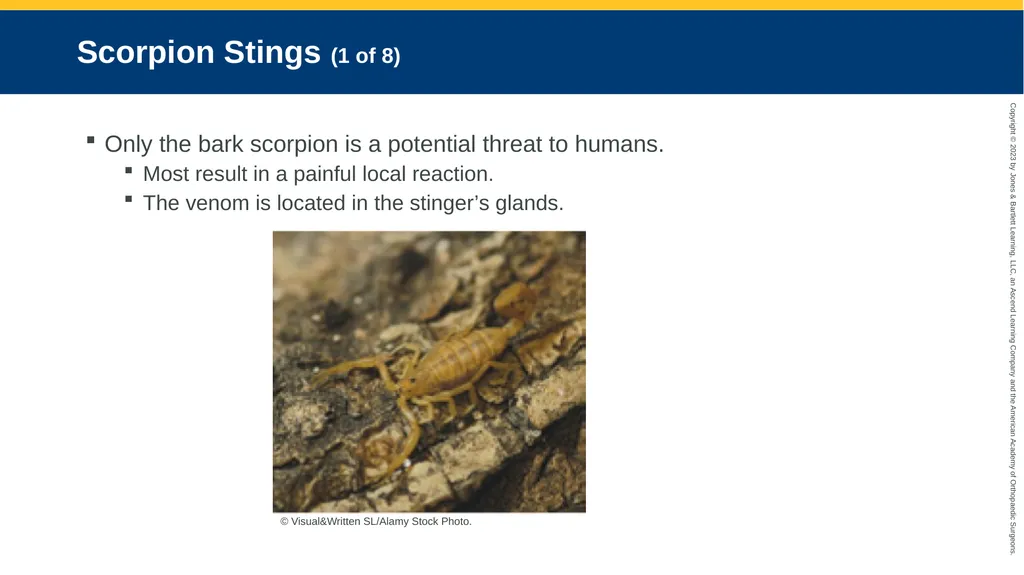
Scorpion Stings (1 of 8) Only the bark scorpion is a potential threat to humans.
Most result in a painful local reaction.
The venom is located in the stinger’s glands. © Visual&Written SL/Alamy Stock Photo.<br>
Most result in a painful local reaction.
The venom is located in the stinger’s glands. © Visual&Written SL/Alamy Stock Photo.<br>
197
Scorpion Stings (2 of 8) Local sting symptoms within minutes, lasting several hours:
Erythema
Pruritus
Urticaria
Sharp, burning pain
Paresthesia<br>
Erythema
Pruritus
Urticaria
Sharp, burning pain
Paresthesia<br>
198
Scorpion Stings (3 of 8) Sting from the more neurotoxic bark scorpion causes few local symptoms.
Systemic symptoms within minutes
Peak at 4 to 6 hours
Resolve within 24 to 72 hours<br>
Systemic symptoms within minutes
Peak at 4 to 6 hours
Resolve within 24 to 72 hours<br>
199
Scorpion Stings (4 of 8) Autonomic excitation from neurotoxins is the most predominant effect.
Nerve sodium channels remain open.
Continuous activation of the sympathetic, parasympathetic and somatic nerves
Symptoms due to diffuse neuronal excitation
Symptoms based on which portion of the nervous system is most in overdrive<br>
Nerve sodium channels remain open.
Continuous activation of the sympathetic, parasympathetic and somatic nerves
Symptoms due to diffuse neuronal excitation
Symptoms based on which portion of the nervous system is most in overdrive<br>
200
Scorpion Stings (5 of 8) Typical victim has:
Nystagmus
Hypersalivation
Dysphagia
Mydriasis
Restlessness<br>
Nystagmus
Hypersalivation
Dysphagia
Mydriasis
Restlessness<br>
201
Scorpion Stings (6 of 8) Prehospital treatment:
ABCs
Monitoring
Transport
Intubation if necessary
IV, with volume as needed for blood pressure<br>
ABCs
Monitoring
Transport
Intubation if necessary
IV, with volume as needed for blood pressure<br>
202
Scorpion Stings (7 of 8) Prehospital treatment (cont’d):
Ice pack for local swelling
Immobilization of extremity
Constricting band
Treatment of seizures per protocol<br>
Ice pack for local swelling
Immobilization of extremity
Constricting band
Treatment of seizures per protocol<br>
203
Scorpion Stings (8 of 8) In-hospital treatment includes care for ABCs.
Alpha and beta blockers
Atropine
Vasoactive drugs
Antivenin if available<br>
Alpha and beta blockers
Atropine
Vasoactive drugs
Antivenin if available<br>
204
Tick Bites (1 of 3) Blood-sucking arthropods found in rural, wooded areas
Bites are a concern because of disease transmission. © Joao Estevao A. Freitas (jefras)/Shutterstock.<br>
Bites are a concern because of disease transmission. © Joao Estevao A. Freitas (jefras)/Shutterstock.<br>
205
Tick Bites (2 of 3) Tick removal
Put on gloves.
Use curved forceps to grab the head as close to the skin as possible.
Pull straight up using even pressure.
Do not twist or jerk.
Do not use Vaseline or other paste products to encourage the tick’s release.
Avoid further spread of infectious agents.<br>
Put on gloves.
Use curved forceps to grab the head as close to the skin as possible.
Pull straight up using even pressure.
Do not twist or jerk.
Do not use Vaseline or other paste products to encourage the tick’s release.
Avoid further spread of infectious agents.<br>
206
Tick Bites (3 of 3) Once the tick is removed:
Wash the bite with soap and water.
There may be no reason to transport if the patient is asymptomatic (check with local protocol).
Advise the patient to see a physician.<br>
Wash the bite with soap and water.
There may be no reason to transport if the patient is asymptomatic (check with local protocol).
Advise the patient to see a physician.<br>