
Environmental Movements in India: Lessons for New
SN
Published · 22 slides · 0 views

1 / 1



Description
Environmental Movements in India: Lessons for New Generation CONTENTS Introduction Historical Evolution of Environmental Movement Ideological Trends in Indian Environmentalism Emergence of Environmental Movements in India Major
Related Topics
Share
Embed code
Download this presentation From Below
"Environmental Movements in India: Lessons for New" is the property of its rightful owner. Permission is granted to download and print the materials on this website for personal, non-commercial use only, and to display it on your personal computer provided you do not modify the materials and that you retain all copyright notices contained in the materials. By downloading content from our website, you accept the terms of this agreement.
Presentation Transcript
01
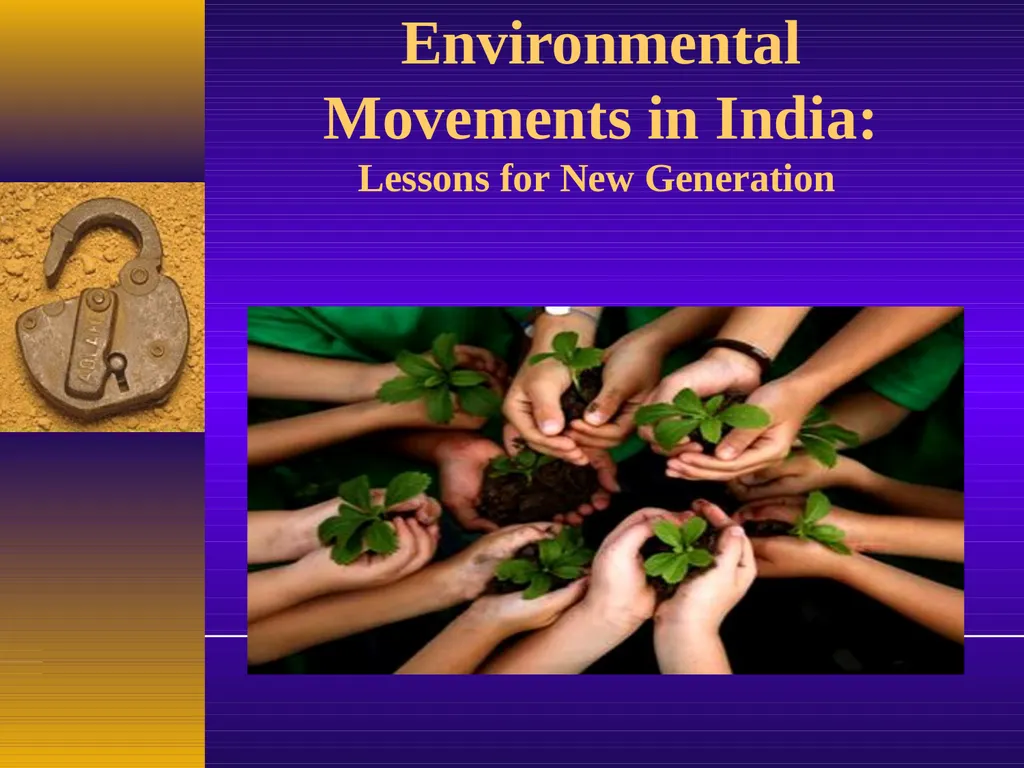
Environmental Movements in India:
Lessons for New Generation<br>
Lessons for New Generation<br>
02
CONTENTS Introduction
Historical Evolution of Environmental Movement
Ideological Trends in Indian Environmentalism
Emergence of Environmental Movements in India
Major Environmental Movements in India
Environmental Movement and Issues on Environmentalism
Towards New Environmentalism: Lessons for New Generation
Role: Government - Private -NGO’S-Individual
Role of Youth - Role of Women
Summary + APPEAL SINCE 1881<br>
Historical Evolution of Environmental Movement
Ideological Trends in Indian Environmentalism
Emergence of Environmental Movements in India
Major Environmental Movements in India
Environmental Movement and Issues on Environmentalism
Towards New Environmentalism: Lessons for New Generation
Role: Government - Private -NGO’S-Individual
Role of Youth - Role of Women
Summary + APPEAL SINCE 1881<br>
03
Understanding on Environmental Movement SINCE 1881<br>
04
Introduction Environment plays a vital role in human living - The environment comprises of all the natural resources such as air water, land, forests, and minerals - It is responsibility of populace to protect the natural resources
Environmental Movement : Form of social movement that involves an array of individuals, groups and coalitions that perceive a common interest in environmental protection and act to bring about changes in environmental policies and practices
Issue: Experiences an almost unrestricted exploitation of resources because of the lure of new consumerist lifestyles
- The balance of nature is disrupted - This has led to many conflicts in the society
Due to technical advancement and other reasons, there is a lot of misuse of natural resources, in the form of land degradation, water pollution, air pollution, and deforestation - All these factors lead to worsening of environment SINCE 1881<br>
Environmental Movement : Form of social movement that involves an array of individuals, groups and coalitions that perceive a common interest in environmental protection and act to bring about changes in environmental policies and practices
Issue: Experiences an almost unrestricted exploitation of resources because of the lure of new consumerist lifestyles
- The balance of nature is disrupted - This has led to many conflicts in the society
Due to technical advancement and other reasons, there is a lot of misuse of natural resources, in the form of land degradation, water pollution, air pollution, and deforestation - All these factors lead to worsening of environment SINCE 1881<br>
05
Introduction - Issues There has been a consistent increase in the consciousness and concern about it around the globe
Resulted to widespread protest movements by aggrieved communities and concerned inhabitants
Numerous hazardous and disastrous incidents that led to ecological crisis in the human history
Environmental movement is global movement, signified by a range of organizations, from the large to grassroots and differs from country to country
It also including conservation and green politics is a dissimilar scientific, social, and political movement to address environmental issues
Includes private citizens, professionals, religious devotees, politicians, scientists and non-profit organizations
Great efforts are being made in order to regain the environment by people through voluntary organizations, which have concerns about the environment SINCE 1881<br>
Resulted to widespread protest movements by aggrieved communities and concerned inhabitants
Numerous hazardous and disastrous incidents that led to ecological crisis in the human history
Environmental movement is global movement, signified by a range of organizations, from the large to grassroots and differs from country to country
It also including conservation and green politics is a dissimilar scientific, social, and political movement to address environmental issues
Includes private citizens, professionals, religious devotees, politicians, scientists and non-profit organizations
Great efforts are being made in order to regain the environment by people through voluntary organizations, which have concerns about the environment SINCE 1881<br>
06
Historical Evolution of Environmental Movement India has the oldest and most diverse environmental movement in Asia
It is more deeply rooted and integrated within its host civilization than any other environmental movement
Early record in India : Epic Mahabharata, where the clash between the Aryans, pastoralists and agriculturists, and the Nishads, forest-dwellers
Kautilya’s Artha Shastra- Kings to protect forests and wild life, particularly elephants
The cultural values in favour of protection of environment were strong enough to give rise to the institution of the sacred groves or Devara Kadu
Several ancient hymns were in praise of nature and specially prayed God to bless the Earth with regular rainfall and greenery SINCE 1881<br>
It is more deeply rooted and integrated within its host civilization than any other environmental movement
Early record in India : Epic Mahabharata, where the clash between the Aryans, pastoralists and agriculturists, and the Nishads, forest-dwellers
Kautilya’s Artha Shastra- Kings to protect forests and wild life, particularly elephants
The cultural values in favour of protection of environment were strong enough to give rise to the institution of the sacred groves or Devara Kadu
Several ancient hymns were in praise of nature and specially prayed God to bless the Earth with regular rainfall and greenery SINCE 1881<br>
07
Ideological Trends in Indian Environmentalism Crusading Gandhians
Relies heavily on a moral/religious idiom in its rejection of the modern way of life
Ecological Marxist
Problem in political and economic terms, arguing that it is the unequal access to resources, rather than the question of values, which better explains the patterns and processes of environmental degradation
Appropriate Technology
Emphasis is not so much on challenging the ‘system’ as in demonstrating in practice a set of socio-technical alternatives to the centralizing and environmentally degrading technologies
Wilderness Enthusiasts
Provided massive documentation of the decline of natural forests and their plant and animal species, urging the government to take remedial action
Scientific Conservation
Concerned with efficiency and management SINCE 1881<br>
Relies heavily on a moral/religious idiom in its rejection of the modern way of life
Ecological Marxist
Problem in political and economic terms, arguing that it is the unequal access to resources, rather than the question of values, which better explains the patterns and processes of environmental degradation
Appropriate Technology
Emphasis is not so much on challenging the ‘system’ as in demonstrating in practice a set of socio-technical alternatives to the centralizing and environmentally degrading technologies
Wilderness Enthusiasts
Provided massive documentation of the decline of natural forests and their plant and animal species, urging the government to take remedial action
Scientific Conservation
Concerned with efficiency and management SINCE 1881<br>
08
Major Environmental Movements in India Bishnoi Movement
Chipko Movement
Save Silent Valley Movement
Jungle Bachao Andholan
Appiko Movement
Narmada Bachao Andholan (NBA)
Tehri Dam Conflict SINCE 1881<br>
Chipko Movement
Save Silent Valley Movement
Jungle Bachao Andholan
Appiko Movement
Narmada Bachao Andholan (NBA)
Tehri Dam Conflict SINCE 1881<br>
09
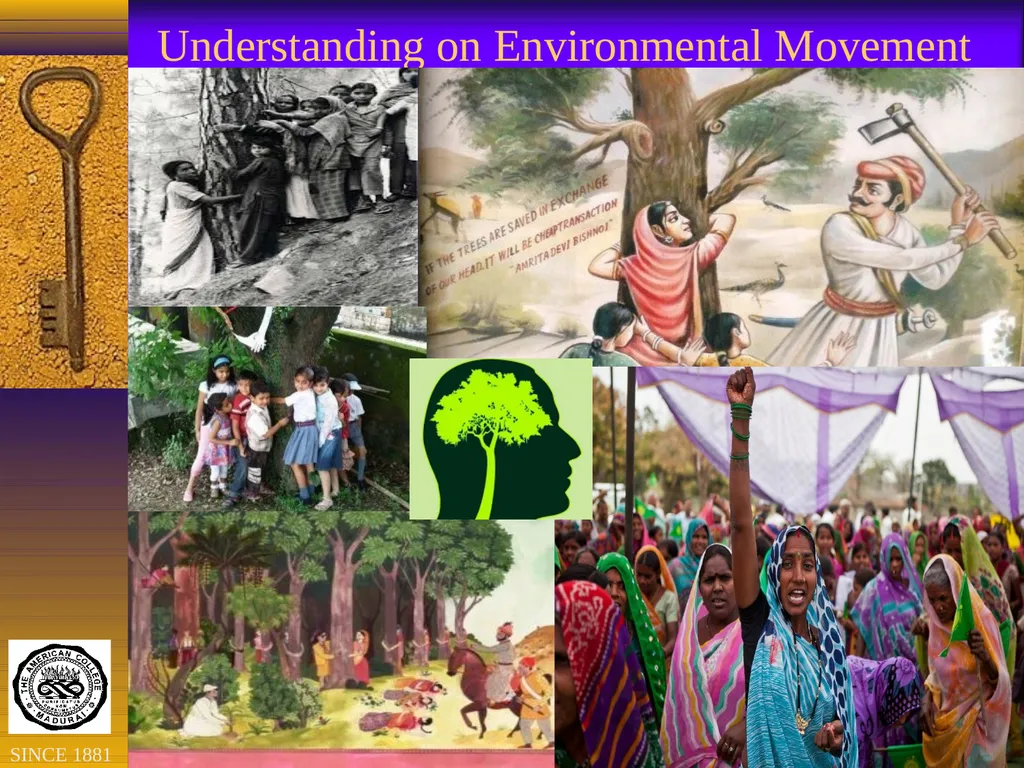
Bishnoi Movement Year: 1700s - Place: Khejarli, Marwar region, Rajasthan state - Leaders: Amrita Devi along with Bishnoi villagers in Khejarli and surrounding villages
Aim: Save sacred trees from being cut down by the king’s soldiers for a new palace
Amrita Devi hugged the trees and encouraged others to do the same - 363 Bishnoi villagers were killed in this movement - The Bishnoi tree martyrs were influenced by the teachings of Guru Maharaj Jambaji, who founded the Bishnoi faith- King who came to know about these events rushed to the village and apologized, ordering the soldiers to cease logging operations - Maharajah designated the Bishnoi state as a protected area, forbidding harm to trees and animals
This legislation still exists today in the region SINCE 1881<br>
Aim: Save sacred trees from being cut down by the king’s soldiers for a new palace
Amrita Devi hugged the trees and encouraged others to do the same - 363 Bishnoi villagers were killed in this movement - The Bishnoi tree martyrs were influenced by the teachings of Guru Maharaj Jambaji, who founded the Bishnoi faith- King who came to know about these events rushed to the village and apologized, ordering the soldiers to cease logging operations - Maharajah designated the Bishnoi state as a protected area, forbidding harm to trees and animals
This legislation still exists today in the region SINCE 1881<br>
10
Chipko Movement Year: 1973 - Place: In Chamoli district and later at Tehri-Garhwal district of Uttarakhand - Leaders: Sundarlal Bahuguna, Gaura Devi, Sudesha Devi, Bachni Devi, Chandi Prasad Bhatt, Govind Singh Rawat, Dhoom Singh Negi, Shamsher Singh Bisht and Ghanasyam Raturi - Aim: To protect the trees on the Himalayan slopes from the axes of contractors of the forest
Bahuguna - importance of trees in the environment which checks the erosion of soil, cause rains and provides pure air - The women of Advani village of Tehri-Garhwal tied the sacred thread around trunks of trees and they hugged the trees, hence it was called ‘Chipko Movement’ or ‘hug the tree movement’- The main demand of the people was that the benefits of the forests (especially the right to fodder) should go to local people
Gathered momentum in 1978 when the women faced police firings and other tortures. The then state Chief Minister, Hemwati Nandan Bahuguna set up a committee to look into the matter, which eventually ruled in favor of the villagers- Became a turning point in the history of eco-development struggles in the region and around the world SINCE 1881<br>
Bahuguna - importance of trees in the environment which checks the erosion of soil, cause rains and provides pure air - The women of Advani village of Tehri-Garhwal tied the sacred thread around trunks of trees and they hugged the trees, hence it was called ‘Chipko Movement’ or ‘hug the tree movement’- The main demand of the people was that the benefits of the forests (especially the right to fodder) should go to local people
Gathered momentum in 1978 when the women faced police firings and other tortures. The then state Chief Minister, Hemwati Nandan Bahuguna set up a committee to look into the matter, which eventually ruled in favor of the villagers- Became a turning point in the history of eco-development struggles in the region and around the world SINCE 1881<br>
11
Save Silent Valley Movement Year: 1978-Place: Silent Valley, an evergreen tropical forest in the Palakkad district of Kerala, India - Leaders: The Kerala Sastra Sahitya Parishad (KSSP) an NGO, and the poet-activist Sughathakumari played an important role in the Silent Valley protests- Aim: In order to protect the Silent Valley, the moist evergreen forest from being destroyed by a hydroelectric project
The Kerala State Electricity Board proposed a hydroelectric dam across the Kunthipuzha River that runs through Silent Valley- 1973, the Planning Commission approved the project at a cost of about Rs 25 crores- Many feared that the project would submerge 8.3 sq km of untouched moist evergreen forest- Several NGOs strongly opposed the project and urged the government to abandon it. 1981, bowing to unrelenting public pressure, Indira Gandhi declared that Silent Valley will be protected-In June 1983 the Center re-examined the issue through a commission chaired by Prof. M.G.K. Menon- In 1985, Prime Minister Rajiv Gandhi formally inaugurated the Silent Valley National Park SINCE 1881<br>
The Kerala State Electricity Board proposed a hydroelectric dam across the Kunthipuzha River that runs through Silent Valley- 1973, the Planning Commission approved the project at a cost of about Rs 25 crores- Many feared that the project would submerge 8.3 sq km of untouched moist evergreen forest- Several NGOs strongly opposed the project and urged the government to abandon it. 1981, bowing to unrelenting public pressure, Indira Gandhi declared that Silent Valley will be protected-In June 1983 the Center re-examined the issue through a commission chaired by Prof. M.G.K. Menon- In 1985, Prime Minister Rajiv Gandhi formally inaugurated the Silent Valley National Park SINCE 1881<br>
12
Jungle Bachao Andholan Year: 1982
Place: Singhbhum district of Bihar
Leaders: The tribals of Singhbhum
Aim: Against governments decision to replace the natural salt forest with Teak
The tribals of Singhbhum district of Bihar started the protest when the government decided to replace the natural salt forests with the highly- priced teak
This move was called by many as “Greed Game Political Populism”
Later this movement spread to Jharkhand and Orissa SINCE 1881<br>
Place: Singhbhum district of Bihar
Leaders: The tribals of Singhbhum
Aim: Against governments decision to replace the natural salt forest with Teak
The tribals of Singhbhum district of Bihar started the protest when the government decided to replace the natural salt forests with the highly- priced teak
This move was called by many as “Greed Game Political Populism”
Later this movement spread to Jharkhand and Orissa SINCE 1881<br>
13
Appiko Movement Year: 1983 - Place: Uttara Kannada and Shimoga districts of Karnataka State - Leaders: Pandurang Hegde - He helped launch the movement in 1983-Aim: Against the felling and commercialization of natural forest and the ruin of ancient livelihood
Southern version of the Chipko movement - The Appiko Movement was locally known as “Appiko Chaluvali”- The locals embraced the trees which were to be cut by contractors of the forest department - The Appiko movement used various techniques to raise awareness such as foot marches in the interior forest, slide shows, folk dances, street plays etc
The movement later focused on the rational use of ecosphere through introducing alternative energy resource to reduce pressure on the forest. The movement became a success. The current status of the project is – stopped SINCE 1881<br>
Southern version of the Chipko movement - The Appiko Movement was locally known as “Appiko Chaluvali”- The locals embraced the trees which were to be cut by contractors of the forest department - The Appiko movement used various techniques to raise awareness such as foot marches in the interior forest, slide shows, folk dances, street plays etc
The movement later focused on the rational use of ecosphere through introducing alternative energy resource to reduce pressure on the forest. The movement became a success. The current status of the project is – stopped SINCE 1881<br>
14
Narmada Bachao Andholan (NBA) Year: 1985 - Place: Narmada River, which flows through the states of Gujarat, Madhya Pradesh and Maharashtra - Leaders: Medha Patker, Baba Amte, adivasis, farmers, environmentalists and human rights activists - Aim: A social movement against a number of large dams being built across the Narmada River
Protest for not providing proper rehabilitation and resettlement for the people -construction of Sardar Sarovar Dam-Later on, the movement turned its focus on the preservation of the environment and the eco-systems of the valley - World Bank withdrew from the project- In October 2000, the Supreme Court gave a judgment approving the construction of the Sardar Sarovar Dam with a condition that height of the dam could be raised to 90 m-This height is much higher than the 88 m which anti-dam activists demanded-The project is expected to be fully com-pleted by 2025-Although not successful, as the dam could not be prevented, the NBA has created an anti-big dam opinion in India and outside SINCE 1881<br>
Protest for not providing proper rehabilitation and resettlement for the people -construction of Sardar Sarovar Dam-Later on, the movement turned its focus on the preservation of the environment and the eco-systems of the valley - World Bank withdrew from the project- In October 2000, the Supreme Court gave a judgment approving the construction of the Sardar Sarovar Dam with a condition that height of the dam could be raised to 90 m-This height is much higher than the 88 m which anti-dam activists demanded-The project is expected to be fully com-pleted by 2025-Although not successful, as the dam could not be prevented, the NBA has created an anti-big dam opinion in India and outside SINCE 1881<br>
15
Tehri Dam Conflict Year: 1990’s - Place: Bhagirathi River near Tehri in Uttarakhand-Leaders: Sundarlal Bahuguna
Aim: The protest was against the displacement of town inhabitants and environmental consequence of the weak ecosystem
Tehri dam attracted national attention in the 1980s and the 1990s
The major objections include, seismic sensitivity of the region, submergence of forest areas along with Tehri town etc
Despite the support from other prominent leaders like Sunderlal Bahuguna, the movement has failed to gather enough popular support at national as well as international levels SINCE 1881<br>
Aim: The protest was against the displacement of town inhabitants and environmental consequence of the weak ecosystem
Tehri dam attracted national attention in the 1980s and the 1990s
The major objections include, seismic sensitivity of the region, submergence of forest areas along with Tehri town etc
Despite the support from other prominent leaders like Sunderlal Bahuguna, the movement has failed to gather enough popular support at national as well as international levels SINCE 1881<br>
16
Issues on Environmentalism Plays a vital role in our survival-Includes all the natural resources such as air water, land, forests, minerals, etc
To protect the natural resources
There is a lot of misuse of these natural resources, in the form of land degradation, water pollution, air pollution, deforestation - Lead to deterioration of our environment
Many efforts made in order to reclaim the environment- People have revoked and adopted non-violent action movements-Based on short-term criteria of exploitation
Micro-action plans to safeguard natural resources and to provide the macro concept for ecological development at the national and regional levels
Witnessed a high rate of resource- Conflicts, which are based on the deteriorating condition of the natural resources -Leading to environmental movements at different levels SINCE 1881<br>
To protect the natural resources
There is a lot of misuse of these natural resources, in the form of land degradation, water pollution, air pollution, deforestation - Lead to deterioration of our environment
Many efforts made in order to reclaim the environment- People have revoked and adopted non-violent action movements-Based on short-term criteria of exploitation
Micro-action plans to safeguard natural resources and to provide the macro concept for ecological development at the national and regional levels
Witnessed a high rate of resource- Conflicts, which are based on the deteriorating condition of the natural resources -Leading to environmental movements at different levels SINCE 1881<br>
17
Towards New Environmentalism Lessons for New Generation
Influencing government decisions, special interests have some built-in advantages over the general public interest
Special interests can organize more effectively, and generate benefits for elected officials
Government enacted numerous significant environmental laws- Backbone of federal policies toward environmental problems
Truly innovative in their policies and their designs - They pitted the general public interest in improving environmental quality
Need innovative approaches to address continuing and emerging environmental problems
Media attention plays a key role in creating the public’s awareness of any urgent problem
Policy innovations are not yet as favorable as they were in this earlier period
Leadership may be capable of altering those conditions, but as yet the public’s concern about the adverse effects of Environmental problems SINCE 1881<br>
Influencing government decisions, special interests have some built-in advantages over the general public interest
Special interests can organize more effectively, and generate benefits for elected officials
Government enacted numerous significant environmental laws- Backbone of federal policies toward environmental problems
Truly innovative in their policies and their designs - They pitted the general public interest in improving environmental quality
Need innovative approaches to address continuing and emerging environmental problems
Media attention plays a key role in creating the public’s awareness of any urgent problem
Policy innovations are not yet as favorable as they were in this earlier period
Leadership may be capable of altering those conditions, but as yet the public’s concern about the adverse effects of Environmental problems SINCE 1881<br>
18
Towards New Environmentalism SINCE 1881 ROLE OF
INTERNATIONAL INSTITUTIONS
GOVENMENTS
PRIVATE CORPORATES
NON GOVERNMENT ORGANISATIONS
PUBLIC
INDIVIDUAL
MASS/SOCIAL MEDIA FAMILY<br>
INTERNATIONAL INSTITUTIONS
GOVENMENTS
PRIVATE CORPORATES
NON GOVERNMENT ORGANISATIONS
PUBLIC
INDIVIDUAL
MASS/SOCIAL MEDIA FAMILY<br>
19
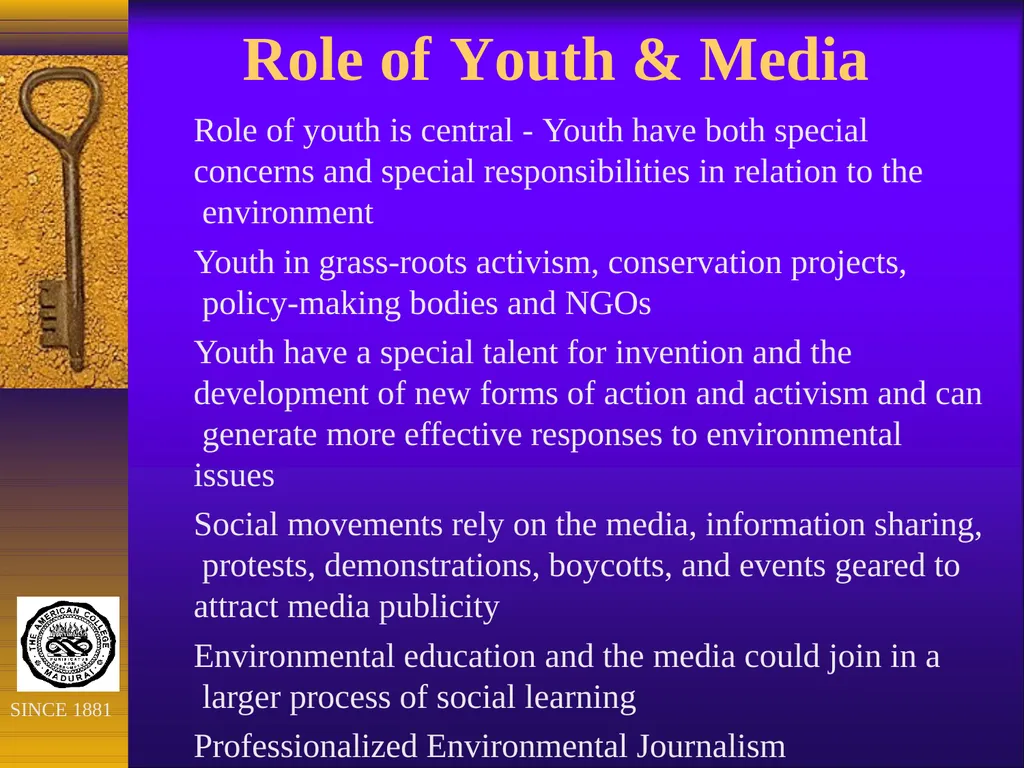
Role of Youth & Media Role of youth is central - Youth have both special concerns and special responsibilities in relation to the environment
Youth in grass-roots activism, conservation projects, policy-making bodies and NGOs
Youth have a special talent for invention and the development of new forms of action and activism and can generate more effective responses to environmental issues
Social movements rely on the media, information sharing, protests, demonstrations, boycotts, and events geared to attract media publicity
Environmental education and the media could join in a larger process of social learning
Professionalized Environmental Journalism SINCE 1881<br>
Youth in grass-roots activism, conservation projects, policy-making bodies and NGOs
Youth have a special talent for invention and the development of new forms of action and activism and can generate more effective responses to environmental issues
Social movements rely on the media, information sharing, protests, demonstrations, boycotts, and events geared to attract media publicity
Environmental education and the media could join in a larger process of social learning
Professionalized Environmental Journalism SINCE 1881<br>
20
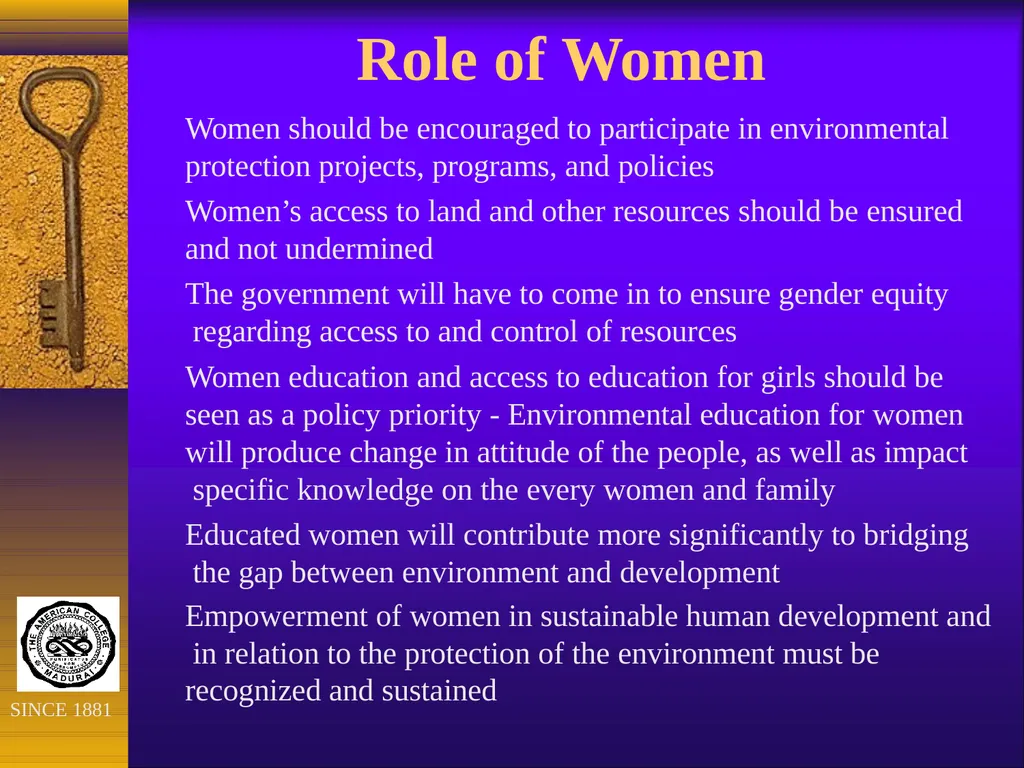
Role of Women Women should be encouraged to participate in environmental protection projects, programs, and policies
Women’s access to land and other resources should be ensured and not undermined
The government will have to come in to ensure gender equity regarding access to and control of resources
Women education and access to education for girls should be seen as a policy priority - Environmental education for women will produce change in attitude of the people, as well as impact specific knowledge on the every women and family
Educated women will contribute more significantly to bridging the gap between environment and development
Empowerment of women in sustainable human development and in relation to the protection of the environment must be recognized and sustained SINCE 1881<br>
Women’s access to land and other resources should be ensured and not undermined
The government will have to come in to ensure gender equity regarding access to and control of resources
Women education and access to education for girls should be seen as a policy priority - Environmental education for women will produce change in attitude of the people, as well as impact specific knowledge on the every women and family
Educated women will contribute more significantly to bridging the gap between environment and development
Empowerment of women in sustainable human development and in relation to the protection of the environment must be recognized and sustained SINCE 1881<br>
21
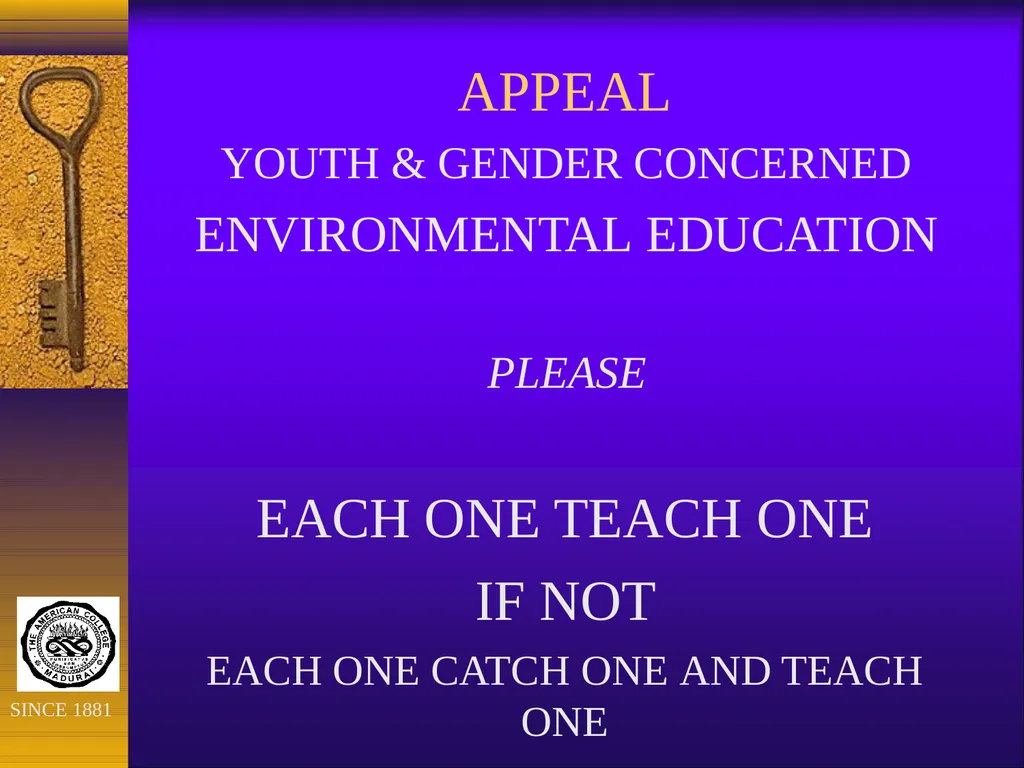
APPEAL YOUTH & GENDER CONCERNED
ENVIRONMENTAL EDUCATION
PLEASE
EACH ONE TEACH ONE
IF NOT
EACH ONE CATCH ONE AND TEACH ONE SINCE 1881<br>
ENVIRONMENTAL EDUCATION
PLEASE
EACH ONE TEACH ONE
IF NOT
EACH ONE CATCH ONE AND TEACH ONE SINCE 1881<br>
22
Questions Please…….. SINCE 1881<br>