
Epidemiology, Screening and Assessment of
PT
Published · 31 slides · 0 views

1 / 1







Description
Epidemiology, Screening and Assessment of Perinatal Mood and Anxiety Disorders (PMADs) Yardana Kaufman, MD Project TEACH NY Faculty, Reproductive Psychiatry Reproductive Psychiatrist, Perinatal Psychiatry Center, Zucker Hillside Hospital,
Related Topics
Share
Embed code
Download this presentation From Below
"Epidemiology, Screening and Assessment of" is the property of its rightful owner. Permission is granted to download and print the materials on this website for personal, non-commercial use only, and to display it on your personal computer provided you do not modify the materials and that you retain all copyright notices contained in the materials. By downloading content from our website, you accept the terms of this agreement.
Presentation Transcript
01
Epidemiology, Screening and Assessment of Perinatal Mood and Anxiety Disorders (PMADs) Yardana Kaufman, MD
Project TEACH NY Faculty, Reproductive Psychiatry
Reproductive Psychiatrist, Perinatal Psychiatry Center, Zucker Hillside Hospital, Northwell Health
Assistant Professor of Psychiatry, Zucker School of Medicine at Hofstra/Northwell
ykaufman@northwell.edu<br>
Project TEACH NY Faculty, Reproductive Psychiatry
Reproductive Psychiatrist, Perinatal Psychiatry Center, Zucker Hillside Hospital, Northwell Health
Assistant Professor of Psychiatry, Zucker School of Medicine at Hofstra/Northwell
ykaufman@northwell.edu<br>
02
Objectives: Describe the epidemiology, risk factors, and complications of PMADs.
Use structured tools to aid in screening and diagnosing patients with PMADs.<br>
Use structured tools to aid in screening and diagnosing patients with PMADs.<br>
03
“Neither I nor my spouse has a relevant financial relationship with a commercial interest to disclose.” Disclosures<br>
04
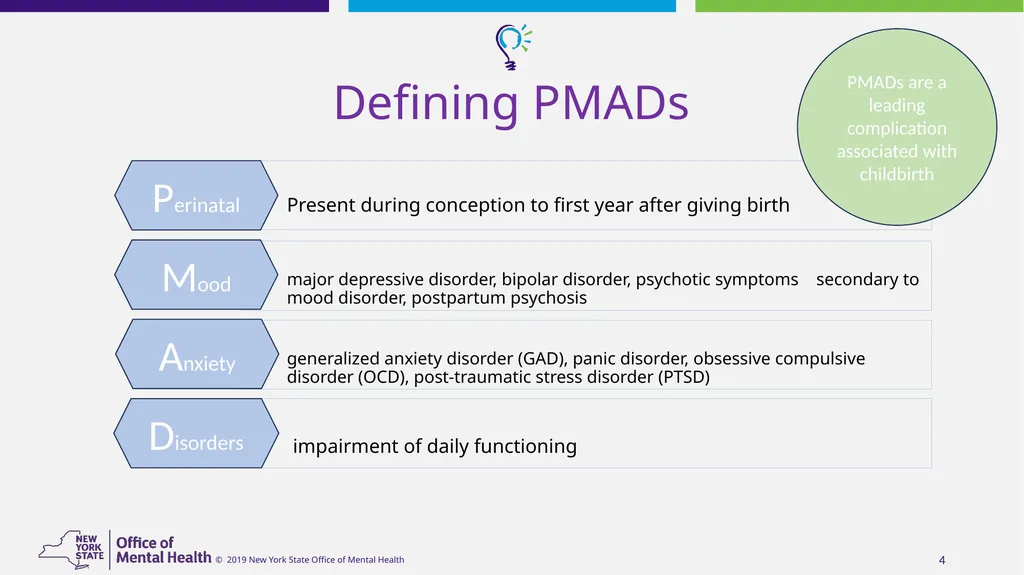
Defining PMADs Present during conception to first year after giving birth major depressive disorder, bipolar disorder, psychotic symptoms secondary to mood disorder, postpartum psychosis generalized anxiety disorder (GAD), panic disorder, obsessive compulsive disorder (OCD), post-traumatic stress disorder (PTSD) impairment of daily functioning Perinatal Mood Anxiety Disorders PMADs are a leading complication associated with childbirth<br>
05
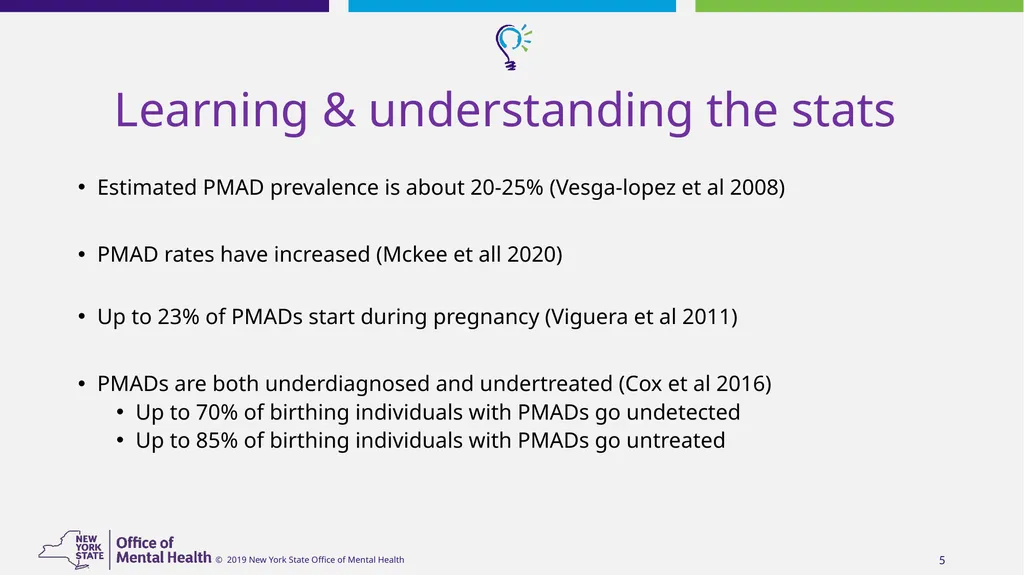
Learning & understanding the stats Estimated PMAD prevalence is about 20-25% (Vesga-lopez et al 2008)
PMAD rates have increased (Mckee et all 2020)
Up to 23% of PMADs start during pregnancy (Viguera et al 2011)
PMADs are both underdiagnosed and undertreated (Cox et al 2016)
Up to 70% of birthing individuals with PMADs go undetected
Up to 85% of birthing individuals with PMADs go untreated<br>
PMAD rates have increased (Mckee et all 2020)
Up to 23% of PMADs start during pregnancy (Viguera et al 2011)
PMADs are both underdiagnosed and undertreated (Cox et al 2016)
Up to 70% of birthing individuals with PMADs go undetected
Up to 85% of birthing individuals with PMADs go untreated<br>
06
(Risk) factors correlated with perinatal psychiatric disorders Lifetime personal or family history of psychiatric disorder
History of PMAD
History of PMDD (premenstrual dysphoric disorder)
Discontinuation of psychotropic medication proximate to conception
Lower educational level attainment
Inadequate social support; marital/partner dissatisfaction
<12 weeks of parental leave
High life stress
Current or past abuse/trauma including domestic violence and traumatic birth experience
Perinatal smoking, EtOH or other substance use
Unplanned or undesired pregnancy
Co-morbid sleep disorders
Co-morbid medical conditions/high-risk pregnancy
Infant/fetus with significant medical comorbidities or stay in NICU Yang, K et al, 2022; Furtado M et al 2018; Hutchens & Kearney 2020 Biologic Psychological Social/
Environmental<br>
History of PMAD
History of PMDD (premenstrual dysphoric disorder)
Discontinuation of psychotropic medication proximate to conception
Lower educational level attainment
Inadequate social support; marital/partner dissatisfaction
<12 weeks of parental leave
High life stress
Current or past abuse/trauma including domestic violence and traumatic birth experience
Perinatal smoking, EtOH or other substance use
Unplanned or undesired pregnancy
Co-morbid sleep disorders
Co-morbid medical conditions/high-risk pregnancy
Infant/fetus with significant medical comorbidities or stay in NICU Yang, K et al, 2022; Furtado M et al 2018; Hutchens & Kearney 2020 Biologic Psychological Social/
Environmental<br>
07
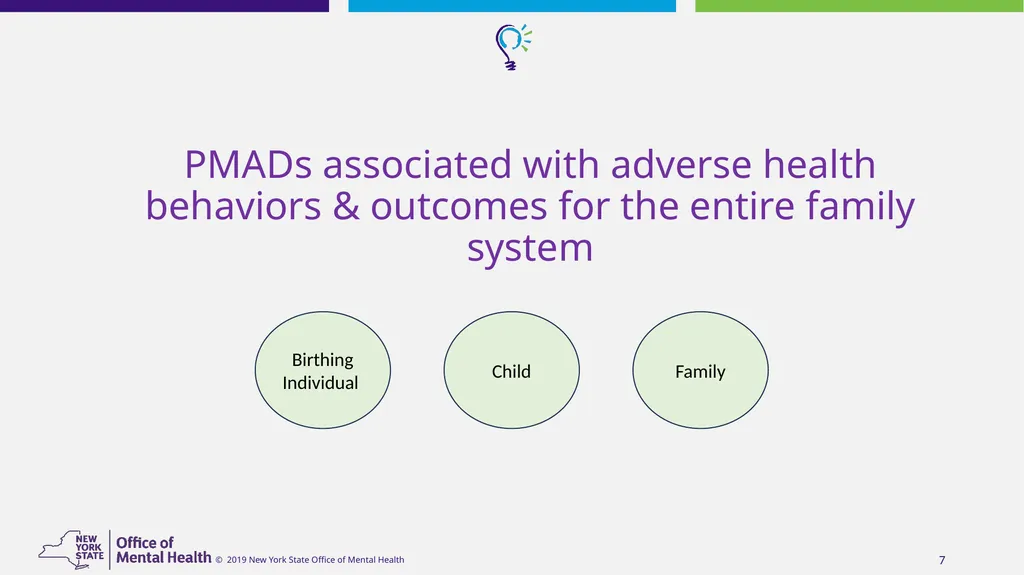
PMADs associated with adverse health behaviors & outcomes for the entire family system Birthing Individual Child Family<br>
08
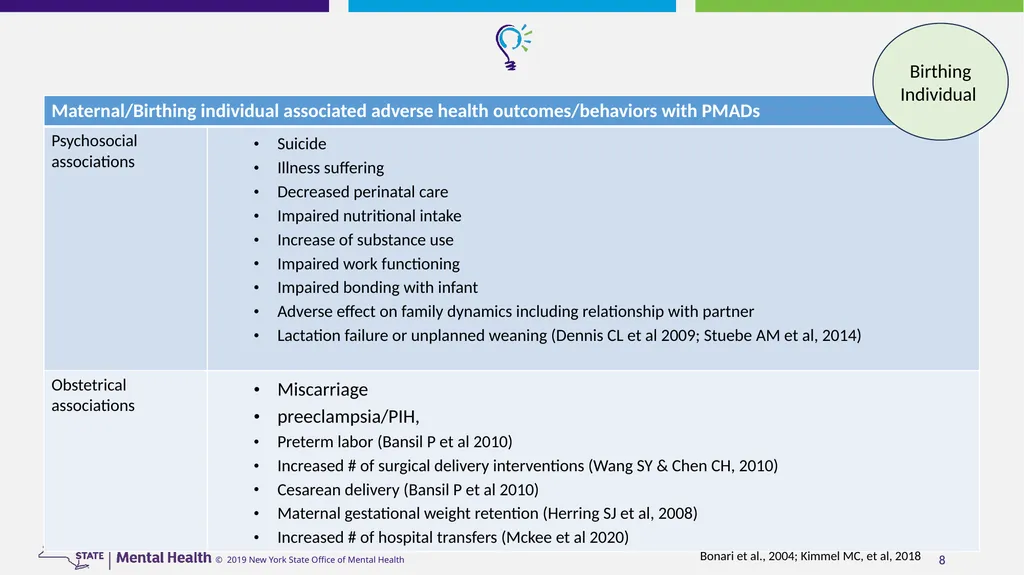
Birthing Individual Bonari et al., 2004; Kimmel MC, et al, 2018<br>
09
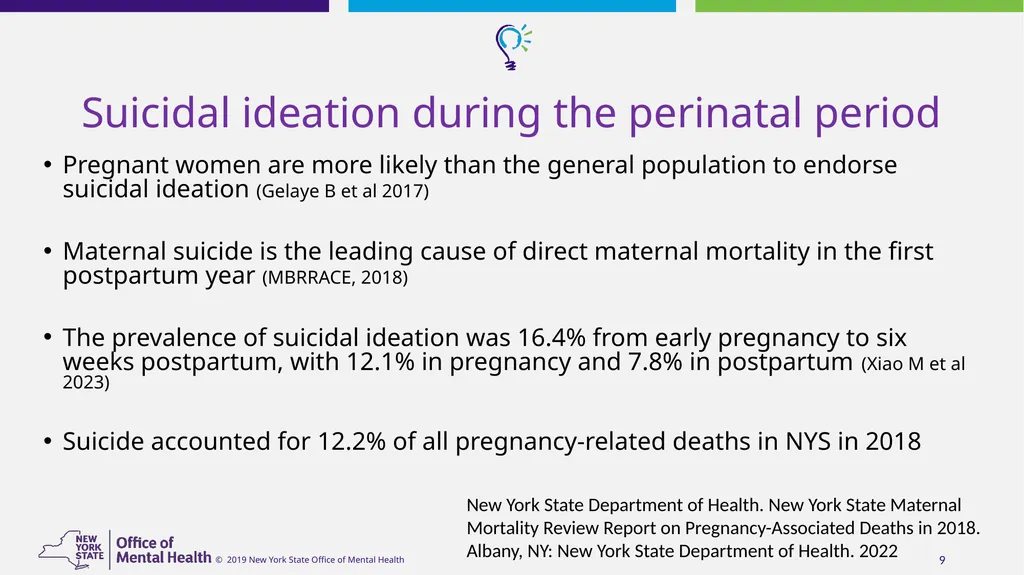
Suicidal ideation during the perinatal period Pregnant women are more likely than the general population to endorse suicidal ideation (Gelaye B et al 2017)
Maternal suicide is the leading cause of direct maternal mortality in the first postpartum year (MBRRACE, 2018)
The prevalence of suicidal ideation was 16.4% from early pregnancy to six weeks postpartum, with 12.1% in pregnancy and 7.8% in postpartum (Xiao M et al 2023)
Suicide accounted for 12.2% of all pregnancy-related deaths in NYS in 2018 New York State Department of Health. New York State Maternal Mortality Review Report on Pregnancy-Associated Deaths in 2018. Albany, NY: New York State Department of Health. 2022<br>
Maternal suicide is the leading cause of direct maternal mortality in the first postpartum year (MBRRACE, 2018)
The prevalence of suicidal ideation was 16.4% from early pregnancy to six weeks postpartum, with 12.1% in pregnancy and 7.8% in postpartum (Xiao M et al 2023)
Suicide accounted for 12.2% of all pregnancy-related deaths in NYS in 2018 New York State Department of Health. New York State Maternal Mortality Review Report on Pregnancy-Associated Deaths in 2018. Albany, NY: New York State Department of Health. 2022<br>
10
Mental health conditions were the 3rd most common underlying cause of pregnancy-related deaths Among 41 pregnancy-related deaths in NYS in 2018, the most common underlying causes of death were embolism-thrombotic (non-cerebral) and hemorrhage (excluding aneurysms or CVA), followed by mental health conditions. 10 8, 20% 8, 20% 6, 15%<br>
11
100% of deaths due to mental health conditions
were judged preventable Preventability varied across underlying causes of death.
Among the leading causes of death, 100% of deaths due to hemorrhage, mental health conditions, and cardiomyopathy were judged preventable. 11<br>
Among the leading causes of death, 100% of deaths due to hemorrhage, mental health conditions, and cardiomyopathy were judged preventable. 11<br>
12
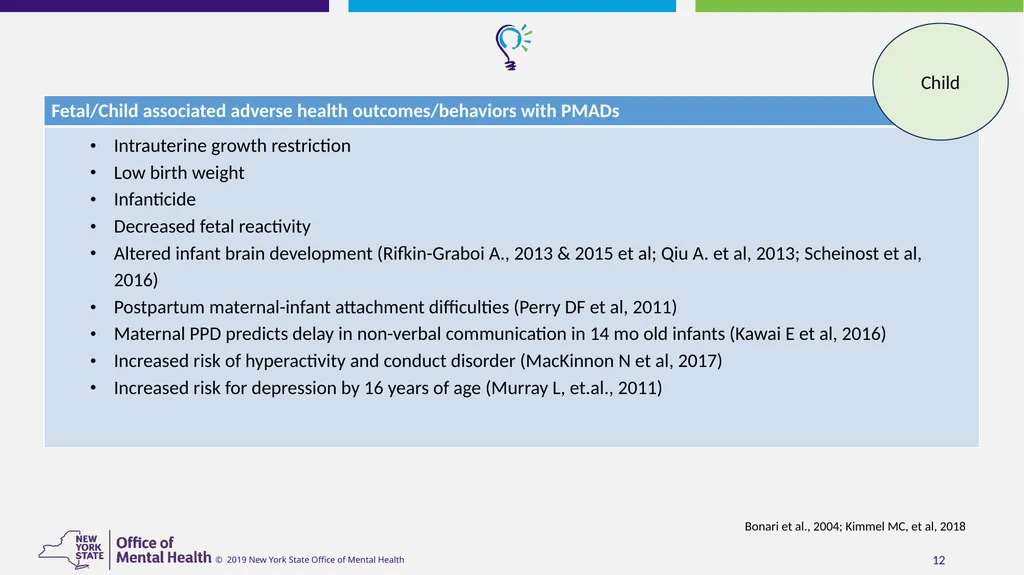
Child Bonari et al., 2004; Kimmel MC, et al, 2018<br>
13
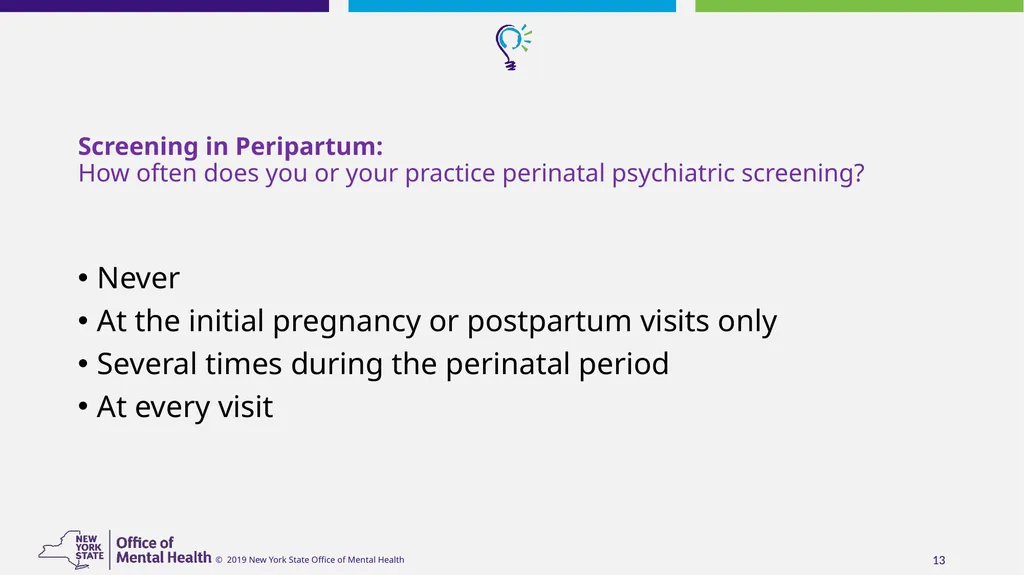
Screening in Peripartum:
How often does you or your practice perinatal psychiatric screening? Never
At the initial pregnancy or postpartum visits only
Several times during the perinatal period
At every visit<br>
At the initial pregnancy or postpartum visits only
Several times during the perinatal period
At every visit<br>
14
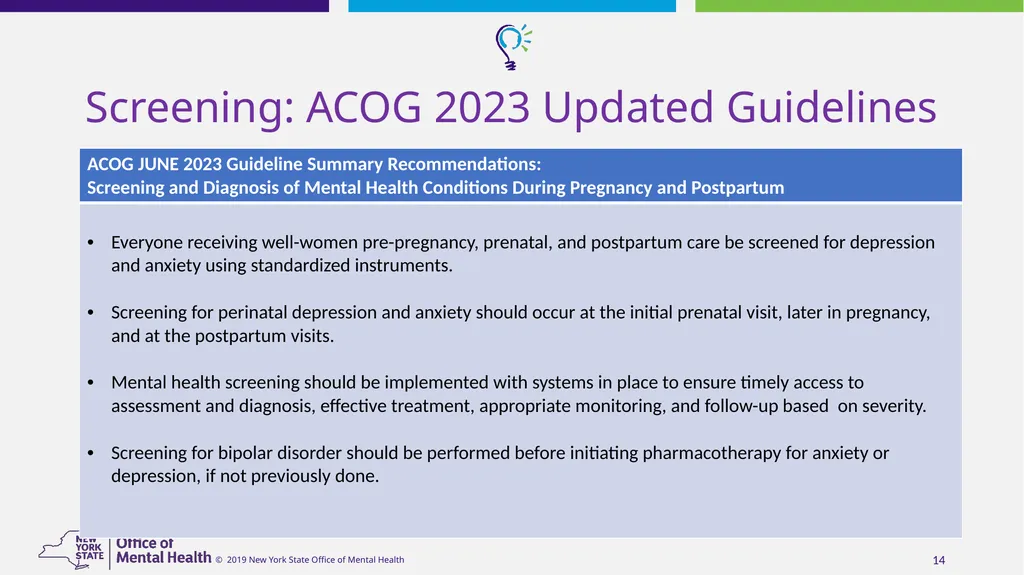
Screening: ACOG 2023 Updated Guidelines<br>
15
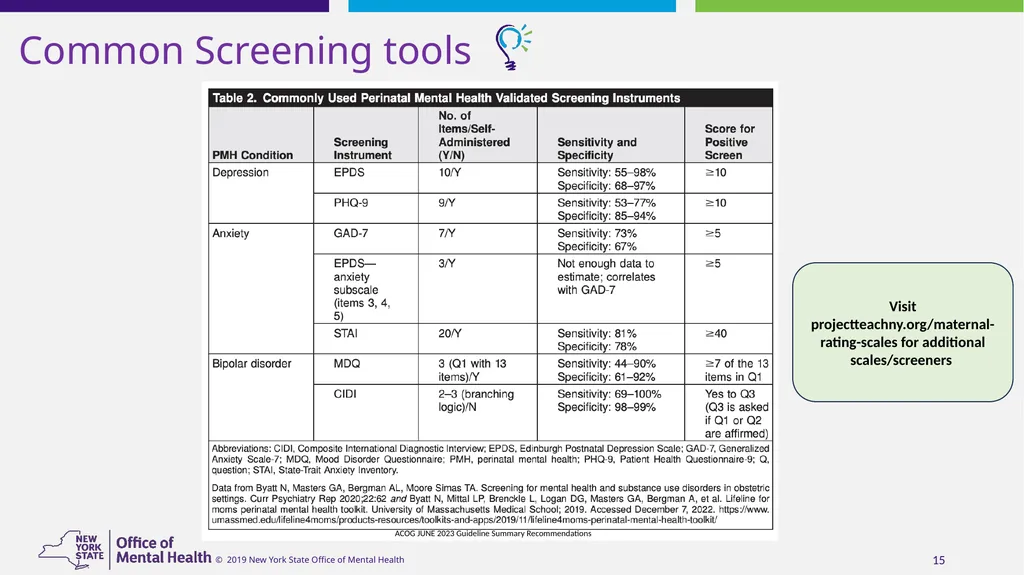
Common Screening tools ACOG JUNE 2023 Guideline Summary Recommendations Visit projectteachny.org/maternal-rating-scales for additional scales/screeners<br>
16
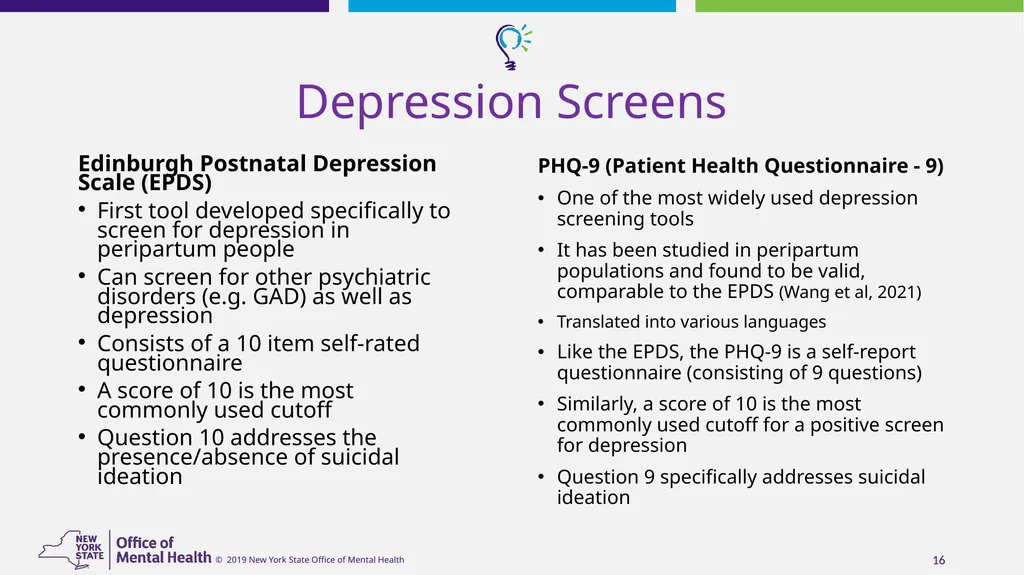
Depression Screens Edinburgh Postnatal Depression Scale (EPDS)
First tool developed specifically to screen for depression in peripartum people
Can screen for other psychiatric disorders (e.g. GAD) as well as depression
Consists of a 10 item self-rated questionnaire
A score of 10 is the most commonly used cutoff
Question 10 addresses the presence/absence of suicidal ideation PHQ-9 (Patient Health Questionnaire - 9)
One of the most widely used depression screening tools
It has been studied in peripartum populations and found to be valid, comparable to the EPDS (Wang et al, 2021)
Translated into various languages
Like the EPDS, the PHQ-9 is a self-report questionnaire (consisting of 9 questions)
Similarly, a score of 10 is the most commonly used cutoff for a positive screen for depression
Question 9 specifically addresses suicidal ideation<br>
First tool developed specifically to screen for depression in peripartum people
Can screen for other psychiatric disorders (e.g. GAD) as well as depression
Consists of a 10 item self-rated questionnaire
A score of 10 is the most commonly used cutoff
Question 10 addresses the presence/absence of suicidal ideation PHQ-9 (Patient Health Questionnaire - 9)
One of the most widely used depression screening tools
It has been studied in peripartum populations and found to be valid, comparable to the EPDS (Wang et al, 2021)
Translated into various languages
Like the EPDS, the PHQ-9 is a self-report questionnaire (consisting of 9 questions)
Similarly, a score of 10 is the most commonly used cutoff for a positive screen for depression
Question 9 specifically addresses suicidal ideation<br>
17
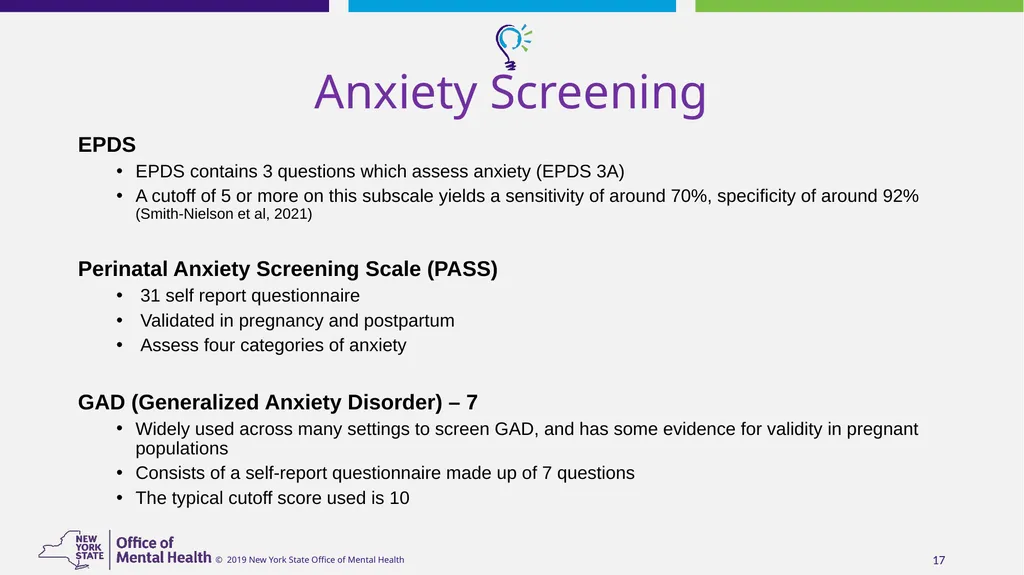
Anxiety Screening EPDS
EPDS contains 3 questions which assess anxiety (EPDS 3A)
A cutoff of 5 or more on this subscale yields a sensitivity of around 70%, specificity of around 92% (Smith-Nielson et al, 2021)
Perinatal Anxiety Screening Scale (PASS)
31 self report questionnaire
Validated in pregnancy and postpartum
Assess four categories of anxiety
GAD (Generalized Anxiety Disorder) – 7
Widely used across many settings to screen GAD, and has some evidence for validity in pregnant populations
Consists of a self-report questionnaire made up of 7 questions
The typical cutoff score used is 10<br>
EPDS contains 3 questions which assess anxiety (EPDS 3A)
A cutoff of 5 or more on this subscale yields a sensitivity of around 70%, specificity of around 92% (Smith-Nielson et al, 2021)
Perinatal Anxiety Screening Scale (PASS)
31 self report questionnaire
Validated in pregnancy and postpartum
Assess four categories of anxiety
GAD (Generalized Anxiety Disorder) – 7
Widely used across many settings to screen GAD, and has some evidence for validity in pregnant populations
Consists of a self-report questionnaire made up of 7 questions
The typical cutoff score used is 10<br>
18
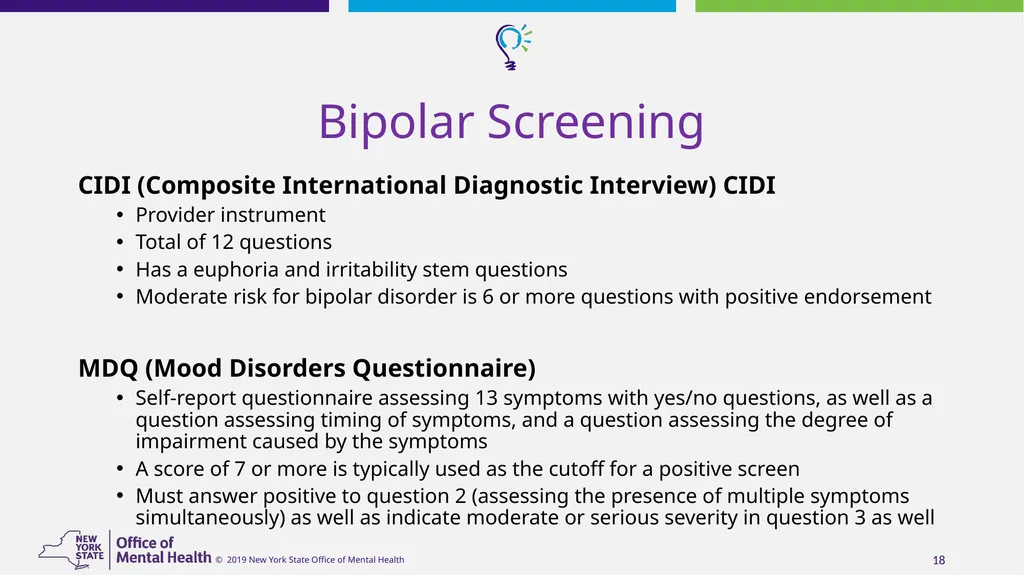
Bipolar Screening CIDI (Composite International Diagnostic Interview) CIDI
Provider instrument
Total of 12 questions
Has a euphoria and irritability stem questions
Moderate risk for bipolar disorder is 6 or more questions with positive endorsement
MDQ (Mood Disorders Questionnaire)
Self-report questionnaire assessing 13 symptoms with yes/no questions, as well as a question assessing timing of symptoms, and a question assessing the degree of impairment caused by the symptoms
A score of 7 or more is typically used as the cutoff for a positive screen
Must answer positive to question 2 (assessing the presence of multiple symptoms simultaneously) as well as indicate moderate or serious severity in question 3 as well<br>
Provider instrument
Total of 12 questions
Has a euphoria and irritability stem questions
Moderate risk for bipolar disorder is 6 or more questions with positive endorsement
MDQ (Mood Disorders Questionnaire)
Self-report questionnaire assessing 13 symptoms with yes/no questions, as well as a question assessing timing of symptoms, and a question assessing the degree of impairment caused by the symptoms
A score of 7 or more is typically used as the cutoff for a positive screen
Must answer positive to question 2 (assessing the presence of multiple symptoms simultaneously) as well as indicate moderate or serious severity in question 3 as well<br>
19
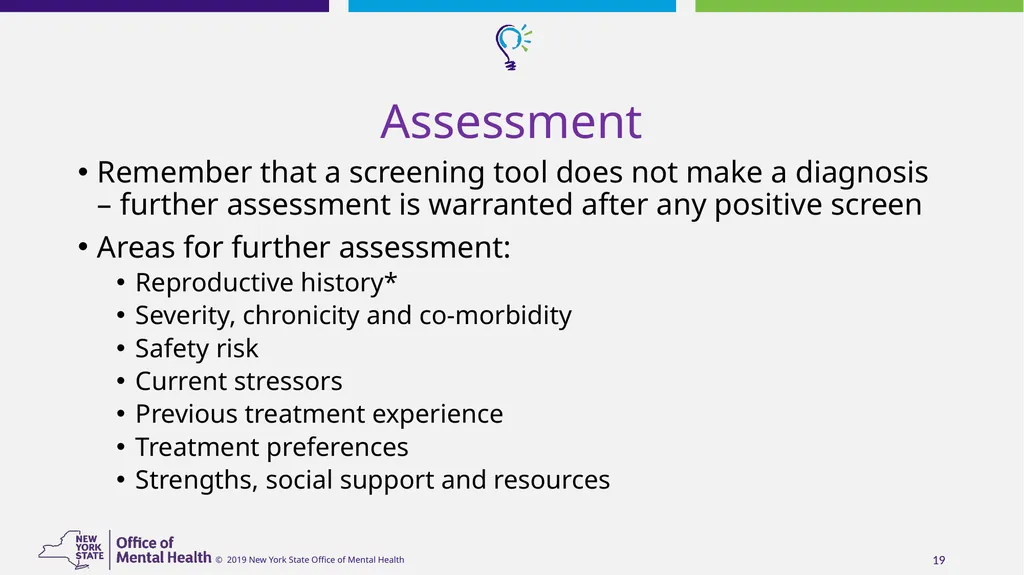
Assessment Remember that a screening tool does not make a diagnosis – further assessment is warranted after any positive screen
Areas for further assessment:
Reproductive history*
Severity, chronicity and co-morbidity
Safety risk
Current stressors
Previous treatment experience
Treatment preferences
Strengths, social support and resources<br>
Areas for further assessment:
Reproductive history*
Severity, chronicity and co-morbidity
Safety risk
Current stressors
Previous treatment experience
Treatment preferences
Strengths, social support and resources<br>
20
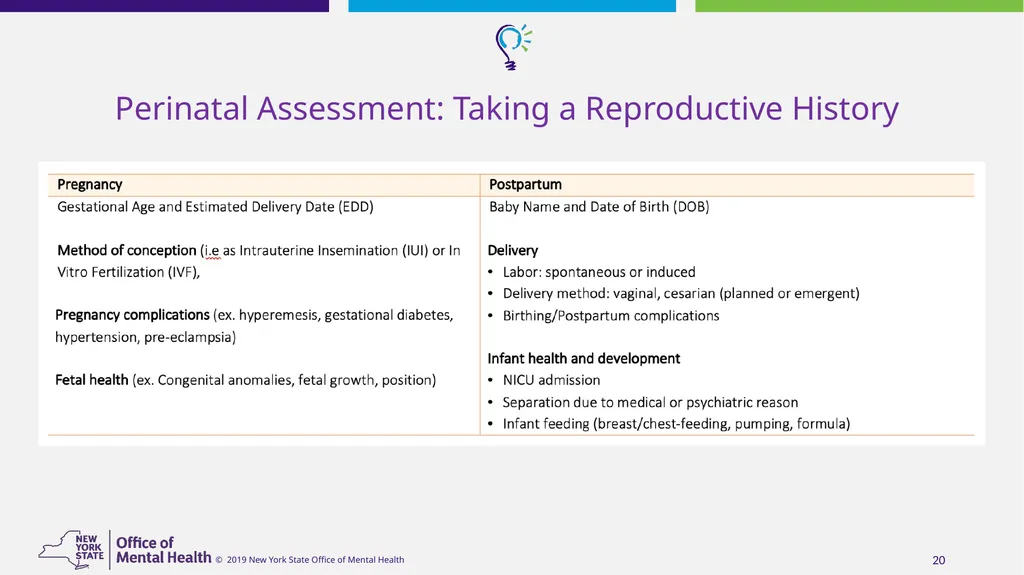
Perinatal Assessment: Taking a Reproductive History<br>
21
Diagnosing unipolar perinatal depression 21 Major depressive disorder with peripartum onset
requires ≥ five of the following symptoms (one must be depressed mood or anhedonia), beginning in pregnancy or within 4 weeks of delivery
Depressed mood, often overshadowed by severe anxiety, crying episodes, feel trapped/overwhelmed
Markedly diminished interest or pleasure in activities- lack of interest in baby/not feeling close to baby
Appetite disturbance- food has no taste, forces self to eat, poor gestational weight
Sleep disturbance- cannot fall or stay asleep - even when the baby is sleeping
Physical agitation (on-edge) or feeling slowed down
Fatigue or loss of energy, exhausted
Feelings of worthlessness or excessive or inappropriate guilt – feeling like a bad mother
Decreased concentration or ability to make decisions
Recurrent thoughts of death or suicidal ideation –my family/baby would be better off without me
†Symptoms must be present most of the day nearly every day for ≥ two weeks. Perinatal Prevalence: 6-11%<br>
requires ≥ five of the following symptoms (one must be depressed mood or anhedonia), beginning in pregnancy or within 4 weeks of delivery
Depressed mood, often overshadowed by severe anxiety, crying episodes, feel trapped/overwhelmed
Markedly diminished interest or pleasure in activities- lack of interest in baby/not feeling close to baby
Appetite disturbance- food has no taste, forces self to eat, poor gestational weight
Sleep disturbance- cannot fall or stay asleep - even when the baby is sleeping
Physical agitation (on-edge) or feeling slowed down
Fatigue or loss of energy, exhausted
Feelings of worthlessness or excessive or inappropriate guilt – feeling like a bad mother
Decreased concentration or ability to make decisions
Recurrent thoughts of death or suicidal ideation –my family/baby would be better off without me
†Symptoms must be present most of the day nearly every day for ≥ two weeks. Perinatal Prevalence: 6-11%<br>
22
Baby blues or PPD
Putnam et al 2017; Jordan et al 2019; Putnick DL et al. 2020 Call Project TEACH!
1-855-227-7272<br>
1-855-227-7272<br>
23
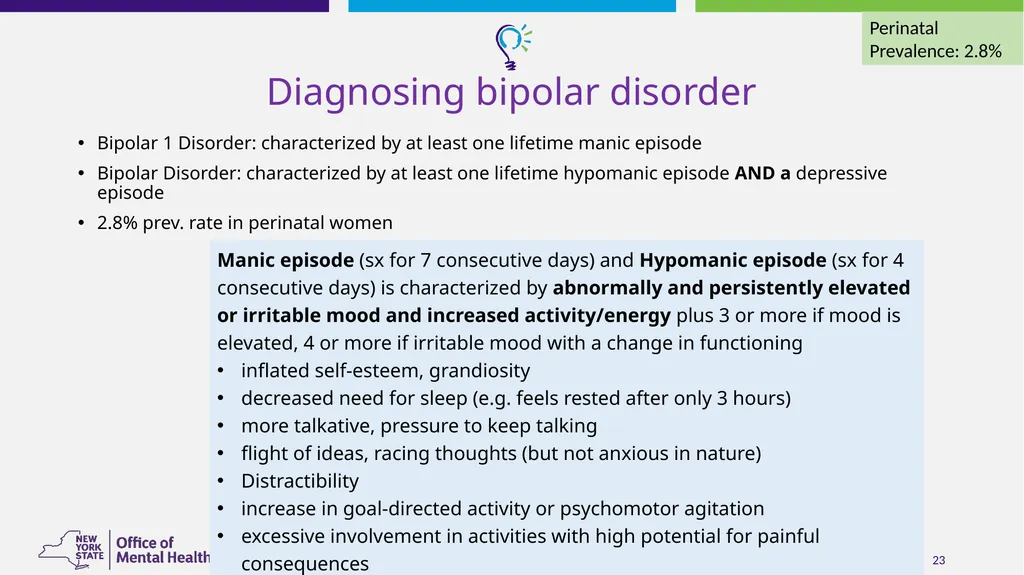
Diagnosing bipolar disorder Bipolar 1 Disorder: characterized by at least one lifetime manic episode
Bipolar Disorder: characterized by at least one lifetime hypomanic episode AND a depressive episode
2.8% prev. rate in perinatal women Manic episode (sx for 7 consecutive days) and Hypomanic episode (sx for 4 consecutive days) is characterized by abnormally and persistently elevated or irritable mood and increased activity/energy plus 3 or more if mood is elevated, 4 or more if irritable mood with a change in functioning
inflated self-esteem, grandiosity
decreased need for sleep (e.g. feels rested after only 3 hours)
more talkative, pressure to keep talking
flight of ideas, racing thoughts (but not anxious in nature)
Distractibility
increase in goal-directed activity or psychomotor agitation
excessive involvement in activities with high potential for painful consequences Perinatal Prevalence: 2.8%<br>
Bipolar Disorder: characterized by at least one lifetime hypomanic episode AND a depressive episode
2.8% prev. rate in perinatal women Manic episode (sx for 7 consecutive days) and Hypomanic episode (sx for 4 consecutive days) is characterized by abnormally and persistently elevated or irritable mood and increased activity/energy plus 3 or more if mood is elevated, 4 or more if irritable mood with a change in functioning
inflated self-esteem, grandiosity
decreased need for sleep (e.g. feels rested after only 3 hours)
more talkative, pressure to keep talking
flight of ideas, racing thoughts (but not anxious in nature)
Distractibility
increase in goal-directed activity or psychomotor agitation
excessive involvement in activities with high potential for painful consequences Perinatal Prevalence: 2.8%<br>
24
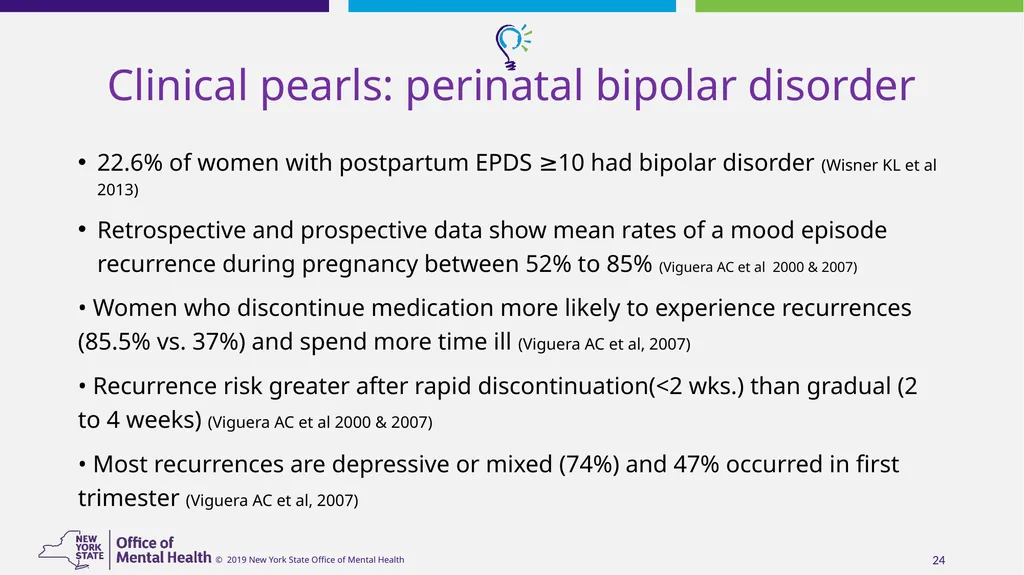
Clinical pearls: perinatal bipolar disorder 22.6% of women with postpartum EPDS ≥10 had bipolar disorder (Wisner KL et al 2013)
Retrospective and prospective data show mean rates of a mood episode recurrence during pregnancy between 52% to 85% (Viguera AC et al 2000 & 2007)
• Women who discontinue medication more likely to experience recurrences (85.5% vs. 37%) and spend more time ill (Viguera AC et al, 2007)
• Recurrence risk greater after rapid discontinuation(<2 wks.) than gradual (2 to 4 weeks) (Viguera AC et al 2000 & 2007)
• Most recurrences are depressive or mixed (74%) and 47% occurred in first trimester (Viguera AC et al, 2007)<br>
Retrospective and prospective data show mean rates of a mood episode recurrence during pregnancy between 52% to 85% (Viguera AC et al 2000 & 2007)
• Women who discontinue medication more likely to experience recurrences (85.5% vs. 37%) and spend more time ill (Viguera AC et al, 2007)
• Recurrence risk greater after rapid discontinuation(<2 wks.) than gradual (2 to 4 weeks) (Viguera AC et al 2000 & 2007)
• Most recurrences are depressive or mixed (74%) and 47% occurred in first trimester (Viguera AC et al, 2007)<br>
25
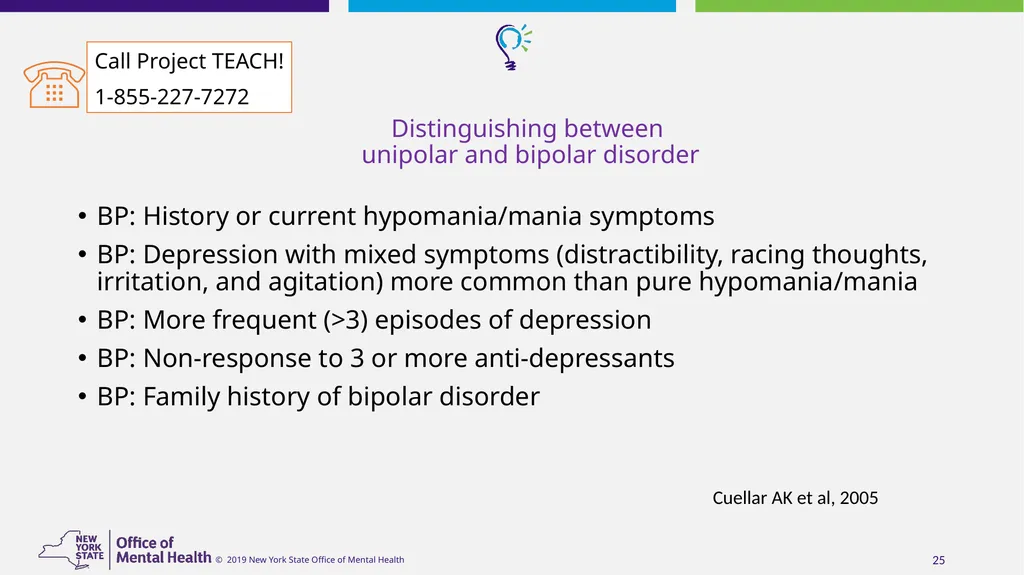
Distinguishing between
unipolar and bipolar disorder BP: History or current hypomania/mania symptoms
BP: Depression with mixed symptoms (distractibility, racing thoughts, irritation, and agitation) more common than pure hypomania/mania
BP: More frequent (>3) episodes of depression
BP: Non-response to 3 or more anti-depressants
BP: Family history of bipolar disorder Cuellar AK et al, 2005 Call Project TEACH!
1-855-227-7272<br>
BP: Depression with mixed symptoms (distractibility, racing thoughts, irritation, and agitation) more common than pure hypomania/mania
BP: More frequent (>3) episodes of depression
BP: Non-response to 3 or more anti-depressants
BP: Family history of bipolar disorder Cuellar AK et al, 2005 Call Project TEACH!
1-855-227-7272<br>
26
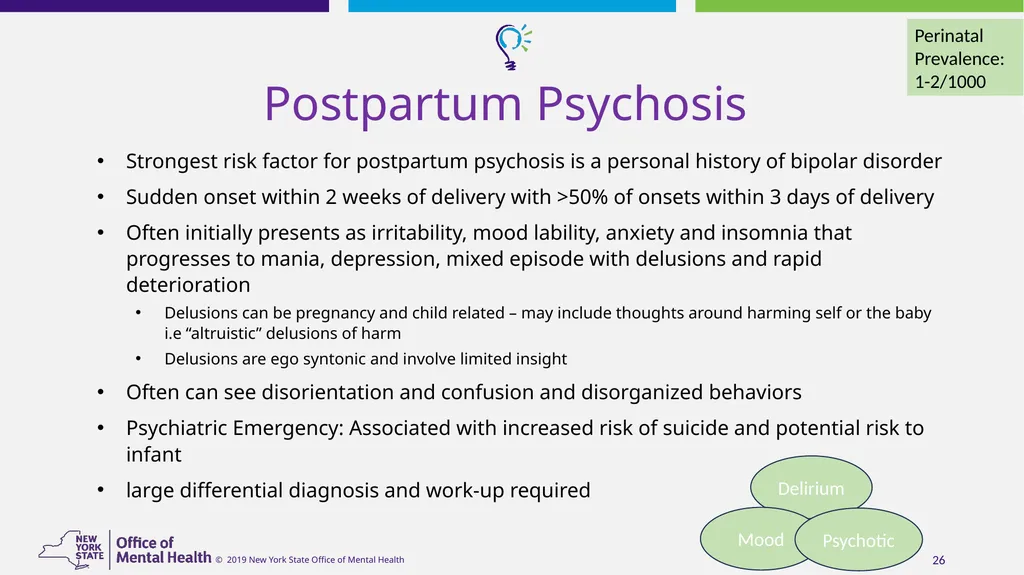
Postpartum Psychosis Strongest risk factor for postpartum psychosis is a personal history of bipolar disorder
Sudden onset within 2 weeks of delivery with >50% of onsets within 3 days of delivery
Often initially presents as irritability, mood lability, anxiety and insomnia that progresses to mania, depression, mixed episode with delusions and rapid deterioration
Delusions can be pregnancy and child related – may include thoughts around harming self or the baby i.e “altruistic” delusions of harm
Delusions are ego syntonic and involve limited insight
Often can see disorientation and confusion and disorganized behaviors
Psychiatric Emergency: Associated with increased risk of suicide and potential risk to infant
large differential diagnosis and work-up required Delirium Mood Psychotic Perinatal Prevalence: 1-2/1000<br>
Sudden onset within 2 weeks of delivery with >50% of onsets within 3 days of delivery
Often initially presents as irritability, mood lability, anxiety and insomnia that progresses to mania, depression, mixed episode with delusions and rapid deterioration
Delusions can be pregnancy and child related – may include thoughts around harming self or the baby i.e “altruistic” delusions of harm
Delusions are ego syntonic and involve limited insight
Often can see disorientation and confusion and disorganized behaviors
Psychiatric Emergency: Associated with increased risk of suicide and potential risk to infant
large differential diagnosis and work-up required Delirium Mood Psychotic Perinatal Prevalence: 1-2/1000<br>
27
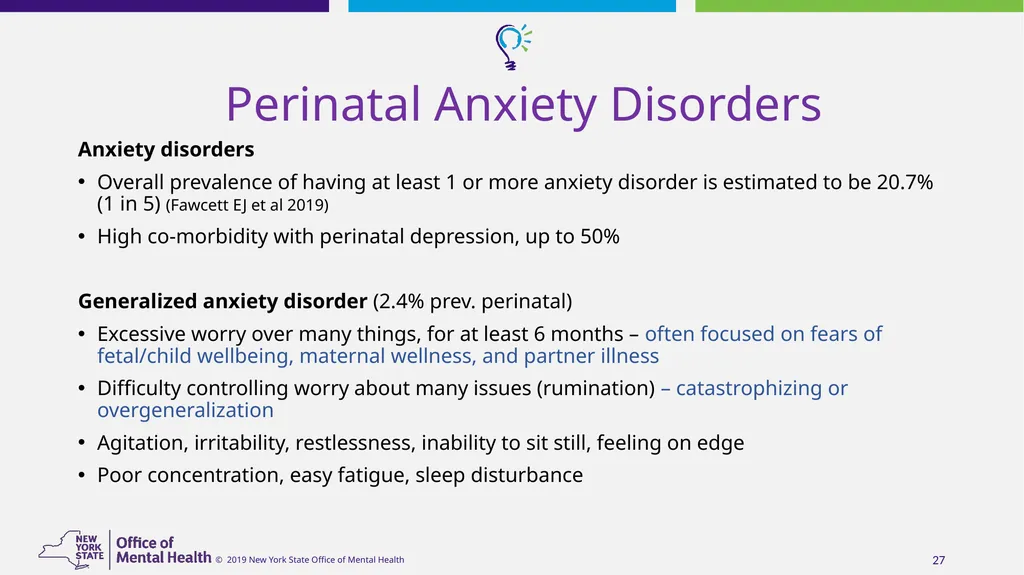
Anxiety disorders
Overall prevalence of having at least 1 or more anxiety disorder is estimated to be 20.7% (1 in 5) (Fawcett EJ et al 2019)
High co-morbidity with perinatal depression, up to 50%
Generalized anxiety disorder (2.4% prev. perinatal)
Excessive worry over many things, for at least 6 months – often focused on fears of fetal/child wellbeing, maternal wellness, and partner illness
Difficulty controlling worry about many issues (rumination) – catastrophizing or overgeneralization
Agitation, irritability, restlessness, inability to sit still, feeling on edge
Poor concentration, easy fatigue, sleep disturbance Perinatal Anxiety Disorders<br>
Overall prevalence of having at least 1 or more anxiety disorder is estimated to be 20.7% (1 in 5) (Fawcett EJ et al 2019)
High co-morbidity with perinatal depression, up to 50%
Generalized anxiety disorder (2.4% prev. perinatal)
Excessive worry over many things, for at least 6 months – often focused on fears of fetal/child wellbeing, maternal wellness, and partner illness
Difficulty controlling worry about many issues (rumination) – catastrophizing or overgeneralization
Agitation, irritability, restlessness, inability to sit still, feeling on edge
Poor concentration, easy fatigue, sleep disturbance Perinatal Anxiety Disorders<br>
28
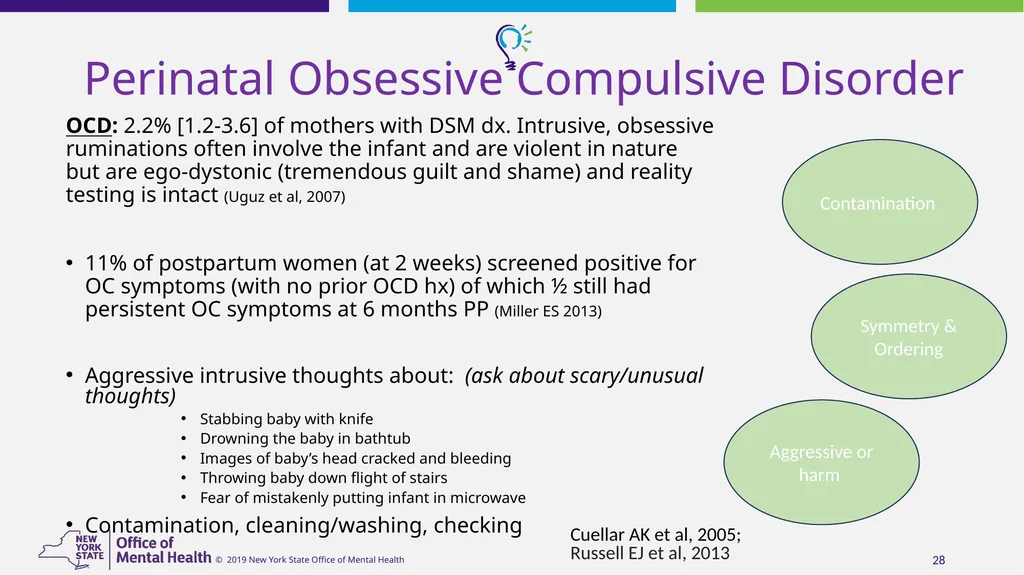
Perinatal Obsessive Compulsive Disorder OCD: 2.2% [1.2-3.6] of mothers with DSM dx. Intrusive, obsessive ruminations often involve the infant and are violent in nature but are ego-dystonic (tremendous guilt and shame) and reality testing is intact (Uguz et al, 2007)
11% of postpartum women (at 2 weeks) screened positive for OC symptoms (with no prior OCD hx) of which ½ still had persistent OC symptoms at 6 months PP (Miller ES 2013)
Aggressive intrusive thoughts about: (ask about scary/unusual thoughts)
Stabbing baby with knife
Drowning the baby in bathtub
Images of baby’s head cracked and bleeding
Throwing baby down flight of stairs
Fear of mistakenly putting infant in microwave
Contamination, cleaning/washing, checking 28 Contamination Symmetry & Ordering Aggressive or harm Cuellar AK et al, 2005;
Russell EJ et al, 2013<br>
11% of postpartum women (at 2 weeks) screened positive for OC symptoms (with no prior OCD hx) of which ½ still had persistent OC symptoms at 6 months PP (Miller ES 2013)
Aggressive intrusive thoughts about: (ask about scary/unusual thoughts)
Stabbing baby with knife
Drowning the baby in bathtub
Images of baby’s head cracked and bleeding
Throwing baby down flight of stairs
Fear of mistakenly putting infant in microwave
Contamination, cleaning/washing, checking 28 Contamination Symmetry & Ordering Aggressive or harm Cuellar AK et al, 2005;
Russell EJ et al, 2013<br>
29
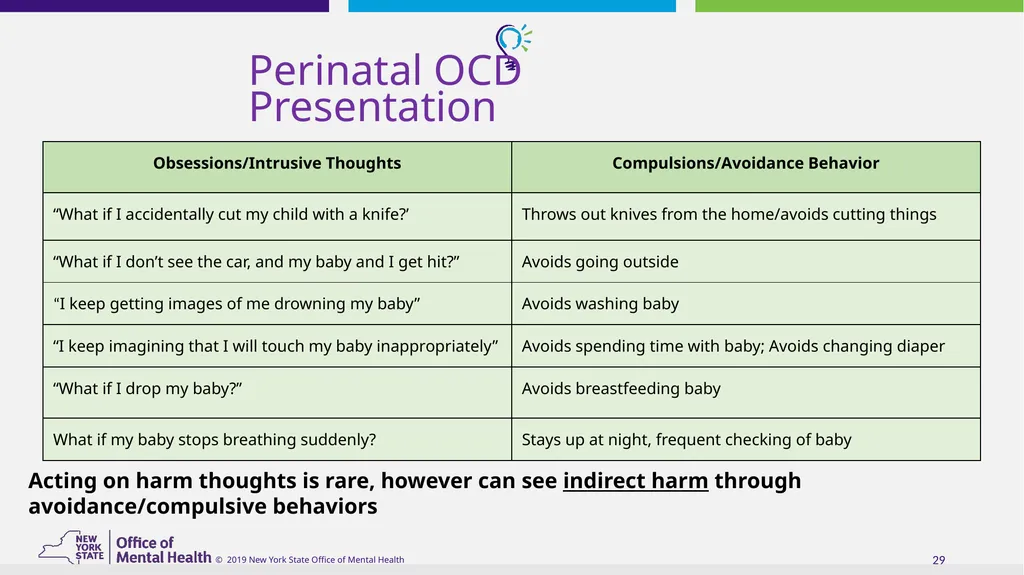
Perinatal OCD Presentation Acting on harm thoughts is rare, however can see indirect harm through avoidance/compulsive behaviors<br>
30
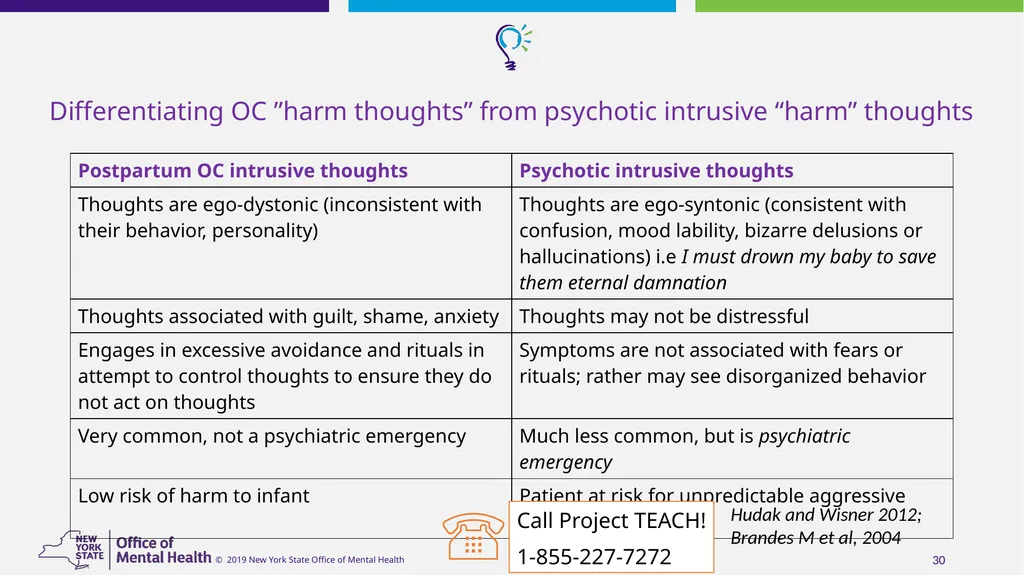
Differentiating OC ”harm thoughts” from psychotic intrusive “harm” thoughts Call Project TEACH!
1-855-227-7272 Hudak and Wisner 2012;
Brandes M et al, 2004<br>
1-855-227-7272 Hudak and Wisner 2012;
Brandes M et al, 2004<br>
31
Thank You !<br>