
EPR-Public Communications L-06 Public

Description: EPR-Public Communications L-06 Public InformationCommunications Organization Objective To understand the Incident Command System (ICS) used to respond to a nuclear or radiological emergency; To understand how the Public Information Officer
Related Topics
Download Presentation
"EPR-Public Communications L-06 Public" is the property of its rightful owner. Permission is granted to download and print the materials on this website for personal, non-commercial use only, and to display it on your personal computer provided you do not modify the materials and that you retain all copyright notices contained in the materials. By downloading content from our website, you accept the terms of this agreement.
Presentation Transcript
slide1. EPR-Public Communications
L-06 Public Information/Communications Organization<br>
slide2. Objective To understand the Incident Command System (ICS) used to respond to a nuclear or radiological emergency;
To understand how the Public Information Officer role is organized and its place in the overall response system.<br>
slide3. Outline Incident Command System
Public Information Centre
Public information activities
Organization and planning<br>
slide4. Incident command system Most widely used structure for emergency response;
Consolidates emergency planning and decision making;
Consistent terminology;
Integrated communications;
Scalable according to the size of the emergency;
Recommended by the IAEA.<br>
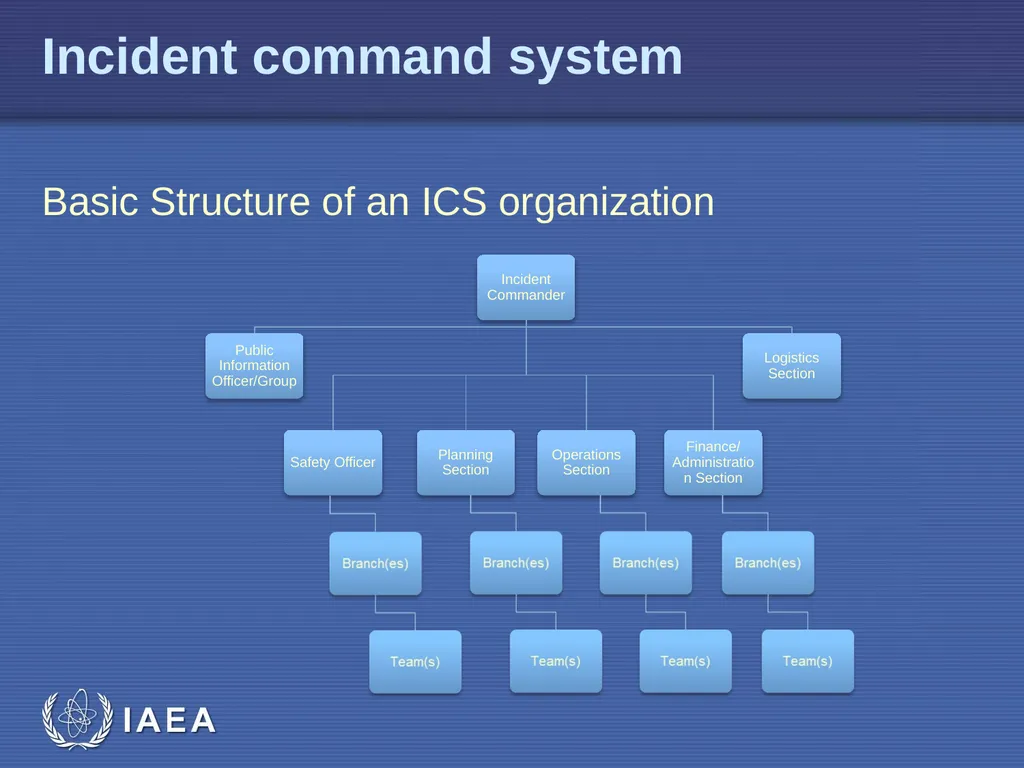
slide5. Incident command system Basic Structure of an ICS organization<br>
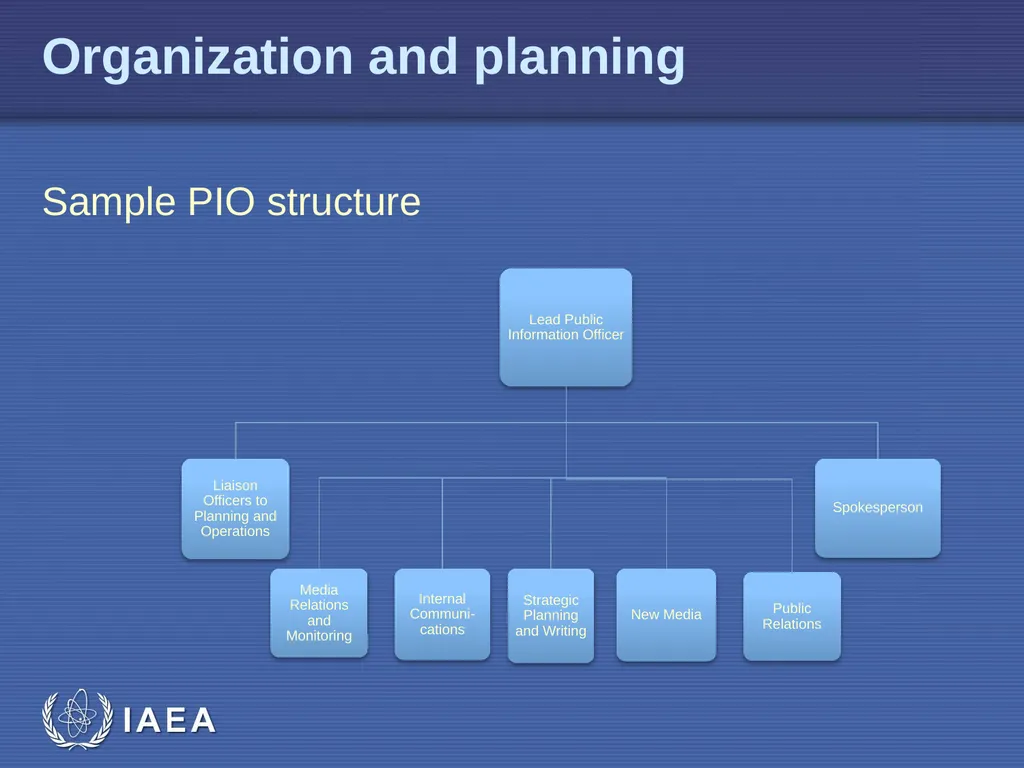
slide6. Organization and planning Sample PIO structure<br>
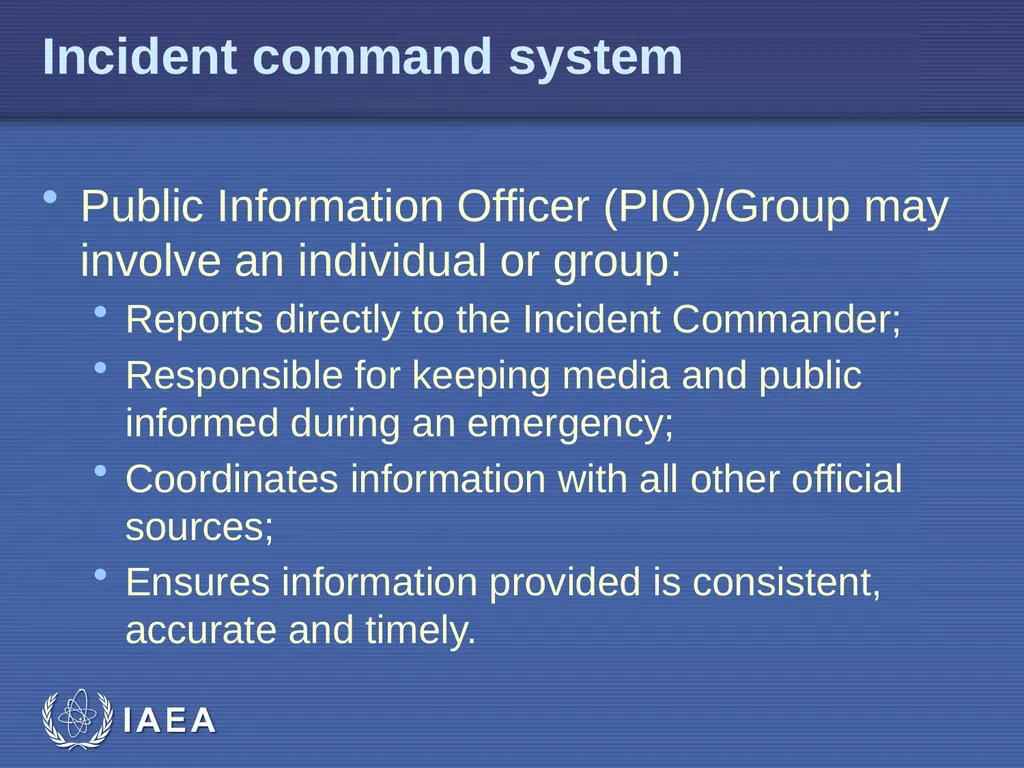
slide7. Incident command system Public Information Officer (PIO)/Group may involve an individual or group:
Reports directly to the Incident Commander;
Responsible for keeping media and public informed during an emergency;
Coordinates information with all other official sources;
Ensures information provided is consistent, accurate and timely.<br>
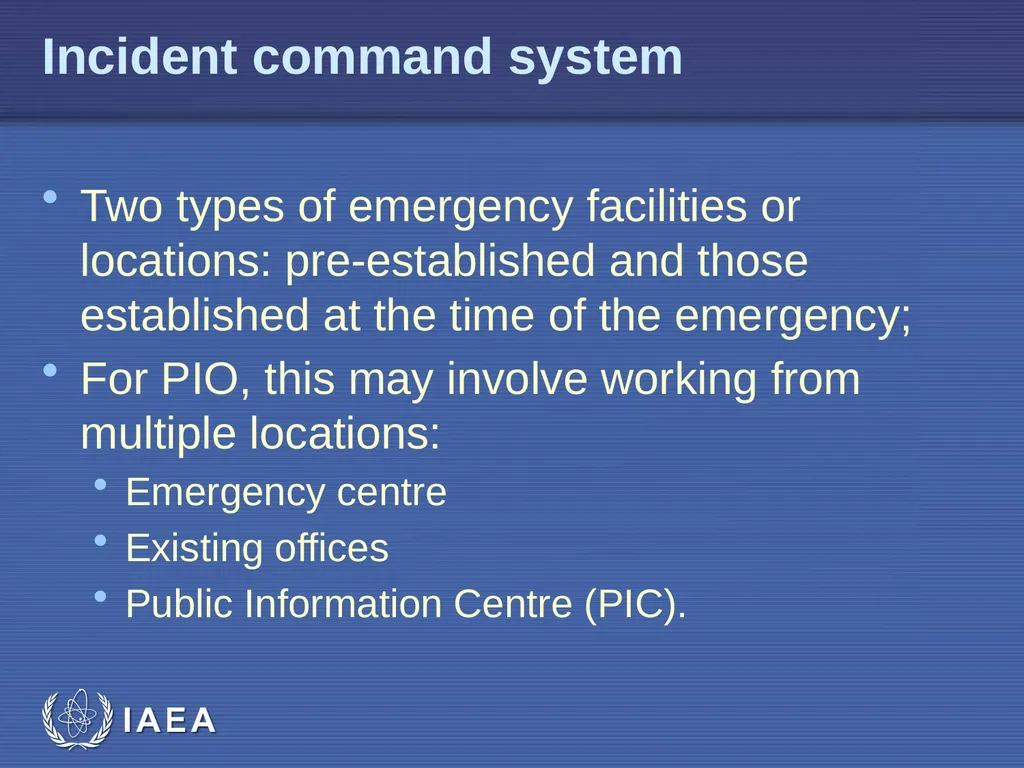
slide8. Incident command system Two types of emergency facilities or locations: pre-established and those established at the time of the emergency;
For PIO, this may involve working from multiple locations:
Emergency centre
Existing offices
Public Information Centre (PIC).<br>
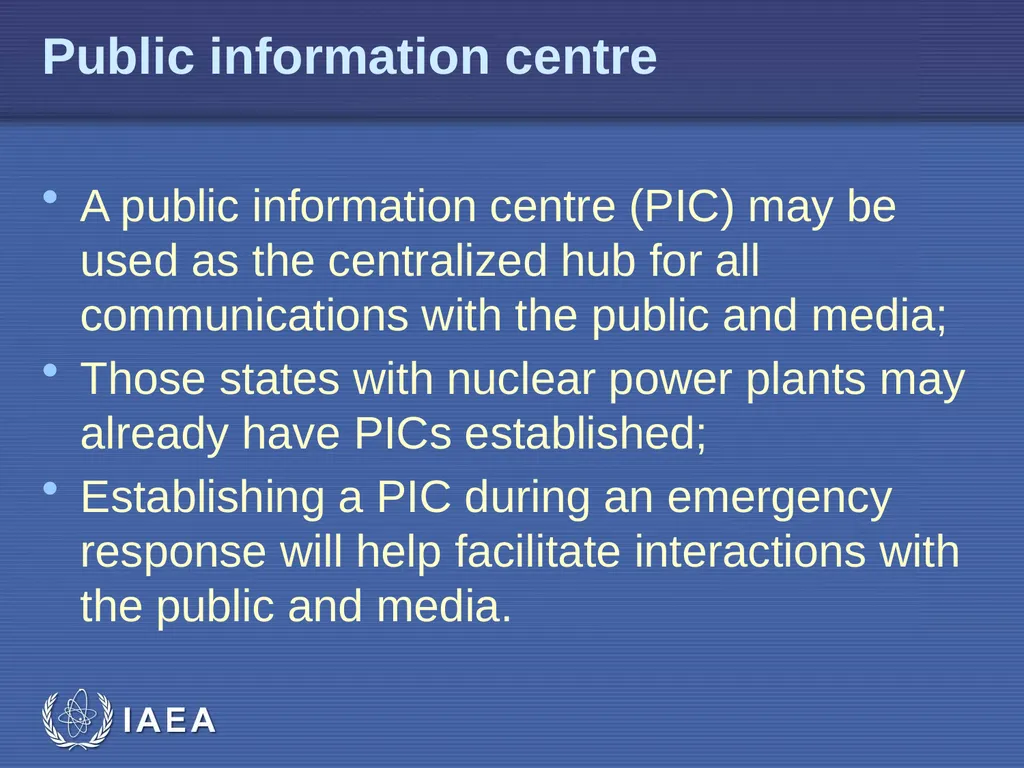
slide9. Public information centre A public information centre (PIC) may be used as the centralized hub for all communications with the public and media;
Those states with nuclear power plants may already have PICs established;
Establishing a PIC during an emergency response will help facilitate interactions with the public and media.<br>
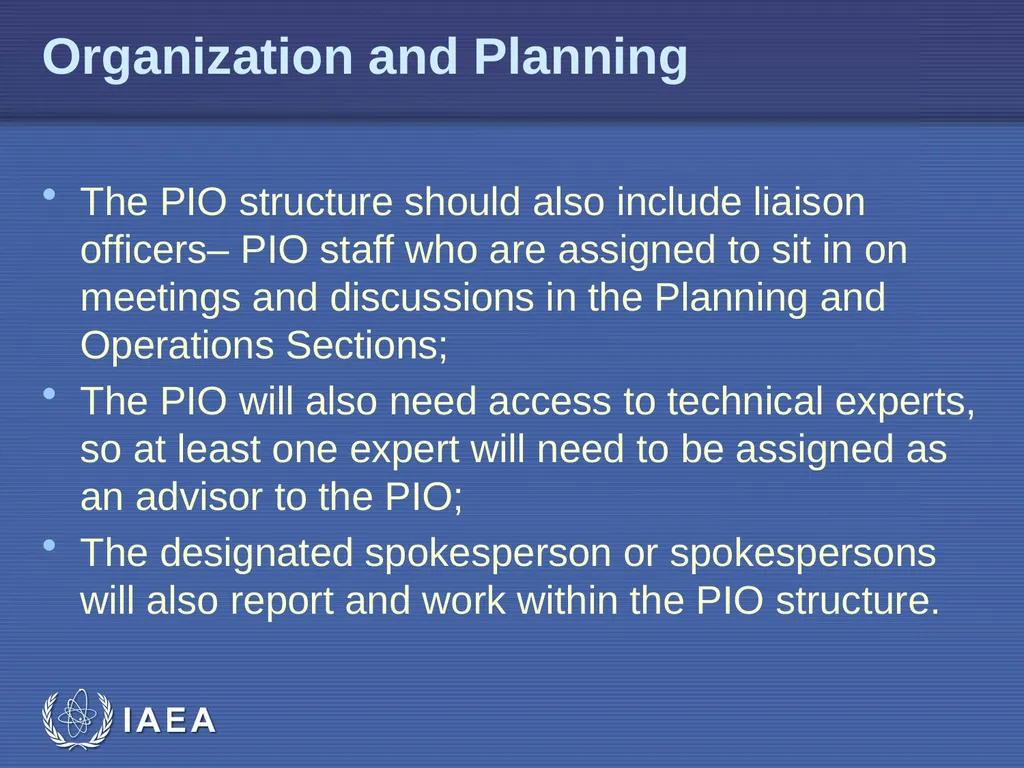
slide10. Organization and Planning The PIO structure should also include liaison officers– PIO staff who are assigned to sit in on meetings and discussions in the Planning and Operations Sections;
The PIO will also need access to technical experts, so at least one expert will need to be assigned as an advisor to the PIO;
The designated spokesperson or spokespersons will also report and work within the PIO structure.<br>
slide11. Discussion Develop an appropriate structure for the PIO according to activities to be undertaken and the geographical location;
How would you organize your PIO using emergency response structure that is currently used?<br>
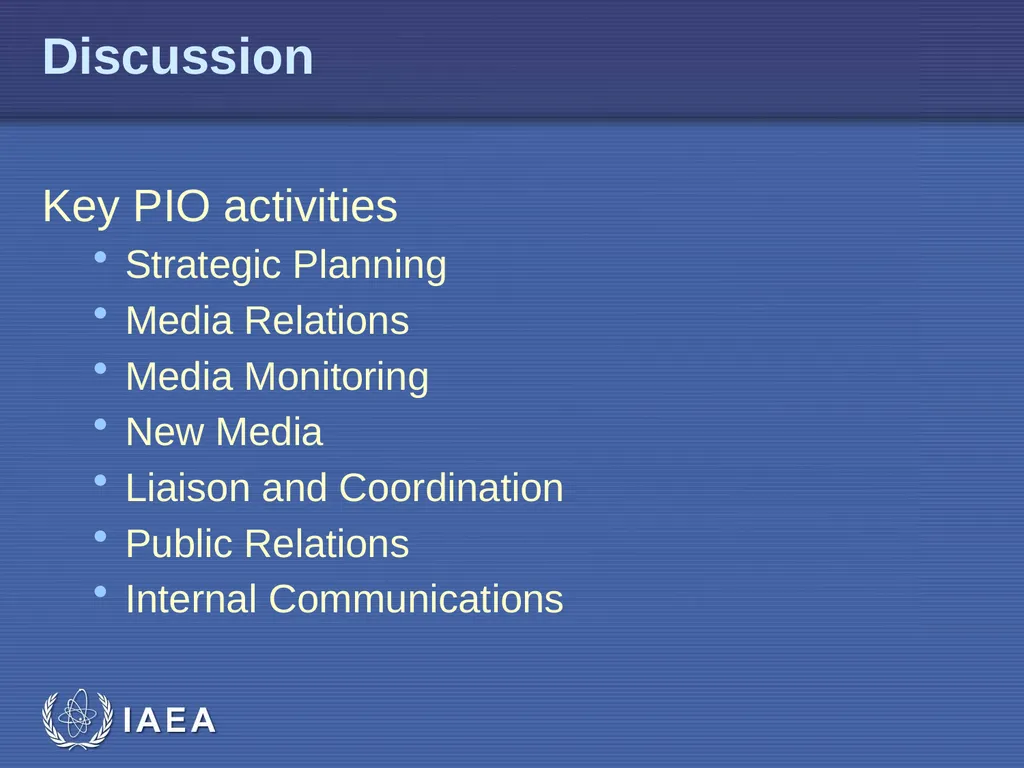
slide12. Discussion Key PIO activities
Strategic Planning
Media Relations
Media Monitoring
New Media
Liaison and Coordination
Public Relations
Internal Communications<br>
slide13. Organization and planning Plans and procedures will need to be developed to guide the public information activities during an emergency response;
Existing plans could be used as appropriate but may need to be revised;
Changes will be needed to reflect whoever is responsible for approving the release of all public information products in an emergency.<br>
slide14. Organization and planning Plans should also be in place to coordinate public communications activities with regional and or local authorities;
Procedures will also be required for practical arrangements specific to the PIO:
Staff roster
Activation procedures
Dissemination of information
Media monitoring
Translation
Templates for holding statements and news releases
Toll free public line.<br>
slide15. Summary In a complex emergency, the PIO will require a team of experienced public information staff organized into an appropriate structure;
Plans, procedures and practical arrangements will need to be established in advance in order for the PIO to undertake key activities to inform the public and media;
These plans, procedures and arrangements should be exercised on a regular basis.<br>
slide2. Objective To understand the Incident Command System (ICS) used to respond to a nuclear or radiological emergency;
To understand how the Public Information Officer role is organized and its place in the overall response system.<br>
slide3. Outline Incident Command System
Public Information Centre
Public information activities
Organization and planning<br>
slide4. Incident command system Most widely used structure for emergency response;
Consolidates emergency planning and decision making;
Consistent terminology;
Integrated communications;
Scalable according to the size of the emergency;
Recommended by the IAEA.<br>
slide5. Incident command system Basic Structure of an ICS organization<br>
slide6. Organization and planning Sample PIO structure<br>
slide7. Incident command system Public Information Officer (PIO)/Group may involve an individual or group:
Reports directly to the Incident Commander;
Responsible for keeping media and public informed during an emergency;
Coordinates information with all other official sources;
Ensures information provided is consistent, accurate and timely.<br>
slide8. Incident command system Two types of emergency facilities or locations: pre-established and those established at the time of the emergency;
For PIO, this may involve working from multiple locations:
Emergency centre
Existing offices
Public Information Centre (PIC).<br>
slide9. Public information centre A public information centre (PIC) may be used as the centralized hub for all communications with the public and media;
Those states with nuclear power plants may already have PICs established;
Establishing a PIC during an emergency response will help facilitate interactions with the public and media.<br>
slide10. Organization and Planning The PIO structure should also include liaison officers– PIO staff who are assigned to sit in on meetings and discussions in the Planning and Operations Sections;
The PIO will also need access to technical experts, so at least one expert will need to be assigned as an advisor to the PIO;
The designated spokesperson or spokespersons will also report and work within the PIO structure.<br>
slide11. Discussion Develop an appropriate structure for the PIO according to activities to be undertaken and the geographical location;
How would you organize your PIO using emergency response structure that is currently used?<br>
slide12. Discussion Key PIO activities
Strategic Planning
Media Relations
Media Monitoring
New Media
Liaison and Coordination
Public Relations
Internal Communications<br>
slide13. Organization and planning Plans and procedures will need to be developed to guide the public information activities during an emergency response;
Existing plans could be used as appropriate but may need to be revised;
Changes will be needed to reflect whoever is responsible for approving the release of all public information products in an emergency.<br>
slide14. Organization and planning Plans should also be in place to coordinate public communications activities with regional and or local authorities;
Procedures will also be required for practical arrangements specific to the PIO:
Staff roster
Activation procedures
Dissemination of information
Media monitoring
Translation
Templates for holding statements and news releases
Toll free public line.<br>
slide15. Summary In a complex emergency, the PIO will require a team of experienced public information staff organized into an appropriate structure;
Plans, procedures and practical arrangements will need to be established in advance in order for the PIO to undertake key activities to inform the public and media;
These plans, procedures and arrangements should be exercised on a regular basis.<br>