
EPSRC Impact Acceleration Account 2017-2020 –

Description: EPSRC Impact Acceleration Account 2017-2020 Launch April 7th 2017 Dr Mark Rushforth Head of Partnerships Business Engagement m.rushforthlancaster.ac.uk Phil Ternouth IAA Manager p.ternouth1lancaster.ac.uk Dr Dee Hennessy Faculty
Related Topics
Download Presentation
"EPSRC Impact Acceleration Account 2017-2020 –" is the property of its rightful owner. Permission is granted to download and print the materials on this website for personal, non-commercial use only, and to display it on your personal computer provided you do not modify the materials and that you retain all copyright notices contained in the materials. By downloading content from our website, you accept the terms of this agreement.
Presentation Transcript
slide1. EPSRC Impact Acceleration Account
2017-2020 – Launch April 7th 2017 Dr Mark Rushforth
Head of Partnerships & Business Engagement
m.rushforth@lancaster.ac.uk Phil Ternouth
IAA Manager
p.ternouth1@lancaster.ac.uk Dr Dee Hennessy
Faculty Engagement Facilitator d.hennessy@lancaster.ac.uk<br>
slide2. Roadmap Introductions
What We Did
Impact and how it arises
Academic benefits from collaborations
Value of collaboration to partners
Barriers to successful collaboration
Launch of the IAA 2017 – 2020<br>
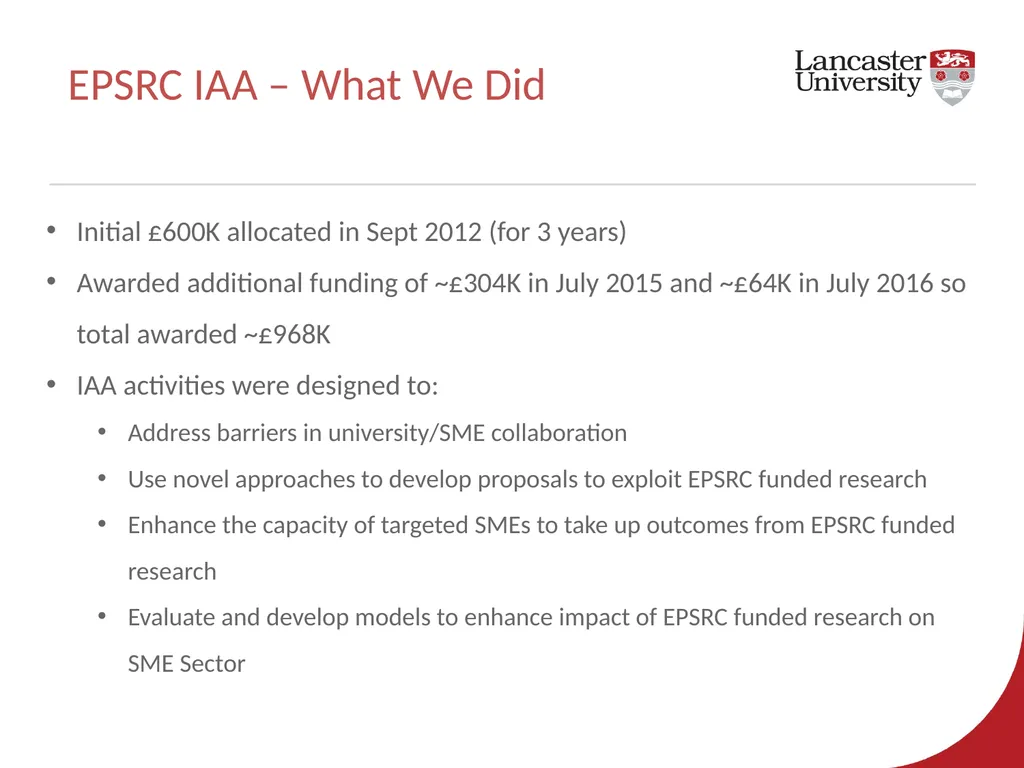
slide3. EPSRC IAA – What We Did Initial £600K allocated in Sept 2012 (for 3 years)
Awarded additional funding of ~£304K in July 2015 and ~£64K in July 2016 so total awarded ~£968K
IAA activities were designed to:
Address barriers in university/SME collaboration
Use novel approaches to develop proposals to exploit EPSRC funded research
Enhance the capacity of targeted SMEs to take up outcomes from EPSRC funded research
Evaluate and develop models to enhance impact of EPSRC funded research on SME Sector<br>
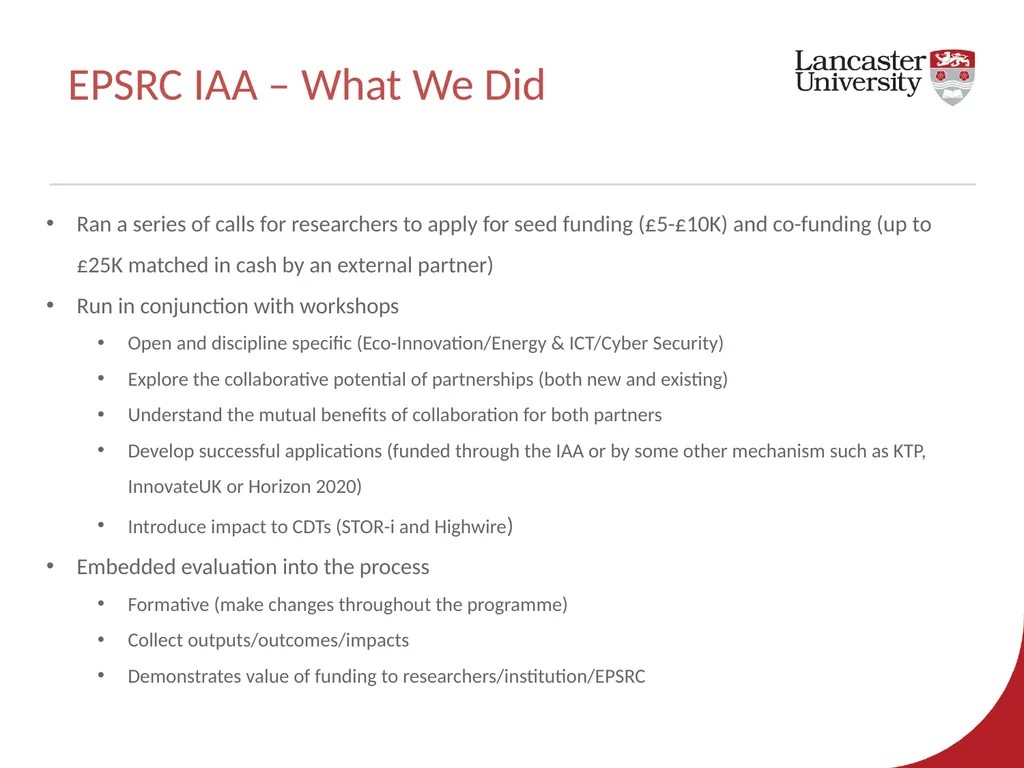
slide4. EPSRC IAA – What We Did Ran a series of calls for researchers to apply for seed funding (£5-£10K) and co-funding (up to £25K matched in cash by an external partner)
Run in conjunction with workshops
Open and discipline specific (Eco-Innovation/Energy & ICT/Cyber Security)
Explore the collaborative potential of partnerships (both new and existing)
Understand the mutual benefits of collaboration for both partners
Develop successful applications (funded through the IAA or by some other mechanism such as KTP, InnovateUK or Horizon 2020)
Introduce impact to CDTs (STOR-i and Highwire)
Embedded evaluation into the process
Formative (make changes throughout the programme)
Collect outputs/outcomes/impacts
Demonstrates value of funding to researchers/institution/EPSRC<br>
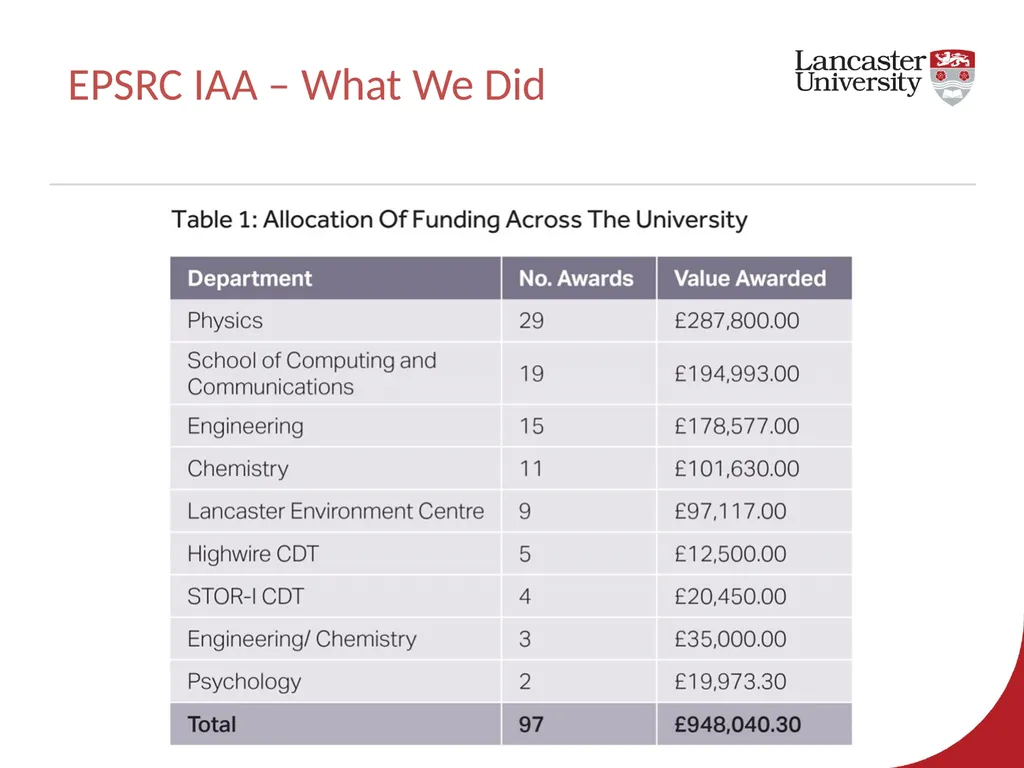
slide5. EPSRC IAA – What We Did<br>
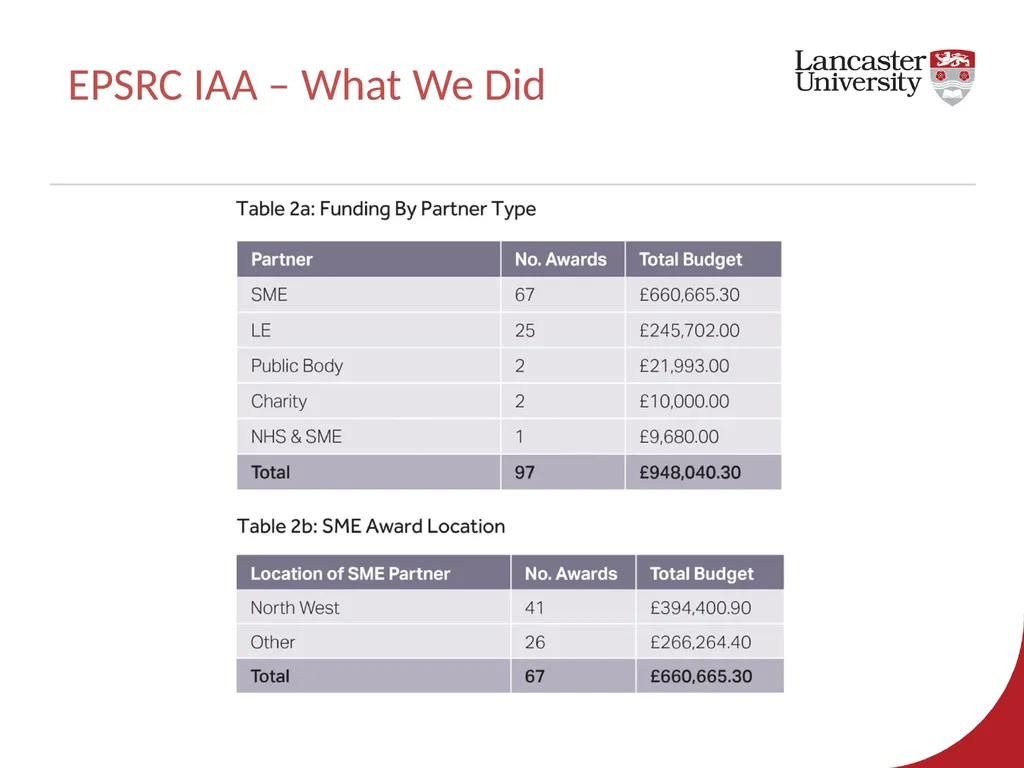
slide6. EPSRC IAA – What We Did<br>
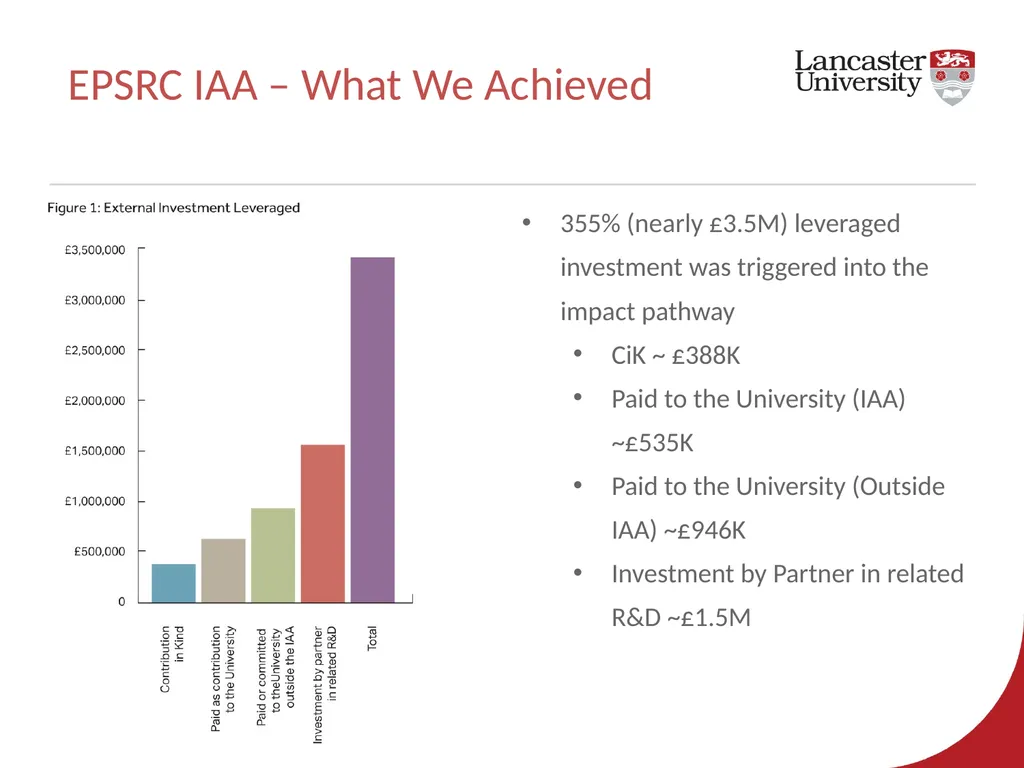
slide7. EPSRC IAA – What We Achieved 355% (nearly £3.5M) leveraged investment was triggered into the impact pathway
CiK ~ £388K
Paid to the University (IAA) ~£535K
Paid to the University (Outside IAA) ~£946K
Investment by Partner in related R&D ~£1.5M<br>
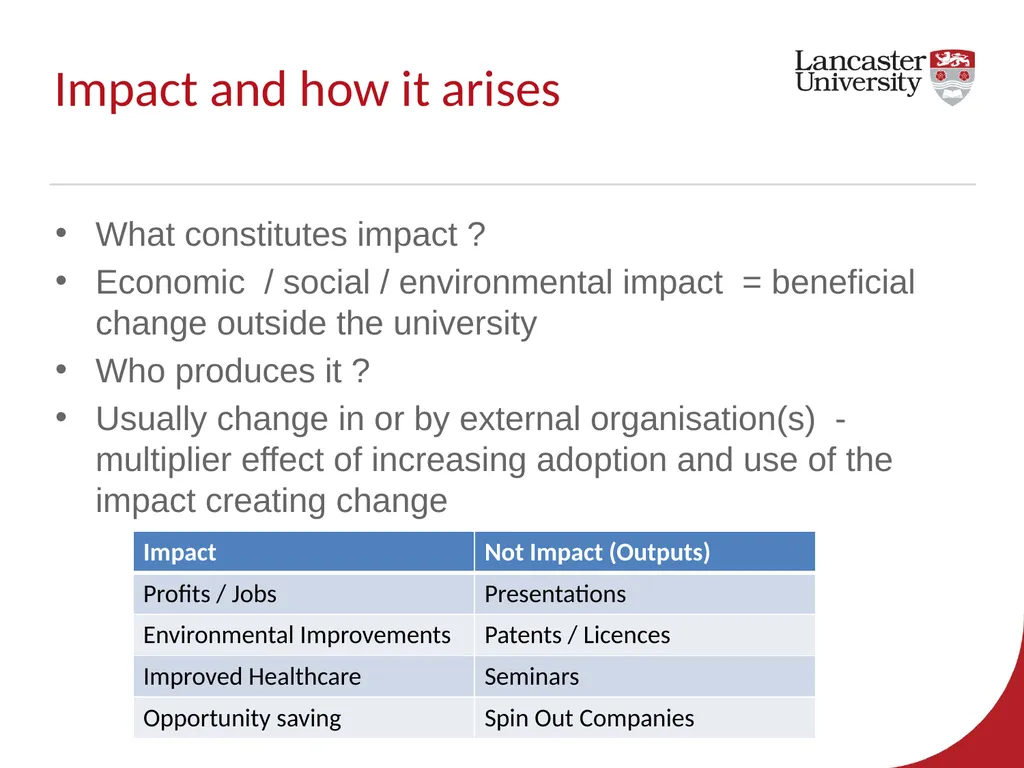
slide8. Impact and how it arises What constitutes impact ?
Economic / social / environmental impact = beneficial change outside the university
Who produces it ?
Usually change in or by external organisation(s) - multiplier effect of increasing adoption and use of the impact creating change<br>
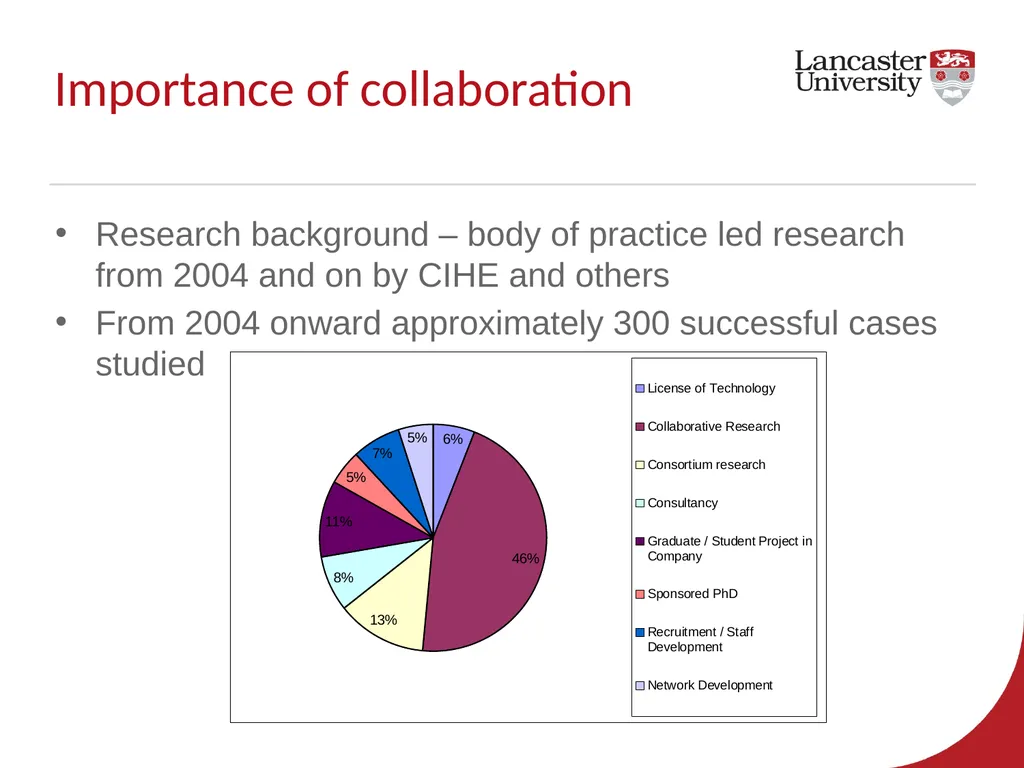
slide9. Research background – body of practice led research from 2004 and on by CIHE and others
From 2004 onward approximately 300 successful cases studied Importance of collaboration<br>
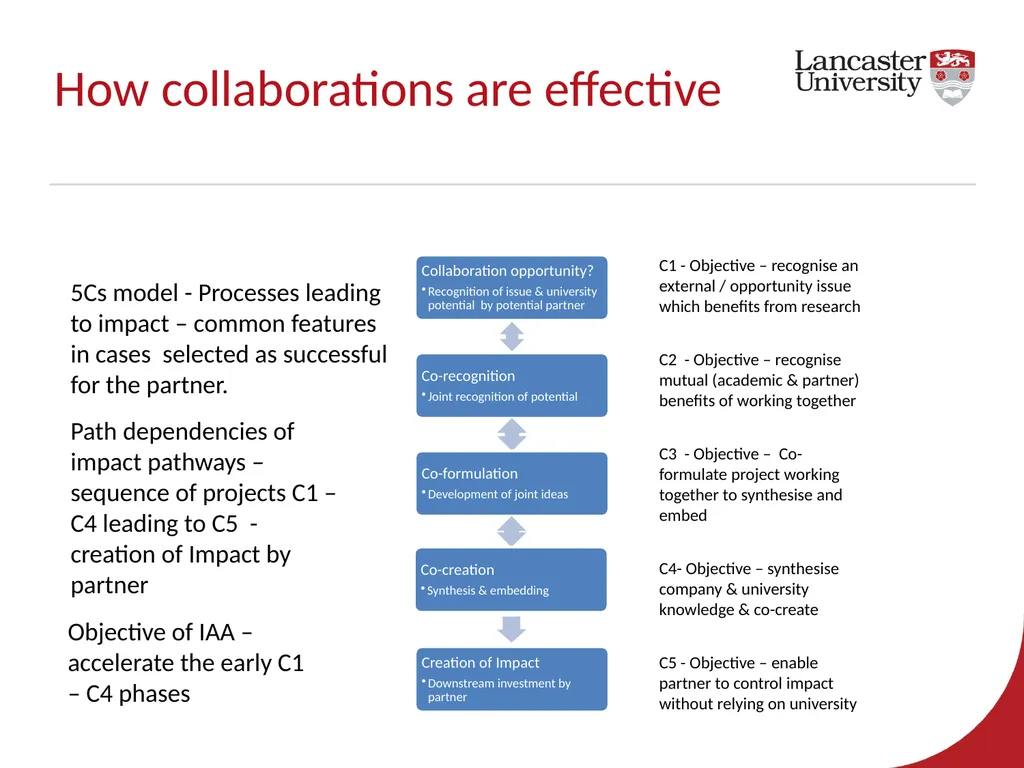
slide10. How collaborations are effective 5Cs model - Processes leading to impact – common features in cases selected as successful for the partner. C5 - Objective – enable partner to control impact without relying on university C4- Objective – synthesise company & university knowledge & co-create C3 - Objective – Co-formulate project working together to synthesise and embed C2 - Objective – recognise mutual (academic & partner) benefits of working together C1 - Objective – recognise an external / opportunity issue which benefits from research Path dependencies of impact pathways – sequence of projects C1 – C4 leading to C5 - creation of Impact by partner Objective of IAA – accelerate the early C1 – C4 phases<br>
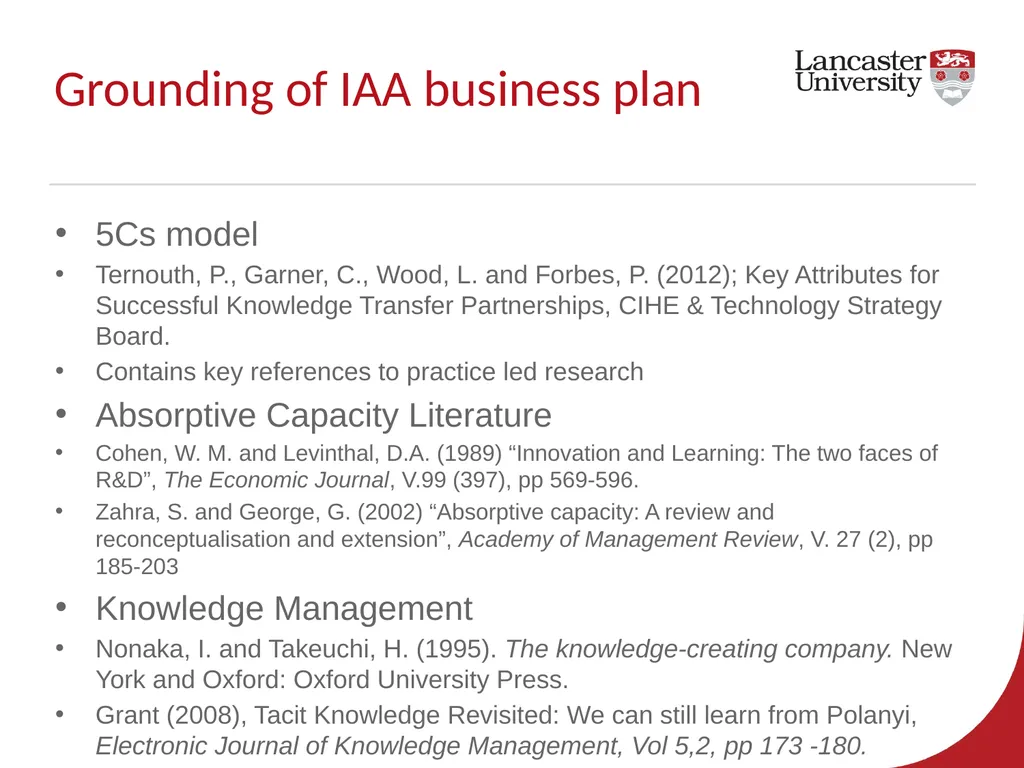
slide11. 5Cs model
Ternouth, P., Garner, C., Wood, L. and Forbes, P. (2012); Key Attributes for Successful Knowledge Transfer Partnerships, CIHE & Technology Strategy Board.
Contains key references to practice led research
Absorptive Capacity Literature
Cohen, W. M. and Levinthal, D.A. (1989) “Innovation and Learning: The two faces of R&D”, The Economic Journal, V.99 (397), pp 569-596.
Zahra, S. and George, G. (2002) “Absorptive capacity: A review and reconceptualisation and extension”, Academy of Management Review, V. 27 (2), pp 185-203
Knowledge Management
Nonaka, I. and Takeuchi, H. (1995). The knowledge-creating company. New York and Oxford: Oxford University Press.
Grant (2008), Tacit Knowledge Revisited: We can still learn from Polanyi, Electronic Journal of Knowledge Management, Vol 5,2, pp 173 -180. Grounding of IAA business plan<br>
slide12. Impact Pathway “An impact pathway identifies a potential sequence of activities, actors and beneficiaries through which a sustainable economic, societal or environmental impact is intended. Typically, an impact pathway from academic research will take the form of several successive projects through which research findings are progressively translated into practical application and then the widespread use of products and/or services enabled only by the application of those research findings.”
University 2017- 2020 IAA Bid Guidance Notes<br>
slide13. Impact arises in the form of a beneficial change outside the university arising from the use of research outcomes by one or more partners
It typically arises through forms of collaboration which enable those partners to embed and use research outcomes through synthesis with their own knowledge to create and sustain an impact generating innovation.
The objective of the IAA is to accelerate the development of Impact Pathways until they become self- sustaining (can generate their own funding).
Impact relies on the alignment of incentives of the University & Partner(s) – mutually beneficial. The next two sessions. Summary – impact and how it arises<br>
slide14. Academic incentives An interactive session in groups inviting delegates to share their experience and perceptions of the academic benefits arising from collaborations with external partners.<br>
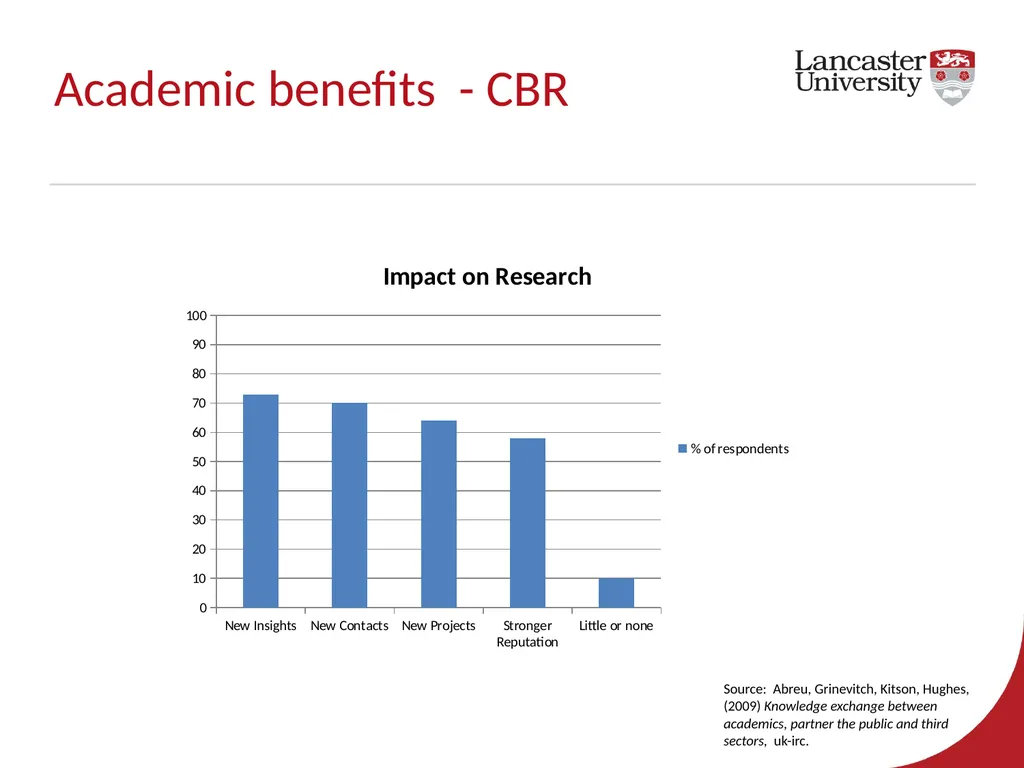
slide15. Academic benefits - CBR Source: Abreu, Grinevitch, Kitson, Hughes, (2009) Knowledge exchange between academics, partner the public and third sectors, uk-irc.<br>
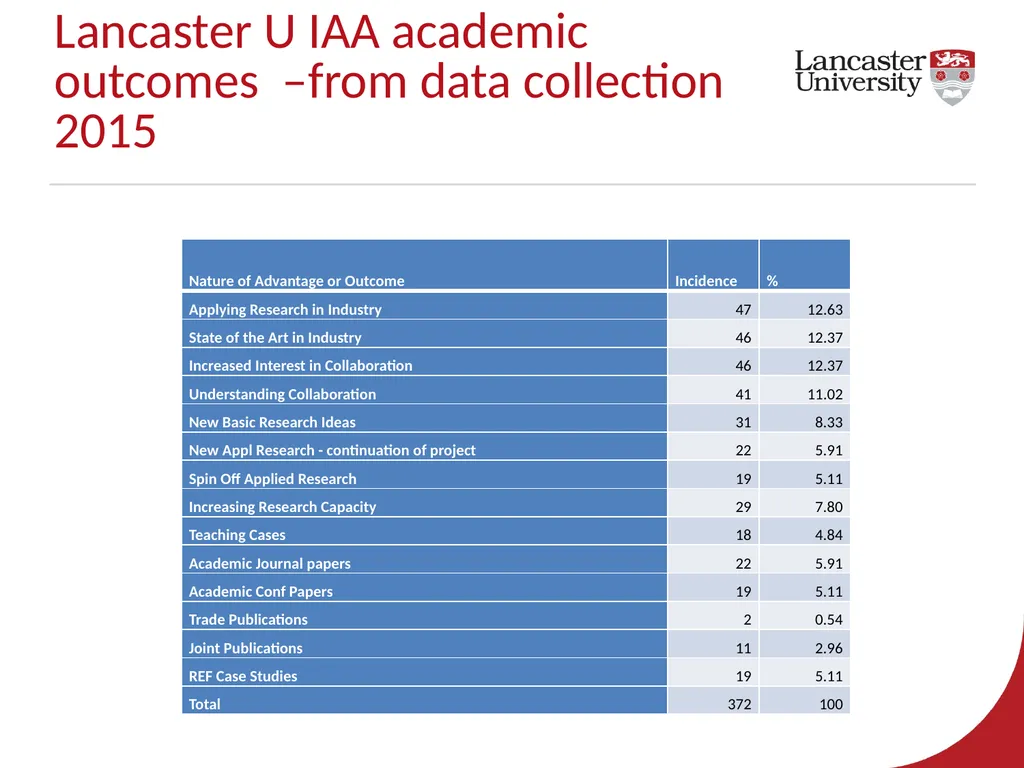
slide16. Lancaster U IAA academic outcomes –from data collection 2015<br>
slide17. Partner Benefits An interactive session in groups inviting delegates to share their experience and perceptions of how partners benefit from collaborations with Universities and why they might want to collaborate.<br>
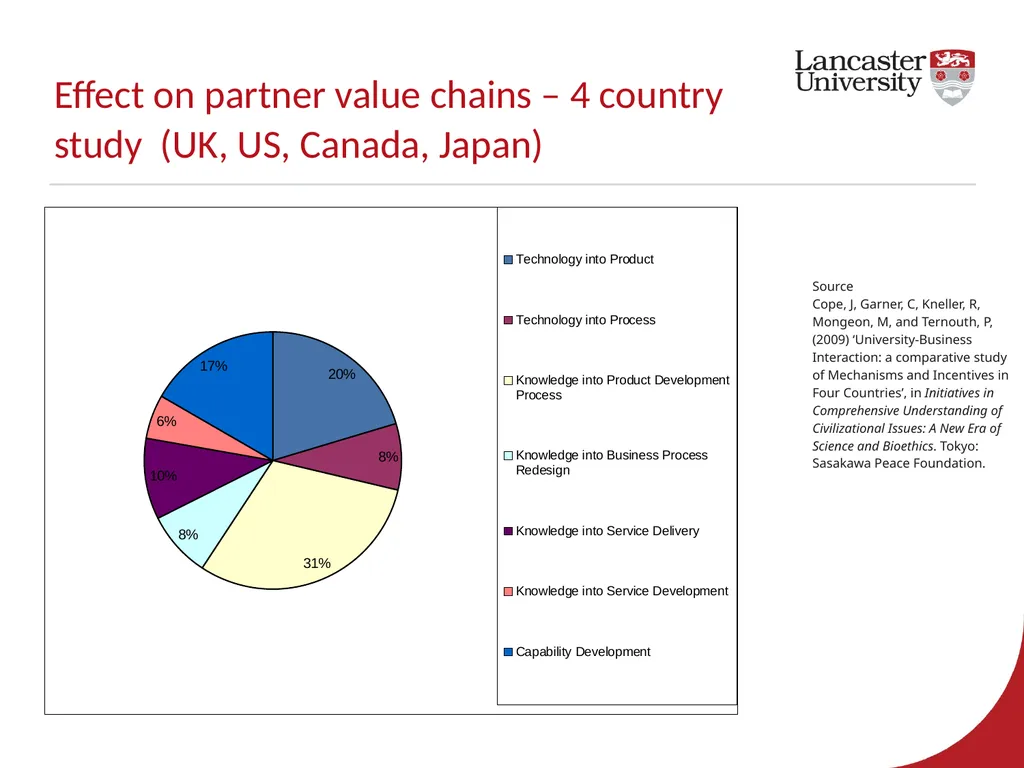
slide18. Effect on partner value chains – 4 country study (UK, US, Canada, Japan) Source
Cope, J, Garner, C, Kneller, R, Mongeon, M, and Ternouth, P, (2009) ‘University-Business Interaction: a comparative study of Mechanisms and Incentives in Four Countries’, in Initiatives in Comprehensive Understanding of Civilizational Issues: A New Era of Science and Bioethics. Tokyo: Sasakawa Peace Foundation.<br>
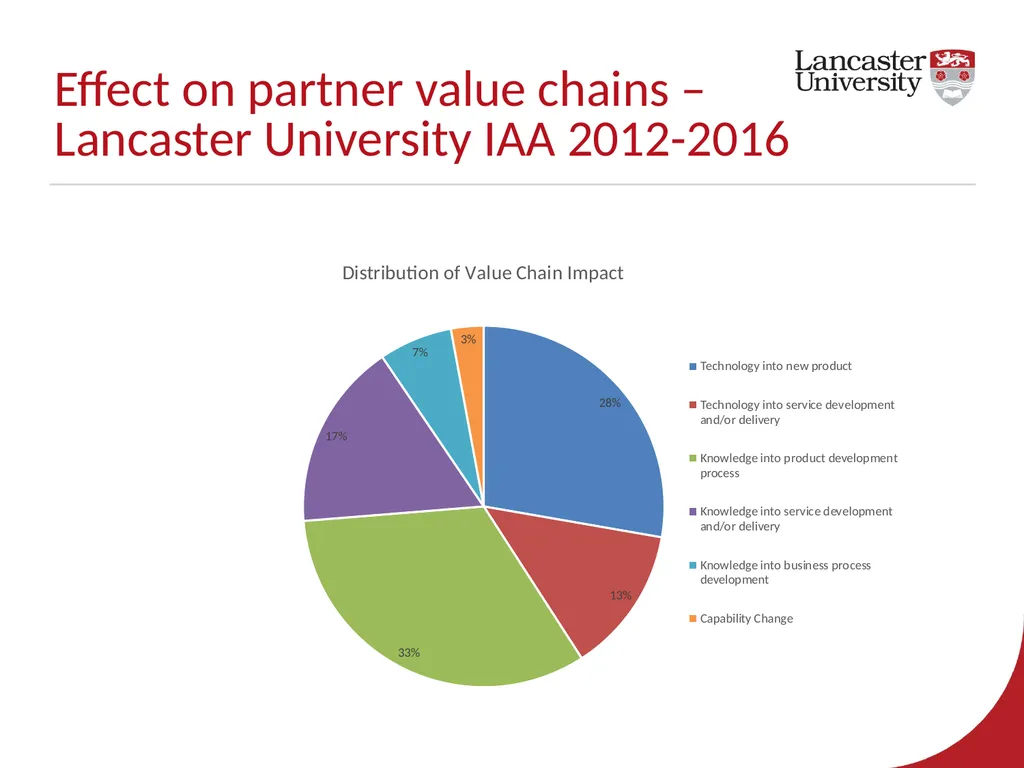
slide19. Effect on partner value chains – Lancaster University IAA 2012-2016<br>
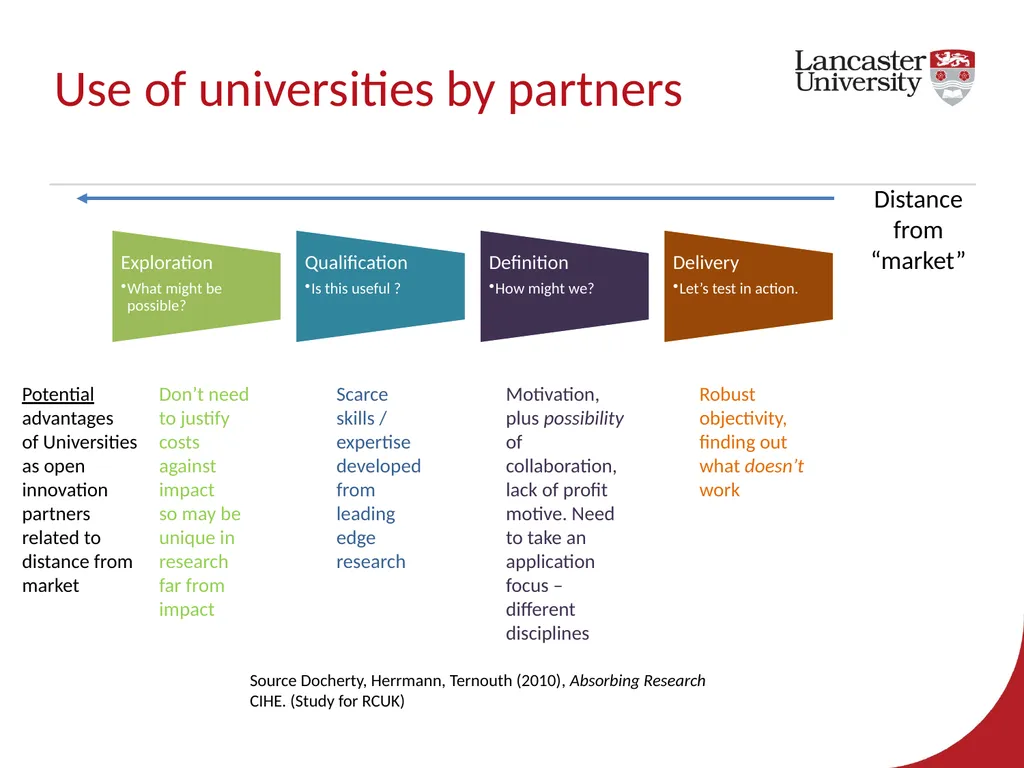
slide20. Use of universities by partners Potential advantages
of Universities
as open innovation partners related to distance from market Don’t need to justify costs against impact
so may be unique in research far from impact Scarce skills / expertise developed from leading edge research Motivation, plus possibility of collaboration, lack of profit motive. Need to take an application focus – different disciplines Robust objectivity,
finding out what doesn’t
work Source Docherty, Herrmann, Ternouth (2010), Absorbing Research CIHE. (Study for RCUK) Distance from “market”<br>
slide21. Barriers to collaboration An interactive session in groups inviting delegates to share their experience and perceptions of what might get in the way of effective and successful collaborations with partners.<br>
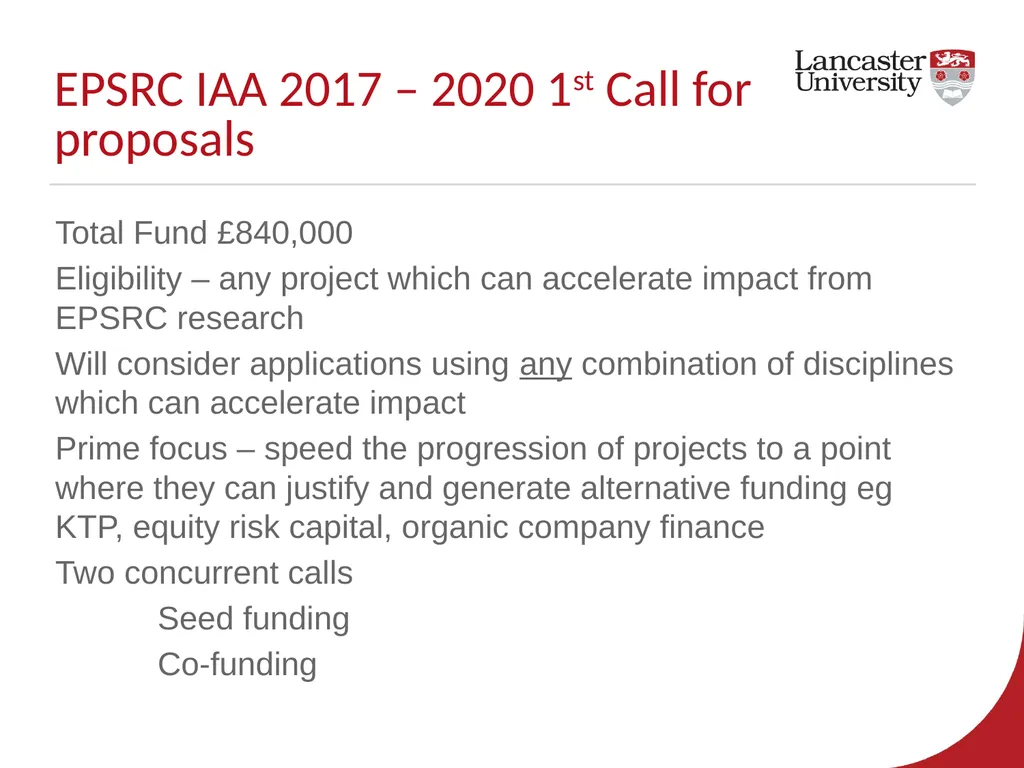
slide22. EPSRC IAA 2017 – 2020 1st Call for proposals Total Fund £840,000
Eligibility – any project which can accelerate impact from EPSRC research
Will consider applications using any combination of disciplines which can accelerate impact
Prime focus – speed the progression of projects to a point where they can justify and generate alternative funding eg KTP, equity risk capital, organic company finance
Two concurrent calls
Seed funding
Co-funding<br>
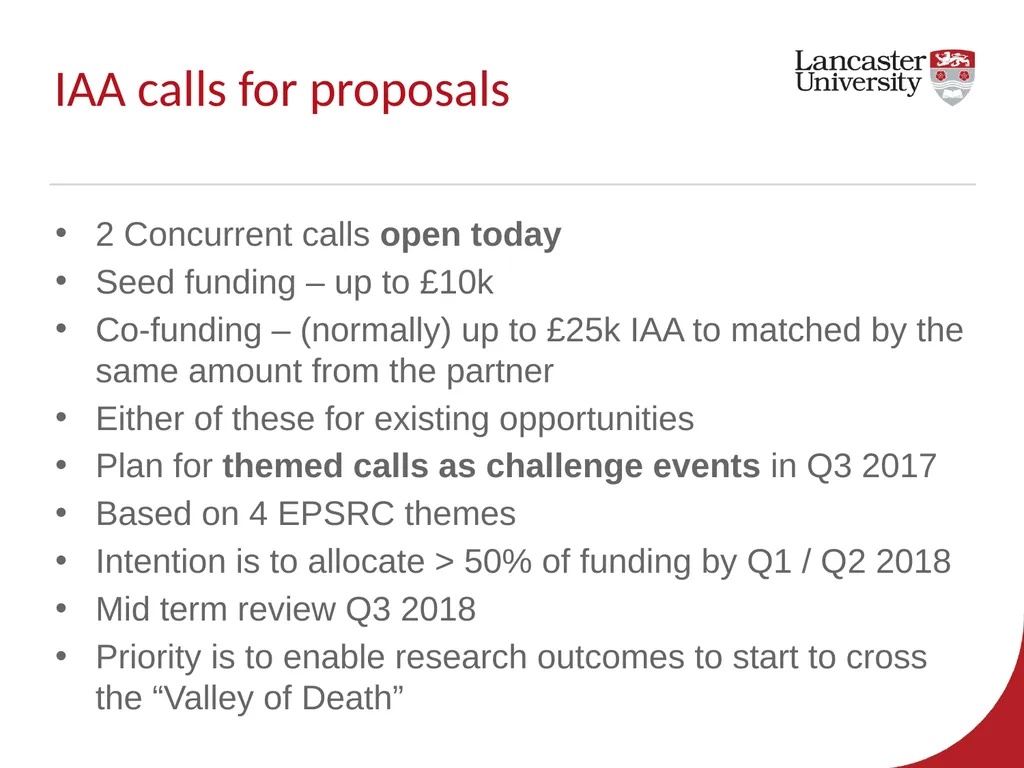
slide23. 2 Concurrent calls open today
Seed funding – up to £10k
Co-funding – (normally) up to £25k IAA to matched by the same amount from the partner
Either of these for existing opportunities
Plan for themed calls as challenge events in Q3 2017
Based on 4 EPSRC themes
Intention is to allocate > 50% of funding by Q1 / Q2 2018
Mid term review Q3 2018
Priority is to enable research outcomes to start to cross the “Valley of Death” IAA calls for proposals<br>
slide24. Up to £10k to be spent on first stage of collaboration
Objective is to develop and test a business case for co-funding by R&D and/or market studies - de-risking investment by the partner
For example key research outcomes are currently at TRL 2, or TRL 3 with new partner esp SMEs
Requires no financial commitment by the partner but contribution in kind to assessing outcomes and testing business case is expected.
Launched NOW deadline 9:00 15th May
3 page bid form Seed Funding<br>
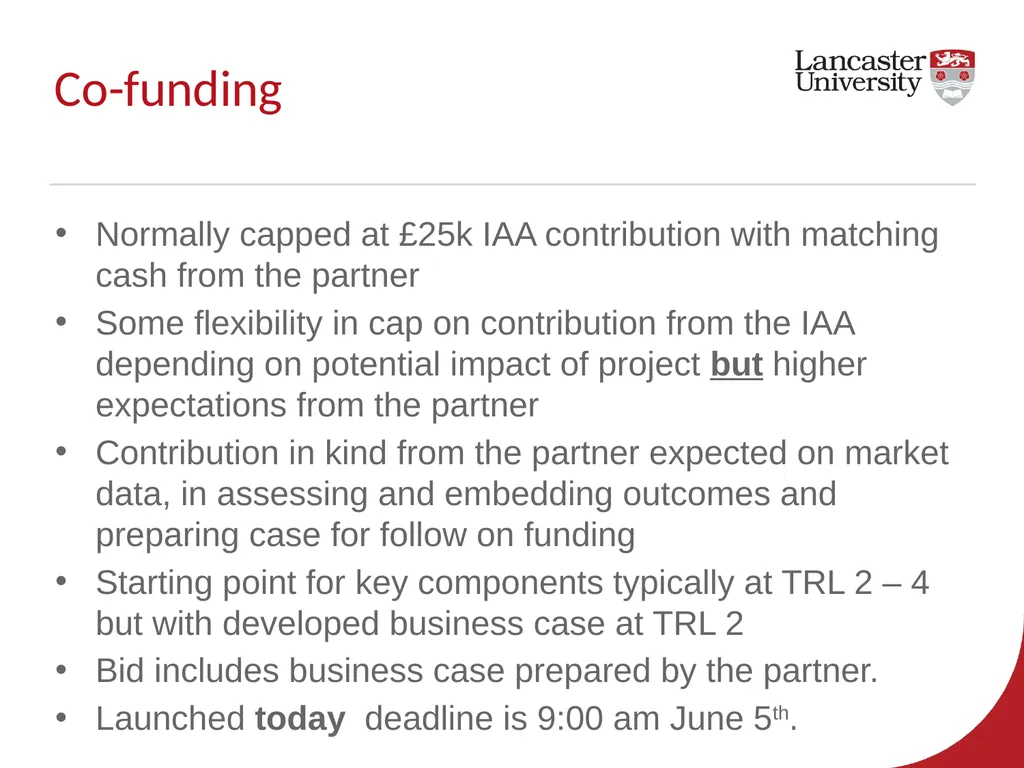
slide25. Normally capped at £25k IAA contribution with matching cash from the partner
Some flexibility in cap on contribution from the IAA depending on potential impact of project but higher expectations from the partner
Contribution in kind from the partner expected on market data, in assessing and embedding outcomes and preparing case for follow on funding
Starting point for key components typically at TRL 2 – 4 but with developed business case at TRL 2
Bid includes business case prepared by the partner.
Launched today deadline is 9:00 am June 5th. Co-funding<br>
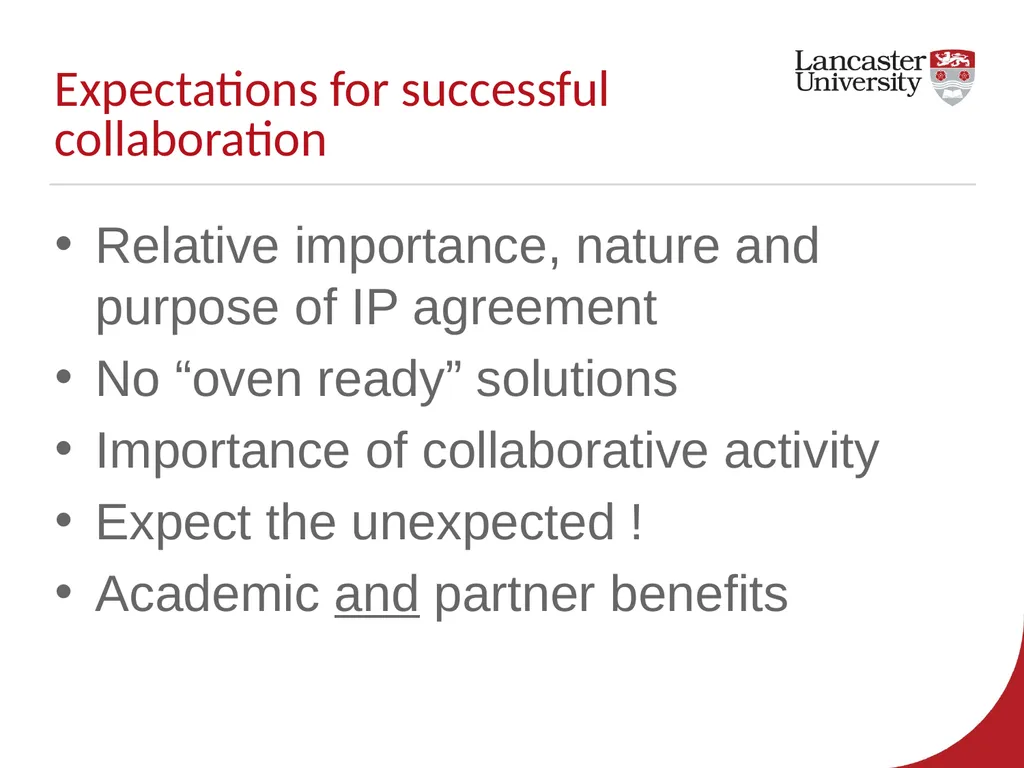
slide26. Relative importance, nature and purpose of IP agreement
No “oven ready” solutions
Importance of collaborative activity
Expect the unexpected !
Academic and partner benefits Expectations for successful collaboration<br>
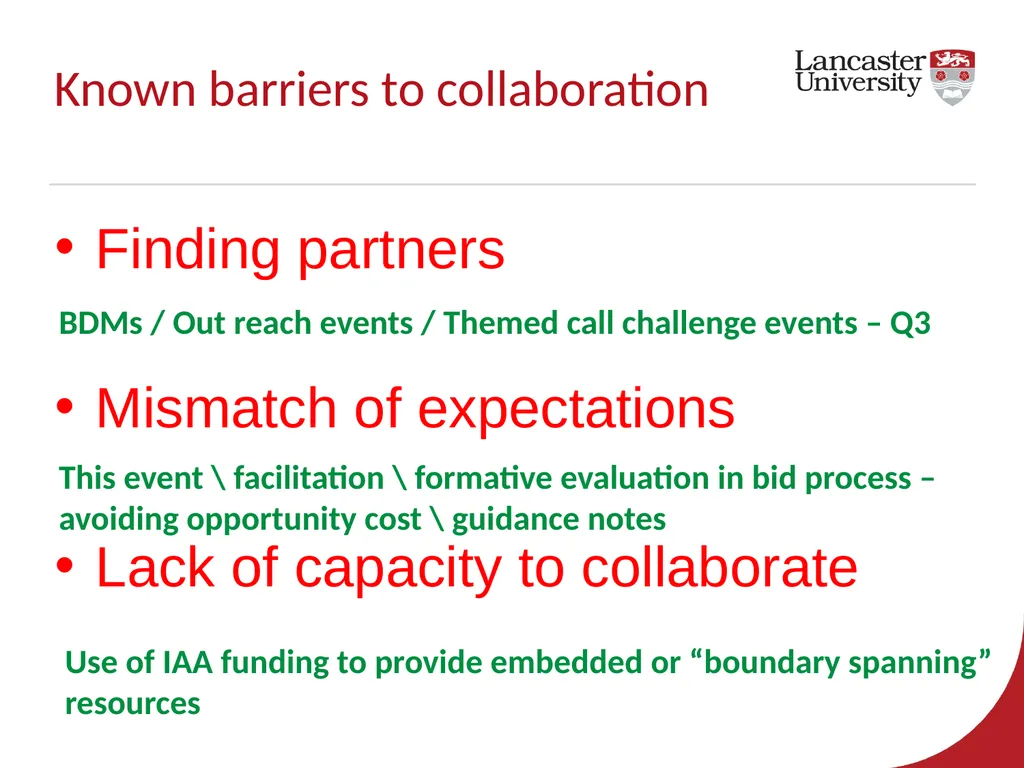
slide27. Finding partners
Mismatch of expectations
Lack of capacity to collaborate Known barriers to collaboration BDMs / Out reach events / Themed call challenge events – Q3 This event \ facilitation \ formative evaluation in bid process – avoiding opportunity cost \ guidance notes Use of IAA funding to provide embedded or “boundary spanning” resources<br>
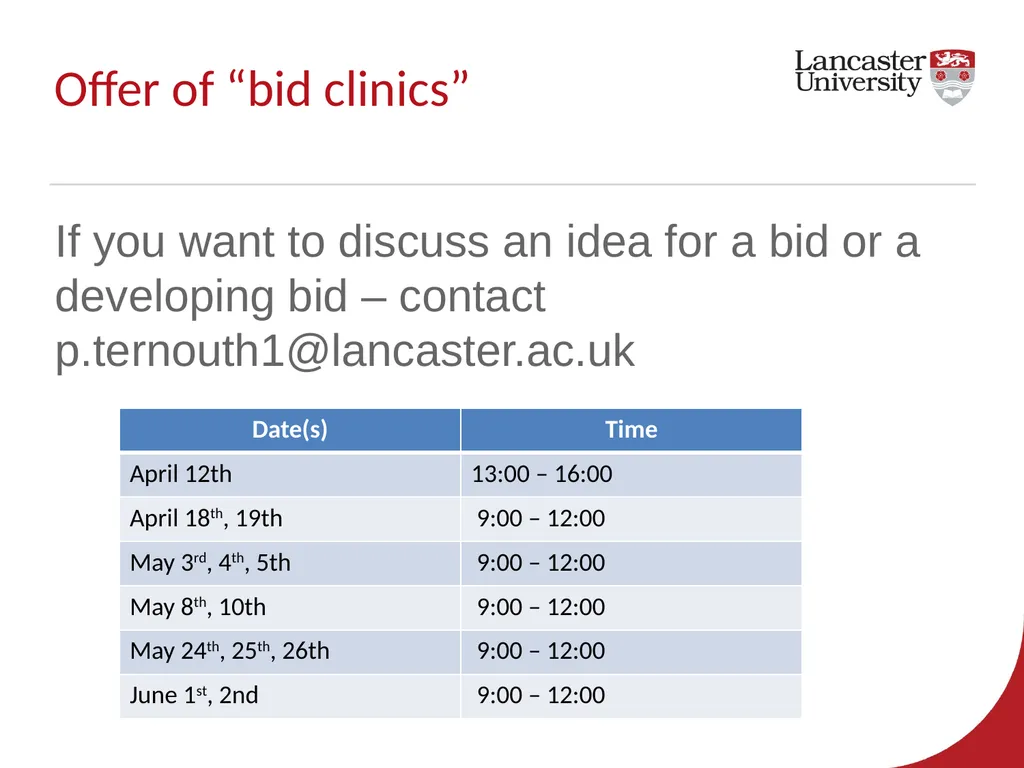
slide28. Offer of “bid clinics” If you want to discuss an idea for a bid or a developing bid – contact p.ternouth1@lancaster.ac.uk<br>
slide29. On-line availability of all bid details http://www.lancaster.ac.uk/sci-tech/business/business-projects/impact-acceleration-account/epsrc-impact-acceleration-account-2017-2020 Criteria and guidance notes
Bid forms
This presentation
Achievements of the IAA 2012 - 2016<br>
2017-2020 – Launch April 7th 2017 Dr Mark Rushforth
Head of Partnerships & Business Engagement
m.rushforth@lancaster.ac.uk Phil Ternouth
IAA Manager
p.ternouth1@lancaster.ac.uk Dr Dee Hennessy
Faculty Engagement Facilitator d.hennessy@lancaster.ac.uk<br>
slide2. Roadmap Introductions
What We Did
Impact and how it arises
Academic benefits from collaborations
Value of collaboration to partners
Barriers to successful collaboration
Launch of the IAA 2017 – 2020<br>
slide3. EPSRC IAA – What We Did Initial £600K allocated in Sept 2012 (for 3 years)
Awarded additional funding of ~£304K in July 2015 and ~£64K in July 2016 so total awarded ~£968K
IAA activities were designed to:
Address barriers in university/SME collaboration
Use novel approaches to develop proposals to exploit EPSRC funded research
Enhance the capacity of targeted SMEs to take up outcomes from EPSRC funded research
Evaluate and develop models to enhance impact of EPSRC funded research on SME Sector<br>
slide4. EPSRC IAA – What We Did Ran a series of calls for researchers to apply for seed funding (£5-£10K) and co-funding (up to £25K matched in cash by an external partner)
Run in conjunction with workshops
Open and discipline specific (Eco-Innovation/Energy & ICT/Cyber Security)
Explore the collaborative potential of partnerships (both new and existing)
Understand the mutual benefits of collaboration for both partners
Develop successful applications (funded through the IAA or by some other mechanism such as KTP, InnovateUK or Horizon 2020)
Introduce impact to CDTs (STOR-i and Highwire)
Embedded evaluation into the process
Formative (make changes throughout the programme)
Collect outputs/outcomes/impacts
Demonstrates value of funding to researchers/institution/EPSRC<br>
slide5. EPSRC IAA – What We Did<br>
slide6. EPSRC IAA – What We Did<br>
slide7. EPSRC IAA – What We Achieved 355% (nearly £3.5M) leveraged investment was triggered into the impact pathway
CiK ~ £388K
Paid to the University (IAA) ~£535K
Paid to the University (Outside IAA) ~£946K
Investment by Partner in related R&D ~£1.5M<br>
slide8. Impact and how it arises What constitutes impact ?
Economic / social / environmental impact = beneficial change outside the university
Who produces it ?
Usually change in or by external organisation(s) - multiplier effect of increasing adoption and use of the impact creating change<br>
slide9. Research background – body of practice led research from 2004 and on by CIHE and others
From 2004 onward approximately 300 successful cases studied Importance of collaboration<br>
slide10. How collaborations are effective 5Cs model - Processes leading to impact – common features in cases selected as successful for the partner. C5 - Objective – enable partner to control impact without relying on university C4- Objective – synthesise company & university knowledge & co-create C3 - Objective – Co-formulate project working together to synthesise and embed C2 - Objective – recognise mutual (academic & partner) benefits of working together C1 - Objective – recognise an external / opportunity issue which benefits from research Path dependencies of impact pathways – sequence of projects C1 – C4 leading to C5 - creation of Impact by partner Objective of IAA – accelerate the early C1 – C4 phases<br>
slide11. 5Cs model
Ternouth, P., Garner, C., Wood, L. and Forbes, P. (2012); Key Attributes for Successful Knowledge Transfer Partnerships, CIHE & Technology Strategy Board.
Contains key references to practice led research
Absorptive Capacity Literature
Cohen, W. M. and Levinthal, D.A. (1989) “Innovation and Learning: The two faces of R&D”, The Economic Journal, V.99 (397), pp 569-596.
Zahra, S. and George, G. (2002) “Absorptive capacity: A review and reconceptualisation and extension”, Academy of Management Review, V. 27 (2), pp 185-203
Knowledge Management
Nonaka, I. and Takeuchi, H. (1995). The knowledge-creating company. New York and Oxford: Oxford University Press.
Grant (2008), Tacit Knowledge Revisited: We can still learn from Polanyi, Electronic Journal of Knowledge Management, Vol 5,2, pp 173 -180. Grounding of IAA business plan<br>
slide12. Impact Pathway “An impact pathway identifies a potential sequence of activities, actors and beneficiaries through which a sustainable economic, societal or environmental impact is intended. Typically, an impact pathway from academic research will take the form of several successive projects through which research findings are progressively translated into practical application and then the widespread use of products and/or services enabled only by the application of those research findings.”
University 2017- 2020 IAA Bid Guidance Notes<br>
slide13. Impact arises in the form of a beneficial change outside the university arising from the use of research outcomes by one or more partners
It typically arises through forms of collaboration which enable those partners to embed and use research outcomes through synthesis with their own knowledge to create and sustain an impact generating innovation.
The objective of the IAA is to accelerate the development of Impact Pathways until they become self- sustaining (can generate their own funding).
Impact relies on the alignment of incentives of the University & Partner(s) – mutually beneficial. The next two sessions. Summary – impact and how it arises<br>
slide14. Academic incentives An interactive session in groups inviting delegates to share their experience and perceptions of the academic benefits arising from collaborations with external partners.<br>
slide15. Academic benefits - CBR Source: Abreu, Grinevitch, Kitson, Hughes, (2009) Knowledge exchange between academics, partner the public and third sectors, uk-irc.<br>
slide16. Lancaster U IAA academic outcomes –from data collection 2015<br>
slide17. Partner Benefits An interactive session in groups inviting delegates to share their experience and perceptions of how partners benefit from collaborations with Universities and why they might want to collaborate.<br>
slide18. Effect on partner value chains – 4 country study (UK, US, Canada, Japan) Source
Cope, J, Garner, C, Kneller, R, Mongeon, M, and Ternouth, P, (2009) ‘University-Business Interaction: a comparative study of Mechanisms and Incentives in Four Countries’, in Initiatives in Comprehensive Understanding of Civilizational Issues: A New Era of Science and Bioethics. Tokyo: Sasakawa Peace Foundation.<br>
slide19. Effect on partner value chains – Lancaster University IAA 2012-2016<br>
slide20. Use of universities by partners Potential advantages
of Universities
as open innovation partners related to distance from market Don’t need to justify costs against impact
so may be unique in research far from impact Scarce skills / expertise developed from leading edge research Motivation, plus possibility of collaboration, lack of profit motive. Need to take an application focus – different disciplines Robust objectivity,
finding out what doesn’t
work Source Docherty, Herrmann, Ternouth (2010), Absorbing Research CIHE. (Study for RCUK) Distance from “market”<br>
slide21. Barriers to collaboration An interactive session in groups inviting delegates to share their experience and perceptions of what might get in the way of effective and successful collaborations with partners.<br>
slide22. EPSRC IAA 2017 – 2020 1st Call for proposals Total Fund £840,000
Eligibility – any project which can accelerate impact from EPSRC research
Will consider applications using any combination of disciplines which can accelerate impact
Prime focus – speed the progression of projects to a point where they can justify and generate alternative funding eg KTP, equity risk capital, organic company finance
Two concurrent calls
Seed funding
Co-funding<br>
slide23. 2 Concurrent calls open today
Seed funding – up to £10k
Co-funding – (normally) up to £25k IAA to matched by the same amount from the partner
Either of these for existing opportunities
Plan for themed calls as challenge events in Q3 2017
Based on 4 EPSRC themes
Intention is to allocate > 50% of funding by Q1 / Q2 2018
Mid term review Q3 2018
Priority is to enable research outcomes to start to cross the “Valley of Death” IAA calls for proposals<br>
slide24. Up to £10k to be spent on first stage of collaboration
Objective is to develop and test a business case for co-funding by R&D and/or market studies - de-risking investment by the partner
For example key research outcomes are currently at TRL 2, or TRL 3 with new partner esp SMEs
Requires no financial commitment by the partner but contribution in kind to assessing outcomes and testing business case is expected.
Launched NOW deadline 9:00 15th May
3 page bid form Seed Funding<br>
slide25. Normally capped at £25k IAA contribution with matching cash from the partner
Some flexibility in cap on contribution from the IAA depending on potential impact of project but higher expectations from the partner
Contribution in kind from the partner expected on market data, in assessing and embedding outcomes and preparing case for follow on funding
Starting point for key components typically at TRL 2 – 4 but with developed business case at TRL 2
Bid includes business case prepared by the partner.
Launched today deadline is 9:00 am June 5th. Co-funding<br>
slide26. Relative importance, nature and purpose of IP agreement
No “oven ready” solutions
Importance of collaborative activity
Expect the unexpected !
Academic and partner benefits Expectations for successful collaboration<br>
slide27. Finding partners
Mismatch of expectations
Lack of capacity to collaborate Known barriers to collaboration BDMs / Out reach events / Themed call challenge events – Q3 This event \ facilitation \ formative evaluation in bid process – avoiding opportunity cost \ guidance notes Use of IAA funding to provide embedded or “boundary spanning” resources<br>
slide28. Offer of “bid clinics” If you want to discuss an idea for a bid or a developing bid – contact p.ternouth1@lancaster.ac.uk<br>
slide29. On-line availability of all bid details http://www.lancaster.ac.uk/sci-tech/business/business-projects/impact-acceleration-account/epsrc-impact-acceleration-account-2017-2020 Criteria and guidance notes
Bid forms
This presentation
Achievements of the IAA 2012 - 2016<br>