Equalization and Universalization of Elementary Education Dr. Goutam Patra Govt. College of Education, Banipur, North 24 Paraganas, West Bengal, India Concept 1.Inequality is a glaring consequence of imbalance of educational development and
"Equalization and Universalization of Elementary" is the property of its rightful owner. Permission is granted to
download and print the materials on this website for personal, non-commercial use only, and to display it
on your personal computer provided you do not modify the materials and that you retain all copyright
notices contained in the materials. By downloading content from our website, you accept the terms of this
agreement.
Presentation Transcript
01
Equalization and Universalization of Elementary Education Dr. Goutam Patra Govt. College of Education, Banipur, North 24 Paraganas, West Bengal, India<br>
02
Concept
1.Inequality is a glaring consequence of imbalance of educational development and the progress of our country
2. Equalization in educational opportunity is to be served to the underprivileged for the improvement of their condition<br>
03
Educational opportunity is to be provided to all irrespective of caste, creed, colour and religion
Equalization and universalization create an egalitarian and ideal human society
Exploitation is to be minimized<br>
04
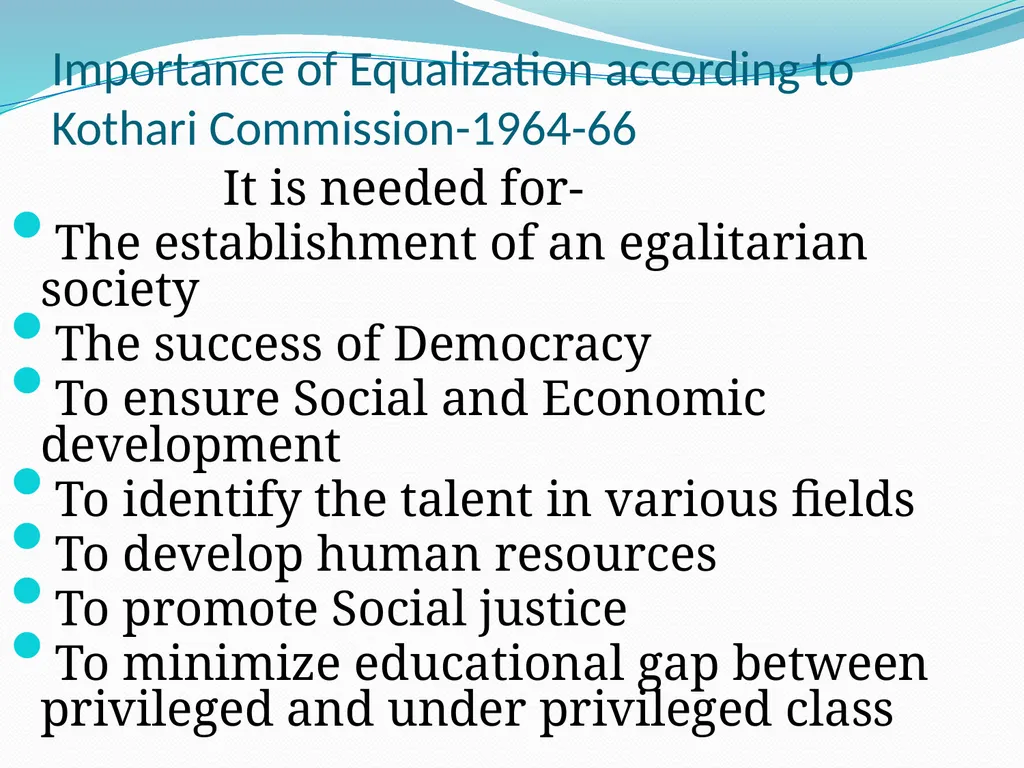
Importance of Equalization according to Kothari Commission-1964-66 It is needed for-
The establishment of an egalitarian society
The success of Democracy
To ensure Social and Economic development
To identify the talent in various fields
To develop human resources
To promote Social justice
To minimize educational gap between privileged and under privileged class<br>
05
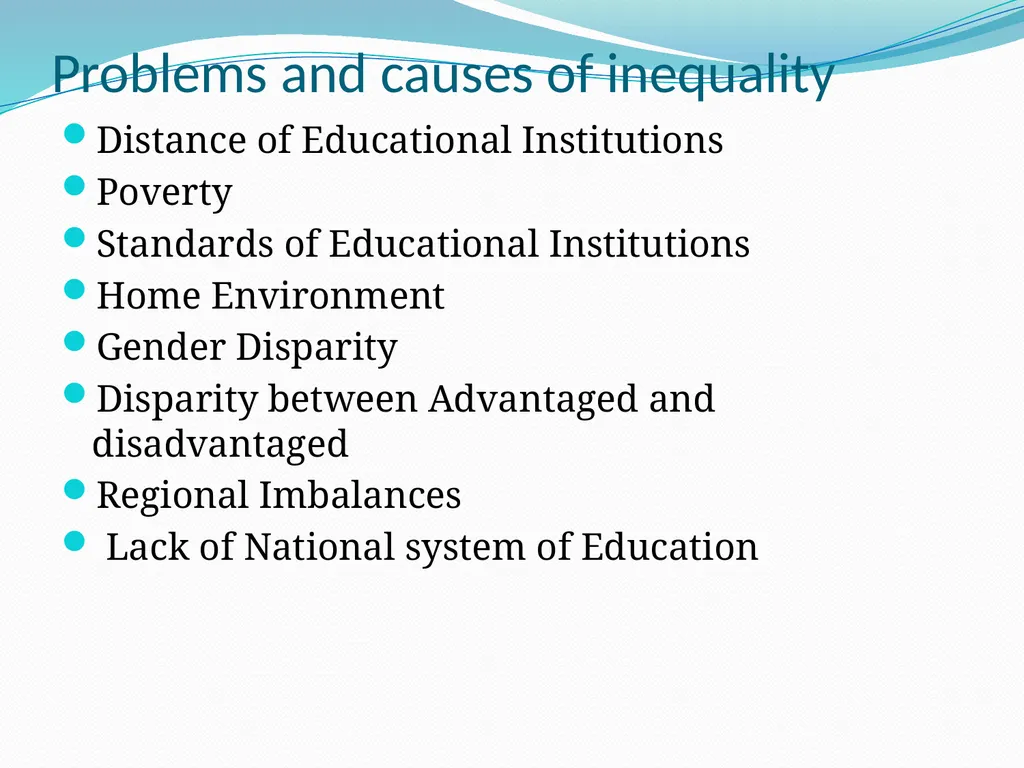
Problems and causes of inequality Distance of Educational Institutions
Poverty
Standards of Educational Institutions
Home Environment
Gender Disparity
Disparity between Advantaged and disadvantaged
Regional Imbalances
Lack of National system of Education<br>
06
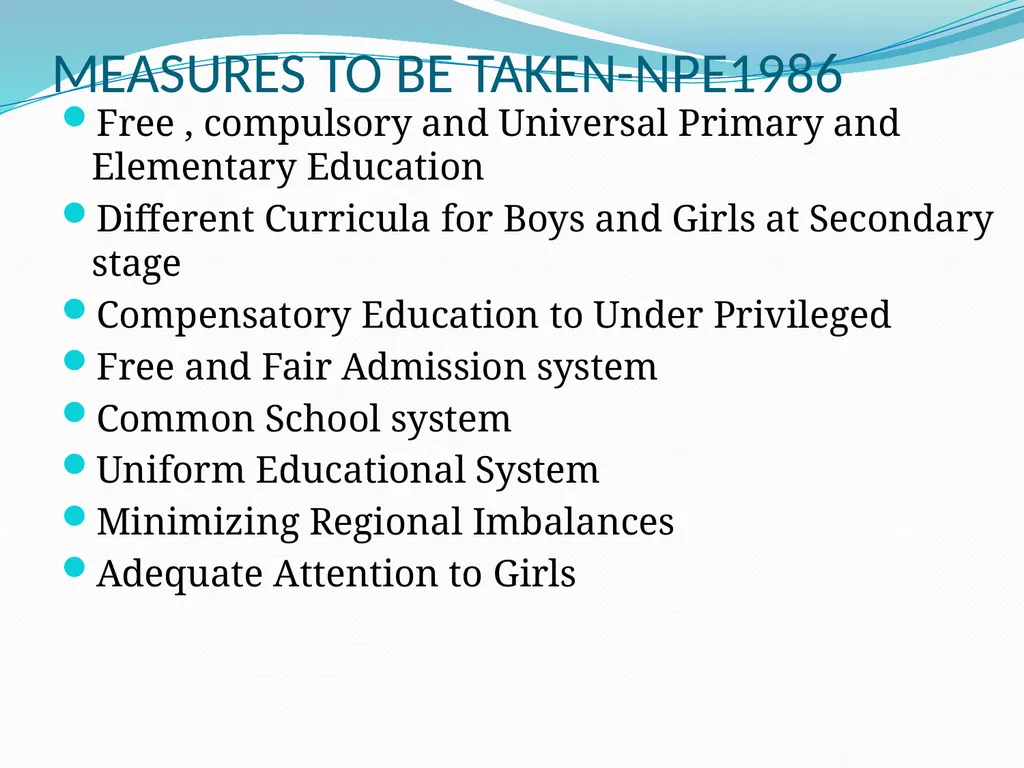
MEASURES TO BE TAKEN-NPE1986 Free , compulsory and Universal Primary and Elementary Education
Different Curricula for Boys and Girls at Secondary stage
Compensatory Education to Under Privileged
Free and Fair Admission system
Common School system
Uniform Educational System
Minimizing Regional Imbalances
Adequate Attention to Girls<br>
07
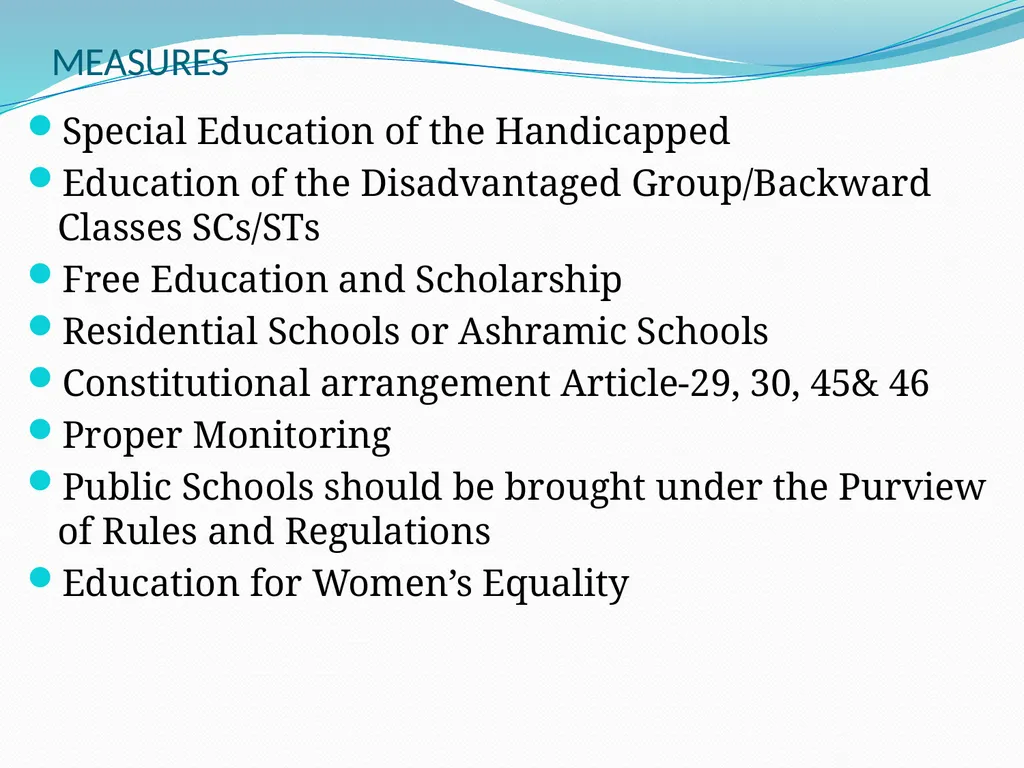
MEASURES Special Education of the Handicapped
Education of the Disadvantaged Group/Backward Classes SCs/STs
Free Education and Scholarship
Residential Schools or Ashramic Schools
Constitutional arrangement Article-29, 30, 45& 46
Proper Monitoring
Public Schools should be brought under the Purview of Rules and Regulations
Education for Women’s Equality<br>
08
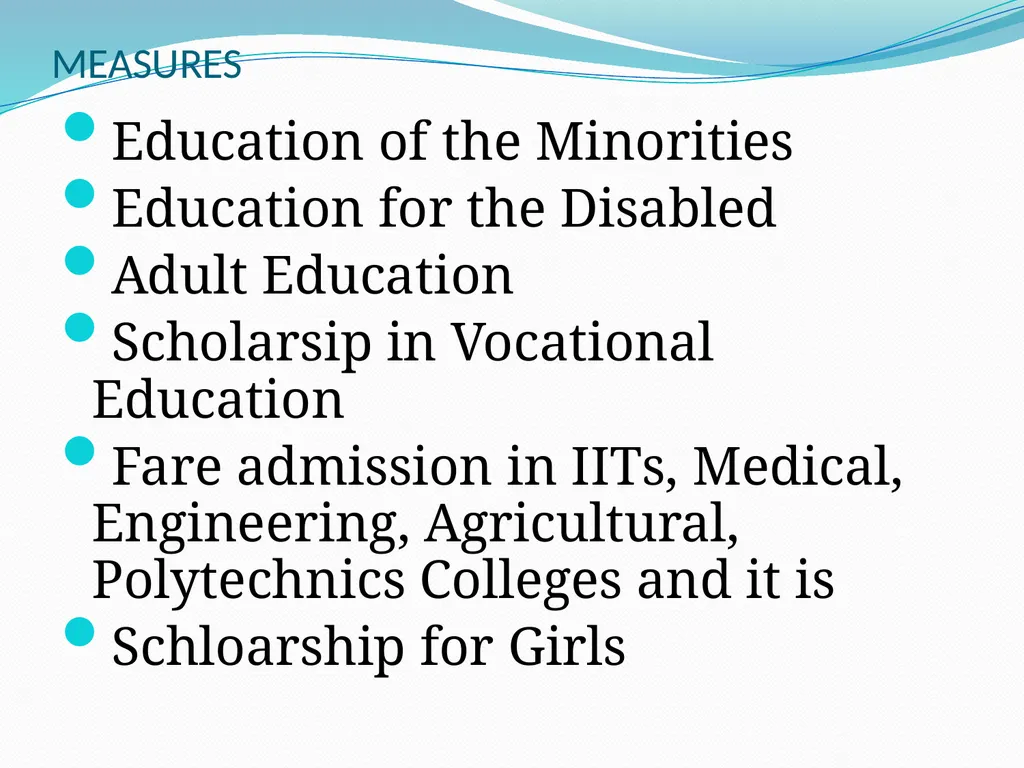
MEASURES Education of the Minorities
Education for the Disabled
Adult Education
Scholarsip in Vocational Education
Fare admission in IITs, Medical, Engineering, Agricultural, Polytechnics Colleges and it is
Schloarship for Girls<br>
09
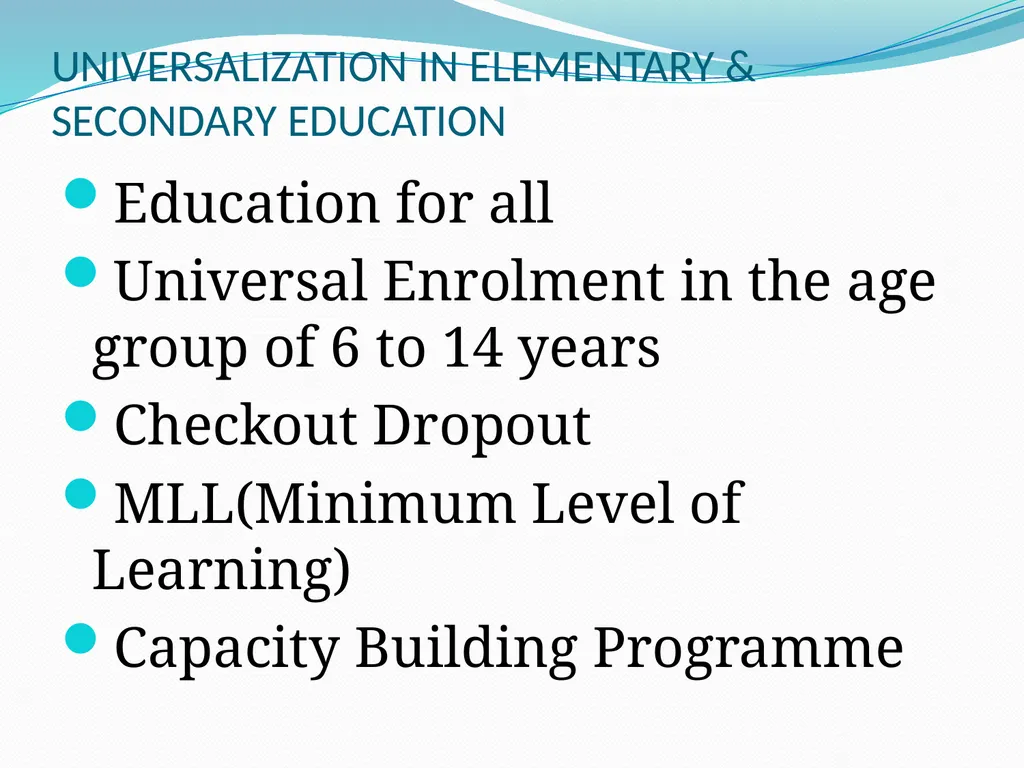
UNIVERSALIZATION IN ELEMENTARY & SECONDARY EDUCATION Education for all
Universal Enrolment in the age group of 6 to 14 years
Checkout Dropout
MLL(Minimum Level of Learning)
Capacity Building Programme<br>
10
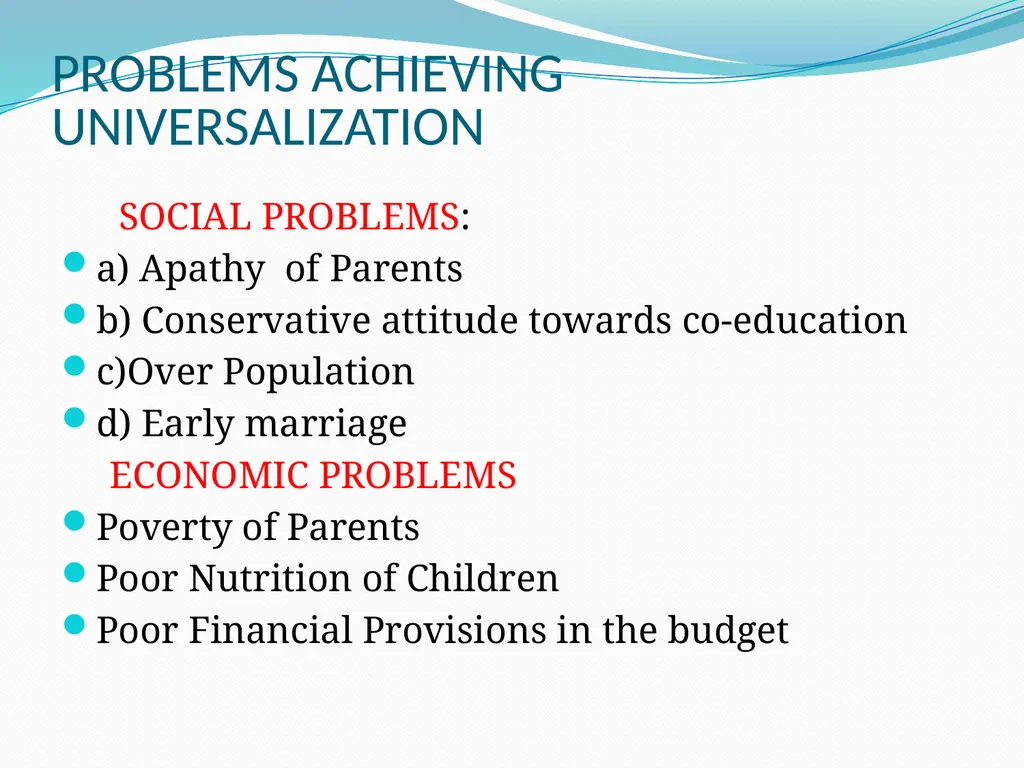
PROBLEMS ACHIEVING UNIVERSALIZATION SOCIAL PROBLEMS:
a) Apathy of Parents
b) Conservative attitude towards co-education
c)Over Population
d) Early marriage
ECONOMIC PROBLEMS
Poverty of Parents
Poor Nutrition of Children
Poor Financial Provisions in the budget<br>
11
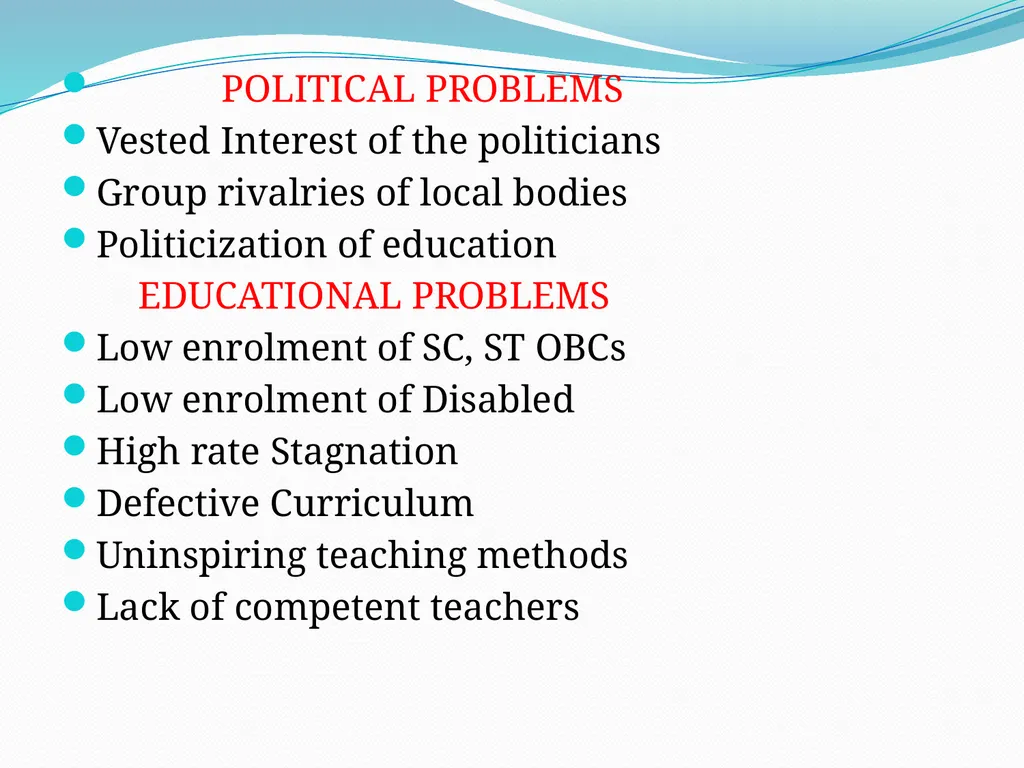
POLITICAL PROBLEMS
Vested Interest of the politicians
Group rivalries of local bodies
Politicization of education
EDUCATIONAL PROBLEMS
Low enrolment of SC, ST OBCs
Low enrolment of Disabled
High rate Stagnation
Defective Curriculum
Uninspiring teaching methods
Lack of competent teachers<br>
12
Geographical problems
Inaccessible areas
Scattered population in hilly areas
ADMINISTRATIVE PROBLEMS
Inequality in educational opportunity
Lack of Women Teachers
Lack of Effective Supervision
Failure to enforce Compulsory education
Lack of suitable admission policy
Lack of suitable teaching Aids<br>
13
MEASURES FOR UNIVERSALIZATION Universalization of provision
Universalization of Enrolment
Universalization of Retention
Universalization of community participation
Universalization of Achievement through MLL For EFA
Emphasis on joyful learning
Inservice Training
Child centered Approach
Community participation to achieve NEEM<br>
14
VIEWS OF SWAMI VIVEKANANDA ‘If there is any land on this earth that can lay claim to be the blessed Punyabhumi (land of virtue)- the land where humanity has attained its highest towards generosity, towards purity, towards calmness, above all, the land of introspection and of spirituality-it is India’
Character building to solve inequality-- three things to make every man great-every nation great
Conviction of the powers of goodness
Absence of jealousy and suspicion
Helping all who are trying to be and to do good<br>
15
Views against Untouchability
Views on Indian Womanhood- Sita the ideal character
Women education
Faith on One self
Positive Education
National Integration<br>