
ERC Solicitation 15-589 Webinar Engineering



Description: ERC Solicitation 15-589 Webinar Engineering Research Centers Program Division of Engineering Education and Centers Engineering Directorate, NSF 1 Guidance for Preliminary Proposal Development Aug 31, 2015 10:00 AM EDT Format and Team for
Related Topics
Download Presentation
"ERC Solicitation 15-589 Webinar Engineering" is the property of its rightful owner. Permission is granted to download and print the materials on this website for personal, non-commercial use only, and to display it on your personal computer provided you do not modify the materials and that you retain all copyright notices contained in the materials. By downloading content from our website, you accept the terms of this agreement.
Presentation Transcript
slide1. ERC Solicitation 15-589
Webinar Engineering Research Centers Program
Division of Engineering Education and Centers
Engineering Directorate, NSF 1 Guidance for Preliminary Proposal Development Aug 31, 2015 10:00 AM EDT<br>
slide2. Format and Team for the Webinar Gen-3 ERC New Features: NSF 15-589
ENG/EEC Leadership
Proposals
Program/Proposal Guidance - Keith Roper, ERC Leader/EEC
Vision, Strategic Planning, Research - Keith Roper, ERC Leader/EEC
Workforce Development
University – Elliot Douglas, Engineering Education Program Director/EEC
Pre-college – Mary Poats, RET Program Director (PD)/EEC
Infrastructure
Broadening Participation – James Moore, Broadening Participation PD/EEC
Infrastructure - Carmiña Londoño, Engineering Research Centers PD/EEC
Innovation Ecosystem
Deborah Jackson, Engineering Research Centers PD/EEC 2<br>
slide3. NSF 15-589 New Features Three Fundamental Questions
What is the compelling new idea and how does it relate to national needs?
Why is a center necessary to tackle the idea?
How will the ERC's infrastructure integrate and implement research, workforce development and innovation ecosystem development efforts to achieve its vision?
Specific Review Criteria
Integrated Strategic Plans for Research, Workforce Development, Innovation
Leadership: expertise in research, workforce development, and innovation
Diversity Director: experienced in proven activities to create culture of inclusion
Research: impact, benchmarking, partnerships, system-at-scale
Workforce Development: literature-based, inclusive, assessment
Innovation: scale-able, sustainable, community
Infrastructure: plan for community of inclusion 3<br>
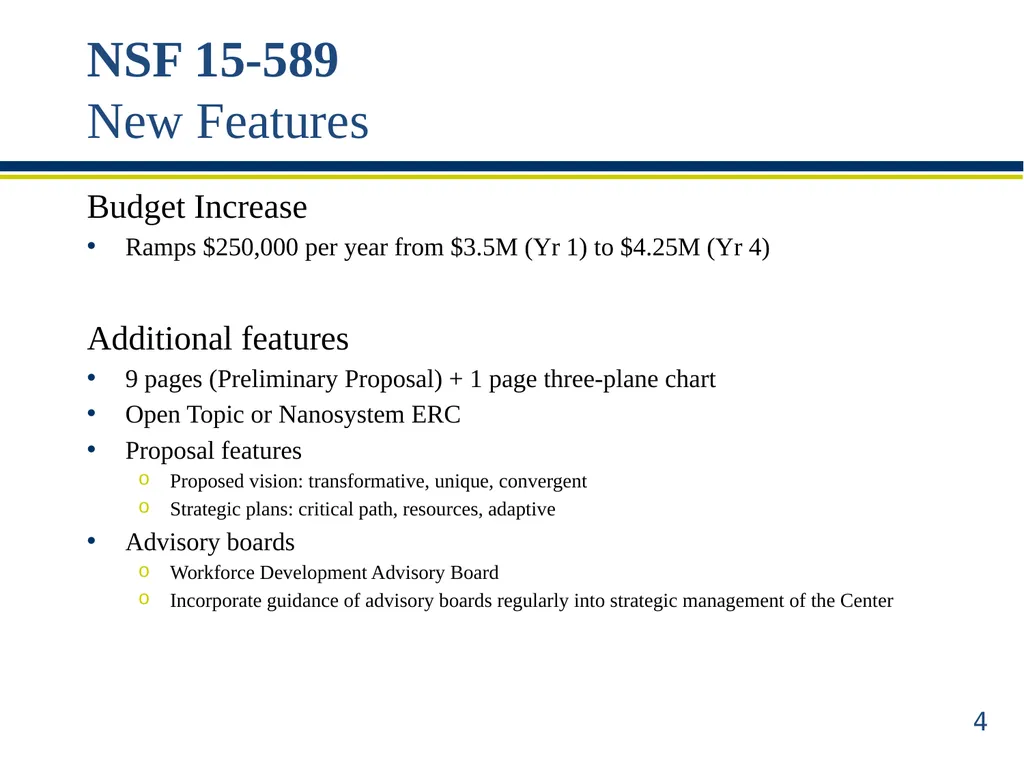
slide4. NSF 15-589 New Features Budget Increase
Ramps $250,000 per year from $3.5M (Yr 1) to $4.25M (Yr 4)
Additional features
9 pages (Preliminary Proposal) + 1 page three-plane chart
Open Topic or Nanosystem ERC
Proposal features
Proposed vision: transformative, unique, convergent
Strategic plans: critical path, resources, adaptive
Advisory boards
Workforce Development Advisory Board
Incorporate guidance of advisory boards regularly into strategic management of the Center 4<br>
slide5. New Features Q&A 5<br>
slide6. Engineering Research Centers Program 6<br>
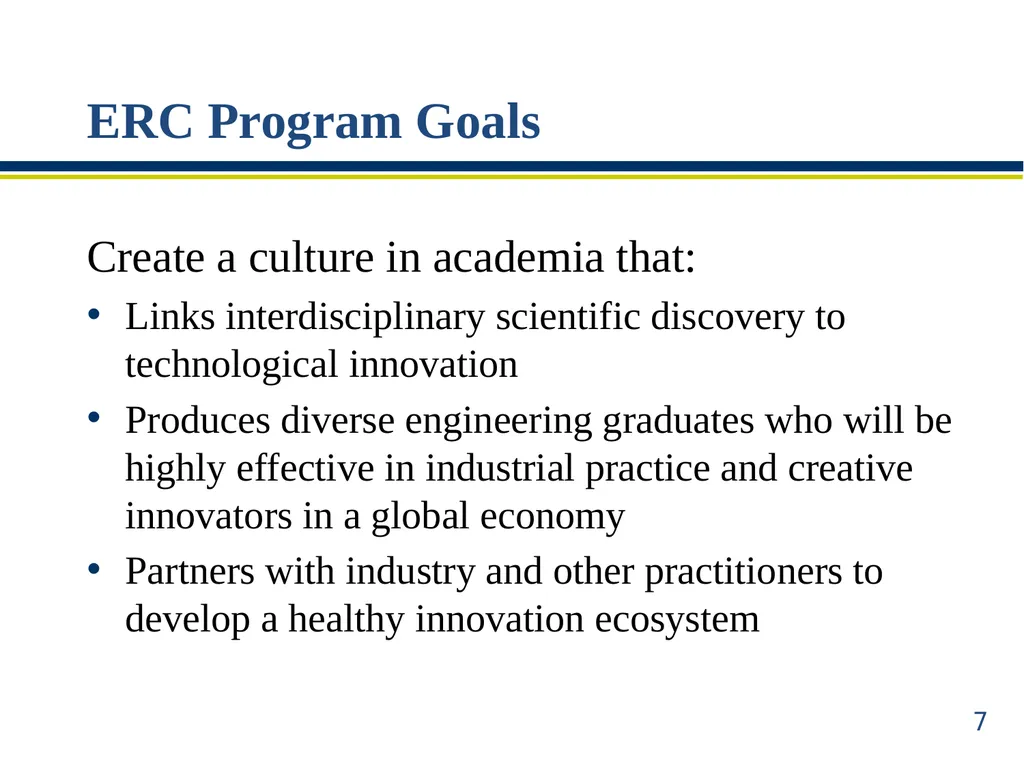
slide7. ERC Program Goals Create a culture in academia that:
Links interdisciplinary scientific discovery to technological innovation
Produces diverse engineering graduates who will be highly effective in industrial practice and creative innovators in a global economy
Partners with industry and other practitioners to develop a healthy innovation ecosystem 7<br>
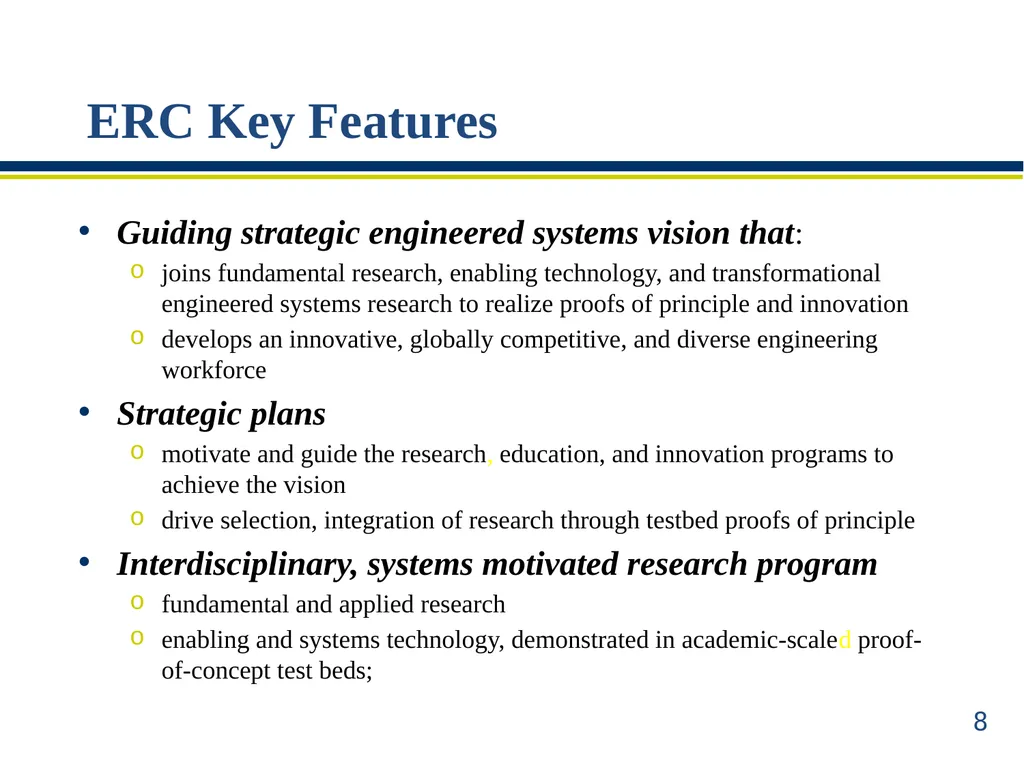
slide8. ERC Key Features Guiding strategic engineered systems vision that:
joins fundamental research, enabling technology, and transformational engineered systems research to realize proofs of principle and innovation
develops an innovative, globally competitive, and diverse engineering workforce
Strategic plans
motivate and guide the research, education, and innovation programs to achieve the vision
drive selection, integration of research through testbed proofs of principle
Interdisciplinary, systems motivated research program
fundamental and applied research
enabling and systems technology, demonstrated in academic-scaled proof-of-concept test beds; 8<br>
slide9. What’s an Engineered System? A combination of components and elements that work together to perform a useful function
New technology platform for:
new product line or new manufacturing process
transforming public sector, healthcare services, or infrastructure services
Research is designed to:
address fundamental barriers
advance proofs of principle in test beds
incorporate factors effecting system-wide performance (e.g., utility, efficiency, resilience, etc.) 9<br>
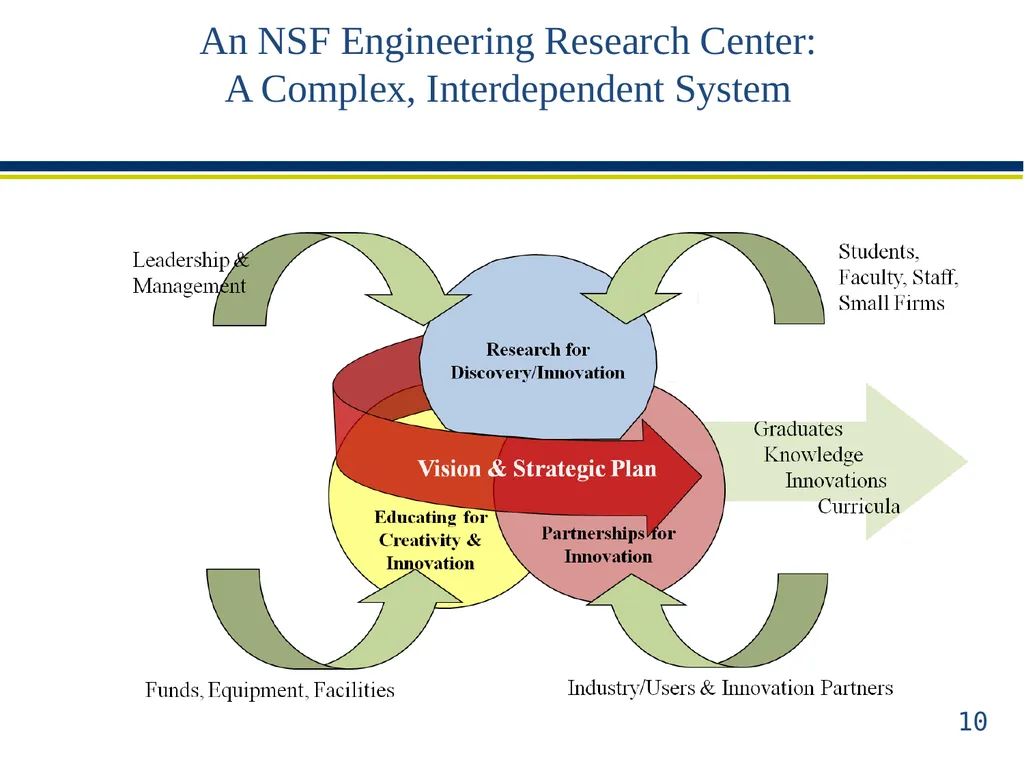
slide10. An NSF Engineering Research Center:
A Complex, Interdependent System 10<br>
slide11. Guidance for Proposals 11<br>
slide12. Principal Investigator (PI): Eligibility Requirements Tenured faculty member in an engineering department/school of engineering at the lead university
Ph.D. in engineering; or
Ph.D. in associated field of science with:
Substantial career experience in engineering
Primary appointment in an engineering department or school of engineering
PI and co-PIs: expertise in research, workforce development, and innovation 12<br>
slide13. Lead University: Eligibility Requirements Submission as lead university only by a U.S. University with:
B.S., M.S., and Ph.D. engineering degree programs
Breadth and depth to support proposed vision 13<br>
slide14. Institution Serving Large Numbers of Minority Groups Underrepresented in Engineering Must be lead or partner institution
May classify under Dept of Education guidelines: http://www2.ed.gov/about/offices/list/ocr/edlite-minorityinst.html ; or
Document significant enrollment of minority students (i.e., African Americans, Pacific Islanders, Native Americans, Hispanic Americans, and persons with disabilities who are U.S. citizens of Permanent Residents) who are majoring in engineering studies to qualify; and
Document graduation track record of underrepresented minority groups 14<br>
slide15. Invited Full Proposal: Organizational Requirements Lead and up to four domestic partner universities or colleges (one serving large numbers of underrepresented groups) that commit to cost share and participate in all ERC frameworks
Fee paying industry partners, including practitioner organization partners as appropriate
Long-term pre-college institutional partners
State/local government and/or university/private innovation partners to stimulate innovation and entrepreneurship
Commitment to include participating foreign partners/collaborators (in proposal or future) 15<br>
slide16. Invited Full Proposal: Organizational Options Affiliated universities/colleges/institutions that:
Academic institutions that provide 2 faculty for specific research and/or education tasks
Federal laboratories providing staff for specific tasks (cannot be supported by NSF funds)
Community colleges and/or technical colleges that participate in the education programs 16<br>
slide17. Pre-proposal feedback from NSF: July – Oct 22, 2015 Teleconference with ERC Program Director
Send email to kroper@nsf.gov with 10-sentence summary of ERC engineered system, including the research focus, engineering workforce development program, and innovation ecosystem and 3-plane diagram
You will be contacted by ERC Program Director (PD) to arrange a teleconference with your team for a maximum of 45 minutes.
Send slides (maximum of 10) for discussion in advance. Slides should address the proposed vision, strategic plan, research thrusts, workforce development (education), innovation ecosystem, infrastructure, and 3-plane chart. 17<br>
slide18. Letter of Intent (LOI): Due Sept 25, 2015 Required in Order to Submit a Pre-Proposal
Used by NSF to determine proposal load and form preliminary sets of reviewers
PI may only submit a preliminary proposal, if an LOI is submitted
There will be no official response from NSF regarding the LOI 18<br>
slide19. Letter of Intent (LOI): Submission Requirements Identify one to four participating partner universities
Multiple LOIs may be submitted by lead university
PI (Center Director) may submit only one LOI
No change in partners, PI, or co-PIs between LOI submission and preproposal 19<br>
slide20. PI and Co-PI: Limitations Submitting PI (Center Director) may submit only one LOI and one preliminary proposal
PI is binding after submission of the preliminary proposal
PI may not participate in any other LOI or preliminary proposal, while a PI
Co-PI may participate in more than one LOI or preliminary proposal
No change in PI or Co-PIs between LOI submission and preliminary proposal
Co-PIs may change after acceptance to submit full proposal 20<br>
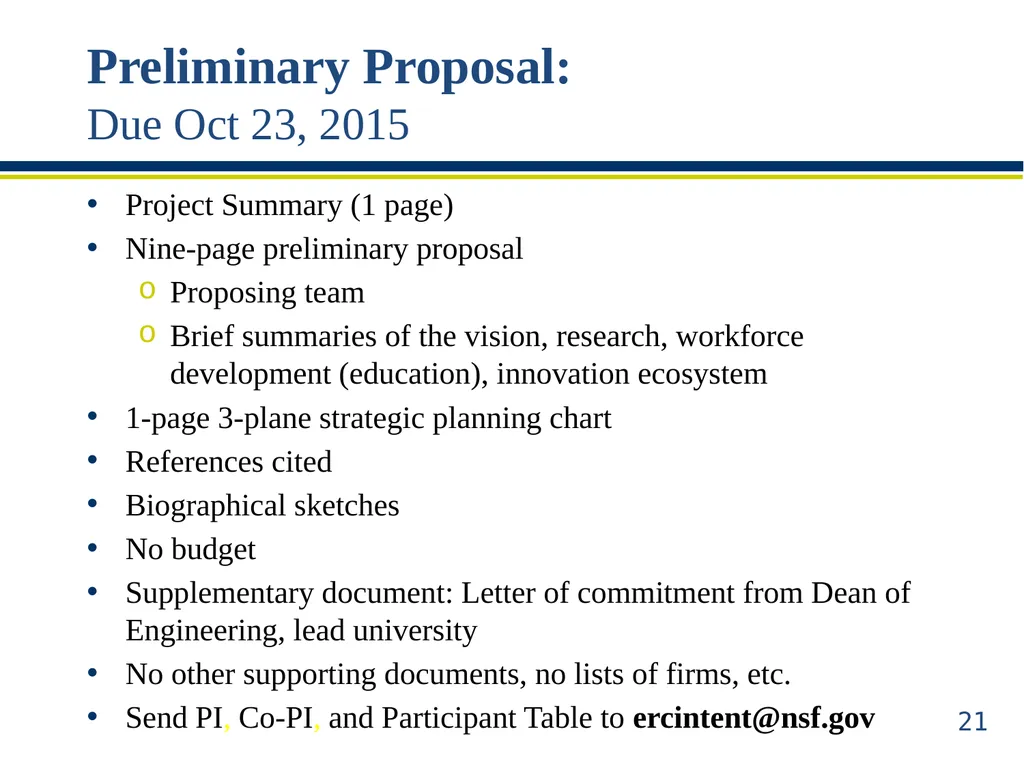
slide21. Preliminary Proposal: Due Oct 23, 2015 Project Summary (1 page)
Nine-page preliminary proposal
Proposing team
Brief summaries of the vision, research, workforce development (education), innovation ecosystem
1-page 3-plane strategic planning chart
References cited
Biographical sketches
No budget
Supplementary document: Letter of commitment from Dean of Engineering, lead university
No other supporting documents, no lists of firms, etc.
Send PI, Co-PI, and Participant Table to ercintent@nsf.gov 21<br>
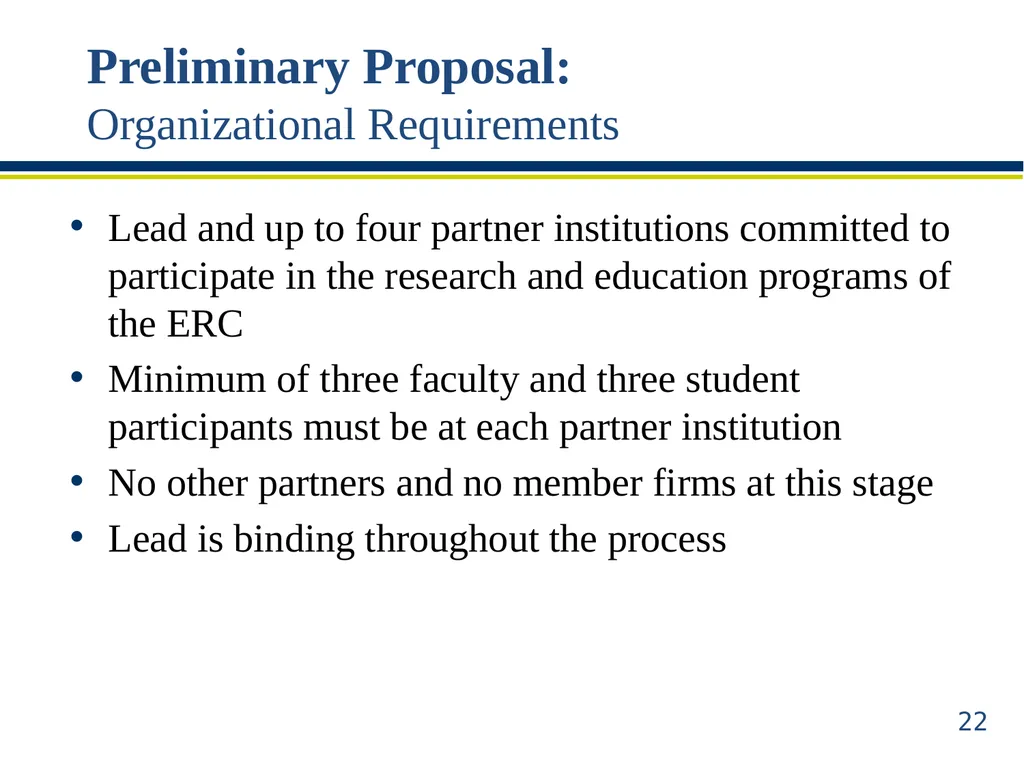
slide22. Preliminary Proposal: Organizational Requirements Lead and up to four partner institutions committed to participate in the research and education programs of the ERC
Minimum of three faculty and three student participants must be at each partner institution
No other partners and no member firms at this stage
Lead is binding throughout the process 22<br>
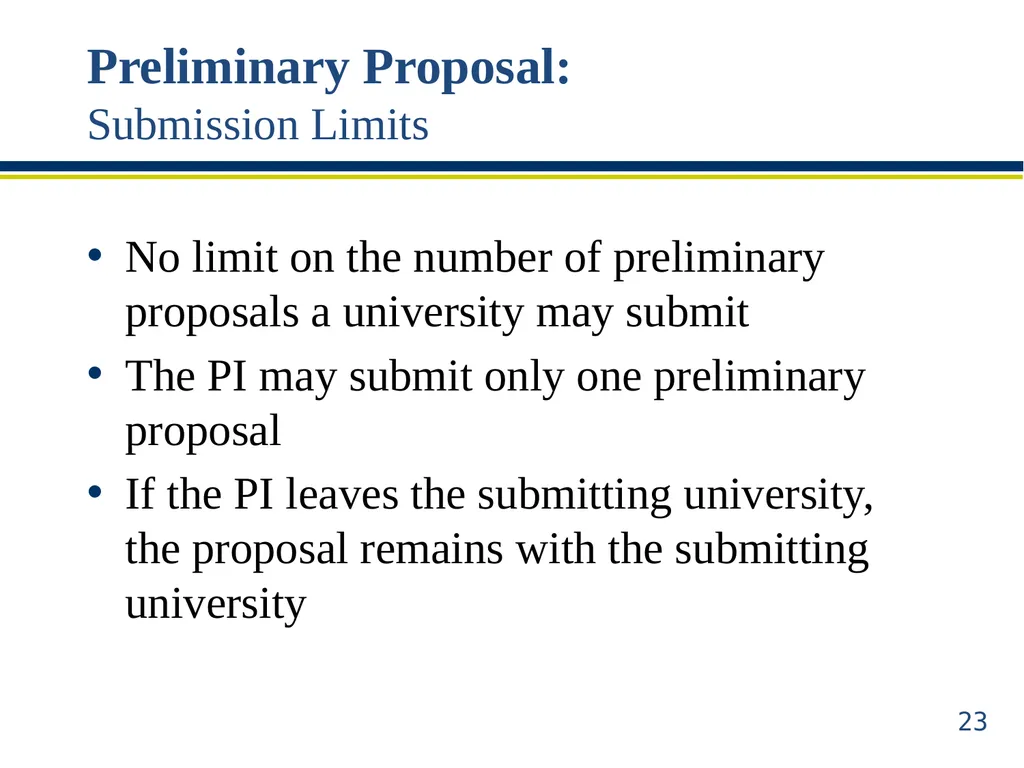
slide23. Preliminary Proposal: Submission Limits No limit on the number of preliminary proposals a university may submit
The PI may submit only one preliminary proposal
If the PI leaves the submitting university, the proposal remains with the submitting university 23<br>
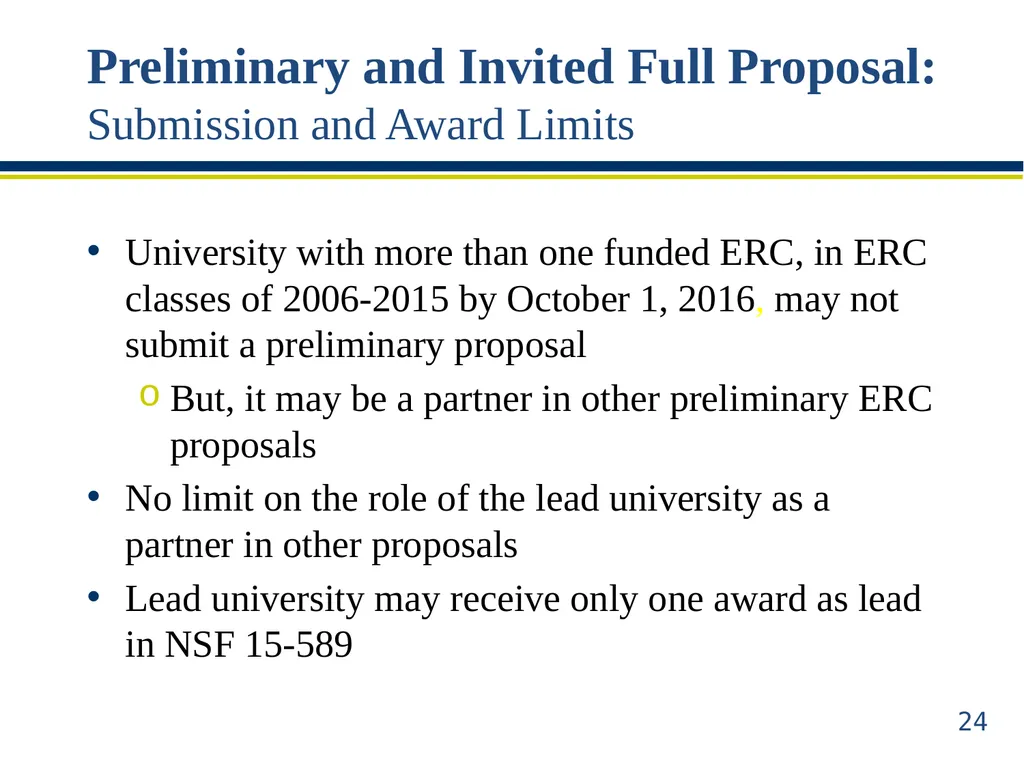
slide24. Preliminary and Invited Full Proposal: Submission and Award Limits University with more than one funded ERC, in ERC classes of 2006-2015 by October 1, 2016, may not submit a preliminary proposal
But, it may be a partner in other preliminary ERC proposals
No limit on the role of the lead university as a partner in other proposals
Lead university may receive only one award as lead in NSF 15-589 24<br>
slide25. Preliminary Proposal: Review Process LOIs to be used to form panels around technology areas
Panels to be finalized upon receipt of the proposals
Proposals to be sent out for review in Oct-Dec 2015
Panels to be held in December 2015
Invitations for Full proposals to be sent in January - February 2016
Full proposals are due June 16, 2016
Up to four awards will be made, depending on budget
Awards to be notified: Sept. 2017). 25<br>
slide26. Program Level Overview/Guidance for Proposals Q&A 26<br>
slide27. Vision, Strategic Plan, Research 27<br>
slide28. ERC Engineered Systems Vision: Topic Area Open Topic ERC
Engineered system(s) chosen by the PI
Nanosystems ERC
Engineered system(s) chosen by the PI
Vision requires a substantial body of new fundamental nanoscale research
Scaling from fundamentals to devices, components, and systems to assure sustained nano-enabled functionality
No preference at NSF for either topic area 28<br>
slide29. ERC Engineered Systems Vision: Qualities and Best Practices Transformative: discoveries and basic research drive compelling advances toward an emerging, potentially revolutionary technology system
Potential to significantly change current practices, establish new industries, transform public sector services, healthcare, or the infrastructure, etc.
Could increase national competitiveness or contribute to the solution of a major societal problem with national or, perhaps, international impact
Convergent: Envisioned results are achievable in 10 years by strategic alignment of nascent discoveries, existing capabilities, and resources 29<br>
slide30. ERC Engineered Systems Vision: What doesn’t qualify? Not unique:
Engineered systems topics that significantly overlap an ongoing or graduated ERC do not qualify
Discussion of added value relative to achievements and/or plans of other related large centers is lacking
Added value relative to achievements and/or plans of other large centers is not significant
Proposals focused on transformations of engineering education as an engineered system do not qualify
However, proposals that address educational technology as an engineered system would qualify 30<br>
slide31. ERC Vision, Strategy, and Research: What doesn’t fit the ERC model? Insufficient resources (e.g., knowledge/technology base, personnel, infrastructure, etc.) to integrate research with enabling technology, reach milestones, and realize proof of principles in systems test beds within 10 years.
Unbalanced focus on exploration of a phenomena, discovery, technology improvement, or innovation without clear systems integration and/or end-to-end strategic planning.
Proposed work is incremental without compelling transformational impact - too applied.
State of the art advances in basic research or commercial capabilities are unanticipated, overlooked, or not integrated into planned resources/activities to achieve vision. 31<br>
slide32. Preliminary Proposal: 9-Page Project Description Requirements (p.23) Infrastructure: PI/co-PI expertise in discovery, workforce development, innovation
Ten-year vision to link discovery to transformational engineered system and its impact
Strategic Research Plan
Identifies barriers, gaps, and requirements based on review of state of the art
Leverages recent internal & external breakthroughs to achieve vision
Aligns resources to support critical path actions, and adapts, to disrupt state of the art
Research: addresses barriers to achieve ERC vision at fundamental, technological, and proof-of-concept, test-bed levels.
Workforce Development: literature-based, inclusive, K-grad approach to achieve goals (e.g., skill sets) via curricula and activities that evolve based on assessment
Innovation Ecosystem: Strategic selection of sectors/firms, specification of roles of industry/ practitioner members, and cultivation of innovation in the ERC.
Do not list potential or committed industrial or other supporters
Dean’s Letter plus required NSF proposal documents. No other supporting letters. 32<br>
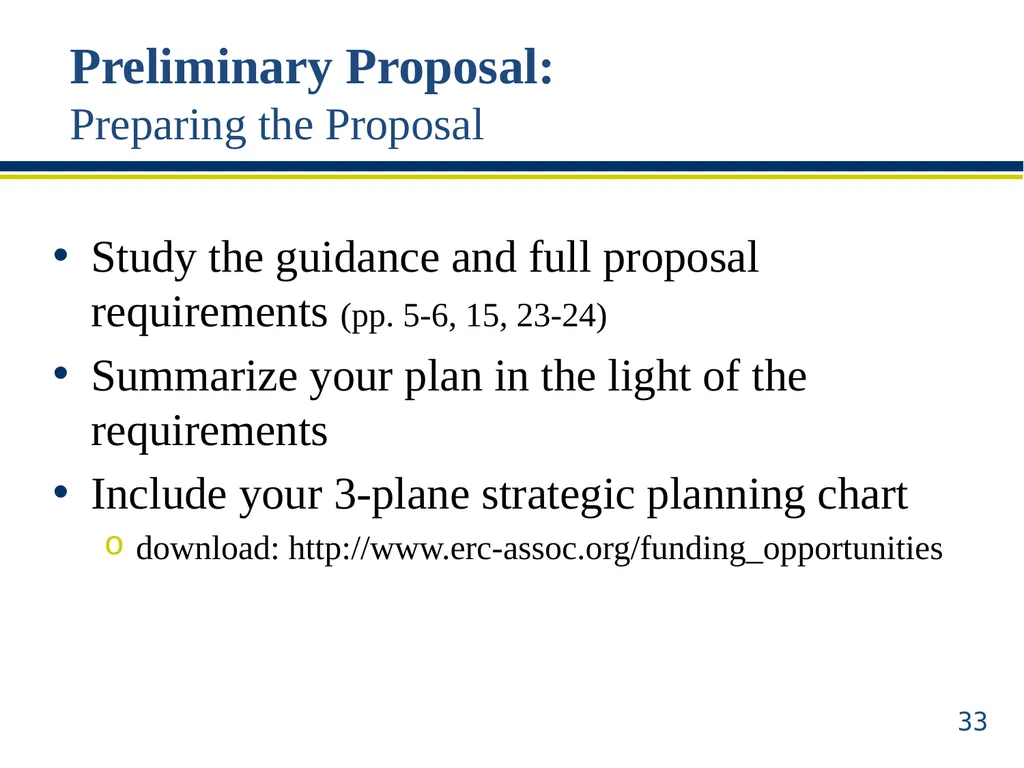
slide33. Preliminary Proposal: Preparing the Proposal Study the guidance and full proposal requirements (pp. 5-6, 15, 23-24)
Summarize your plan in the light of the requirements
Include your 3-plane strategic planning chart
download: http://www.erc-assoc.org/funding_opportunities 33<br>
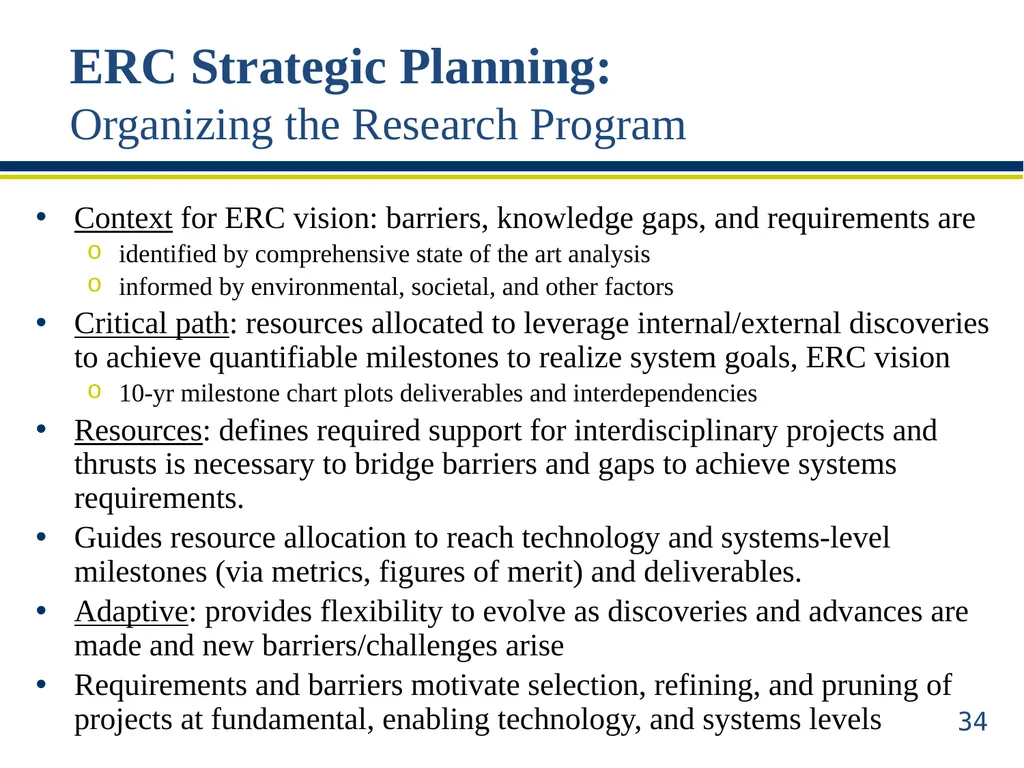
slide34. ERC Strategic Planning: Organizing the Research Program Context for ERC vision: barriers, knowledge gaps, and requirements are
identified by comprehensive state of the art analysis
informed by environmental, societal, and other factors
Critical path: resources allocated to leverage internal/external discoveries to achieve quantifiable milestones to realize system goals, ERC vision
10-yr milestone chart plots deliverables and interdependencies
Resources: defines required support for interdisciplinary projects and thrusts is necessary to bridge barriers and gaps to achieve systems requirements.
Guides resource allocation to reach technology and systems-level milestones (via metrics, figures of merit) and deliverables.
Adaptive: provides flexibility to evolve as discoveries and advances are made and new barriers/challenges arise
Requirements and barriers motivate selection, refining, and pruning of projects at fundamental, enabling technology, and systems levels 34<br>
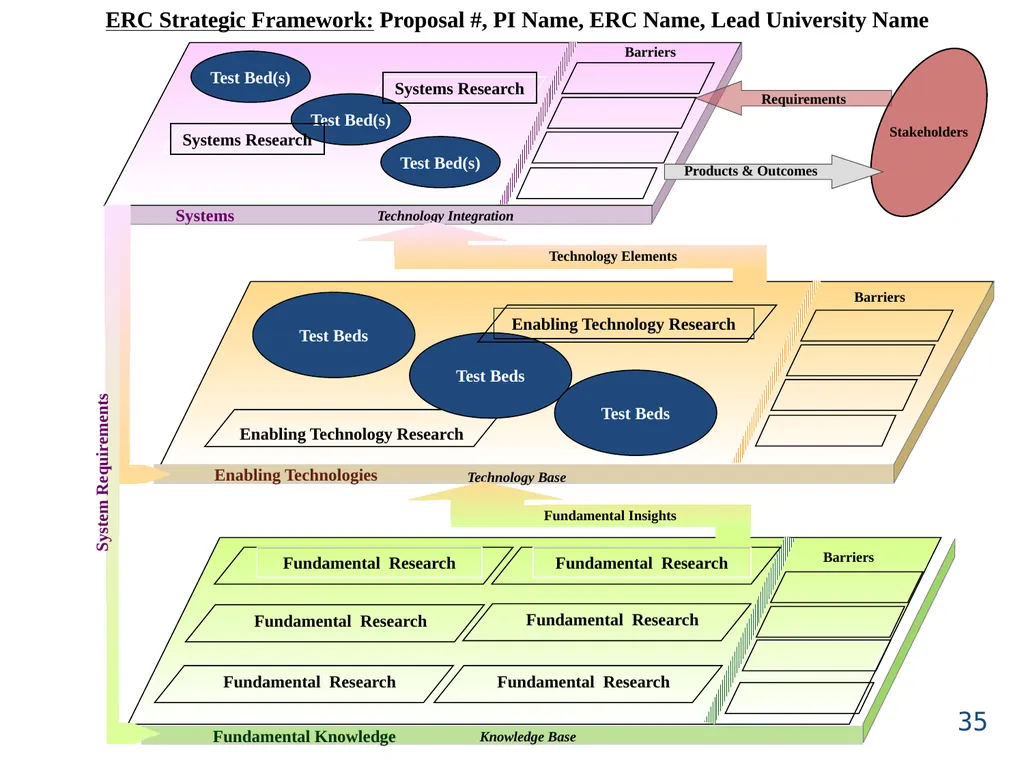
slide35. QoLT 3-plane chart Barriers Enabling Technologies Technology Base Barriers Fundamental Knowledge Knowledge Base Systems Technology Integration Requirements Stakeholders Barriers Technology Elements Fundamental Insights Technology Elements Products & Outcomes ERC Strategic Framework: Proposal #, PI Name, ERC Name, Lead University Name System Requirements Test Bed(s) Systems Research Systems Research Test Beds Enabling Technology Research Enabling Technology Research Test Bed(s) Test Bed(s) Test Beds Test Beds 35<br>
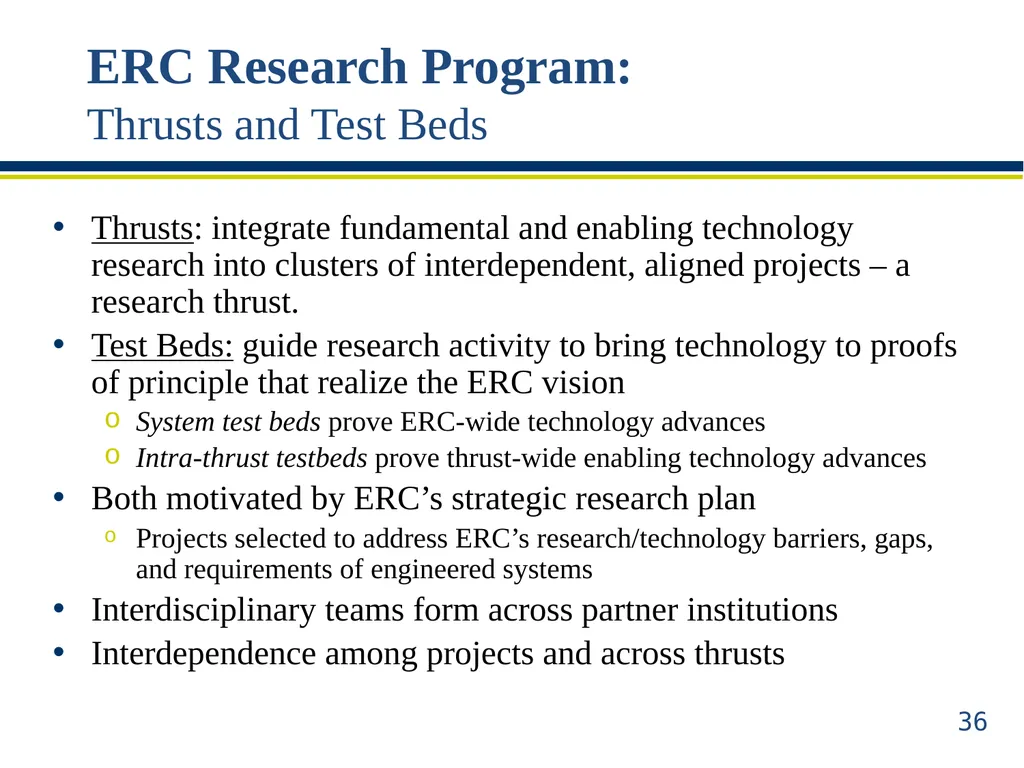
slide36. ERC Research Program: Thrusts and Test Beds Thrusts: integrate fundamental and enabling technology research into clusters of interdependent, aligned projects – a research thrust.
Test Beds: guide research activity to bring technology to proofs of principle that realize the ERC vision
System test beds prove ERC-wide technology advances
Intra-thrust testbeds prove thrust-wide enabling technology advances
Both motivated by ERC’s strategic research plan
Projects selected to address ERC’s research/technology barriers, gaps, and requirements of engineered systems
Interdisciplinary teams form across partner institutions
Interdependence among projects and across thrusts 36<br>
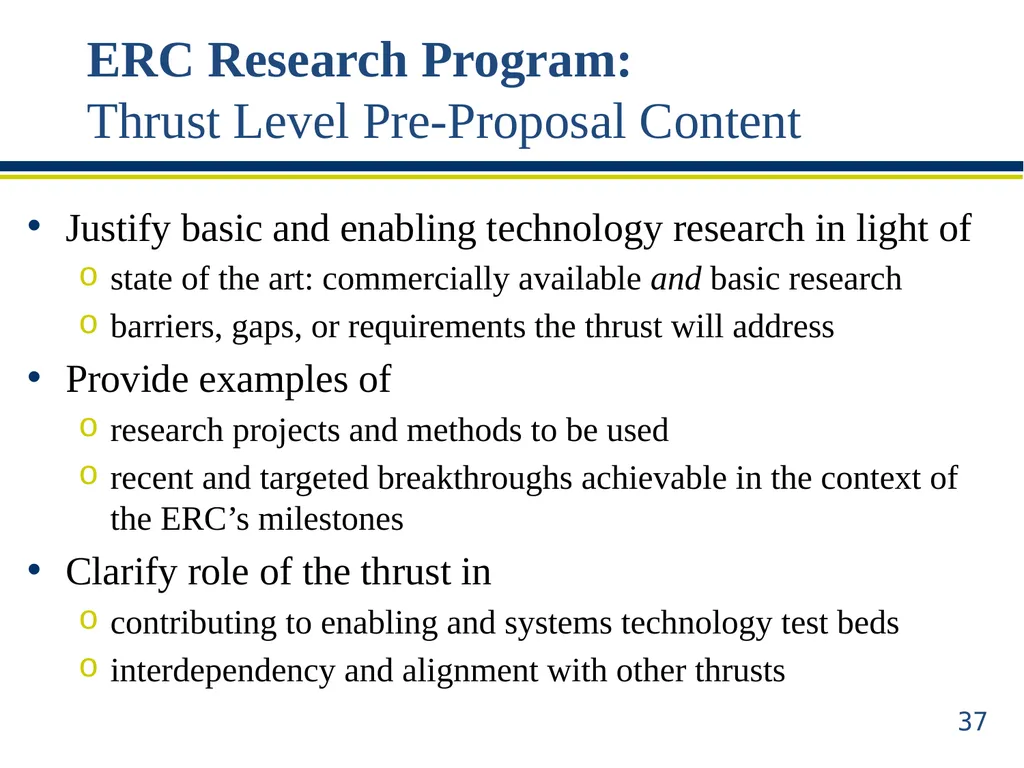
slide37. ERC Research Program: Thrust Level Pre-Proposal Content Justify basic and enabling technology research in light of
state of the art: commercially available and basic research
barriers, gaps, or requirements the thrust will address
Provide examples of
research projects and methods to be used
recent and targeted breakthroughs achievable in the context of the ERC’s milestones
Clarify role of the thrust in
contributing to enabling and systems technology test beds
interdependency and alignment with other thrusts 37<br>
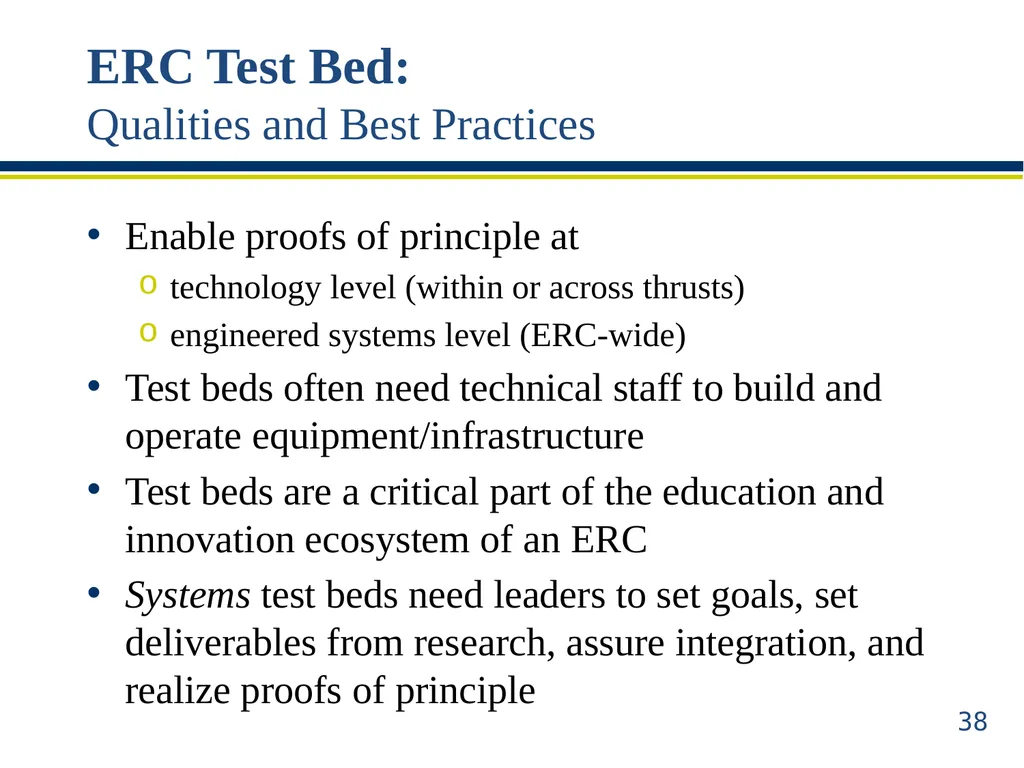
slide38. ERC Test Bed: Qualities and Best Practices Enable proofs of principle at
technology level (within or across thrusts)
engineered systems level (ERC-wide)
Test beds often need technical staff to build and operate equipment/infrastructure
Test beds are a critical part of the education and innovation ecosystem of an ERC
Systems test beds need leaders to set goals, set deliverables from research, assure integration, and realize proofs of principle 38<br>
slide39. Vision, Strategic Plan, Research Q&A 39<br>
slide40. Engineering Workforce Development University and Pre-College Education 40<br>
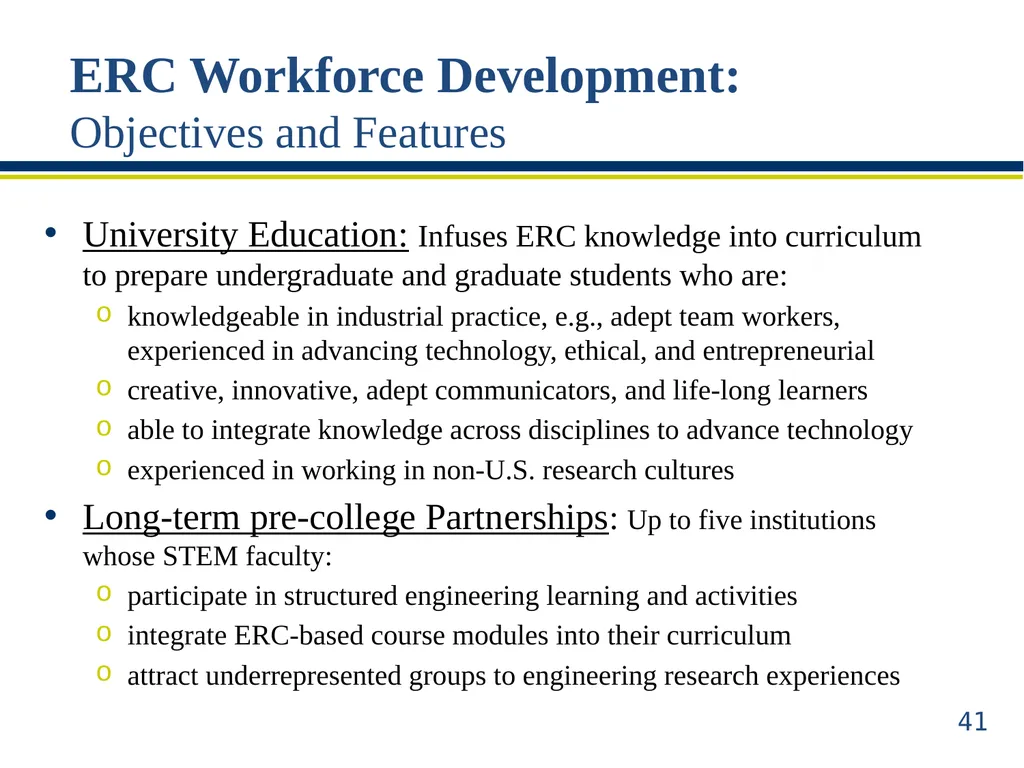
slide41. ERC Workforce Development: Objectives and Features University Education: Infuses ERC knowledge into curriculum to prepare undergraduate and graduate students who are:
knowledgeable in industrial practice, e.g., adept team workers, experienced in advancing technology, ethical, and entrepreneurial
creative, innovative, adept communicators, and life-long learners
able to integrate knowledge across disciplines to advance technology
experienced in working in non-U.S. research cultures
Long-term pre-college Partnerships: Up to five institutions whose STEM faculty:
participate in structured engineering learning and activities
integrate ERC-based course modules into their curriculum
attract underrepresented groups to engineering research experiences 41<br>
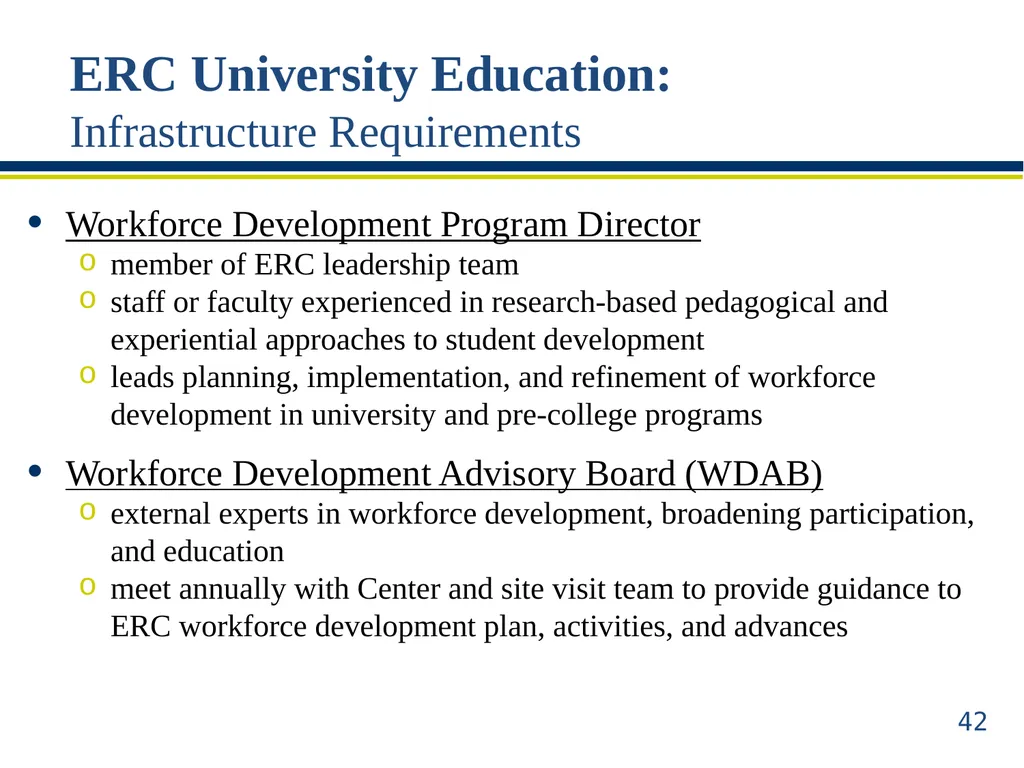
slide42. ERC University Education: Infrastructure Requirements Workforce Development Program Director
member of ERC leadership team
staff or faculty experienced in research-based pedagogical and experiential approaches to student development
leads planning, implementation, and refinement of workforce development in university and pre-college programs
Workforce Development Advisory Board (WDAB)
external experts in workforce development, broadening participation, and education
meet annually with Center and site visit team to provide guidance to ERC workforce development plan, activities, and advances 42<br>
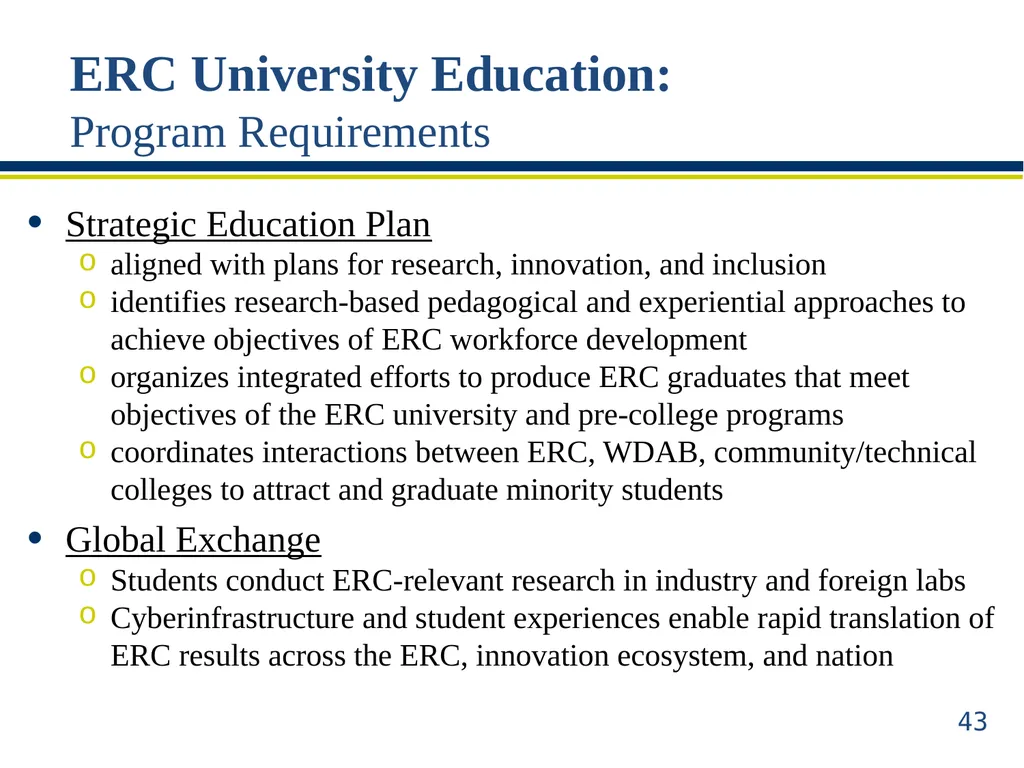
slide43. ERC University Education: Program Requirements Strategic Education Plan
aligned with plans for research, innovation, and inclusion
identifies research-based pedagogical and experiential approaches to achieve objectives of ERC workforce development
organizes integrated efforts to produce ERC graduates that meet objectives of the ERC university and pre-college programs
coordinates interactions between ERC, WDAB, community/technical colleges to attract and graduate minority students
Global Exchange
Students conduct ERC-relevant research in industry and foreign labs
Cyberinfrastructure and student experiences enable rapid translation of ERC results across the ERC, innovation ecosystem, and nation 43<br>
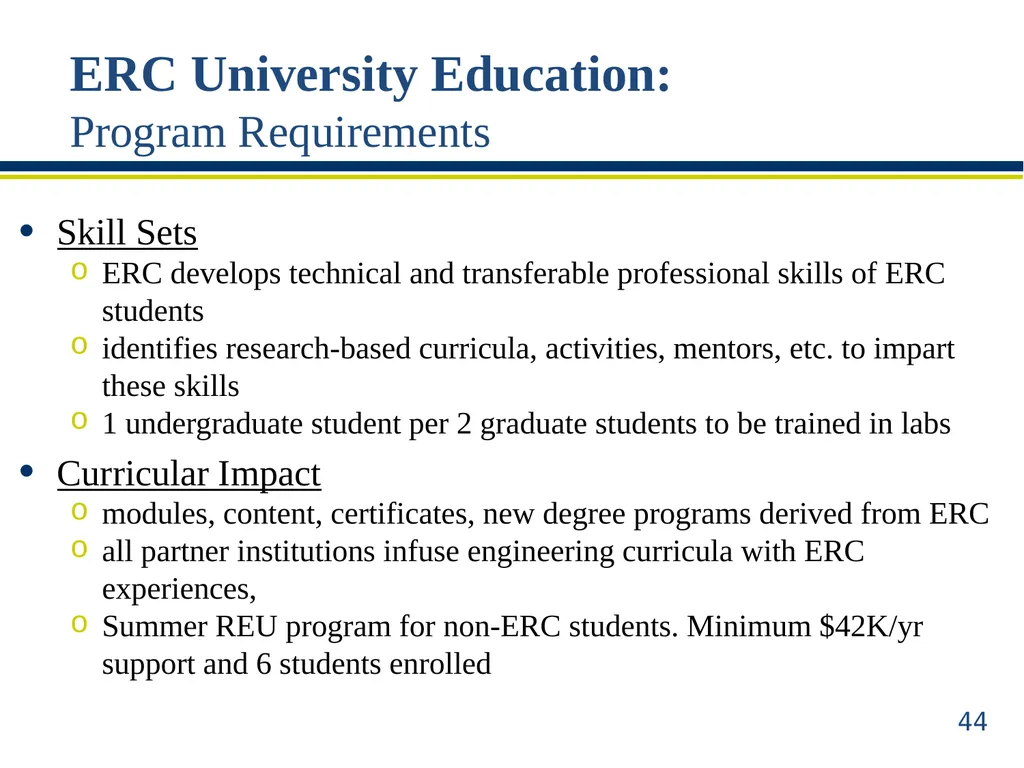
slide44. ERC University Education: Program Requirements Skill Sets
ERC develops technical and transferable professional skills of ERC students
identifies research-based curricula, activities, mentors, etc. to impart these skills
1 undergraduate student per 2 graduate students to be trained in labs
Curricular Impact
modules, content, certificates, new degree programs derived from ERC
all partner institutions infuse engineering curricula with ERC experiences,
Summer REU program for non-ERC students. Minimum $42K/yr support and 6 students enrolled 44<br>
slide45. ERC Pre-college Education: Program Requirements Engagement: innovative best practices and effective efforts to
teach engineering concepts derived from ERC research
engage ERC faculty and students to stimulate K-12 interest in engineering careers and increase diversity
support P-12 faculty development to sustain pre-college teaching of engineering concepts
Partnership: up to 5 pre-college institutions near ERC that
support engineering research education and experiences for their faculty and students
introduce high school students to research in university labs
involve K-CC STEM faculty in RET program to experience research
sustain follow-up to ensure RET experience is translated to K-CC curricula 45<br>
slide46. ERC Assessment: Program Requirements Smart, measurable, attainable, realistic, and timely goals identified at Graduate and Pre-college levels
External formative and summative evaluation of progress and achievement of goals within Center lifetime.
External evaluations and Workforce Development Advisory Board feedback are used regularly to improve workforce development program
Full proposal requires institutional review board approval 46<br>
slide47. Engineering Workforce Development Q&A 47<br>
slide48. Broadening Participation 48<br>
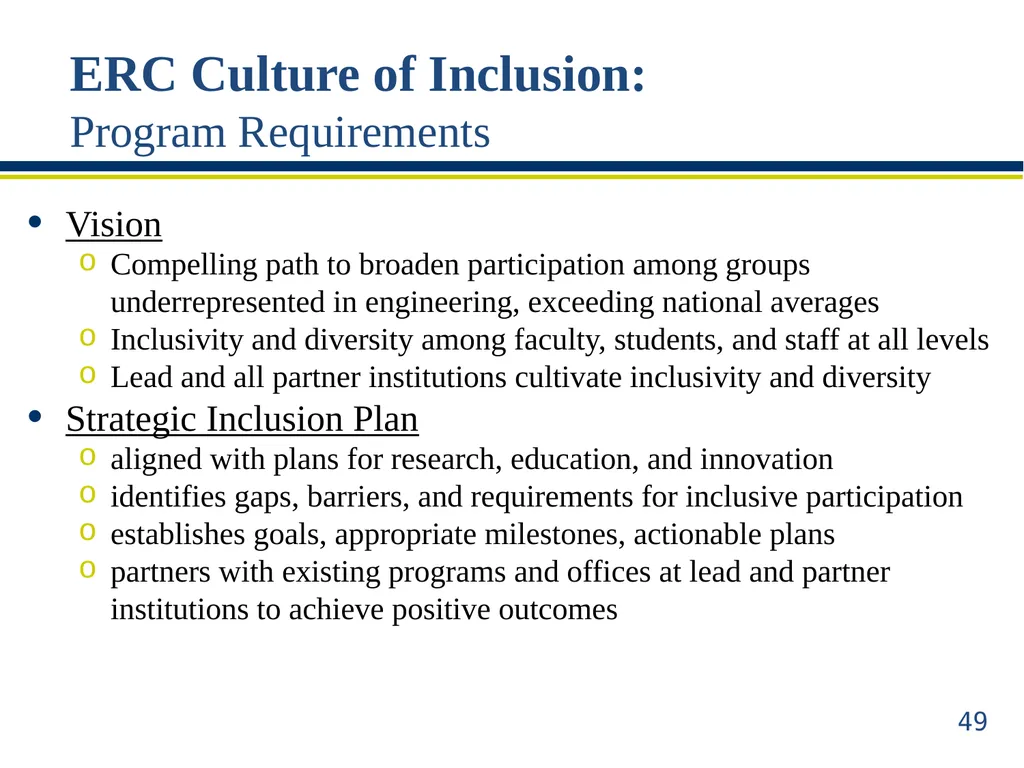
slide49. ERC Culture of Inclusion: Program Requirements Vision
Compelling path to broaden participation among groups underrepresented in engineering, exceeding national averages
Inclusivity and diversity among faculty, students, and staff at all levels
Lead and all partner institutions cultivate inclusivity and diversity
Strategic Inclusion Plan
aligned with plans for research, education, and innovation
identifies gaps, barriers, and requirements for inclusive participation
establishes goals, appropriate milestones, actionable plans
partners with existing programs and offices at lead and partner institutions to achieve positive outcomes 49<br>
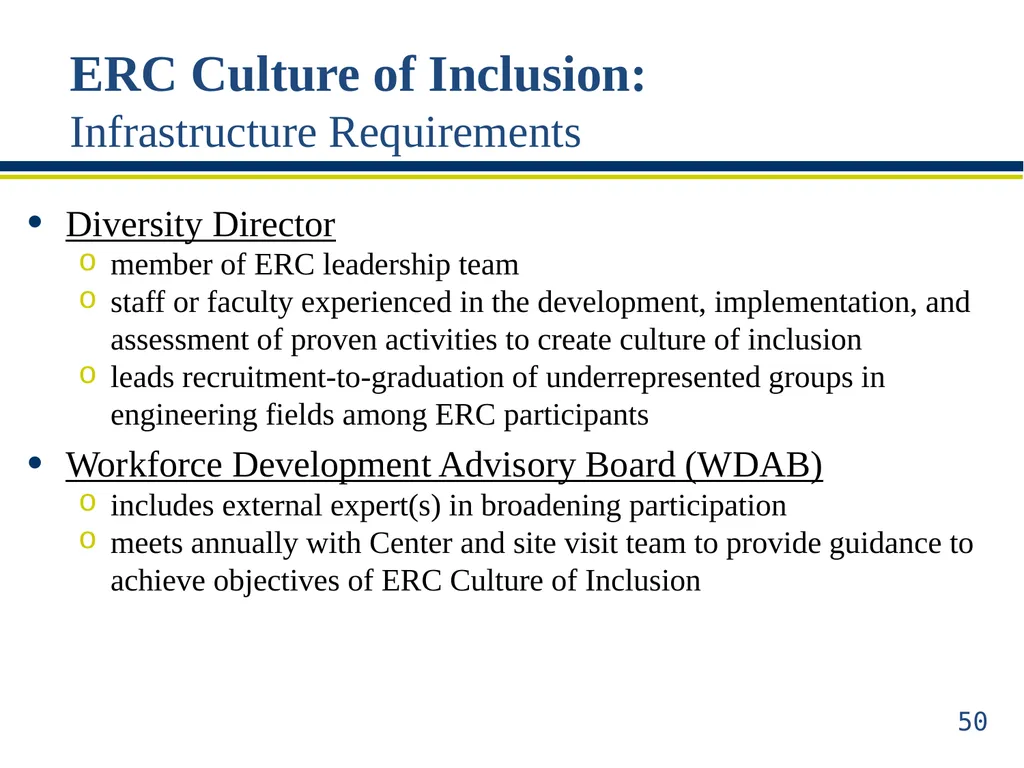
slide50. ERC Culture of Inclusion: Infrastructure Requirements Diversity Director
member of ERC leadership team
staff or faculty experienced in the development, implementation, and assessment of proven activities to create culture of inclusion
leads recruitment-to-graduation of underrepresented groups in engineering fields among ERC participants
Workforce Development Advisory Board (WDAB)
includes external expert(s) in broadening participation
meets annually with Center and site visit team to provide guidance to achieve objectives of ERC Culture of Inclusion 50<br>
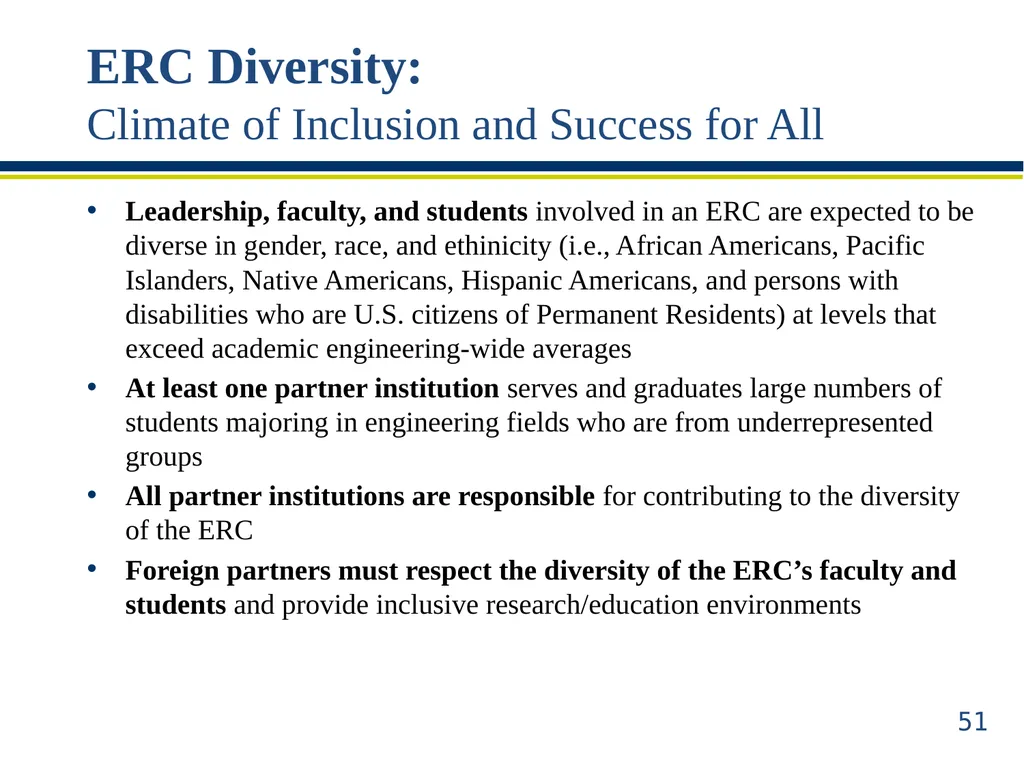
slide51. ERC Diversity: Climate of Inclusion and Success for All Leadership, faculty, and students involved in an ERC are expected to be diverse in gender, race, and ethinicity (i.e., African Americans, Pacific Islanders, Native Americans, Hispanic Americans, and persons with disabilities who are U.S. citizens of Permanent Residents) at levels that exceed academic engineering-wide averages
At least one partner institution serves and graduates large numbers of students majoring in engineering fields who are from underrepresented groups
All partner institutions are responsible for contributing to the diversity of the ERC
Foreign partners must respect the diversity of the ERC’s faculty and students and provide inclusive research/education environments 51<br>
slide52. Women in ERCs (FY 2006–2014) 52 NOTES:
Data from centers are not included for years in which the center entered demographic data by institution rather than per person.
Both ERC data and national statistics are for U.S. citizens and permanent residents only.
Undergraduates include REU students.
The percentages of women are calculated out of the total number of U.S. citizens and permanent residents, including personnel who did not report gender.
ASEE data are not yet available for 2014 and were not collected for postdoctoral for 2011–2013.
The percentages of personnel who did not report gender are as follows: 2009: 4.26%, 2010: 5.15%, 2011: 7.54%, 2012: 7.55%, 2013: 7.66%, 2014: 7.34%.<br>
slide53. Hispanics in ERCs (FY 2006–2014)*,** * Does not include centers from the Earthquake Technology Sector ** Hispanics in ERCs data are for U.S. Citizens and Permanent Residents only. 53<br>
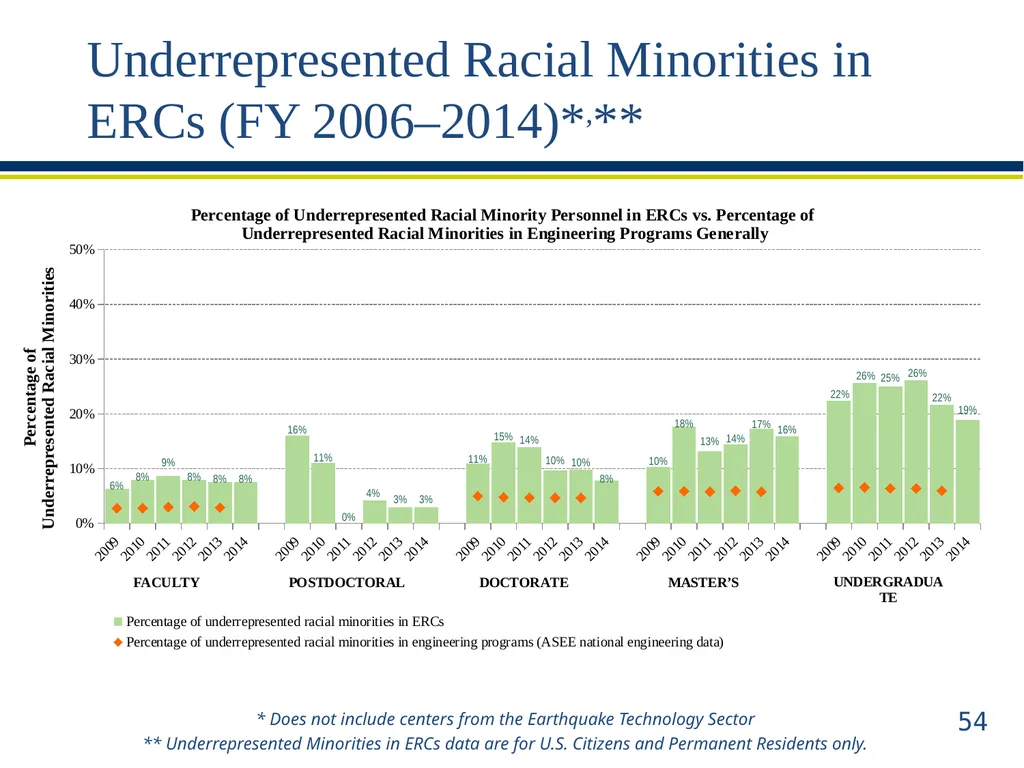
slide54. Underrepresented Racial Minorities in ERCs (FY 2006–2014)*,** * Does not include centers from the Earthquake Technology Sector ** Underrepresented Minorities in ERCs data are for U.S. Citizens and Permanent Residents only. 54<br>
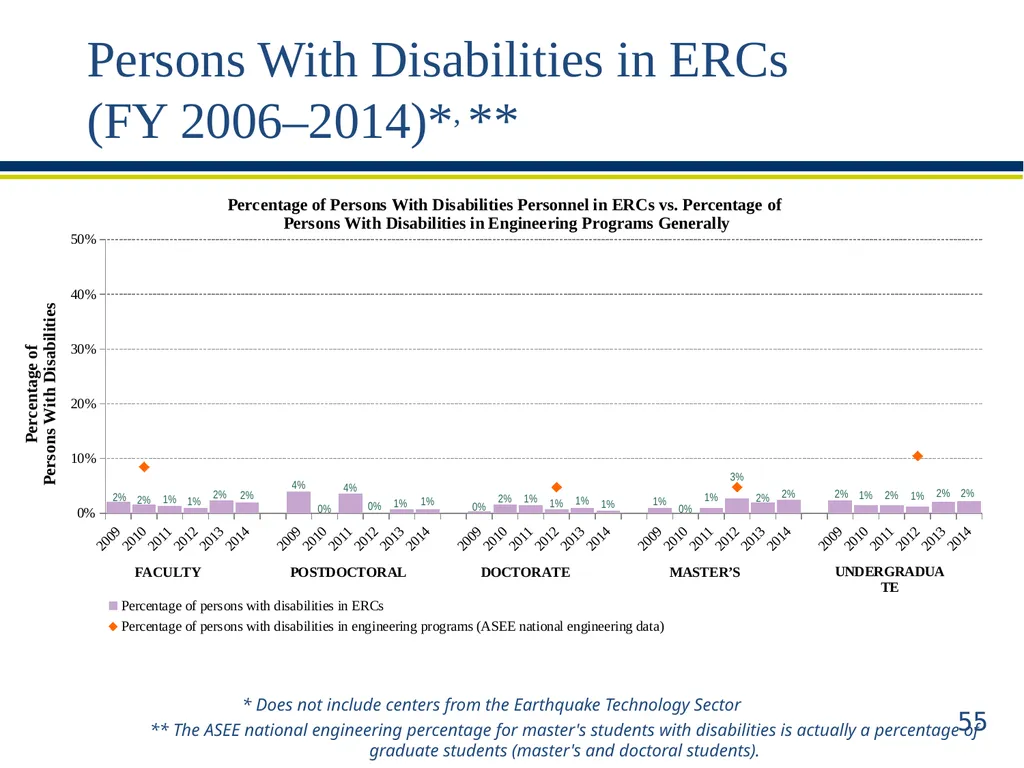
slide55. Persons With Disabilities in ERCs (FY 2006–2014)*, ** * Does not include centers from the Earthquake Technology Sector ** The ASEE national engineering percentage for master's students with disabilities is actually a percentage of graduate students (master's and doctoral students). 55<br>
slide56. Broadening Participation Q&A 56<br>
slide57. Infrastructure 57<br>
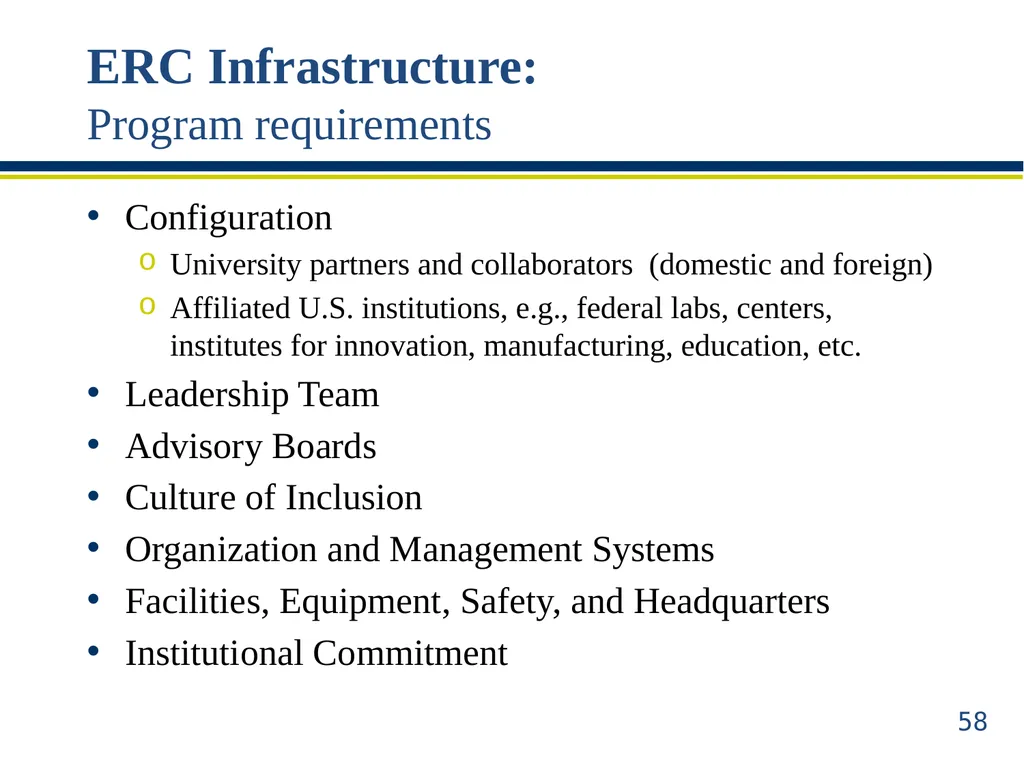
slide58. ERC Infrastructure: Program requirements Configuration
University partners and collaborators (domestic and foreign)
Affiliated U.S. institutions, e.g., federal labs, centers, institutes for innovation, manufacturing, education, etc.
Leadership Team
Advisory Boards
Culture of Inclusion
Organization and Management Systems
Facilities, Equipment, Safety, and Headquarters
Institutional Commitment 58<br>
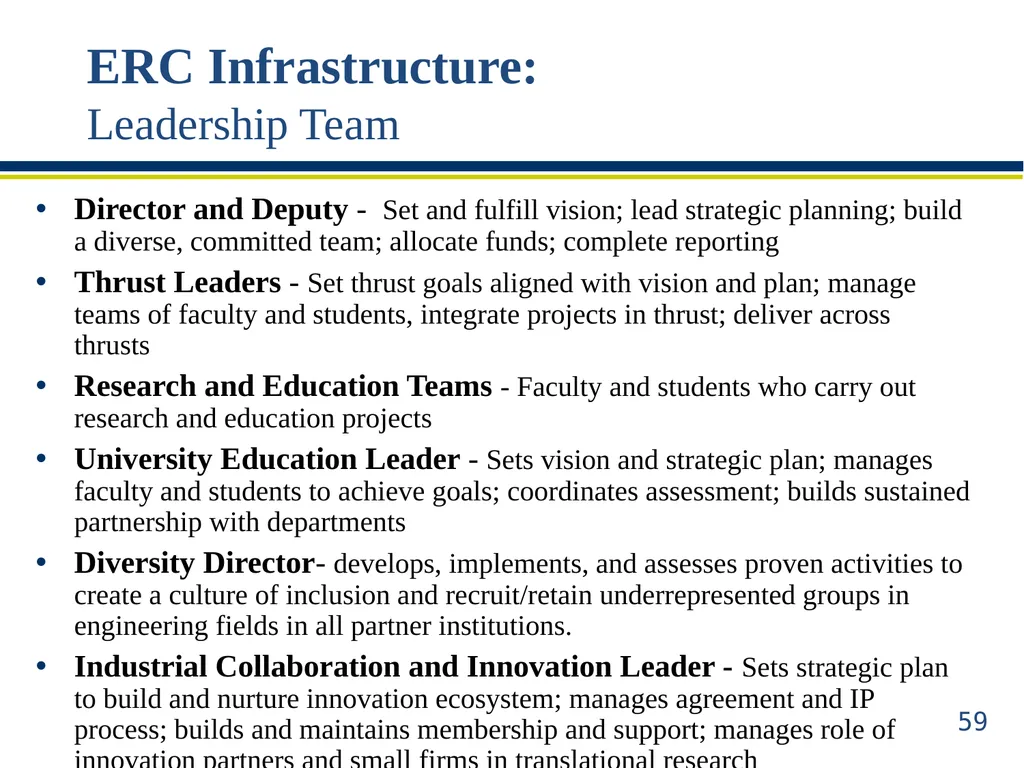
slide59. ERC Infrastructure: Leadership Team Director and Deputy - Set and fulfill vision; lead strategic planning; build a diverse, committed team; allocate funds; complete reporting
Thrust Leaders - Set thrust goals aligned with vision and plan; manage teams of faculty and students, integrate projects in thrust; deliver across thrusts
Research and Education Teams - Faculty and students who carry out research and education projects
University Education Leader - Sets vision and strategic plan; manages faculty and students to achieve goals; coordinates assessment; builds sustained partnership with departments
Diversity Director- develops, implements, and assesses proven activities to create a culture of inclusion and recruit/retain underrepresented groups in engineering fields in all partner institutions.
Industrial Collaboration and Innovation Leader - Sets strategic plan to build and nurture innovation ecosystem; manages agreement and IP process; builds and maintains membership and support; manages role of innovation partners and small firms in translational research 59<br>
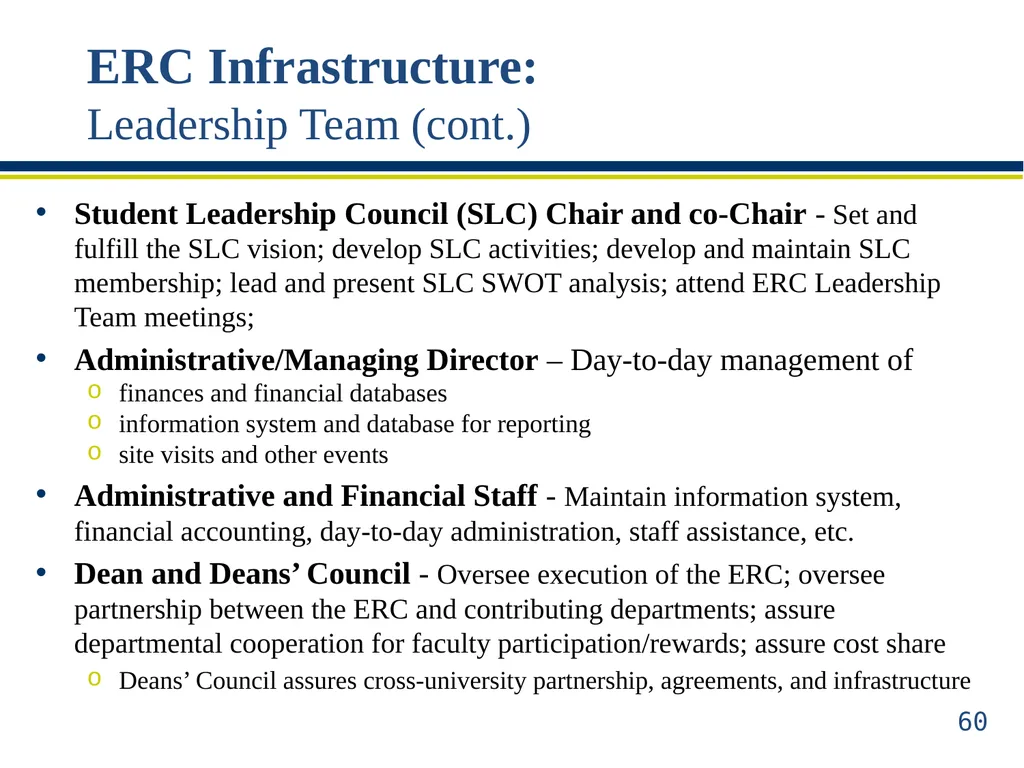
slide60. ERC Infrastructure: Leadership Team (cont.) 60 Student Leadership Council (SLC) Chair and co-Chair - Set and fulfill the SLC vision; develop SLC activities; develop and maintain SLC membership; lead and present SLC SWOT analysis; attend ERC Leadership Team meetings;
Administrative/Managing Director – Day-to-day management of
finances and financial databases
information system and database for reporting
site visits and other events
Administrative and Financial Staff - Maintain information system, financial accounting, day-to-day administration, staff assistance, etc.
Dean and Deans’ Council - Oversee execution of the ERC; oversee partnership between the ERC and contributing departments; assure departmental cooperation for faculty participation/rewards; assure cost share
Deans’ Council assures cross-university partnership, agreements, and infrastructure<br>
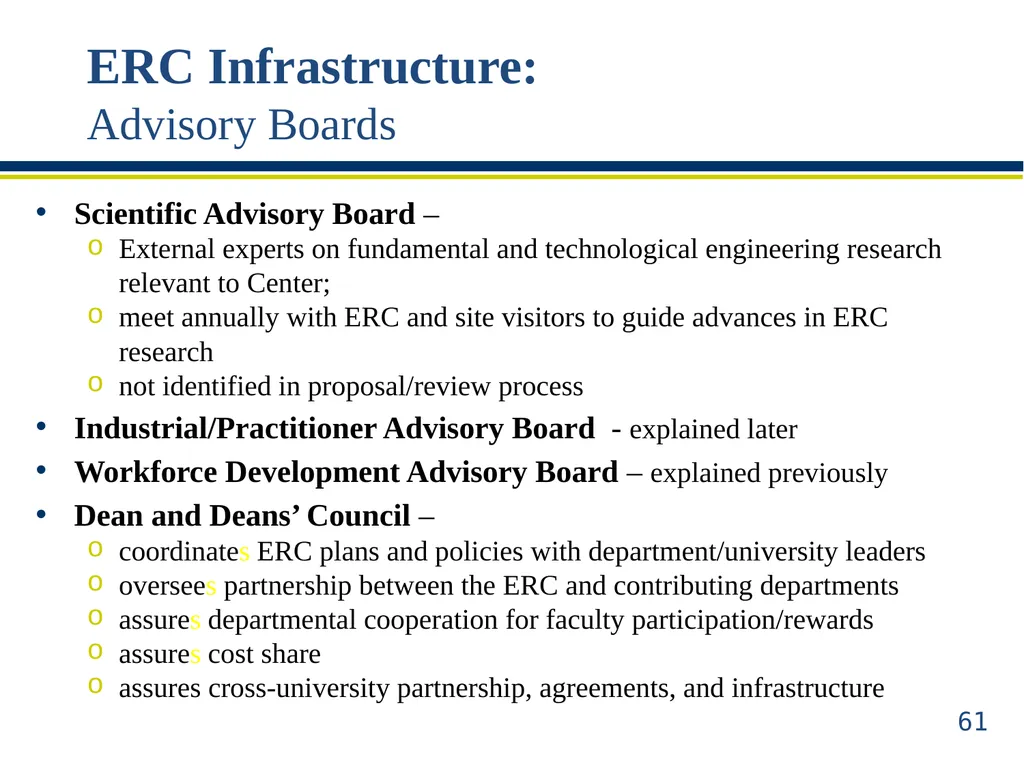
slide61. ERC Infrastructure: Advisory Boards 61 Scientific Advisory Board –
External experts on fundamental and technological engineering research relevant to Center;
meet annually with ERC and site visitors to guide advances in ERC research
not identified in proposal/review process
Industrial/Practitioner Advisory Board - explained later
Workforce Development Advisory Board – explained previously
Dean and Deans’ Council –
coordinates ERC plans and policies with department/university leaders
oversees partnership between the ERC and contributing departments
assures departmental cooperation for faculty participation/rewards
assures cost share
assures cross-university partnership, agreements, and infrastructure<br>
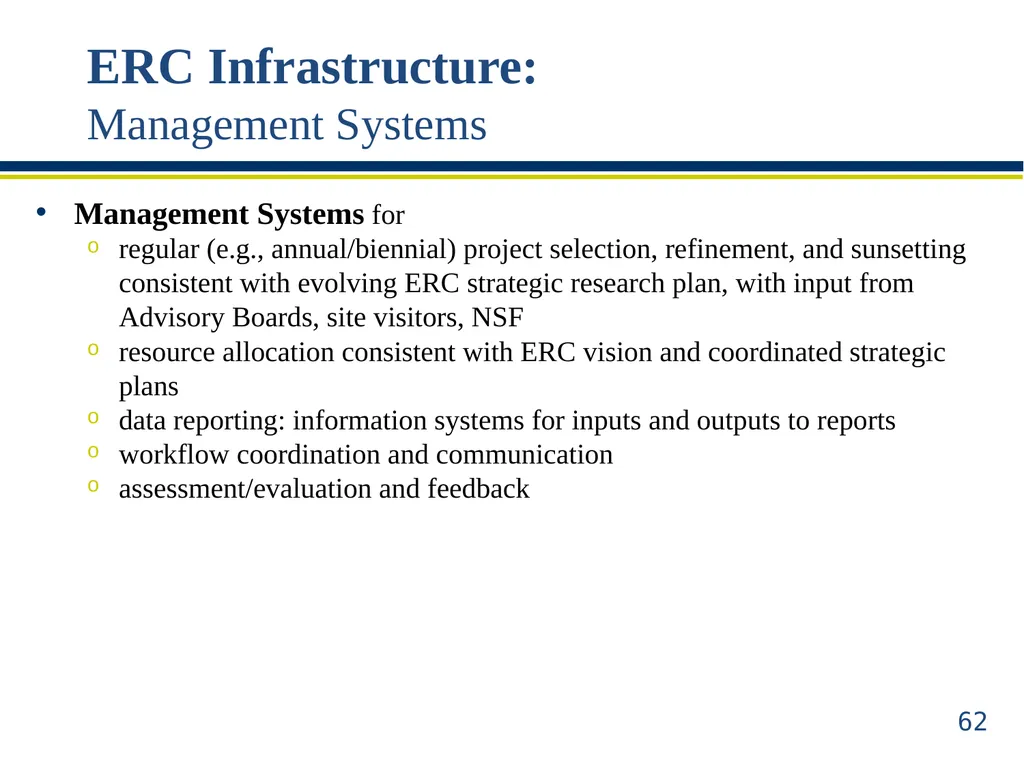
slide62. ERC Infrastructure: Management Systems 62 Management Systems for
regular (e.g., annual/biennial) project selection, refinement, and sunsetting consistent with evolving ERC strategic research plan, with input from Advisory Boards, site visitors, NSF
resource allocation consistent with ERC vision and coordinated strategic plans
data reporting: information systems for inputs and outputs to reports
workflow coordination and communication
assessment/evaluation and feedback<br>
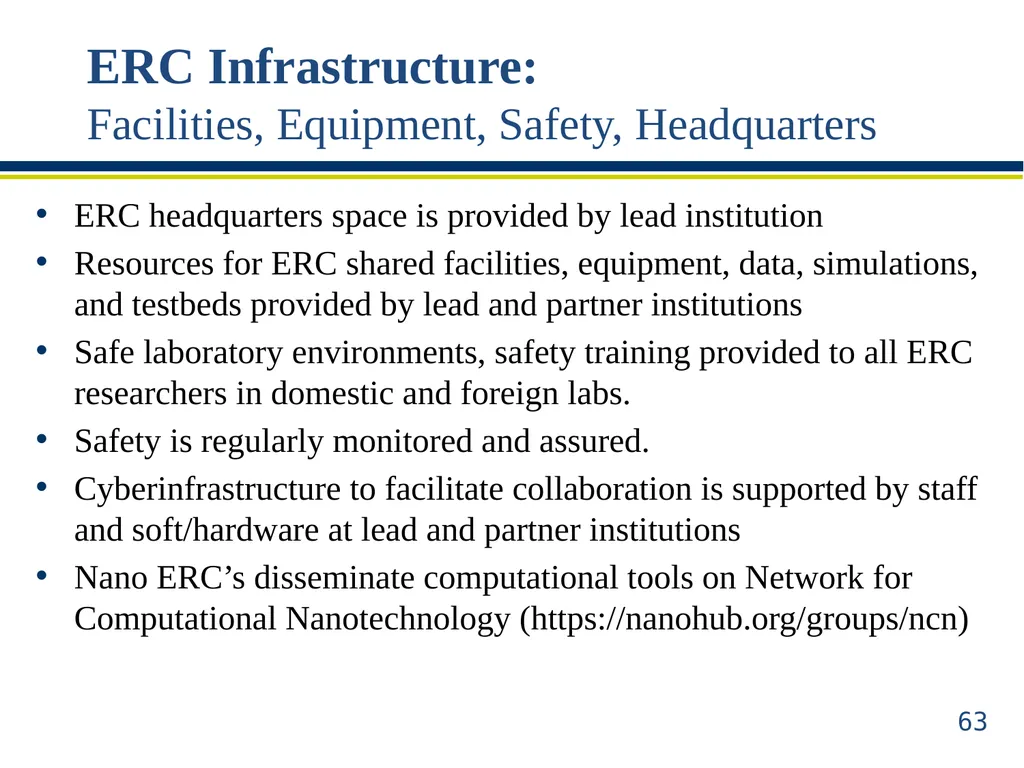
slide63. ERC Infrastructure: Facilities, Equipment, Safety, Headquarters 63 ERC headquarters space is provided by lead institution
Resources for ERC shared facilities, equipment, data, simulations, and testbeds provided by lead and partner institutions
Safe laboratory environments, safety training provided to all ERC researchers in domestic and foreign labs.
Safety is regularly monitored and assured.
Cyberinfrastructure to facilitate collaboration is supported by staff and soft/hardware at lead and partner institutions
Nano ERC’s disseminate computational tools on Network for Computational Nanotechnology (https://nanohub.org/groups/ncn)<br>
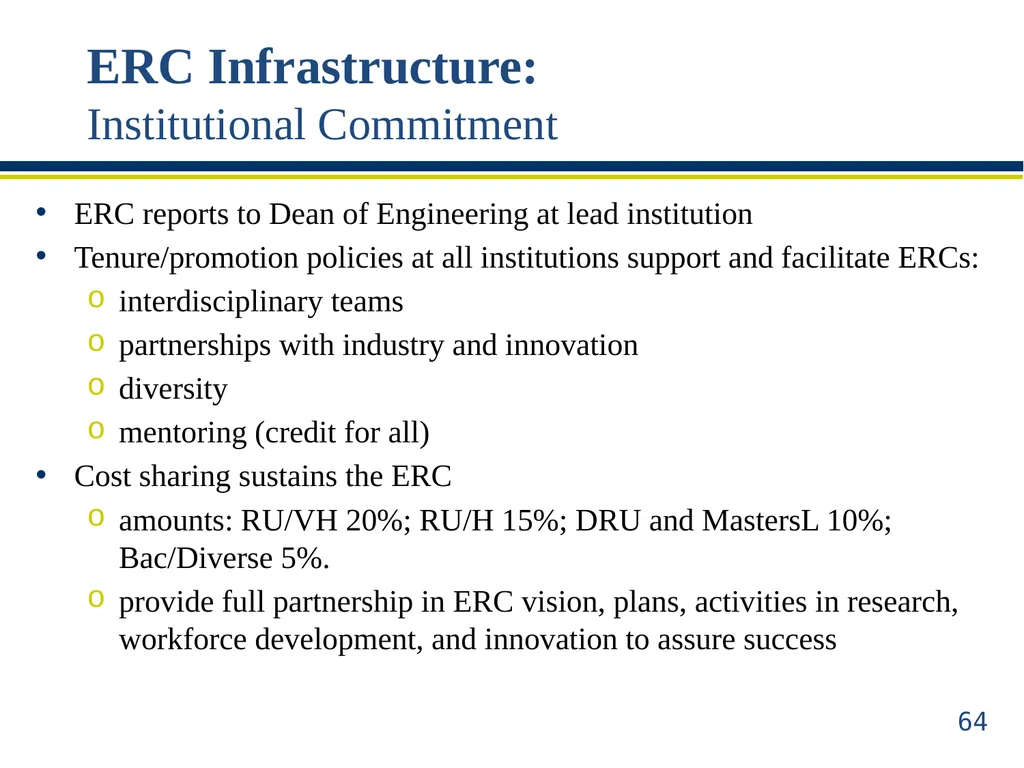
slide64. ERC Infrastructure: Institutional Commitment 64 ERC reports to Dean of Engineering at lead institution
Tenure/promotion policies at all institutions support and facilitate ERCs:
interdisciplinary teams
partnerships with industry and innovation
diversity
mentoring (credit for all)
Cost sharing sustains the ERC
amounts: RU/VH 20%; RU/H 15%; DRU and MastersL 10%; Bac/Diverse 5%.
provide full partnership in ERC vision, plans, activities in research, workforce development, and innovation to assure success<br>
slide65. Infrastructure Q&A 65<br>
slide66. Innovation Ecosystem 66<br>
slide67. ERC Innovation Ecosystem: Purpose Brings industrial/practitioner perspectives to the ERC
Accelerates the transfer and use of ERC-generated knowledge and technology in industry and practice
Links ERC faculty and student researchers to industry 67<br>
slide68. ERC Innovation Ecosystem: Features Membership based collaborative platform, governed by a membership agreement and common IP terms
Firms/practitioners strategically targeted to span the ERC’s technology sector value chain
University and/or state and local government facilitators of innovation and entrepreneurship
Role for translational research in partnership with industry 68<br>
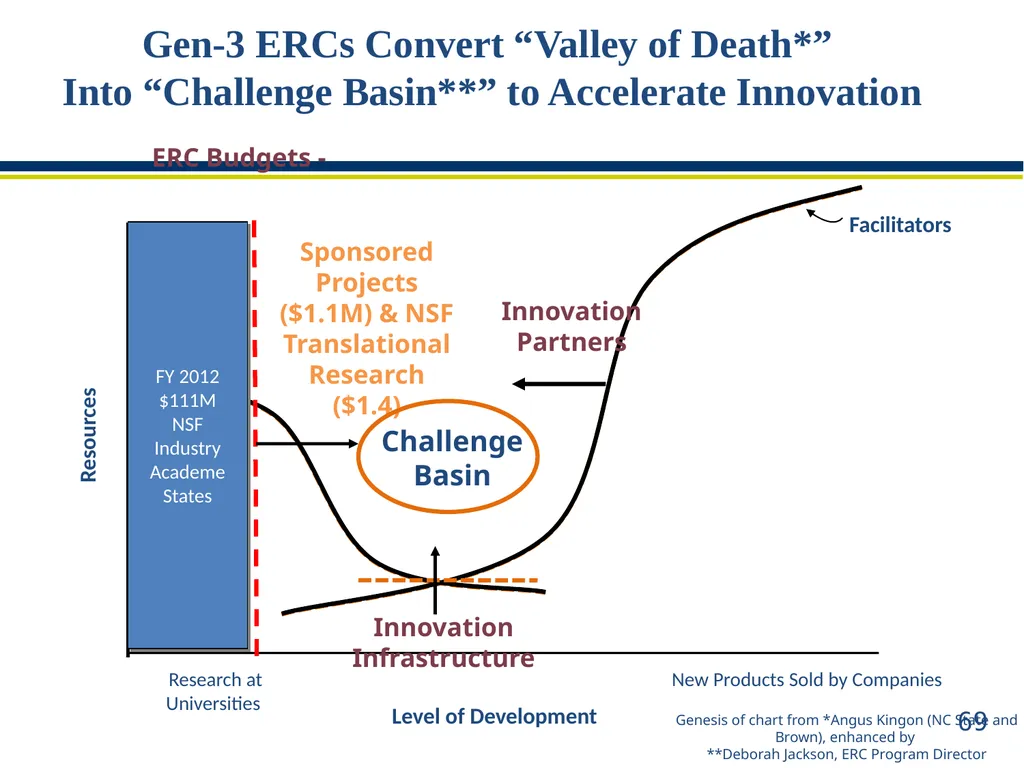
slide69. Resources Research at
Universities New Products Sold by Companies Level of Development Gen-3 ERCs Convert “Valley of Death*”
Into “Challenge Basin**” to Accelerate Innovation Sponsored Projects ($1.1M) & NSF Translational Research ($1.4) Innovation Partners Innovation Infrastructure Genesis of chart from *Angus Kingon (NC State and Brown), enhanced by
**Deborah Jackson, ERC Program Director FY 2012
$111M
NSF
Industry
Academe
States ERC Budgets - 69<br>
slide70. ERC Innovation Ecosystem: Infrastructure Requirements Industrial Liaison Officer
staff member, not faculty, at lead university
develops and cultivates ERC's innovation ecosystem
markets ERC to industry/practitioners, gaining financial support
coordinates industry/practitioner interaction with faculty, students,
manages other partnerships for innovation and translational research program. 70<br>
slide71. ERC Innovation Ecosystem: Infrastructure Requirements (cont.) Industry/Practitioner Advisory Board (IAB)
Key mechanism for industrial/practitioner collaboration for the ERC
Provides input to the ERC Leadership team on project selection and termination
Conducts annual SWOT analysis of the ERC's operations and progress
Meets at least twice a year, including private meeting with NSF site visit team
Scientific Advisory Board (SAB)
Outside experts who are selected by the ERC and meet collectively as a board at least once a year to advise the ERC leadership team
Provides feedback to the ERC Leadership team on research directions/questions and the ERC’s positioning with respect to state-of-the-art
Meets privately with the site visit team for renewal visits (years 3 and 6)
University Policy Board
Coordinate plans and policies with department and university leaders and committees 71<br>
slide72. ERC Innovation Ecosystem: Program Requirements Strategic Innovation Plan
aligned with plans for research, workforce development, and inclusion
identifies relevant market/societal regulations, policies, practices
identifies tangible benchmarks for ERC progress in innovation
targets stakeholders to build competitiveness
positions ERC for disruptive impact in selected industry sector
Stakeholder Community
industry, govt/non-profit practitioners, associations, civil societies, and end users that synergistically implement the ERC vision
Innovation Frameworks
agreements for IPAB membership, technology transfer, intellectual property governance, conflict of interest management, etc.
assure consistency with NSF PAAP and CA-FATC 72<br>
slide73. ERC Innovation Ecosystem: Innovation Partner Commitments State and local government and/or university organizations, or VCs that will:
Accelerate and facilitate innovation
Facilitate success for start-up firms
Provide guidance and training in entrepreneurship 73<br>
slide74. Innovation Ecosystem Q&A 74<br>
Division of Engineering Education and Centers
Engineering Directorate, NSF 1 Guidance for Preliminary Proposal Development Aug 31, 2015 10:00 AM EDT<br>
slide2. Format and Team for the Webinar Gen-3 ERC New Features: NSF 15-589
ENG/EEC Leadership
Proposals
Program/Proposal Guidance - Keith Roper, ERC Leader/EEC
Vision, Strategic Planning, Research - Keith Roper, ERC Leader/EEC
Workforce Development
University – Elliot Douglas, Engineering Education Program Director/EEC
Pre-college – Mary Poats, RET Program Director (PD)/EEC
Infrastructure
Broadening Participation – James Moore, Broadening Participation PD/EEC
Infrastructure - Carmiña Londoño, Engineering Research Centers PD/EEC
Innovation Ecosystem
Deborah Jackson, Engineering Research Centers PD/EEC 2<br>
slide3. NSF 15-589 New Features Three Fundamental Questions
What is the compelling new idea and how does it relate to national needs?
Why is a center necessary to tackle the idea?
How will the ERC's infrastructure integrate and implement research, workforce development and innovation ecosystem development efforts to achieve its vision?
Specific Review Criteria
Integrated Strategic Plans for Research, Workforce Development, Innovation
Leadership: expertise in research, workforce development, and innovation
Diversity Director: experienced in proven activities to create culture of inclusion
Research: impact, benchmarking, partnerships, system-at-scale
Workforce Development: literature-based, inclusive, assessment
Innovation: scale-able, sustainable, community
Infrastructure: plan for community of inclusion 3<br>
slide4. NSF 15-589 New Features Budget Increase
Ramps $250,000 per year from $3.5M (Yr 1) to $4.25M (Yr 4)
Additional features
9 pages (Preliminary Proposal) + 1 page three-plane chart
Open Topic or Nanosystem ERC
Proposal features
Proposed vision: transformative, unique, convergent
Strategic plans: critical path, resources, adaptive
Advisory boards
Workforce Development Advisory Board
Incorporate guidance of advisory boards regularly into strategic management of the Center 4<br>
slide5. New Features Q&A 5<br>
slide6. Engineering Research Centers Program 6<br>
slide7. ERC Program Goals Create a culture in academia that:
Links interdisciplinary scientific discovery to technological innovation
Produces diverse engineering graduates who will be highly effective in industrial practice and creative innovators in a global economy
Partners with industry and other practitioners to develop a healthy innovation ecosystem 7<br>
slide8. ERC Key Features Guiding strategic engineered systems vision that:
joins fundamental research, enabling technology, and transformational engineered systems research to realize proofs of principle and innovation
develops an innovative, globally competitive, and diverse engineering workforce
Strategic plans
motivate and guide the research, education, and innovation programs to achieve the vision
drive selection, integration of research through testbed proofs of principle
Interdisciplinary, systems motivated research program
fundamental and applied research
enabling and systems technology, demonstrated in academic-scaled proof-of-concept test beds; 8<br>
slide9. What’s an Engineered System? A combination of components and elements that work together to perform a useful function
New technology platform for:
new product line or new manufacturing process
transforming public sector, healthcare services, or infrastructure services
Research is designed to:
address fundamental barriers
advance proofs of principle in test beds
incorporate factors effecting system-wide performance (e.g., utility, efficiency, resilience, etc.) 9<br>
slide10. An NSF Engineering Research Center:
A Complex, Interdependent System 10<br>
slide11. Guidance for Proposals 11<br>
slide12. Principal Investigator (PI): Eligibility Requirements Tenured faculty member in an engineering department/school of engineering at the lead university
Ph.D. in engineering; or
Ph.D. in associated field of science with:
Substantial career experience in engineering
Primary appointment in an engineering department or school of engineering
PI and co-PIs: expertise in research, workforce development, and innovation 12<br>
slide13. Lead University: Eligibility Requirements Submission as lead university only by a U.S. University with:
B.S., M.S., and Ph.D. engineering degree programs
Breadth and depth to support proposed vision 13<br>
slide14. Institution Serving Large Numbers of Minority Groups Underrepresented in Engineering Must be lead or partner institution
May classify under Dept of Education guidelines: http://www2.ed.gov/about/offices/list/ocr/edlite-minorityinst.html ; or
Document significant enrollment of minority students (i.e., African Americans, Pacific Islanders, Native Americans, Hispanic Americans, and persons with disabilities who are U.S. citizens of Permanent Residents) who are majoring in engineering studies to qualify; and
Document graduation track record of underrepresented minority groups 14<br>
slide15. Invited Full Proposal: Organizational Requirements Lead and up to four domestic partner universities or colleges (one serving large numbers of underrepresented groups) that commit to cost share and participate in all ERC frameworks
Fee paying industry partners, including practitioner organization partners as appropriate
Long-term pre-college institutional partners
State/local government and/or university/private innovation partners to stimulate innovation and entrepreneurship
Commitment to include participating foreign partners/collaborators (in proposal or future) 15<br>
slide16. Invited Full Proposal: Organizational Options Affiliated universities/colleges/institutions that:
Academic institutions that provide 2 faculty for specific research and/or education tasks
Federal laboratories providing staff for specific tasks (cannot be supported by NSF funds)
Community colleges and/or technical colleges that participate in the education programs 16<br>
slide17. Pre-proposal feedback from NSF: July – Oct 22, 2015 Teleconference with ERC Program Director
Send email to kroper@nsf.gov with 10-sentence summary of ERC engineered system, including the research focus, engineering workforce development program, and innovation ecosystem and 3-plane diagram
You will be contacted by ERC Program Director (PD) to arrange a teleconference with your team for a maximum of 45 minutes.
Send slides (maximum of 10) for discussion in advance. Slides should address the proposed vision, strategic plan, research thrusts, workforce development (education), innovation ecosystem, infrastructure, and 3-plane chart. 17<br>
slide18. Letter of Intent (LOI): Due Sept 25, 2015 Required in Order to Submit a Pre-Proposal
Used by NSF to determine proposal load and form preliminary sets of reviewers
PI may only submit a preliminary proposal, if an LOI is submitted
There will be no official response from NSF regarding the LOI 18<br>
slide19. Letter of Intent (LOI): Submission Requirements Identify one to four participating partner universities
Multiple LOIs may be submitted by lead university
PI (Center Director) may submit only one LOI
No change in partners, PI, or co-PIs between LOI submission and preproposal 19<br>
slide20. PI and Co-PI: Limitations Submitting PI (Center Director) may submit only one LOI and one preliminary proposal
PI is binding after submission of the preliminary proposal
PI may not participate in any other LOI or preliminary proposal, while a PI
Co-PI may participate in more than one LOI or preliminary proposal
No change in PI or Co-PIs between LOI submission and preliminary proposal
Co-PIs may change after acceptance to submit full proposal 20<br>
slide21. Preliminary Proposal: Due Oct 23, 2015 Project Summary (1 page)
Nine-page preliminary proposal
Proposing team
Brief summaries of the vision, research, workforce development (education), innovation ecosystem
1-page 3-plane strategic planning chart
References cited
Biographical sketches
No budget
Supplementary document: Letter of commitment from Dean of Engineering, lead university
No other supporting documents, no lists of firms, etc.
Send PI, Co-PI, and Participant Table to ercintent@nsf.gov 21<br>
slide22. Preliminary Proposal: Organizational Requirements Lead and up to four partner institutions committed to participate in the research and education programs of the ERC
Minimum of three faculty and three student participants must be at each partner institution
No other partners and no member firms at this stage
Lead is binding throughout the process 22<br>
slide23. Preliminary Proposal: Submission Limits No limit on the number of preliminary proposals a university may submit
The PI may submit only one preliminary proposal
If the PI leaves the submitting university, the proposal remains with the submitting university 23<br>
slide24. Preliminary and Invited Full Proposal: Submission and Award Limits University with more than one funded ERC, in ERC classes of 2006-2015 by October 1, 2016, may not submit a preliminary proposal
But, it may be a partner in other preliminary ERC proposals
No limit on the role of the lead university as a partner in other proposals
Lead university may receive only one award as lead in NSF 15-589 24<br>
slide25. Preliminary Proposal: Review Process LOIs to be used to form panels around technology areas
Panels to be finalized upon receipt of the proposals
Proposals to be sent out for review in Oct-Dec 2015
Panels to be held in December 2015
Invitations for Full proposals to be sent in January - February 2016
Full proposals are due June 16, 2016
Up to four awards will be made, depending on budget
Awards to be notified: Sept. 2017). 25<br>
slide26. Program Level Overview/Guidance for Proposals Q&A 26<br>
slide27. Vision, Strategic Plan, Research 27<br>
slide28. ERC Engineered Systems Vision: Topic Area Open Topic ERC
Engineered system(s) chosen by the PI
Nanosystems ERC
Engineered system(s) chosen by the PI
Vision requires a substantial body of new fundamental nanoscale research
Scaling from fundamentals to devices, components, and systems to assure sustained nano-enabled functionality
No preference at NSF for either topic area 28<br>
slide29. ERC Engineered Systems Vision: Qualities and Best Practices Transformative: discoveries and basic research drive compelling advances toward an emerging, potentially revolutionary technology system
Potential to significantly change current practices, establish new industries, transform public sector services, healthcare, or the infrastructure, etc.
Could increase national competitiveness or contribute to the solution of a major societal problem with national or, perhaps, international impact
Convergent: Envisioned results are achievable in 10 years by strategic alignment of nascent discoveries, existing capabilities, and resources 29<br>
slide30. ERC Engineered Systems Vision: What doesn’t qualify? Not unique:
Engineered systems topics that significantly overlap an ongoing or graduated ERC do not qualify
Discussion of added value relative to achievements and/or plans of other related large centers is lacking
Added value relative to achievements and/or plans of other large centers is not significant
Proposals focused on transformations of engineering education as an engineered system do not qualify
However, proposals that address educational technology as an engineered system would qualify 30<br>
slide31. ERC Vision, Strategy, and Research: What doesn’t fit the ERC model? Insufficient resources (e.g., knowledge/technology base, personnel, infrastructure, etc.) to integrate research with enabling technology, reach milestones, and realize proof of principles in systems test beds within 10 years.
Unbalanced focus on exploration of a phenomena, discovery, technology improvement, or innovation without clear systems integration and/or end-to-end strategic planning.
Proposed work is incremental without compelling transformational impact - too applied.
State of the art advances in basic research or commercial capabilities are unanticipated, overlooked, or not integrated into planned resources/activities to achieve vision. 31<br>
slide32. Preliminary Proposal: 9-Page Project Description Requirements (p.23) Infrastructure: PI/co-PI expertise in discovery, workforce development, innovation
Ten-year vision to link discovery to transformational engineered system and its impact
Strategic Research Plan
Identifies barriers, gaps, and requirements based on review of state of the art
Leverages recent internal & external breakthroughs to achieve vision
Aligns resources to support critical path actions, and adapts, to disrupt state of the art
Research: addresses barriers to achieve ERC vision at fundamental, technological, and proof-of-concept, test-bed levels.
Workforce Development: literature-based, inclusive, K-grad approach to achieve goals (e.g., skill sets) via curricula and activities that evolve based on assessment
Innovation Ecosystem: Strategic selection of sectors/firms, specification of roles of industry/ practitioner members, and cultivation of innovation in the ERC.
Do not list potential or committed industrial or other supporters
Dean’s Letter plus required NSF proposal documents. No other supporting letters. 32<br>
slide33. Preliminary Proposal: Preparing the Proposal Study the guidance and full proposal requirements (pp. 5-6, 15, 23-24)
Summarize your plan in the light of the requirements
Include your 3-plane strategic planning chart
download: http://www.erc-assoc.org/funding_opportunities 33<br>
slide34. ERC Strategic Planning: Organizing the Research Program Context for ERC vision: barriers, knowledge gaps, and requirements are
identified by comprehensive state of the art analysis
informed by environmental, societal, and other factors
Critical path: resources allocated to leverage internal/external discoveries to achieve quantifiable milestones to realize system goals, ERC vision
10-yr milestone chart plots deliverables and interdependencies
Resources: defines required support for interdisciplinary projects and thrusts is necessary to bridge barriers and gaps to achieve systems requirements.
Guides resource allocation to reach technology and systems-level milestones (via metrics, figures of merit) and deliverables.
Adaptive: provides flexibility to evolve as discoveries and advances are made and new barriers/challenges arise
Requirements and barriers motivate selection, refining, and pruning of projects at fundamental, enabling technology, and systems levels 34<br>
slide35. QoLT 3-plane chart Barriers Enabling Technologies Technology Base Barriers Fundamental Knowledge Knowledge Base Systems Technology Integration Requirements Stakeholders Barriers Technology Elements Fundamental Insights Technology Elements Products & Outcomes ERC Strategic Framework: Proposal #, PI Name, ERC Name, Lead University Name System Requirements Test Bed(s) Systems Research Systems Research Test Beds Enabling Technology Research Enabling Technology Research Test Bed(s) Test Bed(s) Test Beds Test Beds 35<br>
slide36. ERC Research Program: Thrusts and Test Beds Thrusts: integrate fundamental and enabling technology research into clusters of interdependent, aligned projects – a research thrust.
Test Beds: guide research activity to bring technology to proofs of principle that realize the ERC vision
System test beds prove ERC-wide technology advances
Intra-thrust testbeds prove thrust-wide enabling technology advances
Both motivated by ERC’s strategic research plan
Projects selected to address ERC’s research/technology barriers, gaps, and requirements of engineered systems
Interdisciplinary teams form across partner institutions
Interdependence among projects and across thrusts 36<br>
slide37. ERC Research Program: Thrust Level Pre-Proposal Content Justify basic and enabling technology research in light of
state of the art: commercially available and basic research
barriers, gaps, or requirements the thrust will address
Provide examples of
research projects and methods to be used
recent and targeted breakthroughs achievable in the context of the ERC’s milestones
Clarify role of the thrust in
contributing to enabling and systems technology test beds
interdependency and alignment with other thrusts 37<br>
slide38. ERC Test Bed: Qualities and Best Practices Enable proofs of principle at
technology level (within or across thrusts)
engineered systems level (ERC-wide)
Test beds often need technical staff to build and operate equipment/infrastructure
Test beds are a critical part of the education and innovation ecosystem of an ERC
Systems test beds need leaders to set goals, set deliverables from research, assure integration, and realize proofs of principle 38<br>
slide39. Vision, Strategic Plan, Research Q&A 39<br>
slide40. Engineering Workforce Development University and Pre-College Education 40<br>
slide41. ERC Workforce Development: Objectives and Features University Education: Infuses ERC knowledge into curriculum to prepare undergraduate and graduate students who are:
knowledgeable in industrial practice, e.g., adept team workers, experienced in advancing technology, ethical, and entrepreneurial
creative, innovative, adept communicators, and life-long learners
able to integrate knowledge across disciplines to advance technology
experienced in working in non-U.S. research cultures
Long-term pre-college Partnerships: Up to five institutions whose STEM faculty:
participate in structured engineering learning and activities
integrate ERC-based course modules into their curriculum
attract underrepresented groups to engineering research experiences 41<br>
slide42. ERC University Education: Infrastructure Requirements Workforce Development Program Director
member of ERC leadership team
staff or faculty experienced in research-based pedagogical and experiential approaches to student development
leads planning, implementation, and refinement of workforce development in university and pre-college programs
Workforce Development Advisory Board (WDAB)
external experts in workforce development, broadening participation, and education
meet annually with Center and site visit team to provide guidance to ERC workforce development plan, activities, and advances 42<br>
slide43. ERC University Education: Program Requirements Strategic Education Plan
aligned with plans for research, innovation, and inclusion
identifies research-based pedagogical and experiential approaches to achieve objectives of ERC workforce development
organizes integrated efforts to produce ERC graduates that meet objectives of the ERC university and pre-college programs
coordinates interactions between ERC, WDAB, community/technical colleges to attract and graduate minority students
Global Exchange
Students conduct ERC-relevant research in industry and foreign labs
Cyberinfrastructure and student experiences enable rapid translation of ERC results across the ERC, innovation ecosystem, and nation 43<br>
slide44. ERC University Education: Program Requirements Skill Sets
ERC develops technical and transferable professional skills of ERC students
identifies research-based curricula, activities, mentors, etc. to impart these skills
1 undergraduate student per 2 graduate students to be trained in labs
Curricular Impact
modules, content, certificates, new degree programs derived from ERC
all partner institutions infuse engineering curricula with ERC experiences,
Summer REU program for non-ERC students. Minimum $42K/yr support and 6 students enrolled 44<br>
slide45. ERC Pre-college Education: Program Requirements Engagement: innovative best practices and effective efforts to
teach engineering concepts derived from ERC research
engage ERC faculty and students to stimulate K-12 interest in engineering careers and increase diversity
support P-12 faculty development to sustain pre-college teaching of engineering concepts
Partnership: up to 5 pre-college institutions near ERC that
support engineering research education and experiences for their faculty and students
introduce high school students to research in university labs
involve K-CC STEM faculty in RET program to experience research
sustain follow-up to ensure RET experience is translated to K-CC curricula 45<br>
slide46. ERC Assessment: Program Requirements Smart, measurable, attainable, realistic, and timely goals identified at Graduate and Pre-college levels
External formative and summative evaluation of progress and achievement of goals within Center lifetime.
External evaluations and Workforce Development Advisory Board feedback are used regularly to improve workforce development program
Full proposal requires institutional review board approval 46<br>
slide47. Engineering Workforce Development Q&A 47<br>
slide48. Broadening Participation 48<br>
slide49. ERC Culture of Inclusion: Program Requirements Vision
Compelling path to broaden participation among groups underrepresented in engineering, exceeding national averages
Inclusivity and diversity among faculty, students, and staff at all levels
Lead and all partner institutions cultivate inclusivity and diversity
Strategic Inclusion Plan
aligned with plans for research, education, and innovation
identifies gaps, barriers, and requirements for inclusive participation
establishes goals, appropriate milestones, actionable plans
partners with existing programs and offices at lead and partner institutions to achieve positive outcomes 49<br>
slide50. ERC Culture of Inclusion: Infrastructure Requirements Diversity Director
member of ERC leadership team
staff or faculty experienced in the development, implementation, and assessment of proven activities to create culture of inclusion
leads recruitment-to-graduation of underrepresented groups in engineering fields among ERC participants
Workforce Development Advisory Board (WDAB)
includes external expert(s) in broadening participation
meets annually with Center and site visit team to provide guidance to achieve objectives of ERC Culture of Inclusion 50<br>
slide51. ERC Diversity: Climate of Inclusion and Success for All Leadership, faculty, and students involved in an ERC are expected to be diverse in gender, race, and ethinicity (i.e., African Americans, Pacific Islanders, Native Americans, Hispanic Americans, and persons with disabilities who are U.S. citizens of Permanent Residents) at levels that exceed academic engineering-wide averages
At least one partner institution serves and graduates large numbers of students majoring in engineering fields who are from underrepresented groups
All partner institutions are responsible for contributing to the diversity of the ERC
Foreign partners must respect the diversity of the ERC’s faculty and students and provide inclusive research/education environments 51<br>
slide52. Women in ERCs (FY 2006–2014) 52 NOTES:
Data from centers are not included for years in which the center entered demographic data by institution rather than per person.
Both ERC data and national statistics are for U.S. citizens and permanent residents only.
Undergraduates include REU students.
The percentages of women are calculated out of the total number of U.S. citizens and permanent residents, including personnel who did not report gender.
ASEE data are not yet available for 2014 and were not collected for postdoctoral for 2011–2013.
The percentages of personnel who did not report gender are as follows: 2009: 4.26%, 2010: 5.15%, 2011: 7.54%, 2012: 7.55%, 2013: 7.66%, 2014: 7.34%.<br>
slide53. Hispanics in ERCs (FY 2006–2014)*,** * Does not include centers from the Earthquake Technology Sector ** Hispanics in ERCs data are for U.S. Citizens and Permanent Residents only. 53<br>
slide54. Underrepresented Racial Minorities in ERCs (FY 2006–2014)*,** * Does not include centers from the Earthquake Technology Sector ** Underrepresented Minorities in ERCs data are for U.S. Citizens and Permanent Residents only. 54<br>
slide55. Persons With Disabilities in ERCs (FY 2006–2014)*, ** * Does not include centers from the Earthquake Technology Sector ** The ASEE national engineering percentage for master's students with disabilities is actually a percentage of graduate students (master's and doctoral students). 55<br>
slide56. Broadening Participation Q&A 56<br>
slide57. Infrastructure 57<br>
slide58. ERC Infrastructure: Program requirements Configuration
University partners and collaborators (domestic and foreign)
Affiliated U.S. institutions, e.g., federal labs, centers, institutes for innovation, manufacturing, education, etc.
Leadership Team
Advisory Boards
Culture of Inclusion
Organization and Management Systems
Facilities, Equipment, Safety, and Headquarters
Institutional Commitment 58<br>
slide59. ERC Infrastructure: Leadership Team Director and Deputy - Set and fulfill vision; lead strategic planning; build a diverse, committed team; allocate funds; complete reporting
Thrust Leaders - Set thrust goals aligned with vision and plan; manage teams of faculty and students, integrate projects in thrust; deliver across thrusts
Research and Education Teams - Faculty and students who carry out research and education projects
University Education Leader - Sets vision and strategic plan; manages faculty and students to achieve goals; coordinates assessment; builds sustained partnership with departments
Diversity Director- develops, implements, and assesses proven activities to create a culture of inclusion and recruit/retain underrepresented groups in engineering fields in all partner institutions.
Industrial Collaboration and Innovation Leader - Sets strategic plan to build and nurture innovation ecosystem; manages agreement and IP process; builds and maintains membership and support; manages role of innovation partners and small firms in translational research 59<br>
slide60. ERC Infrastructure: Leadership Team (cont.) 60 Student Leadership Council (SLC) Chair and co-Chair - Set and fulfill the SLC vision; develop SLC activities; develop and maintain SLC membership; lead and present SLC SWOT analysis; attend ERC Leadership Team meetings;
Administrative/Managing Director – Day-to-day management of
finances and financial databases
information system and database for reporting
site visits and other events
Administrative and Financial Staff - Maintain information system, financial accounting, day-to-day administration, staff assistance, etc.
Dean and Deans’ Council - Oversee execution of the ERC; oversee partnership between the ERC and contributing departments; assure departmental cooperation for faculty participation/rewards; assure cost share
Deans’ Council assures cross-university partnership, agreements, and infrastructure<br>
slide61. ERC Infrastructure: Advisory Boards 61 Scientific Advisory Board –
External experts on fundamental and technological engineering research relevant to Center;
meet annually with ERC and site visitors to guide advances in ERC research
not identified in proposal/review process
Industrial/Practitioner Advisory Board - explained later
Workforce Development Advisory Board – explained previously
Dean and Deans’ Council –
coordinates ERC plans and policies with department/university leaders
oversees partnership between the ERC and contributing departments
assures departmental cooperation for faculty participation/rewards
assures cost share
assures cross-university partnership, agreements, and infrastructure<br>
slide62. ERC Infrastructure: Management Systems 62 Management Systems for
regular (e.g., annual/biennial) project selection, refinement, and sunsetting consistent with evolving ERC strategic research plan, with input from Advisory Boards, site visitors, NSF
resource allocation consistent with ERC vision and coordinated strategic plans
data reporting: information systems for inputs and outputs to reports
workflow coordination and communication
assessment/evaluation and feedback<br>
slide63. ERC Infrastructure: Facilities, Equipment, Safety, Headquarters 63 ERC headquarters space is provided by lead institution
Resources for ERC shared facilities, equipment, data, simulations, and testbeds provided by lead and partner institutions
Safe laboratory environments, safety training provided to all ERC researchers in domestic and foreign labs.
Safety is regularly monitored and assured.
Cyberinfrastructure to facilitate collaboration is supported by staff and soft/hardware at lead and partner institutions
Nano ERC’s disseminate computational tools on Network for Computational Nanotechnology (https://nanohub.org/groups/ncn)<br>
slide64. ERC Infrastructure: Institutional Commitment 64 ERC reports to Dean of Engineering at lead institution
Tenure/promotion policies at all institutions support and facilitate ERCs:
interdisciplinary teams
partnerships with industry and innovation
diversity
mentoring (credit for all)
Cost sharing sustains the ERC
amounts: RU/VH 20%; RU/H 15%; DRU and MastersL 10%; Bac/Diverse 5%.
provide full partnership in ERC vision, plans, activities in research, workforce development, and innovation to assure success<br>
slide65. Infrastructure Q&A 65<br>
slide66. Innovation Ecosystem 66<br>
slide67. ERC Innovation Ecosystem: Purpose Brings industrial/practitioner perspectives to the ERC
Accelerates the transfer and use of ERC-generated knowledge and technology in industry and practice
Links ERC faculty and student researchers to industry 67<br>
slide68. ERC Innovation Ecosystem: Features Membership based collaborative platform, governed by a membership agreement and common IP terms
Firms/practitioners strategically targeted to span the ERC’s technology sector value chain
University and/or state and local government facilitators of innovation and entrepreneurship
Role for translational research in partnership with industry 68<br>
slide69. Resources Research at
Universities New Products Sold by Companies Level of Development Gen-3 ERCs Convert “Valley of Death*”
Into “Challenge Basin**” to Accelerate Innovation Sponsored Projects ($1.1M) & NSF Translational Research ($1.4) Innovation Partners Innovation Infrastructure Genesis of chart from *Angus Kingon (NC State and Brown), enhanced by
**Deborah Jackson, ERC Program Director FY 2012
$111M
NSF
Industry
Academe
States ERC Budgets - 69<br>
slide70. ERC Innovation Ecosystem: Infrastructure Requirements Industrial Liaison Officer
staff member, not faculty, at lead university
develops and cultivates ERC's innovation ecosystem
markets ERC to industry/practitioners, gaining financial support
coordinates industry/practitioner interaction with faculty, students,
manages other partnerships for innovation and translational research program. 70<br>
slide71. ERC Innovation Ecosystem: Infrastructure Requirements (cont.) Industry/Practitioner Advisory Board (IAB)
Key mechanism for industrial/practitioner collaboration for the ERC
Provides input to the ERC Leadership team on project selection and termination
Conducts annual SWOT analysis of the ERC's operations and progress
Meets at least twice a year, including private meeting with NSF site visit team
Scientific Advisory Board (SAB)
Outside experts who are selected by the ERC and meet collectively as a board at least once a year to advise the ERC leadership team
Provides feedback to the ERC Leadership team on research directions/questions and the ERC’s positioning with respect to state-of-the-art
Meets privately with the site visit team for renewal visits (years 3 and 6)
University Policy Board
Coordinate plans and policies with department and university leaders and committees 71<br>
slide72. ERC Innovation Ecosystem: Program Requirements Strategic Innovation Plan
aligned with plans for research, workforce development, and inclusion
identifies relevant market/societal regulations, policies, practices
identifies tangible benchmarks for ERC progress in innovation
targets stakeholders to build competitiveness
positions ERC for disruptive impact in selected industry sector
Stakeholder Community
industry, govt/non-profit practitioners, associations, civil societies, and end users that synergistically implement the ERC vision
Innovation Frameworks
agreements for IPAB membership, technology transfer, intellectual property governance, conflict of interest management, etc.
assure consistency with NSF PAAP and CA-FATC 72<br>
slide73. ERC Innovation Ecosystem: Innovation Partner Commitments State and local government and/or university organizations, or VCs that will:
Accelerate and facilitate innovation
Facilitate success for start-up firms
Provide guidance and training in entrepreneurship 73<br>
slide74. Innovation Ecosystem Q&A 74<br>