ESFEuroCleftNet Project Overview on Oligo Pulldown Assay September 9th, 2014 F. Conte Oligo pulldown assay What is it? Why do we use it? The DNA pulldown assay is a method used to selectively detecting all the DNA-binding proteins which
"ESF/EuroCleftNet Project Overview on Oligo" is the property of its rightful owner. Permission is granted to
download and print the materials on this website for personal, non-commercial use only, and to display it
on your personal computer provided you do not modify the materials and that you retain all copyright
notices contained in the materials. By downloading content from our website, you accept the terms of this
agreement.
Presentation Transcript
01
ESF/EuroCleftNet Project Overview on Oligo Pulldown Assay September 9th, 2014
F. Conte<br>
02
Oligo pulldown assay What is it? Why do we use it? The DNA pulldown assay is a method used to selectively detecting all the DNA-binding proteins which bind a specific sequence of DNA.
Typically, the DNA oligo is labeled with biotin, useful after the incubation with the nuclear extract for recovering the oligo and all the proteins bound on it by using beads coated with streptavidin.
After the separation, the peptides bound to the sequence are eluted from the oligo and analyzed by: A) Western blot;
or
B) mass spectrometry.<br>
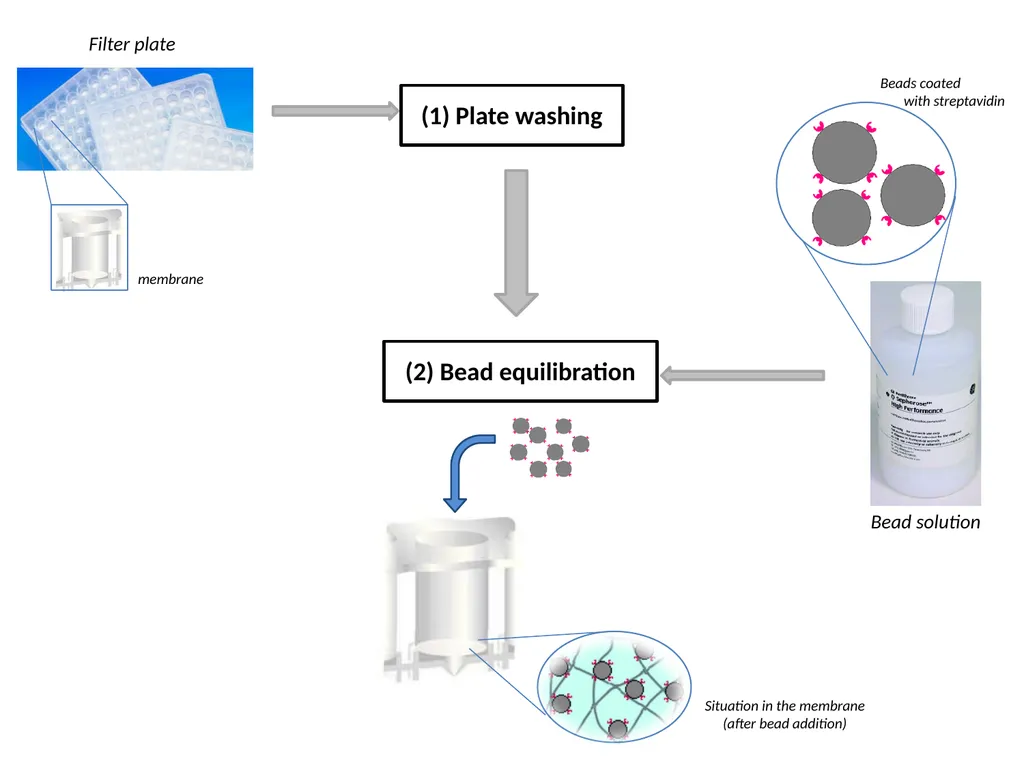
Filter plate membrane (1) Plate washing (2) Bead equilibration Bead solution Beads coated
with streptavidin Situation in the membrane (after bead addition)<br>
05
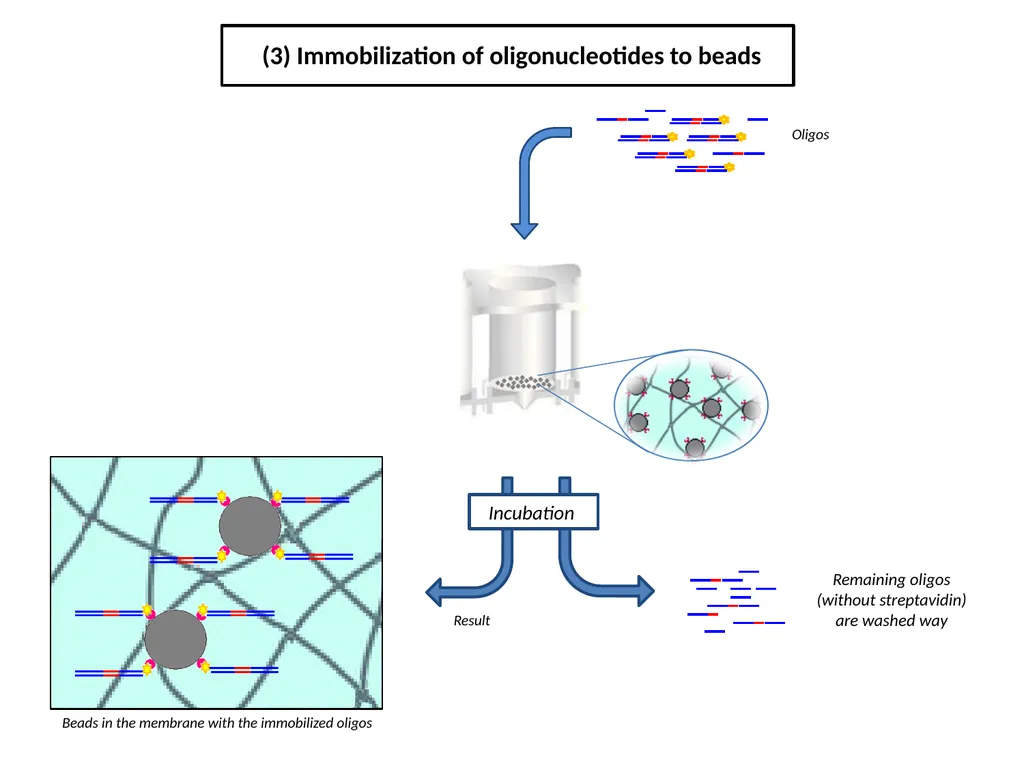
(3) Immobilization of oligonucleotides to beads Result Remaining oligos
(without streptavidin)
are washed way Incubation Oligos Beads in the membrane with the immobilized oligos<br>
06
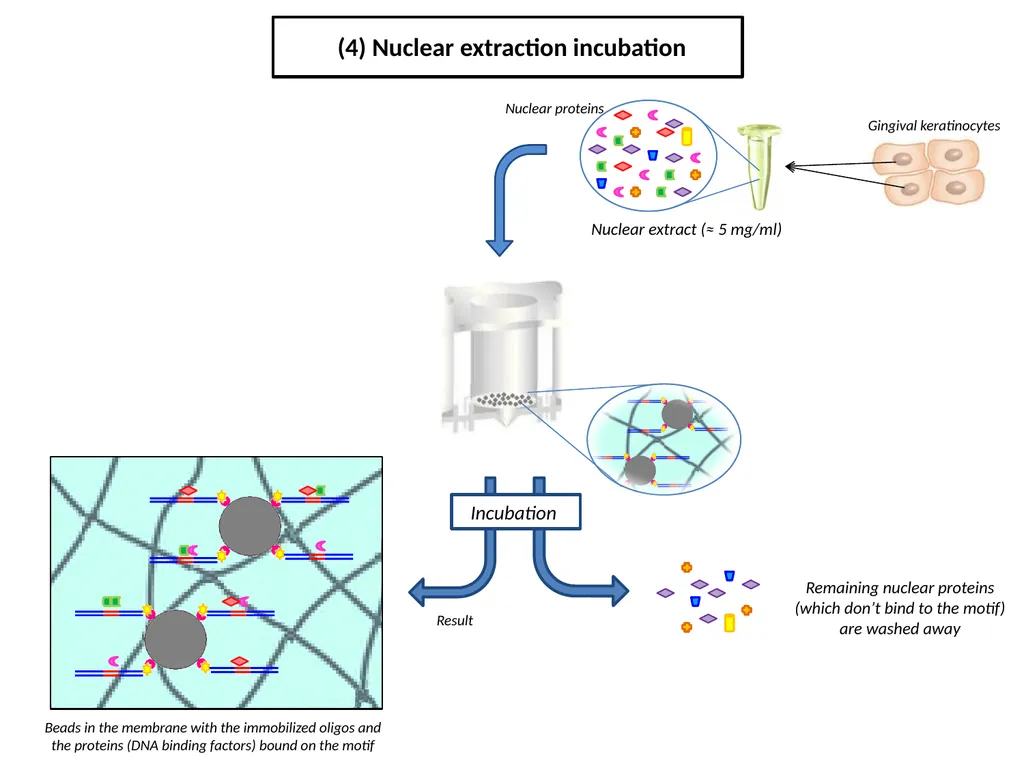
(4) Nuclear extraction incubation Result Remaining nuclear proteins (which don’t bind to the motif)
are washed away Gingival keratinocytes Nuclear extract (≈ 5 mg/ml) Incubation Beads in the membrane with the immobilized oligos and the proteins (DNA binding factors) bound on the motif Nuclear proteins<br>
07
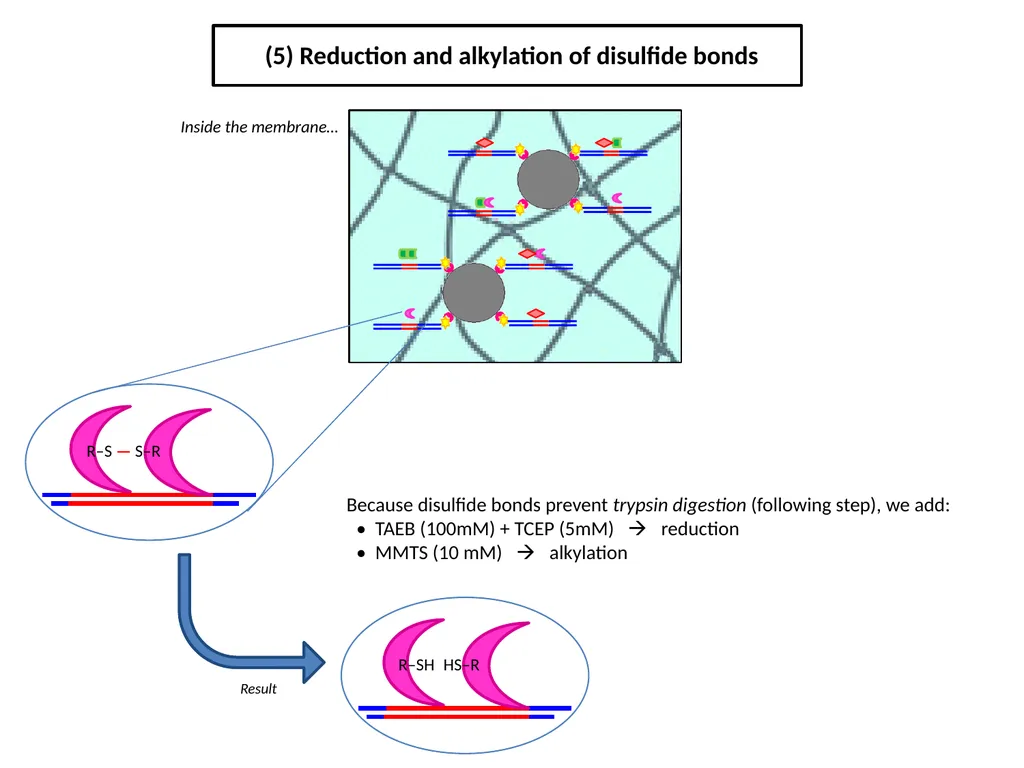
(5) Reduction and alkylation of disulfide bonds R–S — S–R Because disulfide bonds prevent trypsin digestion (following step), we add:
• TAEB (100mM) + TCEP (5mM) reduction
• MMTS (10 mM) alkylation R–SH HS–R Inside the membrane… Result<br>
08
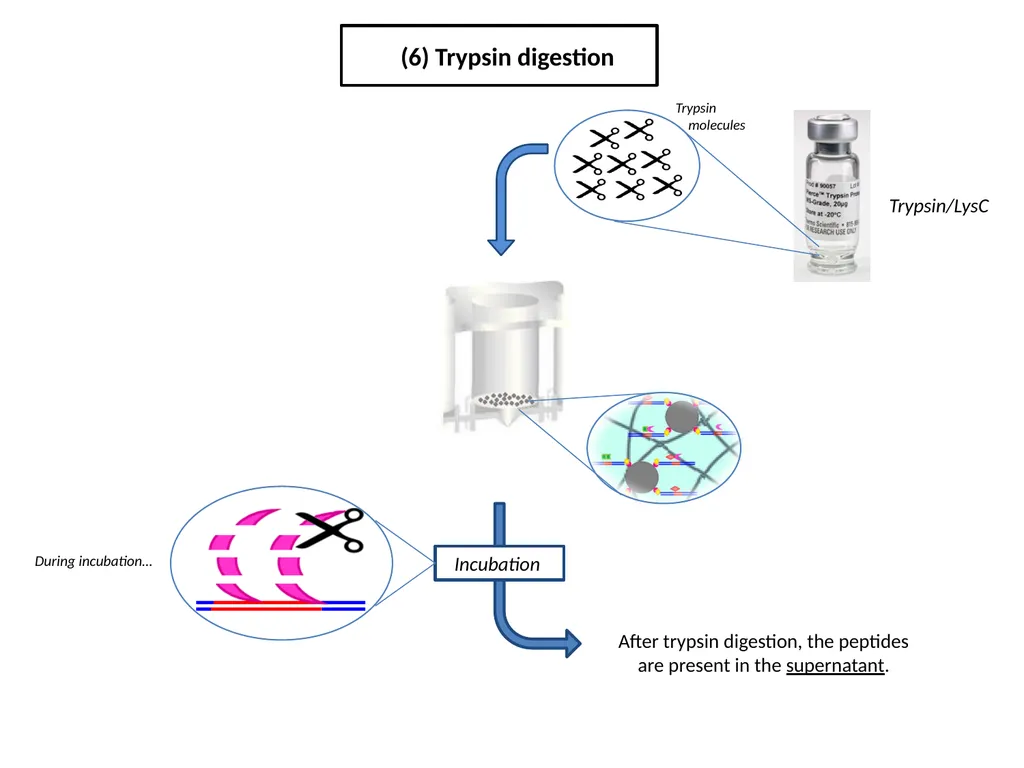
(6) Trypsin digestion Incubation After trypsin digestion, the peptides are present in the supernatant. Trypsin/LysC Trypsin
molecules During incubation…<br>
09
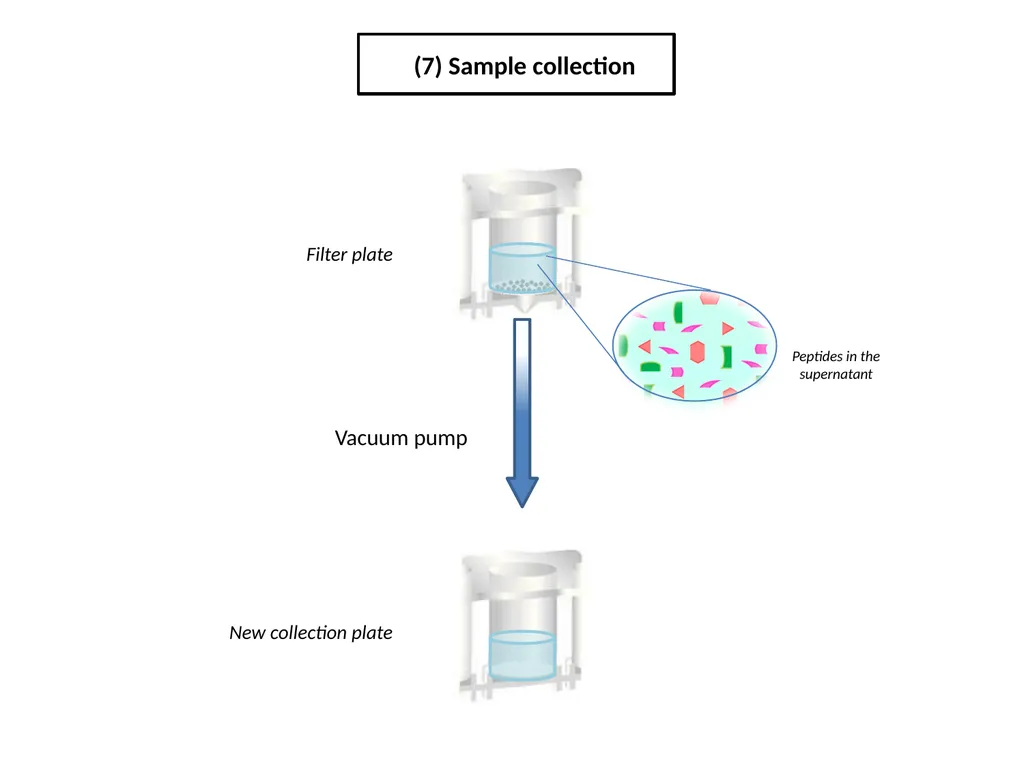
(7) Sample collection Vacuum pump Filter plate New collection plate Peptides in the supernatant<br>
10
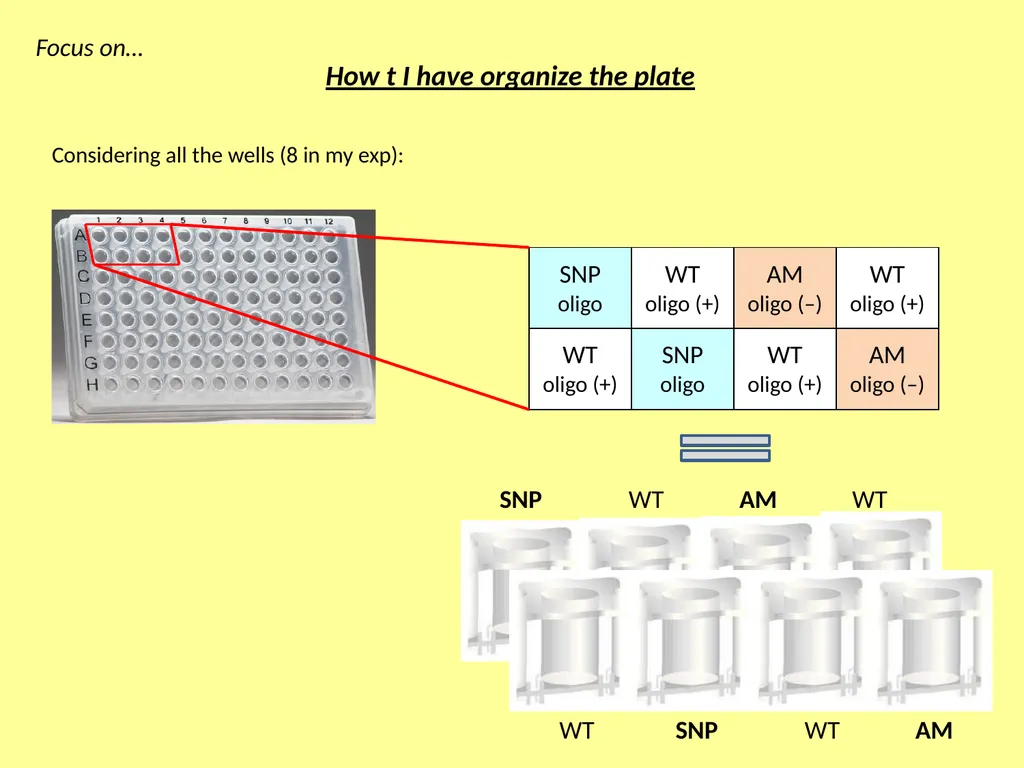
How t I have organize the plate Considering all the wells (8 in my exp): Focus on… WT SNP WT AM SNP WT AM WT<br>
11
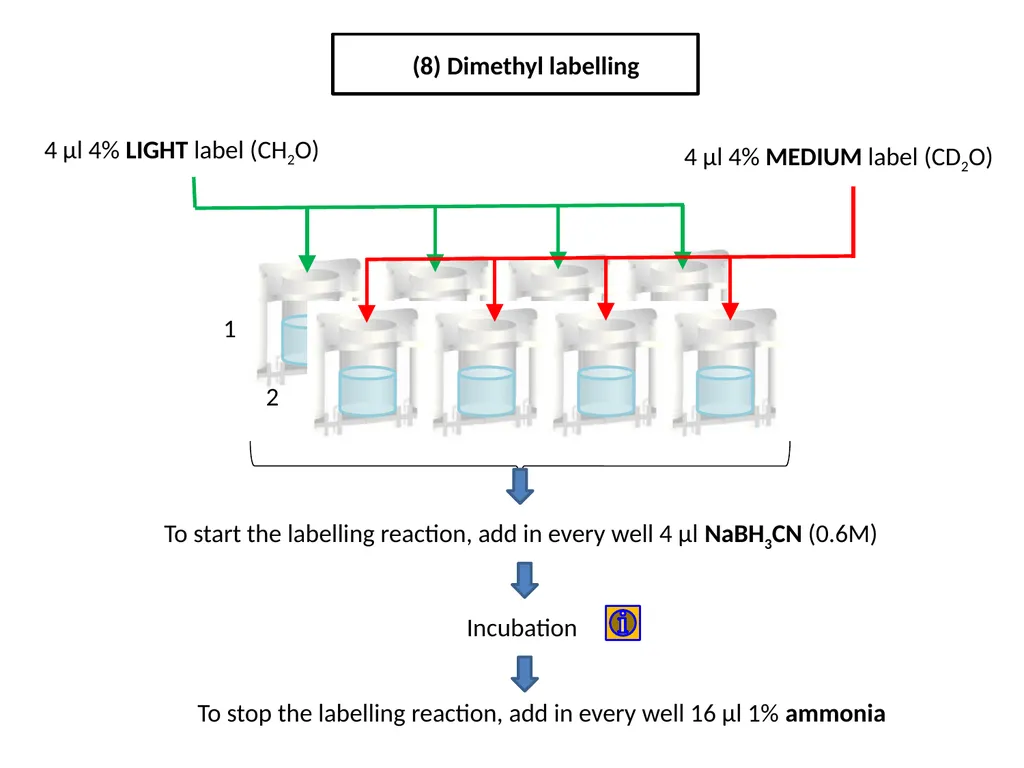
(8) Dimethyl labelling 4 µl 4% LIGHT label (CH2O) 4 µl 4% MEDIUM label (CD2O) To start the labelling reaction, add in every well 4 µl NaBH3CN (0.6M) Incubation To stop the labelling reaction, add in every well 16 µl 1% ammonia 1 2<br>
12
What happens during the incubation Focus on… Normal amino acid
structure: Light labelled amino acid structure: OH2C OH2C Medium labelled amino acid structure: OD2C OD2C Example: peak patterns of the same peptide, bound with LIGHT label (on the left) and with MEDIUM label (on the right).<br>
13
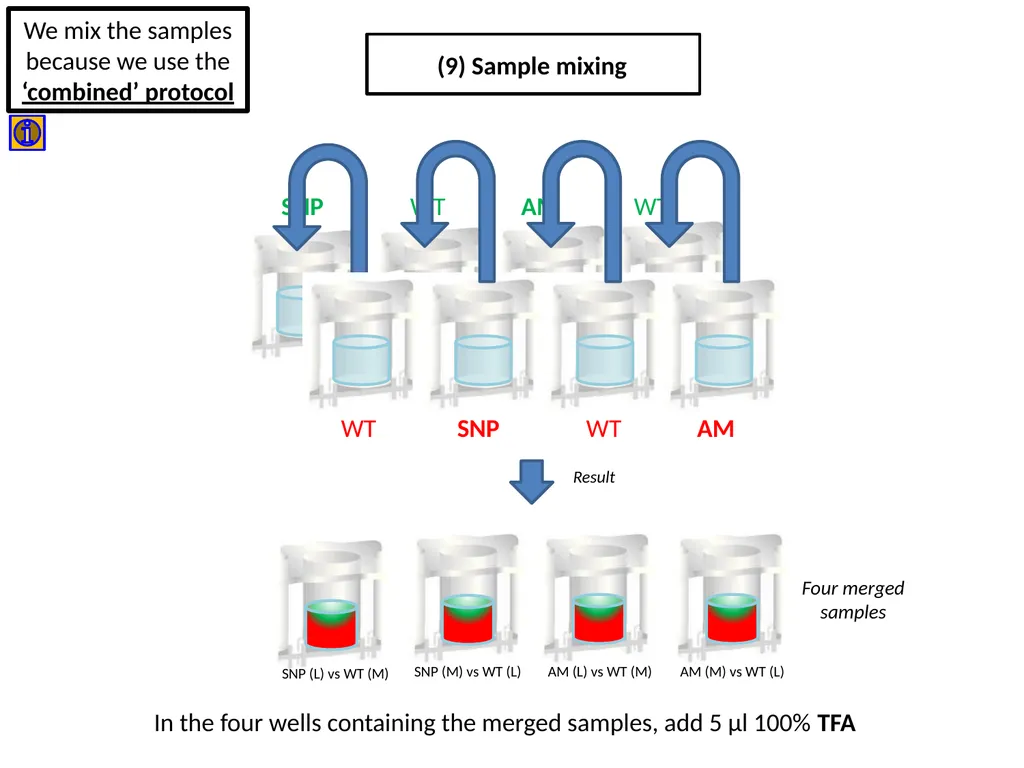
(9) Sample mixing In the four wells containing the merged samples, add 5 µl 100% TFA SNP WT AM WT WT SNP WT AM Four merged samples Result SNP (L) vs WT (M) SNP (M) vs WT (L) AM (L) vs WT (M) AM (M) vs WT (L) We mix the samples because we use the ‘combined’ protocol<br>
14
Two different types of oligo pulldown protocol Further information… There are two different way to analyze the samples after the pulldown:
You can continue to work on your samples separately and, at the end, you have to load your samples in stage tips separately as well.
In other words: for instance, if you start with 8 samples, using this protocol at the end you will use 8 stage tips.
In this way, the mass spec device will elute and analyze one sample at a time, which contains just one type of oligo.
• Advantage: no information loss.
• Disadvantages: much more time; more materials. You can combine the couples of differentially labelled samples and then load this mixed solution directly in one stage tips (one stage tip for each couple).
Example: sample containing SNP oligo + sample containing WT oligo = one mixed sample!
NOTE: in this case, before to merge the couples of samples, you have to differentially label the peptides of those samples you want to mix (in order to make them recognizable/distinguishable).
In this way, the mass spec device will elute and analyze two samples (mixed together) at a time.
• Advantage: less time; less material.
• Disadvantages: loss of information.
NOTE: At the end of this protocol, the mass spec device measures the ratio among the strength with which the factors bind the control oligo and the strength with which they bind the mutant oligo.<br>
15
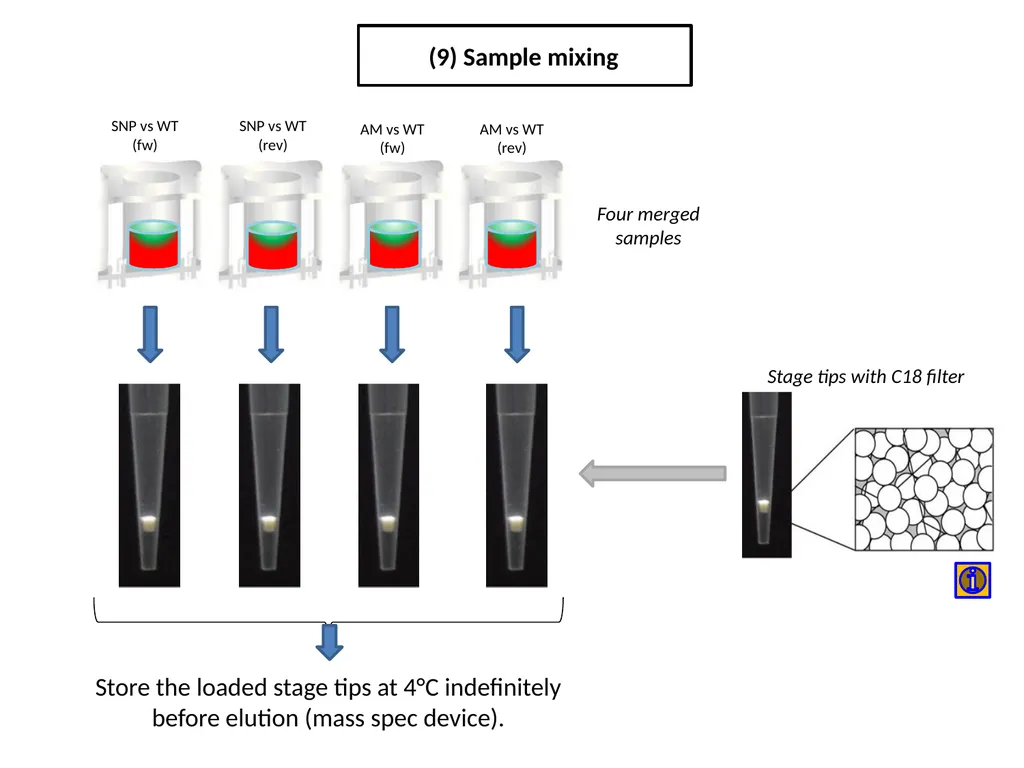
(9) Sample mixing Store the loaded stage tips at 4°C indefinitely
before elution (mass spec device). Stage tips with C18 filter Four merged samples SNP vs WT (fw) SNP vs WT (rev) AM vs WT (fw) AM vs WT (rev)<br>
16
How to prepare the stage tips Focus on… Protocol for micro-purification, enrichment, pre-fractionation and storage of peptides for proteomics using StageTips, Nature Protocol [2007], Rappsilber et al. Figure link: http://www.nature.com/nprot/journal/v2/n8/fig_tab/nprot.2007.261_F1.html C18 structure<br>
17
RESULTS from 1st experiment (12-13/8/2014)<br>
18
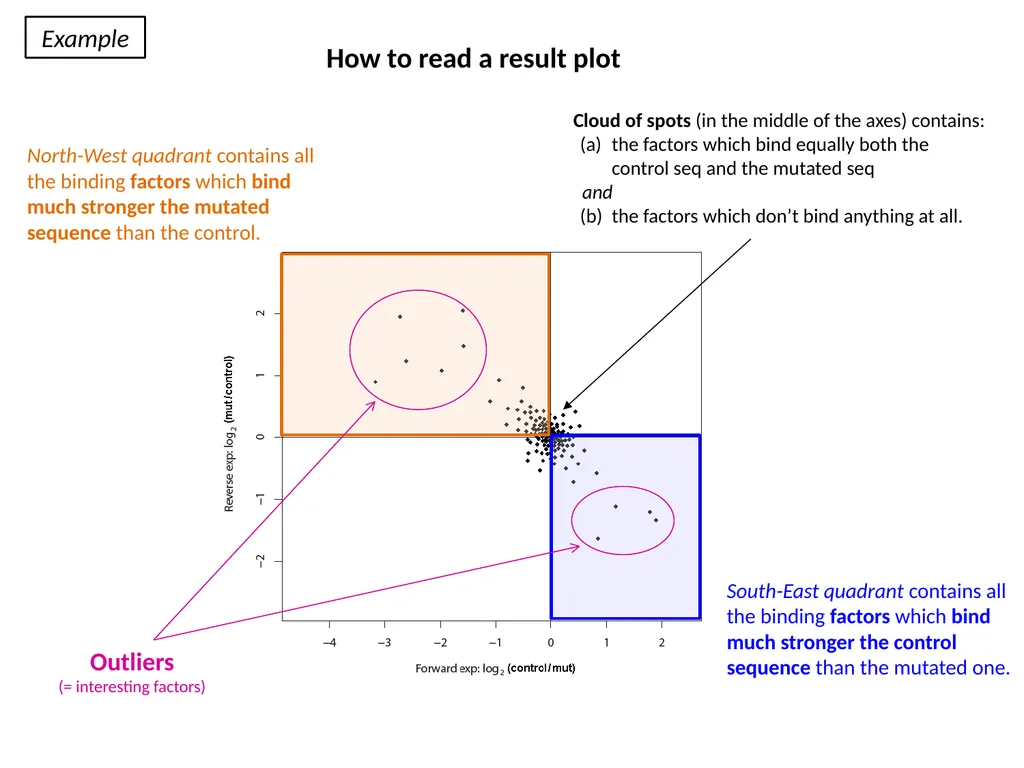
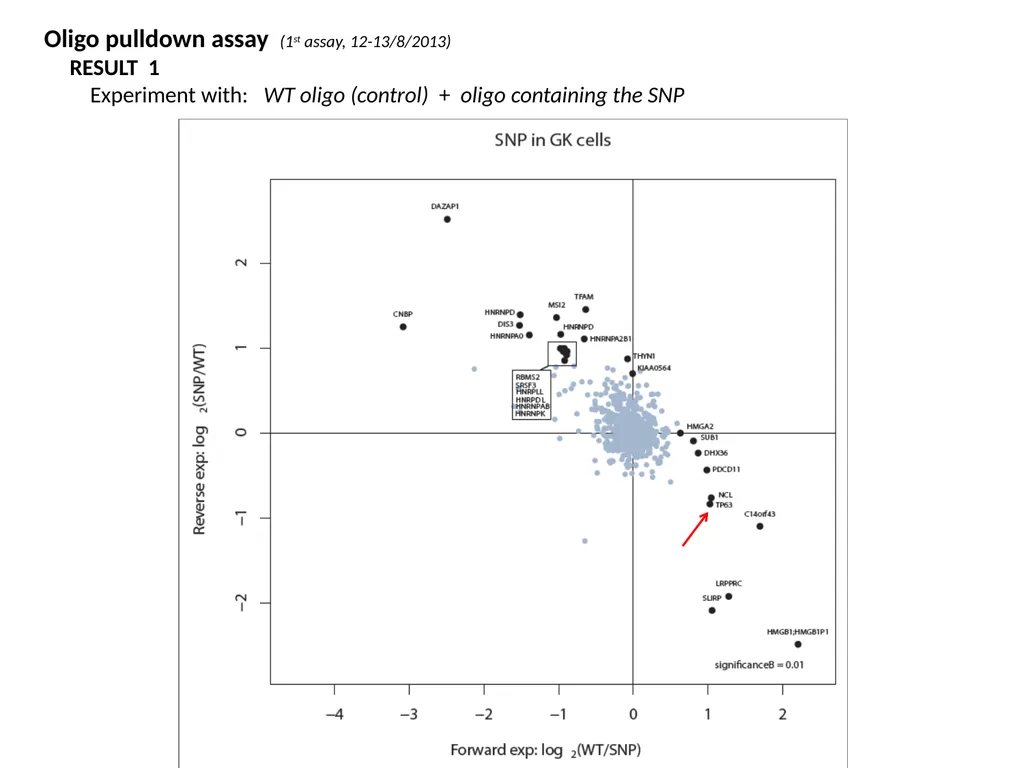
How to read a result plot Cloud of spots (in the middle of the axes) contains:
the factors which bind equally both the control seq and the mutated seq
and
the factors which don’t bind anything at all. South-East quadrant contains all the binding factors which bind much stronger the control sequence than the mutated one. North-West quadrant contains all the binding factors which bind much stronger the mutated sequence than the control. Outliers
(= interesting factors) Example<br>
19
Oligo pulldown assay (1st assay, 12-13/8/2013)
RESULT 1
Experiment with: WT oligo (control) + oligo containing the SNP<br>
20
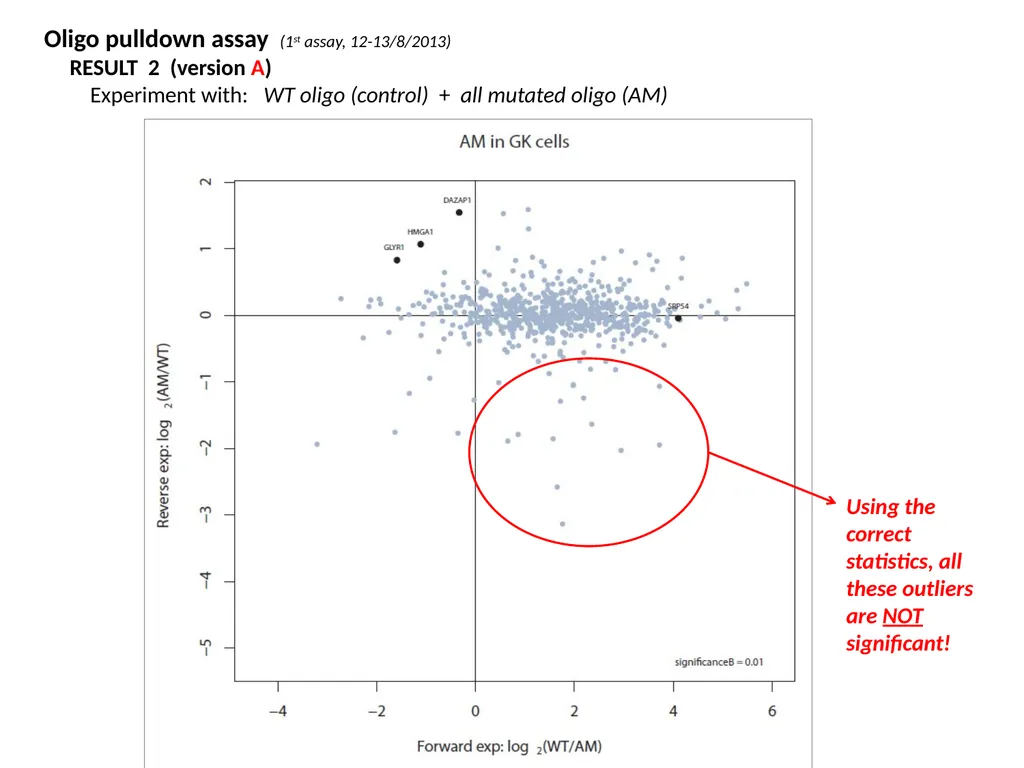
Using the correct statistics, all these outliers are NOT significant! Oligo pulldown assay (1st assay, 12-13/8/2013)
RESULT 2 (version A)
Experiment with: WT oligo (control) + all mutated oligo (AM)<br>
21
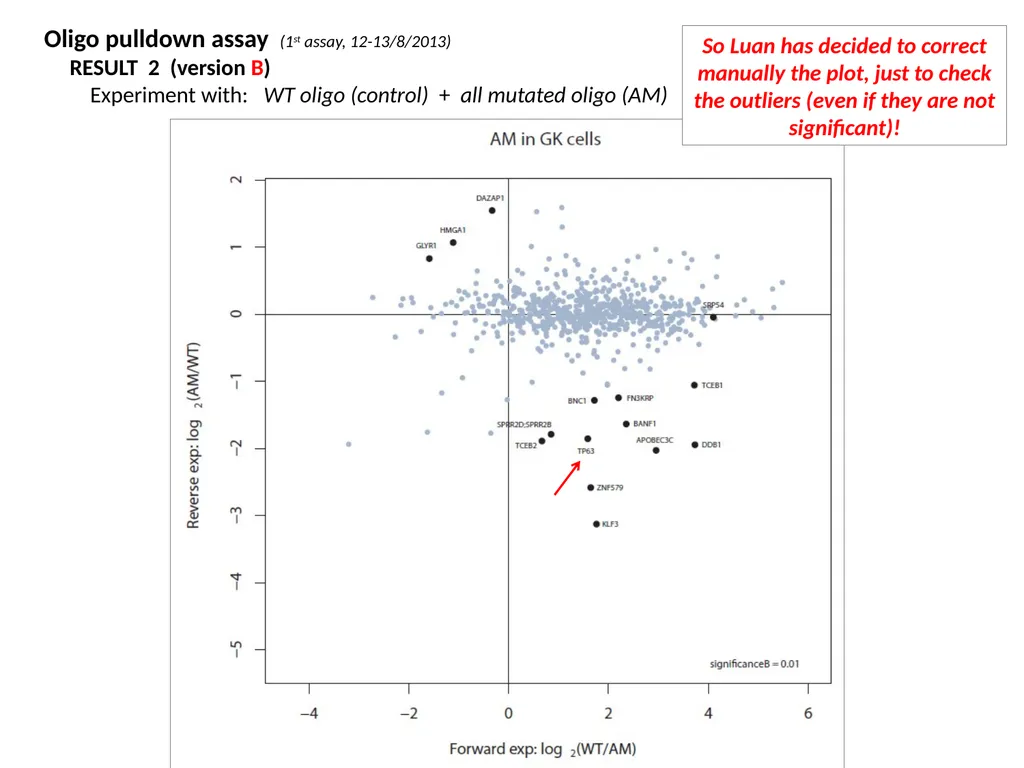
So Luan has decided to correct manually the plot, just to check the outliers (even if they are not significant)! Oligo pulldown assay (1st assay, 12-13/8/2013)
RESULT 2 (version B)
Experiment with: WT oligo (control) + all mutated oligo (AM)<br>
22
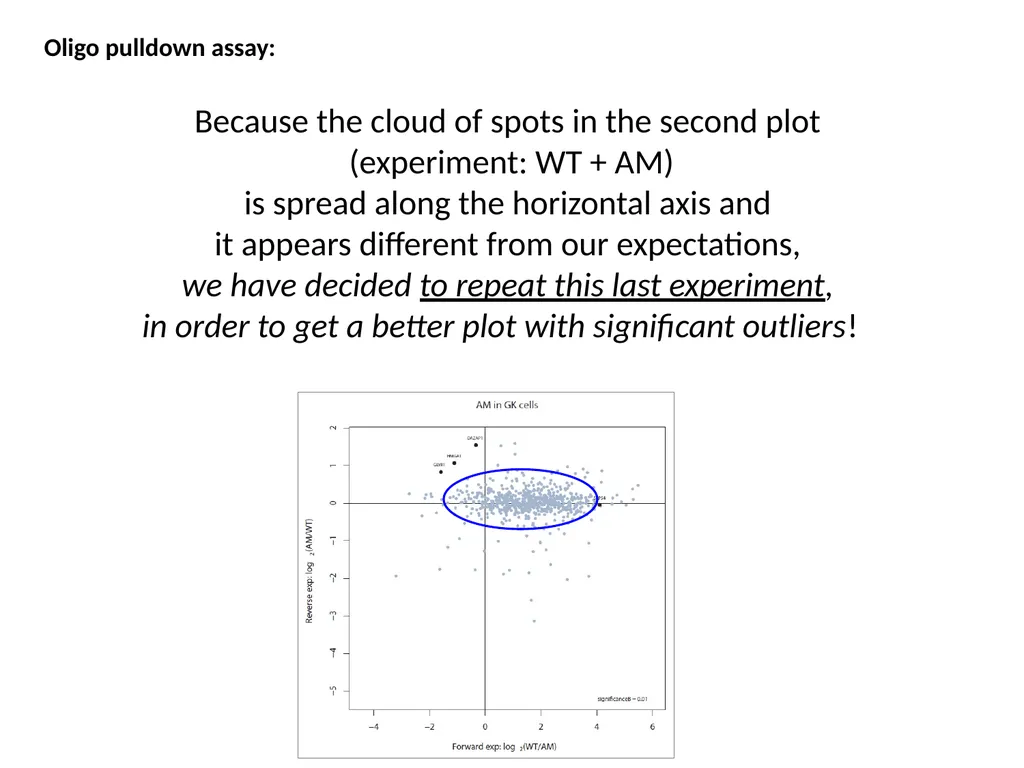
Because the cloud of spots in the second plot
(experiment: WT + AM)
is spread along the horizontal axis and
it appears different from our expectations,
we have decided to repeat this last experiment,
in order to get a better plot with significant outliers! Oligo pulldown assay:<br>