04
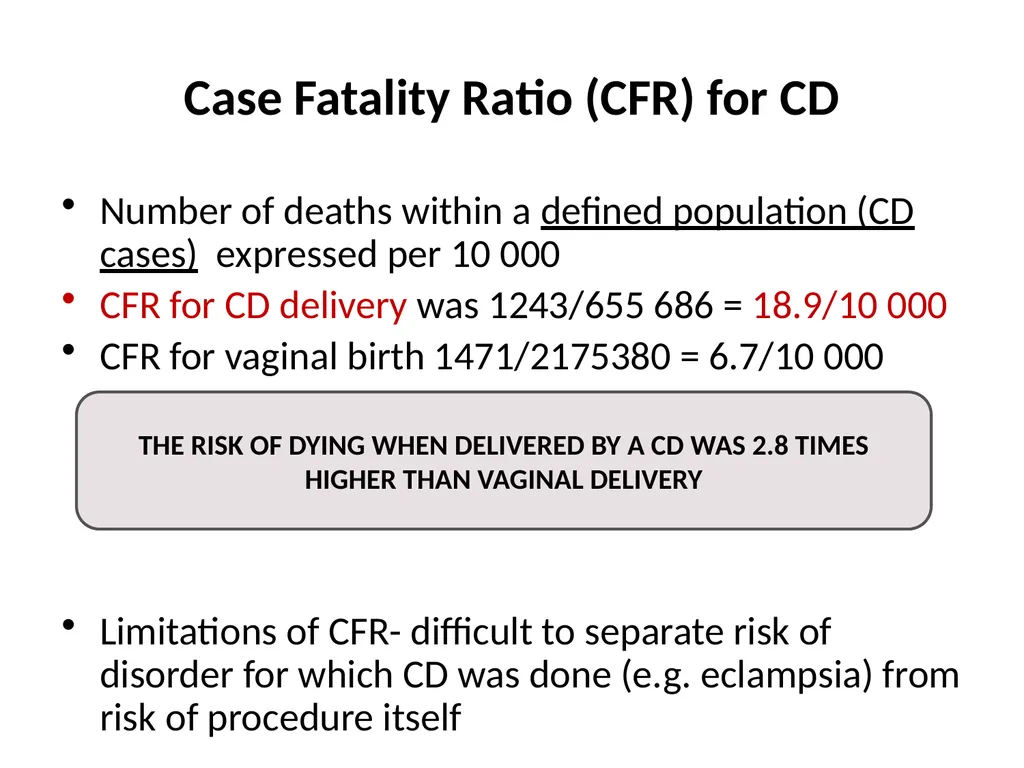
Case Fatality Ratio (CFR) for CD Number of deaths within a defined population (CD cases) expressed per 10 000
CFR for CD delivery was 1243/655 686 = 18.9/10 000
CFR for vaginal birth 1471/2175380 = 6.7/10 000
Limitations of CFR- difficult to separate risk of disorder for which CD was done (e.g. eclampsia) from risk of procedure itself THE RISK OF DYING WHEN DELIVERED BY A CD WAS 2.8 TIMES HIGHER THAN VAGINAL DELIVERY<br>
05
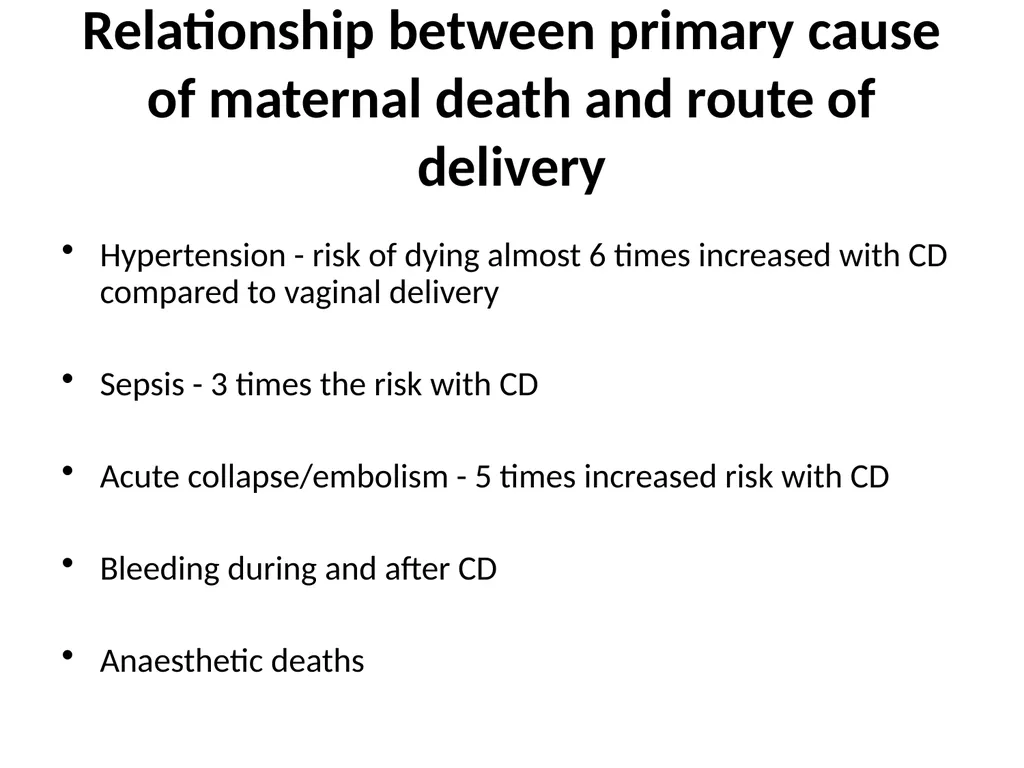
Relationship between primary cause of maternal death and route of delivery Hypertension - risk of dying almost 6 times increased with CD compared to vaginal delivery
Sepsis - 3 times the risk with CD
Acute collapse/embolism - 5 times increased risk with CD
Bleeding during and after CD
Anaesthetic deaths<br>
06
Deaths from Bleeding associated with Caesarean delivery<br>
07
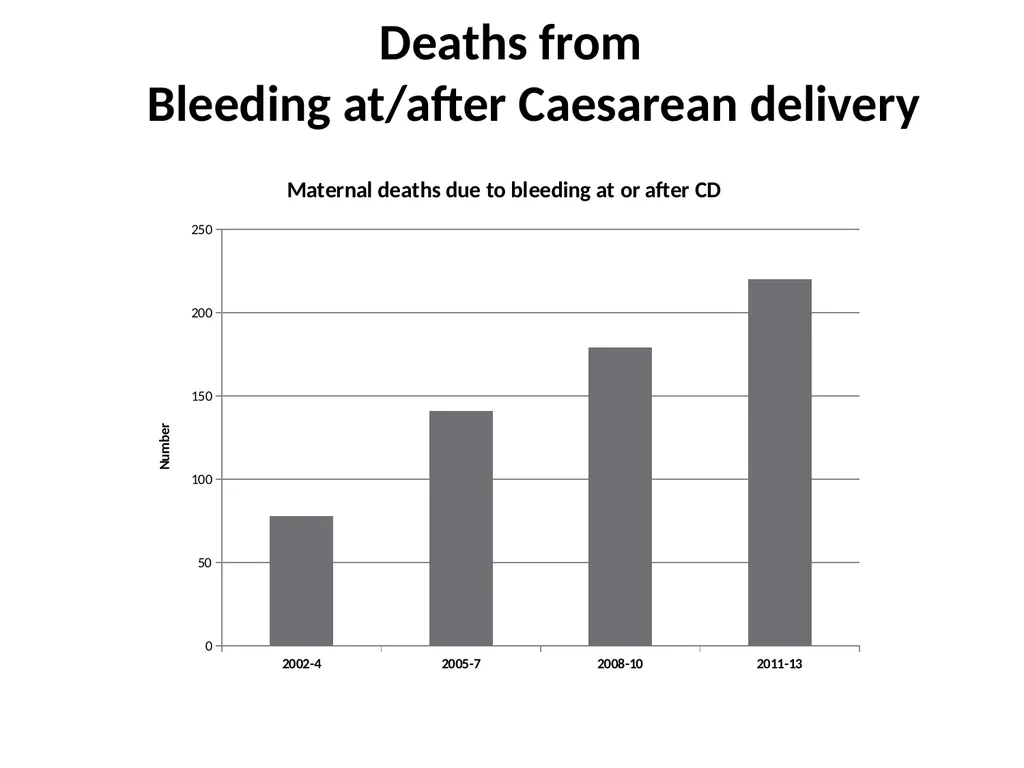
Deaths from � Bleeding at/after Caesarean delivery<br>
08
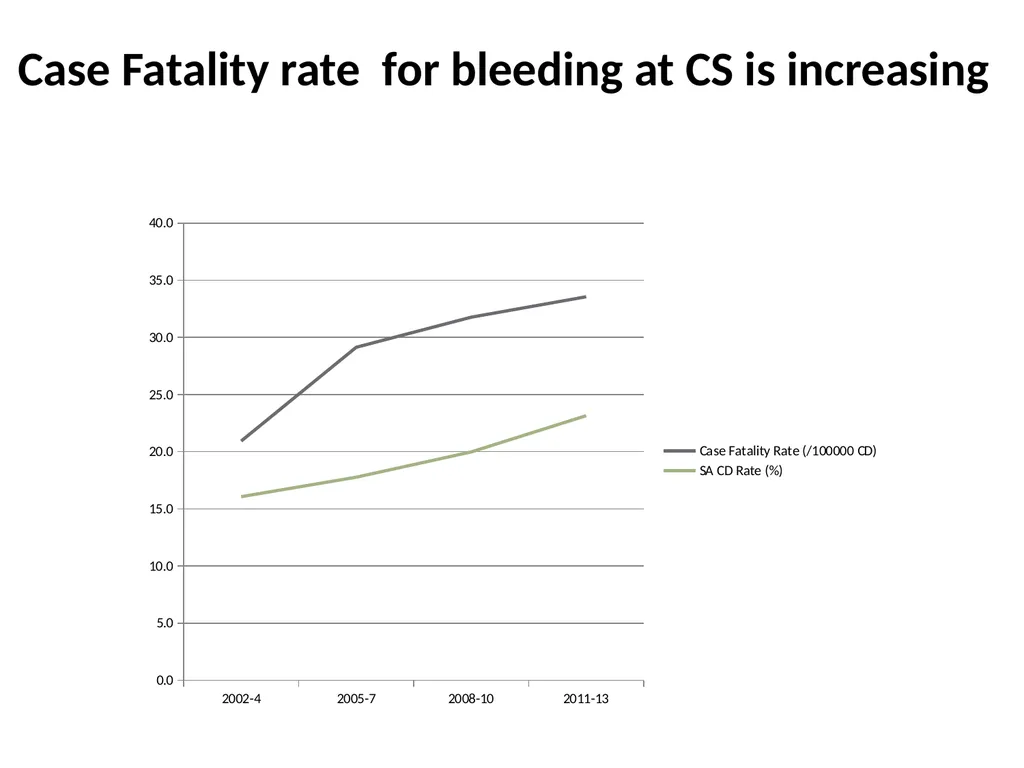
Case Fatality rate for bleeding at CS is increasing<br>
09
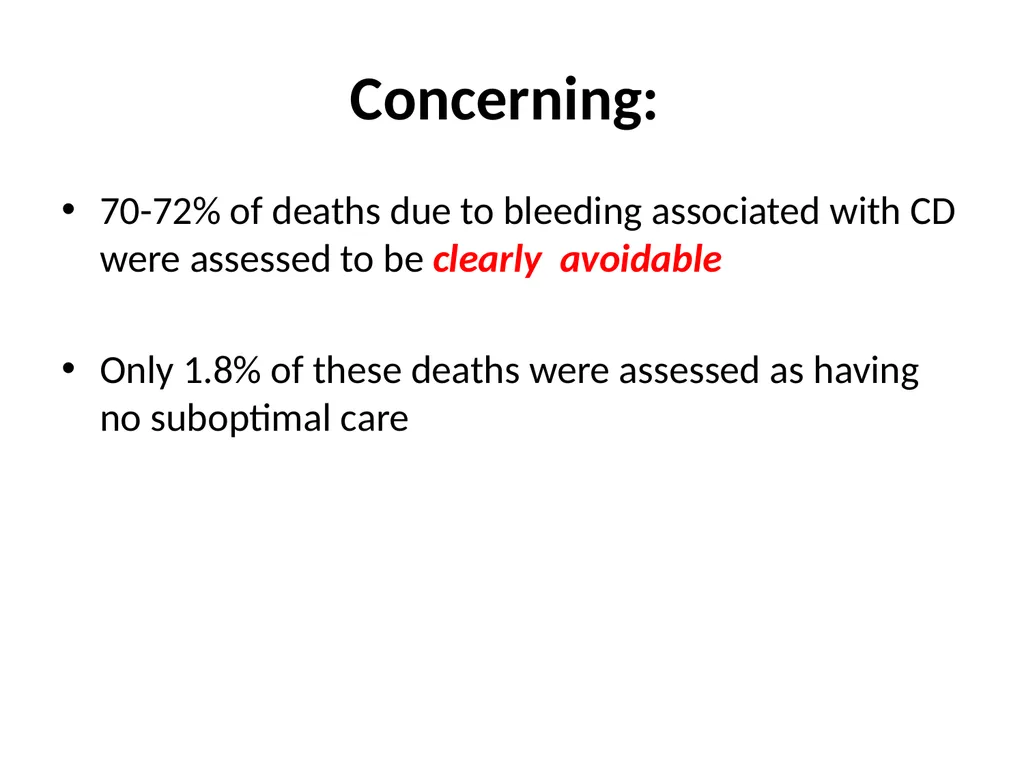
Concerning: 70-72% of deaths due to bleeding associated with CD were assessed to be clearly avoidable
Only 1.8% of these deaths were assessed as having no suboptimal care<br>
10
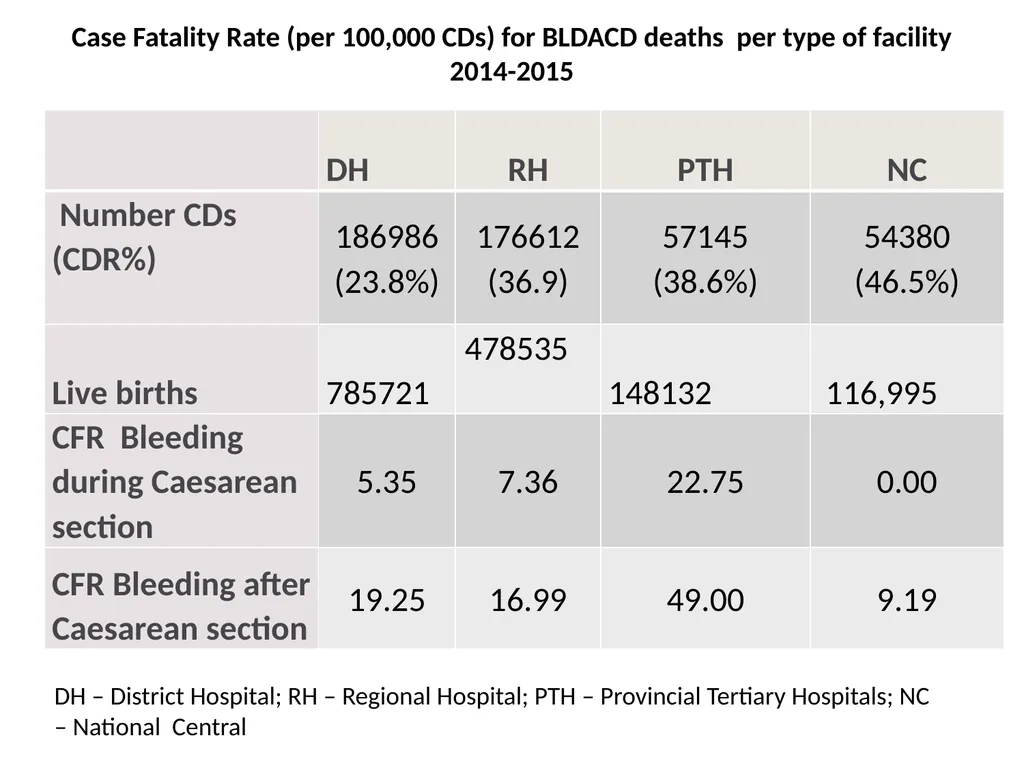
Case Fatality Rate (per 100,000 CDs) for BLDACD deaths per type of facility 2014-2015�. DH – District Hospital; RH – Regional Hospital; PTH – Provincial Tertiary Hospitals; NC – National Central<br>
11
QUESTION A 1. What can be done to reduce deaths due to bleeding associated with Caesarean delivery?
List two interventions.<br>
12
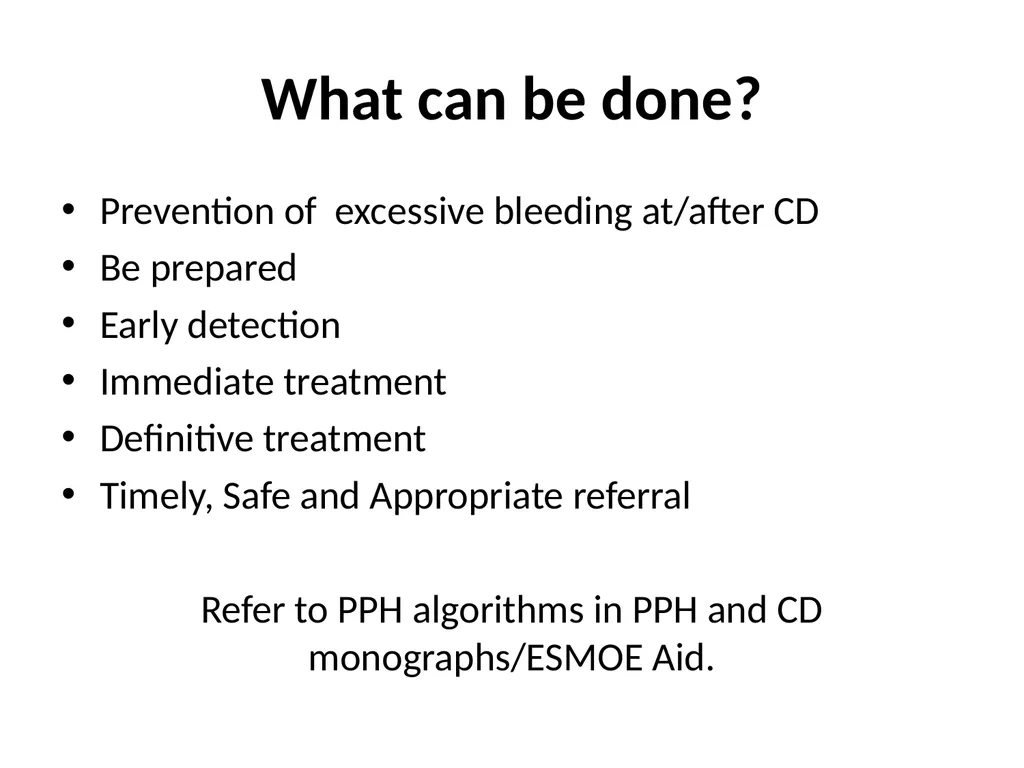
What can be done? Prevention of excessive bleeding at/after CD
Be prepared
Early detection
Immediate treatment
Definitive treatment
Timely, Safe and Appropriate referral
Refer to PPH algorithms in PPH and CD monographs/ESMOE Aid.<br>
13
Deaths from
Anaesthesia at CD NB: Anaesthetic deaths: 2/3 spinal, 1/3 general<br>
14
Anaesthetic deaths by level of care (2011-2013)<br>
15
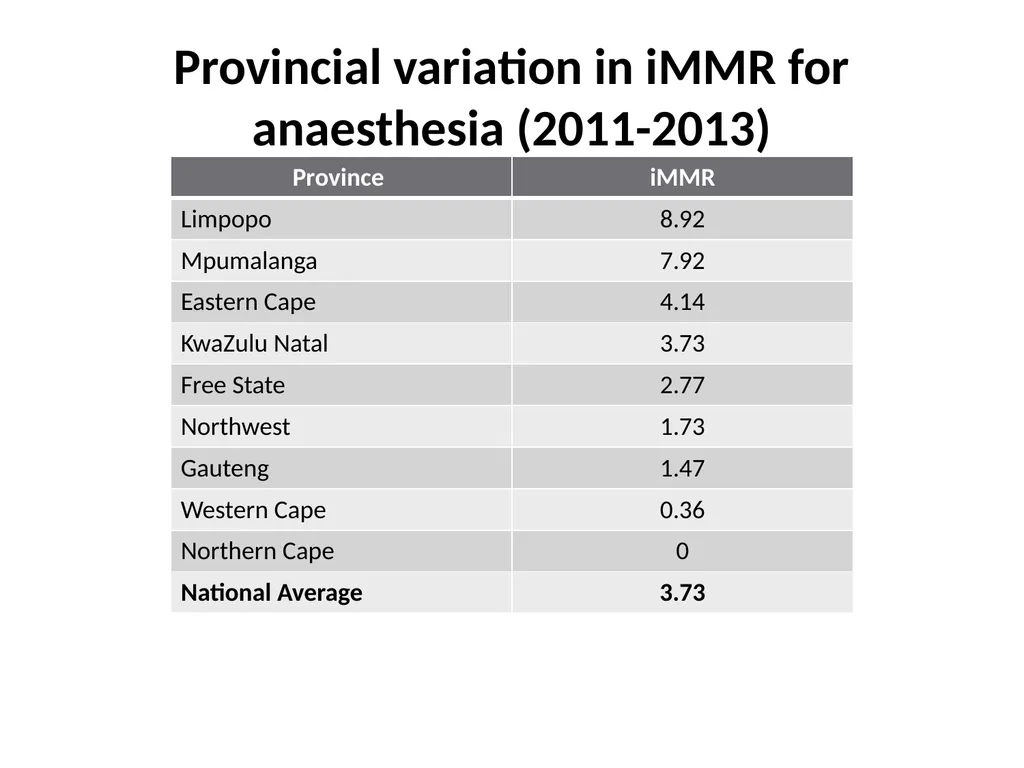
Provincial variation in iMMR for anaesthesia (2011-2013)<br>
16
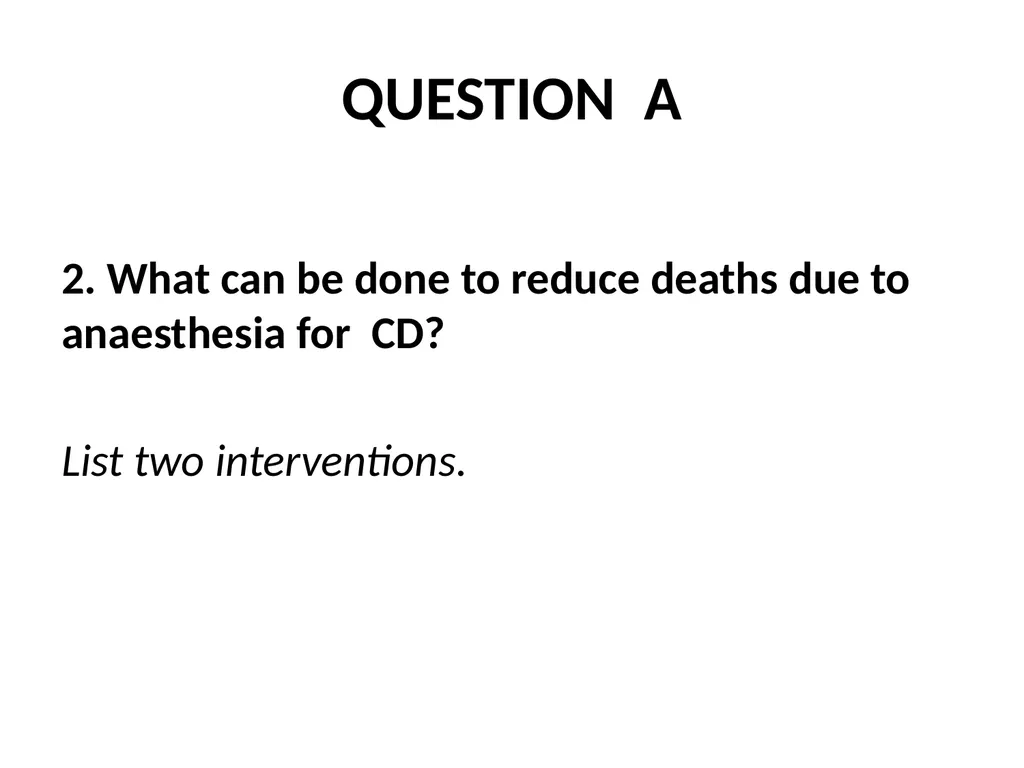
QUESTION A 2. What can be done to reduce deaths due to anaesthesia for CD?
List two interventions.<br>
17
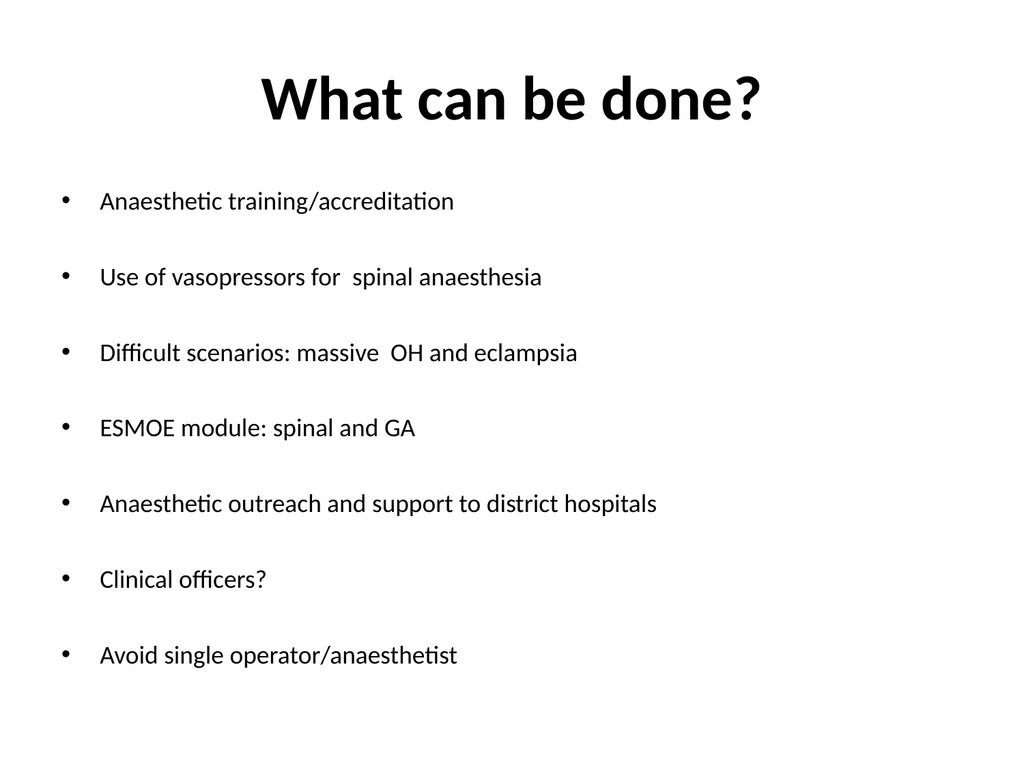
What can be done? Anaesthetic training/accreditation
Use of vasopressors for spinal anaesthesia
Difficult scenarios: massive OH and eclampsia
ESMOE module: spinal and GA
Anaesthetic outreach and support to district hospitals
Clinical officers?
Avoid single operator/anaesthetist<br>
18
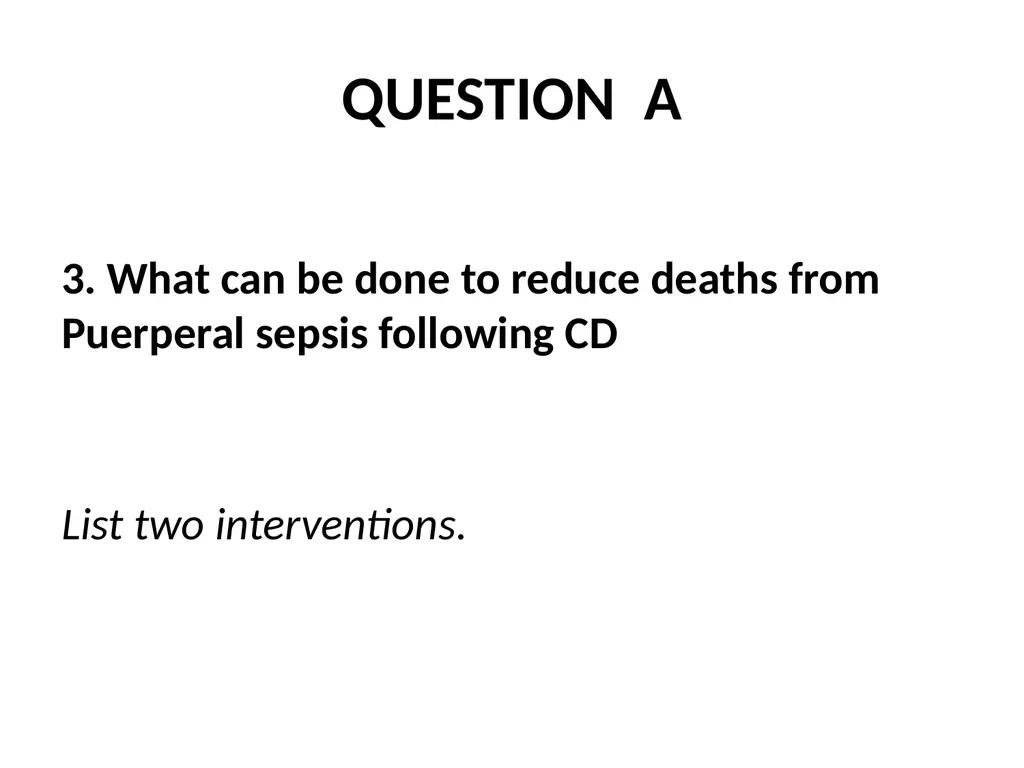
QUESTION A 3. What can be done to reduce deaths from Puerperal sepsis following CD
List two interventions.<br>
19
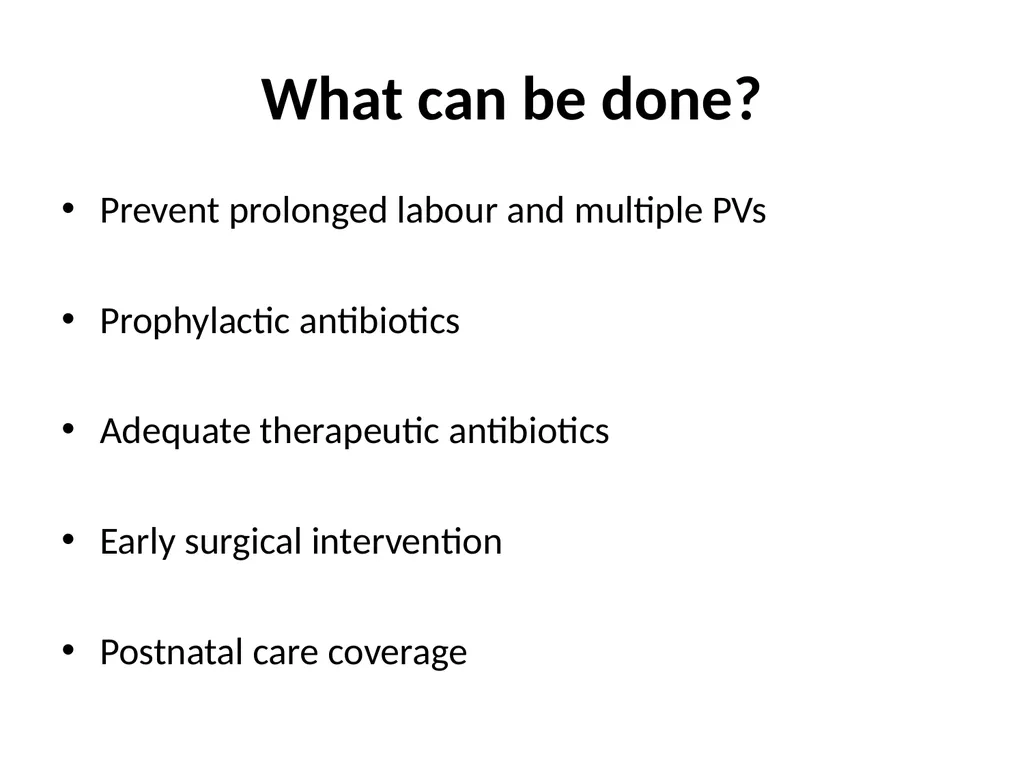
What can be done? Prevent prolonged labour and multiple PVs
Prophylactic antibiotics
Adequate therapeutic antibiotics
Early surgical intervention
Postnatal care coverage<br>
20
QUESTION A 4. What can be done to reduce deaths from
Thrombo-embolism after CD ?
List two interventions.<br>
21
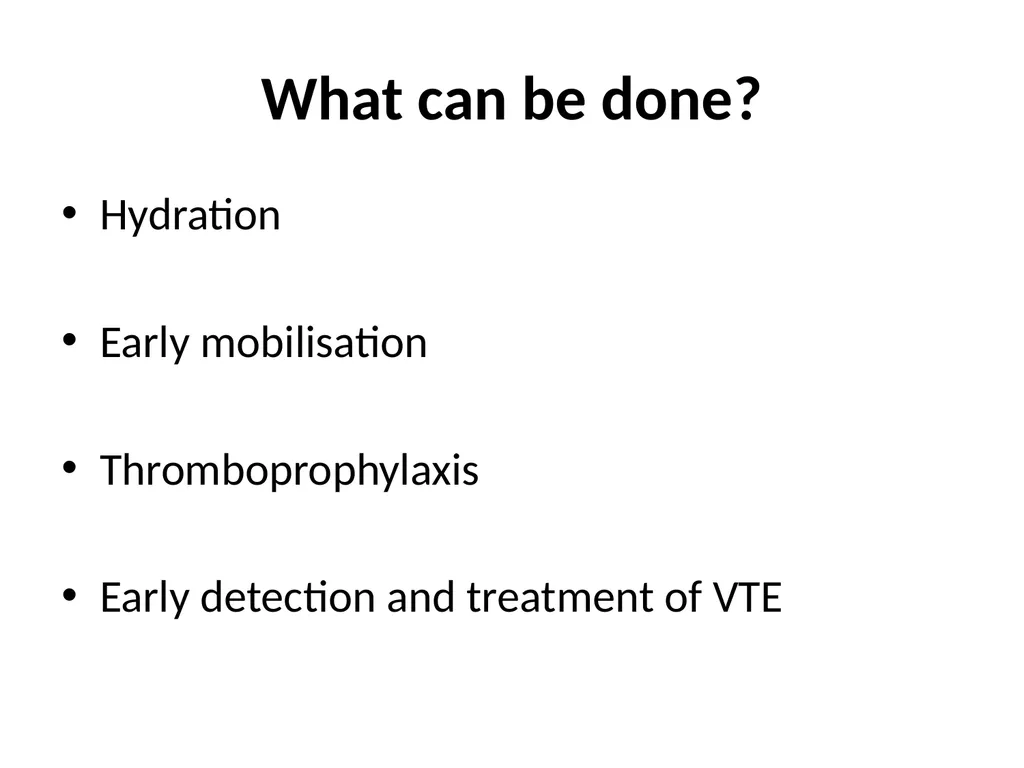
What can be done? Hydration
Early mobilisation
Thromboprophylaxis
Early detection and treatment of VTE<br>
22
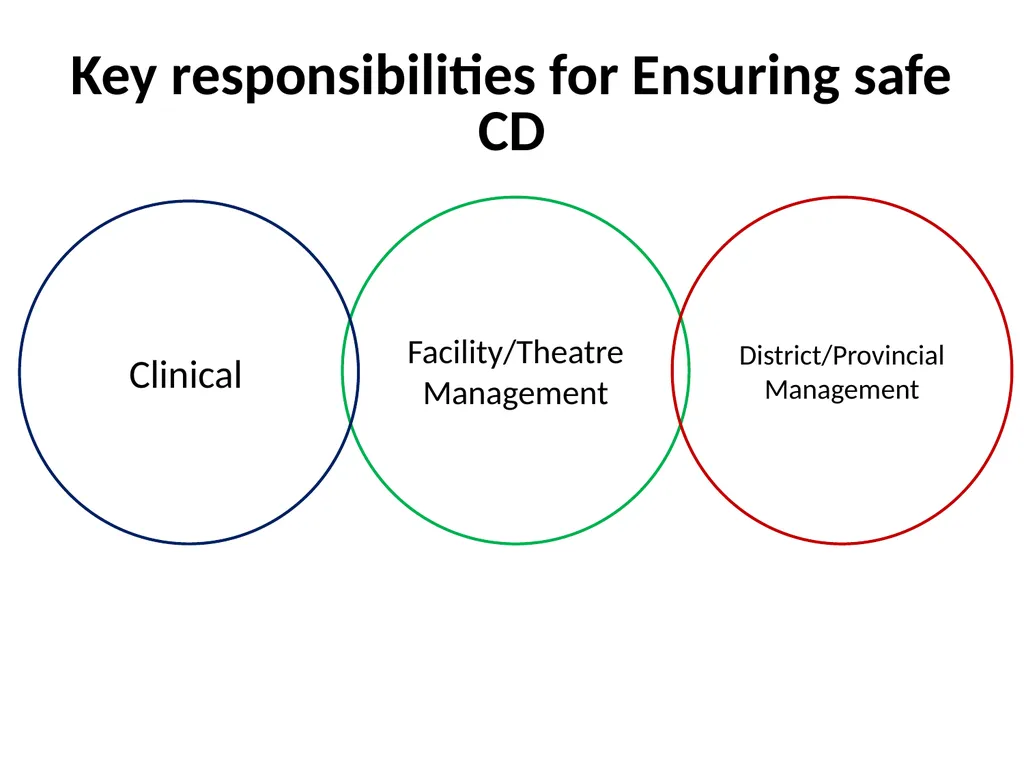
Key responsibilities for Ensuring safe CD Facility/Theatre Management Clinical District/Provincial Management<br>
23
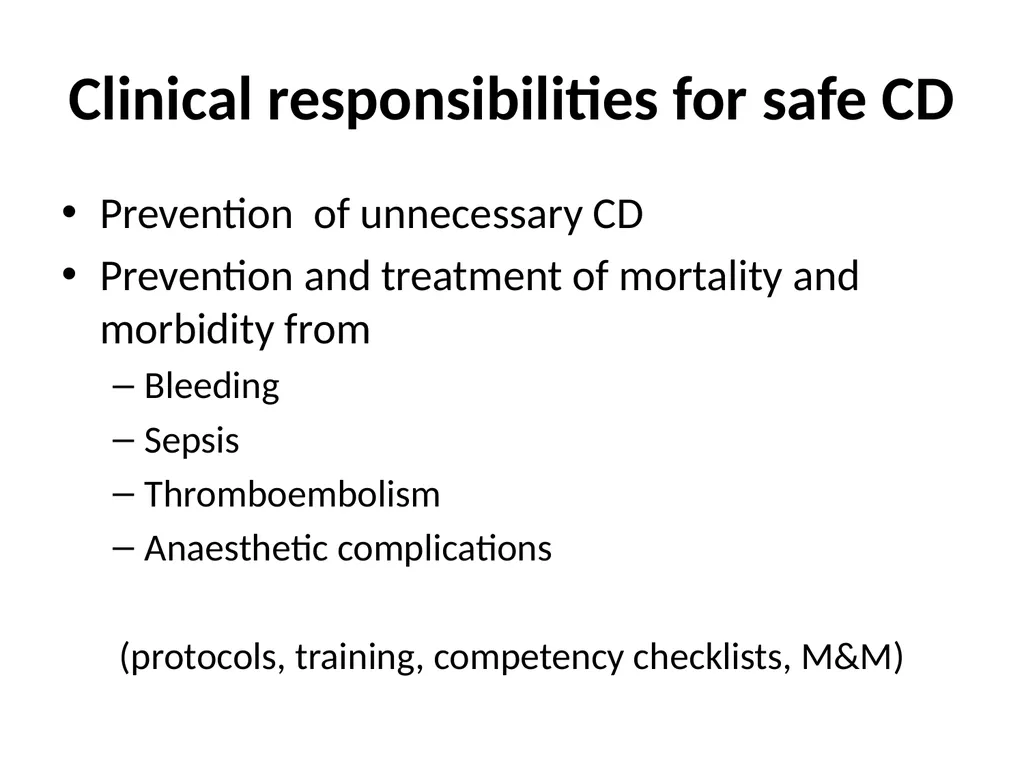
Clinical responsibilities for safe CD Prevention of unnecessary CD
Prevention and treatment of mortality and morbidity from
Bleeding
Sepsis
Thromboembolism
Anaesthetic complications
(protocols, training, competency checklists, M&M)<br>
24
QUESTION B What are the responsibilities of:
facility /theatre mangers in reducing deaths from CD ?
district and provincial managers
List two responsibilities for each<br>
25
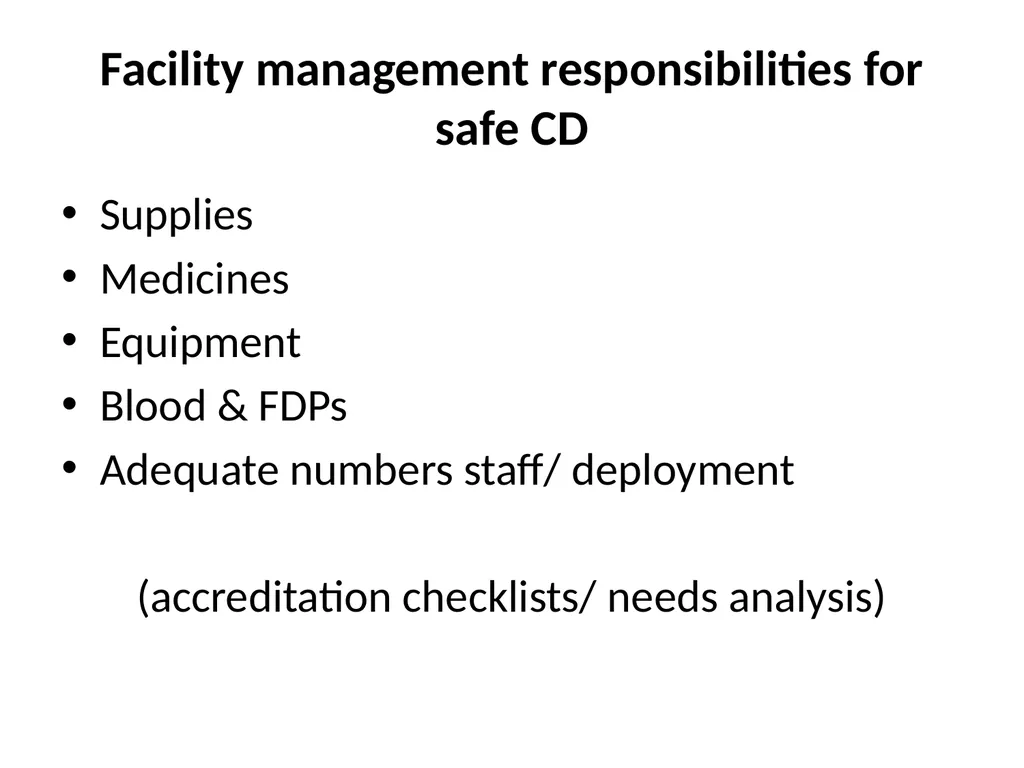
Facility management responsibilities for safe CD Supplies
Medicines
Equipment
Blood & FDPs
Adequate numbers staff/ deployment
(accreditation checklists/ needs analysis)<br>
26
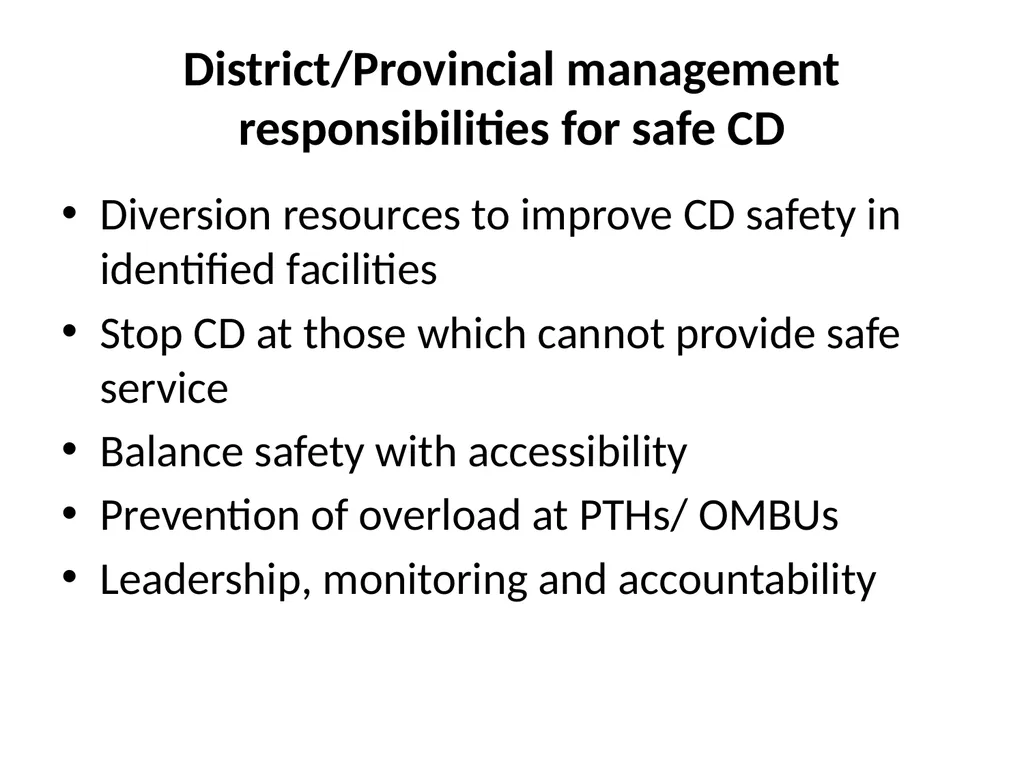
District/Provincial management responsibilities for safe CD Diversion resources to improve CD safety in identified facilities
Stop CD at those which cannot provide safe service
Balance safety with accessibility
Prevention of overload at PTHs/ OMBUs
Leadership, monitoring and accountability<br>
27
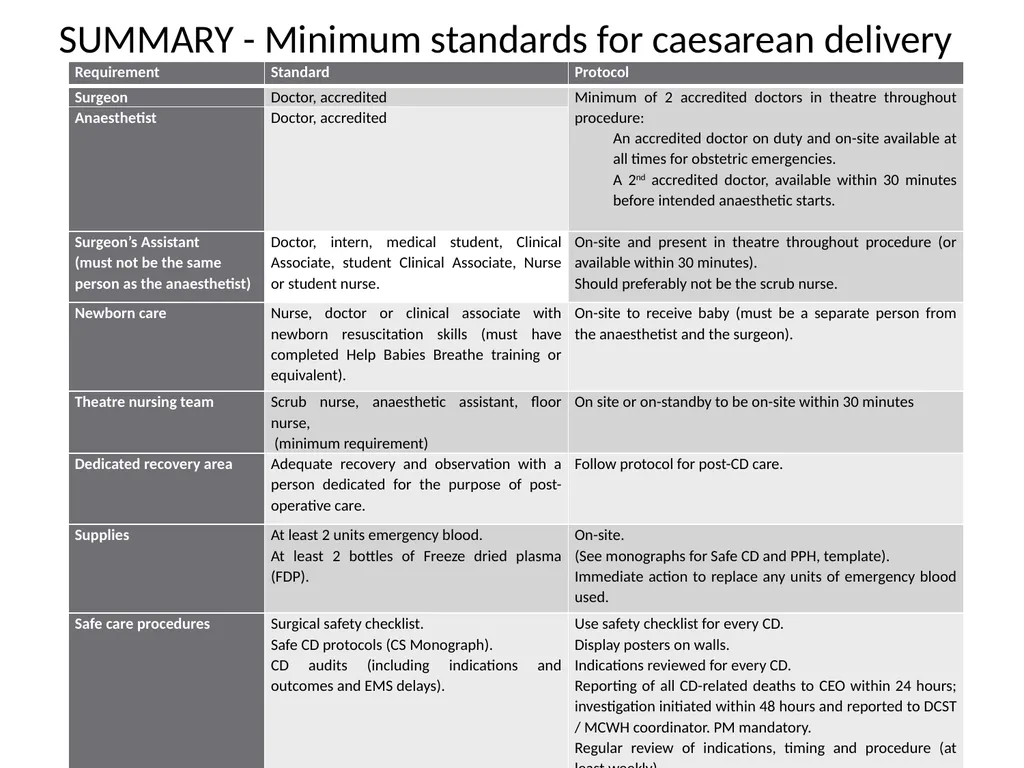
SETTING MINIMUM STANDARDS � FOR CD<br>
28
SUMMARY - Minimum standards for caesarean delivery<br>
29
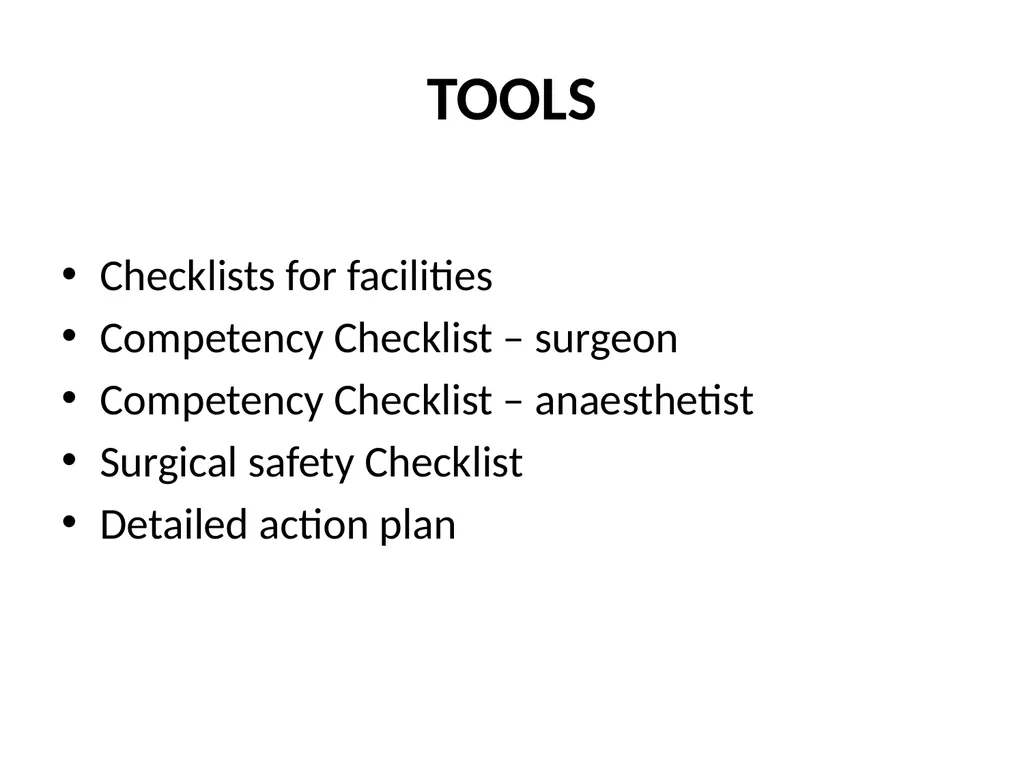
TOOLS Checklists for facilities
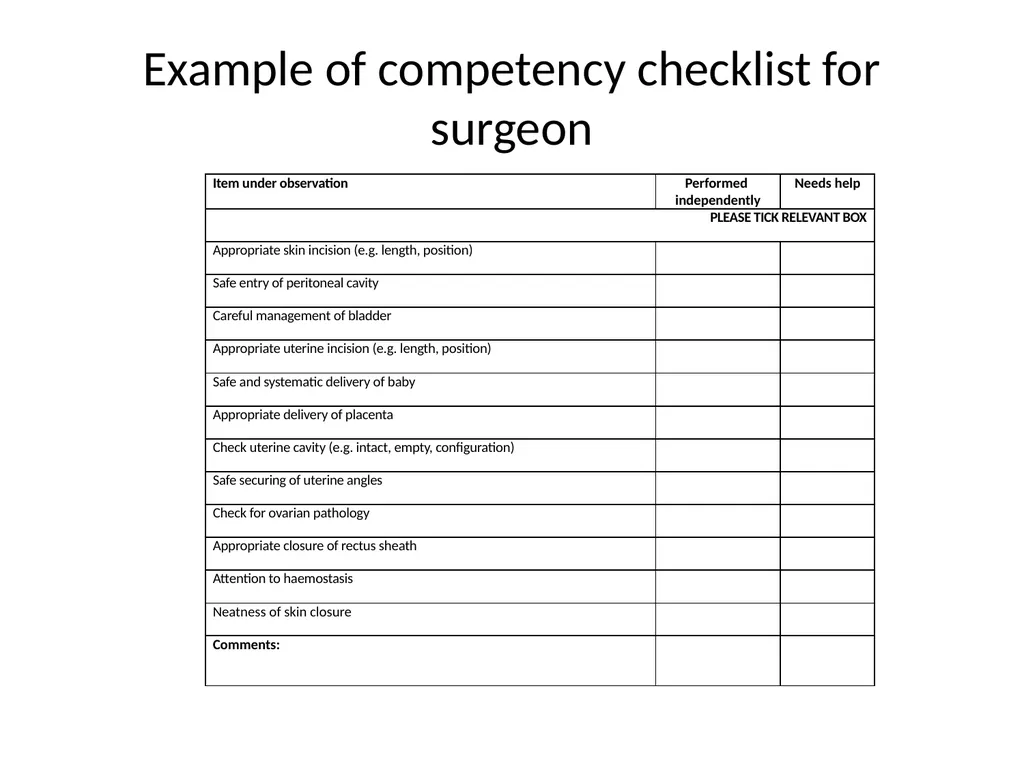
Competency Checklist – surgeon
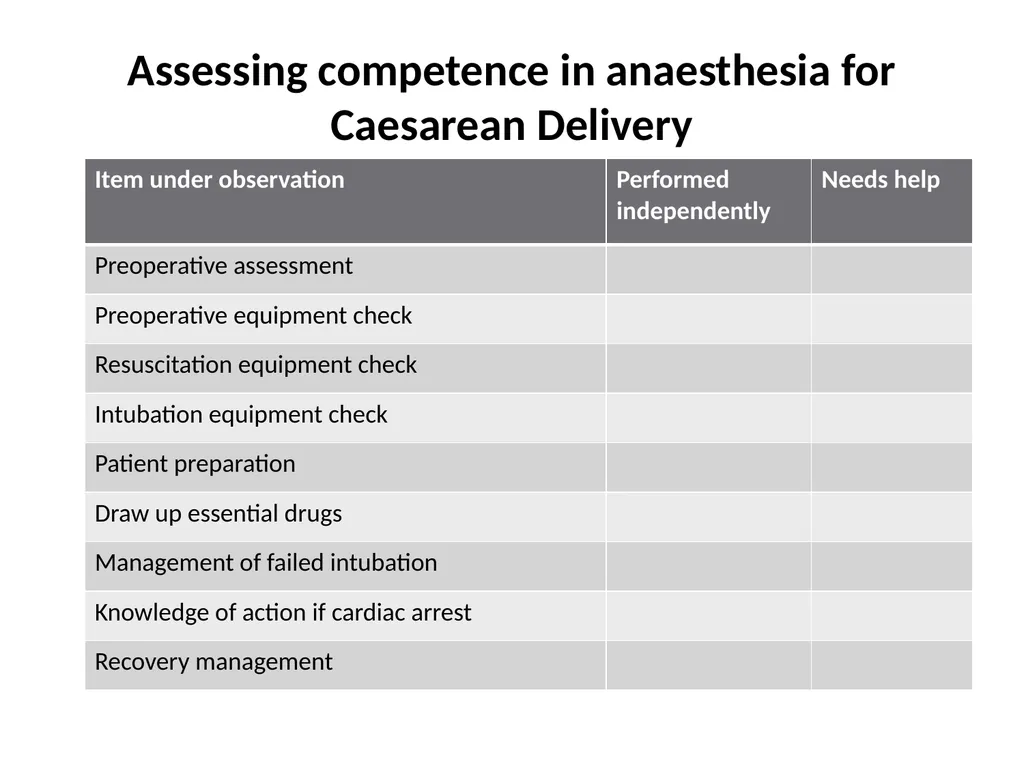
Competency Checklist – anaesthetist
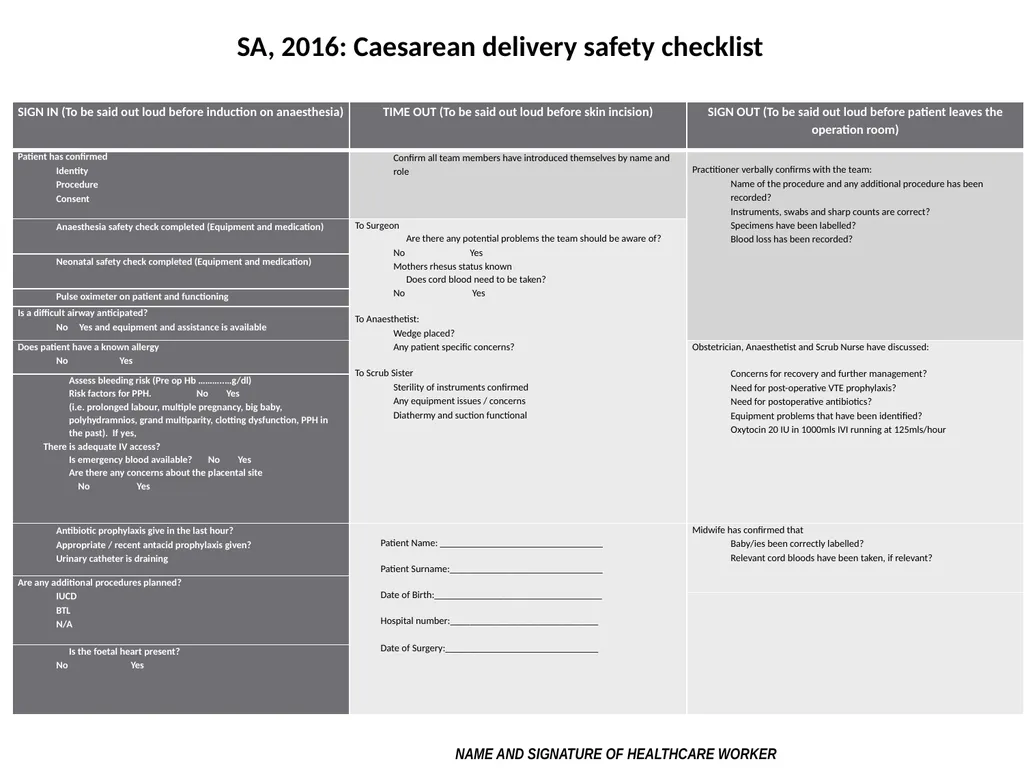
Surgical safety Checklist
Detailed action plan<br>
30
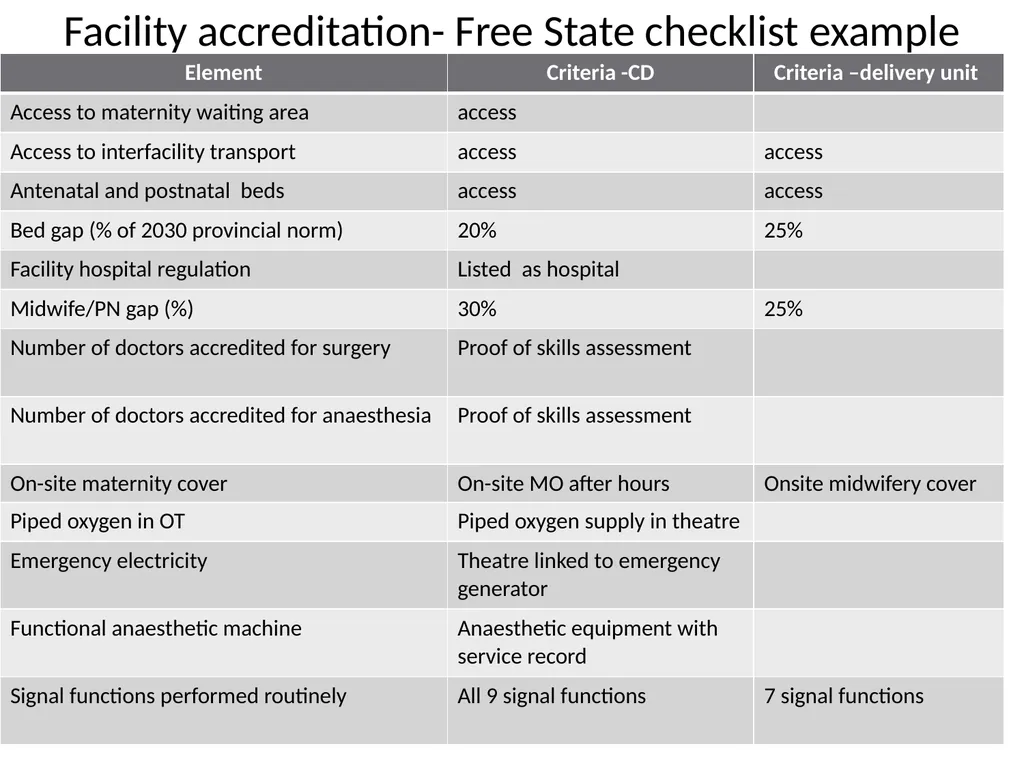
Facility accreditation- Free State checklist example<br>
31
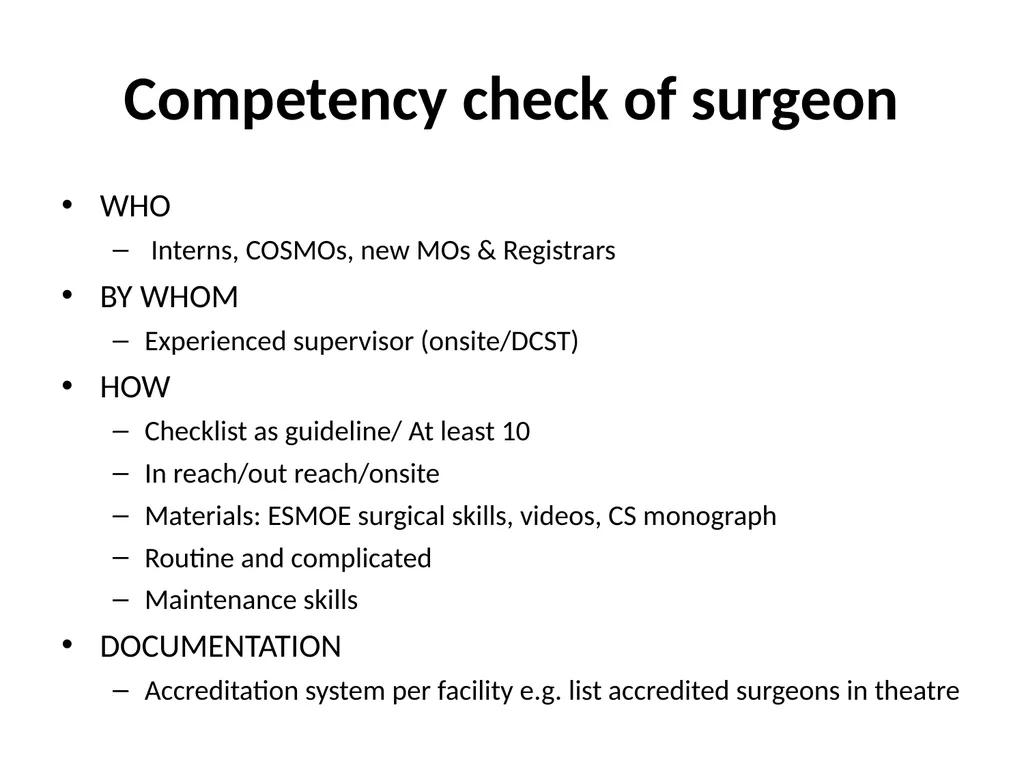
Competency check of surgeon WHO
Interns, COSMOs, new MOs & Registrars
BY WHOM
Experienced supervisor (onsite/DCST)
HOW
Checklist as guideline/ At least 10
In reach/out reach/onsite
Materials: ESMOE surgical skills, videos, CS monograph
Routine and complicated
Maintenance skills
DOCUMENTATION
Accreditation system per facility e.g. list accredited surgeons in theatre<br>
32
Example of competency checklist for surgeon<br>
33
Assessing competence in anaesthesia for Caesarean Delivery<br>
34
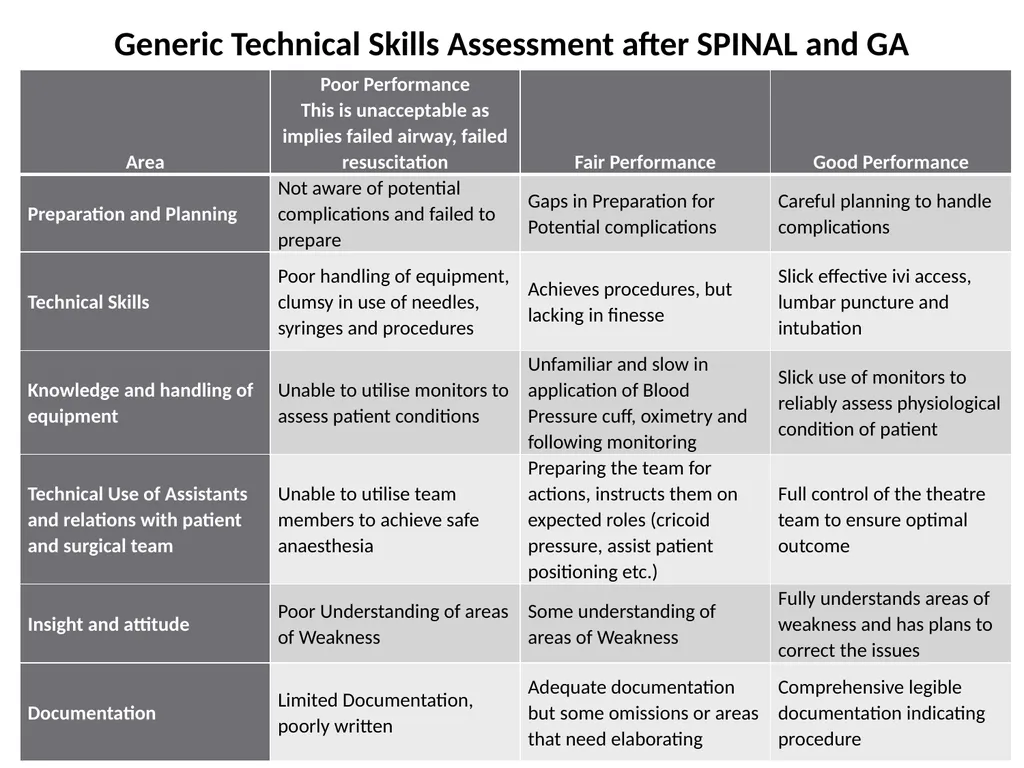
Generic Technical Skills Assessment after SPINAL and GA<br>
35
SA, 2016: Caesarean delivery safety checklist NAME AND SIGNATURE OF HEALTHCARE WORKER<br>
36
QUESTION C How could you monitor caesarean delivery outcomes and safety in your facility?
List three indicators that could be used for this.<br>
37
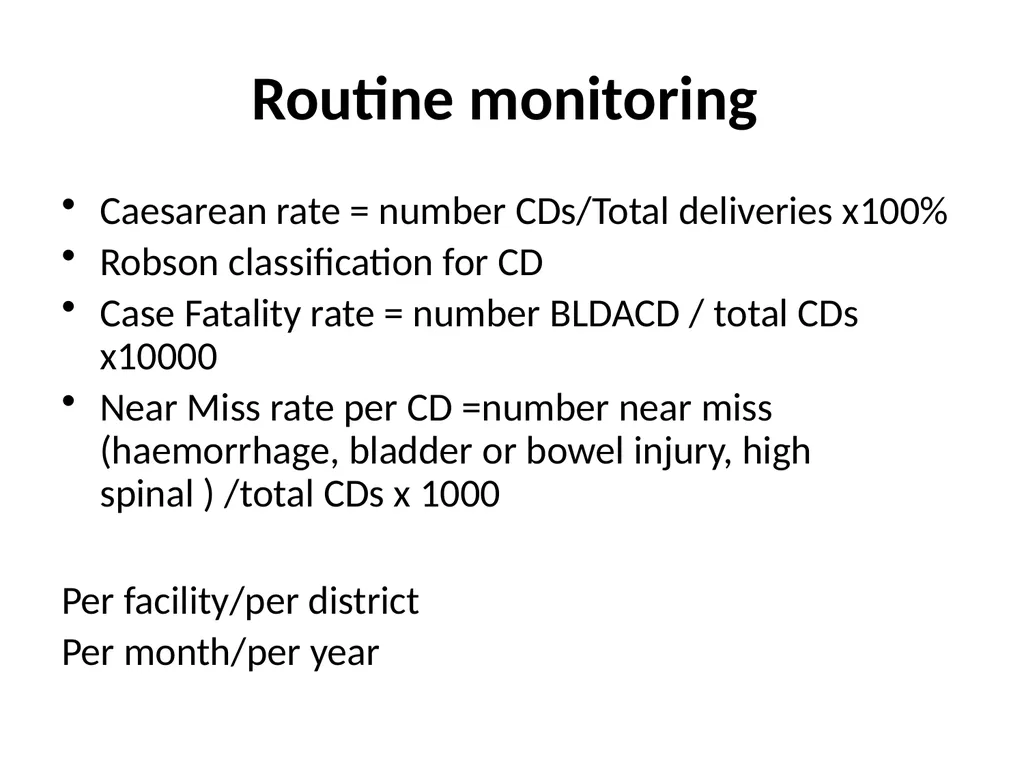
Routine monitoring Caesarean rate = number CDs/Total deliveries x100%
Robson classification for CD
Case Fatality rate = number BLDACD / total CDs x10000
Near Miss rate per CD =number near miss (haemorrhage, bladder or bowel injury, high spinal ) /total CDs x 1000
Per facility/per district
Per month/per year<br>
38
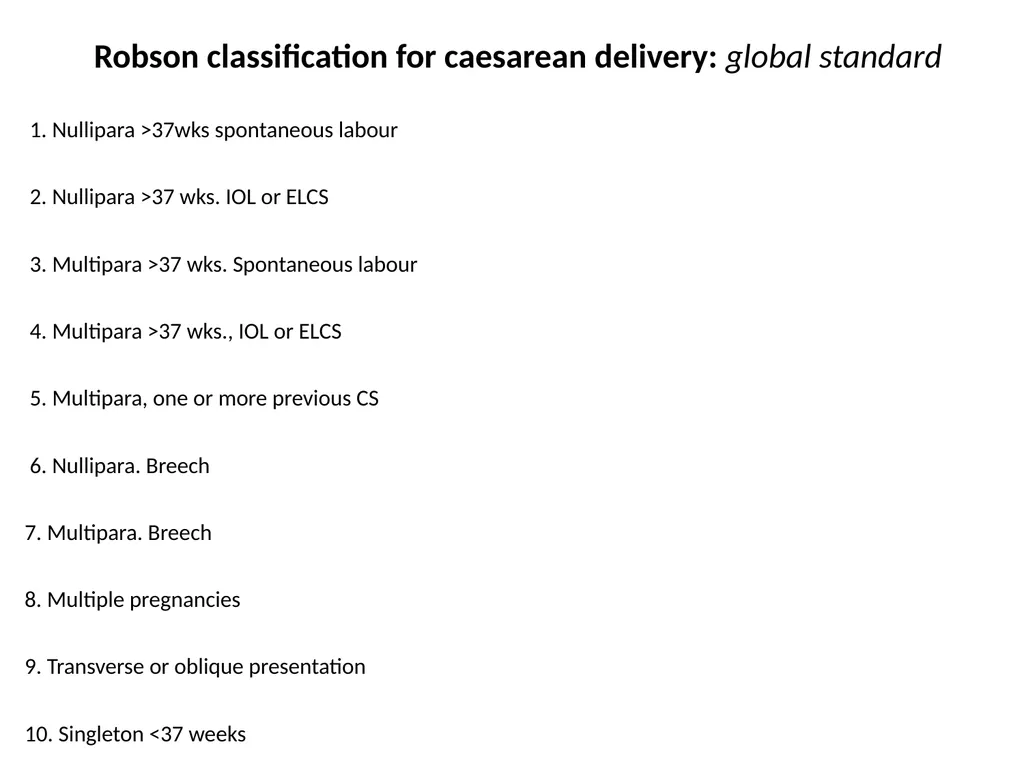
Robson classification for caesarean delivery: global standard 1. Nullipara >37wks spontaneous labour
2. Nullipara >37 wks. IOL or ELCS
3. Multipara >37 wks. Spontaneous labour
4. Multipara >37 wks., IOL or ELCS
5. Multipara, one or more previous CS
6. Nullipara. Breech
7. Multipara. Breech
8. Multiple pregnancies
9. Transverse or oblique presentation
10. Singleton <37 weeks<br>
40
Recap Problem of CD mortality and morbidity in SA
Clinical management of major problems
Minimum standards for a facility providing CD
Strategies to ensure compliance with minimum standards
District planning of maternity services to enable safe CD
Surgical safety checklist and accreditation tools
Monitoring and auditing<br>