Espionage and Intelligence in the Ancient World and the Middle Ages Before there was history there were spies. (Michael Warner, The Rise and Fall of Intelligence, 2014) re Sumerian Uruk c. 3200 BCE (cuneiform) Espionage is one of the
"Espionage and Intelligence in the Ancient World" is the property of its rightful owner. Permission is granted to
download and print the materials on this website for personal, non-commercial use only, and to display it
on your personal computer provided you do not modify the materials and that you retain all copyright
notices contained in the materials. By downloading content from our website, you accept the terms of this
agreement.
Presentation Transcript
01
Espionage and Intelligence in the Ancient World and the Middle Ages ‘Before there was history there were spies.’ (Michael Warner, The Rise and Fall of Intelligence, 2014) re Sumerian Uruk c. 3200 BCE (cuneiform)
‘Espionage is one of the oldest of human activities.’ (Kristie Macrakis, Espionage: A Concise History, 2023)
‘The first major figure in world literature to emphasize the importance of good intelligence was God.’ (Christopher Andrew, The Secret World, 2018)
‘The earliest surviving record of espionage dates from the time of Pharaoh Rameses’ War with the Hittites and the battle of Kadesh (c. 1274 BC)’ (Terry Crowdy, The Enemy Within, 2006)
‘For the first 4,000 years of warfare, up to the start of World War I, nearly all information came from physical intelligence. That is why intelligence played a relatively minor role.’ (David Kahn, ‘An Historical Theory of Intelligence’, 2001)
Cf
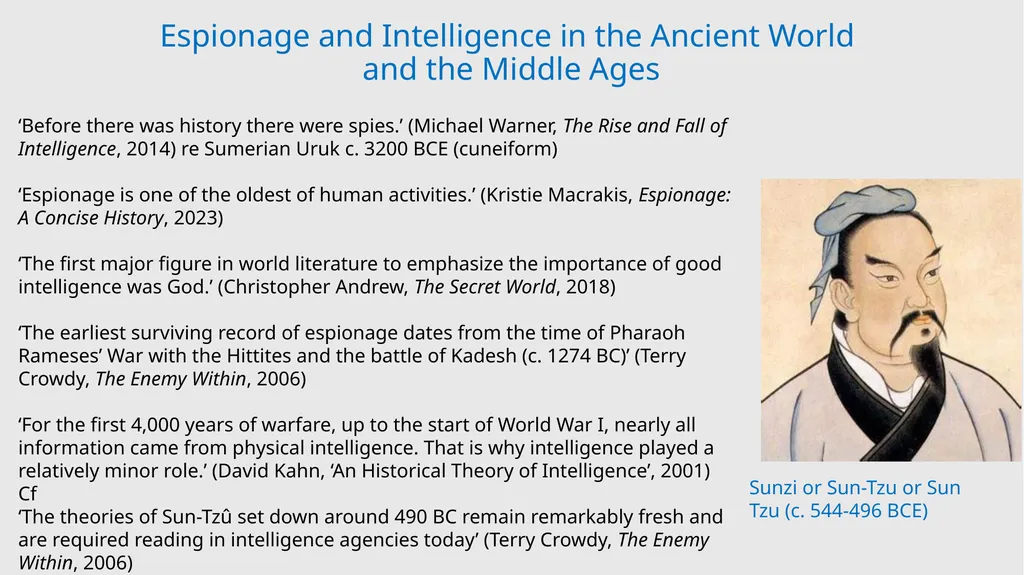
‘The theories of Sun-Tzû set down around 490 BC remain remarkably fresh and are required reading in intelligence agencies today’ (Terry Crowdy, The Enemy Within, 2006) Sunzi or Sun-Tzu or Sun Tzu (c. 544-496 BCE)<br>
02
Alexander the Great’s Empire, 334-323 BCE<br>
03
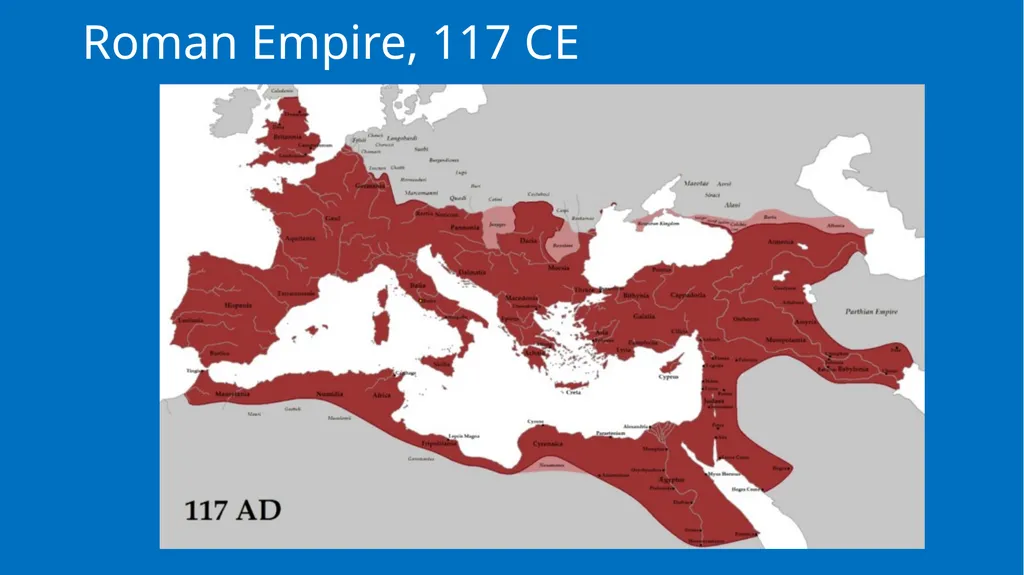
Roman Empire, 117 CE<br>
04
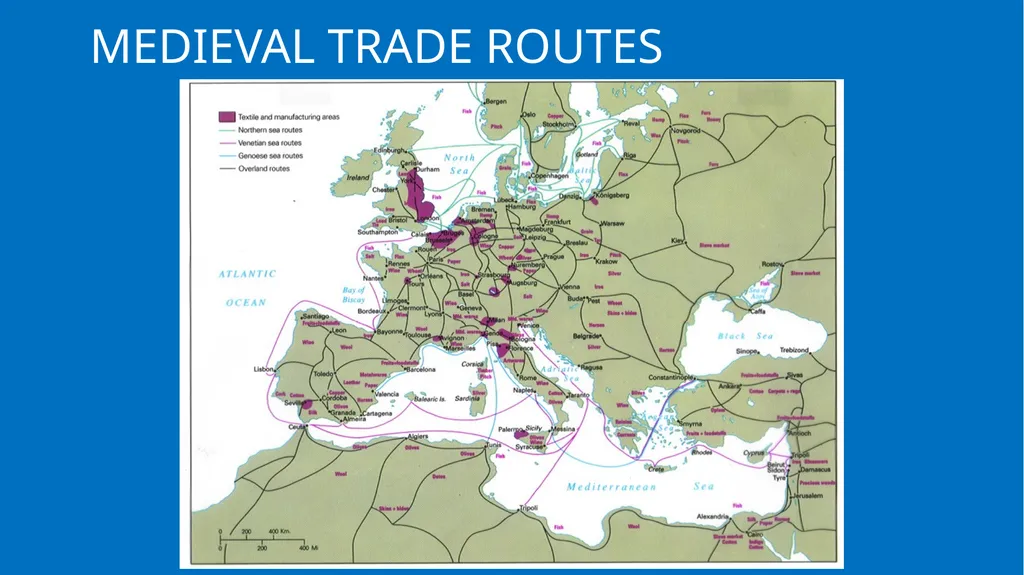
MEDIEVAL TRADE ROUTES<br>
05
Modern Use of Classical Texts & Examples The Bible: Moses, Judas etc: examples of divinely-inspired intelligence & deceit
Ancient Egypt, Sumerians, Hittites, Persians…
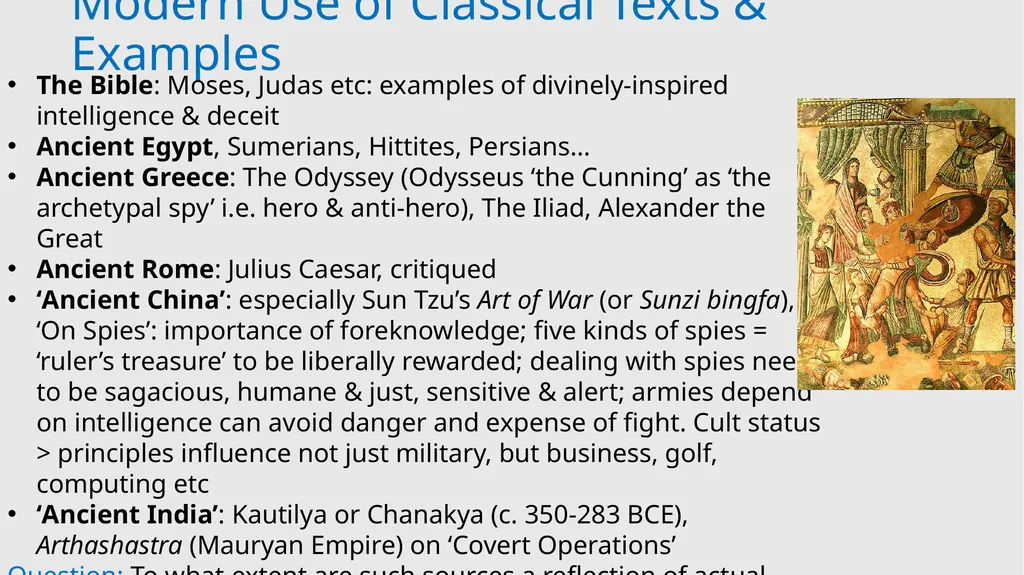
Ancient Greece: The Odyssey (Odysseus ‘the Cunning’ as ‘the archetypal spy’ i.e. hero & anti-hero), The Iliad, Alexander the Great
Ancient Rome: Julius Caesar, critiqued
‘Ancient China’: especially Sun Tzu’s Art of War (or Sunzi bingfa), ‘On Spies’: importance of foreknowledge; five kinds of spies = ‘ruler’s treasure’ to be liberally rewarded; dealing with spies need to be sagacious, humane & just, sensitive & alert; armies depend on intelligence can avoid danger and expense of fight. Cult status > principles influence not just military, but business, golf, computing etc
‘Ancient India’: Kautilya or Chanakya (c. 350-283 BCE), Arthashastra (Mauryan Empire) on ‘Covert Operations’
Question: To what extent are such sources a reflection of actual practice vs ideal or aspiration? What impact did sources have in their own time?<br>
06
Ancient ‘Model’ Ancient world: rulers gather information to make more successful in war & secure in authority
Familiar elements: deception, reconnaissance, spying, assassination, double agents, officials, forms of communication etc, but no calls for organised spy networks or ‘intelligence’ in modern form
What do they mean by ‘intelligence’?: often practical advice to gather knowledge & information, officials policing provinces
Importance of discipline & loyalty alongside deception
Information/knowledge of all sorts (supernatural, social, military) essential to successful warfare and being an effective ruler = political capital to build authority
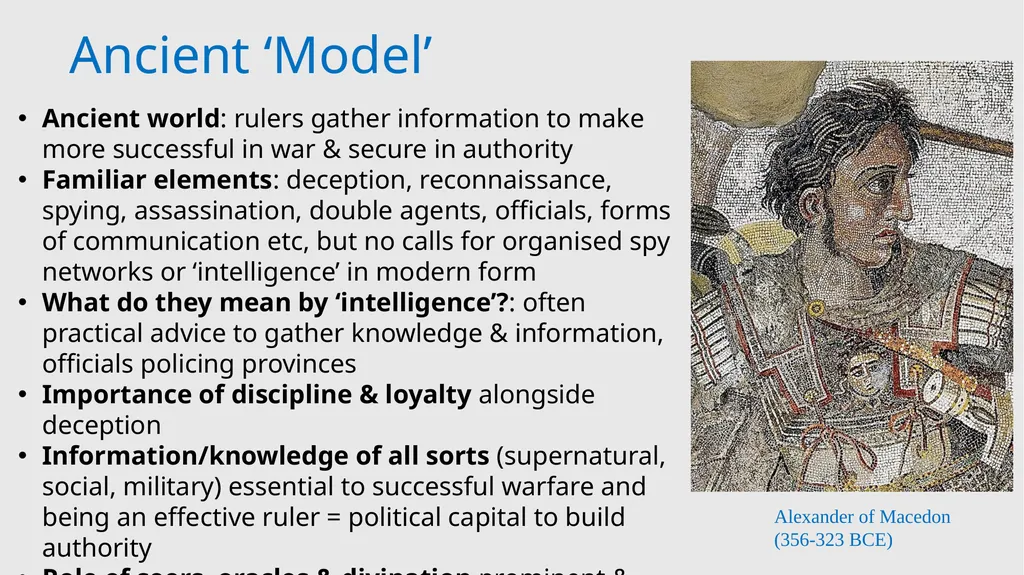
Role of seers, oracles & divination prominent & important Alexander of Macedon
(356-323 BCE)<br>
07
Reflections on Modern (Mis)Use of Classical Texts Classic ‘introductory’ texts > development of intelligence agencies & surveillance state, also dismissive of intelligence ‘failures’, lack of organisation, use of divination
‘Recovered’ texts, e.g. Sun Tzu, translated by C20th intelligence officer
Key problems of translation (variable & disputed) & terminology > find what looking for or used out of context/anachronism?
Authors sometimes direct association with CIA, NSA, MI5 etc (e.g. Andrew, Warner)
Warner’s ‘divine skein’: Sun Tzu > magical or ‘superstitious’ cast aside for ‘real’ military intel, but divination & heavenly signs remained important for sustaining political order
Cf Arthashastra: magical & occult edited out, yet privileged access essential
Cf Islamic powers referencing Quran > divine assistance also cryptography e.g. Abbasid Baghdad
Cf medieval/early modern Christian > focus on role of divine providence > success in battle etc
Cf competitive ownership of knowledge in C21st: informational challenges massive
‘Intelligence’ not just specialised aspect of government or military, but more existential?<br>
08
Medieval comparisons and examples Early/High medieval texts (c. 500-1300): some still heavily literature-dependent (Benham), use of hagiographies, also chronicles
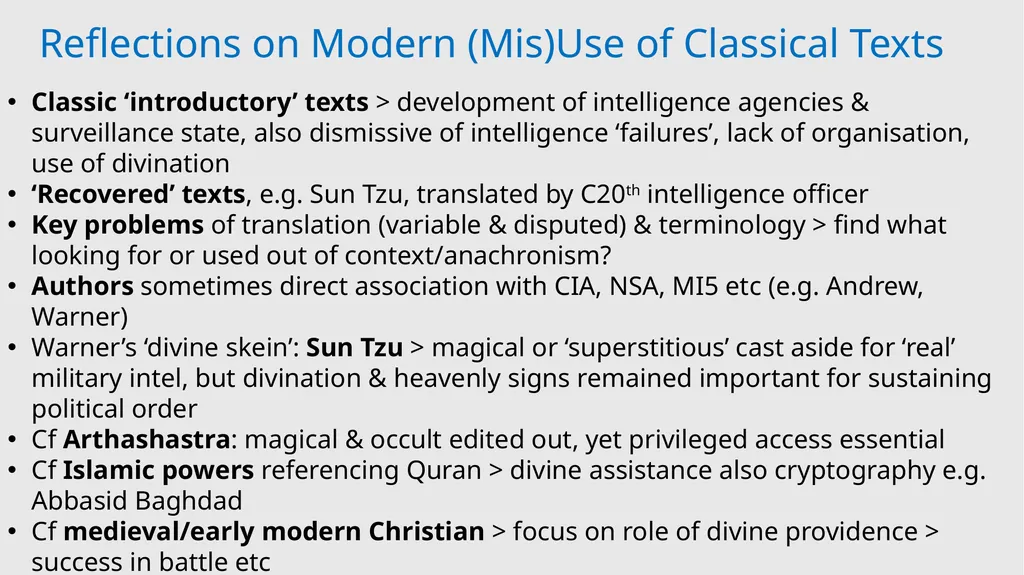
Crusades (Edgington): terminology!, use of scouts, first-hand accounts, employed locals & interpreters, animals as couriers, Saracens superior at intelligence & disinfo
Papal (and later Spanish) inquisition: organised system of surveillance and interrogation
Late Medieval texts: Hundred Years War (Allmand), Wars of the Roses (Arthurson), Burgundian and Flemish Wars; more actual episodes, still war-related, armies & navies (require an enemy to spy and suspect spied on), activities at courts and in towns
Context: continuing classical influences, justification as accepted necessity = ethical, widespread use<br>
09
Late Medieval Contexts Who?: role of women & clergy emphasised, also merchants, pilgrims & tavernkeepers, servants, doctors & officials, linguists & informants, disaffected foreigners, prisoners, students…
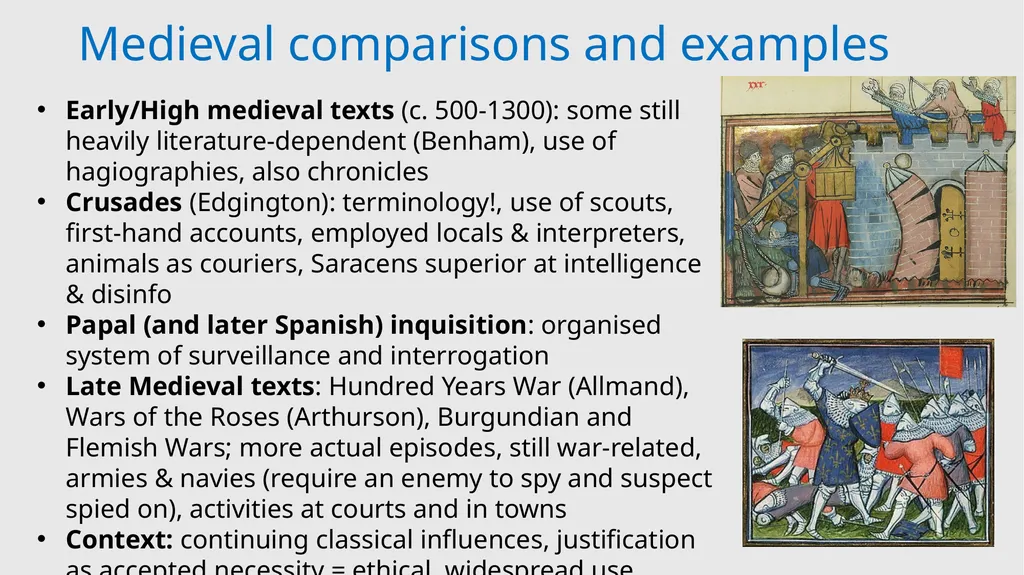
Christine de Pisan (c.1364-1430): ‘subtle spies’, use of disguise & privileged access
Philippe de Commynes (1447-1511): messenger, spy & diplomat = same thing
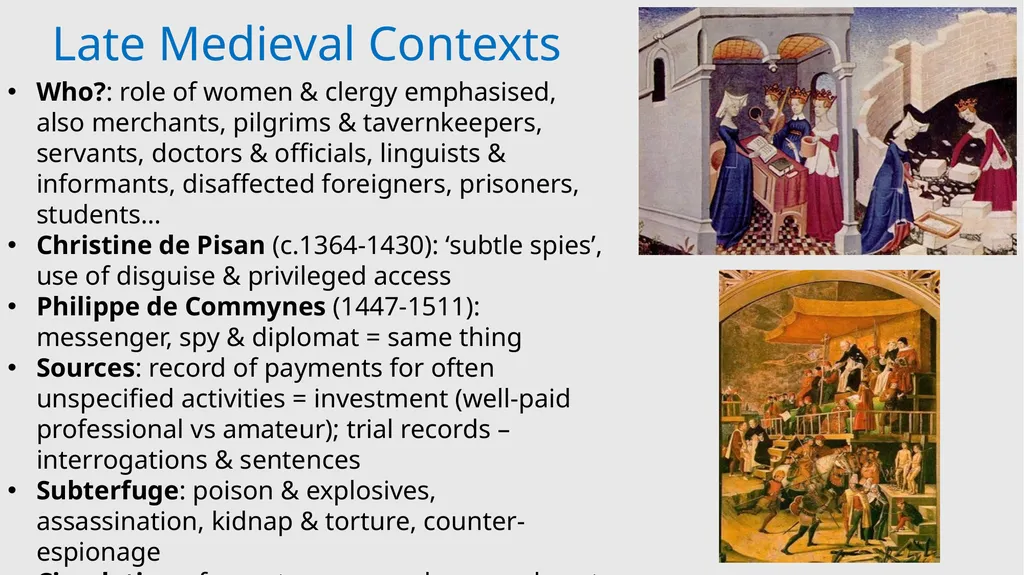
Sources: record of payments for often unspecified activities = investment (well-paid professional vs amateur); trial records – interrogations & sentences
Subterfuge: poison & explosives, assassination, kidnap & torture, counter-espionage
Circulation of secret correspondence and post (and its interception), importance of borders & ports
Cf Renaissance Diplomacy (next week)<br>