ESS 454 Hydrogeology Module 2 Properties of Materials Basic Physics Darcys Law Characteristics of Aquifers Elasticity and Storage Instructor: Michael Brown browness.washington.edu Characteristics of Aquifers Learning Objectives Water
"ESS 454 Hydrogeology Module 2 Properties of" is the property of its rightful owner. Permission is granted to
download and print the materials on this website for personal, non-commercial use only, and to display it
on your personal computer provided you do not modify the materials and that you retain all copyright
notices contained in the materials. By downloading content from our website, you accept the terms of this
agreement.
Presentation Transcript
01
ESS 454 Hydrogeology Module 2
Properties of Materials
Basic Physics
Darcy’s Law
Characteristics of Aquifers
Elasticity and Storage Instructor: Michael Brown
brown@ess.washington.edu<br>
02
Characteristics of Aquifers Learning Objectives Water table:
Define and Illustrate examples of aquifers
Understand the relationship between flow directions and geometry of the surface
If flat -> no flow
Sloping -> flow in down-hill direction
Discharge at lowest point
Aquifer
Understand that it is a geologic unit capable of storing and transmitting water to wells
Know that permeability of aquifer materials is typically > 10-2 Darcy
Confining layers:
Understand definitions of aquitards, aquifuge, and leaky confining layer
Know that permeability of confining layers is typically < 10-2 Darcy K>0.5 inches/day<br>
03
Understand the difference between Unconfined and Confined aquifers
Know what an Artesian aquifer and a Perched aquifer are
Be able to draw representative cross sections to illustrate
Potentiometric Surfaces
Know what is meant by a “screened well”
Be able to illustrate a confined aquifer with a collection of wells screened at a common depth
Be able to contour Head (elevation of water in each well) to illustrate the “Potentiometric Surface”
Be able to determine the magnitude and direction of the gradient of the Potentiometric surface and correctly determine the direction of water flow.
Be able to connect aquifer properties (Transmisivity and Storativity) with properties of geologic materials (K, Sy, compressibility)
Understand the significance of Homogeneity and Anisotropy<br>
04
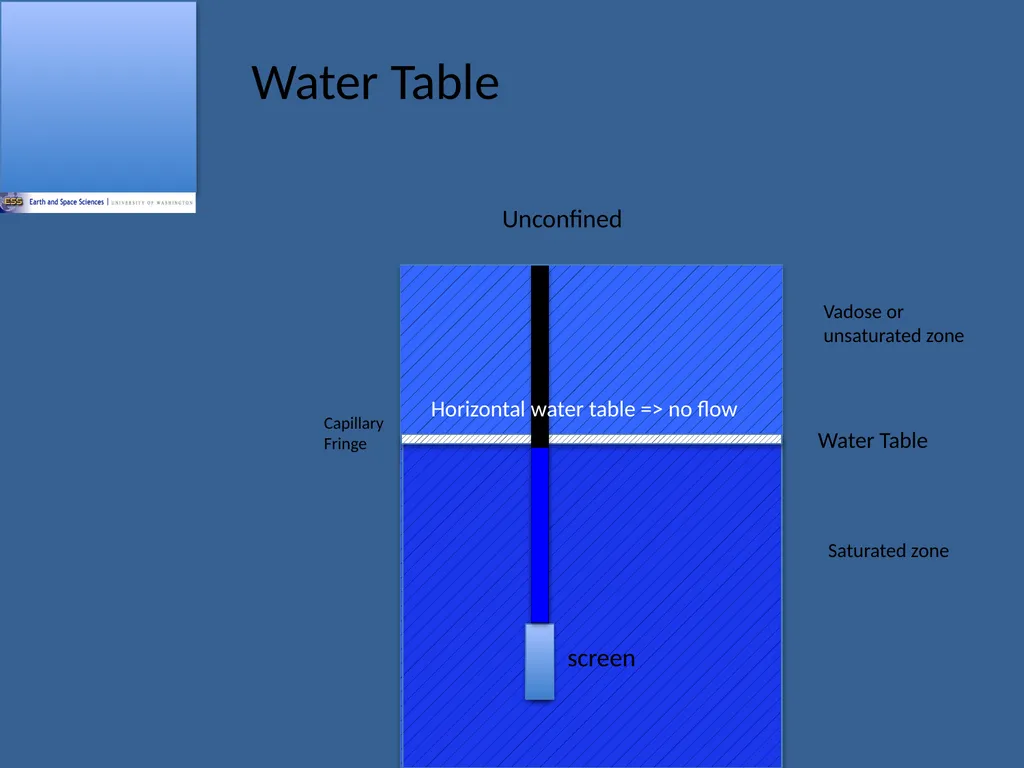
Water Table Vadose or unsaturated zone Saturated zone Water Table screen Unconfined Horizontal water table => no flow<br>
05
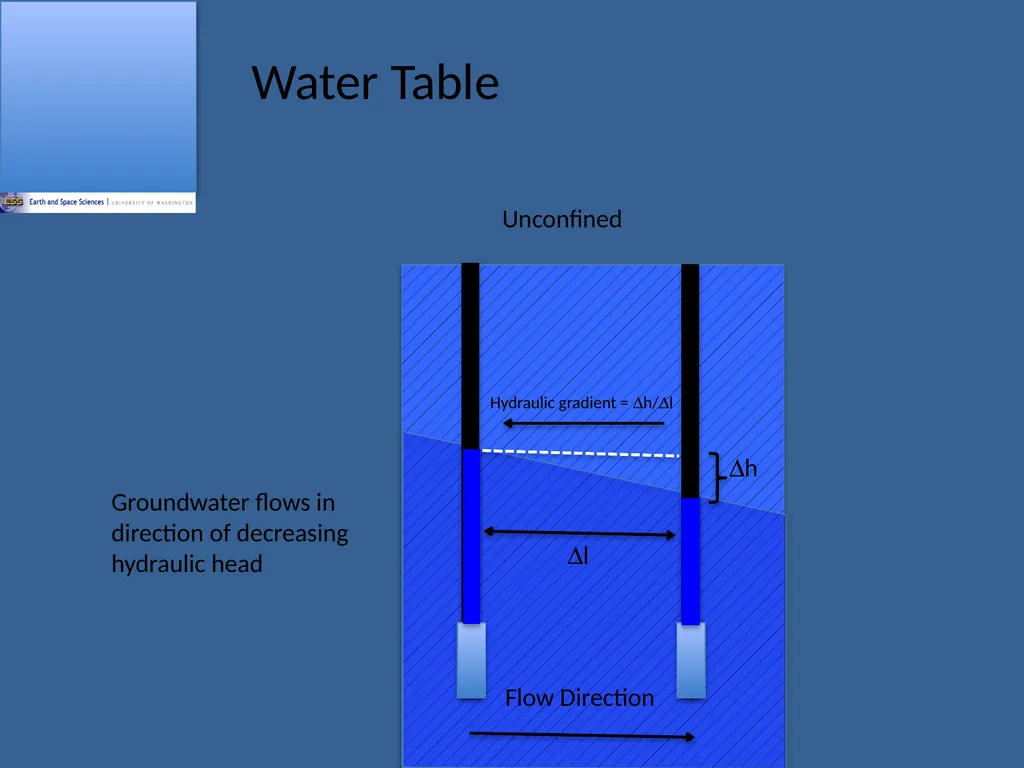
Dh Dl Flow Direction Groundwater flows in direction of decreasing hydraulic head Water Table Unconfined<br>
06
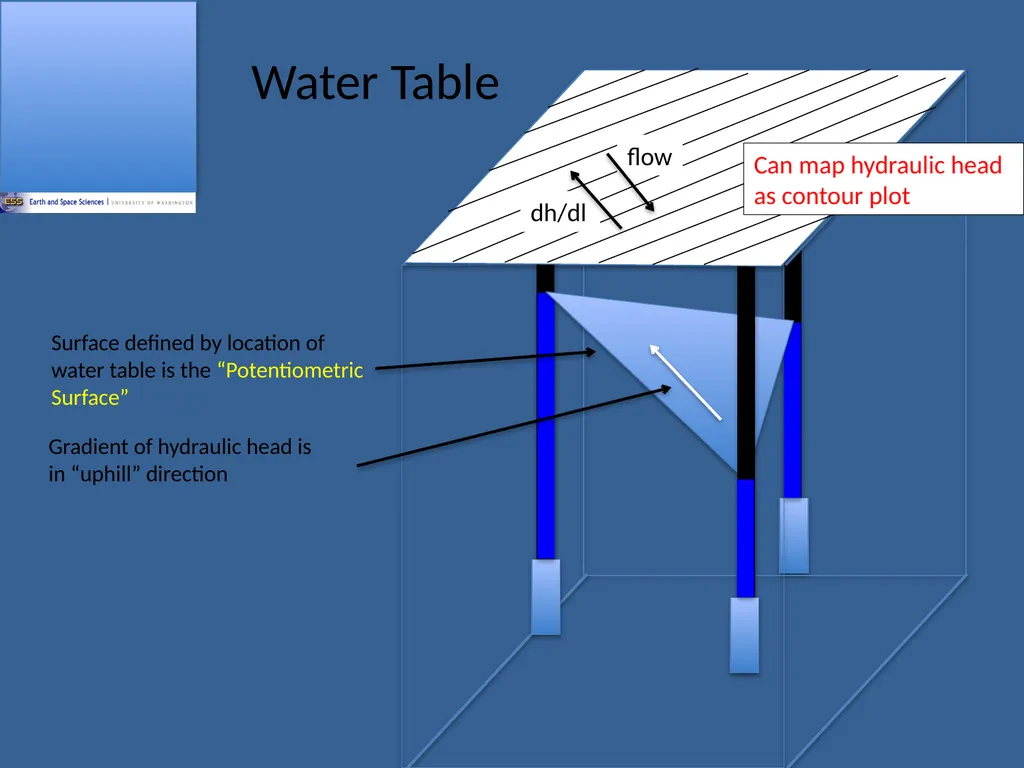
Surface defined by location of water table is the “Potentiometric Surface” Can map hydraulic head
as contour plot Water Table<br>
07
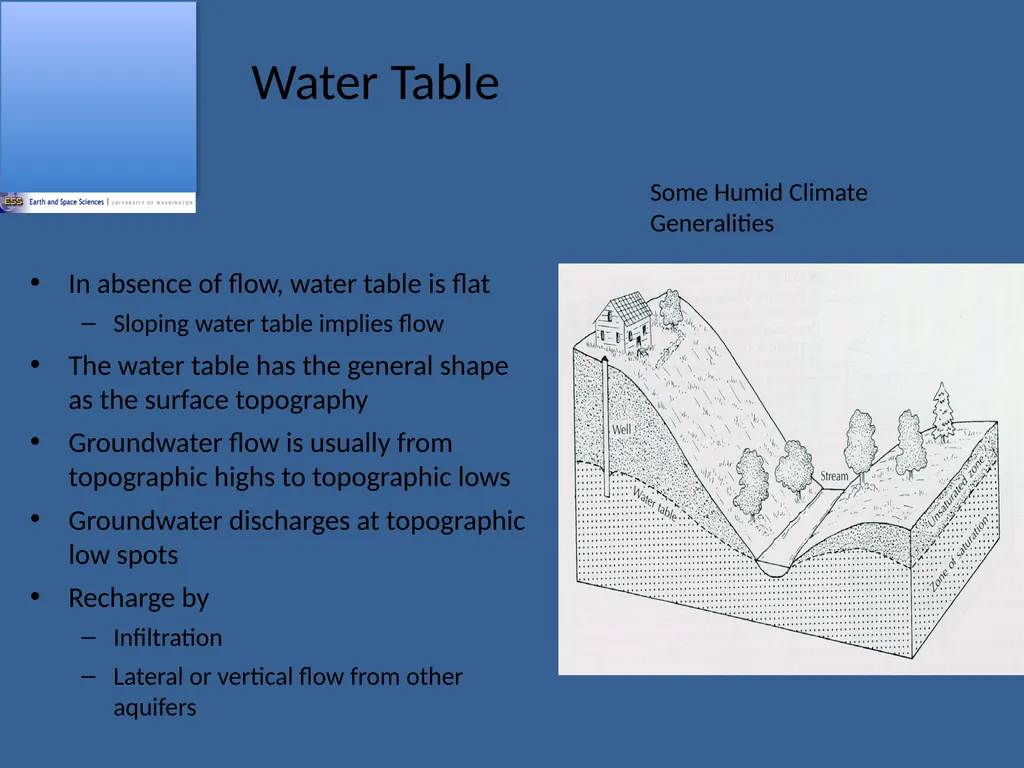
Water Table In absence of flow, water table is flat
Sloping water table implies flow
The water table has the general shape as the surface topography
Groundwater flow is usually from topographic highs to topographic lows
Groundwater discharges at topographic low spots
Recharge by
Infiltration
Lateral or vertical flow from other aquifers Some Humid Climate Generalities<br>
08
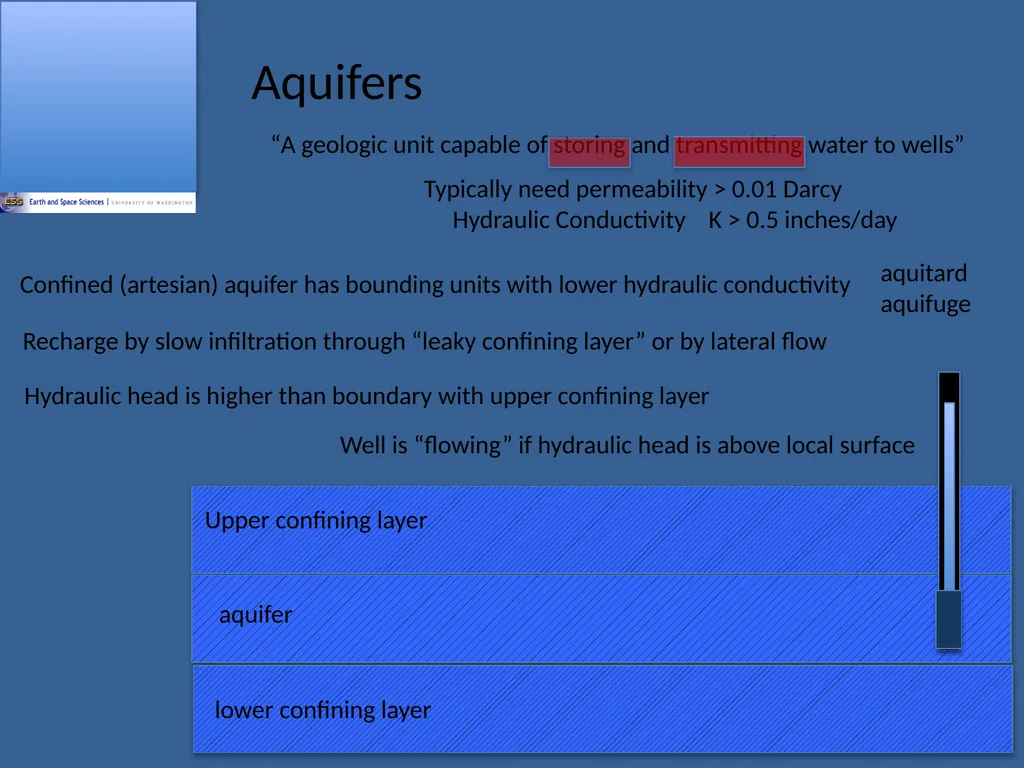
Aquifers “A geologic unit capable of storing and transmitting water to wells” Typically need permeability > 0.01 Darcy
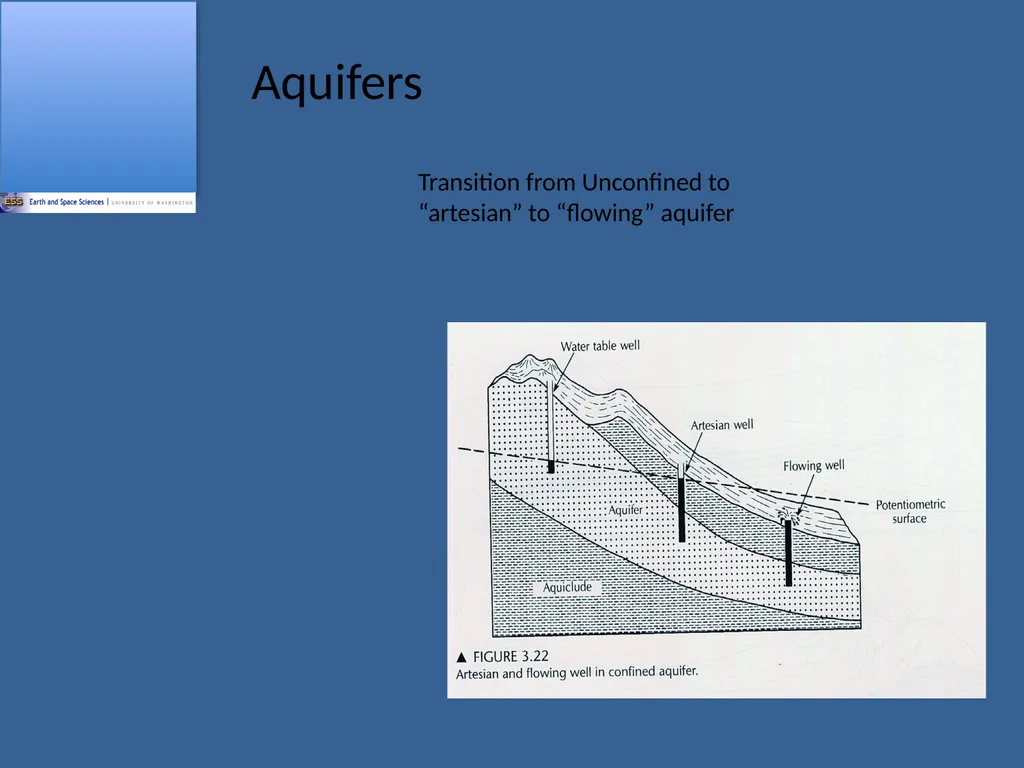
Hydraulic Conductivity K > 0.5 inches/day Confined (artesian) aquifer has bounding units with lower hydraulic conductivity aquitard
aquifuge Recharge by slow infiltration through “leaky confining layer” or by lateral flow Hydraulic head is higher than boundary with upper confining layer Well is “flowing” if hydraulic head is above local surface<br>
09
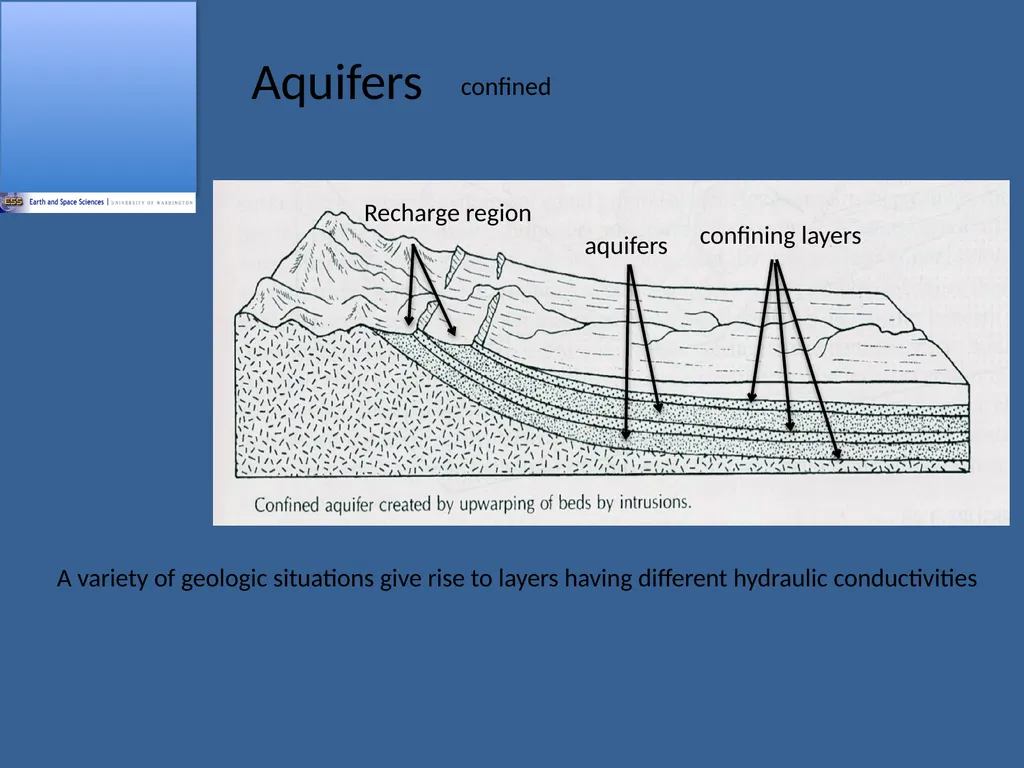
Aquifers confined A variety of geologic situations give rise to layers having different hydraulic conductivities<br>
10
Aquifers Transition from Unconfined to “artesian” to “flowing” aquifer<br>
11
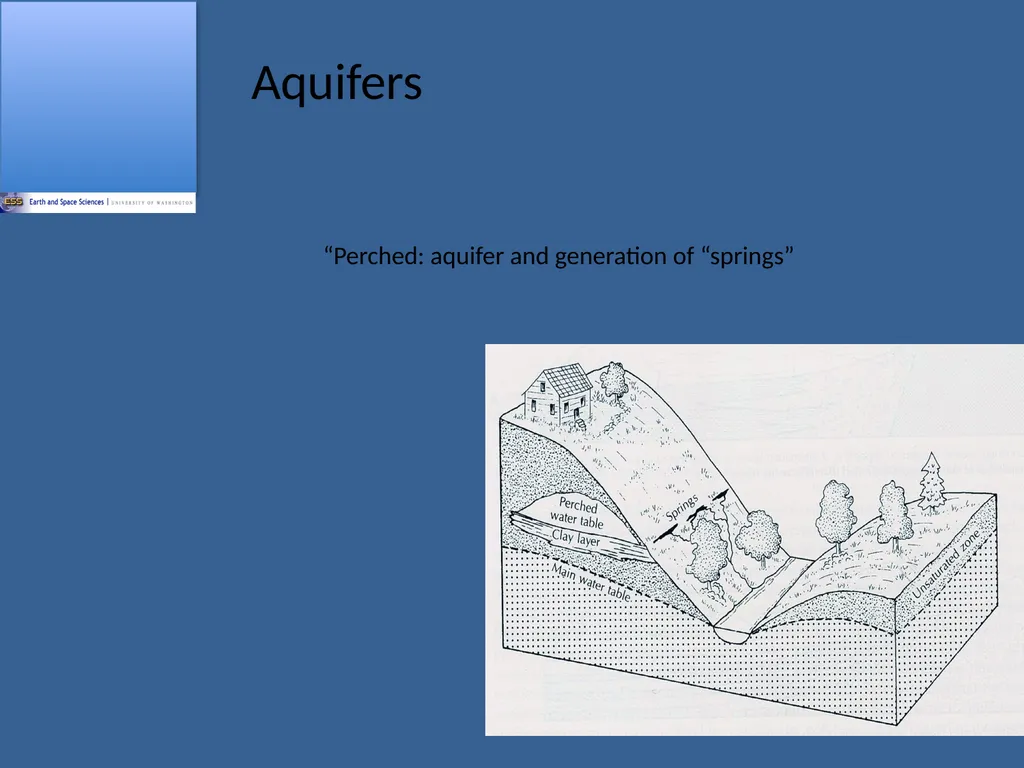
Aquifers “Perched: aquifer and generation of “springs”<br>
12
Aquifer Characteristics Transmisivity – T
T = b * K
b is aquifer thickness, SI units of m2/s
for horizontal flow T is sum of T’s for all layers
Storativity – S
For a volume of water Vw generated from an area “A” for a drop in hydraulic head of Dh
Vw = S A Dh Remember that geologic materials were characterized by their “hydraulic Conductivity” (K) and their “Specific Yield” (Sy) volume S is dimensionless & <1<br>
13
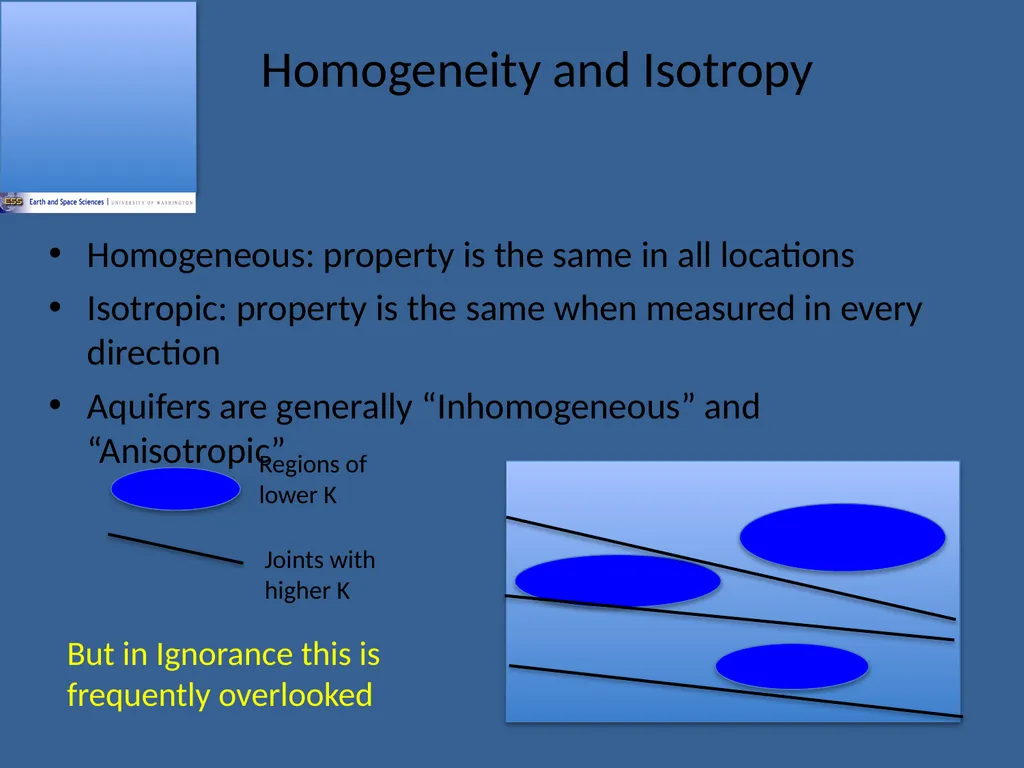
Homogeneity and Isotropy Homogeneous: property is the same in all locations
Isotropic: property is the same when measured in every direction
Aquifers are generally “Inhomogeneous” and “Anisotropic” But in Ignorance this is frequently overlooked<br>
14
Anisotropy A largest difference in Hydraulic Conductivity may exist between the horizontal and vertical directions
For horizontal flow: K = sum (Khmbm)/b
For vertical flow: K = b /sum(bm/Kvm)
K is a “tensor property”
If K is scalar (isotropic) flow is in direction of head gradient
If K is tensor (anisotropic), flow is not parallel to gradient
Flow can be determined from linear algebra
Will quantitatively develop this idea later<br>
15
Coming Up: Specific Storage Elasticity: water and rock are elastic
Hooke’s Law: dx/x = a ds
Effective Stress:
sT = se + P (total stress is supported by rock and by fluid)
dsT = dse + dP (if sT is constant dP = -dse)
Specific Storage (Ss) = rwaterg (a + nb)
Units of 1/L
Storativity S = b Ss (dimensionless) Preview of important concepts<br>