
Essentials of Abnormal Psychology Eighth Edition

Description: Essentials of Abnormal Psychology Eighth Edition Chapter 1 Abnormal Behavior in Historical Context 2019 Cengage. All rights reserved. Outline Understanding Psychopathology The Supernatural Tradition The Biological Tradition The
Related Topics
Download Presentation
"Essentials of Abnormal Psychology Eighth Edition" is the property of its rightful owner. Permission is granted to download and print the materials on this website for personal, non-commercial use only, and to display it on your personal computer provided you do not modify the materials and that you retain all copyright notices contained in the materials. By downloading content from our website, you accept the terms of this agreement.
Presentation Transcript
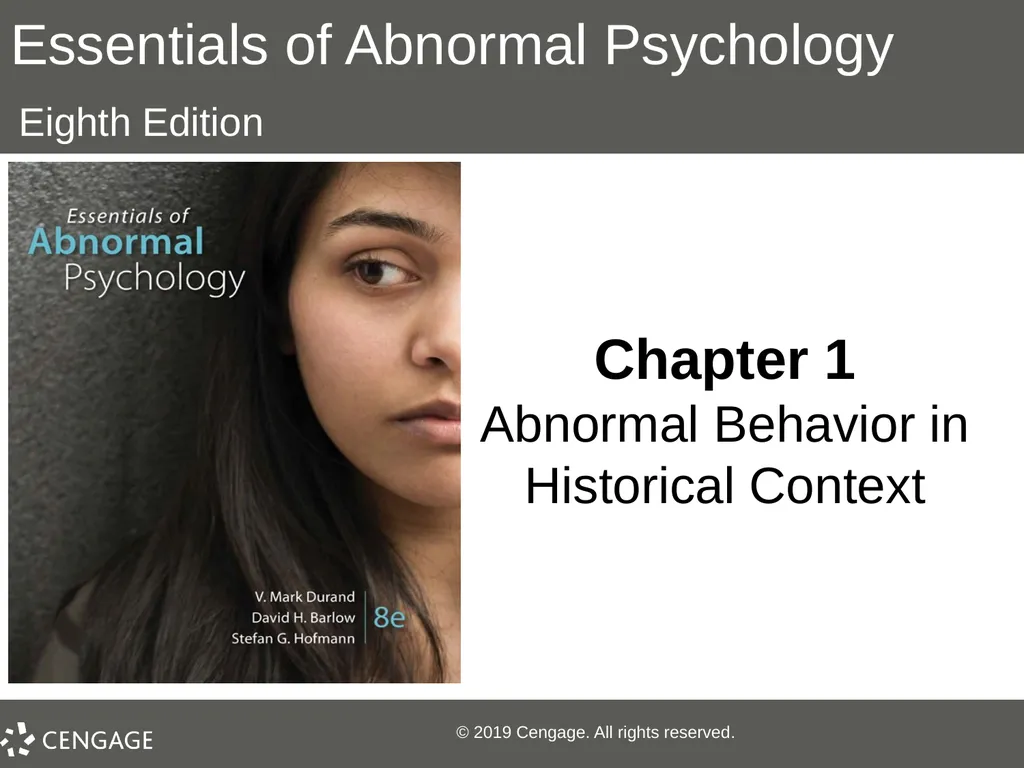
slide1. Essentials of Abnormal Psychology Eighth Edition Chapter 1
Abnormal Behavior in Historical Context © 2019 Cengage. All rights reserved.<br>
slide2. Outline Understanding Psychopathology
The Supernatural Tradition
The Biological Tradition
The Psychological Tradition
An Integrative Approach<br>
slide3. Focus Questions How do we define a psychological disorder?
What supernatural influences were formerly believed to explain abnormal behavior?
What are the assumptions of the biological approach?
How do various psychological approaches explain abnormal behavior?
How do we explain an integrative approach?<br>
slide4. What Is a Psychological Disorder? Part 1 No single definition of psychological abnormality
No single definition of psychological normality<br>
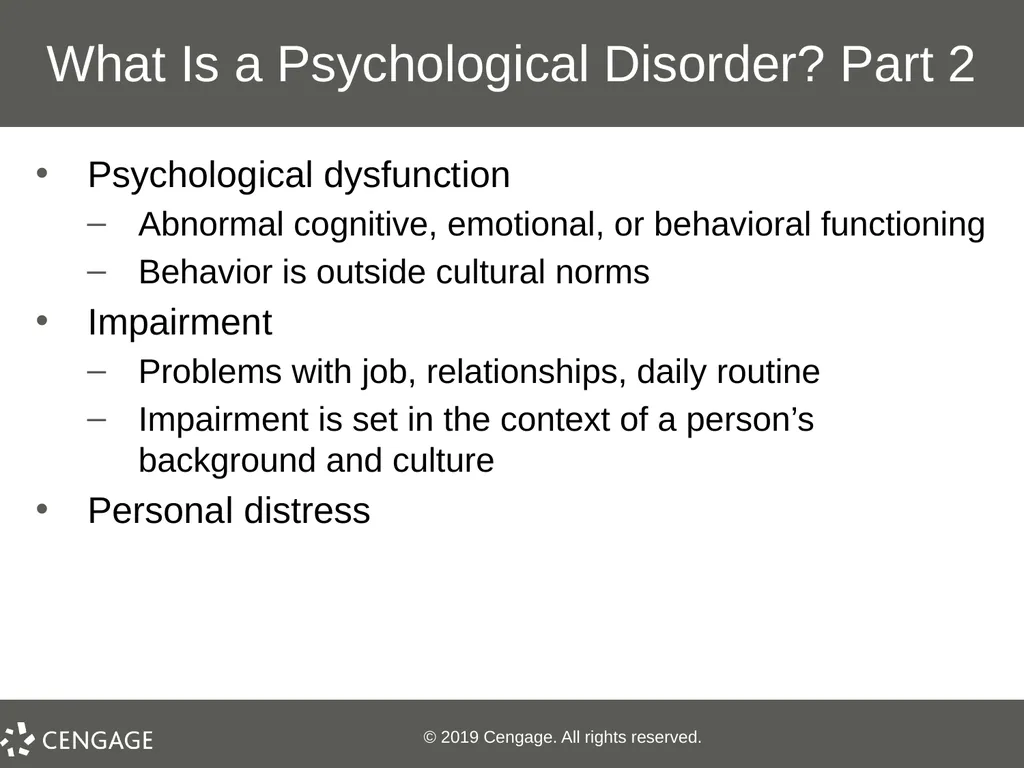
slide5. What Is a Psychological Disorder? Part 2 Psychological dysfunction
Abnormal cognitive, emotional, or behavioral functioning
Behavior is outside cultural norms
Impairment
Problems with job, relationships, daily routine
Impairment is set in the context of a person’s background and culture
Personal distress<br>
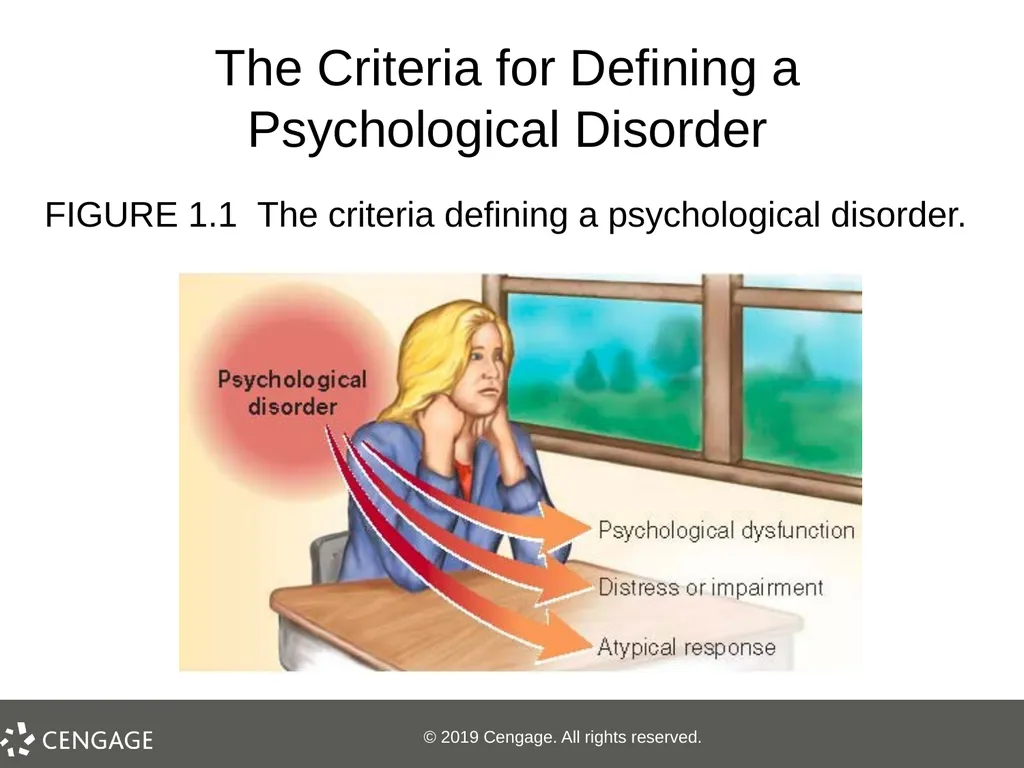
slide6. The Criteria for Defining a Psychological Disorder FIGURE 1.1 The criteria defining a psychological disorder.<br>
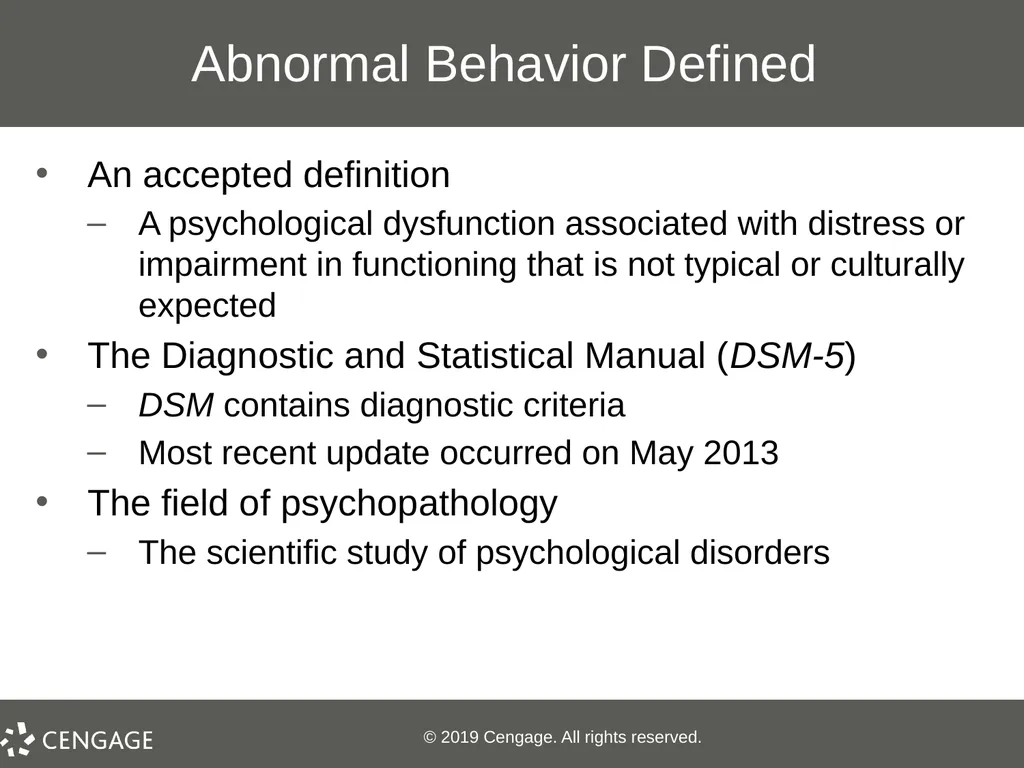
slide7. Abnormal Behavior Defined An accepted definition
A psychological dysfunction associated with distress or impairment in functioning that is not typical or culturally expected
The Diagnostic and Statistical Manual (DSM-5)
DSM contains diagnostic criteria
Most recent update occurred on May 2013
The field of psychopathology
The scientific study of psychological disorders<br>
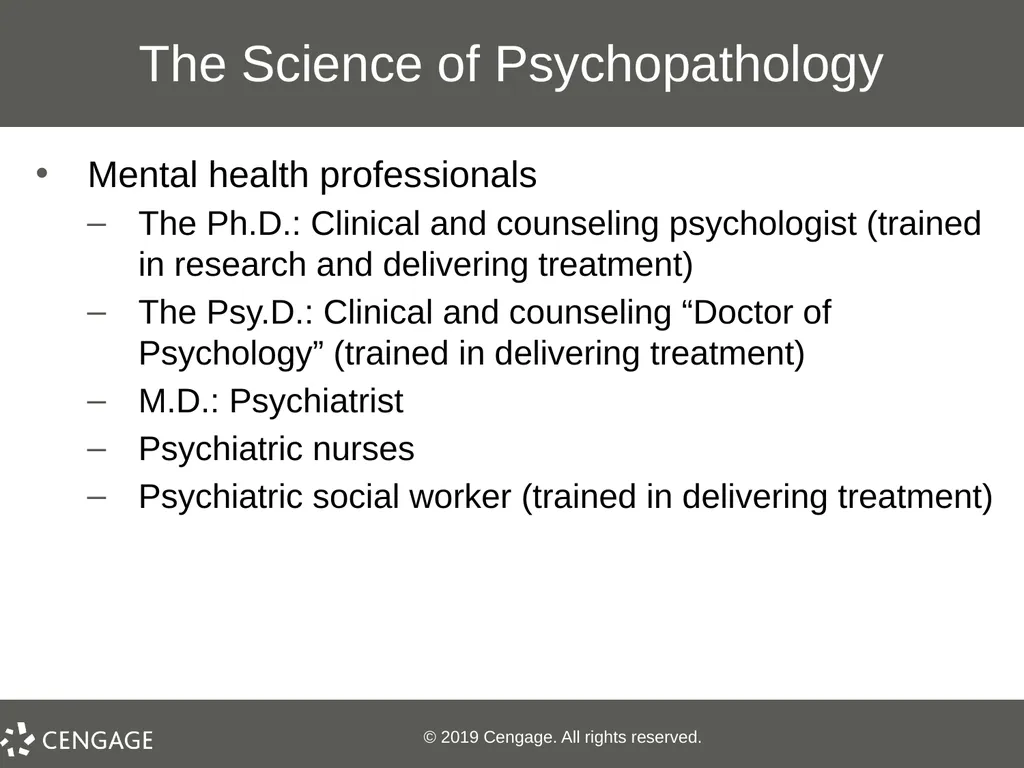
slide8. The Science of Psychopathology Mental health professionals
The Ph.D.: Clinical and counseling psychologist (trained in research and delivering treatment)
The Psy.D.: Clinical and counseling “Doctor of Psychology” (trained in delivering treatment)
M.D.: Psychiatrist
Psychiatric nurses
Psychiatric social worker (trained in delivering treatment)<br>
slide9. The Scientist-Practitioner Practice (treatment delivery) and research mutually influence each other
Stays current with research in field
Evaluates own assessment and treatment
Conducts research<br>
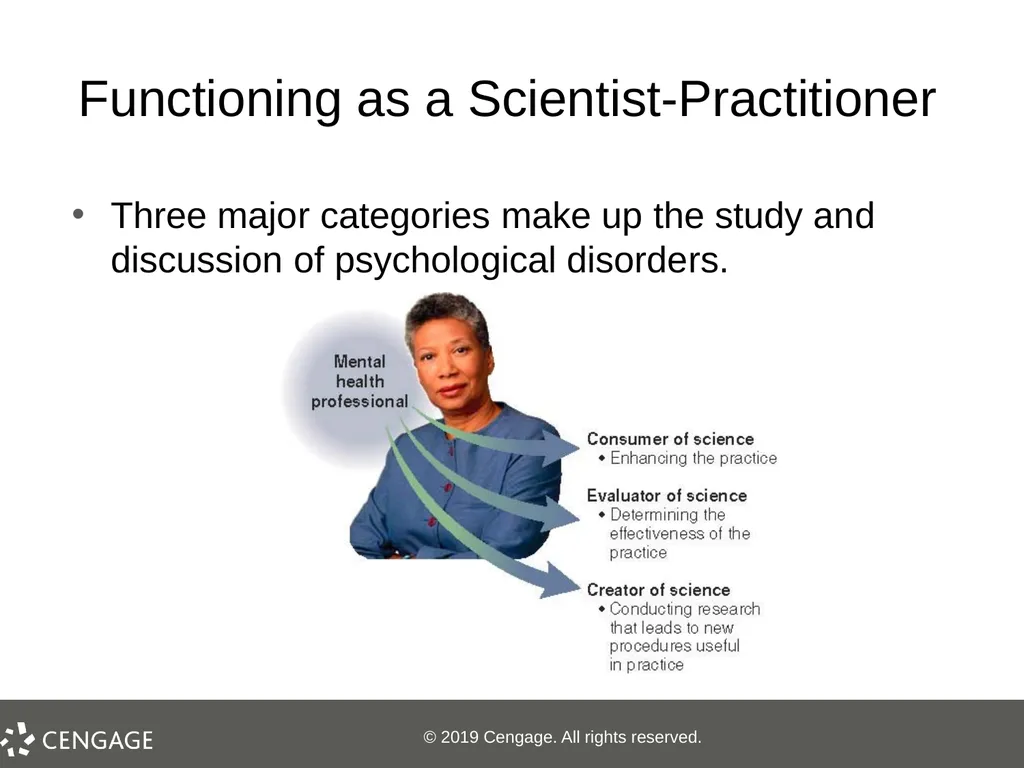
slide10. Functioning as a Scientist-Practitioner Three major categories make up the study and discussion of psychological disorders.<br>
slide11. Clinical Description, Part 1 Begins with the presenting problem
Symptoms (e.g., chronic worry, panic attacks)
Description aims to:
Distinguish clinically significant dysfunction from common human experience
Describe prevalence and incidence of disorders<br>
slide12. Clinical Description, Part 2 Describe onset of disorders
Acute vs. insidious onset
Describe course of disorders
Episodic, time-limited, or chronic course
Prognosis
Good vs. guarded<br>
slide13. Causation, Treatment, and Outcome, Part 1 Etiology
What contributes to the development of psychopathology?
Treatment development
How can we help alleviate psychological suffering?
Includes pharmacological, psychosocial, and/or combined treatments<br>
slide14. Causation, Treatment, and Outcome, Part 2 Treatment outcome research
How do we know that we have helped?
May be difficult to directly target causes of disorders; symptoms are targeted instead<br>
slide15. Historical Conceptions of Abnormal Behavior, Part 1 Major psychological disorders have existed in all cultures and across all time periods
Causes and treatment of abnormal behavior vary widely across cultures, time periods, world views<br>
slide16. Historical Conceptions of Abnormal Behavior, Part 2 Three dominant traditions have existed in the past to explain abnormal behavior
Supernatural
Biological
Psychological<br>
slide17. The Supernatural Tradition, Part 1 Deviant behavior as a battle of “Good” vs. “Evil”
Caused by demonic possession, witchcraft, sorcery
Treatments included exorcism, torture, religious services<br>
slide18. The Supernatural Tradition, Part 2 Mass hysteria
Saint Vitus’s Dance/tarantism
Modern mass hysteria
Emotion contagion
Mob psychology
The moon and the stars
Paracelsus and lunacy<br>
slide19. The Biological Tradition, Part 1 Hippocrates: Abnormal behavior as a physical disease
Hysteria “the wandering uterus”—psychological symptoms were a result of the uterus moving around in the body
Linked abnormality with brain chemical imbalances
Foreshadowed modern views
Galen extended Hippocrates’ work<br>
slide20. The Biological Tradition, Part 2 Galenic-Hippocratic tradition
Humoral theory of disorders: Functioning is related to having two much or too little of four key bodily fluids (humors)
Blood, phlegm, black bile, yellow bile
Example: Depression caused by too much black bile
Treated by changing environmental conditions (e.g., reducing heat) or bloodletting/vomiting<br>
slide21. The 19th Century, Part 1 General paresis (syphilis) and the biological link with madness
Several unusual psychological and behavioral symptoms
Pasteur discovered the cause—a bacterial microorganism
Led to penicillin as a successful treatment
Bolstered the view that mental illness = physical illness<br>
slide22. The 19th Century, Part 2 John P. Grey and the reformers
Psychiatrist who believed mental illness had physical roots
Championed biological tradition in the United States
Led to reforms of hospitals to give psychiatric patients better care<br>
slide23. Early Biological Treatments Electric shock
Crude surgery
Insulin (discovered by accident to calm psychotic patients)
Major tranquilizers (discovered mid-20th century)
Minor tranquilizers (e.g., benzodiazepines)—commonly prescribed for anxiety today<br>
slide24. Consequences of the Biological Tradition Mental illness = physical illness
Emil Kraepelin: Classification of disorders
Emphasized that different disorders have unique age of onset, symptoms, and causes<br>
slide25. The Psychological Tradition, Part 1 The rise of moral therapy
Became popular in first half of 19th century
“Moral” = referring to psychological/emotional factors
Main idea: Treat patients as normally as possible in normal environment
More humane treatment of institutionalized patients
Encouraged and reinforced social interaction<br>
slide26. The Psychological Tradition, Part 2 Proponents of moral therapy
Philippe Pinel and Jean-Baptiste Pussin—patients shouldn’t be restrained
Benjamin Rush—led reforms in United States
Dorothea Dix—mental hygiene movement
Asylum reform > more patients getting care
Moral therapy declined because more difficult with large groups of patients
Soon followed by emergence of competing alternative psychological models<br>
slide27. Psychoanalytic Theory, Part 1 Freudian theory of the structure and function of the mind
Unconscious
Catharsis
Psychoanalytic model sought to explain development and personality
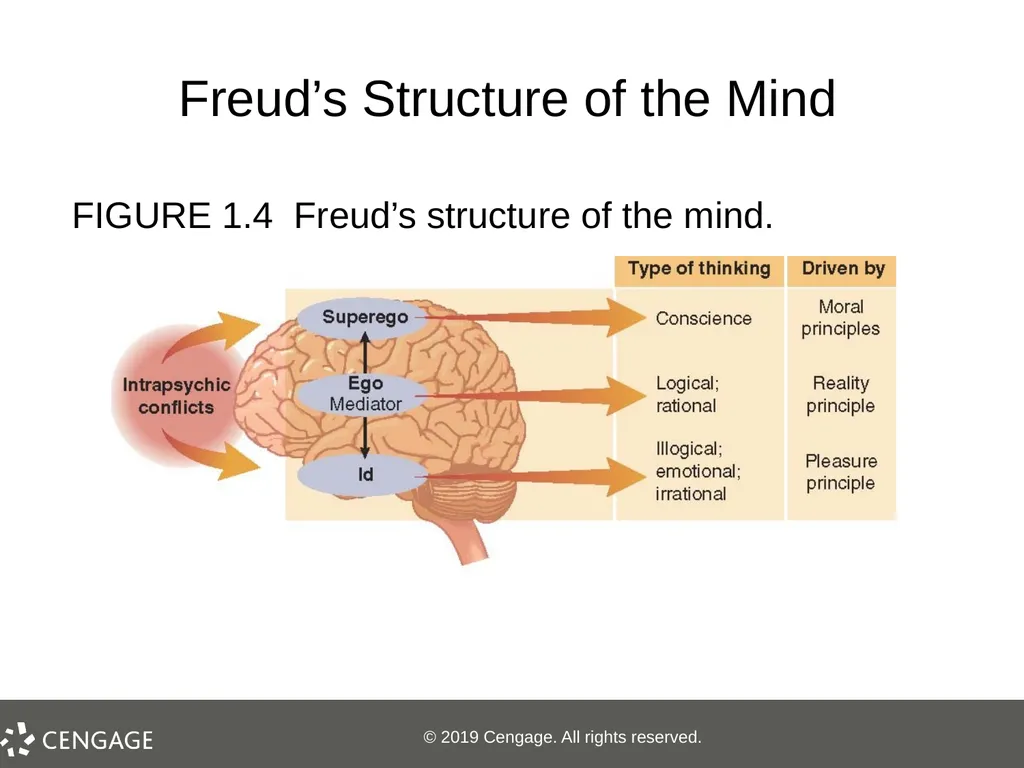
Structure of the mind
Id (pleasure principle; illogical, emotional, irrational)
Superego (moral principles)
Ego (rational; mediates between supergo/id)<br>
slide28. Psychoanalytic Theory, Part 2 Defense mechanisms: Ego’s attempt to manage anxiety resulting from id/superego conflict
Displacement & denial
Rationalization & reaction formation
Projection, repression, and sublimation
Psychosexual stages of development
Oral, anal, phallic, latency, and genital stages<br>
slide29. Freud’s Structure of the Mind FIGURE 1.4 Freud’s structure of the mind.<br>
slide30. Later Developments in Psychoanalytic Thought, Part 1 Anna Freud and self-psychology
Emphasized influence of the ego in defining behavior
Melanie Klein, Otto Kernberg, and object relations theory
Emphasized how children incorporate (introject) objects
Objects—significant others and their images, memories, and values<br>
slide31. Later Developments in Psychoanalytic Thought, Part 2 The “Neo-Freudians”: Departures from Freudian thought
De-emphasized the sexual core of Freud’s theory
Jung, Adler, Horney, Fromm, and Erickson
E.g., Jung emphasized instead the “collective unconscious”<br>
slide32. Psychoanalytic Psychotherapy: The “Talking” Cure Unearth the hidden intrapsychic conflicts
“The real problems”
Therapy is often long term
Techniques
Free association
Dream analysis
Examine transference and counter-transference issues
Little evidence for efficacy<br>
slide33. Humanistic Theory, Part 1 Major themes
People are basically good
Humans strive toward self-actualization
Major players
Abraham Maslow and Carl Rogers<br>
slide34. Humanistic Theory, Part 2 Person-centered therapy
Therapist conveys empathy and unconditional positive regard
Minimal therapist interpretation
No strong evidence that purely humanistic therapies work to treat mental disorders
More effective for people dealing with normal life stress, not suffering from psychopathology<br>
slide35. The Behavioral Model Derived from a scientific approach to the study of psychopathology
Classical conditioning (Pavlov; Watson)
Ubiquitous form of learning
People learn associations between neutral stimuli and stimuli that already have meaning (unconditioned stimuli)
Conditioning explains the acquisition of some fears<br>
slide36. The Beginnings of Behavior Therapy, Part 1 Challenged psychoanalysis and nonscientific approaches
Early pioneers
Joseph Wolpe—systematic desensitization
Operant conditioning (Thorndike; Skinner)
Reinforcement
Another ubiquitous form of learning
Voluntary behavior is controlled by consequences<br>
slide37. The Beginnings of Behavior Therapy, Part 2 Learning traditions influenced the development of behavior therapy
Behavior therapy tends to be time-limited and direct
Strong evidence supporting the efficacy of behavior therapies
Behavior therapy: Creating new associations by practicing new behavioral habits and/or reinforcing useful behaviors with positive consequences<br>
slide38. An Integrative Approach Psychopathology is multiply determined
Unidimensional accounts of psychopathology are incomplete<br>
slide39. An Integrative Approach: Summary Must consider reciprocal relations among:
Neuroscience, cognitive science, behavior science, and developmental science
Defining abnormal behavior
Complex, multifaceted, and has evolved
Science of psychopathology is evolving
The supernatural tradition no longer has a place in a science of abnormal behavior
Multidimensional and integrative<br>
Abnormal Behavior in Historical Context © 2019 Cengage. All rights reserved.<br>
slide2. Outline Understanding Psychopathology
The Supernatural Tradition
The Biological Tradition
The Psychological Tradition
An Integrative Approach<br>
slide3. Focus Questions How do we define a psychological disorder?
What supernatural influences were formerly believed to explain abnormal behavior?
What are the assumptions of the biological approach?
How do various psychological approaches explain abnormal behavior?
How do we explain an integrative approach?<br>
slide4. What Is a Psychological Disorder? Part 1 No single definition of psychological abnormality
No single definition of psychological normality<br>
slide5. What Is a Psychological Disorder? Part 2 Psychological dysfunction
Abnormal cognitive, emotional, or behavioral functioning
Behavior is outside cultural norms
Impairment
Problems with job, relationships, daily routine
Impairment is set in the context of a person’s background and culture
Personal distress<br>
slide6. The Criteria for Defining a Psychological Disorder FIGURE 1.1 The criteria defining a psychological disorder.<br>
slide7. Abnormal Behavior Defined An accepted definition
A psychological dysfunction associated with distress or impairment in functioning that is not typical or culturally expected
The Diagnostic and Statistical Manual (DSM-5)
DSM contains diagnostic criteria
Most recent update occurred on May 2013
The field of psychopathology
The scientific study of psychological disorders<br>
slide8. The Science of Psychopathology Mental health professionals
The Ph.D.: Clinical and counseling psychologist (trained in research and delivering treatment)
The Psy.D.: Clinical and counseling “Doctor of Psychology” (trained in delivering treatment)
M.D.: Psychiatrist
Psychiatric nurses
Psychiatric social worker (trained in delivering treatment)<br>
slide9. The Scientist-Practitioner Practice (treatment delivery) and research mutually influence each other
Stays current with research in field
Evaluates own assessment and treatment
Conducts research<br>
slide10. Functioning as a Scientist-Practitioner Three major categories make up the study and discussion of psychological disorders.<br>
slide11. Clinical Description, Part 1 Begins with the presenting problem
Symptoms (e.g., chronic worry, panic attacks)
Description aims to:
Distinguish clinically significant dysfunction from common human experience
Describe prevalence and incidence of disorders<br>
slide12. Clinical Description, Part 2 Describe onset of disorders
Acute vs. insidious onset
Describe course of disorders
Episodic, time-limited, or chronic course
Prognosis
Good vs. guarded<br>
slide13. Causation, Treatment, and Outcome, Part 1 Etiology
What contributes to the development of psychopathology?
Treatment development
How can we help alleviate psychological suffering?
Includes pharmacological, psychosocial, and/or combined treatments<br>
slide14. Causation, Treatment, and Outcome, Part 2 Treatment outcome research
How do we know that we have helped?
May be difficult to directly target causes of disorders; symptoms are targeted instead<br>
slide15. Historical Conceptions of Abnormal Behavior, Part 1 Major psychological disorders have existed in all cultures and across all time periods
Causes and treatment of abnormal behavior vary widely across cultures, time periods, world views<br>
slide16. Historical Conceptions of Abnormal Behavior, Part 2 Three dominant traditions have existed in the past to explain abnormal behavior
Supernatural
Biological
Psychological<br>
slide17. The Supernatural Tradition, Part 1 Deviant behavior as a battle of “Good” vs. “Evil”
Caused by demonic possession, witchcraft, sorcery
Treatments included exorcism, torture, religious services<br>
slide18. The Supernatural Tradition, Part 2 Mass hysteria
Saint Vitus’s Dance/tarantism
Modern mass hysteria
Emotion contagion
Mob psychology
The moon and the stars
Paracelsus and lunacy<br>
slide19. The Biological Tradition, Part 1 Hippocrates: Abnormal behavior as a physical disease
Hysteria “the wandering uterus”—psychological symptoms were a result of the uterus moving around in the body
Linked abnormality with brain chemical imbalances
Foreshadowed modern views
Galen extended Hippocrates’ work<br>
slide20. The Biological Tradition, Part 2 Galenic-Hippocratic tradition
Humoral theory of disorders: Functioning is related to having two much or too little of four key bodily fluids (humors)
Blood, phlegm, black bile, yellow bile
Example: Depression caused by too much black bile
Treated by changing environmental conditions (e.g., reducing heat) or bloodletting/vomiting<br>
slide21. The 19th Century, Part 1 General paresis (syphilis) and the biological link with madness
Several unusual psychological and behavioral symptoms
Pasteur discovered the cause—a bacterial microorganism
Led to penicillin as a successful treatment
Bolstered the view that mental illness = physical illness<br>
slide22. The 19th Century, Part 2 John P. Grey and the reformers
Psychiatrist who believed mental illness had physical roots
Championed biological tradition in the United States
Led to reforms of hospitals to give psychiatric patients better care<br>
slide23. Early Biological Treatments Electric shock
Crude surgery
Insulin (discovered by accident to calm psychotic patients)
Major tranquilizers (discovered mid-20th century)
Minor tranquilizers (e.g., benzodiazepines)—commonly prescribed for anxiety today<br>
slide24. Consequences of the Biological Tradition Mental illness = physical illness
Emil Kraepelin: Classification of disorders
Emphasized that different disorders have unique age of onset, symptoms, and causes<br>
slide25. The Psychological Tradition, Part 1 The rise of moral therapy
Became popular in first half of 19th century
“Moral” = referring to psychological/emotional factors
Main idea: Treat patients as normally as possible in normal environment
More humane treatment of institutionalized patients
Encouraged and reinforced social interaction<br>
slide26. The Psychological Tradition, Part 2 Proponents of moral therapy
Philippe Pinel and Jean-Baptiste Pussin—patients shouldn’t be restrained
Benjamin Rush—led reforms in United States
Dorothea Dix—mental hygiene movement
Asylum reform > more patients getting care
Moral therapy declined because more difficult with large groups of patients
Soon followed by emergence of competing alternative psychological models<br>
slide27. Psychoanalytic Theory, Part 1 Freudian theory of the structure and function of the mind
Unconscious
Catharsis
Psychoanalytic model sought to explain development and personality
Structure of the mind
Id (pleasure principle; illogical, emotional, irrational)
Superego (moral principles)
Ego (rational; mediates between supergo/id)<br>
slide28. Psychoanalytic Theory, Part 2 Defense mechanisms: Ego’s attempt to manage anxiety resulting from id/superego conflict
Displacement & denial
Rationalization & reaction formation
Projection, repression, and sublimation
Psychosexual stages of development
Oral, anal, phallic, latency, and genital stages<br>
slide29. Freud’s Structure of the Mind FIGURE 1.4 Freud’s structure of the mind.<br>
slide30. Later Developments in Psychoanalytic Thought, Part 1 Anna Freud and self-psychology
Emphasized influence of the ego in defining behavior
Melanie Klein, Otto Kernberg, and object relations theory
Emphasized how children incorporate (introject) objects
Objects—significant others and their images, memories, and values<br>
slide31. Later Developments in Psychoanalytic Thought, Part 2 The “Neo-Freudians”: Departures from Freudian thought
De-emphasized the sexual core of Freud’s theory
Jung, Adler, Horney, Fromm, and Erickson
E.g., Jung emphasized instead the “collective unconscious”<br>
slide32. Psychoanalytic Psychotherapy: The “Talking” Cure Unearth the hidden intrapsychic conflicts
“The real problems”
Therapy is often long term
Techniques
Free association
Dream analysis
Examine transference and counter-transference issues
Little evidence for efficacy<br>
slide33. Humanistic Theory, Part 1 Major themes
People are basically good
Humans strive toward self-actualization
Major players
Abraham Maslow and Carl Rogers<br>
slide34. Humanistic Theory, Part 2 Person-centered therapy
Therapist conveys empathy and unconditional positive regard
Minimal therapist interpretation
No strong evidence that purely humanistic therapies work to treat mental disorders
More effective for people dealing with normal life stress, not suffering from psychopathology<br>
slide35. The Behavioral Model Derived from a scientific approach to the study of psychopathology
Classical conditioning (Pavlov; Watson)
Ubiquitous form of learning
People learn associations between neutral stimuli and stimuli that already have meaning (unconditioned stimuli)
Conditioning explains the acquisition of some fears<br>
slide36. The Beginnings of Behavior Therapy, Part 1 Challenged psychoanalysis and nonscientific approaches
Early pioneers
Joseph Wolpe—systematic desensitization
Operant conditioning (Thorndike; Skinner)
Reinforcement
Another ubiquitous form of learning
Voluntary behavior is controlled by consequences<br>
slide37. The Beginnings of Behavior Therapy, Part 2 Learning traditions influenced the development of behavior therapy
Behavior therapy tends to be time-limited and direct
Strong evidence supporting the efficacy of behavior therapies
Behavior therapy: Creating new associations by practicing new behavioral habits and/or reinforcing useful behaviors with positive consequences<br>
slide38. An Integrative Approach Psychopathology is multiply determined
Unidimensional accounts of psychopathology are incomplete<br>
slide39. An Integrative Approach: Summary Must consider reciprocal relations among:
Neuroscience, cognitive science, behavior science, and developmental science
Defining abnormal behavior
Complex, multifaceted, and has evolved
Science of psychopathology is evolving
The supernatural tradition no longer has a place in a science of abnormal behavior
Multidimensional and integrative<br>