
Establishing transparency framework for the
TG
Published · 32 slides · 0 views

1 / 1



Description
Establishing transparency framework for the republic of Serbia training on ghg inventory module of mrv it system, UNFCCC and EU Reporting requirements 5 July 2021 Development of Climate Change Monitoring, Reporting and Verification (MRV)
Related Topics
Share
Embed code
Download this presentation From Below
"Establishing transparency framework for the" is the property of its rightful owner. Permission is granted to download and print the materials on this website for personal, non-commercial use only, and to display it on your personal computer provided you do not modify the materials and that you retain all copyright notices contained in the materials. By downloading content from our website, you accept the terms of this agreement.
Presentation Transcript
01
Establishing transparency framework for the republic of Serbia – training on ghg inventory module of mrv it system, UNFCCC and EU Reporting requirements 5 July 2021 Development of Climate Change Monitoring, Reporting and Verification (MRV) System<br>
02
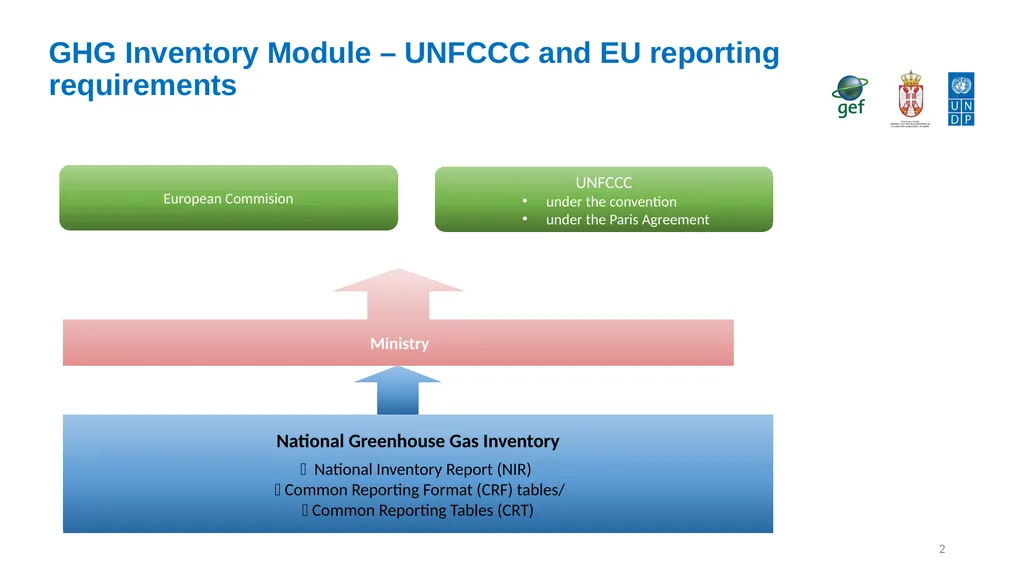
GHG Inventory Module – UNFCCC and EU reporting requirements 2 Ministry National Greenhouse Gas Inventory
National Inventory Report (NIR)
Common Reporting Format (CRF) tables/ Common Reporting Tables (CRT) European Commision UNFCCC
under the convention
under the Paris Agreement<br>
National Inventory Report (NIR)
Common Reporting Format (CRF) tables/ Common Reporting Tables (CRT) European Commision UNFCCC
under the convention
under the Paris Agreement<br>
03
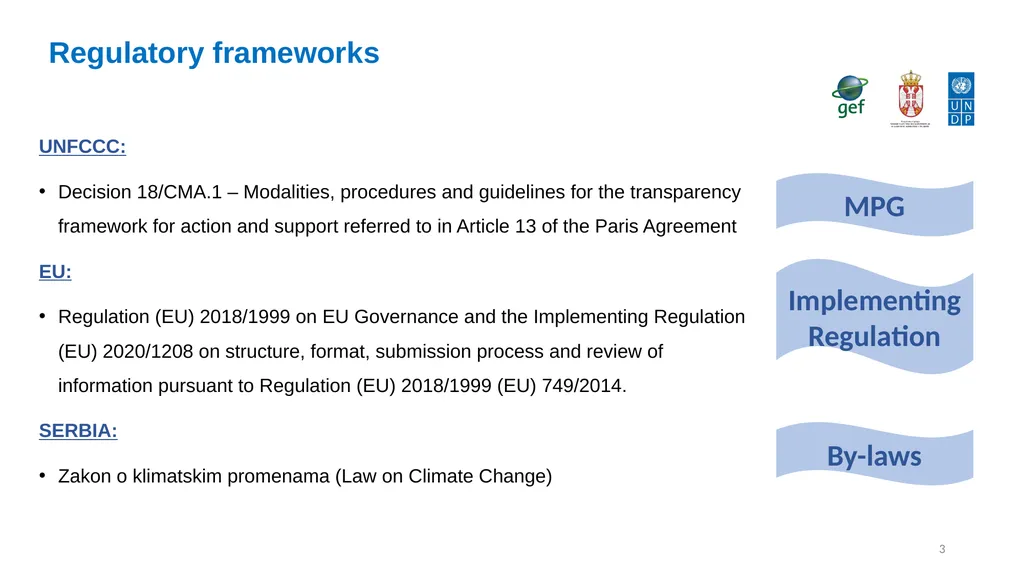
Regulatory frameworks 3 UNFCCC:
Decision 18/CMA.1 – Modalities, procedures and guidelines for the transparency framework for action and support referred to in Article 13 of the Paris Agreement
EU:
Regulation (EU) 2018/1999 on EU Governance and the Implementing Regulation (EU) 2020/1208 on structure, format, submission process and review of information pursuant to Regulation (EU) 2018/1999 (EU) 749/2014.
SERBIA:
Zakon o klimatskim promenama (Law on Climate Change) MPG Implementing Regulation By-laws<br>
Decision 18/CMA.1 – Modalities, procedures and guidelines for the transparency framework for action and support referred to in Article 13 of the Paris Agreement
EU:
Regulation (EU) 2018/1999 on EU Governance and the Implementing Regulation (EU) 2020/1208 on structure, format, submission process and review of information pursuant to Regulation (EU) 2018/1999 (EU) 749/2014.
SERBIA:
Zakon o klimatskim promenama (Law on Climate Change) MPG Implementing Regulation By-laws<br>
04
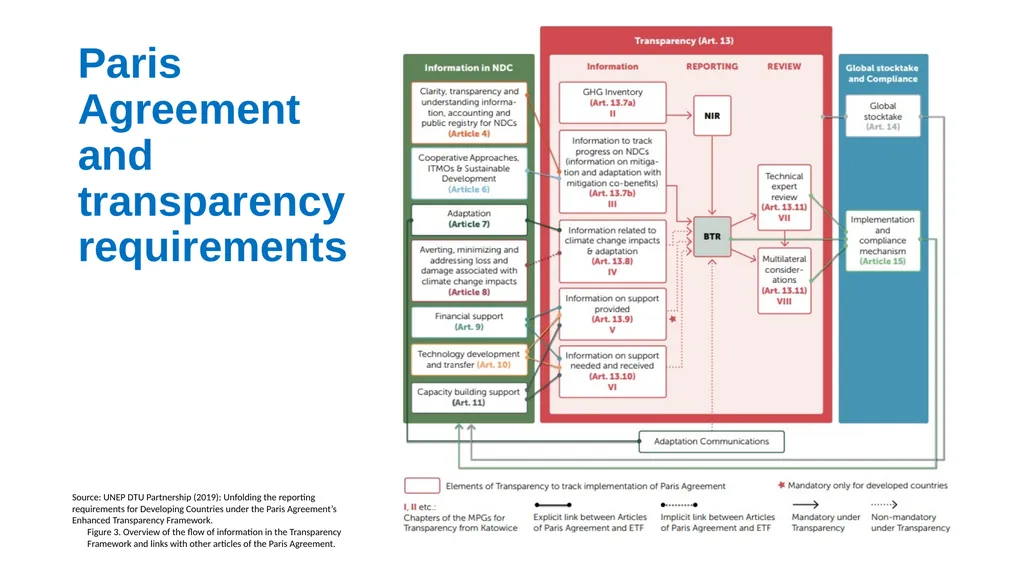
Paris Agreement and transparency requirements Source: UNEP DTU Partnership (2019): Unfolding the reporting requirements for Developing Countries under the Paris Agreement’s Enhanced Transparency Framework.
Figure 3. Overview of the flow of information in the Transparency Framework and links with other articles of the Paris Agreement.<br>
Figure 3. Overview of the flow of information in the Transparency Framework and links with other articles of the Paris Agreement.<br>
05
Paris Agreement and transparency requirements 5 The Parties under the UNFCCC have agreed in the 2015 Paris Agreement to strengthen the global response to the threat of climate change, including by:
(a) Holding the increase in the global average temperature to well below 2 °C above pre-industrial levels and pursuing efforts to limit the temperature increase to 1.5 °C above pre-industrial levels, recognizing that this would significantly reduce the risks and impacts of climate change;
(b) Increasing the ability to adapt to the adverse impacts of climate change and foster climate resilience and low greenhouse gas emissions development, in a manner that does not threaten food production; and
(c) Making finance flows consistent with a pathway towards low greenhouse gas emissions and climate-resilient development.
The Paris Agreement will reflect “equity and the principle of common but differentiated responsibilities and respective capabilities, in the light of different national circumstances”.<br>
(a) Holding the increase in the global average temperature to well below 2 °C above pre-industrial levels and pursuing efforts to limit the temperature increase to 1.5 °C above pre-industrial levels, recognizing that this would significantly reduce the risks and impacts of climate change;
(b) Increasing the ability to adapt to the adverse impacts of climate change and foster climate resilience and low greenhouse gas emissions development, in a manner that does not threaten food production; and
(c) Making finance flows consistent with a pathway towards low greenhouse gas emissions and climate-resilient development.
The Paris Agreement will reflect “equity and the principle of common but differentiated responsibilities and respective capabilities, in the light of different national circumstances”.<br>
06
Paris Agreement and transparency requirements 6 The 2015 Paris Agreement has established universal and harmonised Measurement, Reporting, and Verification (MRV) provisions for tracking climate change action, a common system of transparency that now applies to all countries. This is central to effectively implementing the Nationally Determined Contributions (NDCs) submitted under the Agreement, that Parties are requested to prepare and communicate every five years, from 2020 onwards.
The current division to Annex I and non-Annex I countries will disappear in 2024 and the reporting requirements will be the same for developing and developed countries, with some flexibilities for developing countries in light of their capacities. However, the countries that decided to apply the flexibility option in their Biennial Transparency Report (BTR), will need to explain the constrains and provide the timeframe in which these will be resolved.<br>
The current division to Annex I and non-Annex I countries will disappear in 2024 and the reporting requirements will be the same for developing and developed countries, with some flexibilities for developing countries in light of their capacities. However, the countries that decided to apply the flexibility option in their Biennial Transparency Report (BTR), will need to explain the constrains and provide the timeframe in which these will be resolved.<br>
07
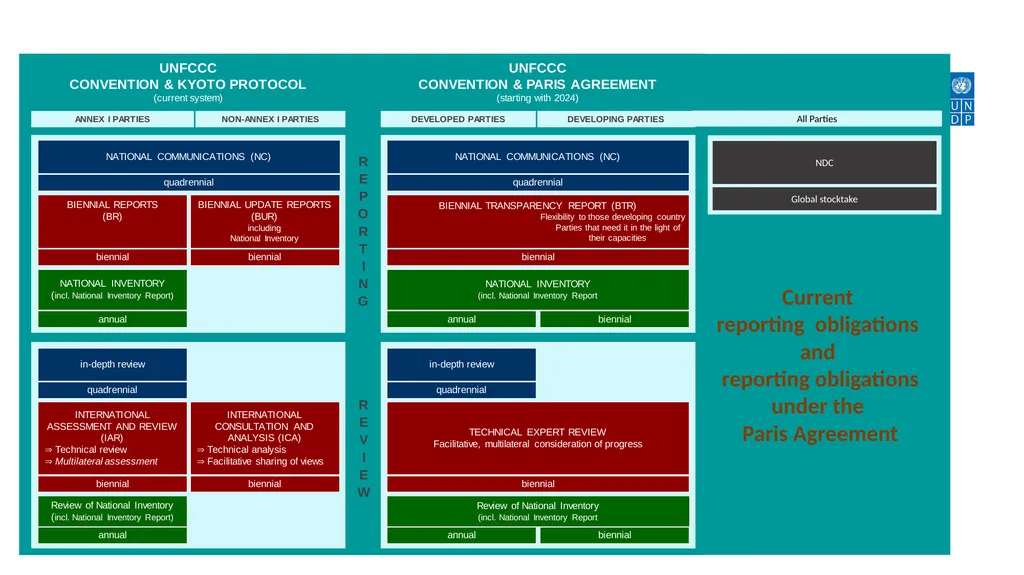
7 Current
reporting obligations
and
reporting obligations under the
Paris Agreement NDC Global stocktake All Parties<br>
08
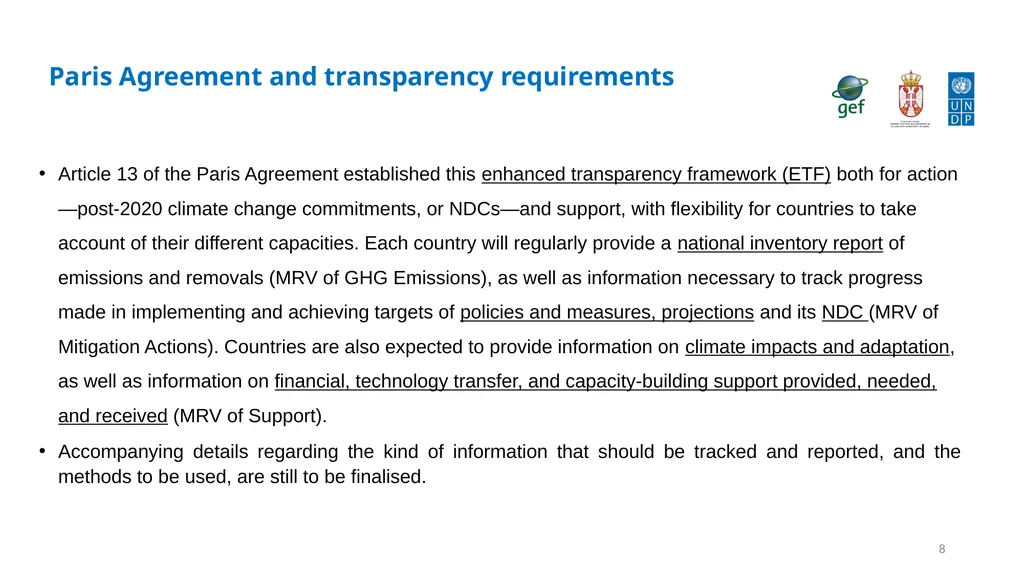
Paris Agreement and transparency requirements 8 Article 13 of the Paris Agreement established this enhanced transparency framework (ETF) both for action—post-2020 climate change commitments, or NDCs—and support, with flexibility for countries to take account of their different capacities. Each country will regularly provide a national inventory report of emissions and removals (MRV of GHG Emissions), as well as information necessary to track progress made in implementing and achieving targets of policies and measures, projections and its NDC (MRV of Mitigation Actions). Countries are also expected to provide information on climate impacts and adaptation, as well as information on financial, technology transfer, and capacity-building support provided, needed, and received (MRV of Support).
Accompanying details regarding the kind of information that should be tracked and reported, and the methods to be used, are still to be finalised.<br>
Accompanying details regarding the kind of information that should be tracked and reported, and the methods to be used, are still to be finalised.<br>
09
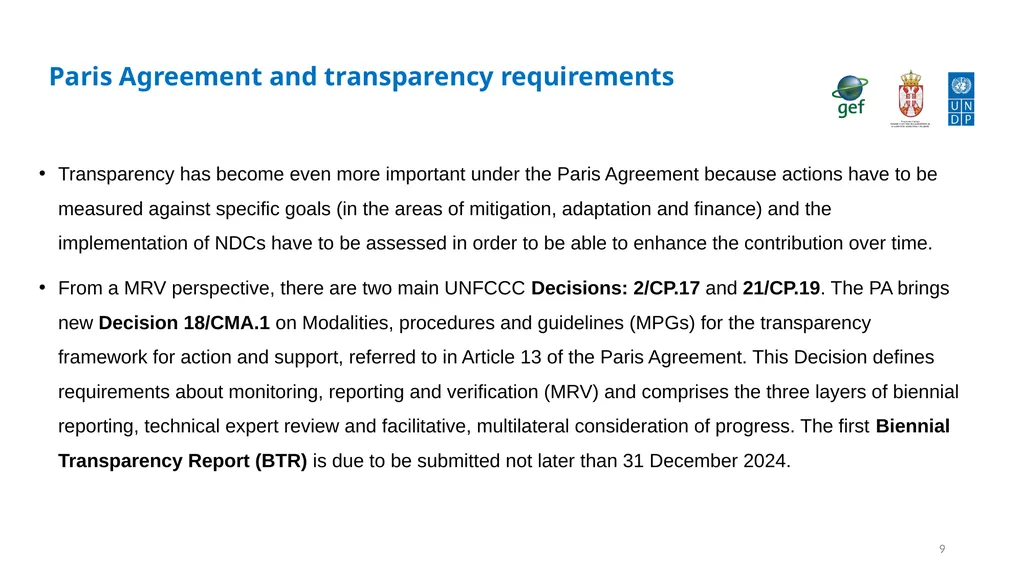
Paris Agreement and transparency requirements 9 Transparency has become even more important under the Paris Agreement because actions have to be measured against specific goals (in the areas of mitigation, adaptation and finance) and the implementation of NDCs have to be assessed in order to be able to enhance the contribution over time.
From a MRV perspective, there are two main UNFCCC Decisions: 2/CP.17 and 21/CP.19. The PA brings new Decision 18/CMA.1 on Modalities, procedures and guidelines (MPGs) for the transparency framework for action and support, referred to in Article 13 of the Paris Agreement. This Decision defines requirements about monitoring, reporting and verification (MRV) and comprises the three layers of biennial reporting, technical expert review and facilitative, multilateral consideration of progress. The first Biennial Transparency Report (BTR) is due to be submitted not later than 31 December 2024.<br>
From a MRV perspective, there are two main UNFCCC Decisions: 2/CP.17 and 21/CP.19. The PA brings new Decision 18/CMA.1 on Modalities, procedures and guidelines (MPGs) for the transparency framework for action and support, referred to in Article 13 of the Paris Agreement. This Decision defines requirements about monitoring, reporting and verification (MRV) and comprises the three layers of biennial reporting, technical expert review and facilitative, multilateral consideration of progress. The first Biennial Transparency Report (BTR) is due to be submitted not later than 31 December 2024.<br>
10
Paris Agreement and transparency requirements 10 The MPGs do not replace the National Communication (NC) reporting guidelines for Annex I and non-Annex I Parties under the Convention. NCs must continue to be submitted by developed and developing countries. Parties may choose to submit a single BTR/NC report in the years an NC is due, following the guidance in the MPGs for BTRs and including supplemental chapters only found in NCs (For instance: research and systematic observations (RSO) and education/training and public awareness).
Currently, details of the MPGs are being further elaborated and negotiated under the UNFCCC. This particularly refers to Common reporting tables (CRTs) for national inventory reports ; Common tabular formats (CTFs) for tracking progress made in implementing and achieving the NDCs and Common tabular formats (CTFs) for support provided and mobilised, as well as support needed and received.
Outlines of the biennial transparency report (BTR), national inventory document (NID) and technical expert review report (TERR) are also discussed.
It is planned to agree on the above-mentioned details of the ETF at COP 26 in Glasgow in 2021.<br>
Currently, details of the MPGs are being further elaborated and negotiated under the UNFCCC. This particularly refers to Common reporting tables (CRTs) for national inventory reports ; Common tabular formats (CTFs) for tracking progress made in implementing and achieving the NDCs and Common tabular formats (CTFs) for support provided and mobilised, as well as support needed and received.
Outlines of the biennial transparency report (BTR), national inventory document (NID) and technical expert review report (TERR) are also discussed.
It is planned to agree on the above-mentioned details of the ETF at COP 26 in Glasgow in 2021.<br>
11
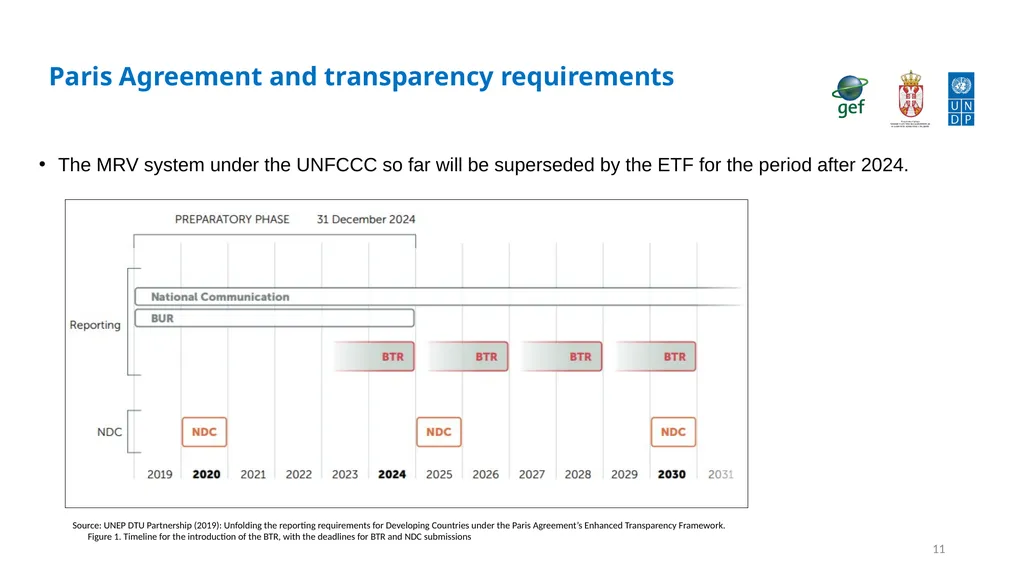
Paris Agreement and transparency requirements 11 The MRV system under the UNFCCC so far will be superseded by the ETF for the period after 2024. Source: UNEP DTU Partnership (2019): Unfolding the reporting requirements for Developing Countries under the Paris Agreement’s Enhanced Transparency Framework.
Figure 1. Timeline for the introduction of the BTR, with the deadlines for BTR and NDC submissions<br>
Figure 1. Timeline for the introduction of the BTR, with the deadlines for BTR and NDC submissions<br>
12
Paris Agreement and transparency requirements 12 Currently, details of the MPGs are being further elaborated and negotiated under the UNFCCC.
Common reporting tables (CRTs) for national inventory reports: https://unfccc.int/documents/279026
Common tabular formats (CTFs) for tracking progress made in implementing and achieving the NDCs and Common tabular formats (CTFs) for support provided and mobilised, as well as support needed and received: https://unfccc.int/documents/279099 and
Outlines of the biennial transparency report (BTR), national inventory document (NID) https://unfccc.int/documents/279027
Technical expert review report (TERR): https://unfccc.int/documents/279028
The MRV system under the UNFCCC so far will be superseded by the ETF for the period after 2024.<br>
Common reporting tables (CRTs) for national inventory reports: https://unfccc.int/documents/279026
Common tabular formats (CTFs) for tracking progress made in implementing and achieving the NDCs and Common tabular formats (CTFs) for support provided and mobilised, as well as support needed and received: https://unfccc.int/documents/279099 and
Outlines of the biennial transparency report (BTR), national inventory document (NID) https://unfccc.int/documents/279027
Technical expert review report (TERR): https://unfccc.int/documents/279028
The MRV system under the UNFCCC so far will be superseded by the ETF for the period after 2024.<br>
13
Decision 18/CMA.1<br>
14
Decision 18/CMA.1 – framework for transparency of action, in line with Art. 13 of Paris Agreement 14 Purpose:
to provide a clear understanding of climate change action, including clarity and tracking progress towards achieving Parties’ individual nationally determined contributions (NDCs) under Article 4, and Parties’ adaptation actions under Article 7, including good practices, priorities, needs and gaps, to inform the global stocktake under Article 14.
to provide clarity, in line with Article 13 on support provided and received by relevant individual Parties in the context of climate change actions under Articles 4, 7, 9, 10 and 11, and to provide a full overview of aggregate financial support provided, to inform global stocktake under Article 14.<br>
to provide a clear understanding of climate change action, including clarity and tracking progress towards achieving Parties’ individual nationally determined contributions (NDCs) under Article 4, and Parties’ adaptation actions under Article 7, including good practices, priorities, needs and gaps, to inform the global stocktake under Article 14.
to provide clarity, in line with Article 13 on support provided and received by relevant individual Parties in the context of climate change actions under Articles 4, 7, 9, 10 and 11, and to provide a full overview of aggregate financial support provided, to inform global stocktake under Article 14.<br>
15
Decision 18/CMA.1 – framework for transparency of action, in line with Art. 13 of Paris Agreement 15 Guiding principles:
Building on and enhancing the transparency arrangements under the Convention, recognising the special circumstances of the least developed countries and small island developing states, and implementing the transparency framework in a facilitative, non-intrusive, non-punitive manner, respecting national sovereignty and avoiding placing undue burden on Parties;
Facilitating improved reporting and transparency over time;
Providing flexibility to those who need it;
Promoting transparency, accuracy, completeness, consistency and comparability,
Avoiding duplication of work and undue burden;
Ensuring that Parties maintain at least the frequency and quality of reporting in line with their obligations;
Ensuring that double counting is avoided;
Ensuring environmental integrity.<br>
Building on and enhancing the transparency arrangements under the Convention, recognising the special circumstances of the least developed countries and small island developing states, and implementing the transparency framework in a facilitative, non-intrusive, non-punitive manner, respecting national sovereignty and avoiding placing undue burden on Parties;
Facilitating improved reporting and transparency over time;
Providing flexibility to those who need it;
Promoting transparency, accuracy, completeness, consistency and comparability,
Avoiding duplication of work and undue burden;
Ensuring that Parties maintain at least the frequency and quality of reporting in line with their obligations;
Ensuring that double counting is avoided;
Ensuring environmental integrity.<br>
16
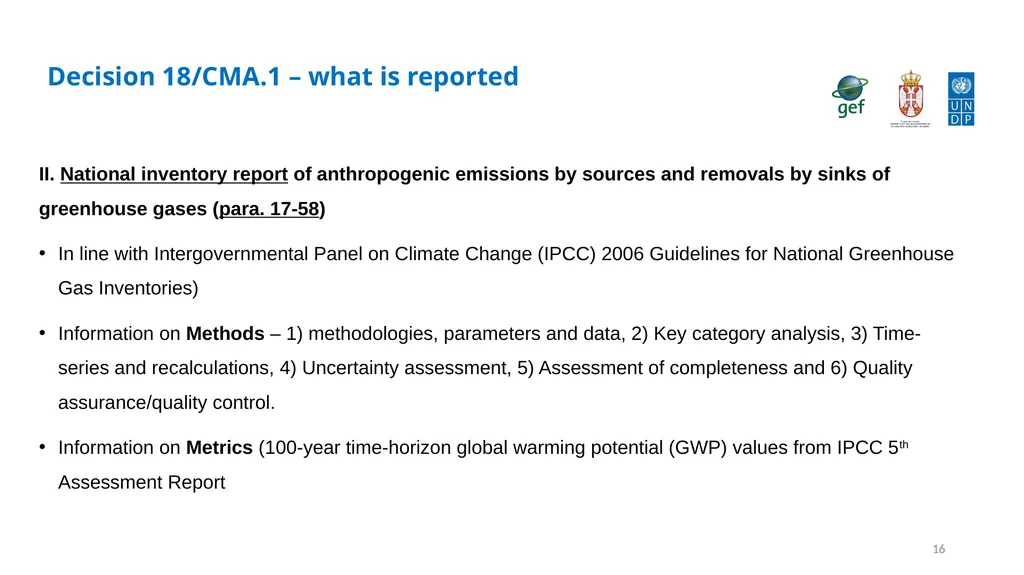
Decision 18/CMA.1 – what is reported 16 II. National inventory report of anthropogenic emissions by sources and removals by sinks of greenhouse gases (para. 17-58)
In line with Intergovernmental Panel on Climate Change (IPCC) 2006 Guidelines for National Greenhouse Gas Inventories)
Information on Methods – 1) methodologies, parameters and data, 2) Key category analysis, 3) Time-series and recalculations, 4) Uncertainty assessment, 5) Assessment of completeness and 6) Quality assurance/quality control.
Information on Metrics (100-year time-horizon global warming potential (GWP) values from IPCC 5th Assessment Report<br>
In line with Intergovernmental Panel on Climate Change (IPCC) 2006 Guidelines for National Greenhouse Gas Inventories)
Information on Methods – 1) methodologies, parameters and data, 2) Key category analysis, 3) Time-series and recalculations, 4) Uncertainty assessment, 5) Assessment of completeness and 6) Quality assurance/quality control.
Information on Metrics (100-year time-horizon global warming potential (GWP) values from IPCC 5th Assessment Report<br>
17
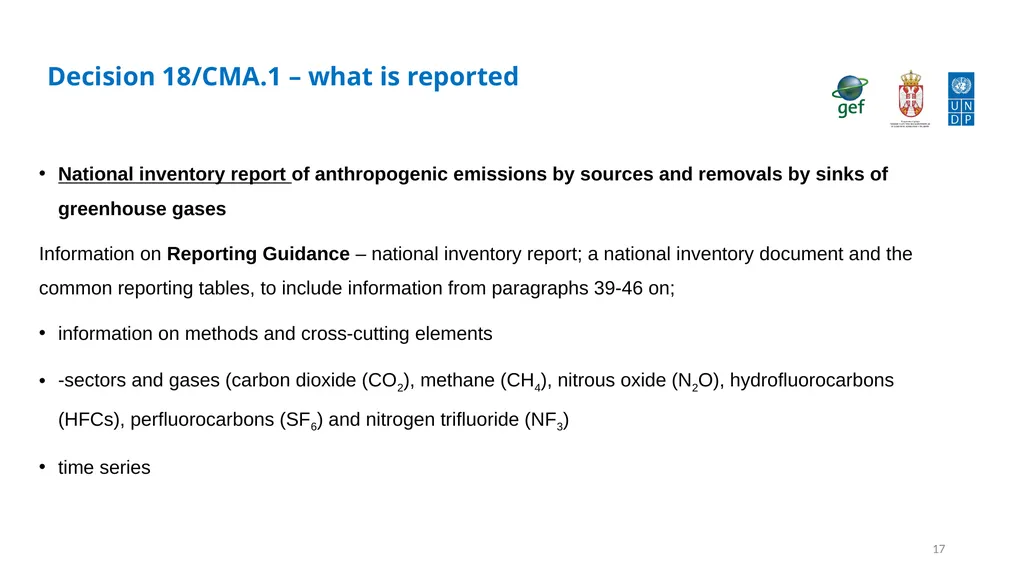
Decision 18/CMA.1 – what is reported 17 National inventory report of anthropogenic emissions by sources and removals by sinks of greenhouse gases
Information on Reporting Guidance – national inventory report; a national inventory document and the common reporting tables, to include information from paragraphs 39-46 on;
information on methods and cross-cutting elements
-sectors and gases (carbon dioxide (CO2), methane (CH4), nitrous oxide (N2O), hydrofluorocarbons (HFCs), perfluorocarbons (SF6) and nitrogen trifluoride (NF3)
time series<br>
Information on Reporting Guidance – national inventory report; a national inventory document and the common reporting tables, to include information from paragraphs 39-46 on;
information on methods and cross-cutting elements
-sectors and gases (carbon dioxide (CO2), methane (CH4), nitrous oxide (N2O), hydrofluorocarbons (HFCs), perfluorocarbons (SF6) and nitrogen trifluoride (NF3)
time series<br>
18
Regulation (EU) 2018/1999 on the Governance of the Energy Union and Climate Action (to be amended by the European Climate Law Regulation)<br>
19
EU Governance regulation of the Energy Union and Climate Action 19 This Regulation establishes a governance mechanism to:
a) implement strategies and measures designed to meet the objectives and targets of the Energy Union and the long- term Union greenhouse gas emissions commitments consistent with the Paris Agreement, and for the first ten-year period, from 2021 to 2030, in particular the Union's 2030 targets for energy and climate;
b) stimulate cooperation between Member States, including, where appropriate, at regional level, designed to achieve the objectives and targets of the Energy Union;
c) ensure the timeliness, transparency, accuracy, consistency, comparability and completeness of reporting by the Union and its Member States to the UNFCCC and Paris Agreement secretariat;
d) contribute to greater regulatory certainty as well as contribute to greater investor certainty and help take full advantage of opportunities for economic development, investment stimulation, job creation and social cohesion.<br>
a) implement strategies and measures designed to meet the objectives and targets of the Energy Union and the long- term Union greenhouse gas emissions commitments consistent with the Paris Agreement, and for the first ten-year period, from 2021 to 2030, in particular the Union's 2030 targets for energy and climate;
b) stimulate cooperation between Member States, including, where appropriate, at regional level, designed to achieve the objectives and targets of the Energy Union;
c) ensure the timeliness, transparency, accuracy, consistency, comparability and completeness of reporting by the Union and its Member States to the UNFCCC and Paris Agreement secretariat;
d) contribute to greater regulatory certainty as well as contribute to greater investor certainty and help take full advantage of opportunities for economic development, investment stimulation, job creation and social cohesion.<br>
20
EU Governance regulation of the Energy Union and Climate Action 20 Based on:
long-term strategies,
integrated national energy and climate plans covering ten-year periods starting from 2021 to 2030,
corresponding integrated national energy and climate progress reports by the Member States and integrated monitoring arrangements by the Commission.
Ensures:
- effective opportunities for the public to participate in the preparation of those national plans and those long-term strategies<br>
long-term strategies,
integrated national energy and climate plans covering ten-year periods starting from 2021 to 2030,
corresponding integrated national energy and climate progress reports by the Member States and integrated monitoring arrangements by the Commission.
Ensures:
- effective opportunities for the public to participate in the preparation of those national plans and those long-term strategies<br>
21
EU Governance regulation of the Energy Union and Climate Action 21 Applies to the five dimensions of the Energy Union, which are closely related and mutually reinforcing:
energy security;
internal energy market;
energy efficiency;
decarbonisation; and
research, innovation and competitiveness.<br>
energy security;
internal energy market;
energy efficiency;
decarbonisation; and
research, innovation and competitiveness.<br>
22
EU Governance regulation of the Energy Union and Climate Action 22 In light of the 2050 climate-neutrality objective, by 2030 greenhouse gas emissions should be reduced and removals enhanced, so that net greenhouse gas emissions, that is emissions after deduction of removals, are reduced economy-wide and domestically by at least 55% by 2030 compared to 1990 levels.
This new 2030 Union climate target is a subsequent target for the purposes of point (11) of Article 2 of Regulation (EU) 2018/1999, and therefore replaces the 2030 Union-wide target for greenhouse gas emissions of 40% set out in that point.
This is now enshrined in the amended proposal for a Regulation on establishing the framework for achieving climate neutrality (European Climate Law) and amended Regulation (EU) 2018/1999<br>
This new 2030 Union climate target is a subsequent target for the purposes of point (11) of Article 2 of Regulation (EU) 2018/1999, and therefore replaces the 2030 Union-wide target for greenhouse gas emissions of 40% set out in that point.
This is now enshrined in the amended proposal for a Regulation on establishing the framework for achieving climate neutrality (European Climate Law) and amended Regulation (EU) 2018/1999<br>
23
EU Governance regulation of the Energy Union and Climate Action 23 Chapter 4 provides requirements for Reporting
Section 1 Biennial progress reports and their follow up
Article 17 Integrated national energy and climate progress reports
1.Without prejudice to Article 26, by 15 March 2023, and every two years thereafter, each Member State shall report to the Commission on the status of implementation of its integrated national energy and climate plan by means of an integrated national energy and climate progress report covering all five dimensions of the Energy Union.
The Article 17 also covers all the necessary details that need to be contained in the integrated national energy and climate progress reports.<br>
Section 1 Biennial progress reports and their follow up
Article 17 Integrated national energy and climate progress reports
1.Without prejudice to Article 26, by 15 March 2023, and every two years thereafter, each Member State shall report to the Commission on the status of implementation of its integrated national energy and climate plan by means of an integrated national energy and climate progress report covering all five dimensions of the Energy Union.
The Article 17 also covers all the necessary details that need to be contained in the integrated national energy and climate progress reports.<br>
24
EU Governance regulation of the Energy Union and Climate Action 24 Chapter 6 prescribes the requirements for the Union and national systems on greenhouse gas emissions and removals by sinks
Article 37 Union and national inventory systems
1.By 1 January 2021, Member States shall establish, operate and seek to continuously improve national inventory systems to estimate anthropogenic emissions by sources and removals by sinks of greenhouse gases listed in Part 2 of Annex V and to ensure the timeliness, transparency, accuracy, consistency, comparability and completeness of their greenhouse gas inventories.
2.Member States shall ensure that their competent inventory authorities have access to the information specified in Annex XII to this Regulation, make use of reporting systems established pursuant to Article 20 of Regulation (EU) No 517/2014 to improve the estimate of fluorinated gases in the national greenhouse gas inventories and are able to undertake the annual consistency checks referred to in points (i) and (j) of Part 1 of Annex V to this Regulation.<br>
Article 37 Union and national inventory systems
1.By 1 January 2021, Member States shall establish, operate and seek to continuously improve national inventory systems to estimate anthropogenic emissions by sources and removals by sinks of greenhouse gases listed in Part 2 of Annex V and to ensure the timeliness, transparency, accuracy, consistency, comparability and completeness of their greenhouse gas inventories.
2.Member States shall ensure that their competent inventory authorities have access to the information specified in Annex XII to this Regulation, make use of reporting systems established pursuant to Article 20 of Regulation (EU) No 517/2014 to improve the estimate of fluorinated gases in the national greenhouse gas inventories and are able to undertake the annual consistency checks referred to in points (i) and (j) of Part 1 of Annex V to this Regulation.<br>
25
EU Governance regulation of the Energy Union and Climate Action 25 Chapter 6 prescribes the requirements for the Union and national systems on greenhouse gas emissions and removals by sinks
Article 38 Inventory review
Article 39 Union and national systems for policies and measures and projections
1.By 1 January 2021, Member States and the Commission shall operate and seek to continuously improve national and Union systems respectively, for reporting on policies and measures and for reporting on projections of anthropogenic greenhouse gas emissions by sources and removals by sinks. Those systems shall include the relevant institutional, legal and procedural arrangements established within a Member State and the Union for evaluating policy and making projections of anthropogenic greenhouse gas emissions by sources and removals by sinks.
In proposing such implementing acts, the Commission shall take into account the relevant decisions adopted by the bodies of the UNFCCC or of the Paris Agreement, including internationally agreed reporting requirements as well as timetables for monitoring and reporting of that information.<br>
Article 38 Inventory review
Article 39 Union and national systems for policies and measures and projections
1.By 1 January 2021, Member States and the Commission shall operate and seek to continuously improve national and Union systems respectively, for reporting on policies and measures and for reporting on projections of anthropogenic greenhouse gas emissions by sources and removals by sinks. Those systems shall include the relevant institutional, legal and procedural arrangements established within a Member State and the Union for evaluating policy and making projections of anthropogenic greenhouse gas emissions by sources and removals by sinks.
In proposing such implementing acts, the Commission shall take into account the relevant decisions adopted by the bodies of the UNFCCC or of the Paris Agreement, including internationally agreed reporting requirements as well as timetables for monitoring and reporting of that information.<br>
26
EU Governance regulation of the Energy Union and Climate Action 26 Chapter 6 prescribes the requirements for the Union and national systems on greenhouse gas emissions and removals by sinks
Article 40 Establishment and operation of registries
1.The Union and the Member States shall set up and maintain registries to accurately account for the nationally determined contribution pursuant to Article 4(13) of the Paris Agreement and for internationally transferred mitigation outcomes pursuant to Article 6 of that Agreement.
Chapter 7 focused on Cooperation and support
Article 41 Cooperation between the Member States and the Union
Article 42 Role of the European Environment Agency<br>
Article 40 Establishment and operation of registries
1.The Union and the Member States shall set up and maintain registries to accurately account for the nationally determined contribution pursuant to Article 4(13) of the Paris Agreement and for internationally transferred mitigation outcomes pursuant to Article 6 of that Agreement.
Chapter 7 focused on Cooperation and support
Article 41 Cooperation between the Member States and the Union
Article 42 Role of the European Environment Agency<br>
27
Serbian Climate Change Law<br>
28
PURPOSE To regulate system for greenhouse gas emission reduction and adaptation to climate change, monitoring and reporting on strategy of low carbon development and its increased ambition, programme of adaptation to climate change, adoption of strategy of low carbon development and programme of adoption to climate change, issuing ETS permits to the operators of industrial installations, issuing approvals to the monitoring plans of the aircraft carriers, monitoring, reporting, verification and accreditation of verifiers and other issues relevant to GHG emission reduction and adaptation to climate change.<br>
29
PURPOSE To regulate system for greenhouse gas emission reduction and adaptation to climate change, monitoring and reporting on
strategy of low carbon development and its increased ambition,
programme of adaptation to climate change,
adoption of strategy of low carbon development and programme of adoption to climate change,
issuing ETS permits to the operators of industrial installations,
issuing approvals to the monitoring plans of the aircraft carriers,
monitoring, reporting, verification and accreditation of verifiers and
other issues relevant to GHG emission reduction and adaptation to climate change.<br>
strategy of low carbon development and its increased ambition,
programme of adaptation to climate change,
adoption of strategy of low carbon development and programme of adoption to climate change,
issuing ETS permits to the operators of industrial installations,
issuing approvals to the monitoring plans of the aircraft carriers,
monitoring, reporting, verification and accreditation of verifiers and
other issues relevant to GHG emission reduction and adaptation to climate change.<br>
30
Objectives Establishing system to reduce GHG emissions in economically efficient and financially viable manner to contribute to scientifically agreed emission reduction targets and avoid dangerous climate change and its adverse impacts
Reducing GHG emission and adapting to climate change by adopting relevant policy documents
Establishing mechanism for timely, transparent, accurate, consistent and comparable monitoring, reporting and verification of data in line with the international obligations (UNFCCC, including the Paris Agreement)<br>
Reducing GHG emission and adapting to climate change by adopting relevant policy documents
Establishing mechanism for timely, transparent, accurate, consistent and comparable monitoring, reporting and verification of data in line with the international obligations (UNFCCC, including the Paris Agreement)<br>
31
Serbian Climate Change Law Chapter V deals with System for Monitoring and Reporting on national GHG emissions
- National GHG inventory system (art. 57)
- GHG Inventory and inventory reports are dealt with in art. 58
- data delivery for GHG inventory and reports are regulated by art. 59-60
- quality assurance and quality of data is prescribed in art. 61
Chapter VI regulates projections of GHG emissions by sources and removals by sinks, art 62-63<br>
- National GHG inventory system (art. 57)
- GHG Inventory and inventory reports are dealt with in art. 58
- data delivery for GHG inventory and reports are regulated by art. 59-60
- quality assurance and quality of data is prescribed in art. 61
Chapter VI regulates projections of GHG emissions by sources and removals by sinks, art 62-63<br>
32
GHG inventory Module
Reporting requirements - Summary 32 UNFCCC:
The modalities, procedures and guidelines (MPGs) for the transparency framework for action and support, referred to in Article 13 of the Paris Agreement are defined in Decision 18/CMA.1.
MPGs para. 17–58: National inventory report of anthropogenic emissions by sources and removals by sinks of greenhouse gases: GHG Inventory (data set) and National Inventory Report (NIR)
EU:
Governance Regulation (EU 2018/1999) and Implementing Regulation (EU 2020/1208):
Article 26: Annual reporting
Article 37: Union and national inventory systems
are fully in line with the Paris Agreement and MPGs
Serbian Climate Change Law
Article 57-61 GHG Inventory
Articles 62 to 65: A system for reporting on policies, measures and GHG projections shall be set up, kept, continuously improved and reported to the UNFCCC Secretariat<br>
The modalities, procedures and guidelines (MPGs) for the transparency framework for action and support, referred to in Article 13 of the Paris Agreement are defined in Decision 18/CMA.1.
MPGs para. 17–58: National inventory report of anthropogenic emissions by sources and removals by sinks of greenhouse gases: GHG Inventory (data set) and National Inventory Report (NIR)
EU:
Governance Regulation (EU 2018/1999) and Implementing Regulation (EU 2020/1208):
Article 26: Annual reporting
Article 37: Union and national inventory systems
are fully in line with the Paris Agreement and MPGs
Serbian Climate Change Law
Article 57-61 GHG Inventory
Articles 62 to 65: A system for reporting on policies, measures and GHG projections shall be set up, kept, continuously improved and reported to the UNFCCC Secretariat<br>