
Estate Planning For Today {Presenter Name}
SB
Published · 37 slides · 0 views

1 / 1


Description
Estate Planning For Today Presenter Name Presenter TitleCredentials Overview Introduction Planning for a Good End of Life Estate Planning Checklist Concluding Thoughts Prepare for a Good End of Life Process Provides A Blueprint For
Related Topics
Share
Embed code
Download this presentation From Below
"Estate Planning For Today {Presenter Name}" is the property of its rightful owner. Permission is granted to download and print the materials on this website for personal, non-commercial use only, and to display it on your personal computer provided you do not modify the materials and that you retain all copyright notices contained in the materials. By downloading content from our website, you accept the terms of this agreement.
Presentation Transcript
01
Estate Planning
For Today {Presenter Name}
{Presenter Title/Credentials}<br>
For Today {Presenter Name}
{Presenter Title/Credentials}<br>
02
Overview Introduction
Planning for a Good End of Life
Estate Planning Checklist
Concluding Thoughts<br>
Planning for a Good End of Life
Estate Planning Checklist
Concluding Thoughts<br>
03
Prepare for a Good End of Life<br>
04
Process Provides A Blueprint For Success<br>
05
The Final Act The Go-Go Years
The Slow-Go Years
The No-Go Years
The Final Act – When Finality Becomes a Reality
But the reality is that The Final Act could occur at any time – there is no season for death<br>
The Slow-Go Years
The No-Go Years
The Final Act – When Finality Becomes a Reality
But the reality is that The Final Act could occur at any time – there is no season for death<br>
06
What Would be a Good End of Life? World Wide Research Project – Breaking News!
100% of People Die!
46% of Americans die with less than $10,000 (MIT)
We all think about living well, so why not think about dying well?
What do you want?<br>
100% of People Die!
46% of Americans die with less than $10,000 (MIT)
We all think about living well, so why not think about dying well?
What do you want?<br>
07
Why We Need a Plan Prince Rogers Nelson
Died April 21, 2016
No direct heirs – 6 siblings
Estimated $300 Million Estate
No Will!
Its one thing dividing $300 million
between 6 people.
However, how do you divide Purple Rain? The vault of unreleased music?<br>
Died April 21, 2016
No direct heirs – 6 siblings
Estimated $300 Million Estate
No Will!
Its one thing dividing $300 million
between 6 people.
However, how do you divide Purple Rain? The vault of unreleased music?<br>
08
Complexities Still Exist Michael Jackson
Died June 25, 2009
Estimated $500 million in debt
Today – there is roughly $500 million in cash in the estate
Neverland is still for sale at roughly $100 million
Had both a will and living trust
However, estate is still ongoing as well as the trust<br>
Died June 25, 2009
Estimated $500 million in debt
Today – there is roughly $500 million in cash in the estate
Neverland is still for sale at roughly $100 million
Had both a will and living trust
However, estate is still ongoing as well as the trust<br>
09
Planning for the End Checklist<br>
10
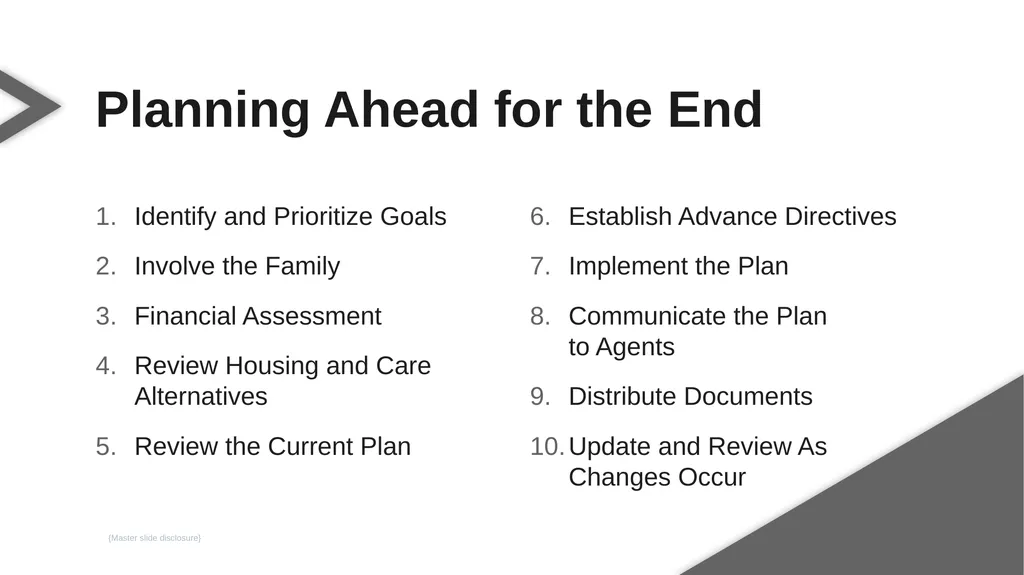
Planning Ahead for the End Identify and Prioritize Goals
Involve the Family
Financial Assessment
Review Housing and Care Alternatives
Review the Current Plan
Establish Advance Directives
Implement the Plan
Communicate the Plan to Agents
Distribute Documents
Update and Review As Changes Occur<br>
Involve the Family
Financial Assessment
Review Housing and Care Alternatives
Review the Current Plan
Establish Advance Directives
Implement the Plan
Communicate the Plan to Agents
Distribute Documents
Update and Review As Changes Occur<br>
11
Identify A List Of Goals Provide support for
surviving spouse
Preserve and transfer assets to next generation
Provide for dependents or children with special needs
Charitable goals
Pets
Minimize taxes and costs
Remove complexity and headaches
Effective and efficient transfer of ownership
Protect against theft or post-mortem fraud<br>
Preserve and transfer assets to next generation
Provide for dependents or children with special needs
Charitable goals
Pets
Minimize taxes and costs
Remove complexity and headaches
Effective and efficient transfer of ownership
Protect against theft or post-mortem fraud<br>
12
Prioritize Your Goals What is most important to you? Retirement income, surviving spouse, charity, children?
Are all your children the same age or close in age?
Do all your beneficiaries have different income needs?
Do you have any minor beneficiaries or beneficiaries with special needs?
What goals do you want to prioritize – often one strategy can help in one area but limit in another<br>
Are all your children the same age or close in age?
Do all your beneficiaries have different income needs?
Do you have any minor beneficiaries or beneficiaries with special needs?
What goals do you want to prioritize – often one strategy can help in one area but limit in another<br>
13
Involve the Family Involve the family
Why?
They will take on a lot of the work
End of life isn't just about the person passing away
Has financial implications to others
Caregiving often falls on family members
Biggest impact is on working women<br>
Why?
They will take on a lot of the work
End of life isn't just about the person passing away
Has financial implications to others
Caregiving often falls on family members
Biggest impact is on working women<br>
14
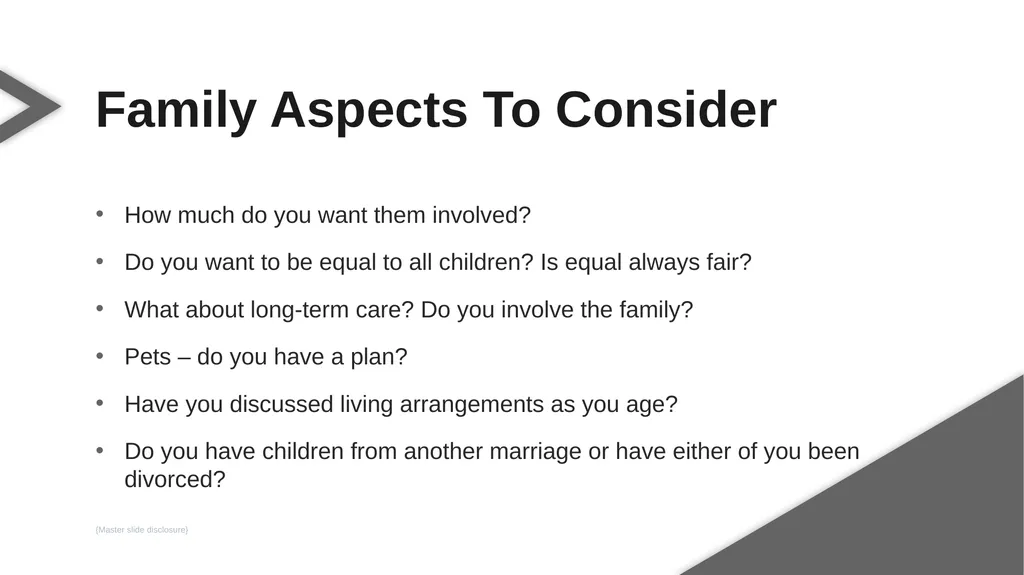
Family Aspects To Consider How much do you want them involved?
Do you want to be equal to all children? Is equal always fair?
What about long-term care? Do you involve the family?
Pets – do you have a plan?
Have you discussed living arrangements as you age?
Do you have children from another marriage or have either of you been divorced?<br>
Do you want to be equal to all children? Is equal always fair?
What about long-term care? Do you involve the family?
Pets – do you have a plan?
Have you discussed living arrangements as you age?
Do you have children from another marriage or have either of you been divorced?<br>
15
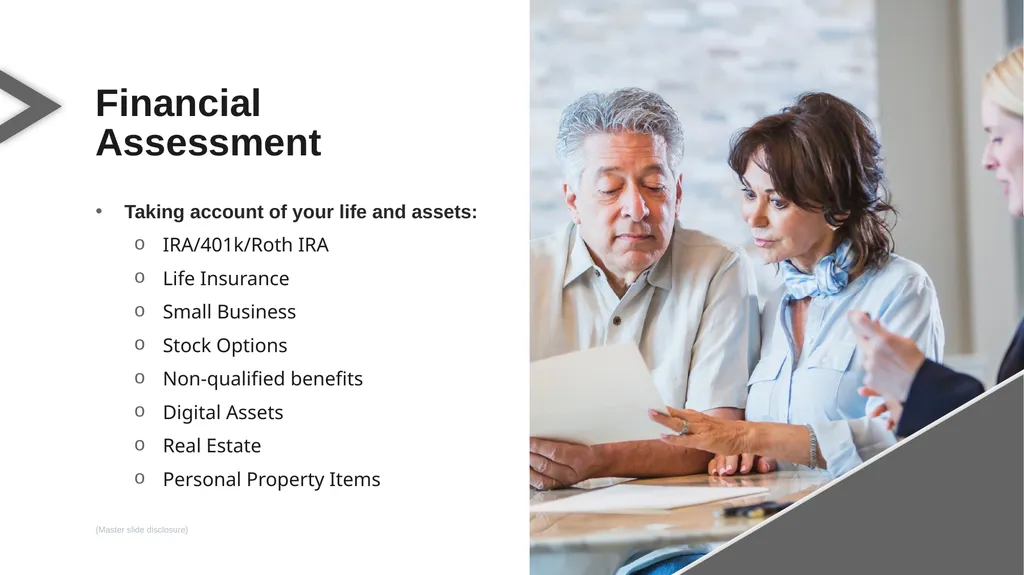
Financial Assessment Taking account of your life and assets:
IRA/401k/Roth IRA
Life Insurance
Small Business
Stock Options
Non-qualified benefits
Digital Assets
Real Estate
Personal Property Items<br>
IRA/401k/Roth IRA
Life Insurance
Small Business
Stock Options
Non-qualified benefits
Digital Assets
Real Estate
Personal Property Items<br>
16
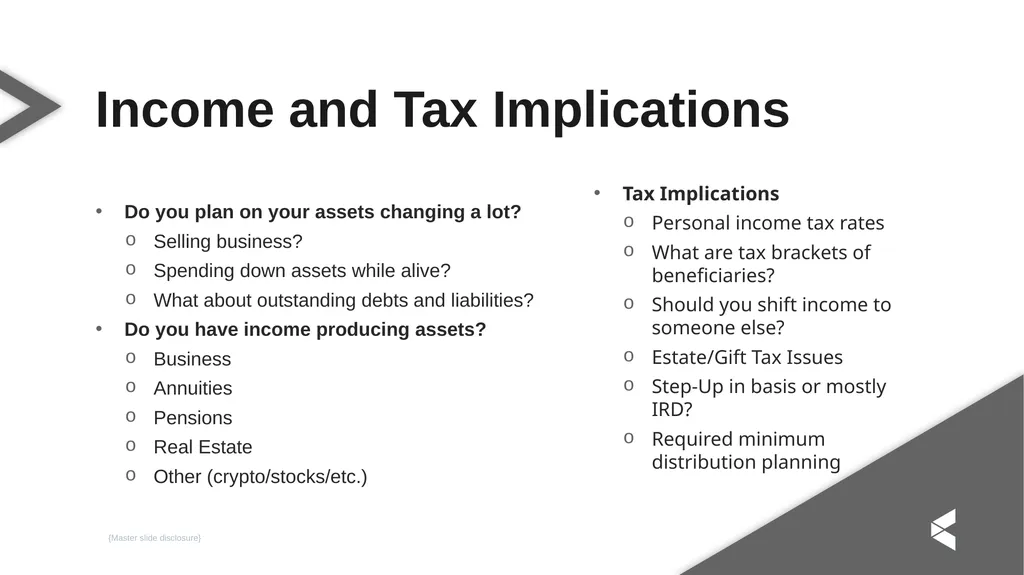
Income and Tax Implications Do you plan on your assets changing a lot?
Selling business?
Spending down assets while alive?
What about outstanding debts and liabilities?
Do you have income producing assets?
Business
Annuities
Pensions
Real Estate
Other (crypto/stocks/etc.) Tax Implications
Personal income tax rates
What are tax brackets of beneficiaries?
Should you shift income to someone else?
Estate/Gift Tax Issues
Step-Up in basis or mostly IRD?
Required minimum distribution planning<br>
Selling business?
Spending down assets while alive?
What about outstanding debts and liabilities?
Do you have income producing assets?
Business
Annuities
Pensions
Real Estate
Other (crypto/stocks/etc.) Tax Implications
Personal income tax rates
What are tax brackets of beneficiaries?
Should you shift income to someone else?
Estate/Gift Tax Issues
Step-Up in basis or mostly IRD?
Required minimum distribution planning<br>
17
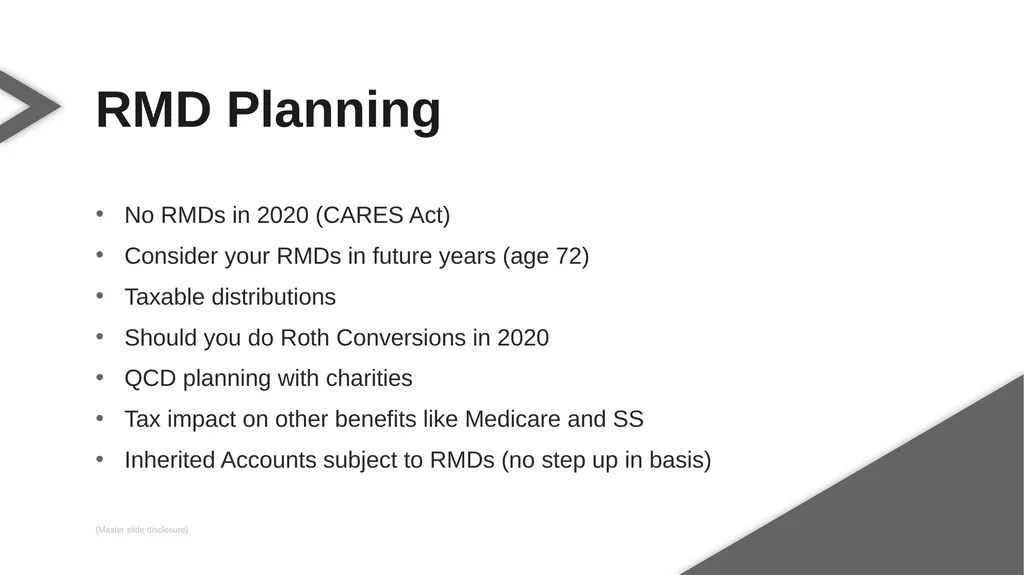
RMD Planning No RMDs in 2020 (CARES Act)
Consider your RMDs in future years (age 72)
Taxable distributions
Should you do Roth Conversions in 2020
QCD planning with charities
Tax impact on other benefits like Medicare and SS
Inherited Accounts subject to RMDs (no step up in basis)<br>
Consider your RMDs in future years (age 72)
Taxable distributions
Should you do Roth Conversions in 2020
QCD planning with charities
Tax impact on other benefits like Medicare and SS
Inherited Accounts subject to RMDs (no step up in basis)<br>
18
Inherited Retirement Accounts No step-up in basis – IRAs are taxable when distributed
SECURE Act (2019) – changed rules substantially
Most beneficiaries like children must distribute within 10 years after the year of death of the owner
Creates complex tax planning issues<br>
SECURE Act (2019) – changed rules substantially
Most beneficiaries like children must distribute within 10 years after the year of death of the owner
Creates complex tax planning issues<br>
19
What End of Stretch Means End of Stretch IRA means :
Higher taxes for many people
Less tax-deferred growth of account
Higher MAGI and Taxable Income can cause loss of benefits or higher taxes in other areas
Review trusts and beneficiaries!<br>
Higher taxes for many people
Less tax-deferred growth of account
Higher MAGI and Taxable Income can cause loss of benefits or higher taxes in other areas
Review trusts and beneficiaries!<br>
20
Roth Conversion Basics Instead of making contributions to a Roth you can CONVERT traditional IRAs
Distribution from IRA must be done by Dec. 31 (amount is taxable unless rolled over or converted within 60 days)
Taxable portion is taxed at ordinary income rates
Raises taxable income
Money rolls from IRA to Roth IRA
In plan, conversion allowed but rare – 401(k) salary deferral to Roth
No 10% tax on conversions
Cannot convert RMDs – important because at age 72, RMDs are always the first money out of account!<br>
Distribution from IRA must be done by Dec. 31 (amount is taxable unless rolled over or converted within 60 days)
Taxable portion is taxed at ordinary income rates
Raises taxable income
Money rolls from IRA to Roth IRA
In plan, conversion allowed but rare – 401(k) salary deferral to Roth
No 10% tax on conversions
Cannot convert RMDs – important because at age 72, RMDs are always the first money out of account!<br>
21
When Is A Good Year To Convert? Tax diversification
Look for lower tax brackets
Tax Cuts and Jobs Act of 2017 lowered taxes
While both spouses still alive
Before RMDs force taxable distributions
Retired – so less income
Large losses – perhaps charitable deduction carry-forwards, investment tax credits, net operating losses, etc.
2020 no RMDs
Depressed investment values
Reduced estate costs or tax burden shifting<br>
Look for lower tax brackets
Tax Cuts and Jobs Act of 2017 lowered taxes
While both spouses still alive
Before RMDs force taxable distributions
Retired – so less income
Large losses – perhaps charitable deduction carry-forwards, investment tax credits, net operating losses, etc.
2020 no RMDs
Depressed investment values
Reduced estate costs or tax burden shifting<br>
22
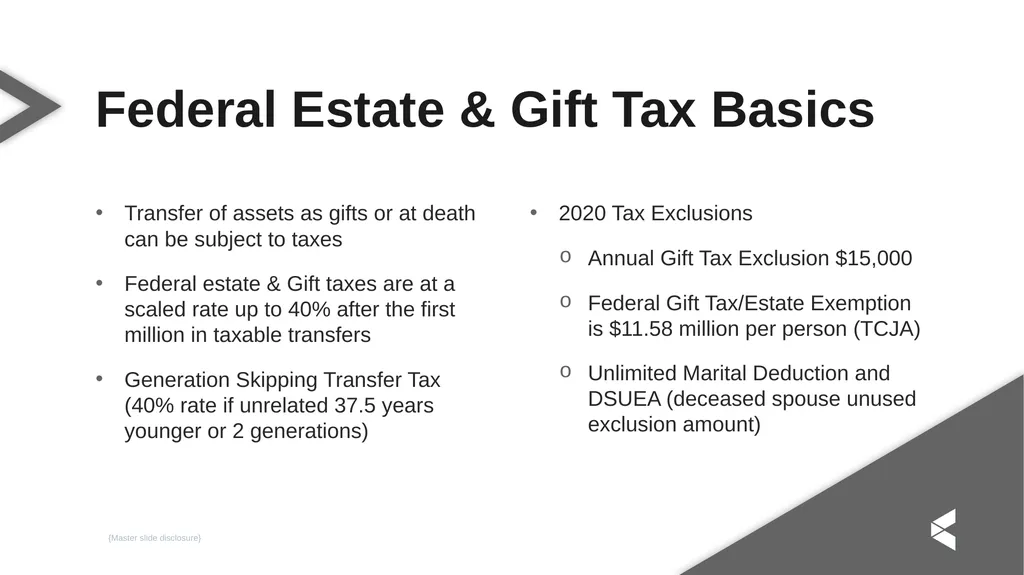
Federal Estate & Gift Tax Basics Transfer of assets as gifts or at death can be subject to taxes
Federal estate & Gift taxes are at a scaled rate up to 40% after the first million in taxable transfers
Generation Skipping Transfer Tax (40% rate if unrelated 37.5 years younger or 2 generations)
2020 Tax Exclusions
Annual Gift Tax Exclusion $15,000
Federal Gift Tax/Estate Exemption is $11.58 million per person (TCJA)
Unlimited Marital Deduction and DSUEA (deceased spouse unused exclusion amount)<br>
Federal estate & Gift taxes are at a scaled rate up to 40% after the first million in taxable transfers
Generation Skipping Transfer Tax (40% rate if unrelated 37.5 years younger or 2 generations)
2020 Tax Exclusions
Annual Gift Tax Exclusion $15,000
Federal Gift Tax/Estate Exemption is $11.58 million per person (TCJA)
Unlimited Marital Deduction and DSUEA (deceased spouse unused exclusion amount)<br>
23
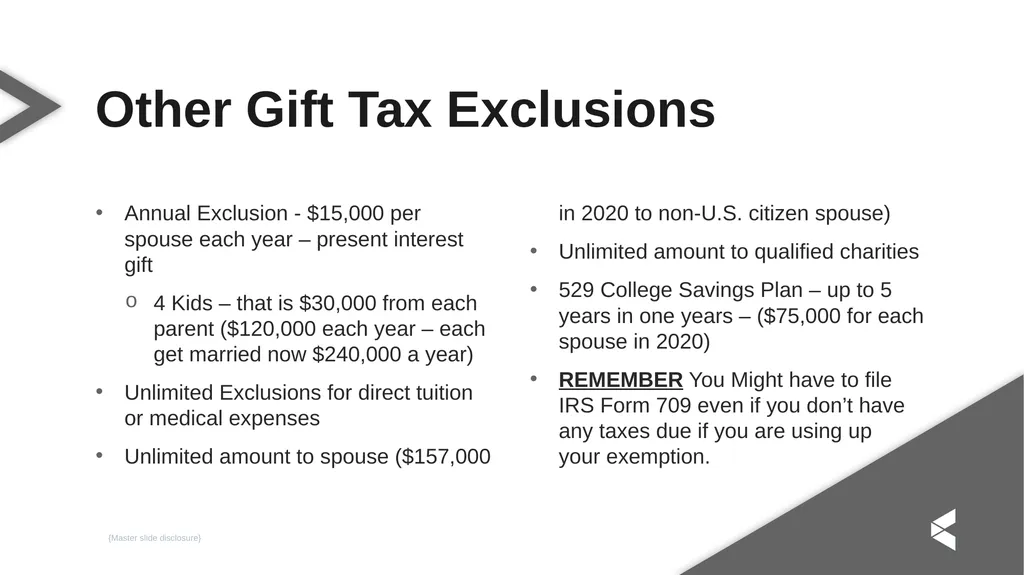
Other Gift Tax Exclusions Annual Exclusion - $15,000 per spouse each year – present interest gift
4 Kids – that is $30,000 from each parent ($120,000 each year – each get married now $240,000 a year)
Unlimited Exclusions for direct tuition or medical expenses
Unlimited amount to spouse ($157,000 in 2020 to non-U.S. citizen spouse)
Unlimited amount to qualified charities
529 College Savings Plan – up to 5 years in one years – ($75,000 for each spouse in 2020)
REMEMBER You Might have to file IRS Form 709 even if you don’t have any taxes due if you are using up your exemption.<br>
4 Kids – that is $30,000 from each parent ($120,000 each year – each get married now $240,000 a year)
Unlimited Exclusions for direct tuition or medical expenses
Unlimited amount to spouse ($157,000 in 2020 to non-U.S. citizen spouse)
Unlimited amount to qualified charities
529 College Savings Plan – up to 5 years in one years – ($75,000 for each spouse in 2020)
REMEMBER You Might have to file IRS Form 709 even if you don’t have any taxes due if you are using up your exemption.<br>
24
To Big To Ignore: The Home Is the house an investment?
Is it a liability?
Is it a source of income?
Does it provide services – ie where you live?
Do your kids want your house?<br>
Is it a liability?
Is it a source of income?
Does it provide services – ie where you live?
Do your kids want your house?<br>
25
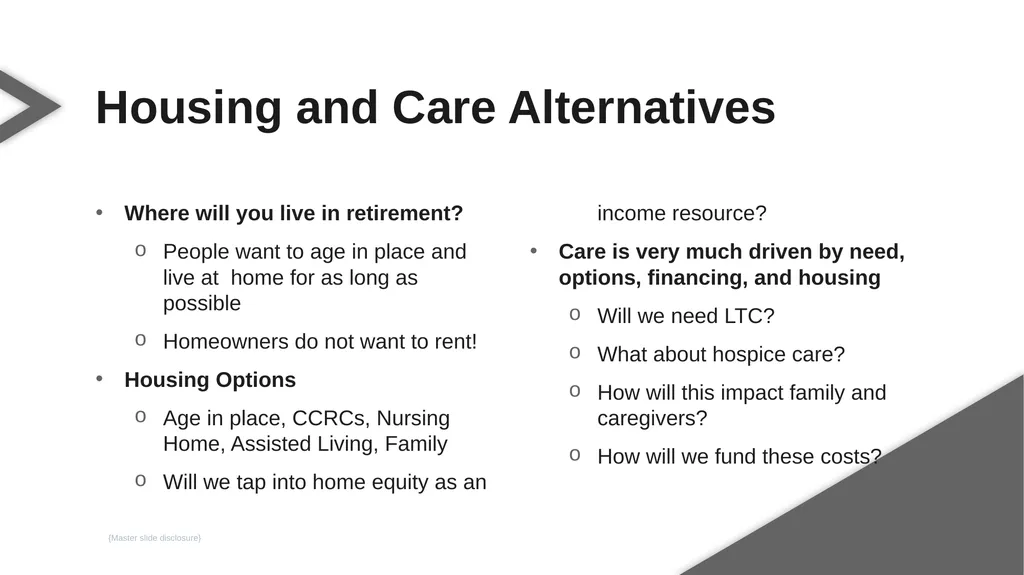
Housing and Care Alternatives Where will you live in retirement?
People want to age in place and live at home for as long as possible
Homeowners do not want to rent!
Housing Options
Age in place, CCRCs, Nursing Home, Assisted Living, Family
Will we tap into home equity as an income resource?
Care is very much driven by need, options, financing, and housing
Will we need LTC?
What about hospice care?
How will this impact family and caregivers?
How will we fund these costs?<br>
People want to age in place and live at home for as long as possible
Homeowners do not want to rent!
Housing Options
Age in place, CCRCs, Nursing Home, Assisted Living, Family
Will we tap into home equity as an income resource?
Care is very much driven by need, options, financing, and housing
Will we need LTC?
What about hospice care?
How will this impact family and caregivers?
How will we fund these costs?<br>
26
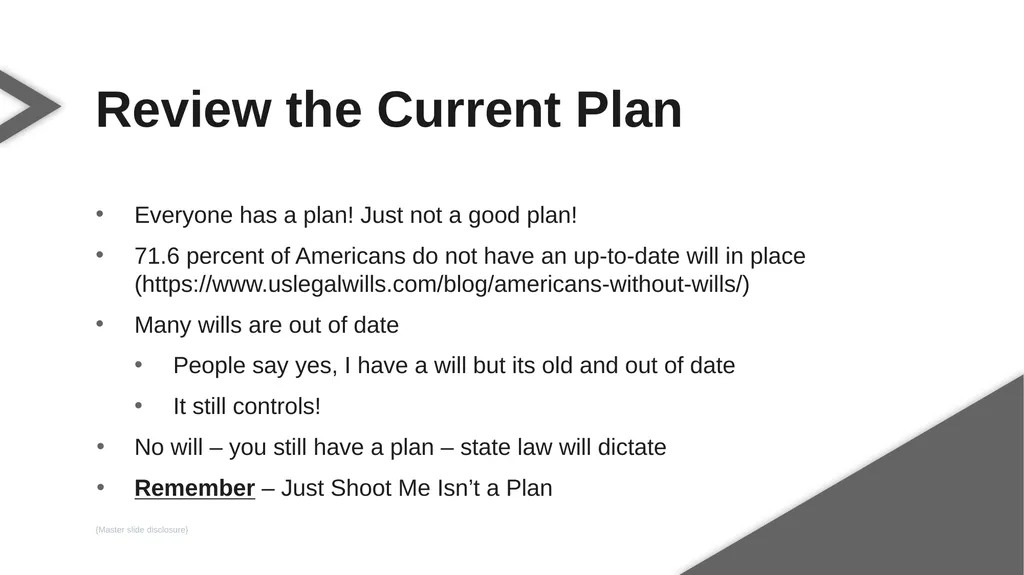
Review the Current Plan Everyone has a plan! Just not a good plan!
71.6 percent of Americans do not have an up-to-date will in place (https://www.uslegalwills.com/blog/americans-without-wills/)
Many wills are out of date
People say yes, I have a will but its old and out of date
It still controls!
No will – you still have a plan – state law will dictate
Remember – Just Shoot Me Isn’t a Plan<br>
71.6 percent of Americans do not have an up-to-date will in place (https://www.uslegalwills.com/blog/americans-without-wills/)
Many wills are out of date
People say yes, I have a will but its old and out of date
It still controls!
No will – you still have a plan – state law will dictate
Remember – Just Shoot Me Isn’t a Plan<br>
27
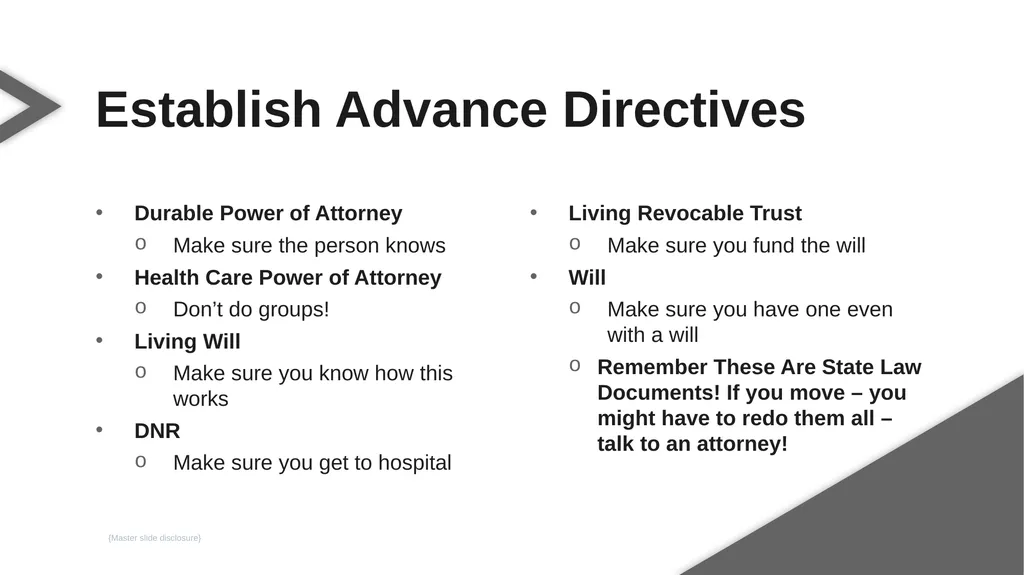
Establish Advance Directives Durable Power of Attorney
Make sure the person knows
Health Care Power of Attorney
Don’t do groups!
Living Will
Make sure you know how this works
DNR
Make sure you get to hospital
Living Revocable Trust
Make sure you fund the will
Will
Make sure you have one even with a will
Remember These Are State Law Documents! If you move – you might have to redo them all – talk to an attorney!<br>
Make sure the person knows
Health Care Power of Attorney
Don’t do groups!
Living Will
Make sure you know how this works
DNR
Make sure you get to hospital
Living Revocable Trust
Make sure you fund the will
Will
Make sure you have one even with a will
Remember These Are State Law Documents! If you move – you might have to redo them all – talk to an attorney!<br>
28
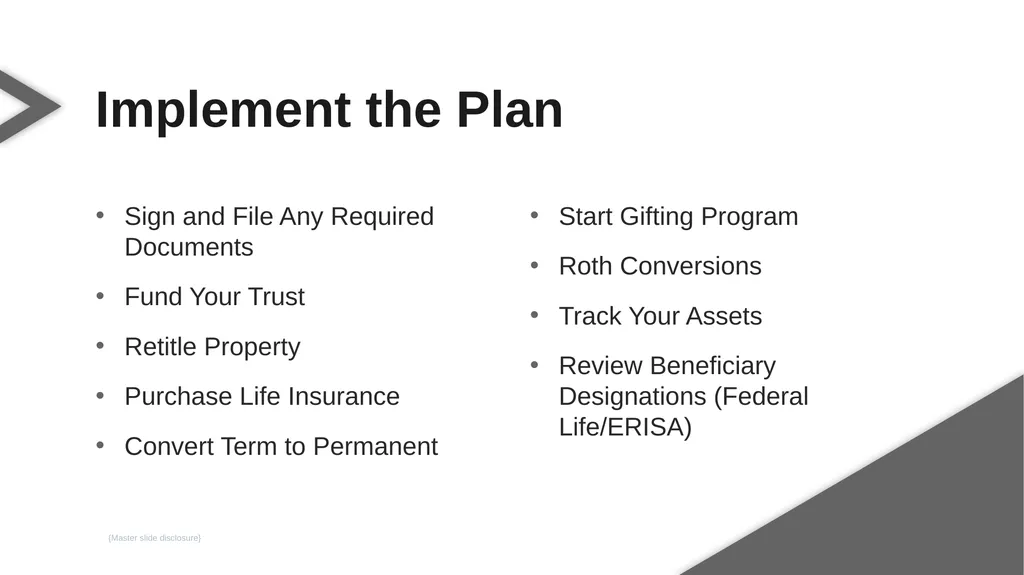
Implement the Plan Sign and File Any Required Documents
Fund Your Trust
Retitle Property
Purchase Life Insurance
Convert Term to Permanent
Start Gifting Program
Roth Conversions
Track Your Assets
Review Beneficiary Designations (Federal Life/ERISA)<br>
Fund Your Trust
Retitle Property
Purchase Life Insurance
Convert Term to Permanent
Start Gifting Program
Roth Conversions
Track Your Assets
Review Beneficiary Designations (Federal Life/ERISA)<br>
29
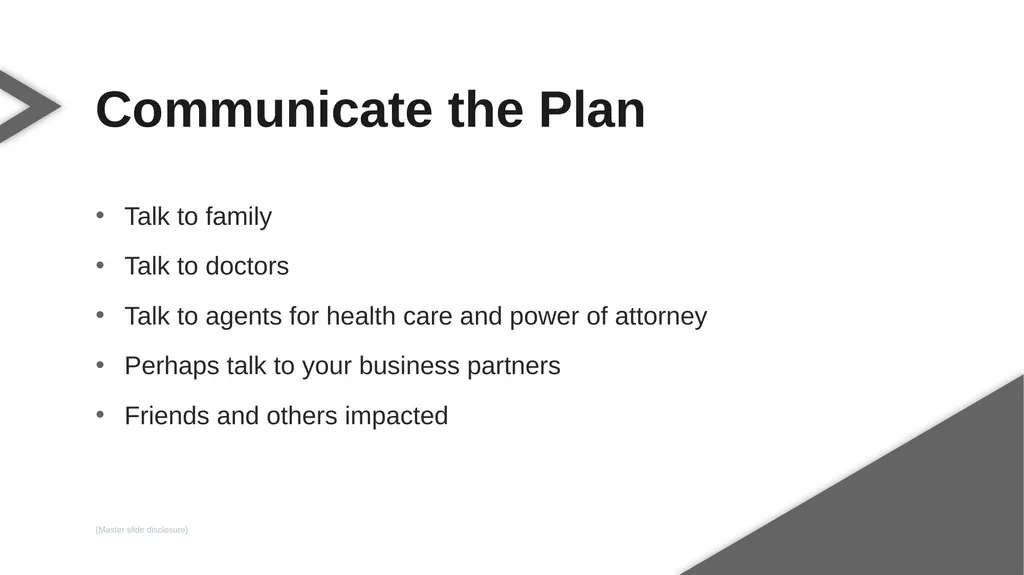
Communicate the Plan Talk to family
Talk to doctors
Talk to agents for health care and power of attorney
Perhaps talk to your business partners
Friends and others impacted<br>
Talk to doctors
Talk to agents for health care and power of attorney
Perhaps talk to your business partners
Friends and others impacted<br>
30
Distribute Documents Keep Copies of Everything
Keep Records
Put somewhere safe
Envelope with Insurance Card, Living Will, HCPOA, DNR
Give copies to advisors, hospital, doctors, agents<br>
Keep Records
Put somewhere safe
Envelope with Insurance Card, Living Will, HCPOA, DNR
Give copies to advisors, hospital, doctors, agents<br>
31
Review and Update Client goals and needs
will change
Laws will change
Client could move
Other family members could die first (did we plan for contingent beneficiaries)
Tax laws change
Federal Estate Tax might not be an issue today
Still file portability – Form 706 Estate tax – could be an issue later<br>
Laws will change
Client could move
Other family members could die first (did we plan for contingent beneficiaries)
Tax laws change
Federal Estate Tax might not be an issue today
Still file portability – Form 706 Estate tax – could be an issue later<br>
32
Concluding Thoughts & Takeaway<br>
33
Planning Ahead for the End Identify and Prioritize Goals
Involve the Family
Financial Assessment
Review Housing and Care Alternatives
Review the Current Plan
Establish Advance Directives
Implement the Plan
Communicate the Plan to Agents
Distribute Documents
Update and Review As Changes Occur<br>
Involve the Family
Financial Assessment
Review Housing and Care Alternatives
Review the Current Plan
Establish Advance Directives
Implement the Plan
Communicate the Plan to Agents
Distribute Documents
Update and Review As Changes Occur<br>
34
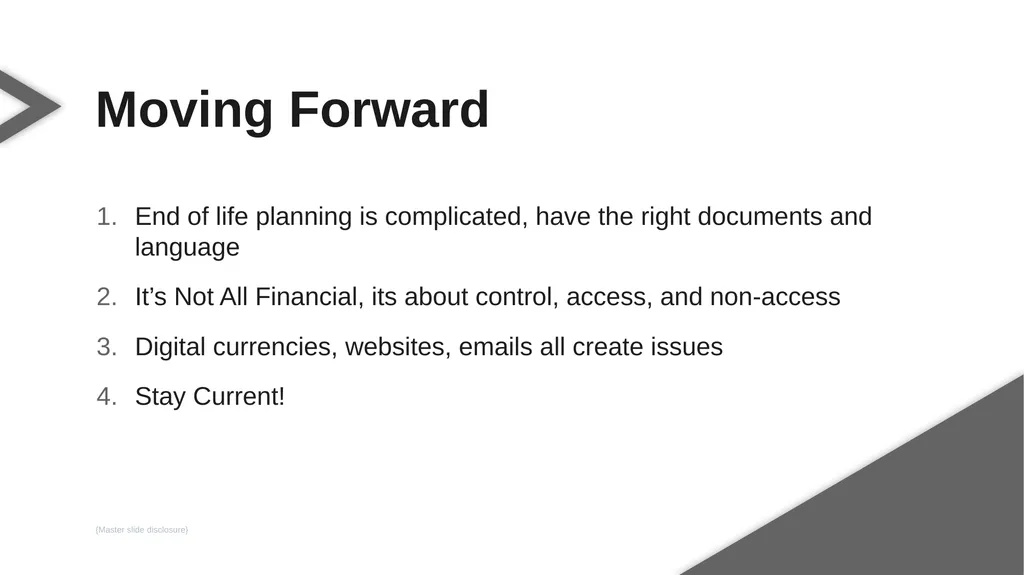
Moving Forward End of life planning is complicated, have the right documents and language
It’s Not All Financial, its about control, access, and non-access
Digital currencies, websites, emails all create issues
Stay Current!<br>
It’s Not All Financial, its about control, access, and non-access
Digital currencies, websites, emails all create issues
Stay Current!<br>
35
Additional Disclosures {Insert Standard BD/RIA Disclosures}
This presentation is designed to provide accurate and authoritative information on the subjects covered. It is not, however, intended to provide specific legal, tax, or other professional advice. For specific professional assistance, the services of an appropriate professional should be sought.
Some IRA's have contribution limitations and tax consequences for early withdrawals. For complete details, consult your tax advisor or attorney. Distributions from traditional IRA's and employer sponsored retirement plans are taxed as ordinary income and, if taken prior to reaching age 59 ½, may be subject to an additional 10% IRS tax penalty. Converting from a traditional IRA to a Roth IRA is a taxable event. A Roth IRA offers tax free withdrawals on taxable contributions. To qualify for the tax-free and penalty-free withdrawal or earnings, a Roth IRA must be in place for at least five tax years, and the distribution must take place after age 59 ½ or due to death, disability, or a first time home purchase (up to a $10,000 lifetime maximum). Depending on state law, Roth IRA distributions may be subject to state taxes. If you are purchasing an annuity to fund any tax-qualified retirement plan (IRA), you should be aware that this tax-deferral feature is available with any investment vehicle and is not unique to an annuity. Carefully consider the features and benefits of the annuity before making the decision to purchase.
The Standard & Poor's 500 Index is a capitalization weighted index of 500 stocks designed to measure performance of the broad domestic economy through changes in the aggregate market value of 500 stocks representing all major industries.
Converting from a traditional IRA to a Roth IRA is a taxable event.
The hypothetical investment results are for illustrative purposes only and should not be deemed a representations of past or future results. Actual investment results may be more or less than those shown. This doe snot represent any specific product [and/or service].
This event is purely educational. No products or services will be offered for sale and there is no obligation.<br>
This presentation is designed to provide accurate and authoritative information on the subjects covered. It is not, however, intended to provide specific legal, tax, or other professional advice. For specific professional assistance, the services of an appropriate professional should be sought.
Some IRA's have contribution limitations and tax consequences for early withdrawals. For complete details, consult your tax advisor or attorney. Distributions from traditional IRA's and employer sponsored retirement plans are taxed as ordinary income and, if taken prior to reaching age 59 ½, may be subject to an additional 10% IRS tax penalty. Converting from a traditional IRA to a Roth IRA is a taxable event. A Roth IRA offers tax free withdrawals on taxable contributions. To qualify for the tax-free and penalty-free withdrawal or earnings, a Roth IRA must be in place for at least five tax years, and the distribution must take place after age 59 ½ or due to death, disability, or a first time home purchase (up to a $10,000 lifetime maximum). Depending on state law, Roth IRA distributions may be subject to state taxes. If you are purchasing an annuity to fund any tax-qualified retirement plan (IRA), you should be aware that this tax-deferral feature is available with any investment vehicle and is not unique to an annuity. Carefully consider the features and benefits of the annuity before making the decision to purchase.
The Standard & Poor's 500 Index is a capitalization weighted index of 500 stocks designed to measure performance of the broad domestic economy through changes in the aggregate market value of 500 stocks representing all major industries.
Converting from a traditional IRA to a Roth IRA is a taxable event.
The hypothetical investment results are for illustrative purposes only and should not be deemed a representations of past or future results. Actual investment results may be more or less than those shown. This doe snot represent any specific product [and/or service].
This event is purely educational. No products or services will be offered for sale and there is no obligation.<br>
36
Thank You For Joining Us!<br>